In This Article
Waste disclosures must link material waste to management actions, boundaries, metrics, and verifiable records under ESRS E5.
What CSRD Requires for Waste Reporting Under ESRS E5
CSRD sets who must report; ESRS E5 sets what to disclose when waste is material. Start by checking the company’s reporting scope, applicable year, and whether waste meets either impact or financial materiality criteria.
For companies required to report material waste information, the work covers four areas:
Management: Explain waste policies, actions, resources, targets, and progress.
Boundaries: Separate waste from the company’s own activities from supply-chain and customer waste, without double counting.
Metrics: Report waste in metric tons, distinguish hazardous from nonhazardous waste, and separate recycling, other recovery, and disposal.
Controls: Assign data owners, check contractor records, document estimates, and retain records that support the disclosures.
A waste total alone is not enough. The report must connect material waste issues with management’s response and the records behind the numbers. A U.S. supplier answering a customer questionnaire does not become a CSRD reporter solely because of that request.
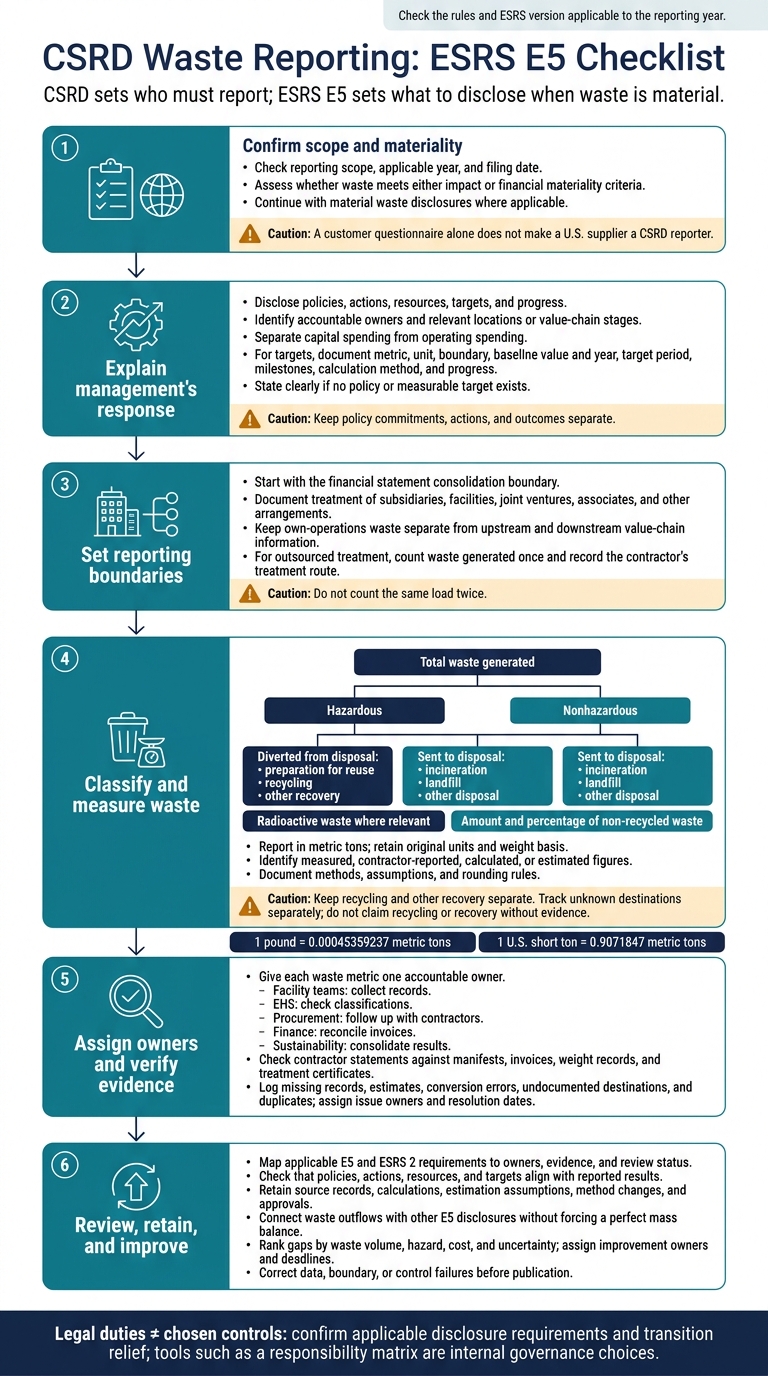
CSRD Waste Reporting: ESRS E5 Checklist
Educational session on draft ESRS E5 Resource use and circular economy
sbb-itb-8baf5f1
Disclose Waste Policies, Actions, and Targets
After identifying material waste, explain how management responds.
When waste is material, ESRS E5 requires disclosure of the policies, actions, resources, and targets used to manage it. These disclosures sit alongside ESRS 2 requirements. They do not prescribe a specific waste program or require zero waste. Keep policy commitments, actions, and outcomes separate.
Explain Policies, Actions, and Resources
Describe each policy’s objective and the material waste issues it covers in your own operations and relevant value-chain stages. Explain how the policy works, which functions carry it out, and which executive or board-level owner holds top accountability. State any exclusions and describe applicable circular-economy principles or eco-design requirements.
You can use an existing policy if it already covers waste. If no policy exists, say so and explain how the issue is managed.
For current and planned actions, disclose their status, timing, locations or value-chain stages, and intended outcomes. Detail the human, technical, and financial resources involved, separating capital spending from operating spending. Classify each action by its waste-hierarchy level: prevention, reuse, recycling, recovery, or disposal. If there are no actions, explain why.
| Disclosure | Supporting records | Responsible teams |
|---|---|---|
| Policy scope and accountability | Approved policy, governance minutes, organization chart, supplier standards | Sustainability, legal, board or executive office |
| Actions and waste-hierarchy alignment | Project plans, treatment specifications, completion records | Operations, EHS, procurement |
| Allocated resources | Approved budgets, staffing plans, capital and operating-cost records | Finance, operations |
| Targets and effectiveness | Baseline calculations, performance dashboards, management reviews | Sustainability, EHS, data owners |
Then report whether those policies and actions are producing measurable change.
Set Out Targets, Baselines, and Progress
Targets turn policy commitments into measurable performance. For each target, disclose the metric, unit, boundary, baseline value and year, target period, milestones, calculation method, and progress. Explain whether the target is voluntary or legally required, identify its waste-hierarchy level, and state any ecological threshold or scientific basis used. Do not describe a target as science-based without evidence.
Absolute, intensity, and diversion targets measure different outcomes; companies are not universally required to set all three. A better diversion rate alone does not prove that waste has been prevented. Use indicators to track implementation, but keep them separate from environmental outcomes.
Useful indicators include total waste, waste per unit, disposal share, contamination rates, reuse volume, and audit findings. If no measurable target exists, state that clearly. Disclose the indicators used to track performance, who owns them, how often they are reviewed, and the process for corrective action.
Define Waste Reporting Boundaries and Data Requirements
Once waste is assessed as material, set the reporting boundary and required data fields before collecting site data.
Use Commission Delegated Regulation (EU) 2023/2772, Annex I, ESRS E5, as amended for the reporting year. Treat E5-5 as the core waste disclosure and identify which datapoints are mandatory, conditional, or covered by transition relief. [3][4]
Define Entity and Value-Chain Boundaries
Start with the financial statement consolidation boundary. Include controlled subsidiaries and relevant facilities, and document how you treat joint ventures, associates, and other arrangements.
Keep waste from own operations separate from upstream and downstream value-chain information. Packaging discarded by a customer may be material value-chain information, but it does not belong in own-operations tonnage. When waste treatment is outsourced, report the waste generated by the undertaking once and record the contractor’s treatment route. Do not count the same load twice. Where primary value-chain data are unavailable, the three-year transition relief allows reasonable estimates. [5][7]
Report Waste Amounts and Treatment Routes
Report total waste generated, with hazardous and nonhazardous waste identified. Break down waste diverted from disposal by preparation for reuse, recycling, and other recovery. Break down waste sent to disposal by incineration, landfill, and other disposal. Report radioactive waste where relevant, along with the amount and percentage of non-recycled waste. [3][4]
Keep recovery and recycling separate. Track unknown destinations separately, and do not classify them as recycling or recovery without evidence.
Document Units, Weights, and Estimates
Report waste amounts in metric tons, retaining the original source unit for auditability. Convert pounds using 0.00045359237 metric tons per pound and U.S. short tons using 0.9071847 metric tons per short ton.
Preserve the original weight basis - wet, dry, tare-excluded, or another documented basis - and apply it consistently across facilities and reporting periods. Identify whether each figure was measured, contractor-reported, calculated, or estimated. Document the method, assumptions, and rounding rules. [3][4]
Keep a controls checklist covering:
Facility, waste stream, and hazard class
Treatment route and consolidation status
Original unit and converted amount
Source records, conversion factors, and estimation flags
Link Waste Data to Other E5 Disclosures
Reconcile waste outflows with resource inflows and other E5 disclosures, but do not force a perfect mass balance. Where material, connect waste streams to the material choices and design features that drive them: recycled content, reusable packaging, durability, repairability, remanufacturing, and circular design.
Waste metrics alone do not satisfy disclosures on circular design, resource inflows, products and materials sold, or anticipated financial effects. Use a reconciliation bridge to prevent double counting. Cover material purchased, material incorporated into products, inventory change, by-products, products sold, and waste generated. [5][8]
Establish these boundary definitions before assigning owners and controls.
Build a Waste Reporting Process With Clear Controls
Once boundaries are set, assign owners and put controls in place before sites begin collecting data.
Assign Data Owners and Check Source Records
Give each waste metric one accountable owner. Facility teams collect records; environmental health and safety teams check classifications; procurement follows up with contractors; finance reconciles invoices; and sustainability brings the results together. Name a reporting lead to review the disclosure before final approval, and document these roles in a responsibility matrix.
Check contractor statements against manifests, invoices, weight records, and treatment certificates. Log missing records, estimates, conversion errors, undocumented destinations, and duplicates. Give each issue an owner and a resolution date, and require review of any boundary or method changes.
A controlled spreadsheet can work if formulas are locked, supporting evidence is linked, and changes and approvals are logged. These controls should carry through to disclosure review and evidence retention.
Check Disclosure Coverage and Keep Evidence
Map each applicable E5 and ESRS 2 requirement to an owner, supporting evidence, and review status. Check that policies, actions, resources, and targets line up with the reported results. Keep the materiality assessment, reasons for omissions, and basis for any transition relief, and confirm that the relief applies to the reporting period. ESRS 2 also requires disclosure of sustainability-reporting risk management and internal controls. [9]
Retain source records, calculations, estimation assumptions, method changes, and approvals to support assurance. Set retention periods that meet applicable legal requirements.
Separate legal duties from chosen controls. Waste-law recordkeeping may be mandatory, while a responsibility matrix or quarterly reconciliation is an internal governance choice. Keep supplier requests proportional to risk and the records available. Use gaps in the disclosure map to guide changes to waste practices.
Use Data Gaps to Improve Waste Practices
Rank gaps by waste volume, hazard, cost, and uncertainty. Missing treatment evidence calls for contractor follow-up. Repeated volume estimates may justify weighing equipment or better contract terms, while persistent disposal volumes can inform waste prevention, packaging redesign, and reuse decisions.
Assign each improvement an owner and deadline, then track progress against the relevant E5 target.
Conclusion: Waste Reporting Checklist
Use this checklist before sign-off to check the disclosure’s scope, materiality, boundaries, controls, and supporting records.
Rules and dates: Check the scope, reporting wave, filing date, and applicable ESRS version against current CSRD requirements.
Materiality and boundaries: Keep the waste materiality file. List the entities, sites, facilities, and value-chain activities in scope, and separate waste from your own operations from value-chain information.
Policies, actions, and targets: Check that policies and actions have owners, resources, and timelines. Targets should have metrics, baselines, deadlines, and progress updates that clearly separate results from commitments.
Waste data: Verify total waste, hazardous and nonhazardous classifications, treatment routes, unknown destinations, and radioactive waste where applicable. Report consistently in metric tons, retain source units in working files, and preserve weight bases. Document methods, conversions, and estimates. Classify recovery and recycling separately, and do not count unverified recovery as recycling. [6][1][10][2]
Ownership and evidence: Review sign-off with named owners. Reconcile source records with reported totals, retain treatment records and calculation files, and check that every open gap has a corrective-action owner and deadline. If any item fails, correct the data, boundary, or control before publication.
FAQs
How do I check whether my U.S. company falls under CSRD?
Your U.S. company falls under the Corporate Sustainability Reporting Directive (CSRD) if it meets both thresholds:
Your group generates more than €450 million in EU net turnover.
You have an EU subsidiary or branch generating more than €200 million in net turnover.
If both apply, reporting begins with fiscal year 2028, and the first reports are due in 2029.
How do I determine whether waste is material?
Under CSRD and ESRS E5, use a double materiality assessment. Waste is material if it meets either threshold: its impact on the environment and human health across your operations and full value chain, or its financial effects on your company over the short, medium, or long term.
Set these thresholds through stakeholder engagement, data analysis, and expert judgment. Document your methodology and governance oversight to support and justify your conclusions.
What if my waste contractor cannot verify treatment routes?
If your waste contractor can’t verify treatment routes, document how you estimate them. Include your assumptions, gaps in the contractor’s data, and the steps you’ll take to improve accuracy.
For the first three reporting years, CSRD allows reasonable estimates when specific value chain data isn’t available. Under ESRS, companies are expected to work toward collecting primary data across the full scope of reporting. This information is subject to limited assurance.



FAQ