
Oct 7, 2026 · 9 min read
Capacity Building
In This Article
Identify and remove incentive, staffing, data, contract, and readiness barriers before scaling circular skills across partner networks.
On this page
What Blocks Circular Skills in Partner Networks?
I’d check what blocks the work before buying more training. For repair, reuse, and materials recovery, I’d start with one stalled task, name an owner, and check whether staff have the time, authority, records, and funding to finish it.
My checklist covers five areas:
Incentives: Agree on who pays, who gains, and whether buyers will commit to demand.
Staff time and leadership: Protect practice time, fund tools, and reward circular results - not just output.
Data and contracts: Share usable records and put return duties, costs, and trial risks in writing.
Partner readiness: Check what each partner can do, with support matched to smaller firms’ resources.
Results: Track task performance alongside repair success, reuse, and recovery - not course attendance alone.
I’d test one bounded use case over 60–90 days before expanding training. A missed target does not prove a skill gap: in the article’s hypothetical example, a 42% return rate against a 70% target points to missing records and unclear pickup ownership.
My starting rule: <u>fix the barrier, then train for the task.</u>
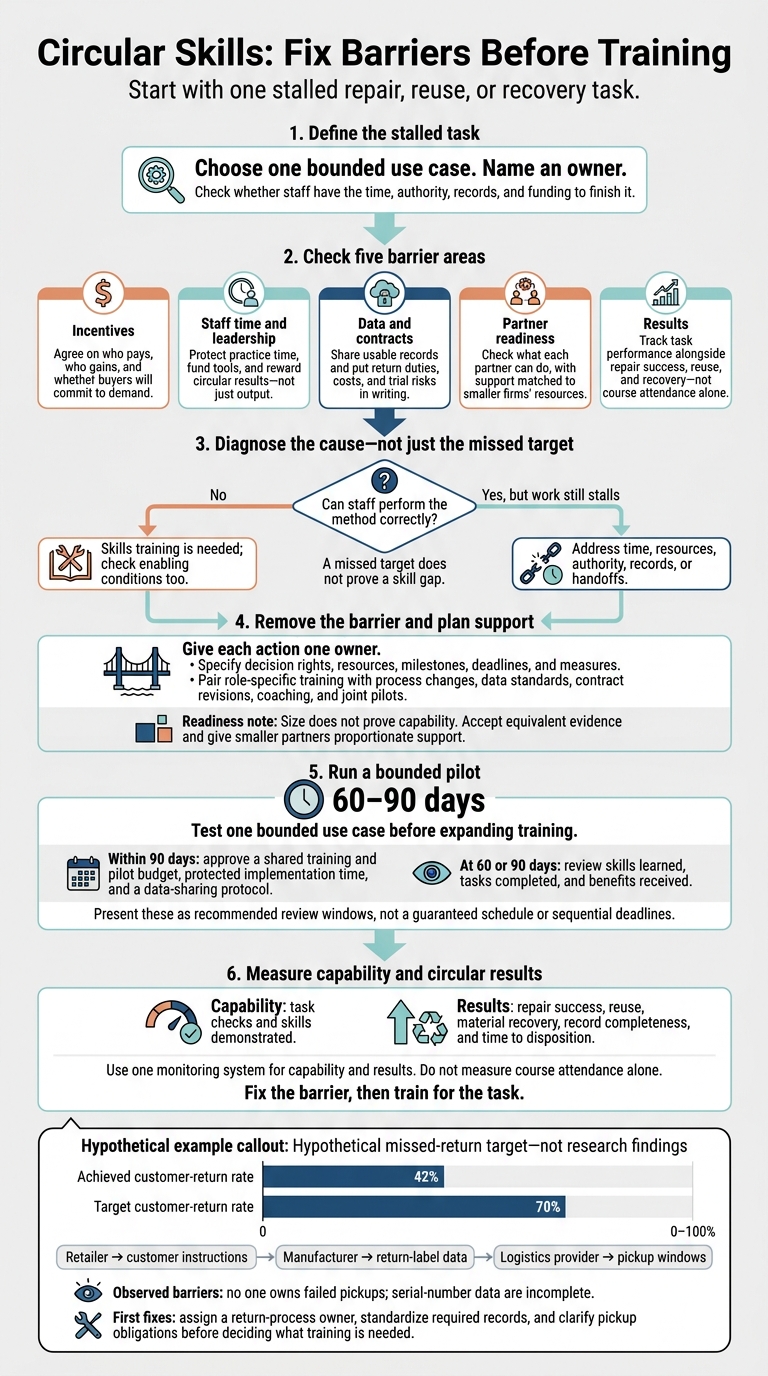
Circular Skills: Fix Barriers Before Training
How Do Incentives, Staff Time, and Leadership Affect Learning?
Who Pays for Training, and Who Gains?
A partner has little reason to pay for training when another organization gets the savings. Agree on cost sharing before training starts, whether through expected benefits, a pooled training fund, or lead-firm sponsorship. Define who controls the resulting know-how and how partners will share savings or revenue. Before funding training, require demand commitments from buyers or lead firms.[7][13][14][15]
Even fair cost sharing falls short if staff have no time to use what they learn.
Do Staff Have Time and Authority to Use Their Skills?
Check what’s holding up the work before assigning more training. A short task check and workflow observation can help: staff who cannot perform the method need skills training; staff who perform it correctly but still face delays need time, resources, or authority. Provide paid learning and practice time, reduce competing duties, and name an owner with a training budget, clear decision rights, and a route for escalating problems.[8][9][11]
| Staffing or authority barrier | Network effect | Observable warning sign |
|---|---|---|
| Circular tasks added to unchanged workloads | Pilots stall and partner data arrive late | Canceled training, overtime, missed deadlines |
| No named owner | Requests move between partners without resolution | Unanswered requests or duplicated work |
| No authority to approve changes | Skills never become part of daily work | Routine decisions wait weeks for approval |
| No budget or required tools | Staff cannot practice or apply learning | Training completed, but no change in how work gets done |
When staff have time but results still stall, leadership targets are usually the next constraint.
Does Leadership Reward Circular Results?
Targets focused only on output can make repair and sorting look like poor performance. Leaders should balance output and cost with repair completion, reuse, and material quality - and specify which targets govern the pilot. Each partner needs an accountable executive and a lead responsible for day-to-day work. If priorities change, update milestones in writing rather than quietly cutting time or funding.[9][12]
Within 90 days, sponsors should approve a shared training and pilot budget, protected implementation time, and a data-sharing protocol. At 60 or 90 days, review one clearly bounded use case against skills learned, tasks completed, and benefits received.[9][10]
sbb-itb-8baf5f1
Why do circular business models fail to scale? Strategic misalignment
How Do Data Gaps and Contracts Limit Circular Work?
Once staffing and leadership are in place, records and contract terms determine whether partners can put circular skills to work.
What Data Do Partners Need to Share?
Missing records can stop circular work. To choose a safe repair, reuse, or recovery route, staff need material composition, product condition, location, ownership, repair history, expected return timing, and outcome data. Missing service logs, systems that don’t connect, confidentiality limits, and uncertain origins can leave trained employees unable to act. Smaller partners often feel these gaps first because they lack shared systems, legal support, and data staff.
| Decision | Minimum useful records | What they support |
|---|---|---|
| Material identification | Composition, grade, additives, hazardous substances, product identifiers | Safe sorting and compatible recovery routes |
| Traceability | Serial number or batch ID, origin, location, owner, transfer history | Verified custody and clear handoff responsibility |
| Demand forecasting | Return volumes, timing, condition, customer demand, historical recovery rates | Labor, storage, and processing plans |
| Maintenance and repair | Operating hours, failure history, inspection results, parts replaced, repair instructions | Repair decisions and preventive maintenance |
| Impact measurement | Material weight, avoided virgin material, energy use, emissions factors, transport, reuse cycles, calculation boundaries | Consistent comparisons of recovery outcomes |
Shared records need common fields and definitions. When systems don’t connect, use standardized files and stable identifiers. Define each field’s unit, source, timestamp, owner, and verification status. Label uncertain information as estimated, self-reported, or unknown.
Set correction procedures and access permissions so partners can share verified attributes or aggregates without exposing unnecessary commercial details. Confidentiality rules should spell out permitted uses, retention periods, and security controls.
Data rules define what partners can know. Contracts define what they’re paid and allowed to do.
Which Contract Terms Help Partners Build Skills?
Price-and-delivery contracts often leave circular tasks unpaid. Make the work enforceable: state who provides records, handles returns, documents lessons, and pays for testing, transport, storage, and reprocessing. Without those terms, staff may know the method but have no way to put it into practice.
| Contract area | Transaction-focused terms | Provisions that support circular skills |
|---|---|---|
| Training | No learning obligation | Funded onboarding, role-specific training, refresher sessions, and designated training time |
| Data access | Data shared only when legally required | Defined data fields, formats, access rights, update duties, audit trails, and confidentiality controls |
| Return duties | Returns handled case by case | Clear take-back, collection, packaging, timing, inspection, and disposition responsibilities |
| Performance targets | Lowest price or units delivered | Shared targets for repair rate, reuse cycles, recovery yield, contamination, return rate, or avoided waste |
| Handoffs | Deliverable ends at transaction completion | Handoffs, repair manuals, lessons learned, documentation, and access to qualified personnel |
| Improvement process | Changes require a new negotiation | Joint reviews, pilots, corrective actions, escalation routes, and approval for controlled experiments |
| Feedstock commitments | Spot purchases with uncertain volume | Longer-term volume, quality, and forecasting commitments with adjustment mechanisms |
| Trial risk | One party bears failure and test costs | Defined responsibility for data errors, contamination, product failure, recalls, insurance, and pilot losses |
Before trials begin, define pilot scope, acceptance criteria, permitted deviations, stop-work triggers, review dates, and insurance requirements. Agree on how gains or losses will be shared and who owns improvements. Have counsel review liability, IP, privacy, competition, warranty, and procurement terms for the specific deal.
Once data and contract barriers are cleared, compare partner readiness before assigning shared work.
How Can Partners Assess Differences in Readiness?
Assess capability, not maturity. Check whether each partner has the knowledge, equipment, financing, and experience to carry out its assigned work reliably.[19] Compare partners against the barriers already identified: time, data, contracts, and leadership.
How Can Assessments Account for Smaller Partners?
Size does not prove capability. Accept equivalent evidence, including spreadsheets, paper logs, demonstrations, or sample records, if it shows that work is reliable. When past records are missing, use a 30-, 60-, or 90-day baseline. Phase in requirements tied to scale, and support deadlines with shared templates, coaching, pooled logistics, equipment access, or funding.[18][20]
| Readiness area | Observable evidence |
|---|---|
| Leadership commitment | Named sponsor; documented decisions that remove barriers |
| Technical skills | Qualified staff; safe task demonstrations; repair results |
| Data management | Traceable item records; named data owner; quality checks |
| Reverse logistics | Return instructions; collection points; inspection and routing rules |
| Process consistency | Repeatable results across shifts; documented exception handling |
| Measurement | Baselines; timestamps; outcome records using agreed definitions |
| Investment capacity | Approved budget; available staff time; equipment access |
Apply the same evidence standard to distinguish limits of scale from actual capability gaps.
How Can Partners Find the Cause of Missed Targets?
Map each activity to its skill, owner, authority, data source, risk, and enabling condition. Then follow items through the process. At each failed handoff, check for gaps in incentives, staffing, infrastructure, information, contracts, and leadership.[16]
Before assigning training for a missed target, find where the process failed.
Hypothetical missed-return target: A network aims for a 70% customer-return rate but achieves 42%. The retailer provides customer instructions, the manufacturer controls return-label data, and the logistics provider controls pickup windows. No one owns failed pickups, and serial-number data are incomplete. These findings point to ownership and information gaps - not necessarily weak collection skills. Assign a return-process owner, standardize required records, and clarify pickup obligations before deciding what training is needed.[16]
What Should a Shared Skills Plan Include?
Record priority gaps in a shared capability map. Give each action one owner, and specify decision rights, resources, milestones, deadlines, and measures. Pair role-specific training with process changes, data standards, contract revisions, coaching, and joint pilots. Track repair success, record completeness, and time to disposition - not just course attendance.[17][19]
Conclusion: Fix Shared Barriers Before Expanding Training
Treat circular skills as a network coordination problem. Training falls short when the network cannot turn new skills into daily work.[6][21] Remove the bottleneck before expanding training.
Start with a brief, joint assessment to identify the single barrier blocking use. Assign one accountable executive to approve resources and settle cross-partner conflicts, while the teams responsible for daily work remove the barrier. Expand role-specific training only when staff have the time, authority, data, and incentives to apply it.[3]
Measure both capability and results. Once the barrier is removed, track skills alongside repair, reuse, and recovery results on a fixed schedule. Pair task checks with reuse rates, repair outcomes, or material recovery, using one monitoring system for both capability and results.[22]
Adjust the approach by sector, location, and partner role - no single fix works everywhere. In the U.S., follow state and local rules. Keep outcome standards consistent, but match support to partner readiness and give smaller partners proportionate support.[11]
FAQs
How can we tell whether training will fix our bottleneck?
Use a gap analysis to compare current capabilities with your requirements [1]. Training can help close gaps in technical expertise or capacity, particularly for small and mid-sized partners [1][2].
But training alone won’t fix misaligned incentives, poorly designed contracts, or weak data governance [1][3]. Regular reviews and real-time feedback help separate skill gaps from systemic problems that call for changes to governance or operations [4][5].
How can we align incentives, contracts, and leadership support?
Make sustainability part of day-to-day business. Set up a governance charter that defines roles, decision-making authority, and escalation paths when financial and sustainability goals conflict. Use tiered contract incentives, such as performance-based premiums or discounts, to reward progress and spell out the consequences of nonperformance. Appoint executive sponsors and link performance metrics to sustainability KPIs.
Council Fire helps stakeholders align, designs equitable governance, and develops sustainability strategies that deliver measurable, long-term results.
How can we address unequal partner resources and data access?
Set contribution tiers based on each partner’s size, revenue, or carbon footprint so collaboration doesn’t depend on who has the biggest budget. Smaller partners can contribute local expertise or data. Digital collaboration hubs with tiered access controls let partners share methodologies while protecting proprietary information. Shared templates make reporting easier.
Council Fire can help design governance that addresses power dynamics. Technical assistance, training, and neutral facilitators give all partners the support they need to participate effectively.



FAQ