In This Article
Match supplier origin and custody records to transactions, rank and resolve gaps, and hold purchases until origin is verified.
Supply Chain Compliance: Closing Supplier Data Gaps
Supplier claims alone do not prove where goods come from. Closing data gaps means matching origin and custody records to purchases, resolving conflicts, and holding affected orders when required proof is missing. Even a valid certificate may not cover a specific shipment.
A clear process connects supplier records to purchasing decisions:
Set requirements: Define required records, assign owners, and map upstream suppliers.
Check the records: Match products, lots, quantities, and shipments; flag missing sources and conflicting details.
Act on risk: Give suppliers clear requests and deadlines, then escalate unresolved gaps.
Control purchases: Approve, limit, hold, or stop affected purchases based on verified records and legal requirements.
Track results: Measure verified coverage, overdue actions, and approval expiration dates - not just uploaded files.
For example, an 18% quantity mismatch between purchase and shipping records needs review, not automatic acceptance. Controls should stay in place until documented release conditions are met.
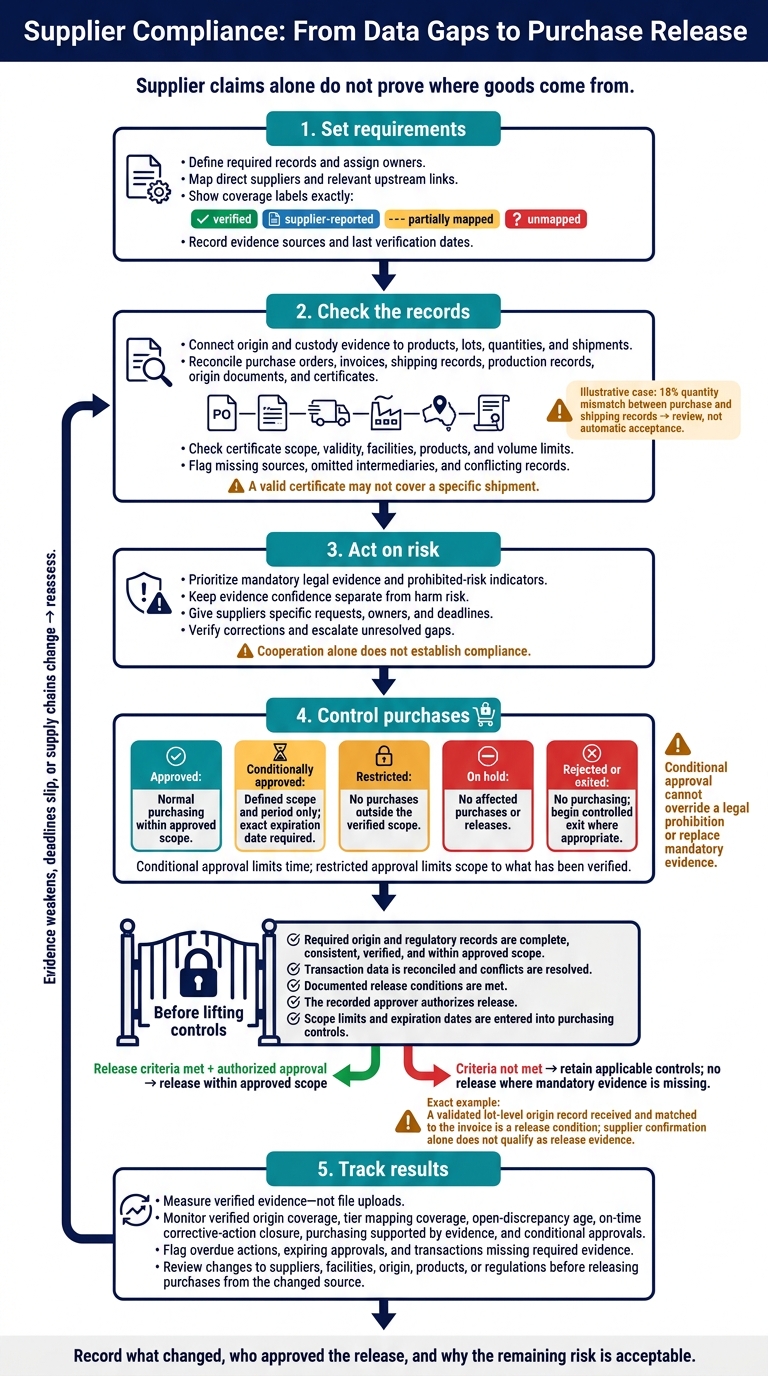
Supplier Compliance: From Data Gaps to Purchase Release
Map Suppliers and Prioritize Data Gaps
Use the evidence register to identify supplier links that still lack traceable origin. Start with the highest-risk material or product group, then map every relevant processor, trader, facility, farm, mine, warehouse, and transport point. Record legal and trading names, address, country, owner or operator, role, and material handled. OECD guidance recommends first scoping products, suppliers, geographies, and activities where risks may be greatest, then mapping priority relationships in detail.[2][5] Show where origin evidence stops and match those relationships to transaction records.
Keep unknown links visible. Label map coverage as verified, supplier-reported, partially mapped, or unmapped. Distinguish between information not yet requested and information a supplier declined to provide. Include the last verification date, evidence source, and percentage of purchase volume covered.
Match Origin Records to Transactions
Use the mapped relationships to connect purchase orders, invoices, bills of lading, transport and warehouse records, production records, origin declarations, import/export documents, and certificates to each product, batch, lot, shipment, or defined period.
Match records using purchase-order numbers, invoice numbers, container numbers, lot codes, bill-of-lading numbers, production dates, quantities, facilities, and suppliers. Flag missing source locations, quantity overruns, date mismatches, duplicate certificate numbers, name changes, omitted intermediaries, product-description conflicts, and country or facility conflicts. If origin remains unknown, label the gap upstream source not established.[3][4]
Check what each certificate covers: issuer, validity dates, certificate holder, facilities, products, chain-of-custody model, geography, exclusions, and volume limits. A valid certificate may cover a facility or management system without proving shipment origin. When its scope is incomplete, review traceability data, chain-of-custody records, certificates of origin, and source-linking documents together.[4]
Treat every mismatch as a gap to rank before supplier escalation.
Rank Evidence Gaps by Risk
Rank the gaps found through mapping and record matching. Address mandatory legal evidence and prohibited-risk indicators first. Then weigh the severity and likelihood of human-rights or environmental harm, geography, material, and purchasing volume. Use supplier criticality only for continuity planning. Keep evidence confidence separate from harm risk.[2][5] Use this matrix as a working template.
| Required evidence | Evidence received | Gap type | Confidence level | Risk rating | Owner | Deadline | Remaining risk |
|---|---|---|---|---|---|---|---|
| Mine or farm of origin | Supplier declaration naming country only | Missing location and source-level evidence | Low | High | Supplier compliance lead | June 30, 2026 | Origin and human-rights risks remain unverified |
| Processor identity and address | Processor named on certificate; no transaction link | Missing transaction linkage | Medium | High | Procurement manager | June 15, 2026 | Certificate may not cover the shipment |
| Purchase order and bill of lading | Both received; quantities differ by 18% | Conflicting records | Medium | Medium | Logistics owner | June 10, 2026 | Quantity and chain-of-custody uncertainty |
| Certificate of origin | Valid certificate covering supplier facility, not product lot | Scope limitation | Medium-low | High | Compliance officer | June 20, 2026 | Shipment origin remains unconfirmed |
| Upstream trader | Trader appears on invoice but not map | Omitted intermediary | Low | Medium | Supplier account owner | June 12, 2026 | Unknown custody and mixing risk |
[ ] Identify direct suppliers and relevant upstream links, or label them unmapped.
[ ] Document risk criteria for priority products and materials.
[ ] Link origin records to products, lots, batches, shipments, or defined periods.
[ ] Reconcile transaction, production, origin, and certificate records.
[ ] Check certificate scope against shipment origin requirements.
[ ] Log missing sources, omitted intermediaries, and conflicting records.
[ ] Assign each gap a confidence level, risk rating, owner, deadline, and remaining-risk statement.
[ ] Prioritize severe human-rights, environmental, geographic, and legal risks regardless of supplier importance or substitution difficulty.
[ ] Record map coverage and the last verification date.
[ ] Retain evidence for escalation and audit.
Use the ranked gaps to set the order for supplier follow-up and control decisions.
sbb-itb-8baf5f1
Verify Evidence and Escalate Unresolved Gaps
Treat received evidence as unaccepted until verified. For each ranked open gap, identify the applicable requirement and the products, facilities, suppliers, tiers, and reporting period in scope. Test the records, request corrections, and document the decision. Keep the original file, controlled copy, reviewer notes, disputed values, supplier responses, follow-up correspondence, and final disposition in one case file.[8][9] Use that file to decide whether to close the gap or escalate it.
Resolve Conflicting Documents
Check issue and validity dates. Then compare disputed names, registration numbers, addresses, shipment and invoice references, quantities, and origin claims with primary production and custody records. Preserve both versions; never overwrite the original. Log every disputed value, explanation, correction, and approval.
Accept alternative evidence only if it directly supports the same requirement. Document its limits, and keep the gap open if the required fact remains unproven.[11]
Give Suppliers Clear Requests and Support
Tell suppliers exactly what to submit: required fields, acceptable records, reporting periods, file names, deadlines, correction steps, and a secure submission channel. Offer templates, translated instructions, or a working session to reconstruct the record. Review each response, then accept verified evidence, request revisions, or escalate unresolved gaps.
Separate repairable data gaps from escalation triggers. Incomplete templates, inconsistent file names, missing translations, or weak digital records qualify as capacity issues only when the supplier cooperates. Repeated nonresponse, unexplained redactions, or blocked access trigger escalation. Cooperation alone does not establish compliance. Protect confidential records through controlled access or suitable independent review, without bypassing mandatory disclosure.
Set Escalation Triggers and Assign Owners
Base escalation on evidence quality and risk - not supplier importance or convenience. The deadlines below are internal response targets; legal deadlines take priority when they differ. Assign a named supplier contact, procurement owner, compliance reviewer, and authorized approver. Procurement should not accept unresolved evidence on its own. Escalate sooner if new information increases the risk.[5][1]
| Risk level | Trigger | Required action | Purchasing status | Owner | Deadline |
|---|---|---|---|---|---|
| Low | Minor inconsistency, administrative omission, or clearly bounded missing field with no current high-risk indicator | Request clarification or a corrected file; log the issue and verify the response | Normal monitoring | Supplier contact and procurement owner | Clarification within 5 business days; review within 3 business days |
| Moderate | Repeated omissions, incomplete coverage, unresolved quantity or address mismatch, or weak records from a cooperative supplier | Issue a corrective-action plan, provide a template or working session to reconstruct the record, and sample-test corrected records; do not expand affected purchases | Approved limits only | Procurement owner, supplier contact, and compliance reviewer | Plan within 10 business days; remediation within 30 days |
| High | Material origin uncertainty, missing upstream mapping, conflicting primary records, high-risk geography or material, or missed corrective-action deadline | Conduct enhanced due diligence, expand tier mapping, obtain primary records, and use independent verification; release other orders only with authorized compliance approval | Hold affected orders | Compliance reviewer and authorized approver | Escalate within 2 business days; verification plan within 10 business days |
| Critical | Believable evidence of forced labor or other serious legal risk, refusal to disclose material records, falsification indicators, prohibited entity exposure, or evidence insufficient for a mandatory requirement | Stop or hold affected purchasing and shipments, notify legal and senior compliance personnel, preserve records, and determine remediation, rejection, or disengagement; follow applicable legal and customs procedures | Immediate hold | Authorized compliance approver, legal counsel, and procurement leadership | Same business day; decision or formal action plan as soon as legally possible and feasible to implement |
Before closing or escalating the review:
[ ] Classify the supplier response as limited capacity, nonresponse, refusal, or possible falsification.
[ ] Record final approval or hold conditions, including release criteria and decision authority.
Move unresolved high-risk or critical gaps into the purchasing decision step.
Decide Whether Purchasing Can Continue
Use unresolved gaps from the prior review to decide whether purchasing remains open, continues with limits, or stops. Base that decision on verified records, applicable requirements, and residual risk - not supplier promises. Conditional approval cannot override a legal prohibition or replace mandatory evidence.
Set Purchasing Status and Limits
Where possible, assign status to the affected product, facility, origin, or lot. Conditional approval limits time; restricted approval limits scope to what has been verified. Every conditional decision needs an exact expiration date.
| Status | Evidence threshold | Permitted purchases | Safeguards | Approval authority | Next step |
|---|---|---|---|---|---|
| Approved | Required records are complete, current, consistent, and verified | Normal purchasing within approved scope | Routine monitoring | Procurement and compliance owner | Reassess when the supplier, facility, product, origin, or regulation changes |
| Conditionally approved | Limited gaps remain, with documented residual risk acceptable for the approved scope | Defined scope and period only | Added testing, lot-level review, shorter approval period, or contract controls | Designated compliance approver; legal review where needed | Obtain specified evidence by the deadline or apply the recorded status change |
| Restricted | Verified evidence supports only a narrow scope | No purchases outside the verified scope | Purchase-order blocks, manual release, segregation, and increased review | Senior procurement or compliance authority | Expand scope only after verification |
| On hold | Required evidence does not support release | No affected purchases or releases | System block; no exceptions to mandatory requirements | Compliance or legal authority | Lift the hold only after evidence is validated |
| Rejected or exited | Requirements for continued purchasing are not met | No purchasing; begin controlled exit where appropriate | Supplier notice, inventory disposition, alternate-source plan, and record retention | Executive procurement, compliance, and legal stakeholders | Require a new due-diligence review before re-entry |
Begin controlled exit planning after rejection. For a hold, assess whether an exit is needed. If remediation fails, set a final deadline and notify the supplier of unresolved requirements. Plan inventory disposition, assess goods in transit, qualify replacement supply, and weigh impacts on workers, customers, the environment, and communities. Exit planning must not delay a legally required stop.
Document Approval and Release Conditions
Link the decision to the supplier, SKU, facility, origin, lot, purchase order, and case number. Record each gap, applicable requirement, risk rating, temporary control, remediation owner, deadline, and authorized approver. Define reassessment triggers and release evidence that can be verified.
A validated lot-level origin record received and matched to the invoice is a release condition; supplier confirmation alone does not qualify as release evidence.
Apply the same release test to any regulation with a sector-specific traceability threshold.
For U.S. food purchases, verify current FDA Food Traceability Rule coverage, exemptions, traceability-plan duties, key data elements, and record-response deadlines before release.[12][13][14][15][16][17]
Before releasing affected purchases:
[ ] Confirm that required origin and regulatory records are complete, consistent, verified, and within approved scope.
[ ] Obtain the recorded approver’s authorization, then enter scope limits and expiration dates into purchasing controls.
[ ] Send the supplier, procurement, receiving, logistics, quality, and compliance teams the authorized lot, quantity, destination, and release instructions.
[ ] Record any permitted exception, its rationale, controls, and expiration date in the decision record. Prohibit exceptions to mandatory requirements.
[ ] Set the reassessment date and configure purchase blocks for expired approvals, missed evidence deadlines, and purchases outside approved scope.
Monitor Evidence Quality and Prevent Repeat Gaps
After release, keep monitoring the same evidence set so approvals do not outlast the facts. Approved scope stays open only while evidence remains current and verified.
Track Evidence Coverage and Overdue Actions
Track verified evidence - not file uploads. Use a controlled scorecard that defines each measure’s numerator, denominator, owner, review cadence, and escalation threshold. Track exceptions separately so temporary permissions do not inflate coverage.[1][18]
Set the verification standard before scoring. Distinguish original records from independently corroborated records, and never count documented exceptions as verified evidence.
| Measure | Definition |
|---|---|
| Verified origin coverage | In-scope purchase-order lines with verified origin evidence ÷ all in-scope lines. |
| Tier mapping coverage | Verified facilities ÷ expected facilities by tier, with unknown counts flagged. |
| Open-discrepancy age | Count and percentage of open discrepancies aged 0–30, 31–60, 61–90, and more than 90 days. |
| On-time corrective-action closure | Actions verified complete by deadline ÷ actions due during the reporting period. |
| Purchasing supported by evidence | Purchase value supported by adequate evidence ÷ total in-scope purchase value. |
| Conditional approvals | Active purchases under documented exceptions, tracked by value, expiration date, risk owner, and release condition. |
Link overdue items to a central issue register. Include the supplier, facility, material, transaction, missing record, risk rating, owner, due date, last supplier contact, interim control, and escalation status.
Under your documented risk methodology, review high-risk gaps weekly, medium-risk gaps monthly, and lower-risk gaps at least quarterly. Automatically flag overdue actions, expiring approvals, and transactions missing required evidence. Use the scorecard to trigger another review when evidence weakens or deadlines slip.
Update Records When Supply Chains Change
Review changes to facilities, subcontractors, beneficial ownership, raw materials, country of origin, transport routes, products, or regulations before releasing purchases from the changed source. Require suppliers to give advance notice and update affected records.[6][19]
Connect these changes to purchasing workflows. Send buyers a notice that identifies the affected scope and tells them what action to take - not just a dashboard alert.
Gaps keep returning when teams work in silos. Assign one owner to each metric and corrective action.
Coordinate Supplier and Internal Responsibilities
Procurement puts evidence requirements into contracts, onboarding, purchase orders, and reviews. Compliance sets verification standards and escalates unresolved risks, while sustainability coordinates due diligence and improvement. Quality connects evidence to specifications and nonconformance.
Legal interprets obligations and approves responses. IT manages access, lineage, retention, and alerts. The executive risk owner is accountable for escalation decisions.
Review recurring causes quarterly or semiannually. Target the suppliers, facilities, materials, regions, buyers, and document types driving repeat gaps.
Conclusion: Close Gaps Before Lifting Controls
Supplier evidence gaps remain open until the required facts are verified and unresolved high-risk issues are addressed.[7][20]
Keep purchasing restricted while evidence is insufficient. Lift controls only when origin records are verified, transaction data is reconciled, conflicts are resolved, and reviewer approval is documented. Record what changed, who approved the release, and why the remaining risk is acceptable.[10][21]
Review one high-risk file today. Log each gap, the affected transaction, required evidence, risk rating, purchasing status, owner, supplier contact, and deadline. Set a release decision date, and keep the hold in place until all release criteria are met.
FAQs
How can I estimate supplier map coverage when upstream links are unknown?
Measure sourcing coverage by tracking verified, supplier-declared, and unknown-origin sourcing as shares of the same total volume or spend. Start with direct operations, then prioritize upstream sources and counterparties. Connect purchase orders to stable site IDs, coordinates, supplier relationships, volumes, and confidence levels.
For regional estimates, document the limits and plans to improve precision. For unknown origins, record the reasons, resolution deadlines, and assigned owners so follow-up stays accountable and part of procurement and reporting.
How should I investigate quantity mismatches caused by production losses?
Pinpoint the transformation event where the mismatch occurred. Link stable site IDs, batch or lot numbers, quantities, and timestamps to internal purchase orders. Check raw material inputs against outputs and custody transfers.
Keep version histories of declarations and conflicting data, and document how each gap was resolved.
If the evidence is still insufficient, formally escalate to your cross-functional team, including quality and procurement, to require a corrective action plan.
What if my supplier cannot obtain required upstream records?
Treat unknown origin as an escalation trigger, not a low-risk finding. Go beyond screening and validate individual records to identify what went wrong. Document what was known, when it was discovered, and how your company responded.
If the evidence is still insufficient, flag the gap in your system and account for it in sourcing and scoring decisions. Consider pausing or isolating the supply if legal or compliance risk is high. Keep records for audits.




FAQ