In This Article
A 6-step OECD framework to map suppliers, verify evidence, link controls to law, and remediate serious supply-chain harms.
OECD Guidance Shapes Supply Chain Due Diligence
OECD guidance gives procurement teams a 6-step process to address supply chain harm - not a guarantee of legal compliance. Start by mapping supplier sites, ranking risks by severity, and assigning owners to investigate gaps and act on findings.
For small U.S. teams, the process connects:
Policies and risk mapping: Set supplier expectations and focus on where harm to people, communities, or nature may be most severe.
Evidence and legal checks: Verify supplier claims through records and worker feedback, then link controls to applicable laws, including Section 307 and the UFLPA.
Action and results: Match the response to the company’s role in the harm, support remedy where required, and confirm improvement before closing findings.
The test is not how many audits are completed. It is whether harm is addressed, controls work, and unresolved risks receive follow-up.
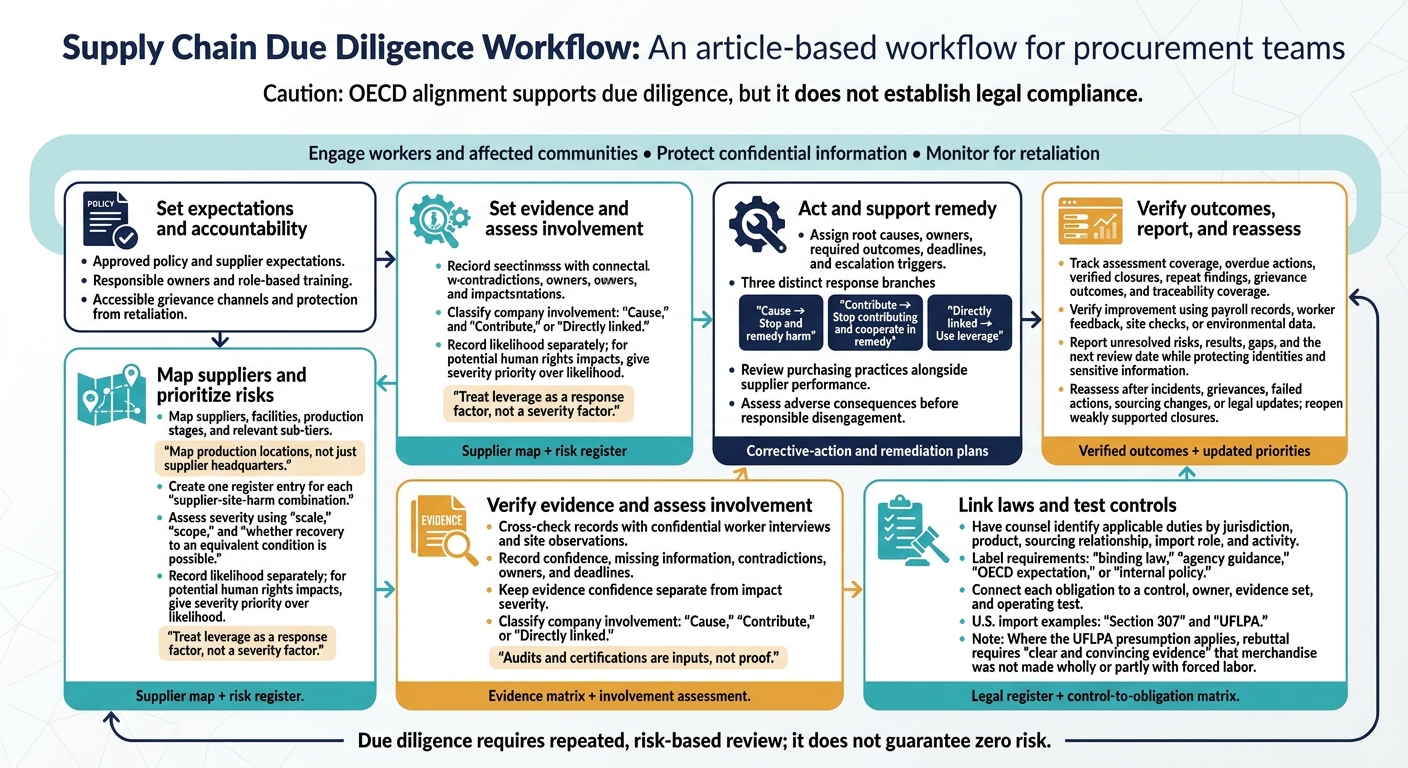
OECD Supply Chain Due Diligence Workflow
Map Suppliers and Prioritize Risks
Define Supplier and Sub-Tier Coverage
Map the supply chain far enough to identify where harm may occur, then dig deeper where risks are highest. Start with procurement records and bills of materials. Link direct suppliers, contractors, manufacturers, processors, distributors, and logistics providers to the products, services, and materials they supply. Record each legal entity, parent company, facility address, sourcing country or region, production stage, and known sub-tier suppliers. Map production locations, not just supplier headquarters. [8][9]
Extend upstream mapping when the severity of harm or gaps in records prevent a sound assessment. For these relationships, request sub-tier names, processing locations, and raw-material origins. [9][11] Use the map to turn each high-risk relationship into a risk register entry.
Build a Supplier Risk Register
Create one register entry for each supplier-site-harm combination. Include the product or material, affected people or environment, actual or potential harm, known incidents, evidence status, severity, likelihood, leverage, responsible owner, next action, deadline, and review date. Screen geographic, sector, product, and entity risk factors for human rights, labor, health and safety, pollution, climate and resource use, bribery, and consumer risks. [13][15]
Assess severity using three measures: scale, or how grave the harm is; scope, or how many people or how much land or water it affects; and whether recovery to an equivalent condition is possible. Record likelihood separately. For potential human rights impacts, give severity priority over likelihood. [7][10][12]
Treat leverage as a response factor, not a severity factor. Purchasing volume, contract terms, and access to supplier leadership help determine what action to take - not how serious the harm is. Flag missing information for follow-up rather than treating it as low risk. Update the map and register after sourcing changes, complaints, serious incidents, or regulatory action. Record why each priority changed. [9][11]
sbb-itb-8baf5f1
Gather Evidence and Assess Links to Harm
Collect and Check Risk Records
Use the risk register to guide evidence collection for each high-priority supplier-site-harm combination. Build a risk-specific evidence set with ownership and facility records, labor-agency agreements, policies, permits, audit findings, grievances, incident reports, and corrective-action records. Include payroll and working-time records for labor risks, environmental monitoring for pollution risks, and transaction or chain-of-custody records to check sourcing claims. Make sure the records cover subcontractors and sub-tier relationships.
Check each source for relevance, coverage, recency, independence, and consistency. Confirm the legal entity, facility, workforce, product, period, creator, and verifier. Cross-check records against confidential worker interviews and site observations. Audits and certifications are inputs, not proof. Log conflicting accounts and missing records, assigning an investigation owner and deadline. Test whether the company identified, assessed, and tracked each risk - not simply whether it has documents on file.
Document the assessment so another reviewer can retrace every conclusion.
Record Evidence and Stakeholder Feedback
Maintain an evidence matrix linked to the risk register. Keep document names, versions, dates, custodians, access restrictions, and links to corrective actions.
| Matrix field | What to record |
|---|---|
| Risk status | Facility, affected people or environment, period, and status: actual, potential, or under review |
| Sources and verification | Record links, interview references, site observations, and checks performed |
| Confidence and gaps | High, medium, or low confidence, with reasons; missing or contradictory evidence |
| Involvement | Cause, contribute, or directly linked, with supporting facts |
| Accountability | Owner, next action, deadline, and review date |
Actual impacts have happened or are still occurring; potential impacts are risks of future harm supported by evidence. Keep evidence confidence separate from impact severity. Uncertain evidence of severe harm calls for investigation, not dismissal.
Assess company involvement through purchasing decisions, contract terms, timing, and leverage - not supplier tier. A company causes harm through its own conduct. It contributes when its actions or omissions materially enable or worsen harm. It is directly linked when harm connects to its operations, products, or services through a business relationship, but the company neither causes nor contributes to it. Record the reasoning: the type of involvement determines the appropriate prevention, mitigation, and remedy response.
Engage workers, their representatives, unions, and affected communities during assessment, corrective-action design, and outcome checks. Use languages they understand and channels they can access outside supplier management’s control. Don’t rely solely on management-selected participants.
Restrict access to identifying information, keep it separate from analytical records, explain how it will be used, and monitor for retaliation after participation. Record how feedback changed the risk rating, involvement analysis, or corrective action, and whether affected people confirm improvement. Treat retaliation as a new adverse impact requiring immediate protection and remedy. Use these findings to test the controls and legal obligations meant to address the risk.
3. Explaining the OECD Due Diligence Guidance
Link Internal Controls to Applicable Laws
OECD alignment supports due diligence, but it does not establish legal compliance. Use OECD guidance to organize due diligence, then connect each risk to the laws that apply. Have counsel identify duties by jurisdiction, product, sourcing relationship, import role, and activity. The legal register turns the existing risk register into legal obligations. Use the risk register and evidence matrix to link each high-priority issue to the laws and controls it may trigger.
Build a Legal Requirements Register
Record each law’s jurisdiction, scope, duty, owner, control, evidence, deadline, review frequency, status, verification date, and change triggers. Label each entry as binding law, agency guidance, OECD expectation, or internal policy. Review legal status and deadlines annually and whenever laws, suppliers, sourcing regions, products, import routes, or activities change.
For import risks, connect legal duties directly to shipment, origin, and payroll records. For U.S. imports, include Section 307 of the Tariff Act, which prohibits importing merchandise mined, produced, or manufactured wholly or partly with forced labor, convict labor, or indentured labor.
Where the Uyghur Forced Labor Prevention Act applies, record a separate duty. Goods connected wholly or partly to the Xinjiang Uyghur Autonomous Region or an entity on the UFLPA Entity List face a rebuttable presumption of forced labor. To rebut that presumption, the importer must show, through clear and convincing evidence, that the merchandise was not made wholly or partly with forced labor.[16][17]
Link raw-material origins and production stages to shipment, payment, recruitment, and payroll records. OECD-aligned due diligence does not replace CBP evidence requirements or make goods admissible.
Once the register is complete, map each duty to one control and one evidence set.
Map OECD Expectations to Controls and Laws
Use the table below to connect OECD-informed controls to applicable legal obligations. Shared evidence does not make separate duties interchangeable. A supplier audit may support OECD due diligence without proving transaction-level traceability or meeting the UFLPA evidence standard.
| OECD expectation | Internal control | Supporting evidence | Applicable legal requirement or output |
|---|---|---|---|
| Policy approval and training | Board or executive approval, annual policy review, role-based training | Approved policy, meeting record, training roster, completion report | Applicable corporate governance, employment, procurement, or disclosure duties |
| Supplier screening | Risk-based onboarding, sanctions and entity-list screening, country and commodity assessment | Screening results, supplier questionnaire, ownership data, approval record | Applicable UFLPA Entity List, sanctions, customs, or sector-specific requirements |
| Transaction-level traceability | Link purchase orders, suppliers, facilities, materials, lots, shipments, and import entries | Purchase orders, invoices, bills of lading, chain-of-custody records, reconciliation logs | Section 307 and UFLPA import admissibility requirements |
| Labor-risk escalation | Stop, hold, investigate, remediate, or escalate transactions when forced-labor indicators arise | Case file, investigation notes, interview records, decision log, corrective-action plan | Forced-labor import restrictions and applicable labor or supply-chain laws |
| Pollution-control permits and monitoring | Permit register, operating limits, monitoring, incident escalation, corrective action | Permits, inspection reports, laboratory results, emissions or discharge logs | Applicable federal, state, local, and host-country environmental requirements |
| Disclosure review | Legal and sustainability review of public claims and unresolved impacts | Draft disclosure, review checklist, approvals, substantiation file | Applicable securities, consumer-protection, reporting, or supply-chain disclosure rules |
Use the matrix to check whether each control works in practice - not just on paper.
Test Controls and Close Evidence Gaps
Maintain a control-to-obligation matrix that links each legal-register entry to its control objective, control owner, operating procedure, evidence location, test frequency, method, result, gap, corrective action, approval, and closure evidence.
Test how controls work, not just how they are designed. Trace transactions through the required records and confirm that escalation occurred. Address gaps that could block imports or conceal severe harm first; hold affected transactions when warranted.
Use a restricted spreadsheet with separate tabs for the legal register, supplier and transaction inventory, control matrix, evidence index, test results, and corrective actions. Limit editing, protect formulas, retain review history, and connect records through stable IDs. Have counsel approve retention rules covering legal, customs, contractual, and litigation-hold needs.
Act on Findings and Review Results
After mapping risks, verifying evidence, and testing controls, use the risk register, evidence matrix, and control-test results to assign actions and track results.
Assign Corrective Actions and Plan Remediation
Prioritize findings by severity, then likelihood. For each action, record the finding, root cause, owners, required outcome, deadline, verification evidence, and escalation trigger. Review purchasing practices alongside supplier performance. Short lead times, late changes, volatility, and pricing pressure can undermine improvements. Escalate missed deadlines, weak evidence, retaliation, or continued severe harm to senior management. Then tighten monitoring, change sourcing or payment terms, suspend new orders, or disengage responsibly.[5][18][20]
Match your response to your involvement. Stop and remedy harm you cause. Stop contributing to harm and cooperate in remedy. When directly linked to harm, use your leverage. The remediation plan should define the harm, affected stakeholders, remedy objective, responsible parties, milestones, funding, verification method, grievance route, and deadline. Before disengaging, assess possible job losses, lost income, and reduced access to remedy.[5][14][19]
Measure whether these actions changed conditions on the ground.
Track Outcomes and Report Unresolved Issues
Track assessment coverage, overdue actions, verified closures, repeat findings, grievance outcomes, and traceability coverage. Close findings only when evidence confirms improvement. Use payroll records, worker feedback, site checks, or environmental data to verify that harm decreased or was remedied. Check whether changes to forecasts, lead times, and order volumes reduced pressure on suppliers.[5][6]
Reassess after incidents, substantiated grievances, failed actions, ownership changes, new sourcing, product changes, or legal updates. Report the status of risk treatment, including prioritized risks, actions, milestones, results, gaps, and the next review date. Give decision-makers concise records. In external reporting, protect worker identities and sensitive grievance data, and obtain informed consent before using stakeholder testimony.[5][6]
Use the latest outcome data to reset priorities, close gaps, and reopen cases where the evidence of resolution is weak.
Conclusion: Check Your Due Diligence Process
Check that the process includes an approved policy, owners, a supplier risk map, evidence records, a legal register, tested controls, action plans, outcome monitoring, communication, and remediation paths. Schedule periodic reviews and protect grievance participants from retaliation. Due diligence requires repeated, risk-based review; it does not guarantee zero risk.[5][18]
FAQs
How can a small team start OECD-aligned due diligence?
Start with a risk-based approach to make the most of limited resources. Map high-risk geographies, commodities, and sectors, starting with Tier 1 suppliers before working through deeper supply chain tiers. Use established external indices and databases to guide initial risk assessments.
Build sustainability requirements into procurement requests and contracts. Set up a formal grievance mechanism that stakeholders can easily access to share feedback. Prioritize the most severe impacts, as defined by the UN Guiding Principles.
What should we do if suppliers withhold sourcing records?
Use contracts and code-of-conduct expectations to require Tier 1 suppliers to request records from upstream suppliers. If engagement stalls, move to a corrective action plan with clear timelines.
If suppliers continue to withhold evidence of serious, verified risks and refuse remediation, pursue responsible disengagement only as a last resort. Document the issue, requests, responses, and outcomes. When data is unavailable, use risk-based proxies, clearly label them as estimates, and improve data coverage over time [1][2][3][4].
How do we prioritize conflicting legal requirements?
Use an OECD-aligned, risk-based approach to assess adverse human rights and environmental impacts across your value chain. Prioritize risks by severity and likelihood, then match your measures to those risks, your involvement, and your leverage.
Where obligations differ across jurisdictions, document how your approach meets the highest applicable due diligence standard for key risks. Build these expectations into policies and risk management, track how well your measures work, and keep records suitable for regulators and courts. [1][2]




FAQ