
Jul 6, 2026
Stakeholder Collaboration for Urban Cybersecurity
Capacity Building
In This Article
Urban cybersecurity is a citywide service-continuity challenge—stakeholders must predefine authority, share telemetry, and rehearse joint responses.
Stakeholder Collaboration for Urban Cybersecurity
Cities do not lose cyber incidents one system at a time. They lose them across water, transit, public safety, schools, and vendor networks at once. I see the main point this way: if a city wants services to keep running, it needs clear roles, shared visibility, written agreements, and joint response plans before an attack starts.
Here’s the short version:
Urban cyber risk is shared risk. One breach can move across agencies, utilities, and service providers fast.
No single team can handle it alone. City leaders, CISOs, utilities, transit teams, vendors, hospitals, schools, nonprofits, and residents all affect response and recovery.
Clear authority matters. Cities need named decision-makers, escalation paths, and pre-set rules for who does what.
Written agreements matter. MOUs, SLAs, and incident support contracts help avoid confusion when time is short.
Joint drills matter. Tabletop exercises help IT, legal, finance, emergency management, and outside partners act as one group.
Community input matters. Public alerts, multilingual messages, and neighborhood partners help cities restore services in ways that match local needs.
A few facts make the case plain:
Local governments and K-12 public schools make up about 75% of government-related cyberattacks in the U.S.
The FBI said cybercrime losses hit $16.6 billion in the prior year, according to its 2025 report.
NYC Cyber Command cut response times from hours to minutes after centralizing telemetry across 100+ agencies.
Atlanta’s 2018 ransomware recovery cost more than $17 million.
I’d sum it up in one line: urban cybersecurity is not just an IT job; it is a city service continuity job.
What cities need | Why it matters |
|---|---|
Clear leadership | Decisions move faster during an incident |
Shared telemetry and threat data | Teams spot cross-system issues sooner |
MOUs, SLAs, and vendor rules | Partners know their jobs before a crisis |
Joint exercises | Staff build habits and contact paths in advance |
Community-facing communications | Residents know what happened and what to do |
If you are a city leader, utility manager, or community partner, the takeaway is simple: plan together before the outage, not during it.
Who Needs to Be Involved in a City Cyber Resilience Effort
Urban cyber resilience depends on clear roles across city leadership, operators, vendors, and community partners.
Public agencies, infrastructure operators, and technology providers
At the city level, the main players include mayors and city managers, CIO and CISO teams, emergency management offices, and agency leaders responsible for water, transit, fire, and EMS. These groups set policy, decide how much risk the city can live with, and lead incident response. Infrastructure owners protect OT and physical assets, while city governments set direction and coordinate response across agencies.
City cybersecurity gets messy fast because many systems people rely on every day are privately owned or run. So coordination can't rest on casual relationships or last-minute phone calls. It needs to be spelled out in advance. Memorandums of Understanding (MOUs) and Service-Level Agreements (SLAs) between city agencies and outside partners help set expectations before something goes wrong. Technology vendors and Managed Security Service Providers (MSSPs) also play a central part, handling 24/7 monitoring, patch management, and forensic support after a breach.
Those formal roles matter most when cities settle coordination rules before an incident starts.
Community organizations and residents as part of the resilience model
Community organizations, schools, hospitals, and nonprofits are often short on staff and funding, but they are still central to urban cybersecurity. Their dependence on one another is hard to ignore. Hospitals rely on water utilities. Utilities rely on city government. When one part breaks, the damage spreads into daily life.
The CyberPeace Institute tracked approximately 43,000 cyber incidents targeting 121 civil society organizations between 2023 and 2025. [6] As Sarah Powazek, Program Director of Public Interest Cybersecurity, CLTC, put it:
"Community organizations as a whole are not getting enough cyber support, and current efforts are not enough to help them protect themselves online." - Sarah Powazek, Program Director of Public Interest Cybersecurity, CLTC [6]
Residents matter too. Public awareness and digital literacy shape how fast people spot and report service issues. Tools like NYC Secure show that cities can send alerts to residents without collecting personal data. [1] That kind of neighborhood-level participation stretches the detection and communication network beyond what city tech teams can do on their own.
Stakeholder roles and responsibilities table
The table below turns those roles into an operating model.
Stakeholder Group | Prevention | Detection | Response | Recovery |
|---|---|---|---|---|
Municipal Government (Leadership/CISO) | Set policy, fund controls, define risk tolerance | Centralize telemetry across agencies | Lead incident response; manage public communications | Restore essential services; audit incident for future policy |
Infrastructure Operators (Utilities/Transit) | Secure OT; apply domain expertise | Monitor specialized systems (e.g., water sensors, transit networks) | Execute technical remediation on critical assets | Repair physical and digital infrastructure; ensure safety |
Technology Providers/MSSPs | Provide standardized tools; patch legacy systems | 24/7 monitoring; run scans; close technical alerts | Contain threats; provide forensic expertise | Rebuild systems; verify data integrity |
Community Organizations & Residents | Improve digital literacy; practice basic cyber hygiene | Report anomalies in public-facing digital services | Follow emergency instructions; use threat-alert apps | Re-establish neighborhood-level trust in city services |
With roles set, the next issue is governance: who has authority, how partners coordinate, and how decisions move during an incident.
Governance and Operating Models for Joint Action
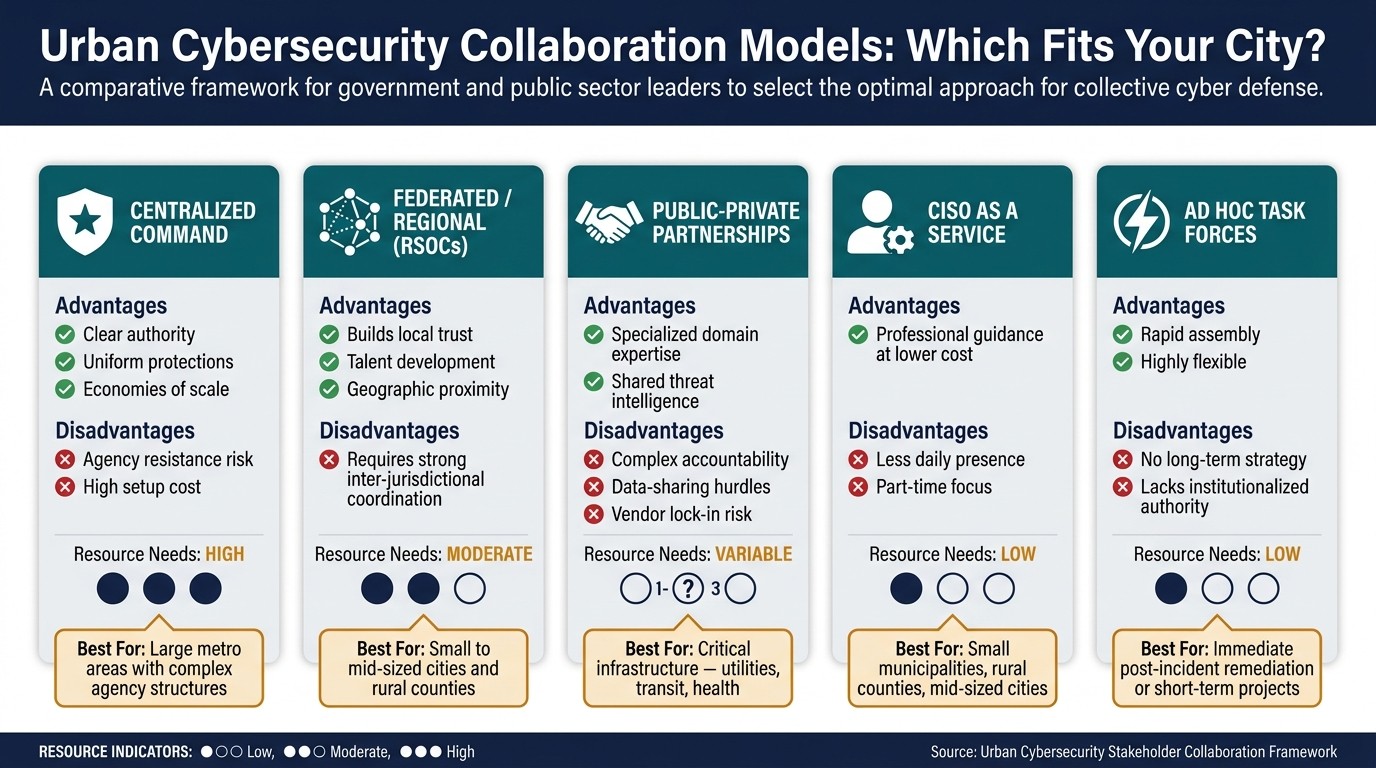
Urban Cybersecurity Collaboration Models: Which Fits Your City?
City-wide governance with clear authority lines
After roles are set, cities need a clear way to make decisions, coordinate teams, and communicate when pressure spikes. A cyber incident has a way of exposing weak governance almost at once. That’s why cities need named decision-makers, clear escalation paths, and pre-approved authority before an attack starts.
The cities that handle this best treat cybersecurity the way they treat emergency management: clear roles, written escalation paths, and agreements worked out ahead of time. A direct reporting line to the mayor or city manager sends a strong signal that cybersecurity is a citywide risk, not just an IT issue. Atlanta’s 2018 ransomware recovery cost the city more than $17 million. [5] Research also shows that organizations where the CISO reports directly to the CIO saw 14% more downtime from security issues and over 40% more financial loss from cyber incidents. [7]
Coordination mechanisms that improve joint action
NYC Cyber Command shows what centralized coordination can look like at scale. It brought oversight across more than 100 agencies, processed 90 billion events a week, and cut response times from hours to minutes. [1] Just as important, it did this without stripping agencies of their own expertise. The model kept local knowledge in place while standardizing telemetry and controls.
Smaller cities need that same discipline, even if the structure looks different. Michigan’s state-run "CISO as a Service" pilot gave cybersecurity assessments and advice to nine local governments through a fee-for-service model. [5] Texas went with a regional model, funding Regional Security Operations Centers that provide 24/7 monitoring for local governments, including one hosted at Angelo State University. The use of students helped cut staffing costs. In 2025, the state allocated $135 million to the Texas Cyber Command to keep these operations running through 2027. [3] Same goal, different setup: better coverage, stronger coordination, and more help for local teams that can’t do it all alone.
Joint tabletop exercises are another tool cities often leave on the shelf. A simulated ransomware scenario that brings IT, legal, finance, and emergency management into the same room does more than test a plan on paper. It builds the working relationships, contact lists, and habits that matter when a live incident hits.
Collaboration models comparison table
No single model works for every city. The right setup depends on size, budget, and how complex the local infrastructure is. The table below lays out several ways cities can coordinate across agencies, operators, and community partners.
Collaboration Model | Advantages | Disadvantages | Resource Needs | Best-Fit Use Case |
|---|---|---|---|---|
Centralized Command | Clear authority; uniform protections; economies of scale | Potential agency resistance over autonomy; high setup cost | High: dedicated executive leadership and staff | Large metropolitan areas with complex agency structures |
Federated / Regional (RSOCs) | Builds local trust; talent development; geographic proximity | Requires strong inter-jurisdictional coordination | Moderate: shared with state or academic partners | Small to mid-sized cities and rural counties |
Public-Private Partnerships | Access to specialized domain expertise; shared threat intelligence | Complex accountability; data-sharing hurdles; potential vendor lock-in | Variable: depends on partner contributions | Critical infrastructure protection - utilities, transit, health |
CISO as a Service | Professional guidance at lower cost than a full-time hire | Less daily operational presence; part-time focus | Low: typically a fee-for-service or chargeback model | Small municipalities, rural counties, or mid-sized cities |
Ad Hoc Task Forces | Rapid assembly for specific incidents; highly flexible | Lacks long-term strategy or institutionalized authority | Low: temporary reallocation of existing staff | Immediate post-incident remediation or short-term projects |
The governance model a city picks affects service continuity, public trust, and the pace of recovery. The next issue is how these operating models translate into better resilience outcomes.
How Collaboration Supports Resilience and Community Goals
Cyber resilience protects services and public trust
Governance only matters if it keeps core services running. When a cyber incident hits a city's water system or emergency dispatch, residents are not thinking about policy charts or org design. They want to know if the water is safe, if 911 still works, and if help will show up on time.
That link between cybersecurity and service delivery is why joint models matter so much. As Quiessence Phillips of NYC Cyber Command put it:
"Cybersecurity can no longer stand alone as a competing priority... it is a core enabler of public trust, service delivery, and resilience." - Quiessence Phillips, Deputy CISO and Head of Threat Management, NYC Cyber Command [1]
When teams plan together, share threat data, and align response steps ahead of time, they move faster under pressure. That speed cuts outages and reduces spillover across agencies. It also helps city leaders explain why some systems were given priority protection and speak with residents in a calm, clear way during a disruption. Clear communication helps keep trust intact when systems are under strain.
Broad community engagement strengthens resilience outcomes
Cyber incidents often hit vulnerable residents first and hardest, especially when restoration priorities and crisis messages are set without community input.
Cities that bring community institutions in early - during planning exercises, while setting restoration priorities, and when shaping public messages - build a fairer resilience model. Resident-facing alerts, multilingual notices, and neighborhood partners push response past city hall and into the places where people actually need help. The same idea applies to multilingual incident communications and community-informed restoration planning: people most affected by a disruption should have a say in how recovery happens.
Cyber and infrastructure integration table
The table below links major urban systems to key cyber risks, likely service impacts, and the joint actions cities can use to cut exposure.
Urban System | Key Cyber Risks | Likely Impacts | Collaborative Mitigation Actions |
|---|---|---|---|
Energy & Utilities | Ransomware; OT system disruption | Power outages; loss of heating/cooling; safety risks | Joint tabletop exercises with private utility operators; shared threat telemetry [4][1] |
Water & Wastewater | Unauthorized access to chemical controls | Water contamination; service outages; environmental damage | Regional risk pooling; CISO-as-a-Service for smaller water districts [2][1] |
Transportation | Signal interference; transit data breaches | Traffic gridlock; transit delays; public safety hazards | Regional ISAOs for real-time threat sharing; cross-jurisdictional MOUs [7] |
Public Safety | Ransomware on CAD/PSAP systems | Delayed emergency response; loss of life; public panic | Unified cyber-operational playbooks; regional SOC monitoring for emergency services [7][8] |
Community Services | Data breaches of resident info; website defacement | Loss of public trust; identity theft; service disruption | Citizen-facing security apps; multilingual incident communications; community input on restoration priorities [2][1] |
These patterns point to the planning priorities that follow.
Planning Support and Key Takeaways
Where Council Fire can add value

Once roles and governance are set, the work shifts from coordination on paper to action in the field.
Council Fire works with governments, infrastructure operators, nonprofits, and foundations to turn collaboration into operating agreements. The firm helps organizations tie cyber risk directly to core services such as water, energy, and public safety. That kind of support is most useful when cities need to turn governance into contracts, communications plans, and response procedures.
Council Fire also supports crisis communications planning. When a disruption hits, city leaders have to explain decisions clearly to city councils, insurers, and the public. Building that communication plan before an incident - not in the middle of one - is a practical move that helps protect public trust.
Key points for decision-makers
Urban cyber risk is shared risk. A breach at one agency, utility, or transit system can ripple across the whole city. That makes collaboration a structural need, not just a policy choice.
For decision-makers, the priorities are straightforward:
Keep accountability with leadership and execution with technical teams. Leadership should own risk tolerance; technical teams should own daily operations [4].
Pre-negotiate MOUs, SLAs, and incident-response contracts. Setting roles and agreements before an incident can speed response when time is tight [7][2].
Rank protections by impact on water, energy, transit, and public safety, not by technical severity alone [4].
Leadership must own accountability, not just activity.
Cities and infrastructure operators that treat cybersecurity as a governance and community issue - not just an IT problem - are the ones building resilience that holds up under pressure.
FAQs
How should a city start building cyber coordination?
Cities need a shared-responsibility mindset across departments and outside partners. When teams work in silos, gaps show up fast. One group assumes another owns the issue, and by the time anyone sorts it out, the damage is done.
Leadership should make ownership clear from the start. That means putting roles, responsibilities, and legal authority in writing through tools like Memorandums of Understanding. Clear agreements cut confusion and help people move when time is tight.
A shared vision matters too. Cities should get everyone pointed in the same direction, run joint tabletop exercises, and use a common model such as the NIST Cybersecurity Framework. When teams practice together and speak the same language, coordination gets a lot smoother.
For smaller jurisdictions, regional or shared-service models can make a lot of sense. If staffing and budget are tight, pooling support with nearby agencies can help fill gaps without each city having to build everything on its own.
Who should lead during a citywide cyber incident?
During a citywide cyber incident, leadership needs to sit at the top. IT teams should run the technical response, but the city manager or other executive leaders - such as mayors, councils, and agency heads - should hold primary oversight.
Cyber risk touches public accountability and day-to-day service delivery, so executive leadership has to set risk tolerance, approve budgets, and back coordination across departments. Council Fire helps governments strengthen that coordination and build resilience.
What agreements should cities put in place first?
Cities should start by putting Memorandums of Understanding or service-level agreements in place with partners. That sounds basic, but it matters. When roles, responsibilities, and expectations are written down ahead of time, there’s far less confusion when pressure hits.
They should also line up contracts with forensics and incident response firms before a crisis starts. Doing this early can lock in response times, help outside teams get to know city systems, and make insurer and auditor approvals easier during an emergency.
Related Blog Posts
Latest Articles
©2025

Narrative Change and Power Building: The Missing Half of Advocacy
Narrative change is the process of disrupting dominant narratives that normalize inequity and advancing new narratives from historically marginalized communities.

Funding Resilience Without Federal Grants
BRIC is unreliable and FEMA is shrinking. Here's how cities fund climate resilience with dedicated revenue, blended finance, and a coordinating authority.

The ESG Blind Spot: How AI Is Finding Risks in Companies Nobody Else Is Watching
Norway's sovereign wealth fund uses AI to screen 7,200 portfolio companies for forced labor and corruption within 24 hours. The real story is the emerging-market coverage gap that traditional ESG data vendors miss — and what it means for any company with a global supply chain.
Narrative Change and Power Building: The Missing Half of Advocacy
Narrative change is the process of disrupting dominant narratives that normalize inequity and advancing new narratives from historically marginalized communities.
Funding Resilience Without Federal Grants
BRIC is unreliable and FEMA is shrinking. Here's how cities fund climate resilience with dedicated revenue, blended finance, and a coordinating authority.
The ESG Blind Spot: How AI Is Finding Risks in Companies Nobody Else Is Watching
Norway's sovereign wealth fund uses AI to screen 7,200 portfolio companies for forced labor and corruption within 24 hours. The real story is the emerging-market coverage gap that traditional ESG data vendors miss — and what it means for any company with a global supply chain.
FAQ
01
What does it really mean to “redefine profit”?
02
What makes Council Fire different?
03
Who does Council Fire work with?
04
What does working with Council Fire actually look like?
05
How does Council Fire help organizations turn big goals into action?
06
How does Council Fire define and measure success?
Jul 6, 2026
Stakeholder Collaboration for Urban Cybersecurity
Capacity Building
In This Article
Urban cybersecurity is a citywide service-continuity challenge—stakeholders must predefine authority, share telemetry, and rehearse joint responses.
Stakeholder Collaboration for Urban Cybersecurity
Cities do not lose cyber incidents one system at a time. They lose them across water, transit, public safety, schools, and vendor networks at once. I see the main point this way: if a city wants services to keep running, it needs clear roles, shared visibility, written agreements, and joint response plans before an attack starts.
Here’s the short version:
Urban cyber risk is shared risk. One breach can move across agencies, utilities, and service providers fast.
No single team can handle it alone. City leaders, CISOs, utilities, transit teams, vendors, hospitals, schools, nonprofits, and residents all affect response and recovery.
Clear authority matters. Cities need named decision-makers, escalation paths, and pre-set rules for who does what.
Written agreements matter. MOUs, SLAs, and incident support contracts help avoid confusion when time is short.
Joint drills matter. Tabletop exercises help IT, legal, finance, emergency management, and outside partners act as one group.
Community input matters. Public alerts, multilingual messages, and neighborhood partners help cities restore services in ways that match local needs.
A few facts make the case plain:
Local governments and K-12 public schools make up about 75% of government-related cyberattacks in the U.S.
The FBI said cybercrime losses hit $16.6 billion in the prior year, according to its 2025 report.
NYC Cyber Command cut response times from hours to minutes after centralizing telemetry across 100+ agencies.
Atlanta’s 2018 ransomware recovery cost more than $17 million.
I’d sum it up in one line: urban cybersecurity is not just an IT job; it is a city service continuity job.
What cities need | Why it matters |
|---|---|
Clear leadership | Decisions move faster during an incident |
Shared telemetry and threat data | Teams spot cross-system issues sooner |
MOUs, SLAs, and vendor rules | Partners know their jobs before a crisis |
Joint exercises | Staff build habits and contact paths in advance |
Community-facing communications | Residents know what happened and what to do |
If you are a city leader, utility manager, or community partner, the takeaway is simple: plan together before the outage, not during it.
Who Needs to Be Involved in a City Cyber Resilience Effort
Urban cyber resilience depends on clear roles across city leadership, operators, vendors, and community partners.
Public agencies, infrastructure operators, and technology providers
At the city level, the main players include mayors and city managers, CIO and CISO teams, emergency management offices, and agency leaders responsible for water, transit, fire, and EMS. These groups set policy, decide how much risk the city can live with, and lead incident response. Infrastructure owners protect OT and physical assets, while city governments set direction and coordinate response across agencies.
City cybersecurity gets messy fast because many systems people rely on every day are privately owned or run. So coordination can't rest on casual relationships or last-minute phone calls. It needs to be spelled out in advance. Memorandums of Understanding (MOUs) and Service-Level Agreements (SLAs) between city agencies and outside partners help set expectations before something goes wrong. Technology vendors and Managed Security Service Providers (MSSPs) also play a central part, handling 24/7 monitoring, patch management, and forensic support after a breach.
Those formal roles matter most when cities settle coordination rules before an incident starts.
Community organizations and residents as part of the resilience model
Community organizations, schools, hospitals, and nonprofits are often short on staff and funding, but they are still central to urban cybersecurity. Their dependence on one another is hard to ignore. Hospitals rely on water utilities. Utilities rely on city government. When one part breaks, the damage spreads into daily life.
The CyberPeace Institute tracked approximately 43,000 cyber incidents targeting 121 civil society organizations between 2023 and 2025. [6] As Sarah Powazek, Program Director of Public Interest Cybersecurity, CLTC, put it:
"Community organizations as a whole are not getting enough cyber support, and current efforts are not enough to help them protect themselves online." - Sarah Powazek, Program Director of Public Interest Cybersecurity, CLTC [6]
Residents matter too. Public awareness and digital literacy shape how fast people spot and report service issues. Tools like NYC Secure show that cities can send alerts to residents without collecting personal data. [1] That kind of neighborhood-level participation stretches the detection and communication network beyond what city tech teams can do on their own.
Stakeholder roles and responsibilities table
The table below turns those roles into an operating model.
Stakeholder Group | Prevention | Detection | Response | Recovery |
|---|---|---|---|---|
Municipal Government (Leadership/CISO) | Set policy, fund controls, define risk tolerance | Centralize telemetry across agencies | Lead incident response; manage public communications | Restore essential services; audit incident for future policy |
Infrastructure Operators (Utilities/Transit) | Secure OT; apply domain expertise | Monitor specialized systems (e.g., water sensors, transit networks) | Execute technical remediation on critical assets | Repair physical and digital infrastructure; ensure safety |
Technology Providers/MSSPs | Provide standardized tools; patch legacy systems | 24/7 monitoring; run scans; close technical alerts | Contain threats; provide forensic expertise | Rebuild systems; verify data integrity |
Community Organizations & Residents | Improve digital literacy; practice basic cyber hygiene | Report anomalies in public-facing digital services | Follow emergency instructions; use threat-alert apps | Re-establish neighborhood-level trust in city services |
With roles set, the next issue is governance: who has authority, how partners coordinate, and how decisions move during an incident.
Governance and Operating Models for Joint Action
Urban Cybersecurity Collaboration Models: Which Fits Your City?
City-wide governance with clear authority lines
After roles are set, cities need a clear way to make decisions, coordinate teams, and communicate when pressure spikes. A cyber incident has a way of exposing weak governance almost at once. That’s why cities need named decision-makers, clear escalation paths, and pre-approved authority before an attack starts.
The cities that handle this best treat cybersecurity the way they treat emergency management: clear roles, written escalation paths, and agreements worked out ahead of time. A direct reporting line to the mayor or city manager sends a strong signal that cybersecurity is a citywide risk, not just an IT issue. Atlanta’s 2018 ransomware recovery cost the city more than $17 million. [5] Research also shows that organizations where the CISO reports directly to the CIO saw 14% more downtime from security issues and over 40% more financial loss from cyber incidents. [7]
Coordination mechanisms that improve joint action
NYC Cyber Command shows what centralized coordination can look like at scale. It brought oversight across more than 100 agencies, processed 90 billion events a week, and cut response times from hours to minutes. [1] Just as important, it did this without stripping agencies of their own expertise. The model kept local knowledge in place while standardizing telemetry and controls.
Smaller cities need that same discipline, even if the structure looks different. Michigan’s state-run "CISO as a Service" pilot gave cybersecurity assessments and advice to nine local governments through a fee-for-service model. [5] Texas went with a regional model, funding Regional Security Operations Centers that provide 24/7 monitoring for local governments, including one hosted at Angelo State University. The use of students helped cut staffing costs. In 2025, the state allocated $135 million to the Texas Cyber Command to keep these operations running through 2027. [3] Same goal, different setup: better coverage, stronger coordination, and more help for local teams that can’t do it all alone.
Joint tabletop exercises are another tool cities often leave on the shelf. A simulated ransomware scenario that brings IT, legal, finance, and emergency management into the same room does more than test a plan on paper. It builds the working relationships, contact lists, and habits that matter when a live incident hits.
Collaboration models comparison table
No single model works for every city. The right setup depends on size, budget, and how complex the local infrastructure is. The table below lays out several ways cities can coordinate across agencies, operators, and community partners.
Collaboration Model | Advantages | Disadvantages | Resource Needs | Best-Fit Use Case |
|---|---|---|---|---|
Centralized Command | Clear authority; uniform protections; economies of scale | Potential agency resistance over autonomy; high setup cost | High: dedicated executive leadership and staff | Large metropolitan areas with complex agency structures |
Federated / Regional (RSOCs) | Builds local trust; talent development; geographic proximity | Requires strong inter-jurisdictional coordination | Moderate: shared with state or academic partners | Small to mid-sized cities and rural counties |
Public-Private Partnerships | Access to specialized domain expertise; shared threat intelligence | Complex accountability; data-sharing hurdles; potential vendor lock-in | Variable: depends on partner contributions | Critical infrastructure protection - utilities, transit, health |
CISO as a Service | Professional guidance at lower cost than a full-time hire | Less daily operational presence; part-time focus | Low: typically a fee-for-service or chargeback model | Small municipalities, rural counties, or mid-sized cities |
Ad Hoc Task Forces | Rapid assembly for specific incidents; highly flexible | Lacks long-term strategy or institutionalized authority | Low: temporary reallocation of existing staff | Immediate post-incident remediation or short-term projects |
The governance model a city picks affects service continuity, public trust, and the pace of recovery. The next issue is how these operating models translate into better resilience outcomes.
How Collaboration Supports Resilience and Community Goals
Cyber resilience protects services and public trust
Governance only matters if it keeps core services running. When a cyber incident hits a city's water system or emergency dispatch, residents are not thinking about policy charts or org design. They want to know if the water is safe, if 911 still works, and if help will show up on time.
That link between cybersecurity and service delivery is why joint models matter so much. As Quiessence Phillips of NYC Cyber Command put it:
"Cybersecurity can no longer stand alone as a competing priority... it is a core enabler of public trust, service delivery, and resilience." - Quiessence Phillips, Deputy CISO and Head of Threat Management, NYC Cyber Command [1]
When teams plan together, share threat data, and align response steps ahead of time, they move faster under pressure. That speed cuts outages and reduces spillover across agencies. It also helps city leaders explain why some systems were given priority protection and speak with residents in a calm, clear way during a disruption. Clear communication helps keep trust intact when systems are under strain.
Broad community engagement strengthens resilience outcomes
Cyber incidents often hit vulnerable residents first and hardest, especially when restoration priorities and crisis messages are set without community input.
Cities that bring community institutions in early - during planning exercises, while setting restoration priorities, and when shaping public messages - build a fairer resilience model. Resident-facing alerts, multilingual notices, and neighborhood partners push response past city hall and into the places where people actually need help. The same idea applies to multilingual incident communications and community-informed restoration planning: people most affected by a disruption should have a say in how recovery happens.
Cyber and infrastructure integration table
The table below links major urban systems to key cyber risks, likely service impacts, and the joint actions cities can use to cut exposure.
Urban System | Key Cyber Risks | Likely Impacts | Collaborative Mitigation Actions |
|---|---|---|---|
Energy & Utilities | Ransomware; OT system disruption | Power outages; loss of heating/cooling; safety risks | Joint tabletop exercises with private utility operators; shared threat telemetry [4][1] |
Water & Wastewater | Unauthorized access to chemical controls | Water contamination; service outages; environmental damage | Regional risk pooling; CISO-as-a-Service for smaller water districts [2][1] |
Transportation | Signal interference; transit data breaches | Traffic gridlock; transit delays; public safety hazards | Regional ISAOs for real-time threat sharing; cross-jurisdictional MOUs [7] |
Public Safety | Ransomware on CAD/PSAP systems | Delayed emergency response; loss of life; public panic | Unified cyber-operational playbooks; regional SOC monitoring for emergency services [7][8] |
Community Services | Data breaches of resident info; website defacement | Loss of public trust; identity theft; service disruption | Citizen-facing security apps; multilingual incident communications; community input on restoration priorities [2][1] |
These patterns point to the planning priorities that follow.
Planning Support and Key Takeaways
Where Council Fire can add value
Once roles and governance are set, the work shifts from coordination on paper to action in the field.
Council Fire works with governments, infrastructure operators, nonprofits, and foundations to turn collaboration into operating agreements. The firm helps organizations tie cyber risk directly to core services such as water, energy, and public safety. That kind of support is most useful when cities need to turn governance into contracts, communications plans, and response procedures.
Council Fire also supports crisis communications planning. When a disruption hits, city leaders have to explain decisions clearly to city councils, insurers, and the public. Building that communication plan before an incident - not in the middle of one - is a practical move that helps protect public trust.
Key points for decision-makers
Urban cyber risk is shared risk. A breach at one agency, utility, or transit system can ripple across the whole city. That makes collaboration a structural need, not just a policy choice.
For decision-makers, the priorities are straightforward:
Keep accountability with leadership and execution with technical teams. Leadership should own risk tolerance; technical teams should own daily operations [4].
Pre-negotiate MOUs, SLAs, and incident-response contracts. Setting roles and agreements before an incident can speed response when time is tight [7][2].
Rank protections by impact on water, energy, transit, and public safety, not by technical severity alone [4].
Leadership must own accountability, not just activity.
Cities and infrastructure operators that treat cybersecurity as a governance and community issue - not just an IT problem - are the ones building resilience that holds up under pressure.
FAQs
How should a city start building cyber coordination?
Cities need a shared-responsibility mindset across departments and outside partners. When teams work in silos, gaps show up fast. One group assumes another owns the issue, and by the time anyone sorts it out, the damage is done.
Leadership should make ownership clear from the start. That means putting roles, responsibilities, and legal authority in writing through tools like Memorandums of Understanding. Clear agreements cut confusion and help people move when time is tight.
A shared vision matters too. Cities should get everyone pointed in the same direction, run joint tabletop exercises, and use a common model such as the NIST Cybersecurity Framework. When teams practice together and speak the same language, coordination gets a lot smoother.
For smaller jurisdictions, regional or shared-service models can make a lot of sense. If staffing and budget are tight, pooling support with nearby agencies can help fill gaps without each city having to build everything on its own.
Who should lead during a citywide cyber incident?
During a citywide cyber incident, leadership needs to sit at the top. IT teams should run the technical response, but the city manager or other executive leaders - such as mayors, councils, and agency heads - should hold primary oversight.
Cyber risk touches public accountability and day-to-day service delivery, so executive leadership has to set risk tolerance, approve budgets, and back coordination across departments. Council Fire helps governments strengthen that coordination and build resilience.
What agreements should cities put in place first?
Cities should start by putting Memorandums of Understanding or service-level agreements in place with partners. That sounds basic, but it matters. When roles, responsibilities, and expectations are written down ahead of time, there’s far less confusion when pressure hits.
They should also line up contracts with forensics and incident response firms before a crisis starts. Doing this early can lock in response times, help outside teams get to know city systems, and make insurer and auditor approvals easier during an emergency.
Related Blog Posts
Latest Articles
©2025
Narrative Change and Power Building: The Missing Half of Advocacy
Narrative change is the process of disrupting dominant narratives that normalize inequity and advancing new narratives from historically marginalized communities.
Funding Resilience Without Federal Grants
BRIC is unreliable and FEMA is shrinking. Here's how cities fund climate resilience with dedicated revenue, blended finance, and a coordinating authority.
The ESG Blind Spot: How AI Is Finding Risks in Companies Nobody Else Is Watching
Norway's sovereign wealth fund uses AI to screen 7,200 portfolio companies for forced labor and corruption within 24 hours. The real story is the emerging-market coverage gap that traditional ESG data vendors miss — and what it means for any company with a global supply chain.
FAQ
01
What does it really mean to “redefine profit”?
02
What makes Council Fire different?
03
Who does Council Fire work with?
04
What does working with Council Fire actually look like?
05
How does Council Fire help organizations turn big goals into action?
06
How does Council Fire define and measure success?
Jul 6, 2026
Stakeholder Collaboration for Urban Cybersecurity
Capacity Building
In This Article
Urban cybersecurity is a citywide service-continuity challenge—stakeholders must predefine authority, share telemetry, and rehearse joint responses.
Stakeholder Collaboration for Urban Cybersecurity
Cities do not lose cyber incidents one system at a time. They lose them across water, transit, public safety, schools, and vendor networks at once. I see the main point this way: if a city wants services to keep running, it needs clear roles, shared visibility, written agreements, and joint response plans before an attack starts.
Here’s the short version:
Urban cyber risk is shared risk. One breach can move across agencies, utilities, and service providers fast.
No single team can handle it alone. City leaders, CISOs, utilities, transit teams, vendors, hospitals, schools, nonprofits, and residents all affect response and recovery.
Clear authority matters. Cities need named decision-makers, escalation paths, and pre-set rules for who does what.
Written agreements matter. MOUs, SLAs, and incident support contracts help avoid confusion when time is short.
Joint drills matter. Tabletop exercises help IT, legal, finance, emergency management, and outside partners act as one group.
Community input matters. Public alerts, multilingual messages, and neighborhood partners help cities restore services in ways that match local needs.
A few facts make the case plain:
Local governments and K-12 public schools make up about 75% of government-related cyberattacks in the U.S.
The FBI said cybercrime losses hit $16.6 billion in the prior year, according to its 2025 report.
NYC Cyber Command cut response times from hours to minutes after centralizing telemetry across 100+ agencies.
Atlanta’s 2018 ransomware recovery cost more than $17 million.
I’d sum it up in one line: urban cybersecurity is not just an IT job; it is a city service continuity job.
What cities need | Why it matters |
|---|---|
Clear leadership | Decisions move faster during an incident |
Shared telemetry and threat data | Teams spot cross-system issues sooner |
MOUs, SLAs, and vendor rules | Partners know their jobs before a crisis |
Joint exercises | Staff build habits and contact paths in advance |
Community-facing communications | Residents know what happened and what to do |
If you are a city leader, utility manager, or community partner, the takeaway is simple: plan together before the outage, not during it.
Who Needs to Be Involved in a City Cyber Resilience Effort
Urban cyber resilience depends on clear roles across city leadership, operators, vendors, and community partners.
Public agencies, infrastructure operators, and technology providers
At the city level, the main players include mayors and city managers, CIO and CISO teams, emergency management offices, and agency leaders responsible for water, transit, fire, and EMS. These groups set policy, decide how much risk the city can live with, and lead incident response. Infrastructure owners protect OT and physical assets, while city governments set direction and coordinate response across agencies.
City cybersecurity gets messy fast because many systems people rely on every day are privately owned or run. So coordination can't rest on casual relationships or last-minute phone calls. It needs to be spelled out in advance. Memorandums of Understanding (MOUs) and Service-Level Agreements (SLAs) between city agencies and outside partners help set expectations before something goes wrong. Technology vendors and Managed Security Service Providers (MSSPs) also play a central part, handling 24/7 monitoring, patch management, and forensic support after a breach.
Those formal roles matter most when cities settle coordination rules before an incident starts.
Community organizations and residents as part of the resilience model
Community organizations, schools, hospitals, and nonprofits are often short on staff and funding, but they are still central to urban cybersecurity. Their dependence on one another is hard to ignore. Hospitals rely on water utilities. Utilities rely on city government. When one part breaks, the damage spreads into daily life.
The CyberPeace Institute tracked approximately 43,000 cyber incidents targeting 121 civil society organizations between 2023 and 2025. [6] As Sarah Powazek, Program Director of Public Interest Cybersecurity, CLTC, put it:
"Community organizations as a whole are not getting enough cyber support, and current efforts are not enough to help them protect themselves online." - Sarah Powazek, Program Director of Public Interest Cybersecurity, CLTC [6]
Residents matter too. Public awareness and digital literacy shape how fast people spot and report service issues. Tools like NYC Secure show that cities can send alerts to residents without collecting personal data. [1] That kind of neighborhood-level participation stretches the detection and communication network beyond what city tech teams can do on their own.
Stakeholder roles and responsibilities table
The table below turns those roles into an operating model.
Stakeholder Group | Prevention | Detection | Response | Recovery |
|---|---|---|---|---|
Municipal Government (Leadership/CISO) | Set policy, fund controls, define risk tolerance | Centralize telemetry across agencies | Lead incident response; manage public communications | Restore essential services; audit incident for future policy |
Infrastructure Operators (Utilities/Transit) | Secure OT; apply domain expertise | Monitor specialized systems (e.g., water sensors, transit networks) | Execute technical remediation on critical assets | Repair physical and digital infrastructure; ensure safety |
Technology Providers/MSSPs | Provide standardized tools; patch legacy systems | 24/7 monitoring; run scans; close technical alerts | Contain threats; provide forensic expertise | Rebuild systems; verify data integrity |
Community Organizations & Residents | Improve digital literacy; practice basic cyber hygiene | Report anomalies in public-facing digital services | Follow emergency instructions; use threat-alert apps | Re-establish neighborhood-level trust in city services |
With roles set, the next issue is governance: who has authority, how partners coordinate, and how decisions move during an incident.
Governance and Operating Models for Joint Action
Urban Cybersecurity Collaboration Models: Which Fits Your City?
City-wide governance with clear authority lines
After roles are set, cities need a clear way to make decisions, coordinate teams, and communicate when pressure spikes. A cyber incident has a way of exposing weak governance almost at once. That’s why cities need named decision-makers, clear escalation paths, and pre-approved authority before an attack starts.
The cities that handle this best treat cybersecurity the way they treat emergency management: clear roles, written escalation paths, and agreements worked out ahead of time. A direct reporting line to the mayor or city manager sends a strong signal that cybersecurity is a citywide risk, not just an IT issue. Atlanta’s 2018 ransomware recovery cost the city more than $17 million. [5] Research also shows that organizations where the CISO reports directly to the CIO saw 14% more downtime from security issues and over 40% more financial loss from cyber incidents. [7]
Coordination mechanisms that improve joint action
NYC Cyber Command shows what centralized coordination can look like at scale. It brought oversight across more than 100 agencies, processed 90 billion events a week, and cut response times from hours to minutes. [1] Just as important, it did this without stripping agencies of their own expertise. The model kept local knowledge in place while standardizing telemetry and controls.
Smaller cities need that same discipline, even if the structure looks different. Michigan’s state-run "CISO as a Service" pilot gave cybersecurity assessments and advice to nine local governments through a fee-for-service model. [5] Texas went with a regional model, funding Regional Security Operations Centers that provide 24/7 monitoring for local governments, including one hosted at Angelo State University. The use of students helped cut staffing costs. In 2025, the state allocated $135 million to the Texas Cyber Command to keep these operations running through 2027. [3] Same goal, different setup: better coverage, stronger coordination, and more help for local teams that can’t do it all alone.
Joint tabletop exercises are another tool cities often leave on the shelf. A simulated ransomware scenario that brings IT, legal, finance, and emergency management into the same room does more than test a plan on paper. It builds the working relationships, contact lists, and habits that matter when a live incident hits.
Collaboration models comparison table
No single model works for every city. The right setup depends on size, budget, and how complex the local infrastructure is. The table below lays out several ways cities can coordinate across agencies, operators, and community partners.
Collaboration Model | Advantages | Disadvantages | Resource Needs | Best-Fit Use Case |
|---|---|---|---|---|
Centralized Command | Clear authority; uniform protections; economies of scale | Potential agency resistance over autonomy; high setup cost | High: dedicated executive leadership and staff | Large metropolitan areas with complex agency structures |
Federated / Regional (RSOCs) | Builds local trust; talent development; geographic proximity | Requires strong inter-jurisdictional coordination | Moderate: shared with state or academic partners | Small to mid-sized cities and rural counties |
Public-Private Partnerships | Access to specialized domain expertise; shared threat intelligence | Complex accountability; data-sharing hurdles; potential vendor lock-in | Variable: depends on partner contributions | Critical infrastructure protection - utilities, transit, health |
CISO as a Service | Professional guidance at lower cost than a full-time hire | Less daily operational presence; part-time focus | Low: typically a fee-for-service or chargeback model | Small municipalities, rural counties, or mid-sized cities |
Ad Hoc Task Forces | Rapid assembly for specific incidents; highly flexible | Lacks long-term strategy or institutionalized authority | Low: temporary reallocation of existing staff | Immediate post-incident remediation or short-term projects |
The governance model a city picks affects service continuity, public trust, and the pace of recovery. The next issue is how these operating models translate into better resilience outcomes.
How Collaboration Supports Resilience and Community Goals
Cyber resilience protects services and public trust
Governance only matters if it keeps core services running. When a cyber incident hits a city's water system or emergency dispatch, residents are not thinking about policy charts or org design. They want to know if the water is safe, if 911 still works, and if help will show up on time.
That link between cybersecurity and service delivery is why joint models matter so much. As Quiessence Phillips of NYC Cyber Command put it:
"Cybersecurity can no longer stand alone as a competing priority... it is a core enabler of public trust, service delivery, and resilience." - Quiessence Phillips, Deputy CISO and Head of Threat Management, NYC Cyber Command [1]
When teams plan together, share threat data, and align response steps ahead of time, they move faster under pressure. That speed cuts outages and reduces spillover across agencies. It also helps city leaders explain why some systems were given priority protection and speak with residents in a calm, clear way during a disruption. Clear communication helps keep trust intact when systems are under strain.
Broad community engagement strengthens resilience outcomes
Cyber incidents often hit vulnerable residents first and hardest, especially when restoration priorities and crisis messages are set without community input.
Cities that bring community institutions in early - during planning exercises, while setting restoration priorities, and when shaping public messages - build a fairer resilience model. Resident-facing alerts, multilingual notices, and neighborhood partners push response past city hall and into the places where people actually need help. The same idea applies to multilingual incident communications and community-informed restoration planning: people most affected by a disruption should have a say in how recovery happens.
Cyber and infrastructure integration table
The table below links major urban systems to key cyber risks, likely service impacts, and the joint actions cities can use to cut exposure.
Urban System | Key Cyber Risks | Likely Impacts | Collaborative Mitigation Actions |
|---|---|---|---|
Energy & Utilities | Ransomware; OT system disruption | Power outages; loss of heating/cooling; safety risks | Joint tabletop exercises with private utility operators; shared threat telemetry [4][1] |
Water & Wastewater | Unauthorized access to chemical controls | Water contamination; service outages; environmental damage | Regional risk pooling; CISO-as-a-Service for smaller water districts [2][1] |
Transportation | Signal interference; transit data breaches | Traffic gridlock; transit delays; public safety hazards | Regional ISAOs for real-time threat sharing; cross-jurisdictional MOUs [7] |
Public Safety | Ransomware on CAD/PSAP systems | Delayed emergency response; loss of life; public panic | Unified cyber-operational playbooks; regional SOC monitoring for emergency services [7][8] |
Community Services | Data breaches of resident info; website defacement | Loss of public trust; identity theft; service disruption | Citizen-facing security apps; multilingual incident communications; community input on restoration priorities [2][1] |
These patterns point to the planning priorities that follow.
Planning Support and Key Takeaways
Where Council Fire can add value
Once roles and governance are set, the work shifts from coordination on paper to action in the field.
Council Fire works with governments, infrastructure operators, nonprofits, and foundations to turn collaboration into operating agreements. The firm helps organizations tie cyber risk directly to core services such as water, energy, and public safety. That kind of support is most useful when cities need to turn governance into contracts, communications plans, and response procedures.
Council Fire also supports crisis communications planning. When a disruption hits, city leaders have to explain decisions clearly to city councils, insurers, and the public. Building that communication plan before an incident - not in the middle of one - is a practical move that helps protect public trust.
Key points for decision-makers
Urban cyber risk is shared risk. A breach at one agency, utility, or transit system can ripple across the whole city. That makes collaboration a structural need, not just a policy choice.
For decision-makers, the priorities are straightforward:
Keep accountability with leadership and execution with technical teams. Leadership should own risk tolerance; technical teams should own daily operations [4].
Pre-negotiate MOUs, SLAs, and incident-response contracts. Setting roles and agreements before an incident can speed response when time is tight [7][2].
Rank protections by impact on water, energy, transit, and public safety, not by technical severity alone [4].
Leadership must own accountability, not just activity.
Cities and infrastructure operators that treat cybersecurity as a governance and community issue - not just an IT problem - are the ones building resilience that holds up under pressure.
FAQs
How should a city start building cyber coordination?
Cities need a shared-responsibility mindset across departments and outside partners. When teams work in silos, gaps show up fast. One group assumes another owns the issue, and by the time anyone sorts it out, the damage is done.
Leadership should make ownership clear from the start. That means putting roles, responsibilities, and legal authority in writing through tools like Memorandums of Understanding. Clear agreements cut confusion and help people move when time is tight.
A shared vision matters too. Cities should get everyone pointed in the same direction, run joint tabletop exercises, and use a common model such as the NIST Cybersecurity Framework. When teams practice together and speak the same language, coordination gets a lot smoother.
For smaller jurisdictions, regional or shared-service models can make a lot of sense. If staffing and budget are tight, pooling support with nearby agencies can help fill gaps without each city having to build everything on its own.
Who should lead during a citywide cyber incident?
During a citywide cyber incident, leadership needs to sit at the top. IT teams should run the technical response, but the city manager or other executive leaders - such as mayors, councils, and agency heads - should hold primary oversight.
Cyber risk touches public accountability and day-to-day service delivery, so executive leadership has to set risk tolerance, approve budgets, and back coordination across departments. Council Fire helps governments strengthen that coordination and build resilience.
What agreements should cities put in place first?
Cities should start by putting Memorandums of Understanding or service-level agreements in place with partners. That sounds basic, but it matters. When roles, responsibilities, and expectations are written down ahead of time, there’s far less confusion when pressure hits.
They should also line up contracts with forensics and incident response firms before a crisis starts. Doing this early can lock in response times, help outside teams get to know city systems, and make insurer and auditor approvals easier during an emergency.
Related Blog Posts
Latest Articles
©2025
Narrative Change and Power Building: The Missing Half of Advocacy
Narrative change is the process of disrupting dominant narratives that normalize inequity and advancing new narratives from historically marginalized communities.
Funding Resilience Without Federal Grants
BRIC is unreliable and FEMA is shrinking. Here's how cities fund climate resilience with dedicated revenue, blended finance, and a coordinating authority.
The ESG Blind Spot: How AI Is Finding Risks in Companies Nobody Else Is Watching
Norway's sovereign wealth fund uses AI to screen 7,200 portfolio companies for forced labor and corruption within 24 hours. The real story is the emerging-market coverage gap that traditional ESG data vendors miss — and what it means for any company with a global supply chain.
FAQ
What does it really mean to “redefine profit”?
What makes Council Fire different?
Who does Council Fire work with?
What does working with Council Fire actually look like?
How does Council Fire help organizations turn big goals into action?
How does Council Fire define and measure success?