
Jun 6, 2026
How to Build Resilience Governance Models That Balance Risk and Equity for Universities & Research Institutions
Capacity Building
In This Article
Practical guide for universities to design governance that balances risk, equity, data, and stakeholder roles.
How to Build Resilience Governance Models That Balance Risk and Equity for Universities & Research Institutions
Universities face growing challenges like climate events, public health crises, and financial instability. To address these, resilience governance models are vital. These models enable institutions to handle disruptions while prioritizing fairness and long-term functionality. Here's a quick guide:
Resilience Governance: Focuses on managing risks (physical, cyber, organizational, psychosocial) while ensuring fairness for vulnerable groups.
Key Principles:
Transparency: Share decisions openly to build trust.
Inclusion: Actively involve diverse stakeholders in decision-making.
Accountability: Track and enforce equity commitments with clear goals and reporting.
Governance Structures:
Centralized: Streamlined but less responsive to local needs.
Polycentric: Distributes authority, allowing flexibility and localized solutions.
Action Steps:
Define a shared vision through collaborative workshops.
Build systems to monitor risk and equity metrics simultaneously.
Formalize policies, assign roles, and align efforts with measurable goals.
Institutions that integrate equity into risk management and engage stakeholders in governance design can better navigate uncertainty and protect their communities.
Core Principles of Risk and Equity in Governance
Key Terms: Risk, Equity, and Institutional Resilience
Let’s break down the essential terms - risk, equity, and institutional resilience - and their role in governance.
Risk spans four interconnected areas: physical, cyber, organizational, and psychosocial [4]. These domains are deeply intertwined, meaning disruptions in one area can ripple through others. For instance, a cyberattack might not only disrupt workflows but also create widespread stress within a campus community.
Equity, in this context, focuses on ensuring that governance decisions do not unfairly impact already vulnerable groups. This includes students dealing with food insecurity, lower-wage staff, or researchers from underrepresented backgrounds.
Institutional resilience refers to the ability of an institution to manage disruptions while maintaining fairness and functionality. This means risk management and equity must work hand-in-hand to absorb challenges without compromising the well-being of any group.
Consider this: nearly 40% of higher education students experience mental health or well-being challenges [4]. This is not a side issue. It’s a critical risk that must be addressed for institutions to build resilience effectively.
With these definitions in mind, let’s examine how governance structures in U.S. universities tackle these challenges.
How U.S. Universities Are Currently Governed
Most universities in the U.S. operate through a multi-layered governance system. At the helm are governing boards, such as trustees or regents, who hold legal and financial authority. Below them, faculty senates oversee academic policies, while equity offices and student affairs divisions focus on inclusion and well-being.
However, these layers often function in isolation. Governing boards typically prioritize financial and legal risks, while equity offices concentrate on inclusion efforts. This disconnect can lead to policies that fail to address systemic inequities, often described as "raceless" or "power-unaware" [5].
Effective governance depends on five key drivers: leadership and direction, strategy and performance, accountability, ethical culture, and stakeholder relationships [3]. When any of these elements falter, an institution’s ability to respond equitably to challenges weakens.
Principles for Equity-Centered Governance
Building equity into governance requires a shift in decision-making at every level. To address existing gaps, three principles should guide resilience governance:
Transparency: Decisions about risks, resources, and governance processes must be visible to the entire campus community. When stakeholders understand how decisions are made, it fosters trust and strengthens accountability.
Inclusion: Representation isn’t enough. Faculty, staff, and students need to actively participate in decision-making. Research shows that shared and inclusive governance - where diverse voices are involved - boosts institutional commitment to long-term objectives like sustainability [6]. A great example is Colorado Mountain College's 2021 initiative, which launched a bachelor’s degree in Ecosystem Science. This program combined traditional ecological knowledge with technical training to address both wildfire risks and social equity [7].
Accountability: Equity efforts shouldn’t fade under pressure. Institutions need clear mechanisms to track and enforce equity commitments. This could include assigning specific roles, setting measurable goals, and publishing regular progress reports. The Equity X Governance model encourages governing boards to take an active role in institutional transformation by embedding equity into every major decision [5].
Principle | In Practice |
|---|---|
Transparency | Sharing risk assessments and resource allocation decisions openly across the institution |
Inclusion | Ensuring governance structures include meaningful input from faculty, staff, and students |
Accountability | Establishing clear roles, measurable goals, and consistent reporting on equity outcomes |
How to Design a Resilience Governance Model
Choosing the Right Governance Structure
The choice of a governance model depends on factors like institutional size, internal dynamics, and the complexity of risks involved. Common approaches include centralized, decentralized, or hybrid (polycentric) systems.
Centralized governance places decision-making authority in a single administrative body, streamlining processes but potentially limiting responsiveness to localized issues. On the other hand, polycentric governance spreads authority across multiple units that coordinate while maintaining local autonomy. This structure fosters resilience by allowing individual units to continue functioning even if one fails or is disrupted. It also encourages experimentation, enabling departments to test new approaches to risk and equity management without jeopardizing the entire system [1].
To evaluate your current governance framework, consider using the Governance Equalizer, which examines five key dimensions [8]:
Dimension | What It Measures |
|---|---|
Politics | The process through which governance decisions are legitimized and enforced |
Profession | The integration of interdisciplinary expertise across departments |
Organization | The structure of decision-making and resource allocation |
Knowledge | The collection, sharing, and application of data for institutional learning |
Public | The extent of engagement with external communities |
By mapping your institution across these dimensions, you can identify areas of strength and pinpoint gaps. Using maturity scales - from informal practices to fully institutionalized goals - can help outline actionable steps for improvement [8].
Once a governance structure is established, the next step is ensuring equity is embedded throughout the risk management process.
Embedding Equity Into Risk Management
After selecting a governance model, equity must become a cornerstone of risk management. Start by examining who bears the greatest risks. Groups like lower-wage employees, first-generation students, and underrepresented researchers often face challenges that traditional risk assessments might miss.
Inclusive governance models enhance this process by incorporating diverse perspectives into risk identification and prioritization. This ensures that assessments account for the varied experiences and vulnerabilities within the institution [6].
Equity provides the foundation, but active participation from stakeholders ensures these efforts are effective and contextually relevant.
Engaging Stakeholders in Governance Design
Excluding stakeholders from governance design can lead to policies that fail to address the needs of marginalized groups. Transparent and inclusive governance requires directly involving community members to ensure decisions reflect actual conditions and challenges.
Effective engagement goes beyond surveys or town halls. It involves creating governance structures where diverse voices hold real decision-making authority, not just advisory roles. A polycentric approach naturally supports this by distributing authority across units already embedded in various communities [1].
When engaging stakeholders, consider the five dimensions of resilience: social equity and governance, health and wellness, ecosystem services, infrastructure, and economic concerns [1][2]. Each dimension affects different groups across the institution and provides unique insights that enhance the governance model's ability to adapt during crises. Balancing and managing these inputs strengthens the institution's capacity to respond effectively to disruptions [1].
Designing for Institutional Resilience in a Changing World | Shop Talk
Steps to Put Resilience Governance Into Practice
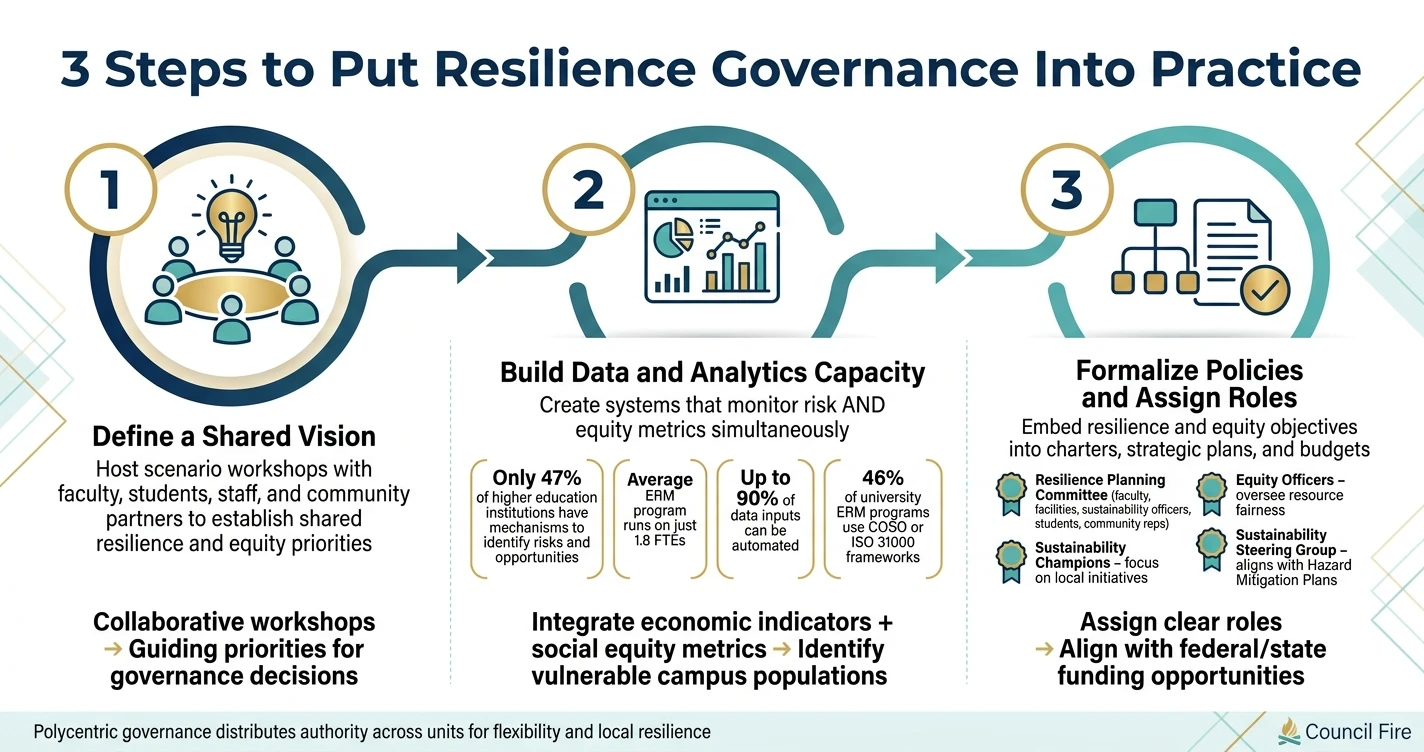
3-Step Resilience Governance Model for Universities
Turning principles into action requires a clear roadmap. Here's how to start:
Step 1: Define a Shared Vision
Begin by fostering a collective understanding of resilience and equity. Hosting scenario workshops can be an effective way to bring together faculty, students, staff, and community partners. These sessions should focus on imagining what a resilient and equitable institution could look like in the future, helping to establish shared priorities rather than crafting a polished mission statement [2]. The goal is to emerge with a guiding set of priorities that inform governance decisions.
Building an analytical foundation to support these priorities is the next critical step.
Step 2: Build Data and Analytics Capacity
Create systems that monitor both risk and equity metrics simultaneously. Many institutions face challenges in this area: only 47% of higher education institutions currently have mechanisms to identify risks and opportunities, and the average Enterprise Risk Management (ERM) program operates with just 1.8 full-time equivalents (FTEs) [9]. By integrating economic indicators, like unemployment trends and emergency financial data, with social equity metrics, institutions can pinpoint which campus populations are most vulnerable during a crisis [2].
Automating data inputs - potentially up to 90% - can significantly reduce the manual workload, allowing staff to focus on analysis and action. Already, 46% of university ERM programs adhere to standardized frameworks such as COSO or ISO 31000 [9]. This type of data-driven approach ensures that governance decisions are well-informed and targeted.
Once the data infrastructure is solid, the next step is to embed these insights into institutional policies and assign clear responsibilities.
Step 3: Formalize Policies and Assign Roles
Incorporate resilience and equity objectives into the institution's charters, strategic plans, and budgets. Before approving major budget decisions, evaluate how these investments address identified disparities [2].
Clearly defined roles are a cornerstone of effective governance. Engage faculty, staff, and community partners to ensure clarity and buy-in. Establishing a Resilience Planning Committee - comprising faculty, facilities staff, sustainability officers, students, and community representatives - can provide a collaborative platform for decision-making [2].
Formalize key positions such as Equity Officers, who oversee resource fairness, and Sustainability Champions, who focus on local initiatives. A Sustainability Steering Group, representing procurement, facilities, and operations, can align resilience efforts with official Hazard Mitigation Plans. This alignment may also open doors to federal and state funding opportunities [1].
"The purpose of this tool is not to ensure all risks are rated as 'Adequately Controlled' but rather to help departments assess their control structure for sufficiency given their environment, resources, and bandwidth." - UCOP Office of Risk Services
Tools and Frameworks to Support Resilience Governance
Established Frameworks for Academic Resilience
Once policies and roles are in place, institutions need structured frameworks to ensure governance decisions remain consistent and effective. Two prominent standards - COSO (Committee of Sponsoring Organizations) and ISO 31000 - are widely adopted for identifying, assessing, and monitoring institutional risks. By 2025, 46% of university ERM programs are expected to align with one of these standardized frameworks [9].
The most impactful institutions use Enterprise Risk Management (ERM) as a strategic tool rather than a compliance exercise. The University of Maryland, Baltimore (UMB) serves as a compelling example. Between 2010 and 2024, UMB integrated ERM into its strategic planning through a proprietary system called the Strategic Plan Implementation Management System (SPIMS). This system allowed schools and administrative units to connect specific risk categories to SMART goals, directly linking risk mitigation to measurable institutional outcomes. The University System of Maryland recognized this program as a best practice [11].
"Organizational resilience is the ability to survive a crisis and thrive in a world of uncertainty. Resilience is a strategic capability. It is more than just about getting through crises." - André Le Duc, Vice President and Chief Resilience Officer, University of Oregon [10]
In addition to these frameworks, assessment tools play a crucial role in identifying institutional strengths and potential gaps.
Assessment Tools for Balancing Risk and Equity
To ensure governance decisions are well-rounded, institutions benefit from tools that evaluate both risk and equity performance. ERM maturity models, for example, provide a quantitative way to assess risk management performance across different dimensions, such as capability, activity, and outcomes. The United Educators Maturity Model is one such tool, offering a structured approach to evaluate ERM programs through four distinct types:
ERM Maturity Model Type | Focus Area |
|---|---|
Capability-based | Evaluates competencies in key institutional areas |
Activity-based | Tracks progress against specific milestones or tasks |
Outcome-based | Measures success based on results and impacts |
Hybrid | Combines capabilities, activities, and outcomes for a comprehensive perspective |
By mapping risk exposure across the five resilience dimensions onto a risk heat map, institutions can better visualize trade-offs and prioritize vulnerabilities affecting campus populations. These insights provide a foundation for stakeholder discussions and help guide action [2]. Metrics like these are critical for the next step: integrating customized solutions into governance practices.
How Council Fire Can Help

While selecting a framework is an important first step, effective implementation is what drives real progress. This is where Council Fire steps in, partnering with institutions to adapt frameworks like COSO and ISO 31000 into practical, equity-focused governance models.
Council Fire's method blends systems thinking with stakeholder-driven planning, translating strategy into measurable action. Whether helping institutions establish their first ERM program or refine an existing one, Council Fire emphasizes embedding equity metrics alongside traditional risk indicators. This approach ensures governance decisions provide a holistic view of institutional health and address the needs of all stakeholders.
Conclusion: Building Resilient and Equitable Institutions
Creating a governance model centered on resilience requires a consistent effort to strengthen and ensure fairness within institutions, while also preparing for future challenges. The steps outlined in this guide - from establishing a shared vision to implementing formal policies - provide a practical roadmap for universities and research institutions.
Resilience goes beyond merely managing risks; it’s about fostering growth and adaptability. As Second Nature aptly states:
"Resilience is not just about survival and bouncing back from disruptions; it is about being able to thrive." [2]
This forward-thinking approach shifts academic governance from reactive crisis management to proactive institution-building. Institutions that view resilience as a strategic capability, rather than a response mechanism, are better positioned to safeguard their communities, uphold their missions, and navigate uncertainty effectively.
Academic leaders should prioritize shared and inclusive governance models. Research shows that such frameworks can enhance institutional dedication to sustainability, with active campus engagement playing a pivotal role [6].
For institutions that may lack the internal capacity to conduct a full resilience assessment, partnering with an external consultant can be a valuable solution. Council Fire collaborates with universities and research institutions to transform governance frameworks into measurable, equity-focused initiatives by combining systems thinking with stakeholder-driven planning.
FAQs
How do we choose between a centralized and polycentric governance model?
When deciding between these approaches, it’s essential to weigh your institution’s specific goals and challenges in building resilience. Centralized models shine in situations requiring swift, uniform action during crises, ensuring consistency across the board. On the other hand, polycentric models, which rely on multiple independent decision-making centers, are better suited for tackling intricate problems. They encourage adaptability, local solutions, and a variety of perspectives. However, these models demand thoughtful coordination to handle their inherent complexities and to prevent potential inequities or system failures. Assess your institution's priorities and its ability to navigate these trade-offs carefully.
Which equity metrics should we track with risk metrics?
To address both risk and equity effectively, it's crucial to monitor a range of metrics that capture the dynamics of institutional functions and community health. These include income inequality, indicators of structural racism, education attainment levels, and measures of community involvement and civic engagement. Additionally, tracking the conditions of vulnerable groups, the distribution and accessibility of resources, and the outcomes of diversity, equity, and inclusion initiatives provides valuable insights. Together, these metrics can uncover persistent challenges and hidden obstacles that conventional risk assessments might miss.
How do we give stakeholders real decision power in crises?
Institutions aiming to empower stakeholders during crises should consider adopting governance models that prioritize collaboration and inclusivity. Establishing formal ethics committees with members from varied backgrounds can help ensure decisions align with shared values and diverse perspectives. Additionally, creating Resilience Planning Working Groups that bring together campus representatives and community partners allows for co-designed solutions that address real needs.
Moving away from rigid, top-down decision-making processes is essential. Instead, institutions should embrace peer engagement, compensating stakeholders for their time and expertise. By doing so, they not only acknowledge the value of these contributions but also ensure that stakeholder input plays a meaningful role in shaping responses to challenges.
Related Blog Posts
How to Build a Climate Resilience Plan for Universities & Research Institutions
How to Integrate Climate Risk into Infrastructure Planning for Universities & Research Institutions
How to Conduct Vulnerability Assessment & Equity Mapping for Universities & Research Institutions
How to Build Resilience Governance Models That Balance Risk and Equity for Corporations
Latest Articles
©2026

Narrative Change and Power Building: The Missing Half of Advocacy
Narrative change is the process of disrupting dominant narratives that normalize inequity and advancing new narratives from historically marginalized communities.

Funding Resilience Without Federal Grants
BRIC is unreliable and FEMA is shrinking. Here's how cities fund climate resilience with dedicated revenue, blended finance, and a coordinating authority.

The ESG Blind Spot: How AI Is Finding Risks in Companies Nobody Else Is Watching
Norway's sovereign wealth fund uses AI to screen 7,200 portfolio companies for forced labor and corruption within 24 hours. The real story is the emerging-market coverage gap that traditional ESG data vendors miss — and what it means for any company with a global supply chain.
Narrative Change and Power Building: The Missing Half of Advocacy
Narrative change is the process of disrupting dominant narratives that normalize inequity and advancing new narratives from historically marginalized communities.
Funding Resilience Without Federal Grants
BRIC is unreliable and FEMA is shrinking. Here's how cities fund climate resilience with dedicated revenue, blended finance, and a coordinating authority.
The ESG Blind Spot: How AI Is Finding Risks in Companies Nobody Else Is Watching
Norway's sovereign wealth fund uses AI to screen 7,200 portfolio companies for forced labor and corruption within 24 hours. The real story is the emerging-market coverage gap that traditional ESG data vendors miss — and what it means for any company with a global supply chain.
FAQ
01
What does it really mean to “redefine profit”?
02
What makes Council Fire different?
03
Who does Council Fire work with?
04
What does working with Council Fire actually look like?
05
How does Council Fire help organizations turn big goals into action?
06
How does Council Fire define and measure success?
07
How does technology fit into Council Fire’s work?
Jun 6, 2026
How to Build Resilience Governance Models That Balance Risk and Equity for Universities & Research Institutions
Capacity Building
In This Article
Practical guide for universities to design governance that balances risk, equity, data, and stakeholder roles.
How to Build Resilience Governance Models That Balance Risk and Equity for Universities & Research Institutions
Universities face growing challenges like climate events, public health crises, and financial instability. To address these, resilience governance models are vital. These models enable institutions to handle disruptions while prioritizing fairness and long-term functionality. Here's a quick guide:
Resilience Governance: Focuses on managing risks (physical, cyber, organizational, psychosocial) while ensuring fairness for vulnerable groups.
Key Principles:
Transparency: Share decisions openly to build trust.
Inclusion: Actively involve diverse stakeholders in decision-making.
Accountability: Track and enforce equity commitments with clear goals and reporting.
Governance Structures:
Centralized: Streamlined but less responsive to local needs.
Polycentric: Distributes authority, allowing flexibility and localized solutions.
Action Steps:
Define a shared vision through collaborative workshops.
Build systems to monitor risk and equity metrics simultaneously.
Formalize policies, assign roles, and align efforts with measurable goals.
Institutions that integrate equity into risk management and engage stakeholders in governance design can better navigate uncertainty and protect their communities.
Core Principles of Risk and Equity in Governance
Key Terms: Risk, Equity, and Institutional Resilience
Let’s break down the essential terms - risk, equity, and institutional resilience - and their role in governance.
Risk spans four interconnected areas: physical, cyber, organizational, and psychosocial [4]. These domains are deeply intertwined, meaning disruptions in one area can ripple through others. For instance, a cyberattack might not only disrupt workflows but also create widespread stress within a campus community.
Equity, in this context, focuses on ensuring that governance decisions do not unfairly impact already vulnerable groups. This includes students dealing with food insecurity, lower-wage staff, or researchers from underrepresented backgrounds.
Institutional resilience refers to the ability of an institution to manage disruptions while maintaining fairness and functionality. This means risk management and equity must work hand-in-hand to absorb challenges without compromising the well-being of any group.
Consider this: nearly 40% of higher education students experience mental health or well-being challenges [4]. This is not a side issue. It’s a critical risk that must be addressed for institutions to build resilience effectively.
With these definitions in mind, let’s examine how governance structures in U.S. universities tackle these challenges.
How U.S. Universities Are Currently Governed
Most universities in the U.S. operate through a multi-layered governance system. At the helm are governing boards, such as trustees or regents, who hold legal and financial authority. Below them, faculty senates oversee academic policies, while equity offices and student affairs divisions focus on inclusion and well-being.
However, these layers often function in isolation. Governing boards typically prioritize financial and legal risks, while equity offices concentrate on inclusion efforts. This disconnect can lead to policies that fail to address systemic inequities, often described as "raceless" or "power-unaware" [5].
Effective governance depends on five key drivers: leadership and direction, strategy and performance, accountability, ethical culture, and stakeholder relationships [3]. When any of these elements falter, an institution’s ability to respond equitably to challenges weakens.
Principles for Equity-Centered Governance
Building equity into governance requires a shift in decision-making at every level. To address existing gaps, three principles should guide resilience governance:
Transparency: Decisions about risks, resources, and governance processes must be visible to the entire campus community. When stakeholders understand how decisions are made, it fosters trust and strengthens accountability.
Inclusion: Representation isn’t enough. Faculty, staff, and students need to actively participate in decision-making. Research shows that shared and inclusive governance - where diverse voices are involved - boosts institutional commitment to long-term objectives like sustainability [6]. A great example is Colorado Mountain College's 2021 initiative, which launched a bachelor’s degree in Ecosystem Science. This program combined traditional ecological knowledge with technical training to address both wildfire risks and social equity [7].
Accountability: Equity efforts shouldn’t fade under pressure. Institutions need clear mechanisms to track and enforce equity commitments. This could include assigning specific roles, setting measurable goals, and publishing regular progress reports. The Equity X Governance model encourages governing boards to take an active role in institutional transformation by embedding equity into every major decision [5].
Principle | In Practice |
|---|---|
Transparency | Sharing risk assessments and resource allocation decisions openly across the institution |
Inclusion | Ensuring governance structures include meaningful input from faculty, staff, and students |
Accountability | Establishing clear roles, measurable goals, and consistent reporting on equity outcomes |
How to Design a Resilience Governance Model
Choosing the Right Governance Structure
The choice of a governance model depends on factors like institutional size, internal dynamics, and the complexity of risks involved. Common approaches include centralized, decentralized, or hybrid (polycentric) systems.
Centralized governance places decision-making authority in a single administrative body, streamlining processes but potentially limiting responsiveness to localized issues. On the other hand, polycentric governance spreads authority across multiple units that coordinate while maintaining local autonomy. This structure fosters resilience by allowing individual units to continue functioning even if one fails or is disrupted. It also encourages experimentation, enabling departments to test new approaches to risk and equity management without jeopardizing the entire system [1].
To evaluate your current governance framework, consider using the Governance Equalizer, which examines five key dimensions [8]:
Dimension | What It Measures |
|---|---|
Politics | The process through which governance decisions are legitimized and enforced |
Profession | The integration of interdisciplinary expertise across departments |
Organization | The structure of decision-making and resource allocation |
Knowledge | The collection, sharing, and application of data for institutional learning |
Public | The extent of engagement with external communities |
By mapping your institution across these dimensions, you can identify areas of strength and pinpoint gaps. Using maturity scales - from informal practices to fully institutionalized goals - can help outline actionable steps for improvement [8].
Once a governance structure is established, the next step is ensuring equity is embedded throughout the risk management process.
Embedding Equity Into Risk Management
After selecting a governance model, equity must become a cornerstone of risk management. Start by examining who bears the greatest risks. Groups like lower-wage employees, first-generation students, and underrepresented researchers often face challenges that traditional risk assessments might miss.
Inclusive governance models enhance this process by incorporating diverse perspectives into risk identification and prioritization. This ensures that assessments account for the varied experiences and vulnerabilities within the institution [6].
Equity provides the foundation, but active participation from stakeholders ensures these efforts are effective and contextually relevant.
Engaging Stakeholders in Governance Design
Excluding stakeholders from governance design can lead to policies that fail to address the needs of marginalized groups. Transparent and inclusive governance requires directly involving community members to ensure decisions reflect actual conditions and challenges.
Effective engagement goes beyond surveys or town halls. It involves creating governance structures where diverse voices hold real decision-making authority, not just advisory roles. A polycentric approach naturally supports this by distributing authority across units already embedded in various communities [1].
When engaging stakeholders, consider the five dimensions of resilience: social equity and governance, health and wellness, ecosystem services, infrastructure, and economic concerns [1][2]. Each dimension affects different groups across the institution and provides unique insights that enhance the governance model's ability to adapt during crises. Balancing and managing these inputs strengthens the institution's capacity to respond effectively to disruptions [1].
Designing for Institutional Resilience in a Changing World | Shop Talk
Steps to Put Resilience Governance Into Practice
3-Step Resilience Governance Model for Universities
Turning principles into action requires a clear roadmap. Here's how to start:
Step 1: Define a Shared Vision
Begin by fostering a collective understanding of resilience and equity. Hosting scenario workshops can be an effective way to bring together faculty, students, staff, and community partners. These sessions should focus on imagining what a resilient and equitable institution could look like in the future, helping to establish shared priorities rather than crafting a polished mission statement [2]. The goal is to emerge with a guiding set of priorities that inform governance decisions.
Building an analytical foundation to support these priorities is the next critical step.
Step 2: Build Data and Analytics Capacity
Create systems that monitor both risk and equity metrics simultaneously. Many institutions face challenges in this area: only 47% of higher education institutions currently have mechanisms to identify risks and opportunities, and the average Enterprise Risk Management (ERM) program operates with just 1.8 full-time equivalents (FTEs) [9]. By integrating economic indicators, like unemployment trends and emergency financial data, with social equity metrics, institutions can pinpoint which campus populations are most vulnerable during a crisis [2].
Automating data inputs - potentially up to 90% - can significantly reduce the manual workload, allowing staff to focus on analysis and action. Already, 46% of university ERM programs adhere to standardized frameworks such as COSO or ISO 31000 [9]. This type of data-driven approach ensures that governance decisions are well-informed and targeted.
Once the data infrastructure is solid, the next step is to embed these insights into institutional policies and assign clear responsibilities.
Step 3: Formalize Policies and Assign Roles
Incorporate resilience and equity objectives into the institution's charters, strategic plans, and budgets. Before approving major budget decisions, evaluate how these investments address identified disparities [2].
Clearly defined roles are a cornerstone of effective governance. Engage faculty, staff, and community partners to ensure clarity and buy-in. Establishing a Resilience Planning Committee - comprising faculty, facilities staff, sustainability officers, students, and community representatives - can provide a collaborative platform for decision-making [2].
Formalize key positions such as Equity Officers, who oversee resource fairness, and Sustainability Champions, who focus on local initiatives. A Sustainability Steering Group, representing procurement, facilities, and operations, can align resilience efforts with official Hazard Mitigation Plans. This alignment may also open doors to federal and state funding opportunities [1].
"The purpose of this tool is not to ensure all risks are rated as 'Adequately Controlled' but rather to help departments assess their control structure for sufficiency given their environment, resources, and bandwidth." - UCOP Office of Risk Services
Tools and Frameworks to Support Resilience Governance
Established Frameworks for Academic Resilience
Once policies and roles are in place, institutions need structured frameworks to ensure governance decisions remain consistent and effective. Two prominent standards - COSO (Committee of Sponsoring Organizations) and ISO 31000 - are widely adopted for identifying, assessing, and monitoring institutional risks. By 2025, 46% of university ERM programs are expected to align with one of these standardized frameworks [9].
The most impactful institutions use Enterprise Risk Management (ERM) as a strategic tool rather than a compliance exercise. The University of Maryland, Baltimore (UMB) serves as a compelling example. Between 2010 and 2024, UMB integrated ERM into its strategic planning through a proprietary system called the Strategic Plan Implementation Management System (SPIMS). This system allowed schools and administrative units to connect specific risk categories to SMART goals, directly linking risk mitigation to measurable institutional outcomes. The University System of Maryland recognized this program as a best practice [11].
"Organizational resilience is the ability to survive a crisis and thrive in a world of uncertainty. Resilience is a strategic capability. It is more than just about getting through crises." - André Le Duc, Vice President and Chief Resilience Officer, University of Oregon [10]
In addition to these frameworks, assessment tools play a crucial role in identifying institutional strengths and potential gaps.
Assessment Tools for Balancing Risk and Equity
To ensure governance decisions are well-rounded, institutions benefit from tools that evaluate both risk and equity performance. ERM maturity models, for example, provide a quantitative way to assess risk management performance across different dimensions, such as capability, activity, and outcomes. The United Educators Maturity Model is one such tool, offering a structured approach to evaluate ERM programs through four distinct types:
ERM Maturity Model Type | Focus Area |
|---|---|
Capability-based | Evaluates competencies in key institutional areas |
Activity-based | Tracks progress against specific milestones or tasks |
Outcome-based | Measures success based on results and impacts |
Hybrid | Combines capabilities, activities, and outcomes for a comprehensive perspective |
By mapping risk exposure across the five resilience dimensions onto a risk heat map, institutions can better visualize trade-offs and prioritize vulnerabilities affecting campus populations. These insights provide a foundation for stakeholder discussions and help guide action [2]. Metrics like these are critical for the next step: integrating customized solutions into governance practices.
How Council Fire Can Help
While selecting a framework is an important first step, effective implementation is what drives real progress. This is where Council Fire steps in, partnering with institutions to adapt frameworks like COSO and ISO 31000 into practical, equity-focused governance models.
Council Fire's method blends systems thinking with stakeholder-driven planning, translating strategy into measurable action. Whether helping institutions establish their first ERM program or refine an existing one, Council Fire emphasizes embedding equity metrics alongside traditional risk indicators. This approach ensures governance decisions provide a holistic view of institutional health and address the needs of all stakeholders.
Conclusion: Building Resilient and Equitable Institutions
Creating a governance model centered on resilience requires a consistent effort to strengthen and ensure fairness within institutions, while also preparing for future challenges. The steps outlined in this guide - from establishing a shared vision to implementing formal policies - provide a practical roadmap for universities and research institutions.
Resilience goes beyond merely managing risks; it’s about fostering growth and adaptability. As Second Nature aptly states:
"Resilience is not just about survival and bouncing back from disruptions; it is about being able to thrive." [2]
This forward-thinking approach shifts academic governance from reactive crisis management to proactive institution-building. Institutions that view resilience as a strategic capability, rather than a response mechanism, are better positioned to safeguard their communities, uphold their missions, and navigate uncertainty effectively.
Academic leaders should prioritize shared and inclusive governance models. Research shows that such frameworks can enhance institutional dedication to sustainability, with active campus engagement playing a pivotal role [6].
For institutions that may lack the internal capacity to conduct a full resilience assessment, partnering with an external consultant can be a valuable solution. Council Fire collaborates with universities and research institutions to transform governance frameworks into measurable, equity-focused initiatives by combining systems thinking with stakeholder-driven planning.
FAQs
How do we choose between a centralized and polycentric governance model?
When deciding between these approaches, it’s essential to weigh your institution’s specific goals and challenges in building resilience. Centralized models shine in situations requiring swift, uniform action during crises, ensuring consistency across the board. On the other hand, polycentric models, which rely on multiple independent decision-making centers, are better suited for tackling intricate problems. They encourage adaptability, local solutions, and a variety of perspectives. However, these models demand thoughtful coordination to handle their inherent complexities and to prevent potential inequities or system failures. Assess your institution's priorities and its ability to navigate these trade-offs carefully.
Which equity metrics should we track with risk metrics?
To address both risk and equity effectively, it's crucial to monitor a range of metrics that capture the dynamics of institutional functions and community health. These include income inequality, indicators of structural racism, education attainment levels, and measures of community involvement and civic engagement. Additionally, tracking the conditions of vulnerable groups, the distribution and accessibility of resources, and the outcomes of diversity, equity, and inclusion initiatives provides valuable insights. Together, these metrics can uncover persistent challenges and hidden obstacles that conventional risk assessments might miss.
How do we give stakeholders real decision power in crises?
Institutions aiming to empower stakeholders during crises should consider adopting governance models that prioritize collaboration and inclusivity. Establishing formal ethics committees with members from varied backgrounds can help ensure decisions align with shared values and diverse perspectives. Additionally, creating Resilience Planning Working Groups that bring together campus representatives and community partners allows for co-designed solutions that address real needs.
Moving away from rigid, top-down decision-making processes is essential. Instead, institutions should embrace peer engagement, compensating stakeholders for their time and expertise. By doing so, they not only acknowledge the value of these contributions but also ensure that stakeholder input plays a meaningful role in shaping responses to challenges.
Related Blog Posts
How to Build a Climate Resilience Plan for Universities & Research Institutions
How to Integrate Climate Risk into Infrastructure Planning for Universities & Research Institutions
How to Conduct Vulnerability Assessment & Equity Mapping for Universities & Research Institutions
How to Build Resilience Governance Models That Balance Risk and Equity for Corporations
Latest Articles
©2026
Narrative Change and Power Building: The Missing Half of Advocacy
Narrative change is the process of disrupting dominant narratives that normalize inequity and advancing new narratives from historically marginalized communities.
Funding Resilience Without Federal Grants
BRIC is unreliable and FEMA is shrinking. Here's how cities fund climate resilience with dedicated revenue, blended finance, and a coordinating authority.
The ESG Blind Spot: How AI Is Finding Risks in Companies Nobody Else Is Watching
Norway's sovereign wealth fund uses AI to screen 7,200 portfolio companies for forced labor and corruption within 24 hours. The real story is the emerging-market coverage gap that traditional ESG data vendors miss — and what it means for any company with a global supply chain.
FAQ
01
What does it really mean to “redefine profit”?
02
What makes Council Fire different?
03
Who does Council Fire work with?
04
What does working with Council Fire actually look like?
05
How does Council Fire help organizations turn big goals into action?
06
How does Council Fire define and measure success?
07
How does technology fit into Council Fire’s work?
Jun 6, 2026
How to Build Resilience Governance Models That Balance Risk and Equity for Universities & Research Institutions
Capacity Building
In This Article
Practical guide for universities to design governance that balances risk, equity, data, and stakeholder roles.
How to Build Resilience Governance Models That Balance Risk and Equity for Universities & Research Institutions
Universities face growing challenges like climate events, public health crises, and financial instability. To address these, resilience governance models are vital. These models enable institutions to handle disruptions while prioritizing fairness and long-term functionality. Here's a quick guide:
Resilience Governance: Focuses on managing risks (physical, cyber, organizational, psychosocial) while ensuring fairness for vulnerable groups.
Key Principles:
Transparency: Share decisions openly to build trust.
Inclusion: Actively involve diverse stakeholders in decision-making.
Accountability: Track and enforce equity commitments with clear goals and reporting.
Governance Structures:
Centralized: Streamlined but less responsive to local needs.
Polycentric: Distributes authority, allowing flexibility and localized solutions.
Action Steps:
Define a shared vision through collaborative workshops.
Build systems to monitor risk and equity metrics simultaneously.
Formalize policies, assign roles, and align efforts with measurable goals.
Institutions that integrate equity into risk management and engage stakeholders in governance design can better navigate uncertainty and protect their communities.
Core Principles of Risk and Equity in Governance
Key Terms: Risk, Equity, and Institutional Resilience
Let’s break down the essential terms - risk, equity, and institutional resilience - and their role in governance.
Risk spans four interconnected areas: physical, cyber, organizational, and psychosocial [4]. These domains are deeply intertwined, meaning disruptions in one area can ripple through others. For instance, a cyberattack might not only disrupt workflows but also create widespread stress within a campus community.
Equity, in this context, focuses on ensuring that governance decisions do not unfairly impact already vulnerable groups. This includes students dealing with food insecurity, lower-wage staff, or researchers from underrepresented backgrounds.
Institutional resilience refers to the ability of an institution to manage disruptions while maintaining fairness and functionality. This means risk management and equity must work hand-in-hand to absorb challenges without compromising the well-being of any group.
Consider this: nearly 40% of higher education students experience mental health or well-being challenges [4]. This is not a side issue. It’s a critical risk that must be addressed for institutions to build resilience effectively.
With these definitions in mind, let’s examine how governance structures in U.S. universities tackle these challenges.
How U.S. Universities Are Currently Governed
Most universities in the U.S. operate through a multi-layered governance system. At the helm are governing boards, such as trustees or regents, who hold legal and financial authority. Below them, faculty senates oversee academic policies, while equity offices and student affairs divisions focus on inclusion and well-being.
However, these layers often function in isolation. Governing boards typically prioritize financial and legal risks, while equity offices concentrate on inclusion efforts. This disconnect can lead to policies that fail to address systemic inequities, often described as "raceless" or "power-unaware" [5].
Effective governance depends on five key drivers: leadership and direction, strategy and performance, accountability, ethical culture, and stakeholder relationships [3]. When any of these elements falter, an institution’s ability to respond equitably to challenges weakens.
Principles for Equity-Centered Governance
Building equity into governance requires a shift in decision-making at every level. To address existing gaps, three principles should guide resilience governance:
Transparency: Decisions about risks, resources, and governance processes must be visible to the entire campus community. When stakeholders understand how decisions are made, it fosters trust and strengthens accountability.
Inclusion: Representation isn’t enough. Faculty, staff, and students need to actively participate in decision-making. Research shows that shared and inclusive governance - where diverse voices are involved - boosts institutional commitment to long-term objectives like sustainability [6]. A great example is Colorado Mountain College's 2021 initiative, which launched a bachelor’s degree in Ecosystem Science. This program combined traditional ecological knowledge with technical training to address both wildfire risks and social equity [7].
Accountability: Equity efforts shouldn’t fade under pressure. Institutions need clear mechanisms to track and enforce equity commitments. This could include assigning specific roles, setting measurable goals, and publishing regular progress reports. The Equity X Governance model encourages governing boards to take an active role in institutional transformation by embedding equity into every major decision [5].
Principle | In Practice |
|---|---|
Transparency | Sharing risk assessments and resource allocation decisions openly across the institution |
Inclusion | Ensuring governance structures include meaningful input from faculty, staff, and students |
Accountability | Establishing clear roles, measurable goals, and consistent reporting on equity outcomes |
How to Design a Resilience Governance Model
Choosing the Right Governance Structure
The choice of a governance model depends on factors like institutional size, internal dynamics, and the complexity of risks involved. Common approaches include centralized, decentralized, or hybrid (polycentric) systems.
Centralized governance places decision-making authority in a single administrative body, streamlining processes but potentially limiting responsiveness to localized issues. On the other hand, polycentric governance spreads authority across multiple units that coordinate while maintaining local autonomy. This structure fosters resilience by allowing individual units to continue functioning even if one fails or is disrupted. It also encourages experimentation, enabling departments to test new approaches to risk and equity management without jeopardizing the entire system [1].
To evaluate your current governance framework, consider using the Governance Equalizer, which examines five key dimensions [8]:
Dimension | What It Measures |
|---|---|
Politics | The process through which governance decisions are legitimized and enforced |
Profession | The integration of interdisciplinary expertise across departments |
Organization | The structure of decision-making and resource allocation |
Knowledge | The collection, sharing, and application of data for institutional learning |
Public | The extent of engagement with external communities |
By mapping your institution across these dimensions, you can identify areas of strength and pinpoint gaps. Using maturity scales - from informal practices to fully institutionalized goals - can help outline actionable steps for improvement [8].
Once a governance structure is established, the next step is ensuring equity is embedded throughout the risk management process.
Embedding Equity Into Risk Management
After selecting a governance model, equity must become a cornerstone of risk management. Start by examining who bears the greatest risks. Groups like lower-wage employees, first-generation students, and underrepresented researchers often face challenges that traditional risk assessments might miss.
Inclusive governance models enhance this process by incorporating diverse perspectives into risk identification and prioritization. This ensures that assessments account for the varied experiences and vulnerabilities within the institution [6].
Equity provides the foundation, but active participation from stakeholders ensures these efforts are effective and contextually relevant.
Engaging Stakeholders in Governance Design
Excluding stakeholders from governance design can lead to policies that fail to address the needs of marginalized groups. Transparent and inclusive governance requires directly involving community members to ensure decisions reflect actual conditions and challenges.
Effective engagement goes beyond surveys or town halls. It involves creating governance structures where diverse voices hold real decision-making authority, not just advisory roles. A polycentric approach naturally supports this by distributing authority across units already embedded in various communities [1].
When engaging stakeholders, consider the five dimensions of resilience: social equity and governance, health and wellness, ecosystem services, infrastructure, and economic concerns [1][2]. Each dimension affects different groups across the institution and provides unique insights that enhance the governance model's ability to adapt during crises. Balancing and managing these inputs strengthens the institution's capacity to respond effectively to disruptions [1].
Designing for Institutional Resilience in a Changing World | Shop Talk
Steps to Put Resilience Governance Into Practice
3-Step Resilience Governance Model for Universities
Turning principles into action requires a clear roadmap. Here's how to start:
Step 1: Define a Shared Vision
Begin by fostering a collective understanding of resilience and equity. Hosting scenario workshops can be an effective way to bring together faculty, students, staff, and community partners. These sessions should focus on imagining what a resilient and equitable institution could look like in the future, helping to establish shared priorities rather than crafting a polished mission statement [2]. The goal is to emerge with a guiding set of priorities that inform governance decisions.
Building an analytical foundation to support these priorities is the next critical step.
Step 2: Build Data and Analytics Capacity
Create systems that monitor both risk and equity metrics simultaneously. Many institutions face challenges in this area: only 47% of higher education institutions currently have mechanisms to identify risks and opportunities, and the average Enterprise Risk Management (ERM) program operates with just 1.8 full-time equivalents (FTEs) [9]. By integrating economic indicators, like unemployment trends and emergency financial data, with social equity metrics, institutions can pinpoint which campus populations are most vulnerable during a crisis [2].
Automating data inputs - potentially up to 90% - can significantly reduce the manual workload, allowing staff to focus on analysis and action. Already, 46% of university ERM programs adhere to standardized frameworks such as COSO or ISO 31000 [9]. This type of data-driven approach ensures that governance decisions are well-informed and targeted.
Once the data infrastructure is solid, the next step is to embed these insights into institutional policies and assign clear responsibilities.
Step 3: Formalize Policies and Assign Roles
Incorporate resilience and equity objectives into the institution's charters, strategic plans, and budgets. Before approving major budget decisions, evaluate how these investments address identified disparities [2].
Clearly defined roles are a cornerstone of effective governance. Engage faculty, staff, and community partners to ensure clarity and buy-in. Establishing a Resilience Planning Committee - comprising faculty, facilities staff, sustainability officers, students, and community representatives - can provide a collaborative platform for decision-making [2].
Formalize key positions such as Equity Officers, who oversee resource fairness, and Sustainability Champions, who focus on local initiatives. A Sustainability Steering Group, representing procurement, facilities, and operations, can align resilience efforts with official Hazard Mitigation Plans. This alignment may also open doors to federal and state funding opportunities [1].
"The purpose of this tool is not to ensure all risks are rated as 'Adequately Controlled' but rather to help departments assess their control structure for sufficiency given their environment, resources, and bandwidth." - UCOP Office of Risk Services
Tools and Frameworks to Support Resilience Governance
Established Frameworks for Academic Resilience
Once policies and roles are in place, institutions need structured frameworks to ensure governance decisions remain consistent and effective. Two prominent standards - COSO (Committee of Sponsoring Organizations) and ISO 31000 - are widely adopted for identifying, assessing, and monitoring institutional risks. By 2025, 46% of university ERM programs are expected to align with one of these standardized frameworks [9].
The most impactful institutions use Enterprise Risk Management (ERM) as a strategic tool rather than a compliance exercise. The University of Maryland, Baltimore (UMB) serves as a compelling example. Between 2010 and 2024, UMB integrated ERM into its strategic planning through a proprietary system called the Strategic Plan Implementation Management System (SPIMS). This system allowed schools and administrative units to connect specific risk categories to SMART goals, directly linking risk mitigation to measurable institutional outcomes. The University System of Maryland recognized this program as a best practice [11].
"Organizational resilience is the ability to survive a crisis and thrive in a world of uncertainty. Resilience is a strategic capability. It is more than just about getting through crises." - André Le Duc, Vice President and Chief Resilience Officer, University of Oregon [10]
In addition to these frameworks, assessment tools play a crucial role in identifying institutional strengths and potential gaps.
Assessment Tools for Balancing Risk and Equity
To ensure governance decisions are well-rounded, institutions benefit from tools that evaluate both risk and equity performance. ERM maturity models, for example, provide a quantitative way to assess risk management performance across different dimensions, such as capability, activity, and outcomes. The United Educators Maturity Model is one such tool, offering a structured approach to evaluate ERM programs through four distinct types:
ERM Maturity Model Type | Focus Area |
|---|---|
Capability-based | Evaluates competencies in key institutional areas |
Activity-based | Tracks progress against specific milestones or tasks |
Outcome-based | Measures success based on results and impacts |
Hybrid | Combines capabilities, activities, and outcomes for a comprehensive perspective |
By mapping risk exposure across the five resilience dimensions onto a risk heat map, institutions can better visualize trade-offs and prioritize vulnerabilities affecting campus populations. These insights provide a foundation for stakeholder discussions and help guide action [2]. Metrics like these are critical for the next step: integrating customized solutions into governance practices.
How Council Fire Can Help
While selecting a framework is an important first step, effective implementation is what drives real progress. This is where Council Fire steps in, partnering with institutions to adapt frameworks like COSO and ISO 31000 into practical, equity-focused governance models.
Council Fire's method blends systems thinking with stakeholder-driven planning, translating strategy into measurable action. Whether helping institutions establish their first ERM program or refine an existing one, Council Fire emphasizes embedding equity metrics alongside traditional risk indicators. This approach ensures governance decisions provide a holistic view of institutional health and address the needs of all stakeholders.
Conclusion: Building Resilient and Equitable Institutions
Creating a governance model centered on resilience requires a consistent effort to strengthen and ensure fairness within institutions, while also preparing for future challenges. The steps outlined in this guide - from establishing a shared vision to implementing formal policies - provide a practical roadmap for universities and research institutions.
Resilience goes beyond merely managing risks; it’s about fostering growth and adaptability. As Second Nature aptly states:
"Resilience is not just about survival and bouncing back from disruptions; it is about being able to thrive." [2]
This forward-thinking approach shifts academic governance from reactive crisis management to proactive institution-building. Institutions that view resilience as a strategic capability, rather than a response mechanism, are better positioned to safeguard their communities, uphold their missions, and navigate uncertainty effectively.
Academic leaders should prioritize shared and inclusive governance models. Research shows that such frameworks can enhance institutional dedication to sustainability, with active campus engagement playing a pivotal role [6].
For institutions that may lack the internal capacity to conduct a full resilience assessment, partnering with an external consultant can be a valuable solution. Council Fire collaborates with universities and research institutions to transform governance frameworks into measurable, equity-focused initiatives by combining systems thinking with stakeholder-driven planning.
FAQs
How do we choose between a centralized and polycentric governance model?
When deciding between these approaches, it’s essential to weigh your institution’s specific goals and challenges in building resilience. Centralized models shine in situations requiring swift, uniform action during crises, ensuring consistency across the board. On the other hand, polycentric models, which rely on multiple independent decision-making centers, are better suited for tackling intricate problems. They encourage adaptability, local solutions, and a variety of perspectives. However, these models demand thoughtful coordination to handle their inherent complexities and to prevent potential inequities or system failures. Assess your institution's priorities and its ability to navigate these trade-offs carefully.
Which equity metrics should we track with risk metrics?
To address both risk and equity effectively, it's crucial to monitor a range of metrics that capture the dynamics of institutional functions and community health. These include income inequality, indicators of structural racism, education attainment levels, and measures of community involvement and civic engagement. Additionally, tracking the conditions of vulnerable groups, the distribution and accessibility of resources, and the outcomes of diversity, equity, and inclusion initiatives provides valuable insights. Together, these metrics can uncover persistent challenges and hidden obstacles that conventional risk assessments might miss.
How do we give stakeholders real decision power in crises?
Institutions aiming to empower stakeholders during crises should consider adopting governance models that prioritize collaboration and inclusivity. Establishing formal ethics committees with members from varied backgrounds can help ensure decisions align with shared values and diverse perspectives. Additionally, creating Resilience Planning Working Groups that bring together campus representatives and community partners allows for co-designed solutions that address real needs.
Moving away from rigid, top-down decision-making processes is essential. Instead, institutions should embrace peer engagement, compensating stakeholders for their time and expertise. By doing so, they not only acknowledge the value of these contributions but also ensure that stakeholder input plays a meaningful role in shaping responses to challenges.
Related Blog Posts
How to Build a Climate Resilience Plan for Universities & Research Institutions
How to Integrate Climate Risk into Infrastructure Planning for Universities & Research Institutions
How to Conduct Vulnerability Assessment & Equity Mapping for Universities & Research Institutions
How to Build Resilience Governance Models That Balance Risk and Equity for Corporations
Latest Articles
©2026
Narrative Change and Power Building: The Missing Half of Advocacy
Narrative change is the process of disrupting dominant narratives that normalize inequity and advancing new narratives from historically marginalized communities.
Funding Resilience Without Federal Grants
BRIC is unreliable and FEMA is shrinking. Here's how cities fund climate resilience with dedicated revenue, blended finance, and a coordinating authority.
The ESG Blind Spot: How AI Is Finding Risks in Companies Nobody Else Is Watching
Norway's sovereign wealth fund uses AI to screen 7,200 portfolio companies for forced labor and corruption within 24 hours. The real story is the emerging-market coverage gap that traditional ESG data vendors miss — and what it means for any company with a global supply chain.
FAQ
What does it really mean to “redefine profit”?
What makes Council Fire different?
Who does Council Fire work with?
What does working with Council Fire actually look like?
How does Council Fire help organizations turn big goals into action?
How does Council Fire define and measure success?
How does technology fit into Council Fire’s work?