
Jun 30, 2026
GRI vs. SASB: ESG Frameworks Compared
ESG Strategy
In This Article
Compare GRI and SASB: when to use each, their materiality focus, and how to combine them for stakeholder and investor reporting.
GRI vs. SASB: ESG Frameworks Compared
If you need one short answer, here it is: GRI is for reporting your company’s impacts on people, the planet, and the economy. SASB is for reporting ESG issues that matter to investors and financial results.
If you are choosing between the two, I would keep it simple:
Use GRI when you need to speak to employees, communities, regulators, NGOs, and customers
Use SASB when you need investor-focused, industry-based metrics
Use both when one report needs to serve both groups
This difference is mostly about materiality:
GRI = impact materiality
SASB = financial materiality
The scale also differs. GRI is used by 10,000+ organizations in 100+ countries, while SASB covers 77 industries across 11 sectors. And in the U.S. market, more than 60% of S&P 500 companies that use sustainability standards reference two or more frameworks.
For me, the easiest way to think about it is this: GRI tells the broad ESG story; SASB tells investors which ESG issues may affect enterprise value.
Quick Comparison
Criteria | GRI | SASB |
|---|---|---|
Main audience | Broad stakeholder groups | Investors, lenders, analysts |
Materiality lens | Impact materiality | Financial materiality |
Main use | Transparency and accountability | Investor decision-making |
Scope | Economic, social, and planet-related topics | ESG topics tied to financial performance |
Industry focus | Mostly shared across sectors, with some sector standards | 77 industry-specific standards |
Metric style | Mix of narrative and numbers | More prescriptive and mostly quantitative |
Best fit | Broad ESG reporting | Investor-facing ESG disclosure |
If I were advising a company from scratch, I’d start with GRI for the base report and then add SASB metrics or an index for investor needs. That gives you one reporting process without making readers search for what matters to them.
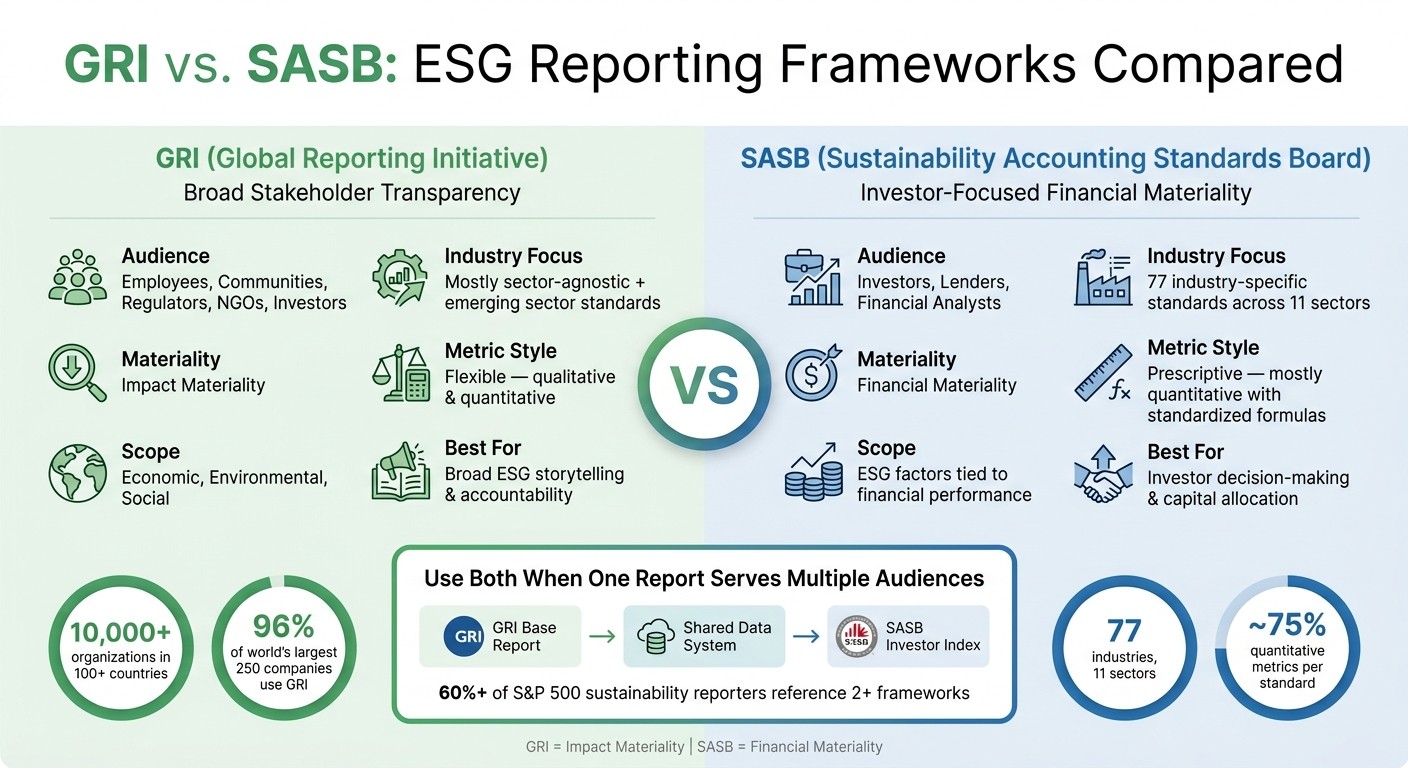
GRI vs. SASB: ESG Reporting Frameworks Compared
GRI and SASB: A Brief Overview
GRI: Broad Sustainability Reporting for Stakeholder Transparency
GRI centers on an organization’s biggest effects on the economy, environment, and people—core pillars of sustainability consulting - and on how the organization handles those effects.
Its framework has three parts: Universal Standards, Sector Standards, and Topic Standards. Together, they cover more than 40 topics, including biodiversity, emissions, labor practices, and anti-corruption [3][5]. That setup gives companies room to report what fits their situation while still keeping a shared global baseline.
GRI speaks to a broad group of readers: investors, employees, communities, regulators, NGOs, and customers [1][2][5]. That broad reach helps explain its scale. More than 10,000 organizations in over 100 countries use GRI Standards [1][4][3], and 96% of the world’s largest 250 companies report sustainability performance with GRI [6].
SASB looks at much of the same territory, but through a tighter lens focused on financial materiality and industry-specific disclosure.
SASB: Industry-Specific Disclosure for Investor Relevance
SASB takes a narrower path. It points to ESG issues that can affect financial condition, operating performance, or risk.
The framework includes standards for 77 industries across 11 sectors [6][3]. In practice, that means the issues shift by industry. A technology company may zero in on data privacy, while an extractives company may pay closer attention to emissions and community relations. Each industry standard includes about six disclosure topics and 13 accounting metrics, with roughly 75% quantitative [6].
The contrast between GRI and SASB stands out more clearly in the side-by-side comparison below.
GRI vs. SASB: Side-by-Side Comparison
Comparison Table: Audience, Materiality, Scope, and Use Case
Both address ESG issues, but they’re built for different readers and different definitions of materiality. This table shows the main differences at a glance.
Feature | GRI | SASB |
|---|---|---|
Primary Audience | Broad stakeholders: employees, NGOs, regulators, investors | Investors, lenders, and financial analysts |
Materiality | Impact materiality (external impacts on people and the environment) | Financial materiality (effects on enterprise value) |
Scope | Comprehensive: economic, environmental, and social topics | Narrow: ESG factors tied directly to financial performance |
Industry Specificity | Mostly sector-agnostic, with sector standards emerging in some industries | Highly specific: 77 distinct industry standards |
Metric Style | Flexible; qualitative and quantitative | Prescriptive; mostly quantitative, with standardized units and formulas |
Primary Use Case | Stakeholder transparency and accountability | Investor decision-making and capital allocation |
The Biggest Differences in Practice
In day-to-day reporting, the gap comes down to what each framework is trying to answer. GRI asks, How does the company affect people and the environment? SASB asks, Which ESG issues could affect enterprise value? That split shapes what gets reported, how teams measure it, and who the final report is meant to serve.
The biggest divide is audience and materiality. GRI centers on outward impacts, so it tends to support broader stakeholder communication. SASB centers on enterprise value, so it pushes companies toward the ESG topics that matter most to investors and analysts. That difference shows up fast when organizations decide which topics make the cut, which metrics to use, and how much detail each audience needs.
There’s also a clear difference in how data is presented. Under GRI, organizations have more room in how they measure and describe performance, which helps when speaking to a mixed audience. Under SASB, each industry works from a tighter set of roughly 5–15 material topics, along with more prescriptive metrics, so investors can compare companies in the same sector more directly [1].
Industry focus is another major gap. GRI uses a shared baseline across sectors, though sector standards are taking shape for some high-impact industries. SASB, by contrast, is built around industry-specific disclosure from the start. That makes it more useful when a company wants to flag sector-specific financial risks in a way the market can read quickly [1].
Adoption and regulatory relevance differ as well. GRI remains widely used for stakeholder reporting, while SASB’s methodology sits underneath ISSB-aligned disclosure in several markets [1][3].
Key Differences Between SASB and GRI: Which Reporting Framework Fits Your Needs?
When to Use GRI, SASB, or Both
The right choice depends on who you need to reach first: stakeholders, investors, or both. In plain terms, pick the framework that lines up with your main audience and the way you define materiality.
When GRI Is the Better Fit
GRI makes more sense when your audience goes beyond investors and includes employees, communities, regulators, or NGOs. It gives you room to report on how your operations affect people and the environment, not just financial outcomes.
It’s also a better pick if your company operates in, or reports under, jurisdictions moving toward double materiality rules, such as the EU's CSRD. The EU's ESRS were developed with significant GRI input and share an impact-oriented philosophy [1][3][7]. On top of that, GRI’s modular Universal Standards make it a practical starting point for first-time reporters.
By comparison, SASB is built for investor-facing disclosure.
When SASB Is the Better Fit
SASB is the stronger option when investors, lenders, and analysts need comparable, financially material data by industry. Its industry-based approach has been integrated into the ISSB's IFRS S1 and S2 standards, which makes SASB a practical route for organizations getting ready for ISSB-aligned reporting [1][5].
How Organizations Use GRI and SASB Together
When one report needs to work for both groups, many organizations use GRI and SASB side by side. GRI handles broad stakeholder reporting, while SASB adds investor-focused, comparable metrics.
A common setup looks like this:
Use GRI as the backbone of the sustainability report
Add a SASB index or supplementary table for sector-specific investor metrics
Run one data system that maps ESG inputs to both frameworks [3][5]
That approach keeps the report usable for a broad audience without leaving investors hunting for the numbers they care about.
Conclusion: Choosing the Right ESG Reporting Approach
GRI vs. SASB comes down to who you need to speak to and what kind of detail they expect.
GRI is built for broad transparency. It looks at impacts on communities, employees, and the environment across any industry. SASB is tighter and more investor-focused, with industry-specific metrics tied to financial materiality. That split is exactly why many organizations use both.
For most organizations, the practical move isn’t either/or. It’s both, in the right order. Start with a GRI base, then layer in SASB metrics so investors get the comparable, industry-specific data they look for.
The aim is a reporting structure that serves both audiences without doing the same work twice. Treat GRI and SASB as complementary tools: use GRI for broad stakeholder transparency, add SASB for investor-focused metrics, and map both to one reporting process. Council Fire can help put that approach to work.
FAQs
How do I choose between GRI and SASB?
Choose based on your main audience and what matters most.
Use GRI if you need a broad view of environmental, social, and economic impacts for a mixed group of stakeholders. Use SASB if you need industry-specific metrics tied to financial materiality for investors. Many organizations use both: GRI for stakeholder communication and SASB for investor disclosures.
Can a company use GRI and SASB together?
Yes. Companies often use GRI and SASB together because each one does a different job.
GRI gives a broad, stakeholder-focused view of a company’s external impacts. SASB adds industry-specific disclosures that matter to investors and tie more directly to financial performance. Used together, they can give leaders a clearer picture of how business results connect with environmental and social outcomes.
Council Fire helps organizations work through these frameworks so reporting doesn’t turn into a box-checking exercise. The goal is to line up financial performance with environmental and social impact in a way that makes sense for the business and the people reading the report.
How does materiality differ in GRI and SASB?
The main difference comes down to materiality.
GRI uses impact materiality. In plain terms, it looks at how a company affects the economy, the environment, and people - even when those effects don’t show up on the company’s financial statements.
SASB uses financial materiality. It focuses on ESG issues that are likely to affect a company’s financial condition, operating performance, or enterprise value.
That difference shapes the audience, too. GRI speaks to a broader group of stakeholders, while SASB is geared more toward investors and financial analysts.
Related Blog Posts
Latest Articles
©2025

Narrative Change and Power Building: The Missing Half of Advocacy
Narrative change is the process of disrupting dominant narratives that normalize inequity and advancing new narratives from historically marginalized communities.

Funding Resilience Without Federal Grants
BRIC is unreliable and FEMA is shrinking. Here's how cities fund climate resilience with dedicated revenue, blended finance, and a coordinating authority.

The ESG Blind Spot: How AI Is Finding Risks in Companies Nobody Else Is Watching
Norway's sovereign wealth fund uses AI to screen 7,200 portfolio companies for forced labor and corruption within 24 hours. The real story is the emerging-market coverage gap that traditional ESG data vendors miss — and what it means for any company with a global supply chain.
Narrative Change and Power Building: The Missing Half of Advocacy
Narrative change is the process of disrupting dominant narratives that normalize inequity and advancing new narratives from historically marginalized communities.
Funding Resilience Without Federal Grants
BRIC is unreliable and FEMA is shrinking. Here's how cities fund climate resilience with dedicated revenue, blended finance, and a coordinating authority.
The ESG Blind Spot: How AI Is Finding Risks in Companies Nobody Else Is Watching
Norway's sovereign wealth fund uses AI to screen 7,200 portfolio companies for forced labor and corruption within 24 hours. The real story is the emerging-market coverage gap that traditional ESG data vendors miss — and what it means for any company with a global supply chain.
FAQ
01
What does it really mean to “redefine profit”?
02
What makes Council Fire different?
03
Who does Council Fire work with?
04
What does working with Council Fire actually look like?
05
How does Council Fire help organizations turn big goals into action?
06
How does Council Fire define and measure success?
Jun 30, 2026
GRI vs. SASB: ESG Frameworks Compared
ESG Strategy
In This Article
Compare GRI and SASB: when to use each, their materiality focus, and how to combine them for stakeholder and investor reporting.
GRI vs. SASB: ESG Frameworks Compared
If you need one short answer, here it is: GRI is for reporting your company’s impacts on people, the planet, and the economy. SASB is for reporting ESG issues that matter to investors and financial results.
If you are choosing between the two, I would keep it simple:
Use GRI when you need to speak to employees, communities, regulators, NGOs, and customers
Use SASB when you need investor-focused, industry-based metrics
Use both when one report needs to serve both groups
This difference is mostly about materiality:
GRI = impact materiality
SASB = financial materiality
The scale also differs. GRI is used by 10,000+ organizations in 100+ countries, while SASB covers 77 industries across 11 sectors. And in the U.S. market, more than 60% of S&P 500 companies that use sustainability standards reference two or more frameworks.
For me, the easiest way to think about it is this: GRI tells the broad ESG story; SASB tells investors which ESG issues may affect enterprise value.
Quick Comparison
Criteria | GRI | SASB |
|---|---|---|
Main audience | Broad stakeholder groups | Investors, lenders, analysts |
Materiality lens | Impact materiality | Financial materiality |
Main use | Transparency and accountability | Investor decision-making |
Scope | Economic, social, and planet-related topics | ESG topics tied to financial performance |
Industry focus | Mostly shared across sectors, with some sector standards | 77 industry-specific standards |
Metric style | Mix of narrative and numbers | More prescriptive and mostly quantitative |
Best fit | Broad ESG reporting | Investor-facing ESG disclosure |
If I were advising a company from scratch, I’d start with GRI for the base report and then add SASB metrics or an index for investor needs. That gives you one reporting process without making readers search for what matters to them.
GRI vs. SASB: ESG Reporting Frameworks Compared
GRI and SASB: A Brief Overview
GRI: Broad Sustainability Reporting for Stakeholder Transparency
GRI centers on an organization’s biggest effects on the economy, environment, and people—core pillars of sustainability consulting - and on how the organization handles those effects.
Its framework has three parts: Universal Standards, Sector Standards, and Topic Standards. Together, they cover more than 40 topics, including biodiversity, emissions, labor practices, and anti-corruption [3][5]. That setup gives companies room to report what fits their situation while still keeping a shared global baseline.
GRI speaks to a broad group of readers: investors, employees, communities, regulators, NGOs, and customers [1][2][5]. That broad reach helps explain its scale. More than 10,000 organizations in over 100 countries use GRI Standards [1][4][3], and 96% of the world’s largest 250 companies report sustainability performance with GRI [6].
SASB looks at much of the same territory, but through a tighter lens focused on financial materiality and industry-specific disclosure.
SASB: Industry-Specific Disclosure for Investor Relevance
SASB takes a narrower path. It points to ESG issues that can affect financial condition, operating performance, or risk.
The framework includes standards for 77 industries across 11 sectors [6][3]. In practice, that means the issues shift by industry. A technology company may zero in on data privacy, while an extractives company may pay closer attention to emissions and community relations. Each industry standard includes about six disclosure topics and 13 accounting metrics, with roughly 75% quantitative [6].
The contrast between GRI and SASB stands out more clearly in the side-by-side comparison below.
GRI vs. SASB: Side-by-Side Comparison
Comparison Table: Audience, Materiality, Scope, and Use Case
Both address ESG issues, but they’re built for different readers and different definitions of materiality. This table shows the main differences at a glance.
Feature | GRI | SASB |
|---|---|---|
Primary Audience | Broad stakeholders: employees, NGOs, regulators, investors | Investors, lenders, and financial analysts |
Materiality | Impact materiality (external impacts on people and the environment) | Financial materiality (effects on enterprise value) |
Scope | Comprehensive: economic, environmental, and social topics | Narrow: ESG factors tied directly to financial performance |
Industry Specificity | Mostly sector-agnostic, with sector standards emerging in some industries | Highly specific: 77 distinct industry standards |
Metric Style | Flexible; qualitative and quantitative | Prescriptive; mostly quantitative, with standardized units and formulas |
Primary Use Case | Stakeholder transparency and accountability | Investor decision-making and capital allocation |
The Biggest Differences in Practice
In day-to-day reporting, the gap comes down to what each framework is trying to answer. GRI asks, How does the company affect people and the environment? SASB asks, Which ESG issues could affect enterprise value? That split shapes what gets reported, how teams measure it, and who the final report is meant to serve.
The biggest divide is audience and materiality. GRI centers on outward impacts, so it tends to support broader stakeholder communication. SASB centers on enterprise value, so it pushes companies toward the ESG topics that matter most to investors and analysts. That difference shows up fast when organizations decide which topics make the cut, which metrics to use, and how much detail each audience needs.
There’s also a clear difference in how data is presented. Under GRI, organizations have more room in how they measure and describe performance, which helps when speaking to a mixed audience. Under SASB, each industry works from a tighter set of roughly 5–15 material topics, along with more prescriptive metrics, so investors can compare companies in the same sector more directly [1].
Industry focus is another major gap. GRI uses a shared baseline across sectors, though sector standards are taking shape for some high-impact industries. SASB, by contrast, is built around industry-specific disclosure from the start. That makes it more useful when a company wants to flag sector-specific financial risks in a way the market can read quickly [1].
Adoption and regulatory relevance differ as well. GRI remains widely used for stakeholder reporting, while SASB’s methodology sits underneath ISSB-aligned disclosure in several markets [1][3].
Key Differences Between SASB and GRI: Which Reporting Framework Fits Your Needs?
When to Use GRI, SASB, or Both
The right choice depends on who you need to reach first: stakeholders, investors, or both. In plain terms, pick the framework that lines up with your main audience and the way you define materiality.
When GRI Is the Better Fit
GRI makes more sense when your audience goes beyond investors and includes employees, communities, regulators, or NGOs. It gives you room to report on how your operations affect people and the environment, not just financial outcomes.
It’s also a better pick if your company operates in, or reports under, jurisdictions moving toward double materiality rules, such as the EU's CSRD. The EU's ESRS were developed with significant GRI input and share an impact-oriented philosophy [1][3][7]. On top of that, GRI’s modular Universal Standards make it a practical starting point for first-time reporters.
By comparison, SASB is built for investor-facing disclosure.
When SASB Is the Better Fit
SASB is the stronger option when investors, lenders, and analysts need comparable, financially material data by industry. Its industry-based approach has been integrated into the ISSB's IFRS S1 and S2 standards, which makes SASB a practical route for organizations getting ready for ISSB-aligned reporting [1][5].
How Organizations Use GRI and SASB Together
When one report needs to work for both groups, many organizations use GRI and SASB side by side. GRI handles broad stakeholder reporting, while SASB adds investor-focused, comparable metrics.
A common setup looks like this:
Use GRI as the backbone of the sustainability report
Add a SASB index or supplementary table for sector-specific investor metrics
Run one data system that maps ESG inputs to both frameworks [3][5]
That approach keeps the report usable for a broad audience without leaving investors hunting for the numbers they care about.
Conclusion: Choosing the Right ESG Reporting Approach
GRI vs. SASB comes down to who you need to speak to and what kind of detail they expect.
GRI is built for broad transparency. It looks at impacts on communities, employees, and the environment across any industry. SASB is tighter and more investor-focused, with industry-specific metrics tied to financial materiality. That split is exactly why many organizations use both.
For most organizations, the practical move isn’t either/or. It’s both, in the right order. Start with a GRI base, then layer in SASB metrics so investors get the comparable, industry-specific data they look for.
The aim is a reporting structure that serves both audiences without doing the same work twice. Treat GRI and SASB as complementary tools: use GRI for broad stakeholder transparency, add SASB for investor-focused metrics, and map both to one reporting process. Council Fire can help put that approach to work.
FAQs
How do I choose between GRI and SASB?
Choose based on your main audience and what matters most.
Use GRI if you need a broad view of environmental, social, and economic impacts for a mixed group of stakeholders. Use SASB if you need industry-specific metrics tied to financial materiality for investors. Many organizations use both: GRI for stakeholder communication and SASB for investor disclosures.
Can a company use GRI and SASB together?
Yes. Companies often use GRI and SASB together because each one does a different job.
GRI gives a broad, stakeholder-focused view of a company’s external impacts. SASB adds industry-specific disclosures that matter to investors and tie more directly to financial performance. Used together, they can give leaders a clearer picture of how business results connect with environmental and social outcomes.
Council Fire helps organizations work through these frameworks so reporting doesn’t turn into a box-checking exercise. The goal is to line up financial performance with environmental and social impact in a way that makes sense for the business and the people reading the report.
How does materiality differ in GRI and SASB?
The main difference comes down to materiality.
GRI uses impact materiality. In plain terms, it looks at how a company affects the economy, the environment, and people - even when those effects don’t show up on the company’s financial statements.
SASB uses financial materiality. It focuses on ESG issues that are likely to affect a company’s financial condition, operating performance, or enterprise value.
That difference shapes the audience, too. GRI speaks to a broader group of stakeholders, while SASB is geared more toward investors and financial analysts.
Related Blog Posts
Latest Articles
©2025
Narrative Change and Power Building: The Missing Half of Advocacy
Narrative change is the process of disrupting dominant narratives that normalize inequity and advancing new narratives from historically marginalized communities.
Funding Resilience Without Federal Grants
BRIC is unreliable and FEMA is shrinking. Here's how cities fund climate resilience with dedicated revenue, blended finance, and a coordinating authority.
The ESG Blind Spot: How AI Is Finding Risks in Companies Nobody Else Is Watching
Norway's sovereign wealth fund uses AI to screen 7,200 portfolio companies for forced labor and corruption within 24 hours. The real story is the emerging-market coverage gap that traditional ESG data vendors miss — and what it means for any company with a global supply chain.
FAQ
01
What does it really mean to “redefine profit”?
02
What makes Council Fire different?
03
Who does Council Fire work with?
04
What does working with Council Fire actually look like?
05
How does Council Fire help organizations turn big goals into action?
06
How does Council Fire define and measure success?
Jun 30, 2026
GRI vs. SASB: ESG Frameworks Compared
ESG Strategy
In This Article
Compare GRI and SASB: when to use each, their materiality focus, and how to combine them for stakeholder and investor reporting.
GRI vs. SASB: ESG Frameworks Compared
If you need one short answer, here it is: GRI is for reporting your company’s impacts on people, the planet, and the economy. SASB is for reporting ESG issues that matter to investors and financial results.
If you are choosing between the two, I would keep it simple:
Use GRI when you need to speak to employees, communities, regulators, NGOs, and customers
Use SASB when you need investor-focused, industry-based metrics
Use both when one report needs to serve both groups
This difference is mostly about materiality:
GRI = impact materiality
SASB = financial materiality
The scale also differs. GRI is used by 10,000+ organizations in 100+ countries, while SASB covers 77 industries across 11 sectors. And in the U.S. market, more than 60% of S&P 500 companies that use sustainability standards reference two or more frameworks.
For me, the easiest way to think about it is this: GRI tells the broad ESG story; SASB tells investors which ESG issues may affect enterprise value.
Quick Comparison
Criteria | GRI | SASB |
|---|---|---|
Main audience | Broad stakeholder groups | Investors, lenders, analysts |
Materiality lens | Impact materiality | Financial materiality |
Main use | Transparency and accountability | Investor decision-making |
Scope | Economic, social, and planet-related topics | ESG topics tied to financial performance |
Industry focus | Mostly shared across sectors, with some sector standards | 77 industry-specific standards |
Metric style | Mix of narrative and numbers | More prescriptive and mostly quantitative |
Best fit | Broad ESG reporting | Investor-facing ESG disclosure |
If I were advising a company from scratch, I’d start with GRI for the base report and then add SASB metrics or an index for investor needs. That gives you one reporting process without making readers search for what matters to them.
GRI vs. SASB: ESG Reporting Frameworks Compared
GRI and SASB: A Brief Overview
GRI: Broad Sustainability Reporting for Stakeholder Transparency
GRI centers on an organization’s biggest effects on the economy, environment, and people—core pillars of sustainability consulting - and on how the organization handles those effects.
Its framework has three parts: Universal Standards, Sector Standards, and Topic Standards. Together, they cover more than 40 topics, including biodiversity, emissions, labor practices, and anti-corruption [3][5]. That setup gives companies room to report what fits their situation while still keeping a shared global baseline.
GRI speaks to a broad group of readers: investors, employees, communities, regulators, NGOs, and customers [1][2][5]. That broad reach helps explain its scale. More than 10,000 organizations in over 100 countries use GRI Standards [1][4][3], and 96% of the world’s largest 250 companies report sustainability performance with GRI [6].
SASB looks at much of the same territory, but through a tighter lens focused on financial materiality and industry-specific disclosure.
SASB: Industry-Specific Disclosure for Investor Relevance
SASB takes a narrower path. It points to ESG issues that can affect financial condition, operating performance, or risk.
The framework includes standards for 77 industries across 11 sectors [6][3]. In practice, that means the issues shift by industry. A technology company may zero in on data privacy, while an extractives company may pay closer attention to emissions and community relations. Each industry standard includes about six disclosure topics and 13 accounting metrics, with roughly 75% quantitative [6].
The contrast between GRI and SASB stands out more clearly in the side-by-side comparison below.
GRI vs. SASB: Side-by-Side Comparison
Comparison Table: Audience, Materiality, Scope, and Use Case
Both address ESG issues, but they’re built for different readers and different definitions of materiality. This table shows the main differences at a glance.
Feature | GRI | SASB |
|---|---|---|
Primary Audience | Broad stakeholders: employees, NGOs, regulators, investors | Investors, lenders, and financial analysts |
Materiality | Impact materiality (external impacts on people and the environment) | Financial materiality (effects on enterprise value) |
Scope | Comprehensive: economic, environmental, and social topics | Narrow: ESG factors tied directly to financial performance |
Industry Specificity | Mostly sector-agnostic, with sector standards emerging in some industries | Highly specific: 77 distinct industry standards |
Metric Style | Flexible; qualitative and quantitative | Prescriptive; mostly quantitative, with standardized units and formulas |
Primary Use Case | Stakeholder transparency and accountability | Investor decision-making and capital allocation |
The Biggest Differences in Practice
In day-to-day reporting, the gap comes down to what each framework is trying to answer. GRI asks, How does the company affect people and the environment? SASB asks, Which ESG issues could affect enterprise value? That split shapes what gets reported, how teams measure it, and who the final report is meant to serve.
The biggest divide is audience and materiality. GRI centers on outward impacts, so it tends to support broader stakeholder communication. SASB centers on enterprise value, so it pushes companies toward the ESG topics that matter most to investors and analysts. That difference shows up fast when organizations decide which topics make the cut, which metrics to use, and how much detail each audience needs.
There’s also a clear difference in how data is presented. Under GRI, organizations have more room in how they measure and describe performance, which helps when speaking to a mixed audience. Under SASB, each industry works from a tighter set of roughly 5–15 material topics, along with more prescriptive metrics, so investors can compare companies in the same sector more directly [1].
Industry focus is another major gap. GRI uses a shared baseline across sectors, though sector standards are taking shape for some high-impact industries. SASB, by contrast, is built around industry-specific disclosure from the start. That makes it more useful when a company wants to flag sector-specific financial risks in a way the market can read quickly [1].
Adoption and regulatory relevance differ as well. GRI remains widely used for stakeholder reporting, while SASB’s methodology sits underneath ISSB-aligned disclosure in several markets [1][3].
Key Differences Between SASB and GRI: Which Reporting Framework Fits Your Needs?
When to Use GRI, SASB, or Both
The right choice depends on who you need to reach first: stakeholders, investors, or both. In plain terms, pick the framework that lines up with your main audience and the way you define materiality.
When GRI Is the Better Fit
GRI makes more sense when your audience goes beyond investors and includes employees, communities, regulators, or NGOs. It gives you room to report on how your operations affect people and the environment, not just financial outcomes.
It’s also a better pick if your company operates in, or reports under, jurisdictions moving toward double materiality rules, such as the EU's CSRD. The EU's ESRS were developed with significant GRI input and share an impact-oriented philosophy [1][3][7]. On top of that, GRI’s modular Universal Standards make it a practical starting point for first-time reporters.
By comparison, SASB is built for investor-facing disclosure.
When SASB Is the Better Fit
SASB is the stronger option when investors, lenders, and analysts need comparable, financially material data by industry. Its industry-based approach has been integrated into the ISSB's IFRS S1 and S2 standards, which makes SASB a practical route for organizations getting ready for ISSB-aligned reporting [1][5].
How Organizations Use GRI and SASB Together
When one report needs to work for both groups, many organizations use GRI and SASB side by side. GRI handles broad stakeholder reporting, while SASB adds investor-focused, comparable metrics.
A common setup looks like this:
Use GRI as the backbone of the sustainability report
Add a SASB index or supplementary table for sector-specific investor metrics
Run one data system that maps ESG inputs to both frameworks [3][5]
That approach keeps the report usable for a broad audience without leaving investors hunting for the numbers they care about.
Conclusion: Choosing the Right ESG Reporting Approach
GRI vs. SASB comes down to who you need to speak to and what kind of detail they expect.
GRI is built for broad transparency. It looks at impacts on communities, employees, and the environment across any industry. SASB is tighter and more investor-focused, with industry-specific metrics tied to financial materiality. That split is exactly why many organizations use both.
For most organizations, the practical move isn’t either/or. It’s both, in the right order. Start with a GRI base, then layer in SASB metrics so investors get the comparable, industry-specific data they look for.
The aim is a reporting structure that serves both audiences without doing the same work twice. Treat GRI and SASB as complementary tools: use GRI for broad stakeholder transparency, add SASB for investor-focused metrics, and map both to one reporting process. Council Fire can help put that approach to work.
FAQs
How do I choose between GRI and SASB?
Choose based on your main audience and what matters most.
Use GRI if you need a broad view of environmental, social, and economic impacts for a mixed group of stakeholders. Use SASB if you need industry-specific metrics tied to financial materiality for investors. Many organizations use both: GRI for stakeholder communication and SASB for investor disclosures.
Can a company use GRI and SASB together?
Yes. Companies often use GRI and SASB together because each one does a different job.
GRI gives a broad, stakeholder-focused view of a company’s external impacts. SASB adds industry-specific disclosures that matter to investors and tie more directly to financial performance. Used together, they can give leaders a clearer picture of how business results connect with environmental and social outcomes.
Council Fire helps organizations work through these frameworks so reporting doesn’t turn into a box-checking exercise. The goal is to line up financial performance with environmental and social impact in a way that makes sense for the business and the people reading the report.
How does materiality differ in GRI and SASB?
The main difference comes down to materiality.
GRI uses impact materiality. In plain terms, it looks at how a company affects the economy, the environment, and people - even when those effects don’t show up on the company’s financial statements.
SASB uses financial materiality. It focuses on ESG issues that are likely to affect a company’s financial condition, operating performance, or enterprise value.
That difference shapes the audience, too. GRI speaks to a broader group of stakeholders, while SASB is geared more toward investors and financial analysts.
Related Blog Posts
Latest Articles
©2025
Narrative Change and Power Building: The Missing Half of Advocacy
Narrative change is the process of disrupting dominant narratives that normalize inequity and advancing new narratives from historically marginalized communities.
Funding Resilience Without Federal Grants
BRIC is unreliable and FEMA is shrinking. Here's how cities fund climate resilience with dedicated revenue, blended finance, and a coordinating authority.
The ESG Blind Spot: How AI Is Finding Risks in Companies Nobody Else Is Watching
Norway's sovereign wealth fund uses AI to screen 7,200 portfolio companies for forced labor and corruption within 24 hours. The real story is the emerging-market coverage gap that traditional ESG data vendors miss — and what it means for any company with a global supply chain.
FAQ
What does it really mean to “redefine profit”?
What makes Council Fire different?
Who does Council Fire work with?
What does working with Council Fire actually look like?
How does Council Fire help organizations turn big goals into action?
How does Council Fire define and measure success?