In This Article
Practical workflow for real-time ESG alerts: exposure mapping, triage windows, evidence verification, approvals, and control testing.
Real-Time ESG News Tracking: From Alerts to Reviews
I treat an ESG alert as a reason to check - not proof of wrongdoing. My workflow links each signal to portfolio holdings, a named reviewer, and a deadline, then carries it through fact-checking, approval, reporting, and follow-up.
I use three triage targets: 1 hour for critical alerts, 4 business hours for high-priority alerts, and 1 business day for routine alerts. These set response speed, not a deadline for proving a claim.
To turn news into a documented decision, I focus on:
Exposure: Match the issuer and related entities to current and event-date holdings.
Review: Check original sources, keep conflicting accounts visible, and rate confidence separately from severity.
Decisions: Record approvals, reasons, actions, and the next review date - even when no action is taken.
Control checks: Track overdue work, test case files quarterly, and run a severe-incident exercise annually.
My guiding rule: <u>move fast on possible harm without presenting uncertainty as fact</u>.
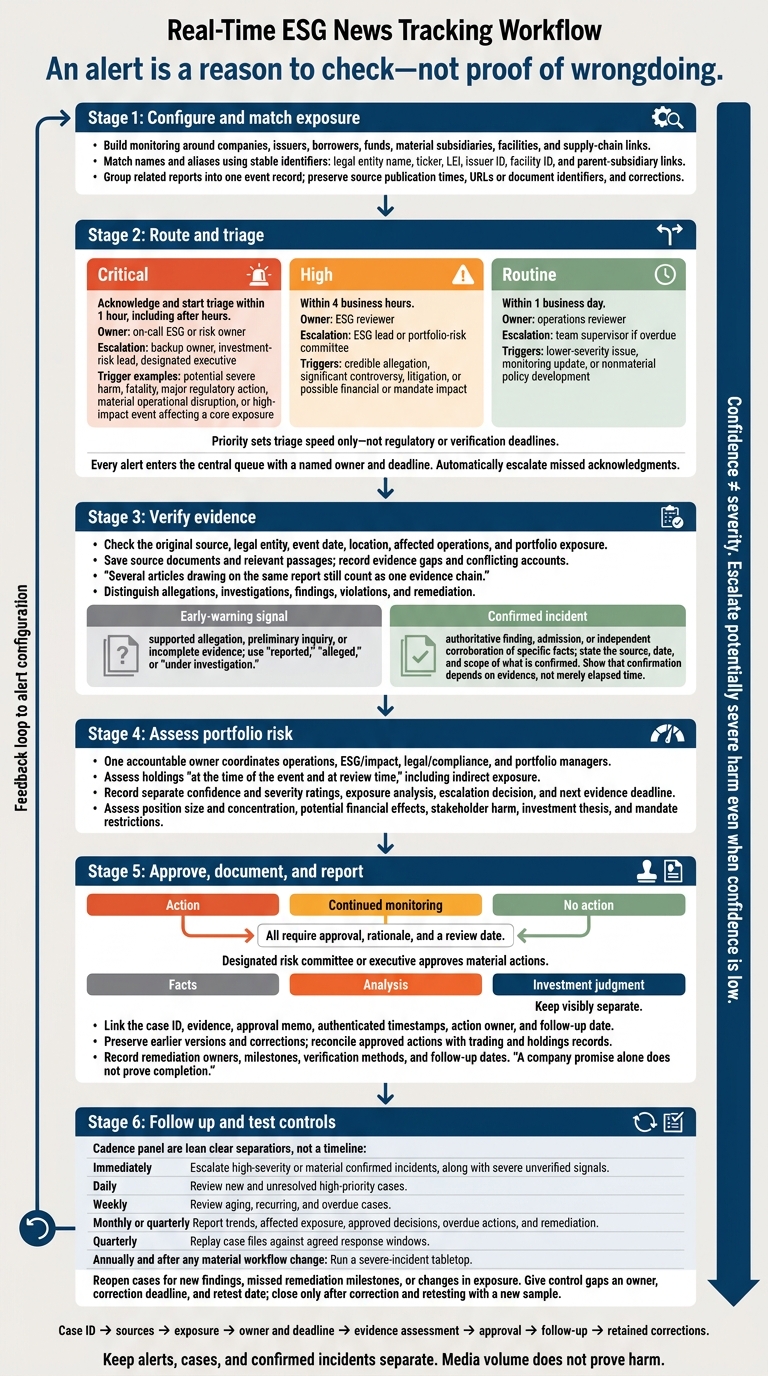
Real-Time ESG News Tracking Workflow
Configure and Route ESG Alerts
With statuses defined, send each new signal to the right review queue before verification starts.
Build Alerts Around Portfolio Exposures
Use the approved exposure map to build monitoring rules for companies, issuers, borrowers, funds, material subsidiaries, facilities, and supply-chain links. Match names and aliases with stable identifiers: legal entity name, ticker, LEI, issuer ID, facility ID, and parent-subsidiary links.
Filter by ESG theme, event type, geography, sector, severity, materiality, confidence, and source type - not broad keywords alone. Include local-language and regional sources where exposure warrants them. Match monitoring rules and review frequency to each holding’s sector and risk profile.
Draw from news outlets, NGO and civil-society reports, regulatory publications, court filings, stakeholder sources, stock-exchange filings, and company disclosures. Group related reports into one event record while keeping each source’s publication time, URL or document identifier, and later corrections.
Never automatically suppress a potentially severe signal because confidence is low. Send every alert to the central queue. Use dashboards and APIs for visibility, with email or pager notices as secondary channels. This separates early warnings from confirmed incidents and directs each signal to the right reviewer.
Routing priority controls response speed; it does not confirm an event. Once routing is in place, assign response times and escalation paths.
Set Alert Priorities and Response Times
Use the internal routing targets below. Priority sets triage speed only.
| Priority | Trigger | Recipient | Triage window | Escalation | System record created |
|---|---|---|---|---|---|
| Critical | Potential severe harm, fatality, major regulatory action, material operational disruption, or high-impact event affecting a core exposure | On-call ESG or risk owner | Acknowledge and start triage within 1 hour, including after hours | Backup owner, investment-risk lead, designated executive | Critical event record and linked exposure review |
| High | Credible allegation, significant controversy, litigation, or possible financial or mandate impact | ESG reviewer | Within 4 business hours | ESG lead or portfolio-risk committee | Review task with evidence and exposure fields |
| Routine | Lower-severity issue, monitoring update, or nonmaterial policy development | Operations reviewer | Within 1 business day | Team supervisor if overdue | Standard alert record |
These windows are routing targets, not regulatory or verification deadlines.
Specify business hours, observed U.S. holidays, the operating time zone, and backup coverage in the routing rules. Show localized timestamps and retain the machine-readable UTC offset:
11/05/2026, 9:00 AM ET
2026-11-05T09:00:00-05:00
Track publication, ingestion, routing, assignment, acknowledgment, escalation, and closure as separate steps. Automatically escalate missed acknowledgments. Keep owners, deadlines, and overdue tasks visible in the central portfolio queue.
Before launch, test a normal alert, a duplicate, a severe low-confidence signal, and a subsidiary or supply-chain match. Check that each test produces the correct exposure link, preserved source metadata, a named owner, a deadline, and a delivery record.
Then test missing identifiers, duplicate notifications, unavailable recipients, and after-hours delivery. Do not go live until missed acknowledgments trigger the intended escalation path.
sbb-itb-8baf5f1
Verify Events and Assess Portfolio Exposure
Check Sources and Classify Evidence
Once a case is routed, the review moves from alert triage to testing the evidence. Confirm the case, owner, and deadline. Open the original source and check the legal entity, event date, location, affected operations, and portfolio exposure. Save the document and relevant passages. If the source is unavailable, record the gap and look for supporting evidence. Do not mark the claim as verified.
Compare company statements with regulatory records, court filings, documented NGO reports, and independent reporting. Several articles drawing on the same report still count as one evidence chain. Keep allegations, investigations, findings, violations, and remediation separate. A company denial does not disprove a claim. Likewise, confirming an event does not confirm every allegation tied to it.
| Review control | Early-warning signal | Confirmed incident |
|---|---|---|
| Evidence standard | Supported allegation, preliminary inquiry, or incomplete evidence | Authoritative finding, admission, or independent corroboration of specific facts |
| Permitted language | “Reported,” “alleged,” or “under investigation” | State exactly what is confirmed, with its source, date, and scope |
| Decision authority | Case owner coordinates verification and specialist review | Designated risk committee or executive approves material actions |
| Escalation | Escalate potentially severe harm despite uncertainty | Apply formal review based on severity, exposure, and disclosure risk |
| Reporting | Show evidence gaps, confidence, and next review date | Show established facts, exposure, management response, and decision rationale |
Automation can help collect and match evidence, but high-impact cases need human review before investment judgments or external reporting. Confidence and severity are separate judgments: weak evidence of potentially severe harm may still warrant urgent escalation. Keep conflicting accounts visible.
Assign Review Owners and Assess Investment Risk
With the evidence standard set, assign one owner to coordinate the portfolio-risk assessment. The owner addresses evidence gaps and records the deadline, severity rationale, and escalation decision. Delegate specialist tasks without dividing accountability:
Operations: Confirm entity and security matches, positions, and duplicates.
ESG/impact: Assess stakeholder harm, scale, duration, reversibility, and management response.
Legal/compliance: Review regulatory records, litigation, disclosure duties, and wording.
Portfolio managers: Assess direct and indirect exposure, valuation effects, engagement options, benchmarks, and mandate restrictions.
Risk committee/executive: Approve material actions, limits, exceptions, or exit analysis.
Assess holdings both at the time of the event and at review time. Include indirect links through suppliers, customers, funds, and project finance. Measure position size and concentration alongside potential revenue losses, cleanup costs, litigation, financing pressure, and stakeholder effects. Check the investment thesis and impact objectives before proposing monitoring, engagement, valuation changes, limits, or exit analysis.
The review record should include a justified status, separate confidence and severity ratings, exposure analysis, escalation decision, accountable owner, and next evidence deadline.
Approve Decisions and Report Portfolio Risk
After reviewing evidence and exposure, apply the approval rules to choose action, continued monitoring, or no action. Keep facts, analysis, and investment judgment separate in the approval memo. Document rejected options, expected portfolio impact, and the person responsible for follow-up. A no-action decision still needs approval, a rationale, and a review date.
Document Evidence, Decisions, and Approvals
Link the approval memo and authorization to the existing case ID and supporting evidence. Label allegations, estimates, and verified findings separately. Keep expected portfolio impacts separate from observed outcomes. Use MM/DD/YYYY for dates, 12-hour time with a time zone, and exposure amounts in USD and as a percentage of NAV.
Require authenticated approval timestamps and role-based editing. Preserve earlier versions, unresolved conflicts, rating changes, and closure reasons. Reconcile approved actions with trading and holdings records so reported exposure matches executed exposure.
Document remediation commitments with owners, milestones, verification methods, and follow-up dates. A company promise alone does not prove completion. Retain approval records according to applicable requirements and the firm’s records policy.[5][4]
Feed approved decisions into the portfolio review calendar and client-facing reports.
Schedule Portfolio Reviews and Reports
Use the review calendar to coordinate escalation, follow-up, and reporting. Immediately escalate high-severity or material confirmed incidents, along with severe unverified signals. Review new and unresolved high-priority cases daily; review aging, recurring, and overdue cases weekly. Define reopening triggers for new findings, missed remediation milestones, or changes in exposure. Agree on ad hoc client notification requirements in advance.[6]
Report trends, affected exposure, approved decisions, overdue actions, and remediation monthly or quarterly. Include each material case’s status, approval details, and follow-up details. Connect case IDs to portfolio surveillance, quantitative risk signals, risk attribution, and internal or client reports.
Keep alerts, cases, and confirmed incidents separate. Media volume does not prove harm, and estimates must remain labeled as estimates.
Test Controls and Follow Up
Once approvals are logged, replay cases to check that the workflow still works as designed.
Replay case files quarterly against agreed response windows. Include confirmed incidents, early warning signals, duplicates, similar issuer names, and subsidiaries. Compare expected and actual issuer matches, severity, routing, ownership, approvals, and classification. Check that source quality and verification supported each classification.
Track detection coverage, false positives, median and worst-case time from detection to approval, overdue reviews by age, and repeat incidents as separate measures. Investigate missed events before adjusting keywords or thresholds. Test each adjustment for its effect on both detection coverage and reviewer workload.
For an audit check, ask an independent reviewer to reconstruct a decision using only the case file. Missing source records, handoffs, or approvals point to gaps in the audit trail. Keep the original record and all later corrections.
Run a severe-incident tabletop annually and after any material workflow change. Include conflicting reports, an unavailable owner, and an investment decision request. Set evaluation criteria before the exercise, then give every gap a named owner, correction deadline, and retest date. Close a gap only after the failed case has been corrected and retested with a new sample.[7][8][9]
FAQs
When should an unverified ESG alert affect investment decisions?
An unverified ESG alert should prompt an issuer-level review, not be treated as proof of misconduct or financial risk. Check the alert against reliable sources before making a formal investment decision [1].
Assess the issue’s severity, recurrence, and possible financial or regulatory impact. Refer potentially material issues to the appropriate committee [1][2]. Adjust positions or exit holdings only after documenting verification that the risk is real - not merely an unresolved information gap [1][3].
How can we reduce alert fatigue without missing serious risks?
Replace manual monitoring with rule-based screening that separates early warnings from confirmed incidents. Set policy-based triggers, such as revenue exposure limits or breaches of specific norms, to filter out noise.
Use automated validation to catch data errors. Then send the remaining alerts through tiered reviews, each with an assigned owner, required evidence, and an escalation deadline. This keeps reviewers focused on verified concerns that matter, rather than minor or outdated signals.
How should we resolve conflicting ESG evidence?
Treat missing data as unknown, not zero. When disclosures lack detail or sources disagree, validate each record by mapping operations and checking origins against permits, satellite evidence, and supplier data.
Record conflicting evidence, what was known, and how each conflict was resolved. Escalate claims that remain unverified after checks across multiple reliable sources. Require human approval for disputed cases, and keep snapshots of inputs and methods so others can reproduce the review.




FAQ