In This Article
Verify durability, repairability, recycled-content, and disposal claims so labels actually guide repair, return, or recovery.
Product Labels Guide Circular Consumption Choices
I treat a product label as a guide to action - not proof of lower impact. Before publishing, I check that each claim has records behind it and tells you how to choose, maintain, repair, or return the product.
My checklist covers four steps:
Define each claim: State durability limits, repair options, and recycled-content percentages. A claim of 30% recycled plastic, for example, should name the covered component and any exclusions.
Separate content from disposal: Recycled material does not mean a product is recyclable. Give collection instructions that match local services, and distinguish home from industrial composting.
Check wording and understanding: Keep limits beside claims, align print and digital labels, and test what people understand - and actually do.
Keep the promise working: Assign claim owners, update records when products or rules change, and maintain parts, repair links, and return programs.
My bottom line: <u>the label and the service behind it must match</u>. Clear wording helps only when buyers can take the next step.
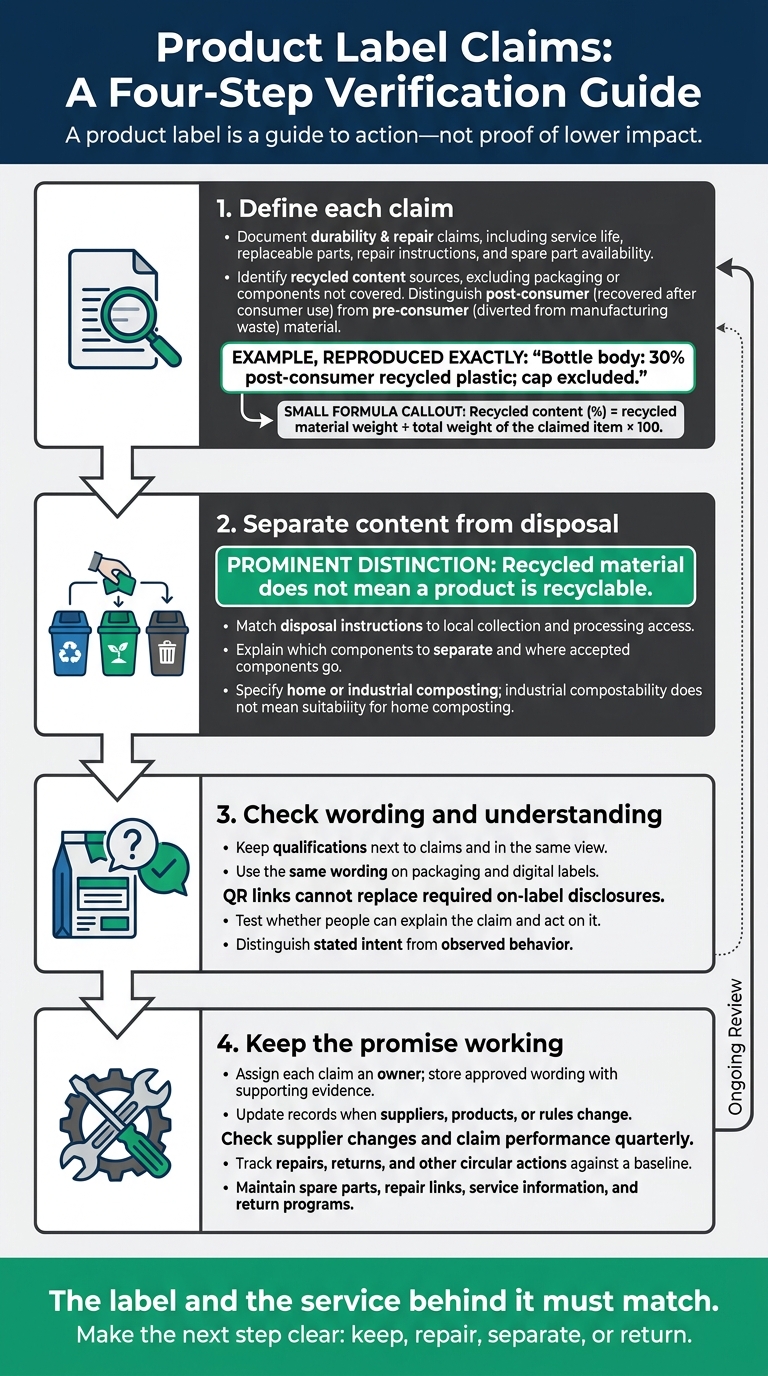
Product Label Claims: A Four-Step Verification Guide
The Most Confusing Sustainability Labels (Compostable, Biodegradable, Recyclable Explained)
sbb-itb-8baf5f1
Define Durability, Repair, and Material Claims
Durability, repair, and material content each need their own proof. Evidence for one does not support the others.
Explain Service Life and Repair Options
Keep durability and repair wording tied to your records. Don’t suggest a longer service life or easier repairs than the evidence supports. State which parts can be replaced, where buyers can find repair instructions, and how long spare parts will be available.
State Recycled Content Precisely
Distinguish post-consumer material recovered after consumer use from pre-consumer material diverted from manufacturing waste. Specify whether the percentage covers the product, packaging, or a component. Keep material records and any relevant certification tied to that scope.
Calculate recycled content by dividing the recycled material’s weight by the total weight of the claimed item, then multiplying by 100. State any exclusions.
Bottle body: 30% post-consumer recycled plastic; cap excluded. [1]
Separate Material Content From Disposal Instructions
Base disposal instructions on access to local collection and processing - not material type alone. Tell buyers which components to separate and where each accepted component goes. For compostable products, specify home or industrial composting. Industrial compostability does not mean a product is suitable for home composting.
Each claim should make the buyer’s next step clear: keep, repair, separate, or return.
| Claim | Required proof | Qualifications to disclose | Consumer action | Risk of misinterpretation |
|---|---|---|---|---|
| Recycled content | Weight calculations and material records | Covered item, percentage, material source, and exclusions | Identify what the percentage covers | Assuming recycled means recyclable |
| Recyclable | Evidence of collection and processing access | Geographic limits and component restrictions | Confirm local collection and sort by component | Assuming acceptance everywhere |
| Repairable | Documented repair procedures and spare-part availability | Which failures or parts are covered, and for how long | Follow the repair guide | Assuming every failure is repairable |
| Compostable | Testing against an applicable compostability standard | Home versus industrial conditions and local composting facility acceptance | Use the specified composting route | Treating industrial compostability as home compostability |
Before publication, test these claim words with consumers to check that the label matches how people read it and act on it.
Check Claims and Use Plain Wording
Once claim content is defined, review the full label: wording, symbols, colors, and placement. Keep qualifications next to claims so buyers can make choices about purchasing, repairing, or returning products.
Record the Proof Behind Each Claim
Keep evidence for durability, repair, and recycled-content claims. Approve each claim only when its supporting records, limits, and conditions are on file.
Replace Vague Claims With Specific Statements
Replace broad claims with the narrowest statement your records support.
Garment made with 85% post-consumer recycled polyester. [1]
Make Labels Accessible and Consistent
Keep each claim and its qualification in the same view. Use the same wording on packaging and digital labels. QR links can provide proof, but they cannot replace required on-label disclosures. [1]
Test Labels and Keep Them Current
Once the label text is set, test it in use. Start with one product category and involve procurement, product design, legal, communications, and service teams.
Test Understanding and Consumer Actions
Use interviews and task-based tests to check both understanding and action. Ask participants to explain each claim without help, then watch what they do. Can they use the label to choose repair, return, or recovery? Keep stated intent separate from observed behavior, and use the pilot to find wording gaps before rollout.
Update Claim Records and Track Results
After the label passes testing, lock the approved version and monitor it. Give each claim an owner, and store its approved wording alongside the supporting evidence. Review claims whenever suppliers, products, or rules change. Check supplier changes and claim performance quarterly [1]. Track repairs, returns, and other circular actions against a baseline.
Link Labels to Repair and Recovery Services
Keep the label useful after launch by maintaining the services it directs people to. Test repair links and keep service details current and accessible.
Conclusion: Publish Clear, Verified Labels
Publish only claims backed by testing, verification, and your records. Explain durability limits and repair options in plain language. For recycled-content claims, name the material, give the percentage, and specify whether the claim covers the product or packaging. Keep disposal instructions separate and link them to local collection and recovery services.
Before release, check every claim and test whether consumers understand it as intended. Labels should help people choose, maintain, repair, or recover a product - not suggest circular benefits beyond what the evidence supports.
Assign clear responsibility for evidence, wording, and service information. Update labels when product data, recovery options, or consumer behavior changes.
FAQs
How can we label products sold in different recycling markets?
Use clear, location-specific wording instead of vague symbols. State that products are recyclable only where municipal programs have the right facilities, and specify which components those programs can process locally.
Provide disassembly steps, material details, and disposal instructions through digital product passports or accessible databases. Back claims with verifiable data, such as post-consumer recycled content percentages, rather than generic statements. This guidance helps consumers sort materials correctly and reduces recycling contamination.
What should we do if a supplier’s claim lacks proof?
Put verification before marketing. Require third-party certifications, chain-of-custody records, or lifecycle assessments rather than relying solely on supplier-reported data. Set clear reporting and verification requirements before awarding contracts. If a supplier falls short, establish a 6- to 12-month milestone plan backed by technical assistance.
Keep unverified claims off product labels. Unsupported claims weaken consumer trust and may create regulatory risks.
How many consumers should test our labels?
Bring together 6 to 8 target consumers in focus groups to pinpoint shared concerns, values, and convenience needs before full-scale development begins.
Pair these discussions with structured surveys, A/B tests of different label formats, and field research in everyday settings. This mix of qualitative and quantitative feedback helps you check whether labels are clear, connect with your audience, and communicate durability, repairability, and recycled content.




FAQ