
Oct 8, 2026 · 12 min read
Sustainability Strategy
In This Article
How open-source records, passports, and workflows help track assets, coordinate partners, and measure repair, reuse, and recovery.
How Open-Source Tools Support Circular Models
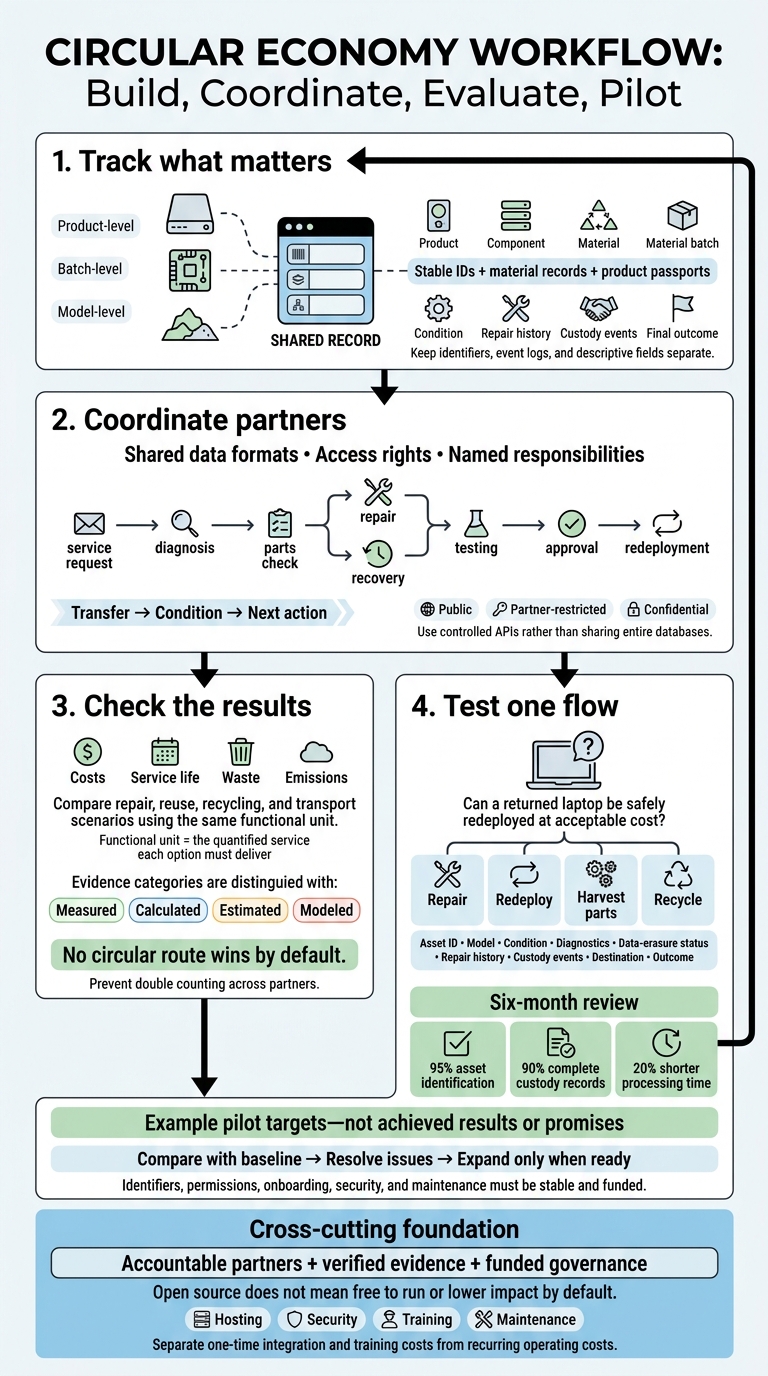
I start with the decision, not the software: can we repair, reuse, or recover a product at an acceptable cost? Open-source tools can help answer that question when we link each item to its condition, repair history, custody records, and final outcome.
I build that approach around four steps:
Track what matters: Give products and components stable IDs, then connect material records and product passports.
Coordinate partners: Set shared data formats, access rights, and clear responsibilities for leasing, repairs, returns, and resale.
Check the results: Compare costs, service life, waste, and emissions. Separate recorded outcomes from modeled estimates.
Test one flow: Start with returned laptops and set a six-month review. Example targets include 95% asset identification and 90% complete custody records - targets, not promised results.
My rule is simple: <u>open source does not mean free to run or lower impact by default</u>. I budget for hosting, security, training, and maintenance, then expand only when the records help us make better decisions.
Open-Source Circular Models: From Records to Results
Kim Lantto (SW): Open source Smart Map for Sharing and Circular Economy
sbb-itb-8baf5f1
Build Shared Asset and Material Records
Preselection checklist: Agree on which objects and lifecycle stages to track, required events and fields, supporting evidence, field owners, access rules, retention periods, and integrations. Define the data dictionary first to keep terms consistent. Assign someone to resolve conflicting records.
Track Asset Identity and History
Start by defining the record. Keep stable identifiers, event logs, and descriptive fields separate. Assign a persistent identifier to each product, component, and material batch. QR codes, barcodes, or RFID tags can link physical items to their records. The identifier should stay the same when custody changes.
For every transfer, inspection, repair, or recovery event, record the timestamp, actor, location, origin system, verification status, and supporting evidence.
eReuse shows component-level electronics traceability for reuse and recycling.[6]
Before deployment, compare the selected repository’s license, hosting model, export options, and rules for assigning or transferring device records. Once identifiers are stable, add material and recovery data to the same records.
Document Materials, Repairs, and Recovery Options
Add the bill of materials, supplier information, hazardous substances, recycled-content evidence, component compatibility, repair instructions, spare-part availability, maintenance history, and disassembly steps. Mark each piece of information as product-level, batch-level, or model-level, and keep measured facts separate from supplier claims.
BAMB’s materials-passport framework spans materials, components, products, and systems in buildings; its projects report more than 300 passports.[6][8]
This structure helps teams trace parts, materials, and recovery options through one source record. A passport framework is neither a software product nor a U.S. mandate.
Set Data Formats and Access Rules
Once you know what to track, decide how partners will name, structure, and exchange the data. Treat shared meanings, data models, and exchange rules as separate decisions. Shared data models help repairers, logisticians, and recyclers interpret each field the same way.
| Component or framework | Classification | Represented information | Intended users | Interoperability role | Licensing considerations |
|---|---|---|---|---|---|
| ECLASS | Classification and semantic dictionary | Product classes, properties, units, values | Manufacturers, suppliers, integrators | Consistent field meanings | ECLASS license required for commercial product descriptions, per Catena-X documentation.[9] |
| Asset Administration Shell (AAS) | Digital-asset representation and information structure | Asset identity, domain-specific submodels | Manufacturers, operators, digital-twin developers | Machine-readable asset records | Distinct specification, submodel, and implementation licenses |
| Catena-X | Industrial data ecosystem and exchange framework | Product, partner, traceability, sustainability data | Automotive companies, suppliers, service providers | Exchange standards and governance | Different conditions for development and productive commercial use.[7] |
Set exchange rules at the field level, since partners need access to different information. Use controlled APIs rather than sharing entire databases. Preserve schema versions, source documents, corrections, and the calculation version behind each impact result. Impact data also needs units, geography, reference year, system boundaries, allocation method, and uncertainty.
Set access levels based on the information:
Public: Repairability guidance and non-sensitive environmental data.
Partner-restricted: Serial history, custody, inventory, supplier declarations, and repair pricing.
Confidential: Formulations, sensitive locations, personal data, customer contracts, and margins.
Assign create, edit, approve, correct, archive, and export rights separately from ownership. These records then supply the data for leasing, reverse logistics, and reuse coordination.
Coordinate Product, Logistics, and Reuse Networks
Once shared identifiers and access rules are in place, open-source workflows can route returns, repairs, and reuse decisions.
Manage Equipment Leasing and Repair
Use operating hours and inspection thresholds to flag returned equipment for service. Release it for redeployment only after testing and quality approval. Route unsuitable assets to recovery.
Follow the workflow from service request → diagnosis → parts check → repair or recovery → testing → approval → redeployment. Record symptoms, safety restrictions, labor, installed and removed parts, and test evidence. Base each routing decision on safety, condition, demand, timing, and net value. Require controlled rebuilding and quality checks before calling the work remanufacturing.
This record structure can also coordinate reverse logistics and packaging returns.
Track Returns and Reusable Packaging
Link crate IDs to shipments and storage records. Confirm custody at every handoff, coordinate pickups and consolidated returns, and require cleaning and inspection before redeployment. Share only the fields each role needs.
Use this handoff checklist for products and packaging:
Transfer: Asset ID, shipment/work order ID, sender, receiver, location, time, quantity, custody status.
Condition: Inspection result, damage, contamination, quarantine.
Next action: Status, owner, deadline, destination.
Mark each transfer as accepted or flagged. Reconcile missing items against their last confirmed custodian.
The workflow also applies to building materials, where removal timing and buyer acceptance determine whether reuse can proceed.
Plan Construction Material Reuse
Grade component condition, estimate residual value, and identify buyers to guide selective disassembly and resale. Give buyers records that include dimensions, photos, availability, disassembly steps, and inspection evidence.
Before scheduling removal, check transport miles, storage capacity, inspection and certification needs, building code, fire and structural requirements, accessibility, and warranty terms.
A passport informs the decision; it does not certify suitability. BAMB brought together 16 European companies, research institutes, and universities and tested the approach through four pilot projects.[10][11][12]
Check whether fasteners allow removal without damage, required inspections are feasible, and storage and transport costs still support reuse. A match remains provisional until the component meets acceptance criteria.
Measure Results and Manage Partner Reporting
Use the shared records from earlier sections to compare routes and check partner claims against the evidence.
Compare Circular Options with openLCA
Use openLCA to compare repair, reuse, recycling, and transport scenarios using the same functional unit.[13][15][5] Define the functional unit - the quantified service each option must deliver - along with reference flows, study period, geography, allocation rules, impact categories, and cost perspective.
Allow for extra costs for databases, methods, training, and support.[14][16]
| Comparison | Functional unit | Key inputs | Calculation boundary | Costs in U.S. dollars | Impact indicators |
|---|---|---|---|---|---|
| Repair vs. replacement | A product delivering equivalent service over a defined period | Parts, energy, service life, failure rate, displaced production | Extraction, manufacturing, repair or replacement, transport, use, end of life | Parts, labor, shipping, downtime, purchase, warranty | Climate change, material use, energy, waste, water |
| Reuse vs. recycling | Equivalent service or recovered material, accounting for substitution | Cleaning, testing, remaining life, yield, substitution | Collection, preparation, processing, next use | Collection, sorting, cleaning, storage, processing, resale revenue | Climate change, virgin-material demand, waste diversion, yield, toxicity |
| Local refurbishment vs. longer-distance transport | A refurbished product delivered and used at its destination | Energy, materials, distance, mode, load factor, damage rate | Collection, refurbishment, all transport legs, use, end of life | Labor, facilities, freight, customs, inventory, returns | Climate change, particulate matter, energy, congestion-related impacts |
No circular route wins by default. Results depend on inventory databases, process data, allocation rules, transport assumptions, assessment methods, and data quality.[13][14] Report both absolute results and results per functional unit. Test how changes in service life, repair success, electricity mix, transport distance, and recycling yield affect the outcome. Use that same result set to choose a route and record the assumptions behind the choice.
Define Circular Metrics and Verify Impact Claims
Keep the asset and batch IDs from earlier sections so repairs, returns, reuse, and recovered content remain linked. Don't count a repair and a later resale as two reused units.
Separate activity, calculations, and modeled benefits. A completed repair is an activity; repair success is calculated; avoided emissions need a baseline and a model. Label every result as measured, calculated, estimated, or modeled. Report revenue in U.S. dollars and mass in pounds, U.S. short tons, or kilograms.
| Metric | Definition and calculation | Source | Frequency | Responsible partner | Supported decision |
|---|---|---|---|---|---|
| Product life extension | Additional service time beyond expected life | Asset history, service and resale records | Quarterly | Product owner or service provider | Design, warranty, replacement planning |
| Repair success | Successful repairs ÷ repair attempts × 100 | Repair tickets and test results | Monthly | Repair partner | Parts inventory and technician training |
| Return rate | Eligible units returned ÷ units sold or issued × 100 | Sales, lease, deposit, return records | Monthly | Brand, lessor, or logistics partner | Collection incentives and network design |
| Reuse rate | Units placed into another use ÷ returned units assessed × 100 | Inspection, resale, redeployment records | Quarterly | Refurbisher or reuse operator | Reuse capacity and channel selection |
| Utilization | Actual service use ÷ available capacity × 100 | IoT, booking, rental, operating logs | Monthly | Asset operator | Fleet size and sharing model |
| Recovery yield | Usable recovered output ÷ input received × 100 | Processor weight tickets and output records | Each batch or monthly | Recycler or recovery partner | Process improvement |
| Recovered content | Recovered material incorporated ÷ total relevant material input × 100 | Bills of materials, supplier declarations, chain-of-custody records | Per product version or quarterly | Manufacturer or supplier | Procurement and product design |
| Secondary-use revenue | Revenue from repaired, refurbished, reused, or recovered products and materials | Invoices and sales ledger | Monthly or quarterly | Finance and commercial partner | Pricing and circular revenue viability |
| Waste diversion | Material diverted from disposal ÷ material received × 100; specify treatment route | Scale tickets, processor certificates, disposal records | Monthly | Logistics or processing partner | Route and vendor management |
| Reporting completeness | Valid, timely required fields or submissions ÷ total required × 100 | Reporting platform audit log | Monthly or quarterly | Program data owner | Partner support and data-quality controls |
Before publication, check that each claim matches the business-as-usual baseline, the model, and the named owners:
Baseline and boundaries: Record the baseline lifetime, replacement rate, composition, transport, energy, disposal, and service volume. Include the functional unit, reporting period, geography, included stages, and allocation rules.
Calculations: Keep formulas, assumptions, units, conversions, uncertainty, model and database versions, and cost inclusions. State whether figures are nominal or inflation-adjusted and how they treat labor, overhead, freight, taxes, incentives, and revenue.
Handoff validation: Require the receiver to confirm receipt or report a discrepancy within five business days. Check for duplicates, missing fields, invalid units or dates, quantity losses, and mass-balance errors. Preserve corrections and unresolved exceptions.
Claims and owners: Name the submitter, validator, and publication approver. Record evidence-review status and benefit attribution, and prevent double counting across partners.
As partners begin submitting results, assign field ownership before anything is published.
Assign Data, Security, and Maintenance Responsibilities
Create a field-level responsibility matrix that names who submits, validates, updates, corrects, controls access, retains, and approves publication or reuse of each field. Repair partners submit fault codes and labor hours. Finance controls revenue fields. The data steward manages definitions and reporting approval.
Data sovereignty means control over who can access, combine, reuse, or publish data, subject to partner agreements and applicable law. Limit customer data collection, obtain consent where applicable, and protect confidential designs and commercial data. Define permitted uses in partner agreements, backed by role-based access, encryption, audit logs, retention limits, and breach-response rules.
Assign a security lead to handle updates and access reviews. Budget for hosting, backups, support, database licenses, and schema migration. Give smaller partners simple workflows, templates, validation messages, and onboarding support.
Use monthly submissions as the default. Review errors monthly and results quarterly. Version schema changes before retiring fields.
Run a Pilot and Review Results
Choose One Flow and Its Required Data
Once shared records and roles are defined, test them in one live flow.
Start with one decision: can a returned laptop be safely redeployed at acceptable cost?
Map collection, inspection, repair, and final disposition. Track custody changes, locations, delays, and losses. Use the minimum viable record, rather than documenting every attribute: asset ID, model, condition, diagnostics, data-erasure status, repair history, custody events, destination, and outcome. Assign each field an owner and an allowed format. Choose only the tools the pilot needs, and test a simple export before building full integrations.
| Pilot need | Required data | Users | Software or standard | Licensing or access check | Expected decision |
|---|---|---|---|---|---|
| Laptop diagnosis and redeployment | Asset ID, hardware condition, component inventory, battery health, repair history, data-erasure status | IT team, refurbisher, recycler | eReuse Workbench and DeviceHub | Budget for hosting, configuration, support, and maintenance | Repair, redeploy, harvest parts, or recycle |
| Environmental comparison, if needed | Materials, energy, transport, repair, remaining service life, and end-of-life assumptions | Sustainability and LCA analysts | openLCA and suitable databases[17][18] | Check separate dataset licenses and usage restrictions | Compare impacts of the laptop’s available routes |
| Shared product data, if needed | Product identity, materials, repair options, recovery guidance | IT team, refurbisher, recycler | Product passport using ECLASS concepts and an Asset Administration Shell | Check licenses and define partner access rights | Share the information partners need to repair, redeploy, harvest parts, or recycle |
Set Pilot Costs, Roles, and Targets
With the flow selected, set the budget, owners, and review date. Before launch, record baseline return rates, average processing time, repair outcomes, processing costs, and reporting completeness.
Set a six-month review window with targets such as 95% asset identification, 90% complete custody records, and 20% shorter processing time.
Give one pilot owner control of the budget and authority to stop or proceed. Assign collection, repair, logistics, data stewardship, and security to named partners. Keep one-time integration and training costs separate from monthly hosting, support, security, and maintenance costs.
Check Results Before Expanding
Use the results to decide whether the workflow is ready for a second flow. Compare them with the baseline using the same functional unit, time period, inclusion rules, and calculation boundaries.
Review shared records and partner reports for participation, unexplained losses, cost per processed laptop, and documented repair or recovery outcomes. Check whether the records provide enough information to choose between repair, redeployment, parts harvesting, and recycling.
Expand only when identifiers, permissions, onboarding, security, and maintenance are stable and funded. Give every unresolved issue an owner and due date. Revise workflows before adding partners or asset categories.
Conclusion: Put Shared Records to Work
Reliable records link repair and reuse decisions with reverse logistics, partner reporting, and measured results. Software runs workflows, standards keep data consistent, and passports organize information for authorized users. A workable circular model also needs accountable partners, verified impact calculations, and funded governance - not just more technology.
FAQs
Can we start circular asset tracking without complete product data?
Yes. Start with a small pilot focused on specific product lines, regions, or customer segments [1]. When direct inputs aren’t available, use secondary industry data to fill the gaps [2].
Use QR codes or simple digital tools to track material flows and support returns [3]. As you scale, add IoT and blockchain to improve visibility and standardize material data [3][1][4].
How can we encourage partners to share reliable data?
Build trust by being transparent and using standardized frameworks, such as ISO 59040 Product Circularity Data Sheets, to share supply-chain data securely and consistently [1]. Bring partners into the process early to assess their readiness, offer training, or jointly fund data-collection infrastructure [2].
Set clear partnership agreements that define roles, risk-sharing, and data-sharing protocols. This helps everyone understand their responsibilities and the value of sharing data [3].
When does repair stop making financial and environmental sense?
Repair stops making financial and environmental sense when it no longer preserves a product’s embedded energy, complexity, and value effectively [1]. When maintenance, repair, and reuse aren’t feasible, turn to remanufacturing. Treat recycling as a last resort [1].
To determine that cutoff, weigh technical, economic, environmental, legal, and market criteria. A product’s remaining value - and demand for its recovered materials - can shift quickly [1].



FAQ