In This Article
Evaluates light-driven plastic recycling by focusing on recovered products, purity, energy use, and practical scale-up tests.
Photochemical Recycling: Light-Driven Plastic Recovery
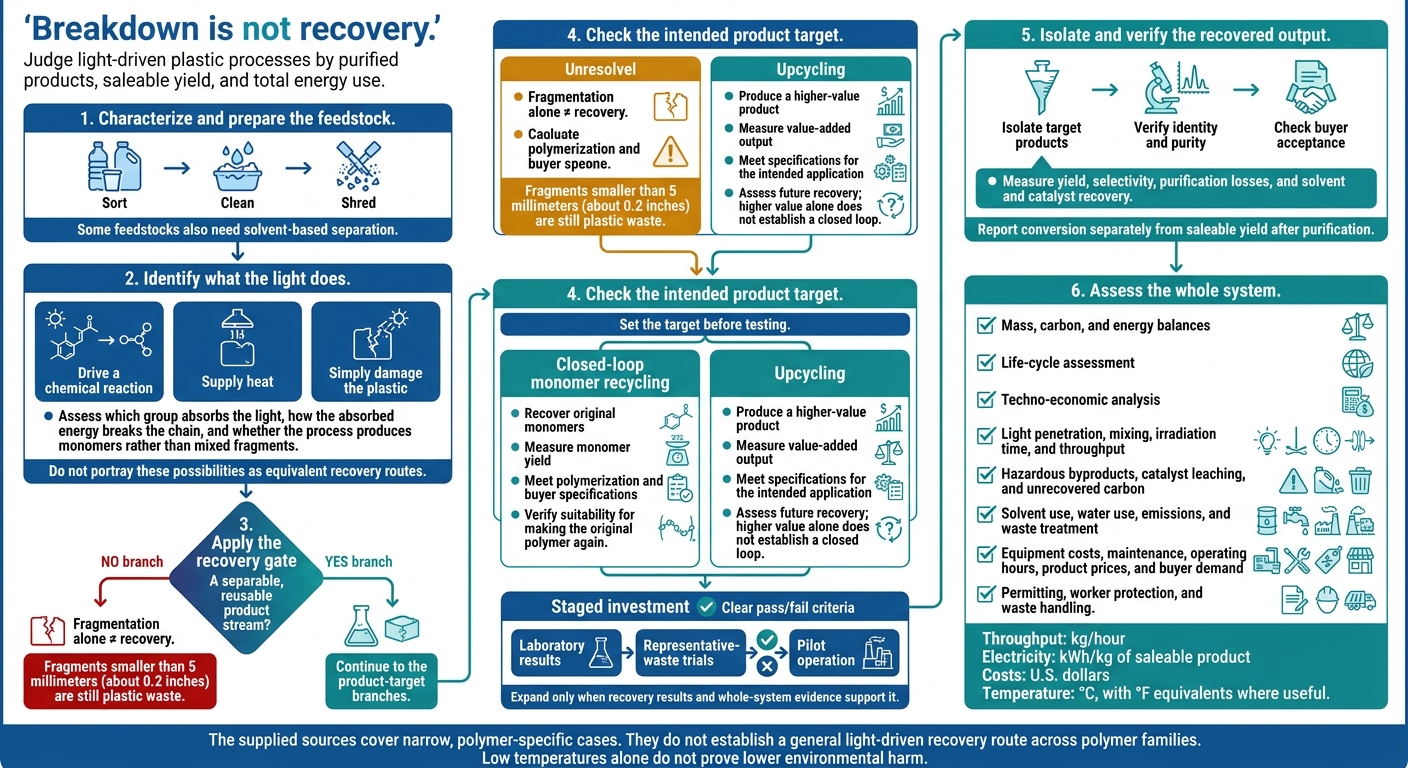
I judge photochemical recycling by what it recovers - not how much plastic disappears. Before backing a process, I would ask for purified product samples, saleable yield, and total energy use. Fragments smaller than 5 millimeters (about 0.2 inches) are still plastic waste.
Light can help turn plastics into reusable chemicals, but the sources reviewed here do not establish a single recovery route for all the plastics discussed. I focus on three questions:
What does the light do? Drive a chemical reaction, supply heat, or simply damage the plastic?
What can we reuse? Original monomers for new plastic, or other chemicals that meet buyer requirements?
Does the whole process work? Check sorting, purification, safety, waste, costs, and energy - not conversion alone.
My starting rule is simple: test before investing. I would move from lab work to waste-feedstock trials and then pilot testing, with <u>clear pass/fail criteria at each stage</u>.
Photochemical Recycling: From Breakdown to Verified Recovery
New method by NTU scientists uses light energy to turn plastic waste into useful chemicals
sbb-itb-8baf5f1
How Light Breaks Down Plastics
Controlled photochemical recovery uses light, photocatalysts, or sensitizers to activate specific bonds and split polymer chains. UV stabilizers can slow these light-driven reactions. [2]
The goal is separable products, not random fragments. Before treatment, the plastic feedstock must be sorted, cleaned, and shredded. Some feedstocks also need solvent-based separation. [1][5]
Chain Cleavage and Monomer Recovery
Assess which group absorbs the light, how the absorbed energy breaks the chain, and whether the process produces monomers rather than mixed fragments. [2]
Photooxidation into Chemical Feedstocks
Photooxidation can turn plastics into chemical feedstocks. The key questions are which products form and how much of the output consists of byproducts.
After irradiation, isolate the target products and verify their identity and purity before reuse. Energy use and economics also need review. [2] Assess each mechanism against the chemistry of the specific polymer being treated.
Which Plastics Researchers Study
The supplied sources cover narrow, polymer-specific cases. They do not establish a general light-driven recovery route across polymer families. [2][3][4]
Results vary by polymer. Several studies address related chemistry rather than direct photochemical recycling.
| Polymer | What the sources show | Assessment |
|---|---|---|
| PMMA | No specific light-driven recovery study supplied | Direct recovery not established |
| Polystyrene (PS) | Photodegradation and fragmentation, not selective product recovery [2] | Direct recovery not established |
| PET | Thermal upcycling through catalytic pyrolysis into oxygen-rich carbon nanotubes [3] | No evidence of direct photochemical recovery |
| PLA | Reprocessing shown for specially designed vitrimers with dynamic bonds, not conventional PLA waste [4] | Not evidence for ordinary PLA recovery |
| PE, PP, and PVC | General photodegradation, without demonstrated selective recovery [2] | Direct recovery not established; PVC requires chlorine management |
The key test is whether light produces a separable, reusable product stream, rather than simply damaging or fragmenting polymer molecules.
PMMA and Polystyrene
The supplied sources do not verify monomer recovery from PMMA or selective product streams from PS. Before assigning either route a readiness level, request the primary study and confirm the exact feedstock used.
PET, PLA, and Other Ester-Containing Polymers
Related studies do not necessarily show direct photochemical recovery from ordinary waste plastics. The cited PET study uses thermal upcycling, not photochemical recycling. [3] Likewise, dynamic bond exchange in a specially designed vitrimer does not establish recovery from conventional polyester waste. [4]
For any claimed light-assisted process, check what the light actually does: act on the polymer, activate a catalyst, or convert an intermediate made through another treatment.
Polyethylene, Polypropylene, and PVC
The stable carbon-carbon backbones of these polymers make controlled, selective conversion difficult. No supplied primary study demonstrates selective photochemical recovery from PE, PP, or PVC. PVC also requires explicit chlorine management. [2]
How to Assess Photochemical Recovery
Photochemical research is polymer-specific and often stops at conversion data. The next step is to check whether the output is usable. Apply these criteria only when the reaction produces a recoverable stream - not just fragmented polymer.
Set the target before testing: closed-loop monomer recovery or upcycling. Measure monomer yield for the first and value-added output for the second.
Match Feedstocks to Product Requirements
Document the polymer composition and contamination. Require data on product identity, purity, yield, selectivity, and acceptance against buyer specifications. Report conversion separately from saleable yield after purification.
Apply the same test to every route: does the recovered stream meet the requirements of the next manufacturing step?
| Requirement | Closed-loop monomer recycling | Upcycling |
|---|---|---|
| Target output | Recover original monomers [2] | Produce a higher-value product [1] |
| Quality | Meet polymerization and buyer specifications | Meet specifications for the intended application |
| Feedstock tolerance | Show tolerated contamination limits | Demonstrate tolerance for the particular process |
| Purification | Measure losses from removing impurities | Measure separation needs and final product recovery |
| Circularity | Verify suitability for making the original polymer again | Assess future recovery; higher value alone does not establish a closed loop |
Once product quality is established, check whether the process can run safely and efficiently at a useful scale.
Check Reactor Performance, Safety, and Resource Use
Request mass, carbon, and energy balances, a life-cycle assessment, and a techno-economic analysis that compares the process with realistic existing management options. Include irradiation, separation, and residue disposal.
Report costs in U.S. dollars, throughput in clearly labeled units such as kg/hour, electricity in kWh/kg of saleable product, and temperatures in °C, with °F equivalents where useful.
| Assessment area | Potential gain to test | Limits and required evidence |
|---|---|---|
| Feedstock | Recover otherwise difficult streams | Test representative feedstocks and document rejected fractions |
| Chemistry | Favor useful products | Measure selectivity, hazardous byproducts, catalyst leaching, and unrecovered carbon |
| Reactor design | Use light effectively | Establish light penetration, mixing, irradiation time, throughput, and irradiation safeguards |
| Separation | Deliver usable output | Quantify product purity, purification losses, and solvent and catalyst recovery |
| Impacts | Reduce resource use | Include total electricity demand, solvent use, water use, emissions, and waste treatment |
| Commercial factors | Produce saleable products | Test equipment costs, maintenance, operating hours, product prices, and buyer demand |
Set Evidence Requirements Before Investing
Require representative-feedstock trials, independent product-quality verification, scale-up operating data, supported economics, and confirmed offtake requirements. Define permitting, worker-protection, and waste-handling obligations before funding. Smaller organizations should begin with limited trials and clear pass/fail criteria, rather than equipment purchases.
Conclusion: Base Decisions on Recovery Evidence
Light can trigger plastic breakdown, but polymer chemistry determines whether recovery is possible. Monomer recovery and upcycling follow different routes, yet both need usable, purified products. Breakdown is not recovery. [2]
The recovered material must be fit for use. Low temperatures alone do not prove that a process reduces harm to the environment. That requires checking the whole system: feedstock tolerance, energy use, solvent recovery, residue management, and product quality.
Advance in stages. Move from laboratory results to representative-waste trials, then to pilot operation. At each stage, assess product quality, scale, and resource use before deciding whether to proceed. Expand only when recovery results and evidence from the whole system support it - not simply because the plastic breaks down.
FAQs
Can sunlight replace UV lamps in photochemical recycling?
The provided sources do not establish whether sunlight can replace UV lamps in photochemical recycling. They discuss recycling and upcycling, challenges with plastic recycling infrastructure, and life cycle assessment methods, but do not specify the light sources needed for photochemical recovery.
How do dyes and additives affect plastic recovery?
Dyes and additives can contaminate plastic recovery streams, reducing recovery yields and process efficiency. Plasticizers, flame retardants, UV stabilizers, and pigments can leach from plastic debris, introducing persistent pollutants or lowering the quality of recycled materials.
Mixed polymer streams that contain additives are often hard to process and can degrade, limiting how many times the material can be recycled. Designing for material purity and avoiding complex additives can improve recovery and help keep materials in the recycling loop.
What should a photochemical recycling pilot prove?
A pilot should show that using light to break plastics down into monomers works technically and makes financial sense. That means processing actual waste with mixed polymers and contaminants, keeping energy use low enough to compete with virgin production, and producing materials fit for high-value reuse - not downcycling.
The pilot should also assess life-cycle trade-offs, checking that energy use and chemical outputs don’t simply shift the burden to toxicity or water depletion.
FAQ