In This Article
Monitor seven early signals—permits, suppliers, disclosures, oversight, communities, traceability, and policy—to reduce nature-related legal risk.
On this page
- ESG Academy: ESG litigation risk
- How to Assess the 7 Signals
- 1. Permit Disputes and Approval Challenges
- 2. Supply-Chain Land-Use Claims
- 3. Gaps in Nature-Related Disclosures
- 4. Gaps in Board Oversight
- 5. Community Complaints and Escalating Disputes
- 6. Gaps in Nature-Related Traceability
- 7. Policy Changes and New Court Decisions
- Conclusion: Record the Signals and Take Action
- FAQs
Nature Litigation Risk: 7 Signals for Companies
Nature litigation risk can start before a lawsuit. I recommend tracking 7 warning signs, assigning an owner to each issue, and involving legal when permits, public claims, or potential harm need review.
Here’s what I would watch:
Permit disputes: Agency objections, missing studies, or approval delays.
Supply-chain land-use claims: Supplier links to deforestation, habitat loss, or disputed land.
Disclosure gaps: Public statements that lack support or conflict with internal records.
Board oversight gaps: Unclear duties, missing reports, or unresolved concerns.
Community complaints: Repeated grievances, formal notices, or reports of serious harm.
Traceability gaps: Unknown origins, missing supplier coordinates, or broken sourcing records.
Policy and court changes: New rules or rulings that affect permits, sourcing, or reporting.
These signals are not proof of liability. My starting point is one record per issue: verified facts, applicable duties, possible costs, an owner, and a deadline. <u>Missing information is not a reason to assume low risk.</u> Review the register at least quarterly, and act sooner when harm or legal deadlines cannot wait.
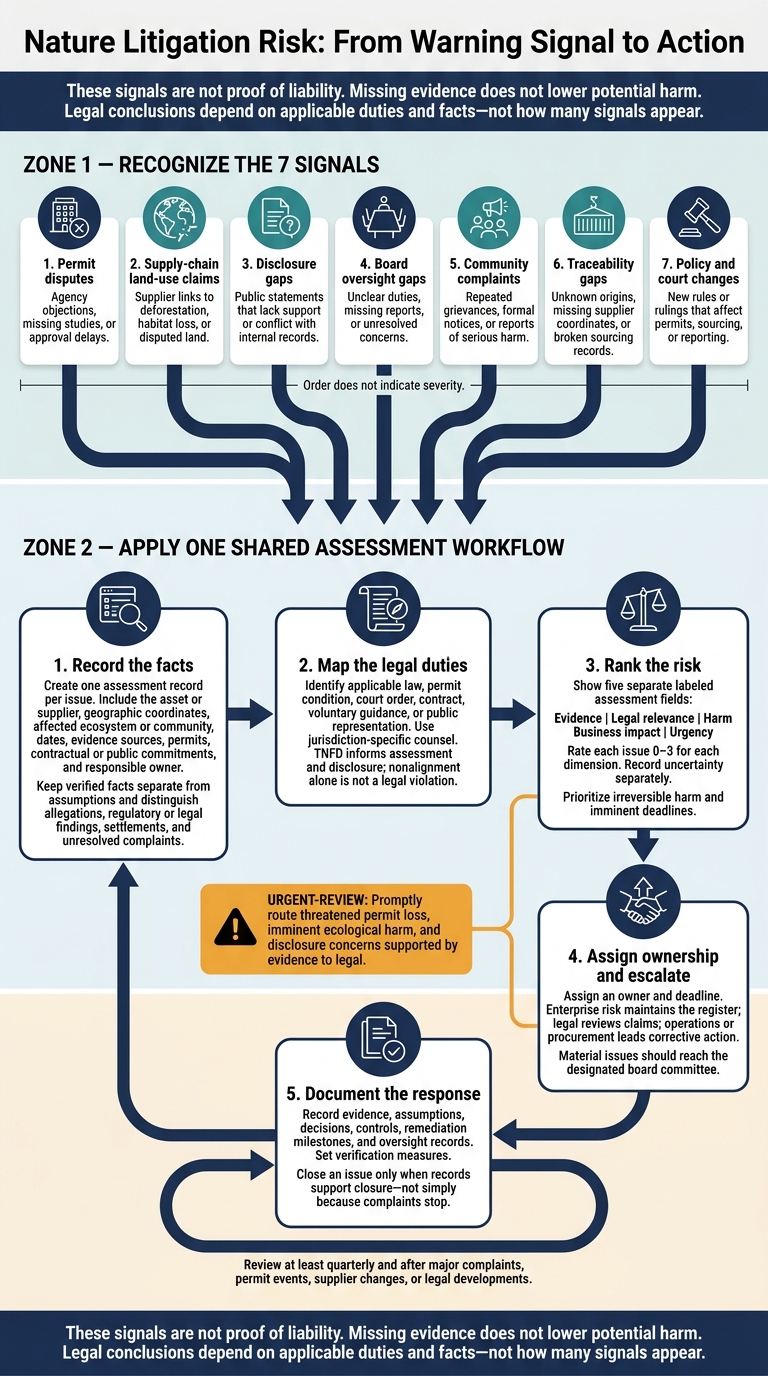
Nature Litigation Risk: From Warning Signal to Action
ESG Academy: ESG litigation risk
sbb-itb-8baf5f1
How to Assess the 7 Signals
When a signal appears, assess its legal exposure, business impact, and escalation speed. Order does not indicate severity. Ask four questions for each signal: What is verified? What legal pathway applies? What business harm could follow? What response is proportionate? Severity depends on the location, habitat, affected communities, permit conditions, and the company’s role.
Create one assessment record per issue so teams can compare signals using the same facts. Record the asset or supplier, geographic coordinates, affected ecosystem or community, dates, evidence sources, permits, contractual or public commitments, and responsible owner. Keep allegations, regulatory or legal findings, settlements, and unresolved complaints separate. A filed claim or settlement does not, by itself, establish wrongdoing. Link supporting records, including inspection reports, supplier data, grievance logs, and relevant board materials.
Map the legal basis. Label each obligation as law, permit condition, court order, contract, voluntary guidance, or public representation. TNFD informs assessment and disclosure; nonalignment alone is not a legal violation. Separately, check whether public statements conflict with internal records or create misleading impressions. For U.S. companies, map applicable federal, state, tribal, and local requirements, along with foreign rules affecting operations and sourcing. With jurisdiction-specific counsel, verify requirements, effective dates, and court decisions against authoritative sources current as of October 19, 2026.
Rate each issue 0–3 for evidence, legal relevance, harm, business impact, and urgency. Record uncertainty separately: missing evidence does not lower potential harm. Consider project delays, remediation costs, supply interruptions, financing restrictions, and disclosure consequences. Promptly route threatened permit loss, imminent ecological harm, and disclosure concerns supported by evidence to legal.
Enterprise risk maintains the register, legal reviews claims, and operations or procurement leads corrective action. Review entries at least quarterly and after major complaints, permit events, supplier changes, or legal developments. Each entry needs an owner, deadline, evidence gap, and escalation decision. Material issues should reach the designated board committee. Close an issue only when records support closure - not simply because complaints stop. Apply this same triage to each signal below before escalating, disclosing, or closing it.
1. Permit Disputes and Approval Challenges
Warning Signs
Watch for agency objections, requests for more studies, disputed conditions, and approval delays involving environmental assessments, species findings, water rights, wetlands permits, and land-use approvals. Missing seasonal surveys, outdated baseline data, and unresolved cumulative impacts can leave the record open to challenge. These problems often emerge before a lawsuit, while the administrative record is still open.
Legal Exposure
Administrative appeals and judicial review can result in permit suspension, vacatur, or additional environmental review. An injunction may stop construction or operations while the case proceeds. NEPA challenges usually focus on whether the agency’s review was adequate, rather than the project’s environmental harm. Counsel should identify which indirect- and cumulative-impact rules apply to the approval.
Business Effects
A denied or contested permit can block a project, delay debt drawdowns or expansion, and reduce asset value.
Texas’s U.S. 99 Grand Parkway, Segments E, F, and G: The 55-mile toll-road project underwent 15 years of NEPA review, including supplemental analysis, litigation, and a construction injunction. It was completed in 2016.[5]
What to Monitor and Do
Track linked approvals as one risk cluster, not separate issues: a challenge to one water or habitat determination may hold up several permits. Measure approval delays in days, carrying costs in dollars, and survey coverage as a share of the project area.
Before committing more capital, address missing seasonal data, resolve agency objections where possible, and test redesign options. Model one-, two-, and three-year delays against financing deadlines, permit expiration dates, and construction windows.
2. Supply-Chain Land-Use Claims
Warning Signs
Watch for deforestation, habitat conversion, wetland drainage or filling, and land clearing tied to agricultural expansion or mining. Start with suppliers whose production coordinates are missing, whose origins change without explanation, or whose land claims overlap. Satellite-detected clearing also warrants review. Check where production took place, whether it was lawful, and how the company is connected.
Legal Exposure
Liability depends on ownership, control, knowledge, and contract terms. The table separates exposure from direct land control from risks tied to upstream suppliers.
| Legal pathway | Exposure | Likely evidence | Business effects |
|---|---|---|---|
| Permit challenges, environmental enforcement, civil claims, contract disputes, applicable statutory duties | Direct: owned, leased, developed, operated, or controlled land | Permits, site maps, satellite imagery, environmental reviews, inspection findings | Project delays, remediation costs, penalties, financing pressure, reputational damage |
| Contract warranties, indemnities, sourcing bans, consumer-protection claims, disclosure disputes, regulatory due diligence | Upstream: supplier land | Supplier geolocation, chain-of-custody records, audit findings, complaints, commodity-trader documentation | Shipment holds, supplier replacement, recalls, lost market access, higher monitoring costs |
Business Effects
Complaints, trader records, and regulator inquiries often surface before anyone files a claim. Supply disruptions can begin well before a court decides liability. Estimate the purchase volume at risk, replacement costs, inventory write-downs, and revenue tied to restricted markets. Public reporting often moves ahead of verified control, traceability, and supporting evidence.
What to Monitor and Do
Send allegations with supporting evidence to legal, procurement, sustainability, and senior management. Pause or isolate questionable supply when needed.
Keep dated evidence of supplier ownership, origin, permits, land-use history, and corrective actions. Cross-check supplier records against satellite imagery, procurement data, complaints, audits, and site verification. Check claims language against the evidence, test contract remedies, and record why you accepted the source, took steps to reduce risk, or ended the sourcing relationship.
Incomplete supplier data also creates disclosure risk.
3. Gaps in Nature-Related Disclosures
Warning Signs
Disclosure gaps often surface before a claim, complaint, or filing. Look for missing or inconsistent public claims across sustainability reports, SEC filings, websites, and marketing materials. Flag omitted material dependencies on land, water, forests, or biodiversity; conflicting baselines, boundaries, or targets; and unsupported claims such as “nature positive,” “deforestation-free,” or “regenerative.”
Compare those claims with internal records. Check whether disclosures cover direct operations, priority sites, upstream and downstream value chains, transition plans, assumptions, scenario analysis, remediation progress and delays, and known disputes. Transition plans also need funding, milestones, and named executive owners.
Legal Exposure
Incomplete or unsupported material nature claims can create securities, reporting, consumer-protection, or greenwashing exposure. Public claims become litigation targets when the supporting evidence is incomplete, inconsistent, or outdated. FTC guidance calls for a reasonable basis for environmental claims and clear, prominent qualifications; scientific claims need competent and reliable supporting evidence.[6][7]
Business Effects
Disclosure mismatches can erode lender and customer confidence, increase review costs, and draw complaints before litigation begins. Watch for growing reliance on estimates, alongside missing data, assurance qualifications, baseline changes, and delayed remediation. State what remains unknown and how that uncertainty affects the claim.
What to Monitor and Do
Use TNFD’s four pillars to check for gaps: governance identifies accountable leaders; strategy links nature risks to locations, value chains, and financial plans; risk and impact management explains controls and remediation; and metrics and targets defines methods, assumptions, boundaries, and progress.[4] Map each statement to the rules that apply.
Keep one claim inventory that records an owner, supporting evidence, approval date, and review deadline for every material statement. Before publication, have legal, finance, sustainability, and operations teams align public language with internal records. Distinguish measured results from estimates, commitments, and aspirations. Correct material errors promptly, and explain methodology changes rather than silently resetting targets.
If the same gaps appear in board materials, escalate them to governance review.
4. Gaps in Board Oversight
Warning Signs
Uncorrected disclosure gaps can become a board-governance failure. Warning signs include no named executive owner, unclear committee duties, nature risk missing from board or committee reports, and no path for escalating urgent concerns.
Activity updates alone aren’t enough. Directors need to know which sites face exposure, what the financial consequences could be, and which decisions they must make. Without that information, they cannot act on permit, disclosure, and supplier issues.
Legal Exposure
Under Delaware’s Caremark framework, liability generally requires either a complete failure to establish reporting systems or a conscious failure to monitor them. Shareholders may request an investigation or bring a derivative claim alleging oversight failures.
A complaint or poor outcome alone does not establish liability. Fiduciary liability and personal exposure depend on the jurisdiction, facts, director conduct, applicable legal standards, and corporate documents.[8][9]
Business Effects
When board and executive authority is unclear, decisions to pause projects, fund remediation, or change suppliers can stall. That can delay permits, supplies, insurance, and financing. When public commitments lack clear accountability, investors may also press for stronger board expertise, committee changes, or independent reviews.
What to Monitor and Do
Name the responsible committee and executive, then check whether their authority matches their duties. Require quarterly board reports and set thresholds for urgent escalation of regulator warnings, threatened litigation, habitat concerns, and repeated community complaints. Reports should identify affected locations, financial exposure, overdue actions, and decisions requested.
Link those reports to capital allocation, procurement, insurance, and annual budgets. Use a permit-denial or supply-interruption exercise to test whether information reaches the board. Record questions, options, decisions, owners, deadlines, and completed actions - not just the discussion. Unresolved complaints and slow escalation are often the first signs of weak oversight.
5. Community Complaints and Escalating Disputes
Warning Signs
Persistent complaints can signal growing litigation risk. Before formal claims appear, unresolved concerns may point to failures in permits, disclosures, or oversight.
Track repeated or unresolved complaints from Indigenous Peoples, residents, workers, NGOs, farmers, fishers, and neighboring businesses. Concerns may involve water access or quality, habitat, pollution, access, land use, cultural resources, consultation, or consent. Watch for repeat complaints, complaints from multiple groups, organized collective complaints, requests for agency investigations, and formal notices. Even one complaint about potentially irreversible habitat or cultural-resource damage may need immediate review.
Legal Exposure
Complaints often form the factual record for legal action. Depending on the jurisdiction and facts, they can lead to agency petitions, injunction requests, or civil claims involving nuisance, trespass, property damage, negligence, statutory violations, contract breaches, or alleged human-rights impacts. Check each concern against permit conditions, monitoring results, consultation records, and agency correspondence.
Business Effects
A dispute can disrupt business before anyone files a lawsuit. Unresolved complaints may delay permits, construction, financing, insurance, production, or access to land and water. They can also increase monitoring, legal, and remediation costs. Estimate exposure in dollars, days of delay, lost production, and remediation costs.
What to Monitor and Do
Maintain a dated escalation log that records the allegation, location, affected parties, evidence, response owner, deadlines, and status. Provide multiple accessible ways to submit complaints, with confidentiality and non-retaliation protections, clear response deadlines, and a documented appeal process.
Set a documented escalation trigger. Serious harm, a request for agency investigation, or formal notice should prompt action without delay. Preserve records when a dispute is likely to lead to a claim or regulatory action. Grievance channels must be accessible, predictable, transparent, and non-retaliatory. They must not replace required consultation or legal process.[10][11]
6. Gaps in Nature-Related Traceability
Warning Signs
Missing coordinates, supplier maps limited to first-tier vendors, broken chain-of-custody records, and supplier declarations without supporting documents all signal gaps. Look for land-use records that conflict with reported origins and shipments that cannot be traced to a source site. Regulators, plaintiffs, and customers often ask for these records first. Treat unknown origin as an escalation trigger, not a low-risk finding.[14][15]
Legal Exposure
Traceability gaps weaken evidence of origin and control. Traceability proves provenance, not legality.[13][14]
| Traceability status | What it proves | Key limitation |
|---|---|---|
| Verified site-level data | Documented links between a site or mapped sourcing area, supplier, product, and period | Verification may be incomplete, outdated, or unrelated to compliance |
| Supplier declaration | What a supplier reports about origin or sourcing area | Information may be inaccurate, incomplete, or unverified |
| Unknown origin | A gap in reliable location or chain-of-custody evidence | Limits exposure assessment, claim defense, and product isolation |
Business Effects
When origins, processing records, and finished batches aren't linked, investigations take longer. Product holds may also extend beyond affected inventory. Mixed-origin materials can make targeted isolation impossible, adding procurement disruption, audit costs, and delays in responding to customers.
What to Monitor and Do
When a gap appears, move from screening to record-level validation. Map direct operations first, followed by priority upstream sources and relevant downstream counterparties. Connect stable site IDs, coordinates or mapped sourcing areas, supplier relationships, volumes, dates, and confidence levels to purchase orders and batch records.[12][13][15]
Check origins against permits, land-use records, and satellite evidence. Keep original declarations and version histories, preserve conflicting records, and document how each conflict is resolved. The record should show what was known, when it was known, and how the company responded.[12][13][15]
Track the shares of verified, supplier-declared, and unknown-origin sourcing using a consistent volume or spend denominator. Monitor unresolved location conflicts, custody breaks, and the time needed to trace a batch.[14][15]
Set deadlines for closing unknowns and specify who can hold or release disputed batches. If only regional estimates are feasible, document their limits and how precision will improve.[12][13][15]
Monitor new laws and court decisions: they can quickly change traceability record requirements and turn gaps into litigation exposure. Proactively addressing these gaps is a core component of building long-term climate resilience and ecosystem health.
7. Policy Changes and New Court Decisions
Warning Signs
Strong internal controls can become liabilities when the rules change. New policies can make disclosure gaps, permit conditions, or sourcing practices targets for litigation.
Monitor federal and state proposals, final rules, guidance, enforcement actions, and consultations covering biodiversity disclosures, deforestation, protected areas, restoration, and permitting. Investor requests for nature-risk metrics can also point to changing expectations.
Escalate when signals overlap - for example, when a disclosure proposal coincides with complaints that public claims leave out habitat impacts. First, determine whether the change is binding now or presents a future risk.
Legal Exposure
Separate future requirements from current duties. Record whether each development is proposed, final, effective, stayed, vacated, or on appeal. Treat guidance as interpretive unless it creates a new duty. For court decisions, document the jurisdiction, holding, remedy, and whether the ruling is binding or merely persuasive.
Use legal status as the first filter for escalation. Proposed rules call for monitoring; final rules call for implementation planning. Court decisions may require immediate changes. These distinctions help teams determine whether a development constrains business activity.
Business Effects
Policy changes can disrupt projects before anyone files a claim. A challenge to an agency’s permit or environmental review can suspend approvals or require supplemental studies, redesign, or delays for a private project.[17]
Map exposure across U.S. facilities, imports, subsidiaries, and value chains. Estimate schedule delays, mitigation costs, inventory holds, and financing effects, with costs stated in U.S. dollars. Early tracking gives teams time to update permits, contracts, and disclosures before deadlines arrive.
What to Monitor and Do
Recent EUDR deadline changes show why monitoring must include amendments. The current timetable identifies December 30, 2026, for large and medium operators and June 30, 2027, for micro and small operators. The revised framework also places the main due-diligence-statement obligation on operators that first place covered products on the EU market. U.S. suppliers should confirm their product scope, responsible entity, and customer requirements rather than rely on an old compliance calendar.[16][18][19]
Assign the legal team ownership of a monthly watchlist, and review it quarterly with procurement, sustainability, operations, and investor relations. Link each relevant change to the affected asset, contract, owner, and deadline.
An injunction, final rule, or enforcement action should trigger immediate review and updates to project plans, supplier requirements, and board reporting. Update the risk register the same day a rule or ruling changes.
Conclusion: Record the Signals and Take Action
The seven signals in this article are warning signs, not proof of liability. They call for a coordinated review. Legal conclusions depend on duties, facts, causation, and the company’s conduct - not how many signals appear.
Record the facts. Use a consistent record for each signal so teams can compare issues on the same basis. Include the source, location, affected asset, legal entity, and affected ecosystem or resource. Support the record with permits, correspondence, maps, field or satellite data, supplier records, complaints, notes, public statements, and contracts. Keep verified facts separate from assumptions, and flag immediate deadlines.
Map the legal duties. Have counsel assess each recorded signal against the legal duties, rights, and obligations that apply. These include permits, disclosure commitments, contracts, fiduciary duties, and community and Indigenous rights.
Rank the risk. Rate legal exposure, business impact, and reversibility separately. Prioritize irreversible harm and imminent deadlines.
Assign ownership and escalate. Once risks are rated, assign owners immediately and involve legal, operations, procurement, finance, and sustainability. Bring material issues affecting strategy, capital allocation, public reporting, or enterprise risk to the board.
Document the response. Record evidence, assumptions, decisions, controls, remediation milestones, and oversight records. Set owners, deadlines, and verification measures.
Update the signal register and schedule a cross-functional review with counsel. Use that register to build a workplan that links each priority issue to a legal assessment, remediation plan, and oversight path.
FAQs
How should we prioritize competing nature risks?
Use the Taskforce on Nature-related Financial Disclosures (TNFD) LEAP approach to map where operations interact with nature, evaluate dependencies and impacts, and assess risks based on likelihood, magnitude, and relevance to business strategy. Factor in local conditions, scientific thresholds, and stakeholder input.
Bring these assessments into enterprise risk management to direct resources toward the highest-priority risks across operations and value chains.
Can supplier certifications reduce our legal exposure?
Supplier certifications can help manage risk, but they work best as part of a traceability system you can verify. On their own, they may be viewed as weak verification if there’s no evidence to back them up.
To reduce legal exposure, support certifications with documented supplier maps, audit reports, and clear purchase records. That proof helps defend your sourcing claims against greenwashing allegations and litigation.
How can we tell whether remediation is working?
Document corrective actions, including what was addressed, when, and why [1]. Use monitoring systems and science-based targets to measure progress against established baselines [2][3]. Keep data transparent and ready for audit so public claims stand up to scrutiny [1].
Council Fire helps organizations put these monitoring frameworks to work, supporting sustainability strategies with verified results - not commitments alone and evidence that stakeholders and regulators can review and assess [2].




FAQ