
May 27, 2026
How to Develop Metrics, Monitoring, and Verification (MRV) for Impact for Corporations
ESG Strategy
In This Article
A practical guide to define MRV scope, choose KPIs, automate data flows, and secure internal and third‑party verification.
How to Develop Metrics, Monitoring, and Verification (MRV) for Impact for Corporations
To meet growing regulatory demands and stakeholder expectations, corporations must establish effective Metrics, Monitoring, and Verification (MRV) systems. These systems ensure accurate tracking, reporting, and validation of sustainability efforts, turning goals into measurable outcomes.
Key Takeaways:
MRV Defined:
Metrics: Setting boundaries, collecting data, and applying calculations.
Monitoring: Regular reporting for compliance (e.g., SEC, California SB 253, EU CSRD).
Verification: Ensuring data quality through internal checks and third-party reviews.
Benefits of MRV:
Financial: Verified data can lower borrowing costs by 40–80 basis points, saving millions annually.
Operational: Faster identification of inefficiencies, leading to energy savings and reduced costs.
Risk Reduction: Prevents stock price drops caused by inaccurate reporting.
Steps to Build MRV Systems:
Define scope and boundaries (Scopes 1, 2, and 3 emissions).
Choose measurable metrics aligned with recognized standards like the GHG Protocol.
Automate monitoring using digital tools to reduce errors and improve efficiency.
Establish internal controls and third-party verification for data reliability.
Report results transparently and refine processes annually.
Corporations that integrate MRV systems into their operations not only meet compliance requirements but also unlock cost savings, operational improvements, and stronger stakeholder trust.
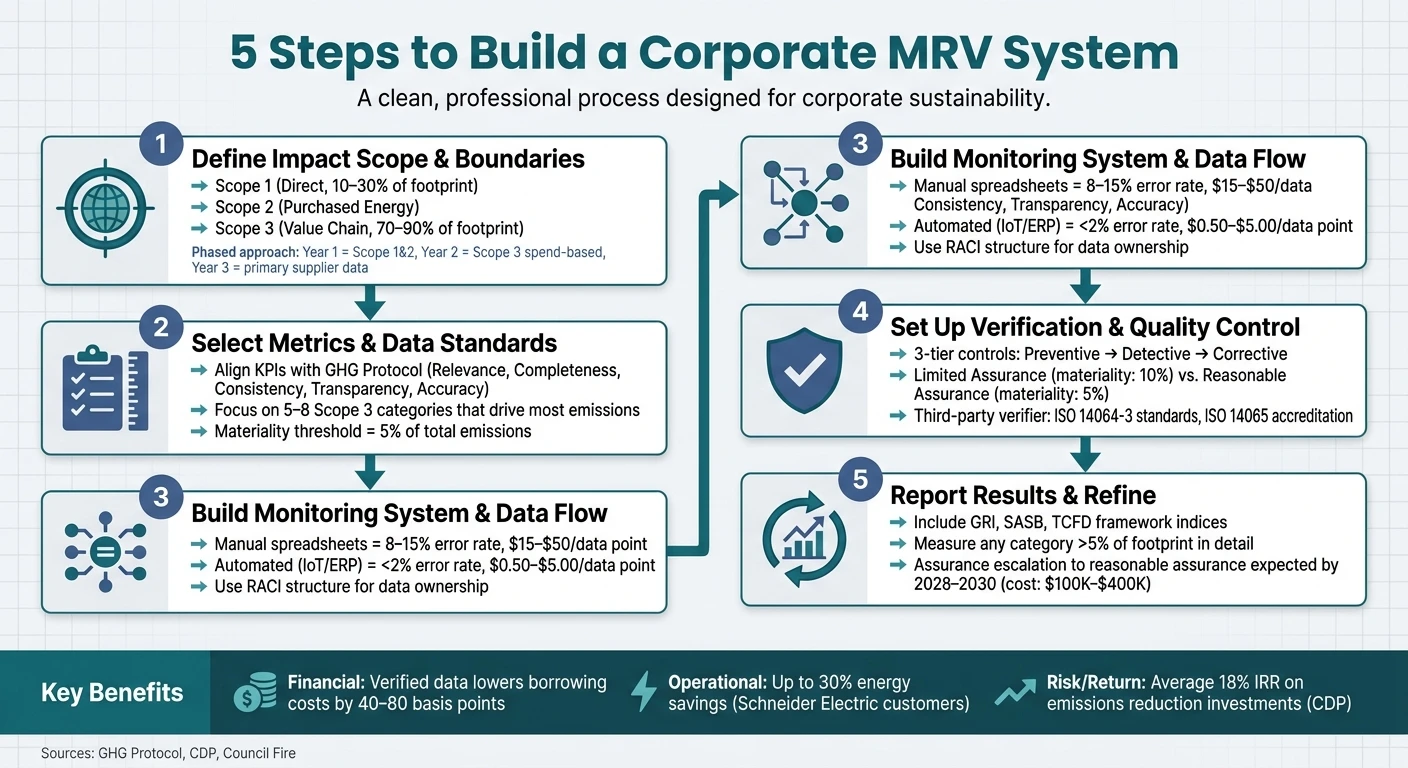
5 Steps to Build a Corporate MRV System for Sustainability Reporting
What are Monitoring, Reporting and Verification (MRV)?
Step 1: Define Your Impact Scope and Reporting Boundaries
Before diving into data collection, it’s crucial to clarify what you’re measuring and why. Skipping this step can result in incomplete or unverifiable MRV (Monitoring, Reporting, and Verification) data.
Identify Your Environmental and Social Impact Categories
Begin with the ESRS (European Sustainability Reporting Standards) topical list, which spans environmental, social, and governance areas. From there, apply materiality scoring to narrow down the typical list of 20–40 topics to the most relevant impacts. A materiality assessment helps prioritize these categories by evaluating their severity, likelihood, and financial implications. For climate-related impacts, specifically screen all 15 Scope 3 categories as outlined by the GHG Protocol. Be sure to document any exclusions, as auditors will likely request justification for these decisions [8][2].
"A materiality assessment determines which sustainability topics deserve attention in your strategy and reporting. It separates the signal from the noise." - Council Fire [6]
A well-executed materiality assessment not only pinpoints critical sustainability topics but also guides the establishment of boundaries for emissions measurement. Once the key impact areas are identified, focus on defining operational boundaries to capture accurate data.
Direct Operations vs. Full Value-Chain Coverage
The GHG Protocol provides two approaches for setting organizational boundaries: the equity share approach, which accounts for emissions proportional to your ownership stake, and the control approach, which includes 100% of emissions from operations you financially or operationally control [1]. Most companies lean toward the control approach as it aligns better with operational accountability.
Following this, categorize emissions into three scopes:
Scope 1: Direct emissions from owned or controlled operations
Scope 2: Indirect emissions from purchased energy
Scope 3: Indirect emissions across the full value chain
While Scopes 1 and 2 are relatively straightforward to measure with high accuracy, they typically account for only 10–30% of a company’s total carbon footprint. Scope 3, which covers the remaining 70–90%, presents greater challenges due to data uncertainties, often starting at ±50% accuracy [8][2]. For example, Walmart’s Project Gigaton involved over 4,500 suppliers in a tiered Scope 3 model, achieving 750 million metric tonnes of cumulative CO₂e reductions by 2024 and reaching 65% primary data coverage for Category 1 emissions [4][3].
A phased approach is often the most practical. In the first year, focus on collecting high-quality Scope 1 and 2 data. In the second year, use spend-based screening for Scope 3 categories, and by the third year, transition to primary supplier data. This gradual progression also helps align with evolving regulatory requirements [8][2].
Align Your Scope with Sustainability Goals and Compliance
Your boundary definitions should reflect both your internal sustainability goals and external regulatory obligations. For instance, California’s SB 253 mandates Scope 3 reporting for companies with revenues exceeding $1 billion starting in 2026, while the EU’s CSRD (Corporate Sustainability Reporting Directive) will affect over 50,000 companies globally between 2024 and 2028 [7][4]. If your business operates in multiple jurisdictions, adopting a "highest common denominator" approach - designing your scope to meet the strictest requirements, such as those under CSRD - can help streamline compliance [9].
Additionally, establish a base year recalculation policy from the start. Most frameworks require recalculating historical baselines if structural changes, such as acquisitions or divestitures, alter your emissions inventory by more than 5% [1][2]. Setting this threshold early ensures consistent year-over-year comparisons and simplifies third-party verification later on.
Step 2: Select Measurable Metrics and Data Standards
The next step is figuring out what to measure and how to measure it consistently. Choosing inappropriate metrics or using inconsistent methods can lead to unreliable data, making it hard to track progress or verify results over time.
How to Choose the Right Key Performance Indicators (KPIs)
Effective KPIs share five essential qualities outlined by the GHG Protocol: relevance, completeness, consistency, transparency, and accuracy [1]. Before adding a metric to your reporting framework, ensure it meets these criteria.
For emissions, KPIs should align with the three operational scopes:
Scope 1: Direct emissions from owned or controlled sources, such as company vehicles or on-site fuel combustion.
Scope 2: Indirect emissions from purchased energy. This requires dual reporting: a location-based figure (reflecting your local grid's carbon intensity) and a market-based figure (accounting for your energy procurement choices, like renewable energy certificates or power purchase agreements) [1].
Scope 3: Covers 15 value chain categories, including everything from purchased goods to the disposal of sold products.
Not all Scope 3 categories require the same level of attention. Typically, 5–8 categories account for most of a company's value chain emissions [1]. Start with a screening based on spending to identify categories that exceed a materiality threshold - commonly set at 5% or more of total estimated emissions. Focus your data collection on these areas while documenting and justifying any exclusions. Selectively reporting only low-emission categories can harm your credibility with both auditors and stakeholders [1].
Strategically selecting KPIs ensures the reliability of your entire Measurement, Reporting, and Verification (MRV) system.
Using Recognized Frameworks and Standards
The GHG Protocol is the gold standard for corporate emissions reporting. It forms the backbone of major regulations like California's SB 253, the EU's CSRD (ESRS E1), and the SEC's climate disclosure rules. According to the GHG Protocol:
"The GHG Protocol Corporate Standard... provides the accounting platform for virtually every corporate GHG reporting program in the world." - GHG Protocol [10]
It’s worth noting that the GHG Protocol is undergoing its first major revision in over a decade. Draft updates to the Corporate and Scope 3 standards are expected between 2025 and 2026, with final versions projected for 2026–2027 [1]. If you're building or updating your MRV system now, ensure it has the flexibility to adapt to changes in market-based accounting rules or biogenic carbon treatment without requiring a complete overhaul.
Once your measurement framework is in place, maintaining high data quality becomes the next priority.
Maintaining Data Quality and Auditability
Strong data quality is essential for accurate audits and transparent reporting. To ensure reliability, follow a clear hierarchy for sourcing and prioritizing data:
Primary data from suppliers should take precedence.
Use activity-based calculations as a secondary option.
Reserve spend-based estimates for categories deemed immaterial [2].
Whenever possible, rely on facility-specific emission factors rather than national or global averages. This approach significantly improves the precision of your calculations [1].
Two practices are critical for ensuring auditability:
Annual updates to emission factors: These updates account for changes in grid carbon intensity and evolving methodologies [1].
A formal recalculation policy: This policy should define specific triggers - such as acquisitions, calculation errors, or methodology changes - that require restating your base year inventory. A common threshold for recalculations is a 5–10% change in your emissions inventory [2]. Establishing this policy early can save time and prevent inconsistencies that could undermine year-over-year comparisons.
Step 3: Build Your Monitoring System and Data Flow
Establishing a reliable data flow from its source to your reports is essential for ensuring accurate and consistent information. A well-designed monitoring system eliminates guesswork, serving as a vital connection between data collection and the verification processes that follow.
Designing an Effective Data Collection Process
One common mistake organizations make is placing the responsibility for data collection entirely on the sustainability team. As a guiding principle states:
"The sustainability team should coordinate, not collect." [11]
This approach emphasizes the importance of assigning clear accountability. Using a RACI structure (Responsible, Accountable, Consulted, Informed), assign ownership for every data point - whether it’s energy invoices, supplier surveys, or other metrics. Develop a data catalog that maps each metric to its source system (e.g., ERP, utility portal, HRIS), outlines the calculation method, and identifies the responsible owner. This catalog acts as the operational foundation for your monitoring system.
Consistency is key when collecting data. Replace informal email requests with structured templates or portal-based submissions, ensuring uniform units of measurement and requiring supporting documentation upfront. Transitioning to monthly or quarterly data collection - instead of rushing to gather information annually - can significantly reduce errors and simplify the year-end process. [12]
Once ownership and standardized templates are established, automation can further enhance accuracy and efficiency.
Using Technology and Digital Tools for Monitoring
Relying on manual spreadsheets for data collection introduces an 8–15% error rate and costs $15–$50 per data point. In contrast, automated methods, such as IoT sensors or ERP integrations, reduce the error rate to under 2% while lowering costs to $0.50–$5.00 per data point. [3] Considering that 88% of spreadsheets contain errors, they pose a significant risk for data requiring external assurance. [11]
A practical example comes from The Clorox Company, which automated utility data collection for 85% of its 40+ North American manufacturing facilities between 2024 and 2026. Utilizing Urjanet, the company achieved 95% data completeness with just a four-person team. This system not only identified $3.2 million in energy efficiency opportunities but also supported a successful limited assurance engagement during its initial reporting cycle. [3]
Costs for enterprise-grade carbon accounting platforms typically range from $25,000 to $250,000 annually, while industrial-grade energy monitoring hardware costs approximately $500–$2,000 per metering point, with monthly connectivity fees of $5–$15 per device. [3] When selecting tools, prioritize integration capabilities that allow software to connect seamlessly with your ERP, procurement, and logistics systems. This reduces redundant tasks and ensures consistent data across platforms.
Maintaining Traceability and Consistency in Data Flow
Automated data collection must also maintain full traceability, linking each data point back to its original source document. This includes tracking any transformations, allocations, or estimates applied to the data. Such traceability is becoming a critical requirement for external assurance, and integrating it from the start is far more cost-effective than addressing gaps after a verification issue arises. [3]
A layered control system is the most effective way to ensure data integrity:
Preventive controls, like standardized templates with built-in unit validation, catch errors at the data entry stage.
Detective controls, such as automated range checks and year-over-year variance alerts, identify anomalies before they enter the reporting process.
Multi-level approval workflows ensure data is locked only after review and approval by the appropriate personnel. [11]
Regular reconciliations between your ESG platform and original source systems further help to identify and resolve discrepancies early, preventing them from escalating across multiple reporting cycles.
Step 4: Set Up Verification and Quality Control
After your monitoring system is up and running with a steady flow of data, the next step is ensuring its reliability. Verification and quality control transform raw data into trustworthy and defensible reports.
Internal Validation and Quality Checks
Before involving external reviewers, it's crucial to establish strong internal validation processes. A three-tier control framework helps identify and address errors effectively:
Control Type | Purpose | Examples |
|---|---|---|
Preventive | Stop errors before they occur | Input validation rules, standardized templates, access controls [13] |
Detective | Identify errors after data entry | Variance analysis, supervisor reviews, reconciliation with source data [13] |
Corrective | Address and fix errors that slip through | Root cause analysis, error logging, restatement procedures [13] |
Each metric should have a formal KPI definition sheet that outlines its boundaries, calculation methods, data sources, and any exclusions. Without this, inconsistencies across departments can compromise credibility [13].
Internal teams should also cross-check bottom-up calculations against top-down estimates and reconcile all data with source records to ensure accuracy and logical consistency [13]. These steps lay the groundwork for external verification.
Third-Party Verification for Added Credibility
While internal controls are essential, they need reinforcement through independent, third-party verification. This step assures stakeholders - whether investors, regulators, or customers - that your data has undergone rigorous, impartial review.
When choosing a verifier, it’s important to differentiate between their methodology and accreditation. For example:
Verification should follow ISO 14064-3 standards.
The verifier must be accredited under ISO 14065.
Team members should meet the competence standards outlined in ISO 14066:2011.
Additionally, avoid engaging the same firm for both consulting and verification services unless conflicts of interest are transparently disclosed.
Understanding the difference between limited and reasonable assurance is also critical:
Limited assurance concludes with a negative statement, such as, "Nothing has come to our attention."
Reasonable assurance provides a positive opinion, stating, "The statements present fairly in all material respects."
The level of scrutiny differs significantly between the two, with materiality thresholds typically set at 5% of total reported emissions for reasonable assurance and 10% for limited assurance [14].
As Jeremiah Say, Lead Systems Architect at GreenCalculus, explains:
"The difference in conclusion language [between limited and reasonable assurance] is small. The difference in evidence gathering, documentation, control testing, sampling, and procedural rigor underneath is substantial." [14]
Documenting Processes for Consistency and Repeatability
Comprehensive documentation ensures consistency and makes your processes repeatable, reducing audit costs and improving efficiency. A practical method is to create "evidence packs" for each KPI. These should include:
The KPI definition sheet
Calculation workbooks
Source evidence (e.g., invoices, meter readings)
Internal review sign-off logs [13]
Dr. Nikhitha KK, Senior Manager of Sustainability Assurance at Glocert International, highlights the importance of this approach:
"The quality of your evidence pack directly determines the efficiency, cost, and outcome of the assurance engagement." [13]
Documentation should also include version control for emission factors and methodologies to support valid year-over-year comparisons. In cases of structural changes like mergers or acquisitions, clearly defined recalculation thresholds (typically 5–10%) should trigger base year restatements [2].
As Council Fire notes:
"Failing to document methodology choices... create[s] audit findings and erode[s] confidence in reported numbers." [2]
The ultimate aim is to maintain a clear, traceable documentation trail that any external reviewer can follow - right from the final reported numbers back to the original data - without needing additional clarifications. This transparency builds trust and ensures the integrity of your reporting process.
Step 5: Report Results and Refine Your MRV System
Once you've built a solid foundation with metrics and verification, the next step is to use that data effectively. This phase focuses on clear communication of results and refining your Measurement, Reporting, and Verification (MRV) system for future improvements.
Turning Data into Clear, Actionable Reports
A well-structured sustainability report serves dual purposes: meeting regulatory requirements and engaging stakeholders. To achieve this, your report should include key elements such as strategy and governance details, material topic management, multi-year performance data, framework indices (like GRI, SASB, and TCFD), and an external assurance statement [5].
Be specific. Avoid vague promises and instead outline measurable objectives. This clarity is what distinguishes a credible report from a generic marketing document [15].
Distribute your report in multiple formats - PDFs, web-based versions, and XBRL files - to cater to diverse stakeholder preferences [5]. With over 90% of S&P 500 companies now publishing sustainability reports [5], the quality bar is higher than ever.
Another critical component is a management assertion that verifies compliance with reporting standards [16]. This brief statement holds significant weight with auditors and investors, serving as a cornerstone for ongoing improvement efforts.
Spotting Performance Gaps and Areas for Improvement
After publishing your report, it’s time to analyze the results and identify areas for improvement. Conduct a structured post-mortem to evaluate what worked, where data gaps existed, and what caused delays. Use these insights to create a formal plan for refining your processes in the next reporting cycle [5].
To pinpoint focus areas, consider hotspot analysis. This involves ranking impact categories by their absolute magnitude and identifying the top contributors - whether it’s specific suppliers, facilities, or product lines [8]. A practical guideline is to measure any category that accounts for more than 5% of your total footprint in detail rather than relying on estimates [8][2].
Data quality is another critical focus area. Scope 3 emissions often make up 70–90% of a company's total carbon footprint, yet they are the most commonly underreported [2]. Using structured scoring methods, such as the PCAF five-level framework, can help you assess uncertainty and prioritize upgrades. For instance, replacing spend-based estimates (which can have uncertainty ranges of ±50% or more) with activity-based or supplier-specific data can significantly improve accuracy [8].
"Measurement without integration into decision-making is wasted effort. If the data sits in a PDF and nothing changes, you've missed the point." – Council Fire Resources [2]
Here’s a quick summary of common improvement areas and how to prioritize them:
Improvement Area | How to Identify It | What to Prioritize |
|---|---|---|
Data Reliability | PCAF Quality Scoring | High uncertainty in material categories |
Operational Impact | Hotspot Ranking | Emissions or impacts with the highest magnitude |
Compliance Risk | Readiness Assessment | Approaching regulatory deadlines (e.g., CSRD) |
Cost Efficiency | Unit Economic Analysis | High manual data collection costs ($15–$50 per data point) |
Addressing these gaps ensures your MRV system evolves effectively.
Updating Your MRV System as Needs Change
Your MRV system must remain flexible to accommodate changing regulations, business needs, and measurement standards.
One immediate challenge is assurance escalation. In the EU, a shift from limited to reasonable assurance is expected by 2028–2030 [16]. Reasonable assurance can cost $100,000–$400,000 - 2–3 times more than limited assurance - due to stricter testing and sampling requirements [16]. To prepare, start building internal controls and evidence trails now. A practical step is to conduct a dry run of the assurance process 8–9 months into your reporting cycle to identify and address control gaps before a formal audit [16].
On the technology front, moving from spreadsheets to ESG data platforms significantly reduces error rates, from 34% to just 8% [3]. As data volumes grow, automation becomes essential - not just for accuracy but also for cost management.
Finally, establish clear base-year recalculation policies. For instance, any acquisition, divestiture, or methodology change resulting in a 5–10% shift should automatically trigger a restatement [1]. Documenting these thresholds now prevents inconsistencies that could compromise multi-year trend analyses later. By keeping your MRV system adaptable, you’ll ensure both compliance and long-term impact.
Conclusion: Building Long-Term Impact Through Effective MRV Systems
An effective MRV (Monitoring, Reporting, and Verification) system does more than just track progress - it connects sustainability goals to measurable outcomes, turning ambitions into actionable results. The five steps outlined here - defining scope and boundaries, selecting standardized metrics, building reliable monitoring systems, verifying data, and refining based on insights - create a continuous improvement loop. This iterative process strengthens data reliability, sharpens focus, and amplifies impact over time, contributing to operational efficiency and strategic growth.
The benefits speak for themselves. Companies that embed MRV practices into their core operations and align sustainability KPIs with financial and strategic decisions often see measurable results. For instance, Schneider Electric customers reported up to 30% energy savings by leveraging structured sustainability tracking. Similarly, a CDP analysis revealed that businesses managing climate risks through structured MRV approaches achieved an average IRR of 18% on emissions reduction investments. These results aren't exceptions - they highlight the value of treating measurement as a strategic discipline.
Strong governance plays a pivotal role alongside technology. Clear executive ownership - ideally from the CFO or CSO - paired with a cross-functional team spanning finance, IT, operations, and procurement ensures accountability and alignment. As global regulations tighten, such as the CSRD affecting approximately 50,000 companies worldwide (including U.S. multinationals with EU operations), robust governance not only mitigates board-level risks but also supports fiduciary responsibilities.
"The real value of assurance lies in the discipline it imposes on data management, controls, and governance." – Council Fire [16]
For those just beginning their MRV journey, start small but impactful. Focus on critical metrics like Scope 1 and 2 emissions, energy usage, and key safety or DEI indicators within clearly defined U.S. operations. Be transparent about assumptions and data gaps. For organizations with more advanced systems, the emphasis should shift toward expanding Scope 3 coverage, integrating supplier data, and preparing for the move from limited to reasonable assurance, which regulators anticipate between 2028 and 2030 [16]. Regardless of your starting point, treat each reporting cycle as a chance to refine and strengthen your MRV system.
FAQs
What MRV scope should we start with?
To begin, carry out a materiality assessment to pinpoint sustainability issues that have a meaningful effect on your organization or the environment. When addressing carbon emissions, make sure to account for all Scope 1 and Scope 2 sources, as well as any significant Scope 3 categories. Carefully examine all 15 categories outlined in the GHG Protocol for Scope 3 emissions. This process helps identify key areas - often representing 80–90% of your overall emissions footprint - so you can prioritize detailed measurement efforts on these critical hotspots first.
How do we make Scope 3 data auditable?
To ensure Scope 3 data is ready for auditing, focus on clarity, traceability, and detailed record-keeping. Start by aligning your approach with the GHG Protocol, clearly defining boundaries and explaining any exclusions. Connect emissions data to supporting evidence, such as invoices or supplier disclosures, to provide a solid foundation for verification.
Use standardized templates for consistency and maintain a comprehensive audit file that includes calculation methods, quality assurance/quality control (QA/QC) records, and validation processes. To strengthen credibility, work with external assurance providers to confirm compliance with ISO 14064-3 standards. This structured approach ensures your data is both reliable and verifiable.
When do we need limited vs. reasonable assurance?
When deciding between limited assurance and reasonable assurance, the choice often hinges on regulatory demands, stakeholder expectations, and how prepared your organization is to meet these standards.
Limited assurance delivers a moderate level of confidence. This option works well for organizations navigating new regulatory frameworks, such as the EU CSRD, or those still building and refining their data systems.
Reasonable assurance offers a higher degree of confidence, comparable to that of financial audits. It’s better suited for metrics that are crucial to investors, organizations striving for ESG leadership, or those gearing up for more stringent requirements in the future.
By aligning your assurance approach with your current needs and future goals, you can effectively balance confidence levels with operational readiness.
Related Blog Posts
Latest Articles
©2026

Narrative Change and Power Building: The Missing Half of Advocacy
Narrative change is the process of disrupting dominant narratives that normalize inequity and advancing new narratives from historically marginalized communities.

Funding Resilience Without Federal Grants
BRIC is unreliable and FEMA is shrinking. Here's how cities fund climate resilience with dedicated revenue, blended finance, and a coordinating authority.

The ESG Blind Spot: How AI Is Finding Risks in Companies Nobody Else Is Watching
Norway's sovereign wealth fund uses AI to screen 7,200 portfolio companies for forced labor and corruption within 24 hours. The real story is the emerging-market coverage gap that traditional ESG data vendors miss — and what it means for any company with a global supply chain.
Narrative Change and Power Building: The Missing Half of Advocacy
Narrative change is the process of disrupting dominant narratives that normalize inequity and advancing new narratives from historically marginalized communities.
Funding Resilience Without Federal Grants
BRIC is unreliable and FEMA is shrinking. Here's how cities fund climate resilience with dedicated revenue, blended finance, and a coordinating authority.
The ESG Blind Spot: How AI Is Finding Risks in Companies Nobody Else Is Watching
Norway's sovereign wealth fund uses AI to screen 7,200 portfolio companies for forced labor and corruption within 24 hours. The real story is the emerging-market coverage gap that traditional ESG data vendors miss — and what it means for any company with a global supply chain.
FAQ
01
What does it really mean to “redefine profit”?
02
What makes Council Fire different?
03
Who does Council Fire work with?
04
What does working with Council Fire actually look like?
05
How does Council Fire help organizations turn big goals into action?
06
How does Council Fire define and measure success?
07
How does technology fit into Council Fire’s work?
May 27, 2026
How to Develop Metrics, Monitoring, and Verification (MRV) for Impact for Corporations
ESG Strategy
In This Article
A practical guide to define MRV scope, choose KPIs, automate data flows, and secure internal and third‑party verification.
How to Develop Metrics, Monitoring, and Verification (MRV) for Impact for Corporations
To meet growing regulatory demands and stakeholder expectations, corporations must establish effective Metrics, Monitoring, and Verification (MRV) systems. These systems ensure accurate tracking, reporting, and validation of sustainability efforts, turning goals into measurable outcomes.
Key Takeaways:
MRV Defined:
Metrics: Setting boundaries, collecting data, and applying calculations.
Monitoring: Regular reporting for compliance (e.g., SEC, California SB 253, EU CSRD).
Verification: Ensuring data quality through internal checks and third-party reviews.
Benefits of MRV:
Financial: Verified data can lower borrowing costs by 40–80 basis points, saving millions annually.
Operational: Faster identification of inefficiencies, leading to energy savings and reduced costs.
Risk Reduction: Prevents stock price drops caused by inaccurate reporting.
Steps to Build MRV Systems:
Define scope and boundaries (Scopes 1, 2, and 3 emissions).
Choose measurable metrics aligned with recognized standards like the GHG Protocol.
Automate monitoring using digital tools to reduce errors and improve efficiency.
Establish internal controls and third-party verification for data reliability.
Report results transparently and refine processes annually.
Corporations that integrate MRV systems into their operations not only meet compliance requirements but also unlock cost savings, operational improvements, and stronger stakeholder trust.
5 Steps to Build a Corporate MRV System for Sustainability Reporting
What are Monitoring, Reporting and Verification (MRV)?
Step 1: Define Your Impact Scope and Reporting Boundaries
Before diving into data collection, it’s crucial to clarify what you’re measuring and why. Skipping this step can result in incomplete or unverifiable MRV (Monitoring, Reporting, and Verification) data.
Identify Your Environmental and Social Impact Categories
Begin with the ESRS (European Sustainability Reporting Standards) topical list, which spans environmental, social, and governance areas. From there, apply materiality scoring to narrow down the typical list of 20–40 topics to the most relevant impacts. A materiality assessment helps prioritize these categories by evaluating their severity, likelihood, and financial implications. For climate-related impacts, specifically screen all 15 Scope 3 categories as outlined by the GHG Protocol. Be sure to document any exclusions, as auditors will likely request justification for these decisions [8][2].
"A materiality assessment determines which sustainability topics deserve attention in your strategy and reporting. It separates the signal from the noise." - Council Fire [6]
A well-executed materiality assessment not only pinpoints critical sustainability topics but also guides the establishment of boundaries for emissions measurement. Once the key impact areas are identified, focus on defining operational boundaries to capture accurate data.
Direct Operations vs. Full Value-Chain Coverage
The GHG Protocol provides two approaches for setting organizational boundaries: the equity share approach, which accounts for emissions proportional to your ownership stake, and the control approach, which includes 100% of emissions from operations you financially or operationally control [1]. Most companies lean toward the control approach as it aligns better with operational accountability.
Following this, categorize emissions into three scopes:
Scope 1: Direct emissions from owned or controlled operations
Scope 2: Indirect emissions from purchased energy
Scope 3: Indirect emissions across the full value chain
While Scopes 1 and 2 are relatively straightforward to measure with high accuracy, they typically account for only 10–30% of a company’s total carbon footprint. Scope 3, which covers the remaining 70–90%, presents greater challenges due to data uncertainties, often starting at ±50% accuracy [8][2]. For example, Walmart’s Project Gigaton involved over 4,500 suppliers in a tiered Scope 3 model, achieving 750 million metric tonnes of cumulative CO₂e reductions by 2024 and reaching 65% primary data coverage for Category 1 emissions [4][3].
A phased approach is often the most practical. In the first year, focus on collecting high-quality Scope 1 and 2 data. In the second year, use spend-based screening for Scope 3 categories, and by the third year, transition to primary supplier data. This gradual progression also helps align with evolving regulatory requirements [8][2].
Align Your Scope with Sustainability Goals and Compliance
Your boundary definitions should reflect both your internal sustainability goals and external regulatory obligations. For instance, California’s SB 253 mandates Scope 3 reporting for companies with revenues exceeding $1 billion starting in 2026, while the EU’s CSRD (Corporate Sustainability Reporting Directive) will affect over 50,000 companies globally between 2024 and 2028 [7][4]. If your business operates in multiple jurisdictions, adopting a "highest common denominator" approach - designing your scope to meet the strictest requirements, such as those under CSRD - can help streamline compliance [9].
Additionally, establish a base year recalculation policy from the start. Most frameworks require recalculating historical baselines if structural changes, such as acquisitions or divestitures, alter your emissions inventory by more than 5% [1][2]. Setting this threshold early ensures consistent year-over-year comparisons and simplifies third-party verification later on.
Step 2: Select Measurable Metrics and Data Standards
The next step is figuring out what to measure and how to measure it consistently. Choosing inappropriate metrics or using inconsistent methods can lead to unreliable data, making it hard to track progress or verify results over time.
How to Choose the Right Key Performance Indicators (KPIs)
Effective KPIs share five essential qualities outlined by the GHG Protocol: relevance, completeness, consistency, transparency, and accuracy [1]. Before adding a metric to your reporting framework, ensure it meets these criteria.
For emissions, KPIs should align with the three operational scopes:
Scope 1: Direct emissions from owned or controlled sources, such as company vehicles or on-site fuel combustion.
Scope 2: Indirect emissions from purchased energy. This requires dual reporting: a location-based figure (reflecting your local grid's carbon intensity) and a market-based figure (accounting for your energy procurement choices, like renewable energy certificates or power purchase agreements) [1].
Scope 3: Covers 15 value chain categories, including everything from purchased goods to the disposal of sold products.
Not all Scope 3 categories require the same level of attention. Typically, 5–8 categories account for most of a company's value chain emissions [1]. Start with a screening based on spending to identify categories that exceed a materiality threshold - commonly set at 5% or more of total estimated emissions. Focus your data collection on these areas while documenting and justifying any exclusions. Selectively reporting only low-emission categories can harm your credibility with both auditors and stakeholders [1].
Strategically selecting KPIs ensures the reliability of your entire Measurement, Reporting, and Verification (MRV) system.
Using Recognized Frameworks and Standards
The GHG Protocol is the gold standard for corporate emissions reporting. It forms the backbone of major regulations like California's SB 253, the EU's CSRD (ESRS E1), and the SEC's climate disclosure rules. According to the GHG Protocol:
"The GHG Protocol Corporate Standard... provides the accounting platform for virtually every corporate GHG reporting program in the world." - GHG Protocol [10]
It’s worth noting that the GHG Protocol is undergoing its first major revision in over a decade. Draft updates to the Corporate and Scope 3 standards are expected between 2025 and 2026, with final versions projected for 2026–2027 [1]. If you're building or updating your MRV system now, ensure it has the flexibility to adapt to changes in market-based accounting rules or biogenic carbon treatment without requiring a complete overhaul.
Once your measurement framework is in place, maintaining high data quality becomes the next priority.
Maintaining Data Quality and Auditability
Strong data quality is essential for accurate audits and transparent reporting. To ensure reliability, follow a clear hierarchy for sourcing and prioritizing data:
Primary data from suppliers should take precedence.
Use activity-based calculations as a secondary option.
Reserve spend-based estimates for categories deemed immaterial [2].
Whenever possible, rely on facility-specific emission factors rather than national or global averages. This approach significantly improves the precision of your calculations [1].
Two practices are critical for ensuring auditability:
Annual updates to emission factors: These updates account for changes in grid carbon intensity and evolving methodologies [1].
A formal recalculation policy: This policy should define specific triggers - such as acquisitions, calculation errors, or methodology changes - that require restating your base year inventory. A common threshold for recalculations is a 5–10% change in your emissions inventory [2]. Establishing this policy early can save time and prevent inconsistencies that could undermine year-over-year comparisons.
Step 3: Build Your Monitoring System and Data Flow
Establishing a reliable data flow from its source to your reports is essential for ensuring accurate and consistent information. A well-designed monitoring system eliminates guesswork, serving as a vital connection between data collection and the verification processes that follow.
Designing an Effective Data Collection Process
One common mistake organizations make is placing the responsibility for data collection entirely on the sustainability team. As a guiding principle states:
"The sustainability team should coordinate, not collect." [11]
This approach emphasizes the importance of assigning clear accountability. Using a RACI structure (Responsible, Accountable, Consulted, Informed), assign ownership for every data point - whether it’s energy invoices, supplier surveys, or other metrics. Develop a data catalog that maps each metric to its source system (e.g., ERP, utility portal, HRIS), outlines the calculation method, and identifies the responsible owner. This catalog acts as the operational foundation for your monitoring system.
Consistency is key when collecting data. Replace informal email requests with structured templates or portal-based submissions, ensuring uniform units of measurement and requiring supporting documentation upfront. Transitioning to monthly or quarterly data collection - instead of rushing to gather information annually - can significantly reduce errors and simplify the year-end process. [12]
Once ownership and standardized templates are established, automation can further enhance accuracy and efficiency.
Using Technology and Digital Tools for Monitoring
Relying on manual spreadsheets for data collection introduces an 8–15% error rate and costs $15–$50 per data point. In contrast, automated methods, such as IoT sensors or ERP integrations, reduce the error rate to under 2% while lowering costs to $0.50–$5.00 per data point. [3] Considering that 88% of spreadsheets contain errors, they pose a significant risk for data requiring external assurance. [11]
A practical example comes from The Clorox Company, which automated utility data collection for 85% of its 40+ North American manufacturing facilities between 2024 and 2026. Utilizing Urjanet, the company achieved 95% data completeness with just a four-person team. This system not only identified $3.2 million in energy efficiency opportunities but also supported a successful limited assurance engagement during its initial reporting cycle. [3]
Costs for enterprise-grade carbon accounting platforms typically range from $25,000 to $250,000 annually, while industrial-grade energy monitoring hardware costs approximately $500–$2,000 per metering point, with monthly connectivity fees of $5–$15 per device. [3] When selecting tools, prioritize integration capabilities that allow software to connect seamlessly with your ERP, procurement, and logistics systems. This reduces redundant tasks and ensures consistent data across platforms.
Maintaining Traceability and Consistency in Data Flow
Automated data collection must also maintain full traceability, linking each data point back to its original source document. This includes tracking any transformations, allocations, or estimates applied to the data. Such traceability is becoming a critical requirement for external assurance, and integrating it from the start is far more cost-effective than addressing gaps after a verification issue arises. [3]
A layered control system is the most effective way to ensure data integrity:
Preventive controls, like standardized templates with built-in unit validation, catch errors at the data entry stage.
Detective controls, such as automated range checks and year-over-year variance alerts, identify anomalies before they enter the reporting process.
Multi-level approval workflows ensure data is locked only after review and approval by the appropriate personnel. [11]
Regular reconciliations between your ESG platform and original source systems further help to identify and resolve discrepancies early, preventing them from escalating across multiple reporting cycles.
Step 4: Set Up Verification and Quality Control
After your monitoring system is up and running with a steady flow of data, the next step is ensuring its reliability. Verification and quality control transform raw data into trustworthy and defensible reports.
Internal Validation and Quality Checks
Before involving external reviewers, it's crucial to establish strong internal validation processes. A three-tier control framework helps identify and address errors effectively:
Control Type | Purpose | Examples |
|---|---|---|
Preventive | Stop errors before they occur | Input validation rules, standardized templates, access controls [13] |
Detective | Identify errors after data entry | Variance analysis, supervisor reviews, reconciliation with source data [13] |
Corrective | Address and fix errors that slip through | Root cause analysis, error logging, restatement procedures [13] |
Each metric should have a formal KPI definition sheet that outlines its boundaries, calculation methods, data sources, and any exclusions. Without this, inconsistencies across departments can compromise credibility [13].
Internal teams should also cross-check bottom-up calculations against top-down estimates and reconcile all data with source records to ensure accuracy and logical consistency [13]. These steps lay the groundwork for external verification.
Third-Party Verification for Added Credibility
While internal controls are essential, they need reinforcement through independent, third-party verification. This step assures stakeholders - whether investors, regulators, or customers - that your data has undergone rigorous, impartial review.
When choosing a verifier, it’s important to differentiate between their methodology and accreditation. For example:
Verification should follow ISO 14064-3 standards.
The verifier must be accredited under ISO 14065.
Team members should meet the competence standards outlined in ISO 14066:2011.
Additionally, avoid engaging the same firm for both consulting and verification services unless conflicts of interest are transparently disclosed.
Understanding the difference between limited and reasonable assurance is also critical:
Limited assurance concludes with a negative statement, such as, "Nothing has come to our attention."
Reasonable assurance provides a positive opinion, stating, "The statements present fairly in all material respects."
The level of scrutiny differs significantly between the two, with materiality thresholds typically set at 5% of total reported emissions for reasonable assurance and 10% for limited assurance [14].
As Jeremiah Say, Lead Systems Architect at GreenCalculus, explains:
"The difference in conclusion language [between limited and reasonable assurance] is small. The difference in evidence gathering, documentation, control testing, sampling, and procedural rigor underneath is substantial." [14]
Documenting Processes for Consistency and Repeatability
Comprehensive documentation ensures consistency and makes your processes repeatable, reducing audit costs and improving efficiency. A practical method is to create "evidence packs" for each KPI. These should include:
The KPI definition sheet
Calculation workbooks
Source evidence (e.g., invoices, meter readings)
Internal review sign-off logs [13]
Dr. Nikhitha KK, Senior Manager of Sustainability Assurance at Glocert International, highlights the importance of this approach:
"The quality of your evidence pack directly determines the efficiency, cost, and outcome of the assurance engagement." [13]
Documentation should also include version control for emission factors and methodologies to support valid year-over-year comparisons. In cases of structural changes like mergers or acquisitions, clearly defined recalculation thresholds (typically 5–10%) should trigger base year restatements [2].
As Council Fire notes:
"Failing to document methodology choices... create[s] audit findings and erode[s] confidence in reported numbers." [2]
The ultimate aim is to maintain a clear, traceable documentation trail that any external reviewer can follow - right from the final reported numbers back to the original data - without needing additional clarifications. This transparency builds trust and ensures the integrity of your reporting process.
Step 5: Report Results and Refine Your MRV System
Once you've built a solid foundation with metrics and verification, the next step is to use that data effectively. This phase focuses on clear communication of results and refining your Measurement, Reporting, and Verification (MRV) system for future improvements.
Turning Data into Clear, Actionable Reports
A well-structured sustainability report serves dual purposes: meeting regulatory requirements and engaging stakeholders. To achieve this, your report should include key elements such as strategy and governance details, material topic management, multi-year performance data, framework indices (like GRI, SASB, and TCFD), and an external assurance statement [5].
Be specific. Avoid vague promises and instead outline measurable objectives. This clarity is what distinguishes a credible report from a generic marketing document [15].
Distribute your report in multiple formats - PDFs, web-based versions, and XBRL files - to cater to diverse stakeholder preferences [5]. With over 90% of S&P 500 companies now publishing sustainability reports [5], the quality bar is higher than ever.
Another critical component is a management assertion that verifies compliance with reporting standards [16]. This brief statement holds significant weight with auditors and investors, serving as a cornerstone for ongoing improvement efforts.
Spotting Performance Gaps and Areas for Improvement
After publishing your report, it’s time to analyze the results and identify areas for improvement. Conduct a structured post-mortem to evaluate what worked, where data gaps existed, and what caused delays. Use these insights to create a formal plan for refining your processes in the next reporting cycle [5].
To pinpoint focus areas, consider hotspot analysis. This involves ranking impact categories by their absolute magnitude and identifying the top contributors - whether it’s specific suppliers, facilities, or product lines [8]. A practical guideline is to measure any category that accounts for more than 5% of your total footprint in detail rather than relying on estimates [8][2].
Data quality is another critical focus area. Scope 3 emissions often make up 70–90% of a company's total carbon footprint, yet they are the most commonly underreported [2]. Using structured scoring methods, such as the PCAF five-level framework, can help you assess uncertainty and prioritize upgrades. For instance, replacing spend-based estimates (which can have uncertainty ranges of ±50% or more) with activity-based or supplier-specific data can significantly improve accuracy [8].
"Measurement without integration into decision-making is wasted effort. If the data sits in a PDF and nothing changes, you've missed the point." – Council Fire Resources [2]
Here’s a quick summary of common improvement areas and how to prioritize them:
Improvement Area | How to Identify It | What to Prioritize |
|---|---|---|
Data Reliability | PCAF Quality Scoring | High uncertainty in material categories |
Operational Impact | Hotspot Ranking | Emissions or impacts with the highest magnitude |
Compliance Risk | Readiness Assessment | Approaching regulatory deadlines (e.g., CSRD) |
Cost Efficiency | Unit Economic Analysis | High manual data collection costs ($15–$50 per data point) |
Addressing these gaps ensures your MRV system evolves effectively.
Updating Your MRV System as Needs Change
Your MRV system must remain flexible to accommodate changing regulations, business needs, and measurement standards.
One immediate challenge is assurance escalation. In the EU, a shift from limited to reasonable assurance is expected by 2028–2030 [16]. Reasonable assurance can cost $100,000–$400,000 - 2–3 times more than limited assurance - due to stricter testing and sampling requirements [16]. To prepare, start building internal controls and evidence trails now. A practical step is to conduct a dry run of the assurance process 8–9 months into your reporting cycle to identify and address control gaps before a formal audit [16].
On the technology front, moving from spreadsheets to ESG data platforms significantly reduces error rates, from 34% to just 8% [3]. As data volumes grow, automation becomes essential - not just for accuracy but also for cost management.
Finally, establish clear base-year recalculation policies. For instance, any acquisition, divestiture, or methodology change resulting in a 5–10% shift should automatically trigger a restatement [1]. Documenting these thresholds now prevents inconsistencies that could compromise multi-year trend analyses later. By keeping your MRV system adaptable, you’ll ensure both compliance and long-term impact.
Conclusion: Building Long-Term Impact Through Effective MRV Systems
An effective MRV (Monitoring, Reporting, and Verification) system does more than just track progress - it connects sustainability goals to measurable outcomes, turning ambitions into actionable results. The five steps outlined here - defining scope and boundaries, selecting standardized metrics, building reliable monitoring systems, verifying data, and refining based on insights - create a continuous improvement loop. This iterative process strengthens data reliability, sharpens focus, and amplifies impact over time, contributing to operational efficiency and strategic growth.
The benefits speak for themselves. Companies that embed MRV practices into their core operations and align sustainability KPIs with financial and strategic decisions often see measurable results. For instance, Schneider Electric customers reported up to 30% energy savings by leveraging structured sustainability tracking. Similarly, a CDP analysis revealed that businesses managing climate risks through structured MRV approaches achieved an average IRR of 18% on emissions reduction investments. These results aren't exceptions - they highlight the value of treating measurement as a strategic discipline.
Strong governance plays a pivotal role alongside technology. Clear executive ownership - ideally from the CFO or CSO - paired with a cross-functional team spanning finance, IT, operations, and procurement ensures accountability and alignment. As global regulations tighten, such as the CSRD affecting approximately 50,000 companies worldwide (including U.S. multinationals with EU operations), robust governance not only mitigates board-level risks but also supports fiduciary responsibilities.
"The real value of assurance lies in the discipline it imposes on data management, controls, and governance." – Council Fire [16]
For those just beginning their MRV journey, start small but impactful. Focus on critical metrics like Scope 1 and 2 emissions, energy usage, and key safety or DEI indicators within clearly defined U.S. operations. Be transparent about assumptions and data gaps. For organizations with more advanced systems, the emphasis should shift toward expanding Scope 3 coverage, integrating supplier data, and preparing for the move from limited to reasonable assurance, which regulators anticipate between 2028 and 2030 [16]. Regardless of your starting point, treat each reporting cycle as a chance to refine and strengthen your MRV system.
FAQs
What MRV scope should we start with?
To begin, carry out a materiality assessment to pinpoint sustainability issues that have a meaningful effect on your organization or the environment. When addressing carbon emissions, make sure to account for all Scope 1 and Scope 2 sources, as well as any significant Scope 3 categories. Carefully examine all 15 categories outlined in the GHG Protocol for Scope 3 emissions. This process helps identify key areas - often representing 80–90% of your overall emissions footprint - so you can prioritize detailed measurement efforts on these critical hotspots first.
How do we make Scope 3 data auditable?
To ensure Scope 3 data is ready for auditing, focus on clarity, traceability, and detailed record-keeping. Start by aligning your approach with the GHG Protocol, clearly defining boundaries and explaining any exclusions. Connect emissions data to supporting evidence, such as invoices or supplier disclosures, to provide a solid foundation for verification.
Use standardized templates for consistency and maintain a comprehensive audit file that includes calculation methods, quality assurance/quality control (QA/QC) records, and validation processes. To strengthen credibility, work with external assurance providers to confirm compliance with ISO 14064-3 standards. This structured approach ensures your data is both reliable and verifiable.
When do we need limited vs. reasonable assurance?
When deciding between limited assurance and reasonable assurance, the choice often hinges on regulatory demands, stakeholder expectations, and how prepared your organization is to meet these standards.
Limited assurance delivers a moderate level of confidence. This option works well for organizations navigating new regulatory frameworks, such as the EU CSRD, or those still building and refining their data systems.
Reasonable assurance offers a higher degree of confidence, comparable to that of financial audits. It’s better suited for metrics that are crucial to investors, organizations striving for ESG leadership, or those gearing up for more stringent requirements in the future.
By aligning your assurance approach with your current needs and future goals, you can effectively balance confidence levels with operational readiness.
Related Blog Posts
Latest Articles
©2026
Narrative Change and Power Building: The Missing Half of Advocacy
Narrative change is the process of disrupting dominant narratives that normalize inequity and advancing new narratives from historically marginalized communities.
Funding Resilience Without Federal Grants
BRIC is unreliable and FEMA is shrinking. Here's how cities fund climate resilience with dedicated revenue, blended finance, and a coordinating authority.
The ESG Blind Spot: How AI Is Finding Risks in Companies Nobody Else Is Watching
Norway's sovereign wealth fund uses AI to screen 7,200 portfolio companies for forced labor and corruption within 24 hours. The real story is the emerging-market coverage gap that traditional ESG data vendors miss — and what it means for any company with a global supply chain.
FAQ
01
What does it really mean to “redefine profit”?
02
What makes Council Fire different?
03
Who does Council Fire work with?
04
What does working with Council Fire actually look like?
05
How does Council Fire help organizations turn big goals into action?
06
How does Council Fire define and measure success?
07
How does technology fit into Council Fire’s work?
May 27, 2026
How to Develop Metrics, Monitoring, and Verification (MRV) for Impact for Corporations
ESG Strategy
In This Article
A practical guide to define MRV scope, choose KPIs, automate data flows, and secure internal and third‑party verification.
How to Develop Metrics, Monitoring, and Verification (MRV) for Impact for Corporations
To meet growing regulatory demands and stakeholder expectations, corporations must establish effective Metrics, Monitoring, and Verification (MRV) systems. These systems ensure accurate tracking, reporting, and validation of sustainability efforts, turning goals into measurable outcomes.
Key Takeaways:
MRV Defined:
Metrics: Setting boundaries, collecting data, and applying calculations.
Monitoring: Regular reporting for compliance (e.g., SEC, California SB 253, EU CSRD).
Verification: Ensuring data quality through internal checks and third-party reviews.
Benefits of MRV:
Financial: Verified data can lower borrowing costs by 40–80 basis points, saving millions annually.
Operational: Faster identification of inefficiencies, leading to energy savings and reduced costs.
Risk Reduction: Prevents stock price drops caused by inaccurate reporting.
Steps to Build MRV Systems:
Define scope and boundaries (Scopes 1, 2, and 3 emissions).
Choose measurable metrics aligned with recognized standards like the GHG Protocol.
Automate monitoring using digital tools to reduce errors and improve efficiency.
Establish internal controls and third-party verification for data reliability.
Report results transparently and refine processes annually.
Corporations that integrate MRV systems into their operations not only meet compliance requirements but also unlock cost savings, operational improvements, and stronger stakeholder trust.
5 Steps to Build a Corporate MRV System for Sustainability Reporting
What are Monitoring, Reporting and Verification (MRV)?
Step 1: Define Your Impact Scope and Reporting Boundaries
Before diving into data collection, it’s crucial to clarify what you’re measuring and why. Skipping this step can result in incomplete or unverifiable MRV (Monitoring, Reporting, and Verification) data.
Identify Your Environmental and Social Impact Categories
Begin with the ESRS (European Sustainability Reporting Standards) topical list, which spans environmental, social, and governance areas. From there, apply materiality scoring to narrow down the typical list of 20–40 topics to the most relevant impacts. A materiality assessment helps prioritize these categories by evaluating their severity, likelihood, and financial implications. For climate-related impacts, specifically screen all 15 Scope 3 categories as outlined by the GHG Protocol. Be sure to document any exclusions, as auditors will likely request justification for these decisions [8][2].
"A materiality assessment determines which sustainability topics deserve attention in your strategy and reporting. It separates the signal from the noise." - Council Fire [6]
A well-executed materiality assessment not only pinpoints critical sustainability topics but also guides the establishment of boundaries for emissions measurement. Once the key impact areas are identified, focus on defining operational boundaries to capture accurate data.
Direct Operations vs. Full Value-Chain Coverage
The GHG Protocol provides two approaches for setting organizational boundaries: the equity share approach, which accounts for emissions proportional to your ownership stake, and the control approach, which includes 100% of emissions from operations you financially or operationally control [1]. Most companies lean toward the control approach as it aligns better with operational accountability.
Following this, categorize emissions into three scopes:
Scope 1: Direct emissions from owned or controlled operations
Scope 2: Indirect emissions from purchased energy
Scope 3: Indirect emissions across the full value chain
While Scopes 1 and 2 are relatively straightforward to measure with high accuracy, they typically account for only 10–30% of a company’s total carbon footprint. Scope 3, which covers the remaining 70–90%, presents greater challenges due to data uncertainties, often starting at ±50% accuracy [8][2]. For example, Walmart’s Project Gigaton involved over 4,500 suppliers in a tiered Scope 3 model, achieving 750 million metric tonnes of cumulative CO₂e reductions by 2024 and reaching 65% primary data coverage for Category 1 emissions [4][3].
A phased approach is often the most practical. In the first year, focus on collecting high-quality Scope 1 and 2 data. In the second year, use spend-based screening for Scope 3 categories, and by the third year, transition to primary supplier data. This gradual progression also helps align with evolving regulatory requirements [8][2].
Align Your Scope with Sustainability Goals and Compliance
Your boundary definitions should reflect both your internal sustainability goals and external regulatory obligations. For instance, California’s SB 253 mandates Scope 3 reporting for companies with revenues exceeding $1 billion starting in 2026, while the EU’s CSRD (Corporate Sustainability Reporting Directive) will affect over 50,000 companies globally between 2024 and 2028 [7][4]. If your business operates in multiple jurisdictions, adopting a "highest common denominator" approach - designing your scope to meet the strictest requirements, such as those under CSRD - can help streamline compliance [9].
Additionally, establish a base year recalculation policy from the start. Most frameworks require recalculating historical baselines if structural changes, such as acquisitions or divestitures, alter your emissions inventory by more than 5% [1][2]. Setting this threshold early ensures consistent year-over-year comparisons and simplifies third-party verification later on.
Step 2: Select Measurable Metrics and Data Standards
The next step is figuring out what to measure and how to measure it consistently. Choosing inappropriate metrics or using inconsistent methods can lead to unreliable data, making it hard to track progress or verify results over time.
How to Choose the Right Key Performance Indicators (KPIs)
Effective KPIs share five essential qualities outlined by the GHG Protocol: relevance, completeness, consistency, transparency, and accuracy [1]. Before adding a metric to your reporting framework, ensure it meets these criteria.
For emissions, KPIs should align with the three operational scopes:
Scope 1: Direct emissions from owned or controlled sources, such as company vehicles or on-site fuel combustion.
Scope 2: Indirect emissions from purchased energy. This requires dual reporting: a location-based figure (reflecting your local grid's carbon intensity) and a market-based figure (accounting for your energy procurement choices, like renewable energy certificates or power purchase agreements) [1].
Scope 3: Covers 15 value chain categories, including everything from purchased goods to the disposal of sold products.
Not all Scope 3 categories require the same level of attention. Typically, 5–8 categories account for most of a company's value chain emissions [1]. Start with a screening based on spending to identify categories that exceed a materiality threshold - commonly set at 5% or more of total estimated emissions. Focus your data collection on these areas while documenting and justifying any exclusions. Selectively reporting only low-emission categories can harm your credibility with both auditors and stakeholders [1].
Strategically selecting KPIs ensures the reliability of your entire Measurement, Reporting, and Verification (MRV) system.
Using Recognized Frameworks and Standards
The GHG Protocol is the gold standard for corporate emissions reporting. It forms the backbone of major regulations like California's SB 253, the EU's CSRD (ESRS E1), and the SEC's climate disclosure rules. According to the GHG Protocol:
"The GHG Protocol Corporate Standard... provides the accounting platform for virtually every corporate GHG reporting program in the world." - GHG Protocol [10]
It’s worth noting that the GHG Protocol is undergoing its first major revision in over a decade. Draft updates to the Corporate and Scope 3 standards are expected between 2025 and 2026, with final versions projected for 2026–2027 [1]. If you're building or updating your MRV system now, ensure it has the flexibility to adapt to changes in market-based accounting rules or biogenic carbon treatment without requiring a complete overhaul.
Once your measurement framework is in place, maintaining high data quality becomes the next priority.
Maintaining Data Quality and Auditability
Strong data quality is essential for accurate audits and transparent reporting. To ensure reliability, follow a clear hierarchy for sourcing and prioritizing data:
Primary data from suppliers should take precedence.
Use activity-based calculations as a secondary option.
Reserve spend-based estimates for categories deemed immaterial [2].
Whenever possible, rely on facility-specific emission factors rather than national or global averages. This approach significantly improves the precision of your calculations [1].
Two practices are critical for ensuring auditability:
Annual updates to emission factors: These updates account for changes in grid carbon intensity and evolving methodologies [1].
A formal recalculation policy: This policy should define specific triggers - such as acquisitions, calculation errors, or methodology changes - that require restating your base year inventory. A common threshold for recalculations is a 5–10% change in your emissions inventory [2]. Establishing this policy early can save time and prevent inconsistencies that could undermine year-over-year comparisons.
Step 3: Build Your Monitoring System and Data Flow
Establishing a reliable data flow from its source to your reports is essential for ensuring accurate and consistent information. A well-designed monitoring system eliminates guesswork, serving as a vital connection between data collection and the verification processes that follow.
Designing an Effective Data Collection Process
One common mistake organizations make is placing the responsibility for data collection entirely on the sustainability team. As a guiding principle states:
"The sustainability team should coordinate, not collect." [11]
This approach emphasizes the importance of assigning clear accountability. Using a RACI structure (Responsible, Accountable, Consulted, Informed), assign ownership for every data point - whether it’s energy invoices, supplier surveys, or other metrics. Develop a data catalog that maps each metric to its source system (e.g., ERP, utility portal, HRIS), outlines the calculation method, and identifies the responsible owner. This catalog acts as the operational foundation for your monitoring system.
Consistency is key when collecting data. Replace informal email requests with structured templates or portal-based submissions, ensuring uniform units of measurement and requiring supporting documentation upfront. Transitioning to monthly or quarterly data collection - instead of rushing to gather information annually - can significantly reduce errors and simplify the year-end process. [12]
Once ownership and standardized templates are established, automation can further enhance accuracy and efficiency.
Using Technology and Digital Tools for Monitoring
Relying on manual spreadsheets for data collection introduces an 8–15% error rate and costs $15–$50 per data point. In contrast, automated methods, such as IoT sensors or ERP integrations, reduce the error rate to under 2% while lowering costs to $0.50–$5.00 per data point. [3] Considering that 88% of spreadsheets contain errors, they pose a significant risk for data requiring external assurance. [11]
A practical example comes from The Clorox Company, which automated utility data collection for 85% of its 40+ North American manufacturing facilities between 2024 and 2026. Utilizing Urjanet, the company achieved 95% data completeness with just a four-person team. This system not only identified $3.2 million in energy efficiency opportunities but also supported a successful limited assurance engagement during its initial reporting cycle. [3]
Costs for enterprise-grade carbon accounting platforms typically range from $25,000 to $250,000 annually, while industrial-grade energy monitoring hardware costs approximately $500–$2,000 per metering point, with monthly connectivity fees of $5–$15 per device. [3] When selecting tools, prioritize integration capabilities that allow software to connect seamlessly with your ERP, procurement, and logistics systems. This reduces redundant tasks and ensures consistent data across platforms.
Maintaining Traceability and Consistency in Data Flow
Automated data collection must also maintain full traceability, linking each data point back to its original source document. This includes tracking any transformations, allocations, or estimates applied to the data. Such traceability is becoming a critical requirement for external assurance, and integrating it from the start is far more cost-effective than addressing gaps after a verification issue arises. [3]
A layered control system is the most effective way to ensure data integrity:
Preventive controls, like standardized templates with built-in unit validation, catch errors at the data entry stage.
Detective controls, such as automated range checks and year-over-year variance alerts, identify anomalies before they enter the reporting process.
Multi-level approval workflows ensure data is locked only after review and approval by the appropriate personnel. [11]
Regular reconciliations between your ESG platform and original source systems further help to identify and resolve discrepancies early, preventing them from escalating across multiple reporting cycles.
Step 4: Set Up Verification and Quality Control
After your monitoring system is up and running with a steady flow of data, the next step is ensuring its reliability. Verification and quality control transform raw data into trustworthy and defensible reports.
Internal Validation and Quality Checks
Before involving external reviewers, it's crucial to establish strong internal validation processes. A three-tier control framework helps identify and address errors effectively:
Control Type | Purpose | Examples |
|---|---|---|
Preventive | Stop errors before they occur | Input validation rules, standardized templates, access controls [13] |
Detective | Identify errors after data entry | Variance analysis, supervisor reviews, reconciliation with source data [13] |
Corrective | Address and fix errors that slip through | Root cause analysis, error logging, restatement procedures [13] |
Each metric should have a formal KPI definition sheet that outlines its boundaries, calculation methods, data sources, and any exclusions. Without this, inconsistencies across departments can compromise credibility [13].
Internal teams should also cross-check bottom-up calculations against top-down estimates and reconcile all data with source records to ensure accuracy and logical consistency [13]. These steps lay the groundwork for external verification.
Third-Party Verification for Added Credibility
While internal controls are essential, they need reinforcement through independent, third-party verification. This step assures stakeholders - whether investors, regulators, or customers - that your data has undergone rigorous, impartial review.
When choosing a verifier, it’s important to differentiate between their methodology and accreditation. For example:
Verification should follow ISO 14064-3 standards.
The verifier must be accredited under ISO 14065.
Team members should meet the competence standards outlined in ISO 14066:2011.
Additionally, avoid engaging the same firm for both consulting and verification services unless conflicts of interest are transparently disclosed.
Understanding the difference between limited and reasonable assurance is also critical:
Limited assurance concludes with a negative statement, such as, "Nothing has come to our attention."
Reasonable assurance provides a positive opinion, stating, "The statements present fairly in all material respects."
The level of scrutiny differs significantly between the two, with materiality thresholds typically set at 5% of total reported emissions for reasonable assurance and 10% for limited assurance [14].
As Jeremiah Say, Lead Systems Architect at GreenCalculus, explains:
"The difference in conclusion language [between limited and reasonable assurance] is small. The difference in evidence gathering, documentation, control testing, sampling, and procedural rigor underneath is substantial." [14]
Documenting Processes for Consistency and Repeatability
Comprehensive documentation ensures consistency and makes your processes repeatable, reducing audit costs and improving efficiency. A practical method is to create "evidence packs" for each KPI. These should include:
The KPI definition sheet
Calculation workbooks
Source evidence (e.g., invoices, meter readings)
Internal review sign-off logs [13]
Dr. Nikhitha KK, Senior Manager of Sustainability Assurance at Glocert International, highlights the importance of this approach:
"The quality of your evidence pack directly determines the efficiency, cost, and outcome of the assurance engagement." [13]
Documentation should also include version control for emission factors and methodologies to support valid year-over-year comparisons. In cases of structural changes like mergers or acquisitions, clearly defined recalculation thresholds (typically 5–10%) should trigger base year restatements [2].
As Council Fire notes:
"Failing to document methodology choices... create[s] audit findings and erode[s] confidence in reported numbers." [2]
The ultimate aim is to maintain a clear, traceable documentation trail that any external reviewer can follow - right from the final reported numbers back to the original data - without needing additional clarifications. This transparency builds trust and ensures the integrity of your reporting process.
Step 5: Report Results and Refine Your MRV System
Once you've built a solid foundation with metrics and verification, the next step is to use that data effectively. This phase focuses on clear communication of results and refining your Measurement, Reporting, and Verification (MRV) system for future improvements.
Turning Data into Clear, Actionable Reports
A well-structured sustainability report serves dual purposes: meeting regulatory requirements and engaging stakeholders. To achieve this, your report should include key elements such as strategy and governance details, material topic management, multi-year performance data, framework indices (like GRI, SASB, and TCFD), and an external assurance statement [5].
Be specific. Avoid vague promises and instead outline measurable objectives. This clarity is what distinguishes a credible report from a generic marketing document [15].
Distribute your report in multiple formats - PDFs, web-based versions, and XBRL files - to cater to diverse stakeholder preferences [5]. With over 90% of S&P 500 companies now publishing sustainability reports [5], the quality bar is higher than ever.
Another critical component is a management assertion that verifies compliance with reporting standards [16]. This brief statement holds significant weight with auditors and investors, serving as a cornerstone for ongoing improvement efforts.
Spotting Performance Gaps and Areas for Improvement
After publishing your report, it’s time to analyze the results and identify areas for improvement. Conduct a structured post-mortem to evaluate what worked, where data gaps existed, and what caused delays. Use these insights to create a formal plan for refining your processes in the next reporting cycle [5].
To pinpoint focus areas, consider hotspot analysis. This involves ranking impact categories by their absolute magnitude and identifying the top contributors - whether it’s specific suppliers, facilities, or product lines [8]. A practical guideline is to measure any category that accounts for more than 5% of your total footprint in detail rather than relying on estimates [8][2].
Data quality is another critical focus area. Scope 3 emissions often make up 70–90% of a company's total carbon footprint, yet they are the most commonly underreported [2]. Using structured scoring methods, such as the PCAF five-level framework, can help you assess uncertainty and prioritize upgrades. For instance, replacing spend-based estimates (which can have uncertainty ranges of ±50% or more) with activity-based or supplier-specific data can significantly improve accuracy [8].
"Measurement without integration into decision-making is wasted effort. If the data sits in a PDF and nothing changes, you've missed the point." – Council Fire Resources [2]
Here’s a quick summary of common improvement areas and how to prioritize them:
Improvement Area | How to Identify It | What to Prioritize |
|---|---|---|
Data Reliability | PCAF Quality Scoring | High uncertainty in material categories |
Operational Impact | Hotspot Ranking | Emissions or impacts with the highest magnitude |
Compliance Risk | Readiness Assessment | Approaching regulatory deadlines (e.g., CSRD) |
Cost Efficiency | Unit Economic Analysis | High manual data collection costs ($15–$50 per data point) |
Addressing these gaps ensures your MRV system evolves effectively.
Updating Your MRV System as Needs Change
Your MRV system must remain flexible to accommodate changing regulations, business needs, and measurement standards.
One immediate challenge is assurance escalation. In the EU, a shift from limited to reasonable assurance is expected by 2028–2030 [16]. Reasonable assurance can cost $100,000–$400,000 - 2–3 times more than limited assurance - due to stricter testing and sampling requirements [16]. To prepare, start building internal controls and evidence trails now. A practical step is to conduct a dry run of the assurance process 8–9 months into your reporting cycle to identify and address control gaps before a formal audit [16].
On the technology front, moving from spreadsheets to ESG data platforms significantly reduces error rates, from 34% to just 8% [3]. As data volumes grow, automation becomes essential - not just for accuracy but also for cost management.
Finally, establish clear base-year recalculation policies. For instance, any acquisition, divestiture, or methodology change resulting in a 5–10% shift should automatically trigger a restatement [1]. Documenting these thresholds now prevents inconsistencies that could compromise multi-year trend analyses later. By keeping your MRV system adaptable, you’ll ensure both compliance and long-term impact.
Conclusion: Building Long-Term Impact Through Effective MRV Systems
An effective MRV (Monitoring, Reporting, and Verification) system does more than just track progress - it connects sustainability goals to measurable outcomes, turning ambitions into actionable results. The five steps outlined here - defining scope and boundaries, selecting standardized metrics, building reliable monitoring systems, verifying data, and refining based on insights - create a continuous improvement loop. This iterative process strengthens data reliability, sharpens focus, and amplifies impact over time, contributing to operational efficiency and strategic growth.
The benefits speak for themselves. Companies that embed MRV practices into their core operations and align sustainability KPIs with financial and strategic decisions often see measurable results. For instance, Schneider Electric customers reported up to 30% energy savings by leveraging structured sustainability tracking. Similarly, a CDP analysis revealed that businesses managing climate risks through structured MRV approaches achieved an average IRR of 18% on emissions reduction investments. These results aren't exceptions - they highlight the value of treating measurement as a strategic discipline.
Strong governance plays a pivotal role alongside technology. Clear executive ownership - ideally from the CFO or CSO - paired with a cross-functional team spanning finance, IT, operations, and procurement ensures accountability and alignment. As global regulations tighten, such as the CSRD affecting approximately 50,000 companies worldwide (including U.S. multinationals with EU operations), robust governance not only mitigates board-level risks but also supports fiduciary responsibilities.
"The real value of assurance lies in the discipline it imposes on data management, controls, and governance." – Council Fire [16]
For those just beginning their MRV journey, start small but impactful. Focus on critical metrics like Scope 1 and 2 emissions, energy usage, and key safety or DEI indicators within clearly defined U.S. operations. Be transparent about assumptions and data gaps. For organizations with more advanced systems, the emphasis should shift toward expanding Scope 3 coverage, integrating supplier data, and preparing for the move from limited to reasonable assurance, which regulators anticipate between 2028 and 2030 [16]. Regardless of your starting point, treat each reporting cycle as a chance to refine and strengthen your MRV system.
FAQs
What MRV scope should we start with?
To begin, carry out a materiality assessment to pinpoint sustainability issues that have a meaningful effect on your organization or the environment. When addressing carbon emissions, make sure to account for all Scope 1 and Scope 2 sources, as well as any significant Scope 3 categories. Carefully examine all 15 categories outlined in the GHG Protocol for Scope 3 emissions. This process helps identify key areas - often representing 80–90% of your overall emissions footprint - so you can prioritize detailed measurement efforts on these critical hotspots first.
How do we make Scope 3 data auditable?
To ensure Scope 3 data is ready for auditing, focus on clarity, traceability, and detailed record-keeping. Start by aligning your approach with the GHG Protocol, clearly defining boundaries and explaining any exclusions. Connect emissions data to supporting evidence, such as invoices or supplier disclosures, to provide a solid foundation for verification.
Use standardized templates for consistency and maintain a comprehensive audit file that includes calculation methods, quality assurance/quality control (QA/QC) records, and validation processes. To strengthen credibility, work with external assurance providers to confirm compliance with ISO 14064-3 standards. This structured approach ensures your data is both reliable and verifiable.
When do we need limited vs. reasonable assurance?
When deciding between limited assurance and reasonable assurance, the choice often hinges on regulatory demands, stakeholder expectations, and how prepared your organization is to meet these standards.
Limited assurance delivers a moderate level of confidence. This option works well for organizations navigating new regulatory frameworks, such as the EU CSRD, or those still building and refining their data systems.
Reasonable assurance offers a higher degree of confidence, comparable to that of financial audits. It’s better suited for metrics that are crucial to investors, organizations striving for ESG leadership, or those gearing up for more stringent requirements in the future.
By aligning your assurance approach with your current needs and future goals, you can effectively balance confidence levels with operational readiness.
Related Blog Posts
Latest Articles
©2026
Narrative Change and Power Building: The Missing Half of Advocacy
Narrative change is the process of disrupting dominant narratives that normalize inequity and advancing new narratives from historically marginalized communities.
Funding Resilience Without Federal Grants
BRIC is unreliable and FEMA is shrinking. Here's how cities fund climate resilience with dedicated revenue, blended finance, and a coordinating authority.
The ESG Blind Spot: How AI Is Finding Risks in Companies Nobody Else Is Watching
Norway's sovereign wealth fund uses AI to screen 7,200 portfolio companies for forced labor and corruption within 24 hours. The real story is the emerging-market coverage gap that traditional ESG data vendors miss — and what it means for any company with a global supply chain.
FAQ
What does it really mean to “redefine profit”?
What makes Council Fire different?
Who does Council Fire work with?
What does working with Council Fire actually look like?
How does Council Fire help organizations turn big goals into action?
How does Council Fire define and measure success?
How does technology fit into Council Fire’s work?