
May 27, 2026
How to Develop Metrics, Monitoring, and Verification (MRV) for Impact for Municipalities & Government Agencies
Sustainability Strategy
In This Article
Practical guide for cities to build MRV systems: set baselines, apply SMART metrics, integrate data, verify results, and support funding.
How to Develop Metrics, Monitoring, and Verification (MRV) for Impact for Municipalities & Government Agencies
Creating effective MRV systems is key for municipalities and government agencies to track progress, manage resources, and meet sustainability goals. MRV - Metrics, Monitoring, and Verification - helps collect, report, and verify data like emissions, energy use, and air quality. This ensures transparency, guides decision-making, and secures federal funding tied to measurable results.
Key Takeaways:
Why MRV Matters: Tracks outcomes, ensures accountability, and informs smarter resource allocation.
What to Measure: Examples include energy use in buildings, vehicle miles traveled, and landfill emissions.
How to Start: Establish baselines, set measurable targets, and follow SMART criteria (Specific, Measurable, Achievable, Relevant, Time-bound).
Implementation Steps: Conduct a gap analysis, pilot programs in key sectors, and integrate MRV with existing systems.
Benefits: Supports funding applications (e.g., Inflation Reduction Act), improves public trust through transparency, and drives continuous improvement.
MRV systems turn data into actionable insights, helping cities meet climate goals and improve public services. Below, we explore how to build and optimize MRV frameworks for measurable impact.
Designing Actionable Sustainability Metrics
Turning Policy Goals into Measurable Metrics
Abstract goals like "reduce our carbon footprint" need to be translated into specific, measurable targets. For instance, a goal could be redefined as reducing municipal building electricity use by 15% by 2030, measured in kilowatt-hours per square foot.
To ensure precision, metrics should be tailored to each municipal sector. The table below outlines examples:
Sector | What to Measure | Where to Get the Data |
|---|---|---|
Facilities | Electricity and fuel use | Utility bills, ENERGY STAR Portfolio Manager |
Transportation | Fuel use, vehicle miles traveled (VMT) | Fleet managers, fuel vendors, mileage records |
Solid Waste | Waste composition, landfill gas | Landfill managers, waste audits, hauling companies |
Wastewater | Biological Oxygen Demand (BOD5) load | Wastewater treatment department records |
Setting Baselines and Targets
Before tracking progress, it’s essential to establish a baseline - a snapshot of current performance. For example, a city might use its 2019 emissions inventory as the benchmark and measure annual reductions from that point forward.
Targets can follow two main approaches:
Science-based targets: Aligned with climate science and global thresholds.
Policy-aligned targets: Reflective of federal or state mandates.
Interim milestones can break down long-term goals into manageable steps, making progress more tangible. Once baselines and targets are defined, applying the SMART criteria ensures metrics are actionable and effective.
Criteria for Effective Metrics
Metrics are only valuable if they meet clear standards, such as those outlined by the SMART framework. Here's how municipalities can apply these criteria:
SMART Criterion | Application in Municipal Context |
|---|---|
Specific | Clearly define the indicator and its scope within the city |
Measurable | Ensure quantitative data is available and methods are clear |
Achievable | Confirm that actions are feasible within local authority |
Relevant | Align metrics with sustainability goals and SDG targets |
Time-bound | Tie metrics to specific reporting cycles and deadlines |
Another critical consideration is jurisdictional alignment. Metrics should focus on areas directly under local control, avoiding reliance on broader regional or national trends. This local accountability is key, especially as around 65% of Sustainable Development Goal (SDG) targets require action at the municipal level [2].
What are Monitoring, Reporting and Verification (MRV)?
Building an MRV Framework for Public Agencies
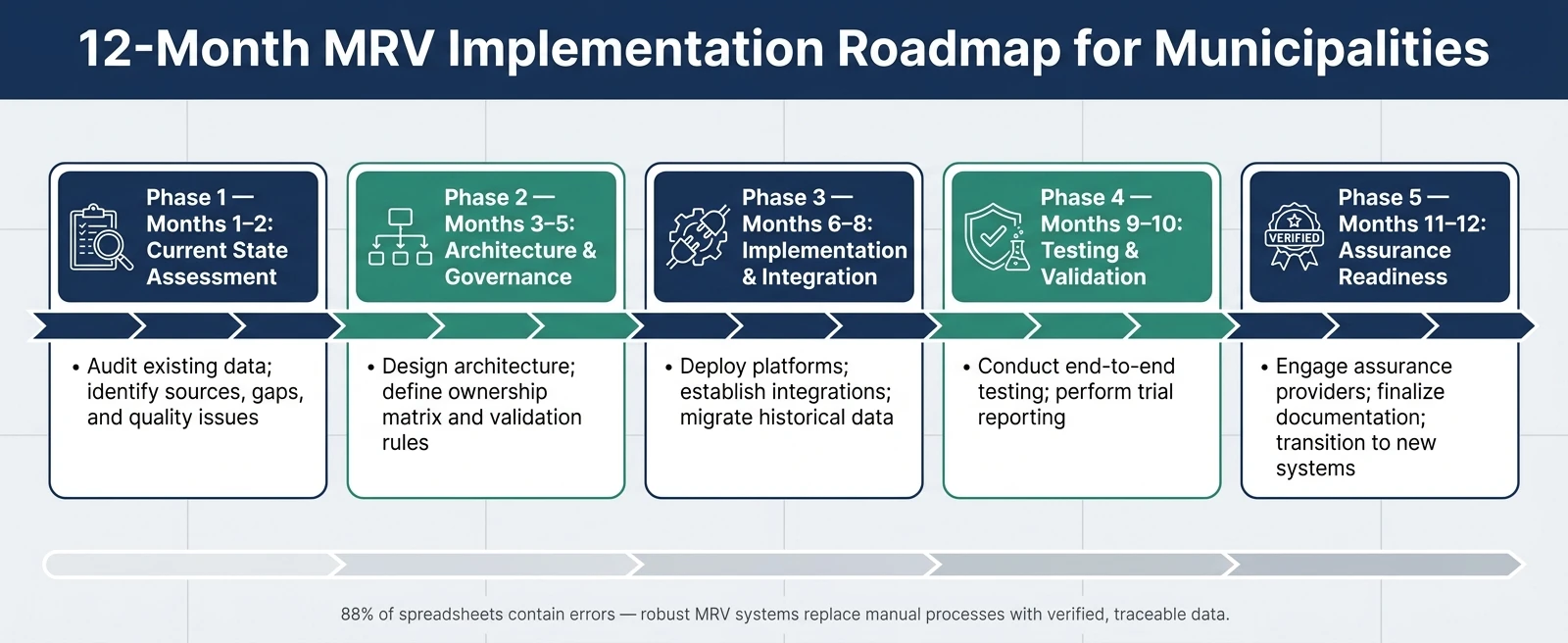
12-Month MRV Framework Implementation Roadmap for Municipalities
Core Components of an MRV Framework
After establishing metrics and baselines, the next step is creating a system to consistently collect, validate, and report data. A strong MRV (Monitoring, Reporting, and Verification) framework stands on four key pillars: governance, data management, verification, and reporting.
Governance ensures that each data point has a clear owner, as discussed earlier in the roles and responsibilities section [3]. Without clear accountability, data management can quickly falter. Effective data management complements governance by providing a well-organized data catalog that links each metric to its source system, calculation method, and responsible party [3]. This structure is critical, especially considering research from the University of Hawaii found that 88% of spreadsheets contain errors, posing risks when data is subject to external review [3].
Verification builds trust in the data by applying automated checks, variance analyses, and multi-level approvals before any figures enter the reporting pipeline [3]. Every reported number must be fully traceable to its source, whether it’s a utility bill, a meter reading, or a fleet mileage log [4].
"The real value of assurance lies in the discipline it imposes on data management, controls, and governance." - Council Fire [4]
These elements lay the groundwork for seamlessly incorporating MRV processes into daily municipal operations.
Connecting MRV with Existing Municipal Systems
Once the MRV framework is established, integrating it with existing municipal systems improves both data reliability and operational efficiency. By linking MRV with platforms like budgeting, asset management, procurement, and HR systems, municipalities can streamline processes and reduce errors [3].
For instance, energy data can flow directly from utility providers into the reporting system, while fleet fuel records can be pulled from fleet management software. Automation like this minimizes manual data entry errors and accelerates reporting timelines [3]. Below is a typical 12-month timeline for implementing an MRV framework:
Implementation Phase | Timeline | Key Activities |
|---|---|---|
Current State Assessment | Months 1–2 | Audit existing data; identify sources, gaps, and quality issues |
Architecture & Governance | Months 3–5 | Design architecture; define ownership matrix and validation rules |
Implementation & Integration | Months 6–8 | Deploy platforms; establish integrations; migrate historical data |
Testing & Validation | Months 9–10 | Conduct end-to-end testing; perform trial reporting |
Assurance Readiness | Months 11–12 | Engage assurance providers; finalize documentation; transition to new systems |
Sustainability data shouldn’t be isolated within a single department. Teams across facilities, finance, procurement, and operations all play a role in creating a more accurate and complete picture. Involving them early ensures the data is more dependable [3].
How Council Fire Can Help

Council Fire collaborates with municipalities to design MRV frameworks that integrate seamlessly with existing systems and ensure strong governance. Their approach includes assessing the current data landscape to identify gaps, developing tailored technology solutions - whether through dedicated ESG platforms or extensions to existing ERP systems - and training staff to maintain these systems over time [3].
This integration delivers more than just smoother reporting. For example, a Port Authority working with Council Fire achieved $125 million in sustainability-related savings by embedding sustainability into its operations and data management processes [3]. For municipalities aiming to move beyond error-prone spreadsheets and build MRV systems that can withstand public scrutiny and third-party verification, operational integration is where the greatest benefits can be realized.
How to Implement Monitoring and Verification: A Step-by-Step Guide
Step-by-Step MRV Implementation Roadmap
Once the MRV framework is in place, the next task is to put monitoring and verification into action. A well-organized rollout is essential to avoid the common mistake of trying to measure everything at once, which often leads to unreliable and inconsistent data.
Begin with a gap analysis to evaluate current data sources, storage systems, and assigned responsibilities. This helps pinpoint weaknesses early, preventing them from becoming larger issues during reporting. After identifying gaps, prioritize sectors like energy, transportation, and waste - areas that typically provide clear data trails and have a substantial impact on emissions. Start small by launching a pilot program in one sector. This approach enables your team to test data collection methods, refine formulas for calculations, and streamline reporting processes before expanding to other areas.
Addressing Data and Capacity Challenges
Fragmented data and limited resources can be major hurdles, but these challenges can be tackled by standardizing processes and building capacity incrementally.
Use uniform templates and consistent calculation methods across all departments to simplify data aggregation and reduce the need for manual adjustments.
Integrate these templates with existing municipal management software to minimize administrative workload.
Investing in staff training is equally important. Organizations like ICLEI offer technical guidelines and training materials tailored for municipal MRV implementation [1]. A phased approach to training, where staff are introduced to the system step by step, helps improve understanding, reduces errors, and ensures smoother adoption.
Once data collection and staff capacity are on track, the focus can shift to ensuring accuracy and fostering transparency.
Ensuring Accuracy and Transparency
Accuracy is the foundation of any credible MRV system. Regular departmental reviews and third-party audits are essential to verify data against original sources, such as utility bills, fuel logs, or meter readings [1]. Ensuring that every data point is traceable to its source strengthens confidence in the reported figures.
Transparency is equally critical. Publishing annual reports that outline findings and progress builds trust with residents and oversight bodies. Following standardized guidelines from established organizations ensures consistency in measurement and verification protocols. Reviewing successful case studies from other municipalities can also provide practical solutions to challenges like fragmented data and resource limitations.
Finally, clear documentation is key. Use concise policy briefs to translate MRV findings into straightforward insights that can guide budget decisions and policy updates. This ensures that monitoring results are not only accurate but also actionable for decision-makers.
Using MRV Results to Improve Policy and Drive Continuous Progress
Applying MRV Findings to Decision-Making
Collecting data is just the beginning; the real impact of MRV (Measurement, Reporting, and Verification) comes when the results are used to shape decisions. By integrating these findings into financial planning and capital projects, MRV transforms from static reports into dynamic tools for action.
Take Oslo's approach in 2017: the city incorporated emissions accounting into its annual financial planning. Every budget line now includes an assessment of carbon impact alongside traditional financial projections. This ensures that fiscal decisions consistently align with climate objectives.
Similarly, assigning climate targets to specific departments - whether public works, procurement, or parks - and linking them to performance evaluations creates accountability across the board. Copenhagen's CPH 2025 Climate Plan serves as a great example, embedding 23 measurable KPIs into annual reviews. This approach helped the city cut per capita emissions from 5.4 to 2.4 tCO2e [5].
The benefits extend beyond emissions reduction. Investments in climate action often yield significant returns, with co-benefits like improved air quality, job creation, and better public health generating $3–$7 for every $1 spent [5]. These figures provide compelling evidence when advocating for climate-focused budgets and policies.
By leveraging data-driven insights, cities can make smarter decisions internally while also fostering the transparency needed to engage the public effectively.
Building Public Trust Through Accountability and Engagement
Transparency isn't just about meeting governance standards - it’s a key strategy for maintaining political and public support. Releasing quarterly or annual dashboards with independently verified emissions data gives residents a clear view of progress and builds credibility [5].
Barcelona's use of its "Decidim" platform between 2020 and 2025 highlights the power of meaningful public engagement. The city involved over 410,000 residents - about 25% of its population - in climate planning efforts. MRV systems tracked "incorporation rates", showing that 68% of citizen proposals received formal responses, and 34% were implemented into policy actions [5]. This level of follow-through turns public participation into a genuine feedback loop rather than a token gesture.
"Cities with strong, well-measured climate programs deliver more predictable regulatory environments." - Sustainability Atlas [5]
For U.S. cities, verified MRV data can unlock access to federal funding. Programs tied to the Inflation Reduction Act (IRA) and the Greenhouse Gas Reduction Fund come with rigorous reporting requirements, which municipalities with robust MRV systems are better equipped to meet [6]. Additionally, documented climate adaptation efforts can qualify communities for the FEMA Community Rating System, potentially reducing flood insurance premiums for residents by up to 45% [6]. These tangible household benefits resonate strongly with the public.
Building a Learning and Feedback Loop
MRV isn't a one-off exercise - it’s a continuous cycle of measuring, reviewing, and adjusting. Yet, only 18% of municipal climate action plans include KPIs that are both tracked and tied to measurable emissions outcomes [5]. Without these, cities lose visibility into which strategies are effective.
To keep MRV systems relevant, cities should schedule regular interdepartmental reviews to recalibrate targets as programs evolve and priorities shift [6]. Baselines are essential for tracking progress, but ongoing reviews ensure that MRV systems remain aligned with current goals.
It's equally important to reassess the metrics themselves. An annual review of the chosen metrics - not just the collected data - prevents cities from being stuck with outdated measures. This is particularly critical during political transitions. Cities that experience a change in governing coalitions within two years of adopting a climate plan implement 30% fewer climate actions on average [5]. A well-documented and institutionalized MRV process serves as a strong safeguard against such disruptions, ensuring continuity and progress regardless of political shifts.
Conclusion and Key Takeaways
A thoughtfully constructed MRV system does much more than ensure regulatory compliance - it provides the analytical backbone for sound climate strategies, informed budgeting, and public transparency. According to Council Fire, accurate emissions accounting forms the bedrock of credible climate action and meaningful stakeholder engagement [7].
With over $500 billion allocated through U.S. federal funding for climate resilience and low-carbon projects, precise tracking is non-negotiable. The principles that drive effective MRV - relevance, completeness, consistency, transparency, and accuracy - are simple yet powerful. These principles come to life through actions like setting clear baselines, aligning reporting with fiscal timelines, regularly updating emission factors, and engaging audit committees. By implementing these steps, organizations not only fulfill compliance obligations but also create opportunities for financial and societal gains.
MRV systems also redefine the concept of ROI by incorporating benefits like environmental improvements, public health advancements, and job creation alongside traditional financial metrics. This broader perspective builds on the actionable strategies and operational insights discussed earlier.
"For public sector organizations that often lack clear financial metrics for evaluating the ROI of investment decisions, an expanded ROI approach can be particularly valuable." - McKinsey & Company
Ultimately, the focus of MRV isn't just on measurement but on continuous improvement. Treating MRV as an evolving system rather than a static report allows cities and agencies to establish trust with their communities, secure federal funding, and demonstrate measurable progress toward their sustainability goals. This dynamic approach ensures that tracking leads to tangible, lasting results.
FAQs
What’s the fastest way to start MRV with limited staff?
For municipalities with smaller teams, you can kick off MRV (Measurement, Reporting, and Verification) efforts efficiently by leveraging simplified inventory tools that tap into existing data sources. Start by selecting a baseline year with the most comprehensive data available. It’s also crucial to involve key data providers - such as local utilities or waste management companies - early in the process to establish data-sharing agreements. To streamline the process, use straightforward calculation templates that quickly convert activity data into emissions values, reducing the need for extensive manual work in future reporting cycles.
How do we verify MRV data before publishing it?
Before sharing MRV data publicly, it’s essential to implement internal controls and thorough quality checks to guarantee its accuracy. Start by employing quality assurance methods such as comparing data against previous years and expected ranges to identify anomalies. Ensure that emission factors are verified and, whenever feasible, reconcile bottom-up calculations with top-down estimates for consistency.
Maintain a clear audit trail by linking all figures to their original sources, such as invoices or meter readings, to support transparency. Conduct internal reviews to catch potential errors, and if possible, consider external verification to boost the credibility and reliability of the data. These steps help ensure the data is both precise and trustworthy.
Which software systems should MRV connect to first?
To build a reliable Metrics, Monitoring, and Verification (MRV) system, start by using software designed to capture essential emissions and energy data. Tools like ENERGY STAR Portfolio Manager are ideal for benchmarking energy use in municipal buildings. For broader, community-level tracking, consider platforms such as the State and Local Energy Planning Platform (SLOPE) to gather comprehensive data. Additionally, incorporate fleet management systems and fuel card data to keep a close eye on transportation emissions, ensuring accurate greenhouse gas reporting.
Related Blog Posts
Latest Articles
©2026

Narrative Change and Power Building: The Missing Half of Advocacy
Narrative change is the process of disrupting dominant narratives that normalize inequity and advancing new narratives from historically marginalized communities.

Funding Resilience Without Federal Grants
BRIC is unreliable and FEMA is shrinking. Here's how cities fund climate resilience with dedicated revenue, blended finance, and a coordinating authority.

The ESG Blind Spot: How AI Is Finding Risks in Companies Nobody Else Is Watching
Norway's sovereign wealth fund uses AI to screen 7,200 portfolio companies for forced labor and corruption within 24 hours. The real story is the emerging-market coverage gap that traditional ESG data vendors miss — and what it means for any company with a global supply chain.
Narrative Change and Power Building: The Missing Half of Advocacy
Narrative change is the process of disrupting dominant narratives that normalize inequity and advancing new narratives from historically marginalized communities.
Funding Resilience Without Federal Grants
BRIC is unreliable and FEMA is shrinking. Here's how cities fund climate resilience with dedicated revenue, blended finance, and a coordinating authority.
The ESG Blind Spot: How AI Is Finding Risks in Companies Nobody Else Is Watching
Norway's sovereign wealth fund uses AI to screen 7,200 portfolio companies for forced labor and corruption within 24 hours. The real story is the emerging-market coverage gap that traditional ESG data vendors miss — and what it means for any company with a global supply chain.
FAQ
01
What does it really mean to “redefine profit”?
02
What makes Council Fire different?
03
Who does Council Fire work with?
04
What does working with Council Fire actually look like?
05
How does Council Fire help organizations turn big goals into action?
06
How does Council Fire define and measure success?
07
How does technology fit into Council Fire’s work?
May 27, 2026
How to Develop Metrics, Monitoring, and Verification (MRV) for Impact for Municipalities & Government Agencies
Sustainability Strategy
In This Article
Practical guide for cities to build MRV systems: set baselines, apply SMART metrics, integrate data, verify results, and support funding.
How to Develop Metrics, Monitoring, and Verification (MRV) for Impact for Municipalities & Government Agencies
Creating effective MRV systems is key for municipalities and government agencies to track progress, manage resources, and meet sustainability goals. MRV - Metrics, Monitoring, and Verification - helps collect, report, and verify data like emissions, energy use, and air quality. This ensures transparency, guides decision-making, and secures federal funding tied to measurable results.
Key Takeaways:
Why MRV Matters: Tracks outcomes, ensures accountability, and informs smarter resource allocation.
What to Measure: Examples include energy use in buildings, vehicle miles traveled, and landfill emissions.
How to Start: Establish baselines, set measurable targets, and follow SMART criteria (Specific, Measurable, Achievable, Relevant, Time-bound).
Implementation Steps: Conduct a gap analysis, pilot programs in key sectors, and integrate MRV with existing systems.
Benefits: Supports funding applications (e.g., Inflation Reduction Act), improves public trust through transparency, and drives continuous improvement.
MRV systems turn data into actionable insights, helping cities meet climate goals and improve public services. Below, we explore how to build and optimize MRV frameworks for measurable impact.
Designing Actionable Sustainability Metrics
Turning Policy Goals into Measurable Metrics
Abstract goals like "reduce our carbon footprint" need to be translated into specific, measurable targets. For instance, a goal could be redefined as reducing municipal building electricity use by 15% by 2030, measured in kilowatt-hours per square foot.
To ensure precision, metrics should be tailored to each municipal sector. The table below outlines examples:
Sector | What to Measure | Where to Get the Data |
|---|---|---|
Facilities | Electricity and fuel use | Utility bills, ENERGY STAR Portfolio Manager |
Transportation | Fuel use, vehicle miles traveled (VMT) | Fleet managers, fuel vendors, mileage records |
Solid Waste | Waste composition, landfill gas | Landfill managers, waste audits, hauling companies |
Wastewater | Biological Oxygen Demand (BOD5) load | Wastewater treatment department records |
Setting Baselines and Targets
Before tracking progress, it’s essential to establish a baseline - a snapshot of current performance. For example, a city might use its 2019 emissions inventory as the benchmark and measure annual reductions from that point forward.
Targets can follow two main approaches:
Science-based targets: Aligned with climate science and global thresholds.
Policy-aligned targets: Reflective of federal or state mandates.
Interim milestones can break down long-term goals into manageable steps, making progress more tangible. Once baselines and targets are defined, applying the SMART criteria ensures metrics are actionable and effective.
Criteria for Effective Metrics
Metrics are only valuable if they meet clear standards, such as those outlined by the SMART framework. Here's how municipalities can apply these criteria:
SMART Criterion | Application in Municipal Context |
|---|---|
Specific | Clearly define the indicator and its scope within the city |
Measurable | Ensure quantitative data is available and methods are clear |
Achievable | Confirm that actions are feasible within local authority |
Relevant | Align metrics with sustainability goals and SDG targets |
Time-bound | Tie metrics to specific reporting cycles and deadlines |
Another critical consideration is jurisdictional alignment. Metrics should focus on areas directly under local control, avoiding reliance on broader regional or national trends. This local accountability is key, especially as around 65% of Sustainable Development Goal (SDG) targets require action at the municipal level [2].
What are Monitoring, Reporting and Verification (MRV)?
Building an MRV Framework for Public Agencies
12-Month MRV Framework Implementation Roadmap for Municipalities
Core Components of an MRV Framework
After establishing metrics and baselines, the next step is creating a system to consistently collect, validate, and report data. A strong MRV (Monitoring, Reporting, and Verification) framework stands on four key pillars: governance, data management, verification, and reporting.
Governance ensures that each data point has a clear owner, as discussed earlier in the roles and responsibilities section [3]. Without clear accountability, data management can quickly falter. Effective data management complements governance by providing a well-organized data catalog that links each metric to its source system, calculation method, and responsible party [3]. This structure is critical, especially considering research from the University of Hawaii found that 88% of spreadsheets contain errors, posing risks when data is subject to external review [3].
Verification builds trust in the data by applying automated checks, variance analyses, and multi-level approvals before any figures enter the reporting pipeline [3]. Every reported number must be fully traceable to its source, whether it’s a utility bill, a meter reading, or a fleet mileage log [4].
"The real value of assurance lies in the discipline it imposes on data management, controls, and governance." - Council Fire [4]
These elements lay the groundwork for seamlessly incorporating MRV processes into daily municipal operations.
Connecting MRV with Existing Municipal Systems
Once the MRV framework is established, integrating it with existing municipal systems improves both data reliability and operational efficiency. By linking MRV with platforms like budgeting, asset management, procurement, and HR systems, municipalities can streamline processes and reduce errors [3].
For instance, energy data can flow directly from utility providers into the reporting system, while fleet fuel records can be pulled from fleet management software. Automation like this minimizes manual data entry errors and accelerates reporting timelines [3]. Below is a typical 12-month timeline for implementing an MRV framework:
Implementation Phase | Timeline | Key Activities |
|---|---|---|
Current State Assessment | Months 1–2 | Audit existing data; identify sources, gaps, and quality issues |
Architecture & Governance | Months 3–5 | Design architecture; define ownership matrix and validation rules |
Implementation & Integration | Months 6–8 | Deploy platforms; establish integrations; migrate historical data |
Testing & Validation | Months 9–10 | Conduct end-to-end testing; perform trial reporting |
Assurance Readiness | Months 11–12 | Engage assurance providers; finalize documentation; transition to new systems |
Sustainability data shouldn’t be isolated within a single department. Teams across facilities, finance, procurement, and operations all play a role in creating a more accurate and complete picture. Involving them early ensures the data is more dependable [3].
How Council Fire Can Help
Council Fire collaborates with municipalities to design MRV frameworks that integrate seamlessly with existing systems and ensure strong governance. Their approach includes assessing the current data landscape to identify gaps, developing tailored technology solutions - whether through dedicated ESG platforms or extensions to existing ERP systems - and training staff to maintain these systems over time [3].
This integration delivers more than just smoother reporting. For example, a Port Authority working with Council Fire achieved $125 million in sustainability-related savings by embedding sustainability into its operations and data management processes [3]. For municipalities aiming to move beyond error-prone spreadsheets and build MRV systems that can withstand public scrutiny and third-party verification, operational integration is where the greatest benefits can be realized.
How to Implement Monitoring and Verification: A Step-by-Step Guide
Step-by-Step MRV Implementation Roadmap
Once the MRV framework is in place, the next task is to put monitoring and verification into action. A well-organized rollout is essential to avoid the common mistake of trying to measure everything at once, which often leads to unreliable and inconsistent data.
Begin with a gap analysis to evaluate current data sources, storage systems, and assigned responsibilities. This helps pinpoint weaknesses early, preventing them from becoming larger issues during reporting. After identifying gaps, prioritize sectors like energy, transportation, and waste - areas that typically provide clear data trails and have a substantial impact on emissions. Start small by launching a pilot program in one sector. This approach enables your team to test data collection methods, refine formulas for calculations, and streamline reporting processes before expanding to other areas.
Addressing Data and Capacity Challenges
Fragmented data and limited resources can be major hurdles, but these challenges can be tackled by standardizing processes and building capacity incrementally.
Use uniform templates and consistent calculation methods across all departments to simplify data aggregation and reduce the need for manual adjustments.
Integrate these templates with existing municipal management software to minimize administrative workload.
Investing in staff training is equally important. Organizations like ICLEI offer technical guidelines and training materials tailored for municipal MRV implementation [1]. A phased approach to training, where staff are introduced to the system step by step, helps improve understanding, reduces errors, and ensures smoother adoption.
Once data collection and staff capacity are on track, the focus can shift to ensuring accuracy and fostering transparency.
Ensuring Accuracy and Transparency
Accuracy is the foundation of any credible MRV system. Regular departmental reviews and third-party audits are essential to verify data against original sources, such as utility bills, fuel logs, or meter readings [1]. Ensuring that every data point is traceable to its source strengthens confidence in the reported figures.
Transparency is equally critical. Publishing annual reports that outline findings and progress builds trust with residents and oversight bodies. Following standardized guidelines from established organizations ensures consistency in measurement and verification protocols. Reviewing successful case studies from other municipalities can also provide practical solutions to challenges like fragmented data and resource limitations.
Finally, clear documentation is key. Use concise policy briefs to translate MRV findings into straightforward insights that can guide budget decisions and policy updates. This ensures that monitoring results are not only accurate but also actionable for decision-makers.
Using MRV Results to Improve Policy and Drive Continuous Progress
Applying MRV Findings to Decision-Making
Collecting data is just the beginning; the real impact of MRV (Measurement, Reporting, and Verification) comes when the results are used to shape decisions. By integrating these findings into financial planning and capital projects, MRV transforms from static reports into dynamic tools for action.
Take Oslo's approach in 2017: the city incorporated emissions accounting into its annual financial planning. Every budget line now includes an assessment of carbon impact alongside traditional financial projections. This ensures that fiscal decisions consistently align with climate objectives.
Similarly, assigning climate targets to specific departments - whether public works, procurement, or parks - and linking them to performance evaluations creates accountability across the board. Copenhagen's CPH 2025 Climate Plan serves as a great example, embedding 23 measurable KPIs into annual reviews. This approach helped the city cut per capita emissions from 5.4 to 2.4 tCO2e [5].
The benefits extend beyond emissions reduction. Investments in climate action often yield significant returns, with co-benefits like improved air quality, job creation, and better public health generating $3–$7 for every $1 spent [5]. These figures provide compelling evidence when advocating for climate-focused budgets and policies.
By leveraging data-driven insights, cities can make smarter decisions internally while also fostering the transparency needed to engage the public effectively.
Building Public Trust Through Accountability and Engagement
Transparency isn't just about meeting governance standards - it’s a key strategy for maintaining political and public support. Releasing quarterly or annual dashboards with independently verified emissions data gives residents a clear view of progress and builds credibility [5].
Barcelona's use of its "Decidim" platform between 2020 and 2025 highlights the power of meaningful public engagement. The city involved over 410,000 residents - about 25% of its population - in climate planning efforts. MRV systems tracked "incorporation rates", showing that 68% of citizen proposals received formal responses, and 34% were implemented into policy actions [5]. This level of follow-through turns public participation into a genuine feedback loop rather than a token gesture.
"Cities with strong, well-measured climate programs deliver more predictable regulatory environments." - Sustainability Atlas [5]
For U.S. cities, verified MRV data can unlock access to federal funding. Programs tied to the Inflation Reduction Act (IRA) and the Greenhouse Gas Reduction Fund come with rigorous reporting requirements, which municipalities with robust MRV systems are better equipped to meet [6]. Additionally, documented climate adaptation efforts can qualify communities for the FEMA Community Rating System, potentially reducing flood insurance premiums for residents by up to 45% [6]. These tangible household benefits resonate strongly with the public.
Building a Learning and Feedback Loop
MRV isn't a one-off exercise - it’s a continuous cycle of measuring, reviewing, and adjusting. Yet, only 18% of municipal climate action plans include KPIs that are both tracked and tied to measurable emissions outcomes [5]. Without these, cities lose visibility into which strategies are effective.
To keep MRV systems relevant, cities should schedule regular interdepartmental reviews to recalibrate targets as programs evolve and priorities shift [6]. Baselines are essential for tracking progress, but ongoing reviews ensure that MRV systems remain aligned with current goals.
It's equally important to reassess the metrics themselves. An annual review of the chosen metrics - not just the collected data - prevents cities from being stuck with outdated measures. This is particularly critical during political transitions. Cities that experience a change in governing coalitions within two years of adopting a climate plan implement 30% fewer climate actions on average [5]. A well-documented and institutionalized MRV process serves as a strong safeguard against such disruptions, ensuring continuity and progress regardless of political shifts.
Conclusion and Key Takeaways
A thoughtfully constructed MRV system does much more than ensure regulatory compliance - it provides the analytical backbone for sound climate strategies, informed budgeting, and public transparency. According to Council Fire, accurate emissions accounting forms the bedrock of credible climate action and meaningful stakeholder engagement [7].
With over $500 billion allocated through U.S. federal funding for climate resilience and low-carbon projects, precise tracking is non-negotiable. The principles that drive effective MRV - relevance, completeness, consistency, transparency, and accuracy - are simple yet powerful. These principles come to life through actions like setting clear baselines, aligning reporting with fiscal timelines, regularly updating emission factors, and engaging audit committees. By implementing these steps, organizations not only fulfill compliance obligations but also create opportunities for financial and societal gains.
MRV systems also redefine the concept of ROI by incorporating benefits like environmental improvements, public health advancements, and job creation alongside traditional financial metrics. This broader perspective builds on the actionable strategies and operational insights discussed earlier.
"For public sector organizations that often lack clear financial metrics for evaluating the ROI of investment decisions, an expanded ROI approach can be particularly valuable." - McKinsey & Company
Ultimately, the focus of MRV isn't just on measurement but on continuous improvement. Treating MRV as an evolving system rather than a static report allows cities and agencies to establish trust with their communities, secure federal funding, and demonstrate measurable progress toward their sustainability goals. This dynamic approach ensures that tracking leads to tangible, lasting results.
FAQs
What’s the fastest way to start MRV with limited staff?
For municipalities with smaller teams, you can kick off MRV (Measurement, Reporting, and Verification) efforts efficiently by leveraging simplified inventory tools that tap into existing data sources. Start by selecting a baseline year with the most comprehensive data available. It’s also crucial to involve key data providers - such as local utilities or waste management companies - early in the process to establish data-sharing agreements. To streamline the process, use straightforward calculation templates that quickly convert activity data into emissions values, reducing the need for extensive manual work in future reporting cycles.
How do we verify MRV data before publishing it?
Before sharing MRV data publicly, it’s essential to implement internal controls and thorough quality checks to guarantee its accuracy. Start by employing quality assurance methods such as comparing data against previous years and expected ranges to identify anomalies. Ensure that emission factors are verified and, whenever feasible, reconcile bottom-up calculations with top-down estimates for consistency.
Maintain a clear audit trail by linking all figures to their original sources, such as invoices or meter readings, to support transparency. Conduct internal reviews to catch potential errors, and if possible, consider external verification to boost the credibility and reliability of the data. These steps help ensure the data is both precise and trustworthy.
Which software systems should MRV connect to first?
To build a reliable Metrics, Monitoring, and Verification (MRV) system, start by using software designed to capture essential emissions and energy data. Tools like ENERGY STAR Portfolio Manager are ideal for benchmarking energy use in municipal buildings. For broader, community-level tracking, consider platforms such as the State and Local Energy Planning Platform (SLOPE) to gather comprehensive data. Additionally, incorporate fleet management systems and fuel card data to keep a close eye on transportation emissions, ensuring accurate greenhouse gas reporting.
Related Blog Posts
Latest Articles
©2026
Narrative Change and Power Building: The Missing Half of Advocacy
Narrative change is the process of disrupting dominant narratives that normalize inequity and advancing new narratives from historically marginalized communities.
Funding Resilience Without Federal Grants
BRIC is unreliable and FEMA is shrinking. Here's how cities fund climate resilience with dedicated revenue, blended finance, and a coordinating authority.
The ESG Blind Spot: How AI Is Finding Risks in Companies Nobody Else Is Watching
Norway's sovereign wealth fund uses AI to screen 7,200 portfolio companies for forced labor and corruption within 24 hours. The real story is the emerging-market coverage gap that traditional ESG data vendors miss — and what it means for any company with a global supply chain.
FAQ
01
What does it really mean to “redefine profit”?
02
What makes Council Fire different?
03
Who does Council Fire work with?
04
What does working with Council Fire actually look like?
05
How does Council Fire help organizations turn big goals into action?
06
How does Council Fire define and measure success?
07
How does technology fit into Council Fire’s work?
May 27, 2026
How to Develop Metrics, Monitoring, and Verification (MRV) for Impact for Municipalities & Government Agencies
Sustainability Strategy
In This Article
Practical guide for cities to build MRV systems: set baselines, apply SMART metrics, integrate data, verify results, and support funding.
How to Develop Metrics, Monitoring, and Verification (MRV) for Impact for Municipalities & Government Agencies
Creating effective MRV systems is key for municipalities and government agencies to track progress, manage resources, and meet sustainability goals. MRV - Metrics, Monitoring, and Verification - helps collect, report, and verify data like emissions, energy use, and air quality. This ensures transparency, guides decision-making, and secures federal funding tied to measurable results.
Key Takeaways:
Why MRV Matters: Tracks outcomes, ensures accountability, and informs smarter resource allocation.
What to Measure: Examples include energy use in buildings, vehicle miles traveled, and landfill emissions.
How to Start: Establish baselines, set measurable targets, and follow SMART criteria (Specific, Measurable, Achievable, Relevant, Time-bound).
Implementation Steps: Conduct a gap analysis, pilot programs in key sectors, and integrate MRV with existing systems.
Benefits: Supports funding applications (e.g., Inflation Reduction Act), improves public trust through transparency, and drives continuous improvement.
MRV systems turn data into actionable insights, helping cities meet climate goals and improve public services. Below, we explore how to build and optimize MRV frameworks for measurable impact.
Designing Actionable Sustainability Metrics
Turning Policy Goals into Measurable Metrics
Abstract goals like "reduce our carbon footprint" need to be translated into specific, measurable targets. For instance, a goal could be redefined as reducing municipal building electricity use by 15% by 2030, measured in kilowatt-hours per square foot.
To ensure precision, metrics should be tailored to each municipal sector. The table below outlines examples:
Sector | What to Measure | Where to Get the Data |
|---|---|---|
Facilities | Electricity and fuel use | Utility bills, ENERGY STAR Portfolio Manager |
Transportation | Fuel use, vehicle miles traveled (VMT) | Fleet managers, fuel vendors, mileage records |
Solid Waste | Waste composition, landfill gas | Landfill managers, waste audits, hauling companies |
Wastewater | Biological Oxygen Demand (BOD5) load | Wastewater treatment department records |
Setting Baselines and Targets
Before tracking progress, it’s essential to establish a baseline - a snapshot of current performance. For example, a city might use its 2019 emissions inventory as the benchmark and measure annual reductions from that point forward.
Targets can follow two main approaches:
Science-based targets: Aligned with climate science and global thresholds.
Policy-aligned targets: Reflective of federal or state mandates.
Interim milestones can break down long-term goals into manageable steps, making progress more tangible. Once baselines and targets are defined, applying the SMART criteria ensures metrics are actionable and effective.
Criteria for Effective Metrics
Metrics are only valuable if they meet clear standards, such as those outlined by the SMART framework. Here's how municipalities can apply these criteria:
SMART Criterion | Application in Municipal Context |
|---|---|
Specific | Clearly define the indicator and its scope within the city |
Measurable | Ensure quantitative data is available and methods are clear |
Achievable | Confirm that actions are feasible within local authority |
Relevant | Align metrics with sustainability goals and SDG targets |
Time-bound | Tie metrics to specific reporting cycles and deadlines |
Another critical consideration is jurisdictional alignment. Metrics should focus on areas directly under local control, avoiding reliance on broader regional or national trends. This local accountability is key, especially as around 65% of Sustainable Development Goal (SDG) targets require action at the municipal level [2].
What are Monitoring, Reporting and Verification (MRV)?
Building an MRV Framework for Public Agencies
12-Month MRV Framework Implementation Roadmap for Municipalities
Core Components of an MRV Framework
After establishing metrics and baselines, the next step is creating a system to consistently collect, validate, and report data. A strong MRV (Monitoring, Reporting, and Verification) framework stands on four key pillars: governance, data management, verification, and reporting.
Governance ensures that each data point has a clear owner, as discussed earlier in the roles and responsibilities section [3]. Without clear accountability, data management can quickly falter. Effective data management complements governance by providing a well-organized data catalog that links each metric to its source system, calculation method, and responsible party [3]. This structure is critical, especially considering research from the University of Hawaii found that 88% of spreadsheets contain errors, posing risks when data is subject to external review [3].
Verification builds trust in the data by applying automated checks, variance analyses, and multi-level approvals before any figures enter the reporting pipeline [3]. Every reported number must be fully traceable to its source, whether it’s a utility bill, a meter reading, or a fleet mileage log [4].
"The real value of assurance lies in the discipline it imposes on data management, controls, and governance." - Council Fire [4]
These elements lay the groundwork for seamlessly incorporating MRV processes into daily municipal operations.
Connecting MRV with Existing Municipal Systems
Once the MRV framework is established, integrating it with existing municipal systems improves both data reliability and operational efficiency. By linking MRV with platforms like budgeting, asset management, procurement, and HR systems, municipalities can streamline processes and reduce errors [3].
For instance, energy data can flow directly from utility providers into the reporting system, while fleet fuel records can be pulled from fleet management software. Automation like this minimizes manual data entry errors and accelerates reporting timelines [3]. Below is a typical 12-month timeline for implementing an MRV framework:
Implementation Phase | Timeline | Key Activities |
|---|---|---|
Current State Assessment | Months 1–2 | Audit existing data; identify sources, gaps, and quality issues |
Architecture & Governance | Months 3–5 | Design architecture; define ownership matrix and validation rules |
Implementation & Integration | Months 6–8 | Deploy platforms; establish integrations; migrate historical data |
Testing & Validation | Months 9–10 | Conduct end-to-end testing; perform trial reporting |
Assurance Readiness | Months 11–12 | Engage assurance providers; finalize documentation; transition to new systems |
Sustainability data shouldn’t be isolated within a single department. Teams across facilities, finance, procurement, and operations all play a role in creating a more accurate and complete picture. Involving them early ensures the data is more dependable [3].
How Council Fire Can Help
Council Fire collaborates with municipalities to design MRV frameworks that integrate seamlessly with existing systems and ensure strong governance. Their approach includes assessing the current data landscape to identify gaps, developing tailored technology solutions - whether through dedicated ESG platforms or extensions to existing ERP systems - and training staff to maintain these systems over time [3].
This integration delivers more than just smoother reporting. For example, a Port Authority working with Council Fire achieved $125 million in sustainability-related savings by embedding sustainability into its operations and data management processes [3]. For municipalities aiming to move beyond error-prone spreadsheets and build MRV systems that can withstand public scrutiny and third-party verification, operational integration is where the greatest benefits can be realized.
How to Implement Monitoring and Verification: A Step-by-Step Guide
Step-by-Step MRV Implementation Roadmap
Once the MRV framework is in place, the next task is to put monitoring and verification into action. A well-organized rollout is essential to avoid the common mistake of trying to measure everything at once, which often leads to unreliable and inconsistent data.
Begin with a gap analysis to evaluate current data sources, storage systems, and assigned responsibilities. This helps pinpoint weaknesses early, preventing them from becoming larger issues during reporting. After identifying gaps, prioritize sectors like energy, transportation, and waste - areas that typically provide clear data trails and have a substantial impact on emissions. Start small by launching a pilot program in one sector. This approach enables your team to test data collection methods, refine formulas for calculations, and streamline reporting processes before expanding to other areas.
Addressing Data and Capacity Challenges
Fragmented data and limited resources can be major hurdles, but these challenges can be tackled by standardizing processes and building capacity incrementally.
Use uniform templates and consistent calculation methods across all departments to simplify data aggregation and reduce the need for manual adjustments.
Integrate these templates with existing municipal management software to minimize administrative workload.
Investing in staff training is equally important. Organizations like ICLEI offer technical guidelines and training materials tailored for municipal MRV implementation [1]. A phased approach to training, where staff are introduced to the system step by step, helps improve understanding, reduces errors, and ensures smoother adoption.
Once data collection and staff capacity are on track, the focus can shift to ensuring accuracy and fostering transparency.
Ensuring Accuracy and Transparency
Accuracy is the foundation of any credible MRV system. Regular departmental reviews and third-party audits are essential to verify data against original sources, such as utility bills, fuel logs, or meter readings [1]. Ensuring that every data point is traceable to its source strengthens confidence in the reported figures.
Transparency is equally critical. Publishing annual reports that outline findings and progress builds trust with residents and oversight bodies. Following standardized guidelines from established organizations ensures consistency in measurement and verification protocols. Reviewing successful case studies from other municipalities can also provide practical solutions to challenges like fragmented data and resource limitations.
Finally, clear documentation is key. Use concise policy briefs to translate MRV findings into straightforward insights that can guide budget decisions and policy updates. This ensures that monitoring results are not only accurate but also actionable for decision-makers.
Using MRV Results to Improve Policy and Drive Continuous Progress
Applying MRV Findings to Decision-Making
Collecting data is just the beginning; the real impact of MRV (Measurement, Reporting, and Verification) comes when the results are used to shape decisions. By integrating these findings into financial planning and capital projects, MRV transforms from static reports into dynamic tools for action.
Take Oslo's approach in 2017: the city incorporated emissions accounting into its annual financial planning. Every budget line now includes an assessment of carbon impact alongside traditional financial projections. This ensures that fiscal decisions consistently align with climate objectives.
Similarly, assigning climate targets to specific departments - whether public works, procurement, or parks - and linking them to performance evaluations creates accountability across the board. Copenhagen's CPH 2025 Climate Plan serves as a great example, embedding 23 measurable KPIs into annual reviews. This approach helped the city cut per capita emissions from 5.4 to 2.4 tCO2e [5].
The benefits extend beyond emissions reduction. Investments in climate action often yield significant returns, with co-benefits like improved air quality, job creation, and better public health generating $3–$7 for every $1 spent [5]. These figures provide compelling evidence when advocating for climate-focused budgets and policies.
By leveraging data-driven insights, cities can make smarter decisions internally while also fostering the transparency needed to engage the public effectively.
Building Public Trust Through Accountability and Engagement
Transparency isn't just about meeting governance standards - it’s a key strategy for maintaining political and public support. Releasing quarterly or annual dashboards with independently verified emissions data gives residents a clear view of progress and builds credibility [5].
Barcelona's use of its "Decidim" platform between 2020 and 2025 highlights the power of meaningful public engagement. The city involved over 410,000 residents - about 25% of its population - in climate planning efforts. MRV systems tracked "incorporation rates", showing that 68% of citizen proposals received formal responses, and 34% were implemented into policy actions [5]. This level of follow-through turns public participation into a genuine feedback loop rather than a token gesture.
"Cities with strong, well-measured climate programs deliver more predictable regulatory environments." - Sustainability Atlas [5]
For U.S. cities, verified MRV data can unlock access to federal funding. Programs tied to the Inflation Reduction Act (IRA) and the Greenhouse Gas Reduction Fund come with rigorous reporting requirements, which municipalities with robust MRV systems are better equipped to meet [6]. Additionally, documented climate adaptation efforts can qualify communities for the FEMA Community Rating System, potentially reducing flood insurance premiums for residents by up to 45% [6]. These tangible household benefits resonate strongly with the public.
Building a Learning and Feedback Loop
MRV isn't a one-off exercise - it’s a continuous cycle of measuring, reviewing, and adjusting. Yet, only 18% of municipal climate action plans include KPIs that are both tracked and tied to measurable emissions outcomes [5]. Without these, cities lose visibility into which strategies are effective.
To keep MRV systems relevant, cities should schedule regular interdepartmental reviews to recalibrate targets as programs evolve and priorities shift [6]. Baselines are essential for tracking progress, but ongoing reviews ensure that MRV systems remain aligned with current goals.
It's equally important to reassess the metrics themselves. An annual review of the chosen metrics - not just the collected data - prevents cities from being stuck with outdated measures. This is particularly critical during political transitions. Cities that experience a change in governing coalitions within two years of adopting a climate plan implement 30% fewer climate actions on average [5]. A well-documented and institutionalized MRV process serves as a strong safeguard against such disruptions, ensuring continuity and progress regardless of political shifts.
Conclusion and Key Takeaways
A thoughtfully constructed MRV system does much more than ensure regulatory compliance - it provides the analytical backbone for sound climate strategies, informed budgeting, and public transparency. According to Council Fire, accurate emissions accounting forms the bedrock of credible climate action and meaningful stakeholder engagement [7].
With over $500 billion allocated through U.S. federal funding for climate resilience and low-carbon projects, precise tracking is non-negotiable. The principles that drive effective MRV - relevance, completeness, consistency, transparency, and accuracy - are simple yet powerful. These principles come to life through actions like setting clear baselines, aligning reporting with fiscal timelines, regularly updating emission factors, and engaging audit committees. By implementing these steps, organizations not only fulfill compliance obligations but also create opportunities for financial and societal gains.
MRV systems also redefine the concept of ROI by incorporating benefits like environmental improvements, public health advancements, and job creation alongside traditional financial metrics. This broader perspective builds on the actionable strategies and operational insights discussed earlier.
"For public sector organizations that often lack clear financial metrics for evaluating the ROI of investment decisions, an expanded ROI approach can be particularly valuable." - McKinsey & Company
Ultimately, the focus of MRV isn't just on measurement but on continuous improvement. Treating MRV as an evolving system rather than a static report allows cities and agencies to establish trust with their communities, secure federal funding, and demonstrate measurable progress toward their sustainability goals. This dynamic approach ensures that tracking leads to tangible, lasting results.
FAQs
What’s the fastest way to start MRV with limited staff?
For municipalities with smaller teams, you can kick off MRV (Measurement, Reporting, and Verification) efforts efficiently by leveraging simplified inventory tools that tap into existing data sources. Start by selecting a baseline year with the most comprehensive data available. It’s also crucial to involve key data providers - such as local utilities or waste management companies - early in the process to establish data-sharing agreements. To streamline the process, use straightforward calculation templates that quickly convert activity data into emissions values, reducing the need for extensive manual work in future reporting cycles.
How do we verify MRV data before publishing it?
Before sharing MRV data publicly, it’s essential to implement internal controls and thorough quality checks to guarantee its accuracy. Start by employing quality assurance methods such as comparing data against previous years and expected ranges to identify anomalies. Ensure that emission factors are verified and, whenever feasible, reconcile bottom-up calculations with top-down estimates for consistency.
Maintain a clear audit trail by linking all figures to their original sources, such as invoices or meter readings, to support transparency. Conduct internal reviews to catch potential errors, and if possible, consider external verification to boost the credibility and reliability of the data. These steps help ensure the data is both precise and trustworthy.
Which software systems should MRV connect to first?
To build a reliable Metrics, Monitoring, and Verification (MRV) system, start by using software designed to capture essential emissions and energy data. Tools like ENERGY STAR Portfolio Manager are ideal for benchmarking energy use in municipal buildings. For broader, community-level tracking, consider platforms such as the State and Local Energy Planning Platform (SLOPE) to gather comprehensive data. Additionally, incorporate fleet management systems and fuel card data to keep a close eye on transportation emissions, ensuring accurate greenhouse gas reporting.
Related Blog Posts
Latest Articles
©2026
Narrative Change and Power Building: The Missing Half of Advocacy
Narrative change is the process of disrupting dominant narratives that normalize inequity and advancing new narratives from historically marginalized communities.
Funding Resilience Without Federal Grants
BRIC is unreliable and FEMA is shrinking. Here's how cities fund climate resilience with dedicated revenue, blended finance, and a coordinating authority.
The ESG Blind Spot: How AI Is Finding Risks in Companies Nobody Else Is Watching
Norway's sovereign wealth fund uses AI to screen 7,200 portfolio companies for forced labor and corruption within 24 hours. The real story is the emerging-market coverage gap that traditional ESG data vendors miss — and what it means for any company with a global supply chain.
FAQ
What does it really mean to “redefine profit”?
What makes Council Fire different?
Who does Council Fire work with?
What does working with Council Fire actually look like?
How does Council Fire help organizations turn big goals into action?
How does Council Fire define and measure success?
How does technology fit into Council Fire’s work?