
Oct 13, 2026 · 13 min read
Sustainability Strategy
In This Article
Turn emissions targets into accountable monthly KPIs linking every major Scope 1–3 source to owners, funded projects, and verifiable reporting.
KPI Plan for Scope 1, 2, 3 Cuts
We turn emissions targets into a plan by linking each major source to a KPI, an owner, a funded project, and a reporting date. We track fuel and energy use separately from emissions in metric tons of CO2e (mtCO2e), so you can see whether projects are cutting emissions - not just completing tasks.
Our checklist covers:
Set the baseline: Define inventory boundaries, document methods, and screen all 15 Scope 3 categories.
Measure each scope: Track direct emissions, purchased energy, and value-chain emissions, with separate measures for energy use, procurement, and supplier engagement.
Assign delivery: Set targets, budgets, project milestones, and monthly, quarterly, and annual reviews.
Check the results: Retain source records, resolve data gaps, approve the plan, and keep credits separate from inventory reductions.
We use consistent calculations and <u>clear ownership</u> to help you decide which projects need funding, correction, or faster delivery.
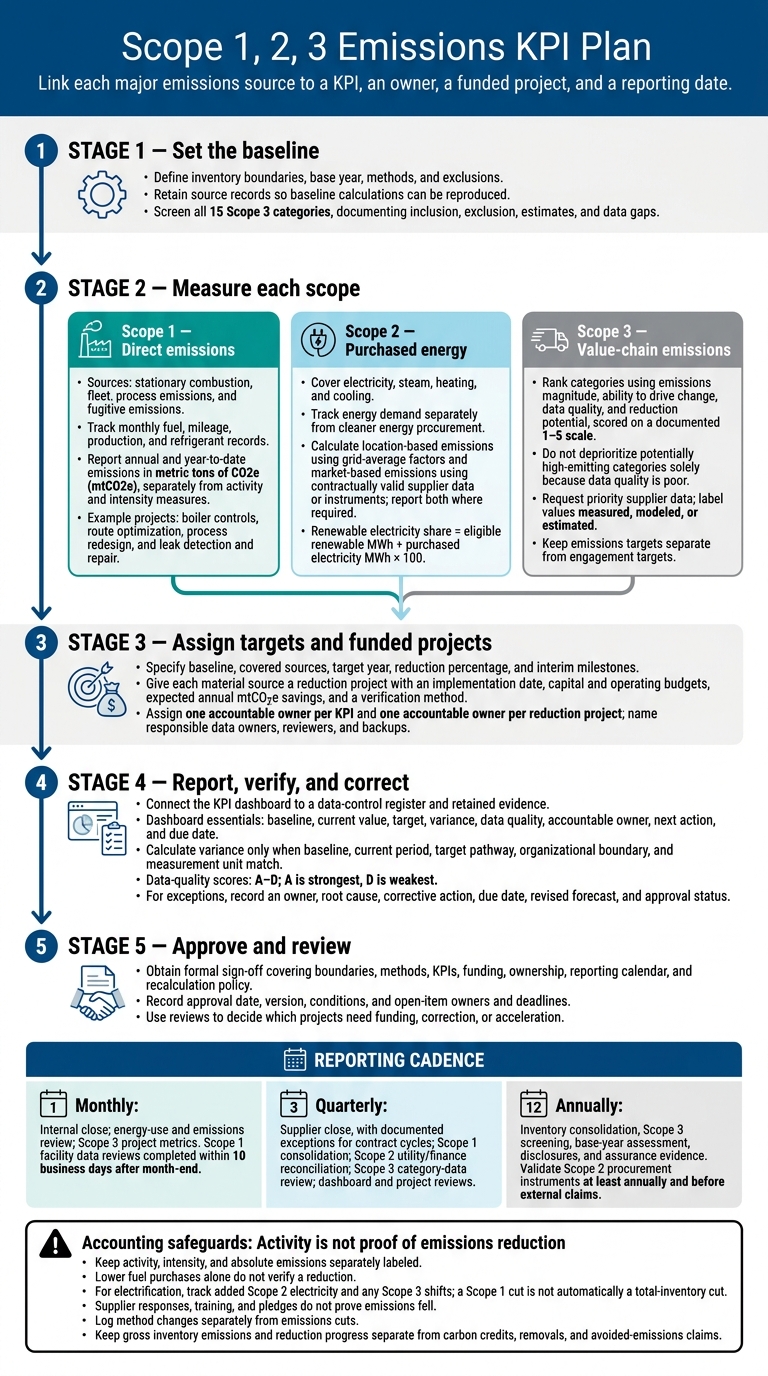
Scope 1, 2, 3 Emissions KPI Plan
How to Build a Sustainability KPI Dashboard in Excel | Step-by-Step
sbb-itb-8baf5f1
2. Build Scope 1 KPIs for Direct Emissions
Turn the base-year inventory into a monthly KPI for each material direct emissions source.
Measure Fuel Use, Fleet Efficiency, Process Emissions, and Fugitive Emissions
Collect monthly records for every owned or controlled direct source. Track annual and year-to-date Scope 1 emissions in mtCO2e, alongside source-level intensity measures. For each KPI, define the source population, unit, formula, base year, reporting period, and exclusions.
| Source | Monthly inputs | Performance measure | Linked reduction project |
|---|---|---|---|
| Stationary combustion | Fuel quantities by fuel type and asset, equipment hours, meter readings | Fuel per operating hour; mtCO2e per unit produced | Boiler controls |
| Fleet | Fuel-card gallons, vehicle IDs, fuel type, mileage | Gallons per mile; share of in-scope vehicles that are electric | Route optimization |
| Process emissions | Material inputs, production volumes, direct measurements or mass balances | mtCO2e per metric ton of product | Process redesign |
| Fugitive emissions | Gas type, installed charge, recharges, leak and repair records | Refrigerant added ÷ installed charge × 100 | Leak detection and repair |
For refrigerants, distinguish recharges after leaks from charges for new equipment. Calculate emissions as mass added or estimated leaked × the applicable GWP, and document the assumption and method.
For alternative fuels, record quantity, energy content, blend share, and the applicable emissions factor. “Renewable” does not mean emissions-free: EPA combustion factors exclude upstream impacts. Report lifecycle comparisons separately from Scope 1 results.[4]
Start with the highest-emitting sources, then assign targets and projects.
Set Scope 1 Targets and Projects
Pair an absolute reduction target with source-specific intensity measures. Record the base year, baseline mtCO2e, covered sources, target year, reduction percentage, interim milestones, accountable owner, and approved budget. Before claiming Science Based Targets initiative (SBTi) validation, check its current ambition and time-frame criteria.[7][8]
Assign every material source a reduction project. Specify its implementation date, capital and operating budgets, expected annual mtCO2e savings, and verification method. Compare measured performance against the project baseline, adjusting for changes in production or operations. Lower fuel purchases alone do not verify a reduction.
For electrification projects, track added Scope 2 electricity and any Scope 3 shifts. A Scope 1 reduction should not be mistaken for a cut in total inventory emissions.
Once the source KPIs and projects are set, lock the monthly reporting process.
Check Scope 1 Readiness
Complete facility data reviews within 10 business days after month-end, then consolidate results quarterly. Facilities should own stationary-fuel records, fleet teams should own vehicle records, operations should own process data, and maintenance should own leak records. Assign a separate reviewer for calculations.
[ ] All in-scope stationary, mobile, process, and fugitive sources have assigned owners and monthly data feeds.
[ ] Facilities, fleet, maintenance, and operations have assigned owners for monthly fuel, mileage, process, and refrigerant data.
[ ] Activity measures, emissions results, intensity indicators, and reduction targets have separate labels.
[ ] Scope 1 emission factors, GWP basis, unit conversions, and estimation methods are documented.
[ ] Baseline calculations can be reproduced from retained source records.
[ ] Each major emissions source has a reduction project, budget, expected savings, and verification method.
[ ] Absolute targets, intensity measures, interim milestones, and target-year definitions are approved.
[ ] Finance, operations, facilities, fleet, sustainability, and internal audit or controllership roles are clear.
[ ] Material data gaps and uncertainty have corrective actions with owners and due dates.
[ ] Any external target claim, including possible SBTi validation, has been checked against current criteria.[7][8]
3. Build Scope 2 KPIs for Purchased Energy
Apply the same monthly KPI discipline to Scope 2, while keeping energy demand separate from contractual claims.
Gather Utility Data and Energy Contracts
Start with the records needed to track energy demand, calculate emissions, and support claims. Inventory every in-scope facility and purchased-energy site or asset, covering electricity, steam, heating, and cooling. Record each address, ownership or lease status, floor area, meter ID, utility or supplier, start and end dates, quantity, unit, tariff, cost, and data source. Keep monthly utility bills and meter exports, and standardize units before calculating emissions.[10]
Keep supplier emissions factors, contract terms, renewable energy certificates (RECs), power purchase agreement (PPA) details, and proof of instrument retirement. Use the checklist below to document instruments and check claims.[9][11]
Calculate location-based emissions with grid-average factors and market-based emissions with contractually valid supplier data or instruments. Report both where required.[9] For each facility and reporting period, report purchased energy, the applicable emissions factor, resulting mtCO2e, accounting method, and data-quality status.
Set Energy-Use and Scope 2 Targets
Track demand reduction separately from cleaner energy procurement. Give each target a boundary, base year, deadline, covered energy sources, exclusions, and accounting basis. Label the target as absolute emissions, intensity, energy demand, or procurement, and disclose the accounting basis for any science-based target.[7]
Use the following KPIs to track demand reduction and procurement progress.
| KPI | Measurement | Use |
|---|---|---|
| Energy demand | Electricity in kWh or MWh; steam, heating, and cooling in documented units | Demand by energy source |
| Scope 2 emissions | Location-based and market-based mtCO2e, reported separately | Accounting-method comparison |
| Renewable electricity share | Eligible renewable MWh ÷ purchased electricity MWh × 100 | Verified procurement coverage |
| Energy intensity | Electricity kWh ÷ consistently defined square feet | Building efficiency |
| Peak demand | Highest billing-period demand in kW | Demand peaks |
| Active project coverage | Facilities with active efficiency projects ÷ in-scope facilities × 100 | Implementation progress |
Once targets are set, assign owners and schedule reconciliations and validation dates.
Check Scope 2 Readiness
Assign owners across facilities, procurement, finance, legal, and sustainability to handle data, contracts, reconciliation, claims, and reporting. Review energy use and emissions monthly. Reconcile utility and financial records quarterly, and validate procurement instruments at least annually and before making external claims.
[ ] Every meter, supplier, and purchased-energy source maps to a facility and reporting period.
[ ] Electricity, steam, heating, and cooling quantities are complete or documented as estimates.
[ ] Utility bills and meter data reconcile to finance records.
[ ] Units, conversion factors, geographic regions, and emissions-factor vintages are documented.
[ ] Location-based and market-based results are calculated separately where required.
[ ] Instrument records identify the generator, technology, project location, generation period, MWh volume, certificate or registry identifier, owner, retirement or cancellation date, applicable emissions factor, and assigned facilities or consumption volume.
[ ] Instruments convey the emissions-rate claim exclusively, are tracked and retired or canceled for the reporting entity, and are issued and redeemed as close as possible to consumption.
[ ] Geographic eligibility, contractual deliverability, vintage, and supplier allocation are verified; no other party has claimed the instrument.
[ ] An allocation worksheet confirms that claimed MWh do not exceed eligible consumption MWh.[9][11]
[ ] Targets specify boundary, base year, target year, metric, accounting basis, and exclusions.
[ ] KPIs cover both energy-demand reduction and procurement.
[ ] Facilities, procurement, finance, legal, and sustainability owners are named.
[ ] Review, reconciliation, validation, and pre-claim deadlines are scheduled.
[ ] Data gaps, estimated values, corrective actions, and missed-target escalation rules are recorded.
4. Build Scope 3 KPIs for Value-Chain Emissions
After facility energy, turn to emissions across the value chain.
Rank Categories and Request Supplier Data
Screen all 15 GHG Protocol Scope 3 categories, even those that initially seem immaterial. For each, record estimated mtCO2e, its share of total Scope 3 emissions, your ability to drive change, data quality, reduction potential, importance to finances or operations, and reasons for inclusion or exclusion.
Score emissions magnitude, ability to drive change, data quality, and reduction potential on a documented 1–5 scale. Keep data gaps visible: poor data shouldn't push a potentially high-emitting category down the priority list. Give priority to categories with the highest emissions or greatest reduction potential.[14] Rank them, then request supplier data in that order.
Use this ranking to set request priorities and data deadlines. Send a standard request with a response deadline to priority suppliers, starting with high-emitting Tier 1 suppliers, suppliers important to business plans, and those over whom your purchasing gives you strong influence.
Ask for quantities, units, material composition, energy use, emissions, transport modes, reporting period, boundaries, factors, methods, Scope 1 and 2 inputs, Scope 3 inputs, allocation rules, exclusions, and assurance status. Require suppliers to label values as measured, modeled, or estimated and attach supporting documents.
Use spend-based estimates for initial screening or when activity data is missing. Document U.S. dollar values and the factor year. Set deadlines to replace priority estimates with activity-based or supplier-specific data, and log method changes separately from emissions cuts.[13][14]
Separate Emissions Targets from Engagement Targets
For each emissions target, specify the Scope 3 category, treatment of acquisitions and divestitures, and recalculation rules. Use the target fields established earlier.
Track purchasing emissions per unit and materials with verified product carbon footprints; freight emissions, modal share, and load factor; travel emissions and passenger-miles; waste emissions and disposal routes; and product use-phase emissions, recycled content, and end-of-life recovery. Report mtCO2e, intensity, and activity separately. Label freight as short ton-miles or metric ton-kilometers.
Keep engagement targets separate from emissions targets. Questionnaire responses, training sessions, and pledges don't prove that emissions fell. A target covering suppliers responsible for 70% of purchased-goods emissions by 2030 must name the climate-target framework, define the emissions denominator, and require evidence of alignment.
Check supplier target boundaries, covered scopes, base and target years, and validation or documented alignment against the applicable criteria. Report supplier-data coverage and assured data separately from emissions results.[12][7]
Check Scope 3 Readiness
Review project metrics monthly, category data quarterly, and the full inventory and target assessment annually. Give procurement, logistics, travel or HR, facilities or operations, product teams, finance, and sustainability clear ownership of their data streams and controls.
[ ] All 15 categories are screened, with written reasons for each exclusion or estimate.
[ ] Priority categories have owners, secondary owners, baselines, supplier requests, and data-improvement deadlines.
[ ] Factors, factor years, GWP values, uncertainty, and allocation rules are recorded.
[ ] Supplier-specific, activity-based, average-data, and spend-based emissions shares are disclosed separately.
[ ] Reduction projects have budgets, milestones, accountable leaders, and expected emissions impacts.
[ ] Engagement targets remain separate from emissions targets.
[ ] Method changes, restatements, and supplier boundary changes are logged.
[ ] Missing supplier data and overdue projects have escalation deadlines.
[ ] Relevant teams review results before publication.
5. Assign Owners and Set Reporting Rules
Once KPI definitions are set, confirm ownership, reporting cadence, and controls so teams report metrics consistently.
Define Team Roles and Reporting Deadlines
Build a RACI matrix with one accountable owner per KPI, one or more responsible data owners, required reviewers, and informed stakeholders. Include executives and teams from sustainability, operations, facilities, procurement, finance, and IT. Internal audit or an external assurer should test controls.
Name a backup owner and reviewer. Give each reduction project one accountable owner, and link it to an approved budget, expected emissions savings, delivery milestones, and a named project manager.
Create a reporting calendar that specifies the owner, deliverable, cutoff date, review date, and sign-off deadline. Include monthly internal close and quarterly supplier close, with documented exceptions for contract cycles. Schedule quarterly dashboard and project reviews, plus annual consolidation of the inventory, Scope 3 screening, base-year assessment, disclosures, and assurance evidence.
Document interim estimates when final data isn't available. Use exact dates and times rather than relative deadlines, and use the calendar to populate a single KPI dashboard and control register.
Build a KPI Dashboard and Data-Control Register
The dashboard tracks progress against reduction targets. The control register protects data integrity.
Give each KPI one dashboard row containing its name, scope and category, unit, baseline period and value, current value, target and target year, variance, data-quality score, accountable owner, status, next action, due date, and evidence location.
Calculate variance only when the baseline, current period, target pathway, organizational boundary, and measurement unit match. Indicate whether higher values are good or bad, and keep absolute emissions separate from intensity metrics.
Use A–D data-quality scores to prioritize fixes: A is strongest, and D is weakest.[15][16]
Maintain a linked control register with the emissions source, activity input, unit, system of record, emission factor, calculation method, reporting frequency, data owner, review control, evidence retained, and known limitation. Retain source files, calculations, periods, boundaries, version numbers, and change logs so every reported value can be rebuilt.[15][17]
| Emissions source | Input | Method | Schedule | Key control | Accountable team |
|---|---|---|---|---|---|
| Natural gas | Therms from utility bills | Activity data × gas emission factor | Monthly | Reconcile bills to general ledger and prior month | Facilities and Finance |
| Purchased electricity | kWh and contractual instruments | Location-based and market-based calculations | Monthly; annual factor review | Check meter completeness and contract validity | Energy Management |
| Purchased goods | Supplier quantities or spend | Supplier-specific, average-data, or spend-based method | Quarterly | Review supplier coverage and duplicate purchases | Procurement and Sustainability |
| Refrigerants | Pounds added during service | Refrigerant quantity × GWP | Monthly or at service event | Match service logs to equipment register | Facilities |
Resolve Data Gaps and Missed Targets
Use the control register to flag exceptions before the annual approval cycle.
Set escalation thresholds before reporting starts for:
Internal data more than five business days overdue.
Unexplained emissions increases above 5% month over month or 10% against the quarterly pathway.
Factor or GWP changes that affect totals by more than 2%.
Annual misses above 5% of target.
Projects forecast to deliver below 90% of approved savings.
Adjust these thresholds for normal operating volatility.
Record an owner, root cause, corrective action, due date, revised forecast, and approval status for each exception. During quarterly reviews, address delays and funding gaps separately from accounting changes. A revised factor alone is not an operational emissions cut.
6. Approve the KPI Plan
Complete Sign-Off and Schedule Reviews
Once KPIs, owners, and controls are set, submit the plan for formal approval. The approval checklist should cover:
[ ] Boundaries, base year, scopes, methods, emission factors, exclusions, and data-quality limits.
[ ] KPIs, target formats, baseline traceability, funding, owners, and review responsibilities.
[ ] The reporting calendar and recalculation policy.
Assign every open item an owner and deadline before approval or release. Require signatures from the sustainability lead, finance or controllership, operations, procurement, facilities or energy management, and the executive sponsor. In the controlled record, document the approval date, version, conditions, and each open item’s owner and due date.
Apply recalculation rules after qualifying structural changes, methodology updates, or material errors. Specify whether the threshold applies individually or cumulatively, and retain both the original baseline and a restatement log.[5][19][6]
Keep gross inventory emissions and reduction progress separate from carbon credits, removals, and avoided-emissions claims.[18] Use scheduled reviews to decide which projects need funding, correction, or acceleration - not just to count completed activities.
Define Implementation Support
After approval, assign implementation support to delivery tasks, not target ownership.
Organizations that need support can work with Council Fire on decarbonization pathways, stakeholder coordination, KPI architecture, data-process design, and implementation planning. Internal leaders remain responsible for source data, targets, budgets, execution, and public claims.
The statement of work should define scope, milestones, assumptions, access, fees, confidentiality, and escalation. Consulting support does not guarantee emissions reductions or provide independent assurance.
FAQs
Which emissions KPIs should we prioritize with a limited budget?
Prioritize high-impact, reliable KPIs. Use a materiality assessment to identify the 5 to 8 Scope 3 categories that account for 80% to 90% of your total footprint.
Use unit economic analysis to pinpoint costly manual data collection. Target data quality improvements at these hotspots - for example, replace spend-based estimates with supplier-specific data - instead of trying to measure everything. Make sure your KPIs cover all Scope 1 and Scope 2 sources.
How can we track progress when supplier data is missing?
Use spend-based estimates or sector-average proxies as interim values to keep tracking your footprint as you expand primary data coverage [1][2].
Record data quality scores and disclose reporting limitations [2]. Set a supplier improvement roadmap with a target of increasing primary data coverage by 10–15 percentage points each year [1]. Maintain a clear audit trail of estimation methods, proxies, and allocations to keep your process audit-ready [3][2].
How do we confirm electrification cuts total emissions?
Track energy use and emissions intensity before and after electrification to measure what changes. Record inventory boundaries and methods in an Inventory Management Plan, and convert greenhouse gases to CO₂e using consistent Global Warming Potentials.
Collect data from utility meters, building management systems, or fleet telematics. Report Scope 2 emissions using both location-based and market-based methods. Run automated year-over-year variance checks and cross-metric checks, and link every reported figure to its source documents so reviewers can verify the numbers.



FAQ