In This Article
Select IRIS+ metrics that can change investment decisions—verify data, resolve evidence gaps, set thresholds, and link to monitoring.
IRIS+ for Impact Due Diligence: Metric Selection
I select IRIS+ metrics by asking one question: could this measure change the investment decision? I start with the relevant Core Metrics Set, add Catalog metrics only to fill a documented gap, and set approval thresholds based on the investment - not assumed IRIS+ rules.
I use five dimensions of impact to test the claim: what changes, who experiences it, how much changes, the investment’s contribution, and the risk of results falling short. Then I:
Check the data: confirm definitions, sources, baselines, coverage, collection costs, and verification.
Address gaps: assign owners and deadlines, and resolve material uncertainty before approval.
Set decision rules: state when results call for approval, more diligence, safeguards, or rejection.
Plan monitoring: carry approved measures into reporting with targets, review dates, and escalation rules.
My rule is simple: delivery counts do not prove outcomes, and <u>missing data is not zero</u>. I keep each measure tied to a claim, a decision, and a person responsible for follow-through.
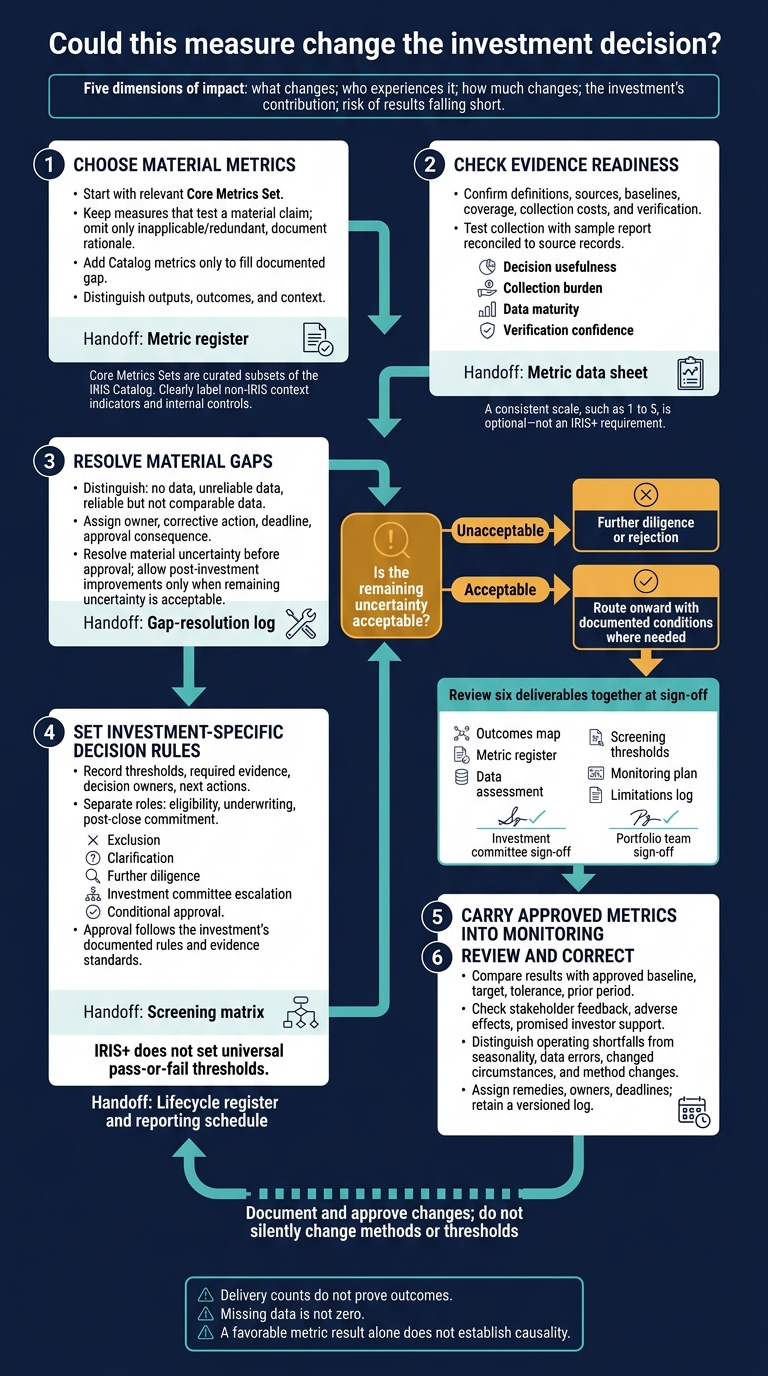
IRIS+ Metric Selection: From Due Diligence to Monitoring
Navigating Impact Project Launch: IRIS+ Sustainable Agriculture Theme
sbb-itb-8baf5f1
Choose Core Metrics and Supplements
Assess the relevant Core Metrics Set against the investment’s intended outcomes, stakeholders, sector, and geographic context. Keep measures that test a material claim. Omit only those that are inapplicable or redundant, and record any data gaps.[8][4] Each retained metric should inform approval, escalation, or rejection. Use that test to narrow the shortlist to measures that can change the screening decision.
Distinguish Outcomes, Outputs, and Context
Outputs show delivery; outcomes show change. Context and risk indicators help explain both. Activity counts alone cannot prove that stakeholders benefit.
Use stakeholder-specific metrics only when they change the investment decision.
Consider Importance of Outcome to Stakeholders (OI5495) when stakeholder priorities affect the investment thesis. Document the method, sample size, and response split. Stakeholder Engagement (OI7914) addresses how the organization obtains and uses stakeholder input - not whether an outcome matters. Before finalizing either measure, verify its current name, definition, and whether the metric belongs in the chosen Core Metrics Set against official IRIS+ resources; record the verification date.[7][9]
Compare Core Metrics Sets and Catalog Metrics
Core Metrics Sets are curated subsets of the IRIS Catalog, not a separate system. Add Catalog metrics only to fill documented gaps in outcomes, stakeholder context, contribution, or risk. Standard definitions help with comparison, but the period, scope, and method must also match.[8][10]
Use the distinctions below to decide whether a measure belongs in the core set, a supplement, or a context indicator.
| Selection option | Selection purpose | Standardization | Customization tradeoff |
|---|---|---|---|
| Core Metrics Set | Establish a package for a defined impact objective | Standard IRIS definitions, curated together | May miss investment-specific issues |
| Catalog supplement | Fill a material evidence gap the core set does not cover | Individual Catalog metric | Adds selection and reporting work |
| Supplementary context indicator | Explain local conditions | Depends on the source and definition | May limit cross-investment comparison |
| Internal management measure | Track implementation and corrective action | Organization-specific unless explicitly mapped | Flexible, but less externally comparable |
Once the shortlist is set, enter every retained and omitted measure, including supplementary measures, in one metric register. Record each measure’s identifier, source, classification, rationale, decision use, scope, definition, formula, unit, disaggregation, baseline, target, period, owner, and evidence source.
Clearly label non-IRIS context indicators and internal controls. If a definition or formula differs from the official IRIS+ version, document the difference rather than presenting the measure as standardized IRIS+ data.[6][8] Use the register as the handoff to monitoring.
Check Data Availability and Quality
Create a Metric Data Sheet
Create one row per metric to check whether its data are ready for use. Include the source, method, owner, frequency, baseline, target, verification method, and date last checked. Keep IRIS+ units and methods. For U.S. reporting, use MM/DD/YYYY dates, commas for thousands, periods for decimals, and USD amounts - for example, $125,000.00 on 03/31/2026.[12][13] Use the sheet to mark each metric as ready for approval or monitoring, conditional, or deferred.
Test collection before accepting a reporting commitment. Request a sample report using the proposed definition and reporting period. Reconcile it to source records, and log the staff time, tools, and cost required. Tag each source as an audited system, administrative record, estimate, survey, or third-party verification.
Set a minimum acceptable standard before using a metric to make decisions. That standard might require complete quarterly reporting for all operating sites, documented calculations, and reconciliation to source records.
Weigh Decision Use Against Collection Burden
Score each metric separately across the dimensions below. Use a consistent scale, such as 1 to 5, and briefly explain each score. Apply investment-specific labels: mandatory for approval or monitoring requirements, conditional when a defined risk or circumstance makes the metric material, and developmental when the method or system needs more work. These labels are internal governance terms only.
| Assessment | What to check | Decision implication |
|---|---|---|
| Decision usefulness | Relevance to approval and whether stakeholders consider the claimed change valid | Easy collection does not justify a measure that misses the intended outcome |
| Collection burden | Staff hours, cost, survey demands, and reporting frequency | Match requirements to capacity and how quickly outcomes change |
| Data maturity | Completeness, timeliness, and consistency across periods | Missing populations or changing methods require a documented improvement plan |
| Verification confidence | Accuracy against source records; comparability of units, populations, and periods | Unreconciled or incompatible figures should not support an unqualified claim |
Send only metrics that pass this test into the gap-resolution log.
Assign Actions to Close Evidence Gaps
Maintain a gap-resolution log that records the metric, gap type, affected period or population, evidence reviewed, risk to the investment decision, responsible owner, corrective action, deadline, interim measure, approval consequence, and closure evidence.
Distinguish between no data, data exist but are unreliable, and data are reliable but not comparable. Common gaps include missing baselines, incomplete stakeholder coverage, inconsistent definitions, unsupported outcome claims, unverified estimates, late reporting, and missing disaggregation.
Resolve material gaps before approval. Allow post-investment improvements only when the remaining uncertainty is acceptable. Do not replace missing outcome evidence with an activity count.[12][5]
Carry approved metrics, fixes, and unresolved conditions into screening rules and post-investment monitoring terms.
Link Screening to Post-Investment Tracking
Set Screening and Approval Rules
Turn retained metrics into screening rules using the metric register and gap log. For each metric, build a screening matrix that records its name and ID, impact objective, stakeholder group, unit, threshold, required evidence, decision owner, and next action.
Keep three roles separate: eligibility tests for mandate fit, underwriting metrics for investment decisions, and post-close commitment metrics for delivery. Specify how failures or uncertainty lead to exclusion, clarification, further diligence, investment committee escalation, or conditional approval. IRIS+ does not set universal pass-or-fail thresholds; set and justify thresholds for each investment.[18]
Keep the stakeholder-benefit case separate from the investor-contribution case. Record attribution, reach, counterfactual, and downside risk.[14][17][15][16] A favorable metric result alone does not establish causality.[14][17]
Carry Approved Metrics Into Monitoring
After approval, carry only retained metrics and open conditions into the monitoring plan. Add approved metrics to the lifecycle register and reporting schedule without changing their approved definitions, formulas, units, or populations. Base baselines, targets, and tolerances on the approved investment case - not on assumed IRIS+ requirements.
Use that same register to connect the approved case to reporting, ownership, and escalation.
Retained measure Screening and approval role Baseline and target Reporting, owner, and verification Escalation rule Number of underserved U.S. households served Test mandate fit; include a reporting covenant Retain the verified starting count and reach target Quarterly; impact lead; reconcile customer records Review departures from the agreed reach tolerance Percent of customers reporting improved access Assess expected stakeholder benefit; establish a baseline before the first draw Retain the baseline percentage and outcome target Semiannually; outcome owner; independent sample survey Escalate declining outcomes or unreliable survey coverage Scope 1 and 2 greenhouse-gas emissions Assess environmental risk; require a measurement plan where needed Record the baseline period, emissions boundary, and target Annually; finance or sustainability owner; verify calculations Review target misses and changes in calculation boundaries Investor technical assistance Test proposed investor contribution; approve support commitments Record starting capability and agreed delivery milestones Quarterly; deal team; document assistance and resulting changes Escalate missed commitments or unsupported contribution claims
Flag every screening criterion that lacks a monitoring counterpart. Explain why it serves as a one-time eligibility test, or assign a documented proxy.
For recurring measures, specify the reporting cutoff, submission deadline, validation window, review meeting, and escalation deadline. Review fast-changing risks quarterly. Use semiannual reviews when outcomes take longer to emerge or surveys place a heavy burden on respondents. Annual reporting may suit slow-moving environmental or infrastructure outcomes, but review material risks sooner.
Review Results and Set Corrective Actions
After each reporting cycle, compare results with the approved case: the baseline, target, tolerance, and prior period. Use the same threshold, tolerance, and evidence standard applied during screening to decide whether corrective action or escalation is needed. Check stakeholder feedback, adverse effects, and whether promised investor support was delivered.
Before assigning an owner, remedy, and deadline, distinguish operating shortfalls from seasonality, data errors, changed circumstances, and method changes. Keep prior submissions in a versioned log, recording revised definitions, approval dates, affected periods, and any restated history. Where feasible, run old and new methods side by side for an overlap period so a method change does not hide poor performance.
Conclusion: Finalize Metrics and Monitoring
At sign-off, review metrics, evidence, and monitoring as one decision package. Check all six deliverables together: the outcomes map, metric register, data assessment, screening thresholds, monitoring plan, and limitations log.
Metric fit: Confirm that each priority outcome has a meaningful indicator. The outcomes map should identify affected stakeholders, time horizons, and assumptions. Stakeholders must be able to challenge how their experience is interpreted - not just supply data.[11]
Evidence readiness: Check that named owners can collect each measure consistently at a reasonable cost. Label estimates, proxies, missing baselines, and coverage gaps. Record who owns each limitation and how it affects decisions. Missing data is not zero.
Monitoring handoff: Confirm that thresholds lead to clear decisions and that approved metrics carry through to monitoring. Obtain sign-off from the investment committee and portfolio team. Set review dates for approval, the first reporting cycle, and each year after that.
After sign-off, lock the metric set and start the first reporting cycle without changing approved definitions, thresholds, or owners.
FAQs
How do I prioritize metrics when investment goals conflict?
Focus on core metrics that reflect your impact thesis and financially material issues. Use double materiality to assess stakeholder impacts and value creation, adding only a few metrics by sector or theme that help guide decisions.
Link these metrics to pre-investment screening and post-investment monitoring. Define data sources, calculation methods, and who owns each metric. If you can’t demonstrate both dimensions, adjust your approach rather than trying to collect everything. [1][2][3]
What evidence gaps should block investment approval?
Withhold investment approval if the organization lacks the capacity to conduct rigorous impact and financial due diligence, if impact goals conflict with returns in ways better suited to philanthropy, or if the opportunity cannot generate enough revenue to repay the investment [1].
Approval should also wait when data owners are missing, metrics remain undefined, or data completeness thresholds have not been met. Resolve these gaps and confirm data reliability before moving forward [2].
When should I revise metrics after investing?
Revise metrics when major investment, organizational, or external changes affect what you track or how accurately you track it. Review or recalculate metrics when mergers, acquisitions, or divestitures change your data inventory by 5% to 10%.
Update metrics as regulations, sustainability standards, or your methodology change. An annual review of your strategy is recommended to check that indicators still align with your impact thesis and collect the data you need to make informed decisions.




FAQ