In This Article
Treat impact claims as unverified until baselines, source records, and causal tests support them.
Impact Investing Due Diligence: Verifying Outcome Claims
I treat an impact claim as unverified until the records support it - not just the story. Before investing, I check what changed, who experienced it, and what likely would have happened without the program. In the article’s example, employment gains of 16 percentage points versus 14 for a comparison group leave a 2-point difference, not proof of cause.
My review covers five checks:
Define the claim: Separate work delivered from changes in people’s lives, and distinguish the program’s results from the investor’s contribution.
Test the starting point: Check baseline data, comparisons, other explanations, lasting results, and possible harms.
Follow the numbers: Review measurement methods, recalculate results, and trace them to source records while protecting personal data.
Check the review: Hear from affected people and assess outside reviewers’ independence, scope, and limits.
Act on the findings: Accept, qualify, reject, or defer the claim; document gaps and set deadlines, reporting duties, and follow-up checks.
My rule is simple: <u>match the claim - and the investment terms - to the strength of the evidence</u>. Missing records call for more checking; conflicting records call for correction.
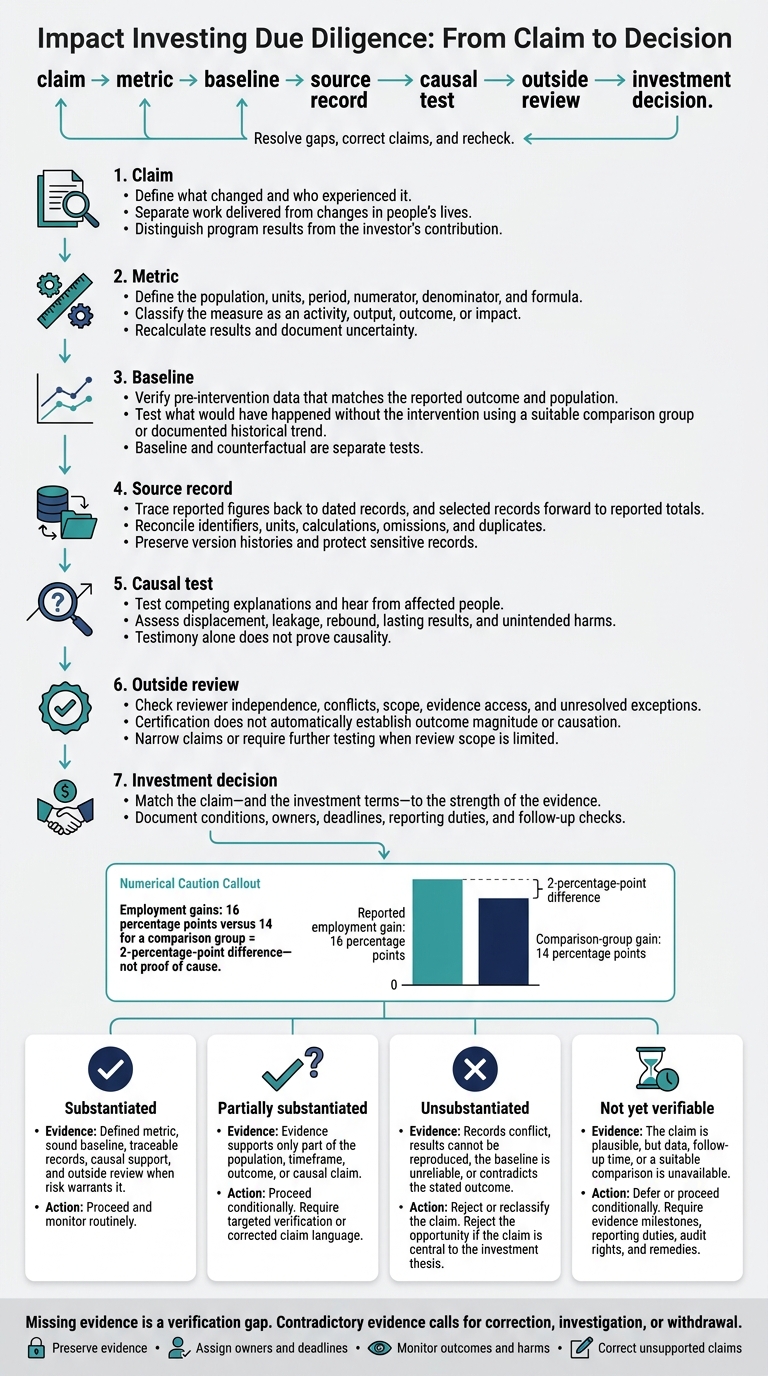
Impact Investing Due Diligence: From Claim to Decision
Class Takeaways - Analysis and Measurement of Impact
sbb-itb-8baf5f1
Step 1: Check Baselines and Additionality
Verify claims against baseline and comparison evidence, starting with those that matter most. Rank them by dollar value, beneficiary count, and importance to the investment committee. Treat claims with missing baseline or comparison evidence as unverified. Record each gap, its materiality, the person responsible, and the deadline.[3][5]
Check Baseline and Comparison Data
Require pre-intervention data that matches the reported result’s outcome, population, geography, units, and reporting period. Check the collection date, sample size, methodology, and data owner. The baseline must predate material exposure to the intervention.
If no direct baseline exists, require a documented reconstruction from reliable historical records, administrative data, surveys, satellite data, or other clearly justified sources. Disclose the assumptions and uncertainty.[8][9]
The baseline and counterfactual are separate tests. Test what would have happened without the intervention against a suitable comparison group or documented historical trend. Compare prior performance, income, geography, market conditions, and exposure to shocks. Watch for cherry-picked start dates, shifting boundaries, unusually weak comparison cases, and baseline revisions made after results were known. For difference-in-differences estimates, check whether the groups followed similar trends before the intervention.[4][6][10]
Once the baseline is supported by evidence, check whether the measurement method and source records support the result.
Assess What the Investment Added
Separate two questions: Did the investment add something that would otherwise have been missing? And did reported outcomes exceed what would have happened anyway?
Request evidence from the time of commitment, such as financing alternatives, rejected funding applications, investor correspondence, and board minutes. Patient capital, first-loss protection, or technical assistance may support an additionality claim. Participation alone does not. Document the investor’s contribution or allocation rather than crediting one investor with every project outcome.[3][7]
Before accepting the full claimed magnitude, test for displacement, leakage, rebound, and permanent losses. Displacement shifts problems elsewhere. Leakage creates harm outside the project boundary. Rebound offsets efficiency gains through greater consumption. Assess whether results will last and whether the intervention caused unintended losses of income, land, access, or services.
Where these effects or the counterfactual remain uncertain, qualify the claim rather than accepting its full reported magnitude. Claims that pass these checks move next to verification of the measurement method and source records.
Step 2: Check Measurement Methods and Source Records
Review Indicators and Data Collection
For every claim in the register, build an indicator dictionary for each measure. Include its definition, outcome type, population or asset boundary, numerator, denominator, unit, period, frequency, formula, data owner, and approval date. Classify the measure as an activity, output, outcome, or impact. For proxies, document the assumption connecting the proxy to the claimed change, along with supporting evidence. Sustainability consulting helps standardize definitions to keep measures consistent, but the underlying data and methods still need verification.
Check how the data were collected: the sampling frame, selection method, sample size, response rate, survey instrument, collection dates, enumerator training, language accessibility, and treatment of nonrespondents. Compare respondents with the eligible population using relevant characteristics.
Recalculate results from the underlying counts. Identify missing observations and test whether reasonable assumptions about missing data change the conclusion. For sampled data, record confidence intervals or other uncertainty measures. Report ranges when the data cannot support a precise figure.
With the measure defined, trace the reported figure to its source records.
Trace Results to Source Records
Follow reported figures back to dated surveys, payroll records, utility bills, meter readings, project logs, or on-site measurements. Then work in the other direction: trace selected source records forward to check for omissions.
Verify identifiers, units, and calculations. Increase testing for financially material claims, unusually large results, and risks involving vulnerable populations. Reconcile totals across source systems, management reports, and relevant financial records. Investigate duplicate participants, canceled projects, and mismatched reporting cutoffs.
Hypothetical energy investment: A fund reports that 40 small businesses saved an average of $350 per month after installing efficient equipment. Obtain pre- and post-installation bills for each business and compare equivalent billing periods. Adjust for electricity rates, weather, operating hours, production, facility size, and partial periods. Recalculate savings in kilowatt-hours and U.S. dollars. If a business closed for two months, do not count its raw bill reduction as equipment-driven savings without an appropriate adjustment.
Once the records reconcile, check how the data were handled, changed, and approved.
Document Data Quality and Changes
Record who collected, processed, reviewed, and approved the data. Preserve source extracts, calculation files, access controls, and version histories, along with explanations for exclusions, estimates, missing periods, and restatements. Document unit conversions and any currency conversion rate, including its source and date.
Break down results by relevant participant groups and locations so averages do not hide weaker outcomes. Protect sensitive records with coded identifiers, restricted access, encryption, and retention limits. Confirm consent before disclosure. When full disclosure would create risk, give reviewers redacted records or secure read-only access.
If the records reconcile, move to causality and outside review.
Step 3: Assess Causality and Outside Reviews
Once the records reconcile, test whether the investment helped produce the reported change.
Test Other Explanations and Hear From Affected People
Check whether the change occurred, whether the investment contributed, and whether the result likely would have happened anyway. Keep a log of competing explanations: economic conditions, policy changes, other funders, self-selection, attrition, and changes in reporting procedures. Test these explanations with comparison groups or contribution analysis.[11][12]
Next, ask affected people whether their experiences support the theory of change or point to missing harms. Go beyond management-selected participants. Include people who left, declined services, or filed complaints. Ask who benefited, who did not, and who faced costs or harm. Provide confidential, accessible channels and protection from retaliation. Use testimony to check whether measured outcomes match lived experience and identify missing effects - not as proof of causality on its own.[13][14]
Match each claim to the evidence. Use “measured increase” or “observed association” when causality remains uncertain; “contributed to” when multiple sources support a plausible causal pathway; and “caused” or “resulted in” only when a strong experimental or quasi-experimental design rules out major alternatives. A comparison group helps only when the analysis adequately addresses differences between participants and nonparticipants.[1][2]
Check Reviewer Independence and Review Scope
Next, assess how much weight the evidence deserves. Request the reviewer’s conflicts statement, compensation arrangements, prior relationships, and engagement terms. Check the criteria, reporting period, exclusions, access to source records, interviews with affected people, and unresolved exceptions. Being paid by management does not automatically invalidate a review, but undisclosed relationships or limits on evidence access make its findings harder to trust.[16][17]
| Review type | Criteria and scope | Assurance or confidence | Main limitation |
|---|---|---|---|
| Management self-reporting | Management selects the framework and reports its data | No independent assurance | May reflect incomplete records, optimism, weak controls, or conflict |
| Limited or reasonable assurance | External testing of specified claims against defined criteria | Limited assurance uses narrower procedures; reasonable assurance provides high, not absolute, confidence through more extensive testing | Confidence is bounded by scope, sampling, and evidence |
| Certification | Assessment against specified standard requirements | Varies by scheme; not automatically impact assurance | Compliance does not establish outcome magnitude or causation |
| Independent impact verification | Evaluation of defined claims through indicators, evidence, causal reasoning, and affected-person or field checks | Varies by engagement; state the confidence level explicitly | Selected claims, sites, or periods may leave material gaps |
A review of reporting controls cannot establish improvements in income, health, or safety. If the review excludes high-risk locations, adverse outcomes, or key causal assumptions, request broader testing. Use the review scope to narrow the claim or set follow-up conditions.[15][16]
Conclusion: Decide, Document, and Monitor
Once you’ve checked the baseline, measurement, source records, causality, and outside review, use the evidence to make an investment decision.
Follow the full chain: claim → metric → baseline → source record → causal test → outside review → investment decision.
Classify Claims and Set Investment Conditions
Match the investment action to the strength of the evidence.
| Claim status | Evidence threshold | Decision and required follow-up |
|---|---|---|
| Substantiated | Defined metric, sound baseline, traceable records, causal support, and outside review when risk warrants it. | Proceed and monitor routinely. |
| Partially substantiated | Evidence supports only part of the population, timeframe, outcome, or causal claim. | Proceed conditionally. Require targeted verification or corrected claim language. |
| Unsubstantiated | Records conflict, results cannot be reproduced, the baseline is unreliable, or evidence contradicts the stated outcome. | Reject or reclassify the claim. Reject the opportunity if the claim is central to the investment thesis. |
| Not yet verifiable | The claim is plausible, but data, follow-up time, or a suitable comparison is unavailable. | Defer or proceed conditionally. Require evidence milestones, reporting duties, audit rights, and remedies. |
Missing evidence is a verification gap. Contradictory evidence calls for correction, investigation, or withdrawal.
Give every unresolved condition an owner and a deadline. Put enforceable obligations in the investment documents.
Keep Evidence and Set Follow-Up Requirements
Keep the records needed to explain and check the decision:
Claims and methods: Claim register, theory of change, baseline and comparison analysis, metric definitions, calculation formulas, and sampling plans.
Data and input: Source-data inventory, reconciliations between source records and reported totals, survey instruments, and stakeholder notes.
Review and decision records: Reviewer qualifications and scope, review reports, identified limitations, management responses, and the final decision rationale.
Restrict access to personal data. Set retention periods based on contractual, regulatory, litigation, and monitoring needs. Preserve original baselines, and document every change: who approved it, why it was made, which period it affects, and whether it requires a restatement.
Set reporting dates, owners, quality checks, harm monitoring, and escalation rules. Report operational indicators quarterly, and collect slower-moving outcomes less often.[19]
Require correction of material errors and withdrawal or qualification of unsupported claims. Tie payments or covenants to outcomes only when the measurement design supports that link. Otherwise, tie them to milestones or capacity-building.[18][20][21]
FAQs
How can I verify impact claims with a small budget?
Keep measurement proportional to the work rather than relying on complex evaluations. Create a metric data sheet that records each indicator’s source, baseline, and verification method. Use simple outcome tracking, periodic surveys, and qualitative assessments. Link every claim to primary source records, such as invoices or survey responses.
Give outcomes consistent attention instead of putting sophisticated methods first. Clearly separate delivery activities - what you did - from outcomes: measured changes in people’s lives.
How do I assess outcomes that take years to emerge?
Track intermediate indicators to measure progress toward long-term outcomes. Document your theory of change so readers can see how each action is expected to lead to results, and set milestones along the way.
Review progress every six months to balance oversight with the time and effort required from respondents. Maintain a versioned evidence log that records assumptions, methods, and findings. Clearly separate modeled potential benefits from verified outcomes.
What if strong results mask harm to some participants?
Strong results must never mask participant harm. Review both intended outcomes and material harms. Test controls for negative impacts directly, set escalation thresholds before fieldwork begins, and ensure oversight committees address issues before claims are published.
Use equity analysis and stakeholder feedback to identify unfair impacts and unintended consequences. Log harms, assign responsibility for corrective action, and report findings openly rather than burying them in favorable aggregate data.




FAQ