May 24, 2026
How to Identify and Secure Funding for Climate Resilience Projects for Maritime & Logistics Companies
Sustainability Strategy
In This Article
Practical steps to define projects, estimate costs, and secure grants, bonds, or PPPs for port and logistics climate resilience.
How to Identify and Secure Funding for Climate Resilience Projects for Maritime & Logistics Companies
Ports and logistics networks face growing risks from climate change, including rising sea levels, extreme weather, and disrupted supply chains. Securing funding for resilience projects is critical to mitigate these challenges, but traditional financial approaches often fail to account for long-term risks. This guide outlines practical steps to identify and secure funding for climate resilience initiatives, focusing on:
Project clarity: Define specific goals (e.g., flood defenses, decarbonization) and measurable outcomes.
Funding sources: Explore grants (e.g., FEMA’s Hazard Mitigation Grant Program), green and blue bonds, and public-private partnerships.
Financial planning: Estimate costs, quantify benefits like avoided losses, and address funding gaps.
Proposal alignment: Tailor applications to funder priorities, emphasizing data, community benefits, and equity.
Can We Make Shipping Green? Financing the Future of Maritime Decarbonisation
Defining Climate Resilience Projects and Funding Needs
When it comes to securing climate finance, clarity is your best ally. To attract funding, you need a well-defined project backed by a solid financial rationale. Funders aren't interested in vague plans - they want to see specific initiatives with measurable outcomes and a clear financial case.
Identifying Resilience Goals
In the maritime and logistics sectors, climate resilience typically falls into three main categories: physical infrastructure, operational continuity, and decarbonization.
Physical infrastructure includes projects like flood defenses for port facilities, storm surge barriers, and reinforced berths.
Operational continuity focuses on solutions such as supply chain redundancies, alternative routing systems, and emergency response plans.
Decarbonization involves measures like shore power systems, which not only cut emissions but also reduce reliance on fuel.
Categorizing your needs early enables you to better align each project with the appropriate funding sources. For instance, a flood defense project and a shore power installation will appeal to entirely different types of funders.
Building a Bankable Project Concept
To attract investors, your project must meet their due diligence standards. This means providing more than just a general overview. A structured project document should include these four key elements:
A clear problem statement
A defined project scope
Measurable expected outcomes
Standardized metrics that resonate with funders
"Climate risk evidence, resilience KPIs, and disclosure (for example, ISSB) are rapidly becoming financing and approval gatekeepers." - Infrastructure Pathways [2]
Aligning your project with established frameworks such as the World Bank's Resilience Rating System or the IIGCC Physical Climate Risk Appraisal Methodology (PCRAM) 2.0 demonstrates readiness for investment. These frameworks enhance transparency and ensure your project is replicable - qualities that can transform an idea into a fundable opportunity.
It's crucial to start this process early. Research shows that decisions made during the feasibility phase determine 70% to 80% of a project's total life cycle costs and resilience potential [2]. Laying this groundwork upfront makes all the difference.
Estimating Costs, Benefits, and the Financing Gap
Accurate cost estimation is essential and involves two main components: CAPEX (capital expenditures) and OPEX (operational expenses). CAPEX includes construction, equipment, and installation costs, with adjustments for climate-related risks. OPEX accounts for ongoing maintenance and monitoring.
On the benefits side, the strongest financial argument often lies in avoided losses rather than direct revenue. Consider the costs of a major disruption - delayed shipments, emergency repairs, lost contracts, or regulatory fines. This "resilience dividend" can significantly outweigh the initial investment. Increasingly, funders expect cost-benefit analyses (CBA) to incorporate forward-looking climate scenarios rather than relying on past data, which no longer meets investor expectations [2].
The financing gap - the difference between your total project cost and available internal funding - must be identified clearly. This allows you to approach suitable funding sources, such as grants, bonds, or blended finance tools, with a credible proposal. If funding for the feasibility phase itself is a challenge, programs like the City Climate Finance Gap Fund are designed to help organizations bridge this early-stage hurdle and develop investor-ready documentation.
Funding Options for Climate Resilience Projects
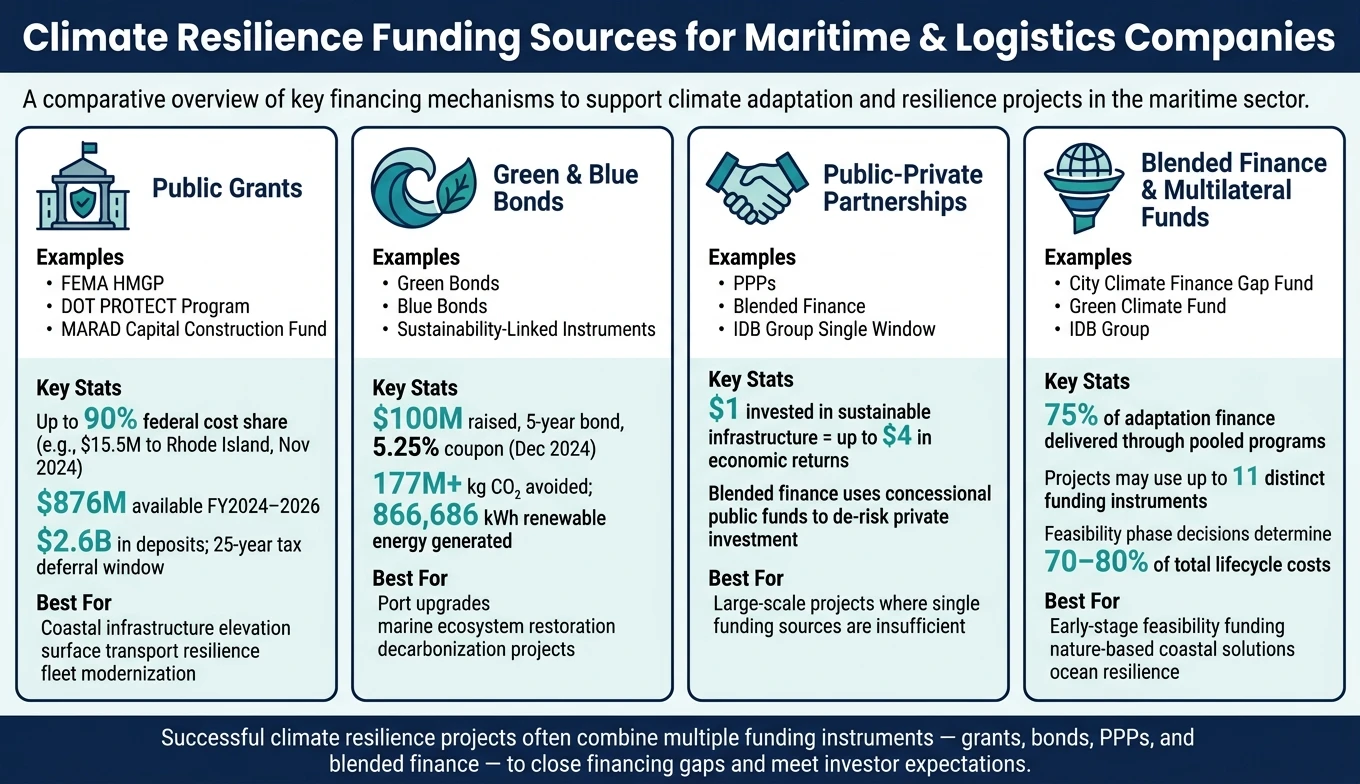
Climate Resilience Funding Sources for Maritime & Logistics Companies
When you've clarified your project needs and identified funding gaps, the next step is finding the right financial support. Maritime and logistics companies have a variety of options, each tailored to specific resilience goals. Below, we’ll explore key funding sources that can directly support your climate-focused initiatives.
Public Grants and Multilateral Climate Finance
Federal grants often provide a solid foundation, especially for port operators and coastal logistics companies. One standout program is the FEMA Hazard Mitigation Grant Program (HMGP), which can cover up to 90% of project costs for qualifying resilience projects [6]. For example, in November 2024, Rhode Island's Department of Environmental Management secured $15.5 million from HMGP to elevate structures and replace docks, addressing sea-level rise and storm surge risks [6].
"Raising dock structures will help protect them from the climate impacts of sea level rise and extreme storm events." - Terry Gray, Director, Rhode Island Department of Environmental Management [6]
For infrastructure related to surface transportation and port access, the DOT's PROTECT Program offers competitive grants totaling $876 million for fiscal years 2024–2026 [3]. Vessel operators might consider the Capital Construction Fund (CCF), managed by MARAD, which allows tax deferral for fleet modernization over a 25-year period and currently holds $2.6 billion in deposits [4]. Recent updates under the 2023 National Defense Authorization Act expanded CCF eligibility to include ferry, tug, barge, and sightseeing operators [4].
Funding Source | Agency | Best For | Key Benefit |
|---|---|---|---|
PROTECT Program | DOT/FHWA | Surface transport resilience improvements | Competitive grants; $876M available FY2024–2026 [3] |
Hazard Mitigation Grant Program | FEMA | Elevating coastal infrastructure, dock replacement | Up to 90% federal cost share [6] |
Capital Construction Fund | MARAD | Fleet modernization and vessel acquisition | Federal income tax deferral, up to 25-year window [4] |
NFWF/NOAA | Nature-based coastal protection solutions | Supports nature-based coastal protection [5] |
For larger-scale projects or those requiring broader capital, market-based instruments offer additional pathways.
Green Bonds, Blue Bonds, and Sustainability-Linked Instruments
Capital markets provide expanding tools for financing significant projects. Green bonds target initiatives with clear environmental benefits, while blue bonds focus on ocean and coastal projects, aligning with UN SDG 14 (Life Below Water) and SDG 6 (Clean Water and Sanitation) [7]. These instruments not only fund infrastructure upgrades but also emphasize measurable environmental outcomes.
A notable example is DP World's December 2024 issuance of a blue bond, raising $100 million via a 5-year bond at a 5.25% coupon. This marked the first corporate blue bond in the MENA region, aimed at sustainable maritime transportation, port upgrades, and marine ecosystem restoration. T. Rowe Price was the primary investor, with Citigroup structuring the transaction under DP World's updated Sustainable Finance Framework [7].
"We recognize UN SDG 14 as the most underfunded of all the sustainable development goals. We hope this transaction can be a model for other issuers and investors to support the blue economy." - Rob Sharps, Chairman, CEO, and President of T. Rowe Price Associates, Inc. [7]
To access these instruments, companies need a Sustainable Finance Framework aligned with recognized standards, such as the IFC Guidelines for Blue Finance. Investors increasingly demand detailed impact reporting. For instance, DP World’s Green Sukuk demonstrated avoided emissions of over 177 million kilograms of CO₂ and generated 866,686 kWh of renewable energy [7]. Tying your project to measurable KPIs, such as reduced air pollution or expanded coastal habitats, can significantly boost its appeal to institutional investors.
Public-Private Partnerships and Blended Finance
When a single funding source isn’t enough, public-private partnerships (PPPs) and blended finance can fill the gap. PPPs involve public agencies sharing risk with private partners, enabling projects that neither could fund alone. Blended finance takes this further by using concessional public funds - such as grants or low-interest loans from multilateral institutions - to attract private investment by reducing risk.
The economic benefits are clear: every $1 invested in sustainable infrastructure can generate up to $4 in economic returns [8]. For maritime and logistics companies, early engagement with multilateral organizations like the IDB Group can be particularly effective. The IDB Group offers "Single Window" advisory services to help structure port and transport projects in a way that appeals to investors [8].
"Well-structured Public-Private Partnerships (PPP) become essential to close these gaps sustainably." - IDB Invest [8]
Before pursuing a PPP, it’s crucial to review your project’s regulatory and contractual framework to identify any gaps in sustainability or resilience. Projects that have undergone a rigorous feasibility phase, including climate scenario analysis and clear KPIs, are far more likely to attract private partners.
Aligning Your Project with Funder Priorities
Once you've established a strong project concept and identified the financing gap, the next step is aligning your proposal with funder priorities. Each funding program has specific goals, and the closer your project meets these objectives, the more competitive your application becomes.
Matching Project Benefits to Funder Objectives
Funders often have precise definitions for terms like "resilience." For example, the Port Infrastructure Development Program (PIDP) defines resilience as the ability to anticipate, prepare for, adapt to, withstand, and recover from disruptions caused by hazards such as sea level rise, flooding, and extreme weather [9]. Broad phrases like "improving port durability" won't suffice; your project must clearly connect its outcomes to the funder's language and priorities.
Here’s how two major programs prioritize projects and what they expect:
Program | Primary Objectives | What Your Project Should Demonstrate |
|---|---|---|
Port Infrastructure Development Program (PIDP) | Safety, efficiency, reliability, emission mitigation [9] | Cost-benefit analysis, engineering studies, facility security plans [9] |
National Coastal Resilience Fund (NCRF) | Nature-based solutions, habitat enhancement, community protection [5] | Use of CREST tool, NOAA Digital Coast data, green-gray hybrid designs [5] |
For projects involving port electrification, microgrids, hydrogen refueling infrastructure, or idling reduction technologies, explicitly present these as emission mitigation initiatives [9]. Funders increasingly value projects that combine physical resilience with environmental benefits in a single investment.
After aligning your project objectives, back them up with solid, data-driven evidence.
Using Data to Support Your Funding Case
Strong data is the key to standing out in a crowded field of applicants. For example, the NOAA Climate Resilience Regional Challenge received nearly 870 letters of intent requesting over $16 billion in funding [10]. With competition this intense, incomplete or poorly documented applications are quickly disqualified.
Build your case using credible, publicly available data. Resources like NOAA's Digital Coast platform and the Coastal Resilience Evaluation and Siting Tool (CREST) can help identify areas where nature-based solutions will have the most impact [5]. Complement this with engineering studies and a formal cost-benefit analysis (CBA), which are critical under PIDP guidelines [9]. Additionally, maximize non-federal contributions, as these are heavily weighted during application evaluations [9].
Beyond technical alignment and data, incorporating social impact into your project can further enhance your proposal.
Adding Equity and Community Benefits to Your Project
Federal funders are increasingly prioritizing projects that benefit disadvantaged communities, as seen with the Justice40 Initiative's goal to ensure 40% of benefits reach these populations [10]. Ignoring this aspect could mean missing out on a significant scoring advantage.
Use tools like the CDC's Social Vulnerability Index (SVI) combined with NOAA sea-level rise data to identify areas where climate risks intersect with socioeconomic vulnerability [11]. Integrate this information into your proposal as a central design feature. For example, in February 2026, a Mid-Atlantic coastal city of 28,000 residents secured $14.7 million in grants by focusing its resilience plan on equity and community engagement. The city used SVI data to model risks and organized bilingual neighborhood workshops with childcare provided. This approach resulted in a FEMA BRIC application that ranked in the top 15% nationally, with a benefit-cost ratio of 4.2:1 [11].
"Equity and inclusion, community engagement, and regional coordination are critical elements of this funding and NOAA's efforts to build Climate-Ready Coasts." - Rick Spinrad, Ph.D., NOAA Administrator [10]
Additionally, workforce development can add value to your proposal. Programs that include worker training for new technologies like electrification not only address labor needs but also enhance community resilience - an approach that resonates with many funders [9].
Building and Executing a Funding Strategy
Once your project aligns with funder priorities, the next step is to put a structured funding strategy into action. This involves focusing on actionable steps, crafting effective proposals, and building strong partnerships to ensure success.
Prioritizing and Sequencing Your Project Pipeline
Organizing your projects around asset lifecycle milestones can significantly enhance their appeal to funders. For example, replacing diesel cargo-handling equipment at the end of its lifecycle is far more cost-effective than retiring functional equipment prematurely. This approach not only reduces incremental capital costs but also strengthens your case for funding.
Begin by conducting a comprehensive greenhouse gas inventory across Scope 1, 2, and 3 emissions. For many ports, Scope 3 emissions - such as those from tenant operations and vessels at berth - can account for up to 82% of the total carbon footprint [12]. To address this, your sequencing plan should incorporate strategies like green leases or clean truck programs to influence tenant behavior alongside internal operational improvements.
"The most cost-effective clean equipment transitions happen at natural replacement points. Forcing premature retirement of working equipment is expensive and politically difficult." - Council Fire [12]
Focus on projects that provide immediate financial returns. For instance, energy efficiency upgrades, such as LED lighting or HVAC optimization, generate savings that can fund future phases. A major East Coast port authority handling over 3 million TEUs annually used a 10-year equipment replacement schedule tied to an $800 million capital plan to great effect. Between 2021 and 2026, this strategy saved $125 million, including $48 million from diesel fuel avoidance and $36 million from designing resilience into projects from the start [12].
Writing Strong Funding Proposals
A well-crafted proposal clearly demonstrates why your project is a solid investment. The following table outlines how key proposal components align with funders’ financial and sustainability goals:
Proposal Component | Financial Objective | Sustainability Objective |
|---|---|---|
Electrification | Cuts diesel fuel costs by ~65% [12] | Reduces emissions [12] |
Resilient Design | Avoids future retrofit capital costs [12] | Prepares for sea-level rise and extreme weather [9] |
Truck Efficiency Program | Avoids compliance costs and penalties [12] | Lowers PM2.5 emissions, improving community health [12] |
Digital Infrastructure | Enhances cargo movement efficiency [9] | Reduces idling and operational waste [9] |
Support each proposal component with credible studies, assessments, and documented investor commitments. For Port Infrastructure Development Program (PIDP) applications, non-federal matching contributions are particularly influential [9]. Additionally, if your project involves a smaller port handling less than 8 million short tons annually, note that 25% of PIDP funds are reserved for small projects. Business plans or investor prospectuses can often meet cost-effectiveness requirements [9].
"When sustainability generates hard financial returns, it builds organizational commitment that outlasts any individual champion." - Council Fire [12]
To strengthen your proposal further, consider forming strategic partnerships that add credibility and increase your chances of securing funding.
Working with Partners and Advisors
Successful proposals are rarely the result of a single organization working in isolation. Establishing a Community Advisory Panel can be instrumental. This panel might include representatives from nearby neighborhoods, environmental justice groups, and maritime climate finance advisors. Their expertise can help address funding gaps, identify the most suitable funding programs, and refine proposals to meet both financial and regulatory expectations [12].
In the East Coast port example mentioned earlier, a collaborative approach led to a 31% reduction in PM2.5 concentrations in the surrounding community and a 52% decrease in emissions over five years [12]. These measurable outcomes not only improved community health but also bolstered future funding applications by showcasing a proven track record of success.
Conclusion: Key Steps to Securing Climate Resilience Funding
Securing funding for climate resilience isn't a one-and-done task - it’s an ongoing process that demands clear project goals, solid data, and a variety of financial tools. The strategies outlined earlier form the backbone of a robust funding approach, helping to address financial shortfalls while meeting the changing expectations of investors.
Projects that succeed often rely on multiple funding instruments - sometimes as many as 11 distinct tools. Notably, 75% of adaptation finance is delivered through pooled programs, drawing from sources like green bonds, blue bonds, public grants, and blended finance models, rather than waiting for a single, large-scale investment [13].
Proposals focused on proactive risk management - such as flood-proofing key infrastructure or transitioning to electric cargo equipment - tend to attract more investor interest. These initiatives demonstrate measurable returns, avoiding the higher costs of reactive measures [13].
Despite their critical role in protecting coastal infrastructure, marine and coastal ecosystems such as mangroves, salt marshes, and seagrasses remain underfunded in global climate finance [1]. For maritime companies, incorporating these natural assets into project designs can unlock funding opportunities, particularly from initiatives like the Green Climate Fund, which prioritizes ocean and coastal resilience.
"Sustainability strategies that don't explicitly address community health impacts and provide tangible community benefits will face opposition that undermines implementation." - Council Fire [12]
Leading companies view climate resilience as an ongoing strategic investment. They start by conducting a thorough greenhouse gas (GHG) inventory, developing actionable and bankable project concepts, engaging with local communities, and timing investments around natural replacement cycles. This methodical approach strengthens proposals and ensures more productive conversations with potential funders.
FAQs
What climate data do I need to prove my port project is “resilient”?
To demonstrate that your port project can withstand challenges, start by collecting climate data on potential hazards such as storm surges, rising sea levels, and extreme weather patterns. Conduct a detailed risk assessment tailored to your site to pinpoint vulnerabilities and determine where investments are most needed. Focus on key areas like hazard exposure, projected sea level changes, storm surge occurrences, and localized climate effects. Tools such as resilience indices can provide valuable insights into your port's capacity to continue operations during and recover after disruptive events.
Which funding option fits my project best: grant, bond, or PPP?
The ideal funding choice hinges on your project's specific requirements, timeline, and eligibility criteria. Grants offer funds that don’t need to be repaid but typically come with stringent conditions and are designated for particular activities. Green bonds are a solid option for projects that generate revenue and require long-term financing solutions. For large-scale initiatives that benefit from shared risk and collaboration, public-private partnerships (PPPs) provide a practical route. Evaluate options based on your project’s size, financial objectives, and ability to manage repayment obligations.
How do I calculate avoided-loss benefits for a funding application?
To determine avoided-loss benefits, start by estimating the potential costs of damages or disruptions that would occur without the project - this could include expenses like emergency repairs or operational downtime. Then, compare these figures to the anticipated costs with the project implemented. By assigning monetary values to possible damages, using historical data or thorough risk assessments, you can quantify the difference between the "Build" and "No-Build" scenarios. Highlighting these cost savings and the enhanced resilience the project provides can make a compelling case for funding.
Related Blog Posts
How to Integrate Climate Risk into Infrastructure Planning for Municipalities & Government Agencies
How to Co-Design Climate-Ready Communities with Residents for Maritime & Logistics Companies
How to Build a Climate-Ready Energy & Water Infrastructure Plan for Maritime & Logistics Companies
How to Finance Green and Nature-Based Infrastructure for Maritime & Logistics Companies
Latest Articles
©2026

Narrative Change and Power Building: The Missing Half of Advocacy
Narrative change is the process of disrupting dominant narratives that normalize inequity and advancing new narratives from historically marginalized communities.

Funding Resilience Without Federal Grants
BRIC is unreliable and FEMA is shrinking. Here's how cities fund climate resilience with dedicated revenue, blended finance, and a coordinating authority.

The ESG Blind Spot: How AI Is Finding Risks in Companies Nobody Else Is Watching
Norway's sovereign wealth fund uses AI to screen 7,200 portfolio companies for forced labor and corruption within 24 hours. The real story is the emerging-market coverage gap that traditional ESG data vendors miss — and what it means for any company with a global supply chain.
Narrative Change and Power Building: The Missing Half of Advocacy
Narrative change is the process of disrupting dominant narratives that normalize inequity and advancing new narratives from historically marginalized communities.
Funding Resilience Without Federal Grants
BRIC is unreliable and FEMA is shrinking. Here's how cities fund climate resilience with dedicated revenue, blended finance, and a coordinating authority.
The ESG Blind Spot: How AI Is Finding Risks in Companies Nobody Else Is Watching
Norway's sovereign wealth fund uses AI to screen 7,200 portfolio companies for forced labor and corruption within 24 hours. The real story is the emerging-market coverage gap that traditional ESG data vendors miss — and what it means for any company with a global supply chain.
FAQ
01
What does it really mean to “redefine profit”?
02
What makes Council Fire different?
03
Who does Council Fire work with?
04
What does working with Council Fire actually look like?
05
How does Council Fire help organizations turn big goals into action?
06
How does Council Fire define and measure success?
07
How does technology fit into Council Fire’s work?
May 24, 2026
How to Identify and Secure Funding for Climate Resilience Projects for Maritime & Logistics Companies
Sustainability Strategy
In This Article
Practical steps to define projects, estimate costs, and secure grants, bonds, or PPPs for port and logistics climate resilience.
How to Identify and Secure Funding for Climate Resilience Projects for Maritime & Logistics Companies
Ports and logistics networks face growing risks from climate change, including rising sea levels, extreme weather, and disrupted supply chains. Securing funding for resilience projects is critical to mitigate these challenges, but traditional financial approaches often fail to account for long-term risks. This guide outlines practical steps to identify and secure funding for climate resilience initiatives, focusing on:
Project clarity: Define specific goals (e.g., flood defenses, decarbonization) and measurable outcomes.
Funding sources: Explore grants (e.g., FEMA’s Hazard Mitigation Grant Program), green and blue bonds, and public-private partnerships.
Financial planning: Estimate costs, quantify benefits like avoided losses, and address funding gaps.
Proposal alignment: Tailor applications to funder priorities, emphasizing data, community benefits, and equity.
Can We Make Shipping Green? Financing the Future of Maritime Decarbonisation
Defining Climate Resilience Projects and Funding Needs
When it comes to securing climate finance, clarity is your best ally. To attract funding, you need a well-defined project backed by a solid financial rationale. Funders aren't interested in vague plans - they want to see specific initiatives with measurable outcomes and a clear financial case.
Identifying Resilience Goals
In the maritime and logistics sectors, climate resilience typically falls into three main categories: physical infrastructure, operational continuity, and decarbonization.
Physical infrastructure includes projects like flood defenses for port facilities, storm surge barriers, and reinforced berths.
Operational continuity focuses on solutions such as supply chain redundancies, alternative routing systems, and emergency response plans.
Decarbonization involves measures like shore power systems, which not only cut emissions but also reduce reliance on fuel.
Categorizing your needs early enables you to better align each project with the appropriate funding sources. For instance, a flood defense project and a shore power installation will appeal to entirely different types of funders.
Building a Bankable Project Concept
To attract investors, your project must meet their due diligence standards. This means providing more than just a general overview. A structured project document should include these four key elements:
A clear problem statement
A defined project scope
Measurable expected outcomes
Standardized metrics that resonate with funders
"Climate risk evidence, resilience KPIs, and disclosure (for example, ISSB) are rapidly becoming financing and approval gatekeepers." - Infrastructure Pathways [2]
Aligning your project with established frameworks such as the World Bank's Resilience Rating System or the IIGCC Physical Climate Risk Appraisal Methodology (PCRAM) 2.0 demonstrates readiness for investment. These frameworks enhance transparency and ensure your project is replicable - qualities that can transform an idea into a fundable opportunity.
It's crucial to start this process early. Research shows that decisions made during the feasibility phase determine 70% to 80% of a project's total life cycle costs and resilience potential [2]. Laying this groundwork upfront makes all the difference.
Estimating Costs, Benefits, and the Financing Gap
Accurate cost estimation is essential and involves two main components: CAPEX (capital expenditures) and OPEX (operational expenses). CAPEX includes construction, equipment, and installation costs, with adjustments for climate-related risks. OPEX accounts for ongoing maintenance and monitoring.
On the benefits side, the strongest financial argument often lies in avoided losses rather than direct revenue. Consider the costs of a major disruption - delayed shipments, emergency repairs, lost contracts, or regulatory fines. This "resilience dividend" can significantly outweigh the initial investment. Increasingly, funders expect cost-benefit analyses (CBA) to incorporate forward-looking climate scenarios rather than relying on past data, which no longer meets investor expectations [2].
The financing gap - the difference between your total project cost and available internal funding - must be identified clearly. This allows you to approach suitable funding sources, such as grants, bonds, or blended finance tools, with a credible proposal. If funding for the feasibility phase itself is a challenge, programs like the City Climate Finance Gap Fund are designed to help organizations bridge this early-stage hurdle and develop investor-ready documentation.
Funding Options for Climate Resilience Projects
Climate Resilience Funding Sources for Maritime & Logistics Companies
When you've clarified your project needs and identified funding gaps, the next step is finding the right financial support. Maritime and logistics companies have a variety of options, each tailored to specific resilience goals. Below, we’ll explore key funding sources that can directly support your climate-focused initiatives.
Public Grants and Multilateral Climate Finance
Federal grants often provide a solid foundation, especially for port operators and coastal logistics companies. One standout program is the FEMA Hazard Mitigation Grant Program (HMGP), which can cover up to 90% of project costs for qualifying resilience projects [6]. For example, in November 2024, Rhode Island's Department of Environmental Management secured $15.5 million from HMGP to elevate structures and replace docks, addressing sea-level rise and storm surge risks [6].
"Raising dock structures will help protect them from the climate impacts of sea level rise and extreme storm events." - Terry Gray, Director, Rhode Island Department of Environmental Management [6]
For infrastructure related to surface transportation and port access, the DOT's PROTECT Program offers competitive grants totaling $876 million for fiscal years 2024–2026 [3]. Vessel operators might consider the Capital Construction Fund (CCF), managed by MARAD, which allows tax deferral for fleet modernization over a 25-year period and currently holds $2.6 billion in deposits [4]. Recent updates under the 2023 National Defense Authorization Act expanded CCF eligibility to include ferry, tug, barge, and sightseeing operators [4].
Funding Source | Agency | Best For | Key Benefit |
|---|---|---|---|
PROTECT Program | DOT/FHWA | Surface transport resilience improvements | Competitive grants; $876M available FY2024–2026 [3] |
Hazard Mitigation Grant Program | FEMA | Elevating coastal infrastructure, dock replacement | Up to 90% federal cost share [6] |
Capital Construction Fund | MARAD | Fleet modernization and vessel acquisition | Federal income tax deferral, up to 25-year window [4] |
NFWF/NOAA | Nature-based coastal protection solutions | Supports nature-based coastal protection [5] |
For larger-scale projects or those requiring broader capital, market-based instruments offer additional pathways.
Green Bonds, Blue Bonds, and Sustainability-Linked Instruments
Capital markets provide expanding tools for financing significant projects. Green bonds target initiatives with clear environmental benefits, while blue bonds focus on ocean and coastal projects, aligning with UN SDG 14 (Life Below Water) and SDG 6 (Clean Water and Sanitation) [7]. These instruments not only fund infrastructure upgrades but also emphasize measurable environmental outcomes.
A notable example is DP World's December 2024 issuance of a blue bond, raising $100 million via a 5-year bond at a 5.25% coupon. This marked the first corporate blue bond in the MENA region, aimed at sustainable maritime transportation, port upgrades, and marine ecosystem restoration. T. Rowe Price was the primary investor, with Citigroup structuring the transaction under DP World's updated Sustainable Finance Framework [7].
"We recognize UN SDG 14 as the most underfunded of all the sustainable development goals. We hope this transaction can be a model for other issuers and investors to support the blue economy." - Rob Sharps, Chairman, CEO, and President of T. Rowe Price Associates, Inc. [7]
To access these instruments, companies need a Sustainable Finance Framework aligned with recognized standards, such as the IFC Guidelines for Blue Finance. Investors increasingly demand detailed impact reporting. For instance, DP World’s Green Sukuk demonstrated avoided emissions of over 177 million kilograms of CO₂ and generated 866,686 kWh of renewable energy [7]. Tying your project to measurable KPIs, such as reduced air pollution or expanded coastal habitats, can significantly boost its appeal to institutional investors.
Public-Private Partnerships and Blended Finance
When a single funding source isn’t enough, public-private partnerships (PPPs) and blended finance can fill the gap. PPPs involve public agencies sharing risk with private partners, enabling projects that neither could fund alone. Blended finance takes this further by using concessional public funds - such as grants or low-interest loans from multilateral institutions - to attract private investment by reducing risk.
The economic benefits are clear: every $1 invested in sustainable infrastructure can generate up to $4 in economic returns [8]. For maritime and logistics companies, early engagement with multilateral organizations like the IDB Group can be particularly effective. The IDB Group offers "Single Window" advisory services to help structure port and transport projects in a way that appeals to investors [8].
"Well-structured Public-Private Partnerships (PPP) become essential to close these gaps sustainably." - IDB Invest [8]
Before pursuing a PPP, it’s crucial to review your project’s regulatory and contractual framework to identify any gaps in sustainability or resilience. Projects that have undergone a rigorous feasibility phase, including climate scenario analysis and clear KPIs, are far more likely to attract private partners.
Aligning Your Project with Funder Priorities
Once you've established a strong project concept and identified the financing gap, the next step is aligning your proposal with funder priorities. Each funding program has specific goals, and the closer your project meets these objectives, the more competitive your application becomes.
Matching Project Benefits to Funder Objectives
Funders often have precise definitions for terms like "resilience." For example, the Port Infrastructure Development Program (PIDP) defines resilience as the ability to anticipate, prepare for, adapt to, withstand, and recover from disruptions caused by hazards such as sea level rise, flooding, and extreme weather [9]. Broad phrases like "improving port durability" won't suffice; your project must clearly connect its outcomes to the funder's language and priorities.
Here’s how two major programs prioritize projects and what they expect:
Program | Primary Objectives | What Your Project Should Demonstrate |
|---|---|---|
Port Infrastructure Development Program (PIDP) | Safety, efficiency, reliability, emission mitigation [9] | Cost-benefit analysis, engineering studies, facility security plans [9] |
National Coastal Resilience Fund (NCRF) | Nature-based solutions, habitat enhancement, community protection [5] | Use of CREST tool, NOAA Digital Coast data, green-gray hybrid designs [5] |
For projects involving port electrification, microgrids, hydrogen refueling infrastructure, or idling reduction technologies, explicitly present these as emission mitigation initiatives [9]. Funders increasingly value projects that combine physical resilience with environmental benefits in a single investment.
After aligning your project objectives, back them up with solid, data-driven evidence.
Using Data to Support Your Funding Case
Strong data is the key to standing out in a crowded field of applicants. For example, the NOAA Climate Resilience Regional Challenge received nearly 870 letters of intent requesting over $16 billion in funding [10]. With competition this intense, incomplete or poorly documented applications are quickly disqualified.
Build your case using credible, publicly available data. Resources like NOAA's Digital Coast platform and the Coastal Resilience Evaluation and Siting Tool (CREST) can help identify areas where nature-based solutions will have the most impact [5]. Complement this with engineering studies and a formal cost-benefit analysis (CBA), which are critical under PIDP guidelines [9]. Additionally, maximize non-federal contributions, as these are heavily weighted during application evaluations [9].
Beyond technical alignment and data, incorporating social impact into your project can further enhance your proposal.
Adding Equity and Community Benefits to Your Project
Federal funders are increasingly prioritizing projects that benefit disadvantaged communities, as seen with the Justice40 Initiative's goal to ensure 40% of benefits reach these populations [10]. Ignoring this aspect could mean missing out on a significant scoring advantage.
Use tools like the CDC's Social Vulnerability Index (SVI) combined with NOAA sea-level rise data to identify areas where climate risks intersect with socioeconomic vulnerability [11]. Integrate this information into your proposal as a central design feature. For example, in February 2026, a Mid-Atlantic coastal city of 28,000 residents secured $14.7 million in grants by focusing its resilience plan on equity and community engagement. The city used SVI data to model risks and organized bilingual neighborhood workshops with childcare provided. This approach resulted in a FEMA BRIC application that ranked in the top 15% nationally, with a benefit-cost ratio of 4.2:1 [11].
"Equity and inclusion, community engagement, and regional coordination are critical elements of this funding and NOAA's efforts to build Climate-Ready Coasts." - Rick Spinrad, Ph.D., NOAA Administrator [10]
Additionally, workforce development can add value to your proposal. Programs that include worker training for new technologies like electrification not only address labor needs but also enhance community resilience - an approach that resonates with many funders [9].
Building and Executing a Funding Strategy
Once your project aligns with funder priorities, the next step is to put a structured funding strategy into action. This involves focusing on actionable steps, crafting effective proposals, and building strong partnerships to ensure success.
Prioritizing and Sequencing Your Project Pipeline
Organizing your projects around asset lifecycle milestones can significantly enhance their appeal to funders. For example, replacing diesel cargo-handling equipment at the end of its lifecycle is far more cost-effective than retiring functional equipment prematurely. This approach not only reduces incremental capital costs but also strengthens your case for funding.
Begin by conducting a comprehensive greenhouse gas inventory across Scope 1, 2, and 3 emissions. For many ports, Scope 3 emissions - such as those from tenant operations and vessels at berth - can account for up to 82% of the total carbon footprint [12]. To address this, your sequencing plan should incorporate strategies like green leases or clean truck programs to influence tenant behavior alongside internal operational improvements.
"The most cost-effective clean equipment transitions happen at natural replacement points. Forcing premature retirement of working equipment is expensive and politically difficult." - Council Fire [12]
Focus on projects that provide immediate financial returns. For instance, energy efficiency upgrades, such as LED lighting or HVAC optimization, generate savings that can fund future phases. A major East Coast port authority handling over 3 million TEUs annually used a 10-year equipment replacement schedule tied to an $800 million capital plan to great effect. Between 2021 and 2026, this strategy saved $125 million, including $48 million from diesel fuel avoidance and $36 million from designing resilience into projects from the start [12].
Writing Strong Funding Proposals
A well-crafted proposal clearly demonstrates why your project is a solid investment. The following table outlines how key proposal components align with funders’ financial and sustainability goals:
Proposal Component | Financial Objective | Sustainability Objective |
|---|---|---|
Electrification | Cuts diesel fuel costs by ~65% [12] | Reduces emissions [12] |
Resilient Design | Avoids future retrofit capital costs [12] | Prepares for sea-level rise and extreme weather [9] |
Truck Efficiency Program | Avoids compliance costs and penalties [12] | Lowers PM2.5 emissions, improving community health [12] |
Digital Infrastructure | Enhances cargo movement efficiency [9] | Reduces idling and operational waste [9] |
Support each proposal component with credible studies, assessments, and documented investor commitments. For Port Infrastructure Development Program (PIDP) applications, non-federal matching contributions are particularly influential [9]. Additionally, if your project involves a smaller port handling less than 8 million short tons annually, note that 25% of PIDP funds are reserved for small projects. Business plans or investor prospectuses can often meet cost-effectiveness requirements [9].
"When sustainability generates hard financial returns, it builds organizational commitment that outlasts any individual champion." - Council Fire [12]
To strengthen your proposal further, consider forming strategic partnerships that add credibility and increase your chances of securing funding.
Working with Partners and Advisors
Successful proposals are rarely the result of a single organization working in isolation. Establishing a Community Advisory Panel can be instrumental. This panel might include representatives from nearby neighborhoods, environmental justice groups, and maritime climate finance advisors. Their expertise can help address funding gaps, identify the most suitable funding programs, and refine proposals to meet both financial and regulatory expectations [12].
In the East Coast port example mentioned earlier, a collaborative approach led to a 31% reduction in PM2.5 concentrations in the surrounding community and a 52% decrease in emissions over five years [12]. These measurable outcomes not only improved community health but also bolstered future funding applications by showcasing a proven track record of success.
Conclusion: Key Steps to Securing Climate Resilience Funding
Securing funding for climate resilience isn't a one-and-done task - it’s an ongoing process that demands clear project goals, solid data, and a variety of financial tools. The strategies outlined earlier form the backbone of a robust funding approach, helping to address financial shortfalls while meeting the changing expectations of investors.
Projects that succeed often rely on multiple funding instruments - sometimes as many as 11 distinct tools. Notably, 75% of adaptation finance is delivered through pooled programs, drawing from sources like green bonds, blue bonds, public grants, and blended finance models, rather than waiting for a single, large-scale investment [13].
Proposals focused on proactive risk management - such as flood-proofing key infrastructure or transitioning to electric cargo equipment - tend to attract more investor interest. These initiatives demonstrate measurable returns, avoiding the higher costs of reactive measures [13].
Despite their critical role in protecting coastal infrastructure, marine and coastal ecosystems such as mangroves, salt marshes, and seagrasses remain underfunded in global climate finance [1]. For maritime companies, incorporating these natural assets into project designs can unlock funding opportunities, particularly from initiatives like the Green Climate Fund, which prioritizes ocean and coastal resilience.
"Sustainability strategies that don't explicitly address community health impacts and provide tangible community benefits will face opposition that undermines implementation." - Council Fire [12]
Leading companies view climate resilience as an ongoing strategic investment. They start by conducting a thorough greenhouse gas (GHG) inventory, developing actionable and bankable project concepts, engaging with local communities, and timing investments around natural replacement cycles. This methodical approach strengthens proposals and ensures more productive conversations with potential funders.
FAQs
What climate data do I need to prove my port project is “resilient”?
To demonstrate that your port project can withstand challenges, start by collecting climate data on potential hazards such as storm surges, rising sea levels, and extreme weather patterns. Conduct a detailed risk assessment tailored to your site to pinpoint vulnerabilities and determine where investments are most needed. Focus on key areas like hazard exposure, projected sea level changes, storm surge occurrences, and localized climate effects. Tools such as resilience indices can provide valuable insights into your port's capacity to continue operations during and recover after disruptive events.
Which funding option fits my project best: grant, bond, or PPP?
The ideal funding choice hinges on your project's specific requirements, timeline, and eligibility criteria. Grants offer funds that don’t need to be repaid but typically come with stringent conditions and are designated for particular activities. Green bonds are a solid option for projects that generate revenue and require long-term financing solutions. For large-scale initiatives that benefit from shared risk and collaboration, public-private partnerships (PPPs) provide a practical route. Evaluate options based on your project’s size, financial objectives, and ability to manage repayment obligations.
How do I calculate avoided-loss benefits for a funding application?
To determine avoided-loss benefits, start by estimating the potential costs of damages or disruptions that would occur without the project - this could include expenses like emergency repairs or operational downtime. Then, compare these figures to the anticipated costs with the project implemented. By assigning monetary values to possible damages, using historical data or thorough risk assessments, you can quantify the difference between the "Build" and "No-Build" scenarios. Highlighting these cost savings and the enhanced resilience the project provides can make a compelling case for funding.
Related Blog Posts
How to Integrate Climate Risk into Infrastructure Planning for Municipalities & Government Agencies
How to Co-Design Climate-Ready Communities with Residents for Maritime & Logistics Companies
How to Build a Climate-Ready Energy & Water Infrastructure Plan for Maritime & Logistics Companies
How to Finance Green and Nature-Based Infrastructure for Maritime & Logistics Companies
Latest Articles
©2026
Narrative Change and Power Building: The Missing Half of Advocacy
Narrative change is the process of disrupting dominant narratives that normalize inequity and advancing new narratives from historically marginalized communities.
Funding Resilience Without Federal Grants
BRIC is unreliable and FEMA is shrinking. Here's how cities fund climate resilience with dedicated revenue, blended finance, and a coordinating authority.
The ESG Blind Spot: How AI Is Finding Risks in Companies Nobody Else Is Watching
Norway's sovereign wealth fund uses AI to screen 7,200 portfolio companies for forced labor and corruption within 24 hours. The real story is the emerging-market coverage gap that traditional ESG data vendors miss — and what it means for any company with a global supply chain.
FAQ
01
What does it really mean to “redefine profit”?
02
What makes Council Fire different?
03
Who does Council Fire work with?
04
What does working with Council Fire actually look like?
05
How does Council Fire help organizations turn big goals into action?
06
How does Council Fire define and measure success?
07
How does technology fit into Council Fire’s work?
May 24, 2026
How to Identify and Secure Funding for Climate Resilience Projects for Maritime & Logistics Companies
Sustainability Strategy
In This Article
Practical steps to define projects, estimate costs, and secure grants, bonds, or PPPs for port and logistics climate resilience.
How to Identify and Secure Funding for Climate Resilience Projects for Maritime & Logistics Companies
Ports and logistics networks face growing risks from climate change, including rising sea levels, extreme weather, and disrupted supply chains. Securing funding for resilience projects is critical to mitigate these challenges, but traditional financial approaches often fail to account for long-term risks. This guide outlines practical steps to identify and secure funding for climate resilience initiatives, focusing on:
Project clarity: Define specific goals (e.g., flood defenses, decarbonization) and measurable outcomes.
Funding sources: Explore grants (e.g., FEMA’s Hazard Mitigation Grant Program), green and blue bonds, and public-private partnerships.
Financial planning: Estimate costs, quantify benefits like avoided losses, and address funding gaps.
Proposal alignment: Tailor applications to funder priorities, emphasizing data, community benefits, and equity.
Can We Make Shipping Green? Financing the Future of Maritime Decarbonisation
Defining Climate Resilience Projects and Funding Needs
When it comes to securing climate finance, clarity is your best ally. To attract funding, you need a well-defined project backed by a solid financial rationale. Funders aren't interested in vague plans - they want to see specific initiatives with measurable outcomes and a clear financial case.
Identifying Resilience Goals
In the maritime and logistics sectors, climate resilience typically falls into three main categories: physical infrastructure, operational continuity, and decarbonization.
Physical infrastructure includes projects like flood defenses for port facilities, storm surge barriers, and reinforced berths.
Operational continuity focuses on solutions such as supply chain redundancies, alternative routing systems, and emergency response plans.
Decarbonization involves measures like shore power systems, which not only cut emissions but also reduce reliance on fuel.
Categorizing your needs early enables you to better align each project with the appropriate funding sources. For instance, a flood defense project and a shore power installation will appeal to entirely different types of funders.
Building a Bankable Project Concept
To attract investors, your project must meet their due diligence standards. This means providing more than just a general overview. A structured project document should include these four key elements:
A clear problem statement
A defined project scope
Measurable expected outcomes
Standardized metrics that resonate with funders
"Climate risk evidence, resilience KPIs, and disclosure (for example, ISSB) are rapidly becoming financing and approval gatekeepers." - Infrastructure Pathways [2]
Aligning your project with established frameworks such as the World Bank's Resilience Rating System or the IIGCC Physical Climate Risk Appraisal Methodology (PCRAM) 2.0 demonstrates readiness for investment. These frameworks enhance transparency and ensure your project is replicable - qualities that can transform an idea into a fundable opportunity.
It's crucial to start this process early. Research shows that decisions made during the feasibility phase determine 70% to 80% of a project's total life cycle costs and resilience potential [2]. Laying this groundwork upfront makes all the difference.
Estimating Costs, Benefits, and the Financing Gap
Accurate cost estimation is essential and involves two main components: CAPEX (capital expenditures) and OPEX (operational expenses). CAPEX includes construction, equipment, and installation costs, with adjustments for climate-related risks. OPEX accounts for ongoing maintenance and monitoring.
On the benefits side, the strongest financial argument often lies in avoided losses rather than direct revenue. Consider the costs of a major disruption - delayed shipments, emergency repairs, lost contracts, or regulatory fines. This "resilience dividend" can significantly outweigh the initial investment. Increasingly, funders expect cost-benefit analyses (CBA) to incorporate forward-looking climate scenarios rather than relying on past data, which no longer meets investor expectations [2].
The financing gap - the difference between your total project cost and available internal funding - must be identified clearly. This allows you to approach suitable funding sources, such as grants, bonds, or blended finance tools, with a credible proposal. If funding for the feasibility phase itself is a challenge, programs like the City Climate Finance Gap Fund are designed to help organizations bridge this early-stage hurdle and develop investor-ready documentation.
Funding Options for Climate Resilience Projects
Climate Resilience Funding Sources for Maritime & Logistics Companies
When you've clarified your project needs and identified funding gaps, the next step is finding the right financial support. Maritime and logistics companies have a variety of options, each tailored to specific resilience goals. Below, we’ll explore key funding sources that can directly support your climate-focused initiatives.
Public Grants and Multilateral Climate Finance
Federal grants often provide a solid foundation, especially for port operators and coastal logistics companies. One standout program is the FEMA Hazard Mitigation Grant Program (HMGP), which can cover up to 90% of project costs for qualifying resilience projects [6]. For example, in November 2024, Rhode Island's Department of Environmental Management secured $15.5 million from HMGP to elevate structures and replace docks, addressing sea-level rise and storm surge risks [6].
"Raising dock structures will help protect them from the climate impacts of sea level rise and extreme storm events." - Terry Gray, Director, Rhode Island Department of Environmental Management [6]
For infrastructure related to surface transportation and port access, the DOT's PROTECT Program offers competitive grants totaling $876 million for fiscal years 2024–2026 [3]. Vessel operators might consider the Capital Construction Fund (CCF), managed by MARAD, which allows tax deferral for fleet modernization over a 25-year period and currently holds $2.6 billion in deposits [4]. Recent updates under the 2023 National Defense Authorization Act expanded CCF eligibility to include ferry, tug, barge, and sightseeing operators [4].
Funding Source | Agency | Best For | Key Benefit |
|---|---|---|---|
PROTECT Program | DOT/FHWA | Surface transport resilience improvements | Competitive grants; $876M available FY2024–2026 [3] |
Hazard Mitigation Grant Program | FEMA | Elevating coastal infrastructure, dock replacement | Up to 90% federal cost share [6] |
Capital Construction Fund | MARAD | Fleet modernization and vessel acquisition | Federal income tax deferral, up to 25-year window [4] |
NFWF/NOAA | Nature-based coastal protection solutions | Supports nature-based coastal protection [5] |
For larger-scale projects or those requiring broader capital, market-based instruments offer additional pathways.
Green Bonds, Blue Bonds, and Sustainability-Linked Instruments
Capital markets provide expanding tools for financing significant projects. Green bonds target initiatives with clear environmental benefits, while blue bonds focus on ocean and coastal projects, aligning with UN SDG 14 (Life Below Water) and SDG 6 (Clean Water and Sanitation) [7]. These instruments not only fund infrastructure upgrades but also emphasize measurable environmental outcomes.
A notable example is DP World's December 2024 issuance of a blue bond, raising $100 million via a 5-year bond at a 5.25% coupon. This marked the first corporate blue bond in the MENA region, aimed at sustainable maritime transportation, port upgrades, and marine ecosystem restoration. T. Rowe Price was the primary investor, with Citigroup structuring the transaction under DP World's updated Sustainable Finance Framework [7].
"We recognize UN SDG 14 as the most underfunded of all the sustainable development goals. We hope this transaction can be a model for other issuers and investors to support the blue economy." - Rob Sharps, Chairman, CEO, and President of T. Rowe Price Associates, Inc. [7]
To access these instruments, companies need a Sustainable Finance Framework aligned with recognized standards, such as the IFC Guidelines for Blue Finance. Investors increasingly demand detailed impact reporting. For instance, DP World’s Green Sukuk demonstrated avoided emissions of over 177 million kilograms of CO₂ and generated 866,686 kWh of renewable energy [7]. Tying your project to measurable KPIs, such as reduced air pollution or expanded coastal habitats, can significantly boost its appeal to institutional investors.
Public-Private Partnerships and Blended Finance
When a single funding source isn’t enough, public-private partnerships (PPPs) and blended finance can fill the gap. PPPs involve public agencies sharing risk with private partners, enabling projects that neither could fund alone. Blended finance takes this further by using concessional public funds - such as grants or low-interest loans from multilateral institutions - to attract private investment by reducing risk.
The economic benefits are clear: every $1 invested in sustainable infrastructure can generate up to $4 in economic returns [8]. For maritime and logistics companies, early engagement with multilateral organizations like the IDB Group can be particularly effective. The IDB Group offers "Single Window" advisory services to help structure port and transport projects in a way that appeals to investors [8].
"Well-structured Public-Private Partnerships (PPP) become essential to close these gaps sustainably." - IDB Invest [8]
Before pursuing a PPP, it’s crucial to review your project’s regulatory and contractual framework to identify any gaps in sustainability or resilience. Projects that have undergone a rigorous feasibility phase, including climate scenario analysis and clear KPIs, are far more likely to attract private partners.
Aligning Your Project with Funder Priorities
Once you've established a strong project concept and identified the financing gap, the next step is aligning your proposal with funder priorities. Each funding program has specific goals, and the closer your project meets these objectives, the more competitive your application becomes.
Matching Project Benefits to Funder Objectives
Funders often have precise definitions for terms like "resilience." For example, the Port Infrastructure Development Program (PIDP) defines resilience as the ability to anticipate, prepare for, adapt to, withstand, and recover from disruptions caused by hazards such as sea level rise, flooding, and extreme weather [9]. Broad phrases like "improving port durability" won't suffice; your project must clearly connect its outcomes to the funder's language and priorities.
Here’s how two major programs prioritize projects and what they expect:
Program | Primary Objectives | What Your Project Should Demonstrate |
|---|---|---|
Port Infrastructure Development Program (PIDP) | Safety, efficiency, reliability, emission mitigation [9] | Cost-benefit analysis, engineering studies, facility security plans [9] |
National Coastal Resilience Fund (NCRF) | Nature-based solutions, habitat enhancement, community protection [5] | Use of CREST tool, NOAA Digital Coast data, green-gray hybrid designs [5] |
For projects involving port electrification, microgrids, hydrogen refueling infrastructure, or idling reduction technologies, explicitly present these as emission mitigation initiatives [9]. Funders increasingly value projects that combine physical resilience with environmental benefits in a single investment.
After aligning your project objectives, back them up with solid, data-driven evidence.
Using Data to Support Your Funding Case
Strong data is the key to standing out in a crowded field of applicants. For example, the NOAA Climate Resilience Regional Challenge received nearly 870 letters of intent requesting over $16 billion in funding [10]. With competition this intense, incomplete or poorly documented applications are quickly disqualified.
Build your case using credible, publicly available data. Resources like NOAA's Digital Coast platform and the Coastal Resilience Evaluation and Siting Tool (CREST) can help identify areas where nature-based solutions will have the most impact [5]. Complement this with engineering studies and a formal cost-benefit analysis (CBA), which are critical under PIDP guidelines [9]. Additionally, maximize non-federal contributions, as these are heavily weighted during application evaluations [9].
Beyond technical alignment and data, incorporating social impact into your project can further enhance your proposal.
Adding Equity and Community Benefits to Your Project
Federal funders are increasingly prioritizing projects that benefit disadvantaged communities, as seen with the Justice40 Initiative's goal to ensure 40% of benefits reach these populations [10]. Ignoring this aspect could mean missing out on a significant scoring advantage.
Use tools like the CDC's Social Vulnerability Index (SVI) combined with NOAA sea-level rise data to identify areas where climate risks intersect with socioeconomic vulnerability [11]. Integrate this information into your proposal as a central design feature. For example, in February 2026, a Mid-Atlantic coastal city of 28,000 residents secured $14.7 million in grants by focusing its resilience plan on equity and community engagement. The city used SVI data to model risks and organized bilingual neighborhood workshops with childcare provided. This approach resulted in a FEMA BRIC application that ranked in the top 15% nationally, with a benefit-cost ratio of 4.2:1 [11].
"Equity and inclusion, community engagement, and regional coordination are critical elements of this funding and NOAA's efforts to build Climate-Ready Coasts." - Rick Spinrad, Ph.D., NOAA Administrator [10]
Additionally, workforce development can add value to your proposal. Programs that include worker training for new technologies like electrification not only address labor needs but also enhance community resilience - an approach that resonates with many funders [9].
Building and Executing a Funding Strategy
Once your project aligns with funder priorities, the next step is to put a structured funding strategy into action. This involves focusing on actionable steps, crafting effective proposals, and building strong partnerships to ensure success.
Prioritizing and Sequencing Your Project Pipeline
Organizing your projects around asset lifecycle milestones can significantly enhance their appeal to funders. For example, replacing diesel cargo-handling equipment at the end of its lifecycle is far more cost-effective than retiring functional equipment prematurely. This approach not only reduces incremental capital costs but also strengthens your case for funding.
Begin by conducting a comprehensive greenhouse gas inventory across Scope 1, 2, and 3 emissions. For many ports, Scope 3 emissions - such as those from tenant operations and vessels at berth - can account for up to 82% of the total carbon footprint [12]. To address this, your sequencing plan should incorporate strategies like green leases or clean truck programs to influence tenant behavior alongside internal operational improvements.
"The most cost-effective clean equipment transitions happen at natural replacement points. Forcing premature retirement of working equipment is expensive and politically difficult." - Council Fire [12]
Focus on projects that provide immediate financial returns. For instance, energy efficiency upgrades, such as LED lighting or HVAC optimization, generate savings that can fund future phases. A major East Coast port authority handling over 3 million TEUs annually used a 10-year equipment replacement schedule tied to an $800 million capital plan to great effect. Between 2021 and 2026, this strategy saved $125 million, including $48 million from diesel fuel avoidance and $36 million from designing resilience into projects from the start [12].
Writing Strong Funding Proposals
A well-crafted proposal clearly demonstrates why your project is a solid investment. The following table outlines how key proposal components align with funders’ financial and sustainability goals:
Proposal Component | Financial Objective | Sustainability Objective |
|---|---|---|
Electrification | Cuts diesel fuel costs by ~65% [12] | Reduces emissions [12] |
Resilient Design | Avoids future retrofit capital costs [12] | Prepares for sea-level rise and extreme weather [9] |
Truck Efficiency Program | Avoids compliance costs and penalties [12] | Lowers PM2.5 emissions, improving community health [12] |
Digital Infrastructure | Enhances cargo movement efficiency [9] | Reduces idling and operational waste [9] |
Support each proposal component with credible studies, assessments, and documented investor commitments. For Port Infrastructure Development Program (PIDP) applications, non-federal matching contributions are particularly influential [9]. Additionally, if your project involves a smaller port handling less than 8 million short tons annually, note that 25% of PIDP funds are reserved for small projects. Business plans or investor prospectuses can often meet cost-effectiveness requirements [9].
"When sustainability generates hard financial returns, it builds organizational commitment that outlasts any individual champion." - Council Fire [12]
To strengthen your proposal further, consider forming strategic partnerships that add credibility and increase your chances of securing funding.
Working with Partners and Advisors
Successful proposals are rarely the result of a single organization working in isolation. Establishing a Community Advisory Panel can be instrumental. This panel might include representatives from nearby neighborhoods, environmental justice groups, and maritime climate finance advisors. Their expertise can help address funding gaps, identify the most suitable funding programs, and refine proposals to meet both financial and regulatory expectations [12].
In the East Coast port example mentioned earlier, a collaborative approach led to a 31% reduction in PM2.5 concentrations in the surrounding community and a 52% decrease in emissions over five years [12]. These measurable outcomes not only improved community health but also bolstered future funding applications by showcasing a proven track record of success.
Conclusion: Key Steps to Securing Climate Resilience Funding
Securing funding for climate resilience isn't a one-and-done task - it’s an ongoing process that demands clear project goals, solid data, and a variety of financial tools. The strategies outlined earlier form the backbone of a robust funding approach, helping to address financial shortfalls while meeting the changing expectations of investors.
Projects that succeed often rely on multiple funding instruments - sometimes as many as 11 distinct tools. Notably, 75% of adaptation finance is delivered through pooled programs, drawing from sources like green bonds, blue bonds, public grants, and blended finance models, rather than waiting for a single, large-scale investment [13].
Proposals focused on proactive risk management - such as flood-proofing key infrastructure or transitioning to electric cargo equipment - tend to attract more investor interest. These initiatives demonstrate measurable returns, avoiding the higher costs of reactive measures [13].
Despite their critical role in protecting coastal infrastructure, marine and coastal ecosystems such as mangroves, salt marshes, and seagrasses remain underfunded in global climate finance [1]. For maritime companies, incorporating these natural assets into project designs can unlock funding opportunities, particularly from initiatives like the Green Climate Fund, which prioritizes ocean and coastal resilience.
"Sustainability strategies that don't explicitly address community health impacts and provide tangible community benefits will face opposition that undermines implementation." - Council Fire [12]
Leading companies view climate resilience as an ongoing strategic investment. They start by conducting a thorough greenhouse gas (GHG) inventory, developing actionable and bankable project concepts, engaging with local communities, and timing investments around natural replacement cycles. This methodical approach strengthens proposals and ensures more productive conversations with potential funders.
FAQs
What climate data do I need to prove my port project is “resilient”?
To demonstrate that your port project can withstand challenges, start by collecting climate data on potential hazards such as storm surges, rising sea levels, and extreme weather patterns. Conduct a detailed risk assessment tailored to your site to pinpoint vulnerabilities and determine where investments are most needed. Focus on key areas like hazard exposure, projected sea level changes, storm surge occurrences, and localized climate effects. Tools such as resilience indices can provide valuable insights into your port's capacity to continue operations during and recover after disruptive events.
Which funding option fits my project best: grant, bond, or PPP?
The ideal funding choice hinges on your project's specific requirements, timeline, and eligibility criteria. Grants offer funds that don’t need to be repaid but typically come with stringent conditions and are designated for particular activities. Green bonds are a solid option for projects that generate revenue and require long-term financing solutions. For large-scale initiatives that benefit from shared risk and collaboration, public-private partnerships (PPPs) provide a practical route. Evaluate options based on your project’s size, financial objectives, and ability to manage repayment obligations.
How do I calculate avoided-loss benefits for a funding application?
To determine avoided-loss benefits, start by estimating the potential costs of damages or disruptions that would occur without the project - this could include expenses like emergency repairs or operational downtime. Then, compare these figures to the anticipated costs with the project implemented. By assigning monetary values to possible damages, using historical data or thorough risk assessments, you can quantify the difference between the "Build" and "No-Build" scenarios. Highlighting these cost savings and the enhanced resilience the project provides can make a compelling case for funding.
Related Blog Posts
How to Integrate Climate Risk into Infrastructure Planning for Municipalities & Government Agencies
How to Co-Design Climate-Ready Communities with Residents for Maritime & Logistics Companies
How to Build a Climate-Ready Energy & Water Infrastructure Plan for Maritime & Logistics Companies
How to Finance Green and Nature-Based Infrastructure for Maritime & Logistics Companies
Latest Articles
©2026
Narrative Change and Power Building: The Missing Half of Advocacy
Narrative change is the process of disrupting dominant narratives that normalize inequity and advancing new narratives from historically marginalized communities.
Funding Resilience Without Federal Grants
BRIC is unreliable and FEMA is shrinking. Here's how cities fund climate resilience with dedicated revenue, blended finance, and a coordinating authority.
The ESG Blind Spot: How AI Is Finding Risks in Companies Nobody Else Is Watching
Norway's sovereign wealth fund uses AI to screen 7,200 portfolio companies for forced labor and corruption within 24 hours. The real story is the emerging-market coverage gap that traditional ESG data vendors miss — and what it means for any company with a global supply chain.
FAQ
What does it really mean to “redefine profit”?
What makes Council Fire different?
Who does Council Fire work with?
What does working with Council Fire actually look like?
How does Council Fire help organizations turn big goals into action?
How does Council Fire define and measure success?
How does technology fit into Council Fire’s work?