
Sep 10, 2026
How CFOs Use Scenarios in Climate Finance
Sustainability Strategy
In This Article
Climate scenarios must change capital decisions—CFOs should use three focused cases to stress-test assets and embed results in approvals.
How CFOs Use Scenarios in Climate Finance
Climate scenario work is about one thing: better capital decisions. I use it to test how carbon costs, energy prices, insurance, downtime, and policy shifts could change cash flow, asset life, and project returns.
In plain terms, the article shows that CFOs should not treat climate scenarios as a reporting exercise. They should use them in budgeting, long-range planning, impairment reviews, debt planning, insurance reviews, and capex approvals. A simple starting point works best: focus on the most exposed assets, use three scenarios, update assumptions each year, and push results into NPV, IRR, payback, and hurdle rates.
Here’s the article in one view:
I start with material exposures, not every risk at once.
I move from a qualitative screen to simple stress tests, then into finance models.
I focus on inputs that move the numbers: carbon price, energy cost, insurance, downtime, policy timing, and financing cost.
I usually use three cases: orderly transition, delayed transition, and high physical risk.
I adjust for sector and geography, because flood and wildfire risk is local.
I review assumptions annually and do a deeper update every 2–3 years.
I make scenario results visible in approvals, especially for long-lived or high-capex assets.
I set clear ownership across finance, risk, sustainability, and business units.
A few numbers from the article show why this matters:
BP took about $17.5 billion in non-cash impairments and write-offs after changing long-term price assumptions.
In some NGFS-style pathways, carbon prices can reach $100–$250 per metric ton by 2030 and $320–$430 by 2040.
Some companies use thresholds like $10 million in capex or asset lives above 15 years to trigger scenario review.
Bottom line: I would summarize the article this way - keep the scenario set small, tie it to actual planning choices, and make sure it changes approvals when risk is material.
Where Finance Teams Should Start
Start with Material Exposures and Existing Planning Processes
Once CFOs understand why scenario work matters, the next move is to focus on the exposures most likely to shift financial results.
Trying to model every possible climate risk at once is a good way to get stuck. A better place to start is with the areas that already stand out: facilities in flood-prone locations, supply chains clustered in water-stressed regions, or revenue streams tied to energy-intensive operations. Fold this work into ERM, capital budgeting reviews, and strategic planning cycles so business leaders can use the results when actual decisions are on the table. [3][4]
That first screen gives finance teams a practical base for the initial round of financial stress tests.
Move from Qualitative to Quantitative Analysis in Stages
Teams that wait for perfect data often lose momentum. A staged approach helps keep the work moving without putting too much time or money in too early.
Start with a qualitative risk screen. Map the main climate-related drivers to specific business units or asset groups, then note where the financial hit may show up: lower revenue, higher operating costs, earlier capital replacement, or impairment risk. The result is a ranked set of exposures worth deeper analysis.
Next, run directional stress tests on the top exposures. These do not need to be overly detailed at the start. The point is to see which assumptions change the numbers in a meaningful way. [6][7]
Then, embed quantified scenario outputs into financial models such as DCF analyses, capital request templates, and long-range forecasts. Use parameters that match planning assumptions the organization already uses and accepts. [4][5]
When Outside Support Can Speed Up Execution
Teams that do not yet have climate finance capacity can move faster with outside help, especially when that help connects scenario selection to capital planning. Council Fire helps teams turn climate scenarios into inputs for capital planning and investment decisions.
Finance Trends 2026: The intersection of CFO strategy and sustainability | Deloitte Insights
Which Data Matters and How Many Scenarios to Use
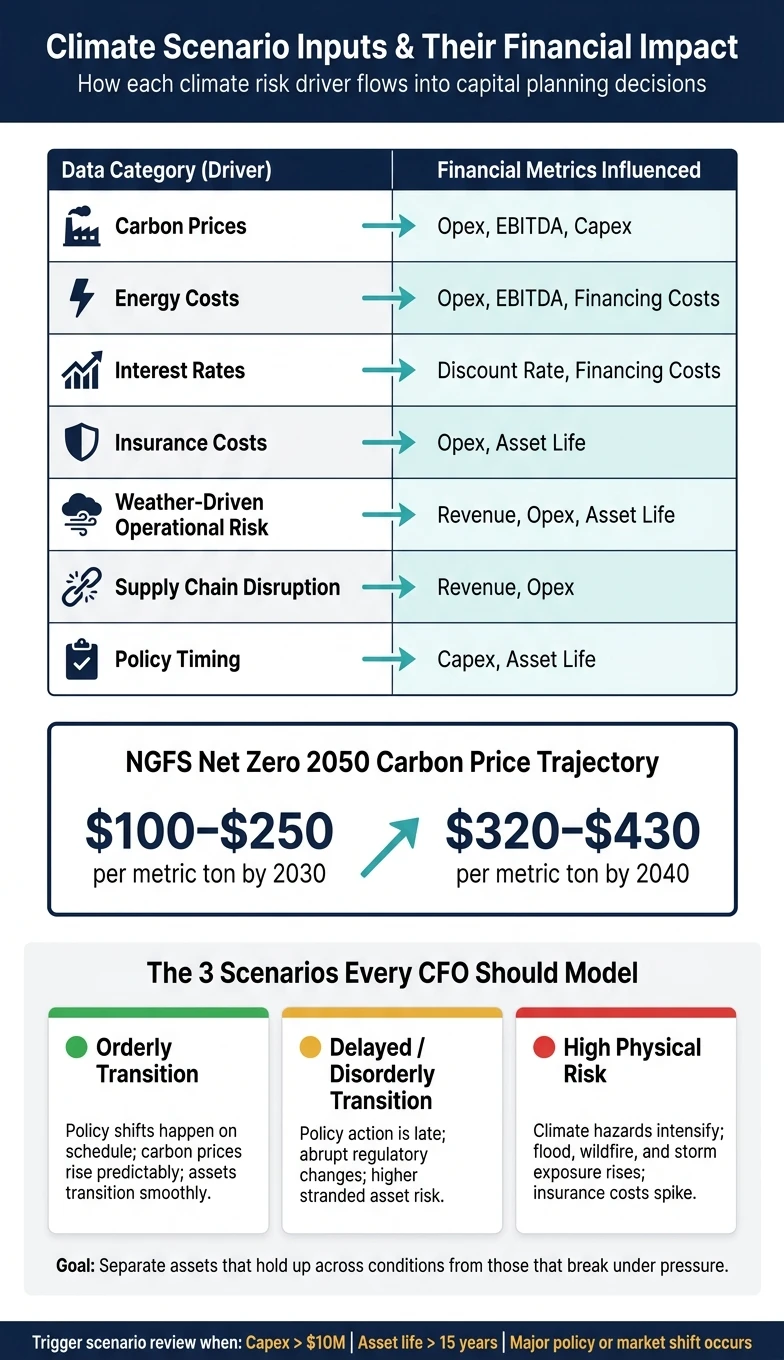
Climate Scenario Inputs vs. Financial Metrics: A CFO's Decision Framework
Data Inputs That Change Financial Results
After the first exposure screen, narrow the work to the inputs that directly change cash flow, valuation, or financing costs.
Carbon prices often have the biggest effect on the model. In NGFS Net Zero 2050-type scenarios, modeled shadow carbon prices can reach $100–$250 per ton of CO₂ by 2030 and $320–$430 per ton by 2040.[11] For carbon-heavy operations, those numbers can squeeze EBITDA, shift the math on capital projects, and move high-emitting assets closer to early retirement.
Energy costs matter just as much. Power and fuel assumptions shape opex and margins. Long-term power purchase agreements can also cut risk in long-range cash flows, which may change financing costs.
Beyond carbon and energy, insurance costs and coverage terms are becoming material, especially for assets in coastal or wildfire-prone areas. Facility downtime tied to climate hazard data flows straight into revenue forecasts. Policy timing shapes when compliance capex lands and how long current assets remain usable.
The table below shows where each data category hits the financial model:
Data Category | Financial Metrics Influenced |
|---|---|
Carbon Prices | Opex, EBITDA, Capex |
Energy Costs | Opex, EBITDA, Financing Costs |
Interest Rates | Discount Rate, Financing Costs |
Insurance Costs | Opex, Asset Life |
Weather-Driven Operational Risk | Revenue, Opex, Asset Life |
Supply Chain Disruption | Revenue, Opex |
Policy Timing | Capex, Asset Life |
A Practical Number of Scenarios for Capital Planning
Three scenarios are usually enough.[12]
Use an orderly transition case, a delayed or disorderly transition case, and a high physical risk case. That mix gives finance a clean way to test both policy stress and physical stress. The goal is simple: separate assets that hold up across conditions from those that break under pressure.[8][9][10]
The next screen is location. The same scenario can lead to very different outcomes by region.
How to Set Scenario Scope by Sector and Geography
Scenario design should match where the organization operates and what it owns. Regional portfolios need regional assumptions. A single national average can distort risk and send the model in the wrong direction.
On the Gulf Coast, the frequency of a "1-in-100-year" coastal flood could nearly quadruple for many counties by mid-century.[13] In plain English, that means more expected downtime, higher insurance premiums, and shorter usable life for coastal facilities.
In the Western U.S., land burned by wildfires could increase two to six times by around 2050.[14] For operations with major on-site infrastructure, that lifts the risk of facility damage and supply disruption.
Once those geography-specific inputs are in place, finance can use them as the baseline for refresh cycles and capital approvals.
How Often to Update Models and How to Use Results in Approvals
When to Refresh Scenarios and Assumptions
Once scenarios are in use, the next issue is timing. Climate inputs can go stale fast. If carbon prices, energy assumptions, or policy outlooks are out of date, capital decisions can drift off course and skew NPV, IRR, and capital allocation.[15][16]
A sensible rhythm is simple: review key assumptions every year, then do a deeper model refresh every two to three years.[15][16] The annual pass checks last year’s inputs against current external data, spots material gaps, and updates items such as carbon price paths or physical risk estimates. The deeper refresh should take a harder look at the full setup - scenario selection, sector coverage, regional tailoring, and the method used to turn climate risk into cash flow impacts.
One point matters a lot here: keep updates to external scenario inputs separate from updates to internal valuation models. The outside scenario set may need recalibration more often than the financial model itself.
Some events should force an off-cycle refresh, no matter what the calendar says. That includes:
major policy shifts
sharp energy price moves
changes in technology costs
new disclosure expectations from investors or rating agencies[15][16]
Fresh assumptions only matter if they make their way into actual capital decisions.
How Scenario Results Feed Into Capital Approval
The cleanest approach is to plug climate outputs into the same approval metrics committees already know: NPV, IRR, payback period, and hurdle rates.[17][18]
For projects with material climate exposure, use the same three scenarios already in the planning set - orderly transition, delayed transition, and high physical risk - and show how each one changes the core financial picture. If a project fails under one plausible scenario, that shouldn’t be buried in the back of the memo. It needs to show up plainly in the approval case.
Capital Decision | Key Scenario Inputs | Financial Metrics Affected | Approval Implication |
|---|---|---|---|
New gas-fired power asset | Carbon price path, policy phase-out timeline | NPV, terminal value, IRR | May require a higher hurdle rate |
Solar plus storage project | Policy incentives, technology cost curve, physical risk | NPV, IRR, payback | Returns often improve under stronger policy support and higher carbon prices |
Coastal facility resilience upgrade | Flood frequency, insurance cost trajectory, avoided downtime | NPV, payback, life-cycle cost | Can improve risk-adjusted returns by reducing expected losses |
Energy efficiency retrofit in a logistics network | Internal shadow carbon price, energy cost path | Payback, opex reduction, IRR | Often has strong near-term payback and lowers transition exposure |
For long-lived assets, map the cash flow horizon against scenario-based policy and demand shifts, then test terminal value sensitivity under high-transition-risk conditions.[2] If NPV turns negative under plausible scenarios, that result should trigger escalation - not sit as a footnote.
That kind of discipline makes scenario analysis repeatable from one budget cycle to the next and from one capital review to another.
Governance Steps That Keep Scenario Use on Track
Approval discipline falls apart when ownership is fuzzy. The split here should be clear: finance owns decision use, risk checks assumptions, sustainability provides climate inputs, and business units add asset-level context.[2][1]
Finance sets the ground rules: which projects need scenario analysis, which stress tests are mandatory, and how scenario-based metrics affect approval standards. Many firms use a threshold such as $10 million in capex or assets with lives longer than 15 years. Risk reviews scenario choice and stress-testing methods to make sure they line up with the firm’s broader risk appetite. Sustainability maintains external inputs such as NGFS pathways, IPCC data, and U.S. policy trajectories, and flags when those inputs need to be updated. Business units turn scenario outputs into operating assumptions like expected uptime, maintenance timing, and local regulatory conditions.
To keep the process tight, maintain:
a current assumptions register
version-controlled models
an approval checklist confirming that climate scenarios were applied and risk-adjusted metrics were reviewed[2][16]
When a project fails scenario screening, governance should require escalation to enterprise risk or a board-level committee.
What Good Climate Scenario Use Looks Like for CFOs
After approval rules are set, the last test is simple: do scenarios change decisions? Good climate scenario use is a capital allocation tool. If it doesn’t shape approvals, it’s not ready for capital approval.
At the process level, start with the exposures already flagged in planning - carbon-intensive assets, long-lived infrastructure, and hazard-prone real estate - and build them into the capital review you already use. Climate inputs should move through the same approval path as every other capital input. No side process. No separate track.
Keep the scenario set compact, with a clear split between transition risk and physical risk. That makes the analysis easier to compare and easier to use when teams are weighing one investment against another.
Model refresh matters just as much as model design. Review key assumptions during the annual planning cycle, and update sooner when policy, market conditions, technology, or hazard patterns shift in a meaningful way.
When those parts are in place, scenario analysis starts to earn its seat in capital planning. That’s when climate uncertainty becomes a comparable input in capital allocation.
FAQs
How do I pick which assets to review first?
Start with the assets that matter most to the business and the bottom line. Build an inventory of facilities, properties, and supply chain nodes, then sort them by their exposure to physical climate hazards and transition risks.
Give extra weight to long-lived assets, like infrastructure or buildings with 30-plus-year time frames. A road, plant, or warehouse built today may still be in use decades from now, so decisions made now can lock in cost and risk for years.
Use a marginal abatement cost curve to rank decarbonization options by both cost and impact. That gives teams a clear view of which moves cut emissions at the lowest cost, which ones need more capital, and where tradeoffs show up. Feed those results into risk management and capital allocation so climate decisions shape where money goes, not just what gets reported.
Which climate inputs matter most in capital models?
The most important inputs are transition and physical risk variables that already connect to financial performance.
For transition risk, focus on internal carbon price paths, shifts in the energy mix, and policy-driven technology substitution rates. For physical risk, use asset-level exposure data, including hazard projections for flooding, wildfire, and heat stress, along with site-specific vulnerability assessments. Then quantify how those factors affect revenue, asset values, and capital spending.
When should scenario results change project approval?
Scenario results should shift project approval when they point to material climate-related risks that change a project’s financial outlook or risk profile.
That can include concentration risk, stranded asset exposure, or capital requirement effects that go past set thresholds. If the analysis shows major potential credit losses or physical risk exposure, finance leaders should tighten risk management and update approval criteria.
Related Blog Posts
Latest Articles
©2026

Narrative Change and Power Building: The Missing Half of Advocacy
Narrative change is the process of disrupting dominant narratives that normalize inequity and advancing new narratives from historically marginalized communities.

Funding Resilience Without Federal Grants
BRIC is unreliable and FEMA is shrinking. Here's how cities fund climate resilience with dedicated revenue, blended finance, and a coordinating authority.

The ESG Blind Spot: How AI Is Finding Risks in Companies Nobody Else Is Watching
Norway's sovereign wealth fund uses AI to screen 7,200 portfolio companies for forced labor and corruption within 24 hours. The real story is the emerging-market coverage gap that traditional ESG data vendors miss — and what it means for any company with a global supply chain.
Narrative Change and Power Building: The Missing Half of Advocacy
Narrative change is the process of disrupting dominant narratives that normalize inequity and advancing new narratives from historically marginalized communities.
Funding Resilience Without Federal Grants
BRIC is unreliable and FEMA is shrinking. Here's how cities fund climate resilience with dedicated revenue, blended finance, and a coordinating authority.
The ESG Blind Spot: How AI Is Finding Risks in Companies Nobody Else Is Watching
Norway's sovereign wealth fund uses AI to screen 7,200 portfolio companies for forced labor and corruption within 24 hours. The real story is the emerging-market coverage gap that traditional ESG data vendors miss — and what it means for any company with a global supply chain.
FAQ
01
What does it really mean to “redefine profit”?
02
What makes Council Fire different?
03
Who does Council Fire work with?
04
What does working with Council Fire actually look like?
05
How does Council Fire help organizations turn big goals into action?
06
How does Council Fire define and measure success?
07
How does technology fit into Council Fire’s work?
Sep 10, 2026
How CFOs Use Scenarios in Climate Finance
Sustainability Strategy
In This Article
Climate scenarios must change capital decisions—CFOs should use three focused cases to stress-test assets and embed results in approvals.
How CFOs Use Scenarios in Climate Finance
Climate scenario work is about one thing: better capital decisions. I use it to test how carbon costs, energy prices, insurance, downtime, and policy shifts could change cash flow, asset life, and project returns.
In plain terms, the article shows that CFOs should not treat climate scenarios as a reporting exercise. They should use them in budgeting, long-range planning, impairment reviews, debt planning, insurance reviews, and capex approvals. A simple starting point works best: focus on the most exposed assets, use three scenarios, update assumptions each year, and push results into NPV, IRR, payback, and hurdle rates.
Here’s the article in one view:
I start with material exposures, not every risk at once.
I move from a qualitative screen to simple stress tests, then into finance models.
I focus on inputs that move the numbers: carbon price, energy cost, insurance, downtime, policy timing, and financing cost.
I usually use three cases: orderly transition, delayed transition, and high physical risk.
I adjust for sector and geography, because flood and wildfire risk is local.
I review assumptions annually and do a deeper update every 2–3 years.
I make scenario results visible in approvals, especially for long-lived or high-capex assets.
I set clear ownership across finance, risk, sustainability, and business units.
A few numbers from the article show why this matters:
BP took about $17.5 billion in non-cash impairments and write-offs after changing long-term price assumptions.
In some NGFS-style pathways, carbon prices can reach $100–$250 per metric ton by 2030 and $320–$430 by 2040.
Some companies use thresholds like $10 million in capex or asset lives above 15 years to trigger scenario review.
Bottom line: I would summarize the article this way - keep the scenario set small, tie it to actual planning choices, and make sure it changes approvals when risk is material.
Where Finance Teams Should Start
Start with Material Exposures and Existing Planning Processes
Once CFOs understand why scenario work matters, the next move is to focus on the exposures most likely to shift financial results.
Trying to model every possible climate risk at once is a good way to get stuck. A better place to start is with the areas that already stand out: facilities in flood-prone locations, supply chains clustered in water-stressed regions, or revenue streams tied to energy-intensive operations. Fold this work into ERM, capital budgeting reviews, and strategic planning cycles so business leaders can use the results when actual decisions are on the table. [3][4]
That first screen gives finance teams a practical base for the initial round of financial stress tests.
Move from Qualitative to Quantitative Analysis in Stages
Teams that wait for perfect data often lose momentum. A staged approach helps keep the work moving without putting too much time or money in too early.
Start with a qualitative risk screen. Map the main climate-related drivers to specific business units or asset groups, then note where the financial hit may show up: lower revenue, higher operating costs, earlier capital replacement, or impairment risk. The result is a ranked set of exposures worth deeper analysis.
Next, run directional stress tests on the top exposures. These do not need to be overly detailed at the start. The point is to see which assumptions change the numbers in a meaningful way. [6][7]
Then, embed quantified scenario outputs into financial models such as DCF analyses, capital request templates, and long-range forecasts. Use parameters that match planning assumptions the organization already uses and accepts. [4][5]
When Outside Support Can Speed Up Execution
Teams that do not yet have climate finance capacity can move faster with outside help, especially when that help connects scenario selection to capital planning. Council Fire helps teams turn climate scenarios into inputs for capital planning and investment decisions.
Finance Trends 2026: The intersection of CFO strategy and sustainability | Deloitte Insights
Which Data Matters and How Many Scenarios to Use
Climate Scenario Inputs vs. Financial Metrics: A CFO's Decision Framework
Data Inputs That Change Financial Results
After the first exposure screen, narrow the work to the inputs that directly change cash flow, valuation, or financing costs.
Carbon prices often have the biggest effect on the model. In NGFS Net Zero 2050-type scenarios, modeled shadow carbon prices can reach $100–$250 per ton of CO₂ by 2030 and $320–$430 per ton by 2040.[11] For carbon-heavy operations, those numbers can squeeze EBITDA, shift the math on capital projects, and move high-emitting assets closer to early retirement.
Energy costs matter just as much. Power and fuel assumptions shape opex and margins. Long-term power purchase agreements can also cut risk in long-range cash flows, which may change financing costs.
Beyond carbon and energy, insurance costs and coverage terms are becoming material, especially for assets in coastal or wildfire-prone areas. Facility downtime tied to climate hazard data flows straight into revenue forecasts. Policy timing shapes when compliance capex lands and how long current assets remain usable.
The table below shows where each data category hits the financial model:
Data Category | Financial Metrics Influenced |
|---|---|
Carbon Prices | Opex, EBITDA, Capex |
Energy Costs | Opex, EBITDA, Financing Costs |
Interest Rates | Discount Rate, Financing Costs |
Insurance Costs | Opex, Asset Life |
Weather-Driven Operational Risk | Revenue, Opex, Asset Life |
Supply Chain Disruption | Revenue, Opex |
Policy Timing | Capex, Asset Life |
A Practical Number of Scenarios for Capital Planning
Three scenarios are usually enough.[12]
Use an orderly transition case, a delayed or disorderly transition case, and a high physical risk case. That mix gives finance a clean way to test both policy stress and physical stress. The goal is simple: separate assets that hold up across conditions from those that break under pressure.[8][9][10]
The next screen is location. The same scenario can lead to very different outcomes by region.
How to Set Scenario Scope by Sector and Geography
Scenario design should match where the organization operates and what it owns. Regional portfolios need regional assumptions. A single national average can distort risk and send the model in the wrong direction.
On the Gulf Coast, the frequency of a "1-in-100-year" coastal flood could nearly quadruple for many counties by mid-century.[13] In plain English, that means more expected downtime, higher insurance premiums, and shorter usable life for coastal facilities.
In the Western U.S., land burned by wildfires could increase two to six times by around 2050.[14] For operations with major on-site infrastructure, that lifts the risk of facility damage and supply disruption.
Once those geography-specific inputs are in place, finance can use them as the baseline for refresh cycles and capital approvals.
How Often to Update Models and How to Use Results in Approvals
When to Refresh Scenarios and Assumptions
Once scenarios are in use, the next issue is timing. Climate inputs can go stale fast. If carbon prices, energy assumptions, or policy outlooks are out of date, capital decisions can drift off course and skew NPV, IRR, and capital allocation.[15][16]
A sensible rhythm is simple: review key assumptions every year, then do a deeper model refresh every two to three years.[15][16] The annual pass checks last year’s inputs against current external data, spots material gaps, and updates items such as carbon price paths or physical risk estimates. The deeper refresh should take a harder look at the full setup - scenario selection, sector coverage, regional tailoring, and the method used to turn climate risk into cash flow impacts.
One point matters a lot here: keep updates to external scenario inputs separate from updates to internal valuation models. The outside scenario set may need recalibration more often than the financial model itself.
Some events should force an off-cycle refresh, no matter what the calendar says. That includes:
major policy shifts
sharp energy price moves
changes in technology costs
new disclosure expectations from investors or rating agencies[15][16]
Fresh assumptions only matter if they make their way into actual capital decisions.
How Scenario Results Feed Into Capital Approval
The cleanest approach is to plug climate outputs into the same approval metrics committees already know: NPV, IRR, payback period, and hurdle rates.[17][18]
For projects with material climate exposure, use the same three scenarios already in the planning set - orderly transition, delayed transition, and high physical risk - and show how each one changes the core financial picture. If a project fails under one plausible scenario, that shouldn’t be buried in the back of the memo. It needs to show up plainly in the approval case.
Capital Decision | Key Scenario Inputs | Financial Metrics Affected | Approval Implication |
|---|---|---|---|
New gas-fired power asset | Carbon price path, policy phase-out timeline | NPV, terminal value, IRR | May require a higher hurdle rate |
Solar plus storage project | Policy incentives, technology cost curve, physical risk | NPV, IRR, payback | Returns often improve under stronger policy support and higher carbon prices |
Coastal facility resilience upgrade | Flood frequency, insurance cost trajectory, avoided downtime | NPV, payback, life-cycle cost | Can improve risk-adjusted returns by reducing expected losses |
Energy efficiency retrofit in a logistics network | Internal shadow carbon price, energy cost path | Payback, opex reduction, IRR | Often has strong near-term payback and lowers transition exposure |
For long-lived assets, map the cash flow horizon against scenario-based policy and demand shifts, then test terminal value sensitivity under high-transition-risk conditions.[2] If NPV turns negative under plausible scenarios, that result should trigger escalation - not sit as a footnote.
That kind of discipline makes scenario analysis repeatable from one budget cycle to the next and from one capital review to another.
Governance Steps That Keep Scenario Use on Track
Approval discipline falls apart when ownership is fuzzy. The split here should be clear: finance owns decision use, risk checks assumptions, sustainability provides climate inputs, and business units add asset-level context.[2][1]
Finance sets the ground rules: which projects need scenario analysis, which stress tests are mandatory, and how scenario-based metrics affect approval standards. Many firms use a threshold such as $10 million in capex or assets with lives longer than 15 years. Risk reviews scenario choice and stress-testing methods to make sure they line up with the firm’s broader risk appetite. Sustainability maintains external inputs such as NGFS pathways, IPCC data, and U.S. policy trajectories, and flags when those inputs need to be updated. Business units turn scenario outputs into operating assumptions like expected uptime, maintenance timing, and local regulatory conditions.
To keep the process tight, maintain:
a current assumptions register
version-controlled models
an approval checklist confirming that climate scenarios were applied and risk-adjusted metrics were reviewed[2][16]
When a project fails scenario screening, governance should require escalation to enterprise risk or a board-level committee.
What Good Climate Scenario Use Looks Like for CFOs
After approval rules are set, the last test is simple: do scenarios change decisions? Good climate scenario use is a capital allocation tool. If it doesn’t shape approvals, it’s not ready for capital approval.
At the process level, start with the exposures already flagged in planning - carbon-intensive assets, long-lived infrastructure, and hazard-prone real estate - and build them into the capital review you already use. Climate inputs should move through the same approval path as every other capital input. No side process. No separate track.
Keep the scenario set compact, with a clear split between transition risk and physical risk. That makes the analysis easier to compare and easier to use when teams are weighing one investment against another.
Model refresh matters just as much as model design. Review key assumptions during the annual planning cycle, and update sooner when policy, market conditions, technology, or hazard patterns shift in a meaningful way.
When those parts are in place, scenario analysis starts to earn its seat in capital planning. That’s when climate uncertainty becomes a comparable input in capital allocation.
FAQs
How do I pick which assets to review first?
Start with the assets that matter most to the business and the bottom line. Build an inventory of facilities, properties, and supply chain nodes, then sort them by their exposure to physical climate hazards and transition risks.
Give extra weight to long-lived assets, like infrastructure or buildings with 30-plus-year time frames. A road, plant, or warehouse built today may still be in use decades from now, so decisions made now can lock in cost and risk for years.
Use a marginal abatement cost curve to rank decarbonization options by both cost and impact. That gives teams a clear view of which moves cut emissions at the lowest cost, which ones need more capital, and where tradeoffs show up. Feed those results into risk management and capital allocation so climate decisions shape where money goes, not just what gets reported.
Which climate inputs matter most in capital models?
The most important inputs are transition and physical risk variables that already connect to financial performance.
For transition risk, focus on internal carbon price paths, shifts in the energy mix, and policy-driven technology substitution rates. For physical risk, use asset-level exposure data, including hazard projections for flooding, wildfire, and heat stress, along with site-specific vulnerability assessments. Then quantify how those factors affect revenue, asset values, and capital spending.
When should scenario results change project approval?
Scenario results should shift project approval when they point to material climate-related risks that change a project’s financial outlook or risk profile.
That can include concentration risk, stranded asset exposure, or capital requirement effects that go past set thresholds. If the analysis shows major potential credit losses or physical risk exposure, finance leaders should tighten risk management and update approval criteria.
Related Blog Posts
Latest Articles
©2026
Narrative Change and Power Building: The Missing Half of Advocacy
Narrative change is the process of disrupting dominant narratives that normalize inequity and advancing new narratives from historically marginalized communities.
Funding Resilience Without Federal Grants
BRIC is unreliable and FEMA is shrinking. Here's how cities fund climate resilience with dedicated revenue, blended finance, and a coordinating authority.
The ESG Blind Spot: How AI Is Finding Risks in Companies Nobody Else Is Watching
Norway's sovereign wealth fund uses AI to screen 7,200 portfolio companies for forced labor and corruption within 24 hours. The real story is the emerging-market coverage gap that traditional ESG data vendors miss — and what it means for any company with a global supply chain.
FAQ
01
What does it really mean to “redefine profit”?
02
What makes Council Fire different?
03
Who does Council Fire work with?
04
What does working with Council Fire actually look like?
05
How does Council Fire help organizations turn big goals into action?
06
How does Council Fire define and measure success?
07
How does technology fit into Council Fire’s work?
Sep 10, 2026
How CFOs Use Scenarios in Climate Finance
Sustainability Strategy
In This Article
Climate scenarios must change capital decisions—CFOs should use three focused cases to stress-test assets and embed results in approvals.
How CFOs Use Scenarios in Climate Finance
Climate scenario work is about one thing: better capital decisions. I use it to test how carbon costs, energy prices, insurance, downtime, and policy shifts could change cash flow, asset life, and project returns.
In plain terms, the article shows that CFOs should not treat climate scenarios as a reporting exercise. They should use them in budgeting, long-range planning, impairment reviews, debt planning, insurance reviews, and capex approvals. A simple starting point works best: focus on the most exposed assets, use three scenarios, update assumptions each year, and push results into NPV, IRR, payback, and hurdle rates.
Here’s the article in one view:
I start with material exposures, not every risk at once.
I move from a qualitative screen to simple stress tests, then into finance models.
I focus on inputs that move the numbers: carbon price, energy cost, insurance, downtime, policy timing, and financing cost.
I usually use three cases: orderly transition, delayed transition, and high physical risk.
I adjust for sector and geography, because flood and wildfire risk is local.
I review assumptions annually and do a deeper update every 2–3 years.
I make scenario results visible in approvals, especially for long-lived or high-capex assets.
I set clear ownership across finance, risk, sustainability, and business units.
A few numbers from the article show why this matters:
BP took about $17.5 billion in non-cash impairments and write-offs after changing long-term price assumptions.
In some NGFS-style pathways, carbon prices can reach $100–$250 per metric ton by 2030 and $320–$430 by 2040.
Some companies use thresholds like $10 million in capex or asset lives above 15 years to trigger scenario review.
Bottom line: I would summarize the article this way - keep the scenario set small, tie it to actual planning choices, and make sure it changes approvals when risk is material.
Where Finance Teams Should Start
Start with Material Exposures and Existing Planning Processes
Once CFOs understand why scenario work matters, the next move is to focus on the exposures most likely to shift financial results.
Trying to model every possible climate risk at once is a good way to get stuck. A better place to start is with the areas that already stand out: facilities in flood-prone locations, supply chains clustered in water-stressed regions, or revenue streams tied to energy-intensive operations. Fold this work into ERM, capital budgeting reviews, and strategic planning cycles so business leaders can use the results when actual decisions are on the table. [3][4]
That first screen gives finance teams a practical base for the initial round of financial stress tests.
Move from Qualitative to Quantitative Analysis in Stages
Teams that wait for perfect data often lose momentum. A staged approach helps keep the work moving without putting too much time or money in too early.
Start with a qualitative risk screen. Map the main climate-related drivers to specific business units or asset groups, then note where the financial hit may show up: lower revenue, higher operating costs, earlier capital replacement, or impairment risk. The result is a ranked set of exposures worth deeper analysis.
Next, run directional stress tests on the top exposures. These do not need to be overly detailed at the start. The point is to see which assumptions change the numbers in a meaningful way. [6][7]
Then, embed quantified scenario outputs into financial models such as DCF analyses, capital request templates, and long-range forecasts. Use parameters that match planning assumptions the organization already uses and accepts. [4][5]
When Outside Support Can Speed Up Execution
Teams that do not yet have climate finance capacity can move faster with outside help, especially when that help connects scenario selection to capital planning. Council Fire helps teams turn climate scenarios into inputs for capital planning and investment decisions.
Finance Trends 2026: The intersection of CFO strategy and sustainability | Deloitte Insights
Which Data Matters and How Many Scenarios to Use
Climate Scenario Inputs vs. Financial Metrics: A CFO's Decision Framework
Data Inputs That Change Financial Results
After the first exposure screen, narrow the work to the inputs that directly change cash flow, valuation, or financing costs.
Carbon prices often have the biggest effect on the model. In NGFS Net Zero 2050-type scenarios, modeled shadow carbon prices can reach $100–$250 per ton of CO₂ by 2030 and $320–$430 per ton by 2040.[11] For carbon-heavy operations, those numbers can squeeze EBITDA, shift the math on capital projects, and move high-emitting assets closer to early retirement.
Energy costs matter just as much. Power and fuel assumptions shape opex and margins. Long-term power purchase agreements can also cut risk in long-range cash flows, which may change financing costs.
Beyond carbon and energy, insurance costs and coverage terms are becoming material, especially for assets in coastal or wildfire-prone areas. Facility downtime tied to climate hazard data flows straight into revenue forecasts. Policy timing shapes when compliance capex lands and how long current assets remain usable.
The table below shows where each data category hits the financial model:
Data Category | Financial Metrics Influenced |
|---|---|
Carbon Prices | Opex, EBITDA, Capex |
Energy Costs | Opex, EBITDA, Financing Costs |
Interest Rates | Discount Rate, Financing Costs |
Insurance Costs | Opex, Asset Life |
Weather-Driven Operational Risk | Revenue, Opex, Asset Life |
Supply Chain Disruption | Revenue, Opex |
Policy Timing | Capex, Asset Life |
A Practical Number of Scenarios for Capital Planning
Three scenarios are usually enough.[12]
Use an orderly transition case, a delayed or disorderly transition case, and a high physical risk case. That mix gives finance a clean way to test both policy stress and physical stress. The goal is simple: separate assets that hold up across conditions from those that break under pressure.[8][9][10]
The next screen is location. The same scenario can lead to very different outcomes by region.
How to Set Scenario Scope by Sector and Geography
Scenario design should match where the organization operates and what it owns. Regional portfolios need regional assumptions. A single national average can distort risk and send the model in the wrong direction.
On the Gulf Coast, the frequency of a "1-in-100-year" coastal flood could nearly quadruple for many counties by mid-century.[13] In plain English, that means more expected downtime, higher insurance premiums, and shorter usable life for coastal facilities.
In the Western U.S., land burned by wildfires could increase two to six times by around 2050.[14] For operations with major on-site infrastructure, that lifts the risk of facility damage and supply disruption.
Once those geography-specific inputs are in place, finance can use them as the baseline for refresh cycles and capital approvals.
How Often to Update Models and How to Use Results in Approvals
When to Refresh Scenarios and Assumptions
Once scenarios are in use, the next issue is timing. Climate inputs can go stale fast. If carbon prices, energy assumptions, or policy outlooks are out of date, capital decisions can drift off course and skew NPV, IRR, and capital allocation.[15][16]
A sensible rhythm is simple: review key assumptions every year, then do a deeper model refresh every two to three years.[15][16] The annual pass checks last year’s inputs against current external data, spots material gaps, and updates items such as carbon price paths or physical risk estimates. The deeper refresh should take a harder look at the full setup - scenario selection, sector coverage, regional tailoring, and the method used to turn climate risk into cash flow impacts.
One point matters a lot here: keep updates to external scenario inputs separate from updates to internal valuation models. The outside scenario set may need recalibration more often than the financial model itself.
Some events should force an off-cycle refresh, no matter what the calendar says. That includes:
major policy shifts
sharp energy price moves
changes in technology costs
new disclosure expectations from investors or rating agencies[15][16]
Fresh assumptions only matter if they make their way into actual capital decisions.
How Scenario Results Feed Into Capital Approval
The cleanest approach is to plug climate outputs into the same approval metrics committees already know: NPV, IRR, payback period, and hurdle rates.[17][18]
For projects with material climate exposure, use the same three scenarios already in the planning set - orderly transition, delayed transition, and high physical risk - and show how each one changes the core financial picture. If a project fails under one plausible scenario, that shouldn’t be buried in the back of the memo. It needs to show up plainly in the approval case.
Capital Decision | Key Scenario Inputs | Financial Metrics Affected | Approval Implication |
|---|---|---|---|
New gas-fired power asset | Carbon price path, policy phase-out timeline | NPV, terminal value, IRR | May require a higher hurdle rate |
Solar plus storage project | Policy incentives, technology cost curve, physical risk | NPV, IRR, payback | Returns often improve under stronger policy support and higher carbon prices |
Coastal facility resilience upgrade | Flood frequency, insurance cost trajectory, avoided downtime | NPV, payback, life-cycle cost | Can improve risk-adjusted returns by reducing expected losses |
Energy efficiency retrofit in a logistics network | Internal shadow carbon price, energy cost path | Payback, opex reduction, IRR | Often has strong near-term payback and lowers transition exposure |
For long-lived assets, map the cash flow horizon against scenario-based policy and demand shifts, then test terminal value sensitivity under high-transition-risk conditions.[2] If NPV turns negative under plausible scenarios, that result should trigger escalation - not sit as a footnote.
That kind of discipline makes scenario analysis repeatable from one budget cycle to the next and from one capital review to another.
Governance Steps That Keep Scenario Use on Track
Approval discipline falls apart when ownership is fuzzy. The split here should be clear: finance owns decision use, risk checks assumptions, sustainability provides climate inputs, and business units add asset-level context.[2][1]
Finance sets the ground rules: which projects need scenario analysis, which stress tests are mandatory, and how scenario-based metrics affect approval standards. Many firms use a threshold such as $10 million in capex or assets with lives longer than 15 years. Risk reviews scenario choice and stress-testing methods to make sure they line up with the firm’s broader risk appetite. Sustainability maintains external inputs such as NGFS pathways, IPCC data, and U.S. policy trajectories, and flags when those inputs need to be updated. Business units turn scenario outputs into operating assumptions like expected uptime, maintenance timing, and local regulatory conditions.
To keep the process tight, maintain:
a current assumptions register
version-controlled models
an approval checklist confirming that climate scenarios were applied and risk-adjusted metrics were reviewed[2][16]
When a project fails scenario screening, governance should require escalation to enterprise risk or a board-level committee.
What Good Climate Scenario Use Looks Like for CFOs
After approval rules are set, the last test is simple: do scenarios change decisions? Good climate scenario use is a capital allocation tool. If it doesn’t shape approvals, it’s not ready for capital approval.
At the process level, start with the exposures already flagged in planning - carbon-intensive assets, long-lived infrastructure, and hazard-prone real estate - and build them into the capital review you already use. Climate inputs should move through the same approval path as every other capital input. No side process. No separate track.
Keep the scenario set compact, with a clear split between transition risk and physical risk. That makes the analysis easier to compare and easier to use when teams are weighing one investment against another.
Model refresh matters just as much as model design. Review key assumptions during the annual planning cycle, and update sooner when policy, market conditions, technology, or hazard patterns shift in a meaningful way.
When those parts are in place, scenario analysis starts to earn its seat in capital planning. That’s when climate uncertainty becomes a comparable input in capital allocation.
FAQs
How do I pick which assets to review first?
Start with the assets that matter most to the business and the bottom line. Build an inventory of facilities, properties, and supply chain nodes, then sort them by their exposure to physical climate hazards and transition risks.
Give extra weight to long-lived assets, like infrastructure or buildings with 30-plus-year time frames. A road, plant, or warehouse built today may still be in use decades from now, so decisions made now can lock in cost and risk for years.
Use a marginal abatement cost curve to rank decarbonization options by both cost and impact. That gives teams a clear view of which moves cut emissions at the lowest cost, which ones need more capital, and where tradeoffs show up. Feed those results into risk management and capital allocation so climate decisions shape where money goes, not just what gets reported.
Which climate inputs matter most in capital models?
The most important inputs are transition and physical risk variables that already connect to financial performance.
For transition risk, focus on internal carbon price paths, shifts in the energy mix, and policy-driven technology substitution rates. For physical risk, use asset-level exposure data, including hazard projections for flooding, wildfire, and heat stress, along with site-specific vulnerability assessments. Then quantify how those factors affect revenue, asset values, and capital spending.
When should scenario results change project approval?
Scenario results should shift project approval when they point to material climate-related risks that change a project’s financial outlook or risk profile.
That can include concentration risk, stranded asset exposure, or capital requirement effects that go past set thresholds. If the analysis shows major potential credit losses or physical risk exposure, finance leaders should tighten risk management and update approval criteria.
Related Blog Posts
Latest Articles
©2026
Narrative Change and Power Building: The Missing Half of Advocacy
Narrative change is the process of disrupting dominant narratives that normalize inequity and advancing new narratives from historically marginalized communities.
Funding Resilience Without Federal Grants
BRIC is unreliable and FEMA is shrinking. Here's how cities fund climate resilience with dedicated revenue, blended finance, and a coordinating authority.
The ESG Blind Spot: How AI Is Finding Risks in Companies Nobody Else Is Watching
Norway's sovereign wealth fund uses AI to screen 7,200 portfolio companies for forced labor and corruption within 24 hours. The real story is the emerging-market coverage gap that traditional ESG data vendors miss — and what it means for any company with a global supply chain.
FAQ
What does it really mean to “redefine profit”?
What makes Council Fire different?
Who does Council Fire work with?
What does working with Council Fire actually look like?
How does Council Fire help organizations turn big goals into action?
How does Council Fire define and measure success?
How does technology fit into Council Fire’s work?