Oct 18, 2026 · 13 min read
ESG Strategy
In This Article
Practical checklist for hydropower green bonds: assess eligibility, proceeds and repayment, test risks, safeguards, and reporting.
Green bonds for hydropower projects
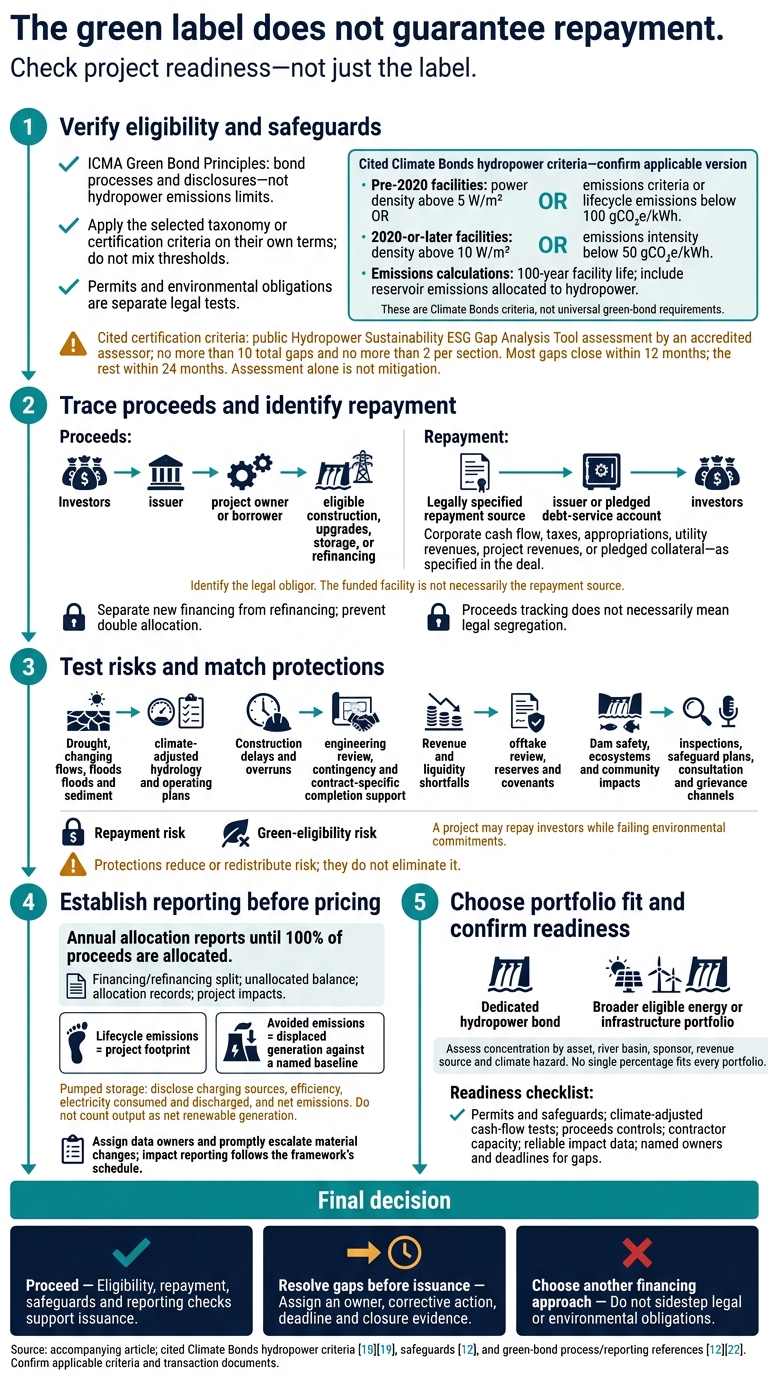
Green bonds can fund hydropower construction, upgrades, storage, and eligible refinancing - but the green label does not guarantee repayment. I start with three checks: does the project qualify, where will the money go, and what cash flow will repay investors?
Before issuing or investing, I check:
Eligibility: Apply the chosen framework’s emissions rules and safeguards. Hydropower does not qualify automatically.
Funding and repayment: Identify the borrower, track eligible spending, and separate new investment from refinancing.
Risk: Test drought, construction delays, dam safety, permits, and impacts on rivers and communities.
Reporting: Plan annual allocation reports until 100% of proceeds are allocated, with clear methods for measuring project results.
Portfolio fit: Compare a hydro-only bond with a broader mix of eligible energy and infrastructure assets.
My decision comes down to <u>project readiness - not the label</u>. I would proceed only when eligibility, repayment, safeguards, and reporting checks support the deal; otherwise, I would close the gaps first or choose another financing route.
Hydropower Green Bonds: From Eligibility to Issuance
Green Bond Principles Explained Simply (7 Minutes)
sbb-itb-8baf5f1
Hydropower Eligibility and Green Bond Rules
Separate bond process rules from project eligibility. The 2025 ICMA Green Bond Principles guide disclosures and controls; they do not set hydropower emissions limits. A taxonomy defines which activities qualify, while Climate Bonds Certification adds technical tests and safeguards. Apply each framework on its own terms - do not mix thresholds across systems.[7][12] These screens determine whether a hydropower project can enter a green bond framework and support marketing the bond as green.
Eligible Projects and Emissions Limits
Screen run-of-river plants, reservoirs, upgrades, and enabling infrastructure separately. For upgrades, specify whether the spending adds generation, improves efficiency, extends operating life, or improves safety. A connection to a dam does not, by itself, qualify enabling infrastructure.
Under the cited Climate Bonds hydropower criteria, facilities must meet one of the two thresholds for their operating date:[10][11]
Pre-2020 facilities: Power density above 5 W/m² or lifecycle emissions below 100 gCO₂e/kWh.
2020-or-later facilities: Power density above 10 W/m² or emissions intensity below 50 gCO₂e/kWh.
Confirm which sector-criteria version applies and keep evidence of the project’s operation date. Document capacity, reservoir area, generation forecasts, and calculation boundaries. Use a 100-year facility life, include reservoir emissions allocated to hydropower, and disclose assumptions for construction, operation, and decommissioning. The G-res Tool can estimate net reservoir emissions, but its assumptions and uncertainty still need review.[8][10]
Treat pumped storage as storage - not automatic renewable generation. Disclose the charging source, round-trip efficiency, electricity consumed and discharged, and net emissions. Keep this accounting separate from conventional generation: charging power and energy losses drive the climate result.
Project Safeguards and U.S. Permits
Assess biodiversity, fish passage, downstream flows, reservoir methane, sediment, water quality, resettlement, and Indigenous rights - including free, prior, and informed consent where applicable.
The cited Climate Bonds criteria require a public Hydropower Sustainability ESG Gap Analysis Tool assessment by an accredited assessor. They permit no more than 10 total gaps, with no more than 2 per section. Most gaps must close within 12 months, and the rest within 24 months. Document corrective actions; the assessment itself does not count as mitigation.[6]
| Requirement | Purpose | Applicability | Review or evidence | Legal status |
|---|---|---|---|---|
| Green Bond Principles alignment | Establish bond processes and disclosures | Issuers choosing GBP alignment | Eligibility framework, proceeds controls, reporting, and external review | Voluntary guidance, not a permit |
| Climate Bonds Certification | Test technical eligibility and safeguards | Transactions seeking certification under the applicable standard and sector criteria | Independent verification, emissions or power-density evidence, and accredited sustainability assessment | Voluntary certification, not a permit |
| FERC licensing and environmental review | Authorize and regulate projects within federal jurisdiction | Depends on project location, ownership, design, and federal nexus | Licensing or exemption determination; NEPA review, Endangered Species Act compliance, cultural-resource review, and Tribal consultation | Legally enforceable where applicable |
| Clean Water Act and state approvals | Protect water quality and regulate relevant water-resource impacts | Depends on required federal approvals and project activities | Section 401 certification, possible Section 404 authorization, and applicable state water-rights, siting, and dam-safety approvals | Legally enforceable; permits alone do not establish green eligibility |
After these screens, bond structuring addresses how proceeds will flow and which source will fund repayment.
Bond Issuers, Proceeds, and Deal Structures
Once a project passes eligibility checks, clarify who issues the bond, who receives the funds, and which cash flows repay investors.
Who Issues Bonds and Manages Proceeds
Public entities, utilities, lenders, developers, and project companies can issue hydropower green bonds or arrange their financing. Identify the legal obligor and who controls the proceeds. An issuer may lend the funds to the project owner while keeping responsibility for reporting and allocation.[7][14]
| Stage | Entity | Flow or control |
|---|---|---|
| Bond purchase | Investors → issuer | Investors provide capital; the issuer takes on the bond obligation. |
| Proceeds management | Issuer treasury or trustee, where appointed | A designated account, subportfolio, or subledger tracks net proceeds. |
| Project funding | Issuer → borrower or project owner | Funds reach projects through direct spending or intermediary loans. |
| Execution | Borrower → contractors and suppliers | Payments cover eligible equipment, construction, or rehabilitation; refinancing reimburses eligible prior spending. |
| Operations | Electricity buyers → facility owner | Power sales generate operating cash flow. |
| Debt service | Issuer or pledged debt-service account → investors | Principal and interest come from the legally specified repayment source - not necessarily the funded facility. |
Tracking does not mean legal segregation. A separate restricted account is needed only if applicable rules, the framework, or deal documents require one. Reconcile the proceeds ledger with accounting records, and retain invoices, approvals, and funding-source records.[7][9][15]
Compare Bond Structures and Repayment Sources
These categories can overlap. A public-authority issuer, for example, can use revenue bonds to fund a hydropower portfolio. Blended finance combines public, private, and concessional capital; it is not a bond type. Neither a green label nor an external review guarantees lower borrowing costs or stronger credit quality.
Once the obligor is clear, match the bond structure to its repayment source and construction risk.
| Arrangement | Typical issuer | Repayment and recourse | Construction exposure | Investor protections | Reporting workload |
|---|---|---|---|---|---|
| Corporate | Utility or developer | Corporate cash flow; generally issuer-level recourse | Borne across the company | Corporate covenants; security where applicable | Asset or portfolio allocation and impact |
| Municipal/public-authority | Government or public-power authority | Taxes, appropriations, or authority revenues; obligation varies | Depends on project stage | Revenue pledge, reserves, disclosure duties | Green reporting plus public disclosures |
| Revenue | Utility or authority | Pledged system revenues; limited to specified security | System construction and operating risks | Rate covenants, coverage tests, reserves | Allocation, system finances, impact |
| Project | Special-purpose project company | Facility cash flow; usually limited sponsor recourse | Direct completion exposure before operation | Completion support, offtake contracts, reserves, step-in rights | Detailed construction, financial, and impact reports |
| Portfolio/securitized | Bank, utility, aggregator, or special-purpose issuer | Issuer cash flow or pooled assets, depending on structure | Mixed across assets; shared risks remain | Eligibility tests, servicing rules, reserves, payment waterfall | Pool performance, substitutions, allocation, impact |
| Blended-finance arrangement | Public, private, and concessional participants | Defined separately for each funding layer | Support may absorb specified construction losses | Guarantees, subordinated capital, first-loss protection | Bond reporting plus funder-specific requirements |
Repayment can come from corporate cash flow, taxes, appropriations, utility revenues, project revenues, or pledged collateral. For guarantees or concessional support, state exactly what is covered and when claims become payable. These choices shape the risk analysis, protections, covenants, and disclosures discussed next.
Fund Construction, Upgrades, and Refinancing
With the structure set, define exactly what proceeds may fund. For existing hydropower assets, separate new upgrade spending from refinancing. Document the financing/refinancing split, original expenditure and financing dates, look-back period, remaining useful life, and eligible balance. Assign each asset its own identifier and maintain funding records to prevent double allocation across bonds and other financing.[7][15][16][17]
Keep project costs separate from transaction costs. Exclude underwriting, legal, trustee, and external-review fees unless the framework expressly allows them. Disclose unallocated proceeds, permitted temporary investments, liquidity and credit limits, and the expected allocation date. Report allocations annually until all proceeds are allocated, including the financing/refinancing split, remaining balance, and expected impacts.[7][9][12][13]
Project Risks, Investor Protections, and Reporting
Once proceeds and repayment are defined, match hydropower-specific risks to the bond structure. Hydropower bonds depend on water availability, dam safety, permits, and community conditions.
Assess Financial, Climate, and Project Risks
Separate repayment risk from green-eligibility risk. A project may keep paying bondholders while failing its environmental commitments. Use one risk register for permitting, construction, operations, and refinancing. Assign consequence ratings based on project evidence. Test future droughts, floods, low flows, and evaporation rather than relying only on historical hydrology.[19][22]
Set likelihood ratings after reviewing the documents. Leave them unscored until the evidence is complete.
| Risk | Evidence needed | Potential consequence | Owner | Mitigation and escalation trigger |
|---|---|---|---|---|
| Permitting and construction | Permit conditions, geotechnical studies, schedule, contingency | Delayed revenue and higher costs | Sponsor and independent engineer | Track critical milestones; escalate permit loss or forecast contingency exhaustion. |
| Drought, changing flows, and sediment | Historical records and climate-adjusted flow, evaporation, and sediment models | Lower generation, storage loss, flood damage | Hydrology and operations teams | Adjust operating rules and maintenance; escalate departures from modeled operating limits. |
| Dam safety | Inspection findings, instrumentation, emergency plans | Injury, liability, outage, asset loss | Dam-safety officer | Use independent inspections and emergency exercises; escalate breached safety thresholds immediately. |
| Transmission, prices, and offtaker credit | Interconnection terms, curtailment history, price scenarios, buyer credit | Undelivered power or unpaid revenue | Commercial and finance teams | Review contracts and credit support; escalate payment defaults or material curtailment. |
| Interest rates, refinancing, liquidity, and currency | Debt maturities, cash-flow stress tests, currency mismatches | Cash shortfalls or refinancing failure | Treasury | Match funding and revenues, assess hedges and reserves; escalate covenant or liquidity pressure. |
| Ecosystems, communities, and Indigenous rights | Environmental assessments, consultation records, rights and resettlement commitments | Habitat damage, livelihood losses, disputes, injunctions | Environmental, social, and legal teams | Put safeguard plans and grievance channels in place; escalate serious harm or unmet commitments. |
| Greenwashing and eligibility | Eligibility evidence, allocation records, impact methods | Misleading claims or loss of eligibility | Green-bond committee | Review claims and negative outcomes; escalate unsupported claims or eligibility changes. |
Match Investor Protections to Project Risks
Match each protection to a specific failure. Power purchase agreements reduce price uncertainty, but investors still need to review delivery duties, curtailment, force majeure, termination rights, and buyer credit. Completion guarantees cover delays or overruns only within the contract’s limits and the guarantor’s capacity.
Debt-service reserves cover temporary shortfalls. Debt-service coverage covenants can restrict distributions when cash flow weakens. Check enforcement rights and intercreditor limits, too. For insurance, review exclusions, deductibles, coverage limits, and insurer credit.
Independent engineering and hydrology reviews should test energy yield, construction assumptions, transmission access, and climate resilience. Use the findings to shape operating rules, reserves, and covenants. Keep dam-safety monitoring, emergency exercises, and safeguard action plans active after construction, with named owners and deadlines.
Provide accessible grievance channels. Address Indigenous consultation and, where applicable, Free, Prior and Informed Consent. These measures reduce or redistribute risk; they do not eliminate it.[18][20][21]
Report Proceeds Allocation and Project Impact
Organize oversight around the Green Bond Principles’ four components: use of proceeds; project evaluation and selection; management of proceeds; and reporting.[7] Treasury owns allocation controls, while the green-bond committee approves eligibility. Project teams supply operating and safeguard data; sustainability staff check methods and combine results. Internal audit or an assurance provider tests specified controls.
Publish impact reports on the framework’s schedule, focusing on generation, reservoir emissions, sediment, and community outcomes.
Track material changes as they happen - not just at year-end. Data owners must promptly escalate permit withdrawal, major overruns, safety concerns, prolonged underperformance, or lost eligibility. The issuer discloses material changes under its framework and bond documents.[7][16]
| Reporting item | Owner and boundary | Baseline, attribution, and uncertainty | Frequency and checks |
|---|---|---|---|
| Allocations, financing/refinancing, unallocated balance | Treasury; bond-funded assets and expenditures | State allocation dates, financing/refinancing shares, temporary investments, and substitutions | Annual until full allocation; reconcile records and verify against supporting accounting records |
| Capacity and generation | Operator; installed MW and metered net MWh | Separate actual from expected output; explain hydrology and curtailment; state bond-attribution method | Annual; meter checks and engineering review |
| Lifecycle emissions | Environmental specialists; construction, land-use, reservoir, operations, and decommissioning emissions | Report tCO₂e/MWh; disclose model, boundary, assumptions, and uncertainty | Framework schedule; methodology review and scoped assurance |
| Avoided emissions | Sustainability team; defined displaced generation | Report tCO₂e against a named grid baseline; disclose attribution, factors, and uncertainty | Framework schedule; verify calculations and baseline |
| Power density and reservoir water balance | Engineering and environmental teams; reservoir and affected river reaches | W/m² where relevant; define reservoir area, water balance, and environmental-flow baseline | Annual summary supported by operating monitoring |
| Biodiversity | Environmental team; affected habitats and species | Compare fish passage, habitat, and sediment outcomes with pre-project conditions; disclose attribution limits | Safeguard schedule; specialist review |
| Community outcomes | Social team; affected households and communities | Track commitments, resettlement, agreements, and grievance status against documented baselines | Regular monitoring and annual disclosure; safeguard review |
Keep lifecycle emissions and avoided emissions separate. Lifecycle emissions measure the project’s footprint; avoided emissions estimate displaced generation against a baseline. Do not count pumped-storage output as net renewable generation. Disclose charging sources and storage throughput separately.
For each review or assurance engagement, state its scope, provider, timing, limits, and any adverse findings. None guarantees repayment, dam safety, or the absence of environmental harm.[7][16]
The next question is whether hydropower should stand alone or sit within a broader green finance plan.
Hydropower's Role in a Green Finance Plan
Once eligibility, proceeds, risk controls, and reporting are defined, decide whether to finance hydropower through a dedicated bond or a broader green portfolio. Hydro can supply firm power, balance the grid, and provide pumped storage. These benefits need site-specific evidence and must be weighed against changes in river flows, fish barriers, sediment disruption, methane, and community impacts.[5][24][25] That assessment helps determine whether to keep the bond hydro-only or include other eligible assets.
Compare Dedicated and Diversified Financing
Let portfolio goals guide the financing scope, rather than the largest available project. Set concentration limits by asset, river basin, sponsor, revenue source, and climate hazard. No single percentage fits every portfolio.
Pair hydro with wind, solar, storage, transmission upgrades, and efficiency when those assets support the portfolio’s goals. Give watershed restoration, fish passage, and biodiversity work their own budget lines.
| Financing approach | Project fit | Diversification | Reporting focus |
|---|---|---|---|
| Dedicated hydropower green bond | A defined hydro construction, refurbishment, storage, or efficiency program that meets the framework’s hydro criteria | Low; concentration may be high | Site-specific allocations and impacts |
| Diversified renewable-energy bond | Hydro alongside wind, solar, storage, and possibly grid assets, each meeting defined eligibility rules | Moderate to high | Allocations by asset category, with generation and storage impacts reported separately |
| Green infrastructure bond | Hydro within a broader program of qualifying transmission, efficiency, water, and energy infrastructure | Potentially high | Allocations across infrastructure categories and category-specific impacts |
| Climate-resilience bond | Hydro-related investments addressing drought, flood, water security, or grid adaptation, backed by measurable resilience benefits | Depends on asset and hazard concentration | Hazards addressed, beneficiaries, avoided disruption, and adaptation performance |
Check Readiness Before Issuing a Bond
Make readiness a condition of issuance. Before pricing, check outstanding permits, safeguards, and consultation obligations. Assign each gap an owner, corrective action, deadline, and evidence needed to confirm closure.[5][23]
Engineering and finance teams should jointly test climate-adjusted hydrology, adaptation costs, revenue assumptions, and the ability to service debt under downside scenarios. Treasury should show how it will track proceeds, while project teams confirm contractor capacity and reliable impact data.
Set the reporting process before pricing. If key gaps remain, delay issuance or use another financing route.
Conclusion: Decide Whether to Proceed
Once eligibility, structure, risk, and reporting checks are complete, make the final issuance decision. A green label does not prove readiness or credit quality. Permits, safeguards, and credit analysis remain separate tests.
In the final approval memo, document commitments: who controls allocations, who verifies eligible spending, and who reports results. Then make the final call.[7][12]
Record one decision: proceed, resolve gaps before issuance, or choose another financing approach. Give each fixable gap an owner and a deadline. Do not use a different financing structure to sidestep legal or environmental obligations.
FAQs
What happens if a hydropower project loses green eligibility?
If a hydropower project loses its green eligibility, it may no longer meet the green bond’s core “use of proceeds” commitment to fund projects with specific environmental benefits [1][2]. This could breach the issuer’s contractual obligations to investors [3][1][2]. Issuers typically rely on oversight from bodies such as a Green Bond Committee to monitor compliance and help prevent reputational damage or accusations of greenwashing [4][2].
Can green bonds fund projects still awaiting permits?
Projects awaiting permits can be included in a green bond portfolio. However, all required permits and feasibility studies must be completed before engaging lenders or issuing debt.
Lenders need regulatory approvals, including those required by FERC, to confirm that a project has a viable path to operation and can generate cash flow to repay its debt. Completing permits early reduces development risk and helps attract institutional investors.
How can investors verify hydropower impact claims?
Investors can review three sources to check a green bond’s framework, use of funds, and climate impact:
Pre-issuance second-party opinions (SPOs) assess whether the project framework aligns with recognized green bond principles.
Annual allocation and impact reports show how proceeds are used and measure environmental outcomes, such as megawatt-hours of renewable energy generated.
Independent third-party verification, such as Climate Bonds Certified status, provides assurance that projects meet science-based criteria and contribute to verified climate goals.


FAQ