
May 8, 2026
How to Facilitate Cross-Sector Collaboration for Climate Action for Universities & Research Institutions
Sustainability Strategy
In This Article
Practical steps for universities to build cross-sector climate partnerships: stakeholder mapping, governance, funding, pilots, and policy.
How to Facilitate Cross-Sector Collaboration for Climate Action for Universities & Research Institutions
Universities and research institutions can play a key role in addressing climate challenges by partnering with governments, industries, NGOs, and philanthropic organizations. These collaborations transform academic research into practical solutions and drive meaningful climate progress. Here's how institutions can lead impactful partnerships:
Stakeholder Mapping: Identify internal strengths and external gaps, then connect with partners from academia, public agencies, private companies, and nonprofits.
Shared Goals: Use backward mapping to align on objectives and define measurable outcomes to ensure focus and accountability.
Governance Structures: Establish clear roles, steering committees, and dedicated partnership managers to maintain coordination and progress.
Funding Strategies: Combine government grants, private sponsorships, and philanthropic support while pooling resources across partners.
Pilot Projects: Start small with focused initiatives to test ideas, gather data, and refine strategies before scaling up.
Policy Influence: Use research insights to shape regulations and inspire broader change through proven models and frameworks.
With deliberate planning, universities can bridge the gap between research and action, creating partnerships that deliver scalable climate solutions.
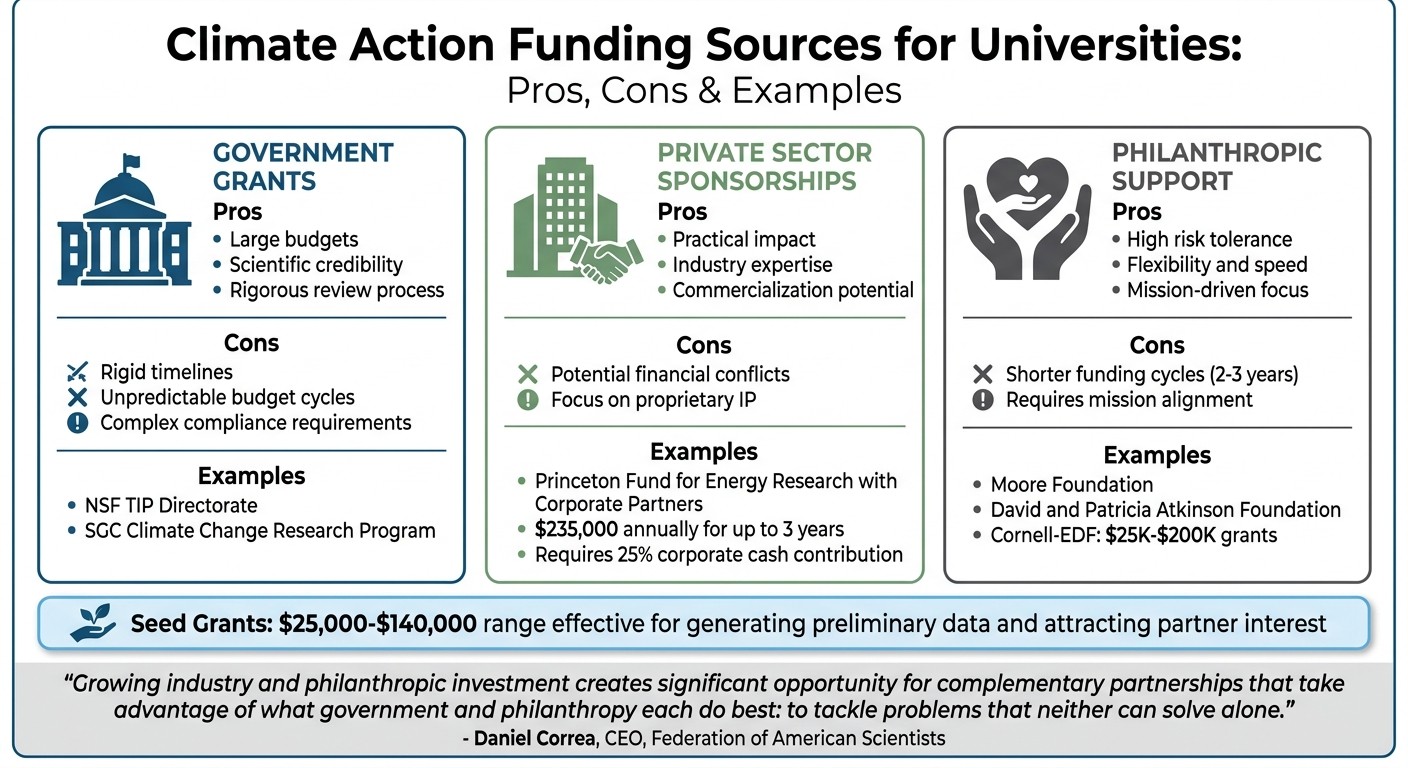
Comparison of Climate Action Funding Sources for Universities
Fostering Collaboration: Stony Brook's Path to Climate Solutions
1. Finding and Connecting with Key Stakeholders
Effective climate partnerships hinge on identifying the right collaborators and understanding the value each one brings. Universities must extend their search beyond traditional academic circles, mapping stakeholders across four key sectors: academia (researchers and professors), public (government entities), private (businesses and industries), and philanthropic organizations [2]. This "4P" model ensures access to a wide range of expertise, resources, and implementation capabilities.
1.1 Mapping Your Stakeholders
The first step is to evaluate your institution's existing strengths and identify areas needing external support. For example, Colorado State University's CCI Directory provides a detailed catalog of capabilities across its various colleges, departments, and centers, helping to highlight gaps [9][4]. Similarly, UC Irvine discovered through an internal review that nearly 50% of its curriculum is related to sustainability [4].
Once internal strengths are clear, conduct a gap analysis to determine which external partners can fill the void [5]. This process should focus on identifying organizations that bring the necessary resources, expertise, or capacity your institution lacks. Potential partners might include local and regional governments, community-based organizations, tribal governments, non-profits, federally funded national laboratories, and private companies [6]. Prioritize those who align with your climate goals and can scale impactful solutions [3].
As Imperial College President Hugh Brady noted:
Outside stakeholders often lack a clear understanding of universities' capabilities and may struggle to navigate these often decentralized institutions [2].
To address this, universities should create a clear "shop window" that showcases their offerings in a straightforward way. Some institutions have even formed "boundary units" or "schools of convergence science" to bridge departmental divides, making it easier for outside organizations to connect with the right researchers and resources [2].
With a clear understanding of your internal capabilities and external needs, the next step is engaging with potential partners.
1.2 Starting Conversations and Building Relationships
Identifying stakeholders is just the beginning - successful partnerships require meaningful dialogue and trust-building. The NOAA Regional Integrated Sciences and Assessments (RISA) Program offers a great example of co-production, where academics and decision-makers collaborate from the outset to define the research problems they aim to solve [7]. This approach ensures the research is actionable and directly supports climate adaptation and policy efforts.
Universities are uniquely positioned to bring together diverse groups without appearing biased [5]. Leverage this neutrality to host workshops, roundtables, or advisory boards that encourage open dialogue. For instance, the Government-University-Industry Research (GUIRR) Roundtable held five workshops in mid-2021, gathering experts from various sectors to discuss climate research and policy strategies in the U.S. [7]. Such structured events build trust and uncover shared goals before formal partnerships are established.
When selecting partners, focus on shared interests, complementary expertise, and aligned goals [8]. Long-standing relationships often lead to successful partnerships because the trust already built helps navigate challenges and maintain momentum over time [8]. To streamline collaboration, appoint a dedicated partnership manager, funded jointly by all parties, to oversee and guide the process [8].
Formal structures ensure partnerships remain effective. UC Irvine, for example, created a faculty steering committee for internal coordination and an external advisory board with representatives from government, NGOs, and the private sector [4]. The University of Florida collaborated with Bok Tower Gardens in Central Florida to address public health, food accessibility, and community capacity [8]. These examples highlight how multi-tiered advisory frameworks can help prioritize stakeholders and amplify diverse voices throughout the partnership's duration.
2. Creating Shared Goals and Objectives
Once partners are identified, the next step is aligning all sectors - academia, government, private companies, and NGOs - around common climate objectives. This requires deliberate collaboration to avoid organizational silos that could hinder cohesive solutions [8]. Building on the capabilities identified earlier, this alignment lays the groundwork for establishing effective governance and measurable outcomes in the next phases.
2.1 Working Together to Define Objectives
Start by using a backwards mapping approach to define the partnership's ultimate impact [8]. First, identify the desired long-term outcomes - whether social, economic, or environmental. Then, work backward to pinpoint the necessary practices and resources. This ensures the collaboration remains focused on outcomes from the very beginning.
Leadership plays a crucial role here. Assign a dedicated partnership manager to oversee the process. During the initial workshop, establish ground rules collaboratively to streamline decision-making and consensus-building [8].
One example of this approach in action is the University of Florida's partnership with Bok Tower Gardens in central Florida. Before tackling specific projects, the partners invested significant time in building trust and social capital, creating a strong foundation for their long-term collaboration [8].
To align goals across all levels, structured frameworks like the Targeting Outcomes of Programs (TOP) Model can be invaluable. This model helps connect basic resources and activities to broader goals, such as knowledge shifts and ultimate social or environmental impacts. Regular face-to-face meetings, supplemented by teleconferences, can keep these shared objectives at the forefront [8].
As John M. Diaz, an Assistant Professor at the University of Florida, highlights:
If strategic planning is overlooked early on, it has the potential to promote project or organizational silos compromising the ability to create integrative solutions [8].
Once shared objectives are established, the focus shifts to defining metrics and tracking progress.
2.2 Choosing Metrics and Tracking Tools
Goal-setting should be treated as a flexible process [10]. Begin with qualitative goals, and as the partnership evolves, transition to specific, time-bound quantitative targets. For instance, the SIDS Lighthouses Initiative, which supports renewable energy in small island states, has updated its targets for 2020, 2023, and 2030 to reflect changing priorities and measurable progress [10].
Develop a logic model to outline the program's structure and agreed-upon performance indicators [8]. Additionally, setting up a secretariat or governance body can help coordinate reporting efforts and maintain engagement over time.
Public reporting platforms, like the UN Climate Change Global Climate Action Portal, can enhance transparency and credibility by showcasing progress systematically [10]. Nathan Cogswell and Kiyomi de Zoysa from the World Resources Institute stress the importance of intentional design and governance:
Without greater intentionality in how initiatives are designed, governed and assessed, the growing landscape of climate cooperation risks dilution rather than delivery [10].
Finally, create a utilization plan for the data collected. This ensures the information is used to improve the program, communicate successes effectively, and keep stakeholders informed and engaged.
3. Setting Up Partnerships That Work
Building strong partnerships requires clear governance and well-defined roles to maintain accountability and ensure progress.
3.1 Creating Governance Structures
A three-tier governance model can balance coordination, leadership, and execution effectively. This structure typically includes: a partnership manager funded by all parties for daily oversight, steering committees to link with parent organizations, and agile workgroups for swift implementation[8].
For instance, the University of California, Irvine (UCI) offers a practical example. In 2025, UCI formalized its Climate Collaboration initiative by forming an Advisory Council of Deans and a Faculty Steering Committee for internal coordination. To maintain external accountability, they established an external advisory board with representatives from government, NGOs, and the private sector[4].
Building consensus is key to sustaining partnerships over the long term. Setting ground rules from the beginning ensures clarity on participant behavior and decision-making timelines. Bringing in a neutral facilitator can help partners feel heard and avoid rushed decisions. Regular communication - through annual in-person meetings, teleconferences, and structured email updates - keeps everyone aligned and fosters trust over time[8].
With a solid governance framework in place, universities are better positioned to harness their resources for impactful climate action.
3.2 Using University Resources and Expertise
Universities bring a wealth of organizational capacity, technical know-how, and unique resources that can accelerate climate initiatives. Interdisciplinary hubs are particularly effective at breaking down internal silos and providing external stakeholders with streamlined access to university expertise[1][2].
One example is the Aviation Impact Accelerator (AIA), which unites researchers, industry leaders, government officials, and philanthropists to advance sustainable aviation. In 2024, AIA released the report "Five Years to Chart a New Future for Aviation", influencing both government policy and industry research investments[2]. Another example is INSPIRASI, a collaboration between Nanyang Technological University Singapore, four Indonesian universities, and Indonesia's Endowment Fund. Together, they created a "renewable energy living lab" aimed at bridging the gap between academic research and industrial applications in Southeast Asia[2].
Student engagement is another avenue where universities can make a difference. In November 2024, the National University of Colombia partnered with the UNDP to offer a 120-hour course on food sustainability and climate action. Scholarships were provided to leaders of farmer organizations in the Sumapaz Paramo region, enabling them to apply academic insights to local agricultural practices[12].
To enhance collaboration, universities can create a centralized "shop window" that simplifies navigation of their diverse academic capabilities. This approach allows universities to contribute more effectively in areas such as public policy, business strategy, and climate mitigation and resilience, aligning their expertise with cross-sector climate goals[1][3].
4. Getting Funding and Resources Together
Universities need to combine various funding streams and share resources effectively to advance meaningful climate action.
4.1 Finding Funding Sources
Different funding sources bring their own advantages and challenges. Government grants often provide substantial budgets and lend scientific credibility, but they come with strict timelines and complex compliance requirements. Private sector sponsorships offer practical insights and opportunities for commercialization, though they may involve negotiations over intellectual property rights. Meanwhile, philanthropic support is known for its flexibility and willingness to back high-risk projects, though funding cycles are typically short, lasting only two to three years[15].
In March 2026, Princeton University's Andlinger Center introduced the Fund for Energy Research with Corporate Partners. This initiative provides research grants of $235,000 annually for up to three years. To ensure meaningful industry involvement, corporate partners must contribute at least 25% of the total project budget in cash[13]. Similarly, Cornell University and the Environmental Defense Fund (EDF) launched a funding initiative in January 2026 with two tracks: a Research Track offering $25,000–$100,000 for one year and an Impact Track providing up to $200,000 over two years for projects ready for policy implementation[14].
"Growing industry and philanthropic investment creates significant opportunity for complementary partnerships that take advantage of what government and philanthropy each do best: to tackle problems that neither can solve alone."
- Daniel Correa, CEO, Federation of American Scientists[15]
The University of Virginia adopted a different model in August 2025 by introducing the Climate Collaborative. This program allocates up to $1.5 million over three years to interdisciplinary teams, requiring the inclusion of a practitioner leader from local or tribal organizations as an equal partner[16].
Funding Source | Pros | Cons | Examples |
|---|---|---|---|
Government Grants | Large budgets, scientific credibility, rigorous review[15] | Rigid timelines, unpredictable budget cycles, complex compliance[15] | NSF TIP Directorate, SGC Climate Change Research Program[15][6] |
Private Sector Sponsorships | Practical impact, industry expertise, commercialization potential[13] | Potential financial conflicts, focus on proprietary IP[13] | Princeton Fund for Energy Research with Corporate Partners[13] |
Philanthropic Support | High risk tolerance, flexibility, and speed[15] | Shorter funding cycles (2–3 years), requires mission alignment[15] | Moore Foundation, David and Patricia Atkinson Foundation[14][15] |
Smaller seed grants, ranging from $25,000 to $140,000, are an effective way to generate preliminary data and attract partner interest[13][14]. For instance, Cornell Atkinson and EDF plan to fund 5–10 collaborative projects annually over four years, showing how steady investment in smaller projects can lead to a pipeline of climate solutions[14].
To prevent conflicts of interest, principal investigators should maintain corporate financial stakes below $5,000[13]. When philanthropic practices don't align with federal or university rules, third-party fiscal sponsors can act as intermediaries to bridge the gap[15].
Once funding is secured, maximizing non-monetary contributions is equally important to amplify the overall impact.
4.2 Sharing Resources Across Partners
Pooling institutional resources can often achieve more than financial contributions alone. Universities bring valuable assets to partnerships, including specialized research facilities, state-of-the-art equipment, data platforms, and technical expertise. Sharing these resources can significantly reduce costs and accelerate progress.
To ensure fairness and trust, partnerships should jointly fund neutral coordinators. By having all partners contribute proportionally to the coordinator's salary, the role remains impartial and serves the collective interests rather than favoring a single institution[8].
Grant proposals should also include community organizations, tribal governments, and NGOs as formal sub-recipients, rather than treating them as consultants. This approach ensures equitable financial distribution and acknowledges the essential expertise these groups bring to climate research[6][16]. Collaborative review processes and funder consortia, highlighted at the September 2025 Philanthropy Partnerships Summit, can further reduce administrative burdens and avoid fragmentation[15].
"Strategic collaboration between NSF and philanthropy can multiply the impact of both sectors' investments."
- Erwin Gianchandani, Assistant Director for TIP, National Science Foundation[15]
To formalize shared resource arrangements, Memorandums of Understanding (MOUs) offer a low-risk way to establish trust and outline data-sharing protocols. These agreements allow partners to test alignment before committing to larger financial obligations[15]. Rapid-response grants, ranging from $5,000 to $25,000, can also be useful for seizing time-sensitive opportunities or addressing urgent policy needs during the partnership[14].
5. Launching and Growing Climate Projects
Transforming collaborative planning into real-world climate solutions begins with focused pilot initiatives. For universities, this approach enables the testing of ideas in practical settings before expanding to larger-scale programs. With funding and partnerships secured, the next step is to put plans into action.
5.1 Starting with Pilot Projects
A small, dedicated implementation team, led by a neutral program manager with joint funding, can accelerate the execution of pilot projects. This structure supports quick decision-making, which is especially important for time-sensitive initiatives.
Using a backward mapping strategy can help guide pilot efforts. Begin by defining the desired social, economic, and environmental outcomes, then determine the steps needed to achieve them. Creating a logic model early on clarifies how team members and participants will collaborate, making it easier to identify performance metrics right from the start.
"A planned and phased approach is needed for partnerships to build the necessary foundation in order for subsequent stages to flourish."
– John M. Diaz, Assistant Professor, University of Florida
The "living lab" model offers a hands-on way to connect academic research with practical applications. For instance, in January 2025, the Indonesia–NTU Singapore Institute of Research for Sustainability and Innovation launched a renewable energy living lab in partnership with Nanyang Technological University Singapore, four Indonesian universities, and Indonesia's Ministry of Higher Education. This initiative tested renewable energy solutions tailored to Southeast Asia's tropical climate [2]. Similarly, King Abdullah University of Science and Technology collaborated with the Saudi Electric Company to pilot carbon capture technology at the Rabigh Energy Production Plant, adapting the system to local conditions to support Saudi Arabia’s net-zero goals [2].
When choosing pilot partners, focus on aligning resources, expertise, and reputation. Collaborating with trusted entities can boost public support and enhance social capital. Additionally, create a utilization plan to outline how pilot data will be used - not only to refine the project in real-time but also to demonstrate success to stakeholders and funders.
Once the pilot is operational, tracking progress becomes essential for making timely improvements.
5.2 Tracking Progress and Making Adjustments
After launching the pilot, systematic monitoring ensures the project remains on course and provides insights for scaling up successful initiatives. A clear set of performance measures is key to effective tracking. The Targeting Outcomes of Programs (TOP) Model offers a structured way to evaluate progress across seven levels: Resources, Activities, Participation, Reaction, KASA (Knowledge, Attitudes, Skills, Aspirations), Practices, and SEE (Social, Economic, Environmental) conditions [8].
TOP Model Level | Focus Area for Tracking |
|---|---|
SEE Conditions | Social, Economic, and Environmental impacts |
Practices | Behavioral changes and adoption of new methods |
KASA | Changes in Knowledge, Attitudes, Skills, and Aspirations |
Reaction | Participant satisfaction with the pilot process |
Participation | Number and diversity of stakeholders involved |
Activities | Delivery of specific project components |
Resources | Time, funding, and expertise invested |
Regular engagement is vital to keep the project on track. Schedule consistent face-to-face meetings and teleconferences to ensure active participation and address challenges as they arise. A facilitator can help establish decision-making guidelines, balancing the need for consensus with the urgency of progress.
"Program evaluation is a crucial process for any partnership in order to improve its own efforts and demonstrate its success, which will in turn help partnerships attain additional funding and public support."
– John M. Diaz, Assistant Professor, University of Florida
As data is collected, use it to refine strategies. Early planning gaps can lead to fragmented efforts, weakening the overall impact. Regular evaluation allows for quick adjustments, helping to overcome obstacles and build momentum for scaling up successful projects. This iterative process ensures that climate initiatives remain effective and aligned with their goals.
6. Shaping Policy and Creating System-Wide Change
When pilot projects demonstrate success, universities have the opportunity to use their insights to influence policy and drive change on a broader scale. By building on earlier collaborative efforts, these actions allow universities to extend their influence far beyond the campus. As trusted institutions, universities are in a unique position to connect research with practical policy applications, effectively bridging the gap between academic findings and actionable solutions. Through strategic partnerships with governments and the dissemination of proven approaches, they can significantly amplify their impact.
6.1 Working with Policymakers
Universities can play a critical role in shaping climate policy by providing practical research and serving as platforms for meaningful policy discussions. For example, the Center for Global Sustainability's 2026 report, Decision informative and policy relevant scenario modeling for energy sector in sub-Saharan Africa, presented a framework for incorporating local actions into climate governance [5]. This kind of targeted research equips policymakers with the tools they need to craft effective regulations.
"Universities have a unique ability to serve the public interest by connecting research, education, policy, and meaningful action on climate change."
– Center for Global Sustainability [5]
Collaboration with government agencies can take many forms, such as fellowships, placements, and policy forums. A notable example is the Aviation Impact Accelerator, which brought together researchers, industry leaders, and government representatives to produce the 2025 report Five Years to Chart a New Future for Aviation. The insights from this project are now shaping government policies, industry research, and investment decisions in sustainable aviation [2]. Similarly, in 2025, the University of Cambridge partnered with South Africa’s University of Witwatersrand to engage businesses directly in public policy development [2].
Embedding experts into government offices is another effective strategy for influencing policy. For example, in 2020, Brown University’s Policy Lab worked with the Rhode Island Department of Health to test letter designs for COVID-19 testing, leading to a 25–60% increase in testing uptake without additional costs. This collaboration laid the groundwork for ongoing partnerships [18]. Another instance is the National Science Foundation’s 2022 grant to the National Bureau of Economic Research, which supported the creation of the EAGER: Place-Based Innovation Policy Study Group. This group, led by researchers from Columbia and MIT, worked closely with NSF staff to evaluate innovation ecosystems and shape the NSF Regional Innovation Engines program [18].
Effective communication is essential for policy influence. Universities should create concise policy briefs that highlight key takeaways and actionable insights. Engaging with policymakers through various channels - such as legislative testimony, public forums, and direct meetings - ensures that research findings reach the right audiences. Specialized outreach offices, or "boundary units", can also help government officials navigate university resources and connect with experts [2][1].
6.2 Sharing Successful Models
Beyond direct policy engagement, universities can inspire broader change by sharing models of collaboration that have proven effective. Documenting these processes and making them accessible encourages other institutions and sectors to adopt similar approaches. For instance, during the 2019–2020 academic year, the University of Michigan’s President’s Commission on Carbon Neutrality used an External Collaboration Internal Analysis Team to explore scalable solutions. This team prioritized partnerships and mitigation policies that included input from vulnerable communities, ensuring an equitable implementation process [17].
In 2024 and 2025, the University of California and other institutions synthesized workshop findings into the Climate Action in Higher Education: Roadmap. This strategic framework, developed with contributors like David Ackerly and Roger Bales, outlined how universities can align operations, academics, and other components to drive climate action and societal leadership [17]. These roadmaps serve as valuable guides for institutions aiming to coordinate their sustainability efforts.
The 4P framework (Public-Private-People Partnerships) is another example of a successful model for large-scale collaboration. A notable case is the Indonesia–NTU Singapore Institute of Research for Sustainability and Innovation (INSPIRASI), which unites the Indonesian Ministry of Higher Education, Nanyang Technological University, and four Indonesian universities. This partnership bridges academic research and industrial applications to address climate challenges [2].
"By collaborating more strategically with each other and external stakeholders, universities can amplify their contributions and unlock sustainable solutions at scale."
– Mirielle Eaton and Lindsay Hooper [2]
To ensure these models are replicable, universities should document their processes, including governance structures, funding mechanisms, and engagement strategies. Sharing these insights through white papers, presentations, and online platforms can facilitate broader adoption. For instance, the California Strategic Growth Council’s Participatory Research to Policy Model required researchers to include community organizations and local governments as key collaborators. This approach ensured that research outcomes were aligned with community needs and informed state-level climate policies [6].
7. Case Study: University Climate Change Coalition (UC3)
The University Climate Change Coalition (UC3) serves as a prime example of how research institutions can spearhead collaborative efforts to tackle climate challenges. Established in February 2018 at the Higher Education Climate Leadership Summit, UC3 operates as a core initiative of Second Nature. It brings together 23 of the world’s top research universities to advance climate action on campuses, within local communities, and on a global scale. Guided by a five-year strategic plan (2020–2025), UC3 has emerged as a leader in emissions reduction strategies, described by Second Nature as an "accelerant of place-based climate solutions" [19].
A core principle of UC3 is its focus on place-based action, which involves tailoring climate solutions to the unique needs of specific regions. By fostering partnerships between academic institutions and local stakeholders, the coalition ensures that its initiatives are both relevant and impactful. Regional forums hosted by UC3 bring together university leaders, government officials, private sector representatives, and NGOs to address climate challenges collaboratively and in ways that resonate with local priorities.
"UC3 highlights how research institutions can play an invaluable role in boosting community climate action."
– Second Nature [19]
The coalition also benefits from the collective leadership of university presidents and chancellors, who work to embed climate action into academics, campus operations, and community outreach. By prioritizing demand-driven research, UC3 addresses key gaps in climate knowledge and develops actionable solutions. This research is shaped by input from community and industry partners, ensuring that it aligns with real-world needs.
UC3’s report, Research for Solutions: Convening Stakeholders to Galvanize Local Climate Action, outlines how universities can lead collaborative efforts to drive community-wide climate initiatives. By documenting its strategies and sharing effective models, the coalition extends its impact beyond the campus, showcasing how academic institutions can play a pivotal role in advancing localized climate solutions. UC3’s approach serves as a blueprint for leveraging the influence of universities to create meaningful environmental progress through cross-sector collaboration.
8. Working with Council Fire for Expert Support
Council Fire provides the expertise needed to transform ambitious climate action plans into measurable outcomes. Universities and research institutions often face challenges in turning their climate goals into actionable strategies that effectively involve multiple sectors. Council Fire excels at bridging this gap, offering a combination of stakeholder engagement, technical modeling, and financial planning to help institutions build coalitions that achieve tangible climate results.
One standout example of their work occurred in February 2026, when Council Fire facilitated a regional climate compact involving 35 organizations. This initiative spanned three counties, 28 municipalities, and four academic institutions. Starting with 65 individual stakeholder interviews to understand priorities and challenges, they then organized working groups to align efforts. The outcome was a signed agreement to cut regional emissions by 50% by 2030, which also secured $280 million in coordinated climate investments and $48 million in federal FEMA and DOE grants through joint applications [20]. This process demonstrates how targeted collaboration can lead to impactful regional and institutional climate progress.
Council Fire also specializes in creating comprehensive carbon neutrality roadmaps to tackle complex infrastructure challenges. For instance, in February 2026, they partnered with a major research university of 35,000 students to accelerate its carbon neutrality goal from 2040 to 2035. The roadmap outlined a phased transition to an 800-well ground-source heat pump system and a 15 MW solar array. By prioritizing early investments in efficiency measures that generated immediate savings, the $340 million plan is expected to yield $410 million in energy cost savings over 25 years [21].
Their approach emphasizes practical leadership over prolonged consensus-building. By mapping stakeholders based on ambition and pragmatism, Council Fire designs governance structures that promote accountability and transparency. One example is their clean energy procurement collaborative, which aggregated 420 GWh of demand across multiple institutions. This collaboration achieved renewable energy pricing 18% below retail rates, saving participants $12 million annually [20].
For universities ready to move from bold climate commitments to actionable results, Council Fire offers expertise in aligning stakeholders, developing detailed technical plans, and navigating federal incentives. Their method focuses on sequencing investments to optimize cash flow, minimizing reliance on offsets to maintain credibility, and addressing high-impact systems like central heating plants. By integrating these strategies with earlier efforts in stakeholder engagement and resource sharing, Council Fire ensures that climate goals lead to both environmental progress and financial benefits.
Conclusion
Universities and research institutions are in a powerful position to advance meaningful climate action through well-crafted, cross-sector collaborations. To move forward, deliberate steps are essential: identifying the right partners, establishing governance frameworks with dedicated partnership managers, and using backwards mapping to align on shared goals before discussing resources.
"Developing a successful partnership with multiple stakeholders is an emergent process that requires time and effort - collaboration does not happen overnight."
John M. Diaz, Assistant Professor, University of Florida [8]
Shifting from isolated efforts to integrated collaboration tackles what experts refer to as the "transformation knowledge" gap - bridging the divide between understanding climate science and enacting systemic change [11]. This involves dismantling internal silos through convergence science, creating accessible platforms for external partners to engage with university expertise, and prioritizing "handprint" actions that drive system-wide impact rather than focusing solely on reducing individual carbon footprints.
The "4P" model - uniting Professors, Public, Private, and Philanthropic sectors - offers a proven framework to pool the resources and expertise necessary for equitable climate solutions [2]. Initiatives like the Aviation Impact Accelerator and INSPIRASI illustrate how such partnerships can shape policy, accelerate innovation, and implement large-scale solutions.
Success hinges on having neutral coordinators, fixed meeting schedules, and shared incentives. Universities must also adapt their internal reward systems to encourage faculty involvement in external collaborations, ensuring that institutional priorities align with partnership objectives [1][2].
With the right partnerships, governance, and shared commitment, universities can transform academic expertise into impactful climate solutions that serve communities, industries, and ecosystems alike.
FAQs
How do we pick the right partners fast?
To select the best partners efficiently for cross-sector climate collaboration, start with clear criteria and a step-by-step process. Look for organizations - whether businesses, government bodies, or NGOs - whose missions align closely with your climate goals. Prioritize shared interests, establish trust from the outset, and evaluate their capabilities to ensure they can play a meaningful role. This thoughtful approach speeds up progress and lays the groundwork for successful, impactful partnerships.
What metrics should we track to prove impact?
Key metrics for assessing the impact of cross-sector climate action include several critical areas. Stakeholder engagement can be measured by the number and diversity of partners involved, as well as the quality of their interactions. Research outputs are another key focus, including the development of publications and new technologies. Additionally, policy influence is vital, tracking the adoption of research-driven policies that support climate goals. Educational outcomes also play a role, such as the number of students trained in climate-related skills. Lastly, tangible climate solutions like measurable emission reductions and resilience initiatives highlight the practical results of these efforts. Together, these metrics illustrate how collaborations can lead to impactful climate solutions and drive meaningful change.
How do we fund pilots without IP conflicts?
To finance pilot projects while avoiding intellectual property (IP) conflicts, it’s crucial to establish clear agreements from the outset. Draft Memoranda of Understanding (MOUs) or formal contracts that outline specific details such as IP ownership, licensing terms, and revenue-sharing arrangements before the project begins. This approach promotes transparency and minimizes the risk of disputes down the line.
In addition, incorporating systems thinking and adaptive governance can enhance collaboration and decision-making, especially when navigating complex IP concerns. These frameworks help address potential conflicts effectively, ensuring smoother project execution. Taking proactive, structured steps like these is essential for maintaining clarity and preventing future issues.
Related Blog Posts
Latest Articles
©2025

Narrative Change and Power Building: The Missing Half of Advocacy
Narrative change is the process of disrupting dominant narratives that normalize inequity and advancing new narratives from historically marginalized communities.

Funding Resilience Without Federal Grants
BRIC is unreliable and FEMA is shrinking. Here's how cities fund climate resilience with dedicated revenue, blended finance, and a coordinating authority.

The ESG Blind Spot: How AI Is Finding Risks in Companies Nobody Else Is Watching
Norway's sovereign wealth fund uses AI to screen 7,200 portfolio companies for forced labor and corruption within 24 hours. The real story is the emerging-market coverage gap that traditional ESG data vendors miss — and what it means for any company with a global supply chain.
Narrative Change and Power Building: The Missing Half of Advocacy
Narrative change is the process of disrupting dominant narratives that normalize inequity and advancing new narratives from historically marginalized communities.
Funding Resilience Without Federal Grants
BRIC is unreliable and FEMA is shrinking. Here's how cities fund climate resilience with dedicated revenue, blended finance, and a coordinating authority.
The ESG Blind Spot: How AI Is Finding Risks in Companies Nobody Else Is Watching
Norway's sovereign wealth fund uses AI to screen 7,200 portfolio companies for forced labor and corruption within 24 hours. The real story is the emerging-market coverage gap that traditional ESG data vendors miss — and what it means for any company with a global supply chain.
FAQ
01
What does it really mean to “redefine profit”?
02
What makes Council Fire different?
03
Who does Council Fire work with?
04
What does working with Council Fire actually look like?
05
How does Council Fire help organizations turn big goals into action?
06
How does Council Fire define and measure success?
May 8, 2026
How to Facilitate Cross-Sector Collaboration for Climate Action for Universities & Research Institutions
Sustainability Strategy
In This Article
Practical steps for universities to build cross-sector climate partnerships: stakeholder mapping, governance, funding, pilots, and policy.
How to Facilitate Cross-Sector Collaboration for Climate Action for Universities & Research Institutions
Universities and research institutions can play a key role in addressing climate challenges by partnering with governments, industries, NGOs, and philanthropic organizations. These collaborations transform academic research into practical solutions and drive meaningful climate progress. Here's how institutions can lead impactful partnerships:
Stakeholder Mapping: Identify internal strengths and external gaps, then connect with partners from academia, public agencies, private companies, and nonprofits.
Shared Goals: Use backward mapping to align on objectives and define measurable outcomes to ensure focus and accountability.
Governance Structures: Establish clear roles, steering committees, and dedicated partnership managers to maintain coordination and progress.
Funding Strategies: Combine government grants, private sponsorships, and philanthropic support while pooling resources across partners.
Pilot Projects: Start small with focused initiatives to test ideas, gather data, and refine strategies before scaling up.
Policy Influence: Use research insights to shape regulations and inspire broader change through proven models and frameworks.
With deliberate planning, universities can bridge the gap between research and action, creating partnerships that deliver scalable climate solutions.
Comparison of Climate Action Funding Sources for Universities
Fostering Collaboration: Stony Brook's Path to Climate Solutions
1. Finding and Connecting with Key Stakeholders
Effective climate partnerships hinge on identifying the right collaborators and understanding the value each one brings. Universities must extend their search beyond traditional academic circles, mapping stakeholders across four key sectors: academia (researchers and professors), public (government entities), private (businesses and industries), and philanthropic organizations [2]. This "4P" model ensures access to a wide range of expertise, resources, and implementation capabilities.
1.1 Mapping Your Stakeholders
The first step is to evaluate your institution's existing strengths and identify areas needing external support. For example, Colorado State University's CCI Directory provides a detailed catalog of capabilities across its various colleges, departments, and centers, helping to highlight gaps [9][4]. Similarly, UC Irvine discovered through an internal review that nearly 50% of its curriculum is related to sustainability [4].
Once internal strengths are clear, conduct a gap analysis to determine which external partners can fill the void [5]. This process should focus on identifying organizations that bring the necessary resources, expertise, or capacity your institution lacks. Potential partners might include local and regional governments, community-based organizations, tribal governments, non-profits, federally funded national laboratories, and private companies [6]. Prioritize those who align with your climate goals and can scale impactful solutions [3].
As Imperial College President Hugh Brady noted:
Outside stakeholders often lack a clear understanding of universities' capabilities and may struggle to navigate these often decentralized institutions [2].
To address this, universities should create a clear "shop window" that showcases their offerings in a straightforward way. Some institutions have even formed "boundary units" or "schools of convergence science" to bridge departmental divides, making it easier for outside organizations to connect with the right researchers and resources [2].
With a clear understanding of your internal capabilities and external needs, the next step is engaging with potential partners.
1.2 Starting Conversations and Building Relationships
Identifying stakeholders is just the beginning - successful partnerships require meaningful dialogue and trust-building. The NOAA Regional Integrated Sciences and Assessments (RISA) Program offers a great example of co-production, where academics and decision-makers collaborate from the outset to define the research problems they aim to solve [7]. This approach ensures the research is actionable and directly supports climate adaptation and policy efforts.
Universities are uniquely positioned to bring together diverse groups without appearing biased [5]. Leverage this neutrality to host workshops, roundtables, or advisory boards that encourage open dialogue. For instance, the Government-University-Industry Research (GUIRR) Roundtable held five workshops in mid-2021, gathering experts from various sectors to discuss climate research and policy strategies in the U.S. [7]. Such structured events build trust and uncover shared goals before formal partnerships are established.
When selecting partners, focus on shared interests, complementary expertise, and aligned goals [8]. Long-standing relationships often lead to successful partnerships because the trust already built helps navigate challenges and maintain momentum over time [8]. To streamline collaboration, appoint a dedicated partnership manager, funded jointly by all parties, to oversee and guide the process [8].
Formal structures ensure partnerships remain effective. UC Irvine, for example, created a faculty steering committee for internal coordination and an external advisory board with representatives from government, NGOs, and the private sector [4]. The University of Florida collaborated with Bok Tower Gardens in Central Florida to address public health, food accessibility, and community capacity [8]. These examples highlight how multi-tiered advisory frameworks can help prioritize stakeholders and amplify diverse voices throughout the partnership's duration.
2. Creating Shared Goals and Objectives
Once partners are identified, the next step is aligning all sectors - academia, government, private companies, and NGOs - around common climate objectives. This requires deliberate collaboration to avoid organizational silos that could hinder cohesive solutions [8]. Building on the capabilities identified earlier, this alignment lays the groundwork for establishing effective governance and measurable outcomes in the next phases.
2.1 Working Together to Define Objectives
Start by using a backwards mapping approach to define the partnership's ultimate impact [8]. First, identify the desired long-term outcomes - whether social, economic, or environmental. Then, work backward to pinpoint the necessary practices and resources. This ensures the collaboration remains focused on outcomes from the very beginning.
Leadership plays a crucial role here. Assign a dedicated partnership manager to oversee the process. During the initial workshop, establish ground rules collaboratively to streamline decision-making and consensus-building [8].
One example of this approach in action is the University of Florida's partnership with Bok Tower Gardens in central Florida. Before tackling specific projects, the partners invested significant time in building trust and social capital, creating a strong foundation for their long-term collaboration [8].
To align goals across all levels, structured frameworks like the Targeting Outcomes of Programs (TOP) Model can be invaluable. This model helps connect basic resources and activities to broader goals, such as knowledge shifts and ultimate social or environmental impacts. Regular face-to-face meetings, supplemented by teleconferences, can keep these shared objectives at the forefront [8].
As John M. Diaz, an Assistant Professor at the University of Florida, highlights:
If strategic planning is overlooked early on, it has the potential to promote project or organizational silos compromising the ability to create integrative solutions [8].
Once shared objectives are established, the focus shifts to defining metrics and tracking progress.
2.2 Choosing Metrics and Tracking Tools
Goal-setting should be treated as a flexible process [10]. Begin with qualitative goals, and as the partnership evolves, transition to specific, time-bound quantitative targets. For instance, the SIDS Lighthouses Initiative, which supports renewable energy in small island states, has updated its targets for 2020, 2023, and 2030 to reflect changing priorities and measurable progress [10].
Develop a logic model to outline the program's structure and agreed-upon performance indicators [8]. Additionally, setting up a secretariat or governance body can help coordinate reporting efforts and maintain engagement over time.
Public reporting platforms, like the UN Climate Change Global Climate Action Portal, can enhance transparency and credibility by showcasing progress systematically [10]. Nathan Cogswell and Kiyomi de Zoysa from the World Resources Institute stress the importance of intentional design and governance:
Without greater intentionality in how initiatives are designed, governed and assessed, the growing landscape of climate cooperation risks dilution rather than delivery [10].
Finally, create a utilization plan for the data collected. This ensures the information is used to improve the program, communicate successes effectively, and keep stakeholders informed and engaged.
3. Setting Up Partnerships That Work
Building strong partnerships requires clear governance and well-defined roles to maintain accountability and ensure progress.
3.1 Creating Governance Structures
A three-tier governance model can balance coordination, leadership, and execution effectively. This structure typically includes: a partnership manager funded by all parties for daily oversight, steering committees to link with parent organizations, and agile workgroups for swift implementation[8].
For instance, the University of California, Irvine (UCI) offers a practical example. In 2025, UCI formalized its Climate Collaboration initiative by forming an Advisory Council of Deans and a Faculty Steering Committee for internal coordination. To maintain external accountability, they established an external advisory board with representatives from government, NGOs, and the private sector[4].
Building consensus is key to sustaining partnerships over the long term. Setting ground rules from the beginning ensures clarity on participant behavior and decision-making timelines. Bringing in a neutral facilitator can help partners feel heard and avoid rushed decisions. Regular communication - through annual in-person meetings, teleconferences, and structured email updates - keeps everyone aligned and fosters trust over time[8].
With a solid governance framework in place, universities are better positioned to harness their resources for impactful climate action.
3.2 Using University Resources and Expertise
Universities bring a wealth of organizational capacity, technical know-how, and unique resources that can accelerate climate initiatives. Interdisciplinary hubs are particularly effective at breaking down internal silos and providing external stakeholders with streamlined access to university expertise[1][2].
One example is the Aviation Impact Accelerator (AIA), which unites researchers, industry leaders, government officials, and philanthropists to advance sustainable aviation. In 2024, AIA released the report "Five Years to Chart a New Future for Aviation", influencing both government policy and industry research investments[2]. Another example is INSPIRASI, a collaboration between Nanyang Technological University Singapore, four Indonesian universities, and Indonesia's Endowment Fund. Together, they created a "renewable energy living lab" aimed at bridging the gap between academic research and industrial applications in Southeast Asia[2].
Student engagement is another avenue where universities can make a difference. In November 2024, the National University of Colombia partnered with the UNDP to offer a 120-hour course on food sustainability and climate action. Scholarships were provided to leaders of farmer organizations in the Sumapaz Paramo region, enabling them to apply academic insights to local agricultural practices[12].
To enhance collaboration, universities can create a centralized "shop window" that simplifies navigation of their diverse academic capabilities. This approach allows universities to contribute more effectively in areas such as public policy, business strategy, and climate mitigation and resilience, aligning their expertise with cross-sector climate goals[1][3].
4. Getting Funding and Resources Together
Universities need to combine various funding streams and share resources effectively to advance meaningful climate action.
4.1 Finding Funding Sources
Different funding sources bring their own advantages and challenges. Government grants often provide substantial budgets and lend scientific credibility, but they come with strict timelines and complex compliance requirements. Private sector sponsorships offer practical insights and opportunities for commercialization, though they may involve negotiations over intellectual property rights. Meanwhile, philanthropic support is known for its flexibility and willingness to back high-risk projects, though funding cycles are typically short, lasting only two to three years[15].
In March 2026, Princeton University's Andlinger Center introduced the Fund for Energy Research with Corporate Partners. This initiative provides research grants of $235,000 annually for up to three years. To ensure meaningful industry involvement, corporate partners must contribute at least 25% of the total project budget in cash[13]. Similarly, Cornell University and the Environmental Defense Fund (EDF) launched a funding initiative in January 2026 with two tracks: a Research Track offering $25,000–$100,000 for one year and an Impact Track providing up to $200,000 over two years for projects ready for policy implementation[14].
"Growing industry and philanthropic investment creates significant opportunity for complementary partnerships that take advantage of what government and philanthropy each do best: to tackle problems that neither can solve alone."
- Daniel Correa, CEO, Federation of American Scientists[15]
The University of Virginia adopted a different model in August 2025 by introducing the Climate Collaborative. This program allocates up to $1.5 million over three years to interdisciplinary teams, requiring the inclusion of a practitioner leader from local or tribal organizations as an equal partner[16].
Funding Source | Pros | Cons | Examples |
|---|---|---|---|
Government Grants | Large budgets, scientific credibility, rigorous review[15] | Rigid timelines, unpredictable budget cycles, complex compliance[15] | NSF TIP Directorate, SGC Climate Change Research Program[15][6] |
Private Sector Sponsorships | Practical impact, industry expertise, commercialization potential[13] | Potential financial conflicts, focus on proprietary IP[13] | Princeton Fund for Energy Research with Corporate Partners[13] |
Philanthropic Support | High risk tolerance, flexibility, and speed[15] | Shorter funding cycles (2–3 years), requires mission alignment[15] | Moore Foundation, David and Patricia Atkinson Foundation[14][15] |
Smaller seed grants, ranging from $25,000 to $140,000, are an effective way to generate preliminary data and attract partner interest[13][14]. For instance, Cornell Atkinson and EDF plan to fund 5–10 collaborative projects annually over four years, showing how steady investment in smaller projects can lead to a pipeline of climate solutions[14].
To prevent conflicts of interest, principal investigators should maintain corporate financial stakes below $5,000[13]. When philanthropic practices don't align with federal or university rules, third-party fiscal sponsors can act as intermediaries to bridge the gap[15].
Once funding is secured, maximizing non-monetary contributions is equally important to amplify the overall impact.
4.2 Sharing Resources Across Partners
Pooling institutional resources can often achieve more than financial contributions alone. Universities bring valuable assets to partnerships, including specialized research facilities, state-of-the-art equipment, data platforms, and technical expertise. Sharing these resources can significantly reduce costs and accelerate progress.
To ensure fairness and trust, partnerships should jointly fund neutral coordinators. By having all partners contribute proportionally to the coordinator's salary, the role remains impartial and serves the collective interests rather than favoring a single institution[8].
Grant proposals should also include community organizations, tribal governments, and NGOs as formal sub-recipients, rather than treating them as consultants. This approach ensures equitable financial distribution and acknowledges the essential expertise these groups bring to climate research[6][16]. Collaborative review processes and funder consortia, highlighted at the September 2025 Philanthropy Partnerships Summit, can further reduce administrative burdens and avoid fragmentation[15].
"Strategic collaboration between NSF and philanthropy can multiply the impact of both sectors' investments."
- Erwin Gianchandani, Assistant Director for TIP, National Science Foundation[15]
To formalize shared resource arrangements, Memorandums of Understanding (MOUs) offer a low-risk way to establish trust and outline data-sharing protocols. These agreements allow partners to test alignment before committing to larger financial obligations[15]. Rapid-response grants, ranging from $5,000 to $25,000, can also be useful for seizing time-sensitive opportunities or addressing urgent policy needs during the partnership[14].
5. Launching and Growing Climate Projects
Transforming collaborative planning into real-world climate solutions begins with focused pilot initiatives. For universities, this approach enables the testing of ideas in practical settings before expanding to larger-scale programs. With funding and partnerships secured, the next step is to put plans into action.
5.1 Starting with Pilot Projects
A small, dedicated implementation team, led by a neutral program manager with joint funding, can accelerate the execution of pilot projects. This structure supports quick decision-making, which is especially important for time-sensitive initiatives.
Using a backward mapping strategy can help guide pilot efforts. Begin by defining the desired social, economic, and environmental outcomes, then determine the steps needed to achieve them. Creating a logic model early on clarifies how team members and participants will collaborate, making it easier to identify performance metrics right from the start.
"A planned and phased approach is needed for partnerships to build the necessary foundation in order for subsequent stages to flourish."
– John M. Diaz, Assistant Professor, University of Florida
The "living lab" model offers a hands-on way to connect academic research with practical applications. For instance, in January 2025, the Indonesia–NTU Singapore Institute of Research for Sustainability and Innovation launched a renewable energy living lab in partnership with Nanyang Technological University Singapore, four Indonesian universities, and Indonesia's Ministry of Higher Education. This initiative tested renewable energy solutions tailored to Southeast Asia's tropical climate [2]. Similarly, King Abdullah University of Science and Technology collaborated with the Saudi Electric Company to pilot carbon capture technology at the Rabigh Energy Production Plant, adapting the system to local conditions to support Saudi Arabia’s net-zero goals [2].
When choosing pilot partners, focus on aligning resources, expertise, and reputation. Collaborating with trusted entities can boost public support and enhance social capital. Additionally, create a utilization plan to outline how pilot data will be used - not only to refine the project in real-time but also to demonstrate success to stakeholders and funders.
Once the pilot is operational, tracking progress becomes essential for making timely improvements.
5.2 Tracking Progress and Making Adjustments
After launching the pilot, systematic monitoring ensures the project remains on course and provides insights for scaling up successful initiatives. A clear set of performance measures is key to effective tracking. The Targeting Outcomes of Programs (TOP) Model offers a structured way to evaluate progress across seven levels: Resources, Activities, Participation, Reaction, KASA (Knowledge, Attitudes, Skills, Aspirations), Practices, and SEE (Social, Economic, Environmental) conditions [8].
TOP Model Level | Focus Area for Tracking |
|---|---|
SEE Conditions | Social, Economic, and Environmental impacts |
Practices | Behavioral changes and adoption of new methods |
KASA | Changes in Knowledge, Attitudes, Skills, and Aspirations |
Reaction | Participant satisfaction with the pilot process |
Participation | Number and diversity of stakeholders involved |
Activities | Delivery of specific project components |
Resources | Time, funding, and expertise invested |
Regular engagement is vital to keep the project on track. Schedule consistent face-to-face meetings and teleconferences to ensure active participation and address challenges as they arise. A facilitator can help establish decision-making guidelines, balancing the need for consensus with the urgency of progress.
"Program evaluation is a crucial process for any partnership in order to improve its own efforts and demonstrate its success, which will in turn help partnerships attain additional funding and public support."
– John M. Diaz, Assistant Professor, University of Florida
As data is collected, use it to refine strategies. Early planning gaps can lead to fragmented efforts, weakening the overall impact. Regular evaluation allows for quick adjustments, helping to overcome obstacles and build momentum for scaling up successful projects. This iterative process ensures that climate initiatives remain effective and aligned with their goals.
6. Shaping Policy and Creating System-Wide Change
When pilot projects demonstrate success, universities have the opportunity to use their insights to influence policy and drive change on a broader scale. By building on earlier collaborative efforts, these actions allow universities to extend their influence far beyond the campus. As trusted institutions, universities are in a unique position to connect research with practical policy applications, effectively bridging the gap between academic findings and actionable solutions. Through strategic partnerships with governments and the dissemination of proven approaches, they can significantly amplify their impact.
6.1 Working with Policymakers
Universities can play a critical role in shaping climate policy by providing practical research and serving as platforms for meaningful policy discussions. For example, the Center for Global Sustainability's 2026 report, Decision informative and policy relevant scenario modeling for energy sector in sub-Saharan Africa, presented a framework for incorporating local actions into climate governance [5]. This kind of targeted research equips policymakers with the tools they need to craft effective regulations.
"Universities have a unique ability to serve the public interest by connecting research, education, policy, and meaningful action on climate change."
– Center for Global Sustainability [5]
Collaboration with government agencies can take many forms, such as fellowships, placements, and policy forums. A notable example is the Aviation Impact Accelerator, which brought together researchers, industry leaders, and government representatives to produce the 2025 report Five Years to Chart a New Future for Aviation. The insights from this project are now shaping government policies, industry research, and investment decisions in sustainable aviation [2]. Similarly, in 2025, the University of Cambridge partnered with South Africa’s University of Witwatersrand to engage businesses directly in public policy development [2].
Embedding experts into government offices is another effective strategy for influencing policy. For example, in 2020, Brown University’s Policy Lab worked with the Rhode Island Department of Health to test letter designs for COVID-19 testing, leading to a 25–60% increase in testing uptake without additional costs. This collaboration laid the groundwork for ongoing partnerships [18]. Another instance is the National Science Foundation’s 2022 grant to the National Bureau of Economic Research, which supported the creation of the EAGER: Place-Based Innovation Policy Study Group. This group, led by researchers from Columbia and MIT, worked closely with NSF staff to evaluate innovation ecosystems and shape the NSF Regional Innovation Engines program [18].
Effective communication is essential for policy influence. Universities should create concise policy briefs that highlight key takeaways and actionable insights. Engaging with policymakers through various channels - such as legislative testimony, public forums, and direct meetings - ensures that research findings reach the right audiences. Specialized outreach offices, or "boundary units", can also help government officials navigate university resources and connect with experts [2][1].
6.2 Sharing Successful Models
Beyond direct policy engagement, universities can inspire broader change by sharing models of collaboration that have proven effective. Documenting these processes and making them accessible encourages other institutions and sectors to adopt similar approaches. For instance, during the 2019–2020 academic year, the University of Michigan’s President’s Commission on Carbon Neutrality used an External Collaboration Internal Analysis Team to explore scalable solutions. This team prioritized partnerships and mitigation policies that included input from vulnerable communities, ensuring an equitable implementation process [17].
In 2024 and 2025, the University of California and other institutions synthesized workshop findings into the Climate Action in Higher Education: Roadmap. This strategic framework, developed with contributors like David Ackerly and Roger Bales, outlined how universities can align operations, academics, and other components to drive climate action and societal leadership [17]. These roadmaps serve as valuable guides for institutions aiming to coordinate their sustainability efforts.
The 4P framework (Public-Private-People Partnerships) is another example of a successful model for large-scale collaboration. A notable case is the Indonesia–NTU Singapore Institute of Research for Sustainability and Innovation (INSPIRASI), which unites the Indonesian Ministry of Higher Education, Nanyang Technological University, and four Indonesian universities. This partnership bridges academic research and industrial applications to address climate challenges [2].
"By collaborating more strategically with each other and external stakeholders, universities can amplify their contributions and unlock sustainable solutions at scale."
– Mirielle Eaton and Lindsay Hooper [2]
To ensure these models are replicable, universities should document their processes, including governance structures, funding mechanisms, and engagement strategies. Sharing these insights through white papers, presentations, and online platforms can facilitate broader adoption. For instance, the California Strategic Growth Council’s Participatory Research to Policy Model required researchers to include community organizations and local governments as key collaborators. This approach ensured that research outcomes were aligned with community needs and informed state-level climate policies [6].
7. Case Study: University Climate Change Coalition (UC3)
The University Climate Change Coalition (UC3) serves as a prime example of how research institutions can spearhead collaborative efforts to tackle climate challenges. Established in February 2018 at the Higher Education Climate Leadership Summit, UC3 operates as a core initiative of Second Nature. It brings together 23 of the world’s top research universities to advance climate action on campuses, within local communities, and on a global scale. Guided by a five-year strategic plan (2020–2025), UC3 has emerged as a leader in emissions reduction strategies, described by Second Nature as an "accelerant of place-based climate solutions" [19].
A core principle of UC3 is its focus on place-based action, which involves tailoring climate solutions to the unique needs of specific regions. By fostering partnerships between academic institutions and local stakeholders, the coalition ensures that its initiatives are both relevant and impactful. Regional forums hosted by UC3 bring together university leaders, government officials, private sector representatives, and NGOs to address climate challenges collaboratively and in ways that resonate with local priorities.
"UC3 highlights how research institutions can play an invaluable role in boosting community climate action."
– Second Nature [19]
The coalition also benefits from the collective leadership of university presidents and chancellors, who work to embed climate action into academics, campus operations, and community outreach. By prioritizing demand-driven research, UC3 addresses key gaps in climate knowledge and develops actionable solutions. This research is shaped by input from community and industry partners, ensuring that it aligns with real-world needs.
UC3’s report, Research for Solutions: Convening Stakeholders to Galvanize Local Climate Action, outlines how universities can lead collaborative efforts to drive community-wide climate initiatives. By documenting its strategies and sharing effective models, the coalition extends its impact beyond the campus, showcasing how academic institutions can play a pivotal role in advancing localized climate solutions. UC3’s approach serves as a blueprint for leveraging the influence of universities to create meaningful environmental progress through cross-sector collaboration.
8. Working with Council Fire for Expert Support
Council Fire provides the expertise needed to transform ambitious climate action plans into measurable outcomes. Universities and research institutions often face challenges in turning their climate goals into actionable strategies that effectively involve multiple sectors. Council Fire excels at bridging this gap, offering a combination of stakeholder engagement, technical modeling, and financial planning to help institutions build coalitions that achieve tangible climate results.
One standout example of their work occurred in February 2026, when Council Fire facilitated a regional climate compact involving 35 organizations. This initiative spanned three counties, 28 municipalities, and four academic institutions. Starting with 65 individual stakeholder interviews to understand priorities and challenges, they then organized working groups to align efforts. The outcome was a signed agreement to cut regional emissions by 50% by 2030, which also secured $280 million in coordinated climate investments and $48 million in federal FEMA and DOE grants through joint applications [20]. This process demonstrates how targeted collaboration can lead to impactful regional and institutional climate progress.
Council Fire also specializes in creating comprehensive carbon neutrality roadmaps to tackle complex infrastructure challenges. For instance, in February 2026, they partnered with a major research university of 35,000 students to accelerate its carbon neutrality goal from 2040 to 2035. The roadmap outlined a phased transition to an 800-well ground-source heat pump system and a 15 MW solar array. By prioritizing early investments in efficiency measures that generated immediate savings, the $340 million plan is expected to yield $410 million in energy cost savings over 25 years [21].
Their approach emphasizes practical leadership over prolonged consensus-building. By mapping stakeholders based on ambition and pragmatism, Council Fire designs governance structures that promote accountability and transparency. One example is their clean energy procurement collaborative, which aggregated 420 GWh of demand across multiple institutions. This collaboration achieved renewable energy pricing 18% below retail rates, saving participants $12 million annually [20].
For universities ready to move from bold climate commitments to actionable results, Council Fire offers expertise in aligning stakeholders, developing detailed technical plans, and navigating federal incentives. Their method focuses on sequencing investments to optimize cash flow, minimizing reliance on offsets to maintain credibility, and addressing high-impact systems like central heating plants. By integrating these strategies with earlier efforts in stakeholder engagement and resource sharing, Council Fire ensures that climate goals lead to both environmental progress and financial benefits.
Conclusion
Universities and research institutions are in a powerful position to advance meaningful climate action through well-crafted, cross-sector collaborations. To move forward, deliberate steps are essential: identifying the right partners, establishing governance frameworks with dedicated partnership managers, and using backwards mapping to align on shared goals before discussing resources.
"Developing a successful partnership with multiple stakeholders is an emergent process that requires time and effort - collaboration does not happen overnight."
John M. Diaz, Assistant Professor, University of Florida [8]
Shifting from isolated efforts to integrated collaboration tackles what experts refer to as the "transformation knowledge" gap - bridging the divide between understanding climate science and enacting systemic change [11]. This involves dismantling internal silos through convergence science, creating accessible platforms for external partners to engage with university expertise, and prioritizing "handprint" actions that drive system-wide impact rather than focusing solely on reducing individual carbon footprints.
The "4P" model - uniting Professors, Public, Private, and Philanthropic sectors - offers a proven framework to pool the resources and expertise necessary for equitable climate solutions [2]. Initiatives like the Aviation Impact Accelerator and INSPIRASI illustrate how such partnerships can shape policy, accelerate innovation, and implement large-scale solutions.
Success hinges on having neutral coordinators, fixed meeting schedules, and shared incentives. Universities must also adapt their internal reward systems to encourage faculty involvement in external collaborations, ensuring that institutional priorities align with partnership objectives [1][2].
With the right partnerships, governance, and shared commitment, universities can transform academic expertise into impactful climate solutions that serve communities, industries, and ecosystems alike.
FAQs
How do we pick the right partners fast?
To select the best partners efficiently for cross-sector climate collaboration, start with clear criteria and a step-by-step process. Look for organizations - whether businesses, government bodies, or NGOs - whose missions align closely with your climate goals. Prioritize shared interests, establish trust from the outset, and evaluate their capabilities to ensure they can play a meaningful role. This thoughtful approach speeds up progress and lays the groundwork for successful, impactful partnerships.
What metrics should we track to prove impact?
Key metrics for assessing the impact of cross-sector climate action include several critical areas. Stakeholder engagement can be measured by the number and diversity of partners involved, as well as the quality of their interactions. Research outputs are another key focus, including the development of publications and new technologies. Additionally, policy influence is vital, tracking the adoption of research-driven policies that support climate goals. Educational outcomes also play a role, such as the number of students trained in climate-related skills. Lastly, tangible climate solutions like measurable emission reductions and resilience initiatives highlight the practical results of these efforts. Together, these metrics illustrate how collaborations can lead to impactful climate solutions and drive meaningful change.
How do we fund pilots without IP conflicts?
To finance pilot projects while avoiding intellectual property (IP) conflicts, it’s crucial to establish clear agreements from the outset. Draft Memoranda of Understanding (MOUs) or formal contracts that outline specific details such as IP ownership, licensing terms, and revenue-sharing arrangements before the project begins. This approach promotes transparency and minimizes the risk of disputes down the line.
In addition, incorporating systems thinking and adaptive governance can enhance collaboration and decision-making, especially when navigating complex IP concerns. These frameworks help address potential conflicts effectively, ensuring smoother project execution. Taking proactive, structured steps like these is essential for maintaining clarity and preventing future issues.
Related Blog Posts
Latest Articles
©2025
Narrative Change and Power Building: The Missing Half of Advocacy
Narrative change is the process of disrupting dominant narratives that normalize inequity and advancing new narratives from historically marginalized communities.
Funding Resilience Without Federal Grants
BRIC is unreliable and FEMA is shrinking. Here's how cities fund climate resilience with dedicated revenue, blended finance, and a coordinating authority.
The ESG Blind Spot: How AI Is Finding Risks in Companies Nobody Else Is Watching
Norway's sovereign wealth fund uses AI to screen 7,200 portfolio companies for forced labor and corruption within 24 hours. The real story is the emerging-market coverage gap that traditional ESG data vendors miss — and what it means for any company with a global supply chain.
FAQ
01
What does it really mean to “redefine profit”?
02
What makes Council Fire different?
03
Who does Council Fire work with?
04
What does working with Council Fire actually look like?
05
How does Council Fire help organizations turn big goals into action?
06
How does Council Fire define and measure success?
May 8, 2026
How to Facilitate Cross-Sector Collaboration for Climate Action for Universities & Research Institutions
Sustainability Strategy
In This Article
Practical steps for universities to build cross-sector climate partnerships: stakeholder mapping, governance, funding, pilots, and policy.
How to Facilitate Cross-Sector Collaboration for Climate Action for Universities & Research Institutions
Universities and research institutions can play a key role in addressing climate challenges by partnering with governments, industries, NGOs, and philanthropic organizations. These collaborations transform academic research into practical solutions and drive meaningful climate progress. Here's how institutions can lead impactful partnerships:
Stakeholder Mapping: Identify internal strengths and external gaps, then connect with partners from academia, public agencies, private companies, and nonprofits.
Shared Goals: Use backward mapping to align on objectives and define measurable outcomes to ensure focus and accountability.
Governance Structures: Establish clear roles, steering committees, and dedicated partnership managers to maintain coordination and progress.
Funding Strategies: Combine government grants, private sponsorships, and philanthropic support while pooling resources across partners.
Pilot Projects: Start small with focused initiatives to test ideas, gather data, and refine strategies before scaling up.
Policy Influence: Use research insights to shape regulations and inspire broader change through proven models and frameworks.
With deliberate planning, universities can bridge the gap between research and action, creating partnerships that deliver scalable climate solutions.
Comparison of Climate Action Funding Sources for Universities
Fostering Collaboration: Stony Brook's Path to Climate Solutions
1. Finding and Connecting with Key Stakeholders
Effective climate partnerships hinge on identifying the right collaborators and understanding the value each one brings. Universities must extend their search beyond traditional academic circles, mapping stakeholders across four key sectors: academia (researchers and professors), public (government entities), private (businesses and industries), and philanthropic organizations [2]. This "4P" model ensures access to a wide range of expertise, resources, and implementation capabilities.
1.1 Mapping Your Stakeholders
The first step is to evaluate your institution's existing strengths and identify areas needing external support. For example, Colorado State University's CCI Directory provides a detailed catalog of capabilities across its various colleges, departments, and centers, helping to highlight gaps [9][4]. Similarly, UC Irvine discovered through an internal review that nearly 50% of its curriculum is related to sustainability [4].
Once internal strengths are clear, conduct a gap analysis to determine which external partners can fill the void [5]. This process should focus on identifying organizations that bring the necessary resources, expertise, or capacity your institution lacks. Potential partners might include local and regional governments, community-based organizations, tribal governments, non-profits, federally funded national laboratories, and private companies [6]. Prioritize those who align with your climate goals and can scale impactful solutions [3].
As Imperial College President Hugh Brady noted:
Outside stakeholders often lack a clear understanding of universities' capabilities and may struggle to navigate these often decentralized institutions [2].
To address this, universities should create a clear "shop window" that showcases their offerings in a straightforward way. Some institutions have even formed "boundary units" or "schools of convergence science" to bridge departmental divides, making it easier for outside organizations to connect with the right researchers and resources [2].
With a clear understanding of your internal capabilities and external needs, the next step is engaging with potential partners.
1.2 Starting Conversations and Building Relationships
Identifying stakeholders is just the beginning - successful partnerships require meaningful dialogue and trust-building. The NOAA Regional Integrated Sciences and Assessments (RISA) Program offers a great example of co-production, where academics and decision-makers collaborate from the outset to define the research problems they aim to solve [7]. This approach ensures the research is actionable and directly supports climate adaptation and policy efforts.
Universities are uniquely positioned to bring together diverse groups without appearing biased [5]. Leverage this neutrality to host workshops, roundtables, or advisory boards that encourage open dialogue. For instance, the Government-University-Industry Research (GUIRR) Roundtable held five workshops in mid-2021, gathering experts from various sectors to discuss climate research and policy strategies in the U.S. [7]. Such structured events build trust and uncover shared goals before formal partnerships are established.
When selecting partners, focus on shared interests, complementary expertise, and aligned goals [8]. Long-standing relationships often lead to successful partnerships because the trust already built helps navigate challenges and maintain momentum over time [8]. To streamline collaboration, appoint a dedicated partnership manager, funded jointly by all parties, to oversee and guide the process [8].
Formal structures ensure partnerships remain effective. UC Irvine, for example, created a faculty steering committee for internal coordination and an external advisory board with representatives from government, NGOs, and the private sector [4]. The University of Florida collaborated with Bok Tower Gardens in Central Florida to address public health, food accessibility, and community capacity [8]. These examples highlight how multi-tiered advisory frameworks can help prioritize stakeholders and amplify diverse voices throughout the partnership's duration.
2. Creating Shared Goals and Objectives
Once partners are identified, the next step is aligning all sectors - academia, government, private companies, and NGOs - around common climate objectives. This requires deliberate collaboration to avoid organizational silos that could hinder cohesive solutions [8]. Building on the capabilities identified earlier, this alignment lays the groundwork for establishing effective governance and measurable outcomes in the next phases.
2.1 Working Together to Define Objectives
Start by using a backwards mapping approach to define the partnership's ultimate impact [8]. First, identify the desired long-term outcomes - whether social, economic, or environmental. Then, work backward to pinpoint the necessary practices and resources. This ensures the collaboration remains focused on outcomes from the very beginning.
Leadership plays a crucial role here. Assign a dedicated partnership manager to oversee the process. During the initial workshop, establish ground rules collaboratively to streamline decision-making and consensus-building [8].
One example of this approach in action is the University of Florida's partnership with Bok Tower Gardens in central Florida. Before tackling specific projects, the partners invested significant time in building trust and social capital, creating a strong foundation for their long-term collaboration [8].
To align goals across all levels, structured frameworks like the Targeting Outcomes of Programs (TOP) Model can be invaluable. This model helps connect basic resources and activities to broader goals, such as knowledge shifts and ultimate social or environmental impacts. Regular face-to-face meetings, supplemented by teleconferences, can keep these shared objectives at the forefront [8].
As John M. Diaz, an Assistant Professor at the University of Florida, highlights:
If strategic planning is overlooked early on, it has the potential to promote project or organizational silos compromising the ability to create integrative solutions [8].
Once shared objectives are established, the focus shifts to defining metrics and tracking progress.
2.2 Choosing Metrics and Tracking Tools
Goal-setting should be treated as a flexible process [10]. Begin with qualitative goals, and as the partnership evolves, transition to specific, time-bound quantitative targets. For instance, the SIDS Lighthouses Initiative, which supports renewable energy in small island states, has updated its targets for 2020, 2023, and 2030 to reflect changing priorities and measurable progress [10].
Develop a logic model to outline the program's structure and agreed-upon performance indicators [8]. Additionally, setting up a secretariat or governance body can help coordinate reporting efforts and maintain engagement over time.
Public reporting platforms, like the UN Climate Change Global Climate Action Portal, can enhance transparency and credibility by showcasing progress systematically [10]. Nathan Cogswell and Kiyomi de Zoysa from the World Resources Institute stress the importance of intentional design and governance:
Without greater intentionality in how initiatives are designed, governed and assessed, the growing landscape of climate cooperation risks dilution rather than delivery [10].
Finally, create a utilization plan for the data collected. This ensures the information is used to improve the program, communicate successes effectively, and keep stakeholders informed and engaged.
3. Setting Up Partnerships That Work
Building strong partnerships requires clear governance and well-defined roles to maintain accountability and ensure progress.
3.1 Creating Governance Structures
A three-tier governance model can balance coordination, leadership, and execution effectively. This structure typically includes: a partnership manager funded by all parties for daily oversight, steering committees to link with parent organizations, and agile workgroups for swift implementation[8].
For instance, the University of California, Irvine (UCI) offers a practical example. In 2025, UCI formalized its Climate Collaboration initiative by forming an Advisory Council of Deans and a Faculty Steering Committee for internal coordination. To maintain external accountability, they established an external advisory board with representatives from government, NGOs, and the private sector[4].
Building consensus is key to sustaining partnerships over the long term. Setting ground rules from the beginning ensures clarity on participant behavior and decision-making timelines. Bringing in a neutral facilitator can help partners feel heard and avoid rushed decisions. Regular communication - through annual in-person meetings, teleconferences, and structured email updates - keeps everyone aligned and fosters trust over time[8].
With a solid governance framework in place, universities are better positioned to harness their resources for impactful climate action.
3.2 Using University Resources and Expertise
Universities bring a wealth of organizational capacity, technical know-how, and unique resources that can accelerate climate initiatives. Interdisciplinary hubs are particularly effective at breaking down internal silos and providing external stakeholders with streamlined access to university expertise[1][2].
One example is the Aviation Impact Accelerator (AIA), which unites researchers, industry leaders, government officials, and philanthropists to advance sustainable aviation. In 2024, AIA released the report "Five Years to Chart a New Future for Aviation", influencing both government policy and industry research investments[2]. Another example is INSPIRASI, a collaboration between Nanyang Technological University Singapore, four Indonesian universities, and Indonesia's Endowment Fund. Together, they created a "renewable energy living lab" aimed at bridging the gap between academic research and industrial applications in Southeast Asia[2].
Student engagement is another avenue where universities can make a difference. In November 2024, the National University of Colombia partnered with the UNDP to offer a 120-hour course on food sustainability and climate action. Scholarships were provided to leaders of farmer organizations in the Sumapaz Paramo region, enabling them to apply academic insights to local agricultural practices[12].
To enhance collaboration, universities can create a centralized "shop window" that simplifies navigation of their diverse academic capabilities. This approach allows universities to contribute more effectively in areas such as public policy, business strategy, and climate mitigation and resilience, aligning their expertise with cross-sector climate goals[1][3].
4. Getting Funding and Resources Together
Universities need to combine various funding streams and share resources effectively to advance meaningful climate action.
4.1 Finding Funding Sources
Different funding sources bring their own advantages and challenges. Government grants often provide substantial budgets and lend scientific credibility, but they come with strict timelines and complex compliance requirements. Private sector sponsorships offer practical insights and opportunities for commercialization, though they may involve negotiations over intellectual property rights. Meanwhile, philanthropic support is known for its flexibility and willingness to back high-risk projects, though funding cycles are typically short, lasting only two to three years[15].
In March 2026, Princeton University's Andlinger Center introduced the Fund for Energy Research with Corporate Partners. This initiative provides research grants of $235,000 annually for up to three years. To ensure meaningful industry involvement, corporate partners must contribute at least 25% of the total project budget in cash[13]. Similarly, Cornell University and the Environmental Defense Fund (EDF) launched a funding initiative in January 2026 with two tracks: a Research Track offering $25,000–$100,000 for one year and an Impact Track providing up to $200,000 over two years for projects ready for policy implementation[14].
"Growing industry and philanthropic investment creates significant opportunity for complementary partnerships that take advantage of what government and philanthropy each do best: to tackle problems that neither can solve alone."
- Daniel Correa, CEO, Federation of American Scientists[15]
The University of Virginia adopted a different model in August 2025 by introducing the Climate Collaborative. This program allocates up to $1.5 million over three years to interdisciplinary teams, requiring the inclusion of a practitioner leader from local or tribal organizations as an equal partner[16].
Funding Source | Pros | Cons | Examples |
|---|---|---|---|
Government Grants | Large budgets, scientific credibility, rigorous review[15] | Rigid timelines, unpredictable budget cycles, complex compliance[15] | NSF TIP Directorate, SGC Climate Change Research Program[15][6] |
Private Sector Sponsorships | Practical impact, industry expertise, commercialization potential[13] | Potential financial conflicts, focus on proprietary IP[13] | Princeton Fund for Energy Research with Corporate Partners[13] |
Philanthropic Support | High risk tolerance, flexibility, and speed[15] | Shorter funding cycles (2–3 years), requires mission alignment[15] | Moore Foundation, David and Patricia Atkinson Foundation[14][15] |
Smaller seed grants, ranging from $25,000 to $140,000, are an effective way to generate preliminary data and attract partner interest[13][14]. For instance, Cornell Atkinson and EDF plan to fund 5–10 collaborative projects annually over four years, showing how steady investment in smaller projects can lead to a pipeline of climate solutions[14].
To prevent conflicts of interest, principal investigators should maintain corporate financial stakes below $5,000[13]. When philanthropic practices don't align with federal or university rules, third-party fiscal sponsors can act as intermediaries to bridge the gap[15].
Once funding is secured, maximizing non-monetary contributions is equally important to amplify the overall impact.
4.2 Sharing Resources Across Partners
Pooling institutional resources can often achieve more than financial contributions alone. Universities bring valuable assets to partnerships, including specialized research facilities, state-of-the-art equipment, data platforms, and technical expertise. Sharing these resources can significantly reduce costs and accelerate progress.
To ensure fairness and trust, partnerships should jointly fund neutral coordinators. By having all partners contribute proportionally to the coordinator's salary, the role remains impartial and serves the collective interests rather than favoring a single institution[8].
Grant proposals should also include community organizations, tribal governments, and NGOs as formal sub-recipients, rather than treating them as consultants. This approach ensures equitable financial distribution and acknowledges the essential expertise these groups bring to climate research[6][16]. Collaborative review processes and funder consortia, highlighted at the September 2025 Philanthropy Partnerships Summit, can further reduce administrative burdens and avoid fragmentation[15].
"Strategic collaboration between NSF and philanthropy can multiply the impact of both sectors' investments."
- Erwin Gianchandani, Assistant Director for TIP, National Science Foundation[15]
To formalize shared resource arrangements, Memorandums of Understanding (MOUs) offer a low-risk way to establish trust and outline data-sharing protocols. These agreements allow partners to test alignment before committing to larger financial obligations[15]. Rapid-response grants, ranging from $5,000 to $25,000, can also be useful for seizing time-sensitive opportunities or addressing urgent policy needs during the partnership[14].
5. Launching and Growing Climate Projects
Transforming collaborative planning into real-world climate solutions begins with focused pilot initiatives. For universities, this approach enables the testing of ideas in practical settings before expanding to larger-scale programs. With funding and partnerships secured, the next step is to put plans into action.
5.1 Starting with Pilot Projects
A small, dedicated implementation team, led by a neutral program manager with joint funding, can accelerate the execution of pilot projects. This structure supports quick decision-making, which is especially important for time-sensitive initiatives.
Using a backward mapping strategy can help guide pilot efforts. Begin by defining the desired social, economic, and environmental outcomes, then determine the steps needed to achieve them. Creating a logic model early on clarifies how team members and participants will collaborate, making it easier to identify performance metrics right from the start.
"A planned and phased approach is needed for partnerships to build the necessary foundation in order for subsequent stages to flourish."
– John M. Diaz, Assistant Professor, University of Florida
The "living lab" model offers a hands-on way to connect academic research with practical applications. For instance, in January 2025, the Indonesia–NTU Singapore Institute of Research for Sustainability and Innovation launched a renewable energy living lab in partnership with Nanyang Technological University Singapore, four Indonesian universities, and Indonesia's Ministry of Higher Education. This initiative tested renewable energy solutions tailored to Southeast Asia's tropical climate [2]. Similarly, King Abdullah University of Science and Technology collaborated with the Saudi Electric Company to pilot carbon capture technology at the Rabigh Energy Production Plant, adapting the system to local conditions to support Saudi Arabia’s net-zero goals [2].
When choosing pilot partners, focus on aligning resources, expertise, and reputation. Collaborating with trusted entities can boost public support and enhance social capital. Additionally, create a utilization plan to outline how pilot data will be used - not only to refine the project in real-time but also to demonstrate success to stakeholders and funders.
Once the pilot is operational, tracking progress becomes essential for making timely improvements.
5.2 Tracking Progress and Making Adjustments
After launching the pilot, systematic monitoring ensures the project remains on course and provides insights for scaling up successful initiatives. A clear set of performance measures is key to effective tracking. The Targeting Outcomes of Programs (TOP) Model offers a structured way to evaluate progress across seven levels: Resources, Activities, Participation, Reaction, KASA (Knowledge, Attitudes, Skills, Aspirations), Practices, and SEE (Social, Economic, Environmental) conditions [8].
TOP Model Level | Focus Area for Tracking |
|---|---|
SEE Conditions | Social, Economic, and Environmental impacts |
Practices | Behavioral changes and adoption of new methods |
KASA | Changes in Knowledge, Attitudes, Skills, and Aspirations |
Reaction | Participant satisfaction with the pilot process |
Participation | Number and diversity of stakeholders involved |
Activities | Delivery of specific project components |
Resources | Time, funding, and expertise invested |
Regular engagement is vital to keep the project on track. Schedule consistent face-to-face meetings and teleconferences to ensure active participation and address challenges as they arise. A facilitator can help establish decision-making guidelines, balancing the need for consensus with the urgency of progress.
"Program evaluation is a crucial process for any partnership in order to improve its own efforts and demonstrate its success, which will in turn help partnerships attain additional funding and public support."
– John M. Diaz, Assistant Professor, University of Florida
As data is collected, use it to refine strategies. Early planning gaps can lead to fragmented efforts, weakening the overall impact. Regular evaluation allows for quick adjustments, helping to overcome obstacles and build momentum for scaling up successful projects. This iterative process ensures that climate initiatives remain effective and aligned with their goals.
6. Shaping Policy and Creating System-Wide Change
When pilot projects demonstrate success, universities have the opportunity to use their insights to influence policy and drive change on a broader scale. By building on earlier collaborative efforts, these actions allow universities to extend their influence far beyond the campus. As trusted institutions, universities are in a unique position to connect research with practical policy applications, effectively bridging the gap between academic findings and actionable solutions. Through strategic partnerships with governments and the dissemination of proven approaches, they can significantly amplify their impact.
6.1 Working with Policymakers
Universities can play a critical role in shaping climate policy by providing practical research and serving as platforms for meaningful policy discussions. For example, the Center for Global Sustainability's 2026 report, Decision informative and policy relevant scenario modeling for energy sector in sub-Saharan Africa, presented a framework for incorporating local actions into climate governance [5]. This kind of targeted research equips policymakers with the tools they need to craft effective regulations.
"Universities have a unique ability to serve the public interest by connecting research, education, policy, and meaningful action on climate change."
– Center for Global Sustainability [5]
Collaboration with government agencies can take many forms, such as fellowships, placements, and policy forums. A notable example is the Aviation Impact Accelerator, which brought together researchers, industry leaders, and government representatives to produce the 2025 report Five Years to Chart a New Future for Aviation. The insights from this project are now shaping government policies, industry research, and investment decisions in sustainable aviation [2]. Similarly, in 2025, the University of Cambridge partnered with South Africa’s University of Witwatersrand to engage businesses directly in public policy development [2].
Embedding experts into government offices is another effective strategy for influencing policy. For example, in 2020, Brown University’s Policy Lab worked with the Rhode Island Department of Health to test letter designs for COVID-19 testing, leading to a 25–60% increase in testing uptake without additional costs. This collaboration laid the groundwork for ongoing partnerships [18]. Another instance is the National Science Foundation’s 2022 grant to the National Bureau of Economic Research, which supported the creation of the EAGER: Place-Based Innovation Policy Study Group. This group, led by researchers from Columbia and MIT, worked closely with NSF staff to evaluate innovation ecosystems and shape the NSF Regional Innovation Engines program [18].
Effective communication is essential for policy influence. Universities should create concise policy briefs that highlight key takeaways and actionable insights. Engaging with policymakers through various channels - such as legislative testimony, public forums, and direct meetings - ensures that research findings reach the right audiences. Specialized outreach offices, or "boundary units", can also help government officials navigate university resources and connect with experts [2][1].
6.2 Sharing Successful Models
Beyond direct policy engagement, universities can inspire broader change by sharing models of collaboration that have proven effective. Documenting these processes and making them accessible encourages other institutions and sectors to adopt similar approaches. For instance, during the 2019–2020 academic year, the University of Michigan’s President’s Commission on Carbon Neutrality used an External Collaboration Internal Analysis Team to explore scalable solutions. This team prioritized partnerships and mitigation policies that included input from vulnerable communities, ensuring an equitable implementation process [17].
In 2024 and 2025, the University of California and other institutions synthesized workshop findings into the Climate Action in Higher Education: Roadmap. This strategic framework, developed with contributors like David Ackerly and Roger Bales, outlined how universities can align operations, academics, and other components to drive climate action and societal leadership [17]. These roadmaps serve as valuable guides for institutions aiming to coordinate their sustainability efforts.
The 4P framework (Public-Private-People Partnerships) is another example of a successful model for large-scale collaboration. A notable case is the Indonesia–NTU Singapore Institute of Research for Sustainability and Innovation (INSPIRASI), which unites the Indonesian Ministry of Higher Education, Nanyang Technological University, and four Indonesian universities. This partnership bridges academic research and industrial applications to address climate challenges [2].
"By collaborating more strategically with each other and external stakeholders, universities can amplify their contributions and unlock sustainable solutions at scale."
– Mirielle Eaton and Lindsay Hooper [2]
To ensure these models are replicable, universities should document their processes, including governance structures, funding mechanisms, and engagement strategies. Sharing these insights through white papers, presentations, and online platforms can facilitate broader adoption. For instance, the California Strategic Growth Council’s Participatory Research to Policy Model required researchers to include community organizations and local governments as key collaborators. This approach ensured that research outcomes were aligned with community needs and informed state-level climate policies [6].
7. Case Study: University Climate Change Coalition (UC3)
The University Climate Change Coalition (UC3) serves as a prime example of how research institutions can spearhead collaborative efforts to tackle climate challenges. Established in February 2018 at the Higher Education Climate Leadership Summit, UC3 operates as a core initiative of Second Nature. It brings together 23 of the world’s top research universities to advance climate action on campuses, within local communities, and on a global scale. Guided by a five-year strategic plan (2020–2025), UC3 has emerged as a leader in emissions reduction strategies, described by Second Nature as an "accelerant of place-based climate solutions" [19].
A core principle of UC3 is its focus on place-based action, which involves tailoring climate solutions to the unique needs of specific regions. By fostering partnerships between academic institutions and local stakeholders, the coalition ensures that its initiatives are both relevant and impactful. Regional forums hosted by UC3 bring together university leaders, government officials, private sector representatives, and NGOs to address climate challenges collaboratively and in ways that resonate with local priorities.
"UC3 highlights how research institutions can play an invaluable role in boosting community climate action."
– Second Nature [19]
The coalition also benefits from the collective leadership of university presidents and chancellors, who work to embed climate action into academics, campus operations, and community outreach. By prioritizing demand-driven research, UC3 addresses key gaps in climate knowledge and develops actionable solutions. This research is shaped by input from community and industry partners, ensuring that it aligns with real-world needs.
UC3’s report, Research for Solutions: Convening Stakeholders to Galvanize Local Climate Action, outlines how universities can lead collaborative efforts to drive community-wide climate initiatives. By documenting its strategies and sharing effective models, the coalition extends its impact beyond the campus, showcasing how academic institutions can play a pivotal role in advancing localized climate solutions. UC3’s approach serves as a blueprint for leveraging the influence of universities to create meaningful environmental progress through cross-sector collaboration.
8. Working with Council Fire for Expert Support
Council Fire provides the expertise needed to transform ambitious climate action plans into measurable outcomes. Universities and research institutions often face challenges in turning their climate goals into actionable strategies that effectively involve multiple sectors. Council Fire excels at bridging this gap, offering a combination of stakeholder engagement, technical modeling, and financial planning to help institutions build coalitions that achieve tangible climate results.
One standout example of their work occurred in February 2026, when Council Fire facilitated a regional climate compact involving 35 organizations. This initiative spanned three counties, 28 municipalities, and four academic institutions. Starting with 65 individual stakeholder interviews to understand priorities and challenges, they then organized working groups to align efforts. The outcome was a signed agreement to cut regional emissions by 50% by 2030, which also secured $280 million in coordinated climate investments and $48 million in federal FEMA and DOE grants through joint applications [20]. This process demonstrates how targeted collaboration can lead to impactful regional and institutional climate progress.
Council Fire also specializes in creating comprehensive carbon neutrality roadmaps to tackle complex infrastructure challenges. For instance, in February 2026, they partnered with a major research university of 35,000 students to accelerate its carbon neutrality goal from 2040 to 2035. The roadmap outlined a phased transition to an 800-well ground-source heat pump system and a 15 MW solar array. By prioritizing early investments in efficiency measures that generated immediate savings, the $340 million plan is expected to yield $410 million in energy cost savings over 25 years [21].
Their approach emphasizes practical leadership over prolonged consensus-building. By mapping stakeholders based on ambition and pragmatism, Council Fire designs governance structures that promote accountability and transparency. One example is their clean energy procurement collaborative, which aggregated 420 GWh of demand across multiple institutions. This collaboration achieved renewable energy pricing 18% below retail rates, saving participants $12 million annually [20].
For universities ready to move from bold climate commitments to actionable results, Council Fire offers expertise in aligning stakeholders, developing detailed technical plans, and navigating federal incentives. Their method focuses on sequencing investments to optimize cash flow, minimizing reliance on offsets to maintain credibility, and addressing high-impact systems like central heating plants. By integrating these strategies with earlier efforts in stakeholder engagement and resource sharing, Council Fire ensures that climate goals lead to both environmental progress and financial benefits.
Conclusion
Universities and research institutions are in a powerful position to advance meaningful climate action through well-crafted, cross-sector collaborations. To move forward, deliberate steps are essential: identifying the right partners, establishing governance frameworks with dedicated partnership managers, and using backwards mapping to align on shared goals before discussing resources.
"Developing a successful partnership with multiple stakeholders is an emergent process that requires time and effort - collaboration does not happen overnight."
John M. Diaz, Assistant Professor, University of Florida [8]
Shifting from isolated efforts to integrated collaboration tackles what experts refer to as the "transformation knowledge" gap - bridging the divide between understanding climate science and enacting systemic change [11]. This involves dismantling internal silos through convergence science, creating accessible platforms for external partners to engage with university expertise, and prioritizing "handprint" actions that drive system-wide impact rather than focusing solely on reducing individual carbon footprints.
The "4P" model - uniting Professors, Public, Private, and Philanthropic sectors - offers a proven framework to pool the resources and expertise necessary for equitable climate solutions [2]. Initiatives like the Aviation Impact Accelerator and INSPIRASI illustrate how such partnerships can shape policy, accelerate innovation, and implement large-scale solutions.
Success hinges on having neutral coordinators, fixed meeting schedules, and shared incentives. Universities must also adapt their internal reward systems to encourage faculty involvement in external collaborations, ensuring that institutional priorities align with partnership objectives [1][2].
With the right partnerships, governance, and shared commitment, universities can transform academic expertise into impactful climate solutions that serve communities, industries, and ecosystems alike.
FAQs
How do we pick the right partners fast?
To select the best partners efficiently for cross-sector climate collaboration, start with clear criteria and a step-by-step process. Look for organizations - whether businesses, government bodies, or NGOs - whose missions align closely with your climate goals. Prioritize shared interests, establish trust from the outset, and evaluate their capabilities to ensure they can play a meaningful role. This thoughtful approach speeds up progress and lays the groundwork for successful, impactful partnerships.
What metrics should we track to prove impact?
Key metrics for assessing the impact of cross-sector climate action include several critical areas. Stakeholder engagement can be measured by the number and diversity of partners involved, as well as the quality of their interactions. Research outputs are another key focus, including the development of publications and new technologies. Additionally, policy influence is vital, tracking the adoption of research-driven policies that support climate goals. Educational outcomes also play a role, such as the number of students trained in climate-related skills. Lastly, tangible climate solutions like measurable emission reductions and resilience initiatives highlight the practical results of these efforts. Together, these metrics illustrate how collaborations can lead to impactful climate solutions and drive meaningful change.
How do we fund pilots without IP conflicts?
To finance pilot projects while avoiding intellectual property (IP) conflicts, it’s crucial to establish clear agreements from the outset. Draft Memoranda of Understanding (MOUs) or formal contracts that outline specific details such as IP ownership, licensing terms, and revenue-sharing arrangements before the project begins. This approach promotes transparency and minimizes the risk of disputes down the line.
In addition, incorporating systems thinking and adaptive governance can enhance collaboration and decision-making, especially when navigating complex IP concerns. These frameworks help address potential conflicts effectively, ensuring smoother project execution. Taking proactive, structured steps like these is essential for maintaining clarity and preventing future issues.
Related Blog Posts
Latest Articles
©2025
Narrative Change and Power Building: The Missing Half of Advocacy
Narrative change is the process of disrupting dominant narratives that normalize inequity and advancing new narratives from historically marginalized communities.
Funding Resilience Without Federal Grants
BRIC is unreliable and FEMA is shrinking. Here's how cities fund climate resilience with dedicated revenue, blended finance, and a coordinating authority.
The ESG Blind Spot: How AI Is Finding Risks in Companies Nobody Else Is Watching
Norway's sovereign wealth fund uses AI to screen 7,200 portfolio companies for forced labor and corruption within 24 hours. The real story is the emerging-market coverage gap that traditional ESG data vendors miss — and what it means for any company with a global supply chain.
FAQ
What does it really mean to “redefine profit”?
What makes Council Fire different?
Who does Council Fire work with?
What does working with Council Fire actually look like?
How does Council Fire help organizations turn big goals into action?
How does Council Fire define and measure success?