In This Article
CBAM checklist to confirm scope, collect installation-level emissions and verification, reconcile records, and prepare for 2027 filings.
EU CBAM Compliance: Supplier Carbon Data Checklist
For 2026 imports, the first EU CBAM declaration and certificate surrender are due September 30, 2027. I start with a simple rule: confirm which goods are covered before asking suppliers for carbon data.
My checklist puts five checks first:
Confirm scope: Check CN codes, origins, and import quantities. Apply the importer-level 50-metric-ton exemption where allowed; electricity and hydrogen are excluded.
Assign responsibility: Identify the authorized CBAM declarant and give each task an owner.
Collect supplier records: Gather installation details, emissions inputs, required verification, and proof of carbon prices paid after rebates.
Check the numbers: Review methods, units, production periods, and shipment links. Resolve gaps using supplier records or a permitted alternative.
Prepare for filing: Keep versioned records, reconcile customs quantities, and plan for certificate purchases starting February 1, 2027.
I track each item by action, owner, evidence, and status. Before sign-off, I check current EU rules and confirm that <u>every required record and review is complete</u>.
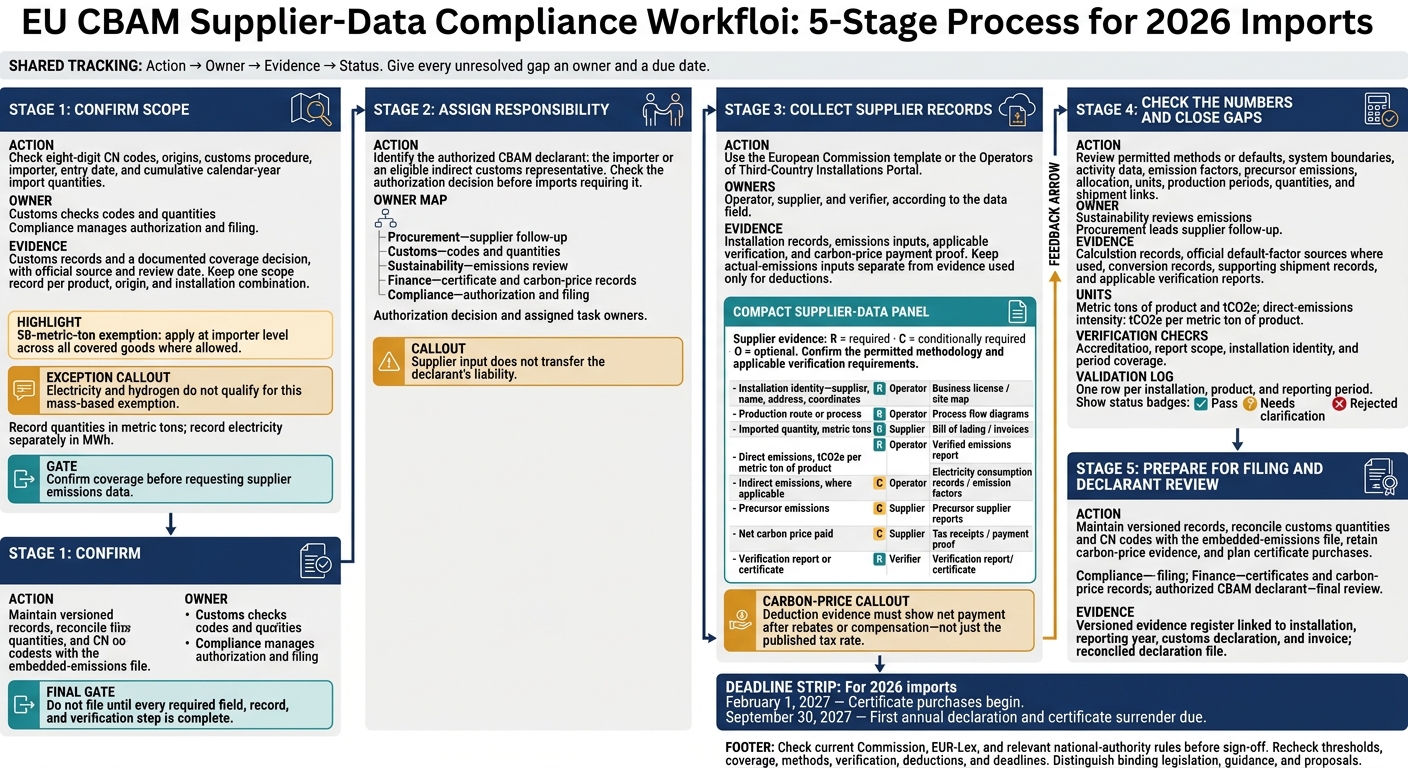
EU CBAM Compliance: 5-Step Supplier Data Checklist
Check Import Coverage and Assign Responsibilities
Check CN Codes, Origins, and Import Quantities
Match each product’s eight-digit CN code against current CBAM coverage. Before requesting emissions data, confirm the origin, customs procedure, importer, and entry date. Link each scope record to the importer, customs representative, supplier, and customs entry date.[1]
Keep one record for each product, origin, and installation combination.
| Scope-table field | What to record |
|---|---|
| Product and CN code | Product description and eight-digit CN code from customs records |
| CBAM sector | Applicable sector and matching Annex I entry |
| Origin | Country of origin, supported by customs and supplier records |
| Producing installation | Name and location of the actual production facility, not just the trading supplier |
| Annual quantity | Cumulative calendar-year imports in metric tons; record electricity separately in MWh |
| Threshold status | Exempt or in scope, based on the importer’s total |
| Official source | Commission or national-authority source |
| Reviewed on | Date the coverage decision was reviewed |
Apply the 50-metric-ton exemption at the importer level across all covered goods. Electricity and hydrogen do not qualify for this mass-based exemption. If the importer exceeds the limit, it must act as an authorized CBAM declarant, report embedded emissions, and purchase CBAM certificates.[1][2]
Confirm scope before moving on to supplier emissions records.
Assign Authorization and Declaration Duties
Record whether the importer or an eligible indirect customs representative will hold authorized CBAM declarant status. Check the authorization decision before importing goods that require it.[1]
Give each team a clear role: procurement handles supplier follow-up; customs checks codes and quantities; sustainability reviews emissions; finance maintains certificate and carbon-price records; and compliance manages authorization and filing. Supplier input does not transfer the declarant’s liability.[1][2]
Verify Coverage Against Official Rules
Check scope against the Commission, EUR-Lex, and the relevant national authority. Save the source and last-checked date with each decision, and label sources as binding legislation, guidance, or proposals. A proposed expansion does not count as current product coverage.[1]
Recheck decisions when classifications, origins, import forecasts, or authorization circumstances change. Request supplier emissions data only after confirming scope.[1]
sbb-itb-8baf5f1
Who Pays for Your Supplier’s Carbon? CBAM 2026 Explained
Collect and Check Supplier Emissions Data
Once coverage is confirmed, collect installation-level emissions data and supporting evidence for each covered import.
Request Installation, Emissions, and Carbon-Price Records
Use the European Commission template or the Operators of Third-Country Installations Portal to gather supplier records. Label each field according to the selected methodology: R = required, C = conditionally required, O = optional. Keep actual-emissions inputs separate from evidence used only for deductions.
| Data field | Requirement | Owner | Supporting evidence | Status |
|---|---|---|---|---|
| Installation identity (supplier, name, address, coordinates) | R | Operator | Business license / site map | Pending |
| Production route or process | R | Operator | Process flow diagrams | Pending |
| Imported quantity (metric tons) | R | Supplier | Bill of lading / invoices | Pending |
| Direct emissions (tCO2e per metric ton of product) | R | Operator | Verified emissions report | Pending |
| Indirect emissions, where applicable | C | Operator | Electricity consumption records / emission factors | Pending |
| Precursor emissions | C | Supplier | Precursor supplier reports | Pending |
| Net carbon price paid | C | Supplier | Tax receipts / payment proof | Pending |
| Verification report or certificate | R | Verifier | Verification report/certificate | Pending |
With the supplier file complete, check whether the method requires electricity data and whether indirect emissions apply to the goods. For a carbon-price deduction, request proof of net payment after rebates or compensation. The published tax rate alone isn't enough.[1][2]
Next, check that the method, units, and allocation rules match the shipment record.
Check Calculation Methods, Units, and Allocation
Confirm the EU-approved calculation method and whether it allows actual verified emissions data or default values.[1][2] If you use a default factor, record its official source and explain why it applies.
For actual calculations, review system boundaries, activity data, emission factors, precursor emissions, and allocation across products. Exclude transport and unrelated activities outside the applicable boundary.
Use metric tons of product and tCO2e, and retain all conversions from U.S. customary units. Reconcile production quantities and the reporting period with the imported goods. Don't assume invoice dates establish the emissions period.
Use the validation log to flag missing, conflicting, or unverified inputs before declaration.
Resolve Data Gaps and Review Verification
Prepare the declaration file with one validation row per installation, product, and reporting period. Record exceptions using the supplier’s submitted value - not a reviewer’s estimate - and mark each result pass, needs clarification, or rejected.
Before accepting actual-emissions figures, check the verifier’s accreditation, report scope, installation identity, and period coverage.[3]
| Validation check | Review result | Required fix | Fix status |
|---|---|---|---|
| Site and route match supporting records | Needs clarification | Resolve missing details or conflicting routes | Open |
| Method and defaults are permitted | Needs clarification | Document the official method source and applicability | Open |
| Emissions inputs have adequate evidence | Needs clarification | Obtain missing calculations, precursor records, or applicable electricity evidence | Open |
| Units, boundaries, and allocation are consistent | Needs clarification | Correct conversions or allocation errors | Open |
| Production period and quantity match imported goods | Needs clarification | Resolve invalid periods or shipment-linkage gaps | Open |
| Verification covers the actual-emissions claim | Needs clarification | Confirm accreditation, site, scope, and period | Open |
| Carbon-price deduction reflects net payment | Needs clarification | Reconcile receipts, rebates, and compensation | Open |
Keep unsupported estimates and other unresolved items open until the supplier provides acceptable evidence or the data is replaced through a permitted method.
Keep Records and Complete Declarant Review
Maintain a Versioned Evidence Register
Store every accepted submission in a versioned evidence register linked to the installation, reporting year, customs declaration, and invoice. Keep supplier emissions data, carbon-price proof, calculation methods, monitoring plans, fuel and electricity records, and verification reports together.[1][2][3] Record emission factor sources and vintages, along with any adjustments or assumptions, so reviewers can trace and repeat the calculation.[4]
Reconcile Records and Approve the Declaration
Before sign-off, reconcile supplier emissions data with customs records. Confirm that import quantities and CN codes match the final embedded-emissions file.[1][2] Record carbon prices paid in the country of origin and retain proof of payment.[1][2] Escalate any unresolved mismatches before submitting the declaration.
Track Deadlines, Certificates, and Rule Updates
Keep a calendar of each obligation, reporting period, and deadline. For 2026 imports, certificate purchases begin on February 1, 2027. The first annual declaration and certificate surrender are due on September 30, 2027. Confirm both dates against current EU rules before filing.[1][2]
Before each cycle, recheck thresholds, CN codes, default values, calculation and verification rules, and carbon-price deduction rules. Log any changes.[1][2][3][4] Keep source records in their original currency, but report required values in euros and EU units.[1][4]
Conclusion: Close Data Gaps Before Filing
Give each unresolved data gap an owner and a due date, with procurement leading supplier follow-up.
Use the checklist to resolve every open item before the authorized CBAM declarant review. Before filing, confirm coverage, responsibilities, installation-level data, calculation methods, required verification, and retained evidence.[1][2][3] Do not file until every required field, record, and verification step is complete.
FAQs
What if my imports exceed 50 metric tons midyear?
If your imports exceed 50 metric tons (about 55 U.S. tons) of covered goods during the year, you must register as an authorized CBAM declarant [1]. You must also purchase the required CBAM certificates and submit an annual CBAM declaration by September 30, reporting imported quantities and their embedded emissions [1]. This annual threshold determines whether your organization must meet these formal reporting and financial requirements [1].
What if my supplier cannot provide verified emissions data?
For EU CBAM reporting, European Commission default emissions values can serve as a fallback. These values are deliberately set higher than actual emissions to encourage the use of verified supplier data.
Record why data is missing and keep audit-ready documentation of your efforts to obtain it. As reporting requirements change, prioritize actual, verified supplier data to improve long-term accuracy and help control costs.
How long must I retain CBAM supporting records?
The provided documentation does not specify a single retention period for CBAM supporting records. Importers must keep accurate records to support their declarations and regulatory audits.
Store supplier emissions data, calculation workbooks, and proof of carbon prices paid in the country of origin in a repository with access controls and version tracking. Your national CBAM authority must be able to review these records.



FAQ