
Dec 26, 2025
ESG Risk Metrics: Sector-Specific Applications
ESG Strategy
In This Article
Compare how MSCI, Sustainalytics, S&P Global and LSEG tailor ESG risk metrics to industry risks, with strengths, limitations, and portfolio integration tips.
ESG Risk Metrics: Sector-Specific Applications
ESG risk metrics are essential for identifying risks and improving sustainability across industries. Companies face unique challenges depending on their sector, and frameworks like MSCI, Sustainalytics, S&P Global, and LSEG Refinitiv offer tailored tools to evaluate and manage these risks effectively. Here's a quick summary of their approaches:
MSCI ESG Ratings: Focuses on industry-specific risks using materiality maps and a sector-relative scoring system. It evaluates over 17,000 issuers globally and incorporates annual updates to reflect emerging trends.
Sustainalytics ESG Risk Ratings: Categorizes risks into manageable and inherent, using over 200 indicators. It emphasizes absolute risk levels and is widely used for sustainability-linked loans and bonds.
S&P Global ESG Scores: Adopts a "double materiality" framework, assessing both financial impacts and societal effects. It uses 62 industry materiality matrices for precise evaluations.
LSEG Refinitiv ESG Scores: Adjusts metrics based on industry and regional factors, offering dual scores for operational performance and controversies.
Each system has strengths and limitations, such as differences in data transparency, update frequency, and the ability to address governance challenges. Organizations must select metrics that align with their sector’s specific risks and stakeholder expectations to create effective ESG strategies.
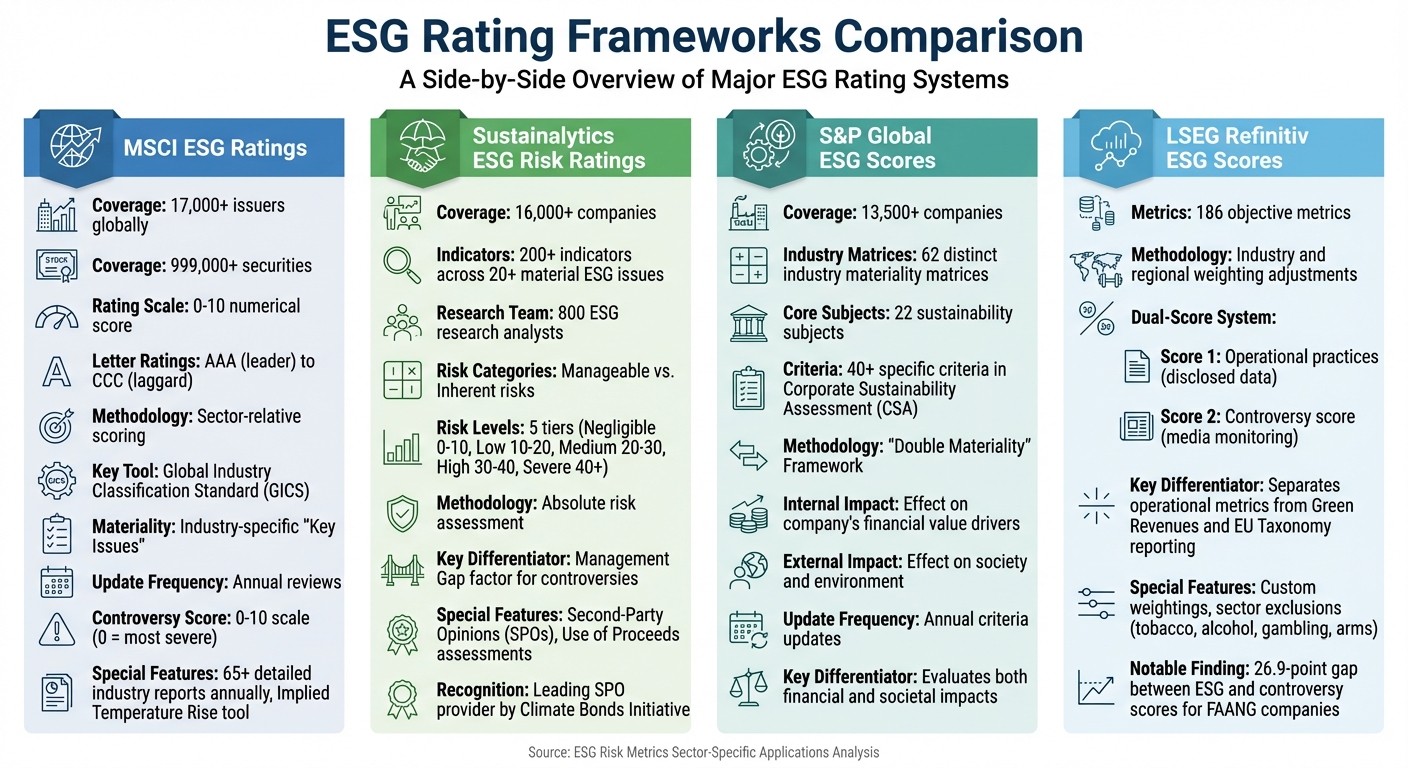
Comparison of Four Major ESG Rating Frameworks: MSCI, Sustainalytics, S&P Global, and LSEG Refinitiv
1. MSCI ESG Ratings
Sector-Specific Materiality
MSCI updates its ESG Ratings model every year, tailoring its focus to industry-specific "Key Issues". These adjustments are based on research, data analysis, and client feedback, ensuring the model reflects the most relevant factors for each sector [2][4]. The system evaluates which ESG factors hold the most importance by analyzing how much a particular industry contributes to externalities - such as carbon emissions - compared to others and the timeframe within which these risks are likely to emerge [2].
To implement this, MSCI uses the Global Industry Classification Standard (GICS) to categorize companies and apply materiality maps that are specific to each industry [2][6]. For instance, water management is a critical focus for utility companies, while data privacy is a top concern for technology firms [6]. Companies are then scored on a scale from 0 to 10, which translates into letter ratings ranging from AAA (leader) to CCC (laggard) [3]. This sector-relative scoring system allows investors to pinpoint companies that excel in sustainability metrics within their specific industry context [8].
Alignment with Impact Objectives
MSCI's sector-relative, "best-in-class" approach is designed to help impact investors identify leaders and steer clear of laggards across 163 distinct sub-industries [8]. The ratings, which cover over 17,000 issuers and nearly 999,000 securities globally as of June 30, 2024, are supported by an impressive output of more than 65 detailed industry reports annually [5][7]. For investors with a climate focus, MSCI offers tools like "Implied Temperature Rise", which assesses how a company’s decarbonization targets align with global climate goals, aiding net-zero transition efforts [7].
The framework also keeps a close watch on controversies, such as environmental violations, labor disputes, and governance failures. These controversies are scored on a scale of 0 to 10, with 0 representing the most severe incidents [3]. This monitoring helps investors identify risks that could undermine their environmental or social objectives. The ratings also evaluate how well companies respond to societal and environmental demands, aligning with strategies that emphasize positive screening [8]. Historical data reveals that companies with top ratings (AAA/AA) outperformed their lower-rated peers over a 17-year period in developed markets ending December 29, 2023 [5].
With these impact-driven evaluations, MSCI integrates these metrics into tools for portfolio construction and management.
Portfolio Integration
Investors rely on MSCI ESG Ratings to track portfolio exposure, design risk-adjusted portfolios, and guide engagement strategies with corporate management [5]. The MSCI ESG Selection P-Series Indexes focus on covering 50% of the free float-adjusted market capitalization for each GICS sector. To qualify, companies must maintain an ESG Rating of BB or higher and an ESG Controversies Score of at least 3 for new inclusions [3]. Quarterly reviews in February, May, August, and November ensure the indexes reflect updates in ESG ratings, controversies, and business activities [3].
The system also screens for business involvement in controversial sectors like weapons, tobacco, and fossil fuels, enabling investors to exclude companies that conflict with their values [3]. Over a 13-year period, MSCI's weight-setting methodology has outperformed both equal-weighted and optimized approaches [2][4]. Additionally, the framework aligns with international standards such as the UN Global Compact and the ILO Declaration on Fundamental Principles and Rights at Work, lending further credibility to institutional investors [3].
Despite its robust framework, certain methodological challenges persist.
Data Transparency and Limitations
While MSCI's approach provides detailed sector-specific insights, it does face some challenges. For instance, ratings are typically reviewed only once a year, leading to delays in reflecting recent company performance. MSCI includes disclosures from up to three months before a rating action, but this still creates a time lag [9].
"The Industry Adjusted Score and ESG Rating are only recalculated at the time of an MSCI ESG Research rating action." - MSCI ESG Research LLC [9]
Although data points such as controversies or governance updates are refreshed weekly, the final Industry Adjusted Score and ESG Rating are recalculated only during formal rating actions, which usually occur annually unless an ad hoc review is triggered [9]. For certain financial instruments like covered bonds, MSCI applies a "market standard" approach, assigning the average management score of all rated credit institutions in the same country rather than using entity-specific data [10].
Another challenge lies in averaging effects in materiality. Issues impacting only a small subset of companies within an industry may appear to have a low average weight, potentially obscuring risks for those specific companies [2]. Extraordinary events, such as geopolitical crises or market disruptions, can also affect the reliability of data inputs, further complicating sector-specific evaluations [9]. These limitations underscore the importance of timely and granular data in accurately capturing industry-specific risks.
2. Sustainalytics ESG Risk Ratings
Sector-Specific Materiality
Sustainalytics employs a dual-layered approach to evaluating ESG risks, focusing on both a company's exposure to industry-specific ESG challenges and how effectively it manages those risks. This begins with assessing risk exposure at the sub-industry level, ensuring that the unique challenges of different sectors are taken into account. For example, the baseline risks faced by a utility company are vastly different from those encountered by a technology firm.
The framework examines over 20 material ESG issues (MEIs) using more than 200 indicators. Backed by a team of 800 ESG research analysts, Sustainalytics combines qualitative insights with quantitative data, covering over 16,000 companies from major global indices. The methodology differentiates between risks that can be mitigated - through policies, oversight, or other measures - and those that are inherent to a sector’s operations. For instance, while an oil company can take steps to reduce its carbon emissions, it cannot entirely eliminate the risks tied to its industry, and these unavoidable risks are factored into the ratings separately [11].
Risk levels are categorized into five tiers: Negligible (0–10), Low (10–20), Medium (20–30), High (30–40), and Severe (40+). This system allows for direct comparisons of ESG risks across industries. The framework also accounts for unique, company-specific issues, such as controversies or unexpected events, which may elevate an organization's overall risk profile. This detailed analysis helps align ESG ratings with measurable impact goals [11].
Alignment with Impact Objectives
Sustainalytics integrates its ratings with broader impact goals through tools like Second-Party Opinions (SPOs) and Use of Proceeds assessments. These tools evaluate the tangible impact of green, social, and sustainability bonds. For example, banks often use ESG Risk Ratings to set terms for sustainability-linked loans, adjusting interest rates based on a borrower’s ability to manage key ESG risks. Sustainalytics has been recognized by the Climate Bonds Initiative as a leading SPO provider, reinforcing its credibility in sustainable finance.
The methodology also includes a "Management Gap" factor, which reflects how controversies can lower a company’s management score. This adjustment highlights weaknesses in risk mitigation strategies. Additionally, investors can aggregate absolute risk scores across portfolios, offering a standardized view of ESG risks across diverse asset classes [11].
"Controversies have a discounting effect on the company's management score, as they show that the company's programs and policies have not been completely effective." - Sustainalytics [11]
This approach ensures that the insights provided are actionable, helping investors align their portfolios with their impact objectives.
Portfolio Integration
Sustainalytics makes its ratings accessible through various channels, such as Global Access, data feeds, and APIs, simplifying the integration into institutional investment workflows. Portfolio managers can aggregate and compare absolute risk scores across different sub-industries and sectors, all within a single framework. The ESG Risk Decomposition feature further breaks down risks into those driven by exposure and those stemming from management shortcomings, offering greater transparency for investment decisions.
Corporate issuers also benefit from SPOs, using them to bolster transparency and credibility when issuing green or social bonds, which can attract investors focused on impact-driven outcomes. By centering its framework on corporate governance, material ESG issues, and company-specific challenges, Sustainalytics provides a solid foundation for portfolio construction and benchmarking companies against their industry peers [11].
Data Transparency and Limitations
Although Sustainalytics offers detailed risk assessments, including unmanageable risks in the analysis can sometimes obscure a company’s broader environmental impact. For example, a company with a "Low Risk" rating might still have inherent impacts tied to its sector that remain unavoidable.
The ratings rely heavily on analyst insights and qualitative evaluations, which add valuable context but also introduce an element of subjectivity. While the Management Gap and related controversies act as reactive indicators, they effectively pinpoint areas where a company’s risk mitigation strategies fall short. Sustainalytics’ recognition as the "Best ESG Research and Data Provider" by Environmental Finance and Investment Week reflects its strong reputation in the market [11].
3. S&P Global ESG Scores
Sector-Specific Materiality
S&P Global takes a highly detailed approach to ESG scoring, tailoring its analysis to the unique risks and opportunities of each industry. To achieve this, it has developed 62 distinct industry materiality matrices, ensuring that its framework adapts to the specific challenges of different sectors. Instead of applying a universal model, the system categorizes sustainability issues into 22 "core subjects", which are further broken down into over 40 specific criteria within the Corporate Sustainability Assessment (CSA). These criteria are updated annually to reflect changes in regulations and emerging risks [12].
The methodology uses a "double materiality" framework, which evaluates sustainability issues from two perspectives. The first lens assesses how ESG factors influence a company's financial performance - such as sales growth or cost of capital. The second lens examines the company's broader impact on society and the environment. According to S&P Global:
"In this double materiality framework, we view a sustainability issue as material if it has an effect on society or the environment (external or outward impact) and an effect on a company's value drivers over the short, medium or long term (internal or inward-flowing impact)" [12].
This approach is particularly beneficial for industries facing complex challenges, including energy, mobility, and heavy industry. The CSA database, which covers more than 13,500 companies, incorporates a wide range of inputs - global trends, scientific research, regulatory standards, and direct corporate feedback - to ensure the scoring process remains comprehensive and relevant [12]. By focusing on both external and internal impacts, S&P Global's framework provides a nuanced assessment of ESG risks and opportunities.
Alignment with Impact Objectives
S&P Global's commitment to refining its ESG scoring process ensures it remains aligned with the shifting landscape of sustainability. Materiality is treated as a dynamic concept, with industry matrices and criteria weights updated regularly to reflect evolving priorities. This adaptability supports the growing alignment between financial and non-financial disclosure standards, helping investors identify sustainability factors that contribute to long-term value. By evaluating both a company's financial performance and its broader societal and environmental impacts, the double materiality framework bridges traditional financial analysis with a more comprehensive impact assessment. As S&P Global explains:
"The materiality assessment forms the foundation of the weights of the criteria within the CSA and the resulting S&P Global ESG Scores" [12].
These ongoing updates provide portfolio managers with the tools to benchmark and adjust investments effectively, ensuring they remain aligned with long-term sustainability goals.
Portfolio Integration
With its extensive coverage of over 13,500 companies and annual updates to criteria, the CSA enables portfolio managers to compare ESG performance across and within industries. By combining internal company data with external scientific research, the CSA offers a robust foundation for decision-making. This integration helps determine whether a company's ESG performance stems from genuine improvements in operations or simply from operating in a sector with fewer inherent risks.
Data Transparency and Limitations
While S&P Global's methodology is thorough, it is not without challenges. As the Financial Times points out:
"The problem when measuring ESG is not a lack of data but an oversupply of tools and frameworks" [1].
This abundance can make it difficult to discern which metrics hold the most significance. Governance metrics, in particular, pose unique challenges because they involve abstract concepts like "ethical principles" and "integrity", which are harder to quantify than legal compliance [1]. Additionally, the need to distinguish between standard industry metrics and those specific to a sector complicates cross-industry comparisons. However, the ongoing shift toward mandatory disclosures is expected to improve consistency and comparability, helping to streamline ESG assessments over time [1].
4. LSEG Refinitiv ESG Scores
Sector-Specific Materiality
LSEG Refinitiv takes a nuanced approach to ESG scoring by adjusting materiality weightings based on industry and regional factors, leveraging 186 objective metrics. Instead of applying a one-size-fits-all standard, the system recognizes that specific factors hold varying levels of importance across sectors. Leon Saunders Calvert, Head of Research & Portfolio Management at LSEG, explains:
"Fuel efficiency, for example, has a bigger impact on an airline's bottom line than it does on an investment bank's, a consideration which must be incorporated into the methodology of an ESG score or ranking" [13].
This approach treats ESG data as essential, objective information, ensuring that scores reflect a company's performance relative to its industry peers [14]. By tailoring these metrics, LSEG creates a dual-score system that provides a more precise evaluation of ESG impact.
Alignment with Impact Objectives
LSEG's dual-score strategy builds on this tailored materiality framework to capture multiple ESG dimensions. The first score evaluates a company's operational practices using publicly disclosed data, while the second - known as the controversy score - relies on global media monitoring to highlight risks. For instance, an analysis of FAANG companies revealed a striking 26.9-point gap between their standard ESG and controversy scores, underscoring the disconnect between self-reported data and external perceptions [13].
The methodology also separates operational metrics from tools like "Green Revenues" and "EU Taxonomy" reporting, which focus on the broader environmental and social impact of a company's products and services.
Portfolio Integration
LSEG offers detailed pillar and category scores, enabling portfolio managers to apply custom weightings and exclusions. This flexibility allows them to address specific concerns, such as excluding sectors like tobacco, alcohol, gambling, and arms, based on their investment strategies [13].
Data Transparency and Limitations
While LSEG's methodology is comprehensive, it does face certain challenges. As Calvert acknowledges:
"A single ESG score cannot capture this complexity... a company's carbon footprint does not necessarily correlate with its diversity and inclusion practices" [13].
The lack of global ESG reporting standards means that different data providers often collect and weigh information differently, leading to inconsistencies and low correlation between scores. Additionally, the operational focus of standard ESG scores can sometimes produce results that seem counterintuitive, especially when a company's internal operations don't align with the sustainability performance of its products. To address these issues, LSEG emphasizes methodological transparency, empowering investors to choose the scoring approach that aligns best with their objectives [13].
How Do the ESG Risk Ratings Work?
Strengths and Weaknesses
Each ESG framework offers its own set of benefits while grappling with specific challenges, particularly when applied to assessing sector-specific risks. Interestingly, the issue isn't a lack of data but rather an overwhelming abundance of tools, which complicates the process of identifying the most relevant metrics for meaningful measurement [1]. This complexity was underscored by the OECD's analysis in February 2025, which revealed over 2,000 individual metrics spread across eight major ESG rating products, highlighting significant issues with comparability [15].
When focusing on sector-specific strengths, the advantages of tailored frameworks come into view. For instance, a 13-year study demonstrated that MSCI’s approach, which emphasizes industry-specific weighting and annual recalibration, outperformed both equal-weighted and optimized schemes. This success stems from its ability to account for industry externalities and risks that evolve over time [2][4]. Moreover, company-specific details - such as unique production methods and geographical operations - add a level of precision that broader, generic models often fail to achieve [2][4].
One of the most persistent challenges in ESG measurement lies in governance. Unlike environmental or social factors, governance metrics are harder to quantify, as they often involve ethical considerations that go beyond mere legal compliance [1]. This difficulty spans various sectors, from evaluating board oversight in healthcare to gauging transparency in financial services.
Efforts to standardize ESG metrics are underway but remain slow-moving. The World Economic Forum, in collaboration with the "Big Four" accounting firms, has introduced 21 core quantitative metrics and 34 expanded metrics to promote consistency [1]. While these metrics build on existing standards to enhance comparability, the sheer number of competing frameworks still leaves investors struggling to benchmark performance effectively across sectors. Additionally, research suggests that the composition of a company’s board plays a critical role in the success of ESG measurement initiatives [1].
The table below outlines key criteria, comparing the strengths of MSCI ESG Ratings with the broader challenges faced by general frameworks:
| <strong>Criteria</strong> | <strong>MSCI ESG Ratings</strong> | <strong>General Framework Challenges</strong> |
| --- | --- | --- |
| <strong>Materiality</strong> | Employs an Industry Materiality Map to pinpoint critical sub-industry issues <a href="https://www.msci.com/data-and-analytics/sustainability-solutions/esg-industry-materiality-map" target="_blank" style="text-decoration: none;" rel="nofollow noopener noreferrer" data-framer-link="Link:{"url":"https://www.msci.com/data-and-analytics/sustainability-solutions/esg-industry-materiality-map","type":"url"}" data-framer-open-in-new-tab=""><sup>[4]</sup></a> | An overabundance of data complicates identifying meaningful metrics <a href="https://diligent.com/resources/blog/metrics" target="_blank" style="text-decoration: none;" rel="nofollow noopener noreferrer" data-framer-link="Link:{"url":"https://diligent.com/resources/blog/metrics","type":"url"}" data-framer-open-in-new-tab=""><sup>[1]</sup></a> |
| <strong>Weighting</strong> | Focuses on industry contributions to externalities and risk timelines <a href="https://www.msci.com/data-and-analytics/sustainability-solutions/esg-industry-materiality-map" target="_blank" style="text-decoration: none;" rel="nofollow noopener noreferrer" data-framer-link="Link:{"url":"https://www.msci.com/data-and-analytics/sustainability-solutions/esg-industry-materiality-map","type":"url"}" data-framer-open-in-new-tab=""><sup>[4]</sup></a> | Governance metrics remain difficult to measure effectively <a href="https://diligent.com/resources/blog/metrics" target="_blank" style="text-decoration: none;" rel="nofollow noopener noreferrer" data-framer-link="Link:{"url":"https://diligent.com/resources/blog/metrics","type":"url"}" data-framer-open-in-new-tab=""><sup>[1]</sup></a> |
| <strong>Adaptability</strong> | Recalibrates annually based on research and client feedback <a href="https://www.msci.com/our-solutions/esg-investing/esg-industry-materiality-map" target="_blank" style="text-decoration: none;" rel="nofollow noopener noreferrer" data-framer-link="Link:{"url":"https://www.msci.com/our-solutions/esg-investing/esg-industry-materiality-map","type":"url"}" data-framer-open-in-new-tab=""><sup>[2]</sup></a> | Progress toward standardization remains slow <a href="https://diligent.com/resources/blog/metrics" target="_blank" style="text-decoration: none;" rel="nofollow noopener noreferrer" data-framer-link="Link:{"url":"https://diligent.com/resources/blog/metrics","type":"url"}" data-framer-open-in-new-tab=""><sup>[1]</sup></a> |
| <strong>Granularity</strong> | Considers company-specific details like production methods and geographic factors <a href="https://www.msci.com/data-and-analytics/sustainability-solutions/esg-industry-materiality-map" target="_blank" style="text-decoration: none;" rel="nofollow noopener noreferrer" data-framer-link="Link:{"url":"https://www.msci.com/data-and-analytics/sustainability-solutions/esg-industry-materiality-map","type":"url"}" data-framer-open-in-new-tab=""><sup>[4]</sup></a> | Often limited to mandatory disclosures unless companies go beyond requirements <a href="https://diligent.com/resources/blog/metrics" target="_blank" style="text-decoration: none;" rel="nofollow noopener noreferrer" data-framer-link="Link:{"url":"https://diligent.com/resources/blog/metrics","type":"url"}" data-framer-open-in-new-tab=""><sup>[1]</sup></a> |
| <strong>Criteria</strong> | <strong>MSCI ESG Ratings</strong> | <strong>General Framework Challenges</strong> |
| --- | --- | --- |
| <strong>Materiality</strong> | Employs an Industry Materiality Map to pinpoint critical sub-industry issues <a href="https://www.msci.com/data-and-analytics/sustainability-solutions/esg-industry-materiality-map" target="_blank" style="text-decoration: none;" rel="nofollow noopener noreferrer" data-framer-link="Link:{"url":"https://www.msci.com/data-and-analytics/sustainability-solutions/esg-industry-materiality-map","type":"url"}" data-framer-open-in-new-tab=""><sup>[4]</sup></a> | An overabundance of data complicates identifying meaningful metrics <a href="https://diligent.com/resources/blog/metrics" target="_blank" style="text-decoration: none;" rel="nofollow noopener noreferrer" data-framer-link="Link:{"url":"https://diligent.com/resources/blog/metrics","type":"url"}" data-framer-open-in-new-tab=""><sup>[1]</sup></a> |
| <strong>Weighting</strong> | Focuses on industry contributions to externalities and risk timelines <a href="https://www.msci.com/data-and-analytics/sustainability-solutions/esg-industry-materiality-map" target="_blank" style="text-decoration: none;" rel="nofollow noopener noreferrer" data-framer-link="Link:{"url":"https://www.msci.com/data-and-analytics/sustainability-solutions/esg-industry-materiality-map","type":"url"}" data-framer-open-in-new-tab=""><sup>[4]</sup></a> | Governance metrics remain difficult to measure effectively <a href="https://diligent.com/resources/blog/metrics" target="_blank" style="text-decoration: none;" rel="nofollow noopener noreferrer" data-framer-link="Link:{"url":"https://diligent.com/resources/blog/metrics","type":"url"}" data-framer-open-in-new-tab=""><sup>[1]</sup></a> |
| <strong>Adaptability</strong> | Recalibrates annually based on research and client feedback <a href="https://www.msci.com/our-solutions/esg-investing/esg-industry-materiality-map" target="_blank" style="text-decoration: none;" rel="nofollow noopener noreferrer" data-framer-link="Link:{"url":"https://www.msci.com/our-solutions/esg-investing/esg-industry-materiality-map","type":"url"}" data-framer-open-in-new-tab=""><sup>[2]</sup></a> | Progress toward standardization remains slow <a href="https://diligent.com/resources/blog/metrics" target="_blank" style="text-decoration: none;" rel="nofollow noopener noreferrer" data-framer-link="Link:{"url":"https://diligent.com/resources/blog/metrics","type":"url"}" data-framer-open-in-new-tab=""><sup>[1]</sup></a> |
| <strong>Granularity</strong> | Considers company-specific details like production methods and geographic factors <a href="https://www.msci.com/data-and-analytics/sustainability-solutions/esg-industry-materiality-map" target="_blank" style="text-decoration: none;" rel="nofollow noopener noreferrer" data-framer-link="Link:{"url":"https://www.msci.com/data-and-analytics/sustainability-solutions/esg-industry-materiality-map","type":"url"}" data-framer-open-in-new-tab=""><sup>[4]</sup></a> | Often limited to mandatory disclosures unless companies go beyond requirements <a href="https://diligent.com/resources/blog/metrics" target="_blank" style="text-decoration: none;" rel="nofollow noopener noreferrer" data-framer-link="Link:{"url":"https://diligent.com/resources/blog/metrics","type":"url"}" data-framer-open-in-new-tab=""><sup>[1]</sup></a> |This combination of strengths and challenges illustrates the evolving nature of ESG frameworks and the ongoing efforts to refine their application across industries.
Conclusion
Turning the evaluations above into actionable ESG strategies requires a focus on aligning measurement frameworks with the specific challenges of each sector. The tools provided by MSCI, Sustainalytics, S&P Global, and LSEG offer tailored approaches that address the financial and operational intricacies of various industries. For instance, MSCI's materiality maps highlight key sub-industry issues, Sustainalytics categorizes risks into manageable and unmanageable, S&P Global’s double materiality framework considers both financial and societal impacts, and LSEG’s dual-score system differentiates operational performance from controversy exposure.
To build effective ESG strategies, organizations should combine standard metrics established by industry associations with custom metrics tailored to their unique business models. This approach enables meaningful peer comparisons while addressing the specific nuances often overlooked by generic frameworks [1]. Ensuring data integrity through regular audits is critical - not just for regulatory compliance but also for staying true to internal values. Additionally, ESG efforts must extend beyond the corporate sphere, factoring in supplier practices, pay equity concerns, and carbon footprints across the supply chain [1].
Council Fire collaborates with organizations to translate ESG concepts into measurable outcomes. By leveraging tools like interactive dashboards and methodologies such as Social Return on Investment (SROI), they help assign tangible monetary values to social and environmental efforts [16]. These tools not only identify operational risks early but also create a solid business case for sustainable innovation.
The most impactful ESG strategies set clear key performance indicators (KPIs) across short, medium, and long-term horizons, ensuring measurable progress over time [16]. The challenge lies in selecting metrics that reflect your sector’s material impacts and align with stakeholder expectations [16].
FAQs
How do ESG risk metrics vary by sector?
ESG risk metrics are designed to address the specific challenges and priorities of different industries. The importance and weighting of environmental, social, and governance factors vary widely depending on the sector. For example, utilities and energy companies are often assessed on metrics like carbon intensity and water usage, while governance issues such as data privacy and anti-money-laundering measures take center stage for financial services.
Even the same ESG metric can have different implications across industries. Carbon emissions, for instance, are a major concern for the energy sector, whereas consumer goods companies might focus more on product safety and waste management. This tailored, sector-specific approach ensures that businesses are evaluated on ESG factors most relevant to their operations and impact.
Council Fire supports organizations across the U.S. in navigating these complexities by translating industry-specific ESG risks into practical strategies. By concentrating on the metrics that align with their sector, companies can strengthen their sustainability efforts, enhance ESG ratings, and build trust with investors and stakeholders.
What challenges do companies face when choosing the right ESG framework for their industry?
Choosing the right ESG framework for a particular industry can feel overwhelming due to several complicating factors. One major hurdle is the sheer number of overlapping standards, guidelines, and methodologies. This abundance often creates confusion, making it tough to pinpoint which metrics matter most. Without a universally accepted ESG reporting standard, companies are left to navigate a maze of requirements that vary in focus and scope. This lack of uniformity can lead to inconsistent reporting and challenges in benchmarking performance.
Practical issues, such as data availability and reliability, also differ significantly across industries. For instance, sectors like energy or transportation typically have well-established emissions data. In contrast, social and governance metrics can be far more elusive and harder to measure. Adding to the complexity, regulatory landscapes are shifting rapidly. Take the U.S. SEC’s climate-related disclosure rules, for example - they demand companies to continuously revisit and adjust their reporting frameworks to stay compliant.
To help businesses tackle these challenges, Council Fire works with organizations to align their industry-specific priorities with the most suitable ESG standards. By designing customized reporting strategies, they ensure companies not only meet regulatory demands but also address stakeholder expectations and derive meaningful insights to support sustainable growth in the long run.
How can businesses effectively use ESG metrics to enhance their strategies?
To successfully weave ESG metrics into business strategies, companies should begin by pinpointing the environmental, social, and governance factors that matter most to their operations and stakeholders. This could include metrics like carbon emissions, water usage, workforce diversity, or governance practices - ensuring they align with industry benchmarks and the company’s long-term objectives.
Once these priorities are clear, they should be embedded into core decision-making processes such as strategic planning, risk management, and capital allocation. ESG targets must be tied to measurable outcomes, like linking them to executive performance incentives or improving supply chain practices. Progress should be tracked and reported consistently, using established frameworks like SASB or TCFD to ensure transparency and accountability.
Expert input can make this process smoother. For instance, Council Fire specializes in helping businesses align profitability with environmental and social benefits by crafting actionable strategies and fostering stakeholder engagement. By emphasizing ESG metrics, companies can position themselves for growth, strengthen resilience, and meet the expectations of their stakeholders.
Related Blog Posts
Latest Articles
©2025



FAQ
01
What does it really mean to “redefine profit”?
02
What makes Council Fire different?
03
Who does Council Fire you work with?
04
What does working with Council Fire actually look like?
05
How does Council Fire help organizations turn big goals into action?
06
How does Council Fire define and measure success?
Dec 26, 2025
ESG Risk Metrics: Sector-Specific Applications
ESG Strategy
In This Article
Compare how MSCI, Sustainalytics, S&P Global and LSEG tailor ESG risk metrics to industry risks, with strengths, limitations, and portfolio integration tips.
ESG Risk Metrics: Sector-Specific Applications
ESG risk metrics are essential for identifying risks and improving sustainability across industries. Companies face unique challenges depending on their sector, and frameworks like MSCI, Sustainalytics, S&P Global, and LSEG Refinitiv offer tailored tools to evaluate and manage these risks effectively. Here's a quick summary of their approaches:
MSCI ESG Ratings: Focuses on industry-specific risks using materiality maps and a sector-relative scoring system. It evaluates over 17,000 issuers globally and incorporates annual updates to reflect emerging trends.
Sustainalytics ESG Risk Ratings: Categorizes risks into manageable and inherent, using over 200 indicators. It emphasizes absolute risk levels and is widely used for sustainability-linked loans and bonds.
S&P Global ESG Scores: Adopts a "double materiality" framework, assessing both financial impacts and societal effects. It uses 62 industry materiality matrices for precise evaluations.
LSEG Refinitiv ESG Scores: Adjusts metrics based on industry and regional factors, offering dual scores for operational performance and controversies.
Each system has strengths and limitations, such as differences in data transparency, update frequency, and the ability to address governance challenges. Organizations must select metrics that align with their sector’s specific risks and stakeholder expectations to create effective ESG strategies.
Comparison of Four Major ESG Rating Frameworks: MSCI, Sustainalytics, S&P Global, and LSEG Refinitiv
1. MSCI ESG Ratings
Sector-Specific Materiality
MSCI updates its ESG Ratings model every year, tailoring its focus to industry-specific "Key Issues". These adjustments are based on research, data analysis, and client feedback, ensuring the model reflects the most relevant factors for each sector [2][4]. The system evaluates which ESG factors hold the most importance by analyzing how much a particular industry contributes to externalities - such as carbon emissions - compared to others and the timeframe within which these risks are likely to emerge [2].
To implement this, MSCI uses the Global Industry Classification Standard (GICS) to categorize companies and apply materiality maps that are specific to each industry [2][6]. For instance, water management is a critical focus for utility companies, while data privacy is a top concern for technology firms [6]. Companies are then scored on a scale from 0 to 10, which translates into letter ratings ranging from AAA (leader) to CCC (laggard) [3]. This sector-relative scoring system allows investors to pinpoint companies that excel in sustainability metrics within their specific industry context [8].
Alignment with Impact Objectives
MSCI's sector-relative, "best-in-class" approach is designed to help impact investors identify leaders and steer clear of laggards across 163 distinct sub-industries [8]. The ratings, which cover over 17,000 issuers and nearly 999,000 securities globally as of June 30, 2024, are supported by an impressive output of more than 65 detailed industry reports annually [5][7]. For investors with a climate focus, MSCI offers tools like "Implied Temperature Rise", which assesses how a company’s decarbonization targets align with global climate goals, aiding net-zero transition efforts [7].
The framework also keeps a close watch on controversies, such as environmental violations, labor disputes, and governance failures. These controversies are scored on a scale of 0 to 10, with 0 representing the most severe incidents [3]. This monitoring helps investors identify risks that could undermine their environmental or social objectives. The ratings also evaluate how well companies respond to societal and environmental demands, aligning with strategies that emphasize positive screening [8]. Historical data reveals that companies with top ratings (AAA/AA) outperformed their lower-rated peers over a 17-year period in developed markets ending December 29, 2023 [5].
With these impact-driven evaluations, MSCI integrates these metrics into tools for portfolio construction and management.
Portfolio Integration
Investors rely on MSCI ESG Ratings to track portfolio exposure, design risk-adjusted portfolios, and guide engagement strategies with corporate management [5]. The MSCI ESG Selection P-Series Indexes focus on covering 50% of the free float-adjusted market capitalization for each GICS sector. To qualify, companies must maintain an ESG Rating of BB or higher and an ESG Controversies Score of at least 3 for new inclusions [3]. Quarterly reviews in February, May, August, and November ensure the indexes reflect updates in ESG ratings, controversies, and business activities [3].
The system also screens for business involvement in controversial sectors like weapons, tobacco, and fossil fuels, enabling investors to exclude companies that conflict with their values [3]. Over a 13-year period, MSCI's weight-setting methodology has outperformed both equal-weighted and optimized approaches [2][4]. Additionally, the framework aligns with international standards such as the UN Global Compact and the ILO Declaration on Fundamental Principles and Rights at Work, lending further credibility to institutional investors [3].
Despite its robust framework, certain methodological challenges persist.
Data Transparency and Limitations
While MSCI's approach provides detailed sector-specific insights, it does face some challenges. For instance, ratings are typically reviewed only once a year, leading to delays in reflecting recent company performance. MSCI includes disclosures from up to three months before a rating action, but this still creates a time lag [9].
"The Industry Adjusted Score and ESG Rating are only recalculated at the time of an MSCI ESG Research rating action." - MSCI ESG Research LLC [9]
Although data points such as controversies or governance updates are refreshed weekly, the final Industry Adjusted Score and ESG Rating are recalculated only during formal rating actions, which usually occur annually unless an ad hoc review is triggered [9]. For certain financial instruments like covered bonds, MSCI applies a "market standard" approach, assigning the average management score of all rated credit institutions in the same country rather than using entity-specific data [10].
Another challenge lies in averaging effects in materiality. Issues impacting only a small subset of companies within an industry may appear to have a low average weight, potentially obscuring risks for those specific companies [2]. Extraordinary events, such as geopolitical crises or market disruptions, can also affect the reliability of data inputs, further complicating sector-specific evaluations [9]. These limitations underscore the importance of timely and granular data in accurately capturing industry-specific risks.
2. Sustainalytics ESG Risk Ratings
Sector-Specific Materiality
Sustainalytics employs a dual-layered approach to evaluating ESG risks, focusing on both a company's exposure to industry-specific ESG challenges and how effectively it manages those risks. This begins with assessing risk exposure at the sub-industry level, ensuring that the unique challenges of different sectors are taken into account. For example, the baseline risks faced by a utility company are vastly different from those encountered by a technology firm.
The framework examines over 20 material ESG issues (MEIs) using more than 200 indicators. Backed by a team of 800 ESG research analysts, Sustainalytics combines qualitative insights with quantitative data, covering over 16,000 companies from major global indices. The methodology differentiates between risks that can be mitigated - through policies, oversight, or other measures - and those that are inherent to a sector’s operations. For instance, while an oil company can take steps to reduce its carbon emissions, it cannot entirely eliminate the risks tied to its industry, and these unavoidable risks are factored into the ratings separately [11].
Risk levels are categorized into five tiers: Negligible (0–10), Low (10–20), Medium (20–30), High (30–40), and Severe (40+). This system allows for direct comparisons of ESG risks across industries. The framework also accounts for unique, company-specific issues, such as controversies or unexpected events, which may elevate an organization's overall risk profile. This detailed analysis helps align ESG ratings with measurable impact goals [11].
Alignment with Impact Objectives
Sustainalytics integrates its ratings with broader impact goals through tools like Second-Party Opinions (SPOs) and Use of Proceeds assessments. These tools evaluate the tangible impact of green, social, and sustainability bonds. For example, banks often use ESG Risk Ratings to set terms for sustainability-linked loans, adjusting interest rates based on a borrower’s ability to manage key ESG risks. Sustainalytics has been recognized by the Climate Bonds Initiative as a leading SPO provider, reinforcing its credibility in sustainable finance.
The methodology also includes a "Management Gap" factor, which reflects how controversies can lower a company’s management score. This adjustment highlights weaknesses in risk mitigation strategies. Additionally, investors can aggregate absolute risk scores across portfolios, offering a standardized view of ESG risks across diverse asset classes [11].
"Controversies have a discounting effect on the company's management score, as they show that the company's programs and policies have not been completely effective." - Sustainalytics [11]
This approach ensures that the insights provided are actionable, helping investors align their portfolios with their impact objectives.
Portfolio Integration
Sustainalytics makes its ratings accessible through various channels, such as Global Access, data feeds, and APIs, simplifying the integration into institutional investment workflows. Portfolio managers can aggregate and compare absolute risk scores across different sub-industries and sectors, all within a single framework. The ESG Risk Decomposition feature further breaks down risks into those driven by exposure and those stemming from management shortcomings, offering greater transparency for investment decisions.
Corporate issuers also benefit from SPOs, using them to bolster transparency and credibility when issuing green or social bonds, which can attract investors focused on impact-driven outcomes. By centering its framework on corporate governance, material ESG issues, and company-specific challenges, Sustainalytics provides a solid foundation for portfolio construction and benchmarking companies against their industry peers [11].
Data Transparency and Limitations
Although Sustainalytics offers detailed risk assessments, including unmanageable risks in the analysis can sometimes obscure a company’s broader environmental impact. For example, a company with a "Low Risk" rating might still have inherent impacts tied to its sector that remain unavoidable.
The ratings rely heavily on analyst insights and qualitative evaluations, which add valuable context but also introduce an element of subjectivity. While the Management Gap and related controversies act as reactive indicators, they effectively pinpoint areas where a company’s risk mitigation strategies fall short. Sustainalytics’ recognition as the "Best ESG Research and Data Provider" by Environmental Finance and Investment Week reflects its strong reputation in the market [11].
3. S&P Global ESG Scores
Sector-Specific Materiality
S&P Global takes a highly detailed approach to ESG scoring, tailoring its analysis to the unique risks and opportunities of each industry. To achieve this, it has developed 62 distinct industry materiality matrices, ensuring that its framework adapts to the specific challenges of different sectors. Instead of applying a universal model, the system categorizes sustainability issues into 22 "core subjects", which are further broken down into over 40 specific criteria within the Corporate Sustainability Assessment (CSA). These criteria are updated annually to reflect changes in regulations and emerging risks [12].
The methodology uses a "double materiality" framework, which evaluates sustainability issues from two perspectives. The first lens assesses how ESG factors influence a company's financial performance - such as sales growth or cost of capital. The second lens examines the company's broader impact on society and the environment. According to S&P Global:
"In this double materiality framework, we view a sustainability issue as material if it has an effect on society or the environment (external or outward impact) and an effect on a company's value drivers over the short, medium or long term (internal or inward-flowing impact)" [12].
This approach is particularly beneficial for industries facing complex challenges, including energy, mobility, and heavy industry. The CSA database, which covers more than 13,500 companies, incorporates a wide range of inputs - global trends, scientific research, regulatory standards, and direct corporate feedback - to ensure the scoring process remains comprehensive and relevant [12]. By focusing on both external and internal impacts, S&P Global's framework provides a nuanced assessment of ESG risks and opportunities.
Alignment with Impact Objectives
S&P Global's commitment to refining its ESG scoring process ensures it remains aligned with the shifting landscape of sustainability. Materiality is treated as a dynamic concept, with industry matrices and criteria weights updated regularly to reflect evolving priorities. This adaptability supports the growing alignment between financial and non-financial disclosure standards, helping investors identify sustainability factors that contribute to long-term value. By evaluating both a company's financial performance and its broader societal and environmental impacts, the double materiality framework bridges traditional financial analysis with a more comprehensive impact assessment. As S&P Global explains:
"The materiality assessment forms the foundation of the weights of the criteria within the CSA and the resulting S&P Global ESG Scores" [12].
These ongoing updates provide portfolio managers with the tools to benchmark and adjust investments effectively, ensuring they remain aligned with long-term sustainability goals.
Portfolio Integration
With its extensive coverage of over 13,500 companies and annual updates to criteria, the CSA enables portfolio managers to compare ESG performance across and within industries. By combining internal company data with external scientific research, the CSA offers a robust foundation for decision-making. This integration helps determine whether a company's ESG performance stems from genuine improvements in operations or simply from operating in a sector with fewer inherent risks.
Data Transparency and Limitations
While S&P Global's methodology is thorough, it is not without challenges. As the Financial Times points out:
"The problem when measuring ESG is not a lack of data but an oversupply of tools and frameworks" [1].
This abundance can make it difficult to discern which metrics hold the most significance. Governance metrics, in particular, pose unique challenges because they involve abstract concepts like "ethical principles" and "integrity", which are harder to quantify than legal compliance [1]. Additionally, the need to distinguish between standard industry metrics and those specific to a sector complicates cross-industry comparisons. However, the ongoing shift toward mandatory disclosures is expected to improve consistency and comparability, helping to streamline ESG assessments over time [1].
4. LSEG Refinitiv ESG Scores
Sector-Specific Materiality
LSEG Refinitiv takes a nuanced approach to ESG scoring by adjusting materiality weightings based on industry and regional factors, leveraging 186 objective metrics. Instead of applying a one-size-fits-all standard, the system recognizes that specific factors hold varying levels of importance across sectors. Leon Saunders Calvert, Head of Research & Portfolio Management at LSEG, explains:
"Fuel efficiency, for example, has a bigger impact on an airline's bottom line than it does on an investment bank's, a consideration which must be incorporated into the methodology of an ESG score or ranking" [13].
This approach treats ESG data as essential, objective information, ensuring that scores reflect a company's performance relative to its industry peers [14]. By tailoring these metrics, LSEG creates a dual-score system that provides a more precise evaluation of ESG impact.
Alignment with Impact Objectives
LSEG's dual-score strategy builds on this tailored materiality framework to capture multiple ESG dimensions. The first score evaluates a company's operational practices using publicly disclosed data, while the second - known as the controversy score - relies on global media monitoring to highlight risks. For instance, an analysis of FAANG companies revealed a striking 26.9-point gap between their standard ESG and controversy scores, underscoring the disconnect between self-reported data and external perceptions [13].
The methodology also separates operational metrics from tools like "Green Revenues" and "EU Taxonomy" reporting, which focus on the broader environmental and social impact of a company's products and services.
Portfolio Integration
LSEG offers detailed pillar and category scores, enabling portfolio managers to apply custom weightings and exclusions. This flexibility allows them to address specific concerns, such as excluding sectors like tobacco, alcohol, gambling, and arms, based on their investment strategies [13].
Data Transparency and Limitations
While LSEG's methodology is comprehensive, it does face certain challenges. As Calvert acknowledges:
"A single ESG score cannot capture this complexity... a company's carbon footprint does not necessarily correlate with its diversity and inclusion practices" [13].
The lack of global ESG reporting standards means that different data providers often collect and weigh information differently, leading to inconsistencies and low correlation between scores. Additionally, the operational focus of standard ESG scores can sometimes produce results that seem counterintuitive, especially when a company's internal operations don't align with the sustainability performance of its products. To address these issues, LSEG emphasizes methodological transparency, empowering investors to choose the scoring approach that aligns best with their objectives [13].
How Do the ESG Risk Ratings Work?
Strengths and Weaknesses
Each ESG framework offers its own set of benefits while grappling with specific challenges, particularly when applied to assessing sector-specific risks. Interestingly, the issue isn't a lack of data but rather an overwhelming abundance of tools, which complicates the process of identifying the most relevant metrics for meaningful measurement [1]. This complexity was underscored by the OECD's analysis in February 2025, which revealed over 2,000 individual metrics spread across eight major ESG rating products, highlighting significant issues with comparability [15].
When focusing on sector-specific strengths, the advantages of tailored frameworks come into view. For instance, a 13-year study demonstrated that MSCI’s approach, which emphasizes industry-specific weighting and annual recalibration, outperformed both equal-weighted and optimized schemes. This success stems from its ability to account for industry externalities and risks that evolve over time [2][4]. Moreover, company-specific details - such as unique production methods and geographical operations - add a level of precision that broader, generic models often fail to achieve [2][4].
One of the most persistent challenges in ESG measurement lies in governance. Unlike environmental or social factors, governance metrics are harder to quantify, as they often involve ethical considerations that go beyond mere legal compliance [1]. This difficulty spans various sectors, from evaluating board oversight in healthcare to gauging transparency in financial services.
Efforts to standardize ESG metrics are underway but remain slow-moving. The World Economic Forum, in collaboration with the "Big Four" accounting firms, has introduced 21 core quantitative metrics and 34 expanded metrics to promote consistency [1]. While these metrics build on existing standards to enhance comparability, the sheer number of competing frameworks still leaves investors struggling to benchmark performance effectively across sectors. Additionally, research suggests that the composition of a company’s board plays a critical role in the success of ESG measurement initiatives [1].
The table below outlines key criteria, comparing the strengths of MSCI ESG Ratings with the broader challenges faced by general frameworks:
| <strong>Criteria</strong> | <strong>MSCI ESG Ratings</strong> | <strong>General Framework Challenges</strong> |
| --- | --- | --- |
| <strong>Materiality</strong> | Employs an Industry Materiality Map to pinpoint critical sub-industry issues <a href="https://www.msci.com/data-and-analytics/sustainability-solutions/esg-industry-materiality-map" target="_blank" style="text-decoration: none;" rel="nofollow noopener noreferrer" data-framer-link="Link:{"url":"https://www.msci.com/data-and-analytics/sustainability-solutions/esg-industry-materiality-map","type":"url"}" data-framer-open-in-new-tab=""><sup>[4]</sup></a> | An overabundance of data complicates identifying meaningful metrics <a href="https://diligent.com/resources/blog/metrics" target="_blank" style="text-decoration: none;" rel="nofollow noopener noreferrer" data-framer-link="Link:{"url":"https://diligent.com/resources/blog/metrics","type":"url"}" data-framer-open-in-new-tab=""><sup>[1]</sup></a> |
| <strong>Weighting</strong> | Focuses on industry contributions to externalities and risk timelines <a href="https://www.msci.com/data-and-analytics/sustainability-solutions/esg-industry-materiality-map" target="_blank" style="text-decoration: none;" rel="nofollow noopener noreferrer" data-framer-link="Link:{"url":"https://www.msci.com/data-and-analytics/sustainability-solutions/esg-industry-materiality-map","type":"url"}" data-framer-open-in-new-tab=""><sup>[4]</sup></a> | Governance metrics remain difficult to measure effectively <a href="https://diligent.com/resources/blog/metrics" target="_blank" style="text-decoration: none;" rel="nofollow noopener noreferrer" data-framer-link="Link:{"url":"https://diligent.com/resources/blog/metrics","type":"url"}" data-framer-open-in-new-tab=""><sup>[1]</sup></a> |
| <strong>Adaptability</strong> | Recalibrates annually based on research and client feedback <a href="https://www.msci.com/our-solutions/esg-investing/esg-industry-materiality-map" target="_blank" style="text-decoration: none;" rel="nofollow noopener noreferrer" data-framer-link="Link:{"url":"https://www.msci.com/our-solutions/esg-investing/esg-industry-materiality-map","type":"url"}" data-framer-open-in-new-tab=""><sup>[2]</sup></a> | Progress toward standardization remains slow <a href="https://diligent.com/resources/blog/metrics" target="_blank" style="text-decoration: none;" rel="nofollow noopener noreferrer" data-framer-link="Link:{"url":"https://diligent.com/resources/blog/metrics","type":"url"}" data-framer-open-in-new-tab=""><sup>[1]</sup></a> |
| <strong>Granularity</strong> | Considers company-specific details like production methods and geographic factors <a href="https://www.msci.com/data-and-analytics/sustainability-solutions/esg-industry-materiality-map" target="_blank" style="text-decoration: none;" rel="nofollow noopener noreferrer" data-framer-link="Link:{"url":"https://www.msci.com/data-and-analytics/sustainability-solutions/esg-industry-materiality-map","type":"url"}" data-framer-open-in-new-tab=""><sup>[4]</sup></a> | Often limited to mandatory disclosures unless companies go beyond requirements <a href="https://diligent.com/resources/blog/metrics" target="_blank" style="text-decoration: none;" rel="nofollow noopener noreferrer" data-framer-link="Link:{"url":"https://diligent.com/resources/blog/metrics","type":"url"}" data-framer-open-in-new-tab=""><sup>[1]</sup></a> |
This combination of strengths and challenges illustrates the evolving nature of ESG frameworks and the ongoing efforts to refine their application across industries.
Conclusion
Turning the evaluations above into actionable ESG strategies requires a focus on aligning measurement frameworks with the specific challenges of each sector. The tools provided by MSCI, Sustainalytics, S&P Global, and LSEG offer tailored approaches that address the financial and operational intricacies of various industries. For instance, MSCI's materiality maps highlight key sub-industry issues, Sustainalytics categorizes risks into manageable and unmanageable, S&P Global’s double materiality framework considers both financial and societal impacts, and LSEG’s dual-score system differentiates operational performance from controversy exposure.
To build effective ESG strategies, organizations should combine standard metrics established by industry associations with custom metrics tailored to their unique business models. This approach enables meaningful peer comparisons while addressing the specific nuances often overlooked by generic frameworks [1]. Ensuring data integrity through regular audits is critical - not just for regulatory compliance but also for staying true to internal values. Additionally, ESG efforts must extend beyond the corporate sphere, factoring in supplier practices, pay equity concerns, and carbon footprints across the supply chain [1].
Council Fire collaborates with organizations to translate ESG concepts into measurable outcomes. By leveraging tools like interactive dashboards and methodologies such as Social Return on Investment (SROI), they help assign tangible monetary values to social and environmental efforts [16]. These tools not only identify operational risks early but also create a solid business case for sustainable innovation.
The most impactful ESG strategies set clear key performance indicators (KPIs) across short, medium, and long-term horizons, ensuring measurable progress over time [16]. The challenge lies in selecting metrics that reflect your sector’s material impacts and align with stakeholder expectations [16].
FAQs
How do ESG risk metrics vary by sector?
ESG risk metrics are designed to address the specific challenges and priorities of different industries. The importance and weighting of environmental, social, and governance factors vary widely depending on the sector. For example, utilities and energy companies are often assessed on metrics like carbon intensity and water usage, while governance issues such as data privacy and anti-money-laundering measures take center stage for financial services.
Even the same ESG metric can have different implications across industries. Carbon emissions, for instance, are a major concern for the energy sector, whereas consumer goods companies might focus more on product safety and waste management. This tailored, sector-specific approach ensures that businesses are evaluated on ESG factors most relevant to their operations and impact.
Council Fire supports organizations across the U.S. in navigating these complexities by translating industry-specific ESG risks into practical strategies. By concentrating on the metrics that align with their sector, companies can strengthen their sustainability efforts, enhance ESG ratings, and build trust with investors and stakeholders.
What challenges do companies face when choosing the right ESG framework for their industry?
Choosing the right ESG framework for a particular industry can feel overwhelming due to several complicating factors. One major hurdle is the sheer number of overlapping standards, guidelines, and methodologies. This abundance often creates confusion, making it tough to pinpoint which metrics matter most. Without a universally accepted ESG reporting standard, companies are left to navigate a maze of requirements that vary in focus and scope. This lack of uniformity can lead to inconsistent reporting and challenges in benchmarking performance.
Practical issues, such as data availability and reliability, also differ significantly across industries. For instance, sectors like energy or transportation typically have well-established emissions data. In contrast, social and governance metrics can be far more elusive and harder to measure. Adding to the complexity, regulatory landscapes are shifting rapidly. Take the U.S. SEC’s climate-related disclosure rules, for example - they demand companies to continuously revisit and adjust their reporting frameworks to stay compliant.
To help businesses tackle these challenges, Council Fire works with organizations to align their industry-specific priorities with the most suitable ESG standards. By designing customized reporting strategies, they ensure companies not only meet regulatory demands but also address stakeholder expectations and derive meaningful insights to support sustainable growth in the long run.
How can businesses effectively use ESG metrics to enhance their strategies?
To successfully weave ESG metrics into business strategies, companies should begin by pinpointing the environmental, social, and governance factors that matter most to their operations and stakeholders. This could include metrics like carbon emissions, water usage, workforce diversity, or governance practices - ensuring they align with industry benchmarks and the company’s long-term objectives.
Once these priorities are clear, they should be embedded into core decision-making processes such as strategic planning, risk management, and capital allocation. ESG targets must be tied to measurable outcomes, like linking them to executive performance incentives or improving supply chain practices. Progress should be tracked and reported consistently, using established frameworks like SASB or TCFD to ensure transparency and accountability.
Expert input can make this process smoother. For instance, Council Fire specializes in helping businesses align profitability with environmental and social benefits by crafting actionable strategies and fostering stakeholder engagement. By emphasizing ESG metrics, companies can position themselves for growth, strengthen resilience, and meet the expectations of their stakeholders.
Related Blog Posts
FAQ
01
What does it really mean to “redefine profit”?
02
What makes Council Fire different?
03
Who does Council Fire you work with?
04
What does working with Council Fire actually look like?
05
How does Council Fire help organizations turn big goals into action?
06
How does Council Fire define and measure success?
Dec 26, 2025
ESG Risk Metrics: Sector-Specific Applications
ESG Strategy
In This Article
Compare how MSCI, Sustainalytics, S&P Global and LSEG tailor ESG risk metrics to industry risks, with strengths, limitations, and portfolio integration tips.
ESG Risk Metrics: Sector-Specific Applications
ESG risk metrics are essential for identifying risks and improving sustainability across industries. Companies face unique challenges depending on their sector, and frameworks like MSCI, Sustainalytics, S&P Global, and LSEG Refinitiv offer tailored tools to evaluate and manage these risks effectively. Here's a quick summary of their approaches:
MSCI ESG Ratings: Focuses on industry-specific risks using materiality maps and a sector-relative scoring system. It evaluates over 17,000 issuers globally and incorporates annual updates to reflect emerging trends.
Sustainalytics ESG Risk Ratings: Categorizes risks into manageable and inherent, using over 200 indicators. It emphasizes absolute risk levels and is widely used for sustainability-linked loans and bonds.
S&P Global ESG Scores: Adopts a "double materiality" framework, assessing both financial impacts and societal effects. It uses 62 industry materiality matrices for precise evaluations.
LSEG Refinitiv ESG Scores: Adjusts metrics based on industry and regional factors, offering dual scores for operational performance and controversies.
Each system has strengths and limitations, such as differences in data transparency, update frequency, and the ability to address governance challenges. Organizations must select metrics that align with their sector’s specific risks and stakeholder expectations to create effective ESG strategies.
Comparison of Four Major ESG Rating Frameworks: MSCI, Sustainalytics, S&P Global, and LSEG Refinitiv
1. MSCI ESG Ratings
Sector-Specific Materiality
MSCI updates its ESG Ratings model every year, tailoring its focus to industry-specific "Key Issues". These adjustments are based on research, data analysis, and client feedback, ensuring the model reflects the most relevant factors for each sector [2][4]. The system evaluates which ESG factors hold the most importance by analyzing how much a particular industry contributes to externalities - such as carbon emissions - compared to others and the timeframe within which these risks are likely to emerge [2].
To implement this, MSCI uses the Global Industry Classification Standard (GICS) to categorize companies and apply materiality maps that are specific to each industry [2][6]. For instance, water management is a critical focus for utility companies, while data privacy is a top concern for technology firms [6]. Companies are then scored on a scale from 0 to 10, which translates into letter ratings ranging from AAA (leader) to CCC (laggard) [3]. This sector-relative scoring system allows investors to pinpoint companies that excel in sustainability metrics within their specific industry context [8].
Alignment with Impact Objectives
MSCI's sector-relative, "best-in-class" approach is designed to help impact investors identify leaders and steer clear of laggards across 163 distinct sub-industries [8]. The ratings, which cover over 17,000 issuers and nearly 999,000 securities globally as of June 30, 2024, are supported by an impressive output of more than 65 detailed industry reports annually [5][7]. For investors with a climate focus, MSCI offers tools like "Implied Temperature Rise", which assesses how a company’s decarbonization targets align with global climate goals, aiding net-zero transition efforts [7].
The framework also keeps a close watch on controversies, such as environmental violations, labor disputes, and governance failures. These controversies are scored on a scale of 0 to 10, with 0 representing the most severe incidents [3]. This monitoring helps investors identify risks that could undermine their environmental or social objectives. The ratings also evaluate how well companies respond to societal and environmental demands, aligning with strategies that emphasize positive screening [8]. Historical data reveals that companies with top ratings (AAA/AA) outperformed their lower-rated peers over a 17-year period in developed markets ending December 29, 2023 [5].
With these impact-driven evaluations, MSCI integrates these metrics into tools for portfolio construction and management.
Portfolio Integration
Investors rely on MSCI ESG Ratings to track portfolio exposure, design risk-adjusted portfolios, and guide engagement strategies with corporate management [5]. The MSCI ESG Selection P-Series Indexes focus on covering 50% of the free float-adjusted market capitalization for each GICS sector. To qualify, companies must maintain an ESG Rating of BB or higher and an ESG Controversies Score of at least 3 for new inclusions [3]. Quarterly reviews in February, May, August, and November ensure the indexes reflect updates in ESG ratings, controversies, and business activities [3].
The system also screens for business involvement in controversial sectors like weapons, tobacco, and fossil fuels, enabling investors to exclude companies that conflict with their values [3]. Over a 13-year period, MSCI's weight-setting methodology has outperformed both equal-weighted and optimized approaches [2][4]. Additionally, the framework aligns with international standards such as the UN Global Compact and the ILO Declaration on Fundamental Principles and Rights at Work, lending further credibility to institutional investors [3].
Despite its robust framework, certain methodological challenges persist.
Data Transparency and Limitations
While MSCI's approach provides detailed sector-specific insights, it does face some challenges. For instance, ratings are typically reviewed only once a year, leading to delays in reflecting recent company performance. MSCI includes disclosures from up to three months before a rating action, but this still creates a time lag [9].
"The Industry Adjusted Score and ESG Rating are only recalculated at the time of an MSCI ESG Research rating action." - MSCI ESG Research LLC [9]
Although data points such as controversies or governance updates are refreshed weekly, the final Industry Adjusted Score and ESG Rating are recalculated only during formal rating actions, which usually occur annually unless an ad hoc review is triggered [9]. For certain financial instruments like covered bonds, MSCI applies a "market standard" approach, assigning the average management score of all rated credit institutions in the same country rather than using entity-specific data [10].
Another challenge lies in averaging effects in materiality. Issues impacting only a small subset of companies within an industry may appear to have a low average weight, potentially obscuring risks for those specific companies [2]. Extraordinary events, such as geopolitical crises or market disruptions, can also affect the reliability of data inputs, further complicating sector-specific evaluations [9]. These limitations underscore the importance of timely and granular data in accurately capturing industry-specific risks.
2. Sustainalytics ESG Risk Ratings
Sector-Specific Materiality
Sustainalytics employs a dual-layered approach to evaluating ESG risks, focusing on both a company's exposure to industry-specific ESG challenges and how effectively it manages those risks. This begins with assessing risk exposure at the sub-industry level, ensuring that the unique challenges of different sectors are taken into account. For example, the baseline risks faced by a utility company are vastly different from those encountered by a technology firm.
The framework examines over 20 material ESG issues (MEIs) using more than 200 indicators. Backed by a team of 800 ESG research analysts, Sustainalytics combines qualitative insights with quantitative data, covering over 16,000 companies from major global indices. The methodology differentiates between risks that can be mitigated - through policies, oversight, or other measures - and those that are inherent to a sector’s operations. For instance, while an oil company can take steps to reduce its carbon emissions, it cannot entirely eliminate the risks tied to its industry, and these unavoidable risks are factored into the ratings separately [11].
Risk levels are categorized into five tiers: Negligible (0–10), Low (10–20), Medium (20–30), High (30–40), and Severe (40+). This system allows for direct comparisons of ESG risks across industries. The framework also accounts for unique, company-specific issues, such as controversies or unexpected events, which may elevate an organization's overall risk profile. This detailed analysis helps align ESG ratings with measurable impact goals [11].
Alignment with Impact Objectives
Sustainalytics integrates its ratings with broader impact goals through tools like Second-Party Opinions (SPOs) and Use of Proceeds assessments. These tools evaluate the tangible impact of green, social, and sustainability bonds. For example, banks often use ESG Risk Ratings to set terms for sustainability-linked loans, adjusting interest rates based on a borrower’s ability to manage key ESG risks. Sustainalytics has been recognized by the Climate Bonds Initiative as a leading SPO provider, reinforcing its credibility in sustainable finance.
The methodology also includes a "Management Gap" factor, which reflects how controversies can lower a company’s management score. This adjustment highlights weaknesses in risk mitigation strategies. Additionally, investors can aggregate absolute risk scores across portfolios, offering a standardized view of ESG risks across diverse asset classes [11].
"Controversies have a discounting effect on the company's management score, as they show that the company's programs and policies have not been completely effective." - Sustainalytics [11]
This approach ensures that the insights provided are actionable, helping investors align their portfolios with their impact objectives.
Portfolio Integration
Sustainalytics makes its ratings accessible through various channels, such as Global Access, data feeds, and APIs, simplifying the integration into institutional investment workflows. Portfolio managers can aggregate and compare absolute risk scores across different sub-industries and sectors, all within a single framework. The ESG Risk Decomposition feature further breaks down risks into those driven by exposure and those stemming from management shortcomings, offering greater transparency for investment decisions.
Corporate issuers also benefit from SPOs, using them to bolster transparency and credibility when issuing green or social bonds, which can attract investors focused on impact-driven outcomes. By centering its framework on corporate governance, material ESG issues, and company-specific challenges, Sustainalytics provides a solid foundation for portfolio construction and benchmarking companies against their industry peers [11].
Data Transparency and Limitations
Although Sustainalytics offers detailed risk assessments, including unmanageable risks in the analysis can sometimes obscure a company’s broader environmental impact. For example, a company with a "Low Risk" rating might still have inherent impacts tied to its sector that remain unavoidable.
The ratings rely heavily on analyst insights and qualitative evaluations, which add valuable context but also introduce an element of subjectivity. While the Management Gap and related controversies act as reactive indicators, they effectively pinpoint areas where a company’s risk mitigation strategies fall short. Sustainalytics’ recognition as the "Best ESG Research and Data Provider" by Environmental Finance and Investment Week reflects its strong reputation in the market [11].
3. S&P Global ESG Scores
Sector-Specific Materiality
S&P Global takes a highly detailed approach to ESG scoring, tailoring its analysis to the unique risks and opportunities of each industry. To achieve this, it has developed 62 distinct industry materiality matrices, ensuring that its framework adapts to the specific challenges of different sectors. Instead of applying a universal model, the system categorizes sustainability issues into 22 "core subjects", which are further broken down into over 40 specific criteria within the Corporate Sustainability Assessment (CSA). These criteria are updated annually to reflect changes in regulations and emerging risks [12].
The methodology uses a "double materiality" framework, which evaluates sustainability issues from two perspectives. The first lens assesses how ESG factors influence a company's financial performance - such as sales growth or cost of capital. The second lens examines the company's broader impact on society and the environment. According to S&P Global:
"In this double materiality framework, we view a sustainability issue as material if it has an effect on society or the environment (external or outward impact) and an effect on a company's value drivers over the short, medium or long term (internal or inward-flowing impact)" [12].
This approach is particularly beneficial for industries facing complex challenges, including energy, mobility, and heavy industry. The CSA database, which covers more than 13,500 companies, incorporates a wide range of inputs - global trends, scientific research, regulatory standards, and direct corporate feedback - to ensure the scoring process remains comprehensive and relevant [12]. By focusing on both external and internal impacts, S&P Global's framework provides a nuanced assessment of ESG risks and opportunities.
Alignment with Impact Objectives
S&P Global's commitment to refining its ESG scoring process ensures it remains aligned with the shifting landscape of sustainability. Materiality is treated as a dynamic concept, with industry matrices and criteria weights updated regularly to reflect evolving priorities. This adaptability supports the growing alignment between financial and non-financial disclosure standards, helping investors identify sustainability factors that contribute to long-term value. By evaluating both a company's financial performance and its broader societal and environmental impacts, the double materiality framework bridges traditional financial analysis with a more comprehensive impact assessment. As S&P Global explains:
"The materiality assessment forms the foundation of the weights of the criteria within the CSA and the resulting S&P Global ESG Scores" [12].
These ongoing updates provide portfolio managers with the tools to benchmark and adjust investments effectively, ensuring they remain aligned with long-term sustainability goals.
Portfolio Integration
With its extensive coverage of over 13,500 companies and annual updates to criteria, the CSA enables portfolio managers to compare ESG performance across and within industries. By combining internal company data with external scientific research, the CSA offers a robust foundation for decision-making. This integration helps determine whether a company's ESG performance stems from genuine improvements in operations or simply from operating in a sector with fewer inherent risks.
Data Transparency and Limitations
While S&P Global's methodology is thorough, it is not without challenges. As the Financial Times points out:
"The problem when measuring ESG is not a lack of data but an oversupply of tools and frameworks" [1].
This abundance can make it difficult to discern which metrics hold the most significance. Governance metrics, in particular, pose unique challenges because they involve abstract concepts like "ethical principles" and "integrity", which are harder to quantify than legal compliance [1]. Additionally, the need to distinguish between standard industry metrics and those specific to a sector complicates cross-industry comparisons. However, the ongoing shift toward mandatory disclosures is expected to improve consistency and comparability, helping to streamline ESG assessments over time [1].
4. LSEG Refinitiv ESG Scores
Sector-Specific Materiality
LSEG Refinitiv takes a nuanced approach to ESG scoring by adjusting materiality weightings based on industry and regional factors, leveraging 186 objective metrics. Instead of applying a one-size-fits-all standard, the system recognizes that specific factors hold varying levels of importance across sectors. Leon Saunders Calvert, Head of Research & Portfolio Management at LSEG, explains:
"Fuel efficiency, for example, has a bigger impact on an airline's bottom line than it does on an investment bank's, a consideration which must be incorporated into the methodology of an ESG score or ranking" [13].
This approach treats ESG data as essential, objective information, ensuring that scores reflect a company's performance relative to its industry peers [14]. By tailoring these metrics, LSEG creates a dual-score system that provides a more precise evaluation of ESG impact.
Alignment with Impact Objectives
LSEG's dual-score strategy builds on this tailored materiality framework to capture multiple ESG dimensions. The first score evaluates a company's operational practices using publicly disclosed data, while the second - known as the controversy score - relies on global media monitoring to highlight risks. For instance, an analysis of FAANG companies revealed a striking 26.9-point gap between their standard ESG and controversy scores, underscoring the disconnect between self-reported data and external perceptions [13].
The methodology also separates operational metrics from tools like "Green Revenues" and "EU Taxonomy" reporting, which focus on the broader environmental and social impact of a company's products and services.
Portfolio Integration
LSEG offers detailed pillar and category scores, enabling portfolio managers to apply custom weightings and exclusions. This flexibility allows them to address specific concerns, such as excluding sectors like tobacco, alcohol, gambling, and arms, based on their investment strategies [13].
Data Transparency and Limitations
While LSEG's methodology is comprehensive, it does face certain challenges. As Calvert acknowledges:
"A single ESG score cannot capture this complexity... a company's carbon footprint does not necessarily correlate with its diversity and inclusion practices" [13].
The lack of global ESG reporting standards means that different data providers often collect and weigh information differently, leading to inconsistencies and low correlation between scores. Additionally, the operational focus of standard ESG scores can sometimes produce results that seem counterintuitive, especially when a company's internal operations don't align with the sustainability performance of its products. To address these issues, LSEG emphasizes methodological transparency, empowering investors to choose the scoring approach that aligns best with their objectives [13].
How Do the ESG Risk Ratings Work?
Strengths and Weaknesses
Each ESG framework offers its own set of benefits while grappling with specific challenges, particularly when applied to assessing sector-specific risks. Interestingly, the issue isn't a lack of data but rather an overwhelming abundance of tools, which complicates the process of identifying the most relevant metrics for meaningful measurement [1]. This complexity was underscored by the OECD's analysis in February 2025, which revealed over 2,000 individual metrics spread across eight major ESG rating products, highlighting significant issues with comparability [15].
When focusing on sector-specific strengths, the advantages of tailored frameworks come into view. For instance, a 13-year study demonstrated that MSCI’s approach, which emphasizes industry-specific weighting and annual recalibration, outperformed both equal-weighted and optimized schemes. This success stems from its ability to account for industry externalities and risks that evolve over time [2][4]. Moreover, company-specific details - such as unique production methods and geographical operations - add a level of precision that broader, generic models often fail to achieve [2][4].
One of the most persistent challenges in ESG measurement lies in governance. Unlike environmental or social factors, governance metrics are harder to quantify, as they often involve ethical considerations that go beyond mere legal compliance [1]. This difficulty spans various sectors, from evaluating board oversight in healthcare to gauging transparency in financial services.
Efforts to standardize ESG metrics are underway but remain slow-moving. The World Economic Forum, in collaboration with the "Big Four" accounting firms, has introduced 21 core quantitative metrics and 34 expanded metrics to promote consistency [1]. While these metrics build on existing standards to enhance comparability, the sheer number of competing frameworks still leaves investors struggling to benchmark performance effectively across sectors. Additionally, research suggests that the composition of a company’s board plays a critical role in the success of ESG measurement initiatives [1].
The table below outlines key criteria, comparing the strengths of MSCI ESG Ratings with the broader challenges faced by general frameworks:
| <strong>Criteria</strong> | <strong>MSCI ESG Ratings</strong> | <strong>General Framework Challenges</strong> |
| --- | --- | --- |
| <strong>Materiality</strong> | Employs an Industry Materiality Map to pinpoint critical sub-industry issues <a href="https://www.msci.com/data-and-analytics/sustainability-solutions/esg-industry-materiality-map" target="_blank" style="text-decoration: none;" rel="nofollow noopener noreferrer" data-framer-link="Link:{"url":"https://www.msci.com/data-and-analytics/sustainability-solutions/esg-industry-materiality-map","type":"url"}" data-framer-open-in-new-tab=""><sup>[4]</sup></a> | An overabundance of data complicates identifying meaningful metrics <a href="https://diligent.com/resources/blog/metrics" target="_blank" style="text-decoration: none;" rel="nofollow noopener noreferrer" data-framer-link="Link:{"url":"https://diligent.com/resources/blog/metrics","type":"url"}" data-framer-open-in-new-tab=""><sup>[1]</sup></a> |
| <strong>Weighting</strong> | Focuses on industry contributions to externalities and risk timelines <a href="https://www.msci.com/data-and-analytics/sustainability-solutions/esg-industry-materiality-map" target="_blank" style="text-decoration: none;" rel="nofollow noopener noreferrer" data-framer-link="Link:{"url":"https://www.msci.com/data-and-analytics/sustainability-solutions/esg-industry-materiality-map","type":"url"}" data-framer-open-in-new-tab=""><sup>[4]</sup></a> | Governance metrics remain difficult to measure effectively <a href="https://diligent.com/resources/blog/metrics" target="_blank" style="text-decoration: none;" rel="nofollow noopener noreferrer" data-framer-link="Link:{"url":"https://diligent.com/resources/blog/metrics","type":"url"}" data-framer-open-in-new-tab=""><sup>[1]</sup></a> |
| <strong>Adaptability</strong> | Recalibrates annually based on research and client feedback <a href="https://www.msci.com/our-solutions/esg-investing/esg-industry-materiality-map" target="_blank" style="text-decoration: none;" rel="nofollow noopener noreferrer" data-framer-link="Link:{"url":"https://www.msci.com/our-solutions/esg-investing/esg-industry-materiality-map","type":"url"}" data-framer-open-in-new-tab=""><sup>[2]</sup></a> | Progress toward standardization remains slow <a href="https://diligent.com/resources/blog/metrics" target="_blank" style="text-decoration: none;" rel="nofollow noopener noreferrer" data-framer-link="Link:{"url":"https://diligent.com/resources/blog/metrics","type":"url"}" data-framer-open-in-new-tab=""><sup>[1]</sup></a> |
| <strong>Granularity</strong> | Considers company-specific details like production methods and geographic factors <a href="https://www.msci.com/data-and-analytics/sustainability-solutions/esg-industry-materiality-map" target="_blank" style="text-decoration: none;" rel="nofollow noopener noreferrer" data-framer-link="Link:{"url":"https://www.msci.com/data-and-analytics/sustainability-solutions/esg-industry-materiality-map","type":"url"}" data-framer-open-in-new-tab=""><sup>[4]</sup></a> | Often limited to mandatory disclosures unless companies go beyond requirements <a href="https://diligent.com/resources/blog/metrics" target="_blank" style="text-decoration: none;" rel="nofollow noopener noreferrer" data-framer-link="Link:{"url":"https://diligent.com/resources/blog/metrics","type":"url"}" data-framer-open-in-new-tab=""><sup>[1]</sup></a> |
This combination of strengths and challenges illustrates the evolving nature of ESG frameworks and the ongoing efforts to refine their application across industries.
Conclusion
Turning the evaluations above into actionable ESG strategies requires a focus on aligning measurement frameworks with the specific challenges of each sector. The tools provided by MSCI, Sustainalytics, S&P Global, and LSEG offer tailored approaches that address the financial and operational intricacies of various industries. For instance, MSCI's materiality maps highlight key sub-industry issues, Sustainalytics categorizes risks into manageable and unmanageable, S&P Global’s double materiality framework considers both financial and societal impacts, and LSEG’s dual-score system differentiates operational performance from controversy exposure.
To build effective ESG strategies, organizations should combine standard metrics established by industry associations with custom metrics tailored to their unique business models. This approach enables meaningful peer comparisons while addressing the specific nuances often overlooked by generic frameworks [1]. Ensuring data integrity through regular audits is critical - not just for regulatory compliance but also for staying true to internal values. Additionally, ESG efforts must extend beyond the corporate sphere, factoring in supplier practices, pay equity concerns, and carbon footprints across the supply chain [1].
Council Fire collaborates with organizations to translate ESG concepts into measurable outcomes. By leveraging tools like interactive dashboards and methodologies such as Social Return on Investment (SROI), they help assign tangible monetary values to social and environmental efforts [16]. These tools not only identify operational risks early but also create a solid business case for sustainable innovation.
The most impactful ESG strategies set clear key performance indicators (KPIs) across short, medium, and long-term horizons, ensuring measurable progress over time [16]. The challenge lies in selecting metrics that reflect your sector’s material impacts and align with stakeholder expectations [16].
FAQs
How do ESG risk metrics vary by sector?
ESG risk metrics are designed to address the specific challenges and priorities of different industries. The importance and weighting of environmental, social, and governance factors vary widely depending on the sector. For example, utilities and energy companies are often assessed on metrics like carbon intensity and water usage, while governance issues such as data privacy and anti-money-laundering measures take center stage for financial services.
Even the same ESG metric can have different implications across industries. Carbon emissions, for instance, are a major concern for the energy sector, whereas consumer goods companies might focus more on product safety and waste management. This tailored, sector-specific approach ensures that businesses are evaluated on ESG factors most relevant to their operations and impact.
Council Fire supports organizations across the U.S. in navigating these complexities by translating industry-specific ESG risks into practical strategies. By concentrating on the metrics that align with their sector, companies can strengthen their sustainability efforts, enhance ESG ratings, and build trust with investors and stakeholders.
What challenges do companies face when choosing the right ESG framework for their industry?
Choosing the right ESG framework for a particular industry can feel overwhelming due to several complicating factors. One major hurdle is the sheer number of overlapping standards, guidelines, and methodologies. This abundance often creates confusion, making it tough to pinpoint which metrics matter most. Without a universally accepted ESG reporting standard, companies are left to navigate a maze of requirements that vary in focus and scope. This lack of uniformity can lead to inconsistent reporting and challenges in benchmarking performance.
Practical issues, such as data availability and reliability, also differ significantly across industries. For instance, sectors like energy or transportation typically have well-established emissions data. In contrast, social and governance metrics can be far more elusive and harder to measure. Adding to the complexity, regulatory landscapes are shifting rapidly. Take the U.S. SEC’s climate-related disclosure rules, for example - they demand companies to continuously revisit and adjust their reporting frameworks to stay compliant.
To help businesses tackle these challenges, Council Fire works with organizations to align their industry-specific priorities with the most suitable ESG standards. By designing customized reporting strategies, they ensure companies not only meet regulatory demands but also address stakeholder expectations and derive meaningful insights to support sustainable growth in the long run.
How can businesses effectively use ESG metrics to enhance their strategies?
To successfully weave ESG metrics into business strategies, companies should begin by pinpointing the environmental, social, and governance factors that matter most to their operations and stakeholders. This could include metrics like carbon emissions, water usage, workforce diversity, or governance practices - ensuring they align with industry benchmarks and the company’s long-term objectives.
Once these priorities are clear, they should be embedded into core decision-making processes such as strategic planning, risk management, and capital allocation. ESG targets must be tied to measurable outcomes, like linking them to executive performance incentives or improving supply chain practices. Progress should be tracked and reported consistently, using established frameworks like SASB or TCFD to ensure transparency and accountability.
Expert input can make this process smoother. For instance, Council Fire specializes in helping businesses align profitability with environmental and social benefits by crafting actionable strategies and fostering stakeholder engagement. By emphasizing ESG metrics, companies can position themselves for growth, strengthen resilience, and meet the expectations of their stakeholders.
Related Blog Posts
FAQ
What does it really mean to “redefine profit”?
What makes Council Fire different?
Who does Council Fire you work with?
What does working with Council Fire actually look like?
How does Council Fire help organizations turn big goals into action?
How does Council Fire define and measure success?