
Sep 26, 2026 · 29 min read
ESG Strategy
In This Article
Seven ESG disclosure risks for 2026: greenwashing, weak metrics, poor controls, unsupported targets, and investor/consumer claims.
On this page
- ESG Litigation in the US – Disclosures and Risks
- Quick comparison
- Why ESG Statements Face More Scrutiny in 2026
- What Counts as an ESG Disclosure
- 1. Greenwashing and Environmental Marketing Claims
- 2. Inaccurate or Incomplete ESG Metrics
- 3. Weak Internal Controls and Governance
- 4. Unsupported Targets and Net-Zero Commitments
- 5. Forward-Looking ESG Statements
- 6. Securities Fraud and Investor Claims
- 7. Conflicting Disclosures and Disclosure Omissions
- Practical Risk Checks for Each Disclosure Item
- Comparison Tables for ESG Disclosure Review
- Cross-Functional Review and Disclosure Readiness
- Pre-Publication ESG Disclosure Checklist
- Conclusion
- FAQs
ESG Disclosure Litigation: 7 Legal Risks in 2026
ESG risk did not go away when the SEC stepped back from its climate rule. It just moved. In 2026, I’d read the danger in two lanes: investor claims and consumer claims. If a company says “carbon neutral,” “recyclable,” “net zero,” or posts ESG numbers without clear backup, that statement can still face SEC scrutiny, FTC scrutiny, state-law claims, or private lawsuits.
Here’s the short version:
Federal pullback is not a shield. The SEC moved to rescind its climate-disclosure rule in May 2026, but anti-fraud rules still apply.
State rules still matter. California SB 261 requires certain companies doing business in the state and making over $500 million in annual revenue to publish climate-risk reports starting January 1, 2026.
Voluntary claims still count. A website, investor deck, product label, earnings call, or social post can all become evidence.
The seven main risks are clear: greenwashing, weak metrics, weak controls, unsupported targets, forward-looking claims with no basis, investor suits, and conflicting public statements.
Recent dollar figures show the stakes: reported SEC penalties of $1.5 million, $17.5 million, and a reported $1.1 million greenwashing settlement in New York.
If I had to reduce the whole article to one rule, it would be this: say less, prove more, and keep the same story everywhere.
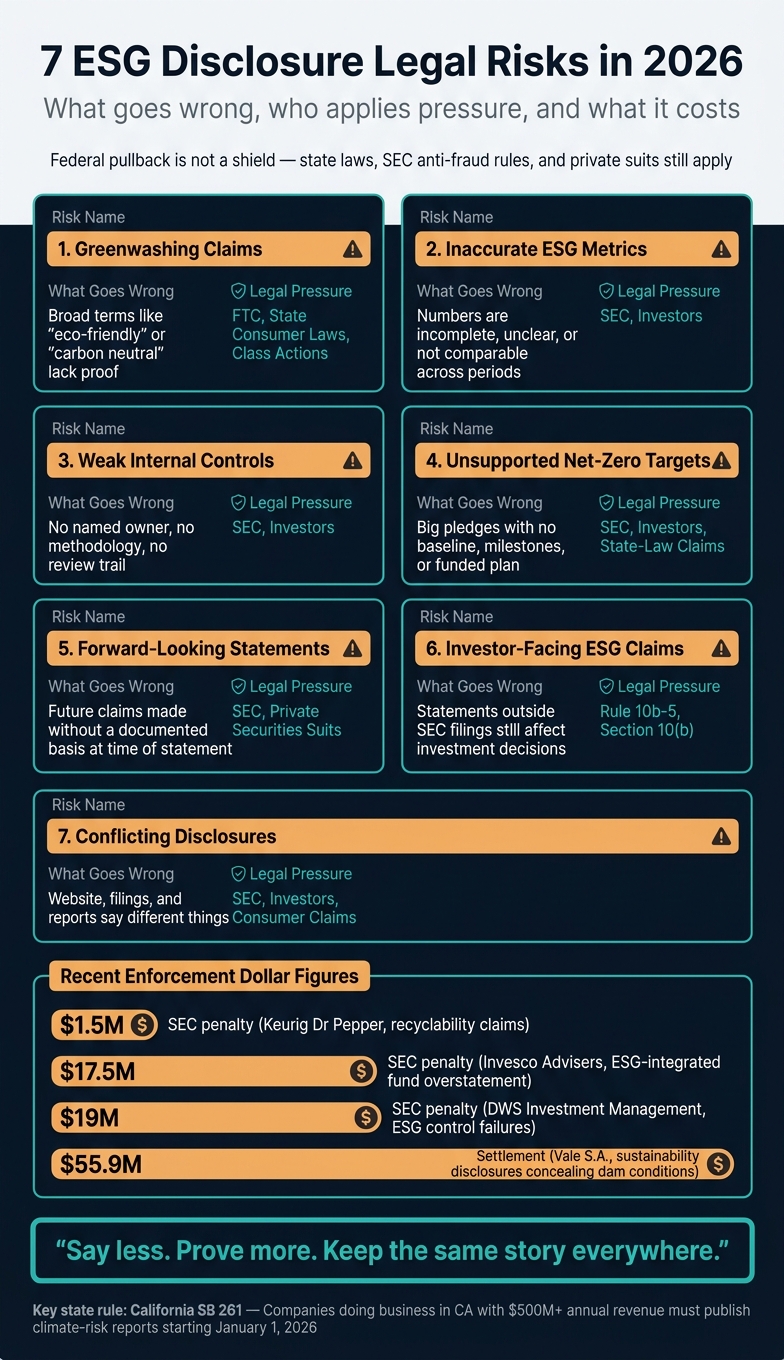
7 ESG Disclosure Legal Risks: What Goes Wrong & Who's Watching
ESG Litigation in the US – Disclosures and Risks
sbb-itb-8baf5f1
Quick comparison
| Risk area | What usually goes wrong | Main legal pressure |
|---|---|---|
| Greenwashing claims | Broad claims like “eco-friendly” or “carbon neutral” lack proof | FTC, state consumer laws, class actions |
| ESG metrics | Numbers are incomplete, unclear, or not comparable | SEC, investors |
| Internal controls | No owner, no method, no review trail | SEC, investors |
| Net-zero targets | Big pledges with no baseline, milestones, or plan | SEC, investors, state-law claims |
| Forward-looking statements | Future claims made without support at the time | SEC, private securities suits |
| Investor-facing ESG claims | Statements outside SEC filings still affect investment decisions | Rule 10b-5, Section 10(b) |
| Conflicting disclosures | Website, filings, and reports do not match | SEC, investors, consumer claims |
I’d approach every ESG statement the same way: What exactly was said? Who saw it? What proof existed on that date? That is the core test running through all seven risks.
Why ESG Statements Face More Scrutiny in 2026
ESG statements now draw pressure from securities law, consumer-protection law, and advertising rules. That pressure is not abstract. More than 150 U.S. greenwashing class actions were reportedly tracked through early 2025, with California and New York named as the busiest venues.[6] At the same time, ESG claims now show up almost everywhere a company speaks: investor materials, product pages, sustainability reports, press releases, and ad campaigns.
Federal uncertainty has not let companies off the hook at the state level. California's SB 261 now requires covered companies to publish climate-related financial risk reports. The law applies to companies doing business in the state with annual revenue above $500 million, and reports are required starting January 1, 2026.[3] In plain terms, federal and state rules are not moving in lockstep. A company can face less clarity in Washington while still dealing with firm duties in Sacramento.
That split matters because even a statement that is technically true can still mislead if it leaves out key context. An emissions-reduction claim, for instance, may leave out Scope 3 emissions or acquired businesses. A "carbon neutral" claim may also say too little about how much the result depends on offsets, how long those offsets last, or how they were counted.[7] That's often where trouble starts - not with an outright falsehood, but with the fine print no one saw.
Four issues sit behind most ESG disclosure disputes:
| Theme | Core Question | Why It Matters in 2026 |
|---|---|---|
| Substantiation | Can the claim be proven with reliable data? | FTC and state law require competent, reliable evidence before publication |
| Governance | Who reviewed and approved the underlying data? | Weak controls can make an isolated error look reckless |
| Consistency | Does the claim match across all public channels? | Contradictions between filings and marketing are a common plaintiff theory |
| Documented foundation | Was there a documented basis for the statement at the time it was made? | Targets and pledges without implementation plans face heightened challenge, especially for net-zero targets |
These four themes show up again and again. Substantiation asks whether the company can back up the claim. Governance looks at who checked the numbers and signed off. Consistency tests whether the same story appears in SEC-facing materials, websites, and campaigns. Documented foundation gets at a simple but sharp point: what support existed when the statement was made.
Before getting into the seven legal risks, it helps to settle one threshold issue: which statements count as ESG disclosures in the first place.
What Counts as an ESG Disclosure
An ESG disclosure is any public statement that can be checked for truth, completeness, and support. That covers claims about emissions, energy, water, offsets, climate strategy, transition plans, workforce data, and supply chains.
Not all claims carry the same legal risk. A product claim and a company-wide claim may sound similar on the surface, but the legal standard behind them can be very different.
Product claims often fall under FTC rules and state consumer protection laws. Company-wide claims more often draw securities risk. The proof bar changes too. A product claim usually leans on lifecycle data and certifications. A company claim leans on governed inventories and documented transition plans. Even broad terms like "sustainable", "eco-friendly," and "green" still count when they suggest a measurable environmental benefit. That scope test shapes how each of the seven risks below should be read.
Use this split to match each claim with the right legal standard and the proof needed to back it up:
| Claim Type | Main Legal Driver | Most Likely Challenger | Evidence Required |
|---|---|---|---|
| "Made with recycled content" | FTC Green Guides, State Consumer Protection Laws | Consumers, State AGs | Lifecycle assessment, third-party certification |
| "Carbon neutral" / "Net-zero" | SEC Antifraud Rules, State Securities Laws | Investors, SEC, Pension Fund Fiduciaries | Verified offsets, documented methodology |
| "Sustainably sourced" | FTC Green Guides, State Consumer Protection Laws | Consumers, State AGs, NGOs | Supplier audit trail, grievance mechanism |
| Workforce diversity metrics | SEC Antifraud Rules, State Securities Laws | Investors, SEC | Consistent reporting methodology |
1. Greenwashing and Environmental Marketing Claims
Greenwashing is one of the plainest examples of ESG disclosure litigation because it turns marketing copy into a proof problem. It shows up when ESG claims aren't backed by enough support. And a claim can still mislead even when part of it is true. Broad, unqualified terms like "eco-friendly" and "carbon neutral" carry extra risk because they imply an overall environmental benefit that may be hard - or flat-out impossible - to prove. That kind of language becomes dangerous when the support file doesn't line up with the claim.[1]
In the U.S., product-level ESG marketing claims can trigger scrutiny under FTC Section 5, state consumer-protection laws, and class actions. The FTC's Green Guides give courts and regulators a way to judge whether consumers were misled.[4][8]
The risk stops being abstract once those claims reach consumers, investors, and plaintiffs. In Bush v. Rust-Oleum Corp., a federal judge in California approved a $1.5 million settlement in October 2025 over Krud Kutter products labeled "Non-Toxic" and "Earth Friendly." Plaintiffs alleged that the products contained substances that could harm humans, animals, and the environment.[12] In Colgate-Palmolive's "Recyclable Tube" litigation, a federal court denied Colgate's motion to dismiss on February 6, 2024, allowing claims to move forward over whether the tube's physical characteristics sharply limited its acceptance in actual recycling programs.[11] Same core issue in both cases: what the company said, what the data showed, and what it left out.
Common trouble spots include:
Missing lifecycle data
Recycling claims that ignore local access
Offsets without additionality or retirement proof
Certification logos with no scope disclosure
The smart move is simple: build a substantiation file before anything goes public. Tie each material word to dated evidence, define the product boundary, and put qualifiers where readers will actually notice them. If the data doesn't support the line, don't use the line.
2. Inaccurate or Incomplete ESG Metrics
Once a company has support for the number itself, the next risk is whether the metric is complete and comparable. A number can be mathematically right and still leave readers with the wrong impression if it leaves out material limits, assumptions, or exclusions.
You can see this most clearly in recycling, AUM, and safety disclosures. The pattern is pretty consistent. Keurig Dr Pepper paid a $1.5 million penalty after the SEC said its recyclability claims left out the fact that two major recyclers would not accept the pods.[15] Invesco Advisers paid $17.5 million after the SEC said its "ESG integrated" asset share was overstated because passive ETF assets were included in the denominator.[14] Vale S.A. faced a $55.9 million settlement over sustainability consulting and disclosures that concealed the condition of its dams.[13][5]
In most cases, the problem doesn't start with bad intent on paper. It starts with loose metric definitions, weak reporting boundaries, missing source data, undocumented method changes, and manual compilation across several systems with no clear owner and no review trail. That’s where small gaps turn into public problems.
The fix is simple in concept, even if it takes discipline in practice: handle material ESG metrics the way finance teams handle controlled financial data. Give each metric a named data owner. Write down the definition and calculation method. Keep the source support. Then run consistency checks everywhere the number appears, including SEC filings, sustainability reports, earnings presentations, and the company website.
Percentage claims need even more care. Spell out exactly what sits in the denominator. Confirm that it lines up with the headline claim. If any assets, facilities, or products were left out, say so clearly.
| Risk pattern | Typical problem | Control response |
|---|---|---|
| Incomplete metric | Positive result omits material limits or adverse facts | Completeness certification and escalation process |
| Unsupported percentage | Denominator includes activities outside the stated ESG methodology | Lock denominator and document inclusion criteria |
| Methodology drift | Current metric isn't comparable with prior periods | Formal change-approval process with restatement |
| Inconsistent disclosure | Different figures appear across filings and public materials | Central disclosure inventory with cross-channel sign-off |
Put material limits in the main disclosure. A footnote disclaimer is not a cure.
3. Weak Internal Controls and Governance
A number can be accurate and still create trouble if the process behind it is undocumented or can’t be repeated. In many cases, the main issue isn’t just the figure on the page. It’s the control breakdown behind it. That’s the kind of gap that tends to draw regulator attention.
Regulators often look less at the number itself and more at whether a company’s ESG controls actually did what the company said they did. The SEC’s September 2023 action against DWS Investment Management Americas shows this clearly. The SEC alleged that DWS made misleading statements about its ESG-integrated products and failed to adopt and implement policies and procedures reasonably designed to ensure those public ESG statements were accurate. DWS agreed to a $19 million penalty, a censure, and a cease-and-desist order.[19] In May 2022, BNY Mellon Investment Adviser faced SEC charges for misstatements and omissions about ESG considerations in certain mutual funds, including a claim that some investments carried a quality-review score the firm had represented was applied to all investments.[20] In September 2022, Compass Minerals International agreed to a $12 million settlement in an SEC matter involving alleged disclosure violations arising from a deficient disclosure process and environmental contamination concerns.[17] Different facts, same pattern: missing ownership, weak sign-off, or no audit trail.
The usual trouble spots are familiar: no named data owner, no written methodology, no approval record, no board oversight, and no check against other public disclosures. A paper policy, on its own, doesn’t do much if no one checks whether people follow it.
The practical move is to handle ESG disclosure like a controlled reporting process, not a messaging exercise. That means one accountable owner for each material metric, written definitions and reporting boundaries, retained source data and calculation files, and cross-functional sign-off from legal, finance, and compliance. It also means testing whether written policies are followed in practice. Governance statements need special care. If a company says the board oversees ESG risk or that ESG is built into risk management, those claims should be checked against meeting agendas, minutes, and escalation records before publication.
| Governance gap | Higher-risk indicator | More defensible practice |
|---|---|---|
| Data collection | Manual spreadsheets, unclear ownership | Centralized inventory with named metric owners |
| Method approval | No record of who approved the method or when | Written methodology with dated approval log |
| Board oversight | No minutes or risk committee review of ESG data | Documented board materials with material ESG risks identified |
| Disclosure reconciliation | ESG statements bypass legal or compliance review | Mandatory sign-off for high-risk and externally sourced claims |
These failures matter most when ESG claims rely on judgment, estimates, or long-dated targets.
4. Unsupported Targets and Net-Zero Commitments
Even strong reporting controls won't save a target that has no factual footing. A net-zero pledge turns into legal risk when the support behind it is weak. A 2050 goal with no baseline, no defined emissions scope, no interim milestones, and no funded plan can be treated as a material claim rather than a vague aspiration.[22][26]
In investor materials, that can support securities-fraud claims. In marketing, it can trigger consumer-protection claims if the company can't back up the promise.[1][22][24] The legal theory shifts based on where the statement appears, but the core problem is often the same: the evidence doesn't match the claim.
The risk gets worse when companies blur the line between a commitment, a target, and an achieved result. Common trouble spots include missing Scope 3 data while using language that suggests full value-chain coverage, heavy use of offsets without records on additionality or permanence, and no capital-allocation plan tied to the stated reductions.[21] The Science Based Targets initiative is clear on this point: a commitment is a formal intent to develop and submit targets within 24 months, not proof that a validated target already exists.[25] When public disclosures use commitment, target, and validated target as if they mean the same thing, that kind of loose wording tends to draw scrutiny.
The same rule applies to the evidence file behind each claim. Every net-zero or emissions-reduction statement should be handled as a controlled disclosure, not a marketing line. Before publication, the statement should tie back to a documented greenhouse gas inventory. Scope 1, Scope 2, and any relevant Scope 3 categories should be clearly defined. The baseline year should be identified. Interim milestones should connect in a clear way to the long-term goal. If the company relies on offsets, those instruments need their own records covering credit quality, retirement status, and how they support direct reductions rather than stand in for them.[1][10]
| Evidence gap | Why it matters | Better practice |
|---|---|---|
| No documented emissions baseline | Claim cannot be verified | Reconcile baseline to GHG inventory with retained source data |
| Missing Scope 3 data despite broad language | Implies coverage the company cannot support | Define covered categories explicitly; disclose exclusions |
| Offsets substituting for direct reductions | Implies decarbonization without operational change | Separate reduction-versus-credit breakdown in disclosure |
| No interim milestones | Long-term target is unverifiable near term | Pair 2050 goal with quantified 2030 and annual indicators |
| No capital or operational plan | Target reads as aspirational, not achievable | Document planned actions, capital needs, and responsible owners |
Qualifying language matters, but only if it's accurate. A statement of intent is not the same as a verified progress claim. If the company hasn't finished the work needed to support a firm target, the disclosure should say that plainly. It should describe an ambition, not suggest that a verified commitment is already in place.[22]
5. Forward-Looking ESG Statements
A forward-looking ESG statement lays out future ESG commitments, targets, or projections. The legal danger starts when a company talks about a future ESG outcome as though it already rests on a documented foundation. Under Exchange Act Section 10(b) and SEC Rule 10b-5, plaintiffs may argue that a company announced a future ESG result without a reasonable basis for getting there. If that basis was missing at the time of the statement, the disclosure can be seen as materially misleading.
Once a company makes a target public, the risk changes. The issue is no longer just whether the target can be supported at the start. It also becomes whether later updates describe performance in an accurate way. The PSLRA safe harbor applies only to forward-looking statements that are properly labeled and paired with meaningful cautionary language that points to the main risks that could block the result. [29][30] The SEC’s March 6, 2024 climate-disclosure rule also extended safe harbor treatment to transition plans, scenario analysis, internal carbon pricing, and targets and goals. [28] Historical inputs still need separate support. [28]
In practice, many of these cases come down to one simple gap: there was no written basis for the claim when it was made. “On track” language is a good example. It suggests the company has measured progress against interim milestones and has a record showing where things stand. If that variance analysis does not exist in writing, the statement is much harder to defend. And when those statements shape investor expectations, the path to securities-fraud claims gets shorter.
| Forward-looking claim | Core risk | Control response |
|---|---|---|
| "We will reduce emissions 50% by 2030" | Future promise without a defensible basis | Document assumptions, milestones, resources, and governance |
| "We are on track to meet our 2030 target" | Implied progress without a written variance analysis | Require quantified progress analysis before approving this language |
| A scenario-based revenue forecast | Unsupported model assumptions or false precision | Disclose the model, sensitivities, limitations, and scenario source |
The practical answer is to treat each forward-looking ESG statement as a controlled disclosure. Before anything goes out, legal, finance, sustainability, and operations should check that the statement matches what the company has actually planned. The cautionary language should also name the main obstacles in plain terms, such as permitting delays, technology readiness, or financing limits that could keep the company from meeting the target. [29][30]
6. Securities Fraud and Investor Claims
Once ESG claims reach investors, the risk moves beyond marketing and into securities law. Statements made on earnings calls, in investor presentations, press releases, and sustainability reports can still trigger Section 10(b) and SEC Rule 10b-5, even when they do not appear in an SEC filing, if investors claim those statements mattered to an investment decision.[31][24]
A missed ESG target, by itself, is not securities fraud. The core issue is whether the statement was misleading when made, or whether it left out facts a reasonable investor would have needed. In other words, liability turns on what the company knew, what basis it had, and how it chose to speak at that moment - not on the simple fact that the ESG result later fell short. That is why the same ESG language can look harmless in a marketing piece but become far more risky in investor materials.[24]
The SEC has already brought ESG-related cases tied to fund marketing, asset-allocation statements, and disclosure controls. That track record shows how fast these claims can turn into securities matters.[14][33][34][35]
Poor records and uneven methods become a much bigger problem when they show up in investor-facing disclosures. One issue comes up again and again: different figures appearing across public investor materials with no explanation. Plaintiffs and courts are not limited to one document. They can look across all public channels, compare wording, and test whether the company had support for what it said. Because of that, companies should keep version histories, source data, assumptions, review comments, approvals, and decision logs anywhere ESG claims appear.[31][32]
A practical way to handle this is simple:
Treat material ESG statements the way you would treat other investor disclosures.
Assign clear ownership for each claim.
Document the method behind the number or statement.
Reconcile the claim across all public channels.
Send it through legal, finance, sustainability, and investor relations before publication.
If support is thin, the safer move is usually to narrow the claim, qualify it, delay it, or cut it.
| Alleged Misstatement Type | Primary Legal Exposure | Common Evidence Gap |
|---|---|---|
| ESG fund labeled as integrating ESG factors without doing so | SEC enforcement; private securities class actions | No records linking the stated policy to actual investment decisions |
| Sustainability claim omitting material sourcing or data limits | Rule 10b-5 omission claim | Missing documentation of known contradictory information |
| Precise ESG percentage without a defined classification rule | SEC enforcement; private securities class actions | No defensible denominator or classification methodology |
| Different figures in investor-facing materials with no reconciliation | Investor litigation; regulatory inquiry | No reconciliation records or explanation for differences |
The next risk appears when the same ESG claim shifts across filings, reports, and marketing.
7. Conflicting Disclosures and Disclosure Omissions
The last risk is inconsistency. ESG claims can drift across reports, filings, websites, earnings calls, and marketing, until the public record starts to say different things at once.[5][18] The problem usually is not a single bad figure. It is a set of statements that, taken together, does not line up.
This happens more often than many teams expect. A sustainability report may say climate-risk controls are fully in place, while the annual report says those same controls are still being built. Or a website may promise "net zero by 2050" without saying the goal covers only Scope 1 and Scope 2 emissions and depends in part on future offsets. In those cases, the key question is materiality - whether there is a substantial likelihood that a reasonable investor would see the missing or conflicting detail as changing the "total mix" of available information.[38] Not every mismatch will meet that bar, but every mismatch should be checked.[38][39]
A conflict turns into legal risk when one statement makes another one misleading. Under Rule 10b-5, an omission can create liability if it makes an affirmative statement misleading, even when the omission by itself would not support a private claim.[37][40] The Supreme Court's 2024 Macquarie Infrastructure Corp. v. Moab Partners decision made that point clearer: a pure omission alone will generally not support a private Rule 10b-5 claim.[37][40] What matters is the combined effect of the company’s public statements.
In practice, most conflicts come from basic gaps that no one tied together in time: different reporting boundaries, different base years, different methods, different source data, or different assumptions. Left unreconciled, those gaps can create trouble fast. And the risk is not limited to SEC filings. The SEC has pursued claims tied to sustainability reports and other ESG communications outside periodic filings.[41]
The fix is plain, even if the work is not. Use one central ESG disclosure inventory. Check it against every public claim before anything goes out. If a contradiction or omission shows up, pause publication - or pull the claim - if it may be materially misleading. Then correct the statement across all public channels, keep the review record, and decide whether the situation calls for a formal correction, a filing amendment, an investor communication, or notice to a regulator. That is why a line-by-line prepublication review matters so much.
| Disclosure Channel | Primary Risk | Control Response |
|---|---|---|
| Sustainability report vs. SEC filing | Boundary or methodology contradiction | Reconcile scope, base year, and method before publication |
| Website vs. investor presentation | Target omission or scope mismatch | Confirm qualifications appear consistently across all claims |
| Earnings call vs. annual report | Performance inconsistency | Document base year changes and restatements with comparable data |
| Product advertising vs. internal records | Unsupported carbon-neutral or offset claim | Verify offset role, permanence, and limitations are disclosed[7][36] |
Practical Risk Checks for Each Disclosure Item
Use one pre-publication review across all seven ESG disclosure risk areas. In practice, each ESG disclosure file should spell out the owner, definition, methodology, reporting period, boundary, units, source data, calculations, assumptions, approvals, and revision history. For Scope 1, record the facilities, activity data, emissions factors, consolidation method, exclusions, and approver. The FTC expects objective environmental claims to have competent and reliable supporting evidence before they are made, while SEC staff apply established anti-fraud principles to materially false or misleading disclosures.[1][2][5]
Targets and forward-looking statements need the same discipline. Document the baseline, milestones, implementation plan, capital needs, and dependencies. If offsets are part of the picture, record the project, standard, vintage, retirement status, ownership, and additionality basis. A specific commitment can create securities-law exposure if the company knew, or recklessly disregarded, that it could not achieve it.[23]
The table below sums up the core checks by risk area:
| Risk Area | Prepublication Checks |
|---|---|
| Greenwashing and environmental marketing | Define terms; test claim scope against evidence; document lifecycle, geography, product, and time-period limits; disclose exclusions and offset reliance. |
| ESG metrics | Assign an owner; define methodology; confirm period, boundary, units, source records, review trail, and reconciliation. |
| Internal controls and governance | Assign control owners; document input, calculation, review, approval, and change controls; separate prep from review; retain oversight evidence. |
| Targets and net-zero commitments | Set baseline, milestones, plan, capital needs, dependencies, offset assumptions, and covered emissions. |
| Forward-looking statements | Label projections; state assumptions, risks, and dependencies; confirm reasonable basis; update or withdraw when plans change. |
| Securities fraud and investor claims | Compare with filings, risk factors, MD&A, and internal facts; test omitted facts; document legal review; escalate red flags. |
| Conflicting disclosures and omissions | Maintain one inventory; compare definitions, periods, boundaries, and figures; explain changes; investigate discrepancies before release. |
Don’t stop at the headline claim. Apply these checks line by line. Absolute terms like "zero", "fully", "100%", "carbon neutral", and "net zero" call for the clearest support because they leave little room for ambiguity.[1][4]
Keep an exception log for data gaps, judgment calls, rejected wording, and final decisions.
Comparison Tables for ESG Disclosure Review
These tables turn the earlier risk checks into a fast prepublication review. They help teams find evidence gaps, sort the claim, and line up public wording before anything goes live. This is where ESG disclosure often becomes legally exposed: the evidence says one thing, the wording says another, or one channel drifts from the next. For climate metrics, present both absolute and intensity figures in metric tons of CO2e, and list offsets separately.
Table 1: Common ESG Metrics, Evidence Requirements, and Failure Points
| Common ESG Metric | Likely Evidence Requirements | Common Failure Points |
|---|---|---|
| Scope 1 & 2 GHG Emissions | Utility bills, fuel purchase records, refrigerant logs, reporting boundary, calculation file, emission factors, review or assurance status | Outdated emission factors; omitting small or recently acquired facilities; inconsistent organizational boundaries; no year-over-year baseline reconciliation |
| Scope 3 Value-Chain Emissions | Supplier surveys, bills of lading, spend-based proxies, GHG Protocol Scope 3 Standard methodology, calculation file | Double-counting; relying only on secondary data for high-impact suppliers; omitting material categories; unsupported estimates |
| Renewable Energy Use | Renewable energy certificates, power purchase agreements, metering records, retirement confirmation | Claiming renewable use without a clear boundary or retirement status; inconsistent treatment of certificates |
| Energy Consumption | Meter data, fuel logs, building management system exports, boundary definition | Inconsistent organizational boundary across reporting periods; acquisitions or divestitures not adjusted |
| Water Use | Facility water meters, municipal invoices, process records, water-stress context | Missing high-risk basin data; no distinction between withdrawal and consumption |
| Waste Diversion Rate | Hauler manifests, recycling receipts, landfill invoices, third-party weight tickets | Unverified hauler data; inconsistent methodology or boundary |
| Workforce Diversity | HR system exports, self-identification records, definition of covered workforce, reporting boundary | Inconsistent definitions of leadership or workforce; excluding contractors or part-time employees without disclosure |
| Employee Turnover | HR records, calculation methodology, baseline year, voluntary vs. total turnover distinction | Changing the denominator or definition between periods without explanation |
| Workplace Safety | Incident records, hours-worked data, calculation methodology, review status | Excluding contractor hours; inconsistent incident classification |
| Supply-Chain Human Rights | Supplier audits, traceability documentation, corrective action records, scope of covered suppliers | Relying on self-certifications; covering only Tier 1 suppliers while claiming value-chain scope |
| ESG Integration (Funds) | Written policy defining ESG integration, portfolio screening logs, fund-level application records | Applying the label to passive ETFs that do not use ESG factors. |
The Invesco settlement shows the risk of classifying passive ETFs as ESG-integrated without a written policy or matching methodology.[14]
Table 2: Aspiration vs. Target vs. Public Commitment
Not every ESG statement carries the same weight. A vague goal is one thing. A dated, metric-based promise is another. The wording matters, because once a company sounds definite in public, it needs proof to match.
| Disclosure Level | Definition | Example | Relative Scrutiny |
|---|---|---|---|
| General Aspiration | Direction stated without a defined metric, boundary, or deadline | We aspire to become a more sustainable company. | Lower |
| Measurable Target | Specific metric, baseline, boundary, and deadline, but no documented implementation plan | Reduce Scope 1 and Scope 2 emissions from U.S. facilities by 40% from a 2024 baseline by December 31, 2030. | Moderate |
| Public Commitment (Backed) | Target plus an approved budget, interim milestones, governance owner, supplier and operational responsibilities, and a process for revising when assumptions change | Net zero by 2050 with a 50% reduction by 2030, backed by a facility-level reduction roadmap, renewable-electricity procurement strategy, annual milestones, and progress data. | Higher if unsupported |
The wording signals the level of commitment. Terms like will, on track, carbon neutral, and science-based turn an aspiration into a claim that needs proof.
Once the claim level is set, reconcile it against every public channel.
Table 3: ESG Claim Reconciliation Across Channels
This is where many disclosure problems start. A claim looks fine in one place, then shifts a little in another. Maybe the website sounds broader than the SEC filing. Maybe a product label leaves out limits that appear in the sustainability report. To an outside reader, that mismatch can look like more than sloppiness.
If a plaintiff can compare two public versions of the same claim and find a mismatch, the company has a problem. Most disclosure disputes start when the same claim changes from one channel to the next. Every public ESG claim should be traceable to the same evidence package regardless of where it appears. Use the same claim ID, source records, reporting boundary, baseline and measurement period, methodology and emission factors, assumptions and estimates, limitations and exclusions, internal approvals, assurance status, related financial impacts, and links to other public statements.
| Public Claim Channel | Source Records | Assumptions & Limitations | Conflicting Statements Check |
|---|---|---|---|
| Sustainability Report | GHG inventory software, facility activity data, emission factors, calculation file | Defined reporting boundary, baseline year, assumptions, exclusions | Does the reported reduction match the Risk Factors and MD&A in the 10-K? |
| SEC Filing (10-K / 20-F) | Legal and compliance risk assessment, internal audit findings | Based on current regulatory posture; subject to change | Are material risks downplayed in the CEO letter or investor presentation? |
| Investor Presentation | Portfolio ESG screening logs, capital-expenditure plans | Limited to owned operations or actively managed funds, as applicable | Does the website claim broader or 100% integration? |
| Product Label / Advertising | Third-party lab tests, lifecycle assessment, recycling-access data | Recyclable refers to specific materials in specific geographies | Does the sustainability report acknowledge the label's limitations? |
| Website / Social Media | Supplier audit database, certification records | Sustainable sourcing covers only Tier 1 suppliers in North America | Does packaging imply broader coverage than the underlying data? |
| Executive Remarks / Earnings Calls | Transcript, internal briefing materials, IR review log | Statements made without matching disclosed targets and risk factors | Do forward-looking remarks align with disclosed targets and risk factors? |
Before publication, assign each claim a unique ID and attach the evidence package. If a claim changes across channels, classify the difference, assign an owner, and fix it before release.
Cross-Functional Review and Disclosure Readiness
Once the risk checks and reconciliation tables are done, one last gate remains: cross-functional sign-off. If a disclosure lacks a named reviewer, review date, and source evidence, it’s open to challenge. This review step acts as the control layer that keeps greenwashing, metric mistakes, and conflicting statements from slipping into public view.
Each team has a clear job. Legal looks for misleading or inconsistent wording. Finance ties figures back to accounting records. Sustainability checks methodologies, boundaries, and target definitions. Investor relations makes sure the content lines up with earnings materials. Operations confirms that the assets, facilities, suppliers, or projects behind the claims are real.
The review path should fit the disclosure channel. ESG data filed with the SEC should move through the same disclosure controls used for other material information, including CEO/CFO certification where applicable.[42][16] Voluntary reports and marketing claims can still create exposure when they clash with filed statements. That’s why marketing claims need legal review before publication, linked to the same evidence file.
Use one sign-off process across every channel, but adjust the controls based on the type of disclosure.
| Disclosure Type | Primary Control Focus | Key Documentation |
|---|---|---|
| SEC Filing (10-K, proxy, etc.) | Disclosure controls & procedures, CEO/CFO certification, materiality review | Sub-certifications, reconciliation workpapers, legal sign-off, version control |
| Voluntary Sustainability Report | Methodology control, data ownership, management approval | Boundary definitions, calculation files, assurance status, restatement explanations |
| Marketing & Advertising | Claim substantiation, consumer interpretation, legal review | Scientific or technical evidence, qualifications, cross-channel consistency check |
That sign-off record should feed straight into the pre-publication checklist. Before anything goes out the door, the final readiness gate should confirm that each material claim has a named owner, reviewer, review date, source file, calculation trail, and approver.
Pre-Publication ESG Disclosure Checklist
The last gate before release is a pre-publication checklist. This is the final control before anything goes live. It takes the earlier risk review and turns it into a clear release test, focused on four themes: substantiation, governance, consistency, and documentation.
Use this checklist immediately before publication. Before release, document these nine points:
| Checklist Item | What to Confirm | Evidence to Retain |
|---|---|---|
| Claim scope | Exact wording, audience, channel, entity, geography, and time period are specified | Claim memo, scope note |
| Applicable legal standards | Applicable U.S. federal, state, SEC, FTC, and exchange requirements are assessed | Jurisdiction review, materiality memo |
| Data traceability | Each published figure traces to source records and a named owner | Claim-to-source register, reconciliation workpapers |
| Methodology documentation | Method boundaries, baselines, exclusions, offsets, and assumptions are documented | Methodology file, protocol references |
| Cross-channel consistency | The same claim appears in every public channel | Comparison log, version history |
| Target support | Each commitment has a funded plan, accountable owner, and interim milestones | Road map, budget, governance records |
| Forward-looking label and cautionary language | Projections are labeled, assumptions disclosed, and cautionary language is claim-specific | Assumptions register, legal review memo |
| Documented approvals | Legal, finance, operations, sustainability, and executive sign-offs are on record | Approval matrix with names, dates, and versions |
| Retained evidence | Final wording, source data, approval log, and change history are stored and accessible | Auditable repository under retention policy |
If even one item is missing, stop the release until it is fixed.
The Keurig Dr Pepper case is a sharp reminder here. Operational ESG claims need to line up with the exact definitions and source records used in SEC filings.
Treat unresolved items as blockers, not loose ends. If a number does not trace back to source records, narrow the claim. If a target does not have a funded plan, add limits to the wording or hold publication. When the evidence is incomplete, the right move is to narrow the claim, delay publication, or remove the statement altogether.[1][9][43]
Conclusion
In 2026, ESG disclosure risk often comes down to a few plain problems: claims without backup, weak controls, mixed messages, and leaving out facts that matter. Even a statement that is technically correct can still mislead if it skips key limits, changes in baselines, or heavy reliance on offsets. Across all seven risks, the pattern is the same: weak proof, weak controls, or public statements that don’t line up.
The danger goes up when a company makes future-facing claims or broad environmental promises without a clear evidence file. Net-zero and carbon-neutral commitments need a defined baseline, scope, timeline, milestones, assumptions, and dependencies. Marketing claims need competent, reliable support before publication.
The answer is not just tighter wording. It is a stronger review and substantiation process. Frameworks and assurance can help, but they do not replace evidence, judgment, or legal review. The pre-publication checklist is the last line of defense, not a stand-in for proof. Exposure turns on wording, scope, evidence, audience, materiality, jurisdiction, and law.
The rulebook is still shifting. The SEC proposed rescinding its climate-disclosure rules in May 2026, but that move does not reduce exposure under current securities and consumer-protection laws.[27] California SB 261 requires covered companies doing business in the state and earning more than $500 million in annual revenue to report climate-related financial risks, with reporting due starting January 1, 2026.[3] In practice, that puts as much weight on the control process as on the rule itself.
The practical takeaway is simple: treat every material ESG statement as a cross-functional review item. Sustainability, finance, operations, and legal should all review the same claim before it goes public. Before release, test each ESG statement for support, consistency, and legal exposure.
This article provides general information, not legal advice. Companies should consult qualified U.S. securities, advertising, and environmental counsel on specific disclosures, claims, controls, and risks.
FAQs
Which ESG claims are riskiest?
The ESG claims most likely to create legal trouble are the ones that sound good but lack documented proof. Risk climbs fast when companies use broad or absolute terms like eco-friendly, sustainable, carbon neutral, or net zero without making the scope, assumptions, or time frame clear. If people can’t tell what the claim covers, how it was measured, or when it applies, the claim becomes much harder to defend.
Aspirational claims can create the same problem. Long-term decarbonization targets may look fine on paper, but they become high-risk when there’s no documented transition plan behind them, no interim milestones, and no capital set aside to get the work done. In plain English: if a company says it’s heading somewhere, it needs a map, checkpoints, and money for the trip.
Claims linked to third-party certifications or seals can also backfire when the verification process is weak or leaves room for confusion. A badge or label may give a claim more weight in the eyes of customers and regulators, which is exactly why weak verification can make it misleading.
Who can sue over ESG disclosures?
A lot of different parties can challenge ESG disclosures in court or through agency action. That group often includes:
Investors, through private securities lawsuits
Consumers or consumer groups, under state consumer-protection laws or the FTC Act
NGOs and advocacy groups, through complaints that can trigger investigations
In some jurisdictions, board members may also face personal liability if they approve disclosures that are materially misleading.
How should companies verify net-zero claims?
Companies should back net-zero claims with documented, verifiable evidence. That means keeping records that spell out the scope, assumptions, exclusions, and time periods behind each claim. If the paper trail is thin, the claim is too.
They also need a credible transition plan - one with interim milestones, allocated capital, and governance oversight. In plain terms, a company can’t just say where it wants to go; it has to show how it plans to get there, who’s accountable, and what resources are on the table.
ESG data should face the same level of scrutiny as financial reporting. That calls for strong internal controls and, where possible, third-party assurance. When companies treat this data with that kind of discipline, their claims carry more weight.



FAQ