In This Article
Controls-driven workflow to manage EPR scope, SKUs, fee calculation, filings, and record retention across state programs.
EPR Reporting: Circular Compliance Monitoring Guide
EPR reporting starts with knowing who must report, what materials count, and where products are sold. For each state, assign a filing owner, confirm current rules, and link reported quantities to source records.
California, Colorado, and Oregon have different requirements. A shared workflow can support all three, but producer definitions, fees, deadlines, and correction rules must stay separate.
The reporting process covers five steps:
Confirm scope: Identify responsible producers, covered products, exemptions, and registration duties.
Check quantities: Map SKU packaging, assign volumes by state, reconcile records, and verify units.
Calculate fees: Keep approved quantities separate from rates, credits, and payment terms.
Verify filings: Review submissions, confirm acceptance, and resolve rejected files.
Keep records: Retain supporting files, approvals, invoices, and payment proof. California and Colorado require five-year retention; confirm when each period starts.
Monthly change reviews and quarterly reconciliations help keep data ready before filing deadlines.
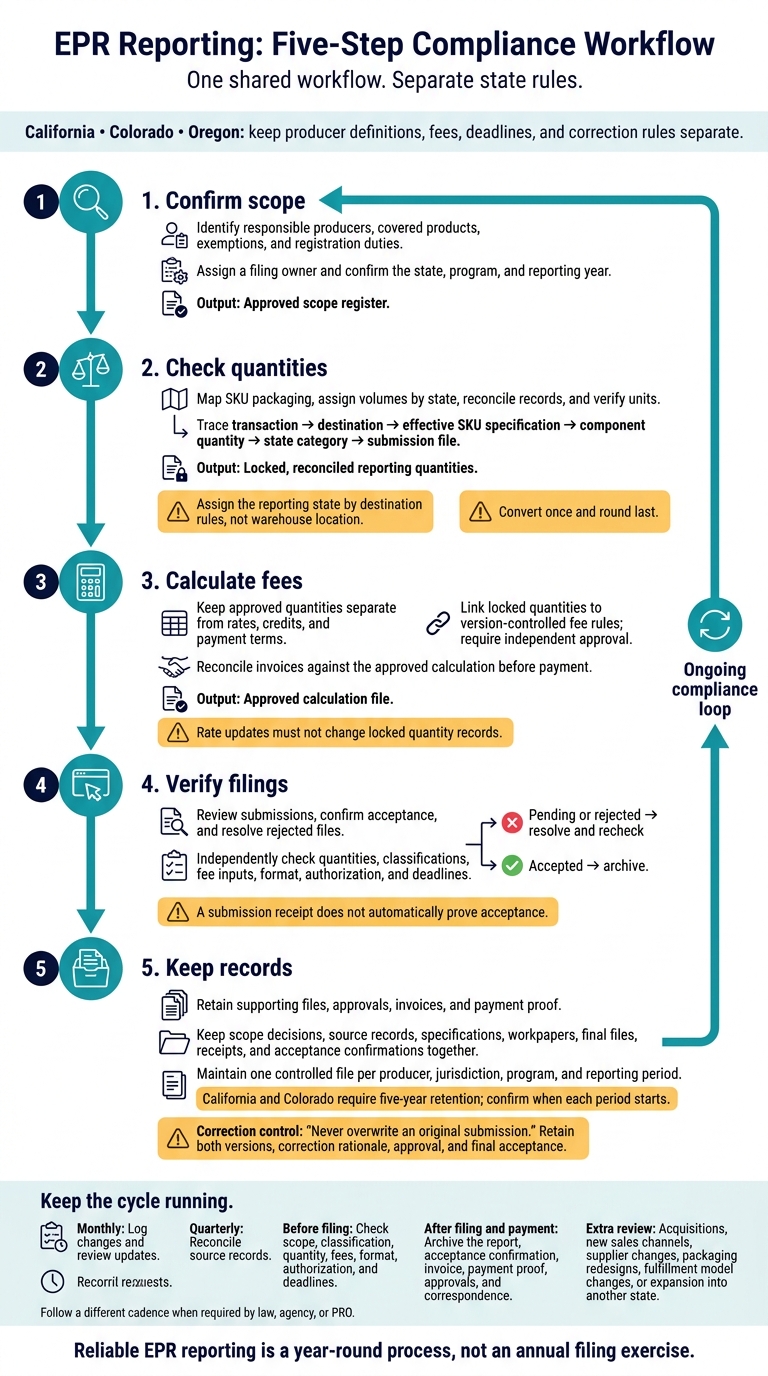
EPR Reporting: Five-Step Compliance Workflow
Volume Records and Reporting Data
Map SKUs to Products and Packaging
Use the state-by-state compliance register to lock the state, program, and reporting year before mapping packaging.
Create a version-controlled SKU-packaging record for every covered SKU. Include the product ID, legal producer, category, packaging format, component count, material type, plastic content, component weight, total package weight, unit of measure, supplier, effective date, change date, and approval owner. Link each record to specifications, supplier declarations, bills of materials, and exemption determinations. Keep unit-, case-, and pallet-level packaging records where covered.[6]
For California, track component counts and plastic-only weight separately. Break multilayer packaging into its material components so only plastic enters the plastic-weight total.[2][4]
Once SKU records are locked, assign volumes using transaction-level data - not summary totals.
Assign Reportable Quantities to Each State
Trace every quantity from its transaction through the destination, effective SKU specification, component quantity, state category, and state submission file. Keep invoice, shipment, and order-line identifiers. Assign the reporting state by destination rules, not warehouse location. For imports and marketplace sales, check state rules and contractual roles to confirm who reports. Processing payments alone does not make a party the responsible producer.
Keep sold, shipped, returned, exported, and transferred quantities separate. Apply each program’s rules before adding quantities together, and check distributor and intercompany records for duplicate reporting.
Send missing destinations for review. Use estimates only under an approved method. In Oregon, correct estimates before the next annual deadline when better data becomes available. Colorado allows prorated national totals under specified conditions.[7]
Reconcile Data Sources and Units
| Source | Use | Limit | Operational control owner | Reconciliation control |
|---|---|---|---|---|
| ERP or sales records | Units, SKUs, invoices | Billing address may differ from destination | Finance | Match sales lines to shipments and reversals |
| Shipment records | Destination and movement | May miss drop shipments or returns | Logistics | Match shipment quantities to sales and returns |
| Packaging bills of materials | Components and weights | Specifications can become outdated | Packaging engineering | Match effective dates to transactions |
| Supplier declarations | Composition and attributes | Data may be stale or estimated | Procurement | Compare with specifications and measured weights |
| Weight estimates | Fill specification gaps | Add uncertainty | Data owner and compliance reviewer | Approve method, affected units, and replacement date |
| Reporting templates | State categories and fields | Mapping or formula errors | Compliance | Tie totals to approved source data; lock formulas |
Convert once and round last. Preserve source units and use these conversions: 1 lb = 0.45359237 kg, 1 short ton = 907.18474 kg, and 1 metric ton = 1,000 kg. California requires metric reporting.[5] Follow the template’s rounding rules.
Flag missing weights rather than treating them as no packaging. For every estimate, record its source, method, affected SKUs, uncertainty, reviewer, approval date, and replacement deadline.
Use the reconciled totals as the fee-input layer in the next step.
sbb-itb-8baf5f1
Fee Calculations and Financial Controls
Separate Reporting Data From Fee Rules
Feed reconciled reporting totals into a separate fee-rule register. Link verified data - with quantities, classifications, and weights locked - to rates, thresholds, minimum charges, flat dues, credits, eco-modulation adjustments, exemptions, and payment terms. Rate updates must not change locked quantity records. Calculate charges using the program’s fee basis, not a default percentage of sales.
California SB 54 uses a PRO fee schedule to fund the approved plan, not a universal sales-percentage charge.[3][8]
Apply recyclability or design attributes only when fee rules require eco-modulation or other design-based adjustments. Keep the official schedule or notice, its source and version, publication date, effective period, calculation date, and evidence supporting classifications or adjustments. Store reporting periods, rate periods, invoice dates, and payment deadlines in separate fields.
Assign Fee Reviews and Approvals
Assign a named employee to each role below. Use locked formulas and version-controlled rate tables, and require someone other than the preparer to approve the calculation. Use one approved calculation file for review, approval, invoicing, and payment so state reporting data stays intact throughout fee processing.
| Fee input | Data owner | Supporting records | Review cadence | Calculation control | Exception trigger | Approver |
|---|---|---|---|---|---|---|
| Approved scope and state quantity | Compliance and sales operations/supply chain | Scope register, reconciled totals, exemption records | Each reporting cycle | Link approved scope and locked totals to fee calculation | New product, market, or exemption; unexplained variance or missing state allocation | Compliance manager |
| Material, format, and weight | Packaging engineering | Bills of materials, specifications, supplier data, scale records | Each cycle; annual master-data review | Verify component mapping and unit conversions | Unknown material or material change | Packaging lead |
| Rate and effective period | Tax, finance, or compliance | Official notice, schedule version, publication record | When revised; before calculation | Lock version-controlled rate table | Missing, expired, or conflicting rate | Tax/finance manager |
| Thresholds, minimums, and flat dues | Compliance | Program and PRO guidance, fee schedule | Each calculation | Separate rule flags and approvals | Threshold crossed or unexpected minimum | Compliance manager |
| Credits and eco-modulation adjustments | Sustainability and compliance | Design, recyclability, eligibility evidence | Each cycle; when attributes change | Require evidence before adjustment | Unsupported credit or adjustment | Sustainability director |
| Estimate or accrual | Finance | Calculation file, review sign-off | Monthly or quarterly close | Independently recalculate and check variance | Material change from prior estimate | Controller |
| Invoice or dues amount | Accounts payable/finance | PRO invoice, statement, purchase order | Upon receipt | Three-way match against the approved calculation file | Invoice differs from the approved estimate or report | Controller |
| Payment and remittance | Accounts payable | Payment confirmation, bank record, remittance notice | Each due date | Payment-calendar tracking and aging review | Late, partial, or unidentified payment | Treasury or controller |
Treat budgets and accruals as estimates until the invoice arrives. At each close, finance should record the expected obligation. Once billed, reconcile invoice lines against approved quantities, classifications, rates, and adjustments.
Investigate every variance that exceeds tolerance or lacks an explanation. Separate timing differences from quantity changes, revised rates, missing credits, minimum charges, late-submission charges, and errors. Document the resolution before approving payment, then true up the accrual. Match the approved amount to the accounts-payable entry and bank payment, and retain the payment date, reference, and outstanding balance.
Base submission checks and record retention on the approved calculation file.
Submission Checks and Record Retention
Use the approved calculation file as the control source for the final filing package.
Check Reporting Data and Submission Files
Check the package for completeness, accuracy, consistency, and timeliness. Before submission, have an independent reviewer compare the final file against locked quantities, fee inputs, and source records.
| Check | Failure risk | Owner | Retained records | Escalation path |
|---|---|---|---|---|
| Reporting entity and jurisdiction | Wrong legal entity, producer, or state | Compliance lead | Registration records and scope memo | Legal or program contact |
| Category and material completeness | Covered SKUs or packaging components omitted | Product data owner | SKU-to-material mapping and exclusion decisions | Business-unit owner |
| Volume reconciliation | Reported quantities do not match sales, shipment, or production records | Finance or data-control owner | Reconciliation workbook and source extracts | Escalate variances above the approved threshold |
| Product and packaging classifications | Incorrect material, format, or covered-material category | Packaging or regulatory specialist | Specifications, bills of materials, and classification rationale | Disputed classifications for documented review |
| Unit conversions | Pounds, kilograms, units, or other measures converted incorrectly | Data analyst | Conversion methodology and formulas | Unexplained or material differences |
| State allocations | National volumes assigned to the wrong state | Tax, sales, or distribution-data owner | State allocation logic and customer-location extracts | Missing or conflicting location data |
| Fee inputs | Rates, weights, modifiers, or exemptions applied incorrectly | Finance owner | Rate schedules and fee workpapers | Finance approver and PRO |
| Prior-period changes | Restatements or unusual changes lack explanation | Compliance lead | Year-over-year variance analysis and change log | Management |
| Approvals | Report lacks required certification or internal approval | Authorized signatory | Signed approval, authorization evidence, reviewer, review date, file version, unresolved issues, and approval decision | Before submission |
| File format and validation | Portal rejects an invalid template or field | Reporting coordinator | Final export, validation results, and error messages | Program or PRO technical contact |
| Reporting period | Data covers the wrong year or incomplete period | Compliance lead | Reporting-period confirmation | Immediately |
| Destination and deadline | File submitted to the wrong portal or after the deadline | Reporting coordinator | Submission calendar and portal receipt or acceptance notice | Management |
| Acceptance status | Upload is mistaken for completed filing | Reporting coordinator | Receipt, acceptance notice, status screen, and follow-up correspondence | Pending, rejected, or unclear status |
After validation, confirm the portal status before closing the filing. A submission receipt does not automatically prove acceptance. Save the timestamp, receipt number, validation results, and program acceptance status. Keep pending or rejected submissions open in the tracker until follow-up is complete.[9][10]
Keep a Complete Compliance File
After submission, lock the full evidence set in one record package. Keep scope decisions, registrations, source extracts, specifications, workpapers, rate schedules, approvals, final files, receipts, acceptance confirmations, invoices, and payment records together.
Maintain one controlled file for each producer, jurisdiction, program, and reporting period. Keep submitted versions read-only, and store a backup outside the portal. California and Colorado require five-year retention.[12][11] Verify when each program’s retention clock starts.
Handle Corrections and Reporting Exceptions
Log each issue in the compliance tracker with an owner, response deadline, affected records, and resolution. Resubmit only after the correction is approved. Route rejected files to the filing coordinator, missing evidence to the data owner, classification disputes to regulatory or legal review, and agency or PRO inquiries to the compliance lead.
Check each program’s correction procedure for required explanations, approvals, deadlines, and charges. Do not apply one state’s correction rule to another.
Never overwrite an original submission. Retain both versions, the original receipt or rejection, the reason for the correction, changed fields, reviewer approval, resubmission receipt, and final acceptance. Link any fee adjustment to the revised invoice, credit, or payment record. Check whether the same error affects other states or reporting periods.
Conclusion: Keep EPR Monitoring on Track
Apply the same controls each cycle to keep scope, data, fees, and filings aligned. Reliable EPR reporting is a year-round process, not an annual filing exercise. Use one control loop for scope, volumes, fees, filing, and records, while keeping state rules separate.[13][14]
Set a Recurring Compliance Schedule
Once the filing workflow is in place, follow a fixed schedule unless a law, agency, or PRO requires a different cadence. Screen launches, log changes monthly, and reconcile source records quarterly. Before filing, check scope, classification, quantity, fees, format, authorization, and deadlines. After filing and payment, archive the report, acceptance confirmation, invoice, payment proof, approvals, and correspondence.
Check agency and PRO updates throughout the year and before each filing. Run an extra review after acquisitions, new sales channels, supplier changes, packaging redesigns, fulfillment model changes, or expansion into another state. For each change, record its source, effective date, affected states and products or materials, owner, required action, and completion status.
Track Data Quality and Assign Owners
With the schedule set, assign one filing owner and make each team’s responsibilities clear. Operations owns specifications and quantities; procurement owns supplier evidence; finance owns state allocations and fees; and compliance owns scope and deadlines.
Track coverage, reconciliation rate, unresolved exceptions, filing timeliness, correction volume, financial impact, and file-retrieval time. Use these measures to spot gaps before the next reporting cycle.
Schedule the next review, confirm state and PRO calendars, and give every open action an owner and due date.
FAQs
How do I determine who reports marketplace sales?
Use your monitoring system’s responsibility assignment to identify who reports “units sold” within your EPR reporting boundary. Then link sales and order data to the person or system that manages it.
For EPR monitoring, Council Fire recommends tracking units sold, drop-off locations, and material weight by category. Set validation rules to flag missing or inconsistent data before submission [1].
What if suppliers cannot provide packaging weights?
Missing data is not zero. When suppliers can’t provide packaging weights, label any estimates as estimated, not measured, in your records.
Make weight reporting a binding requirement in supplier contracts, purchase orders, and specifications. Use structured templates or portal submissions with real-time validation to flag missing or inconsistent information before it enters your reporting system. Keep reported and verified data separate to support accurate regulatory submissions.
How should I prioritize EPR reporting errors?
Focus first on data gaps linked to your largest waste streams and circular interventions with the highest value or regulatory risk. Use automated, real-time checks to flag missing or inconsistent data before finalizing reports.
When errors occur, log them, trace their root causes, and follow formal procedures to restate reports when needed. Keep documentation audit-ready through version control and regular performance reviews.




FAQ