
Aug 10, 2026
Distributed vs Central Leadership in Ecosystem Governance
Sustainability Strategy
In This Article
Compare central, distributed, and hybrid governance for ecosystems—trade-offs in speed, trust, coordination, risk, and partner buy-in.
Distributed vs Central Leadership in Ecosystem Governance
If you need fast decisions, put authority in one place. If you need deep partner support, share it. If you need both, split the work on purpose.
I’d sum up the choice this way: central leadership is best for speed, standards, and clear accountability; distributed leadership is best for trust, local fit, and partner ownership. Most U.S. ecosystems - especially in climate, supply chains, and cross-sector work - end up needing a mix of both.
Before I go further, here’s the plain-English takeaway:
Central leadership works best when deadlines are fixed, rules must be consistent, and one group needs to keep everyone aligned.
Distributed leadership works best when success depends on local knowledge, shared decisions, and long-term partner support.
Hybrid models often work best because they keep targets and funding in one place while sharing implementation across the network.
The trade-offs usually show up in six areas: speed, trust, coordination, risk, partner buy-in, and context fit.
The article points to concrete signals:
54% of surveyed U.S. federal, state, and local officials said a centralized structure for climate adaptation funding was very or extremely useful.
CDP’s supply chain system supports 270+ corporations and about 45,000 suppliers, which shows why one standard process can matter at scale.
The Rio Grande Water Fund reached 100+ partners and restored about 251,000 acres by 2022, showing how shared leadership can work across many groups.
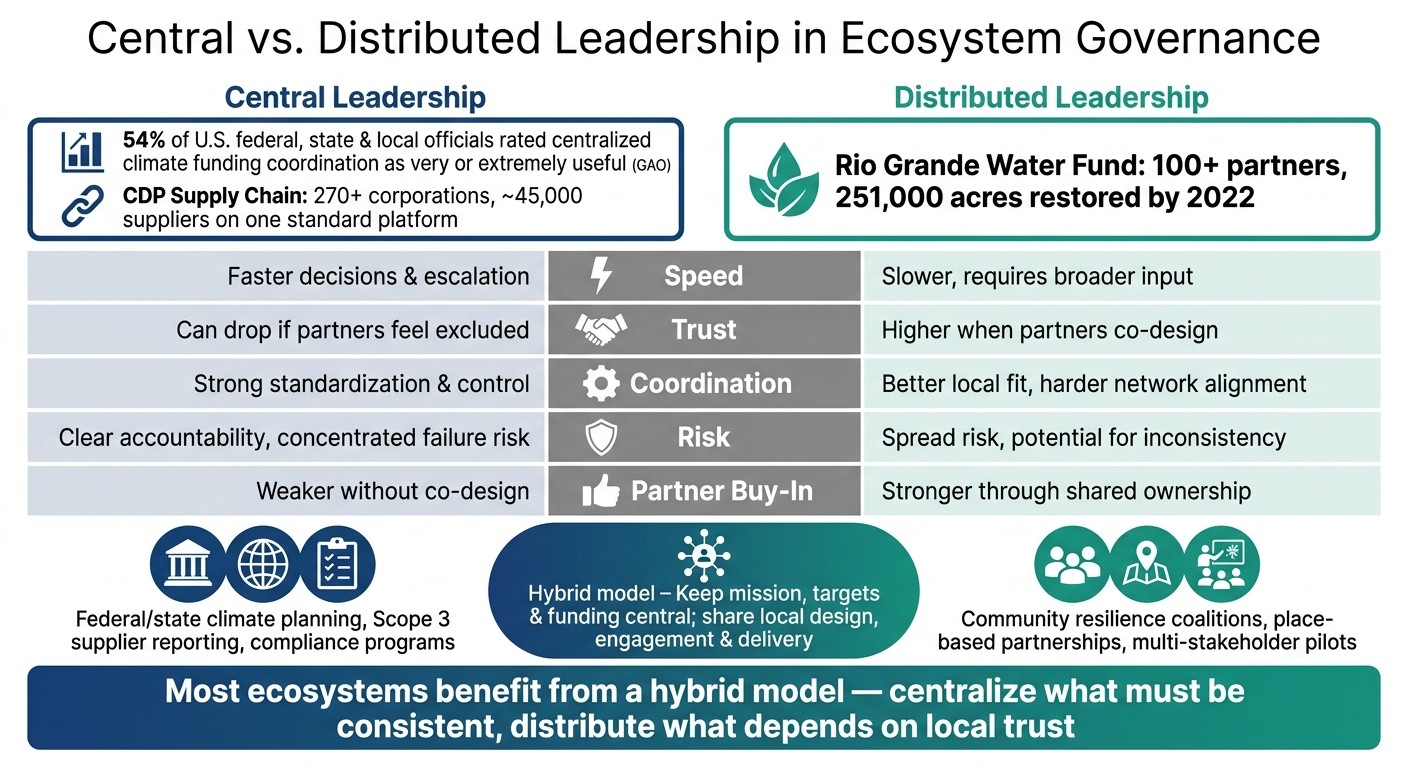
Central vs. Distributed Leadership in Ecosystem Governance: Key Trade-Offs
Quick Comparison
Criteria | Central leadership | Distributed leadership |
|---|---|---|
Decision-making | One lead group decides | Several partners share authority |
Speed | Faster alignment and escalation | Slower, with more discussion |
Trust | Can drop if partners feel left out | Often stronger when partners have a voice |
Coordination | Easier to standardize and track | Harder unless rules are clear |
Risk | Clear ownership, but more concentrated failure risk | Risk is spread out, but execution can vary |
Best fit | Compliance programs, state/federal planning, supplier reporting | Community coalitions, place-based work, shared pilots |
My bottom line: don’t pick a model by habit. Pick it by function. Keep mission, targets, funding, and accountability at the center when consistency matters. Share local design, engagement, and delivery when the work depends on trust and on-the-ground judgment.
Central leadership in ecosystem governance
Central leadership helps a network move fast when one group can set the rules, settle disagreements, and keep work on track. That speed is useful. But it often comes with friction.
Where central leadership gains speed and control
Central leadership tends to work best when the main problem is fragmentation. If a federal agency or coordinating body has clear decision rights, it can set priorities, issue one set of standards, and resolve conflicts without waiting for dozens of partners to agree first.[15][16] In plain terms, this model is strongest on speed and control, and weaker on buy-in.
The Inflation Reduction Act offers a clear example. The Biden administration set up the White House Office on Clean Energy Innovation and Implementation to coordinate clean-energy rollout across federal agencies.[13][14]
You see the same logic in enterprise supply chains. A central ESG or compliance team can push out one supplier code of conduct, one set of emissions reporting rules, and one risk-scoring system across thousands of suppliers.[3][4][8] Without that kind of control, business units often drift in different directions.
This also shows up in cross-sector climate programs. When one central body owns the performance dashboard and the reporting calendar, progress is easier to track, and follow-up tends to happen more consistently.[1][2][5][11][12]
Where central leadership can weaken trust and buy-in
The part that makes central leadership efficient can also make it feel imposed from above. When goals, timelines, and implementation rules arrive fully formed from the center, local partners may feel managed instead of included in the design. That gap matters, especially if you want long-term commitment.[5][6][7][11]
Central plans can also miss local conditions. A climate resilience program designed from the center may focus on one hazard and miss other local risks. If there are no clear feedback loops, those blind spots may not show up until rollout is already in motion.[6][7][9][10]
The bigger problem is often equity. If central decisions steer funding, visibility, and influence toward a small number of places while other partners carry more of the transition cost, trust starts to wear down. Some partners pull back. Others do the bare minimum.[6][7][9][10][11] Research on multi-level climate governance points to the same issue: centralized, siloed systems can weaken the perceived legitimacy of climate policy, especially when local governments and community organizations were not involved in shaping it.[5][7][9][11]
A practical fix is to keep central authority over standards and deadlines, while sharing design work so local partners can shape how implementation fits on the ground.
That tension leads directly to distributed leadership, where authority and accountability sit across the network.
Distributed leadership in ecosystem governance
When central leadership leans on speed and control, distributed leadership works differently. It spreads authority across the network. Local governments, NGOs, businesses, and community groups share control over goals, interpretation, and implementation. This is shared authority, not simple task delegation. Partners help set the direction and adjust execution to fit local conditions.
How distributed leadership builds trust and local responsiveness
The biggest upside is legitimacy. When people help shape the work, they’re more likely to stand behind it. Co-design, shared steering committees, and representative forums show that local know-how matters. It isn’t just being heard on the sidelines. A meta-analysis of participatory environmental governance found that real power-sharing and building trust improved cooperation and process quality more than learning mechanisms alone.[18]
A strong example comes from the Rio Grande Water Fund (RGWF) in New Mexico. By 2022, the Rio Grande Water Fund had more than 100 partners and had restored about 251,000 acres toward a 600,000-acre goal by 2034.[19] That kind of voluntary, cross-boundary coordination did not come from top-down orders. It grew through shared charters, a multi-stakeholder hub, and local actors with real authority over implementation.
Distributed decision rights also make local action easier. Different partners can try different approaches at the same time, compare results, and spread what works across the network. That matters in climate adaptation and nature-based solutions, where conditions can change a lot from one region to another.
That upside can turn into a problem when coordination and accountability fall short.
Where distributed leadership creates coordination and accountability challenges
The same traits that make distributed leadership more open also make it slower and tougher to manage. When many actors hold partial authority, it takes more time to line up priorities, and execution can drift from one partner to the next.
Research on global multi-stakeholder partnerships found that around one-third of World Summit on Sustainable Development (WSSD) partnerships lacked clear, quantifiable goals and review mechanisms, which directly limited their accountability and effectiveness.[17]
The answer is not to pull all power back to the center. It’s to be clear about the rules of the road:
Define which decisions stay local and which need network-wide agreement
Set shared metrics
Create escalation paths for disputes[17]
That trade-off leads straight to the comparison with central leadership: faster control versus broader buy-in.
Distributed vs. central leadership: direct trade-offs by use case
The best model depends on the job in front of you. Central leadership tends to win on speed and control. Distributed leadership tends to win on trust, local fit, and shared ownership. Across the five lenses this article follows - speed, trust, coordination, risk, and buy-in - each model brings a different set of trade-offs.
Central leadership puts decision rights in one place. Escalation paths are clear, and approvals often move fast. That said, when trust is low, people may hold back data, comply without much energy, or simply disengage. Distributed leadership usually moves at a slower pace because it makes room for local input and shared decisions. But that extra time often leads to stronger commitment and better execution on the ground. Central leadership makes accountability easy to see, though it also puts more system-wide failure risk in one place. Distributed leadership spreads that risk across the network, but it can lead to uneven execution.
Criteria | Central leadership | Distributed leadership |
|---|---|---|
Speed | Faster decisions and escalation | Slower decisions when broad input is required |
Trust | Can be lower if partners feel directed from the top | Often higher when partners help shape decisions |
Coordination | Stronger standardization and tighter control | Better local adaptation but harder network-wide alignment |
Risk | Clear accountability but higher system-wide failure risk | Shared risk but more chance of inconsistency or drift |
Partner buy-in | Can be weaker without co-design | Often stronger due to shared ownership |
In practice, these trade-offs usually push teams toward a hybrid design, not a pure version of either model.
Which model fits climate, supply chain, and cross-sector ecosystems
Climate work shows this split clearly. Federal or state climate planning with fixed deadlines usually calls for central leadership: clear authority, common standards, and fast coordination across agencies. A GAO survey found that 54% of relevant federal, state, and local officials rated a centralized government structure to coordinate adaptation funding as very or extremely useful for U.S. climate adaptation.[20] That makes sense when timing, funding rules, and cross-agency alignment all matter at once.
Community climate resilience work plays by different rules. When success depends on neighborhood trust, local knowledge, and long-term stewardship, distributed leadership often works better. People are more likely to stay involved when they help shape the work rather than just receive instructions from above.
Supply chains show a similar pattern. CDP's Supply Chain program is a centralized Scope 3 data platform that lets more than 270 corporations request standardized environmental data from about 45,000 suppliers.[21] If you're trying to gather comparable data at that scale, central control matters. Everyone has to work from the same playbook.
But circular supply chain innovation is another story. When brands, recyclers, and logistics providers are building new value chains together and testing pilots, a distributed or hybrid model tends to fit better. That setup gives partners room to test ideas, solve problems together, and adjust as they go.
Use case | Most suitable model | Why |
|---|---|---|
Federal or state climate planning with fixed deadlines | Central leadership | Clear authority, funding rules, and faster coordination |
Community climate resilience coalitions | Distributed leadership | Stronger local knowledge, trust, and participation |
Scope 3 reporting and supplier compliance programs | Central leadership | Consistent data standards, enforcement, and accountability |
Circular supply chain innovation across partners | Hybrid or distributed leadership | Shared experimentation and partner problem-solving matter |
Cross-sector infrastructure or place-based partnerships | Hybrid leadership | Central targets with distributed implementation usually work best |
Multi-stakeholder community partnerships | Distributed leadership | Broad representation improves legitimacy and long-term support |
The hard part is deciding how to divide authority without losing coordination. That middle ground is usually where hybrid governance begins.
Choosing a hybrid model and key takeaways
How to design a hybrid governance model
Those trade-offs lead to a practical answer: hybrid governance. Most ecosystems work best when they split control with care. Keep the parts that need consistency at the center, and let partners shape the parts that depend on local context.
The center should own mission, targets, funding, and accountability. Partners should shape implementation, local priorities, and community engagement within clear guardrails. That balance gives you consistency where it matters and room to act where conditions change on the ground.
Three moves help this model hold together. First, map decision rights. Second, set shared metrics. Third, create councils, hubs, or working groups with defined authority.
A simple decision-rights framework clears up who decides, who recommends, who must be consulted, and who stays informed across strategy, standards, funding, and operations. That sounds basic, but it prevents a lot of friction. Without it, teams waste time guessing, double-checking, or stepping on each other’s toes.
Once roles are clear, shared metrics help the center stay informed without grabbing control back. Stable funding matters too. It lets the center set rules and accountability while distributed partners carry out the work locally. Put together, these tools keep the model flexible without letting accountability drift.
Key points leaders should remember
When timelines are fixed and standards are non-negotiable, use central leadership. Clear authority and short escalation paths improve speed and coordination. That matters most in compliance-heavy programs and federally funded climate initiatives.
When success depends on local trust and long-term participation, distribute authority. Partners who help shape decisions are more likely to follow through. Community resilience coalitions and place-based partnerships need distributed leadership to build the buy-in that turns plans into action.
When both conditions apply, choose a hybrid model on purpose. A hybrid model is not a fallback. It is a governance choice. The key question is simple: which functions must stay central, and which should be distributed for local trust and adaptation? Answer that plainly, then revisit it as the ecosystem matures. That’s how leaders keep governance aligned across speed, trust, coordination, risk, and buy-in.
FAQs
How do I choose between central and distributed leadership?
Choose centralized leadership when you need one shared strategy, common standards, and the same metrics across teams or business units. It works well when consistency matters more than speed on the ground, and when you can live with slower local action or some distance from day-to-day work.
Choose distributed leadership when speed, local action, and strong department ownership matter most. This model helps teams move fast and stay close to what’s happening, but it needs close coordination so different groups don’t drift into conflicting approaches.
For cross-sector, climate, or supply chain work, the best results usually come from clear decision rights, open conflict resolution, trust-building, and steering or working groups that keep people aligned. In many cases, a hybrid model works best - as long as central direction and local execution are clearly split and everyone knows who owns what.
What decisions should stay central in a hybrid model?
In a hybrid governance model, central leadership should keep control of strategic shifts, major investments, and governance norms so the organization doesn’t splinter in different directions.
It should also define shared principles, performance measurement standards, and high-level stakeholder accountability. Day-to-day operations can sit with decentralized units to keep teams nimble, while central oversight helps ensure the work stays aligned with long-term sustainability and broader business goals.
When does distributed leadership slow progress too much?
Distributed leadership can slow progress when governance, decision-making, and conflict resolution aren’t clear. When no one knows who has the final say, teams can get stuck. Different work styles, competing priorities, and low trust often add friction, turning simple choices into long debates and draining momentum.
It can also falter when there are no grounded leaders to move the conversation forward and turn discussion into action. In that kind of setup, efforts often splinter during planning instead of lining up around a shared path. And when teams don’t have measurement that everyone trusts, focus starts to drift and results become much harder to prove.
Related Blog Posts
Latest Articles
©2025

Narrative Change and Power Building: The Missing Half of Advocacy
Narrative change is the process of disrupting dominant narratives that normalize inequity and advancing new narratives from historically marginalized communities.

Funding Resilience Without Federal Grants
BRIC is unreliable and FEMA is shrinking. Here's how cities fund climate resilience with dedicated revenue, blended finance, and a coordinating authority.

The ESG Blind Spot: How AI Is Finding Risks in Companies Nobody Else Is Watching
Norway's sovereign wealth fund uses AI to screen 7,200 portfolio companies for forced labor and corruption within 24 hours. The real story is the emerging-market coverage gap that traditional ESG data vendors miss — and what it means for any company with a global supply chain.
Narrative Change and Power Building: The Missing Half of Advocacy
Narrative change is the process of disrupting dominant narratives that normalize inequity and advancing new narratives from historically marginalized communities.
Funding Resilience Without Federal Grants
BRIC is unreliable and FEMA is shrinking. Here's how cities fund climate resilience with dedicated revenue, blended finance, and a coordinating authority.
The ESG Blind Spot: How AI Is Finding Risks in Companies Nobody Else Is Watching
Norway's sovereign wealth fund uses AI to screen 7,200 portfolio companies for forced labor and corruption within 24 hours. The real story is the emerging-market coverage gap that traditional ESG data vendors miss — and what it means for any company with a global supply chain.
FAQ
01
What does it really mean to “redefine profit”?
02
What makes Council Fire different?
03
Who does Council Fire work with?
04
What does working with Council Fire actually look like?
05
How does Council Fire help organizations turn big goals into action?
06
How does Council Fire define and measure success?
Aug 10, 2026
Distributed vs Central Leadership in Ecosystem Governance
Sustainability Strategy
In This Article
Compare central, distributed, and hybrid governance for ecosystems—trade-offs in speed, trust, coordination, risk, and partner buy-in.
Distributed vs Central Leadership in Ecosystem Governance
If you need fast decisions, put authority in one place. If you need deep partner support, share it. If you need both, split the work on purpose.
I’d sum up the choice this way: central leadership is best for speed, standards, and clear accountability; distributed leadership is best for trust, local fit, and partner ownership. Most U.S. ecosystems - especially in climate, supply chains, and cross-sector work - end up needing a mix of both.
Before I go further, here’s the plain-English takeaway:
Central leadership works best when deadlines are fixed, rules must be consistent, and one group needs to keep everyone aligned.
Distributed leadership works best when success depends on local knowledge, shared decisions, and long-term partner support.
Hybrid models often work best because they keep targets and funding in one place while sharing implementation across the network.
The trade-offs usually show up in six areas: speed, trust, coordination, risk, partner buy-in, and context fit.
The article points to concrete signals:
54% of surveyed U.S. federal, state, and local officials said a centralized structure for climate adaptation funding was very or extremely useful.
CDP’s supply chain system supports 270+ corporations and about 45,000 suppliers, which shows why one standard process can matter at scale.
The Rio Grande Water Fund reached 100+ partners and restored about 251,000 acres by 2022, showing how shared leadership can work across many groups.
Central vs. Distributed Leadership in Ecosystem Governance: Key Trade-Offs
Quick Comparison
Criteria | Central leadership | Distributed leadership |
|---|---|---|
Decision-making | One lead group decides | Several partners share authority |
Speed | Faster alignment and escalation | Slower, with more discussion |
Trust | Can drop if partners feel left out | Often stronger when partners have a voice |
Coordination | Easier to standardize and track | Harder unless rules are clear |
Risk | Clear ownership, but more concentrated failure risk | Risk is spread out, but execution can vary |
Best fit | Compliance programs, state/federal planning, supplier reporting | Community coalitions, place-based work, shared pilots |
My bottom line: don’t pick a model by habit. Pick it by function. Keep mission, targets, funding, and accountability at the center when consistency matters. Share local design, engagement, and delivery when the work depends on trust and on-the-ground judgment.
Central leadership in ecosystem governance
Central leadership helps a network move fast when one group can set the rules, settle disagreements, and keep work on track. That speed is useful. But it often comes with friction.
Where central leadership gains speed and control
Central leadership tends to work best when the main problem is fragmentation. If a federal agency or coordinating body has clear decision rights, it can set priorities, issue one set of standards, and resolve conflicts without waiting for dozens of partners to agree first.[15][16] In plain terms, this model is strongest on speed and control, and weaker on buy-in.
The Inflation Reduction Act offers a clear example. The Biden administration set up the White House Office on Clean Energy Innovation and Implementation to coordinate clean-energy rollout across federal agencies.[13][14]
You see the same logic in enterprise supply chains. A central ESG or compliance team can push out one supplier code of conduct, one set of emissions reporting rules, and one risk-scoring system across thousands of suppliers.[3][4][8] Without that kind of control, business units often drift in different directions.
This also shows up in cross-sector climate programs. When one central body owns the performance dashboard and the reporting calendar, progress is easier to track, and follow-up tends to happen more consistently.[1][2][5][11][12]
Where central leadership can weaken trust and buy-in
The part that makes central leadership efficient can also make it feel imposed from above. When goals, timelines, and implementation rules arrive fully formed from the center, local partners may feel managed instead of included in the design. That gap matters, especially if you want long-term commitment.[5][6][7][11]
Central plans can also miss local conditions. A climate resilience program designed from the center may focus on one hazard and miss other local risks. If there are no clear feedback loops, those blind spots may not show up until rollout is already in motion.[6][7][9][10]
The bigger problem is often equity. If central decisions steer funding, visibility, and influence toward a small number of places while other partners carry more of the transition cost, trust starts to wear down. Some partners pull back. Others do the bare minimum.[6][7][9][10][11] Research on multi-level climate governance points to the same issue: centralized, siloed systems can weaken the perceived legitimacy of climate policy, especially when local governments and community organizations were not involved in shaping it.[5][7][9][11]
A practical fix is to keep central authority over standards and deadlines, while sharing design work so local partners can shape how implementation fits on the ground.
That tension leads directly to distributed leadership, where authority and accountability sit across the network.
Distributed leadership in ecosystem governance
When central leadership leans on speed and control, distributed leadership works differently. It spreads authority across the network. Local governments, NGOs, businesses, and community groups share control over goals, interpretation, and implementation. This is shared authority, not simple task delegation. Partners help set the direction and adjust execution to fit local conditions.
How distributed leadership builds trust and local responsiveness
The biggest upside is legitimacy. When people help shape the work, they’re more likely to stand behind it. Co-design, shared steering committees, and representative forums show that local know-how matters. It isn’t just being heard on the sidelines. A meta-analysis of participatory environmental governance found that real power-sharing and building trust improved cooperation and process quality more than learning mechanisms alone.[18]
A strong example comes from the Rio Grande Water Fund (RGWF) in New Mexico. By 2022, the Rio Grande Water Fund had more than 100 partners and had restored about 251,000 acres toward a 600,000-acre goal by 2034.[19] That kind of voluntary, cross-boundary coordination did not come from top-down orders. It grew through shared charters, a multi-stakeholder hub, and local actors with real authority over implementation.
Distributed decision rights also make local action easier. Different partners can try different approaches at the same time, compare results, and spread what works across the network. That matters in climate adaptation and nature-based solutions, where conditions can change a lot from one region to another.
That upside can turn into a problem when coordination and accountability fall short.
Where distributed leadership creates coordination and accountability challenges
The same traits that make distributed leadership more open also make it slower and tougher to manage. When many actors hold partial authority, it takes more time to line up priorities, and execution can drift from one partner to the next.
Research on global multi-stakeholder partnerships found that around one-third of World Summit on Sustainable Development (WSSD) partnerships lacked clear, quantifiable goals and review mechanisms, which directly limited their accountability and effectiveness.[17]
The answer is not to pull all power back to the center. It’s to be clear about the rules of the road:
Define which decisions stay local and which need network-wide agreement
Set shared metrics
Create escalation paths for disputes[17]
That trade-off leads straight to the comparison with central leadership: faster control versus broader buy-in.
Distributed vs. central leadership: direct trade-offs by use case
The best model depends on the job in front of you. Central leadership tends to win on speed and control. Distributed leadership tends to win on trust, local fit, and shared ownership. Across the five lenses this article follows - speed, trust, coordination, risk, and buy-in - each model brings a different set of trade-offs.
Central leadership puts decision rights in one place. Escalation paths are clear, and approvals often move fast. That said, when trust is low, people may hold back data, comply without much energy, or simply disengage. Distributed leadership usually moves at a slower pace because it makes room for local input and shared decisions. But that extra time often leads to stronger commitment and better execution on the ground. Central leadership makes accountability easy to see, though it also puts more system-wide failure risk in one place. Distributed leadership spreads that risk across the network, but it can lead to uneven execution.
Criteria | Central leadership | Distributed leadership |
|---|---|---|
Speed | Faster decisions and escalation | Slower decisions when broad input is required |
Trust | Can be lower if partners feel directed from the top | Often higher when partners help shape decisions |
Coordination | Stronger standardization and tighter control | Better local adaptation but harder network-wide alignment |
Risk | Clear accountability but higher system-wide failure risk | Shared risk but more chance of inconsistency or drift |
Partner buy-in | Can be weaker without co-design | Often stronger due to shared ownership |
In practice, these trade-offs usually push teams toward a hybrid design, not a pure version of either model.
Which model fits climate, supply chain, and cross-sector ecosystems
Climate work shows this split clearly. Federal or state climate planning with fixed deadlines usually calls for central leadership: clear authority, common standards, and fast coordination across agencies. A GAO survey found that 54% of relevant federal, state, and local officials rated a centralized government structure to coordinate adaptation funding as very or extremely useful for U.S. climate adaptation.[20] That makes sense when timing, funding rules, and cross-agency alignment all matter at once.
Community climate resilience work plays by different rules. When success depends on neighborhood trust, local knowledge, and long-term stewardship, distributed leadership often works better. People are more likely to stay involved when they help shape the work rather than just receive instructions from above.
Supply chains show a similar pattern. CDP's Supply Chain program is a centralized Scope 3 data platform that lets more than 270 corporations request standardized environmental data from about 45,000 suppliers.[21] If you're trying to gather comparable data at that scale, central control matters. Everyone has to work from the same playbook.
But circular supply chain innovation is another story. When brands, recyclers, and logistics providers are building new value chains together and testing pilots, a distributed or hybrid model tends to fit better. That setup gives partners room to test ideas, solve problems together, and adjust as they go.
Use case | Most suitable model | Why |
|---|---|---|
Federal or state climate planning with fixed deadlines | Central leadership | Clear authority, funding rules, and faster coordination |
Community climate resilience coalitions | Distributed leadership | Stronger local knowledge, trust, and participation |
Scope 3 reporting and supplier compliance programs | Central leadership | Consistent data standards, enforcement, and accountability |
Circular supply chain innovation across partners | Hybrid or distributed leadership | Shared experimentation and partner problem-solving matter |
Cross-sector infrastructure or place-based partnerships | Hybrid leadership | Central targets with distributed implementation usually work best |
Multi-stakeholder community partnerships | Distributed leadership | Broad representation improves legitimacy and long-term support |
The hard part is deciding how to divide authority without losing coordination. That middle ground is usually where hybrid governance begins.
Choosing a hybrid model and key takeaways
How to design a hybrid governance model
Those trade-offs lead to a practical answer: hybrid governance. Most ecosystems work best when they split control with care. Keep the parts that need consistency at the center, and let partners shape the parts that depend on local context.
The center should own mission, targets, funding, and accountability. Partners should shape implementation, local priorities, and community engagement within clear guardrails. That balance gives you consistency where it matters and room to act where conditions change on the ground.
Three moves help this model hold together. First, map decision rights. Second, set shared metrics. Third, create councils, hubs, or working groups with defined authority.
A simple decision-rights framework clears up who decides, who recommends, who must be consulted, and who stays informed across strategy, standards, funding, and operations. That sounds basic, but it prevents a lot of friction. Without it, teams waste time guessing, double-checking, or stepping on each other’s toes.
Once roles are clear, shared metrics help the center stay informed without grabbing control back. Stable funding matters too. It lets the center set rules and accountability while distributed partners carry out the work locally. Put together, these tools keep the model flexible without letting accountability drift.
Key points leaders should remember
When timelines are fixed and standards are non-negotiable, use central leadership. Clear authority and short escalation paths improve speed and coordination. That matters most in compliance-heavy programs and federally funded climate initiatives.
When success depends on local trust and long-term participation, distribute authority. Partners who help shape decisions are more likely to follow through. Community resilience coalitions and place-based partnerships need distributed leadership to build the buy-in that turns plans into action.
When both conditions apply, choose a hybrid model on purpose. A hybrid model is not a fallback. It is a governance choice. The key question is simple: which functions must stay central, and which should be distributed for local trust and adaptation? Answer that plainly, then revisit it as the ecosystem matures. That’s how leaders keep governance aligned across speed, trust, coordination, risk, and buy-in.
FAQs
How do I choose between central and distributed leadership?
Choose centralized leadership when you need one shared strategy, common standards, and the same metrics across teams or business units. It works well when consistency matters more than speed on the ground, and when you can live with slower local action or some distance from day-to-day work.
Choose distributed leadership when speed, local action, and strong department ownership matter most. This model helps teams move fast and stay close to what’s happening, but it needs close coordination so different groups don’t drift into conflicting approaches.
For cross-sector, climate, or supply chain work, the best results usually come from clear decision rights, open conflict resolution, trust-building, and steering or working groups that keep people aligned. In many cases, a hybrid model works best - as long as central direction and local execution are clearly split and everyone knows who owns what.
What decisions should stay central in a hybrid model?
In a hybrid governance model, central leadership should keep control of strategic shifts, major investments, and governance norms so the organization doesn’t splinter in different directions.
It should also define shared principles, performance measurement standards, and high-level stakeholder accountability. Day-to-day operations can sit with decentralized units to keep teams nimble, while central oversight helps ensure the work stays aligned with long-term sustainability and broader business goals.
When does distributed leadership slow progress too much?
Distributed leadership can slow progress when governance, decision-making, and conflict resolution aren’t clear. When no one knows who has the final say, teams can get stuck. Different work styles, competing priorities, and low trust often add friction, turning simple choices into long debates and draining momentum.
It can also falter when there are no grounded leaders to move the conversation forward and turn discussion into action. In that kind of setup, efforts often splinter during planning instead of lining up around a shared path. And when teams don’t have measurement that everyone trusts, focus starts to drift and results become much harder to prove.
Related Blog Posts
Latest Articles
©2025
Narrative Change and Power Building: The Missing Half of Advocacy
Narrative change is the process of disrupting dominant narratives that normalize inequity and advancing new narratives from historically marginalized communities.
Funding Resilience Without Federal Grants
BRIC is unreliable and FEMA is shrinking. Here's how cities fund climate resilience with dedicated revenue, blended finance, and a coordinating authority.
The ESG Blind Spot: How AI Is Finding Risks in Companies Nobody Else Is Watching
Norway's sovereign wealth fund uses AI to screen 7,200 portfolio companies for forced labor and corruption within 24 hours. The real story is the emerging-market coverage gap that traditional ESG data vendors miss — and what it means for any company with a global supply chain.
FAQ
01
What does it really mean to “redefine profit”?
02
What makes Council Fire different?
03
Who does Council Fire work with?
04
What does working with Council Fire actually look like?
05
How does Council Fire help organizations turn big goals into action?
06
How does Council Fire define and measure success?
Aug 10, 2026
Distributed vs Central Leadership in Ecosystem Governance
Sustainability Strategy
In This Article
Compare central, distributed, and hybrid governance for ecosystems—trade-offs in speed, trust, coordination, risk, and partner buy-in.
Distributed vs Central Leadership in Ecosystem Governance
If you need fast decisions, put authority in one place. If you need deep partner support, share it. If you need both, split the work on purpose.
I’d sum up the choice this way: central leadership is best for speed, standards, and clear accountability; distributed leadership is best for trust, local fit, and partner ownership. Most U.S. ecosystems - especially in climate, supply chains, and cross-sector work - end up needing a mix of both.
Before I go further, here’s the plain-English takeaway:
Central leadership works best when deadlines are fixed, rules must be consistent, and one group needs to keep everyone aligned.
Distributed leadership works best when success depends on local knowledge, shared decisions, and long-term partner support.
Hybrid models often work best because they keep targets and funding in one place while sharing implementation across the network.
The trade-offs usually show up in six areas: speed, trust, coordination, risk, partner buy-in, and context fit.
The article points to concrete signals:
54% of surveyed U.S. federal, state, and local officials said a centralized structure for climate adaptation funding was very or extremely useful.
CDP’s supply chain system supports 270+ corporations and about 45,000 suppliers, which shows why one standard process can matter at scale.
The Rio Grande Water Fund reached 100+ partners and restored about 251,000 acres by 2022, showing how shared leadership can work across many groups.
Central vs. Distributed Leadership in Ecosystem Governance: Key Trade-Offs
Quick Comparison
Criteria | Central leadership | Distributed leadership |
|---|---|---|
Decision-making | One lead group decides | Several partners share authority |
Speed | Faster alignment and escalation | Slower, with more discussion |
Trust | Can drop if partners feel left out | Often stronger when partners have a voice |
Coordination | Easier to standardize and track | Harder unless rules are clear |
Risk | Clear ownership, but more concentrated failure risk | Risk is spread out, but execution can vary |
Best fit | Compliance programs, state/federal planning, supplier reporting | Community coalitions, place-based work, shared pilots |
My bottom line: don’t pick a model by habit. Pick it by function. Keep mission, targets, funding, and accountability at the center when consistency matters. Share local design, engagement, and delivery when the work depends on trust and on-the-ground judgment.
Central leadership in ecosystem governance
Central leadership helps a network move fast when one group can set the rules, settle disagreements, and keep work on track. That speed is useful. But it often comes with friction.
Where central leadership gains speed and control
Central leadership tends to work best when the main problem is fragmentation. If a federal agency or coordinating body has clear decision rights, it can set priorities, issue one set of standards, and resolve conflicts without waiting for dozens of partners to agree first.[15][16] In plain terms, this model is strongest on speed and control, and weaker on buy-in.
The Inflation Reduction Act offers a clear example. The Biden administration set up the White House Office on Clean Energy Innovation and Implementation to coordinate clean-energy rollout across federal agencies.[13][14]
You see the same logic in enterprise supply chains. A central ESG or compliance team can push out one supplier code of conduct, one set of emissions reporting rules, and one risk-scoring system across thousands of suppliers.[3][4][8] Without that kind of control, business units often drift in different directions.
This also shows up in cross-sector climate programs. When one central body owns the performance dashboard and the reporting calendar, progress is easier to track, and follow-up tends to happen more consistently.[1][2][5][11][12]
Where central leadership can weaken trust and buy-in
The part that makes central leadership efficient can also make it feel imposed from above. When goals, timelines, and implementation rules arrive fully formed from the center, local partners may feel managed instead of included in the design. That gap matters, especially if you want long-term commitment.[5][6][7][11]
Central plans can also miss local conditions. A climate resilience program designed from the center may focus on one hazard and miss other local risks. If there are no clear feedback loops, those blind spots may not show up until rollout is already in motion.[6][7][9][10]
The bigger problem is often equity. If central decisions steer funding, visibility, and influence toward a small number of places while other partners carry more of the transition cost, trust starts to wear down. Some partners pull back. Others do the bare minimum.[6][7][9][10][11] Research on multi-level climate governance points to the same issue: centralized, siloed systems can weaken the perceived legitimacy of climate policy, especially when local governments and community organizations were not involved in shaping it.[5][7][9][11]
A practical fix is to keep central authority over standards and deadlines, while sharing design work so local partners can shape how implementation fits on the ground.
That tension leads directly to distributed leadership, where authority and accountability sit across the network.
Distributed leadership in ecosystem governance
When central leadership leans on speed and control, distributed leadership works differently. It spreads authority across the network. Local governments, NGOs, businesses, and community groups share control over goals, interpretation, and implementation. This is shared authority, not simple task delegation. Partners help set the direction and adjust execution to fit local conditions.
How distributed leadership builds trust and local responsiveness
The biggest upside is legitimacy. When people help shape the work, they’re more likely to stand behind it. Co-design, shared steering committees, and representative forums show that local know-how matters. It isn’t just being heard on the sidelines. A meta-analysis of participatory environmental governance found that real power-sharing and building trust improved cooperation and process quality more than learning mechanisms alone.[18]
A strong example comes from the Rio Grande Water Fund (RGWF) in New Mexico. By 2022, the Rio Grande Water Fund had more than 100 partners and had restored about 251,000 acres toward a 600,000-acre goal by 2034.[19] That kind of voluntary, cross-boundary coordination did not come from top-down orders. It grew through shared charters, a multi-stakeholder hub, and local actors with real authority over implementation.
Distributed decision rights also make local action easier. Different partners can try different approaches at the same time, compare results, and spread what works across the network. That matters in climate adaptation and nature-based solutions, where conditions can change a lot from one region to another.
That upside can turn into a problem when coordination and accountability fall short.
Where distributed leadership creates coordination and accountability challenges
The same traits that make distributed leadership more open also make it slower and tougher to manage. When many actors hold partial authority, it takes more time to line up priorities, and execution can drift from one partner to the next.
Research on global multi-stakeholder partnerships found that around one-third of World Summit on Sustainable Development (WSSD) partnerships lacked clear, quantifiable goals and review mechanisms, which directly limited their accountability and effectiveness.[17]
The answer is not to pull all power back to the center. It’s to be clear about the rules of the road:
Define which decisions stay local and which need network-wide agreement
Set shared metrics
Create escalation paths for disputes[17]
That trade-off leads straight to the comparison with central leadership: faster control versus broader buy-in.
Distributed vs. central leadership: direct trade-offs by use case
The best model depends on the job in front of you. Central leadership tends to win on speed and control. Distributed leadership tends to win on trust, local fit, and shared ownership. Across the five lenses this article follows - speed, trust, coordination, risk, and buy-in - each model brings a different set of trade-offs.
Central leadership puts decision rights in one place. Escalation paths are clear, and approvals often move fast. That said, when trust is low, people may hold back data, comply without much energy, or simply disengage. Distributed leadership usually moves at a slower pace because it makes room for local input and shared decisions. But that extra time often leads to stronger commitment and better execution on the ground. Central leadership makes accountability easy to see, though it also puts more system-wide failure risk in one place. Distributed leadership spreads that risk across the network, but it can lead to uneven execution.
Criteria | Central leadership | Distributed leadership |
|---|---|---|
Speed | Faster decisions and escalation | Slower decisions when broad input is required |
Trust | Can be lower if partners feel directed from the top | Often higher when partners help shape decisions |
Coordination | Stronger standardization and tighter control | Better local adaptation but harder network-wide alignment |
Risk | Clear accountability but higher system-wide failure risk | Shared risk but more chance of inconsistency or drift |
Partner buy-in | Can be weaker without co-design | Often stronger due to shared ownership |
In practice, these trade-offs usually push teams toward a hybrid design, not a pure version of either model.
Which model fits climate, supply chain, and cross-sector ecosystems
Climate work shows this split clearly. Federal or state climate planning with fixed deadlines usually calls for central leadership: clear authority, common standards, and fast coordination across agencies. A GAO survey found that 54% of relevant federal, state, and local officials rated a centralized government structure to coordinate adaptation funding as very or extremely useful for U.S. climate adaptation.[20] That makes sense when timing, funding rules, and cross-agency alignment all matter at once.
Community climate resilience work plays by different rules. When success depends on neighborhood trust, local knowledge, and long-term stewardship, distributed leadership often works better. People are more likely to stay involved when they help shape the work rather than just receive instructions from above.
Supply chains show a similar pattern. CDP's Supply Chain program is a centralized Scope 3 data platform that lets more than 270 corporations request standardized environmental data from about 45,000 suppliers.[21] If you're trying to gather comparable data at that scale, central control matters. Everyone has to work from the same playbook.
But circular supply chain innovation is another story. When brands, recyclers, and logistics providers are building new value chains together and testing pilots, a distributed or hybrid model tends to fit better. That setup gives partners room to test ideas, solve problems together, and adjust as they go.
Use case | Most suitable model | Why |
|---|---|---|
Federal or state climate planning with fixed deadlines | Central leadership | Clear authority, funding rules, and faster coordination |
Community climate resilience coalitions | Distributed leadership | Stronger local knowledge, trust, and participation |
Scope 3 reporting and supplier compliance programs | Central leadership | Consistent data standards, enforcement, and accountability |
Circular supply chain innovation across partners | Hybrid or distributed leadership | Shared experimentation and partner problem-solving matter |
Cross-sector infrastructure or place-based partnerships | Hybrid leadership | Central targets with distributed implementation usually work best |
Multi-stakeholder community partnerships | Distributed leadership | Broad representation improves legitimacy and long-term support |
The hard part is deciding how to divide authority without losing coordination. That middle ground is usually where hybrid governance begins.
Choosing a hybrid model and key takeaways
How to design a hybrid governance model
Those trade-offs lead to a practical answer: hybrid governance. Most ecosystems work best when they split control with care. Keep the parts that need consistency at the center, and let partners shape the parts that depend on local context.
The center should own mission, targets, funding, and accountability. Partners should shape implementation, local priorities, and community engagement within clear guardrails. That balance gives you consistency where it matters and room to act where conditions change on the ground.
Three moves help this model hold together. First, map decision rights. Second, set shared metrics. Third, create councils, hubs, or working groups with defined authority.
A simple decision-rights framework clears up who decides, who recommends, who must be consulted, and who stays informed across strategy, standards, funding, and operations. That sounds basic, but it prevents a lot of friction. Without it, teams waste time guessing, double-checking, or stepping on each other’s toes.
Once roles are clear, shared metrics help the center stay informed without grabbing control back. Stable funding matters too. It lets the center set rules and accountability while distributed partners carry out the work locally. Put together, these tools keep the model flexible without letting accountability drift.
Key points leaders should remember
When timelines are fixed and standards are non-negotiable, use central leadership. Clear authority and short escalation paths improve speed and coordination. That matters most in compliance-heavy programs and federally funded climate initiatives.
When success depends on local trust and long-term participation, distribute authority. Partners who help shape decisions are more likely to follow through. Community resilience coalitions and place-based partnerships need distributed leadership to build the buy-in that turns plans into action.
When both conditions apply, choose a hybrid model on purpose. A hybrid model is not a fallback. It is a governance choice. The key question is simple: which functions must stay central, and which should be distributed for local trust and adaptation? Answer that plainly, then revisit it as the ecosystem matures. That’s how leaders keep governance aligned across speed, trust, coordination, risk, and buy-in.
FAQs
How do I choose between central and distributed leadership?
Choose centralized leadership when you need one shared strategy, common standards, and the same metrics across teams or business units. It works well when consistency matters more than speed on the ground, and when you can live with slower local action or some distance from day-to-day work.
Choose distributed leadership when speed, local action, and strong department ownership matter most. This model helps teams move fast and stay close to what’s happening, but it needs close coordination so different groups don’t drift into conflicting approaches.
For cross-sector, climate, or supply chain work, the best results usually come from clear decision rights, open conflict resolution, trust-building, and steering or working groups that keep people aligned. In many cases, a hybrid model works best - as long as central direction and local execution are clearly split and everyone knows who owns what.
What decisions should stay central in a hybrid model?
In a hybrid governance model, central leadership should keep control of strategic shifts, major investments, and governance norms so the organization doesn’t splinter in different directions.
It should also define shared principles, performance measurement standards, and high-level stakeholder accountability. Day-to-day operations can sit with decentralized units to keep teams nimble, while central oversight helps ensure the work stays aligned with long-term sustainability and broader business goals.
When does distributed leadership slow progress too much?
Distributed leadership can slow progress when governance, decision-making, and conflict resolution aren’t clear. When no one knows who has the final say, teams can get stuck. Different work styles, competing priorities, and low trust often add friction, turning simple choices into long debates and draining momentum.
It can also falter when there are no grounded leaders to move the conversation forward and turn discussion into action. In that kind of setup, efforts often splinter during planning instead of lining up around a shared path. And when teams don’t have measurement that everyone trusts, focus starts to drift and results become much harder to prove.
Related Blog Posts
Latest Articles
©2025
Narrative Change and Power Building: The Missing Half of Advocacy
Narrative change is the process of disrupting dominant narratives that normalize inequity and advancing new narratives from historically marginalized communities.
Funding Resilience Without Federal Grants
BRIC is unreliable and FEMA is shrinking. Here's how cities fund climate resilience with dedicated revenue, blended finance, and a coordinating authority.
The ESG Blind Spot: How AI Is Finding Risks in Companies Nobody Else Is Watching
Norway's sovereign wealth fund uses AI to screen 7,200 portfolio companies for forced labor and corruption within 24 hours. The real story is the emerging-market coverage gap that traditional ESG data vendors miss — and what it means for any company with a global supply chain.
FAQ
What does it really mean to “redefine profit”?
What makes Council Fire different?
Who does Council Fire work with?
What does working with Council Fire actually look like?
How does Council Fire help organizations turn big goals into action?
How does Council Fire define and measure success?