Jul 11, 2026
Digital Twins: Key to Circular Economy Success
Sustainability Strategy
In This Article
Treat digital twins as decision tools: begin with energy, water, and predictive maintenance to cut waste and prove ROI before scaling.
Digital Twins: Key to Circular Economy Success
If you want a circular industrial park, start with digital twins for energy, water, and maintenance first. The research is clear on that point: the strongest proof today is in energy efficiency, water reuse, and predictive maintenance, while park-wide material exchange is still less proven.
I see three takeaways from the article:
Digital twins help parks track energy, water, materials, and equipment in near real time
Studies report up to 15% lower energy demand and 25% lower CO2 and greenhouse gas emissions
The best first rollout is usually a phased setup: start small, prove ROI, then expand across tenants and shared systems
A few facts stand out:
Kalundborg’s symbiosis network exchanges about 2.9 million metric tons of by-products and waste each year
Governance failures drive more than 50% of ecosystem breakdowns
Park-level success depends less on software alone and more on shared data, trust, rules, and clear KPIs
Here’s the short version: I’d treat a digital twin as a decision tool, not just a dashboard. Use it first where the evidence is strongest - energy, water, and asset upkeep - then extend it into reuse, recycling, and tenant-to-tenant exchange once the data base and governance model are in place.
That is the core message of the article.
How Digital Twins Support Circularity in Industrial Parks
Resource Monitoring, Energy Optimization, and Waste Reduction
Digital twins track material, water, and energy flows across an industrial park in real time, which helps operators find losses and cut waste. When paired with IoT data and analytics, they give tenants and shared utilities one shared view of resource use. That matters because people can’t fix what they can’t see. A shared twin also lets tenants coordinate resource management instead of working in separate silos.
The same visibility helps at the equipment level too, especially when teams need to decide whether to repair, service, or replace an asset.
Predictive Maintenance and Equipment Life Extension
Predictive maintenance cuts repair costs and helps avoid unplanned downtime. When IoT-enabled predictive maintenance algorithms are built into digital twin platforms, they can assess equipment performance and schedule repairs before a breakdown happens [2]. From a circularity standpoint, the value is simple: it supports repair instead of replacement.
Teams can also test refurbishment or maintenance options in a virtual setting before making a move [2]. That gives operators a lower-risk way to extend asset life and reduce material waste. In plain terms, it helps parks get more use out of the equipment they already own.
That same data layer can also support exchange between tenants.
Reuse, Recycling, and Industrial Symbiosis Coordination
Digital twins can help coordinate industrial symbiosis by matching one tenant’s by-products with another tenant’s input needs. In Denmark, the Kalundborg Industrial Symbiosis network exchanges about 2.9 million metric tons of by-products and waste each year through its connected system [1].
Recent research points to digitalization as a key enabler of this kind of coordination:
"Digitalization - via IoT, blockchain, and artificial intelligence - acts as a catalyst for improving the efficacy of industrial symbiosis. These technologies facilitate a continuous flow of information among partners." - MDPI Sustainability [1]
Digital twins can also support material passports - digital records that document a component’s composition, recycled content, and disassembly methods. That makes higher-value recycling and reuse more feasible at end of life [3]. Smart contracts can also automate tenant agreements and cut the admin work tied to resource sharing [2][1].
Recent studies also show that some of these uses are more mature than others, while the evidence base for other applications is still limited.
Circular Cities • Modeling Positive Energy Districts Using Digital Twins
What Recent Studies Show About Park-Level Applications
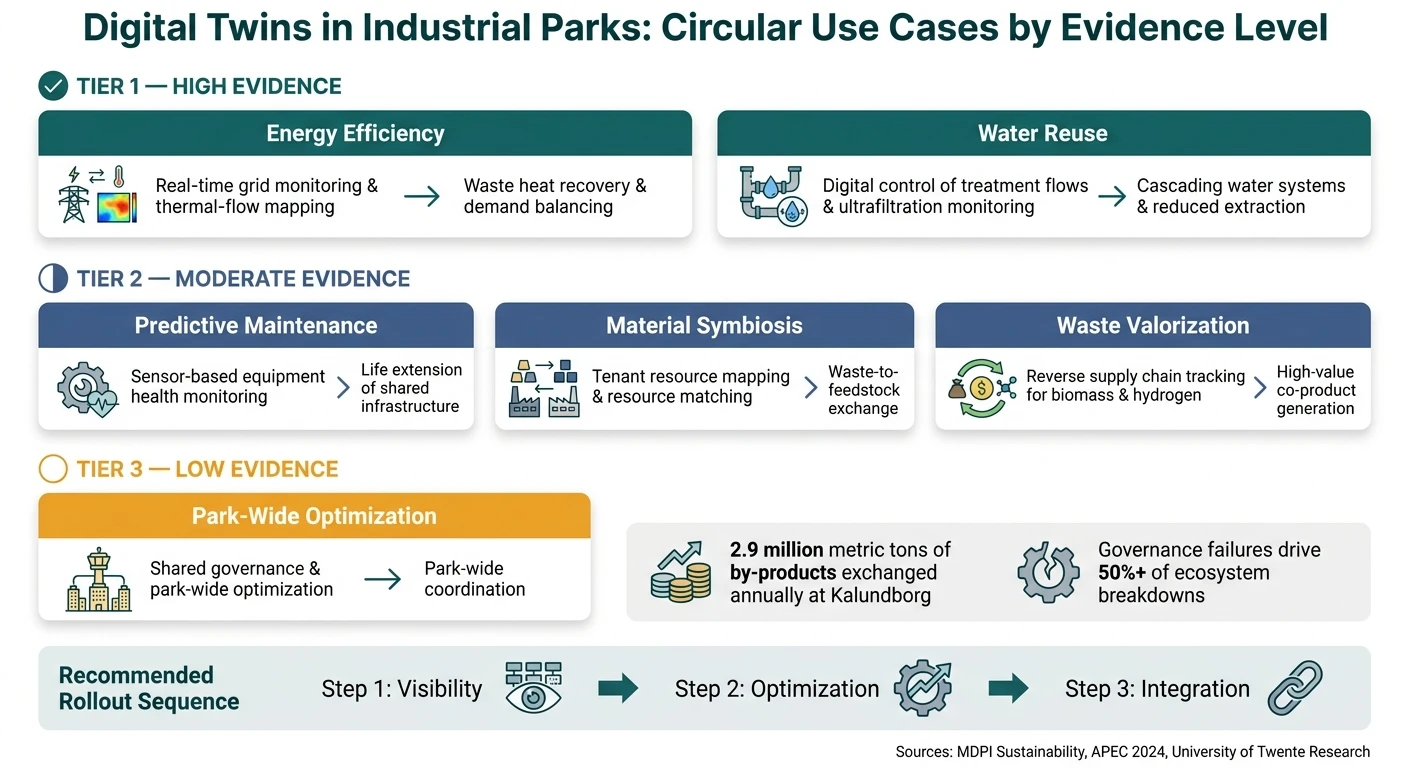
Digital Twins for Circular Economy: Use Cases by Evidence Level
The key question isn’t what digital twins could do. It’s which park-level uses already have solid backing in the literature.
The Most Developed Use Cases in the Literature
Recent studies point most clearly to energy efficiency and water reuse as the best-supported park-level applications. In practice, that means things like real-time grid monitoring, thermal-flow mapping, and heat recovery tuning. These are the most established use cases in the research, with examples such as Kalundborg and TEDA.
Predictive maintenance also has decent support, though mostly at the facility level. Using sensors to track equipment health is no longer a fringe idea. The harder part is stretching that model across shared park systems, where many tenants rely on the same assets. That shift is still taking shape.
Beyond these better-tested uses, the more connected circular applications are still at an early stage.
Where Evidence Is Still Emerging
This gap in the evidence shows up most clearly in areas where parks need tight coordination across tenants, shared utilities, and reverse flows.
Material symbiosis coordination is still mostly in the pilot phase. Park-wide coordination remains largely experimental, and full-scale deployment is still limited.
One example is the HUB-CEIS hub in Fundão, Portugal, which uses IoT and AI to manage a reverse supply chain for green hydrogen from forest biomass waste and is estimated to reduce 120,000 metric tons of CO2 per year [1].
Governance is still a major barrier in multi-tenant parks. More teams are now looking at digital twins as governance tools, not just monitoring systems. The appeal is simple: shared, transparent data on economic and environmental outcomes can make it easier for tenants to work together. That matters because it shifts the role of the park from just tracking resources to coordinating circular exchanges.
The table below separates the more mature applications from the ones still taking shape.
Comparison Table: Circular Function, Twin Capability, and Evidence Level
Circular Function | Digital Twin Capability | Operational Benefit | Evidence Level |
|---|---|---|---|
Energy Efficiency | Real-time grid monitoring and thermal-flow mapping | Waste heat recovery and demand balancing | High |
Water Reuse | Digital control of treatment flows and ultrafiltration monitoring | Cascading water systems and reduced extraction | High |
Predictive Maintenance | Sensor-based equipment health monitoring | Life extension of shared infrastructure | Moderate |
Material Symbiosis | Tenant resource mapping and resource matching | Waste-to-feedstock exchange | Moderate |
Waste Valorization | Reverse supply chain tracking for biomass and hydrogen | High-value co-product generation | Moderate |
Park-Wide Optimization | Shared governance and park-wide optimization | Park-wide coordination | Low |
These maturity gaps should help shape which use cases parks tackle first.
Implementation Requirements and Barriers
Core Technical Requirements
These use cases stand or fall on one thing: reliable park-wide data infrastructure. Park-level digital twins need interoperable systems that pull data across firms and asset types into one usable view. Without that, the model is just a patchwork.
Shared data standards matter here. So do EPD inputs and material passports, which help keep park data interoperable and traceable [3]. AI and simulation tools also play a clear role. They let teams test scenarios, weigh trade-offs, and compare primary and recycled inputs before making costly decisions [3].
Data, Cost, and Integration Barriers
The biggest obstacles are familiar but stubborn: incomplete data, high cost, and hard cross-tenant sharing. That problem gets sharper in parks where each tenant controls its own dataset and guards it closely. In many cases, park environmental data is incomplete or inconsistent [3], which makes it harder to build a reliable park-level digital twin in the first place.
Cost is another sticking point. Building a park-level twin takes major upfront investment, so not every use case makes sense on day one. Security concerns add more friction, especially when data has to move across multiple parties. Traceable data-sharing protocols can lower that risk [1], but they don't remove the need for trust, rules, and day-to-day coordination.
These limits shape rollout choices. In plain terms, teams should start with the smallest set of use cases that can show clear ROI without forcing a full-park build from the start.
Comparison Table: Key Barriers and Practical Mitigation Steps
Implementation Barrier | Practical Mitigation Steps |
|---|---|
Incomplete or inconsistent data | Adopt ISO 19650-1:2018 and ISO 21930:2017, and embed EPD-based data inputs and material passports into digital platforms [3] |
High upfront modeling costs | Use phased deployment and begin with high-value use cases to demonstrate ROI |
Cross-tenant data sharing resistance | Establish shared governance frameworks; use blockchain for secure, decentralized exchange [1] |
Cybersecurity risks | Use traceable, decentralized data protocols [1] |
The next step is choosing the smallest high-value rollout.
Governance failures drive more than 50% of ecosystem breakdowns [1]. That makes governance design a first-order implementation task.
Planning Considerations for Eco-Industrial Parks
Start with High-Value Use Cases and Scalable Architecture
The main lesson is simple: start small, then build out. Data-sharing issues and governance limits can slow things down, so the smartest move is to begin with the use cases that show value fast - the ones with the best return - then expand once the case is clear. [5][13][14]
A modular stack works best here. Put sensors and meters at the base, layer analytics and simulation on top, and then connect asset twins that can grow from single assets to whole areas and, later, the full park. [7][8][10]
The Ecofactorij industrial business park in Apeldoorn, Netherlands, gives a solid example. Research from the University of Twente describes a digital twin for the park's industrial microgrid and shows how better visibility into the energy system can act as an early step before parks connect more systems. [7]
This setup helps parks show value at the asset level first, before trying to link systems across multiple tenants. In practice, deployment tends to work best in three phases:
Align Digital Infrastructure with Circular Goals and Governance
Architecture by itself won't do the job. Planning also has to match park rules, decision-making, and KPIs. It helps to treat digital infrastructure as part of the circular-economy asset base. In plain terms, each investment should tie to a clear outcome: energy intensity per unit of output, tons of waste diverted, gallons of water reused, equipment uptime gained, or emissions reduced. [9][10]
The 2024 APEC report treats digital tools as a core planning capability and calls for multidisciplinary collaboration from the start. [13] When circular KPIs are built into park governance on day one, it becomes much easier to justify budgets and choose the right tools based on resource efficiency and resilience.
Conclusion: What the Research Makes Clear
The research points in one direction: digital twins create the most value when they work alongside IoT, AI, simulation, and integrated data platforms. [4][14][16][11][17] The strongest proof so far is in energy monitoring, operational optimization, and predictive maintenance, while full circular park deployment is still taking shape. [15][17]
For most parks, the first rollout should function as a decision-support platform. Prove the value first. Then scale once that proof is there.
FAQs
What is a digital twin in an industrial park?
In an industrial park, a digital twin is a virtual copy of the site that helps teams manage resources better and run day-to-day work with less waste.
It brings together data from physical assets so managers can test scenarios, fine-tune material flows, track energy use, and improve shared-resource networks. That makes it easier to move away from linear supply chains and toward more resilient, circular models.
Why should parks start with energy, water, and maintenance?
Parks usually begin with energy, water, and maintenance because these are the main flows that keep industrial activity moving. When teams track them with real-time data, they can see where resources go, spot waste faster, and find near-term chances to share byproducts between nearby facilities, such as waste heat or treated wastewater.
Managing these systems together can lower operating costs, reduce freshwater use, and cut waste disposal. Just as important, it creates a base that can scale over time, helping parks improve performance, support sustainability goals, and build long-term value.
What do industrial parks need before scaling a digital twin?
Before scaling a digital twin, industrial parks need a clear view of how resources move across the site. That starts with detailed resource mapping and material flow analysis, which track the real-time flow of energy, water, and materials.
This baseline shows where waste drains value and builds the data base needed to manage inputs and outputs with more control.
Related Blog Posts
The Circular Supply Chain: A Roadmap for Manufacturers Navigating ESG Pressures
Ports, Policy, and Planet: How Maritime Leaders Can Future-Proof Infrastructure
How to Design a Circular Supply Chain Roadmap for Municipalities & Government Agencies
How to Design a Circular Supply Chain Roadmap for Corporations
Latest Articles
©2026

Narrative Change and Power Building: The Missing Half of Advocacy
Narrative change is the process of disrupting dominant narratives that normalize inequity and advancing new narratives from historically marginalized communities.

Funding Resilience Without Federal Grants
BRIC is unreliable and FEMA is shrinking. Here's how cities fund climate resilience with dedicated revenue, blended finance, and a coordinating authority.

The ESG Blind Spot: How AI Is Finding Risks in Companies Nobody Else Is Watching
Norway's sovereign wealth fund uses AI to screen 7,200 portfolio companies for forced labor and corruption within 24 hours. The real story is the emerging-market coverage gap that traditional ESG data vendors miss — and what it means for any company with a global supply chain.
Narrative Change and Power Building: The Missing Half of Advocacy
Narrative change is the process of disrupting dominant narratives that normalize inequity and advancing new narratives from historically marginalized communities.
Funding Resilience Without Federal Grants
BRIC is unreliable and FEMA is shrinking. Here's how cities fund climate resilience with dedicated revenue, blended finance, and a coordinating authority.
The ESG Blind Spot: How AI Is Finding Risks in Companies Nobody Else Is Watching
Norway's sovereign wealth fund uses AI to screen 7,200 portfolio companies for forced labor and corruption within 24 hours. The real story is the emerging-market coverage gap that traditional ESG data vendors miss — and what it means for any company with a global supply chain.
FAQ
01
What does it really mean to “redefine profit”?
02
What makes Council Fire different?
03
Who does Council Fire work with?
04
What does working with Council Fire actually look like?
05
How does Council Fire help organizations turn big goals into action?
06
How does Council Fire define and measure success?
07
How does technology fit into Council Fire’s work?
Jul 11, 2026
Digital Twins: Key to Circular Economy Success
Sustainability Strategy
In This Article
Treat digital twins as decision tools: begin with energy, water, and predictive maintenance to cut waste and prove ROI before scaling.
Digital Twins: Key to Circular Economy Success
If you want a circular industrial park, start with digital twins for energy, water, and maintenance first. The research is clear on that point: the strongest proof today is in energy efficiency, water reuse, and predictive maintenance, while park-wide material exchange is still less proven.
I see three takeaways from the article:
Digital twins help parks track energy, water, materials, and equipment in near real time
Studies report up to 15% lower energy demand and 25% lower CO2 and greenhouse gas emissions
The best first rollout is usually a phased setup: start small, prove ROI, then expand across tenants and shared systems
A few facts stand out:
Kalundborg’s symbiosis network exchanges about 2.9 million metric tons of by-products and waste each year
Governance failures drive more than 50% of ecosystem breakdowns
Park-level success depends less on software alone and more on shared data, trust, rules, and clear KPIs
Here’s the short version: I’d treat a digital twin as a decision tool, not just a dashboard. Use it first where the evidence is strongest - energy, water, and asset upkeep - then extend it into reuse, recycling, and tenant-to-tenant exchange once the data base and governance model are in place.
That is the core message of the article.
How Digital Twins Support Circularity in Industrial Parks
Resource Monitoring, Energy Optimization, and Waste Reduction
Digital twins track material, water, and energy flows across an industrial park in real time, which helps operators find losses and cut waste. When paired with IoT data and analytics, they give tenants and shared utilities one shared view of resource use. That matters because people can’t fix what they can’t see. A shared twin also lets tenants coordinate resource management instead of working in separate silos.
The same visibility helps at the equipment level too, especially when teams need to decide whether to repair, service, or replace an asset.
Predictive Maintenance and Equipment Life Extension
Predictive maintenance cuts repair costs and helps avoid unplanned downtime. When IoT-enabled predictive maintenance algorithms are built into digital twin platforms, they can assess equipment performance and schedule repairs before a breakdown happens [2]. From a circularity standpoint, the value is simple: it supports repair instead of replacement.
Teams can also test refurbishment or maintenance options in a virtual setting before making a move [2]. That gives operators a lower-risk way to extend asset life and reduce material waste. In plain terms, it helps parks get more use out of the equipment they already own.
That same data layer can also support exchange between tenants.
Reuse, Recycling, and Industrial Symbiosis Coordination
Digital twins can help coordinate industrial symbiosis by matching one tenant’s by-products with another tenant’s input needs. In Denmark, the Kalundborg Industrial Symbiosis network exchanges about 2.9 million metric tons of by-products and waste each year through its connected system [1].
Recent research points to digitalization as a key enabler of this kind of coordination:
"Digitalization - via IoT, blockchain, and artificial intelligence - acts as a catalyst for improving the efficacy of industrial symbiosis. These technologies facilitate a continuous flow of information among partners." - MDPI Sustainability [1]
Digital twins can also support material passports - digital records that document a component’s composition, recycled content, and disassembly methods. That makes higher-value recycling and reuse more feasible at end of life [3]. Smart contracts can also automate tenant agreements and cut the admin work tied to resource sharing [2][1].
Recent studies also show that some of these uses are more mature than others, while the evidence base for other applications is still limited.
Circular Cities • Modeling Positive Energy Districts Using Digital Twins
What Recent Studies Show About Park-Level Applications
Digital Twins for Circular Economy: Use Cases by Evidence Level
The key question isn’t what digital twins could do. It’s which park-level uses already have solid backing in the literature.
The Most Developed Use Cases in the Literature
Recent studies point most clearly to energy efficiency and water reuse as the best-supported park-level applications. In practice, that means things like real-time grid monitoring, thermal-flow mapping, and heat recovery tuning. These are the most established use cases in the research, with examples such as Kalundborg and TEDA.
Predictive maintenance also has decent support, though mostly at the facility level. Using sensors to track equipment health is no longer a fringe idea. The harder part is stretching that model across shared park systems, where many tenants rely on the same assets. That shift is still taking shape.
Beyond these better-tested uses, the more connected circular applications are still at an early stage.
Where Evidence Is Still Emerging
This gap in the evidence shows up most clearly in areas where parks need tight coordination across tenants, shared utilities, and reverse flows.
Material symbiosis coordination is still mostly in the pilot phase. Park-wide coordination remains largely experimental, and full-scale deployment is still limited.
One example is the HUB-CEIS hub in Fundão, Portugal, which uses IoT and AI to manage a reverse supply chain for green hydrogen from forest biomass waste and is estimated to reduce 120,000 metric tons of CO2 per year [1].
Governance is still a major barrier in multi-tenant parks. More teams are now looking at digital twins as governance tools, not just monitoring systems. The appeal is simple: shared, transparent data on economic and environmental outcomes can make it easier for tenants to work together. That matters because it shifts the role of the park from just tracking resources to coordinating circular exchanges.
The table below separates the more mature applications from the ones still taking shape.
Comparison Table: Circular Function, Twin Capability, and Evidence Level
Circular Function | Digital Twin Capability | Operational Benefit | Evidence Level |
|---|---|---|---|
Energy Efficiency | Real-time grid monitoring and thermal-flow mapping | Waste heat recovery and demand balancing | High |
Water Reuse | Digital control of treatment flows and ultrafiltration monitoring | Cascading water systems and reduced extraction | High |
Predictive Maintenance | Sensor-based equipment health monitoring | Life extension of shared infrastructure | Moderate |
Material Symbiosis | Tenant resource mapping and resource matching | Waste-to-feedstock exchange | Moderate |
Waste Valorization | Reverse supply chain tracking for biomass and hydrogen | High-value co-product generation | Moderate |
Park-Wide Optimization | Shared governance and park-wide optimization | Park-wide coordination | Low |
These maturity gaps should help shape which use cases parks tackle first.
Implementation Requirements and Barriers
Core Technical Requirements
These use cases stand or fall on one thing: reliable park-wide data infrastructure. Park-level digital twins need interoperable systems that pull data across firms and asset types into one usable view. Without that, the model is just a patchwork.
Shared data standards matter here. So do EPD inputs and material passports, which help keep park data interoperable and traceable [3]. AI and simulation tools also play a clear role. They let teams test scenarios, weigh trade-offs, and compare primary and recycled inputs before making costly decisions [3].
Data, Cost, and Integration Barriers
The biggest obstacles are familiar but stubborn: incomplete data, high cost, and hard cross-tenant sharing. That problem gets sharper in parks where each tenant controls its own dataset and guards it closely. In many cases, park environmental data is incomplete or inconsistent [3], which makes it harder to build a reliable park-level digital twin in the first place.
Cost is another sticking point. Building a park-level twin takes major upfront investment, so not every use case makes sense on day one. Security concerns add more friction, especially when data has to move across multiple parties. Traceable data-sharing protocols can lower that risk [1], but they don't remove the need for trust, rules, and day-to-day coordination.
These limits shape rollout choices. In plain terms, teams should start with the smallest set of use cases that can show clear ROI without forcing a full-park build from the start.
Comparison Table: Key Barriers and Practical Mitigation Steps
Implementation Barrier | Practical Mitigation Steps |
|---|---|
Incomplete or inconsistent data | Adopt ISO 19650-1:2018 and ISO 21930:2017, and embed EPD-based data inputs and material passports into digital platforms [3] |
High upfront modeling costs | Use phased deployment and begin with high-value use cases to demonstrate ROI |
Cross-tenant data sharing resistance | Establish shared governance frameworks; use blockchain for secure, decentralized exchange [1] |
Cybersecurity risks | Use traceable, decentralized data protocols [1] |
The next step is choosing the smallest high-value rollout.
Governance failures drive more than 50% of ecosystem breakdowns [1]. That makes governance design a first-order implementation task.
Planning Considerations for Eco-Industrial Parks
Start with High-Value Use Cases and Scalable Architecture
The main lesson is simple: start small, then build out. Data-sharing issues and governance limits can slow things down, so the smartest move is to begin with the use cases that show value fast - the ones with the best return - then expand once the case is clear. [5][13][14]
A modular stack works best here. Put sensors and meters at the base, layer analytics and simulation on top, and then connect asset twins that can grow from single assets to whole areas and, later, the full park. [7][8][10]
The Ecofactorij industrial business park in Apeldoorn, Netherlands, gives a solid example. Research from the University of Twente describes a digital twin for the park's industrial microgrid and shows how better visibility into the energy system can act as an early step before parks connect more systems. [7]
This setup helps parks show value at the asset level first, before trying to link systems across multiple tenants. In practice, deployment tends to work best in three phases:
Align Digital Infrastructure with Circular Goals and Governance
Architecture by itself won't do the job. Planning also has to match park rules, decision-making, and KPIs. It helps to treat digital infrastructure as part of the circular-economy asset base. In plain terms, each investment should tie to a clear outcome: energy intensity per unit of output, tons of waste diverted, gallons of water reused, equipment uptime gained, or emissions reduced. [9][10]
The 2024 APEC report treats digital tools as a core planning capability and calls for multidisciplinary collaboration from the start. [13] When circular KPIs are built into park governance on day one, it becomes much easier to justify budgets and choose the right tools based on resource efficiency and resilience.
Conclusion: What the Research Makes Clear
The research points in one direction: digital twins create the most value when they work alongside IoT, AI, simulation, and integrated data platforms. [4][14][16][11][17] The strongest proof so far is in energy monitoring, operational optimization, and predictive maintenance, while full circular park deployment is still taking shape. [15][17]
For most parks, the first rollout should function as a decision-support platform. Prove the value first. Then scale once that proof is there.
FAQs
What is a digital twin in an industrial park?
In an industrial park, a digital twin is a virtual copy of the site that helps teams manage resources better and run day-to-day work with less waste.
It brings together data from physical assets so managers can test scenarios, fine-tune material flows, track energy use, and improve shared-resource networks. That makes it easier to move away from linear supply chains and toward more resilient, circular models.
Why should parks start with energy, water, and maintenance?
Parks usually begin with energy, water, and maintenance because these are the main flows that keep industrial activity moving. When teams track them with real-time data, they can see where resources go, spot waste faster, and find near-term chances to share byproducts between nearby facilities, such as waste heat or treated wastewater.
Managing these systems together can lower operating costs, reduce freshwater use, and cut waste disposal. Just as important, it creates a base that can scale over time, helping parks improve performance, support sustainability goals, and build long-term value.
What do industrial parks need before scaling a digital twin?
Before scaling a digital twin, industrial parks need a clear view of how resources move across the site. That starts with detailed resource mapping and material flow analysis, which track the real-time flow of energy, water, and materials.
This baseline shows where waste drains value and builds the data base needed to manage inputs and outputs with more control.
Related Blog Posts
The Circular Supply Chain: A Roadmap for Manufacturers Navigating ESG Pressures
Ports, Policy, and Planet: How Maritime Leaders Can Future-Proof Infrastructure
How to Design a Circular Supply Chain Roadmap for Municipalities & Government Agencies
How to Design a Circular Supply Chain Roadmap for Corporations
Latest Articles
©2026
Narrative Change and Power Building: The Missing Half of Advocacy
Narrative change is the process of disrupting dominant narratives that normalize inequity and advancing new narratives from historically marginalized communities.
Funding Resilience Without Federal Grants
BRIC is unreliable and FEMA is shrinking. Here's how cities fund climate resilience with dedicated revenue, blended finance, and a coordinating authority.
The ESG Blind Spot: How AI Is Finding Risks in Companies Nobody Else Is Watching
Norway's sovereign wealth fund uses AI to screen 7,200 portfolio companies for forced labor and corruption within 24 hours. The real story is the emerging-market coverage gap that traditional ESG data vendors miss — and what it means for any company with a global supply chain.
FAQ
01
What does it really mean to “redefine profit”?
02
What makes Council Fire different?
03
Who does Council Fire work with?
04
What does working with Council Fire actually look like?
05
How does Council Fire help organizations turn big goals into action?
06
How does Council Fire define and measure success?
07
How does technology fit into Council Fire’s work?
Jul 11, 2026
Digital Twins: Key to Circular Economy Success
Sustainability Strategy
In This Article
Treat digital twins as decision tools: begin with energy, water, and predictive maintenance to cut waste and prove ROI before scaling.
Digital Twins: Key to Circular Economy Success
If you want a circular industrial park, start with digital twins for energy, water, and maintenance first. The research is clear on that point: the strongest proof today is in energy efficiency, water reuse, and predictive maintenance, while park-wide material exchange is still less proven.
I see three takeaways from the article:
Digital twins help parks track energy, water, materials, and equipment in near real time
Studies report up to 15% lower energy demand and 25% lower CO2 and greenhouse gas emissions
The best first rollout is usually a phased setup: start small, prove ROI, then expand across tenants and shared systems
A few facts stand out:
Kalundborg’s symbiosis network exchanges about 2.9 million metric tons of by-products and waste each year
Governance failures drive more than 50% of ecosystem breakdowns
Park-level success depends less on software alone and more on shared data, trust, rules, and clear KPIs
Here’s the short version: I’d treat a digital twin as a decision tool, not just a dashboard. Use it first where the evidence is strongest - energy, water, and asset upkeep - then extend it into reuse, recycling, and tenant-to-tenant exchange once the data base and governance model are in place.
That is the core message of the article.
How Digital Twins Support Circularity in Industrial Parks
Resource Monitoring, Energy Optimization, and Waste Reduction
Digital twins track material, water, and energy flows across an industrial park in real time, which helps operators find losses and cut waste. When paired with IoT data and analytics, they give tenants and shared utilities one shared view of resource use. That matters because people can’t fix what they can’t see. A shared twin also lets tenants coordinate resource management instead of working in separate silos.
The same visibility helps at the equipment level too, especially when teams need to decide whether to repair, service, or replace an asset.
Predictive Maintenance and Equipment Life Extension
Predictive maintenance cuts repair costs and helps avoid unplanned downtime. When IoT-enabled predictive maintenance algorithms are built into digital twin platforms, they can assess equipment performance and schedule repairs before a breakdown happens [2]. From a circularity standpoint, the value is simple: it supports repair instead of replacement.
Teams can also test refurbishment or maintenance options in a virtual setting before making a move [2]. That gives operators a lower-risk way to extend asset life and reduce material waste. In plain terms, it helps parks get more use out of the equipment they already own.
That same data layer can also support exchange between tenants.
Reuse, Recycling, and Industrial Symbiosis Coordination
Digital twins can help coordinate industrial symbiosis by matching one tenant’s by-products with another tenant’s input needs. In Denmark, the Kalundborg Industrial Symbiosis network exchanges about 2.9 million metric tons of by-products and waste each year through its connected system [1].
Recent research points to digitalization as a key enabler of this kind of coordination:
"Digitalization - via IoT, blockchain, and artificial intelligence - acts as a catalyst for improving the efficacy of industrial symbiosis. These technologies facilitate a continuous flow of information among partners." - MDPI Sustainability [1]
Digital twins can also support material passports - digital records that document a component’s composition, recycled content, and disassembly methods. That makes higher-value recycling and reuse more feasible at end of life [3]. Smart contracts can also automate tenant agreements and cut the admin work tied to resource sharing [2][1].
Recent studies also show that some of these uses are more mature than others, while the evidence base for other applications is still limited.
Circular Cities • Modeling Positive Energy Districts Using Digital Twins
What Recent Studies Show About Park-Level Applications
Digital Twins for Circular Economy: Use Cases by Evidence Level
The key question isn’t what digital twins could do. It’s which park-level uses already have solid backing in the literature.
The Most Developed Use Cases in the Literature
Recent studies point most clearly to energy efficiency and water reuse as the best-supported park-level applications. In practice, that means things like real-time grid monitoring, thermal-flow mapping, and heat recovery tuning. These are the most established use cases in the research, with examples such as Kalundborg and TEDA.
Predictive maintenance also has decent support, though mostly at the facility level. Using sensors to track equipment health is no longer a fringe idea. The harder part is stretching that model across shared park systems, where many tenants rely on the same assets. That shift is still taking shape.
Beyond these better-tested uses, the more connected circular applications are still at an early stage.
Where Evidence Is Still Emerging
This gap in the evidence shows up most clearly in areas where parks need tight coordination across tenants, shared utilities, and reverse flows.
Material symbiosis coordination is still mostly in the pilot phase. Park-wide coordination remains largely experimental, and full-scale deployment is still limited.
One example is the HUB-CEIS hub in Fundão, Portugal, which uses IoT and AI to manage a reverse supply chain for green hydrogen from forest biomass waste and is estimated to reduce 120,000 metric tons of CO2 per year [1].
Governance is still a major barrier in multi-tenant parks. More teams are now looking at digital twins as governance tools, not just monitoring systems. The appeal is simple: shared, transparent data on economic and environmental outcomes can make it easier for tenants to work together. That matters because it shifts the role of the park from just tracking resources to coordinating circular exchanges.
The table below separates the more mature applications from the ones still taking shape.
Comparison Table: Circular Function, Twin Capability, and Evidence Level
Circular Function | Digital Twin Capability | Operational Benefit | Evidence Level |
|---|---|---|---|
Energy Efficiency | Real-time grid monitoring and thermal-flow mapping | Waste heat recovery and demand balancing | High |
Water Reuse | Digital control of treatment flows and ultrafiltration monitoring | Cascading water systems and reduced extraction | High |
Predictive Maintenance | Sensor-based equipment health monitoring | Life extension of shared infrastructure | Moderate |
Material Symbiosis | Tenant resource mapping and resource matching | Waste-to-feedstock exchange | Moderate |
Waste Valorization | Reverse supply chain tracking for biomass and hydrogen | High-value co-product generation | Moderate |
Park-Wide Optimization | Shared governance and park-wide optimization | Park-wide coordination | Low |
These maturity gaps should help shape which use cases parks tackle first.
Implementation Requirements and Barriers
Core Technical Requirements
These use cases stand or fall on one thing: reliable park-wide data infrastructure. Park-level digital twins need interoperable systems that pull data across firms and asset types into one usable view. Without that, the model is just a patchwork.
Shared data standards matter here. So do EPD inputs and material passports, which help keep park data interoperable and traceable [3]. AI and simulation tools also play a clear role. They let teams test scenarios, weigh trade-offs, and compare primary and recycled inputs before making costly decisions [3].
Data, Cost, and Integration Barriers
The biggest obstacles are familiar but stubborn: incomplete data, high cost, and hard cross-tenant sharing. That problem gets sharper in parks where each tenant controls its own dataset and guards it closely. In many cases, park environmental data is incomplete or inconsistent [3], which makes it harder to build a reliable park-level digital twin in the first place.
Cost is another sticking point. Building a park-level twin takes major upfront investment, so not every use case makes sense on day one. Security concerns add more friction, especially when data has to move across multiple parties. Traceable data-sharing protocols can lower that risk [1], but they don't remove the need for trust, rules, and day-to-day coordination.
These limits shape rollout choices. In plain terms, teams should start with the smallest set of use cases that can show clear ROI without forcing a full-park build from the start.
Comparison Table: Key Barriers and Practical Mitigation Steps
Implementation Barrier | Practical Mitigation Steps |
|---|---|
Incomplete or inconsistent data | Adopt ISO 19650-1:2018 and ISO 21930:2017, and embed EPD-based data inputs and material passports into digital platforms [3] |
High upfront modeling costs | Use phased deployment and begin with high-value use cases to demonstrate ROI |
Cross-tenant data sharing resistance | Establish shared governance frameworks; use blockchain for secure, decentralized exchange [1] |
Cybersecurity risks | Use traceable, decentralized data protocols [1] |
The next step is choosing the smallest high-value rollout.
Governance failures drive more than 50% of ecosystem breakdowns [1]. That makes governance design a first-order implementation task.
Planning Considerations for Eco-Industrial Parks
Start with High-Value Use Cases and Scalable Architecture
The main lesson is simple: start small, then build out. Data-sharing issues and governance limits can slow things down, so the smartest move is to begin with the use cases that show value fast - the ones with the best return - then expand once the case is clear. [5][13][14]
A modular stack works best here. Put sensors and meters at the base, layer analytics and simulation on top, and then connect asset twins that can grow from single assets to whole areas and, later, the full park. [7][8][10]
The Ecofactorij industrial business park in Apeldoorn, Netherlands, gives a solid example. Research from the University of Twente describes a digital twin for the park's industrial microgrid and shows how better visibility into the energy system can act as an early step before parks connect more systems. [7]
This setup helps parks show value at the asset level first, before trying to link systems across multiple tenants. In practice, deployment tends to work best in three phases:
Align Digital Infrastructure with Circular Goals and Governance
Architecture by itself won't do the job. Planning also has to match park rules, decision-making, and KPIs. It helps to treat digital infrastructure as part of the circular-economy asset base. In plain terms, each investment should tie to a clear outcome: energy intensity per unit of output, tons of waste diverted, gallons of water reused, equipment uptime gained, or emissions reduced. [9][10]
The 2024 APEC report treats digital tools as a core planning capability and calls for multidisciplinary collaboration from the start. [13] When circular KPIs are built into park governance on day one, it becomes much easier to justify budgets and choose the right tools based on resource efficiency and resilience.
Conclusion: What the Research Makes Clear
The research points in one direction: digital twins create the most value when they work alongside IoT, AI, simulation, and integrated data platforms. [4][14][16][11][17] The strongest proof so far is in energy monitoring, operational optimization, and predictive maintenance, while full circular park deployment is still taking shape. [15][17]
For most parks, the first rollout should function as a decision-support platform. Prove the value first. Then scale once that proof is there.
FAQs
What is a digital twin in an industrial park?
In an industrial park, a digital twin is a virtual copy of the site that helps teams manage resources better and run day-to-day work with less waste.
It brings together data from physical assets so managers can test scenarios, fine-tune material flows, track energy use, and improve shared-resource networks. That makes it easier to move away from linear supply chains and toward more resilient, circular models.
Why should parks start with energy, water, and maintenance?
Parks usually begin with energy, water, and maintenance because these are the main flows that keep industrial activity moving. When teams track them with real-time data, they can see where resources go, spot waste faster, and find near-term chances to share byproducts between nearby facilities, such as waste heat or treated wastewater.
Managing these systems together can lower operating costs, reduce freshwater use, and cut waste disposal. Just as important, it creates a base that can scale over time, helping parks improve performance, support sustainability goals, and build long-term value.
What do industrial parks need before scaling a digital twin?
Before scaling a digital twin, industrial parks need a clear view of how resources move across the site. That starts with detailed resource mapping and material flow analysis, which track the real-time flow of energy, water, and materials.
This baseline shows where waste drains value and builds the data base needed to manage inputs and outputs with more control.
Related Blog Posts
The Circular Supply Chain: A Roadmap for Manufacturers Navigating ESG Pressures
Ports, Policy, and Planet: How Maritime Leaders Can Future-Proof Infrastructure
How to Design a Circular Supply Chain Roadmap for Municipalities & Government Agencies
How to Design a Circular Supply Chain Roadmap for Corporations
Latest Articles
©2026
Narrative Change and Power Building: The Missing Half of Advocacy
Narrative change is the process of disrupting dominant narratives that normalize inequity and advancing new narratives from historically marginalized communities.
Funding Resilience Without Federal Grants
BRIC is unreliable and FEMA is shrinking. Here's how cities fund climate resilience with dedicated revenue, blended finance, and a coordinating authority.
The ESG Blind Spot: How AI Is Finding Risks in Companies Nobody Else Is Watching
Norway's sovereign wealth fund uses AI to screen 7,200 portfolio companies for forced labor and corruption within 24 hours. The real story is the emerging-market coverage gap that traditional ESG data vendors miss — and what it means for any company with a global supply chain.
FAQ
What does it really mean to “redefine profit”?
What makes Council Fire different?
Who does Council Fire work with?
What does working with Council Fire actually look like?
How does Council Fire help organizations turn big goals into action?
How does Council Fire define and measure success?
How does technology fit into Council Fire’s work?