In This Article
Equity for early hydrogen risks; add debt only when CFADS, contracts, and DSCR show reliable repayment capacity.
Debt vs. Equity in Hydrogen Project Capital Stacks
I would use equity to fund unresolved hydrogen project risks and add debt only when contracts and cash flow support repayment. Before borrowing, I would test cash available for debt service - not just revenue - against loan payments, cost overruns, and weaker production.
Here’s how I compare the two:
Debt: Requires principal and interest payments, ranks ahead of equity, and adds lender restrictions without giving up ownership.
Equity: Has no fixed repayment schedule but shares ownership and control. Investors absorb losses first and receive cash only after required payments.
Project stage: I would lead with equity during development, add construction debt when contracts and sponsor support are in place, and consider refinancing after proven performance.
Cash protection: I would budget for reserves, equipment replacement, and delays - and treat grants and tax credits as conditional until their requirements and timing are firm.
Quick Comparison
| Factor | Debt | Equity |
|---|---|---|
| Repayment | Scheduled principal and interest | No fixed schedule |
| Ownership and control | No ownership; lender consent rights and covenants | Ownership stake; negotiated voting rights |
| Payment priority | Paid before equity | Paid after required obligations |
| Risk and return | Default risk; returns generally limited to interest and fees | First-loss risk; uncertain, potentially higher returns |
| Best fit | Contracts and cash flow support repayment | Development costs and risks lenders will not fund |
My starting test is simple: DSCR = cash available for debt service ÷ scheduled principal and interest. A ratio of 1.0× means cash only matches those payments, with no cushion. I would test downside cases before choosing leverage: <u>cash remaining after debt payments is not automatically available to owners</u>.
Who Funds Green Hydrogen ? The Climate Finance Models Developers Need to Know
sbb-itb-8baf5f1
Debt and Equity Funding Options
Once repayment priority and control are set, the next step is to match capital sources to the project’s stage and cash flow.
Debt Types and Lender Requirements
Secured senior project debt gives lenders first-priority security over project assets and cash flow. Construction facilities cover build costs and may convert to term debt after completion. Long-term loans amortize during operations. Bonds can offer longer maturities but may demand more disclosure and credit support. Private debt can provide tailored terms, usually at a higher cost. Government-backed loan guarantees may also support borrowing, but neither a guarantee nor hydrogen-project status replaces project-specific underwriting.[6][7][8]
Lenders assess technology performance, independent engineering, permits, land rights, warranties, cost protections, supply contracts, offtake, and O&M agreements. Reserve accounts, completion guarantees, and counterparty credit support help cover shortfalls.
Cash flow available for debt service (CFADS) equals revenue minus operating costs, taxes, working-capital changes, and maintenance capital expenditures, as defined in the financing documents. DSCR = CFADS ÷ scheduled principal and interest. Lenders use base-case and downside scenarios to test both measures and determine how much debt the project can support.[4][5][6][7]
When cash flow and collateral cannot support enough debt, equity fills the funding gap and absorbs the earliest project risk.
Equity Sources and Investor Requirements
Early-stage hydrogen projects rely on equity because lenders need contracts, permits, and operating history before providing meaningful leverage.
Sponsor equity typically pays for feasibility work, engineering, permitting, and commercial negotiations before dependable revenue exists. Infrastructure funds favor construction-ready or operating assets backed by durable contracts. Private equity may take on more execution risk in return for higher expected returns and a clear exit path. Corporate investors may provide technology, supply access, or offtake support alongside capital to address development and commercialization risks. In return, they may seek board seats or commercial rights.[4][5][6]
Development investors risk backing a project that never reaches financial close. Investors in operating assets, by contrast, can review actual production, availability, margins, and maintenance history. Unproven technology, construction exposure, weak offtake, uncertain incentives, and limited operating history generally increase equity needs. Each risk needs its own assessment rather than a standard debt-equity percentage split.[4][5][6][9][10]
Legal form is not the same as economic risk. A subordinated shareholder loan remains debt, even if long maturity, payment-in-kind interest, and blocked repayments give it equity-like features. Senior lenders treat it as sponsor support or quasi-equity only when the financing documents allow it. Convertible instruments follow their terms until conversion. Grants and tax-credit proceeds are separate funding inputs - not automatically equity - and should count toward funding only when their conditions and timing are firm.[6][9]
How Project Stage Shapes the Funding Mix
Technical success is not bankability. A proven electrolyzer does not guarantee access to water, power, transport, or creditworthy buyers. Likewise, a signed offtake agreement does not prove that an integrated plant will work at the proposed scale. Equity absorbs early uncertainty. Debt follows measurable cash flow and progress on both technical and commercial risks - not the project’s stage label alone.[11][14][16]
As risk falls, the funding mix shifts from sponsor equity toward debt. Each stage brings different funding options and investor expectations.
| Project stage | Technology readiness | Contract maturity | Cash-flow visibility | Debt capacity | Likely funding sources | Investor priorities |
|---|---|---|---|---|---|---|
| Development | Concept or pilot stage; scale-up risk remains | Early supplier, site, and offtake discussions | Low or negative; spending comes before revenue | Minimal | Sponsor equity, corporate investors, grants, tax incentives, and concessional capital where available | Technical validation, permitting, demand, and upside |
| Construction | Technology selected; procurement underway; integration risk remains | Permits, EPC terms, supply contracts, interconnection, and offtake largely developed | No operating revenue; completion still depends on budget and schedule | Possible with sound risk allocation and bankable contracts | Equity, senior construction debt, guaranteed or concessional loans, grants, and sponsor support | Completion, cost control, guarantees, collateral, and repayment protection |
| Commissioning | Testing, performance verification, and reliability checks | Contracts take effect, but acceptance tests may still be pending | Cash flow begins; output and availability may remain below nameplate capacity | Limited until performance tests pass | Equity, working-capital facilities, completion support, and bridge financing | Performance tests, defects, ramp-up, liquidity, and reserves |
| Operations | Proven efficiency, availability, and degradation history | Long-term offtake and operating contracts active | More predictable with contracted production and pricing | Strongest; refinancing or long-term project debt may be available | Operating-project debt, refinancing, retained cash flow, tax-credit monetization, and equity | Debt service coverage, margins, maintenance, and resilience under adverse conditions |
| Expansion | Existing asset proven; added capacity brings new risks | New EPC, equipment, interconnection, and offtake terms required | Existing cash flow may help; added revenue remains uncertain | Depends on existing coverage and bankability of the added phase | Retained cash, new equity, expansion debt, equipment finance, grants, and corporate investment | Incremental returns, execution risk, dilution, and reserves |
Funding Development, Construction, and Commissioning
Development funding pays for work that may never lead to an operating asset. Concessional capital can close funding gaps, but it cannot make an unviable project viable. Link funding to engineering, permitting, and commercial milestones.[11][12][16][17]
Construction debt becomes more available when permits, equipment contracts, delivery schedules, and bankable agreements fit one workable plan. Completion alone should not release sponsor support. Financing documents should define capacity, efficiency, availability, safety, and product-quality tests. They should also name who pays for delays, overruns, and weak initial output until the project passes those tests and meets ramp-up requirements. Sponsor support should remain in place through performance testing.[14][16][18]
Funding Operations, Refinancing, and Expansion
Refinancing becomes easier to support with a record of sustained production, availability, efficiency, and collections.[11][14] Lenders shift their attention from development uncertainty to proven cash flow and its ability to cover debt payments.
| Funding category | Performance history | Repayment or return source | Investor risk | Required protections |
|---|---|---|---|---|
| Early-stage equity | Limited or none | Project sale, dividends, refinancing, or long-term value | Development failure and loss of capital | Governance rights, milestone funding, and sponsor commitments |
| Operating-project debt | Proven production and collections | Contracted hydrogen revenue and operating cash flow | Operating, market, counterparty, and refinancing risk | Debt-service reserves, cash waterfall, covenants, and asset and contract security |
| Expansion funding | Existing history; new capacity unproven | Retained cash flow, new equity, equipment finance, or project debt | Construction and integration failures | Separate cost model, completion support, warranties, and existing-lender consent |
Treat expansion as a new layer of risk, even when the existing plant performs well. Model power, water, compression, storage, and connection requirements separately, and isolate expansion risk where possible. Let operating cash flow - not project promise - guide the next financing move.
Electrolyzer stack replacement also needs recurring funding. Set reserve contributions using operating hours, degradation, and supplier terms rather than assuming future borrowing will cover the bill.[13][15]
How Cash Flow Sets Debt Capacity
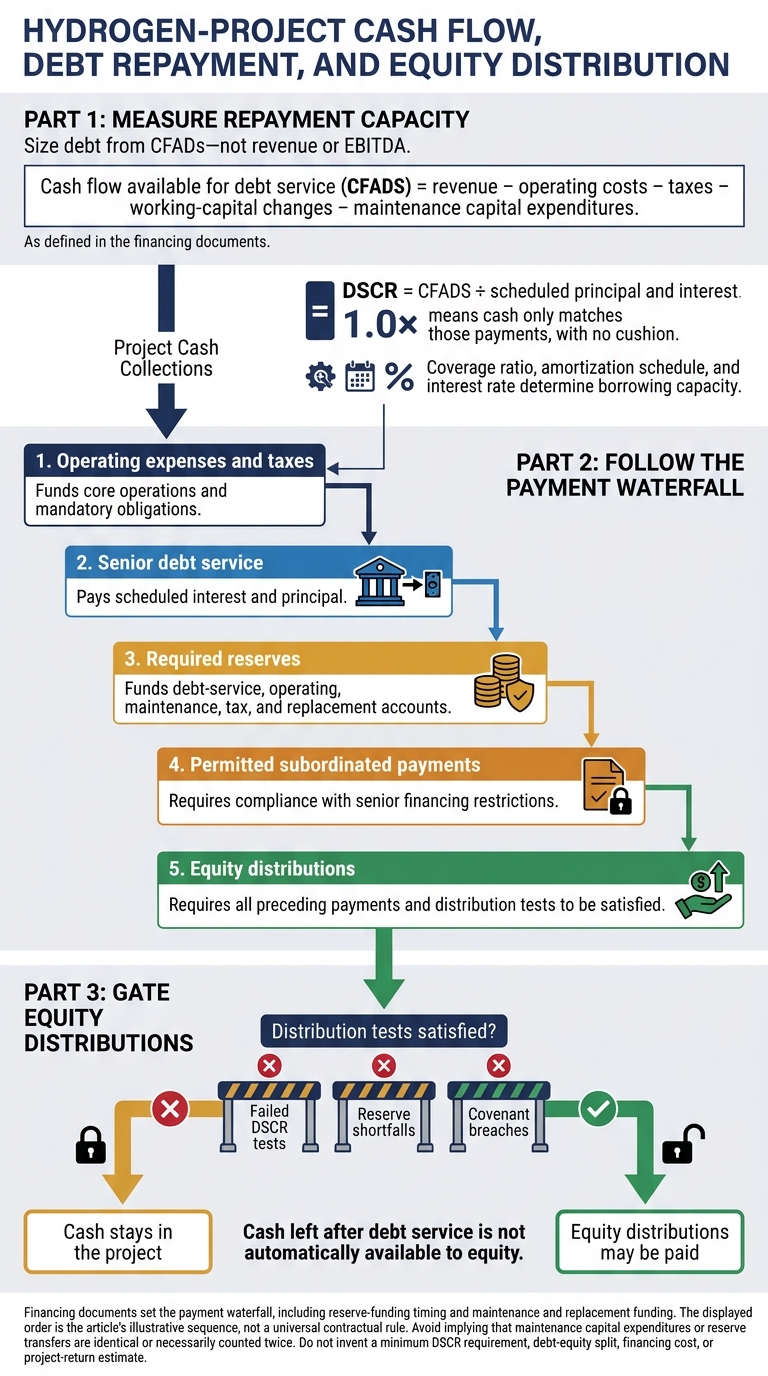
Hydrogen Project Cash Flow: Debt Before Equity
Once a project begins operating, lenders size debt against actual cash flow available for debt service (CFADS), not development promises. Cash flow repays debt; equity covers shortfalls and receives what remains.
Size debt from CFADS, not revenue or EBITDA. The coverage ratio, amortization schedule, and interest rate determine borrowing capacity. At this stage, debt begins to replace equity as the project’s main funding source.
Moderate debt can lower the weighted average cost of capital (WACC). Too much debt increases lending spreads, reserve requirements, and the returns equity investors demand.
Testing Costs, Offtake, and Downside Risk
Test power price ($/MWh), energy use (kWh/kg H₂), and hydrogen margin ($/kg H₂) together. The same analysis should test power availability, efficiency, degradation, output, stack replacement, water treatment, compression, transportation, and storage as a group - not in isolation.
Check whether offtake pricing, minimum purchases, buyer credit, and termination rights protect cash flow when costs rise or production falls. Model monthly or quarterly cash balances to spot shortfalls that annual averages can hide.
| Cash-flow condition | Debt-capacity effect | Reserves, financing costs, and sponsor support |
|---|---|---|
| Creditworthy buyer with enforceable minimum purchases | More predictable repayment capacity | Potentially lower financing spread; reserves still required |
| Merchant sales or a buyer lacking creditworthiness | Less revenue lenders can count on | Lower leverage, larger liquidity buffers, and possible sponsor guarantees |
| Volatile power costs, outages, or faster degradation | Lower stress-case DSCR | More operating and replacement reserves; potentially higher pricing |
| Delayed commercial operations or construction overruns | Revenue starts later while interest and costs accumulate | Interest reserves, contingency equity, and completion support |
| Uncertain incentive eligibility or payment timing | Less dependable cash for repayment | Conservative credit assumptions and additional liquidity |
Treat Section 45V as conditional cash until qualification, verification, and monetization are certain. Lenders discount incentive cash until qualification and payment timing are firm.
Payment Priority and Limits on Equity Distributions
| Priority | Cash use | Payment condition |
|---|---|---|
| 1 | Operating expenses and taxes | Funds core operations and mandatory obligations |
| 2 | Senior debt service | Pays scheduled interest and principal |
| 3 | Required reserves | Funds debt-service, operating, maintenance, tax, and replacement accounts |
| 4 | Permitted subordinated payments | Requires compliance with senior financing restrictions |
| 5 | Equity distributions | Requires all preceding payments and distribution tests to be satisfied |
The financing documents set this payment waterfall, including when reserves must be funded and how maintenance and replacement costs are covered. EBITDA and net income miss key cash obligations; CFADS measures repayment capacity.
Cash left after debt service is not automatically available to equity. Failed DSCR tests, reserve shortfalls, or covenant breaches can block distributions even when accounting earnings are positive. That cash stays in the project rather than going to sponsors.
Conclusion: Match Funding to Risk and Cash Flow
Use equity for unresolved risk; add debt when CFADS and contracts support repayment. Equity absorbs development and execution risk. Debt requires fixed payments backed by contractual protections.[6][7]
Apply this rule based on the project’s stage.
| Project stage | Funding rule |
|---|---|
| Early development | Lead with equity until technical, permitting, and commercial risks are resolved |
| Construction-ready | Add debt when contracts and completion support justify borrowing |
| Commissioning | Maintain equity support until performance tests and ramp-up requirements are met |
| Stable operations | Consider refinancing when reliable production and recurring cash flow support repayment |
Before adding leverage, test the contracts, cash flow, and downside cases behind it.
Project Financing Checklist
Bankability: Verify technology performance at a comparable scale and duty cycle. Secure permits, land, interconnection, and water or feedstock rights. Check EPC cost protections, performance tests, and contingency.
Contract tenor: Confirm that revenue contracts cover the debt tenor plus a tail, with appropriate minimum-volume, take-or-pay, price-indexation, and change-in-law protections.
Buyer credit: Check buyer creditworthiness and any parent support, letter of credit, insurance, or payment guarantee.
DSCR and reserves: Test base-case and downside DSCR, debt-service reserve requirements, and minimum liquidity thresholds.
Sponsor support: Confirm the sponsor can fund overruns, delays, working capital, and required equity cures.
Control and returns: Document decision rights over budgets, refinancing, borrowing, distributions, and operations. Check whether equity IRR, project IRR, and exit value compensate investors for the remaining risks.
Downside exposure: Stress-test schedule, cost, operations, market, credit, rates, policy, foreign-exchange (FX), and exit risks.
Review the resulting funding gaps and investor returns before adding debt. Revisit the funding mix after commissioning and demonstrated operating performance.
FAQs
What DSCR should my hydrogen project target?
Lenders typically look for a base-case debt service coverage ratio (DSCR) of about 1.30x–1.35x, with downside coverage above 1.15x [1]. That cushion gives lenders more confidence in the project’s ability to repay its debt.
Meeting these targets calls for long-term, take-or-pay agreements with investment-grade counterparties, ideally spanning 10–20 years or more, to reduce risk [1]. Projects with merchant exposure or higher technology risk may need higher DSCRs or lower leverage [2].
How can I balance ownership dilution against debt risk?
Match financing to your project’s risk profile. Equity can fund development and working capital, but it dilutes ownership. Debt keeps ownership intact, but it requires steady cash flow to cover repayments.
Project finance through a special purpose vehicle can isolate risks and increase borrowing capacity. Blended finance, including public or philanthropic first-loss tranches or guarantees, can reduce risk, help secure senior commercial debt, and limit reliance on expensive equity.
When does refinancing outweigh its costs?
Refinancing is worth the cost when it helps a maturing project stand on its own commercially [1]. Steady performance, predictable revenue, and a proven ability to work as designed can help attract commercial lenders [1][2].
Replacing catalytic or publicly supported capital with senior commercial debt frees concessional funds for new projects [2]. Smaller projects, though, may have fewer refinancing options: in markets with fewer buyers and lenders, they can be harder to sell or refinance [3].

FAQ