
Jul 29, 2026
Data Centers vs Devices: ESG Risk Compare
ESG Strategy
In This Article
Data centers pose concentrated site ESG risks (energy, water, permits); devices drive dispersed supply-chain risks (minerals, labor, e‑waste).
Data Centers vs Devices: ESG Risk Compare
If you want the short answer: data centers face the biggest risk at the site level, while devices face the biggest risk across mining, manufacturing, and e-waste.
I see the split this way:
Data centers are hit hardest by power use, emissions, water demand, grid strain, and local backlash
Devices are hit hardest by embodied emissions, mineral sourcing, labor abuse, and end-of-life waste
Data centers tend to face local pressure from utilities, regulators, and nearby communities
Device makers tend to face global supply-chain pressure tied to traceability, human rights, and recycling rules
A few numbers make the contrast clear:
62 million metric tons of e-waste were generated in 2022
Only 22.3% was formally collected and recycled
More than 50% of global cobalt supply comes from the DRC
For many devices, 50% or more of lifetime climate impact can happen before first use
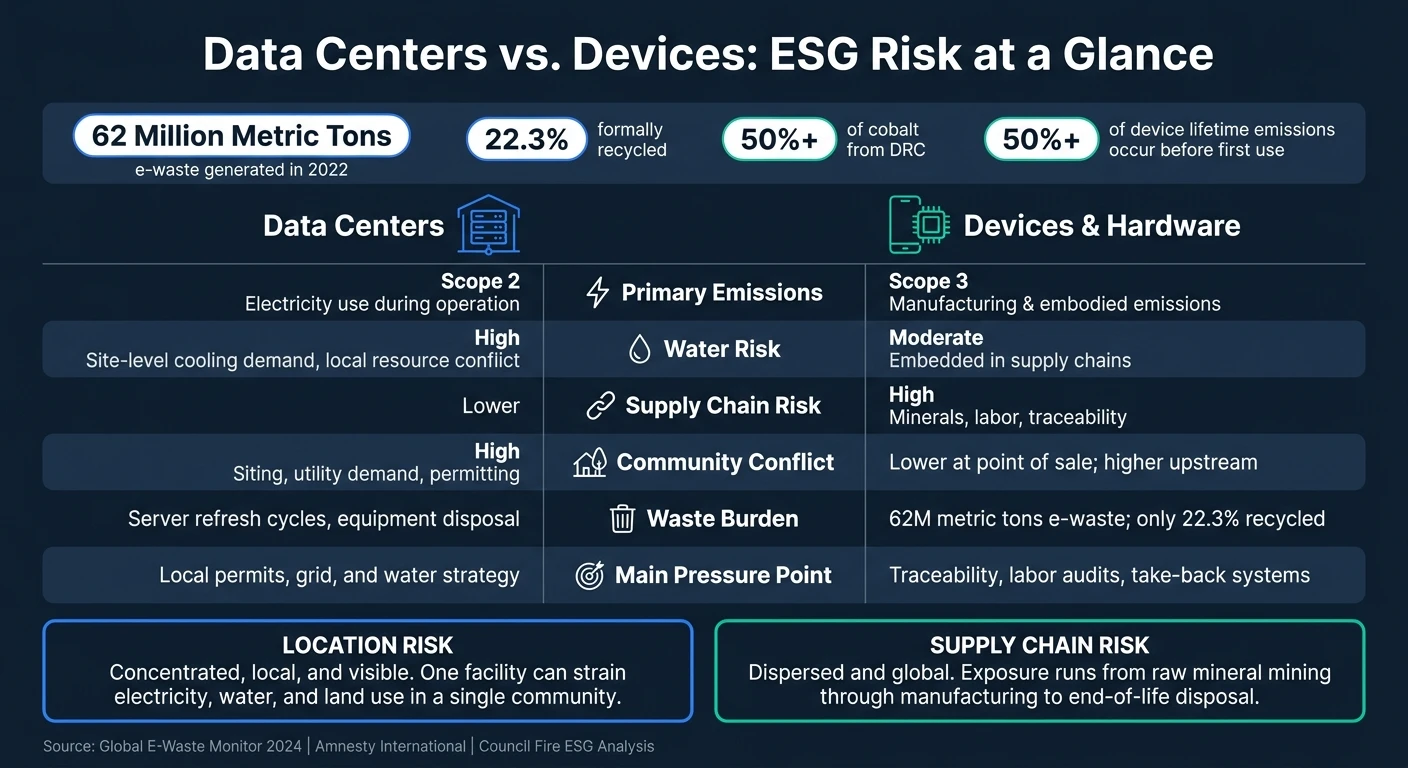
Data Centers vs. Devices: ESG Risk Comparison
The Choice Between Data Centers and Carbon Emissions
Quick Comparison
Risk area | Data centers | Devices |
|---|---|---|
Main emissions source | Electricity use at the facility | Manufacturing and purchased goods |
Water stress | High in cooling-heavy sites | More indirect through suppliers |
Supply-chain risk | Lower than devices | High, especially minerals and labor |
Community conflict | High, tied to siting and utility demand | Lower at point of sale, higher upstream |
Waste burden | Server turnover and equipment disposal | Large e-waste volumes and take-back duties |
Main pressure point | Local permits, grid, and water | Traceability, labor checks, and recycling |
I’d treat this as a location risk vs. supply-chain risk problem. If you run both, you need separate controls for facilities, sourcing, and end-of-life flows.
Where Data Centers Face Greater ESG Risk
Data-center ESG risk is concentrated, local, and visible. One large facility can strain a community’s electricity, water, and land use all at once. That makes the effects hard to miss for residents, regulators, and utilities.
Energy Demand, Emissions, and Grid Exposure
Data centers are using more electricity, and AI is a big reason why. AI workloads are driving a sharp rise in data-center power demand, and projections for 2025–2030 are moving much higher because of it.
That load does not stop at the meter. More electricity use also means more cooling demand, which can add pressure to local water supplies.
Feature | Data Centers |
|---|---|
Primary Emission Type | Operational (electricity use) |
Energy Intensity | High, rising sharply due to AI |
Demand Growth | Accelerating with AI workloads |
Risk Concentration | Highly concentrated in specific locales |
This is what makes the risk profile different from many other sectors. The emissions are tied mainly to day-to-day power use, and the stress tends to land in a small number of places rather than being spread out.
Cooling Water Use and Local Resource Conflicts
Cooling water is the other big pressure point. Water stewardship is now an operating risk, not just a reporting issue. The strain is strongest in water-stressed regions.
Data centers are clustered in states such as Arizona and Texas, where farms and households are already competing for limited water. In places like that, water-positive claims can be tough to defend when replenishment happens in a different watershed. On paper, that may look fine. On the ground, people often see it very differently.
The same local strain shows up in more than water. It spills into power capacity, road use, and the permitting process.
Infrastructure Waste, Siting, and Community Pushback
Data centers can also set off local infrastructure upgrades, including power, water, and road work. Utilities often pass those costs on to ratepayers, which turns a private expansion into a public issue fast.
Community pushback is growing as well. Residents are raising concerns about noise, heat, and peak-day water demand. None of this is abstract when the site is down the road and the pressure shows up on monthly bills or during hot-weather shortages.
Siting decisions now depend more on climate resilience, water access, and grid stability than on connectivity or labor costs. That shift keeps permitting, community relations, and utility politics at the center of data-center ESG risk.
Where Device and Hardware Makers Face Greater ESG Risk
By contrast, device risk is harder to spot on-site and far more concentrated upstream. For device and hardware makers, ESG exposure runs across the global supply chain, from raw material extraction all the way to end-of-life.
Embodied Emissions and Manufacturing Footprint
For devices, most emissions happen before a product is ever turned on. Embodied emissions - greenhouse gases released before first use - can account for 50% or more of a device's total lifetime climate impact.[1][2][6] A smartphone carries roughly 50 kg CO2e in embodied emissions, a laptop around 200 kg, and a desktop PC as much as 350 kg.[9]
That burden grows when products are replaced often. Smartphones are commonly replaced every two to three years, and laptops every three to five years.[1][6] Each upgrade cycle sets off another round of manufacturing emissions. In practice, that means Scope 3 emissions from purchased goods and manufacturing tend to dominate the footprint for hardware makers, while data centers still focus mainly on electricity use during operation.
Critical Minerals, Human Rights, and Supply Chain Labor
Devices depend on critical minerals such as cobalt, lithium, tin, tungsten, tantalum, and rare earth elements. The way many of these materials are mined creates some of the most serious social risks in the hardware sector.[3][5][7]
More than 50% of global cobalt comes from the Democratic Republic of Congo, where artisanal mining has been linked again and again to child labor and dangerous working conditions.[10][13][17][18] Amnesty International found major electronics brands had not verified whether cobalt from child-labor-linked mines entered their supply chains.[18] Tin carries the highest labor-rights risk among the 3TG minerals, with child labor and forced labor documented in Bolivia, Myanmar, Indonesia, China, and Peru.[7] Tantalum, used in capacitors found in nearly every device, is tied to child labor in Mozambique, Burundi, and Rwanda, all classified as extreme-risk for child labor.[7]
Traceability remains a major weak spot. About 73% of ICT companies publish Conflict Minerals Reports, but those disclosures usually do not cover cobalt, rare earths, or lower-tier suppliers.[12]
That upstream exposure does not stop once a device leaves the market. It shows up again at end of life, where disposal becomes another major ESG pressure point.
E-Waste, Toxic Materials, and Producer Responsibility
Devices are the main driver of global e-waste. In 2022, the world generated 62 million metric tons of e-waste, and that figure is projected to hit 82 million metric tons by 2030.[8][11][14] Only 22.3% of that volume was formally collected and recycled in 2022.[8][11][14][15][16] The rest largely ends up in informal recycling systems or landfills, where hazardous substances such as lead, cadmium, mercury, and brominated flame retardants can leach into soil and water or spread through the air.[14][15][16] The World Health Organization has linked e-waste exposure to neurological damage and developmental problems, especially in children and pregnant women.[16]
Rules are getting tighter. The EU's WEEE Directive applies Extended Producer Responsibility, requiring manufacturers to fund or run take-back and recycling systems and meet minimum collection targets.[4] In the United States, rules are still patchwork at the state level, but pressure for stronger federal oversight is growing as volumes rise. The result is a broader set of duties than data-center operators usually face. For hardware makers, ESG scrutiny stretches from product design to take-back, reuse, and recycling results.
Data Centers vs. Devices: ESG Risk Side by Side
Once you put the sector-specific risks next to each other, the split is pretty clear: data centers create concentrated local exposure, while device makers create dispersed global exposure.
The main difference comes down to where the risk piles up. Data centers take it on at the site level. Device makers spread it across mines, factories, shipping networks, and end-of-life disposal.
Environmental Risk: Where the Footprint Sits
For data centers, the biggest environmental load shows up during day-to-day operation. That means constant electricity use, cooling water demand, and pressure on local resources. Device makers look different. Most of their environmental impact sits upstream, in raw material extraction, processing, and manufacturing.
Risk Factor | Data Centers | Device & Hardware Makers |
|---|---|---|
Primary emissions scope | Mostly Scope 2 (electricity) | Mostly Scope 3 (embodied/manufacturing) |
Energy intensity | High - ongoing operational demand | High - concentrated in the production phase |
Water risk | High - site-level cooling demand and local resource conflict | Moderate - embedded in manufacturing supply chains |
Waste volume | Lower during operation; rising with server refresh cycles | Very high - large e-waste and producer responsibility exposure |
Circularity risk | Hardware refresh cycles and secure decommissioning | Short product life cycles, repairability, and take-back obligations |
These environmental patterns also shape who applies pressure. For data centers, pressure tends to come from local communities, regulators, and utilities. For device makers, it stretches across the supply chain.
Social and Governance Risk: Community Pressure vs. Supply Chain Oversight
With data centers, social and governance scrutiny stays close to home. It tends to focus on permitting, utility ties, renewable energy claims, and water stewardship in drought-prone areas.[19][20] For device makers, the pressure lands elsewhere: Scope 3 emissions, conflict minerals disclosures, supplier labor audits, and e-waste recovery rates.[19]
The hard part is traceability. The more fragmented the supply chain gets, the tougher it becomes to check conditions in lower-tier suppliers. That’s where risk can hide in plain sight.
So the near-term priority shifts by business model. For data centers, it’s utility planning, permitting, and water strategy. For device makers, it’s supplier traceability, product design, and take-back systems.
What Leaders Should Do Next
Once the risk split is clear, the response has to split as well. Site operations, procurement, and end-of-life risk each need their own governance path. If an organization runs both data centers and device portfolios, those exposures overlap. That’s where integrated ESG governance matters - bringing IT, procurement, facilities, finance, and sustainability to the same table so risk awareness turns into actual risk reduction.
Key Points for Strategy, Disclosure, and Action
For data-center operators, the main control point is the site itself. That means setting clear metrics around Power Usage Effectiveness (PUE), Water Usage Effectiveness (WUE), renewable energy share, and site emissions. Water tracking dropped from 43% to 27%, which makes water risk harder to manage and harder to disclose.[21]
For device makers, the control point sits in the supply chain. Go past Tier 1 suppliers and map down to smelters, refiners, and raw material sources. Most conflict-minerals reporting still stops too early.[22]
End-of-life recovery should stand on its own in the strategy, not get buried in a side note. Build take-back, repair, and certified recycling into procurement contracts. Council Fire can help align product design, procurement, and recovery in one circularity program.
In practice, the playbook is pretty direct:
Map material risks by business line
Set measurable targets for both facilities and supply chains
Tie disclosure to capital allocation
FAQs
Why are data center ESG risks more local?
Data center ESG risks tend to be local because these sites rely on land, water, and power in one location. When those resources are tight, the facility can end up competing head-to-head with nearby residents, farms, and natural systems.
You can see that pressure on the ground. It often shows up as peak-day water demand, strain on grid capacity, higher utility costs, and added stress on community infrastructure. Just as important, it can weaken public trust if people feel the project is taking more than the area can comfortably support.
Why do devices carry higher supply-chain ESG risk?
Hardware devices carry more supply-chain ESG risk because the path from raw material to finished product is long, global, and often hard to see clearly. Batteries and semiconductors, in particular, depend on materials that are often sourced from regions with weaker labor rules and looser pollution controls.
A lot of the risk also sits deeper in the supply chain, far beyond direct suppliers. That’s where human rights issues, hazardous waste, and supply-chain transparency become much harder to track and manage.
What should companies track first?
Start with a materiality assessment. It helps you spot the intervention points that will have the biggest effect. For technology and manufacturing companies, that usually means mapping supply chain tiers to find the main emission sources, most often semiconductor fabrication, component manufacturing, and assembly.
At the same time, run a digital audit to find devices that drain energy and set baseline metrics for optimization. Council Fire recommends using these findings to build practical paths for decarbonization and long-term value creation.
Related Blog Posts
Latest Articles
©2026

Narrative Change and Power Building: The Missing Half of Advocacy
Narrative change is the process of disrupting dominant narratives that normalize inequity and advancing new narratives from historically marginalized communities.

Funding Resilience Without Federal Grants
BRIC is unreliable and FEMA is shrinking. Here's how cities fund climate resilience with dedicated revenue, blended finance, and a coordinating authority.

The ESG Blind Spot: How AI Is Finding Risks in Companies Nobody Else Is Watching
Norway's sovereign wealth fund uses AI to screen 7,200 portfolio companies for forced labor and corruption within 24 hours. The real story is the emerging-market coverage gap that traditional ESG data vendors miss — and what it means for any company with a global supply chain.
Narrative Change and Power Building: The Missing Half of Advocacy
Narrative change is the process of disrupting dominant narratives that normalize inequity and advancing new narratives from historically marginalized communities.
Funding Resilience Without Federal Grants
BRIC is unreliable and FEMA is shrinking. Here's how cities fund climate resilience with dedicated revenue, blended finance, and a coordinating authority.
The ESG Blind Spot: How AI Is Finding Risks in Companies Nobody Else Is Watching
Norway's sovereign wealth fund uses AI to screen 7,200 portfolio companies for forced labor and corruption within 24 hours. The real story is the emerging-market coverage gap that traditional ESG data vendors miss — and what it means for any company with a global supply chain.
FAQ
01
What does it really mean to “redefine profit”?
02
What makes Council Fire different?
03
Who does Council Fire work with?
04
What does working with Council Fire actually look like?
05
How does Council Fire help organizations turn big goals into action?
06
How does Council Fire define and measure success?
07
How does technology fit into Council Fire’s work?
Jul 29, 2026
Data Centers vs Devices: ESG Risk Compare
ESG Strategy
In This Article
Data centers pose concentrated site ESG risks (energy, water, permits); devices drive dispersed supply-chain risks (minerals, labor, e‑waste).
Data Centers vs Devices: ESG Risk Compare
If you want the short answer: data centers face the biggest risk at the site level, while devices face the biggest risk across mining, manufacturing, and e-waste.
I see the split this way:
Data centers are hit hardest by power use, emissions, water demand, grid strain, and local backlash
Devices are hit hardest by embodied emissions, mineral sourcing, labor abuse, and end-of-life waste
Data centers tend to face local pressure from utilities, regulators, and nearby communities
Device makers tend to face global supply-chain pressure tied to traceability, human rights, and recycling rules
A few numbers make the contrast clear:
62 million metric tons of e-waste were generated in 2022
Only 22.3% was formally collected and recycled
More than 50% of global cobalt supply comes from the DRC
For many devices, 50% or more of lifetime climate impact can happen before first use
Data Centers vs. Devices: ESG Risk Comparison
The Choice Between Data Centers and Carbon Emissions
Quick Comparison
Risk area | Data centers | Devices |
|---|---|---|
Main emissions source | Electricity use at the facility | Manufacturing and purchased goods |
Water stress | High in cooling-heavy sites | More indirect through suppliers |
Supply-chain risk | Lower than devices | High, especially minerals and labor |
Community conflict | High, tied to siting and utility demand | Lower at point of sale, higher upstream |
Waste burden | Server turnover and equipment disposal | Large e-waste volumes and take-back duties |
Main pressure point | Local permits, grid, and water | Traceability, labor checks, and recycling |
I’d treat this as a location risk vs. supply-chain risk problem. If you run both, you need separate controls for facilities, sourcing, and end-of-life flows.
Where Data Centers Face Greater ESG Risk
Data-center ESG risk is concentrated, local, and visible. One large facility can strain a community’s electricity, water, and land use all at once. That makes the effects hard to miss for residents, regulators, and utilities.
Energy Demand, Emissions, and Grid Exposure
Data centers are using more electricity, and AI is a big reason why. AI workloads are driving a sharp rise in data-center power demand, and projections for 2025–2030 are moving much higher because of it.
That load does not stop at the meter. More electricity use also means more cooling demand, which can add pressure to local water supplies.
Feature | Data Centers |
|---|---|
Primary Emission Type | Operational (electricity use) |
Energy Intensity | High, rising sharply due to AI |
Demand Growth | Accelerating with AI workloads |
Risk Concentration | Highly concentrated in specific locales |
This is what makes the risk profile different from many other sectors. The emissions are tied mainly to day-to-day power use, and the stress tends to land in a small number of places rather than being spread out.
Cooling Water Use and Local Resource Conflicts
Cooling water is the other big pressure point. Water stewardship is now an operating risk, not just a reporting issue. The strain is strongest in water-stressed regions.
Data centers are clustered in states such as Arizona and Texas, where farms and households are already competing for limited water. In places like that, water-positive claims can be tough to defend when replenishment happens in a different watershed. On paper, that may look fine. On the ground, people often see it very differently.
The same local strain shows up in more than water. It spills into power capacity, road use, and the permitting process.
Infrastructure Waste, Siting, and Community Pushback
Data centers can also set off local infrastructure upgrades, including power, water, and road work. Utilities often pass those costs on to ratepayers, which turns a private expansion into a public issue fast.
Community pushback is growing as well. Residents are raising concerns about noise, heat, and peak-day water demand. None of this is abstract when the site is down the road and the pressure shows up on monthly bills or during hot-weather shortages.
Siting decisions now depend more on climate resilience, water access, and grid stability than on connectivity or labor costs. That shift keeps permitting, community relations, and utility politics at the center of data-center ESG risk.
Where Device and Hardware Makers Face Greater ESG Risk
By contrast, device risk is harder to spot on-site and far more concentrated upstream. For device and hardware makers, ESG exposure runs across the global supply chain, from raw material extraction all the way to end-of-life.
Embodied Emissions and Manufacturing Footprint
For devices, most emissions happen before a product is ever turned on. Embodied emissions - greenhouse gases released before first use - can account for 50% or more of a device's total lifetime climate impact.[1][2][6] A smartphone carries roughly 50 kg CO2e in embodied emissions, a laptop around 200 kg, and a desktop PC as much as 350 kg.[9]
That burden grows when products are replaced often. Smartphones are commonly replaced every two to three years, and laptops every three to five years.[1][6] Each upgrade cycle sets off another round of manufacturing emissions. In practice, that means Scope 3 emissions from purchased goods and manufacturing tend to dominate the footprint for hardware makers, while data centers still focus mainly on electricity use during operation.
Critical Minerals, Human Rights, and Supply Chain Labor
Devices depend on critical minerals such as cobalt, lithium, tin, tungsten, tantalum, and rare earth elements. The way many of these materials are mined creates some of the most serious social risks in the hardware sector.[3][5][7]
More than 50% of global cobalt comes from the Democratic Republic of Congo, where artisanal mining has been linked again and again to child labor and dangerous working conditions.[10][13][17][18] Amnesty International found major electronics brands had not verified whether cobalt from child-labor-linked mines entered their supply chains.[18] Tin carries the highest labor-rights risk among the 3TG minerals, with child labor and forced labor documented in Bolivia, Myanmar, Indonesia, China, and Peru.[7] Tantalum, used in capacitors found in nearly every device, is tied to child labor in Mozambique, Burundi, and Rwanda, all classified as extreme-risk for child labor.[7]
Traceability remains a major weak spot. About 73% of ICT companies publish Conflict Minerals Reports, but those disclosures usually do not cover cobalt, rare earths, or lower-tier suppliers.[12]
That upstream exposure does not stop once a device leaves the market. It shows up again at end of life, where disposal becomes another major ESG pressure point.
E-Waste, Toxic Materials, and Producer Responsibility
Devices are the main driver of global e-waste. In 2022, the world generated 62 million metric tons of e-waste, and that figure is projected to hit 82 million metric tons by 2030.[8][11][14] Only 22.3% of that volume was formally collected and recycled in 2022.[8][11][14][15][16] The rest largely ends up in informal recycling systems or landfills, where hazardous substances such as lead, cadmium, mercury, and brominated flame retardants can leach into soil and water or spread through the air.[14][15][16] The World Health Organization has linked e-waste exposure to neurological damage and developmental problems, especially in children and pregnant women.[16]
Rules are getting tighter. The EU's WEEE Directive applies Extended Producer Responsibility, requiring manufacturers to fund or run take-back and recycling systems and meet minimum collection targets.[4] In the United States, rules are still patchwork at the state level, but pressure for stronger federal oversight is growing as volumes rise. The result is a broader set of duties than data-center operators usually face. For hardware makers, ESG scrutiny stretches from product design to take-back, reuse, and recycling results.
Data Centers vs. Devices: ESG Risk Side by Side
Once you put the sector-specific risks next to each other, the split is pretty clear: data centers create concentrated local exposure, while device makers create dispersed global exposure.
The main difference comes down to where the risk piles up. Data centers take it on at the site level. Device makers spread it across mines, factories, shipping networks, and end-of-life disposal.
Environmental Risk: Where the Footprint Sits
For data centers, the biggest environmental load shows up during day-to-day operation. That means constant electricity use, cooling water demand, and pressure on local resources. Device makers look different. Most of their environmental impact sits upstream, in raw material extraction, processing, and manufacturing.
Risk Factor | Data Centers | Device & Hardware Makers |
|---|---|---|
Primary emissions scope | Mostly Scope 2 (electricity) | Mostly Scope 3 (embodied/manufacturing) |
Energy intensity | High - ongoing operational demand | High - concentrated in the production phase |
Water risk | High - site-level cooling demand and local resource conflict | Moderate - embedded in manufacturing supply chains |
Waste volume | Lower during operation; rising with server refresh cycles | Very high - large e-waste and producer responsibility exposure |
Circularity risk | Hardware refresh cycles and secure decommissioning | Short product life cycles, repairability, and take-back obligations |
These environmental patterns also shape who applies pressure. For data centers, pressure tends to come from local communities, regulators, and utilities. For device makers, it stretches across the supply chain.
Social and Governance Risk: Community Pressure vs. Supply Chain Oversight
With data centers, social and governance scrutiny stays close to home. It tends to focus on permitting, utility ties, renewable energy claims, and water stewardship in drought-prone areas.[19][20] For device makers, the pressure lands elsewhere: Scope 3 emissions, conflict minerals disclosures, supplier labor audits, and e-waste recovery rates.[19]
The hard part is traceability. The more fragmented the supply chain gets, the tougher it becomes to check conditions in lower-tier suppliers. That’s where risk can hide in plain sight.
So the near-term priority shifts by business model. For data centers, it’s utility planning, permitting, and water strategy. For device makers, it’s supplier traceability, product design, and take-back systems.
What Leaders Should Do Next
Once the risk split is clear, the response has to split as well. Site operations, procurement, and end-of-life risk each need their own governance path. If an organization runs both data centers and device portfolios, those exposures overlap. That’s where integrated ESG governance matters - bringing IT, procurement, facilities, finance, and sustainability to the same table so risk awareness turns into actual risk reduction.
Key Points for Strategy, Disclosure, and Action
For data-center operators, the main control point is the site itself. That means setting clear metrics around Power Usage Effectiveness (PUE), Water Usage Effectiveness (WUE), renewable energy share, and site emissions. Water tracking dropped from 43% to 27%, which makes water risk harder to manage and harder to disclose.[21]
For device makers, the control point sits in the supply chain. Go past Tier 1 suppliers and map down to smelters, refiners, and raw material sources. Most conflict-minerals reporting still stops too early.[22]
End-of-life recovery should stand on its own in the strategy, not get buried in a side note. Build take-back, repair, and certified recycling into procurement contracts. Council Fire can help align product design, procurement, and recovery in one circularity program.
In practice, the playbook is pretty direct:
Map material risks by business line
Set measurable targets for both facilities and supply chains
Tie disclosure to capital allocation
FAQs
Why are data center ESG risks more local?
Data center ESG risks tend to be local because these sites rely on land, water, and power in one location. When those resources are tight, the facility can end up competing head-to-head with nearby residents, farms, and natural systems.
You can see that pressure on the ground. It often shows up as peak-day water demand, strain on grid capacity, higher utility costs, and added stress on community infrastructure. Just as important, it can weaken public trust if people feel the project is taking more than the area can comfortably support.
Why do devices carry higher supply-chain ESG risk?
Hardware devices carry more supply-chain ESG risk because the path from raw material to finished product is long, global, and often hard to see clearly. Batteries and semiconductors, in particular, depend on materials that are often sourced from regions with weaker labor rules and looser pollution controls.
A lot of the risk also sits deeper in the supply chain, far beyond direct suppliers. That’s where human rights issues, hazardous waste, and supply-chain transparency become much harder to track and manage.
What should companies track first?
Start with a materiality assessment. It helps you spot the intervention points that will have the biggest effect. For technology and manufacturing companies, that usually means mapping supply chain tiers to find the main emission sources, most often semiconductor fabrication, component manufacturing, and assembly.
At the same time, run a digital audit to find devices that drain energy and set baseline metrics for optimization. Council Fire recommends using these findings to build practical paths for decarbonization and long-term value creation.
Related Blog Posts
Latest Articles
©2026
Narrative Change and Power Building: The Missing Half of Advocacy
Narrative change is the process of disrupting dominant narratives that normalize inequity and advancing new narratives from historically marginalized communities.
Funding Resilience Without Federal Grants
BRIC is unreliable and FEMA is shrinking. Here's how cities fund climate resilience with dedicated revenue, blended finance, and a coordinating authority.
The ESG Blind Spot: How AI Is Finding Risks in Companies Nobody Else Is Watching
Norway's sovereign wealth fund uses AI to screen 7,200 portfolio companies for forced labor and corruption within 24 hours. The real story is the emerging-market coverage gap that traditional ESG data vendors miss — and what it means for any company with a global supply chain.
FAQ
01
What does it really mean to “redefine profit”?
02
What makes Council Fire different?
03
Who does Council Fire work with?
04
What does working with Council Fire actually look like?
05
How does Council Fire help organizations turn big goals into action?
06
How does Council Fire define and measure success?
07
How does technology fit into Council Fire’s work?
Jul 29, 2026
Data Centers vs Devices: ESG Risk Compare
ESG Strategy
In This Article
Data centers pose concentrated site ESG risks (energy, water, permits); devices drive dispersed supply-chain risks (minerals, labor, e‑waste).
Data Centers vs Devices: ESG Risk Compare
If you want the short answer: data centers face the biggest risk at the site level, while devices face the biggest risk across mining, manufacturing, and e-waste.
I see the split this way:
Data centers are hit hardest by power use, emissions, water demand, grid strain, and local backlash
Devices are hit hardest by embodied emissions, mineral sourcing, labor abuse, and end-of-life waste
Data centers tend to face local pressure from utilities, regulators, and nearby communities
Device makers tend to face global supply-chain pressure tied to traceability, human rights, and recycling rules
A few numbers make the contrast clear:
62 million metric tons of e-waste were generated in 2022
Only 22.3% was formally collected and recycled
More than 50% of global cobalt supply comes from the DRC
For many devices, 50% or more of lifetime climate impact can happen before first use
Data Centers vs. Devices: ESG Risk Comparison
The Choice Between Data Centers and Carbon Emissions
Quick Comparison
Risk area | Data centers | Devices |
|---|---|---|
Main emissions source | Electricity use at the facility | Manufacturing and purchased goods |
Water stress | High in cooling-heavy sites | More indirect through suppliers |
Supply-chain risk | Lower than devices | High, especially minerals and labor |
Community conflict | High, tied to siting and utility demand | Lower at point of sale, higher upstream |
Waste burden | Server turnover and equipment disposal | Large e-waste volumes and take-back duties |
Main pressure point | Local permits, grid, and water | Traceability, labor checks, and recycling |
I’d treat this as a location risk vs. supply-chain risk problem. If you run both, you need separate controls for facilities, sourcing, and end-of-life flows.
Where Data Centers Face Greater ESG Risk
Data-center ESG risk is concentrated, local, and visible. One large facility can strain a community’s electricity, water, and land use all at once. That makes the effects hard to miss for residents, regulators, and utilities.
Energy Demand, Emissions, and Grid Exposure
Data centers are using more electricity, and AI is a big reason why. AI workloads are driving a sharp rise in data-center power demand, and projections for 2025–2030 are moving much higher because of it.
That load does not stop at the meter. More electricity use also means more cooling demand, which can add pressure to local water supplies.
Feature | Data Centers |
|---|---|
Primary Emission Type | Operational (electricity use) |
Energy Intensity | High, rising sharply due to AI |
Demand Growth | Accelerating with AI workloads |
Risk Concentration | Highly concentrated in specific locales |
This is what makes the risk profile different from many other sectors. The emissions are tied mainly to day-to-day power use, and the stress tends to land in a small number of places rather than being spread out.
Cooling Water Use and Local Resource Conflicts
Cooling water is the other big pressure point. Water stewardship is now an operating risk, not just a reporting issue. The strain is strongest in water-stressed regions.
Data centers are clustered in states such as Arizona and Texas, where farms and households are already competing for limited water. In places like that, water-positive claims can be tough to defend when replenishment happens in a different watershed. On paper, that may look fine. On the ground, people often see it very differently.
The same local strain shows up in more than water. It spills into power capacity, road use, and the permitting process.
Infrastructure Waste, Siting, and Community Pushback
Data centers can also set off local infrastructure upgrades, including power, water, and road work. Utilities often pass those costs on to ratepayers, which turns a private expansion into a public issue fast.
Community pushback is growing as well. Residents are raising concerns about noise, heat, and peak-day water demand. None of this is abstract when the site is down the road and the pressure shows up on monthly bills or during hot-weather shortages.
Siting decisions now depend more on climate resilience, water access, and grid stability than on connectivity or labor costs. That shift keeps permitting, community relations, and utility politics at the center of data-center ESG risk.
Where Device and Hardware Makers Face Greater ESG Risk
By contrast, device risk is harder to spot on-site and far more concentrated upstream. For device and hardware makers, ESG exposure runs across the global supply chain, from raw material extraction all the way to end-of-life.
Embodied Emissions and Manufacturing Footprint
For devices, most emissions happen before a product is ever turned on. Embodied emissions - greenhouse gases released before first use - can account for 50% or more of a device's total lifetime climate impact.[1][2][6] A smartphone carries roughly 50 kg CO2e in embodied emissions, a laptop around 200 kg, and a desktop PC as much as 350 kg.[9]
That burden grows when products are replaced often. Smartphones are commonly replaced every two to three years, and laptops every three to five years.[1][6] Each upgrade cycle sets off another round of manufacturing emissions. In practice, that means Scope 3 emissions from purchased goods and manufacturing tend to dominate the footprint for hardware makers, while data centers still focus mainly on electricity use during operation.
Critical Minerals, Human Rights, and Supply Chain Labor
Devices depend on critical minerals such as cobalt, lithium, tin, tungsten, tantalum, and rare earth elements. The way many of these materials are mined creates some of the most serious social risks in the hardware sector.[3][5][7]
More than 50% of global cobalt comes from the Democratic Republic of Congo, where artisanal mining has been linked again and again to child labor and dangerous working conditions.[10][13][17][18] Amnesty International found major electronics brands had not verified whether cobalt from child-labor-linked mines entered their supply chains.[18] Tin carries the highest labor-rights risk among the 3TG minerals, with child labor and forced labor documented in Bolivia, Myanmar, Indonesia, China, and Peru.[7] Tantalum, used in capacitors found in nearly every device, is tied to child labor in Mozambique, Burundi, and Rwanda, all classified as extreme-risk for child labor.[7]
Traceability remains a major weak spot. About 73% of ICT companies publish Conflict Minerals Reports, but those disclosures usually do not cover cobalt, rare earths, or lower-tier suppliers.[12]
That upstream exposure does not stop once a device leaves the market. It shows up again at end of life, where disposal becomes another major ESG pressure point.
E-Waste, Toxic Materials, and Producer Responsibility
Devices are the main driver of global e-waste. In 2022, the world generated 62 million metric tons of e-waste, and that figure is projected to hit 82 million metric tons by 2030.[8][11][14] Only 22.3% of that volume was formally collected and recycled in 2022.[8][11][14][15][16] The rest largely ends up in informal recycling systems or landfills, where hazardous substances such as lead, cadmium, mercury, and brominated flame retardants can leach into soil and water or spread through the air.[14][15][16] The World Health Organization has linked e-waste exposure to neurological damage and developmental problems, especially in children and pregnant women.[16]
Rules are getting tighter. The EU's WEEE Directive applies Extended Producer Responsibility, requiring manufacturers to fund or run take-back and recycling systems and meet minimum collection targets.[4] In the United States, rules are still patchwork at the state level, but pressure for stronger federal oversight is growing as volumes rise. The result is a broader set of duties than data-center operators usually face. For hardware makers, ESG scrutiny stretches from product design to take-back, reuse, and recycling results.
Data Centers vs. Devices: ESG Risk Side by Side
Once you put the sector-specific risks next to each other, the split is pretty clear: data centers create concentrated local exposure, while device makers create dispersed global exposure.
The main difference comes down to where the risk piles up. Data centers take it on at the site level. Device makers spread it across mines, factories, shipping networks, and end-of-life disposal.
Environmental Risk: Where the Footprint Sits
For data centers, the biggest environmental load shows up during day-to-day operation. That means constant electricity use, cooling water demand, and pressure on local resources. Device makers look different. Most of their environmental impact sits upstream, in raw material extraction, processing, and manufacturing.
Risk Factor | Data Centers | Device & Hardware Makers |
|---|---|---|
Primary emissions scope | Mostly Scope 2 (electricity) | Mostly Scope 3 (embodied/manufacturing) |
Energy intensity | High - ongoing operational demand | High - concentrated in the production phase |
Water risk | High - site-level cooling demand and local resource conflict | Moderate - embedded in manufacturing supply chains |
Waste volume | Lower during operation; rising with server refresh cycles | Very high - large e-waste and producer responsibility exposure |
Circularity risk | Hardware refresh cycles and secure decommissioning | Short product life cycles, repairability, and take-back obligations |
These environmental patterns also shape who applies pressure. For data centers, pressure tends to come from local communities, regulators, and utilities. For device makers, it stretches across the supply chain.
Social and Governance Risk: Community Pressure vs. Supply Chain Oversight
With data centers, social and governance scrutiny stays close to home. It tends to focus on permitting, utility ties, renewable energy claims, and water stewardship in drought-prone areas.[19][20] For device makers, the pressure lands elsewhere: Scope 3 emissions, conflict minerals disclosures, supplier labor audits, and e-waste recovery rates.[19]
The hard part is traceability. The more fragmented the supply chain gets, the tougher it becomes to check conditions in lower-tier suppliers. That’s where risk can hide in plain sight.
So the near-term priority shifts by business model. For data centers, it’s utility planning, permitting, and water strategy. For device makers, it’s supplier traceability, product design, and take-back systems.
What Leaders Should Do Next
Once the risk split is clear, the response has to split as well. Site operations, procurement, and end-of-life risk each need their own governance path. If an organization runs both data centers and device portfolios, those exposures overlap. That’s where integrated ESG governance matters - bringing IT, procurement, facilities, finance, and sustainability to the same table so risk awareness turns into actual risk reduction.
Key Points for Strategy, Disclosure, and Action
For data-center operators, the main control point is the site itself. That means setting clear metrics around Power Usage Effectiveness (PUE), Water Usage Effectiveness (WUE), renewable energy share, and site emissions. Water tracking dropped from 43% to 27%, which makes water risk harder to manage and harder to disclose.[21]
For device makers, the control point sits in the supply chain. Go past Tier 1 suppliers and map down to smelters, refiners, and raw material sources. Most conflict-minerals reporting still stops too early.[22]
End-of-life recovery should stand on its own in the strategy, not get buried in a side note. Build take-back, repair, and certified recycling into procurement contracts. Council Fire can help align product design, procurement, and recovery in one circularity program.
In practice, the playbook is pretty direct:
Map material risks by business line
Set measurable targets for both facilities and supply chains
Tie disclosure to capital allocation
FAQs
Why are data center ESG risks more local?
Data center ESG risks tend to be local because these sites rely on land, water, and power in one location. When those resources are tight, the facility can end up competing head-to-head with nearby residents, farms, and natural systems.
You can see that pressure on the ground. It often shows up as peak-day water demand, strain on grid capacity, higher utility costs, and added stress on community infrastructure. Just as important, it can weaken public trust if people feel the project is taking more than the area can comfortably support.
Why do devices carry higher supply-chain ESG risk?
Hardware devices carry more supply-chain ESG risk because the path from raw material to finished product is long, global, and often hard to see clearly. Batteries and semiconductors, in particular, depend on materials that are often sourced from regions with weaker labor rules and looser pollution controls.
A lot of the risk also sits deeper in the supply chain, far beyond direct suppliers. That’s where human rights issues, hazardous waste, and supply-chain transparency become much harder to track and manage.
What should companies track first?
Start with a materiality assessment. It helps you spot the intervention points that will have the biggest effect. For technology and manufacturing companies, that usually means mapping supply chain tiers to find the main emission sources, most often semiconductor fabrication, component manufacturing, and assembly.
At the same time, run a digital audit to find devices that drain energy and set baseline metrics for optimization. Council Fire recommends using these findings to build practical paths for decarbonization and long-term value creation.
Related Blog Posts
Latest Articles
©2026
Narrative Change and Power Building: The Missing Half of Advocacy
Narrative change is the process of disrupting dominant narratives that normalize inequity and advancing new narratives from historically marginalized communities.
Funding Resilience Without Federal Grants
BRIC is unreliable and FEMA is shrinking. Here's how cities fund climate resilience with dedicated revenue, blended finance, and a coordinating authority.
The ESG Blind Spot: How AI Is Finding Risks in Companies Nobody Else Is Watching
Norway's sovereign wealth fund uses AI to screen 7,200 portfolio companies for forced labor and corruption within 24 hours. The real story is the emerging-market coverage gap that traditional ESG data vendors miss — and what it means for any company with a global supply chain.
FAQ
What does it really mean to “redefine profit”?
What makes Council Fire different?
Who does Council Fire work with?
What does working with Council Fire actually look like?
How does Council Fire help organizations turn big goals into action?
How does Council Fire define and measure success?
How does technology fit into Council Fire’s work?