
Aug 28, 2026
Consumer Barriers Across Circular Models
Sustainability Strategy
In This Article
How convenience, trust, and extra effort block consumer uptake across rental, resale, refill, repair, subscription, and take-back models.
Consumer Barriers Across Circular Models
Most circular models lose people on the same two points: extra effort and low confidence. In this market, even with 33% of U.S. apparel purchases in the past year coming from secondhand and the U.S. secondhand market reaching $56 billion, many shoppers still choose the easiest path.
If I boil the article down, here’s the core point:
Rental struggles with returns, care rules, and hygiene worries.
Resale wins on lower price, but search time and item condition slow people down.
Refill depends on store setup, repeat visits, and people remembering containers.
Repair can stop the most new purchases, but it asks for the most time, effort, and service trust.
Subscription has to keep proving the monthly fee is worth it.
Take-back often fails when drop-off is hard or people do not know the program exists.
What stands out to me is simple: the more impact a model can have, the more it often asks from the customer. Repair is the clearest case, with an 82.2% displacement rate versus 64.6% for peer-to-peer resale.
The future of circular textiles: Understanding consumer behavior in a circular economy
Quick Comparison
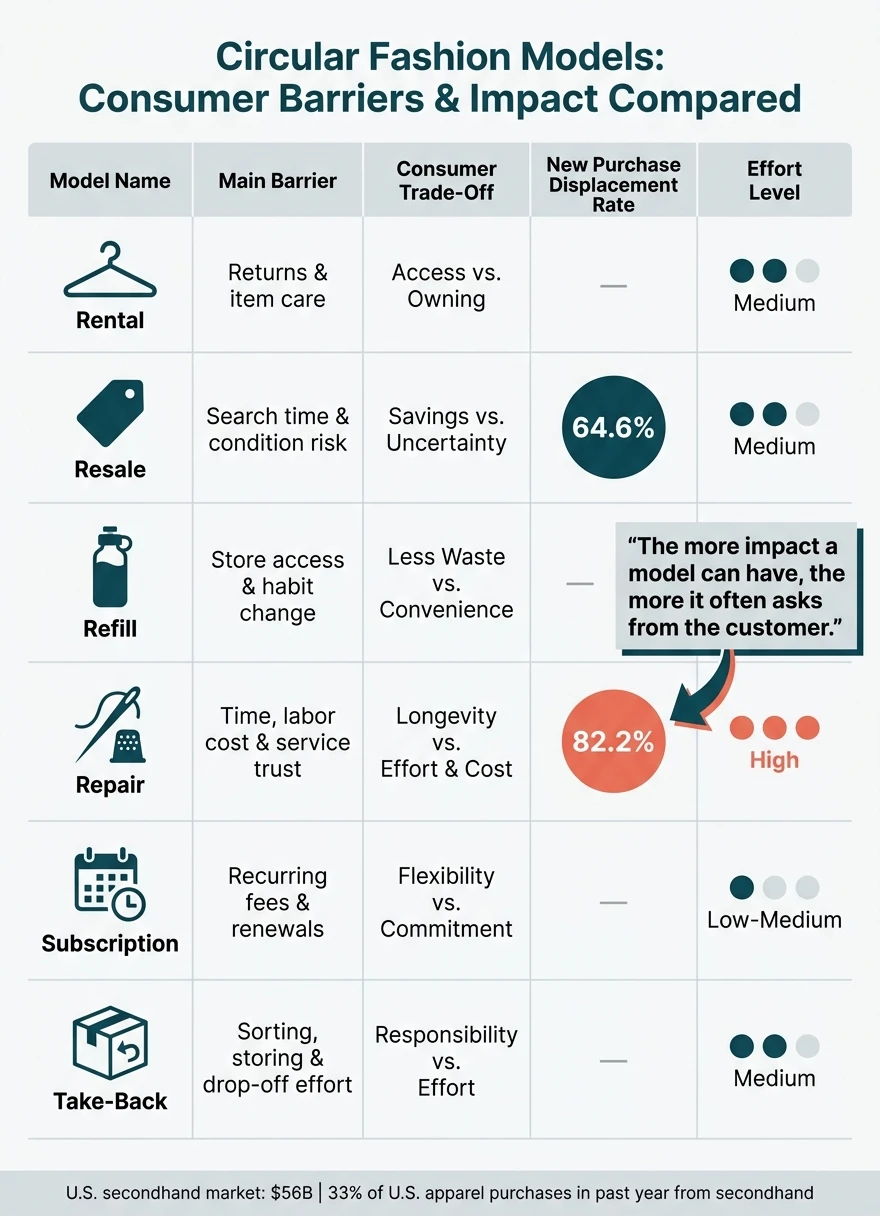
Circular Fashion Models: Consumer Barriers & Impact Compared
Model | Main Barrier | What the shopper is weighing |
|---|---|---|
Rental | Returns and item care | Access vs. owning |
Resale | Search time and condition risk | Savings vs. uncertainty |
Refill | Store access and habit change | Less waste vs. convenience |
Repair | Time, labor cost, and trust in service | Keeping an item longer vs. replacing it |
Subscription | Recurring fees and renewals | Flexibility vs. monthly commitment |
Take-back | Sorting, storing, and drop-off effort | Proper disposal vs. extra work |
For me, the main takeaway is not that shoppers reject circular options. It is that they leave when the step count, hassle, or doubt gets too high.
1. Rental
Ownership Norms
In the U.S., buying still feels like the default. Renting often reads as temporary, or even like a stopgap. That resistance tends to soften with expensive items people don't use often, like tools or cars. Even then, people bring the same expectation to the experience: it should feel easy, low-stress, and not much harder than a normal purchase.
Convenience Friction
Rental puts more on the customer than a standard sale. They may need to return the item, follow care instructions, report damage on time, and line up pickups or drop-offs. Transport bottlenecks make that even tougher [1][2]. Once a model adds too many steps after checkout, people start to drop off.
Trust and Hygiene
People want clear proof that items were cleaned and inspected, but that work is often hidden from view [1][2]. That gap matters. If customers can't see the process, they may assume corners were cut. Damage risk adds another layer of stress, especially when rental agreements require strict maintenance rules and fast reporting to avoid fees or service interruptions [1][2].
"Consumers want proof that items were cleaned and inspected"
That concern isn't just about cleanliness. It's also about peace of mind. If the item arrives looking fine but the care process is unclear, trust can slip fast.
Value and Commitment
For rental to click, people have to feel that access is worth the price, not just convenient. These models usually work better for higher-priced items, where cleaning, grading, and logistics costs are easier to absorb. Pay-per-use pricing can help by making the offer feel closer to actual use. The same pressure shows up in resale too, where condition and price have to do the heavy lifting instead of logistics.
2. Resale
Ownership Norms
Resale has moved into the mainstream, but it still runs into an old habit: for some shoppers, new still signals status, taste, or even a sense of self. Adoption is growing at scale, yet that bias toward buying new still holds some people back. Compared with rental, resale avoids the hassle of returns, but it brings a different set of trade-offs - more uncertainty about condition and more work for the buyer during search.
Secondhand can still feel like settling when status and identity are tied to buying something fresh off the shelf. That pushback tends to ease with high-quality or luxury goods, where resale is more likely to read as smart value rather than compromise.
Convenience Friction
Resale is labor-heavy from the start. Each item has to be handled, checked, photographed, stored, and shipped. That’s a lot of manual work before a buyer even clicks.
On the buyer side, the friction shows up in a different way:
Searching through one-off inventory
Guessing at fit or sizing
Judging condition from only a few photos
In other words, resale pushes more work onto the seller upfront and more uncertainty onto the buyer during search.
Trust and Quality
Once an item goes live, trust becomes the big sticking point. The core issues are authenticity and hidden defects. Most buyers can’t inspect the product before it ships, and condition grading often varies from one seller to the next.
Authentication and seller verification help cut that uncertainty. They don’t remove it entirely, but they make the purchase feel less like a gamble.
Value
Resale’s pitch is simple: pay less for a secondhand item. The challenge is that the economics are tight. Professional resale services usually need an item’s original retail price to be at least $130 to cover manual processing costs [3]. On top of that, resale often needs deep discounts - often around 50% off original retail - to move.
That leaves little room for error. If prices don’t drop far enough, buyers may not feel the savings are worth the uncertainty around condition and the time spent searching. If prices drop too far, margins disappear.
Resale works best when the savings are big enough to make that trade feel fair: lower cost in exchange for more uncertainty and more effort.
3. Refill
Ownership Norms
Refill mostly avoids the ownership debate. You already own the container; you just bring it back and fill it again. Still, it pushes against a deeply set shopping habit: buying a brand-new, sealed item every time. Fresh packaging often signals cleanliness and freshness at a glance. A reused container has to earn that same confidence. So the main challenge here isn't ownership so much as changing routine.
Convenience Friction
Refill runs into its biggest problem with infrastructure and day-to-day behavior, not ownership or uncertainty about product condition. That's what sets it apart from rental and resale. For refill to work, people need a nearby store, a refill station that is stocked and easy to spot, and a container they remembered to bring. That's a lot more effort than pulling a new bottle off the shelf, and it turns a simple purchase into a repeated errand.
A 2020 Unilever trial with UK retailer Asda found that visible, well-designed refill zones increased purchases by 33% versus standard single-use packaging. But that lift only happened when the setup was easy to find and simple to use.
Trust and Hygiene
Once convenience is handled, hygiene becomes the next hurdle. Shoppers worry about contamination and whether the station is clean. Clear cleaning routines and visible upkeep can ease that concern, but only when stores do them every time. When those standards slip, trust can disappear fast.
Value and Commitment
The value pitch for refill is simple: lower cost per use and less waste. But the ask is bigger than it first seems. This is not a one-time switch. It depends on people coming back and doing the same thing again and again.
Most shoppers say they care about sustainability, but at checkout, convenience and price still tend to decide the sale. Refill programs usually start to work at scale only when shoppers have enough choice in one place. Evidence suggests that 50 or more products in one location can lift sales and return rates [2]. Without that level of variety, the extra effort often feels like a hassle.
Refill succeeds when the lower-waste option feels just as easy as the default one.
Where refill depends on repeated participation, repair depends on whether people choose to keep what they already own.
4. Repair
Ownership Norms
Repair pushes people to think less like shoppers and more like caretakers. You already own the item, so the real question is simple: Is it worth fixing? That change matters. Repair is not mainly about swapping one item for another. It is about keeping the one you have in use for longer.
That also changes the role of the owner. Instead of moving an item along, you become the person who maintains it. That can mean learning basic upkeep, setting aside time for maintenance, and making peace with a bit of wear. Brands that back repair make this shift easier by removing friction and giving people a clearer path to follow.
Convenience Friction
Repair comes with real hassle, and that hassle adds up fast. A person may need to find a technician, ask for a quote, compare the cost, and then decide whether the item is worth the wait. The problem is not only inconvenience. It is delayed decision-making. People have to weigh effort, downtime, and price before they do anything, so repair can feel heavier than the other models.
Cost is another sticking point. For repair to pencil out, the item usually has to be worth enough to cover manual labor, cleaning, and logistics. Integrated repair services can cut the search burden. When the process starts to feel easier, the next issue is trust in the quality of the work.
Trust and Hygiene
For electronics, trust usually comes down to data privacy and whether personal information has been handled safely. For clothing and personal items, people tend to worry more about cleanliness and workmanship. At the center of both is the same issue: confidence in the repair itself.
In-house repair can tighten quality control. Outsourced networks can create more variation.
Value and Commitment
Repair has an 82.2% displacement rate, meaning it prevents a new purchase in roughly four out of five cases - higher than peer-to-peer resale at 64.6% [1]. That gives repair unusual power when the goal is to curb overproduction.
Still, that value has to feel concrete at the moment a person decides. Good intentions around sustainability often give way to convenience at the point of purchase. A few levers can help change that math:
Loyalty programs
Store credit
Financial incentives
Where repair keeps ownership in place, subscription moves more of the upkeep burden to the provider.
5. Subscription
Ownership Norms
Unlike rental, resale, or repair, subscription runs into friction after the first transaction. It shifts people away from owning a product and toward paying for access, and for many U.S. shoppers, that still feels a bit unfamiliar. The issue isn’t so much status. It’s whether access feels like enough month after month.
Convenience Friction
Support tends to fall when the model brings recurring charges, renewals, and regular effort beyond the first purchase. In plain terms, sign-up is only the start. The model also has to fit household budgets and day-to-day routines over time.
Trust, Value, and Commitment
Subscriptions work only when the ongoing value is plainly higher than the recurring cost. That’s the heart of it. Subscription keeps the customer in the loop the whole time, while take-back asks them to step back in only at the point of disposal.
6. Take-Back
If a subscription model ends with access, take-back ends with one last step: the item has to come back.
Ownership Norms
Take-back programs ask people to do something that can feel a little backward in the U.S.: return something they already own. In a linear system, the job usually ends when the item gets tossed. In a circular take-back model, the customer has one more role. They have to sort the item, hold onto it, and send it back or bring it in.
That sounds simple on paper. In daily life, it runs into a strong habit. U.S. buying patterns tend to favor ownership and the pull of buying new, which makes this shift harder.
Convenience Friction
The main barrier is effort. Take-back only works when people are willing to sort, prep, and drop off items instead of throwing them away. Each extra step makes the return less likely.
A few pain points show up again and again:
Long drop-off distances
Unclear instructions
Packaging rules
Timing and schedule hassles
A store-based electronics take-back program removes the shipping step, which helps. But even then, the model still depends on people remembering to bring items with them and deciding the trip is worth it.
Once returning the item feels easy enough, attention shifts to the next issue: what happens after drop-off.
Trust and Hygiene
There’s a real trust gap here. People want to know where the returned item goes and what is done with it after they hand it over. If that path feels hidden, doubt creeps in fast.
One of the most direct ways to close that gap is transparent impact reporting. Show the customer where the returned item went and what it became. That kind of clarity can turn a vague promise into something people can picture and believe.
Value and Commitment
Even when the return process is simple, participation still comes down to whether the payoff feels worth the effort.
Take-back asks for work without an instant reward. That’s why store credit or a similar incentive matters. It gives the customer a clear reason to follow through instead of putting the item aside and forgetting about it.
Barriers That Recur Across Models vs. Barriers Specific to One Model
Looking across all six models, one theme keeps showing up: convenience and trust come up again and again, while cost, logistics, and habit change play out in different ways depending on the model. When a shopper has to do more work after checkout, many fall back to the default option. That pressure shows up in every model, even if the friction comes from a different place.
Repair runs into a basic math problem: labor can cost more than the item feels worth. Resale is often shaped by where the best inventory ends up, with stronger markets pulling in the top goods. Refill leans hard on rules and physical systems that make adoption possible in the first place.
Here’s the clearest way to separate the barriers:
Barrier | Recurring Across Models | Concentrated in One Model |
|---|---|---|
Convenience / effort | All models | - |
Trust and quality uncertainty | Resale, rental, repair | - |
Intent-action gap / habit change | Refill, take-back | - |
Ownership norms | Rental, subscription | - |
Perceived value gap | Resale, refill | - |
High labor cost vs. low item value | - | Repair |
Best inventory flowing to stronger markets | - | Resale |
Regulatory dependence for adoption | - | Refill |
Return steps and sorting burden | - | Take-back |
That distinction matters. Similar consumer resistance can come from very different causes, so each model needs its own answer. Repair’s 82.2% displacement rate is higher than peer-to-peer resale’s 64.6% [1], which shows that some circular models cut new purchases more than others, even when the barriers look similar at first glance.
Most consumers don’t weigh the full lifecycle value. They compare immediate friction with immediate ease. Adoption tends to grow when the circular option feels as fast, clear, and worthwhile as the linear default.
Trade-Offs and Pros and Cons by Model
Once you look across the barriers side by side, the trade-offs come into focus. Every circular model asks people to give something up now in exchange for a later gain. The friction happens in the moment; the payoff comes afterward. For many U.S. shoppers, convenience still decides what happens at checkout, so even one extra step can slow uptake.
Seen through that lens, the models don’t ask for the same level of effort. Repair creates the biggest shift in behavior, resale is easier to try, and refill rises or falls on convenience and setup.
The table below maps those trade-offs onto the consumer journey and shows where each model is most likely to lose people:
Circular Model | Main Drop-off Point | Main Consumer Trade-Off | Pros | Cons |
|---|---|---|---|---|
Rental | Return / maintenance step | Access vs. ownership | Lower upfront cost; access to premium goods without storage | Coordination effort; hygiene concerns; maintenance responsibility |
Resale | Purchase or listing stage | Cost savings vs. perceived risk | Financial savings; unique inventory | Quality uncertainty; time-intensive to list or search |
Refill | Point of purchase | Sustainability vs. convenience | Reduced packaging waste; cost-effective over time | Limited locations; requires habit change and container management |
Repair | Decision to repair | Longevity vs. effort and cost | Highest displacement of new purchases | High time and labor cost; requires skill or trusted provider |
Subscription | Renewal or upgrade moment | Flexibility vs. commitment | Predictable access; simple swaps | Subscription fatigue; long-term cost can exceed ownership |
Take-Back | End-of-life disposal | Responsibility vs. effort | Responsible disposal; potential rewards or incentives | Inconvenient drop-off points; low consumer awareness |
One theme rises above the rest: the models that displace the most new purchases usually ask the most from the consumer. Repair is the clearest case. It can prevent more new purchases than resale, but it also asks people to find a provider, accept service costs, and wait for the item to come back [1]. In plain terms, more circular impact often means more work for the shopper.
That leaves one practical question: which models can remove enough friction, fast enough, to win the moment of purchase?
Conclusion
Consumer barriers across circular models don’t boil down to one issue with one fix. The same friction points show up again and again - trust, convenience, effort, and habit - but each model puts pressure on a different one. Limited know-how and thin infrastructure slow repair and take-back, while low awareness of how these models work adds friction across the board.
Repair shows the sharpest trade-off between impact and effort. It displaces new purchases at 82.2%, compared with 64.6% for peer-to-peer resale [1]. But that stronger impact comes with a catch: consumers usually need to spend more time, build more skill, and do more of the work themselves.
That difference matters in practice. Resale depends on authenticity checks. Refill works better when access is easy and shoppers can find more refill options in one store. Rental and subscription need simple returns and clear schedules. Repair needs easier upkeep and better support. Take-back needs clearer labels and drop-off points that are closer to where people live and shop. In other words, the barrier may sound similar on paper, but it doesn’t play out the same way from one model to the next.
For Council Fire, barrier mapping helps turn circular goals into operational priorities and match the right intervention to the right model.
FAQs
Why do convenience and trust matter most across circular models?
Convenience and trust matter most because they close the gap between good intentions and daily behavior. People may want to make better choices, but if returns, refills, repairs, or resale feel slow or confusing, many won’t follow through.
Trust carries the same weight. Consumers need confidence in product quality, environmental claims, and personal security. Clear, direct communication helps circular options feel dependable and easier to choose.
Which circular model has the biggest impact on reducing new purchases?
Repair has the biggest effect right now. Its displacement rate is 82.2%, which means about four out of five repairs stop a new purchase from happening.
Peer-to-peer resale also cuts demand for new production. Still, rebound effects can eat into part of that gain when shoppers use the money they saved to buy extra items.
How can brands reduce friction in rental, resale, refill, repair, subscription, and take-back?
Brands can cut friction in circular models when participation feels simple, clear, and worth the effort. If the process is clunky, most people will drop off. If it feels easy and useful, they’re far more likely to join in and come back.
A good place to start is the basic experience. Sign-up should take as few steps as possible. Returns should be easy to understand, with digital tools that guide people instead of slowing them down. The less guesswork involved, the better.
Incentives help move people from interest to action. Store credit, loyalty rewards, and similar perks give customers a direct reason to take part. That small nudge can make the difference between a one-time idea and a repeat habit.
Trust matters just as much. People want to know the item has been checked, that it’s genuine, and where it sits in its lifecycle. Clear quality checks, authenticity guarantees, and plain-language lifecycle details help remove doubt at the point of decision.
Brands also need to spell out what happens after purchase. Care instructions and return steps should be easy to find and easy to follow. When customers know how to maintain an item and what to do when they’re done with it, participation feels far less like work.
Some of this depends on work behind the scenes. Partnerships can help improve logistics and create more consistent return standards across channels. That makes the whole system smoother for customers and easier for brands to manage at scale.
Related Blog Posts
Latest Articles
©2026

Narrative Change and Power Building: The Missing Half of Advocacy
Narrative change is the process of disrupting dominant narratives that normalize inequity and advancing new narratives from historically marginalized communities.

Funding Resilience Without Federal Grants
BRIC is unreliable and FEMA is shrinking. Here's how cities fund climate resilience with dedicated revenue, blended finance, and a coordinating authority.

The ESG Blind Spot: How AI Is Finding Risks in Companies Nobody Else Is Watching
Norway's sovereign wealth fund uses AI to screen 7,200 portfolio companies for forced labor and corruption within 24 hours. The real story is the emerging-market coverage gap that traditional ESG data vendors miss — and what it means for any company with a global supply chain.
Narrative Change and Power Building: The Missing Half of Advocacy
Narrative change is the process of disrupting dominant narratives that normalize inequity and advancing new narratives from historically marginalized communities.
Funding Resilience Without Federal Grants
BRIC is unreliable and FEMA is shrinking. Here's how cities fund climate resilience with dedicated revenue, blended finance, and a coordinating authority.
The ESG Blind Spot: How AI Is Finding Risks in Companies Nobody Else Is Watching
Norway's sovereign wealth fund uses AI to screen 7,200 portfolio companies for forced labor and corruption within 24 hours. The real story is the emerging-market coverage gap that traditional ESG data vendors miss — and what it means for any company with a global supply chain.
FAQ
01
What does it really mean to “redefine profit”?
02
What makes Council Fire different?
03
Who does Council Fire work with?
04
What does working with Council Fire actually look like?
05
How does Council Fire help organizations turn big goals into action?
06
How does Council Fire define and measure success?
07
How does technology fit into Council Fire’s work?
Aug 28, 2026
Consumer Barriers Across Circular Models
Sustainability Strategy
In This Article
How convenience, trust, and extra effort block consumer uptake across rental, resale, refill, repair, subscription, and take-back models.
Consumer Barriers Across Circular Models
Most circular models lose people on the same two points: extra effort and low confidence. In this market, even with 33% of U.S. apparel purchases in the past year coming from secondhand and the U.S. secondhand market reaching $56 billion, many shoppers still choose the easiest path.
If I boil the article down, here’s the core point:
Rental struggles with returns, care rules, and hygiene worries.
Resale wins on lower price, but search time and item condition slow people down.
Refill depends on store setup, repeat visits, and people remembering containers.
Repair can stop the most new purchases, but it asks for the most time, effort, and service trust.
Subscription has to keep proving the monthly fee is worth it.
Take-back often fails when drop-off is hard or people do not know the program exists.
What stands out to me is simple: the more impact a model can have, the more it often asks from the customer. Repair is the clearest case, with an 82.2% displacement rate versus 64.6% for peer-to-peer resale.
The future of circular textiles: Understanding consumer behavior in a circular economy
Quick Comparison
Circular Fashion Models: Consumer Barriers & Impact Compared
Model | Main Barrier | What the shopper is weighing |
|---|---|---|
Rental | Returns and item care | Access vs. owning |
Resale | Search time and condition risk | Savings vs. uncertainty |
Refill | Store access and habit change | Less waste vs. convenience |
Repair | Time, labor cost, and trust in service | Keeping an item longer vs. replacing it |
Subscription | Recurring fees and renewals | Flexibility vs. monthly commitment |
Take-back | Sorting, storing, and drop-off effort | Proper disposal vs. extra work |
For me, the main takeaway is not that shoppers reject circular options. It is that they leave when the step count, hassle, or doubt gets too high.
1. Rental
Ownership Norms
In the U.S., buying still feels like the default. Renting often reads as temporary, or even like a stopgap. That resistance tends to soften with expensive items people don't use often, like tools or cars. Even then, people bring the same expectation to the experience: it should feel easy, low-stress, and not much harder than a normal purchase.
Convenience Friction
Rental puts more on the customer than a standard sale. They may need to return the item, follow care instructions, report damage on time, and line up pickups or drop-offs. Transport bottlenecks make that even tougher [1][2]. Once a model adds too many steps after checkout, people start to drop off.
Trust and Hygiene
People want clear proof that items were cleaned and inspected, but that work is often hidden from view [1][2]. That gap matters. If customers can't see the process, they may assume corners were cut. Damage risk adds another layer of stress, especially when rental agreements require strict maintenance rules and fast reporting to avoid fees or service interruptions [1][2].
"Consumers want proof that items were cleaned and inspected"
That concern isn't just about cleanliness. It's also about peace of mind. If the item arrives looking fine but the care process is unclear, trust can slip fast.
Value and Commitment
For rental to click, people have to feel that access is worth the price, not just convenient. These models usually work better for higher-priced items, where cleaning, grading, and logistics costs are easier to absorb. Pay-per-use pricing can help by making the offer feel closer to actual use. The same pressure shows up in resale too, where condition and price have to do the heavy lifting instead of logistics.
2. Resale
Ownership Norms
Resale has moved into the mainstream, but it still runs into an old habit: for some shoppers, new still signals status, taste, or even a sense of self. Adoption is growing at scale, yet that bias toward buying new still holds some people back. Compared with rental, resale avoids the hassle of returns, but it brings a different set of trade-offs - more uncertainty about condition and more work for the buyer during search.
Secondhand can still feel like settling when status and identity are tied to buying something fresh off the shelf. That pushback tends to ease with high-quality or luxury goods, where resale is more likely to read as smart value rather than compromise.
Convenience Friction
Resale is labor-heavy from the start. Each item has to be handled, checked, photographed, stored, and shipped. That’s a lot of manual work before a buyer even clicks.
On the buyer side, the friction shows up in a different way:
Searching through one-off inventory
Guessing at fit or sizing
Judging condition from only a few photos
In other words, resale pushes more work onto the seller upfront and more uncertainty onto the buyer during search.
Trust and Quality
Once an item goes live, trust becomes the big sticking point. The core issues are authenticity and hidden defects. Most buyers can’t inspect the product before it ships, and condition grading often varies from one seller to the next.
Authentication and seller verification help cut that uncertainty. They don’t remove it entirely, but they make the purchase feel less like a gamble.
Value
Resale’s pitch is simple: pay less for a secondhand item. The challenge is that the economics are tight. Professional resale services usually need an item’s original retail price to be at least $130 to cover manual processing costs [3]. On top of that, resale often needs deep discounts - often around 50% off original retail - to move.
That leaves little room for error. If prices don’t drop far enough, buyers may not feel the savings are worth the uncertainty around condition and the time spent searching. If prices drop too far, margins disappear.
Resale works best when the savings are big enough to make that trade feel fair: lower cost in exchange for more uncertainty and more effort.
3. Refill
Ownership Norms
Refill mostly avoids the ownership debate. You already own the container; you just bring it back and fill it again. Still, it pushes against a deeply set shopping habit: buying a brand-new, sealed item every time. Fresh packaging often signals cleanliness and freshness at a glance. A reused container has to earn that same confidence. So the main challenge here isn't ownership so much as changing routine.
Convenience Friction
Refill runs into its biggest problem with infrastructure and day-to-day behavior, not ownership or uncertainty about product condition. That's what sets it apart from rental and resale. For refill to work, people need a nearby store, a refill station that is stocked and easy to spot, and a container they remembered to bring. That's a lot more effort than pulling a new bottle off the shelf, and it turns a simple purchase into a repeated errand.
A 2020 Unilever trial with UK retailer Asda found that visible, well-designed refill zones increased purchases by 33% versus standard single-use packaging. But that lift only happened when the setup was easy to find and simple to use.
Trust and Hygiene
Once convenience is handled, hygiene becomes the next hurdle. Shoppers worry about contamination and whether the station is clean. Clear cleaning routines and visible upkeep can ease that concern, but only when stores do them every time. When those standards slip, trust can disappear fast.
Value and Commitment
The value pitch for refill is simple: lower cost per use and less waste. But the ask is bigger than it first seems. This is not a one-time switch. It depends on people coming back and doing the same thing again and again.
Most shoppers say they care about sustainability, but at checkout, convenience and price still tend to decide the sale. Refill programs usually start to work at scale only when shoppers have enough choice in one place. Evidence suggests that 50 or more products in one location can lift sales and return rates [2]. Without that level of variety, the extra effort often feels like a hassle.
Refill succeeds when the lower-waste option feels just as easy as the default one.
Where refill depends on repeated participation, repair depends on whether people choose to keep what they already own.
4. Repair
Ownership Norms
Repair pushes people to think less like shoppers and more like caretakers. You already own the item, so the real question is simple: Is it worth fixing? That change matters. Repair is not mainly about swapping one item for another. It is about keeping the one you have in use for longer.
That also changes the role of the owner. Instead of moving an item along, you become the person who maintains it. That can mean learning basic upkeep, setting aside time for maintenance, and making peace with a bit of wear. Brands that back repair make this shift easier by removing friction and giving people a clearer path to follow.
Convenience Friction
Repair comes with real hassle, and that hassle adds up fast. A person may need to find a technician, ask for a quote, compare the cost, and then decide whether the item is worth the wait. The problem is not only inconvenience. It is delayed decision-making. People have to weigh effort, downtime, and price before they do anything, so repair can feel heavier than the other models.
Cost is another sticking point. For repair to pencil out, the item usually has to be worth enough to cover manual labor, cleaning, and logistics. Integrated repair services can cut the search burden. When the process starts to feel easier, the next issue is trust in the quality of the work.
Trust and Hygiene
For electronics, trust usually comes down to data privacy and whether personal information has been handled safely. For clothing and personal items, people tend to worry more about cleanliness and workmanship. At the center of both is the same issue: confidence in the repair itself.
In-house repair can tighten quality control. Outsourced networks can create more variation.
Value and Commitment
Repair has an 82.2% displacement rate, meaning it prevents a new purchase in roughly four out of five cases - higher than peer-to-peer resale at 64.6% [1]. That gives repair unusual power when the goal is to curb overproduction.
Still, that value has to feel concrete at the moment a person decides. Good intentions around sustainability often give way to convenience at the point of purchase. A few levers can help change that math:
Loyalty programs
Store credit
Financial incentives
Where repair keeps ownership in place, subscription moves more of the upkeep burden to the provider.
5. Subscription
Ownership Norms
Unlike rental, resale, or repair, subscription runs into friction after the first transaction. It shifts people away from owning a product and toward paying for access, and for many U.S. shoppers, that still feels a bit unfamiliar. The issue isn’t so much status. It’s whether access feels like enough month after month.
Convenience Friction
Support tends to fall when the model brings recurring charges, renewals, and regular effort beyond the first purchase. In plain terms, sign-up is only the start. The model also has to fit household budgets and day-to-day routines over time.
Trust, Value, and Commitment
Subscriptions work only when the ongoing value is plainly higher than the recurring cost. That’s the heart of it. Subscription keeps the customer in the loop the whole time, while take-back asks them to step back in only at the point of disposal.
6. Take-Back
If a subscription model ends with access, take-back ends with one last step: the item has to come back.
Ownership Norms
Take-back programs ask people to do something that can feel a little backward in the U.S.: return something they already own. In a linear system, the job usually ends when the item gets tossed. In a circular take-back model, the customer has one more role. They have to sort the item, hold onto it, and send it back or bring it in.
That sounds simple on paper. In daily life, it runs into a strong habit. U.S. buying patterns tend to favor ownership and the pull of buying new, which makes this shift harder.
Convenience Friction
The main barrier is effort. Take-back only works when people are willing to sort, prep, and drop off items instead of throwing them away. Each extra step makes the return less likely.
A few pain points show up again and again:
Long drop-off distances
Unclear instructions
Packaging rules
Timing and schedule hassles
A store-based electronics take-back program removes the shipping step, which helps. But even then, the model still depends on people remembering to bring items with them and deciding the trip is worth it.
Once returning the item feels easy enough, attention shifts to the next issue: what happens after drop-off.
Trust and Hygiene
There’s a real trust gap here. People want to know where the returned item goes and what is done with it after they hand it over. If that path feels hidden, doubt creeps in fast.
One of the most direct ways to close that gap is transparent impact reporting. Show the customer where the returned item went and what it became. That kind of clarity can turn a vague promise into something people can picture and believe.
Value and Commitment
Even when the return process is simple, participation still comes down to whether the payoff feels worth the effort.
Take-back asks for work without an instant reward. That’s why store credit or a similar incentive matters. It gives the customer a clear reason to follow through instead of putting the item aside and forgetting about it.
Barriers That Recur Across Models vs. Barriers Specific to One Model
Looking across all six models, one theme keeps showing up: convenience and trust come up again and again, while cost, logistics, and habit change play out in different ways depending on the model. When a shopper has to do more work after checkout, many fall back to the default option. That pressure shows up in every model, even if the friction comes from a different place.
Repair runs into a basic math problem: labor can cost more than the item feels worth. Resale is often shaped by where the best inventory ends up, with stronger markets pulling in the top goods. Refill leans hard on rules and physical systems that make adoption possible in the first place.
Here’s the clearest way to separate the barriers:
Barrier | Recurring Across Models | Concentrated in One Model |
|---|---|---|
Convenience / effort | All models | - |
Trust and quality uncertainty | Resale, rental, repair | - |
Intent-action gap / habit change | Refill, take-back | - |
Ownership norms | Rental, subscription | - |
Perceived value gap | Resale, refill | - |
High labor cost vs. low item value | - | Repair |
Best inventory flowing to stronger markets | - | Resale |
Regulatory dependence for adoption | - | Refill |
Return steps and sorting burden | - | Take-back |
That distinction matters. Similar consumer resistance can come from very different causes, so each model needs its own answer. Repair’s 82.2% displacement rate is higher than peer-to-peer resale’s 64.6% [1], which shows that some circular models cut new purchases more than others, even when the barriers look similar at first glance.
Most consumers don’t weigh the full lifecycle value. They compare immediate friction with immediate ease. Adoption tends to grow when the circular option feels as fast, clear, and worthwhile as the linear default.
Trade-Offs and Pros and Cons by Model
Once you look across the barriers side by side, the trade-offs come into focus. Every circular model asks people to give something up now in exchange for a later gain. The friction happens in the moment; the payoff comes afterward. For many U.S. shoppers, convenience still decides what happens at checkout, so even one extra step can slow uptake.
Seen through that lens, the models don’t ask for the same level of effort. Repair creates the biggest shift in behavior, resale is easier to try, and refill rises or falls on convenience and setup.
The table below maps those trade-offs onto the consumer journey and shows where each model is most likely to lose people:
Circular Model | Main Drop-off Point | Main Consumer Trade-Off | Pros | Cons |
|---|---|---|---|---|
Rental | Return / maintenance step | Access vs. ownership | Lower upfront cost; access to premium goods without storage | Coordination effort; hygiene concerns; maintenance responsibility |
Resale | Purchase or listing stage | Cost savings vs. perceived risk | Financial savings; unique inventory | Quality uncertainty; time-intensive to list or search |
Refill | Point of purchase | Sustainability vs. convenience | Reduced packaging waste; cost-effective over time | Limited locations; requires habit change and container management |
Repair | Decision to repair | Longevity vs. effort and cost | Highest displacement of new purchases | High time and labor cost; requires skill or trusted provider |
Subscription | Renewal or upgrade moment | Flexibility vs. commitment | Predictable access; simple swaps | Subscription fatigue; long-term cost can exceed ownership |
Take-Back | End-of-life disposal | Responsibility vs. effort | Responsible disposal; potential rewards or incentives | Inconvenient drop-off points; low consumer awareness |
One theme rises above the rest: the models that displace the most new purchases usually ask the most from the consumer. Repair is the clearest case. It can prevent more new purchases than resale, but it also asks people to find a provider, accept service costs, and wait for the item to come back [1]. In plain terms, more circular impact often means more work for the shopper.
That leaves one practical question: which models can remove enough friction, fast enough, to win the moment of purchase?
Conclusion
Consumer barriers across circular models don’t boil down to one issue with one fix. The same friction points show up again and again - trust, convenience, effort, and habit - but each model puts pressure on a different one. Limited know-how and thin infrastructure slow repair and take-back, while low awareness of how these models work adds friction across the board.
Repair shows the sharpest trade-off between impact and effort. It displaces new purchases at 82.2%, compared with 64.6% for peer-to-peer resale [1]. But that stronger impact comes with a catch: consumers usually need to spend more time, build more skill, and do more of the work themselves.
That difference matters in practice. Resale depends on authenticity checks. Refill works better when access is easy and shoppers can find more refill options in one store. Rental and subscription need simple returns and clear schedules. Repair needs easier upkeep and better support. Take-back needs clearer labels and drop-off points that are closer to where people live and shop. In other words, the barrier may sound similar on paper, but it doesn’t play out the same way from one model to the next.
For Council Fire, barrier mapping helps turn circular goals into operational priorities and match the right intervention to the right model.
FAQs
Why do convenience and trust matter most across circular models?
Convenience and trust matter most because they close the gap between good intentions and daily behavior. People may want to make better choices, but if returns, refills, repairs, or resale feel slow or confusing, many won’t follow through.
Trust carries the same weight. Consumers need confidence in product quality, environmental claims, and personal security. Clear, direct communication helps circular options feel dependable and easier to choose.
Which circular model has the biggest impact on reducing new purchases?
Repair has the biggest effect right now. Its displacement rate is 82.2%, which means about four out of five repairs stop a new purchase from happening.
Peer-to-peer resale also cuts demand for new production. Still, rebound effects can eat into part of that gain when shoppers use the money they saved to buy extra items.
How can brands reduce friction in rental, resale, refill, repair, subscription, and take-back?
Brands can cut friction in circular models when participation feels simple, clear, and worth the effort. If the process is clunky, most people will drop off. If it feels easy and useful, they’re far more likely to join in and come back.
A good place to start is the basic experience. Sign-up should take as few steps as possible. Returns should be easy to understand, with digital tools that guide people instead of slowing them down. The less guesswork involved, the better.
Incentives help move people from interest to action. Store credit, loyalty rewards, and similar perks give customers a direct reason to take part. That small nudge can make the difference between a one-time idea and a repeat habit.
Trust matters just as much. People want to know the item has been checked, that it’s genuine, and where it sits in its lifecycle. Clear quality checks, authenticity guarantees, and plain-language lifecycle details help remove doubt at the point of decision.
Brands also need to spell out what happens after purchase. Care instructions and return steps should be easy to find and easy to follow. When customers know how to maintain an item and what to do when they’re done with it, participation feels far less like work.
Some of this depends on work behind the scenes. Partnerships can help improve logistics and create more consistent return standards across channels. That makes the whole system smoother for customers and easier for brands to manage at scale.
Related Blog Posts
Latest Articles
©2026
Narrative Change and Power Building: The Missing Half of Advocacy
Narrative change is the process of disrupting dominant narratives that normalize inequity and advancing new narratives from historically marginalized communities.
Funding Resilience Without Federal Grants
BRIC is unreliable and FEMA is shrinking. Here's how cities fund climate resilience with dedicated revenue, blended finance, and a coordinating authority.
The ESG Blind Spot: How AI Is Finding Risks in Companies Nobody Else Is Watching
Norway's sovereign wealth fund uses AI to screen 7,200 portfolio companies for forced labor and corruption within 24 hours. The real story is the emerging-market coverage gap that traditional ESG data vendors miss — and what it means for any company with a global supply chain.
FAQ
01
What does it really mean to “redefine profit”?
02
What makes Council Fire different?
03
Who does Council Fire work with?
04
What does working with Council Fire actually look like?
05
How does Council Fire help organizations turn big goals into action?
06
How does Council Fire define and measure success?
07
How does technology fit into Council Fire’s work?
Aug 28, 2026
Consumer Barriers Across Circular Models
Sustainability Strategy
In This Article
How convenience, trust, and extra effort block consumer uptake across rental, resale, refill, repair, subscription, and take-back models.
Consumer Barriers Across Circular Models
Most circular models lose people on the same two points: extra effort and low confidence. In this market, even with 33% of U.S. apparel purchases in the past year coming from secondhand and the U.S. secondhand market reaching $56 billion, many shoppers still choose the easiest path.
If I boil the article down, here’s the core point:
Rental struggles with returns, care rules, and hygiene worries.
Resale wins on lower price, but search time and item condition slow people down.
Refill depends on store setup, repeat visits, and people remembering containers.
Repair can stop the most new purchases, but it asks for the most time, effort, and service trust.
Subscription has to keep proving the monthly fee is worth it.
Take-back often fails when drop-off is hard or people do not know the program exists.
What stands out to me is simple: the more impact a model can have, the more it often asks from the customer. Repair is the clearest case, with an 82.2% displacement rate versus 64.6% for peer-to-peer resale.
The future of circular textiles: Understanding consumer behavior in a circular economy
Quick Comparison
Circular Fashion Models: Consumer Barriers & Impact Compared
Model | Main Barrier | What the shopper is weighing |
|---|---|---|
Rental | Returns and item care | Access vs. owning |
Resale | Search time and condition risk | Savings vs. uncertainty |
Refill | Store access and habit change | Less waste vs. convenience |
Repair | Time, labor cost, and trust in service | Keeping an item longer vs. replacing it |
Subscription | Recurring fees and renewals | Flexibility vs. monthly commitment |
Take-back | Sorting, storing, and drop-off effort | Proper disposal vs. extra work |
For me, the main takeaway is not that shoppers reject circular options. It is that they leave when the step count, hassle, or doubt gets too high.
1. Rental
Ownership Norms
In the U.S., buying still feels like the default. Renting often reads as temporary, or even like a stopgap. That resistance tends to soften with expensive items people don't use often, like tools or cars. Even then, people bring the same expectation to the experience: it should feel easy, low-stress, and not much harder than a normal purchase.
Convenience Friction
Rental puts more on the customer than a standard sale. They may need to return the item, follow care instructions, report damage on time, and line up pickups or drop-offs. Transport bottlenecks make that even tougher [1][2]. Once a model adds too many steps after checkout, people start to drop off.
Trust and Hygiene
People want clear proof that items were cleaned and inspected, but that work is often hidden from view [1][2]. That gap matters. If customers can't see the process, they may assume corners were cut. Damage risk adds another layer of stress, especially when rental agreements require strict maintenance rules and fast reporting to avoid fees or service interruptions [1][2].
"Consumers want proof that items were cleaned and inspected"
That concern isn't just about cleanliness. It's also about peace of mind. If the item arrives looking fine but the care process is unclear, trust can slip fast.
Value and Commitment
For rental to click, people have to feel that access is worth the price, not just convenient. These models usually work better for higher-priced items, where cleaning, grading, and logistics costs are easier to absorb. Pay-per-use pricing can help by making the offer feel closer to actual use. The same pressure shows up in resale too, where condition and price have to do the heavy lifting instead of logistics.
2. Resale
Ownership Norms
Resale has moved into the mainstream, but it still runs into an old habit: for some shoppers, new still signals status, taste, or even a sense of self. Adoption is growing at scale, yet that bias toward buying new still holds some people back. Compared with rental, resale avoids the hassle of returns, but it brings a different set of trade-offs - more uncertainty about condition and more work for the buyer during search.
Secondhand can still feel like settling when status and identity are tied to buying something fresh off the shelf. That pushback tends to ease with high-quality or luxury goods, where resale is more likely to read as smart value rather than compromise.
Convenience Friction
Resale is labor-heavy from the start. Each item has to be handled, checked, photographed, stored, and shipped. That’s a lot of manual work before a buyer even clicks.
On the buyer side, the friction shows up in a different way:
Searching through one-off inventory
Guessing at fit or sizing
Judging condition from only a few photos
In other words, resale pushes more work onto the seller upfront and more uncertainty onto the buyer during search.
Trust and Quality
Once an item goes live, trust becomes the big sticking point. The core issues are authenticity and hidden defects. Most buyers can’t inspect the product before it ships, and condition grading often varies from one seller to the next.
Authentication and seller verification help cut that uncertainty. They don’t remove it entirely, but they make the purchase feel less like a gamble.
Value
Resale’s pitch is simple: pay less for a secondhand item. The challenge is that the economics are tight. Professional resale services usually need an item’s original retail price to be at least $130 to cover manual processing costs [3]. On top of that, resale often needs deep discounts - often around 50% off original retail - to move.
That leaves little room for error. If prices don’t drop far enough, buyers may not feel the savings are worth the uncertainty around condition and the time spent searching. If prices drop too far, margins disappear.
Resale works best when the savings are big enough to make that trade feel fair: lower cost in exchange for more uncertainty and more effort.
3. Refill
Ownership Norms
Refill mostly avoids the ownership debate. You already own the container; you just bring it back and fill it again. Still, it pushes against a deeply set shopping habit: buying a brand-new, sealed item every time. Fresh packaging often signals cleanliness and freshness at a glance. A reused container has to earn that same confidence. So the main challenge here isn't ownership so much as changing routine.
Convenience Friction
Refill runs into its biggest problem with infrastructure and day-to-day behavior, not ownership or uncertainty about product condition. That's what sets it apart from rental and resale. For refill to work, people need a nearby store, a refill station that is stocked and easy to spot, and a container they remembered to bring. That's a lot more effort than pulling a new bottle off the shelf, and it turns a simple purchase into a repeated errand.
A 2020 Unilever trial with UK retailer Asda found that visible, well-designed refill zones increased purchases by 33% versus standard single-use packaging. But that lift only happened when the setup was easy to find and simple to use.
Trust and Hygiene
Once convenience is handled, hygiene becomes the next hurdle. Shoppers worry about contamination and whether the station is clean. Clear cleaning routines and visible upkeep can ease that concern, but only when stores do them every time. When those standards slip, trust can disappear fast.
Value and Commitment
The value pitch for refill is simple: lower cost per use and less waste. But the ask is bigger than it first seems. This is not a one-time switch. It depends on people coming back and doing the same thing again and again.
Most shoppers say they care about sustainability, but at checkout, convenience and price still tend to decide the sale. Refill programs usually start to work at scale only when shoppers have enough choice in one place. Evidence suggests that 50 or more products in one location can lift sales and return rates [2]. Without that level of variety, the extra effort often feels like a hassle.
Refill succeeds when the lower-waste option feels just as easy as the default one.
Where refill depends on repeated participation, repair depends on whether people choose to keep what they already own.
4. Repair
Ownership Norms
Repair pushes people to think less like shoppers and more like caretakers. You already own the item, so the real question is simple: Is it worth fixing? That change matters. Repair is not mainly about swapping one item for another. It is about keeping the one you have in use for longer.
That also changes the role of the owner. Instead of moving an item along, you become the person who maintains it. That can mean learning basic upkeep, setting aside time for maintenance, and making peace with a bit of wear. Brands that back repair make this shift easier by removing friction and giving people a clearer path to follow.
Convenience Friction
Repair comes with real hassle, and that hassle adds up fast. A person may need to find a technician, ask for a quote, compare the cost, and then decide whether the item is worth the wait. The problem is not only inconvenience. It is delayed decision-making. People have to weigh effort, downtime, and price before they do anything, so repair can feel heavier than the other models.
Cost is another sticking point. For repair to pencil out, the item usually has to be worth enough to cover manual labor, cleaning, and logistics. Integrated repair services can cut the search burden. When the process starts to feel easier, the next issue is trust in the quality of the work.
Trust and Hygiene
For electronics, trust usually comes down to data privacy and whether personal information has been handled safely. For clothing and personal items, people tend to worry more about cleanliness and workmanship. At the center of both is the same issue: confidence in the repair itself.
In-house repair can tighten quality control. Outsourced networks can create more variation.
Value and Commitment
Repair has an 82.2% displacement rate, meaning it prevents a new purchase in roughly four out of five cases - higher than peer-to-peer resale at 64.6% [1]. That gives repair unusual power when the goal is to curb overproduction.
Still, that value has to feel concrete at the moment a person decides. Good intentions around sustainability often give way to convenience at the point of purchase. A few levers can help change that math:
Loyalty programs
Store credit
Financial incentives
Where repair keeps ownership in place, subscription moves more of the upkeep burden to the provider.
5. Subscription
Ownership Norms
Unlike rental, resale, or repair, subscription runs into friction after the first transaction. It shifts people away from owning a product and toward paying for access, and for many U.S. shoppers, that still feels a bit unfamiliar. The issue isn’t so much status. It’s whether access feels like enough month after month.
Convenience Friction
Support tends to fall when the model brings recurring charges, renewals, and regular effort beyond the first purchase. In plain terms, sign-up is only the start. The model also has to fit household budgets and day-to-day routines over time.
Trust, Value, and Commitment
Subscriptions work only when the ongoing value is plainly higher than the recurring cost. That’s the heart of it. Subscription keeps the customer in the loop the whole time, while take-back asks them to step back in only at the point of disposal.
6. Take-Back
If a subscription model ends with access, take-back ends with one last step: the item has to come back.
Ownership Norms
Take-back programs ask people to do something that can feel a little backward in the U.S.: return something they already own. In a linear system, the job usually ends when the item gets tossed. In a circular take-back model, the customer has one more role. They have to sort the item, hold onto it, and send it back or bring it in.
That sounds simple on paper. In daily life, it runs into a strong habit. U.S. buying patterns tend to favor ownership and the pull of buying new, which makes this shift harder.
Convenience Friction
The main barrier is effort. Take-back only works when people are willing to sort, prep, and drop off items instead of throwing them away. Each extra step makes the return less likely.
A few pain points show up again and again:
Long drop-off distances
Unclear instructions
Packaging rules
Timing and schedule hassles
A store-based electronics take-back program removes the shipping step, which helps. But even then, the model still depends on people remembering to bring items with them and deciding the trip is worth it.
Once returning the item feels easy enough, attention shifts to the next issue: what happens after drop-off.
Trust and Hygiene
There’s a real trust gap here. People want to know where the returned item goes and what is done with it after they hand it over. If that path feels hidden, doubt creeps in fast.
One of the most direct ways to close that gap is transparent impact reporting. Show the customer where the returned item went and what it became. That kind of clarity can turn a vague promise into something people can picture and believe.
Value and Commitment
Even when the return process is simple, participation still comes down to whether the payoff feels worth the effort.
Take-back asks for work without an instant reward. That’s why store credit or a similar incentive matters. It gives the customer a clear reason to follow through instead of putting the item aside and forgetting about it.
Barriers That Recur Across Models vs. Barriers Specific to One Model
Looking across all six models, one theme keeps showing up: convenience and trust come up again and again, while cost, logistics, and habit change play out in different ways depending on the model. When a shopper has to do more work after checkout, many fall back to the default option. That pressure shows up in every model, even if the friction comes from a different place.
Repair runs into a basic math problem: labor can cost more than the item feels worth. Resale is often shaped by where the best inventory ends up, with stronger markets pulling in the top goods. Refill leans hard on rules and physical systems that make adoption possible in the first place.
Here’s the clearest way to separate the barriers:
Barrier | Recurring Across Models | Concentrated in One Model |
|---|---|---|
Convenience / effort | All models | - |
Trust and quality uncertainty | Resale, rental, repair | - |
Intent-action gap / habit change | Refill, take-back | - |
Ownership norms | Rental, subscription | - |
Perceived value gap | Resale, refill | - |
High labor cost vs. low item value | - | Repair |
Best inventory flowing to stronger markets | - | Resale |
Regulatory dependence for adoption | - | Refill |
Return steps and sorting burden | - | Take-back |
That distinction matters. Similar consumer resistance can come from very different causes, so each model needs its own answer. Repair’s 82.2% displacement rate is higher than peer-to-peer resale’s 64.6% [1], which shows that some circular models cut new purchases more than others, even when the barriers look similar at first glance.
Most consumers don’t weigh the full lifecycle value. They compare immediate friction with immediate ease. Adoption tends to grow when the circular option feels as fast, clear, and worthwhile as the linear default.
Trade-Offs and Pros and Cons by Model
Once you look across the barriers side by side, the trade-offs come into focus. Every circular model asks people to give something up now in exchange for a later gain. The friction happens in the moment; the payoff comes afterward. For many U.S. shoppers, convenience still decides what happens at checkout, so even one extra step can slow uptake.
Seen through that lens, the models don’t ask for the same level of effort. Repair creates the biggest shift in behavior, resale is easier to try, and refill rises or falls on convenience and setup.
The table below maps those trade-offs onto the consumer journey and shows where each model is most likely to lose people:
Circular Model | Main Drop-off Point | Main Consumer Trade-Off | Pros | Cons |
|---|---|---|---|---|
Rental | Return / maintenance step | Access vs. ownership | Lower upfront cost; access to premium goods without storage | Coordination effort; hygiene concerns; maintenance responsibility |
Resale | Purchase or listing stage | Cost savings vs. perceived risk | Financial savings; unique inventory | Quality uncertainty; time-intensive to list or search |
Refill | Point of purchase | Sustainability vs. convenience | Reduced packaging waste; cost-effective over time | Limited locations; requires habit change and container management |
Repair | Decision to repair | Longevity vs. effort and cost | Highest displacement of new purchases | High time and labor cost; requires skill or trusted provider |
Subscription | Renewal or upgrade moment | Flexibility vs. commitment | Predictable access; simple swaps | Subscription fatigue; long-term cost can exceed ownership |
Take-Back | End-of-life disposal | Responsibility vs. effort | Responsible disposal; potential rewards or incentives | Inconvenient drop-off points; low consumer awareness |
One theme rises above the rest: the models that displace the most new purchases usually ask the most from the consumer. Repair is the clearest case. It can prevent more new purchases than resale, but it also asks people to find a provider, accept service costs, and wait for the item to come back [1]. In plain terms, more circular impact often means more work for the shopper.
That leaves one practical question: which models can remove enough friction, fast enough, to win the moment of purchase?
Conclusion
Consumer barriers across circular models don’t boil down to one issue with one fix. The same friction points show up again and again - trust, convenience, effort, and habit - but each model puts pressure on a different one. Limited know-how and thin infrastructure slow repair and take-back, while low awareness of how these models work adds friction across the board.
Repair shows the sharpest trade-off between impact and effort. It displaces new purchases at 82.2%, compared with 64.6% for peer-to-peer resale [1]. But that stronger impact comes with a catch: consumers usually need to spend more time, build more skill, and do more of the work themselves.
That difference matters in practice. Resale depends on authenticity checks. Refill works better when access is easy and shoppers can find more refill options in one store. Rental and subscription need simple returns and clear schedules. Repair needs easier upkeep and better support. Take-back needs clearer labels and drop-off points that are closer to where people live and shop. In other words, the barrier may sound similar on paper, but it doesn’t play out the same way from one model to the next.
For Council Fire, barrier mapping helps turn circular goals into operational priorities and match the right intervention to the right model.
FAQs
Why do convenience and trust matter most across circular models?
Convenience and trust matter most because they close the gap between good intentions and daily behavior. People may want to make better choices, but if returns, refills, repairs, or resale feel slow or confusing, many won’t follow through.
Trust carries the same weight. Consumers need confidence in product quality, environmental claims, and personal security. Clear, direct communication helps circular options feel dependable and easier to choose.
Which circular model has the biggest impact on reducing new purchases?
Repair has the biggest effect right now. Its displacement rate is 82.2%, which means about four out of five repairs stop a new purchase from happening.
Peer-to-peer resale also cuts demand for new production. Still, rebound effects can eat into part of that gain when shoppers use the money they saved to buy extra items.
How can brands reduce friction in rental, resale, refill, repair, subscription, and take-back?
Brands can cut friction in circular models when participation feels simple, clear, and worth the effort. If the process is clunky, most people will drop off. If it feels easy and useful, they’re far more likely to join in and come back.
A good place to start is the basic experience. Sign-up should take as few steps as possible. Returns should be easy to understand, with digital tools that guide people instead of slowing them down. The less guesswork involved, the better.
Incentives help move people from interest to action. Store credit, loyalty rewards, and similar perks give customers a direct reason to take part. That small nudge can make the difference between a one-time idea and a repeat habit.
Trust matters just as much. People want to know the item has been checked, that it’s genuine, and where it sits in its lifecycle. Clear quality checks, authenticity guarantees, and plain-language lifecycle details help remove doubt at the point of decision.
Brands also need to spell out what happens after purchase. Care instructions and return steps should be easy to find and easy to follow. When customers know how to maintain an item and what to do when they’re done with it, participation feels far less like work.
Some of this depends on work behind the scenes. Partnerships can help improve logistics and create more consistent return standards across channels. That makes the whole system smoother for customers and easier for brands to manage at scale.
Related Blog Posts
Latest Articles
©2026
Narrative Change and Power Building: The Missing Half of Advocacy
Narrative change is the process of disrupting dominant narratives that normalize inequity and advancing new narratives from historically marginalized communities.
Funding Resilience Without Federal Grants
BRIC is unreliable and FEMA is shrinking. Here's how cities fund climate resilience with dedicated revenue, blended finance, and a coordinating authority.
The ESG Blind Spot: How AI Is Finding Risks in Companies Nobody Else Is Watching
Norway's sovereign wealth fund uses AI to screen 7,200 portfolio companies for forced labor and corruption within 24 hours. The real story is the emerging-market coverage gap that traditional ESG data vendors miss — and what it means for any company with a global supply chain.
FAQ
What does it really mean to “redefine profit”?
What makes Council Fire different?
Who does Council Fire work with?
What does working with Council Fire actually look like?
How does Council Fire help organizations turn big goals into action?
How does Council Fire define and measure success?
How does technology fit into Council Fire’s work?