
Jul 1, 2026
How Second-Hand Platforms Support Circular Economy
Sustainability Strategy
In This Article
Second-hand platforms extend product life and cut waste - only when design, logistics, and measurement make resale displace new purchases.
How Second-Hand Platforms Support Circular Economy
Second-hand platforms help cut waste only when they keep goods in use long enough to reduce new buying. In the U.S., the resale market hit $55.5 billion in 2025, 93% of Americans bought at least one pre-owned item, and the country still sends about 15.42 billion kg of textile waste to landfills each year. The point is simple: resale, refurbishment, and upcycling can slow the buy-use-trash cycle, but they work best when products are durable, sorting and repair costs stay in check, and resale replaces a new purchase.
If I boil the article down, here’s what matters most:
Why this matters: The U.S. still loses huge material and product value under a linear model.
What these platforms do: They extend product life through reuse, refurbishment, and upcycling.
What the data shows: One resale can cut product-linked emissions by 43% to 82%; in apparel, one resale adds about 3.2 years of use.
Where it breaks down: Cheap, low-durability goods, weak condition data, returns, shipping, and repair labor can erase gains.
What sustainability consulting experts recommend organizations track: landfill diversion, product life added, avoided emissions, resale recovery value, and whether used sales replace new ones.
A few facts stand out. In 2023, U.S. retail returns reached $743 billion, equal to 14.5% of sales. Brands also produced 2.5 billion to 5 billion excess items. At the same time, many discarded goods are still usable, yet they never make it back to market because sorting, cleaning, and fixing them costs too much.
For me, the core takeaway is clear: second-hand platforms are not enough on their own. They matter most when they sit inside a bigger system that includes better product design, lower-friction take-back, tighter quality checks, efficient shipping, and clear measurement.
Area | What the article says |
|---|---|
Main problem | Products are discarded before their full use is recovered |
Main fix | Resale, refurbishment, and upcycling keep goods in circulation |
Main limit | Reuse only helps if it displaces new production |
Main proof needed | Data on reuse, landfill diversion, costs, and avoided emissions |
If you want a short answer, it’s this: second-hand platforms support a circular economy by keeping products in use longer, cutting waste, and recovering product value - but only when the economics, logistics, and measurement hold up.
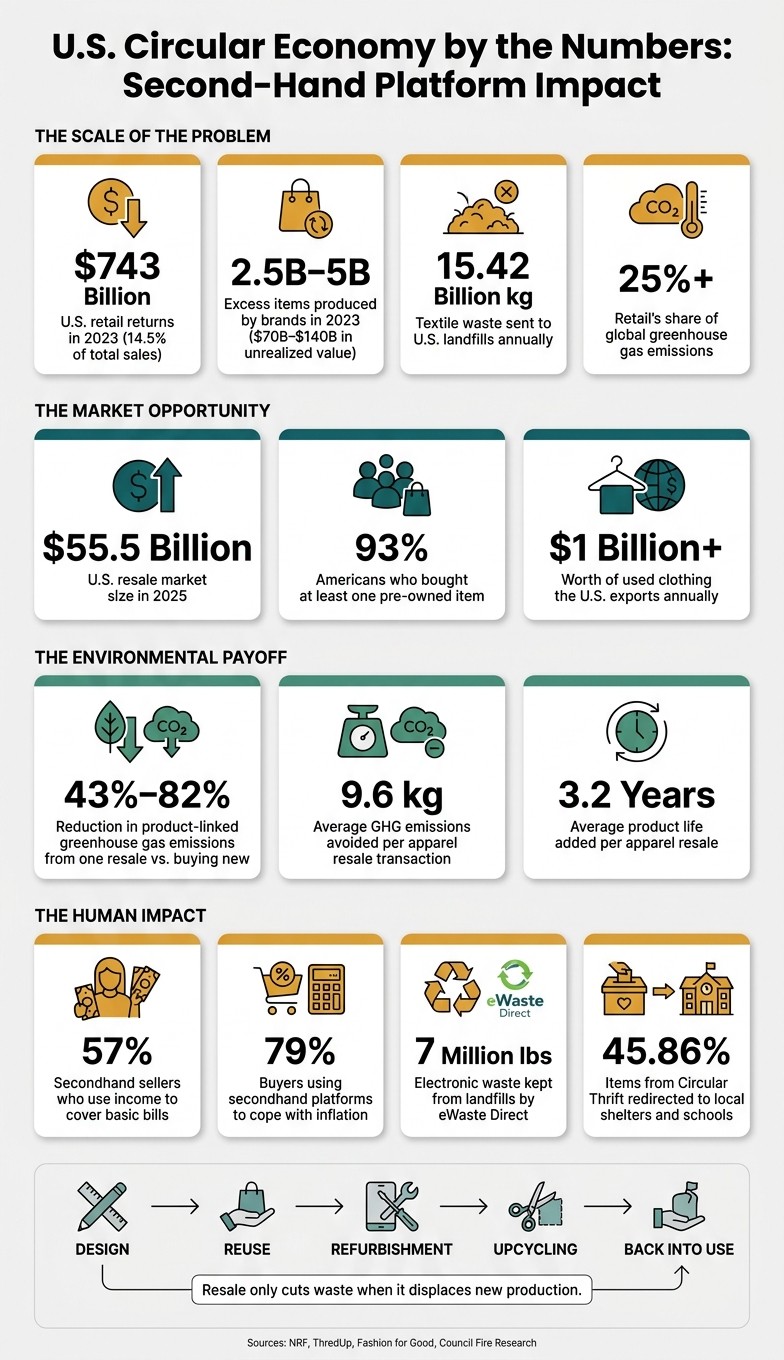
U.S. Circular Economy by the Numbers: Second-Hand Platform Impact
How ThredUp Resells 17 Million Garments Every Year | AI in Action | Business Insider
The Problem: Linear Consumption Shortens Product Lifecycles and Increases Waste
Linear consumption pushes products out of use before their value is fully recovered.
Why Products Lose Value Too Quickly
A lot of early disposal starts long before a customer throws anything away. It begins in product design, pricing, and the way companies sell new items. Clothing, for example, is more often made with synthetic materials and built to wear out fast, which makes it harder to repair, resell, or remake [7][11].
Electronics follow a similar pattern, but for a different reason. People often replace devices not because they stop working, but because they feel outdated. Research on the U.S. smartphone market found that many replacements are driven by "perceived performance loss" rather than actual mechanical failure or the end of the product's functional life [9]. In plain terms, the phone still works, but the user has already moved on. That shrinks the product's useful life and weakens reuse markets at the same time.
Manufacturers don't always help keep products in circulation, either. In many cases, they have little reason to support resale. Rebates can make brand-new products look like the better deal compared with used or refurbished options [6]. When that happens, resale markets have to fight uphill just to recover value that should have stayed in the system.
What the United States Loses Under a Linear Model
The cost of this model stacks up fast. In 2023, returned goods reached $743 billion, equal to 14.5% of total retail sales [8]. Brands also produced between 2.5 billion and 5 billion items of excess stock that same year, representing $70 billion to $140 billion in unrealized sales [8]. One return or one early replacement may seem small on its own, but across the market, those choices turn into a massive waste stream.
The environmental toll is just as severe. Retail accounts for more than 25% of global greenhouse gas emissions and 35% of microplastics pollution [8]. The U.S. is also the world's largest exporter of used clothing, sending more than $1 billion worth overseas each year instead of processing it at home [10]. That gap leaves money, materials, and jobs on the table - and it's exactly where second-hand and upcycled platforms step in to create circular value.
The Solution: How Second-Hand and Upcycled Platforms Support Circular Use
Second-hand and upcycled platforms put used goods back to work through resale, refurbishment, and upcycling. Behind that is the less glamorous part that makes the whole thing run: collection, sorting, and resale systems. That setup turns reuse from a personal choice into a circular model that can work at scale.
Core Circular Mechanisms These Platforms Support
These platforms recover value in three main ways. Reuse and recommerce keep a product in its original form. A jacket sold again on a peer-to-peer marketplace still carries all the water, energy, and labor that already went into making it. Refurbishment brings products back into working order, especially electronics, before they move to a second owner. Upcycling takes discarded materials and turns them into something new, often with better quality than the first version.
In each case, the point is simple: get more use out of what already exists instead of pulling more raw material into the system.
Platform Features That Make Reuse Work at Scale
Trust is still the biggest hurdle in secondhand buying. The platforms that handle this well tend to rely on a few practical features. Quality grades and clear condition notes show buyers what they're getting before they hit purchase. Ownership records and repair history add peace of mind, especially for electronics and other higher-priced items. Resale pricing also matters. Sellers can get back part of what they spent, while buyers get a lower-cost option.
Reverse logistics matter just as much. Take-back programs and local drop-off options make it easier to move items back into circulation instead of leaving them in a closet, garage, or trash bin. Many platforms now use AI to help with listings and flag fraud.
The Environmental, Social, and Economic Value Created
The payoff shows up across the board. Reselling one product cuts its linked greenhouse gas emissions by 43% to 82% compared with buying new [5]. In apparel, a single transaction avoids an average of 9.6 kg of greenhouse gas emissions and adds 3.2 years to the life of the item [13].
There’s a household money angle too, and it’s hard to ignore. 57% of secondhand sellers use that income to cover basic bills [2]. On the buyer side, 79% of buyers use these platforms to deal with inflation and rising costs [2]. That means reuse is not just about waste reduction. For many people, it also helps the monthly budget hold together.
Examples of Platform Models in Practice
You can see these mechanics in both big online marketplaces and local reuse efforts.
eWaste Direct, led by Angie Cardona-Nelson and selling through eBay since 2008, moved from getting 80% of its revenue from recycling to getting 80% from refurbished tech resale. In the process, it kept more than 7 million pounds of electronic waste out of landfills [4].
Circular Thrift in Bexley, Ohio collected 10,772 apparel units from November 2022 through October 2023. It used a carbon-neutral bike trailer for collection and sent 45.86% of items back to local shelters and schools [1]. That’s a good reminder that a platform does not have to be huge to show clear impact.
"The circular economy is a system designed to keep products and materials in use for as long as possible. Instead of throwing items away after one use, they're reused, repaired, or resold." - Renée Morin, Chief Sustainability Officer, eBay [4]
Even the strongest platform model still depends on product design, collection systems, and what buyers choose to do.
What Limits Circular Impact on These Platforms
The same systems that make resale work can also make it fall apart. Second-hand platforms cut waste only when they can sort, price, and move durable goods at a cost that makes sense. That’s the pressure point. If those steps break down, resale stops short of replacing new production.
Design and Behavior Barriers in the US Market
A lot of goods enter resale in rough shape. Others are still usable, but sorting or fixing them costs more than the item is worth. A Fashion for Good study found that 86.5% of garments imported as "rewearable" arrived stained, faded, or torn [12]. At the same time, 37% of discarded clothing had no damage at all, and 41% had only minor flaws - but those items still never make it back into resale because sorting and repair are too expensive [12]. When damaged or low-price items can’t get back into circulation, platforms miss the main point of circular reuse: extending product life.
Fast fashion makes this worse. Low-durability items have weak resale value, and cleaning or repairing them often costs more than buying a cheap new replacement.
Poor condition data adds another problem: more returns and less trust. U.S. consumers returned $743 billion worth of retail products in 2023 - 14.5% of total sales [8]. Vague listings can push those numbers even higher [3][8].
Operational and Policy Gaps That Reduce Impact
A lot of circular programs run into trouble in day-to-day operations. Every second-hand item is different, so each one needs its own handling, review, and sorting. Repair takes time, and labor accounts for 50% of repair cost per item [14]. For a resale program to stay financially viable, refurbishment costs usually need to remain under 30% of the resale price [3]. Once that limit is passed, margins vanish and storage fills up with items that won’t sell. In practice, circular impact depends on selective intake, not blanket collection.
Policy gaps add friction. Many used goods are taxed each time they change hands, which pushes up prices and makes secondhand less able to compete. Extended producer responsibility, or EPR, rules are starting to appear in California, Oregon, and New York, but the U.S. still lacks national standards for condition reporting and for reuse and waste metrics [3][14].
When Resale Does Not Reduce Impact
A second-hand sale does not always replace a new purchase. If someone buys used and still buys new, the waste-cutting effect is small.
Reverse logistics can also wipe out the upside when shipping, cleaning, and repair create more cost and impact than reuse saves [12][15]. The model works best when logistics are efficient, local, or bundled.
The harder issue is scale without slower production. If resale grows while new production keeps moving at full speed, the result is a parallel market, not a system that cuts waste.
Real impact comes down to proof:
what gets reused
what gets landfilled
what actually replaces a new purchase
The next step is measuring which items, channels, and logistics cut waste in practice.
How Organizations Can Build and Measure Circular Platform Strategies
Knowing where circular impact falls apart is only part of the job. The harder part is building a system that stays solid from the first product audit to full-scale rollout.
A Practical Implementation Path for US Organizations
To turn circular goals into actual results, organizations should begin with product categories that can recover enough value to justify the work. That starts with a product audit. Not every category makes sense for resale. Durable goods like outdoor gear, electronics, furniture, and luxury apparel often hold enough value to offset handling costs. In apparel, labor can make up more than half of resale costs [16].
After identifying the right categories, the next step is to set inspection standards before launch. Verizon’s Certified Pre-Owned program is a good example. It uses a 100+ point quality check across 10 categories and includes a 90-day limited warranty [18]. In furniture, Sabai’s buy-back model shows how a brand can support resale of its own products, keep large items out of landfills, and return a commission to the first owner [17]. A local pilot helps test intake, repair, and resale economics before expanding. At each stage, the key question stays the same: is resale replacing new production, or is it just creating a second sales lane?
The table below keeps attention on value recovery, not volume for its own sake.
Implementation Stage | Key Actions | Decision Points | Key Metrics |
|---|---|---|---|
Assessment | Audit product categories for durability and resale value | In-house vs. third-party platform | Potential resale recovery value ($); estimated volume diverted (tons) |
Design | Set inspection and return protocols; select business model (C2C, consignment, trade-in) | Store credit vs. cash payouts; authentication method | Projected margin per item; labor cost as % of resale price |
Pilot | Launch local pilot; partner with local repair and refurbishment providers | Brand take-back vs. peer-to-peer shipping | Items diverted from landfill (lbs); participation rate |
Scale | Integrate with ESG reporting; automate sorting with RFID or QR codes | Expansion to new categories | Avoided CO2 emissions; product life extended (years); total circular revenue ($) |
What to Measure and How Council Fire Can Support Execution
Measurement should center on resale performance, not just platform activity. It’s not enough to count listings, transactions, or site traffic. Organizations need to track whether resale is cutting demand for new production. That means measuring landfill diversion, product life extension, avoided emissions, resale recovery value, and participation rates.
"Reselling a product can reduce the associated greenhouse gas emissions for that sale anywhere from 43 to 82 percent." - Scot Case, VP, CSR & Sustainability, NRF [5]
These metrics should flow into ESG reporting, climate targets, and community disclosures. This is often where teams get stuck. Council Fire helps organizations put circular strategies into practice by linking platform activity to long-term financial and environmental performance, coordinating stakeholder work across the system, and building communication plans that make results easier to track and explain. The aim is measurable circular performance tied to financial, environmental, and social results.
Conclusion: Second-Hand Platforms Work Best as Part of a Broader Circular System
Once the operating model is in place, impact depends on disciplined measurement and careful scale. Linear consumption creates clear losses in materials, emissions, and economic value that never comes back. Second-hand and upcycled platforms can help recover that value, but only when the system underneath is built well. Platform governance, inspection standards, logistics choices, and measurement frameworks shape whether resale displaces new production or simply operates beside it. Organizations that connect resale with design, logistics, and measurement build circular impact that lasts.
FAQs
How do second-hand platforms reduce waste?
Second-hand platforms play a direct role in the circular economy. They keep products in use for longer, extend life cycles, and help divert items from landfills. That matters because every item reused is one less item pushed out of the system too soon.
By making resale, repair, and refurbishment easier, these platforms also cut demand for new manufacturing. In plain terms, that can mean less pressure on raw materials and lower energy use across the supply chain.
There’s also a climate angle. When people buy pre-owned goods, they can reduce emissions linked to production, packaging, and shipping. It’s a simple shift, but one that can trim waste and make better use of what already exists.
When does resale fail to replace new buying?
Resale falls short when it doesn't replace a new purchase and instead becomes one more thing people buy. Lower second-hand prices can make used items feel cheap enough to grab on impulse or toss into a wardrobe as an extra, not a substitute.
That can feed overconsumption through the rebound effect. Money saved by buying used - or cash made from reselling - can free up room in a shopper's budget to buy even more new clothing.
Which products work best in a circular resale model?
Products that fit a circular resale model best tend to share two traits: they hold their value and they last. That’s why premium and luxury apparel, footwear, and accessories often lead the pack. These items usually keep strong appeal after first purchase, which makes resale a smart path instead of a last resort.
Returned goods and excess inventory can also do well in this model, especially when they’re near-new. Instead of sitting in storage or getting marked down through old channels, they can move into circular marketplaces where buyers are still willing to pay. Products that stay relevant beyond short-lived trends usually see the best results.
Related Blog Posts
Latest Articles
©2025

Narrative Change and Power Building: The Missing Half of Advocacy
Narrative change is the process of disrupting dominant narratives that normalize inequity and advancing new narratives from historically marginalized communities.

Funding Resilience Without Federal Grants
BRIC is unreliable and FEMA is shrinking. Here's how cities fund climate resilience with dedicated revenue, blended finance, and a coordinating authority.

The ESG Blind Spot: How AI Is Finding Risks in Companies Nobody Else Is Watching
Norway's sovereign wealth fund uses AI to screen 7,200 portfolio companies for forced labor and corruption within 24 hours. The real story is the emerging-market coverage gap that traditional ESG data vendors miss — and what it means for any company with a global supply chain.
Narrative Change and Power Building: The Missing Half of Advocacy
Narrative change is the process of disrupting dominant narratives that normalize inequity and advancing new narratives from historically marginalized communities.
Funding Resilience Without Federal Grants
BRIC is unreliable and FEMA is shrinking. Here's how cities fund climate resilience with dedicated revenue, blended finance, and a coordinating authority.
The ESG Blind Spot: How AI Is Finding Risks in Companies Nobody Else Is Watching
Norway's sovereign wealth fund uses AI to screen 7,200 portfolio companies for forced labor and corruption within 24 hours. The real story is the emerging-market coverage gap that traditional ESG data vendors miss — and what it means for any company with a global supply chain.
FAQ
01
What does it really mean to “redefine profit”?
02
What makes Council Fire different?
03
Who does Council Fire work with?
04
What does working with Council Fire actually look like?
05
How does Council Fire help organizations turn big goals into action?
06
How does Council Fire define and measure success?
Jul 1, 2026
How Second-Hand Platforms Support Circular Economy
Sustainability Strategy
In This Article
Second-hand platforms extend product life and cut waste - only when design, logistics, and measurement make resale displace new purchases.
How Second-Hand Platforms Support Circular Economy
Second-hand platforms help cut waste only when they keep goods in use long enough to reduce new buying. In the U.S., the resale market hit $55.5 billion in 2025, 93% of Americans bought at least one pre-owned item, and the country still sends about 15.42 billion kg of textile waste to landfills each year. The point is simple: resale, refurbishment, and upcycling can slow the buy-use-trash cycle, but they work best when products are durable, sorting and repair costs stay in check, and resale replaces a new purchase.
If I boil the article down, here’s what matters most:
Why this matters: The U.S. still loses huge material and product value under a linear model.
What these platforms do: They extend product life through reuse, refurbishment, and upcycling.
What the data shows: One resale can cut product-linked emissions by 43% to 82%; in apparel, one resale adds about 3.2 years of use.
Where it breaks down: Cheap, low-durability goods, weak condition data, returns, shipping, and repair labor can erase gains.
What sustainability consulting experts recommend organizations track: landfill diversion, product life added, avoided emissions, resale recovery value, and whether used sales replace new ones.
A few facts stand out. In 2023, U.S. retail returns reached $743 billion, equal to 14.5% of sales. Brands also produced 2.5 billion to 5 billion excess items. At the same time, many discarded goods are still usable, yet they never make it back to market because sorting, cleaning, and fixing them costs too much.
For me, the core takeaway is clear: second-hand platforms are not enough on their own. They matter most when they sit inside a bigger system that includes better product design, lower-friction take-back, tighter quality checks, efficient shipping, and clear measurement.
Area | What the article says |
|---|---|
Main problem | Products are discarded before their full use is recovered |
Main fix | Resale, refurbishment, and upcycling keep goods in circulation |
Main limit | Reuse only helps if it displaces new production |
Main proof needed | Data on reuse, landfill diversion, costs, and avoided emissions |
If you want a short answer, it’s this: second-hand platforms support a circular economy by keeping products in use longer, cutting waste, and recovering product value - but only when the economics, logistics, and measurement hold up.
U.S. Circular Economy by the Numbers: Second-Hand Platform Impact
How ThredUp Resells 17 Million Garments Every Year | AI in Action | Business Insider
The Problem: Linear Consumption Shortens Product Lifecycles and Increases Waste
Linear consumption pushes products out of use before their value is fully recovered.
Why Products Lose Value Too Quickly
A lot of early disposal starts long before a customer throws anything away. It begins in product design, pricing, and the way companies sell new items. Clothing, for example, is more often made with synthetic materials and built to wear out fast, which makes it harder to repair, resell, or remake [7][11].
Electronics follow a similar pattern, but for a different reason. People often replace devices not because they stop working, but because they feel outdated. Research on the U.S. smartphone market found that many replacements are driven by "perceived performance loss" rather than actual mechanical failure or the end of the product's functional life [9]. In plain terms, the phone still works, but the user has already moved on. That shrinks the product's useful life and weakens reuse markets at the same time.
Manufacturers don't always help keep products in circulation, either. In many cases, they have little reason to support resale. Rebates can make brand-new products look like the better deal compared with used or refurbished options [6]. When that happens, resale markets have to fight uphill just to recover value that should have stayed in the system.
What the United States Loses Under a Linear Model
The cost of this model stacks up fast. In 2023, returned goods reached $743 billion, equal to 14.5% of total retail sales [8]. Brands also produced between 2.5 billion and 5 billion items of excess stock that same year, representing $70 billion to $140 billion in unrealized sales [8]. One return or one early replacement may seem small on its own, but across the market, those choices turn into a massive waste stream.
The environmental toll is just as severe. Retail accounts for more than 25% of global greenhouse gas emissions and 35% of microplastics pollution [8]. The U.S. is also the world's largest exporter of used clothing, sending more than $1 billion worth overseas each year instead of processing it at home [10]. That gap leaves money, materials, and jobs on the table - and it's exactly where second-hand and upcycled platforms step in to create circular value.
The Solution: How Second-Hand and Upcycled Platforms Support Circular Use
Second-hand and upcycled platforms put used goods back to work through resale, refurbishment, and upcycling. Behind that is the less glamorous part that makes the whole thing run: collection, sorting, and resale systems. That setup turns reuse from a personal choice into a circular model that can work at scale.
Core Circular Mechanisms These Platforms Support
These platforms recover value in three main ways. Reuse and recommerce keep a product in its original form. A jacket sold again on a peer-to-peer marketplace still carries all the water, energy, and labor that already went into making it. Refurbishment brings products back into working order, especially electronics, before they move to a second owner. Upcycling takes discarded materials and turns them into something new, often with better quality than the first version.
In each case, the point is simple: get more use out of what already exists instead of pulling more raw material into the system.
Platform Features That Make Reuse Work at Scale
Trust is still the biggest hurdle in secondhand buying. The platforms that handle this well tend to rely on a few practical features. Quality grades and clear condition notes show buyers what they're getting before they hit purchase. Ownership records and repair history add peace of mind, especially for electronics and other higher-priced items. Resale pricing also matters. Sellers can get back part of what they spent, while buyers get a lower-cost option.
Reverse logistics matter just as much. Take-back programs and local drop-off options make it easier to move items back into circulation instead of leaving them in a closet, garage, or trash bin. Many platforms now use AI to help with listings and flag fraud.
The Environmental, Social, and Economic Value Created
The payoff shows up across the board. Reselling one product cuts its linked greenhouse gas emissions by 43% to 82% compared with buying new [5]. In apparel, a single transaction avoids an average of 9.6 kg of greenhouse gas emissions and adds 3.2 years to the life of the item [13].
There’s a household money angle too, and it’s hard to ignore. 57% of secondhand sellers use that income to cover basic bills [2]. On the buyer side, 79% of buyers use these platforms to deal with inflation and rising costs [2]. That means reuse is not just about waste reduction. For many people, it also helps the monthly budget hold together.
Examples of Platform Models in Practice
You can see these mechanics in both big online marketplaces and local reuse efforts.
eWaste Direct, led by Angie Cardona-Nelson and selling through eBay since 2008, moved from getting 80% of its revenue from recycling to getting 80% from refurbished tech resale. In the process, it kept more than 7 million pounds of electronic waste out of landfills [4].
Circular Thrift in Bexley, Ohio collected 10,772 apparel units from November 2022 through October 2023. It used a carbon-neutral bike trailer for collection and sent 45.86% of items back to local shelters and schools [1]. That’s a good reminder that a platform does not have to be huge to show clear impact.
"The circular economy is a system designed to keep products and materials in use for as long as possible. Instead of throwing items away after one use, they're reused, repaired, or resold." - Renée Morin, Chief Sustainability Officer, eBay [4]
Even the strongest platform model still depends on product design, collection systems, and what buyers choose to do.
What Limits Circular Impact on These Platforms
The same systems that make resale work can also make it fall apart. Second-hand platforms cut waste only when they can sort, price, and move durable goods at a cost that makes sense. That’s the pressure point. If those steps break down, resale stops short of replacing new production.
Design and Behavior Barriers in the US Market
A lot of goods enter resale in rough shape. Others are still usable, but sorting or fixing them costs more than the item is worth. A Fashion for Good study found that 86.5% of garments imported as "rewearable" arrived stained, faded, or torn [12]. At the same time, 37% of discarded clothing had no damage at all, and 41% had only minor flaws - but those items still never make it back into resale because sorting and repair are too expensive [12]. When damaged or low-price items can’t get back into circulation, platforms miss the main point of circular reuse: extending product life.
Fast fashion makes this worse. Low-durability items have weak resale value, and cleaning or repairing them often costs more than buying a cheap new replacement.
Poor condition data adds another problem: more returns and less trust. U.S. consumers returned $743 billion worth of retail products in 2023 - 14.5% of total sales [8]. Vague listings can push those numbers even higher [3][8].
Operational and Policy Gaps That Reduce Impact
A lot of circular programs run into trouble in day-to-day operations. Every second-hand item is different, so each one needs its own handling, review, and sorting. Repair takes time, and labor accounts for 50% of repair cost per item [14]. For a resale program to stay financially viable, refurbishment costs usually need to remain under 30% of the resale price [3]. Once that limit is passed, margins vanish and storage fills up with items that won’t sell. In practice, circular impact depends on selective intake, not blanket collection.
Policy gaps add friction. Many used goods are taxed each time they change hands, which pushes up prices and makes secondhand less able to compete. Extended producer responsibility, or EPR, rules are starting to appear in California, Oregon, and New York, but the U.S. still lacks national standards for condition reporting and for reuse and waste metrics [3][14].
When Resale Does Not Reduce Impact
A second-hand sale does not always replace a new purchase. If someone buys used and still buys new, the waste-cutting effect is small.
Reverse logistics can also wipe out the upside when shipping, cleaning, and repair create more cost and impact than reuse saves [12][15]. The model works best when logistics are efficient, local, or bundled.
The harder issue is scale without slower production. If resale grows while new production keeps moving at full speed, the result is a parallel market, not a system that cuts waste.
Real impact comes down to proof:
what gets reused
what gets landfilled
what actually replaces a new purchase
The next step is measuring which items, channels, and logistics cut waste in practice.
How Organizations Can Build and Measure Circular Platform Strategies
Knowing where circular impact falls apart is only part of the job. The harder part is building a system that stays solid from the first product audit to full-scale rollout.
A Practical Implementation Path for US Organizations
To turn circular goals into actual results, organizations should begin with product categories that can recover enough value to justify the work. That starts with a product audit. Not every category makes sense for resale. Durable goods like outdoor gear, electronics, furniture, and luxury apparel often hold enough value to offset handling costs. In apparel, labor can make up more than half of resale costs [16].
After identifying the right categories, the next step is to set inspection standards before launch. Verizon’s Certified Pre-Owned program is a good example. It uses a 100+ point quality check across 10 categories and includes a 90-day limited warranty [18]. In furniture, Sabai’s buy-back model shows how a brand can support resale of its own products, keep large items out of landfills, and return a commission to the first owner [17]. A local pilot helps test intake, repair, and resale economics before expanding. At each stage, the key question stays the same: is resale replacing new production, or is it just creating a second sales lane?
The table below keeps attention on value recovery, not volume for its own sake.
Implementation Stage | Key Actions | Decision Points | Key Metrics |
|---|---|---|---|
Assessment | Audit product categories for durability and resale value | In-house vs. third-party platform | Potential resale recovery value ($); estimated volume diverted (tons) |
Design | Set inspection and return protocols; select business model (C2C, consignment, trade-in) | Store credit vs. cash payouts; authentication method | Projected margin per item; labor cost as % of resale price |
Pilot | Launch local pilot; partner with local repair and refurbishment providers | Brand take-back vs. peer-to-peer shipping | Items diverted from landfill (lbs); participation rate |
Scale | Integrate with ESG reporting; automate sorting with RFID or QR codes | Expansion to new categories | Avoided CO2 emissions; product life extended (years); total circular revenue ($) |
What to Measure and How Council Fire Can Support Execution
Measurement should center on resale performance, not just platform activity. It’s not enough to count listings, transactions, or site traffic. Organizations need to track whether resale is cutting demand for new production. That means measuring landfill diversion, product life extension, avoided emissions, resale recovery value, and participation rates.
"Reselling a product can reduce the associated greenhouse gas emissions for that sale anywhere from 43 to 82 percent." - Scot Case, VP, CSR & Sustainability, NRF [5]
These metrics should flow into ESG reporting, climate targets, and community disclosures. This is often where teams get stuck. Council Fire helps organizations put circular strategies into practice by linking platform activity to long-term financial and environmental performance, coordinating stakeholder work across the system, and building communication plans that make results easier to track and explain. The aim is measurable circular performance tied to financial, environmental, and social results.
Conclusion: Second-Hand Platforms Work Best as Part of a Broader Circular System
Once the operating model is in place, impact depends on disciplined measurement and careful scale. Linear consumption creates clear losses in materials, emissions, and economic value that never comes back. Second-hand and upcycled platforms can help recover that value, but only when the system underneath is built well. Platform governance, inspection standards, logistics choices, and measurement frameworks shape whether resale displaces new production or simply operates beside it. Organizations that connect resale with design, logistics, and measurement build circular impact that lasts.
FAQs
How do second-hand platforms reduce waste?
Second-hand platforms play a direct role in the circular economy. They keep products in use for longer, extend life cycles, and help divert items from landfills. That matters because every item reused is one less item pushed out of the system too soon.
By making resale, repair, and refurbishment easier, these platforms also cut demand for new manufacturing. In plain terms, that can mean less pressure on raw materials and lower energy use across the supply chain.
There’s also a climate angle. When people buy pre-owned goods, they can reduce emissions linked to production, packaging, and shipping. It’s a simple shift, but one that can trim waste and make better use of what already exists.
When does resale fail to replace new buying?
Resale falls short when it doesn't replace a new purchase and instead becomes one more thing people buy. Lower second-hand prices can make used items feel cheap enough to grab on impulse or toss into a wardrobe as an extra, not a substitute.
That can feed overconsumption through the rebound effect. Money saved by buying used - or cash made from reselling - can free up room in a shopper's budget to buy even more new clothing.
Which products work best in a circular resale model?
Products that fit a circular resale model best tend to share two traits: they hold their value and they last. That’s why premium and luxury apparel, footwear, and accessories often lead the pack. These items usually keep strong appeal after first purchase, which makes resale a smart path instead of a last resort.
Returned goods and excess inventory can also do well in this model, especially when they’re near-new. Instead of sitting in storage or getting marked down through old channels, they can move into circular marketplaces where buyers are still willing to pay. Products that stay relevant beyond short-lived trends usually see the best results.
Related Blog Posts
Latest Articles
©2025
Narrative Change and Power Building: The Missing Half of Advocacy
Narrative change is the process of disrupting dominant narratives that normalize inequity and advancing new narratives from historically marginalized communities.
Funding Resilience Without Federal Grants
BRIC is unreliable and FEMA is shrinking. Here's how cities fund climate resilience with dedicated revenue, blended finance, and a coordinating authority.
The ESG Blind Spot: How AI Is Finding Risks in Companies Nobody Else Is Watching
Norway's sovereign wealth fund uses AI to screen 7,200 portfolio companies for forced labor and corruption within 24 hours. The real story is the emerging-market coverage gap that traditional ESG data vendors miss — and what it means for any company with a global supply chain.
FAQ
01
What does it really mean to “redefine profit”?
02
What makes Council Fire different?
03
Who does Council Fire work with?
04
What does working with Council Fire actually look like?
05
How does Council Fire help organizations turn big goals into action?
06
How does Council Fire define and measure success?
Jul 1, 2026
How Second-Hand Platforms Support Circular Economy
Sustainability Strategy
In This Article
Second-hand platforms extend product life and cut waste - only when design, logistics, and measurement make resale displace new purchases.
How Second-Hand Platforms Support Circular Economy
Second-hand platforms help cut waste only when they keep goods in use long enough to reduce new buying. In the U.S., the resale market hit $55.5 billion in 2025, 93% of Americans bought at least one pre-owned item, and the country still sends about 15.42 billion kg of textile waste to landfills each year. The point is simple: resale, refurbishment, and upcycling can slow the buy-use-trash cycle, but they work best when products are durable, sorting and repair costs stay in check, and resale replaces a new purchase.
If I boil the article down, here’s what matters most:
Why this matters: The U.S. still loses huge material and product value under a linear model.
What these platforms do: They extend product life through reuse, refurbishment, and upcycling.
What the data shows: One resale can cut product-linked emissions by 43% to 82%; in apparel, one resale adds about 3.2 years of use.
Where it breaks down: Cheap, low-durability goods, weak condition data, returns, shipping, and repair labor can erase gains.
What sustainability consulting experts recommend organizations track: landfill diversion, product life added, avoided emissions, resale recovery value, and whether used sales replace new ones.
A few facts stand out. In 2023, U.S. retail returns reached $743 billion, equal to 14.5% of sales. Brands also produced 2.5 billion to 5 billion excess items. At the same time, many discarded goods are still usable, yet they never make it back to market because sorting, cleaning, and fixing them costs too much.
For me, the core takeaway is clear: second-hand platforms are not enough on their own. They matter most when they sit inside a bigger system that includes better product design, lower-friction take-back, tighter quality checks, efficient shipping, and clear measurement.
Area | What the article says |
|---|---|
Main problem | Products are discarded before their full use is recovered |
Main fix | Resale, refurbishment, and upcycling keep goods in circulation |
Main limit | Reuse only helps if it displaces new production |
Main proof needed | Data on reuse, landfill diversion, costs, and avoided emissions |
If you want a short answer, it’s this: second-hand platforms support a circular economy by keeping products in use longer, cutting waste, and recovering product value - but only when the economics, logistics, and measurement hold up.
U.S. Circular Economy by the Numbers: Second-Hand Platform Impact
How ThredUp Resells 17 Million Garments Every Year | AI in Action | Business Insider
The Problem: Linear Consumption Shortens Product Lifecycles and Increases Waste
Linear consumption pushes products out of use before their value is fully recovered.
Why Products Lose Value Too Quickly
A lot of early disposal starts long before a customer throws anything away. It begins in product design, pricing, and the way companies sell new items. Clothing, for example, is more often made with synthetic materials and built to wear out fast, which makes it harder to repair, resell, or remake [7][11].
Electronics follow a similar pattern, but for a different reason. People often replace devices not because they stop working, but because they feel outdated. Research on the U.S. smartphone market found that many replacements are driven by "perceived performance loss" rather than actual mechanical failure or the end of the product's functional life [9]. In plain terms, the phone still works, but the user has already moved on. That shrinks the product's useful life and weakens reuse markets at the same time.
Manufacturers don't always help keep products in circulation, either. In many cases, they have little reason to support resale. Rebates can make brand-new products look like the better deal compared with used or refurbished options [6]. When that happens, resale markets have to fight uphill just to recover value that should have stayed in the system.
What the United States Loses Under a Linear Model
The cost of this model stacks up fast. In 2023, returned goods reached $743 billion, equal to 14.5% of total retail sales [8]. Brands also produced between 2.5 billion and 5 billion items of excess stock that same year, representing $70 billion to $140 billion in unrealized sales [8]. One return or one early replacement may seem small on its own, but across the market, those choices turn into a massive waste stream.
The environmental toll is just as severe. Retail accounts for more than 25% of global greenhouse gas emissions and 35% of microplastics pollution [8]. The U.S. is also the world's largest exporter of used clothing, sending more than $1 billion worth overseas each year instead of processing it at home [10]. That gap leaves money, materials, and jobs on the table - and it's exactly where second-hand and upcycled platforms step in to create circular value.
The Solution: How Second-Hand and Upcycled Platforms Support Circular Use
Second-hand and upcycled platforms put used goods back to work through resale, refurbishment, and upcycling. Behind that is the less glamorous part that makes the whole thing run: collection, sorting, and resale systems. That setup turns reuse from a personal choice into a circular model that can work at scale.
Core Circular Mechanisms These Platforms Support
These platforms recover value in three main ways. Reuse and recommerce keep a product in its original form. A jacket sold again on a peer-to-peer marketplace still carries all the water, energy, and labor that already went into making it. Refurbishment brings products back into working order, especially electronics, before they move to a second owner. Upcycling takes discarded materials and turns them into something new, often with better quality than the first version.
In each case, the point is simple: get more use out of what already exists instead of pulling more raw material into the system.
Platform Features That Make Reuse Work at Scale
Trust is still the biggest hurdle in secondhand buying. The platforms that handle this well tend to rely on a few practical features. Quality grades and clear condition notes show buyers what they're getting before they hit purchase. Ownership records and repair history add peace of mind, especially for electronics and other higher-priced items. Resale pricing also matters. Sellers can get back part of what they spent, while buyers get a lower-cost option.
Reverse logistics matter just as much. Take-back programs and local drop-off options make it easier to move items back into circulation instead of leaving them in a closet, garage, or trash bin. Many platforms now use AI to help with listings and flag fraud.
The Environmental, Social, and Economic Value Created
The payoff shows up across the board. Reselling one product cuts its linked greenhouse gas emissions by 43% to 82% compared with buying new [5]. In apparel, a single transaction avoids an average of 9.6 kg of greenhouse gas emissions and adds 3.2 years to the life of the item [13].
There’s a household money angle too, and it’s hard to ignore. 57% of secondhand sellers use that income to cover basic bills [2]. On the buyer side, 79% of buyers use these platforms to deal with inflation and rising costs [2]. That means reuse is not just about waste reduction. For many people, it also helps the monthly budget hold together.
Examples of Platform Models in Practice
You can see these mechanics in both big online marketplaces and local reuse efforts.
eWaste Direct, led by Angie Cardona-Nelson and selling through eBay since 2008, moved from getting 80% of its revenue from recycling to getting 80% from refurbished tech resale. In the process, it kept more than 7 million pounds of electronic waste out of landfills [4].
Circular Thrift in Bexley, Ohio collected 10,772 apparel units from November 2022 through October 2023. It used a carbon-neutral bike trailer for collection and sent 45.86% of items back to local shelters and schools [1]. That’s a good reminder that a platform does not have to be huge to show clear impact.
"The circular economy is a system designed to keep products and materials in use for as long as possible. Instead of throwing items away after one use, they're reused, repaired, or resold." - Renée Morin, Chief Sustainability Officer, eBay [4]
Even the strongest platform model still depends on product design, collection systems, and what buyers choose to do.
What Limits Circular Impact on These Platforms
The same systems that make resale work can also make it fall apart. Second-hand platforms cut waste only when they can sort, price, and move durable goods at a cost that makes sense. That’s the pressure point. If those steps break down, resale stops short of replacing new production.
Design and Behavior Barriers in the US Market
A lot of goods enter resale in rough shape. Others are still usable, but sorting or fixing them costs more than the item is worth. A Fashion for Good study found that 86.5% of garments imported as "rewearable" arrived stained, faded, or torn [12]. At the same time, 37% of discarded clothing had no damage at all, and 41% had only minor flaws - but those items still never make it back into resale because sorting and repair are too expensive [12]. When damaged or low-price items can’t get back into circulation, platforms miss the main point of circular reuse: extending product life.
Fast fashion makes this worse. Low-durability items have weak resale value, and cleaning or repairing them often costs more than buying a cheap new replacement.
Poor condition data adds another problem: more returns and less trust. U.S. consumers returned $743 billion worth of retail products in 2023 - 14.5% of total sales [8]. Vague listings can push those numbers even higher [3][8].
Operational and Policy Gaps That Reduce Impact
A lot of circular programs run into trouble in day-to-day operations. Every second-hand item is different, so each one needs its own handling, review, and sorting. Repair takes time, and labor accounts for 50% of repair cost per item [14]. For a resale program to stay financially viable, refurbishment costs usually need to remain under 30% of the resale price [3]. Once that limit is passed, margins vanish and storage fills up with items that won’t sell. In practice, circular impact depends on selective intake, not blanket collection.
Policy gaps add friction. Many used goods are taxed each time they change hands, which pushes up prices and makes secondhand less able to compete. Extended producer responsibility, or EPR, rules are starting to appear in California, Oregon, and New York, but the U.S. still lacks national standards for condition reporting and for reuse and waste metrics [3][14].
When Resale Does Not Reduce Impact
A second-hand sale does not always replace a new purchase. If someone buys used and still buys new, the waste-cutting effect is small.
Reverse logistics can also wipe out the upside when shipping, cleaning, and repair create more cost and impact than reuse saves [12][15]. The model works best when logistics are efficient, local, or bundled.
The harder issue is scale without slower production. If resale grows while new production keeps moving at full speed, the result is a parallel market, not a system that cuts waste.
Real impact comes down to proof:
what gets reused
what gets landfilled
what actually replaces a new purchase
The next step is measuring which items, channels, and logistics cut waste in practice.
How Organizations Can Build and Measure Circular Platform Strategies
Knowing where circular impact falls apart is only part of the job. The harder part is building a system that stays solid from the first product audit to full-scale rollout.
A Practical Implementation Path for US Organizations
To turn circular goals into actual results, organizations should begin with product categories that can recover enough value to justify the work. That starts with a product audit. Not every category makes sense for resale. Durable goods like outdoor gear, electronics, furniture, and luxury apparel often hold enough value to offset handling costs. In apparel, labor can make up more than half of resale costs [16].
After identifying the right categories, the next step is to set inspection standards before launch. Verizon’s Certified Pre-Owned program is a good example. It uses a 100+ point quality check across 10 categories and includes a 90-day limited warranty [18]. In furniture, Sabai’s buy-back model shows how a brand can support resale of its own products, keep large items out of landfills, and return a commission to the first owner [17]. A local pilot helps test intake, repair, and resale economics before expanding. At each stage, the key question stays the same: is resale replacing new production, or is it just creating a second sales lane?
The table below keeps attention on value recovery, not volume for its own sake.
Implementation Stage | Key Actions | Decision Points | Key Metrics |
|---|---|---|---|
Assessment | Audit product categories for durability and resale value | In-house vs. third-party platform | Potential resale recovery value ($); estimated volume diverted (tons) |
Design | Set inspection and return protocols; select business model (C2C, consignment, trade-in) | Store credit vs. cash payouts; authentication method | Projected margin per item; labor cost as % of resale price |
Pilot | Launch local pilot; partner with local repair and refurbishment providers | Brand take-back vs. peer-to-peer shipping | Items diverted from landfill (lbs); participation rate |
Scale | Integrate with ESG reporting; automate sorting with RFID or QR codes | Expansion to new categories | Avoided CO2 emissions; product life extended (years); total circular revenue ($) |
What to Measure and How Council Fire Can Support Execution
Measurement should center on resale performance, not just platform activity. It’s not enough to count listings, transactions, or site traffic. Organizations need to track whether resale is cutting demand for new production. That means measuring landfill diversion, product life extension, avoided emissions, resale recovery value, and participation rates.
"Reselling a product can reduce the associated greenhouse gas emissions for that sale anywhere from 43 to 82 percent." - Scot Case, VP, CSR & Sustainability, NRF [5]
These metrics should flow into ESG reporting, climate targets, and community disclosures. This is often where teams get stuck. Council Fire helps organizations put circular strategies into practice by linking platform activity to long-term financial and environmental performance, coordinating stakeholder work across the system, and building communication plans that make results easier to track and explain. The aim is measurable circular performance tied to financial, environmental, and social results.
Conclusion: Second-Hand Platforms Work Best as Part of a Broader Circular System
Once the operating model is in place, impact depends on disciplined measurement and careful scale. Linear consumption creates clear losses in materials, emissions, and economic value that never comes back. Second-hand and upcycled platforms can help recover that value, but only when the system underneath is built well. Platform governance, inspection standards, logistics choices, and measurement frameworks shape whether resale displaces new production or simply operates beside it. Organizations that connect resale with design, logistics, and measurement build circular impact that lasts.
FAQs
How do second-hand platforms reduce waste?
Second-hand platforms play a direct role in the circular economy. They keep products in use for longer, extend life cycles, and help divert items from landfills. That matters because every item reused is one less item pushed out of the system too soon.
By making resale, repair, and refurbishment easier, these platforms also cut demand for new manufacturing. In plain terms, that can mean less pressure on raw materials and lower energy use across the supply chain.
There’s also a climate angle. When people buy pre-owned goods, they can reduce emissions linked to production, packaging, and shipping. It’s a simple shift, but one that can trim waste and make better use of what already exists.
When does resale fail to replace new buying?
Resale falls short when it doesn't replace a new purchase and instead becomes one more thing people buy. Lower second-hand prices can make used items feel cheap enough to grab on impulse or toss into a wardrobe as an extra, not a substitute.
That can feed overconsumption through the rebound effect. Money saved by buying used - or cash made from reselling - can free up room in a shopper's budget to buy even more new clothing.
Which products work best in a circular resale model?
Products that fit a circular resale model best tend to share two traits: they hold their value and they last. That’s why premium and luxury apparel, footwear, and accessories often lead the pack. These items usually keep strong appeal after first purchase, which makes resale a smart path instead of a last resort.
Returned goods and excess inventory can also do well in this model, especially when they’re near-new. Instead of sitting in storage or getting marked down through old channels, they can move into circular marketplaces where buyers are still willing to pay. Products that stay relevant beyond short-lived trends usually see the best results.
Related Blog Posts
Latest Articles
©2025
Narrative Change and Power Building: The Missing Half of Advocacy
Narrative change is the process of disrupting dominant narratives that normalize inequity and advancing new narratives from historically marginalized communities.
Funding Resilience Without Federal Grants
BRIC is unreliable and FEMA is shrinking. Here's how cities fund climate resilience with dedicated revenue, blended finance, and a coordinating authority.
The ESG Blind Spot: How AI Is Finding Risks in Companies Nobody Else Is Watching
Norway's sovereign wealth fund uses AI to screen 7,200 portfolio companies for forced labor and corruption within 24 hours. The real story is the emerging-market coverage gap that traditional ESG data vendors miss — and what it means for any company with a global supply chain.
FAQ
What does it really mean to “redefine profit”?
What makes Council Fire different?
Who does Council Fire work with?
What does working with Council Fire actually look like?
How does Council Fire help organizations turn big goals into action?
How does Council Fire define and measure success?