
May 10, 2026
How to Communicate Sustainability to Non-Technical Audiences for NGOs & Nonprofits
Sustainability Strategy
In This Article
Practical tips for NGOs to explain sustainability to non-technical audiences using plain language, stories, visuals, and transparency.
How to Communicate Sustainability to Non-Technical Audiences for NGOs & Nonprofits
Sustainability communication can be challenging, especially when technical concepts must resonate with non-technical audiences. Here's how NGOs and nonprofits can simplify their message and build trust:
Understand Your Audience
Tailor messages to different groups - donors care about measurable outcomes, while volunteers value direct impact. Listening and gathering feedback ensures your message aligns with their interests.
Use Plain Language and Analogies
Avoid jargon. Translate technical terms into relatable comparisons, like equating CO₂ reductions to miles of driving avoided. Highlight the human benefits, such as health improvements or cost savings.
Leverage Stories and Visuals
Combine data with stories to create emotional connections. Use visuals like maps or infographics to make complex data easier to grasp and more engaging.
Be Transparent
Share both successes and challenges. Openly discussing setbacks builds credibility and shows commitment to improvement.
Work with Experts
Collaborate with consultants to craft clear messages and actionable plans. They can help align technical data with your mission and make it relatable to diverse stakeholders.
Key takeaway: Clear, honest, and relatable communication helps bridge the gap between sustainability goals and the real-world benefits your audience cares about.
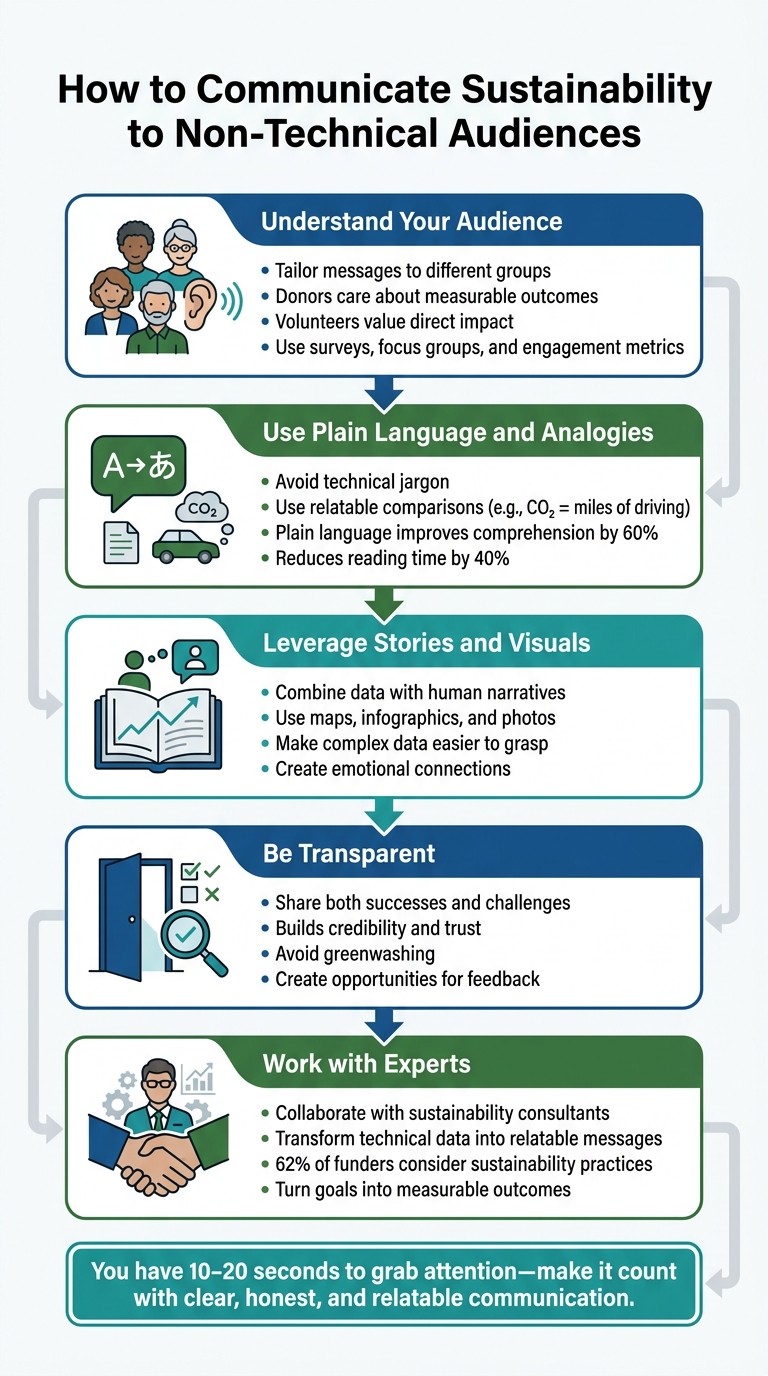
5 Steps to Communicate Sustainability to Non-Technical Audiences
Communicating Sustainability: 10 Principles to be Effective | Phillip Haid
Know Your Audience and Adjust Your Message
Before crafting messages about sustainability, it’s essential to understand your audience. Many nonprofits mistakenly assume their supporters share the same priorities. However, the motivations of a donor interested in legacy giving differ greatly from those of a volunteer eager for hands-on community involvement. A 2024 report from the Barr Foundation highlighted this point, revealing that their grantees wanted the foundation to take a more visible stand on core values like racial equity [5].
"Building that trust starts with listening. So, we have always strived for our communications to start and end and do everything in between with listening." – Jim Canales & Stefan Lanfer, Barr Foundation [5]
This statement emphasizes the importance of a listening-first approach. Tailored communication isn’t just thoughtful - it’s strategic. Dr. Le Thu, an emergency medicine physician and advocate, reinforces this by stating, “rigorous audience research, including surveys, focus groups, and analysis of existing engagement patterns, is crucial for crafting resonant messages that connect with specific demographics” [4]. Different stakeholders - from engaged supporters to skeptical onlookers - require messaging that reflects their distinct needs, using the right tone, language, and delivery.
Find Knowledge Gaps and What People Care About
To create messages that resonate, start by identifying what your audience knows and what matters to them. Use tools like surveys, interviews, and feedback forums to gather insights. Engagement metrics, such as email open rates, social media activity, and event participation, can also help pinpoint areas of interest.
The Barr Foundation refined its communication strategy by actively listening to its community. Feedback revealed a desire for the foundation to take a stronger stance on racial equity. This insight directly influenced the development of their "Powering Cultural Futures" initiative (2021–2024), designed to support artists and communities of color in Massachusetts [5]. Their ability to adapt based on direct input underscores the power of listening.
Create Different Messages for Different Groups
Once you’ve segmented your audience, tailor your messaging to meet the unique priorities of each group. For instance:
Donors often care about measurable results, long-term outcomes, and legacy-building.
Volunteers are more likely to value hands-on experiences and direct community impact.
Corporate partners or board members may focus on risk management and cost efficiency.
Marketing teams look for stories that enhance brand identity.
Finance teams prioritize metrics like capital performance and asset value.
While the core sustainability project remains the same, framing it in ways that align with each group’s perspective can deepen engagement and amplify your organization’s overall impact. Tailored communication not only respects individual viewpoints but also strengthens your ability to achieve meaningful results.
Make Complex Ideas Simple with Plain Language and Analogies
Using technical jargon can overwhelm audiences, forcing them to focus on decoding unfamiliar terms rather than absorbing the key message [7]. To truly connect with your audience, it's essential to present your work in language they already understand. Clear communication not only engages non-technical audiences but also reinforces broader goals.
"Fluency theory says we're more likely to trust information we easily understand." - The Storytelling for Good Team [7]
Research supports this idea. Between June 1 and August 31, 2023, MIT Sloan professor Catherine Tucker and her team conducted a study involving 380,000 households in China. They tested whether simplifying sustainability language could influence behavior. One group received messages framed in abstract, technical terms, while another got the same information translated into everyday language, such as "kilometers of reduced driving." The simplified messages led to a 2.2% increase in recycling rates, outperforming monetary incentives, which only achieved a 1.9% improvement [6].
Use Everyday Comparisons
Turning abstract data into relatable comparisons makes a huge difference. For instance, instead of listing gallons of water saved, explain the impact in terms of how many Olympic-sized swimming pools that would fill. Similarly, translating CO₂ emissions into something tangible - like the equivalent miles of driving avoided - helps people grasp the scale of the impact. These relatable comparisons make technical data easier to visualize, helping audiences understand why these efforts are important.
Explain Why Sustainability Efforts Matter
Highlighting the human benefits of sustainability is more impactful than relying on technical terms. For example, say "keeping babies alive during birth" rather than "reducing intrapartum stillbirths", and "saves three times as much money as it costs" instead of "triple return on investment" [7]. Shifting to plain, relatable language makes your message more memorable and easier to share. Studies show that documents written in plain language improve comprehension by 60% and reduce reading time by 40% [9], increasing the likelihood your message will resonate amid busy schedules and crowded inboxes.
Use Stories and Visuals to Connect with Your Audience
Simplifying language is just the first step in making complex data relatable. Adding stories and visuals bridges the gap between raw numbers and their real-world significance. While numbers alone rarely inspire action, embedding them in human narratives and pairing them with visuals can make your message stick. This technique, often called data storytelling, turns statistics into impactful narratives, while visuals help untangle complex ideas for diverse audiences [11].
"Numbers, by themselves, can be cold and impersonal. But when woven into a compelling story, data becomes a powerful tool for action."
– Myriam Munezero, Data Analyst [10]
The secret lies in grounding your data within human experiences. For instance, Partnership with Children, a nonprofit in New York City, launched an interactive fundraising campaign in 2026. They used a map that enabled donors to explore their work by school and neighborhood. By combining program data with public poverty metrics, they created a powerful narrative that outperformed all their previous fundraising efforts [11].
Share Real Project Examples
Real-world examples are proof that your solutions work. They also provide relatable context for your audience. Take the Natural Resources Defense Council (NRDC) as an example. In 2012, they turned a technical 69-page report into a consumer-friendly campaign called "Wasted: How America Is Losing Up to 40 Percent of Its Food From Farm to Fork to Table." The team reshaped the data into a "farm-to-fork" story, adding infographics that illustrated waste at every stage. By including photos of imperfect produce, they made the issue more tangible. This campaign sparked over 200 media stories in outlets like The New York Times and CNN, eventually influencing both the Obama Administration and the United Nations to set food waste reduction targets [8].
In 2016, the NRDC followed up with "The Extraordinary Life and Times of Strawberry," a video that tracked a single strawberry’s journey to highlight consumer waste. By focusing on one relatable item instead of abstract data, they created an emotional connection that encouraged behavior change.
"Telling folks about a problem makes a story for a day, but if you can also talk about solutions, your work will have staying power."
– Lisa Benenson, Natural Resources Defense Council [8]
These examples show how storytelling can make data more relatable and impactful.
Present Data with Visual Tools
Visual tools, like maps, are invaluable for nonprofits because geography provides a universal point of reference. For example, the Independent Drivers Guild, which represents 80,000 drivers in New York City, used data visualization to advocate for more legal relief stands. They layered driver survey data onto the city’s street network, factoring in zoning and traffic volume. This method produced a shortlist of 16 specific locations, which helped them secure discussions with city officials [11].
"A map makes your work immediate and specific in a way that a table of numbers simply can't."
– Olivia Ildefonso and Charles Grosperrin, Co-founders, North Arrow [11]
Social media platforms like Instagram also offer opportunities for visual storytelling. As of December 2024, The Ocean Cleanup has used Instagram to merge environmental data with striking visuals and milestone updates. By presenting scientific research in an accessible way, they’ve mobilized global action, reaching everyone from researchers to casual followers [10]. When designing visuals, it’s essential to lead with your most compelling findings to grab attention quickly. Briefly explaining your data sources also builds trust with donors and officials [11].
Build Trust Through Honesty and Open Conversation
People can easily spot dishonesty, and being transparent is not just the right thing to do - it’s also smart. Research from the Center for Public Interest Communications highlights that explaining how decisions are made builds trust almost as effectively as showing exactly where funding is allocated [12]. This means sharing the reasoning behind your choices, supported by reports, expert opinions, and community feedback, can go a long way in earning public confidence.
Share Both Wins and Setbacks
Acknowledging challenges doesn’t weaken credibility - it strengthens it. For example, in 2023, Patagonia released an environmental and social responsibility report that openly discussed failures alongside achievements. They revealed factory audits uncovering wage violations and an increase in supply chain emissions despite reduction efforts. Instead of harming their reputation, this honesty reinforced their trustworthiness, showing a genuine commitment to improvement [13].
"Transparency includes acknowledging areas where progress lags, challenges encountered, and limitations of current efforts. This honesty builds more trust than selective disclosure of only positive results."
– Grounded World [13]
Present your sustainability efforts as a work in progress, one with both victories and obstacles. When you explain tough budget decisions - even the less glamorous ones - it helps your community understand the real-world challenges you face [12]. Avoid vague language like "leveraging resources" and replace it with specific actions. For instance, rather than saying you're "addressing housing inequality", describe the local regulations you’re actively working to change, such as lot size restrictions or unit caps [12].
This kind of transparency sets the stage for open and ongoing communication. By embracing openness, you invite your audience to be part of the conversation about your progress.
Create Opportunities for Feedback and Discussion
True engagement happens when audiences become active participants. Keep your storytelling dynamic through community meetings, donor calls, and social media updates [12]. This shifts communication from a one-sided broadcast to a collaborative exchange between your organization and the public [1].
Involve voices from across your organization - not just leadership. Highlight contributions from staff members and local community leaders to deepen the sense of connection and transparency [12]. Tailor your communication to specific audiences and show how your efforts impact their communities directly. This approach builds stronger relationships with stakeholders [1]. Social media platforms and community forums are also excellent spaces for fostering dialogue, addressing questions, and responding to concerns quickly, demonstrating that you’re listening and taking action [13].
Work with Experts to Improve Your Communication
Clear and transparent communication is key to effectively sharing your sustainability goals, and working with experts can help tailor these messages for diverse audiences. Many nonprofits face challenges balancing technical knowledge with compelling storytelling, but sustainability consultants specialize in bridging this gap. They transform complex data into relatable narratives that resonate with donors, volunteers, and community members alike.
Get Professional Help with Your Messaging
Professional consultants bring depth to your messaging, moving beyond generic statements to demonstrate genuine environmental accountability. They analyze audience segments, addressing specific interests and concerns [1]. For instance, they can take operational data - like carbon footprints or energy audit results - and craft engaging narratives for annual reports or grant applications [14]. According to a 2024 survey by the Council on Foundations, 62% of institutional funders now consider sustainability practices when making grant decisions [14].
Experts also ensure that your sustainability goals align seamlessly with your organization’s mission. For example, they might connect air quality improvements to health initiatives or integrate climate literacy into education programs. This alignment prevents inconsistencies between your goals and actions, complementing the clear communication strategies discussed earlier.
Turn Sustainability Goals into Action with Partners
Consultants don’t just refine your messaging - they help turn goals into measurable outcomes. They simplify processes, such as using emissions calculators to estimate the environmental impact of electricity use or travel [14]. They also identify actionable steps, like energy audits that reveal conservation opportunities. For instance, an expert-led $15,000 HVAC upgrade resulted in $5,000 in annual savings, recouping the investment in just three years [14].
"Sustainability isn't a distraction from your mission - for most nonprofits, it's a prerequisite for credibly advancing it."
– Council Fire [14]
Beyond technical assessments, consultants create tools like internal message guides and FAQs, ensuring your team communicates consistently. They also design engagement strategies, such as small-group briefings for key funders, to showcase progress effectively [15]. This combination of expertise and strategic communication transforms vague sustainability ambitions into concrete, measurable actions that enhance credibility with every audience you serve.
Conclusion
Effective sustainability communication thrives on clarity, storytelling, and openness. Connecting with non-technical audiences doesn’t mean watering down your message - it’s about meeting people where they are. Tailoring your approach for different stakeholders - whether donors, community members, or board executives - ensures your message resonates. After all, you often have just 10-20 seconds to grab someone’s attention before they move on [2].
The best sustainability communication blends plain language with compelling narratives. Replace overused phrases like "going green" with relatable insights, backed by specific examples and analogies. Visual tools can also transform complex data into information that’s easy to grasp. As sustainability writer Mike Hower puts it:
"Embracing the spirit of sustainability means having the courage to talk about the entire journey - and that means setbacks as well as successes" [2].
Honesty builds trust far better than exaggerated claims. By openly addressing both achievements and challenges, you foster meaningful conversations with your stakeholders. This approach also shields you from accusations of greenwashing, an increasingly critical issue as regulations like the EU Empowering Consumers Directive take effect on September 27, 2026 [3]. Transparency not only enhances credibility but also paves the way for collaborative, informed action.
Partnering with experts like Council Fire can turn aspirations into measurable outcomes. These professionals help avoid common communication missteps, ensure compliance with regulations, and craft actionable strategies that align with your goals. They bridge the gap between technical expertise and impactful messaging, creating communication plans that resonate with diverse audiences.
Ultimately, clear sustainability messaging is reflected in tangible results [1]. When your communication aligns with your mission and demonstrates genuine environmental accountability, it creates lasting value that goes beyond any single campaign or report. By adopting these principles, NGOs and nonprofits can connect technical data to meaningful, real-world outcomes.
FAQs
What sustainability metrics should we share with donors?
When sharing metrics, choose ones that can be clearly measured, resonate with your audience, and align with donor priorities. Examples might include environmental outcomes like reducing carbon emissions, conserving water, or diverting waste, as well as social outcomes such as fostering community involvement or creating jobs. Prioritize clarity and honesty in your communication. Use straightforward language and incorporate visual tools like charts or infographics to make the information easy to understand, especially for those without technical expertise. This approach helps build trust and strengthens connections with your audience.
How do we avoid greenwashing in our sustainability messaging?
To steer clear of greenwashing, make sure your claims are backed by genuine actions and reflect reality. Be open and honest in your messaging, avoiding any overstatements or misleading information. Align your communication with tangible sustainability initiatives, and address the specific concerns of your audience. This approach fosters trust and reinforces credibility, helping you sidestep any accusations of greenwashing.
What visuals work best for explaining sustainability impact fast?
The best visuals for quickly conveying sustainability impact are those that break down complex concepts into straightforward, visually engaging formats. Tools like infographics, clean and simple charts, and striking images that showcase environmental or social benefits work particularly well. These visuals help translate technical information into relatable stories, ensuring sustainability ideas are both accessible and memorable for non-technical audiences.
Related Blog Posts
Latest Articles
©2025

Narrative Change and Power Building: The Missing Half of Advocacy
Narrative change is the process of disrupting dominant narratives that normalize inequity and advancing new narratives from historically marginalized communities.

Funding Resilience Without Federal Grants
BRIC is unreliable and FEMA is shrinking. Here's how cities fund climate resilience with dedicated revenue, blended finance, and a coordinating authority.

The ESG Blind Spot: How AI Is Finding Risks in Companies Nobody Else Is Watching
Norway's sovereign wealth fund uses AI to screen 7,200 portfolio companies for forced labor and corruption within 24 hours. The real story is the emerging-market coverage gap that traditional ESG data vendors miss — and what it means for any company with a global supply chain.
Narrative Change and Power Building: The Missing Half of Advocacy
Narrative change is the process of disrupting dominant narratives that normalize inequity and advancing new narratives from historically marginalized communities.
Funding Resilience Without Federal Grants
BRIC is unreliable and FEMA is shrinking. Here's how cities fund climate resilience with dedicated revenue, blended finance, and a coordinating authority.
The ESG Blind Spot: How AI Is Finding Risks in Companies Nobody Else Is Watching
Norway's sovereign wealth fund uses AI to screen 7,200 portfolio companies for forced labor and corruption within 24 hours. The real story is the emerging-market coverage gap that traditional ESG data vendors miss — and what it means for any company with a global supply chain.
FAQ
01
What does it really mean to “redefine profit”?
02
What makes Council Fire different?
03
Who does Council Fire work with?
04
What does working with Council Fire actually look like?
05
How does Council Fire help organizations turn big goals into action?
06
How does Council Fire define and measure success?
May 10, 2026
How to Communicate Sustainability to Non-Technical Audiences for NGOs & Nonprofits
Sustainability Strategy
In This Article
Practical tips for NGOs to explain sustainability to non-technical audiences using plain language, stories, visuals, and transparency.
How to Communicate Sustainability to Non-Technical Audiences for NGOs & Nonprofits
Sustainability communication can be challenging, especially when technical concepts must resonate with non-technical audiences. Here's how NGOs and nonprofits can simplify their message and build trust:
Understand Your Audience
Tailor messages to different groups - donors care about measurable outcomes, while volunteers value direct impact. Listening and gathering feedback ensures your message aligns with their interests.
Use Plain Language and Analogies
Avoid jargon. Translate technical terms into relatable comparisons, like equating CO₂ reductions to miles of driving avoided. Highlight the human benefits, such as health improvements or cost savings.
Leverage Stories and Visuals
Combine data with stories to create emotional connections. Use visuals like maps or infographics to make complex data easier to grasp and more engaging.
Be Transparent
Share both successes and challenges. Openly discussing setbacks builds credibility and shows commitment to improvement.
Work with Experts
Collaborate with consultants to craft clear messages and actionable plans. They can help align technical data with your mission and make it relatable to diverse stakeholders.
Key takeaway: Clear, honest, and relatable communication helps bridge the gap between sustainability goals and the real-world benefits your audience cares about.
5 Steps to Communicate Sustainability to Non-Technical Audiences
Communicating Sustainability: 10 Principles to be Effective | Phillip Haid
Know Your Audience and Adjust Your Message
Before crafting messages about sustainability, it’s essential to understand your audience. Many nonprofits mistakenly assume their supporters share the same priorities. However, the motivations of a donor interested in legacy giving differ greatly from those of a volunteer eager for hands-on community involvement. A 2024 report from the Barr Foundation highlighted this point, revealing that their grantees wanted the foundation to take a more visible stand on core values like racial equity [5].
"Building that trust starts with listening. So, we have always strived for our communications to start and end and do everything in between with listening." – Jim Canales & Stefan Lanfer, Barr Foundation [5]
This statement emphasizes the importance of a listening-first approach. Tailored communication isn’t just thoughtful - it’s strategic. Dr. Le Thu, an emergency medicine physician and advocate, reinforces this by stating, “rigorous audience research, including surveys, focus groups, and analysis of existing engagement patterns, is crucial for crafting resonant messages that connect with specific demographics” [4]. Different stakeholders - from engaged supporters to skeptical onlookers - require messaging that reflects their distinct needs, using the right tone, language, and delivery.
Find Knowledge Gaps and What People Care About
To create messages that resonate, start by identifying what your audience knows and what matters to them. Use tools like surveys, interviews, and feedback forums to gather insights. Engagement metrics, such as email open rates, social media activity, and event participation, can also help pinpoint areas of interest.
The Barr Foundation refined its communication strategy by actively listening to its community. Feedback revealed a desire for the foundation to take a stronger stance on racial equity. This insight directly influenced the development of their "Powering Cultural Futures" initiative (2021–2024), designed to support artists and communities of color in Massachusetts [5]. Their ability to adapt based on direct input underscores the power of listening.
Create Different Messages for Different Groups
Once you’ve segmented your audience, tailor your messaging to meet the unique priorities of each group. For instance:
Donors often care about measurable results, long-term outcomes, and legacy-building.
Volunteers are more likely to value hands-on experiences and direct community impact.
Corporate partners or board members may focus on risk management and cost efficiency.
Marketing teams look for stories that enhance brand identity.
Finance teams prioritize metrics like capital performance and asset value.
While the core sustainability project remains the same, framing it in ways that align with each group’s perspective can deepen engagement and amplify your organization’s overall impact. Tailored communication not only respects individual viewpoints but also strengthens your ability to achieve meaningful results.
Make Complex Ideas Simple with Plain Language and Analogies
Using technical jargon can overwhelm audiences, forcing them to focus on decoding unfamiliar terms rather than absorbing the key message [7]. To truly connect with your audience, it's essential to present your work in language they already understand. Clear communication not only engages non-technical audiences but also reinforces broader goals.
"Fluency theory says we're more likely to trust information we easily understand." - The Storytelling for Good Team [7]
Research supports this idea. Between June 1 and August 31, 2023, MIT Sloan professor Catherine Tucker and her team conducted a study involving 380,000 households in China. They tested whether simplifying sustainability language could influence behavior. One group received messages framed in abstract, technical terms, while another got the same information translated into everyday language, such as "kilometers of reduced driving." The simplified messages led to a 2.2% increase in recycling rates, outperforming monetary incentives, which only achieved a 1.9% improvement [6].
Use Everyday Comparisons
Turning abstract data into relatable comparisons makes a huge difference. For instance, instead of listing gallons of water saved, explain the impact in terms of how many Olympic-sized swimming pools that would fill. Similarly, translating CO₂ emissions into something tangible - like the equivalent miles of driving avoided - helps people grasp the scale of the impact. These relatable comparisons make technical data easier to visualize, helping audiences understand why these efforts are important.
Explain Why Sustainability Efforts Matter
Highlighting the human benefits of sustainability is more impactful than relying on technical terms. For example, say "keeping babies alive during birth" rather than "reducing intrapartum stillbirths", and "saves three times as much money as it costs" instead of "triple return on investment" [7]. Shifting to plain, relatable language makes your message more memorable and easier to share. Studies show that documents written in plain language improve comprehension by 60% and reduce reading time by 40% [9], increasing the likelihood your message will resonate amid busy schedules and crowded inboxes.
Use Stories and Visuals to Connect with Your Audience
Simplifying language is just the first step in making complex data relatable. Adding stories and visuals bridges the gap between raw numbers and their real-world significance. While numbers alone rarely inspire action, embedding them in human narratives and pairing them with visuals can make your message stick. This technique, often called data storytelling, turns statistics into impactful narratives, while visuals help untangle complex ideas for diverse audiences [11].
"Numbers, by themselves, can be cold and impersonal. But when woven into a compelling story, data becomes a powerful tool for action."
– Myriam Munezero, Data Analyst [10]
The secret lies in grounding your data within human experiences. For instance, Partnership with Children, a nonprofit in New York City, launched an interactive fundraising campaign in 2026. They used a map that enabled donors to explore their work by school and neighborhood. By combining program data with public poverty metrics, they created a powerful narrative that outperformed all their previous fundraising efforts [11].
Share Real Project Examples
Real-world examples are proof that your solutions work. They also provide relatable context for your audience. Take the Natural Resources Defense Council (NRDC) as an example. In 2012, they turned a technical 69-page report into a consumer-friendly campaign called "Wasted: How America Is Losing Up to 40 Percent of Its Food From Farm to Fork to Table." The team reshaped the data into a "farm-to-fork" story, adding infographics that illustrated waste at every stage. By including photos of imperfect produce, they made the issue more tangible. This campaign sparked over 200 media stories in outlets like The New York Times and CNN, eventually influencing both the Obama Administration and the United Nations to set food waste reduction targets [8].
In 2016, the NRDC followed up with "The Extraordinary Life and Times of Strawberry," a video that tracked a single strawberry’s journey to highlight consumer waste. By focusing on one relatable item instead of abstract data, they created an emotional connection that encouraged behavior change.
"Telling folks about a problem makes a story for a day, but if you can also talk about solutions, your work will have staying power."
– Lisa Benenson, Natural Resources Defense Council [8]
These examples show how storytelling can make data more relatable and impactful.
Present Data with Visual Tools
Visual tools, like maps, are invaluable for nonprofits because geography provides a universal point of reference. For example, the Independent Drivers Guild, which represents 80,000 drivers in New York City, used data visualization to advocate for more legal relief stands. They layered driver survey data onto the city’s street network, factoring in zoning and traffic volume. This method produced a shortlist of 16 specific locations, which helped them secure discussions with city officials [11].
"A map makes your work immediate and specific in a way that a table of numbers simply can't."
– Olivia Ildefonso and Charles Grosperrin, Co-founders, North Arrow [11]
Social media platforms like Instagram also offer opportunities for visual storytelling. As of December 2024, The Ocean Cleanup has used Instagram to merge environmental data with striking visuals and milestone updates. By presenting scientific research in an accessible way, they’ve mobilized global action, reaching everyone from researchers to casual followers [10]. When designing visuals, it’s essential to lead with your most compelling findings to grab attention quickly. Briefly explaining your data sources also builds trust with donors and officials [11].
Build Trust Through Honesty and Open Conversation
People can easily spot dishonesty, and being transparent is not just the right thing to do - it’s also smart. Research from the Center for Public Interest Communications highlights that explaining how decisions are made builds trust almost as effectively as showing exactly where funding is allocated [12]. This means sharing the reasoning behind your choices, supported by reports, expert opinions, and community feedback, can go a long way in earning public confidence.
Share Both Wins and Setbacks
Acknowledging challenges doesn’t weaken credibility - it strengthens it. For example, in 2023, Patagonia released an environmental and social responsibility report that openly discussed failures alongside achievements. They revealed factory audits uncovering wage violations and an increase in supply chain emissions despite reduction efforts. Instead of harming their reputation, this honesty reinforced their trustworthiness, showing a genuine commitment to improvement [13].
"Transparency includes acknowledging areas where progress lags, challenges encountered, and limitations of current efforts. This honesty builds more trust than selective disclosure of only positive results."
– Grounded World [13]
Present your sustainability efforts as a work in progress, one with both victories and obstacles. When you explain tough budget decisions - even the less glamorous ones - it helps your community understand the real-world challenges you face [12]. Avoid vague language like "leveraging resources" and replace it with specific actions. For instance, rather than saying you're "addressing housing inequality", describe the local regulations you’re actively working to change, such as lot size restrictions or unit caps [12].
This kind of transparency sets the stage for open and ongoing communication. By embracing openness, you invite your audience to be part of the conversation about your progress.
Create Opportunities for Feedback and Discussion
True engagement happens when audiences become active participants. Keep your storytelling dynamic through community meetings, donor calls, and social media updates [12]. This shifts communication from a one-sided broadcast to a collaborative exchange between your organization and the public [1].
Involve voices from across your organization - not just leadership. Highlight contributions from staff members and local community leaders to deepen the sense of connection and transparency [12]. Tailor your communication to specific audiences and show how your efforts impact their communities directly. This approach builds stronger relationships with stakeholders [1]. Social media platforms and community forums are also excellent spaces for fostering dialogue, addressing questions, and responding to concerns quickly, demonstrating that you’re listening and taking action [13].
Work with Experts to Improve Your Communication
Clear and transparent communication is key to effectively sharing your sustainability goals, and working with experts can help tailor these messages for diverse audiences. Many nonprofits face challenges balancing technical knowledge with compelling storytelling, but sustainability consultants specialize in bridging this gap. They transform complex data into relatable narratives that resonate with donors, volunteers, and community members alike.
Get Professional Help with Your Messaging
Professional consultants bring depth to your messaging, moving beyond generic statements to demonstrate genuine environmental accountability. They analyze audience segments, addressing specific interests and concerns [1]. For instance, they can take operational data - like carbon footprints or energy audit results - and craft engaging narratives for annual reports or grant applications [14]. According to a 2024 survey by the Council on Foundations, 62% of institutional funders now consider sustainability practices when making grant decisions [14].
Experts also ensure that your sustainability goals align seamlessly with your organization’s mission. For example, they might connect air quality improvements to health initiatives or integrate climate literacy into education programs. This alignment prevents inconsistencies between your goals and actions, complementing the clear communication strategies discussed earlier.
Turn Sustainability Goals into Action with Partners
Consultants don’t just refine your messaging - they help turn goals into measurable outcomes. They simplify processes, such as using emissions calculators to estimate the environmental impact of electricity use or travel [14]. They also identify actionable steps, like energy audits that reveal conservation opportunities. For instance, an expert-led $15,000 HVAC upgrade resulted in $5,000 in annual savings, recouping the investment in just three years [14].
"Sustainability isn't a distraction from your mission - for most nonprofits, it's a prerequisite for credibly advancing it."
– Council Fire [14]
Beyond technical assessments, consultants create tools like internal message guides and FAQs, ensuring your team communicates consistently. They also design engagement strategies, such as small-group briefings for key funders, to showcase progress effectively [15]. This combination of expertise and strategic communication transforms vague sustainability ambitions into concrete, measurable actions that enhance credibility with every audience you serve.
Conclusion
Effective sustainability communication thrives on clarity, storytelling, and openness. Connecting with non-technical audiences doesn’t mean watering down your message - it’s about meeting people where they are. Tailoring your approach for different stakeholders - whether donors, community members, or board executives - ensures your message resonates. After all, you often have just 10-20 seconds to grab someone’s attention before they move on [2].
The best sustainability communication blends plain language with compelling narratives. Replace overused phrases like "going green" with relatable insights, backed by specific examples and analogies. Visual tools can also transform complex data into information that’s easy to grasp. As sustainability writer Mike Hower puts it:
"Embracing the spirit of sustainability means having the courage to talk about the entire journey - and that means setbacks as well as successes" [2].
Honesty builds trust far better than exaggerated claims. By openly addressing both achievements and challenges, you foster meaningful conversations with your stakeholders. This approach also shields you from accusations of greenwashing, an increasingly critical issue as regulations like the EU Empowering Consumers Directive take effect on September 27, 2026 [3]. Transparency not only enhances credibility but also paves the way for collaborative, informed action.
Partnering with experts like Council Fire can turn aspirations into measurable outcomes. These professionals help avoid common communication missteps, ensure compliance with regulations, and craft actionable strategies that align with your goals. They bridge the gap between technical expertise and impactful messaging, creating communication plans that resonate with diverse audiences.
Ultimately, clear sustainability messaging is reflected in tangible results [1]. When your communication aligns with your mission and demonstrates genuine environmental accountability, it creates lasting value that goes beyond any single campaign or report. By adopting these principles, NGOs and nonprofits can connect technical data to meaningful, real-world outcomes.
FAQs
What sustainability metrics should we share with donors?
When sharing metrics, choose ones that can be clearly measured, resonate with your audience, and align with donor priorities. Examples might include environmental outcomes like reducing carbon emissions, conserving water, or diverting waste, as well as social outcomes such as fostering community involvement or creating jobs. Prioritize clarity and honesty in your communication. Use straightforward language and incorporate visual tools like charts or infographics to make the information easy to understand, especially for those without technical expertise. This approach helps build trust and strengthens connections with your audience.
How do we avoid greenwashing in our sustainability messaging?
To steer clear of greenwashing, make sure your claims are backed by genuine actions and reflect reality. Be open and honest in your messaging, avoiding any overstatements or misleading information. Align your communication with tangible sustainability initiatives, and address the specific concerns of your audience. This approach fosters trust and reinforces credibility, helping you sidestep any accusations of greenwashing.
What visuals work best for explaining sustainability impact fast?
The best visuals for quickly conveying sustainability impact are those that break down complex concepts into straightforward, visually engaging formats. Tools like infographics, clean and simple charts, and striking images that showcase environmental or social benefits work particularly well. These visuals help translate technical information into relatable stories, ensuring sustainability ideas are both accessible and memorable for non-technical audiences.
Related Blog Posts
Latest Articles
©2025
Narrative Change and Power Building: The Missing Half of Advocacy
Narrative change is the process of disrupting dominant narratives that normalize inequity and advancing new narratives from historically marginalized communities.
Funding Resilience Without Federal Grants
BRIC is unreliable and FEMA is shrinking. Here's how cities fund climate resilience with dedicated revenue, blended finance, and a coordinating authority.
The ESG Blind Spot: How AI Is Finding Risks in Companies Nobody Else Is Watching
Norway's sovereign wealth fund uses AI to screen 7,200 portfolio companies for forced labor and corruption within 24 hours. The real story is the emerging-market coverage gap that traditional ESG data vendors miss — and what it means for any company with a global supply chain.
FAQ
01
What does it really mean to “redefine profit”?
02
What makes Council Fire different?
03
Who does Council Fire work with?
04
What does working with Council Fire actually look like?
05
How does Council Fire help organizations turn big goals into action?
06
How does Council Fire define and measure success?
May 10, 2026
How to Communicate Sustainability to Non-Technical Audiences for NGOs & Nonprofits
Sustainability Strategy
In This Article
Practical tips for NGOs to explain sustainability to non-technical audiences using plain language, stories, visuals, and transparency.
How to Communicate Sustainability to Non-Technical Audiences for NGOs & Nonprofits
Sustainability communication can be challenging, especially when technical concepts must resonate with non-technical audiences. Here's how NGOs and nonprofits can simplify their message and build trust:
Understand Your Audience
Tailor messages to different groups - donors care about measurable outcomes, while volunteers value direct impact. Listening and gathering feedback ensures your message aligns with their interests.
Use Plain Language and Analogies
Avoid jargon. Translate technical terms into relatable comparisons, like equating CO₂ reductions to miles of driving avoided. Highlight the human benefits, such as health improvements or cost savings.
Leverage Stories and Visuals
Combine data with stories to create emotional connections. Use visuals like maps or infographics to make complex data easier to grasp and more engaging.
Be Transparent
Share both successes and challenges. Openly discussing setbacks builds credibility and shows commitment to improvement.
Work with Experts
Collaborate with consultants to craft clear messages and actionable plans. They can help align technical data with your mission and make it relatable to diverse stakeholders.
Key takeaway: Clear, honest, and relatable communication helps bridge the gap between sustainability goals and the real-world benefits your audience cares about.
5 Steps to Communicate Sustainability to Non-Technical Audiences
Communicating Sustainability: 10 Principles to be Effective | Phillip Haid
Know Your Audience and Adjust Your Message
Before crafting messages about sustainability, it’s essential to understand your audience. Many nonprofits mistakenly assume their supporters share the same priorities. However, the motivations of a donor interested in legacy giving differ greatly from those of a volunteer eager for hands-on community involvement. A 2024 report from the Barr Foundation highlighted this point, revealing that their grantees wanted the foundation to take a more visible stand on core values like racial equity [5].
"Building that trust starts with listening. So, we have always strived for our communications to start and end and do everything in between with listening." – Jim Canales & Stefan Lanfer, Barr Foundation [5]
This statement emphasizes the importance of a listening-first approach. Tailored communication isn’t just thoughtful - it’s strategic. Dr. Le Thu, an emergency medicine physician and advocate, reinforces this by stating, “rigorous audience research, including surveys, focus groups, and analysis of existing engagement patterns, is crucial for crafting resonant messages that connect with specific demographics” [4]. Different stakeholders - from engaged supporters to skeptical onlookers - require messaging that reflects their distinct needs, using the right tone, language, and delivery.
Find Knowledge Gaps and What People Care About
To create messages that resonate, start by identifying what your audience knows and what matters to them. Use tools like surveys, interviews, and feedback forums to gather insights. Engagement metrics, such as email open rates, social media activity, and event participation, can also help pinpoint areas of interest.
The Barr Foundation refined its communication strategy by actively listening to its community. Feedback revealed a desire for the foundation to take a stronger stance on racial equity. This insight directly influenced the development of their "Powering Cultural Futures" initiative (2021–2024), designed to support artists and communities of color in Massachusetts [5]. Their ability to adapt based on direct input underscores the power of listening.
Create Different Messages for Different Groups
Once you’ve segmented your audience, tailor your messaging to meet the unique priorities of each group. For instance:
Donors often care about measurable results, long-term outcomes, and legacy-building.
Volunteers are more likely to value hands-on experiences and direct community impact.
Corporate partners or board members may focus on risk management and cost efficiency.
Marketing teams look for stories that enhance brand identity.
Finance teams prioritize metrics like capital performance and asset value.
While the core sustainability project remains the same, framing it in ways that align with each group’s perspective can deepen engagement and amplify your organization’s overall impact. Tailored communication not only respects individual viewpoints but also strengthens your ability to achieve meaningful results.
Make Complex Ideas Simple with Plain Language and Analogies
Using technical jargon can overwhelm audiences, forcing them to focus on decoding unfamiliar terms rather than absorbing the key message [7]. To truly connect with your audience, it's essential to present your work in language they already understand. Clear communication not only engages non-technical audiences but also reinforces broader goals.
"Fluency theory says we're more likely to trust information we easily understand." - The Storytelling for Good Team [7]
Research supports this idea. Between June 1 and August 31, 2023, MIT Sloan professor Catherine Tucker and her team conducted a study involving 380,000 households in China. They tested whether simplifying sustainability language could influence behavior. One group received messages framed in abstract, technical terms, while another got the same information translated into everyday language, such as "kilometers of reduced driving." The simplified messages led to a 2.2% increase in recycling rates, outperforming monetary incentives, which only achieved a 1.9% improvement [6].
Use Everyday Comparisons
Turning abstract data into relatable comparisons makes a huge difference. For instance, instead of listing gallons of water saved, explain the impact in terms of how many Olympic-sized swimming pools that would fill. Similarly, translating CO₂ emissions into something tangible - like the equivalent miles of driving avoided - helps people grasp the scale of the impact. These relatable comparisons make technical data easier to visualize, helping audiences understand why these efforts are important.
Explain Why Sustainability Efforts Matter
Highlighting the human benefits of sustainability is more impactful than relying on technical terms. For example, say "keeping babies alive during birth" rather than "reducing intrapartum stillbirths", and "saves three times as much money as it costs" instead of "triple return on investment" [7]. Shifting to plain, relatable language makes your message more memorable and easier to share. Studies show that documents written in plain language improve comprehension by 60% and reduce reading time by 40% [9], increasing the likelihood your message will resonate amid busy schedules and crowded inboxes.
Use Stories and Visuals to Connect with Your Audience
Simplifying language is just the first step in making complex data relatable. Adding stories and visuals bridges the gap between raw numbers and their real-world significance. While numbers alone rarely inspire action, embedding them in human narratives and pairing them with visuals can make your message stick. This technique, often called data storytelling, turns statistics into impactful narratives, while visuals help untangle complex ideas for diverse audiences [11].
"Numbers, by themselves, can be cold and impersonal. But when woven into a compelling story, data becomes a powerful tool for action."
– Myriam Munezero, Data Analyst [10]
The secret lies in grounding your data within human experiences. For instance, Partnership with Children, a nonprofit in New York City, launched an interactive fundraising campaign in 2026. They used a map that enabled donors to explore their work by school and neighborhood. By combining program data with public poverty metrics, they created a powerful narrative that outperformed all their previous fundraising efforts [11].
Share Real Project Examples
Real-world examples are proof that your solutions work. They also provide relatable context for your audience. Take the Natural Resources Defense Council (NRDC) as an example. In 2012, they turned a technical 69-page report into a consumer-friendly campaign called "Wasted: How America Is Losing Up to 40 Percent of Its Food From Farm to Fork to Table." The team reshaped the data into a "farm-to-fork" story, adding infographics that illustrated waste at every stage. By including photos of imperfect produce, they made the issue more tangible. This campaign sparked over 200 media stories in outlets like The New York Times and CNN, eventually influencing both the Obama Administration and the United Nations to set food waste reduction targets [8].
In 2016, the NRDC followed up with "The Extraordinary Life and Times of Strawberry," a video that tracked a single strawberry’s journey to highlight consumer waste. By focusing on one relatable item instead of abstract data, they created an emotional connection that encouraged behavior change.
"Telling folks about a problem makes a story for a day, but if you can also talk about solutions, your work will have staying power."
– Lisa Benenson, Natural Resources Defense Council [8]
These examples show how storytelling can make data more relatable and impactful.
Present Data with Visual Tools
Visual tools, like maps, are invaluable for nonprofits because geography provides a universal point of reference. For example, the Independent Drivers Guild, which represents 80,000 drivers in New York City, used data visualization to advocate for more legal relief stands. They layered driver survey data onto the city’s street network, factoring in zoning and traffic volume. This method produced a shortlist of 16 specific locations, which helped them secure discussions with city officials [11].
"A map makes your work immediate and specific in a way that a table of numbers simply can't."
– Olivia Ildefonso and Charles Grosperrin, Co-founders, North Arrow [11]
Social media platforms like Instagram also offer opportunities for visual storytelling. As of December 2024, The Ocean Cleanup has used Instagram to merge environmental data with striking visuals and milestone updates. By presenting scientific research in an accessible way, they’ve mobilized global action, reaching everyone from researchers to casual followers [10]. When designing visuals, it’s essential to lead with your most compelling findings to grab attention quickly. Briefly explaining your data sources also builds trust with donors and officials [11].
Build Trust Through Honesty and Open Conversation
People can easily spot dishonesty, and being transparent is not just the right thing to do - it’s also smart. Research from the Center for Public Interest Communications highlights that explaining how decisions are made builds trust almost as effectively as showing exactly where funding is allocated [12]. This means sharing the reasoning behind your choices, supported by reports, expert opinions, and community feedback, can go a long way in earning public confidence.
Share Both Wins and Setbacks
Acknowledging challenges doesn’t weaken credibility - it strengthens it. For example, in 2023, Patagonia released an environmental and social responsibility report that openly discussed failures alongside achievements. They revealed factory audits uncovering wage violations and an increase in supply chain emissions despite reduction efforts. Instead of harming their reputation, this honesty reinforced their trustworthiness, showing a genuine commitment to improvement [13].
"Transparency includes acknowledging areas where progress lags, challenges encountered, and limitations of current efforts. This honesty builds more trust than selective disclosure of only positive results."
– Grounded World [13]
Present your sustainability efforts as a work in progress, one with both victories and obstacles. When you explain tough budget decisions - even the less glamorous ones - it helps your community understand the real-world challenges you face [12]. Avoid vague language like "leveraging resources" and replace it with specific actions. For instance, rather than saying you're "addressing housing inequality", describe the local regulations you’re actively working to change, such as lot size restrictions or unit caps [12].
This kind of transparency sets the stage for open and ongoing communication. By embracing openness, you invite your audience to be part of the conversation about your progress.
Create Opportunities for Feedback and Discussion
True engagement happens when audiences become active participants. Keep your storytelling dynamic through community meetings, donor calls, and social media updates [12]. This shifts communication from a one-sided broadcast to a collaborative exchange between your organization and the public [1].
Involve voices from across your organization - not just leadership. Highlight contributions from staff members and local community leaders to deepen the sense of connection and transparency [12]. Tailor your communication to specific audiences and show how your efforts impact their communities directly. This approach builds stronger relationships with stakeholders [1]. Social media platforms and community forums are also excellent spaces for fostering dialogue, addressing questions, and responding to concerns quickly, demonstrating that you’re listening and taking action [13].
Work with Experts to Improve Your Communication
Clear and transparent communication is key to effectively sharing your sustainability goals, and working with experts can help tailor these messages for diverse audiences. Many nonprofits face challenges balancing technical knowledge with compelling storytelling, but sustainability consultants specialize in bridging this gap. They transform complex data into relatable narratives that resonate with donors, volunteers, and community members alike.
Get Professional Help with Your Messaging
Professional consultants bring depth to your messaging, moving beyond generic statements to demonstrate genuine environmental accountability. They analyze audience segments, addressing specific interests and concerns [1]. For instance, they can take operational data - like carbon footprints or energy audit results - and craft engaging narratives for annual reports or grant applications [14]. According to a 2024 survey by the Council on Foundations, 62% of institutional funders now consider sustainability practices when making grant decisions [14].
Experts also ensure that your sustainability goals align seamlessly with your organization’s mission. For example, they might connect air quality improvements to health initiatives or integrate climate literacy into education programs. This alignment prevents inconsistencies between your goals and actions, complementing the clear communication strategies discussed earlier.
Turn Sustainability Goals into Action with Partners
Consultants don’t just refine your messaging - they help turn goals into measurable outcomes. They simplify processes, such as using emissions calculators to estimate the environmental impact of electricity use or travel [14]. They also identify actionable steps, like energy audits that reveal conservation opportunities. For instance, an expert-led $15,000 HVAC upgrade resulted in $5,000 in annual savings, recouping the investment in just three years [14].
"Sustainability isn't a distraction from your mission - for most nonprofits, it's a prerequisite for credibly advancing it."
– Council Fire [14]
Beyond technical assessments, consultants create tools like internal message guides and FAQs, ensuring your team communicates consistently. They also design engagement strategies, such as small-group briefings for key funders, to showcase progress effectively [15]. This combination of expertise and strategic communication transforms vague sustainability ambitions into concrete, measurable actions that enhance credibility with every audience you serve.
Conclusion
Effective sustainability communication thrives on clarity, storytelling, and openness. Connecting with non-technical audiences doesn’t mean watering down your message - it’s about meeting people where they are. Tailoring your approach for different stakeholders - whether donors, community members, or board executives - ensures your message resonates. After all, you often have just 10-20 seconds to grab someone’s attention before they move on [2].
The best sustainability communication blends plain language with compelling narratives. Replace overused phrases like "going green" with relatable insights, backed by specific examples and analogies. Visual tools can also transform complex data into information that’s easy to grasp. As sustainability writer Mike Hower puts it:
"Embracing the spirit of sustainability means having the courage to talk about the entire journey - and that means setbacks as well as successes" [2].
Honesty builds trust far better than exaggerated claims. By openly addressing both achievements and challenges, you foster meaningful conversations with your stakeholders. This approach also shields you from accusations of greenwashing, an increasingly critical issue as regulations like the EU Empowering Consumers Directive take effect on September 27, 2026 [3]. Transparency not only enhances credibility but also paves the way for collaborative, informed action.
Partnering with experts like Council Fire can turn aspirations into measurable outcomes. These professionals help avoid common communication missteps, ensure compliance with regulations, and craft actionable strategies that align with your goals. They bridge the gap between technical expertise and impactful messaging, creating communication plans that resonate with diverse audiences.
Ultimately, clear sustainability messaging is reflected in tangible results [1]. When your communication aligns with your mission and demonstrates genuine environmental accountability, it creates lasting value that goes beyond any single campaign or report. By adopting these principles, NGOs and nonprofits can connect technical data to meaningful, real-world outcomes.
FAQs
What sustainability metrics should we share with donors?
When sharing metrics, choose ones that can be clearly measured, resonate with your audience, and align with donor priorities. Examples might include environmental outcomes like reducing carbon emissions, conserving water, or diverting waste, as well as social outcomes such as fostering community involvement or creating jobs. Prioritize clarity and honesty in your communication. Use straightforward language and incorporate visual tools like charts or infographics to make the information easy to understand, especially for those without technical expertise. This approach helps build trust and strengthens connections with your audience.
How do we avoid greenwashing in our sustainability messaging?
To steer clear of greenwashing, make sure your claims are backed by genuine actions and reflect reality. Be open and honest in your messaging, avoiding any overstatements or misleading information. Align your communication with tangible sustainability initiatives, and address the specific concerns of your audience. This approach fosters trust and reinforces credibility, helping you sidestep any accusations of greenwashing.
What visuals work best for explaining sustainability impact fast?
The best visuals for quickly conveying sustainability impact are those that break down complex concepts into straightforward, visually engaging formats. Tools like infographics, clean and simple charts, and striking images that showcase environmental or social benefits work particularly well. These visuals help translate technical information into relatable stories, ensuring sustainability ideas are both accessible and memorable for non-technical audiences.
Related Blog Posts
Latest Articles
©2025
Narrative Change and Power Building: The Missing Half of Advocacy
Narrative change is the process of disrupting dominant narratives that normalize inequity and advancing new narratives from historically marginalized communities.
Funding Resilience Without Federal Grants
BRIC is unreliable and FEMA is shrinking. Here's how cities fund climate resilience with dedicated revenue, blended finance, and a coordinating authority.
The ESG Blind Spot: How AI Is Finding Risks in Companies Nobody Else Is Watching
Norway's sovereign wealth fund uses AI to screen 7,200 portfolio companies for forced labor and corruption within 24 hours. The real story is the emerging-market coverage gap that traditional ESG data vendors miss — and what it means for any company with a global supply chain.
FAQ
What does it really mean to “redefine profit”?
What makes Council Fire different?
Who does Council Fire work with?
What does working with Council Fire actually look like?
How does Council Fire help organizations turn big goals into action?
How does Council Fire define and measure success?