
May 5, 2026
How to Communicate Sustainability to Non-Technical Audiences for Corporations
Sustainability Strategy
In This Article
Simple strategies to explain sustainability to customers, employees, and investors using plain language, stories, and transparent metrics.
How to Communicate Sustainability to Non-Technical Audiences for Corporations
Sustainability efforts can fail to resonate with non-technical audiences when companies use jargon or overly complex explanations. Clear communication turns confusion into understanding, builds trust, and drives action. Here's why it’s important:
Non-technical audiences (customers, employees, investors) often lack the background to interpret terms like "Scope 3 emissions" or "circular economy."
Data shows: Products with environmental claims can increase brand reach by 24%-33%, and 56% of people take action after engaging with clear messaging.
Challenges: Jargon, abstract metrics, and clichés like "going green" create barriers and lead to skepticism or greenwashing concerns.
Solutions: Use simple language, relatable comparisons, and storytelling to make sustainability efforts accessible and engaging.
The goal is to simplify complex ideas, connect them to everyday concerns, and maintain transparency to build trust.
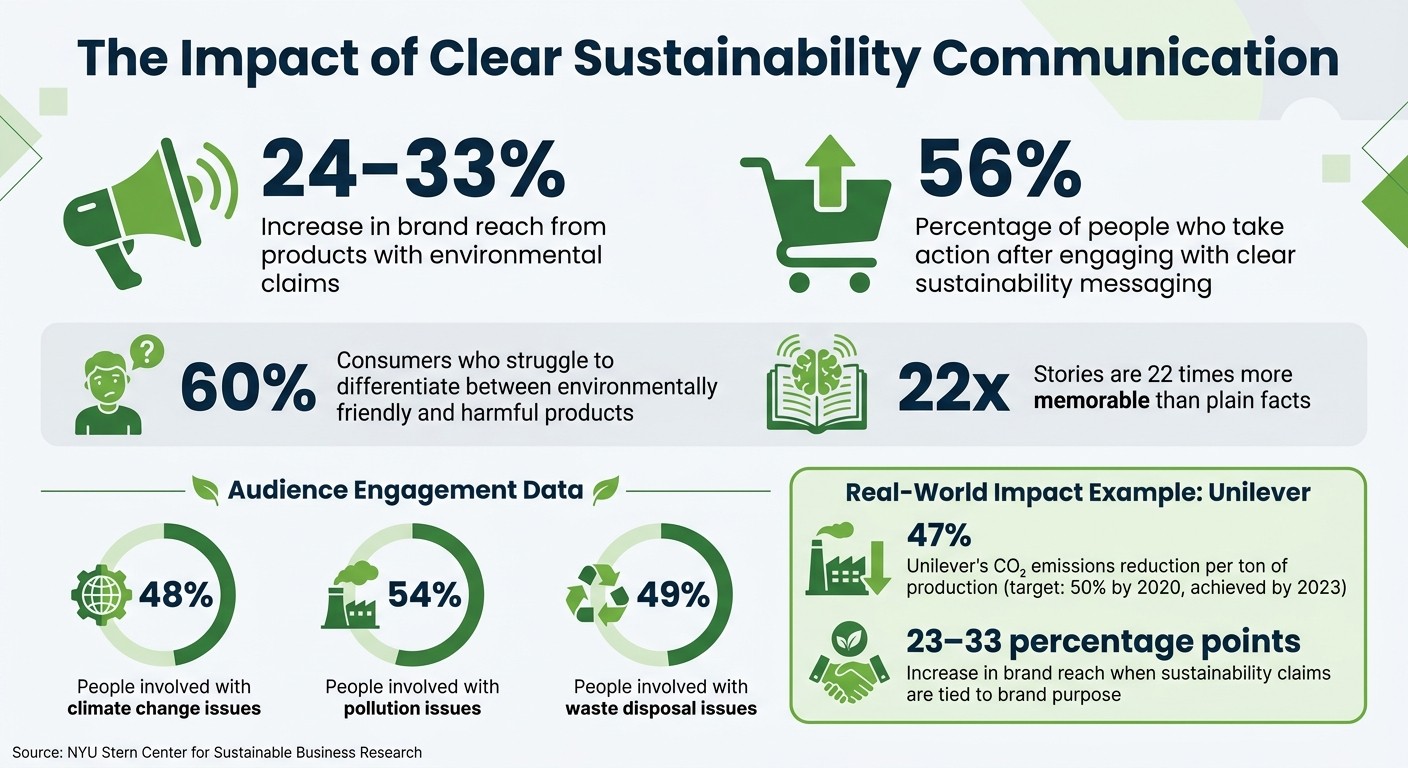
Key Statistics on Sustainability Communication Impact and Consumer Behavior
Communicating Sustainability: 10 Principles to be Effective | Phillip Haid
Understanding Your Audience
To create effective sustainability messages, it's crucial to understand your audience. Different groups care about different things, so breaking your audience into specific segments based on their roles, values, and concerns is essential. This segmentation helps craft messages that feel relevant and personal to each group.
Segmenting Your Audience
Start by categorizing your audience based on their relationship to your organization - employees, customers, and investors. Each group has its own priorities, but you can go deeper. Research from NYU Stern highlights that even the strongest sustainability messages resonate differently depending on subtle factors like age, race, and gender. For instance, younger employees tend to value parental leave policies, racial equity initiatives appeal more to people of color, and women often connect with messages about gender equity [1]. By tailoring messages to these subgroups, you can make technical sustainability data more relatable and accessible.
Professional roles also shape how people perceive sustainability. Finance teams focus on capital expenditure and asset value, while marketing teams are more interested in brand differentiation [7]. Joss Tantram, Founding Partner at Terrafiniti, emphasizes the importance of understanding the motivations and communication preferences of your audience:
"Motivations, mental models, information/communication preferences and the professional and personal norms of people they are looking to reach" [7].
Additionally, consider your "active publics" - those already engaged with sustainability issues. Studies show that 48% of people are involved with climate change, 54% with pollution, and 49% with waste disposal [4]. These groups need different messaging compared to those who are just beginning to explore sustainability topics. Once these segments are identified, gather direct input from each to refine your communication.
Gathering Insights Through Feedback
Effective communication is a two-way street. Start by hosting company-wide workshops or briefings where employees can voice their questions and concerns [2]. This approach not only helps refine your messaging but can also turn skeptics into advocates.
Leverage tools like surveys, focus groups, and digital prompts to collect feedback. Understanding how your audience connects environmental issues to their daily lives can help shape messages that resonate. Ask targeted questions: Do they prefer data-driven insights, visual aids, or storytelling? Are they more likely to engage with a concise summary or an in-depth report [7]?
For customer-facing efforts, embed feedback options directly into their journey. For example, include prompts at checkout or on product packaging to collect real-time reactions about the environmental impact of their purchases [2]. This immediate feedback helps identify what’s working and what needs improvement. It's worth noting that 60% of consumers struggle to differentiate between environmentally friendly and harmful products [8], so their input can guide you in making your messaging clearer and more effective.
Simplifying Sustainability Messaging
Effectively communicating your sustainability efforts starts with understanding your audience. By making your message clear and relatable, you break down barriers that technical jargon often creates. This approach not only ensures accessibility but also sets the foundation for meaningful storytelling and open communication.
Avoiding Jargon and Using Everyday Language
Ditch the technical terms and opt for language that resonates with everyday experiences. For example, instead of saying "carbon negative" or "net zero", try, "We remove more pollution than we create" [2][3]. Similarly, replace "circular economy" with "reusing materials to reduce waste" or describe "scope 3 emissions" as "tracking pollution from our suppliers." These simpler phrases help stakeholders grasp your efforts without feeling overwhelmed.
Adrian Segens, Sustainability Consultant and Founder of Leveller Tech, highlights this point:
"Most consumers don't read a company's big, glossy environmental report when they make a purchase. What consumers relate to is the product itself – we want to know that the product we are buying is more environmentally sound than alternatives." [5]
This underscores the importance of placing your sustainability message where it matters most - on product pages, packaging, or at the point of sale. Avoid vague claims that could be mistaken for greenwashing. Instead, offer specifics like, "We're embedding environmental factors into our supply chain decisions" [6].
Focusing on Core Messages
Once you've stripped out the jargon, focus on a few key points that reflect your sustainability goals. Aim for 3-5 core messages that align with your strengths and stakeholder priorities [3]. Research from NYU Stern shows that sustainability claims are most effective when tied to your brand's purpose. For instance, a claim like "100% sustainably farmed for great taste" connects environmental action directly to product quality [1]. This approach can increase brand reach by 23 to 33 percentage points [1].
Translating Metrics into Relatable Terms
Data can feel abstract unless it’s presented in a way people can understand. Instead of saying "15 million metric tons of CO₂", translate it into something tangible - like the annual emissions of thousands of households [5]. Relatable comparisons, such as "equivalent to taking X number of cars off the road" or "enough to power Y homes for a year", make the impact of your efforts clear [2][5].
Thil Sathyamoorthy, Sustainability Transformation Lead, emphasizes the importance of visuals:
"I personally always love a diagram over a table. Companies should always question which visual would best represent the story behind the data." [5]
Using Storytelling and Visuals
Once you've simplified your message, the next step is to make it stick. Stories are up to 22 times more memorable than plain facts, as they tap into our visual, emotional, and imaginative senses [9]. When combined with visuals, storytelling transforms abstract data into something your audience can connect with on a deeper level. This method enhances your streamlined message, turning raw data into compelling narratives.
Telling Human-Centered Stories
The best sustainability stories revolve around people, not just statistics. Instead of focusing solely on corporate targets, shine a light on the employees or community members driving your initiatives. Thil Sathyamoorthy, Sustainability Transformation Lead, puts it this way:
"Finding those stories that are a win for sustainability, the company, and employees are brilliant for making your data more human." [5]
Craft your narrative with a clear structure: outline the environmental issue, describe the obstacles your team faced, and illustrate the real-world impact. For example, highlight the engineering team that revamped your packaging to cut waste or share the journey of community partners who helped reduce supply chain emissions. Sharing both your successes and struggles builds trust and avoids perceptions of greenwashing [9][10].
Using Visual Aids to Simplify Information
Dense data and lengthy reports can quickly lose your audience's attention. Tools like diagrams, infographics, and videos help make complex ideas - such as carbon accounting or circular economy principles - easier to understand. Infographics work well for social media and consumer-facing content, while more detailed visuals, like charts, are better suited for investors or regulators [10]. By letting your visuals do the talking, you can make your message more impactful and engaging.
Relating Data to Everyday Life
Visual aids can also make abstract numbers relatable. Translate data into comparisons your audience can picture, such as linking energy savings to lower monthly utility bills or equating waste reduction to the number of garbage trucks removed from the streets. Providing context transforms raw data into relatable insights. By blending storytelling with clear visuals, you make complex sustainability concepts accessible and relevant, ensuring your audience connects with your message on a personal level.
Building Trust Through Transparency
When it comes to earning trust, transparency plays a key role. It's not just about showcasing achievements; it’s also about being upfront about the hurdles along the way. Sharing both successes and challenges creates a sense of credibility with stakeholders, reinforcing the authenticity of your sustainability journey [11].
Sharing Progress and Metrics
Keeping stakeholders in the loop with regular updates is essential. Straightforward, no-frills reporting often resonates better than overly polished presentations that feel like marketing. Tools like accessible dashboards or quarterly updates can help present progress in relatable terms. For instance, rather than simply stating a "47% reduction in CO₂ emissions per ton of production", you could explain it in a way that connects with everyday life - like equating it to the number of cars taken off the road. Unilever adopted this approach with its Sustainable Living Plan. By 2023, they had achieved a 47% reduction in CO₂ emissions per ton of production, nearly reaching their 50% target set for 2020 [11].
Highlighting Successes and Challenges
Perfection isn’t the goal - authenticity is. A great example comes from IDEO, which shared its sustainability efforts through a blog series titled "You've just got to get started." Rather than glossing over issues, the firm admitted:
"We have made progress, but we are far from perfect. There's much more work to do. And unfortunately, we are unlikely to be perfect any time soon." [2]
This kind of honesty fosters trust by showing real, incremental progress rather than striving for an unattainable image. When obstacles arise - like difficulties in scaling plastic reduction across a complex supply chain - explaining the steps you’re taking to address them strengthens accountability. Acknowledging setbacks while outlining solutions also helps counter potential accusations of greenwashing [3].
Using ESG Assessments as a Foundation
Environmental, Social, and Governance (ESG) assessments are invaluable tools for identifying the sustainability priorities that matter most to your business and its stakeholders. By focusing on what’s relevant, you avoid overwhelming your audience with unnecessary details. In 2022, luxury fashion brand Chloé conducted a biodiversity footprint assessment using the Global Biodiversity Score tool across its supply chain. This data informed their shift toward responsible materials and a clear goal of reducing impact per product by 30% by 2025. Their transparency not only built credibility but also helped them become the first luxury fashion company to achieve B Corp certification [11]. Grounding your communication in reliable data like this ensures your audience has a solid reason to trust your commitments while steering clear of greenwashing accusations.
Conclusion: Turning Sustainability Communication into Action
Sustainability communication isn’t a one-time effort - it’s a continuous conversation that brings stakeholders together. Companies that excel in this area often set themselves apart by maintaining consistency, being genuine, and tailoring their approach to connect with their audience effectively.
Key Takeaways for Corporate Leaders
The strategies outlined earlier emphasize the need to move away from outdated practices like annual reports and embrace more dynamic approaches. For instance, companies can introduce internal climate communication initiatives and incorporate transparent, data-driven sustainability metrics into customer interactions. This could mean showing carbon impact data at checkout or highlighting eco-friendly choices during the buying process [2]. Accuracy is key; every claim should be backed by reliable data, such as Life Cycle Assessments or Science-Based Targets, and presented in a way that’s easy for people to understand. As the NYU Stern Center for Sustainable Business discovered, specific, measurable actions resonate far more than vague promises [1]. To avoid pitfalls like greenwashing, greenhushing, or greenwishing, ensure every statement is supported by verifiable evidence [3].
Encouraging Long-Term Commitment
Building trust through sustainability communication means keeping the conversation going. Regular updates and consistent messaging are essential [5]. This could include hosting webinars, creating FAQs, or providing other platforms for stakeholder feedback [2]. Data shows that sustainability has a growing influence on markets and highlights the role of employee engagement in driving success [1][12]. With both the challenges and opportunities ahead, clear and consistent communication not only fosters trust and engagement but also positions your organization to thrive in an era where sustainability is a core business priority.
FAQs
What should we say instead of “Scope 3” or “net zero”?
When discussing sustainability, it’s helpful to swap out technical jargon for terms that are easier to understand. For instance, instead of saying “Scope 3,” use carbon footprint or overall emissions. Similarly, replace “net zero” with phrases like balancing emissions or achieving a balance between emissions produced and removed. This approach makes complex ideas more accessible and relatable, especially for those without a technical background.
How can we prove sustainability claims without sounding like greenwashing?
To steer clear of the pitfalls of greenwashing, prioritize transparency and rely on verifiable data. Share specific, tangible proof of your actions and progress rather than making broad, ambiguous promises. Incorporate genuine storytelling to connect with your audience, but ensure it reflects real-world efforts and outcomes. Acknowledging challenges along the way adds credibility and shows a commitment to honesty. By presenting clear, measurable examples of your sustainability initiatives, you can distinguish meaningful efforts from surface-level claims and build lasting trust.
Which sustainability metrics are easiest for non-technical audiences to understand?
When it comes to connecting with non-technical audiences, the most effective sustainability metrics are those linked to outcomes people can easily relate to. For example, highlighting reductions in carbon footprints, water usage, or waste can be far more impactful when presented as real-world benefits. Turning complex data into straightforward stories or using visuals like charts and infographics can make these ideas easier to grasp and far more engaging for a wider audience.
Related Blog Posts
Latest Articles
©2025

Narrative Change and Power Building: The Missing Half of Advocacy
Narrative change is the process of disrupting dominant narratives that normalize inequity and advancing new narratives from historically marginalized communities.

Funding Resilience Without Federal Grants
BRIC is unreliable and FEMA is shrinking. Here's how cities fund climate resilience with dedicated revenue, blended finance, and a coordinating authority.

The ESG Blind Spot: How AI Is Finding Risks in Companies Nobody Else Is Watching
Norway's sovereign wealth fund uses AI to screen 7,200 portfolio companies for forced labor and corruption within 24 hours. The real story is the emerging-market coverage gap that traditional ESG data vendors miss — and what it means for any company with a global supply chain.
Narrative Change and Power Building: The Missing Half of Advocacy
Narrative change is the process of disrupting dominant narratives that normalize inequity and advancing new narratives from historically marginalized communities.
Funding Resilience Without Federal Grants
BRIC is unreliable and FEMA is shrinking. Here's how cities fund climate resilience with dedicated revenue, blended finance, and a coordinating authority.
The ESG Blind Spot: How AI Is Finding Risks in Companies Nobody Else Is Watching
Norway's sovereign wealth fund uses AI to screen 7,200 portfolio companies for forced labor and corruption within 24 hours. The real story is the emerging-market coverage gap that traditional ESG data vendors miss — and what it means for any company with a global supply chain.
FAQ
01
What does it really mean to “redefine profit”?
02
What makes Council Fire different?
03
Who does Council Fire work with?
04
What does working with Council Fire actually look like?
05
How does Council Fire help organizations turn big goals into action?
06
How does Council Fire define and measure success?
May 5, 2026
How to Communicate Sustainability to Non-Technical Audiences for Corporations
Sustainability Strategy
In This Article
Simple strategies to explain sustainability to customers, employees, and investors using plain language, stories, and transparent metrics.
How to Communicate Sustainability to Non-Technical Audiences for Corporations
Sustainability efforts can fail to resonate with non-technical audiences when companies use jargon or overly complex explanations. Clear communication turns confusion into understanding, builds trust, and drives action. Here's why it’s important:
Non-technical audiences (customers, employees, investors) often lack the background to interpret terms like "Scope 3 emissions" or "circular economy."
Data shows: Products with environmental claims can increase brand reach by 24%-33%, and 56% of people take action after engaging with clear messaging.
Challenges: Jargon, abstract metrics, and clichés like "going green" create barriers and lead to skepticism or greenwashing concerns.
Solutions: Use simple language, relatable comparisons, and storytelling to make sustainability efforts accessible and engaging.
The goal is to simplify complex ideas, connect them to everyday concerns, and maintain transparency to build trust.
Key Statistics on Sustainability Communication Impact and Consumer Behavior
Communicating Sustainability: 10 Principles to be Effective | Phillip Haid
Understanding Your Audience
To create effective sustainability messages, it's crucial to understand your audience. Different groups care about different things, so breaking your audience into specific segments based on their roles, values, and concerns is essential. This segmentation helps craft messages that feel relevant and personal to each group.
Segmenting Your Audience
Start by categorizing your audience based on their relationship to your organization - employees, customers, and investors. Each group has its own priorities, but you can go deeper. Research from NYU Stern highlights that even the strongest sustainability messages resonate differently depending on subtle factors like age, race, and gender. For instance, younger employees tend to value parental leave policies, racial equity initiatives appeal more to people of color, and women often connect with messages about gender equity [1]. By tailoring messages to these subgroups, you can make technical sustainability data more relatable and accessible.
Professional roles also shape how people perceive sustainability. Finance teams focus on capital expenditure and asset value, while marketing teams are more interested in brand differentiation [7]. Joss Tantram, Founding Partner at Terrafiniti, emphasizes the importance of understanding the motivations and communication preferences of your audience:
"Motivations, mental models, information/communication preferences and the professional and personal norms of people they are looking to reach" [7].
Additionally, consider your "active publics" - those already engaged with sustainability issues. Studies show that 48% of people are involved with climate change, 54% with pollution, and 49% with waste disposal [4]. These groups need different messaging compared to those who are just beginning to explore sustainability topics. Once these segments are identified, gather direct input from each to refine your communication.
Gathering Insights Through Feedback
Effective communication is a two-way street. Start by hosting company-wide workshops or briefings where employees can voice their questions and concerns [2]. This approach not only helps refine your messaging but can also turn skeptics into advocates.
Leverage tools like surveys, focus groups, and digital prompts to collect feedback. Understanding how your audience connects environmental issues to their daily lives can help shape messages that resonate. Ask targeted questions: Do they prefer data-driven insights, visual aids, or storytelling? Are they more likely to engage with a concise summary or an in-depth report [7]?
For customer-facing efforts, embed feedback options directly into their journey. For example, include prompts at checkout or on product packaging to collect real-time reactions about the environmental impact of their purchases [2]. This immediate feedback helps identify what’s working and what needs improvement. It's worth noting that 60% of consumers struggle to differentiate between environmentally friendly and harmful products [8], so their input can guide you in making your messaging clearer and more effective.
Simplifying Sustainability Messaging
Effectively communicating your sustainability efforts starts with understanding your audience. By making your message clear and relatable, you break down barriers that technical jargon often creates. This approach not only ensures accessibility but also sets the foundation for meaningful storytelling and open communication.
Avoiding Jargon and Using Everyday Language
Ditch the technical terms and opt for language that resonates with everyday experiences. For example, instead of saying "carbon negative" or "net zero", try, "We remove more pollution than we create" [2][3]. Similarly, replace "circular economy" with "reusing materials to reduce waste" or describe "scope 3 emissions" as "tracking pollution from our suppliers." These simpler phrases help stakeholders grasp your efforts without feeling overwhelmed.
Adrian Segens, Sustainability Consultant and Founder of Leveller Tech, highlights this point:
"Most consumers don't read a company's big, glossy environmental report when they make a purchase. What consumers relate to is the product itself – we want to know that the product we are buying is more environmentally sound than alternatives." [5]
This underscores the importance of placing your sustainability message where it matters most - on product pages, packaging, or at the point of sale. Avoid vague claims that could be mistaken for greenwashing. Instead, offer specifics like, "We're embedding environmental factors into our supply chain decisions" [6].
Focusing on Core Messages
Once you've stripped out the jargon, focus on a few key points that reflect your sustainability goals. Aim for 3-5 core messages that align with your strengths and stakeholder priorities [3]. Research from NYU Stern shows that sustainability claims are most effective when tied to your brand's purpose. For instance, a claim like "100% sustainably farmed for great taste" connects environmental action directly to product quality [1]. This approach can increase brand reach by 23 to 33 percentage points [1].
Translating Metrics into Relatable Terms
Data can feel abstract unless it’s presented in a way people can understand. Instead of saying "15 million metric tons of CO₂", translate it into something tangible - like the annual emissions of thousands of households [5]. Relatable comparisons, such as "equivalent to taking X number of cars off the road" or "enough to power Y homes for a year", make the impact of your efforts clear [2][5].
Thil Sathyamoorthy, Sustainability Transformation Lead, emphasizes the importance of visuals:
"I personally always love a diagram over a table. Companies should always question which visual would best represent the story behind the data." [5]
Using Storytelling and Visuals
Once you've simplified your message, the next step is to make it stick. Stories are up to 22 times more memorable than plain facts, as they tap into our visual, emotional, and imaginative senses [9]. When combined with visuals, storytelling transforms abstract data into something your audience can connect with on a deeper level. This method enhances your streamlined message, turning raw data into compelling narratives.
Telling Human-Centered Stories
The best sustainability stories revolve around people, not just statistics. Instead of focusing solely on corporate targets, shine a light on the employees or community members driving your initiatives. Thil Sathyamoorthy, Sustainability Transformation Lead, puts it this way:
"Finding those stories that are a win for sustainability, the company, and employees are brilliant for making your data more human." [5]
Craft your narrative with a clear structure: outline the environmental issue, describe the obstacles your team faced, and illustrate the real-world impact. For example, highlight the engineering team that revamped your packaging to cut waste or share the journey of community partners who helped reduce supply chain emissions. Sharing both your successes and struggles builds trust and avoids perceptions of greenwashing [9][10].
Using Visual Aids to Simplify Information
Dense data and lengthy reports can quickly lose your audience's attention. Tools like diagrams, infographics, and videos help make complex ideas - such as carbon accounting or circular economy principles - easier to understand. Infographics work well for social media and consumer-facing content, while more detailed visuals, like charts, are better suited for investors or regulators [10]. By letting your visuals do the talking, you can make your message more impactful and engaging.
Relating Data to Everyday Life
Visual aids can also make abstract numbers relatable. Translate data into comparisons your audience can picture, such as linking energy savings to lower monthly utility bills or equating waste reduction to the number of garbage trucks removed from the streets. Providing context transforms raw data into relatable insights. By blending storytelling with clear visuals, you make complex sustainability concepts accessible and relevant, ensuring your audience connects with your message on a personal level.
Building Trust Through Transparency
When it comes to earning trust, transparency plays a key role. It's not just about showcasing achievements; it’s also about being upfront about the hurdles along the way. Sharing both successes and challenges creates a sense of credibility with stakeholders, reinforcing the authenticity of your sustainability journey [11].
Sharing Progress and Metrics
Keeping stakeholders in the loop with regular updates is essential. Straightforward, no-frills reporting often resonates better than overly polished presentations that feel like marketing. Tools like accessible dashboards or quarterly updates can help present progress in relatable terms. For instance, rather than simply stating a "47% reduction in CO₂ emissions per ton of production", you could explain it in a way that connects with everyday life - like equating it to the number of cars taken off the road. Unilever adopted this approach with its Sustainable Living Plan. By 2023, they had achieved a 47% reduction in CO₂ emissions per ton of production, nearly reaching their 50% target set for 2020 [11].
Highlighting Successes and Challenges
Perfection isn’t the goal - authenticity is. A great example comes from IDEO, which shared its sustainability efforts through a blog series titled "You've just got to get started." Rather than glossing over issues, the firm admitted:
"We have made progress, but we are far from perfect. There's much more work to do. And unfortunately, we are unlikely to be perfect any time soon." [2]
This kind of honesty fosters trust by showing real, incremental progress rather than striving for an unattainable image. When obstacles arise - like difficulties in scaling plastic reduction across a complex supply chain - explaining the steps you’re taking to address them strengthens accountability. Acknowledging setbacks while outlining solutions also helps counter potential accusations of greenwashing [3].
Using ESG Assessments as a Foundation
Environmental, Social, and Governance (ESG) assessments are invaluable tools for identifying the sustainability priorities that matter most to your business and its stakeholders. By focusing on what’s relevant, you avoid overwhelming your audience with unnecessary details. In 2022, luxury fashion brand Chloé conducted a biodiversity footprint assessment using the Global Biodiversity Score tool across its supply chain. This data informed their shift toward responsible materials and a clear goal of reducing impact per product by 30% by 2025. Their transparency not only built credibility but also helped them become the first luxury fashion company to achieve B Corp certification [11]. Grounding your communication in reliable data like this ensures your audience has a solid reason to trust your commitments while steering clear of greenwashing accusations.
Conclusion: Turning Sustainability Communication into Action
Sustainability communication isn’t a one-time effort - it’s a continuous conversation that brings stakeholders together. Companies that excel in this area often set themselves apart by maintaining consistency, being genuine, and tailoring their approach to connect with their audience effectively.
Key Takeaways for Corporate Leaders
The strategies outlined earlier emphasize the need to move away from outdated practices like annual reports and embrace more dynamic approaches. For instance, companies can introduce internal climate communication initiatives and incorporate transparent, data-driven sustainability metrics into customer interactions. This could mean showing carbon impact data at checkout or highlighting eco-friendly choices during the buying process [2]. Accuracy is key; every claim should be backed by reliable data, such as Life Cycle Assessments or Science-Based Targets, and presented in a way that’s easy for people to understand. As the NYU Stern Center for Sustainable Business discovered, specific, measurable actions resonate far more than vague promises [1]. To avoid pitfalls like greenwashing, greenhushing, or greenwishing, ensure every statement is supported by verifiable evidence [3].
Encouraging Long-Term Commitment
Building trust through sustainability communication means keeping the conversation going. Regular updates and consistent messaging are essential [5]. This could include hosting webinars, creating FAQs, or providing other platforms for stakeholder feedback [2]. Data shows that sustainability has a growing influence on markets and highlights the role of employee engagement in driving success [1][12]. With both the challenges and opportunities ahead, clear and consistent communication not only fosters trust and engagement but also positions your organization to thrive in an era where sustainability is a core business priority.
FAQs
What should we say instead of “Scope 3” or “net zero”?
When discussing sustainability, it’s helpful to swap out technical jargon for terms that are easier to understand. For instance, instead of saying “Scope 3,” use carbon footprint or overall emissions. Similarly, replace “net zero” with phrases like balancing emissions or achieving a balance between emissions produced and removed. This approach makes complex ideas more accessible and relatable, especially for those without a technical background.
How can we prove sustainability claims without sounding like greenwashing?
To steer clear of the pitfalls of greenwashing, prioritize transparency and rely on verifiable data. Share specific, tangible proof of your actions and progress rather than making broad, ambiguous promises. Incorporate genuine storytelling to connect with your audience, but ensure it reflects real-world efforts and outcomes. Acknowledging challenges along the way adds credibility and shows a commitment to honesty. By presenting clear, measurable examples of your sustainability initiatives, you can distinguish meaningful efforts from surface-level claims and build lasting trust.
Which sustainability metrics are easiest for non-technical audiences to understand?
When it comes to connecting with non-technical audiences, the most effective sustainability metrics are those linked to outcomes people can easily relate to. For example, highlighting reductions in carbon footprints, water usage, or waste can be far more impactful when presented as real-world benefits. Turning complex data into straightforward stories or using visuals like charts and infographics can make these ideas easier to grasp and far more engaging for a wider audience.
Related Blog Posts
Latest Articles
©2025
Narrative Change and Power Building: The Missing Half of Advocacy
Narrative change is the process of disrupting dominant narratives that normalize inequity and advancing new narratives from historically marginalized communities.
Funding Resilience Without Federal Grants
BRIC is unreliable and FEMA is shrinking. Here's how cities fund climate resilience with dedicated revenue, blended finance, and a coordinating authority.
The ESG Blind Spot: How AI Is Finding Risks in Companies Nobody Else Is Watching
Norway's sovereign wealth fund uses AI to screen 7,200 portfolio companies for forced labor and corruption within 24 hours. The real story is the emerging-market coverage gap that traditional ESG data vendors miss — and what it means for any company with a global supply chain.
FAQ
01
What does it really mean to “redefine profit”?
02
What makes Council Fire different?
03
Who does Council Fire work with?
04
What does working with Council Fire actually look like?
05
How does Council Fire help organizations turn big goals into action?
06
How does Council Fire define and measure success?
May 5, 2026
How to Communicate Sustainability to Non-Technical Audiences for Corporations
Sustainability Strategy
In This Article
Simple strategies to explain sustainability to customers, employees, and investors using plain language, stories, and transparent metrics.
How to Communicate Sustainability to Non-Technical Audiences for Corporations
Sustainability efforts can fail to resonate with non-technical audiences when companies use jargon or overly complex explanations. Clear communication turns confusion into understanding, builds trust, and drives action. Here's why it’s important:
Non-technical audiences (customers, employees, investors) often lack the background to interpret terms like "Scope 3 emissions" or "circular economy."
Data shows: Products with environmental claims can increase brand reach by 24%-33%, and 56% of people take action after engaging with clear messaging.
Challenges: Jargon, abstract metrics, and clichés like "going green" create barriers and lead to skepticism or greenwashing concerns.
Solutions: Use simple language, relatable comparisons, and storytelling to make sustainability efforts accessible and engaging.
The goal is to simplify complex ideas, connect them to everyday concerns, and maintain transparency to build trust.
Key Statistics on Sustainability Communication Impact and Consumer Behavior
Communicating Sustainability: 10 Principles to be Effective | Phillip Haid
Understanding Your Audience
To create effective sustainability messages, it's crucial to understand your audience. Different groups care about different things, so breaking your audience into specific segments based on their roles, values, and concerns is essential. This segmentation helps craft messages that feel relevant and personal to each group.
Segmenting Your Audience
Start by categorizing your audience based on their relationship to your organization - employees, customers, and investors. Each group has its own priorities, but you can go deeper. Research from NYU Stern highlights that even the strongest sustainability messages resonate differently depending on subtle factors like age, race, and gender. For instance, younger employees tend to value parental leave policies, racial equity initiatives appeal more to people of color, and women often connect with messages about gender equity [1]. By tailoring messages to these subgroups, you can make technical sustainability data more relatable and accessible.
Professional roles also shape how people perceive sustainability. Finance teams focus on capital expenditure and asset value, while marketing teams are more interested in brand differentiation [7]. Joss Tantram, Founding Partner at Terrafiniti, emphasizes the importance of understanding the motivations and communication preferences of your audience:
"Motivations, mental models, information/communication preferences and the professional and personal norms of people they are looking to reach" [7].
Additionally, consider your "active publics" - those already engaged with sustainability issues. Studies show that 48% of people are involved with climate change, 54% with pollution, and 49% with waste disposal [4]. These groups need different messaging compared to those who are just beginning to explore sustainability topics. Once these segments are identified, gather direct input from each to refine your communication.
Gathering Insights Through Feedback
Effective communication is a two-way street. Start by hosting company-wide workshops or briefings where employees can voice their questions and concerns [2]. This approach not only helps refine your messaging but can also turn skeptics into advocates.
Leverage tools like surveys, focus groups, and digital prompts to collect feedback. Understanding how your audience connects environmental issues to their daily lives can help shape messages that resonate. Ask targeted questions: Do they prefer data-driven insights, visual aids, or storytelling? Are they more likely to engage with a concise summary or an in-depth report [7]?
For customer-facing efforts, embed feedback options directly into their journey. For example, include prompts at checkout or on product packaging to collect real-time reactions about the environmental impact of their purchases [2]. This immediate feedback helps identify what’s working and what needs improvement. It's worth noting that 60% of consumers struggle to differentiate between environmentally friendly and harmful products [8], so their input can guide you in making your messaging clearer and more effective.
Simplifying Sustainability Messaging
Effectively communicating your sustainability efforts starts with understanding your audience. By making your message clear and relatable, you break down barriers that technical jargon often creates. This approach not only ensures accessibility but also sets the foundation for meaningful storytelling and open communication.
Avoiding Jargon and Using Everyday Language
Ditch the technical terms and opt for language that resonates with everyday experiences. For example, instead of saying "carbon negative" or "net zero", try, "We remove more pollution than we create" [2][3]. Similarly, replace "circular economy" with "reusing materials to reduce waste" or describe "scope 3 emissions" as "tracking pollution from our suppliers." These simpler phrases help stakeholders grasp your efforts without feeling overwhelmed.
Adrian Segens, Sustainability Consultant and Founder of Leveller Tech, highlights this point:
"Most consumers don't read a company's big, glossy environmental report when they make a purchase. What consumers relate to is the product itself – we want to know that the product we are buying is more environmentally sound than alternatives." [5]
This underscores the importance of placing your sustainability message where it matters most - on product pages, packaging, or at the point of sale. Avoid vague claims that could be mistaken for greenwashing. Instead, offer specifics like, "We're embedding environmental factors into our supply chain decisions" [6].
Focusing on Core Messages
Once you've stripped out the jargon, focus on a few key points that reflect your sustainability goals. Aim for 3-5 core messages that align with your strengths and stakeholder priorities [3]. Research from NYU Stern shows that sustainability claims are most effective when tied to your brand's purpose. For instance, a claim like "100% sustainably farmed for great taste" connects environmental action directly to product quality [1]. This approach can increase brand reach by 23 to 33 percentage points [1].
Translating Metrics into Relatable Terms
Data can feel abstract unless it’s presented in a way people can understand. Instead of saying "15 million metric tons of CO₂", translate it into something tangible - like the annual emissions of thousands of households [5]. Relatable comparisons, such as "equivalent to taking X number of cars off the road" or "enough to power Y homes for a year", make the impact of your efforts clear [2][5].
Thil Sathyamoorthy, Sustainability Transformation Lead, emphasizes the importance of visuals:
"I personally always love a diagram over a table. Companies should always question which visual would best represent the story behind the data." [5]
Using Storytelling and Visuals
Once you've simplified your message, the next step is to make it stick. Stories are up to 22 times more memorable than plain facts, as they tap into our visual, emotional, and imaginative senses [9]. When combined with visuals, storytelling transforms abstract data into something your audience can connect with on a deeper level. This method enhances your streamlined message, turning raw data into compelling narratives.
Telling Human-Centered Stories
The best sustainability stories revolve around people, not just statistics. Instead of focusing solely on corporate targets, shine a light on the employees or community members driving your initiatives. Thil Sathyamoorthy, Sustainability Transformation Lead, puts it this way:
"Finding those stories that are a win for sustainability, the company, and employees are brilliant for making your data more human." [5]
Craft your narrative with a clear structure: outline the environmental issue, describe the obstacles your team faced, and illustrate the real-world impact. For example, highlight the engineering team that revamped your packaging to cut waste or share the journey of community partners who helped reduce supply chain emissions. Sharing both your successes and struggles builds trust and avoids perceptions of greenwashing [9][10].
Using Visual Aids to Simplify Information
Dense data and lengthy reports can quickly lose your audience's attention. Tools like diagrams, infographics, and videos help make complex ideas - such as carbon accounting or circular economy principles - easier to understand. Infographics work well for social media and consumer-facing content, while more detailed visuals, like charts, are better suited for investors or regulators [10]. By letting your visuals do the talking, you can make your message more impactful and engaging.
Relating Data to Everyday Life
Visual aids can also make abstract numbers relatable. Translate data into comparisons your audience can picture, such as linking energy savings to lower monthly utility bills or equating waste reduction to the number of garbage trucks removed from the streets. Providing context transforms raw data into relatable insights. By blending storytelling with clear visuals, you make complex sustainability concepts accessible and relevant, ensuring your audience connects with your message on a personal level.
Building Trust Through Transparency
When it comes to earning trust, transparency plays a key role. It's not just about showcasing achievements; it’s also about being upfront about the hurdles along the way. Sharing both successes and challenges creates a sense of credibility with stakeholders, reinforcing the authenticity of your sustainability journey [11].
Sharing Progress and Metrics
Keeping stakeholders in the loop with regular updates is essential. Straightforward, no-frills reporting often resonates better than overly polished presentations that feel like marketing. Tools like accessible dashboards or quarterly updates can help present progress in relatable terms. For instance, rather than simply stating a "47% reduction in CO₂ emissions per ton of production", you could explain it in a way that connects with everyday life - like equating it to the number of cars taken off the road. Unilever adopted this approach with its Sustainable Living Plan. By 2023, they had achieved a 47% reduction in CO₂ emissions per ton of production, nearly reaching their 50% target set for 2020 [11].
Highlighting Successes and Challenges
Perfection isn’t the goal - authenticity is. A great example comes from IDEO, which shared its sustainability efforts through a blog series titled "You've just got to get started." Rather than glossing over issues, the firm admitted:
"We have made progress, but we are far from perfect. There's much more work to do. And unfortunately, we are unlikely to be perfect any time soon." [2]
This kind of honesty fosters trust by showing real, incremental progress rather than striving for an unattainable image. When obstacles arise - like difficulties in scaling plastic reduction across a complex supply chain - explaining the steps you’re taking to address them strengthens accountability. Acknowledging setbacks while outlining solutions also helps counter potential accusations of greenwashing [3].
Using ESG Assessments as a Foundation
Environmental, Social, and Governance (ESG) assessments are invaluable tools for identifying the sustainability priorities that matter most to your business and its stakeholders. By focusing on what’s relevant, you avoid overwhelming your audience with unnecessary details. In 2022, luxury fashion brand Chloé conducted a biodiversity footprint assessment using the Global Biodiversity Score tool across its supply chain. This data informed their shift toward responsible materials and a clear goal of reducing impact per product by 30% by 2025. Their transparency not only built credibility but also helped them become the first luxury fashion company to achieve B Corp certification [11]. Grounding your communication in reliable data like this ensures your audience has a solid reason to trust your commitments while steering clear of greenwashing accusations.
Conclusion: Turning Sustainability Communication into Action
Sustainability communication isn’t a one-time effort - it’s a continuous conversation that brings stakeholders together. Companies that excel in this area often set themselves apart by maintaining consistency, being genuine, and tailoring their approach to connect with their audience effectively.
Key Takeaways for Corporate Leaders
The strategies outlined earlier emphasize the need to move away from outdated practices like annual reports and embrace more dynamic approaches. For instance, companies can introduce internal climate communication initiatives and incorporate transparent, data-driven sustainability metrics into customer interactions. This could mean showing carbon impact data at checkout or highlighting eco-friendly choices during the buying process [2]. Accuracy is key; every claim should be backed by reliable data, such as Life Cycle Assessments or Science-Based Targets, and presented in a way that’s easy for people to understand. As the NYU Stern Center for Sustainable Business discovered, specific, measurable actions resonate far more than vague promises [1]. To avoid pitfalls like greenwashing, greenhushing, or greenwishing, ensure every statement is supported by verifiable evidence [3].
Encouraging Long-Term Commitment
Building trust through sustainability communication means keeping the conversation going. Regular updates and consistent messaging are essential [5]. This could include hosting webinars, creating FAQs, or providing other platforms for stakeholder feedback [2]. Data shows that sustainability has a growing influence on markets and highlights the role of employee engagement in driving success [1][12]. With both the challenges and opportunities ahead, clear and consistent communication not only fosters trust and engagement but also positions your organization to thrive in an era where sustainability is a core business priority.
FAQs
What should we say instead of “Scope 3” or “net zero”?
When discussing sustainability, it’s helpful to swap out technical jargon for terms that are easier to understand. For instance, instead of saying “Scope 3,” use carbon footprint or overall emissions. Similarly, replace “net zero” with phrases like balancing emissions or achieving a balance between emissions produced and removed. This approach makes complex ideas more accessible and relatable, especially for those without a technical background.
How can we prove sustainability claims without sounding like greenwashing?
To steer clear of the pitfalls of greenwashing, prioritize transparency and rely on verifiable data. Share specific, tangible proof of your actions and progress rather than making broad, ambiguous promises. Incorporate genuine storytelling to connect with your audience, but ensure it reflects real-world efforts and outcomes. Acknowledging challenges along the way adds credibility and shows a commitment to honesty. By presenting clear, measurable examples of your sustainability initiatives, you can distinguish meaningful efforts from surface-level claims and build lasting trust.
Which sustainability metrics are easiest for non-technical audiences to understand?
When it comes to connecting with non-technical audiences, the most effective sustainability metrics are those linked to outcomes people can easily relate to. For example, highlighting reductions in carbon footprints, water usage, or waste can be far more impactful when presented as real-world benefits. Turning complex data into straightforward stories or using visuals like charts and infographics can make these ideas easier to grasp and far more engaging for a wider audience.
Related Blog Posts
Latest Articles
©2025
Narrative Change and Power Building: The Missing Half of Advocacy
Narrative change is the process of disrupting dominant narratives that normalize inequity and advancing new narratives from historically marginalized communities.
Funding Resilience Without Federal Grants
BRIC is unreliable and FEMA is shrinking. Here's how cities fund climate resilience with dedicated revenue, blended finance, and a coordinating authority.
The ESG Blind Spot: How AI Is Finding Risks in Companies Nobody Else Is Watching
Norway's sovereign wealth fund uses AI to screen 7,200 portfolio companies for forced labor and corruption within 24 hours. The real story is the emerging-market coverage gap that traditional ESG data vendors miss — and what it means for any company with a global supply chain.
FAQ
What does it really mean to “redefine profit”?
What makes Council Fire different?
Who does Council Fire work with?
What does working with Council Fire actually look like?
How does Council Fire help organizations turn big goals into action?
How does Council Fire define and measure success?