
May 18, 2026
How to Communicate Sustainability to Non-Technical Audiences for Foundations & Philanthropic Organizations
Sustainability Strategy
In This Article
Practical guide for foundations to explain sustainability to non-technical boards, donors, grantees using clear language, stories, visuals.
How to Communicate Sustainability to Non-Technical Audiences for Foundations & Philanthropic Organizations
Clear communication is the key to making sustainability efforts resonate with board members, donors, grantees, and community partners. These groups often lack technical expertise in sustainability, so it's critical to tailor messages to their priorities and use plain, relatable language. Here's how you can do that effectively:
Know Your Audience: Understand what each group values - whether it's financial outcomes for board members or local impact for community partners - and adjust your message accordingly.
Focus on Results: Replace jargon with clear, outcome-driven statements like, "Our program helped 1,200 families lower energy costs", instead of abstract phrases.
Use Stories and Visuals: Narratives and relatable comparisons (e.g., "equivalent to removing 108 cars from the road") make complex ideas easier to grasp.
Highlight Past Success: Show specific examples of how your organization has addressed sustainability challenges to build trust and credibility.
Simplify Internal Communication: Equip your team with tools like a plain-language guide to ensure consistent and clear messaging.
Communicating Sustainability: 10 Principles to be Effective | Phillip Haid
Identifying and Tailoring Messages for Key Audience Groups
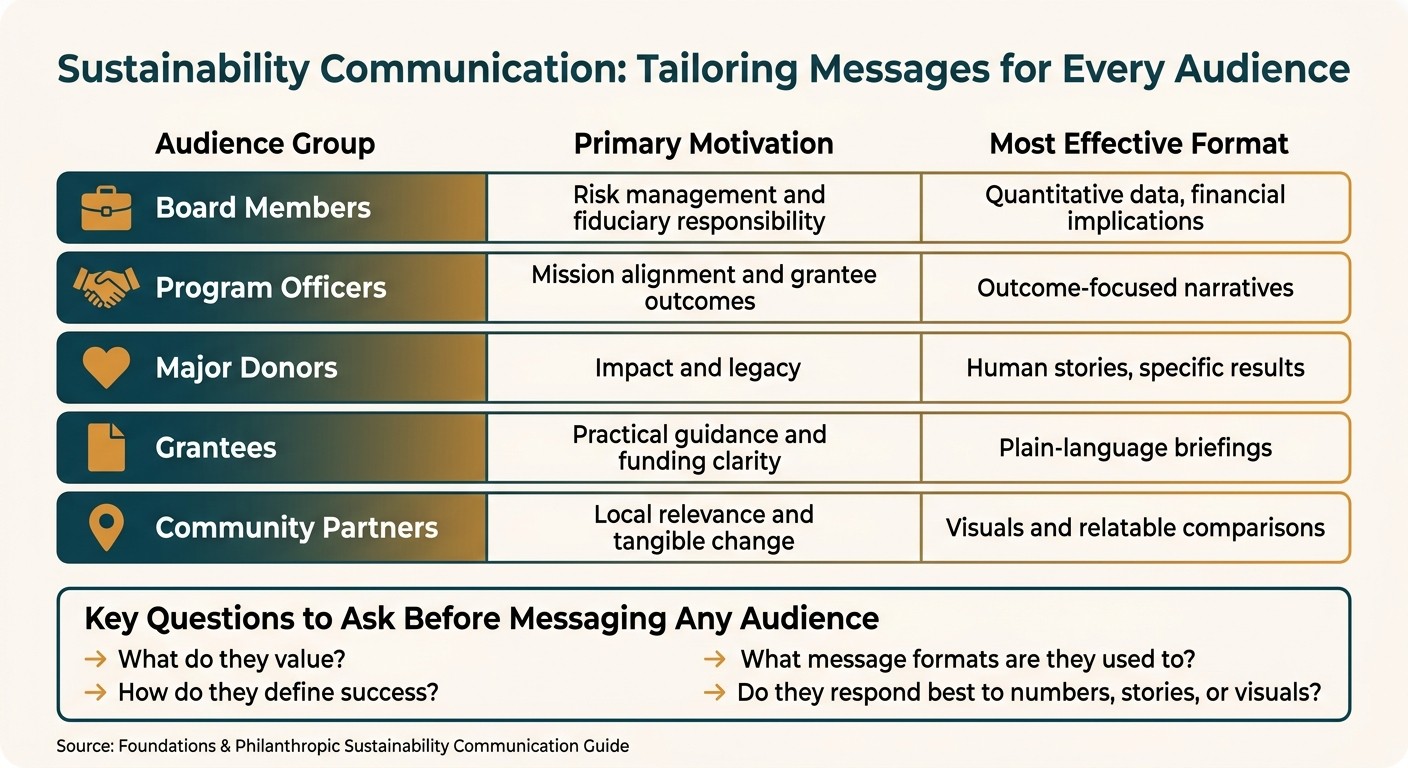
Sustainability Communication: Tailoring Messages for Every Audience
Mapping What Each Audience Needs and Cares About
Stakeholders bring diverse perspectives to the table, and their views on sustainability often reflect their unique roles and priorities. For instance, a board member focused on fiduciary risks will approach sustainability differently than a program officer overseeing community grants. As Joss Tantram, Founding Partner at Terrafiniti, explains:
"Facts are also not enough when they collide with incompatible values, worldviews, mental models or heuristics." [2]
To craft impactful messages, begin by asking four key questions for each audience group: What do they value? How do they define success? What types of messages are they accustomed to? And do they respond best to numbers, stories, or visuals? [2] These answers will guide not only the content of your communication but also its format.
Here’s a quick look at common audience groups in philanthropic organizations, their priorities, and the message formats that resonate most effectively:
Audience Group | Primary Motivation | Most Effective Format |
|---|---|---|
Board Members | Risk management and fiduciary responsibility | Quantitative data, financial implications |
Program Officers | Mission alignment and grantee outcomes | Outcome-focused narratives |
Major Donors | Impact and legacy | Human stories, specific results |
Grantees | Practical guidance and funding clarity | Plain-language briefings |
Community Partners | Local relevance and tangible change | Visuals and relatable comparisons |
By tailoring your approach to each group’s motivations and preferred formats, you can connect with them more effectively and strengthen your sustainability narrative.
Building on Existing Sustainability Work
Once you’ve identified your audience’s needs, the next step is to build on the sustainability efforts your foundation has already undertaken. Highlighting past work - such as climate risk assessments, grant portfolios, or impact reports - anchors your messaging in familiar, credible examples. This ensures that new initiatives feel grounded rather than abstract.
Start by auditing your existing communication materials - letters of inquiry, progress reports, evaluations - and assess whether they encourage clear, results-oriented language or inadvertently lean toward vague, systems-level jargon [1]. Matt Watkins of Watkins Public Affairs underscores this point:
"Foundations cannot demand clarity from grantees while hiding behind language they would reject in an application." [1]
If your foundation has supported projects like climate resilience, energy efficiency, or environmental justice, use them as concrete proof points. For example, instead of vaguely stating a commitment to "advance equitable climate solutions", provide specific examples: "Our 2024 grants in Cook County helped 1,200 families reduce home energy costs." Such specific, outcome-driven statements carry far more weight and credibility than broad, abstract claims. By showcasing real results, you demonstrate the tangible impact of your sustainability efforts.
Making Complex Sustainability Concepts Easy to Understand
Replacing Jargon with Mission-Driven Language
Overly technical language can create barriers between your organization and the people you need to engage. Phrases like "systems-level change" or "equity-centered grant making" may resonate internally but often leave external audiences - like board members, donors, or community partners - struggling to grasp the real-world outcomes. Clear, relatable language can bridge this gap.
The table below illustrates how jargon-heavy phrases can be translated into straightforward, outcome-focused alternatives:
Jargon-Heavy Language | Mission-Driven Alternative |
|---|---|
"We advance systems-level change through equity-centered grant making." | "We funded 17 organizations to help 340 families avoid eviction by connecting them to emergency rental assistance." |
"Funding the people on the front lines." | "Supporting community partners to build sustainable local food systems." |
"Giving folks a seat at the table." | "Collaborating with community leaders to make decisions together." |
By shifting the focus to tangible results, these alternatives help audiences connect with the mission on a personal level.
Using Relatable Metrics and Comparisons
Once the jargon is stripped away, presenting data in familiar terms can further enhance understanding. For example, while "500 metric tons of CO₂ reduction" might sound abstract, framing it as "the equivalent of taking 108 cars off the road for a year" makes the impact instantly relatable.
This approach isn’t just intuitive - it’s proven effective. A study conducted between June and August 2023 by MIT Sloan professor Catherine Tucker and her team demonstrated this. They tested messaging with over 380,000 households, replacing "kilograms of CO₂ emissions" with "equivalent miles of reduced driving." This change led to a 2.2% increase in the amount of recyclables collected per household. In contrast, monetary incentives only boosted recycling by 1.9% - and at a higher cost [3]. As Tucker explained:
"We show that even when presented with accurate carbon emissions, consumers react less strongly to them than something more familiar." [3]
For U.S. audiences, comparisons tied to everyday experiences - like miles driven, households powered, or gallons of water saved - tend to resonate most. Framing these metrics within a clear story ensures the message sticks.
Structuring Sustainability Messages as Clear Narratives
A well-structured narrative can transform complex sustainability efforts into engaging stories. A simple four-part framework - problem, approach, impact, and mission relevance - can guide readers from identifying the challenge to understanding the results.
What makes a sustainability story memorable is its specificity. As The Conversation noted:
"Speaking in code... hampers the ability of funders to build trust with the communities they serve." [4]
Strong narratives avoid jumping straight to the outcome as if the solution materialized out of nowhere. Instead, they detail the steps taken, the people involved, and the decisions made along the way. For instance, naming a neighborhood, highlighting a partner’s role, and quantifying tangible results creates a vivid picture. This level of detail ties the sustainability effort directly to your organization’s broader mission, making it both relatable and impactful.
Using Storytelling and Visual Tools to Communicate Sustainability
Framing Sustainability as Systems Change
Sustainability efforts are rarely isolated; they are part of broader, interconnected systems. Communicating this to non-technical audiences means breaking down these systems into relatable, concrete examples. Instead of using abstract phrases like "advancing systemic change", highlight specific actions and their outcomes. For instance, rather than a vague statement, you could say, “Our foundation supported local policy reforms that updated zoning regulations in three neighborhoods, enabling 200 families to access affordable housing near public transit.” This approach connects with audiences by focusing on tangible, mission-driven results.
Ann Searight Christiano and Matt Sheehan from the Center for Public Interest Communications emphasize this point:
"Vivid, transparent stories and visual language help people see how change happens - and generate a narrative in which we see the potential each of us has to overcome massive social challenges." [5]
Rather than jumping straight to results, guide your audience through the journey. Explain the partnerships formed, the decisions made, and the reasoning behind them. This transparency builds trust. Then, amplify the voices of those directly impacted, ensuring their experiences are central to the narrative.
Centering Grantee and Community Voices
One of the most impactful shifts a foundation can make is transitioning from talking about community issues to engaging with communities directly. When grantees and community members share their own stories, the message resonates with authenticity and credibility that institutional voices alone cannot achieve. This approach complements the goal of making sustainability communication clear and relatable.
This means moving beyond simply quoting individuals in reports. Instead, involve frontline voices from the outset, framing the narrative around possibilities rather than just problems. As Anneliese Palmer, Journalist in Residence at the GW Alliance for a Sustainable Future, explains:
"By asking 'what is possible' rather than solely focusing on 'what is wrong,' storytellers involve frontline communities and individuals directly impacted by climate change in crafting narratives." [8]
This might involve showcasing a grantee partner explaining how a specific grant enabled them to organize food distribution across five zip codes. Including perspectives from staff at all levels - not just leadership - can also add depth and authenticity to the storytelling.
Using Visuals to Clarify Complex Ideas
While authentic narratives form the foundation, visuals play a key role in simplifying complex sustainability concepts. They can translate abstract ideas into something tangible and easier to understand, especially when showing how something works rather than just that it happened.
Here are some effective visual approaches for philanthropic audiences:
Documentary-style photography and video: Capturing real moments - community members, grantee staff, and actual locations - adds credibility and authenticity. Documentary photographer Andrew Cameron puts it well: "Sustainability stories and the way they are told can shape trust, reputation, drive innovation, inspire whole supply chains, and can either support success or contribute to failure."[6]
Data dashboards: Combining quantitative data (e.g., "1,200 households served") with quotes from grantees helps illustrate both the scale of the work and its human impact. [7]
Narrative arc frameworks: Structuring visuals around a clear story arc can create emotional engagement. Stephen Minix of UpMetrics suggests a four-part structure: The Broken World, The Hero (the community), The Journey (the support provided), and The Mended World. This framework gives visual content a compelling and relatable shape. [7]
As UpMetrics aptly states, "Data isn't the enemy of storytelling - it's the engine." [7] By grounding visuals in real data and real people, sustainability efforts become more relatable and impactful than text alone could ever achieve.
Building Internal Alignment and Capacity Around Sustainability
Once external clarity is established, the next step is ensuring that internal teams are aligned and equipped to maintain effective communication.
Developing Simple Internal Reference Tools
Strong external messaging begins with a team that can articulate sustainability concepts in straightforward terms. If staff members struggle to explain these ideas to one another, they’ll face even greater challenges when communicating with donors, board members, or the public.
One practical approach is crafting a "Before and After" language guide. This document helps staff translate abstract, jargon-heavy phrases into more relatable, people-focused language. For example, instead of saying, "equity-centered grantmaking that builds community capacity", staff might use, "funding organizations working on housing stability." This shift makes the work easier to understand at a glance [1]. A concise, one-page guide covering common terms can significantly improve clarity.
To test whether messaging is clear, ask: "Can an outsider easily identify who benefits, how, and why?" [1]. Matt Watkins, CEO of Watkins Public Affairs, emphasizes this point:
"Foundations cannot demand clarity from grantees while hiding behind language they would reject in an application." [1]
Another effective strategy is bringing in "outside readers" - such as community librarians or small-business owners - to review grant summaries and internal documents. Their feedback can help identify and eliminate jargon before it becomes widespread [1].
The next step is embedding these clear communication principles into daily operations.
Integrating Sustainability into Day-to-Day Decision-Making
To ensure sustainability messaging is reflected in everyday actions, organizations must review the tools they already use - such as grant review rubrics, inquiry templates, and progress reports. These tools should reward clarity rather than unintentionally encouraging complexity.
One actionable step is revising scoring criteria for grant applications. Instead of focusing on how well applicants describe "strategies and systems", the evaluation should prioritize whether a non-expert can understand who benefits and what changes will occur [1]. Additionally, requiring a brief public communication plan as part of each grant application can help organizations focus on how they’ll share their message. This plan might outline the target audience, key message, and communication methods [1].
Leadership plays a critical role in setting these expectations. As Watkins notes:
"A foundation that revises its grant applications but cannot pass its own annual report test is asking grantees to do something it won't do." [1]
By modeling clarity in board reports and executive summaries, leadership demonstrates that plain language is a core value, encouraging the rest of the organization to follow suit.
Encouraging Collaboration Between Technical and Program Teams
Clear language and thoughtful decision-making are just the beginning. To ensure everyone is on the same page, organizations must foster collaboration across teams. Sustainability knowledge often resides with a small group of specialists - who may make up just 1% of the workforce [9]. This leaves the majority of staff less familiar with these concepts, creating potential gaps in understanding.
Cross-functional workshops can bridge this divide. These sessions allow technical, finance, and program teams to explain sustainability concepts to one another in plain terms, building a shared understanding [9]. Another helpful tool is a living internal glossary. This evolving resource links key terms like "materiality" or "net zero" to the organization's mission and provides real-world examples, ensuring consistency across teams [9]. A learning adviser at xUnlocked highlights the value of this approach:
"If everyone understands the 'why,' 'what,' and 'how,' they spend less time deciphering what something means, and more time acting on it." [9]
Finally, organizations should embrace transparency when sustainability efforts fall short. Openly discussing challenges and lessons learned not only strengthens internal trust but also enhances credibility with external audiences [1][9].
Conclusion: Key Takeaways for Sustainability Communication
Using clear language fosters trust. This involves crafting messages tailored to specific audiences while emphasizing measurable results. Why? Because what resonates with a board member might not connect with a community partner or a first-time donor. Highlighting outcomes - like saying a program "helped 340 families avoid eviction" - grabs attention more effectively than diving into internal processes. And don’t underestimate the power of storytelling; stories are 22 times more memorable than a list of statistics [10].
Take Patagonia’s 2023 environmental and social responsibility report as an example. By openly sharing both successes and challenges - such as factory audit failures and rising supply chain emissions - the company strengthened stakeholder trust [11]. Foundations can learn from this approach. Being upfront about what didn’t work, and the lessons learned, demonstrates integrity. As Matt Watkins, CEO of Watkins Public Affairs, explains, being honest about failures is just as crucial as being clear [1].
Sustainability communication isn’t a one-time effort - it requires consistent internal alignment, straightforward tools, and an ongoing commitment to transparency. This same clarity should guide decision-making and ensure that strategies remain aligned every step of the way.
FAQs
How do we pick the right sustainability message for each stakeholder group?
To communicate effectively about sustainability, it's essential to align your message with the interests, values, and knowledge level of each stakeholder group. For technical audiences, focus on providing detailed data and using precise terminology to match their expertise. For non-technical audiences, simplify complex ideas with relatable examples, engaging stories, or visual aids that make the concepts easier to grasp. Always prioritize what matters most to your audience - whether they are donors, policymakers, or staff members. This approach helps your message connect, fosters trust, and ensures it meets their expectations.
What are good U.S.-friendly ways to translate CO2 numbers into relatable impact?
To help U.S. audiences grasp CO₂ figures, it's effective to use comparisons tied to everyday activities. For instance, equating emissions to driving a certain number of miles in an average car, powering a typical home for a year, or taking a round-trip flight from JFK to LAX can bridge the gap between abstract numbers and tangible experiences. These relatable examples make greenhouse gas impacts more accessible and easier to visualize for those without a technical background.
How can we keep sustainability language consistent across staff and grantees?
To ensure sustainability communication is accessible and effective, focus on using clear, straightforward language free of unnecessary jargon. Developing a shared vocabulary that emphasizes openness and simplicity can make a big difference. Offering training sessions and resources can help staff and grantees create messages that are easy to understand.
By setting common language standards, promoting consistent storytelling, and regularly reviewing materials, you can maintain alignment across the board. This strategy helps eliminate confusion, connects diverse audiences, and ensures everyone is working toward the same goals.
Related Blog Posts
Latest Articles
©2025

Narrative Change and Power Building: The Missing Half of Advocacy
Narrative change is the process of disrupting dominant narratives that normalize inequity and advancing new narratives from historically marginalized communities.

Funding Resilience Without Federal Grants
BRIC is unreliable and FEMA is shrinking. Here's how cities fund climate resilience with dedicated revenue, blended finance, and a coordinating authority.

The ESG Blind Spot: How AI Is Finding Risks in Companies Nobody Else Is Watching
Norway's sovereign wealth fund uses AI to screen 7,200 portfolio companies for forced labor and corruption within 24 hours. The real story is the emerging-market coverage gap that traditional ESG data vendors miss — and what it means for any company with a global supply chain.
Narrative Change and Power Building: The Missing Half of Advocacy
Narrative change is the process of disrupting dominant narratives that normalize inequity and advancing new narratives from historically marginalized communities.
Funding Resilience Without Federal Grants
BRIC is unreliable and FEMA is shrinking. Here's how cities fund climate resilience with dedicated revenue, blended finance, and a coordinating authority.
The ESG Blind Spot: How AI Is Finding Risks in Companies Nobody Else Is Watching
Norway's sovereign wealth fund uses AI to screen 7,200 portfolio companies for forced labor and corruption within 24 hours. The real story is the emerging-market coverage gap that traditional ESG data vendors miss — and what it means for any company with a global supply chain.
FAQ
01
What does it really mean to “redefine profit”?
02
What makes Council Fire different?
03
Who does Council Fire work with?
04
What does working with Council Fire actually look like?
05
How does Council Fire help organizations turn big goals into action?
06
How does Council Fire define and measure success?
May 18, 2026
How to Communicate Sustainability to Non-Technical Audiences for Foundations & Philanthropic Organizations
Sustainability Strategy
In This Article
Practical guide for foundations to explain sustainability to non-technical boards, donors, grantees using clear language, stories, visuals.
How to Communicate Sustainability to Non-Technical Audiences for Foundations & Philanthropic Organizations
Clear communication is the key to making sustainability efforts resonate with board members, donors, grantees, and community partners. These groups often lack technical expertise in sustainability, so it's critical to tailor messages to their priorities and use plain, relatable language. Here's how you can do that effectively:
Know Your Audience: Understand what each group values - whether it's financial outcomes for board members or local impact for community partners - and adjust your message accordingly.
Focus on Results: Replace jargon with clear, outcome-driven statements like, "Our program helped 1,200 families lower energy costs", instead of abstract phrases.
Use Stories and Visuals: Narratives and relatable comparisons (e.g., "equivalent to removing 108 cars from the road") make complex ideas easier to grasp.
Highlight Past Success: Show specific examples of how your organization has addressed sustainability challenges to build trust and credibility.
Simplify Internal Communication: Equip your team with tools like a plain-language guide to ensure consistent and clear messaging.
Communicating Sustainability: 10 Principles to be Effective | Phillip Haid
Identifying and Tailoring Messages for Key Audience Groups
Sustainability Communication: Tailoring Messages for Every Audience
Mapping What Each Audience Needs and Cares About
Stakeholders bring diverse perspectives to the table, and their views on sustainability often reflect their unique roles and priorities. For instance, a board member focused on fiduciary risks will approach sustainability differently than a program officer overseeing community grants. As Joss Tantram, Founding Partner at Terrafiniti, explains:
"Facts are also not enough when they collide with incompatible values, worldviews, mental models or heuristics." [2]
To craft impactful messages, begin by asking four key questions for each audience group: What do they value? How do they define success? What types of messages are they accustomed to? And do they respond best to numbers, stories, or visuals? [2] These answers will guide not only the content of your communication but also its format.
Here’s a quick look at common audience groups in philanthropic organizations, their priorities, and the message formats that resonate most effectively:
Audience Group | Primary Motivation | Most Effective Format |
|---|---|---|
Board Members | Risk management and fiduciary responsibility | Quantitative data, financial implications |
Program Officers | Mission alignment and grantee outcomes | Outcome-focused narratives |
Major Donors | Impact and legacy | Human stories, specific results |
Grantees | Practical guidance and funding clarity | Plain-language briefings |
Community Partners | Local relevance and tangible change | Visuals and relatable comparisons |
By tailoring your approach to each group’s motivations and preferred formats, you can connect with them more effectively and strengthen your sustainability narrative.
Building on Existing Sustainability Work
Once you’ve identified your audience’s needs, the next step is to build on the sustainability efforts your foundation has already undertaken. Highlighting past work - such as climate risk assessments, grant portfolios, or impact reports - anchors your messaging in familiar, credible examples. This ensures that new initiatives feel grounded rather than abstract.
Start by auditing your existing communication materials - letters of inquiry, progress reports, evaluations - and assess whether they encourage clear, results-oriented language or inadvertently lean toward vague, systems-level jargon [1]. Matt Watkins of Watkins Public Affairs underscores this point:
"Foundations cannot demand clarity from grantees while hiding behind language they would reject in an application." [1]
If your foundation has supported projects like climate resilience, energy efficiency, or environmental justice, use them as concrete proof points. For example, instead of vaguely stating a commitment to "advance equitable climate solutions", provide specific examples: "Our 2024 grants in Cook County helped 1,200 families reduce home energy costs." Such specific, outcome-driven statements carry far more weight and credibility than broad, abstract claims. By showcasing real results, you demonstrate the tangible impact of your sustainability efforts.
Making Complex Sustainability Concepts Easy to Understand
Replacing Jargon with Mission-Driven Language
Overly technical language can create barriers between your organization and the people you need to engage. Phrases like "systems-level change" or "equity-centered grant making" may resonate internally but often leave external audiences - like board members, donors, or community partners - struggling to grasp the real-world outcomes. Clear, relatable language can bridge this gap.
The table below illustrates how jargon-heavy phrases can be translated into straightforward, outcome-focused alternatives:
Jargon-Heavy Language | Mission-Driven Alternative |
|---|---|
"We advance systems-level change through equity-centered grant making." | "We funded 17 organizations to help 340 families avoid eviction by connecting them to emergency rental assistance." |
"Funding the people on the front lines." | "Supporting community partners to build sustainable local food systems." |
"Giving folks a seat at the table." | "Collaborating with community leaders to make decisions together." |
By shifting the focus to tangible results, these alternatives help audiences connect with the mission on a personal level.
Using Relatable Metrics and Comparisons
Once the jargon is stripped away, presenting data in familiar terms can further enhance understanding. For example, while "500 metric tons of CO₂ reduction" might sound abstract, framing it as "the equivalent of taking 108 cars off the road for a year" makes the impact instantly relatable.
This approach isn’t just intuitive - it’s proven effective. A study conducted between June and August 2023 by MIT Sloan professor Catherine Tucker and her team demonstrated this. They tested messaging with over 380,000 households, replacing "kilograms of CO₂ emissions" with "equivalent miles of reduced driving." This change led to a 2.2% increase in the amount of recyclables collected per household. In contrast, monetary incentives only boosted recycling by 1.9% - and at a higher cost [3]. As Tucker explained:
"We show that even when presented with accurate carbon emissions, consumers react less strongly to them than something more familiar." [3]
For U.S. audiences, comparisons tied to everyday experiences - like miles driven, households powered, or gallons of water saved - tend to resonate most. Framing these metrics within a clear story ensures the message sticks.
Structuring Sustainability Messages as Clear Narratives
A well-structured narrative can transform complex sustainability efforts into engaging stories. A simple four-part framework - problem, approach, impact, and mission relevance - can guide readers from identifying the challenge to understanding the results.
What makes a sustainability story memorable is its specificity. As The Conversation noted:
"Speaking in code... hampers the ability of funders to build trust with the communities they serve." [4]
Strong narratives avoid jumping straight to the outcome as if the solution materialized out of nowhere. Instead, they detail the steps taken, the people involved, and the decisions made along the way. For instance, naming a neighborhood, highlighting a partner’s role, and quantifying tangible results creates a vivid picture. This level of detail ties the sustainability effort directly to your organization’s broader mission, making it both relatable and impactful.
Using Storytelling and Visual Tools to Communicate Sustainability
Framing Sustainability as Systems Change
Sustainability efforts are rarely isolated; they are part of broader, interconnected systems. Communicating this to non-technical audiences means breaking down these systems into relatable, concrete examples. Instead of using abstract phrases like "advancing systemic change", highlight specific actions and their outcomes. For instance, rather than a vague statement, you could say, “Our foundation supported local policy reforms that updated zoning regulations in three neighborhoods, enabling 200 families to access affordable housing near public transit.” This approach connects with audiences by focusing on tangible, mission-driven results.
Ann Searight Christiano and Matt Sheehan from the Center for Public Interest Communications emphasize this point:
"Vivid, transparent stories and visual language help people see how change happens - and generate a narrative in which we see the potential each of us has to overcome massive social challenges." [5]
Rather than jumping straight to results, guide your audience through the journey. Explain the partnerships formed, the decisions made, and the reasoning behind them. This transparency builds trust. Then, amplify the voices of those directly impacted, ensuring their experiences are central to the narrative.
Centering Grantee and Community Voices
One of the most impactful shifts a foundation can make is transitioning from talking about community issues to engaging with communities directly. When grantees and community members share their own stories, the message resonates with authenticity and credibility that institutional voices alone cannot achieve. This approach complements the goal of making sustainability communication clear and relatable.
This means moving beyond simply quoting individuals in reports. Instead, involve frontline voices from the outset, framing the narrative around possibilities rather than just problems. As Anneliese Palmer, Journalist in Residence at the GW Alliance for a Sustainable Future, explains:
"By asking 'what is possible' rather than solely focusing on 'what is wrong,' storytellers involve frontline communities and individuals directly impacted by climate change in crafting narratives." [8]
This might involve showcasing a grantee partner explaining how a specific grant enabled them to organize food distribution across five zip codes. Including perspectives from staff at all levels - not just leadership - can also add depth and authenticity to the storytelling.
Using Visuals to Clarify Complex Ideas
While authentic narratives form the foundation, visuals play a key role in simplifying complex sustainability concepts. They can translate abstract ideas into something tangible and easier to understand, especially when showing how something works rather than just that it happened.
Here are some effective visual approaches for philanthropic audiences:
Documentary-style photography and video: Capturing real moments - community members, grantee staff, and actual locations - adds credibility and authenticity. Documentary photographer Andrew Cameron puts it well: "Sustainability stories and the way they are told can shape trust, reputation, drive innovation, inspire whole supply chains, and can either support success or contribute to failure."[6]
Data dashboards: Combining quantitative data (e.g., "1,200 households served") with quotes from grantees helps illustrate both the scale of the work and its human impact. [7]
Narrative arc frameworks: Structuring visuals around a clear story arc can create emotional engagement. Stephen Minix of UpMetrics suggests a four-part structure: The Broken World, The Hero (the community), The Journey (the support provided), and The Mended World. This framework gives visual content a compelling and relatable shape. [7]
As UpMetrics aptly states, "Data isn't the enemy of storytelling - it's the engine." [7] By grounding visuals in real data and real people, sustainability efforts become more relatable and impactful than text alone could ever achieve.
Building Internal Alignment and Capacity Around Sustainability
Once external clarity is established, the next step is ensuring that internal teams are aligned and equipped to maintain effective communication.
Developing Simple Internal Reference Tools
Strong external messaging begins with a team that can articulate sustainability concepts in straightforward terms. If staff members struggle to explain these ideas to one another, they’ll face even greater challenges when communicating with donors, board members, or the public.
One practical approach is crafting a "Before and After" language guide. This document helps staff translate abstract, jargon-heavy phrases into more relatable, people-focused language. For example, instead of saying, "equity-centered grantmaking that builds community capacity", staff might use, "funding organizations working on housing stability." This shift makes the work easier to understand at a glance [1]. A concise, one-page guide covering common terms can significantly improve clarity.
To test whether messaging is clear, ask: "Can an outsider easily identify who benefits, how, and why?" [1]. Matt Watkins, CEO of Watkins Public Affairs, emphasizes this point:
"Foundations cannot demand clarity from grantees while hiding behind language they would reject in an application." [1]
Another effective strategy is bringing in "outside readers" - such as community librarians or small-business owners - to review grant summaries and internal documents. Their feedback can help identify and eliminate jargon before it becomes widespread [1].
The next step is embedding these clear communication principles into daily operations.
Integrating Sustainability into Day-to-Day Decision-Making
To ensure sustainability messaging is reflected in everyday actions, organizations must review the tools they already use - such as grant review rubrics, inquiry templates, and progress reports. These tools should reward clarity rather than unintentionally encouraging complexity.
One actionable step is revising scoring criteria for grant applications. Instead of focusing on how well applicants describe "strategies and systems", the evaluation should prioritize whether a non-expert can understand who benefits and what changes will occur [1]. Additionally, requiring a brief public communication plan as part of each grant application can help organizations focus on how they’ll share their message. This plan might outline the target audience, key message, and communication methods [1].
Leadership plays a critical role in setting these expectations. As Watkins notes:
"A foundation that revises its grant applications but cannot pass its own annual report test is asking grantees to do something it won't do." [1]
By modeling clarity in board reports and executive summaries, leadership demonstrates that plain language is a core value, encouraging the rest of the organization to follow suit.
Encouraging Collaboration Between Technical and Program Teams
Clear language and thoughtful decision-making are just the beginning. To ensure everyone is on the same page, organizations must foster collaboration across teams. Sustainability knowledge often resides with a small group of specialists - who may make up just 1% of the workforce [9]. This leaves the majority of staff less familiar with these concepts, creating potential gaps in understanding.
Cross-functional workshops can bridge this divide. These sessions allow technical, finance, and program teams to explain sustainability concepts to one another in plain terms, building a shared understanding [9]. Another helpful tool is a living internal glossary. This evolving resource links key terms like "materiality" or "net zero" to the organization's mission and provides real-world examples, ensuring consistency across teams [9]. A learning adviser at xUnlocked highlights the value of this approach:
"If everyone understands the 'why,' 'what,' and 'how,' they spend less time deciphering what something means, and more time acting on it." [9]
Finally, organizations should embrace transparency when sustainability efforts fall short. Openly discussing challenges and lessons learned not only strengthens internal trust but also enhances credibility with external audiences [1][9].
Conclusion: Key Takeaways for Sustainability Communication
Using clear language fosters trust. This involves crafting messages tailored to specific audiences while emphasizing measurable results. Why? Because what resonates with a board member might not connect with a community partner or a first-time donor. Highlighting outcomes - like saying a program "helped 340 families avoid eviction" - grabs attention more effectively than diving into internal processes. And don’t underestimate the power of storytelling; stories are 22 times more memorable than a list of statistics [10].
Take Patagonia’s 2023 environmental and social responsibility report as an example. By openly sharing both successes and challenges - such as factory audit failures and rising supply chain emissions - the company strengthened stakeholder trust [11]. Foundations can learn from this approach. Being upfront about what didn’t work, and the lessons learned, demonstrates integrity. As Matt Watkins, CEO of Watkins Public Affairs, explains, being honest about failures is just as crucial as being clear [1].
Sustainability communication isn’t a one-time effort - it requires consistent internal alignment, straightforward tools, and an ongoing commitment to transparency. This same clarity should guide decision-making and ensure that strategies remain aligned every step of the way.
FAQs
How do we pick the right sustainability message for each stakeholder group?
To communicate effectively about sustainability, it's essential to align your message with the interests, values, and knowledge level of each stakeholder group. For technical audiences, focus on providing detailed data and using precise terminology to match their expertise. For non-technical audiences, simplify complex ideas with relatable examples, engaging stories, or visual aids that make the concepts easier to grasp. Always prioritize what matters most to your audience - whether they are donors, policymakers, or staff members. This approach helps your message connect, fosters trust, and ensures it meets their expectations.
What are good U.S.-friendly ways to translate CO2 numbers into relatable impact?
To help U.S. audiences grasp CO₂ figures, it's effective to use comparisons tied to everyday activities. For instance, equating emissions to driving a certain number of miles in an average car, powering a typical home for a year, or taking a round-trip flight from JFK to LAX can bridge the gap between abstract numbers and tangible experiences. These relatable examples make greenhouse gas impacts more accessible and easier to visualize for those without a technical background.
How can we keep sustainability language consistent across staff and grantees?
To ensure sustainability communication is accessible and effective, focus on using clear, straightforward language free of unnecessary jargon. Developing a shared vocabulary that emphasizes openness and simplicity can make a big difference. Offering training sessions and resources can help staff and grantees create messages that are easy to understand.
By setting common language standards, promoting consistent storytelling, and regularly reviewing materials, you can maintain alignment across the board. This strategy helps eliminate confusion, connects diverse audiences, and ensures everyone is working toward the same goals.
Related Blog Posts
Latest Articles
©2025
Narrative Change and Power Building: The Missing Half of Advocacy
Narrative change is the process of disrupting dominant narratives that normalize inequity and advancing new narratives from historically marginalized communities.
Funding Resilience Without Federal Grants
BRIC is unreliable and FEMA is shrinking. Here's how cities fund climate resilience with dedicated revenue, blended finance, and a coordinating authority.
The ESG Blind Spot: How AI Is Finding Risks in Companies Nobody Else Is Watching
Norway's sovereign wealth fund uses AI to screen 7,200 portfolio companies for forced labor and corruption within 24 hours. The real story is the emerging-market coverage gap that traditional ESG data vendors miss — and what it means for any company with a global supply chain.
FAQ
01
What does it really mean to “redefine profit”?
02
What makes Council Fire different?
03
Who does Council Fire work with?
04
What does working with Council Fire actually look like?
05
How does Council Fire help organizations turn big goals into action?
06
How does Council Fire define and measure success?
May 18, 2026
How to Communicate Sustainability to Non-Technical Audiences for Foundations & Philanthropic Organizations
Sustainability Strategy
In This Article
Practical guide for foundations to explain sustainability to non-technical boards, donors, grantees using clear language, stories, visuals.
How to Communicate Sustainability to Non-Technical Audiences for Foundations & Philanthropic Organizations
Clear communication is the key to making sustainability efforts resonate with board members, donors, grantees, and community partners. These groups often lack technical expertise in sustainability, so it's critical to tailor messages to their priorities and use plain, relatable language. Here's how you can do that effectively:
Know Your Audience: Understand what each group values - whether it's financial outcomes for board members or local impact for community partners - and adjust your message accordingly.
Focus on Results: Replace jargon with clear, outcome-driven statements like, "Our program helped 1,200 families lower energy costs", instead of abstract phrases.
Use Stories and Visuals: Narratives and relatable comparisons (e.g., "equivalent to removing 108 cars from the road") make complex ideas easier to grasp.
Highlight Past Success: Show specific examples of how your organization has addressed sustainability challenges to build trust and credibility.
Simplify Internal Communication: Equip your team with tools like a plain-language guide to ensure consistent and clear messaging.
Communicating Sustainability: 10 Principles to be Effective | Phillip Haid
Identifying and Tailoring Messages for Key Audience Groups
Sustainability Communication: Tailoring Messages for Every Audience
Mapping What Each Audience Needs and Cares About
Stakeholders bring diverse perspectives to the table, and their views on sustainability often reflect their unique roles and priorities. For instance, a board member focused on fiduciary risks will approach sustainability differently than a program officer overseeing community grants. As Joss Tantram, Founding Partner at Terrafiniti, explains:
"Facts are also not enough when they collide with incompatible values, worldviews, mental models or heuristics." [2]
To craft impactful messages, begin by asking four key questions for each audience group: What do they value? How do they define success? What types of messages are they accustomed to? And do they respond best to numbers, stories, or visuals? [2] These answers will guide not only the content of your communication but also its format.
Here’s a quick look at common audience groups in philanthropic organizations, their priorities, and the message formats that resonate most effectively:
Audience Group | Primary Motivation | Most Effective Format |
|---|---|---|
Board Members | Risk management and fiduciary responsibility | Quantitative data, financial implications |
Program Officers | Mission alignment and grantee outcomes | Outcome-focused narratives |
Major Donors | Impact and legacy | Human stories, specific results |
Grantees | Practical guidance and funding clarity | Plain-language briefings |
Community Partners | Local relevance and tangible change | Visuals and relatable comparisons |
By tailoring your approach to each group’s motivations and preferred formats, you can connect with them more effectively and strengthen your sustainability narrative.
Building on Existing Sustainability Work
Once you’ve identified your audience’s needs, the next step is to build on the sustainability efforts your foundation has already undertaken. Highlighting past work - such as climate risk assessments, grant portfolios, or impact reports - anchors your messaging in familiar, credible examples. This ensures that new initiatives feel grounded rather than abstract.
Start by auditing your existing communication materials - letters of inquiry, progress reports, evaluations - and assess whether they encourage clear, results-oriented language or inadvertently lean toward vague, systems-level jargon [1]. Matt Watkins of Watkins Public Affairs underscores this point:
"Foundations cannot demand clarity from grantees while hiding behind language they would reject in an application." [1]
If your foundation has supported projects like climate resilience, energy efficiency, or environmental justice, use them as concrete proof points. For example, instead of vaguely stating a commitment to "advance equitable climate solutions", provide specific examples: "Our 2024 grants in Cook County helped 1,200 families reduce home energy costs." Such specific, outcome-driven statements carry far more weight and credibility than broad, abstract claims. By showcasing real results, you demonstrate the tangible impact of your sustainability efforts.
Making Complex Sustainability Concepts Easy to Understand
Replacing Jargon with Mission-Driven Language
Overly technical language can create barriers between your organization and the people you need to engage. Phrases like "systems-level change" or "equity-centered grant making" may resonate internally but often leave external audiences - like board members, donors, or community partners - struggling to grasp the real-world outcomes. Clear, relatable language can bridge this gap.
The table below illustrates how jargon-heavy phrases can be translated into straightforward, outcome-focused alternatives:
Jargon-Heavy Language | Mission-Driven Alternative |
|---|---|
"We advance systems-level change through equity-centered grant making." | "We funded 17 organizations to help 340 families avoid eviction by connecting them to emergency rental assistance." |
"Funding the people on the front lines." | "Supporting community partners to build sustainable local food systems." |
"Giving folks a seat at the table." | "Collaborating with community leaders to make decisions together." |
By shifting the focus to tangible results, these alternatives help audiences connect with the mission on a personal level.
Using Relatable Metrics and Comparisons
Once the jargon is stripped away, presenting data in familiar terms can further enhance understanding. For example, while "500 metric tons of CO₂ reduction" might sound abstract, framing it as "the equivalent of taking 108 cars off the road for a year" makes the impact instantly relatable.
This approach isn’t just intuitive - it’s proven effective. A study conducted between June and August 2023 by MIT Sloan professor Catherine Tucker and her team demonstrated this. They tested messaging with over 380,000 households, replacing "kilograms of CO₂ emissions" with "equivalent miles of reduced driving." This change led to a 2.2% increase in the amount of recyclables collected per household. In contrast, monetary incentives only boosted recycling by 1.9% - and at a higher cost [3]. As Tucker explained:
"We show that even when presented with accurate carbon emissions, consumers react less strongly to them than something more familiar." [3]
For U.S. audiences, comparisons tied to everyday experiences - like miles driven, households powered, or gallons of water saved - tend to resonate most. Framing these metrics within a clear story ensures the message sticks.
Structuring Sustainability Messages as Clear Narratives
A well-structured narrative can transform complex sustainability efforts into engaging stories. A simple four-part framework - problem, approach, impact, and mission relevance - can guide readers from identifying the challenge to understanding the results.
What makes a sustainability story memorable is its specificity. As The Conversation noted:
"Speaking in code... hampers the ability of funders to build trust with the communities they serve." [4]
Strong narratives avoid jumping straight to the outcome as if the solution materialized out of nowhere. Instead, they detail the steps taken, the people involved, and the decisions made along the way. For instance, naming a neighborhood, highlighting a partner’s role, and quantifying tangible results creates a vivid picture. This level of detail ties the sustainability effort directly to your organization’s broader mission, making it both relatable and impactful.
Using Storytelling and Visual Tools to Communicate Sustainability
Framing Sustainability as Systems Change
Sustainability efforts are rarely isolated; they are part of broader, interconnected systems. Communicating this to non-technical audiences means breaking down these systems into relatable, concrete examples. Instead of using abstract phrases like "advancing systemic change", highlight specific actions and their outcomes. For instance, rather than a vague statement, you could say, “Our foundation supported local policy reforms that updated zoning regulations in three neighborhoods, enabling 200 families to access affordable housing near public transit.” This approach connects with audiences by focusing on tangible, mission-driven results.
Ann Searight Christiano and Matt Sheehan from the Center for Public Interest Communications emphasize this point:
"Vivid, transparent stories and visual language help people see how change happens - and generate a narrative in which we see the potential each of us has to overcome massive social challenges." [5]
Rather than jumping straight to results, guide your audience through the journey. Explain the partnerships formed, the decisions made, and the reasoning behind them. This transparency builds trust. Then, amplify the voices of those directly impacted, ensuring their experiences are central to the narrative.
Centering Grantee and Community Voices
One of the most impactful shifts a foundation can make is transitioning from talking about community issues to engaging with communities directly. When grantees and community members share their own stories, the message resonates with authenticity and credibility that institutional voices alone cannot achieve. This approach complements the goal of making sustainability communication clear and relatable.
This means moving beyond simply quoting individuals in reports. Instead, involve frontline voices from the outset, framing the narrative around possibilities rather than just problems. As Anneliese Palmer, Journalist in Residence at the GW Alliance for a Sustainable Future, explains:
"By asking 'what is possible' rather than solely focusing on 'what is wrong,' storytellers involve frontline communities and individuals directly impacted by climate change in crafting narratives." [8]
This might involve showcasing a grantee partner explaining how a specific grant enabled them to organize food distribution across five zip codes. Including perspectives from staff at all levels - not just leadership - can also add depth and authenticity to the storytelling.
Using Visuals to Clarify Complex Ideas
While authentic narratives form the foundation, visuals play a key role in simplifying complex sustainability concepts. They can translate abstract ideas into something tangible and easier to understand, especially when showing how something works rather than just that it happened.
Here are some effective visual approaches for philanthropic audiences:
Documentary-style photography and video: Capturing real moments - community members, grantee staff, and actual locations - adds credibility and authenticity. Documentary photographer Andrew Cameron puts it well: "Sustainability stories and the way they are told can shape trust, reputation, drive innovation, inspire whole supply chains, and can either support success or contribute to failure."[6]
Data dashboards: Combining quantitative data (e.g., "1,200 households served") with quotes from grantees helps illustrate both the scale of the work and its human impact. [7]
Narrative arc frameworks: Structuring visuals around a clear story arc can create emotional engagement. Stephen Minix of UpMetrics suggests a four-part structure: The Broken World, The Hero (the community), The Journey (the support provided), and The Mended World. This framework gives visual content a compelling and relatable shape. [7]
As UpMetrics aptly states, "Data isn't the enemy of storytelling - it's the engine." [7] By grounding visuals in real data and real people, sustainability efforts become more relatable and impactful than text alone could ever achieve.
Building Internal Alignment and Capacity Around Sustainability
Once external clarity is established, the next step is ensuring that internal teams are aligned and equipped to maintain effective communication.
Developing Simple Internal Reference Tools
Strong external messaging begins with a team that can articulate sustainability concepts in straightforward terms. If staff members struggle to explain these ideas to one another, they’ll face even greater challenges when communicating with donors, board members, or the public.
One practical approach is crafting a "Before and After" language guide. This document helps staff translate abstract, jargon-heavy phrases into more relatable, people-focused language. For example, instead of saying, "equity-centered grantmaking that builds community capacity", staff might use, "funding organizations working on housing stability." This shift makes the work easier to understand at a glance [1]. A concise, one-page guide covering common terms can significantly improve clarity.
To test whether messaging is clear, ask: "Can an outsider easily identify who benefits, how, and why?" [1]. Matt Watkins, CEO of Watkins Public Affairs, emphasizes this point:
"Foundations cannot demand clarity from grantees while hiding behind language they would reject in an application." [1]
Another effective strategy is bringing in "outside readers" - such as community librarians or small-business owners - to review grant summaries and internal documents. Their feedback can help identify and eliminate jargon before it becomes widespread [1].
The next step is embedding these clear communication principles into daily operations.
Integrating Sustainability into Day-to-Day Decision-Making
To ensure sustainability messaging is reflected in everyday actions, organizations must review the tools they already use - such as grant review rubrics, inquiry templates, and progress reports. These tools should reward clarity rather than unintentionally encouraging complexity.
One actionable step is revising scoring criteria for grant applications. Instead of focusing on how well applicants describe "strategies and systems", the evaluation should prioritize whether a non-expert can understand who benefits and what changes will occur [1]. Additionally, requiring a brief public communication plan as part of each grant application can help organizations focus on how they’ll share their message. This plan might outline the target audience, key message, and communication methods [1].
Leadership plays a critical role in setting these expectations. As Watkins notes:
"A foundation that revises its grant applications but cannot pass its own annual report test is asking grantees to do something it won't do." [1]
By modeling clarity in board reports and executive summaries, leadership demonstrates that plain language is a core value, encouraging the rest of the organization to follow suit.
Encouraging Collaboration Between Technical and Program Teams
Clear language and thoughtful decision-making are just the beginning. To ensure everyone is on the same page, organizations must foster collaboration across teams. Sustainability knowledge often resides with a small group of specialists - who may make up just 1% of the workforce [9]. This leaves the majority of staff less familiar with these concepts, creating potential gaps in understanding.
Cross-functional workshops can bridge this divide. These sessions allow technical, finance, and program teams to explain sustainability concepts to one another in plain terms, building a shared understanding [9]. Another helpful tool is a living internal glossary. This evolving resource links key terms like "materiality" or "net zero" to the organization's mission and provides real-world examples, ensuring consistency across teams [9]. A learning adviser at xUnlocked highlights the value of this approach:
"If everyone understands the 'why,' 'what,' and 'how,' they spend less time deciphering what something means, and more time acting on it." [9]
Finally, organizations should embrace transparency when sustainability efforts fall short. Openly discussing challenges and lessons learned not only strengthens internal trust but also enhances credibility with external audiences [1][9].
Conclusion: Key Takeaways for Sustainability Communication
Using clear language fosters trust. This involves crafting messages tailored to specific audiences while emphasizing measurable results. Why? Because what resonates with a board member might not connect with a community partner or a first-time donor. Highlighting outcomes - like saying a program "helped 340 families avoid eviction" - grabs attention more effectively than diving into internal processes. And don’t underestimate the power of storytelling; stories are 22 times more memorable than a list of statistics [10].
Take Patagonia’s 2023 environmental and social responsibility report as an example. By openly sharing both successes and challenges - such as factory audit failures and rising supply chain emissions - the company strengthened stakeholder trust [11]. Foundations can learn from this approach. Being upfront about what didn’t work, and the lessons learned, demonstrates integrity. As Matt Watkins, CEO of Watkins Public Affairs, explains, being honest about failures is just as crucial as being clear [1].
Sustainability communication isn’t a one-time effort - it requires consistent internal alignment, straightforward tools, and an ongoing commitment to transparency. This same clarity should guide decision-making and ensure that strategies remain aligned every step of the way.
FAQs
How do we pick the right sustainability message for each stakeholder group?
To communicate effectively about sustainability, it's essential to align your message with the interests, values, and knowledge level of each stakeholder group. For technical audiences, focus on providing detailed data and using precise terminology to match their expertise. For non-technical audiences, simplify complex ideas with relatable examples, engaging stories, or visual aids that make the concepts easier to grasp. Always prioritize what matters most to your audience - whether they are donors, policymakers, or staff members. This approach helps your message connect, fosters trust, and ensures it meets their expectations.
What are good U.S.-friendly ways to translate CO2 numbers into relatable impact?
To help U.S. audiences grasp CO₂ figures, it's effective to use comparisons tied to everyday activities. For instance, equating emissions to driving a certain number of miles in an average car, powering a typical home for a year, or taking a round-trip flight from JFK to LAX can bridge the gap between abstract numbers and tangible experiences. These relatable examples make greenhouse gas impacts more accessible and easier to visualize for those without a technical background.
How can we keep sustainability language consistent across staff and grantees?
To ensure sustainability communication is accessible and effective, focus on using clear, straightforward language free of unnecessary jargon. Developing a shared vocabulary that emphasizes openness and simplicity can make a big difference. Offering training sessions and resources can help staff and grantees create messages that are easy to understand.
By setting common language standards, promoting consistent storytelling, and regularly reviewing materials, you can maintain alignment across the board. This strategy helps eliminate confusion, connects diverse audiences, and ensures everyone is working toward the same goals.
Related Blog Posts
Latest Articles
©2025
Narrative Change and Power Building: The Missing Half of Advocacy
Narrative change is the process of disrupting dominant narratives that normalize inequity and advancing new narratives from historically marginalized communities.
Funding Resilience Without Federal Grants
BRIC is unreliable and FEMA is shrinking. Here's how cities fund climate resilience with dedicated revenue, blended finance, and a coordinating authority.
The ESG Blind Spot: How AI Is Finding Risks in Companies Nobody Else Is Watching
Norway's sovereign wealth fund uses AI to screen 7,200 portfolio companies for forced labor and corruption within 24 hours. The real story is the emerging-market coverage gap that traditional ESG data vendors miss — and what it means for any company with a global supply chain.
FAQ
What does it really mean to “redefine profit”?
What makes Council Fire different?
Who does Council Fire work with?
What does working with Council Fire actually look like?
How does Council Fire help organizations turn big goals into action?
How does Council Fire define and measure success?