In This Article
Integrity and delivery certainty should outweigh price when building a carbon credit portfolio.
Carbon Credit Portfolios: Balancing Cost and Risk
A carbon credit portfolio should meet quality, budget, and delivery needs - not simply secure the lowest price. Each credit represents 1 metric ton of CO₂ equivalent, but equal volumes do not mean equal climate value. Set quality rules before comparing offers, then spread eligible purchases to limit exposure to any single project, supplier, region, or delivery year.
A sound purchasing process covers four steps:
Set limits: Define volume, spending, delivery dates, and intended claims. Track reductions and removals separately.
Compare costs and risks: Include review, legal, monitoring, and retirement costs - not just the quoted price. Weigh issued credits against future deliveries.
Prepare for shortfalls: Use contract safeguards, backup supply, and stress tests for delays, supplier failure, and reversals.
Track results: Maintain project records, review the portfolio quarterly, and require approval for exceptions and public claims.
Credits support climate action alongside direct emissions cuts; they do not reduce reported Scope 1, 2, or 3 emissions. Clear ownership, documented checks, and regular reviews help keep purchases aligned with their purpose.
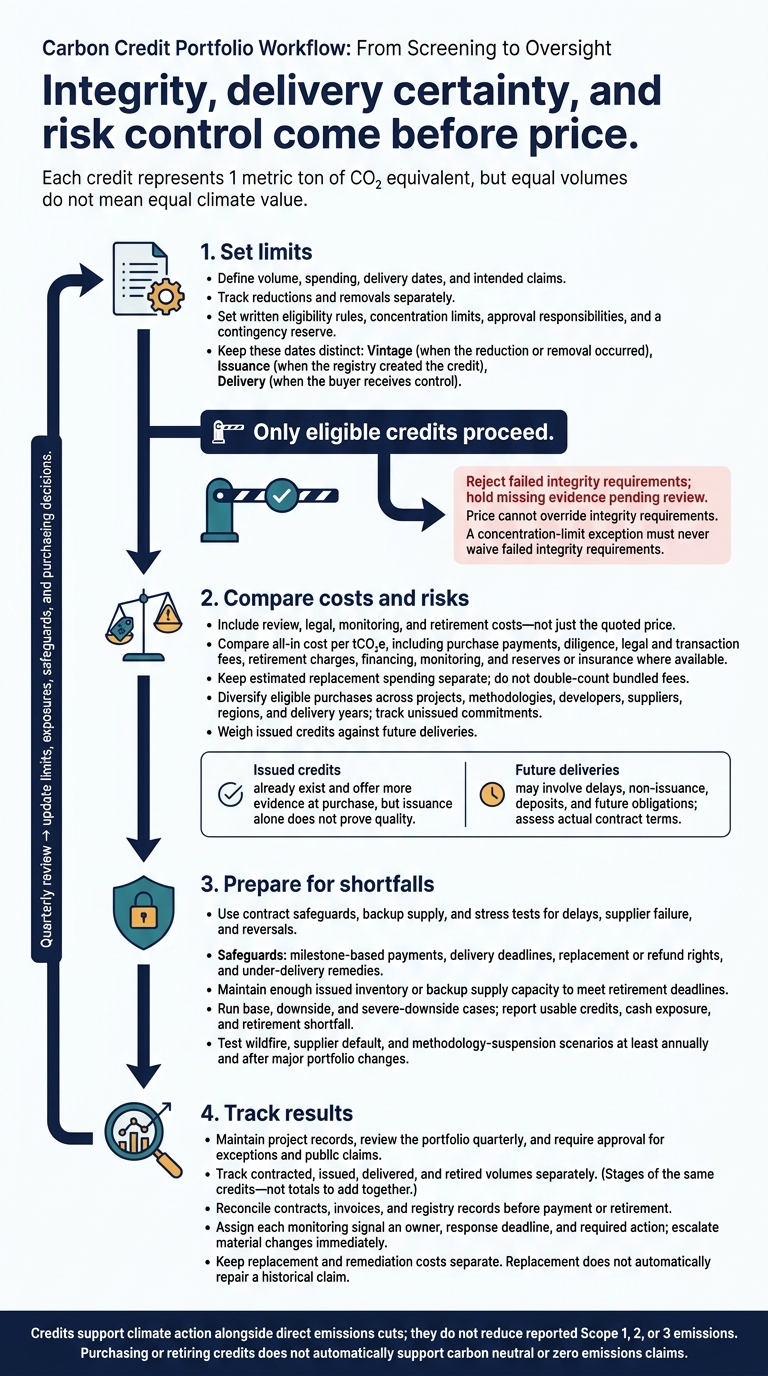
Carbon Credit Portfolio: A Four-Step Buying Process
Set Purchase Goals and Portfolio Limits
Put the integrity rules into a written purchasing policy before buying. The policy should translate eligibility requirements into spending, delivery, and claim controls, with approval from finance, sustainability, legal, and executive leadership. For a small organization, one to two pages with a named owner is enough. Assign responsibility for evidence review, spending approval, and claim authorization, and set approval thresholds and a review schedule.
Define Volume, Budget, Delivery, and Claims Needs
Set annual volume targets, annual and multiyear budgets, committed and optional spending, and a contingency reserve. State whether volume follows verified residual emissions or a separate climate-finance goal.
Specify any required split between emission reductions and removals, minimum durability or reversal-protection requirements, geographic and community priorities, acceptable vintages, delivery deadlines, and retirement requirements. Keep three dates separate: vintage is when the reduction or removal occurred; issuance is when the registry created the credit; delivery is when the buyer receives control. These limits help prevent lower prices from coming at the cost of greater delivery or claim risk.
Before buying, define the evidence needed for each intended public claim. Keep project IDs, methodologies, vintages, serial numbers, registry details, retirement dates, and authorization status or corresponding adjustment, where relevant.[4][5]
Purchasing or retiring credits does not automatically support carbon neutral or zero emissions claims. Require legal review of U.S. advertising, consumer-protection, securities, and disclosure rules. The Federal Trade Commission’s Green Guides also address delayed reductions and avoiding repeated sales of the same reduction.[2][3]
Separate Eligibility Rules From Purchase Preferences
| Rule category | Example requirement | Purchase consequence |
|---|---|---|
| Integrity exclusion | Fails additionality, conservative quantification, leakage controls where relevant, or permanence safeguards | Reject credits that fail; price cannot override the requirement |
| Verification and traceability exclusion | Missing independent verification, registry traceability, clear ownership, or double-issuance and double-claiming controls | Hold pending evidence; reject confirmed failures |
| Community safeguard exclusion | Documented community protections and no unresolved community rights concerns | Suspend or reject pending resolution |
| Preferred attributes | Evidence-backed biodiversity benefits, Indigenous participation, or geographic alignment | Prioritize only among eligible credits |
| Commercial rule | Approved price ceiling, delivery deadline, acceptable vintage, and retirement documentation | Exclude unsuitable offers or seek an authorized commercial exception |
Limit Concentration and Future Delivery Risk
Apply limits to both spending and credit volume across projects, methodologies, developers, suppliers, regions, delivery years, and unissued commitments. Track project IDs and map suppliers to projects: different sellers may offer the same underlying credits.
Set an internal cap on unissued supply based on the annual target, delivery horizon, and retirement deadlines. Base other caps on the actual purchasing horizon and claims needs. An annual portfolio and a multiyear delivery schedule need different limits.
For forward purchases, require milestone-based payments, delivery deadlines, replacement or refund rights, and remedies for under-delivery or methodology changes. Maintain enough issued inventory or backup supply capacity to meet retirement deadlines.
Document every concentration-limit exception, including its rationale, alternatives, mitigation, approvers, and expiration date. Route it through the named finance, sustainability, legal, and executive leadership roles. A concentration-limit exception must never waive failed integrity requirements.
sbb-itb-8baf5f1
Diversify Eligible Credits and Compare Costs
Once eligibility rules and concentration caps are in place, compare the remaining credits by cost and risk.[8][9]
Spread Purchases Across Project Types, Regions, and Suppliers
Treat project types as risk profiles - not quality ratings. Avoidance and reduction credits need checks on baselines, additionality, leakage, and policy. Nature-based removals face wildfire, drought, pest, land-use, and reversal risks. Engineered removals may store carbon longer, but carry technology, energy, cost, and delivery risks. Record each exposure by volume and portfolio share.
Diversification aims to reduce concentration risk at an acceptable total cost, not simply secure a lower price.
| Dimension | Risk addressed | Trade-off | Monitoring signal |
|---|---|---|---|
| Project type and methodology | Dependence on one technology, methodology, or climate pathway | Differences in measurement and durability make comparisons harder | Methodology revisions, performance data, verification findings |
| Region or host country | Local climate hazards, political disruption, and regulatory change | Geographic spread adds legal, social, environmental, and oversight costs | Policy changes, permits, land-rights disputes, wildfire or drought alerts |
| Supplier or developer | Operational failure and counterparty dependence | More contracts, data formats, and relationships to manage | Financial condition, delivery history, audit findings, staffing changes |
| Delivery year | Dependence on one issuance window or market condition | More forecasting and inventory management | Milestone progress, issuance delays, retirement needs |
| Shared exposures | Portfolio-wide losses from wildfire, drought, regulation, or baseline errors | Diversification may create false confidence | Correlated disruptions, common dependencies, portfolio stress tests |
These exposures also help determine how much to rely on issued credits versus future delivery.
Balance Issued Credits and Future Deliveries
Compare contract obligations, not labels. A long-term offtake can also be a staged forward purchase. Issued credits offer more evidence at purchase, but issuance alone does not prove quality.[8][9][10]
Choose a mix that fits delivery certainty, capital exposure, and claim timing.
| Purchase form | Price certainty | Delivery confidence | Quality visibility | Capital exposure | Flexibility | Replacement risk |
|---|---|---|---|---|---|---|
| Issued credits | Usually high at purchase; no future price exposure for acquired units | Highest because credits already exist | Strongest because project and credit records are available | Usually immediate payment | High if credits are transferable and suitable | Lower, though unsuitable or later-disputed credits may still create claims risk |
| Forward contract | Often fixed or formula-based | Lower; credits may be delayed, reduced, or never issued | Medium to low until issuance | May require deposits or staged payments | Lower than spot purchases because terms are precommitted | Material; depends on contract remedies and counterparty strength |
| Long-term offtake | May be fixed, indexed, or negotiated over time | Depends on project and counterparty bankability | Lower at signing for early-stage projects; improves as evidence builds | Can create large future obligations | Low to medium; termination may be costly | Medium to high over a long delivery period |
| Early-stage commitment | May secure a lower or negotiated price | Lowest because development and financing are incomplete | Lowest initially | High development and counterparty exposure | Low unless milestones and exit rights are strong | High |
Stage payments to match cash exposure to evidence: permitting and design, independent validation, verified monitoring, then issuance and transfer. Set annual delivery milestones. Specify which replacements qualify, when they must arrive, and who pays any price difference.
A replacement promise depends on the counterparty’s ability to deliver. Before relying on it, assess financial strength, guarantees, reserves, and delivery history.[6][7]
Calculate Total Costs and Assess Remaining Risks
Calculate all-in cost per tCO2e, including purchase payments, diligence, legal and transaction fees, retirement charges, financing, monitoring, and reserves or insurance where available. Keep estimated replacement spending separate. Don’t count bundled fees twice or treat a buffer contribution as guaranteed coverage.
Compare portfolios by usable credits, not quoted volume. Run base, downside, and severe-downside ranges covering delivery volume and timing, durability, counterparty failure, replacement prices, and suitability for claims. For each case, report usable credits, cash exposure, and any retirement shortfall.
| Trade-off | Compare | Approval question |
|---|---|---|
| Affordability versus durability | Near-term budget savings against storage duration and reversal exposure | Does durability match the intended claim? Lower cost does not make shorter storage equivalent. |
| Supply security versus flexibility | Contracted future access against freedom to change purchases | What happens if required volume falls or delivery fails? |
| Immediate availability versus future capacity | Issued inventory against development commitments | Can the buyer absorb delays and replacement costs without missing its deadline? |
| Price versus demonstrated value | Quoted price against project-level evidence | Does the evidence support the price? Price alone proves nothing about climate value. |
Use these cost and risk assumptions to set monitoring signals and action triggers.
Check Purchases and Monitor Portfolio Performance
Once the portfolio is active, shift from selection to oversight. Check whether it still meets the cost, delivery, and claim assumptions behind the original purchases.
Assign owners across procurement, sustainability, legal, finance, and risk for quarterly portfolio reviews and exception decisions. Escalate material changes immediately. Track contracted, issued, delivered, and retired volumes separately: these are stages of the same credits, not totals to add together. Link each retirement record to its beneficiary, reporting period, and intended claim.[1][11]
Document Project and Supplier Due Diligence
Keep a dated evidence file for each project and supplier. Include the design document, methodology version, validation and verification reports, monitoring reports, registry records, serial numbers, ownership history, retirement instructions, supplier disclosures, financials, and independent assessments. Review this evidence to confirm that the earlier eligibility rules still hold.
Before payment or retirement, reconcile the contract, invoice, and registry record. Confirm issuance, serial numbers, the current account holder, ownership, transfer rights, and contractual duties. These checks support portfolio oversight, claim integrity, and replacement decisions. Verification is evidence, not a guarantee of climate outcomes or suitability for a claim.[1][12][13]
Define Monitoring Signals and Action Triggers
Give each signal an owner, a response deadline, and a required action. Monitor issuance delays, reversals, methodology and registry changes, retirement confirmations, supplier financial health, missed contract milestones, and unresolved community grievances. Check whether shifts in supplier, delivery, or methodology exposure breach portfolio limits or increase concentration risk.
Pause new purchases if a project is suspended or ownership is unclear. Repeated delays, methodology changes, or supplier distress should trigger reduced exposure or replacement planning. Require executive approval for exceptions, and record both the decision and the resolution date.[1][13]
Test wildfire, supplier default, and methodology-suspension scenarios at least annually and after major portfolio changes. Assess the credits and dollars at risk, replacement lead times, and effects on claims.[1][11]
If a retired credit is later challenged, reversed, or found unsuitable, treat remediation as a separate decision - not an automatic fix to the original claim. Decide how to remediate, address claims, communicate with stakeholders, and adjust future allocations. Do not silently substitute credits or assume that replacement repairs a historical claim.[4][11]
Link Procurement to Sustainability Governance
Have the sustainability committee approve portfolio limits, escalation thresholds, and claims language alongside the company’s direct emissions-reduction plan. Use stakeholder input to guide project selection, risk tolerance, and claim language.[11]
Conclusion: Follow a Repeatable Portfolio Process
After purchase, keep portfolio management repeatable, measurable, and auditable. Use the scorecard to keep purchase rules, exposure limits, and delivery dates visible for every holding, then track cost, delivery, and risk against those rules. Integrity, delivery certainty, and risk control come before price. Apply diversification only after a holding meets eligibility requirements.
Keep a Portfolio Scorecard
Give each holding or contract one row in the portfolio scorecard so reviewers can check it at a glance. Include these fields:
| Field | What to record |
|---|---|
| Credit type and methodology | Removal or reduction; methodology name and version |
| Location | Country, state or province, and project site |
| Developer and supplier | Legal names and counterparty roles |
| Vintage and durability | Reduction or removal year; storage period and reversal protections |
| Status | Issued, contracted, or expected delivery date |
| Verification | Verification body, date, scope, and unresolved findings |
| Registry and retirement | Registry, serial numbers, transfer status, retirement date, and beneficiary |
| Unit price | Contract price in U.S. dollars per metric ton of CO₂e |
| Total expected cost | Committed dollars, all-in expected cost per credit, and base and downside cases |
| Spending and volume exposure | Share of committed dollars and contracted metric tons, tracked separately |
| Key risks and mitigations | Unresolved risks; applicable contract protections and controls |
| Owner and next review | Accountable person; review date in MM/DD/YYYY format |
Format dollar entries as $18.50, thousands as $185,000, and exposure percentages as 18.0%. Calculate spending exposure against total committed dollars and volume exposure against total contracted metric tons. Show replacement and remediation costs separately - not buried in an average price.
Before making further commitments, have leadership approve the procurement policy and baseline scorecard. That approval should lock in quality requirements, exposure limits, contract safeguards, decision authority, exception procedures, and review deadlines.
FAQs
How do I set carbon credit portfolio limits?
Set a procurement policy that specifies acceptable standards, methodologies, credit vintage limits, and required co-benefits. Spread purchases across project types and regions rather than defaulting to the cheapest credits, which often carry risks around additionality and permanence.
State which products or facilities the portfolio covers. Put formal monitoring in place to trigger reviews when performance metrics fall short. Publicly share your methodology, portfolio composition, and how credits supplement direct emissions reductions.
How can I spot hidden risks across different projects?
Look beyond price. Check each project’s additionality, permanence, leakage, and quantification methods. Cross-check registry data, marketplace listings, and claims records for duplicate issuance, reuse, or overlapping claims.
Use independent third-party validation, and monitor project performance against your broader portfolio to spot anomalies. Require serial-number tracking and confirmed retirement locks. If data conflicts arise, pause purchases or claims until those conflicts are resolved.
When is paying more for carbon credits justified?
Paying more for carbon credits makes sense when it buys higher quality and integrity. Look for strong additionality, permanence, and verified co-benefits for communities or the environment. Engineered removal credits typically cost more than avoidance credits because they offer greater durability.
Rigorous, third-party verification helps reduce the reputational and financial risks of low-quality credits - those that may fail to deliver real climate impact or face invalidation later.




FAQ