In This Article
Only projects meeting taxpayer, asset, labor, emissions and timing rules qualify for Canada’s Clean Hydrogen ITC—verify before spending.
On this page
- Eligible Taxpayers and Projects
- Canada's Clean Hydrogen Tax Credit - Opportunities and Challenges for Project Development and Finan...
- Eligible Assets, Costs, and Credit Rates
- Carbon-Intensity Modeling and Compliance
- Check Eligibility Before Committing Capital
- Conclusion: Confirm Every Eligibility Requirement
- FAQs
Canada Clean Hydrogen ITC: Project Eligibility Guide
Canada’s Clean Hydrogen ITC offers a refundable credit of up to 40% - but project approval alone does not qualify your spending. Before committing capital, I would check the claimant, production pathway, each asset, emissions estimates, and timing.
As of October 21, 2026, your eligibility review should cover:
Who and what qualifies: Confirm taxpayer status, ownership, Canadian use, and eligible hydrogen or ammonia production.
Costs and rates: Check each asset’s eligible cost, assistance received, shared use, and labor requirements.
Emissions: Expected carbon intensity must stay below 4 kg CO₂e per kg of hydrogen. Actual results can lead to credit recovery.
Timing: Property must be acquired and available for use within the qualifying period. Rates fall by half in 2034, with no credit after that year.
Approval and records: Obtain written NRCan confirmation before claiming, and retain records for CRA review, annual reporting, and possible recapture.
My starting rule is simple: <u>separate the spending decision from the tax claim</u>. NRCan confirmation is not tax clearance, and your records must support both eligibility and later compliance.
Eligible Taxpayers and Projects
Taxpayer, Ownership, and Canadian-Use Rules
Taxpayer status comes first. Ownership and use determine whether a later property claim can qualify.
Under section 127.48 and CRA guidance, the claimant is usually a taxable Canadian corporation. For property held through a partnership, document the agreement, ownership split, cost allocation, and claiming corporation before ordering equipment or starting construction. A project company can claim only for property it owns and uses. Participation in a joint venture does not, by itself, establish entitlement.[8][13][16]
The claimant must show that the property is in Canada and used for the approved project. Keep title documents, invoices, installation records, and commissioning evidence. Confirm that the equipment purchaser, asset owner, and intended claimant align - contracts and invoices alone do not establish eligibility.[3][6][16]
Qualifying Hydrogen and Ammonia Production
Confirm that the production pathway meets the credit rules before assessing individual assets.
Eligible hydrogen pathways include water electrolysis and reforming or partial oxidation of eligible hydrocarbons with carbon capture. NRCan reviews the design, feedstocks, electricity supply, capture performance, production volumes, and emissions assumptions. Eligible hydrocarbons include natural gas, certain substances sourced substantially from raw natural gas, eligible renewable hydrocarbons, and specified by-products identified in federal modeling guidance. Check these assumptions against engineering documents and supply contracts before submitting the project.[1][3][8][14]
For ammonia, demonstrate enough hydrogen-production capacity to meet the ammonia facility’s needs. If the facilities are not co-located, also show that hydrogen transport between them is feasible. Support eligibility with records of capacity, operating hours, transport arrangements, conversion efficiency, storage requirements, and expected losses.[3][13][15]
NRCan confirms the project design; CRA later tests the tax claim.
What NRCan Project Confirmation Covers
NRCan confirmation covers the project pathway - not every claimant, asset, cost, or expense. Before committing capital, assign responsibility for carrying the confirmed project details through to the tax claim.[2][3]
| Review | Evidence needed | Reviewing authority | Claimant’s responsibility |
|---|---|---|---|
| Pathway and expected carbon intensity | Project plan, engineering design, emissions model, and energy-supply evidence | NRCan | Document assumptions and obtain confirmation for each project.[1][2][4] |
| Taxpayer and partnership eligibility | Corporate tax status, ownership records, partnership agreement, and allocations | CRA | Identify the claiming corporation and support the allocation.[8][13][16] |
| Property eligibility and qualifying use | Itemized asset list, title, invoices, location, use, and commissioning records | CRA | Support each asset’s eligibility separately from NRCan confirmation.[3][12][16] |
| Costs attributed to the project | Procurement records, drawings, cost codes, and change orders | CRA, informed by NRCan project details | Trace expenditures to the confirmed scope and exclude unrelated costs.[3][8] |
The next section addresses eligible assets, costs, and credit rates.
sbb-itb-8baf5f1
Canada's Clean Hydrogen Tax Credit - Opportunities and Challenges for Project Development and Finan...
Eligible Assets, Costs, and Credit Rates
Canada Clean Hydrogen ITC Rates and 2034 Phaseout
Once NRCan confirms the pathway, match the project’s assets and costs to the eligibility rules.
Create an Eligible Property Register
Build an asset-level register tied to NRCan’s required property list.[12] For each item, record its category, function, owner, supplier, acquisition date, capital cost, allocation method, and available-for-use date. Keep electrolyzers, rectifiers, reformers, purification systems, clean-ammonia equipment, shared utilities, and direct project-support equipment separate.[3][5][11] Use this register to select rates, allocate costs, and support the filing.
Assess carbon-capture equipment separately under the Clean Hydrogen ITC and CCUS ITC rules. Exclude property in CCA classes 57 and 58 from the hydrogen credit.[3][11]
Confirm that each asset meets the new-property rules. Exclude previously used assets and assets acquired for use or lease. Flag land, buildings, operating expenses, financing costs, and unrelated infrastructure for review rather than automatically including them. Also exclude off-site hydrogen or ammonia transport equipment and equipment that prepares hydrogen for transport, including liquefaction and transport-pressure compression. Screen structured financing and ownership arrangements under section 143.2 before accepting the cost.[3][7]
With the register in place, match each item to its available-for-use date and credit rate.
Credit Rates and the 2034 Phaseout
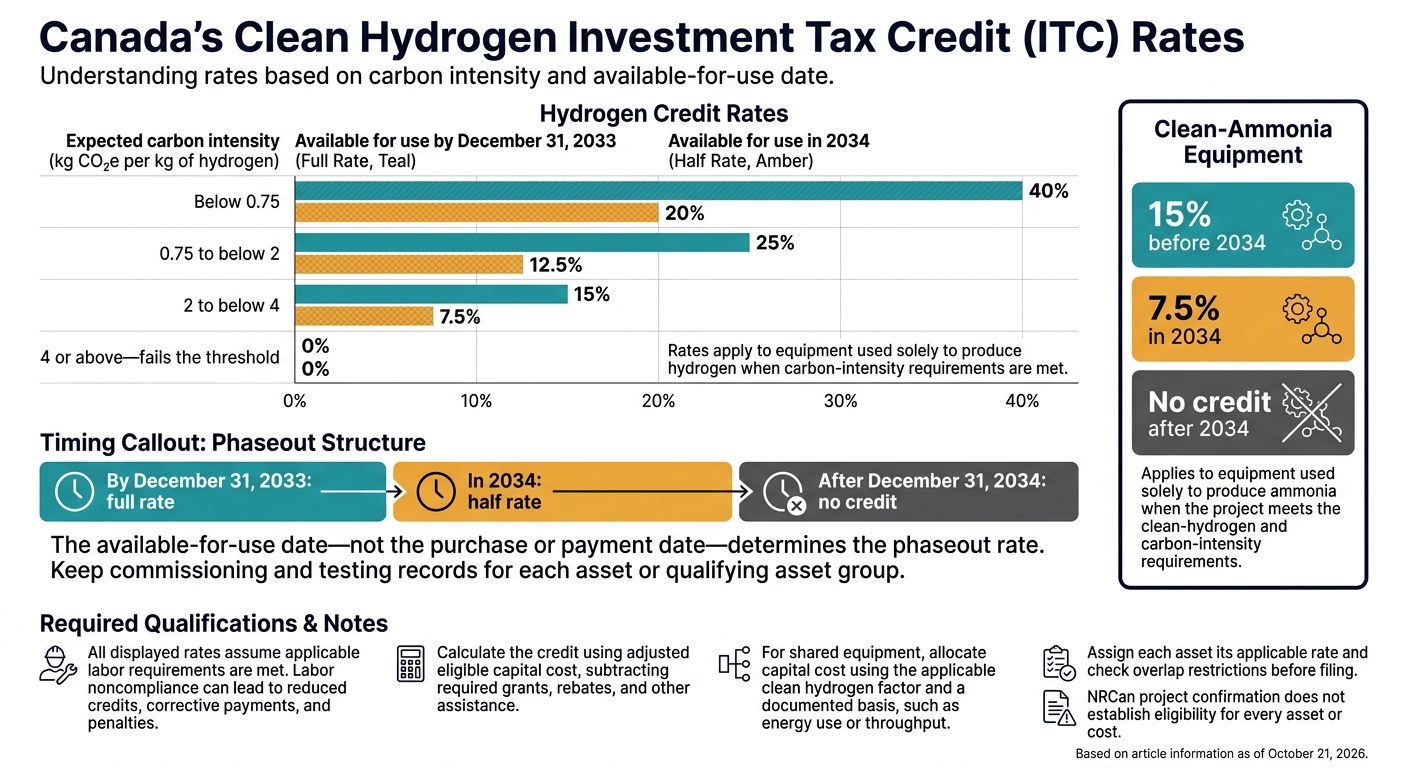
The available-for-use date - not the purchase or payment date - determines the phaseout rate. Property available for use by December 31, 2033, receives the full rate. Property available for use in 2034 receives half that rate, while property available after December 31, 2034, receives no credit. Keep commissioning and testing records for each asset or qualifying asset group.[10]
| Expected carbon intensity (kg CO₂e per kg of hydrogen) | Rate before 2034 | Rate in 2034 |
|---|---|---|
| Below 0.75 | 40% | 20% |
| 0.75 to below 2 | 25% | 12.5% |
| 2 to below 4 | 15% | 7.5% |
| 4 or above - fails the threshold | 0% | 0% |
Labor Rules and Cost Adjustments
Labor compliance affects the credit rate, so include it in the cost calculation rather than treating it as a separate checklist. The table assumes applicable labor requirements are met. Clean-ammonia equipment receives 15% before 2034 or 7.5% in 2034 when it is used solely to produce ammonia and the project meets the clean-hydrogen and carbon-intensity requirements.[9][18]
Use CRA labor guidance to establish the election, prevailing-wage requirements, and apprenticeship-hour requirements before issuing major construction contracts.[10][19] Keep payroll records, contractor certifications, and apprenticeship records. Noncompliance can lead to reduced credits, corrective payments, and penalties - each a separate consequence.[10][19]
Calculate the credit using adjusted eligible capital cost after subtracting required grants, rebates, and other assistance. For shared equipment, allocate capital cost using the applicable clean hydrogen factor and a documented basis, such as energy use or throughput. Assign each asset its credit rate and check overlap restrictions before filing.[3][5][11]
The next section tests the emissions assumptions that determine the rate and recapture risk.
Carbon-Intensity Modeling and Compliance
Once the project path is confirmed, test whether the modeled carbon intensity supports the credit rate and can withstand compliance review.
Check Design and Emissions Assumptions
Turn the FEED study into a documented carbon-intensity (CI) model using the federal methodology. Calculate expected CI on a cradle-to-gate basis, measured in kg CO₂e per kg of hydrogen.[20][2][5][23] Before committing capital, check that the model aligns with Environment and Climate Change Canada’s Fuel Life Cycle Assessment Model and the federal Carbon Intensity Modelling Guidance for the Clean Hydrogen ITC.[20][2]
Model the assumptions for feedstock, electricity, thermal energy, transport, output, and capture. Keep the model version, input files, source evidence, and calculations in the CH-ITC Workbook’s “Side Calculations” worksheet.
Have an independent validator review the model and its supporting evidence. Confirm independence and insurance attestations, technical qualifications, and any training and participation requirements that apply to validator staff.[20] Freeze the validated assumptions before procurement, construction, or contract execution. Require cross-functional approval for material changes.
| Assumption at risk | Supporting evidence | Potentially affected tier | Compliance exposure |
|---|---|---|---|
| Electricity use matches the modeled supply | Supply contracts, generation attributes, metering plans, model inputs | Any tier, depending on electricity emissions | Higher actual CI and recovery risk |
| Capture and storage perform as designed | Equipment guarantees, energy balances, storage agreements, monitoring plans | Any tier relying on captured emissions | Higher residual emissions and recovery exposure |
| Feedstock remains within modeled specifications | Supplier certificates, laboratory results, purchase records | Any tier affected by upstream emissions | Revised assumptions and higher actual CI |
| Hydrogen output and efficiency match FEED estimates | Production meters, commissioning tests, maintenance records | Any tier near a CI boundary | More emissions per kilogram produced |
Reporting, Credit Recovery, and Recapture
Validated assumptions do not lock in the credit. Actual operating data determines the compliance outcome. Calculate actual CI annually using actual inputs, emissions, and output.[22][8]
The compliance period usually starts 120 days after first hydrogen production and ends on the last day of year 5. Shutdown rules can extend it.[7][17] File reports with CRA and NRCan within 180 days after each operating year, including actual CI and kilograms produced. Use each annual filing to compare results with the original model before the next operating year closes. The fifth-year submission must include independent verification covering every compliance year.[21]
At the end of the compliance period, compare average actual CI with the most recent expected CI used to determine the credit.[21] If the difference is 0.5 kg CO₂e per kg of hydrogen or less, the recovery amount is zero.[25]
CI recovery and asset-level recapture are separate risks. Dispositions, exports, or non-eligible use can trigger asset-level recapture during the 20-year recapture period.[17][21]
Before production, assign clear responsibilities: engineering owns design assumptions; environmental staff handle CI data and model updates; operations staff manage meters and deviation logs; tax staff handle filings and recovery calculations; and legal staff oversee contracts and evidence retention. Require monthly or quarterly data reconciliation, plus tax review before changes to feedstocks, power supply, capture systems, ownership, or asset use proceed.[21]
Check Eligibility Before Committing Capital
Capital approval and claim eligibility are separate decisions. NRCan project confirmation is required before claiming the credit - not before every expenditure.[2][1]
Apply the rules above to determine which spending can proceed before confirmation and which commitments must wait.
Prepare the NRCan Project Submission
Finalize the claimant, ownership chain, Canadian site, and project boundary before submitting. Complete NRCan intake, including any applicable pre-screening, and match equipment to the eligible-property rules. If the facilities are separate, include ammonia transport assumptions in the submission.[2][1][3]
Complete FEED or an equivalent study, validate the carbon-intensity model, and assemble the submission. Keep one project baseline file that links engineering documents, ownership evidence, costs, and the model. Include an itemized Class 3 cost assessment, a Level 3 schedule, and the current NRCan property list.[2][12]
Confirmation applies to the submitted design. Review material changes to power supply, capacity, ownership, project boundaries, or ammonia integration. Update modeling and validation as needed, and ask NRCan whether changes require a revised plan. Submit applicable final-design documents through the portal. NRCan may refuse confirmation if requested information remains outstanding for 180 days after its request.[4][5]
Set Evidence Requirements and Spending Gates
Apply these gates before entering term sheets, issuing purchase orders, or signing EPC contracts.
| Stage | Evidence required | Spending or claim gate |
|---|---|---|
| Before procurement | Claimant/ownership chart; Canadian location/use analysis; pathway memo; boundary drawings; preliminary property register; FEED scope; carbon-intensity assumptions; expected credit tier; procurement and construction schedule | Approve, defer, or reject. Use a risk memo to document permitted early spending, commitments that must wait, unresolved eligibility, termination rights, and potential losses. |
| Before submission | FEED or equivalent study; energy and material balances; Class 3 cost assessment; equipment list; carbon-intensity workbook; independent validation report; feedstock and electricity evidence; ammonia boundary analysis, if applicable | Submit only when all documents agree. |
| During construction | POs, invoices, contracts, delivery records, serial numbers, change orders, labor records, commissioning records, and as-built drawings | Support capital cost, new-property, labor, and design compliance. |
| At commissioning | Commissioning certificates, operational tests, acceptance records, available-for-use dates, final asset register, and final design comparison | Determine the claim year and eligible cost base. |
| During claim and operations | Tax schedules, allocation calculations, NRCan correspondence, annual reports, emissions and production data, power records, operating procedures, and compliance certifications | Support the tax return and continuing obligations. |
| If scope changes | Revised drawings and model, validation update, engineering approval, NRCan notice or revised confirmation, and change-impact memo | Determine whether procurement or claiming can continue. |
Go/no-go checklist: Give every unresolved item an accountable owner, a required decision, and a resolution deadline. Block the affected procurement, financing, contracting, or filing decision until the owner closes the item.
| Condition | Accountable owner | Required decision |
|---|---|---|
| Claimant/ownership | Tax director | Proceed, restructure, or stop |
| Canadian location/use | Legal or tax counsel | Approved or unresolved |
| Production pathway | Process engineer and tax counsel | Supported or redesign required |
| Property register | Engineering and tax teams | Eligible, partially eligible, or excluded |
| Credit tier | Carbon-modeling lead | Supported tier or investment case revised |
| FEED and validation | Engineering manager | Submission-ready or remediate |
| NRCan submission | Project counsel | Submit or hold |
| NRCan confirmation | Tax director | Claim permitted or prohibited |
| Available-for-use date | Controller and commissioning manager | Claim year confirmed or evidence incomplete |
| Labor rules | Procurement and compliance leads | Full rate, reduced rate, or unresolved |
| Tax filings | Tax compliance lead | Controls assigned or escalation required |
| Operations controls | Operations and emissions teams | Operating controls live or spending restricted |
Conclusion: Confirm Every Eligibility Requirement
Every eligibility requirement must be met: the taxpayer, project, assets, carbon-intensity model, timing, and labor treatment must all qualify.[10][5][1]
Before committing capital, bring tax, engineering, and implementation teams together for a single, documented go/no-go decision. NRCan confirmation is not tax clearance.[1][4]
FAQs
Can my U.S.-owned Canadian subsidiary claim the credit?
Yes - but both conditions must be met: your subsidiary must be subject to U.S. tax jurisdiction, and the qualifying production facility and activities must be located and operated in the United States or its territories. If either condition is not met, the “U.S. nexus” requirement prevents eligibility. [1]
How can I protect spending before NRCan confirmation?
Use a go/no-go eligibility checklist before releasing funds. First, confirm on a preliminary basis that lifecycle emissions can meet the <4 kg CO2e/kg H2 threshold, prevailing wage and registered apprenticeship requirements can be met, and metering, process, and feedstock records are ready for verification models.
Align documentation of ownership and the placed-in-service date. Set milestones for emissions and data validation, along with required IRS pre-filing registration, to help avoid pauses or revisions after funds have been spent. [1]
Can I combine this credit with other project incentives?
Yes, but check the rules before combining incentives. Review stacking rules, restrictions on claiming the same costs twice, allowed matching funds, tax-basis effects, and monetization rules [1].
For grants, confirm whether tax-credit revenue can count toward cost-share requirements [1]. When combining credits with DOE funding or Section 45Q, coordinate project design and reporting early to meet lifecycle emissions, labor, and verification requirements [1][2].

FAQ