
Jun 24, 2026
How to Build Cross-Sector Partnerships That Drive Systems Change for NGOs & Nonprofits
Capacity Building
In This Article
Map the system, recruit high-leverage partners, set governance and data rules, run a 90-day pilot, and measure system-level change.
How to Build Cross-Sector Partnerships That Drive Systems Change for NGOs & Nonprofits
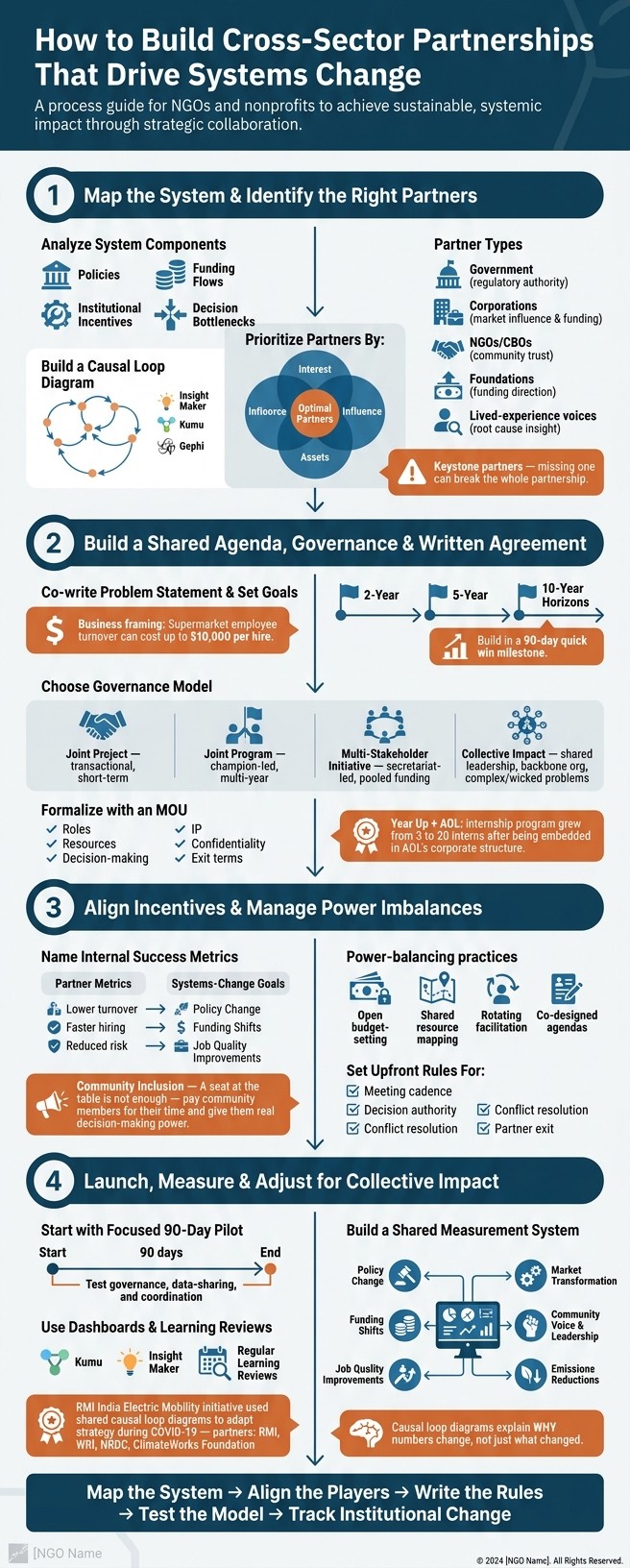
Systems change usually fails when partnerships stay informal, vague, or off-balance. From what I see in this article, the fix is clear: map the system first, bring in the few partners who can shift policy, funding, and institutional behavior, then lock in shared goals, decision rules, and measurement.
If I had to boil the full piece down, I’d say this:
Don’t start with outreach. Start by mapping policies, money flows, bottlenecks, and decision-makers.
Choose partners by leverage, not convenience. Look at influence, incentives, assets, and community trust.
Set rules early. Write down roles, data-sharing terms, governance, and exit steps in an MOU.
Keep power from pooling at the top. Use shared leadership, open budget-setting, and paid community participation.
Test the partnership in a 90-day pilot. Early wins build trust while exposing weak spots in coordination.
Measure system shifts, not just activity. Track changes in policy, budgets, job quality, market behavior, and community voice.
A few examples make the point. Year Up’s work with AOL grew from 3 interns to 20 after the program was built into AOL’s internal systems. Brookings reviewed 11 U.S. regional coalitions that blended public and philanthropic capital to improve local job markets. And one business fact stands out: supermarket turnover can cost up to $10,000 per employee, which helps explain why employers may join workforce partnerships when the case is framed in business terms.
What I like here is the article’s core message: systems change is not about adding more partners. It’s about getting the right partners, giving them a shared target, and making sure the work can survive staff turnover, politics, and funding shifts.
In short, I’d frame the article this way: map the system, align the players, write the rules, test the model, and track whether institutions change how they act.
How to Build Cross-Sector Partnerships That Drive Systems Change
Building Coalitions and Cross-Sector Partnerships
1. Map the system and identify the right partners
Before you start outreach, map the system first. The goal is to recruit partners based on leverage, not just who happens to be available. From there, you can see which actors can actually shift the system.
Analyze the problem, the system, and the leverage points
Cross-sector partnerships work best when the problem is complex and connected to policy, funding, and behavior loops.
Once you've confirmed that's the kind of problem you're dealing with, map the system around it. Track the policies, funding flows, institutional incentives, and decision bottlenecks that keep the issue in place. A causal loop diagram helps you see feedback loops and spot leverage points. Free tools like Insight Maker make it possible to build these diagrams without a technical background. Kumu is another option for actor maps and network visualizations [3].
Keep the map updated as conditions change. Treat it like a living document, not a one-time exercise. Assign one owner to update it as politics, funding, and evidence shift [3].
Prioritize partners by influence, incentives, and community trust
Not every stakeholder should get the same amount of attention. Prioritize partners using three criteria: interest, influence, and assets [2].
Look at the power they hold, the resources they control, and the trust they carry in the community. Government agencies bring regulatory authority, but they may have limited on-the-ground capacity. Corporations can bring market influence and funding power. NGOs and community-based organizations often hold the community trust that makes implementation possible. That trust isn't a side issue; in many cases, it's the difference between a plan that moves and one that stalls. Foundations shape direction through funding. People with lived experience often bring the clearest view of root causes [2].
Pay close attention to keystone partners. If one of these actors is missing, the partnership may not work. Often that means organizations with policy authority or major funding power. Still, don't miss the role of community-based organizations. They carry the trust that government agencies and corporations often need to follow through [2].
With the right partners in view, the next step is to line them up around a shared agenda and a clear decision structure.
Use stakeholder mapping tools to avoid tokenism
Stakeholder mapping only helps avoid tokenism if the people most affected by the problem are included before strategy decisions are made and before partner roles are assigned. A participatory mapping process brings frontline communities and people with lived experience into the room early. That's not just about equity. It's also practical, because these voices often spot root causes that institutional partners miss [3].
Use actor mapping to show who is connected. Then use social network analysis to find decision-makers and bottlenecks. Tools like Gephi and Socilyzer can support this work [3].
The NextWave Plastics coalition shows what this can look like in practice. Lonely Whale brought together companies including Dell Technologies, HP Inc., and IKEA and used mapping to identify that competitors could work together on ocean-bound plastic supply chains when a trusted civil society organization held the space [3].
Before moving ahead, do one more check: map your internal stakeholders too. Board members, program staff, and leadership need to be aligned before you commit to an external partnership. Internal alignment helps prevent delays once the work moves into governance and shared measurement [2].
Once the network is mapped, move to shared goals and governance.
2. Build a shared agenda, governance structure, and written agreement
A partner map is a start, not a plan. To move from interest to action, the group needs a shared agenda, a clear way to make decisions, and a written agreement. Without those pieces, many collaborations lose steam before anyone commits. The map should help turn early conversations into firm choices about roles, rules, and next steps.
Create a common agenda with measurable outcomes
Co-write the problem statement with partners rather than sending around a finished version. Bring people into the room and define the problem together, along with what success should look like over 2, 5, and 10 years. That keeps the work aimed at shifting policy, funding, or institutional behavior instead of drifting into a short-term project [2].
Goals tend to stick when they link mission impact to each sector’s day-to-day interests. A workforce development nonprofit, for instance, can shape its agenda around a hard business fact: employee turnover in the supermarket industry can cost up to $10,000 per employee. That makes a talent pipeline a cost-reduction move, not just a social good. The tone matters too. Speak to partners as peers, not petitioners, and bring answers to business, policy, or operating problems [1]. For government partners, the framing changes. The focus is less on margin and more on policy alignment and public accountability.
It also helps to build in a 90-day quick win. Pick one concrete activity the partnership can finish early. That early result builds trust, shows momentum, and keeps people at the table while the longer-term systems-change goals are still being worked out [2].
Choose a governance model that fits the work
Use the lightest governance model that still matches the problem’s complexity and the pace of decision-making. If the issue cuts across sectors and needs many moving parts to line up, the governance model has to support that. The table below shows four common models [2]:
Governance Model | Decision-Making Style | Accountability | Best Use Case |
|---|---|---|---|
Joint Project | Transactional | Partner-to-partner | Short-term, geographically bounded problems |
Joint Program | Champion-led | Centralized coordinator | Multi-workstream efforts over several years |
Multi-Stakeholder Initiative | Secretariat-led | Formal reporting to funders | Large-scale problems requiring pooled funding |
Collective Impact | Shared leadership via a backbone organization | Shared measurement systems | Complex "wicked" problems requiring action at local, national, and international levels |
A good example is the TV White Space Partnership, a joint project between Microsoft, the Government of the Philippines, and USAID, facilitated by Resonance. The governance model stayed fairly simple because the problem was limited by geography and time [2].
Formalize the partnership with an MOU and rules for external and public data sharing
Put the agreement in writing so it can survive staff turnover and funding changes. At a minimum, the MOU should spell out the shared purpose and scope, each partner’s roles and resource commitments, the decision-making process, governance and decision-making structures, reporting requirements, intellectual property ownership, confidentiality, and exit terms [2].
Set data ownership and rules for external and public data sharing at the start, not later [2]. Just as important, document who holds which role and make sure the partnership belongs to the organization, not just to one person. Year Up’s partnership with AOL shows why this matters. When the internship program was built into AOL’s corporate structure instead of hinging on a single champion, it kept going even after CTO Balan Nair left the company. The program then grew from 3 to 20 interns [1].
With roles and rules in place, the next step is to line up incentives and power.
3. Align incentives and manage power imbalances
Paper agreements don’t keep partnerships together. Shared incentives and a fair balance of power do. Each partner needs a clear reason to stay in the work. At the system level, those incentives shape whether institutions change how they act or just attach their name to another project. And if power stays in a few hands, the partnership may deliver services without changing the system.
Match each partner's incentives to the systems-change goal
Every partner comes in with a different idea of success. Donors and agencies may care most about process and program targets, while corporate partners often look at quarterly earnings and the business case [2]. If those motives stay under the surface, they can pull the work in different directions.
The better move is to name those motives early. Map what each partner needs to justify the work inside their own organization, then link that case to the systems-change goal. Maybe that means lower turnover, faster hiring, or less risk. The point is to connect those internal drivers to shifts in policy, budgets, or day-to-day operating behavior. Companies under pressure or in growth mode tend to be more open to partnership than stable ones [1].
Reduce power gaps through shared leadership and fair resourcing
Funding gaps often become influence gaps. When one partner controls the budget, they usually shape the agenda too, even if no one says it out loud. A few simple practices can help keep that from happening:
Use open budget-setting
Map resources together
Rotate facilitation
Co-design agendas so all partners can add items before each session [2][4]
Community and grassroots organizations need extra care here. A seat at the table is not enough. They need clear decision-making power, and community members should be paid for their time [5]. Shared leadership works best when the people closest to the problem can actually shape what happens.
Set decision, communication, and exit rules before conflict starts
Most partnerships don’t fall apart because of one dramatic blowup. They wear down quietly - people working in silos, talking past each other, or making side decisions before everyone has been heard [5]. It’s much easier to set ground rules early than to patch trust later.
Agree up front on meeting cadence, who can make which decisions, how concerns get raised, and what happens if a partner wants to leave. Common power risks and practical fixes include the following:
Power Challenge | Description | Mitigation Strategy |
|---|---|---|
Budget Control | Lead funders often dominate the agenda and decision-making. | Use transparent, shared budget-setting processes and shared resource mapping [2] [4]. |
Data Ownership | Partners who control data can shape what gets measured and what stays invisible. | Establish clear data-sharing and IP rules in a formal MOU to prevent any one partner from setting the terms [2]. |
Agenda-Setting | Powerful partners may prioritize their own KPIs over the systemic mission. | Co-create a shared vision of success and use rotating facilitation for meetings [2]. |
Representation | Grassroots or community voices are often tokenized or excluded. | Implement compensated community participation and shared leadership models [5]. |
Internal approval barriers | Legal or HR gatekeepers can stall partnership progress. | Bring legal, HR, and procurement leads in early. |
Next, test the partnership in a pilot and track whether it changes decisions, funding, or practice.
4. Launch, measure, and adjust for collective impact
With the agenda, governance, and agreements set, it’s time to move from planning into a pilot you can test in the field.
Start with a pilot that can scale
Don’t try to remake the whole system on day one. Start with a focused initiative that lets you test governance, data-sharing, and partner coordination before you expand. A pilot is not just a smaller version of the full program. It’s a live check on whether the partnership can work when real pressure hits.
Use the first 90 days to show the partnership can deliver. Tie the pilot to the governance model you already picked.
The pilot should reveal whether governance can handle real decisions, not just calendar invites and discussion. A strong pilot will surface where coordination, data-sharing, or decision-making starts to crack before you expand the work.
Build a shared measurement system for system-level outcomes
Outputs - people trained, events held, materials distributed - are easy to count, but they don’t show system change. A shared measurement system tracks what is actually shifting: policy, budgets, market behavior, and community voice.
Start by agreeing on a small set of baseline metrics across all partners, with clear data sources and reporting intervals. The table below links common system-level outcomes to practical indicators and likely data sources.
Systems-Level Outcome | Indicator | Likely Data Sources |
|---|---|---|
Policy Change | Number of new regulations or standards aligned with partnership goals | Government records, legislative trackers, advocacy reports |
Funding Shifts | Total capital/investment secured for system-level solutions | Financial reports, public budget documents, grant records |
Emissions Reductions | Metric tons of CO2 equivalent avoided or sequestered | Environmental sensors, supply chain audits, NGO reports |
Job Quality Improvements | Changes in median wage, benefit access, or safety incidents | Labor statistics, corporate HR audits, workforce surveys |
Community Voice | Participation and leadership rates of marginalized groups in governance | Meeting minutes, stakeholder surveys, attendance logs |
Market Transformation | Percentage of industry actors adopting sustainable or circular models | Industry surveys, market assessment databases |
Assign at least one staff member with a dedicated role for tracking these metrics [3]. If no one owns the job, performance data usually gets buried under daily operations.
That baseline becomes the input for every learning review.
Use dashboards and learning reviews to improve the partnership
Data only changes anything if partners look at it together. Build a simple shared dashboard using Kumu for actor relationships or Insight Maker for causal loops [3]. The point is to give everyone a shared view of what’s moving and what’s stuck.
Pair the dashboard with regular learning reviews that explain why the numbers changed. Causal loop diagrams help a lot here because they let partners see the forces driving results, not just the visible symptoms [3].
Use review sessions to spot bottlenecks, rebalance roles, and adjust the work. Each review should lead to a plain decision about what to keep, change, or stop before expanding further.
Conclusion: The steps that turn partnerships into systems change
Systems change takes shape when partners map the system, agree on the leverage points that matter most, and put structures in place that can last beyond any one project. That kind of discipline matters because systems don’t stand still. They shift, and partnership strategy has to shift with them.
RMI's India Electric Mobility initiative offers a clear example of how this can work in practice. Cross-sector partners used a shared causal loop diagram to spot barriers, test assumptions, and adjust their strategy as conditions changed. RMI, WRI, NRDC, and ClimateWorks Foundation relied on that shared tool to surface system-level barriers and revise their approach during COVID-19. [3]
As the work gets more complex, the mindset has to move from organization-first to system-first. Quick wins help. They build momentum and show people that progress is possible. But long-term change comes from changing relationships, incentives, and power over time.
Those are the conditions that help a collaboration grow into lasting systems change. Start small, stay disciplined, and keep the community at the center so the partnership can outlast any single leader.
FAQs
How do I know if a problem needs a cross-sector partnership?
A cross-sector partnership makes the most sense when the problem is messy, layered, and too big for any one organization to handle on its own. That’s often the case when social, economic, and environmental forces are tied together and call for an all-of-society response.
Start by getting clear on the problem itself. Then confirm that other organizations not only face the same challenge, but also have a genuine reason to work on it. These partnerships take time, attention, and steady coordination, so they’re usually a better fit for systemic issues than for one-off projects.
What should I include in a partnership MOU?
A Memorandum of Understanding should lay out a clear, nonbinding framework for the partnership. It should spell out the shared vision, the outcomes both sides want, each party’s roles and responsibilities, specific contributions, shared goals, and the project timeline.
It should also explain how decisions will be made, whether delegates may take part, what meetings are expected to look like, and how the MOU will be reviewed and updated over time.
How can we tell if the partnership is changing the system?
Look past one-off project results. Bring systems thinking into your evaluation with systems mapping that shows the people involved, the links between them, and the feedback loops that shape what happens. Then track how that system shifts over time.
Use collective impact metrics tied to a shared agenda as well. That gives you a clearer view of whether the partnership is getting at root causes, changing the conditions that keep problems stuck in place, and hitting the leverage points that matter most.
Related Blog Posts
Latest Articles
©2025

Narrative Change and Power Building: The Missing Half of Advocacy
Narrative change is the process of disrupting dominant narratives that normalize inequity and advancing new narratives from historically marginalized communities.

Funding Resilience Without Federal Grants
BRIC is unreliable and FEMA is shrinking. Here's how cities fund climate resilience with dedicated revenue, blended finance, and a coordinating authority.

The ESG Blind Spot: How AI Is Finding Risks in Companies Nobody Else Is Watching
Norway's sovereign wealth fund uses AI to screen 7,200 portfolio companies for forced labor and corruption within 24 hours. The real story is the emerging-market coverage gap that traditional ESG data vendors miss — and what it means for any company with a global supply chain.
Narrative Change and Power Building: The Missing Half of Advocacy
Narrative change is the process of disrupting dominant narratives that normalize inequity and advancing new narratives from historically marginalized communities.
Funding Resilience Without Federal Grants
BRIC is unreliable and FEMA is shrinking. Here's how cities fund climate resilience with dedicated revenue, blended finance, and a coordinating authority.
The ESG Blind Spot: How AI Is Finding Risks in Companies Nobody Else Is Watching
Norway's sovereign wealth fund uses AI to screen 7,200 portfolio companies for forced labor and corruption within 24 hours. The real story is the emerging-market coverage gap that traditional ESG data vendors miss — and what it means for any company with a global supply chain.
FAQ
01
What does it really mean to “redefine profit”?
02
What makes Council Fire different?
03
Who does Council Fire work with?
04
What does working with Council Fire actually look like?
05
How does Council Fire help organizations turn big goals into action?
06
How does Council Fire define and measure success?
Jun 24, 2026
How to Build Cross-Sector Partnerships That Drive Systems Change for NGOs & Nonprofits
Capacity Building
In This Article
Map the system, recruit high-leverage partners, set governance and data rules, run a 90-day pilot, and measure system-level change.
How to Build Cross-Sector Partnerships That Drive Systems Change for NGOs & Nonprofits
Systems change usually fails when partnerships stay informal, vague, or off-balance. From what I see in this article, the fix is clear: map the system first, bring in the few partners who can shift policy, funding, and institutional behavior, then lock in shared goals, decision rules, and measurement.
If I had to boil the full piece down, I’d say this:
Don’t start with outreach. Start by mapping policies, money flows, bottlenecks, and decision-makers.
Choose partners by leverage, not convenience. Look at influence, incentives, assets, and community trust.
Set rules early. Write down roles, data-sharing terms, governance, and exit steps in an MOU.
Keep power from pooling at the top. Use shared leadership, open budget-setting, and paid community participation.
Test the partnership in a 90-day pilot. Early wins build trust while exposing weak spots in coordination.
Measure system shifts, not just activity. Track changes in policy, budgets, job quality, market behavior, and community voice.
A few examples make the point. Year Up’s work with AOL grew from 3 interns to 20 after the program was built into AOL’s internal systems. Brookings reviewed 11 U.S. regional coalitions that blended public and philanthropic capital to improve local job markets. And one business fact stands out: supermarket turnover can cost up to $10,000 per employee, which helps explain why employers may join workforce partnerships when the case is framed in business terms.
What I like here is the article’s core message: systems change is not about adding more partners. It’s about getting the right partners, giving them a shared target, and making sure the work can survive staff turnover, politics, and funding shifts.
In short, I’d frame the article this way: map the system, align the players, write the rules, test the model, and track whether institutions change how they act.
How to Build Cross-Sector Partnerships That Drive Systems Change
Building Coalitions and Cross-Sector Partnerships
1. Map the system and identify the right partners
Before you start outreach, map the system first. The goal is to recruit partners based on leverage, not just who happens to be available. From there, you can see which actors can actually shift the system.
Analyze the problem, the system, and the leverage points
Cross-sector partnerships work best when the problem is complex and connected to policy, funding, and behavior loops.
Once you've confirmed that's the kind of problem you're dealing with, map the system around it. Track the policies, funding flows, institutional incentives, and decision bottlenecks that keep the issue in place. A causal loop diagram helps you see feedback loops and spot leverage points. Free tools like Insight Maker make it possible to build these diagrams without a technical background. Kumu is another option for actor maps and network visualizations [3].
Keep the map updated as conditions change. Treat it like a living document, not a one-time exercise. Assign one owner to update it as politics, funding, and evidence shift [3].
Prioritize partners by influence, incentives, and community trust
Not every stakeholder should get the same amount of attention. Prioritize partners using three criteria: interest, influence, and assets [2].
Look at the power they hold, the resources they control, and the trust they carry in the community. Government agencies bring regulatory authority, but they may have limited on-the-ground capacity. Corporations can bring market influence and funding power. NGOs and community-based organizations often hold the community trust that makes implementation possible. That trust isn't a side issue; in many cases, it's the difference between a plan that moves and one that stalls. Foundations shape direction through funding. People with lived experience often bring the clearest view of root causes [2].
Pay close attention to keystone partners. If one of these actors is missing, the partnership may not work. Often that means organizations with policy authority or major funding power. Still, don't miss the role of community-based organizations. They carry the trust that government agencies and corporations often need to follow through [2].
With the right partners in view, the next step is to line them up around a shared agenda and a clear decision structure.
Use stakeholder mapping tools to avoid tokenism
Stakeholder mapping only helps avoid tokenism if the people most affected by the problem are included before strategy decisions are made and before partner roles are assigned. A participatory mapping process brings frontline communities and people with lived experience into the room early. That's not just about equity. It's also practical, because these voices often spot root causes that institutional partners miss [3].
Use actor mapping to show who is connected. Then use social network analysis to find decision-makers and bottlenecks. Tools like Gephi and Socilyzer can support this work [3].
The NextWave Plastics coalition shows what this can look like in practice. Lonely Whale brought together companies including Dell Technologies, HP Inc., and IKEA and used mapping to identify that competitors could work together on ocean-bound plastic supply chains when a trusted civil society organization held the space [3].
Before moving ahead, do one more check: map your internal stakeholders too. Board members, program staff, and leadership need to be aligned before you commit to an external partnership. Internal alignment helps prevent delays once the work moves into governance and shared measurement [2].
Once the network is mapped, move to shared goals and governance.
2. Build a shared agenda, governance structure, and written agreement
A partner map is a start, not a plan. To move from interest to action, the group needs a shared agenda, a clear way to make decisions, and a written agreement. Without those pieces, many collaborations lose steam before anyone commits. The map should help turn early conversations into firm choices about roles, rules, and next steps.
Create a common agenda with measurable outcomes
Co-write the problem statement with partners rather than sending around a finished version. Bring people into the room and define the problem together, along with what success should look like over 2, 5, and 10 years. That keeps the work aimed at shifting policy, funding, or institutional behavior instead of drifting into a short-term project [2].
Goals tend to stick when they link mission impact to each sector’s day-to-day interests. A workforce development nonprofit, for instance, can shape its agenda around a hard business fact: employee turnover in the supermarket industry can cost up to $10,000 per employee. That makes a talent pipeline a cost-reduction move, not just a social good. The tone matters too. Speak to partners as peers, not petitioners, and bring answers to business, policy, or operating problems [1]. For government partners, the framing changes. The focus is less on margin and more on policy alignment and public accountability.
It also helps to build in a 90-day quick win. Pick one concrete activity the partnership can finish early. That early result builds trust, shows momentum, and keeps people at the table while the longer-term systems-change goals are still being worked out [2].
Choose a governance model that fits the work
Use the lightest governance model that still matches the problem’s complexity and the pace of decision-making. If the issue cuts across sectors and needs many moving parts to line up, the governance model has to support that. The table below shows four common models [2]:
Governance Model | Decision-Making Style | Accountability | Best Use Case |
|---|---|---|---|
Joint Project | Transactional | Partner-to-partner | Short-term, geographically bounded problems |
Joint Program | Champion-led | Centralized coordinator | Multi-workstream efforts over several years |
Multi-Stakeholder Initiative | Secretariat-led | Formal reporting to funders | Large-scale problems requiring pooled funding |
Collective Impact | Shared leadership via a backbone organization | Shared measurement systems | Complex "wicked" problems requiring action at local, national, and international levels |
A good example is the TV White Space Partnership, a joint project between Microsoft, the Government of the Philippines, and USAID, facilitated by Resonance. The governance model stayed fairly simple because the problem was limited by geography and time [2].
Formalize the partnership with an MOU and rules for external and public data sharing
Put the agreement in writing so it can survive staff turnover and funding changes. At a minimum, the MOU should spell out the shared purpose and scope, each partner’s roles and resource commitments, the decision-making process, governance and decision-making structures, reporting requirements, intellectual property ownership, confidentiality, and exit terms [2].
Set data ownership and rules for external and public data sharing at the start, not later [2]. Just as important, document who holds which role and make sure the partnership belongs to the organization, not just to one person. Year Up’s partnership with AOL shows why this matters. When the internship program was built into AOL’s corporate structure instead of hinging on a single champion, it kept going even after CTO Balan Nair left the company. The program then grew from 3 to 20 interns [1].
With roles and rules in place, the next step is to line up incentives and power.
3. Align incentives and manage power imbalances
Paper agreements don’t keep partnerships together. Shared incentives and a fair balance of power do. Each partner needs a clear reason to stay in the work. At the system level, those incentives shape whether institutions change how they act or just attach their name to another project. And if power stays in a few hands, the partnership may deliver services without changing the system.
Match each partner's incentives to the systems-change goal
Every partner comes in with a different idea of success. Donors and agencies may care most about process and program targets, while corporate partners often look at quarterly earnings and the business case [2]. If those motives stay under the surface, they can pull the work in different directions.
The better move is to name those motives early. Map what each partner needs to justify the work inside their own organization, then link that case to the systems-change goal. Maybe that means lower turnover, faster hiring, or less risk. The point is to connect those internal drivers to shifts in policy, budgets, or day-to-day operating behavior. Companies under pressure or in growth mode tend to be more open to partnership than stable ones [1].
Reduce power gaps through shared leadership and fair resourcing
Funding gaps often become influence gaps. When one partner controls the budget, they usually shape the agenda too, even if no one says it out loud. A few simple practices can help keep that from happening:
Use open budget-setting
Map resources together
Rotate facilitation
Co-design agendas so all partners can add items before each session [2][4]
Community and grassroots organizations need extra care here. A seat at the table is not enough. They need clear decision-making power, and community members should be paid for their time [5]. Shared leadership works best when the people closest to the problem can actually shape what happens.
Set decision, communication, and exit rules before conflict starts
Most partnerships don’t fall apart because of one dramatic blowup. They wear down quietly - people working in silos, talking past each other, or making side decisions before everyone has been heard [5]. It’s much easier to set ground rules early than to patch trust later.
Agree up front on meeting cadence, who can make which decisions, how concerns get raised, and what happens if a partner wants to leave. Common power risks and practical fixes include the following:
Power Challenge | Description | Mitigation Strategy |
|---|---|---|
Budget Control | Lead funders often dominate the agenda and decision-making. | Use transparent, shared budget-setting processes and shared resource mapping [2] [4]. |
Data Ownership | Partners who control data can shape what gets measured and what stays invisible. | Establish clear data-sharing and IP rules in a formal MOU to prevent any one partner from setting the terms [2]. |
Agenda-Setting | Powerful partners may prioritize their own KPIs over the systemic mission. | Co-create a shared vision of success and use rotating facilitation for meetings [2]. |
Representation | Grassroots or community voices are often tokenized or excluded. | Implement compensated community participation and shared leadership models [5]. |
Internal approval barriers | Legal or HR gatekeepers can stall partnership progress. | Bring legal, HR, and procurement leads in early. |
Next, test the partnership in a pilot and track whether it changes decisions, funding, or practice.
4. Launch, measure, and adjust for collective impact
With the agenda, governance, and agreements set, it’s time to move from planning into a pilot you can test in the field.
Start with a pilot that can scale
Don’t try to remake the whole system on day one. Start with a focused initiative that lets you test governance, data-sharing, and partner coordination before you expand. A pilot is not just a smaller version of the full program. It’s a live check on whether the partnership can work when real pressure hits.
Use the first 90 days to show the partnership can deliver. Tie the pilot to the governance model you already picked.
The pilot should reveal whether governance can handle real decisions, not just calendar invites and discussion. A strong pilot will surface where coordination, data-sharing, or decision-making starts to crack before you expand the work.
Build a shared measurement system for system-level outcomes
Outputs - people trained, events held, materials distributed - are easy to count, but they don’t show system change. A shared measurement system tracks what is actually shifting: policy, budgets, market behavior, and community voice.
Start by agreeing on a small set of baseline metrics across all partners, with clear data sources and reporting intervals. The table below links common system-level outcomes to practical indicators and likely data sources.
Systems-Level Outcome | Indicator | Likely Data Sources |
|---|---|---|
Policy Change | Number of new regulations or standards aligned with partnership goals | Government records, legislative trackers, advocacy reports |
Funding Shifts | Total capital/investment secured for system-level solutions | Financial reports, public budget documents, grant records |
Emissions Reductions | Metric tons of CO2 equivalent avoided or sequestered | Environmental sensors, supply chain audits, NGO reports |
Job Quality Improvements | Changes in median wage, benefit access, or safety incidents | Labor statistics, corporate HR audits, workforce surveys |
Community Voice | Participation and leadership rates of marginalized groups in governance | Meeting minutes, stakeholder surveys, attendance logs |
Market Transformation | Percentage of industry actors adopting sustainable or circular models | Industry surveys, market assessment databases |
Assign at least one staff member with a dedicated role for tracking these metrics [3]. If no one owns the job, performance data usually gets buried under daily operations.
That baseline becomes the input for every learning review.
Use dashboards and learning reviews to improve the partnership
Data only changes anything if partners look at it together. Build a simple shared dashboard using Kumu for actor relationships or Insight Maker for causal loops [3]. The point is to give everyone a shared view of what’s moving and what’s stuck.
Pair the dashboard with regular learning reviews that explain why the numbers changed. Causal loop diagrams help a lot here because they let partners see the forces driving results, not just the visible symptoms [3].
Use review sessions to spot bottlenecks, rebalance roles, and adjust the work. Each review should lead to a plain decision about what to keep, change, or stop before expanding further.
Conclusion: The steps that turn partnerships into systems change
Systems change takes shape when partners map the system, agree on the leverage points that matter most, and put structures in place that can last beyond any one project. That kind of discipline matters because systems don’t stand still. They shift, and partnership strategy has to shift with them.
RMI's India Electric Mobility initiative offers a clear example of how this can work in practice. Cross-sector partners used a shared causal loop diagram to spot barriers, test assumptions, and adjust their strategy as conditions changed. RMI, WRI, NRDC, and ClimateWorks Foundation relied on that shared tool to surface system-level barriers and revise their approach during COVID-19. [3]
As the work gets more complex, the mindset has to move from organization-first to system-first. Quick wins help. They build momentum and show people that progress is possible. But long-term change comes from changing relationships, incentives, and power over time.
Those are the conditions that help a collaboration grow into lasting systems change. Start small, stay disciplined, and keep the community at the center so the partnership can outlast any single leader.
FAQs
How do I know if a problem needs a cross-sector partnership?
A cross-sector partnership makes the most sense when the problem is messy, layered, and too big for any one organization to handle on its own. That’s often the case when social, economic, and environmental forces are tied together and call for an all-of-society response.
Start by getting clear on the problem itself. Then confirm that other organizations not only face the same challenge, but also have a genuine reason to work on it. These partnerships take time, attention, and steady coordination, so they’re usually a better fit for systemic issues than for one-off projects.
What should I include in a partnership MOU?
A Memorandum of Understanding should lay out a clear, nonbinding framework for the partnership. It should spell out the shared vision, the outcomes both sides want, each party’s roles and responsibilities, specific contributions, shared goals, and the project timeline.
It should also explain how decisions will be made, whether delegates may take part, what meetings are expected to look like, and how the MOU will be reviewed and updated over time.
How can we tell if the partnership is changing the system?
Look past one-off project results. Bring systems thinking into your evaluation with systems mapping that shows the people involved, the links between them, and the feedback loops that shape what happens. Then track how that system shifts over time.
Use collective impact metrics tied to a shared agenda as well. That gives you a clearer view of whether the partnership is getting at root causes, changing the conditions that keep problems stuck in place, and hitting the leverage points that matter most.
Related Blog Posts
Latest Articles
©2025
Narrative Change and Power Building: The Missing Half of Advocacy
Narrative change is the process of disrupting dominant narratives that normalize inequity and advancing new narratives from historically marginalized communities.
Funding Resilience Without Federal Grants
BRIC is unreliable and FEMA is shrinking. Here's how cities fund climate resilience with dedicated revenue, blended finance, and a coordinating authority.
The ESG Blind Spot: How AI Is Finding Risks in Companies Nobody Else Is Watching
Norway's sovereign wealth fund uses AI to screen 7,200 portfolio companies for forced labor and corruption within 24 hours. The real story is the emerging-market coverage gap that traditional ESG data vendors miss — and what it means for any company with a global supply chain.
FAQ
01
What does it really mean to “redefine profit”?
02
What makes Council Fire different?
03
Who does Council Fire work with?
04
What does working with Council Fire actually look like?
05
How does Council Fire help organizations turn big goals into action?
06
How does Council Fire define and measure success?
Jun 24, 2026
How to Build Cross-Sector Partnerships That Drive Systems Change for NGOs & Nonprofits
Capacity Building
In This Article
Map the system, recruit high-leverage partners, set governance and data rules, run a 90-day pilot, and measure system-level change.
How to Build Cross-Sector Partnerships That Drive Systems Change for NGOs & Nonprofits
Systems change usually fails when partnerships stay informal, vague, or off-balance. From what I see in this article, the fix is clear: map the system first, bring in the few partners who can shift policy, funding, and institutional behavior, then lock in shared goals, decision rules, and measurement.
If I had to boil the full piece down, I’d say this:
Don’t start with outreach. Start by mapping policies, money flows, bottlenecks, and decision-makers.
Choose partners by leverage, not convenience. Look at influence, incentives, assets, and community trust.
Set rules early. Write down roles, data-sharing terms, governance, and exit steps in an MOU.
Keep power from pooling at the top. Use shared leadership, open budget-setting, and paid community participation.
Test the partnership in a 90-day pilot. Early wins build trust while exposing weak spots in coordination.
Measure system shifts, not just activity. Track changes in policy, budgets, job quality, market behavior, and community voice.
A few examples make the point. Year Up’s work with AOL grew from 3 interns to 20 after the program was built into AOL’s internal systems. Brookings reviewed 11 U.S. regional coalitions that blended public and philanthropic capital to improve local job markets. And one business fact stands out: supermarket turnover can cost up to $10,000 per employee, which helps explain why employers may join workforce partnerships when the case is framed in business terms.
What I like here is the article’s core message: systems change is not about adding more partners. It’s about getting the right partners, giving them a shared target, and making sure the work can survive staff turnover, politics, and funding shifts.
In short, I’d frame the article this way: map the system, align the players, write the rules, test the model, and track whether institutions change how they act.
How to Build Cross-Sector Partnerships That Drive Systems Change
Building Coalitions and Cross-Sector Partnerships
1. Map the system and identify the right partners
Before you start outreach, map the system first. The goal is to recruit partners based on leverage, not just who happens to be available. From there, you can see which actors can actually shift the system.
Analyze the problem, the system, and the leverage points
Cross-sector partnerships work best when the problem is complex and connected to policy, funding, and behavior loops.
Once you've confirmed that's the kind of problem you're dealing with, map the system around it. Track the policies, funding flows, institutional incentives, and decision bottlenecks that keep the issue in place. A causal loop diagram helps you see feedback loops and spot leverage points. Free tools like Insight Maker make it possible to build these diagrams without a technical background. Kumu is another option for actor maps and network visualizations [3].
Keep the map updated as conditions change. Treat it like a living document, not a one-time exercise. Assign one owner to update it as politics, funding, and evidence shift [3].
Prioritize partners by influence, incentives, and community trust
Not every stakeholder should get the same amount of attention. Prioritize partners using three criteria: interest, influence, and assets [2].
Look at the power they hold, the resources they control, and the trust they carry in the community. Government agencies bring regulatory authority, but they may have limited on-the-ground capacity. Corporations can bring market influence and funding power. NGOs and community-based organizations often hold the community trust that makes implementation possible. That trust isn't a side issue; in many cases, it's the difference between a plan that moves and one that stalls. Foundations shape direction through funding. People with lived experience often bring the clearest view of root causes [2].
Pay close attention to keystone partners. If one of these actors is missing, the partnership may not work. Often that means organizations with policy authority or major funding power. Still, don't miss the role of community-based organizations. They carry the trust that government agencies and corporations often need to follow through [2].
With the right partners in view, the next step is to line them up around a shared agenda and a clear decision structure.
Use stakeholder mapping tools to avoid tokenism
Stakeholder mapping only helps avoid tokenism if the people most affected by the problem are included before strategy decisions are made and before partner roles are assigned. A participatory mapping process brings frontline communities and people with lived experience into the room early. That's not just about equity. It's also practical, because these voices often spot root causes that institutional partners miss [3].
Use actor mapping to show who is connected. Then use social network analysis to find decision-makers and bottlenecks. Tools like Gephi and Socilyzer can support this work [3].
The NextWave Plastics coalition shows what this can look like in practice. Lonely Whale brought together companies including Dell Technologies, HP Inc., and IKEA and used mapping to identify that competitors could work together on ocean-bound plastic supply chains when a trusted civil society organization held the space [3].
Before moving ahead, do one more check: map your internal stakeholders too. Board members, program staff, and leadership need to be aligned before you commit to an external partnership. Internal alignment helps prevent delays once the work moves into governance and shared measurement [2].
Once the network is mapped, move to shared goals and governance.
2. Build a shared agenda, governance structure, and written agreement
A partner map is a start, not a plan. To move from interest to action, the group needs a shared agenda, a clear way to make decisions, and a written agreement. Without those pieces, many collaborations lose steam before anyone commits. The map should help turn early conversations into firm choices about roles, rules, and next steps.
Create a common agenda with measurable outcomes
Co-write the problem statement with partners rather than sending around a finished version. Bring people into the room and define the problem together, along with what success should look like over 2, 5, and 10 years. That keeps the work aimed at shifting policy, funding, or institutional behavior instead of drifting into a short-term project [2].
Goals tend to stick when they link mission impact to each sector’s day-to-day interests. A workforce development nonprofit, for instance, can shape its agenda around a hard business fact: employee turnover in the supermarket industry can cost up to $10,000 per employee. That makes a talent pipeline a cost-reduction move, not just a social good. The tone matters too. Speak to partners as peers, not petitioners, and bring answers to business, policy, or operating problems [1]. For government partners, the framing changes. The focus is less on margin and more on policy alignment and public accountability.
It also helps to build in a 90-day quick win. Pick one concrete activity the partnership can finish early. That early result builds trust, shows momentum, and keeps people at the table while the longer-term systems-change goals are still being worked out [2].
Choose a governance model that fits the work
Use the lightest governance model that still matches the problem’s complexity and the pace of decision-making. If the issue cuts across sectors and needs many moving parts to line up, the governance model has to support that. The table below shows four common models [2]:
Governance Model | Decision-Making Style | Accountability | Best Use Case |
|---|---|---|---|
Joint Project | Transactional | Partner-to-partner | Short-term, geographically bounded problems |
Joint Program | Champion-led | Centralized coordinator | Multi-workstream efforts over several years |
Multi-Stakeholder Initiative | Secretariat-led | Formal reporting to funders | Large-scale problems requiring pooled funding |
Collective Impact | Shared leadership via a backbone organization | Shared measurement systems | Complex "wicked" problems requiring action at local, national, and international levels |
A good example is the TV White Space Partnership, a joint project between Microsoft, the Government of the Philippines, and USAID, facilitated by Resonance. The governance model stayed fairly simple because the problem was limited by geography and time [2].
Formalize the partnership with an MOU and rules for external and public data sharing
Put the agreement in writing so it can survive staff turnover and funding changes. At a minimum, the MOU should spell out the shared purpose and scope, each partner’s roles and resource commitments, the decision-making process, governance and decision-making structures, reporting requirements, intellectual property ownership, confidentiality, and exit terms [2].
Set data ownership and rules for external and public data sharing at the start, not later [2]. Just as important, document who holds which role and make sure the partnership belongs to the organization, not just to one person. Year Up’s partnership with AOL shows why this matters. When the internship program was built into AOL’s corporate structure instead of hinging on a single champion, it kept going even after CTO Balan Nair left the company. The program then grew from 3 to 20 interns [1].
With roles and rules in place, the next step is to line up incentives and power.
3. Align incentives and manage power imbalances
Paper agreements don’t keep partnerships together. Shared incentives and a fair balance of power do. Each partner needs a clear reason to stay in the work. At the system level, those incentives shape whether institutions change how they act or just attach their name to another project. And if power stays in a few hands, the partnership may deliver services without changing the system.
Match each partner's incentives to the systems-change goal
Every partner comes in with a different idea of success. Donors and agencies may care most about process and program targets, while corporate partners often look at quarterly earnings and the business case [2]. If those motives stay under the surface, they can pull the work in different directions.
The better move is to name those motives early. Map what each partner needs to justify the work inside their own organization, then link that case to the systems-change goal. Maybe that means lower turnover, faster hiring, or less risk. The point is to connect those internal drivers to shifts in policy, budgets, or day-to-day operating behavior. Companies under pressure or in growth mode tend to be more open to partnership than stable ones [1].
Reduce power gaps through shared leadership and fair resourcing
Funding gaps often become influence gaps. When one partner controls the budget, they usually shape the agenda too, even if no one says it out loud. A few simple practices can help keep that from happening:
Use open budget-setting
Map resources together
Rotate facilitation
Co-design agendas so all partners can add items before each session [2][4]
Community and grassroots organizations need extra care here. A seat at the table is not enough. They need clear decision-making power, and community members should be paid for their time [5]. Shared leadership works best when the people closest to the problem can actually shape what happens.
Set decision, communication, and exit rules before conflict starts
Most partnerships don’t fall apart because of one dramatic blowup. They wear down quietly - people working in silos, talking past each other, or making side decisions before everyone has been heard [5]. It’s much easier to set ground rules early than to patch trust later.
Agree up front on meeting cadence, who can make which decisions, how concerns get raised, and what happens if a partner wants to leave. Common power risks and practical fixes include the following:
Power Challenge | Description | Mitigation Strategy |
|---|---|---|
Budget Control | Lead funders often dominate the agenda and decision-making. | Use transparent, shared budget-setting processes and shared resource mapping [2] [4]. |
Data Ownership | Partners who control data can shape what gets measured and what stays invisible. | Establish clear data-sharing and IP rules in a formal MOU to prevent any one partner from setting the terms [2]. |
Agenda-Setting | Powerful partners may prioritize their own KPIs over the systemic mission. | Co-create a shared vision of success and use rotating facilitation for meetings [2]. |
Representation | Grassroots or community voices are often tokenized or excluded. | Implement compensated community participation and shared leadership models [5]. |
Internal approval barriers | Legal or HR gatekeepers can stall partnership progress. | Bring legal, HR, and procurement leads in early. |
Next, test the partnership in a pilot and track whether it changes decisions, funding, or practice.
4. Launch, measure, and adjust for collective impact
With the agenda, governance, and agreements set, it’s time to move from planning into a pilot you can test in the field.
Start with a pilot that can scale
Don’t try to remake the whole system on day one. Start with a focused initiative that lets you test governance, data-sharing, and partner coordination before you expand. A pilot is not just a smaller version of the full program. It’s a live check on whether the partnership can work when real pressure hits.
Use the first 90 days to show the partnership can deliver. Tie the pilot to the governance model you already picked.
The pilot should reveal whether governance can handle real decisions, not just calendar invites and discussion. A strong pilot will surface where coordination, data-sharing, or decision-making starts to crack before you expand the work.
Build a shared measurement system for system-level outcomes
Outputs - people trained, events held, materials distributed - are easy to count, but they don’t show system change. A shared measurement system tracks what is actually shifting: policy, budgets, market behavior, and community voice.
Start by agreeing on a small set of baseline metrics across all partners, with clear data sources and reporting intervals. The table below links common system-level outcomes to practical indicators and likely data sources.
Systems-Level Outcome | Indicator | Likely Data Sources |
|---|---|---|
Policy Change | Number of new regulations or standards aligned with partnership goals | Government records, legislative trackers, advocacy reports |
Funding Shifts | Total capital/investment secured for system-level solutions | Financial reports, public budget documents, grant records |
Emissions Reductions | Metric tons of CO2 equivalent avoided or sequestered | Environmental sensors, supply chain audits, NGO reports |
Job Quality Improvements | Changes in median wage, benefit access, or safety incidents | Labor statistics, corporate HR audits, workforce surveys |
Community Voice | Participation and leadership rates of marginalized groups in governance | Meeting minutes, stakeholder surveys, attendance logs |
Market Transformation | Percentage of industry actors adopting sustainable or circular models | Industry surveys, market assessment databases |
Assign at least one staff member with a dedicated role for tracking these metrics [3]. If no one owns the job, performance data usually gets buried under daily operations.
That baseline becomes the input for every learning review.
Use dashboards and learning reviews to improve the partnership
Data only changes anything if partners look at it together. Build a simple shared dashboard using Kumu for actor relationships or Insight Maker for causal loops [3]. The point is to give everyone a shared view of what’s moving and what’s stuck.
Pair the dashboard with regular learning reviews that explain why the numbers changed. Causal loop diagrams help a lot here because they let partners see the forces driving results, not just the visible symptoms [3].
Use review sessions to spot bottlenecks, rebalance roles, and adjust the work. Each review should lead to a plain decision about what to keep, change, or stop before expanding further.
Conclusion: The steps that turn partnerships into systems change
Systems change takes shape when partners map the system, agree on the leverage points that matter most, and put structures in place that can last beyond any one project. That kind of discipline matters because systems don’t stand still. They shift, and partnership strategy has to shift with them.
RMI's India Electric Mobility initiative offers a clear example of how this can work in practice. Cross-sector partners used a shared causal loop diagram to spot barriers, test assumptions, and adjust their strategy as conditions changed. RMI, WRI, NRDC, and ClimateWorks Foundation relied on that shared tool to surface system-level barriers and revise their approach during COVID-19. [3]
As the work gets more complex, the mindset has to move from organization-first to system-first. Quick wins help. They build momentum and show people that progress is possible. But long-term change comes from changing relationships, incentives, and power over time.
Those are the conditions that help a collaboration grow into lasting systems change. Start small, stay disciplined, and keep the community at the center so the partnership can outlast any single leader.
FAQs
How do I know if a problem needs a cross-sector partnership?
A cross-sector partnership makes the most sense when the problem is messy, layered, and too big for any one organization to handle on its own. That’s often the case when social, economic, and environmental forces are tied together and call for an all-of-society response.
Start by getting clear on the problem itself. Then confirm that other organizations not only face the same challenge, but also have a genuine reason to work on it. These partnerships take time, attention, and steady coordination, so they’re usually a better fit for systemic issues than for one-off projects.
What should I include in a partnership MOU?
A Memorandum of Understanding should lay out a clear, nonbinding framework for the partnership. It should spell out the shared vision, the outcomes both sides want, each party’s roles and responsibilities, specific contributions, shared goals, and the project timeline.
It should also explain how decisions will be made, whether delegates may take part, what meetings are expected to look like, and how the MOU will be reviewed and updated over time.
How can we tell if the partnership is changing the system?
Look past one-off project results. Bring systems thinking into your evaluation with systems mapping that shows the people involved, the links between them, and the feedback loops that shape what happens. Then track how that system shifts over time.
Use collective impact metrics tied to a shared agenda as well. That gives you a clearer view of whether the partnership is getting at root causes, changing the conditions that keep problems stuck in place, and hitting the leverage points that matter most.
Related Blog Posts
Latest Articles
©2025
Narrative Change and Power Building: The Missing Half of Advocacy
Narrative change is the process of disrupting dominant narratives that normalize inequity and advancing new narratives from historically marginalized communities.
Funding Resilience Without Federal Grants
BRIC is unreliable and FEMA is shrinking. Here's how cities fund climate resilience with dedicated revenue, blended finance, and a coordinating authority.
The ESG Blind Spot: How AI Is Finding Risks in Companies Nobody Else Is Watching
Norway's sovereign wealth fund uses AI to screen 7,200 portfolio companies for forced labor and corruption within 24 hours. The real story is the emerging-market coverage gap that traditional ESG data vendors miss — and what it means for any company with a global supply chain.
FAQ
What does it really mean to “redefine profit”?
What makes Council Fire different?
Who does Council Fire work with?
What does working with Council Fire actually look like?
How does Council Fire help organizations turn big goals into action?
How does Council Fire define and measure success?