
Jun 23, 2026
How to Build Cross-Sector Partnerships That Drive Systems Change for Municipalities & Government Agencies
Capacity Building
In This Article
Guide for municipalities to design cross-sector partnerships: map systems, align authority, set governance, share data, and track outcomes.
How to Build Cross-Sector Partnerships That Drive Systems Change for Municipalities & Government Agencies
If I want a partnership to change a local system, I can’t start with a meeting. I have to start with clarity. The article’s main point is simple: I need to define the problem as a system, line up authority inside government, bring in the few partners who control the key levers, set rules for decisions and data, and track results from day one.
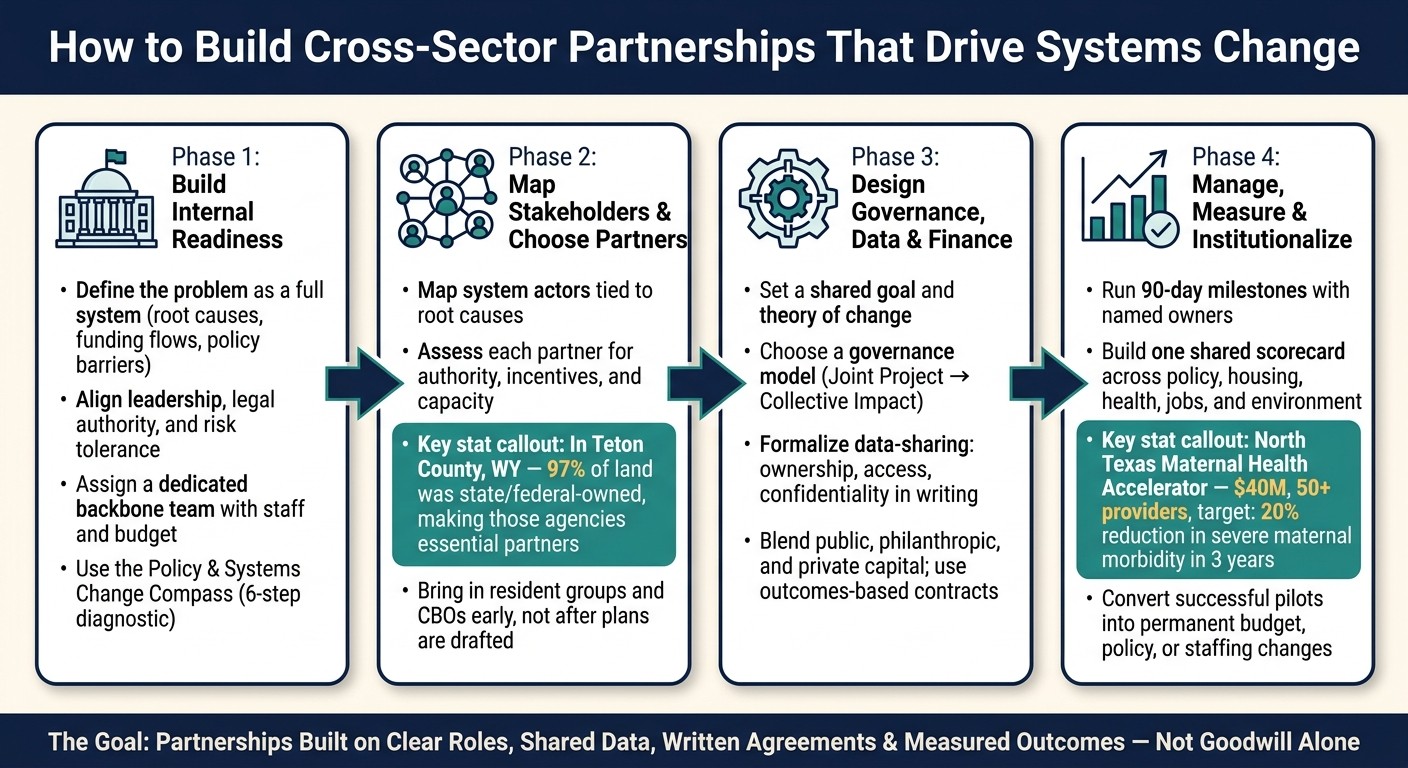
Here’s the full path in plain terms:
Start inside government first
Define the problem beyond one program or department
Map root causes, funding flows, and policy barriers
Confirm leadership support, legal limits, and risk boundaries
Assign a team to run the work
Choose partners based on leverage
Identify agencies, employers, nonprofits, funders, and residents tied to the root causes
Check each group for authority, incentives, and capacity
Bring in resident groups early, not after plans are drafted
Set the partnership rules early
Agree on a shared goal and near-term wins
Pick a governance model that fits the problem
Put data-sharing, funding, and accountability in writing
Run it like a shared work plan
Use 90-day milestones, named owners, and clear measures
Build one scorecard across policy, housing, health, jobs, and climate-related outcomes
Turn pilots into budget, policy, or staffing changes if they work
A few facts from the article show why this matters. In Teton County, Wyoming, stakeholder mapping showed that 97% of the land was under state or federal control, which changed who had to be in the room. In North Texas, a $40 million maternal health effort brought together 50+ providers around one target: cut severe maternal morbidity by 20% in three years. In Manchester, New Hampshire, an early joint effort on panhandling helped build enough trust to support the city’s first city-run shelter.
The bottom line: if I want results that last past one grant cycle or one mayoral term, I need a partnership built on clear roles, shared data, written agreements, and measured outcomes - not goodwill alone.
How to Build Cross-Sector Partnerships for Systems Change
Building Coalitions and Cross-Sector Partnerships
1. Build Internal Readiness Before You Convene Partners
Systems change starts inside government. Before the first partner meeting, the agency has to define the problem, understand its authority, and be clear about its role. That groundwork is what separates a coalition that gets things done from a packed calendar of meetings that leads nowhere.
Define the problem as a system, not a project
Public problems often get framed too narrowly. Affordable housing becomes a zoning issue. Workforce gaps become a training issue. That kind of framing shrinks the guest list and narrows the solution set before the work even begins. Before you bring in outside partners, your team needs to map the full system: root causes, feedback loops, funding flows, and policy barriers that keep the problem stuck.
A practical place to start is the Policy and Systems Change Compass, a six-step process: develop a clear problem statement, identify root causes, draft system goals, map the ecosystem of stakeholders, assess potential solutions, and prioritize by feasibility and impact. [3] In Teton County, Wyoming, the Community Foundation of Jackson Hole used this framework to surface root causes that were not obvious at first, including narrow income requirements in existing support programs and a lack of centralized data collection to measure housing demand. [3] Without that early diagnostic work, a partnership can end up solving the wrong problem.
Another helpful internal check is the Strategic Triangle. It asks three questions at the same time: What is the net improvement in public welfare we're pursuing? (Public Value), Whose permission and financial support do we need? (Legitimacy and Support), and What new delivery capacities or organizational changes are required? (Operational Capacity). [6] This keeps the effort tied to public value instead of collaboration for collaboration's sake. Used with a leadership team, it often brings hidden disagreements to the surface before partners ever join the table.
Once the system is mapped, the agency can match the problem to the authority and team needed to act.
Align leadership, legal authority, and risk tolerance
A cross-sector partnership needs clear executive backing from a mayor, city manager, county executive, or agency head. That backing matters when the work cuts across budgets, legal limits, and jurisdictional boundaries. It also makes clear who has approval power and what resources can keep the effort going.
Just as important is a plainspoken discussion about risk tolerance. If an agency plans to support data sharing or blended finance, partners need to know what level of change can actually get approved and maintained. If that line stays fuzzy, trust erodes fast.
Create a guiding team or backbone function
Someone has to handle the day-to-day work of the partnership. That's the backbone function: a coordinating team in charge of convening, communications, work planning, and partner accountability. [3] It can sit inside a city office or with a community foundation, but it still needs dedicated staff and budget. This cannot live as a side task on someone's already full job.
In Teton County, the Community Foundation of Jackson Hole hired a dedicated staff member to mobilize resources and manage a steering committee for the Housing Collective. [3] The group also had to build enough trust to bring partners into the work. The Urban Institute's assessment put it plainly:
"The backbone organization needs to have fostered relationships that can mobilize organizations and individuals to buy into the initiative's goals." [3]
Early choices about team makeup, goals, and roles shape how the effort performs over time. Set roles, goals, and staffing before launch.
With internal scope, authority, and staffing aligned, the next step is choosing the partners who can move the system.
2. Map Stakeholders and Choose the Right Partners
Once your internal team is lined up and the backbone function is set, the next move is practical: figure out who holds the levers that shape the problem, and be clear about what each partner is there to do. That map helps you sort out who needs a seat at the table, who can sway results, and who will help carry the work.
Use stakeholder mapping to identify system actors
Start with the root-cause map. It shows which actors control the levers behind the issue. From there, group stakeholders by the power they hold over root causes, the assets they bring, and whether they speak for residents and frontline communities.
In Teton County, Wyoming, the Jackson Hole Housing Collective's ecosystem mapping showed that 97% of the land in the county is federally or state-owned and managed, which meant state and federal agencies weren't optional partners - they were operationally essential from day one. [3] That example makes the point plain: map the system first, then build the partner list around the actors that control root causes.
This step helps you avoid a common trap. Many groups lean too hard on big institutions and leave out community-based organizations and resident groups. That’s a miss. Those groups often hold the frontline knowledge and trust that make the work possible.
After you know who should be at the implementation table, pressure-test each partner’s role against three things: incentives, capacity, and authority.
Assess fit with a roles and incentives matrix
Use this matrix to pick partners based on leverage, not familiarity:
Partner Type | Assets | Incentives | Constraints | Role |
|---|---|---|---|---|
Municipal Agencies | Legal authority, land, policy tools | Public outcomes, fiscal health | Budget cycles, political timelines | Catalyst, convener, policy lead |
Anchor Institutions | Research, data, convening power | Regional stability, workforce pipeline | Institutional inertia, academic timelines | Data evaluator, long-term partner |
Philanthropy | Flexible capital, risk tolerance | Systems change, catalytic impact | Donor mandates, limited operational funds | Funder of pilots and backbone costs |
Private Sector | Capital, operational speed, jobs | ROI, workforce stability, ESG goals | Short-term profit focus, risk aversion | Co-investor, technical advisor |
Residents/CBOs | Lived experience, community trust | Quality of life, equity, direct impact | Limited capacity, past distrust | Agenda-setter, frontline implementer |
A matrix like this keeps partner selection grounded in control, incentives, and delivery capacity. It turns the process from “Who do we know?” into “Who can help move this?”
Design community engagement from the start
The most common failure in cross-sector partnerships is simple: community engagement gets treated like a communications step that comes later, instead of a design choice built in from the start. Residents and community-based organizations should help set the agenda while choices are still being shaped - not after the main calls have already been made. If frontline voices are missing, the partnership is likely to overlook the very constraints that decide whether a plan works on the ground.
That means making participation possible in plain terms. Offer stipends, childcare, transportation help, and translated materials so frontline residents can take part as full partners, not symbolic ones.
The Jackson Hole Housing Collective directly identified that underrepresentation of the people most affected had led to gaps in housing policy decisions, and the backbone team used the "Fist to Five" consensus method during convenings: a scale where a score of 5 means total agreement and a score of 3 or below prompts a pause to discuss concerns and reach a higher consensus. [3] It’s a small process tool, but it matters. It gives quieter voices a clear way to slow things down when a group is moving too fast and missing key concerns.
Once the right people are in the room, the next step is to lock in how decisions, data, and funding will work.
3. Design the Partnership: Governance, Data, and Financing
Once the right people are at the table, the next job is more concrete: turn goodwill into a working setup with clear rules, shared information, and funding that can last. Governance, data, and finance are the levers that move collaboration from talk to measurable public value. The task now is to turn partner roles into operating rules for decisions, data, and funding.
Set a shared agenda and theory of change
Every cross-sector partnership needs a shared long-term goal that each partner can point to when priorities clash or momentum slows. A broad vision helps, but on its own, it won’t carry the work very far. Partners also need a set of near- and mid-term priorities that show what progress looks like before the big outcome arrives.
A practical tool for this is a theory of change. Think of it as a written map: it links each partner’s actions to shared outcomes and, from there, to the system-level result the group wants to reach. Used well, it helps the partnership name the few outcomes, owners, and milestones that matter most.
When the problem feels too large or messy to act on, the MAAP criteria can help the group choose a starting point. Pick an entry point that is Meaningful because it touches the larger issue, Actionable because the team can do it now, Acceptable because key stakeholders will back it, and Provisional because it teaches the group what to do next. [4] In plain terms, MAAP helps partners choose a first move that matters, can be done, has support, and produces learning.
Choose a governance model that fits the challenge
After the shared agenda is in place, the next step is choosing the structure that will keep partners aligned. This is where many partnerships quietly come apart. The right model depends on how hard the problem is, how many groups are involved, and how long the work is expected to last.
The table below shows the most common models and where each one tends to fit best.
Governance Model | Best Use Cases | Strengths | Drawbacks | Typical Legal Instruments |
|---|---|---|---|---|
Joint Project | Contained problems in a specific place or short timeframe | Straightforward to manage | Transactional; collapses if one partner exits | MOU or simple contract |
Joint Program | Multiple workstreams over several years | Partners can join or leave as workstreams complete | Depends heavily on one committed champion | Multi-party agreement |
Multi-Stakeholder Initiative | Complex, cross-jurisdiction problems across many geographies | Coordinates many organizations; enables economies of scale | Requires a coordinating office; complex to manage | Formal coordinating office agreement |
Collective Impact | Systems-level change requiring action at multiple levels | Amplifies impact through coordinated independent action | Requires high trust and alignment; difficult to centralize | Charter or multi-stakeholder compact |
One point is worth underlining: state law sets the legal boundaries. Virginia, for example, allows public-private partnerships across many infrastructure categories, including education and telecommunications, while Missouri requires a public vote before entering highway partnerships. [5] That means the governance conversation can’t stay abstract. Check your state’s enabling legislation before locking in a structure.
Build data-sharing and blended finance into the structure
Once governance is set, build in the rules for information flow and capital from the start. Data-sharing and financing should not be left for later or negotiated in the middle of a crisis. If they aren’t written into the partnership design early, they often become the source of delay, mistrust, or both.
On data, spell out ownership, access, confidentiality, IP, and reporting rules in a formal agreement. [7] Those terms set the ground rules for shared work and help avoid disputes once data starts moving between partners.
On financing, combine public, philanthropic, and private capital, and use outcomes-based contracts where performance matters and P3s where risk transfer can improve delivery. [1] Florida’s I-595 P3 cut delivery time and cost compared with standard contracting. [5] That’s the core idea behind blended finance: match each risk to the source of capital best able to carry it.
4. Manage, Measure, and Institutionalize the Partnership
Turn the strategy into a joint implementation plan
Once governance, data, and financing are in place, the partnership needs a steady rhythm. The next step is to turn the agreement into a 90-day work plan with clear milestones, named owners, timelines, and funding for each workstream - whether that comes from a federal grant, a philanthropic contribution, or a municipal budget line. Put responsibilities in MOUs or interagency agreements so there’s no guesswork later.
The backbone team should run that rhythm, track deliverables, and keep decisions from getting stuck. A fist-to-five vote can help surface concerns fast without slowing everything down. [3]
Measure outcomes across policy, social, and economic results
The implementation plan should flow straight into a shared scorecard. Local governments need shared dashboards to keep teams aligned, avoid duplicated services, and coordinate decisions through a shared dashboard. [2] Baseline data should be set before launch so progress can be measured against a clear starting point.
The table below maps outcome types to the indicators, data sources, and agency owners most relevant to municipal partnerships.
Outcome Type | Sample Indicators | Primary Data Sources | Typical Public-Sector Owner |
|---|---|---|---|
Policy/Regulatory | Policy reform milestones; regulatory compliance | Regulatory audits; legal reviews | City Attorney; Dept. of Environmental Quality |
Housing | Units preserved; deed-restricted units produced | Centralized housing dashboards; HUD reports | Housing & Community Development |
Social/Health | Overdose rates; shelter bed utilization; panhandling incidents | Public health data; service provider reports; police/fire records | Health & Human Services |
Environmental | Stormwater runoff reduction; water quality levels; flood-risk reduction | Public Works; Dept. of Sustainability | |
Economic | Job placement; wage growth; local investment | Workforce development records; tax filings | Economic Development Office |
A regular reporting cadence gives partners time to review progress together and make course corrections before small issues become bigger ones. In September 2025, Dallas and Tarrant counties launched the North Texas Maternal Health Accelerator, a $40 million initiative that brought together more than 50 health care providers around a clear target: reducing severe maternal morbidity by 20% over three years. [2]
Address power imbalances and scale what works
Results should guide the next call: which pilot actions deserve to become policy, budget, or staffing changes. If a pilot works, move it into permanent structures rather than leaving it as a short-term project.
Scaling also means changing how the public sector works with outside groups. It’s a shift from procurement to partnership - from managing one-off vendors to overseeing long-term relationships, backed by steady education on risk transfer and lifecycle costing. [5] When outcomes are strong, budgeting tied to outcomes can help direct resources where they have the most impact. That’s how a pilot starts to become standard practice.
Conclusion: A Practical Path to Durable Systems Change
Big public problems don’t give way to stand-alone programs. They take steady coordination across agencies, nonprofits, funders, and private partners. That’s how municipalities move from one-off collaboration to systems change.
That kind of shift starts before anyone sits down at the partner table. It works when agencies line up the problem, the right partners, governance, data, and funding around one shared goal. The path is straightforward: assess the system, align authority, pick the right partners, formalize governance, and track outcomes. Early wins matter because they build trust, and that trust makes tougher structural change possible.
For that sequence to last, agencies need shared systems rather than patchwork coordination. Process matters, but mindset does too. When governance structures, shared dashboards, and performance management get treated like nice-to-haves, promising pilots tend to stall instead of turning into durable practice.
Once those systems are in place, scale stops depending on one champion pushing everything forward. Change lasts when the structure can outlive any single project, grant, or administration.
FAQs
How do I know which partners need a seat at the table?
Start by mapping the stakeholders who can shape the root causes of your challenge across government, business, nonprofits, philanthropy, and the community.
Then narrow your focus to partners who bring the right expertise, data, or ability to serve shared priority populations. Look into what drives them, how they make decisions, and where they lack resources. Just as important, include the people most affected by the issue. Their input helps ground the work in what’s needed and supports effective, equitable solutions.
What governance model makes the most sense for my partnership?
There’s no one-size-fits-all model here. The right setup depends on your goals, the rules you have to work within, and what you want the partnership to deliver. In many cases, the smartest move is to split governance from service delivery: public agencies set shared standards, and partners build on top of a common infrastructure.
When the work gets messy or hard to predict, outcome-based arrangements tend to work better because they leave room for different ways of getting to the same result. To keep everyone moving in the same direction, partnerships often rely on a backbone organization, advisory committees, shared dashboards, cross-sector tables, and dedicated staff. Those pieces help line up incentives and keep accountability from slipping.
How can we keep a cross-sector partnership going after early funding ends?
Anchor the partnership in a backbone organization with dedicated staff, and lock in steady support from a local funder or public institution.
Set continuity plans early. Be clear about who convenes the group, how roles might shift, and how staffing will carry on when people leave or change jobs. Keep shared metrics in place and track progress on a regular basis so partners can show results, make the case for continued investment, and adjust as conditions change.
Related Blog Posts
Latest Articles
©2025

Narrative Change and Power Building: The Missing Half of Advocacy
Narrative change is the process of disrupting dominant narratives that normalize inequity and advancing new narratives from historically marginalized communities.

Funding Resilience Without Federal Grants
BRIC is unreliable and FEMA is shrinking. Here's how cities fund climate resilience with dedicated revenue, blended finance, and a coordinating authority.

The ESG Blind Spot: How AI Is Finding Risks in Companies Nobody Else Is Watching
Norway's sovereign wealth fund uses AI to screen 7,200 portfolio companies for forced labor and corruption within 24 hours. The real story is the emerging-market coverage gap that traditional ESG data vendors miss — and what it means for any company with a global supply chain.
Narrative Change and Power Building: The Missing Half of Advocacy
Narrative change is the process of disrupting dominant narratives that normalize inequity and advancing new narratives from historically marginalized communities.
Funding Resilience Without Federal Grants
BRIC is unreliable and FEMA is shrinking. Here's how cities fund climate resilience with dedicated revenue, blended finance, and a coordinating authority.
The ESG Blind Spot: How AI Is Finding Risks in Companies Nobody Else Is Watching
Norway's sovereign wealth fund uses AI to screen 7,200 portfolio companies for forced labor and corruption within 24 hours. The real story is the emerging-market coverage gap that traditional ESG data vendors miss — and what it means for any company with a global supply chain.
FAQ
01
What does it really mean to “redefine profit”?
02
What makes Council Fire different?
03
Who does Council Fire work with?
04
What does working with Council Fire actually look like?
05
How does Council Fire help organizations turn big goals into action?
06
How does Council Fire define and measure success?
Jun 23, 2026
How to Build Cross-Sector Partnerships That Drive Systems Change for Municipalities & Government Agencies
Capacity Building
In This Article
Guide for municipalities to design cross-sector partnerships: map systems, align authority, set governance, share data, and track outcomes.
How to Build Cross-Sector Partnerships That Drive Systems Change for Municipalities & Government Agencies
If I want a partnership to change a local system, I can’t start with a meeting. I have to start with clarity. The article’s main point is simple: I need to define the problem as a system, line up authority inside government, bring in the few partners who control the key levers, set rules for decisions and data, and track results from day one.
Here’s the full path in plain terms:
Start inside government first
Define the problem beyond one program or department
Map root causes, funding flows, and policy barriers
Confirm leadership support, legal limits, and risk boundaries
Assign a team to run the work
Choose partners based on leverage
Identify agencies, employers, nonprofits, funders, and residents tied to the root causes
Check each group for authority, incentives, and capacity
Bring in resident groups early, not after plans are drafted
Set the partnership rules early
Agree on a shared goal and near-term wins
Pick a governance model that fits the problem
Put data-sharing, funding, and accountability in writing
Run it like a shared work plan
Use 90-day milestones, named owners, and clear measures
Build one scorecard across policy, housing, health, jobs, and climate-related outcomes
Turn pilots into budget, policy, or staffing changes if they work
A few facts from the article show why this matters. In Teton County, Wyoming, stakeholder mapping showed that 97% of the land was under state or federal control, which changed who had to be in the room. In North Texas, a $40 million maternal health effort brought together 50+ providers around one target: cut severe maternal morbidity by 20% in three years. In Manchester, New Hampshire, an early joint effort on panhandling helped build enough trust to support the city’s first city-run shelter.
The bottom line: if I want results that last past one grant cycle or one mayoral term, I need a partnership built on clear roles, shared data, written agreements, and measured outcomes - not goodwill alone.
How to Build Cross-Sector Partnerships for Systems Change
Building Coalitions and Cross-Sector Partnerships
1. Build Internal Readiness Before You Convene Partners
Systems change starts inside government. Before the first partner meeting, the agency has to define the problem, understand its authority, and be clear about its role. That groundwork is what separates a coalition that gets things done from a packed calendar of meetings that leads nowhere.
Define the problem as a system, not a project
Public problems often get framed too narrowly. Affordable housing becomes a zoning issue. Workforce gaps become a training issue. That kind of framing shrinks the guest list and narrows the solution set before the work even begins. Before you bring in outside partners, your team needs to map the full system: root causes, feedback loops, funding flows, and policy barriers that keep the problem stuck.
A practical place to start is the Policy and Systems Change Compass, a six-step process: develop a clear problem statement, identify root causes, draft system goals, map the ecosystem of stakeholders, assess potential solutions, and prioritize by feasibility and impact. [3] In Teton County, Wyoming, the Community Foundation of Jackson Hole used this framework to surface root causes that were not obvious at first, including narrow income requirements in existing support programs and a lack of centralized data collection to measure housing demand. [3] Without that early diagnostic work, a partnership can end up solving the wrong problem.
Another helpful internal check is the Strategic Triangle. It asks three questions at the same time: What is the net improvement in public welfare we're pursuing? (Public Value), Whose permission and financial support do we need? (Legitimacy and Support), and What new delivery capacities or organizational changes are required? (Operational Capacity). [6] This keeps the effort tied to public value instead of collaboration for collaboration's sake. Used with a leadership team, it often brings hidden disagreements to the surface before partners ever join the table.
Once the system is mapped, the agency can match the problem to the authority and team needed to act.
Align leadership, legal authority, and risk tolerance
A cross-sector partnership needs clear executive backing from a mayor, city manager, county executive, or agency head. That backing matters when the work cuts across budgets, legal limits, and jurisdictional boundaries. It also makes clear who has approval power and what resources can keep the effort going.
Just as important is a plainspoken discussion about risk tolerance. If an agency plans to support data sharing or blended finance, partners need to know what level of change can actually get approved and maintained. If that line stays fuzzy, trust erodes fast.
Create a guiding team or backbone function
Someone has to handle the day-to-day work of the partnership. That's the backbone function: a coordinating team in charge of convening, communications, work planning, and partner accountability. [3] It can sit inside a city office or with a community foundation, but it still needs dedicated staff and budget. This cannot live as a side task on someone's already full job.
In Teton County, the Community Foundation of Jackson Hole hired a dedicated staff member to mobilize resources and manage a steering committee for the Housing Collective. [3] The group also had to build enough trust to bring partners into the work. The Urban Institute's assessment put it plainly:
"The backbone organization needs to have fostered relationships that can mobilize organizations and individuals to buy into the initiative's goals." [3]
Early choices about team makeup, goals, and roles shape how the effort performs over time. Set roles, goals, and staffing before launch.
With internal scope, authority, and staffing aligned, the next step is choosing the partners who can move the system.
2. Map Stakeholders and Choose the Right Partners
Once your internal team is lined up and the backbone function is set, the next move is practical: figure out who holds the levers that shape the problem, and be clear about what each partner is there to do. That map helps you sort out who needs a seat at the table, who can sway results, and who will help carry the work.
Use stakeholder mapping to identify system actors
Start with the root-cause map. It shows which actors control the levers behind the issue. From there, group stakeholders by the power they hold over root causes, the assets they bring, and whether they speak for residents and frontline communities.
In Teton County, Wyoming, the Jackson Hole Housing Collective's ecosystem mapping showed that 97% of the land in the county is federally or state-owned and managed, which meant state and federal agencies weren't optional partners - they were operationally essential from day one. [3] That example makes the point plain: map the system first, then build the partner list around the actors that control root causes.
This step helps you avoid a common trap. Many groups lean too hard on big institutions and leave out community-based organizations and resident groups. That’s a miss. Those groups often hold the frontline knowledge and trust that make the work possible.
After you know who should be at the implementation table, pressure-test each partner’s role against three things: incentives, capacity, and authority.
Assess fit with a roles and incentives matrix
Use this matrix to pick partners based on leverage, not familiarity:
Partner Type | Assets | Incentives | Constraints | Role |
|---|---|---|---|---|
Municipal Agencies | Legal authority, land, policy tools | Public outcomes, fiscal health | Budget cycles, political timelines | Catalyst, convener, policy lead |
Anchor Institutions | Research, data, convening power | Regional stability, workforce pipeline | Institutional inertia, academic timelines | Data evaluator, long-term partner |
Philanthropy | Flexible capital, risk tolerance | Systems change, catalytic impact | Donor mandates, limited operational funds | Funder of pilots and backbone costs |
Private Sector | Capital, operational speed, jobs | ROI, workforce stability, ESG goals | Short-term profit focus, risk aversion | Co-investor, technical advisor |
Residents/CBOs | Lived experience, community trust | Quality of life, equity, direct impact | Limited capacity, past distrust | Agenda-setter, frontline implementer |
A matrix like this keeps partner selection grounded in control, incentives, and delivery capacity. It turns the process from “Who do we know?” into “Who can help move this?”
Design community engagement from the start
The most common failure in cross-sector partnerships is simple: community engagement gets treated like a communications step that comes later, instead of a design choice built in from the start. Residents and community-based organizations should help set the agenda while choices are still being shaped - not after the main calls have already been made. If frontline voices are missing, the partnership is likely to overlook the very constraints that decide whether a plan works on the ground.
That means making participation possible in plain terms. Offer stipends, childcare, transportation help, and translated materials so frontline residents can take part as full partners, not symbolic ones.
The Jackson Hole Housing Collective directly identified that underrepresentation of the people most affected had led to gaps in housing policy decisions, and the backbone team used the "Fist to Five" consensus method during convenings: a scale where a score of 5 means total agreement and a score of 3 or below prompts a pause to discuss concerns and reach a higher consensus. [3] It’s a small process tool, but it matters. It gives quieter voices a clear way to slow things down when a group is moving too fast and missing key concerns.
Once the right people are in the room, the next step is to lock in how decisions, data, and funding will work.
3. Design the Partnership: Governance, Data, and Financing
Once the right people are at the table, the next job is more concrete: turn goodwill into a working setup with clear rules, shared information, and funding that can last. Governance, data, and finance are the levers that move collaboration from talk to measurable public value. The task now is to turn partner roles into operating rules for decisions, data, and funding.
Set a shared agenda and theory of change
Every cross-sector partnership needs a shared long-term goal that each partner can point to when priorities clash or momentum slows. A broad vision helps, but on its own, it won’t carry the work very far. Partners also need a set of near- and mid-term priorities that show what progress looks like before the big outcome arrives.
A practical tool for this is a theory of change. Think of it as a written map: it links each partner’s actions to shared outcomes and, from there, to the system-level result the group wants to reach. Used well, it helps the partnership name the few outcomes, owners, and milestones that matter most.
When the problem feels too large or messy to act on, the MAAP criteria can help the group choose a starting point. Pick an entry point that is Meaningful because it touches the larger issue, Actionable because the team can do it now, Acceptable because key stakeholders will back it, and Provisional because it teaches the group what to do next. [4] In plain terms, MAAP helps partners choose a first move that matters, can be done, has support, and produces learning.
Choose a governance model that fits the challenge
After the shared agenda is in place, the next step is choosing the structure that will keep partners aligned. This is where many partnerships quietly come apart. The right model depends on how hard the problem is, how many groups are involved, and how long the work is expected to last.
The table below shows the most common models and where each one tends to fit best.
Governance Model | Best Use Cases | Strengths | Drawbacks | Typical Legal Instruments |
|---|---|---|---|---|
Joint Project | Contained problems in a specific place or short timeframe | Straightforward to manage | Transactional; collapses if one partner exits | MOU or simple contract |
Joint Program | Multiple workstreams over several years | Partners can join or leave as workstreams complete | Depends heavily on one committed champion | Multi-party agreement |
Multi-Stakeholder Initiative | Complex, cross-jurisdiction problems across many geographies | Coordinates many organizations; enables economies of scale | Requires a coordinating office; complex to manage | Formal coordinating office agreement |
Collective Impact | Systems-level change requiring action at multiple levels | Amplifies impact through coordinated independent action | Requires high trust and alignment; difficult to centralize | Charter or multi-stakeholder compact |
One point is worth underlining: state law sets the legal boundaries. Virginia, for example, allows public-private partnerships across many infrastructure categories, including education and telecommunications, while Missouri requires a public vote before entering highway partnerships. [5] That means the governance conversation can’t stay abstract. Check your state’s enabling legislation before locking in a structure.
Build data-sharing and blended finance into the structure
Once governance is set, build in the rules for information flow and capital from the start. Data-sharing and financing should not be left for later or negotiated in the middle of a crisis. If they aren’t written into the partnership design early, they often become the source of delay, mistrust, or both.
On data, spell out ownership, access, confidentiality, IP, and reporting rules in a formal agreement. [7] Those terms set the ground rules for shared work and help avoid disputes once data starts moving between partners.
On financing, combine public, philanthropic, and private capital, and use outcomes-based contracts where performance matters and P3s where risk transfer can improve delivery. [1] Florida’s I-595 P3 cut delivery time and cost compared with standard contracting. [5] That’s the core idea behind blended finance: match each risk to the source of capital best able to carry it.
4. Manage, Measure, and Institutionalize the Partnership
Turn the strategy into a joint implementation plan
Once governance, data, and financing are in place, the partnership needs a steady rhythm. The next step is to turn the agreement into a 90-day work plan with clear milestones, named owners, timelines, and funding for each workstream - whether that comes from a federal grant, a philanthropic contribution, or a municipal budget line. Put responsibilities in MOUs or interagency agreements so there’s no guesswork later.
The backbone team should run that rhythm, track deliverables, and keep decisions from getting stuck. A fist-to-five vote can help surface concerns fast without slowing everything down. [3]
Measure outcomes across policy, social, and economic results
The implementation plan should flow straight into a shared scorecard. Local governments need shared dashboards to keep teams aligned, avoid duplicated services, and coordinate decisions through a shared dashboard. [2] Baseline data should be set before launch so progress can be measured against a clear starting point.
The table below maps outcome types to the indicators, data sources, and agency owners most relevant to municipal partnerships.
Outcome Type | Sample Indicators | Primary Data Sources | Typical Public-Sector Owner |
|---|---|---|---|
Policy/Regulatory | Policy reform milestones; regulatory compliance | Regulatory audits; legal reviews | City Attorney; Dept. of Environmental Quality |
Housing | Units preserved; deed-restricted units produced | Centralized housing dashboards; HUD reports | Housing & Community Development |
Social/Health | Overdose rates; shelter bed utilization; panhandling incidents | Public health data; service provider reports; police/fire records | Health & Human Services |
Environmental | Stormwater runoff reduction; water quality levels; flood-risk reduction | Public Works; Dept. of Sustainability | |
Economic | Job placement; wage growth; local investment | Workforce development records; tax filings | Economic Development Office |
A regular reporting cadence gives partners time to review progress together and make course corrections before small issues become bigger ones. In September 2025, Dallas and Tarrant counties launched the North Texas Maternal Health Accelerator, a $40 million initiative that brought together more than 50 health care providers around a clear target: reducing severe maternal morbidity by 20% over three years. [2]
Address power imbalances and scale what works
Results should guide the next call: which pilot actions deserve to become policy, budget, or staffing changes. If a pilot works, move it into permanent structures rather than leaving it as a short-term project.
Scaling also means changing how the public sector works with outside groups. It’s a shift from procurement to partnership - from managing one-off vendors to overseeing long-term relationships, backed by steady education on risk transfer and lifecycle costing. [5] When outcomes are strong, budgeting tied to outcomes can help direct resources where they have the most impact. That’s how a pilot starts to become standard practice.
Conclusion: A Practical Path to Durable Systems Change
Big public problems don’t give way to stand-alone programs. They take steady coordination across agencies, nonprofits, funders, and private partners. That’s how municipalities move from one-off collaboration to systems change.
That kind of shift starts before anyone sits down at the partner table. It works when agencies line up the problem, the right partners, governance, data, and funding around one shared goal. The path is straightforward: assess the system, align authority, pick the right partners, formalize governance, and track outcomes. Early wins matter because they build trust, and that trust makes tougher structural change possible.
For that sequence to last, agencies need shared systems rather than patchwork coordination. Process matters, but mindset does too. When governance structures, shared dashboards, and performance management get treated like nice-to-haves, promising pilots tend to stall instead of turning into durable practice.
Once those systems are in place, scale stops depending on one champion pushing everything forward. Change lasts when the structure can outlive any single project, grant, or administration.
FAQs
How do I know which partners need a seat at the table?
Start by mapping the stakeholders who can shape the root causes of your challenge across government, business, nonprofits, philanthropy, and the community.
Then narrow your focus to partners who bring the right expertise, data, or ability to serve shared priority populations. Look into what drives them, how they make decisions, and where they lack resources. Just as important, include the people most affected by the issue. Their input helps ground the work in what’s needed and supports effective, equitable solutions.
What governance model makes the most sense for my partnership?
There’s no one-size-fits-all model here. The right setup depends on your goals, the rules you have to work within, and what you want the partnership to deliver. In many cases, the smartest move is to split governance from service delivery: public agencies set shared standards, and partners build on top of a common infrastructure.
When the work gets messy or hard to predict, outcome-based arrangements tend to work better because they leave room for different ways of getting to the same result. To keep everyone moving in the same direction, partnerships often rely on a backbone organization, advisory committees, shared dashboards, cross-sector tables, and dedicated staff. Those pieces help line up incentives and keep accountability from slipping.
How can we keep a cross-sector partnership going after early funding ends?
Anchor the partnership in a backbone organization with dedicated staff, and lock in steady support from a local funder or public institution.
Set continuity plans early. Be clear about who convenes the group, how roles might shift, and how staffing will carry on when people leave or change jobs. Keep shared metrics in place and track progress on a regular basis so partners can show results, make the case for continued investment, and adjust as conditions change.
Related Blog Posts
Latest Articles
©2025
Narrative Change and Power Building: The Missing Half of Advocacy
Narrative change is the process of disrupting dominant narratives that normalize inequity and advancing new narratives from historically marginalized communities.
Funding Resilience Without Federal Grants
BRIC is unreliable and FEMA is shrinking. Here's how cities fund climate resilience with dedicated revenue, blended finance, and a coordinating authority.
The ESG Blind Spot: How AI Is Finding Risks in Companies Nobody Else Is Watching
Norway's sovereign wealth fund uses AI to screen 7,200 portfolio companies for forced labor and corruption within 24 hours. The real story is the emerging-market coverage gap that traditional ESG data vendors miss — and what it means for any company with a global supply chain.
FAQ
01
What does it really mean to “redefine profit”?
02
What makes Council Fire different?
03
Who does Council Fire work with?
04
What does working with Council Fire actually look like?
05
How does Council Fire help organizations turn big goals into action?
06
How does Council Fire define and measure success?
Jun 23, 2026
How to Build Cross-Sector Partnerships That Drive Systems Change for Municipalities & Government Agencies
Capacity Building
In This Article
Guide for municipalities to design cross-sector partnerships: map systems, align authority, set governance, share data, and track outcomes.
How to Build Cross-Sector Partnerships That Drive Systems Change for Municipalities & Government Agencies
If I want a partnership to change a local system, I can’t start with a meeting. I have to start with clarity. The article’s main point is simple: I need to define the problem as a system, line up authority inside government, bring in the few partners who control the key levers, set rules for decisions and data, and track results from day one.
Here’s the full path in plain terms:
Start inside government first
Define the problem beyond one program or department
Map root causes, funding flows, and policy barriers
Confirm leadership support, legal limits, and risk boundaries
Assign a team to run the work
Choose partners based on leverage
Identify agencies, employers, nonprofits, funders, and residents tied to the root causes
Check each group for authority, incentives, and capacity
Bring in resident groups early, not after plans are drafted
Set the partnership rules early
Agree on a shared goal and near-term wins
Pick a governance model that fits the problem
Put data-sharing, funding, and accountability in writing
Run it like a shared work plan
Use 90-day milestones, named owners, and clear measures
Build one scorecard across policy, housing, health, jobs, and climate-related outcomes
Turn pilots into budget, policy, or staffing changes if they work
A few facts from the article show why this matters. In Teton County, Wyoming, stakeholder mapping showed that 97% of the land was under state or federal control, which changed who had to be in the room. In North Texas, a $40 million maternal health effort brought together 50+ providers around one target: cut severe maternal morbidity by 20% in three years. In Manchester, New Hampshire, an early joint effort on panhandling helped build enough trust to support the city’s first city-run shelter.
The bottom line: if I want results that last past one grant cycle or one mayoral term, I need a partnership built on clear roles, shared data, written agreements, and measured outcomes - not goodwill alone.
How to Build Cross-Sector Partnerships for Systems Change
Building Coalitions and Cross-Sector Partnerships
1. Build Internal Readiness Before You Convene Partners
Systems change starts inside government. Before the first partner meeting, the agency has to define the problem, understand its authority, and be clear about its role. That groundwork is what separates a coalition that gets things done from a packed calendar of meetings that leads nowhere.
Define the problem as a system, not a project
Public problems often get framed too narrowly. Affordable housing becomes a zoning issue. Workforce gaps become a training issue. That kind of framing shrinks the guest list and narrows the solution set before the work even begins. Before you bring in outside partners, your team needs to map the full system: root causes, feedback loops, funding flows, and policy barriers that keep the problem stuck.
A practical place to start is the Policy and Systems Change Compass, a six-step process: develop a clear problem statement, identify root causes, draft system goals, map the ecosystem of stakeholders, assess potential solutions, and prioritize by feasibility and impact. [3] In Teton County, Wyoming, the Community Foundation of Jackson Hole used this framework to surface root causes that were not obvious at first, including narrow income requirements in existing support programs and a lack of centralized data collection to measure housing demand. [3] Without that early diagnostic work, a partnership can end up solving the wrong problem.
Another helpful internal check is the Strategic Triangle. It asks three questions at the same time: What is the net improvement in public welfare we're pursuing? (Public Value), Whose permission and financial support do we need? (Legitimacy and Support), and What new delivery capacities or organizational changes are required? (Operational Capacity). [6] This keeps the effort tied to public value instead of collaboration for collaboration's sake. Used with a leadership team, it often brings hidden disagreements to the surface before partners ever join the table.
Once the system is mapped, the agency can match the problem to the authority and team needed to act.
Align leadership, legal authority, and risk tolerance
A cross-sector partnership needs clear executive backing from a mayor, city manager, county executive, or agency head. That backing matters when the work cuts across budgets, legal limits, and jurisdictional boundaries. It also makes clear who has approval power and what resources can keep the effort going.
Just as important is a plainspoken discussion about risk tolerance. If an agency plans to support data sharing or blended finance, partners need to know what level of change can actually get approved and maintained. If that line stays fuzzy, trust erodes fast.
Create a guiding team or backbone function
Someone has to handle the day-to-day work of the partnership. That's the backbone function: a coordinating team in charge of convening, communications, work planning, and partner accountability. [3] It can sit inside a city office or with a community foundation, but it still needs dedicated staff and budget. This cannot live as a side task on someone's already full job.
In Teton County, the Community Foundation of Jackson Hole hired a dedicated staff member to mobilize resources and manage a steering committee for the Housing Collective. [3] The group also had to build enough trust to bring partners into the work. The Urban Institute's assessment put it plainly:
"The backbone organization needs to have fostered relationships that can mobilize organizations and individuals to buy into the initiative's goals." [3]
Early choices about team makeup, goals, and roles shape how the effort performs over time. Set roles, goals, and staffing before launch.
With internal scope, authority, and staffing aligned, the next step is choosing the partners who can move the system.
2. Map Stakeholders and Choose the Right Partners
Once your internal team is lined up and the backbone function is set, the next move is practical: figure out who holds the levers that shape the problem, and be clear about what each partner is there to do. That map helps you sort out who needs a seat at the table, who can sway results, and who will help carry the work.
Use stakeholder mapping to identify system actors
Start with the root-cause map. It shows which actors control the levers behind the issue. From there, group stakeholders by the power they hold over root causes, the assets they bring, and whether they speak for residents and frontline communities.
In Teton County, Wyoming, the Jackson Hole Housing Collective's ecosystem mapping showed that 97% of the land in the county is federally or state-owned and managed, which meant state and federal agencies weren't optional partners - they were operationally essential from day one. [3] That example makes the point plain: map the system first, then build the partner list around the actors that control root causes.
This step helps you avoid a common trap. Many groups lean too hard on big institutions and leave out community-based organizations and resident groups. That’s a miss. Those groups often hold the frontline knowledge and trust that make the work possible.
After you know who should be at the implementation table, pressure-test each partner’s role against three things: incentives, capacity, and authority.
Assess fit with a roles and incentives matrix
Use this matrix to pick partners based on leverage, not familiarity:
Partner Type | Assets | Incentives | Constraints | Role |
|---|---|---|---|---|
Municipal Agencies | Legal authority, land, policy tools | Public outcomes, fiscal health | Budget cycles, political timelines | Catalyst, convener, policy lead |
Anchor Institutions | Research, data, convening power | Regional stability, workforce pipeline | Institutional inertia, academic timelines | Data evaluator, long-term partner |
Philanthropy | Flexible capital, risk tolerance | Systems change, catalytic impact | Donor mandates, limited operational funds | Funder of pilots and backbone costs |
Private Sector | Capital, operational speed, jobs | ROI, workforce stability, ESG goals | Short-term profit focus, risk aversion | Co-investor, technical advisor |
Residents/CBOs | Lived experience, community trust | Quality of life, equity, direct impact | Limited capacity, past distrust | Agenda-setter, frontline implementer |
A matrix like this keeps partner selection grounded in control, incentives, and delivery capacity. It turns the process from “Who do we know?” into “Who can help move this?”
Design community engagement from the start
The most common failure in cross-sector partnerships is simple: community engagement gets treated like a communications step that comes later, instead of a design choice built in from the start. Residents and community-based organizations should help set the agenda while choices are still being shaped - not after the main calls have already been made. If frontline voices are missing, the partnership is likely to overlook the very constraints that decide whether a plan works on the ground.
That means making participation possible in plain terms. Offer stipends, childcare, transportation help, and translated materials so frontline residents can take part as full partners, not symbolic ones.
The Jackson Hole Housing Collective directly identified that underrepresentation of the people most affected had led to gaps in housing policy decisions, and the backbone team used the "Fist to Five" consensus method during convenings: a scale where a score of 5 means total agreement and a score of 3 or below prompts a pause to discuss concerns and reach a higher consensus. [3] It’s a small process tool, but it matters. It gives quieter voices a clear way to slow things down when a group is moving too fast and missing key concerns.
Once the right people are in the room, the next step is to lock in how decisions, data, and funding will work.
3. Design the Partnership: Governance, Data, and Financing
Once the right people are at the table, the next job is more concrete: turn goodwill into a working setup with clear rules, shared information, and funding that can last. Governance, data, and finance are the levers that move collaboration from talk to measurable public value. The task now is to turn partner roles into operating rules for decisions, data, and funding.
Set a shared agenda and theory of change
Every cross-sector partnership needs a shared long-term goal that each partner can point to when priorities clash or momentum slows. A broad vision helps, but on its own, it won’t carry the work very far. Partners also need a set of near- and mid-term priorities that show what progress looks like before the big outcome arrives.
A practical tool for this is a theory of change. Think of it as a written map: it links each partner’s actions to shared outcomes and, from there, to the system-level result the group wants to reach. Used well, it helps the partnership name the few outcomes, owners, and milestones that matter most.
When the problem feels too large or messy to act on, the MAAP criteria can help the group choose a starting point. Pick an entry point that is Meaningful because it touches the larger issue, Actionable because the team can do it now, Acceptable because key stakeholders will back it, and Provisional because it teaches the group what to do next. [4] In plain terms, MAAP helps partners choose a first move that matters, can be done, has support, and produces learning.
Choose a governance model that fits the challenge
After the shared agenda is in place, the next step is choosing the structure that will keep partners aligned. This is where many partnerships quietly come apart. The right model depends on how hard the problem is, how many groups are involved, and how long the work is expected to last.
The table below shows the most common models and where each one tends to fit best.
Governance Model | Best Use Cases | Strengths | Drawbacks | Typical Legal Instruments |
|---|---|---|---|---|
Joint Project | Contained problems in a specific place or short timeframe | Straightforward to manage | Transactional; collapses if one partner exits | MOU or simple contract |
Joint Program | Multiple workstreams over several years | Partners can join or leave as workstreams complete | Depends heavily on one committed champion | Multi-party agreement |
Multi-Stakeholder Initiative | Complex, cross-jurisdiction problems across many geographies | Coordinates many organizations; enables economies of scale | Requires a coordinating office; complex to manage | Formal coordinating office agreement |
Collective Impact | Systems-level change requiring action at multiple levels | Amplifies impact through coordinated independent action | Requires high trust and alignment; difficult to centralize | Charter or multi-stakeholder compact |
One point is worth underlining: state law sets the legal boundaries. Virginia, for example, allows public-private partnerships across many infrastructure categories, including education and telecommunications, while Missouri requires a public vote before entering highway partnerships. [5] That means the governance conversation can’t stay abstract. Check your state’s enabling legislation before locking in a structure.
Build data-sharing and blended finance into the structure
Once governance is set, build in the rules for information flow and capital from the start. Data-sharing and financing should not be left for later or negotiated in the middle of a crisis. If they aren’t written into the partnership design early, they often become the source of delay, mistrust, or both.
On data, spell out ownership, access, confidentiality, IP, and reporting rules in a formal agreement. [7] Those terms set the ground rules for shared work and help avoid disputes once data starts moving between partners.
On financing, combine public, philanthropic, and private capital, and use outcomes-based contracts where performance matters and P3s where risk transfer can improve delivery. [1] Florida’s I-595 P3 cut delivery time and cost compared with standard contracting. [5] That’s the core idea behind blended finance: match each risk to the source of capital best able to carry it.
4. Manage, Measure, and Institutionalize the Partnership
Turn the strategy into a joint implementation plan
Once governance, data, and financing are in place, the partnership needs a steady rhythm. The next step is to turn the agreement into a 90-day work plan with clear milestones, named owners, timelines, and funding for each workstream - whether that comes from a federal grant, a philanthropic contribution, or a municipal budget line. Put responsibilities in MOUs or interagency agreements so there’s no guesswork later.
The backbone team should run that rhythm, track deliverables, and keep decisions from getting stuck. A fist-to-five vote can help surface concerns fast without slowing everything down. [3]
Measure outcomes across policy, social, and economic results
The implementation plan should flow straight into a shared scorecard. Local governments need shared dashboards to keep teams aligned, avoid duplicated services, and coordinate decisions through a shared dashboard. [2] Baseline data should be set before launch so progress can be measured against a clear starting point.
The table below maps outcome types to the indicators, data sources, and agency owners most relevant to municipal partnerships.
Outcome Type | Sample Indicators | Primary Data Sources | Typical Public-Sector Owner |
|---|---|---|---|
Policy/Regulatory | Policy reform milestones; regulatory compliance | Regulatory audits; legal reviews | City Attorney; Dept. of Environmental Quality |
Housing | Units preserved; deed-restricted units produced | Centralized housing dashboards; HUD reports | Housing & Community Development |
Social/Health | Overdose rates; shelter bed utilization; panhandling incidents | Public health data; service provider reports; police/fire records | Health & Human Services |
Environmental | Stormwater runoff reduction; water quality levels; flood-risk reduction | Public Works; Dept. of Sustainability | |
Economic | Job placement; wage growth; local investment | Workforce development records; tax filings | Economic Development Office |
A regular reporting cadence gives partners time to review progress together and make course corrections before small issues become bigger ones. In September 2025, Dallas and Tarrant counties launched the North Texas Maternal Health Accelerator, a $40 million initiative that brought together more than 50 health care providers around a clear target: reducing severe maternal morbidity by 20% over three years. [2]
Address power imbalances and scale what works
Results should guide the next call: which pilot actions deserve to become policy, budget, or staffing changes. If a pilot works, move it into permanent structures rather than leaving it as a short-term project.
Scaling also means changing how the public sector works with outside groups. It’s a shift from procurement to partnership - from managing one-off vendors to overseeing long-term relationships, backed by steady education on risk transfer and lifecycle costing. [5] When outcomes are strong, budgeting tied to outcomes can help direct resources where they have the most impact. That’s how a pilot starts to become standard practice.
Conclusion: A Practical Path to Durable Systems Change
Big public problems don’t give way to stand-alone programs. They take steady coordination across agencies, nonprofits, funders, and private partners. That’s how municipalities move from one-off collaboration to systems change.
That kind of shift starts before anyone sits down at the partner table. It works when agencies line up the problem, the right partners, governance, data, and funding around one shared goal. The path is straightforward: assess the system, align authority, pick the right partners, formalize governance, and track outcomes. Early wins matter because they build trust, and that trust makes tougher structural change possible.
For that sequence to last, agencies need shared systems rather than patchwork coordination. Process matters, but mindset does too. When governance structures, shared dashboards, and performance management get treated like nice-to-haves, promising pilots tend to stall instead of turning into durable practice.
Once those systems are in place, scale stops depending on one champion pushing everything forward. Change lasts when the structure can outlive any single project, grant, or administration.
FAQs
How do I know which partners need a seat at the table?
Start by mapping the stakeholders who can shape the root causes of your challenge across government, business, nonprofits, philanthropy, and the community.
Then narrow your focus to partners who bring the right expertise, data, or ability to serve shared priority populations. Look into what drives them, how they make decisions, and where they lack resources. Just as important, include the people most affected by the issue. Their input helps ground the work in what’s needed and supports effective, equitable solutions.
What governance model makes the most sense for my partnership?
There’s no one-size-fits-all model here. The right setup depends on your goals, the rules you have to work within, and what you want the partnership to deliver. In many cases, the smartest move is to split governance from service delivery: public agencies set shared standards, and partners build on top of a common infrastructure.
When the work gets messy or hard to predict, outcome-based arrangements tend to work better because they leave room for different ways of getting to the same result. To keep everyone moving in the same direction, partnerships often rely on a backbone organization, advisory committees, shared dashboards, cross-sector tables, and dedicated staff. Those pieces help line up incentives and keep accountability from slipping.
How can we keep a cross-sector partnership going after early funding ends?
Anchor the partnership in a backbone organization with dedicated staff, and lock in steady support from a local funder or public institution.
Set continuity plans early. Be clear about who convenes the group, how roles might shift, and how staffing will carry on when people leave or change jobs. Keep shared metrics in place and track progress on a regular basis so partners can show results, make the case for continued investment, and adjust as conditions change.
Related Blog Posts
Latest Articles
©2025
Narrative Change and Power Building: The Missing Half of Advocacy
Narrative change is the process of disrupting dominant narratives that normalize inequity and advancing new narratives from historically marginalized communities.
Funding Resilience Without Federal Grants
BRIC is unreliable and FEMA is shrinking. Here's how cities fund climate resilience with dedicated revenue, blended finance, and a coordinating authority.
The ESG Blind Spot: How AI Is Finding Risks in Companies Nobody Else Is Watching
Norway's sovereign wealth fund uses AI to screen 7,200 portfolio companies for forced labor and corruption within 24 hours. The real story is the emerging-market coverage gap that traditional ESG data vendors miss — and what it means for any company with a global supply chain.
FAQ
What does it really mean to “redefine profit”?
What makes Council Fire different?
Who does Council Fire work with?
What does working with Council Fire actually look like?
How does Council Fire help organizations turn big goals into action?
How does Council Fire define and measure success?