
Jul 22, 2026
Role of MDBs in Blended Finance for Renewables
Sustainability Strategy
In This Article
How MDBs use guarantees, concessional loans, first-loss capital and local currency to de-risk renewables and mobilize private finance.
Role of MDBs in Blended Finance for Renewables
MDBs help renewable energy deals move forward when private investors will not take the risk alone. From the article, I’d boil it down to this: blended finance works best when MDBs use the right mix of guarantees, concessional loans, first-loss capital, and local-currency finance and when policy, utilities, and project prep are strong enough to support the deal.
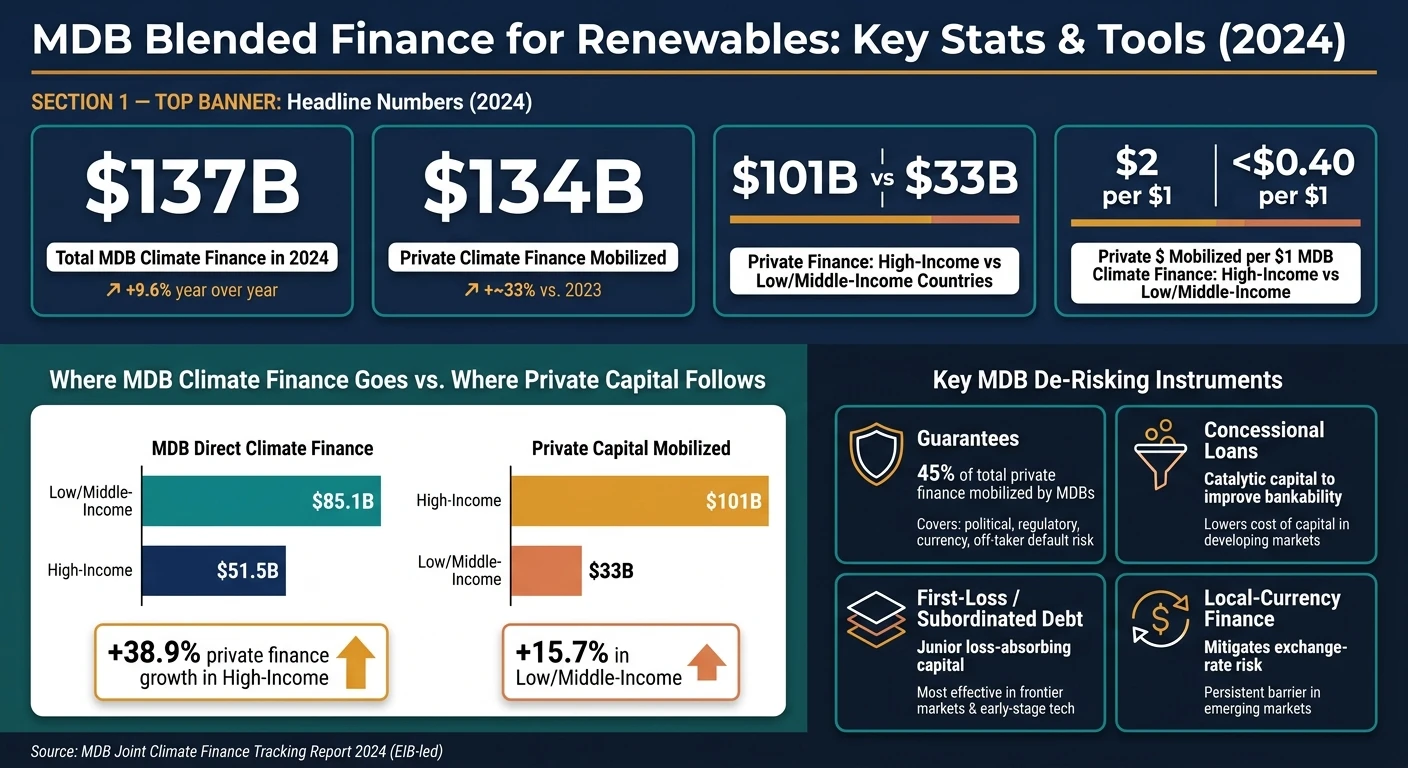
Right away, the numbers show the split. In 2024, MDBs delivered $137 billion in climate finance and mobilized $134 billion in private climate finance. But private money still flowed far more to high-income countries: $101 billion there versus $33 billion in low- and middle-income economies. That tells me one thing very clearly: capital is not the only problem; risk is.
If you want the short version, here it is:
MDBs lower risk so private lenders and investors can join renewable projects.
Guarantees are a main tool and account for 45% of total private finance mobilized by MDBs.
Concessional loans and first-loss capital help make weak projects bankable.
Local-currency finance matters when project revenue and debt are in different currencies.
One tool is usually not enough; stacked structures tend to work better.
Weak policy, weak utilities, and poor deal design can still stop a project even with blended finance.
Governance matters: reporting, additionality, community impacts, and safeguards shape whether deals hold up over time.
A quick comparison makes the pattern easy to see:
Area | What the article shows |
|---|---|
Main MDB role | Reduce project risk and bring in private capital |
Top tools | Guarantees, concessional loans, subordinated/first-loss capital, local-currency finance |
What helps deals close | Bankable PPAs, stable rules, strong off-takers, solid project prep |
Main weak points | Currency mismatch, policy shifts, utility weakness, poor structuring |
Key market gap | Private finance is much stronger in high-income countries than in low- and middle-income ones |
Bottom line | Blended finance can support renewable growth, but it cannot fix weak market conditions by itself |
What I take from the article is simple: MDB blended finance is less about handing out money and more about fixing the exact risks that keep private capital out.
Mobilizing the Private Sector: How MDBs Can Step Up Their Catalytic Role
What Recent Studies Say About MDB Renewable Energy Finance
Recent studies show a clear split in the market. MDB climate finance is going up, but private capital still flows much more heavily into high-income countries. The research usually falls into three buckets: MDB tracking reports, project-level studies, and policy guidance. MDB joint reports, including the annual climate finance tracking report led by the European Investment Bank (EIB), give the broadest numerical view. Project-level studies dig into how particular financing tools change deal bankability. Policy guidance focuses on the nuts and bolts of structuring deals, planning exits, and layering risk. Put together, these sources point to the same theme: MDB support is growing, but mobilization is still uneven across markets and project types.
Trends in MDB Support for Renewables
In 2024, MDBs delivered $137 billion in climate finance, up 9.6% year over year [1]. They also mobilized $134 billion in private climate finance, an increase of about one-third compared with 2023 [1].
The gap between where MDB money goes and where private money follows is hard to miss. MDBs directed $85.1 billion in direct climate finance to low- and middle-income countries, compared with $51.5 billion to high-income countries [1]. But private capital mobilized in high-income countries reached $101 billion, while low- and middle-income countries drew only $33 billion [1]. Growth rates tell the same story. Private finance increased 38.9% in high-income countries versus 15.7% in low- and middle-income nations [1].
Portfolio mix shows another divide. In low- and middle-income countries, 69% of MDB climate finance went to mitigation. In high-income markets, that share rose to 90% [1]. MDBs are also moving past utility-scale solar and wind into distributed generation, storage, and grid upgrades through facilities such as the IFC Risk Mitigation Facility and the IFC Blended Finance Facility. Those projects tend to need more layered risk support, which helps explain why recent research spends less time on headline volume and more time on the tools MDBs use to shift risk.
Blended Finance Tools MDBs Use to De-Risk Renewable Projects
The tougher a renewable project is to finance, the more MDBs lean on layered risk-sharing tools. Recent studies show they do not depend on one instrument alone. They use a toolkit, and it works best when those tools sit together in the capital stack. The table below sums up the main options.
Instrument | Capital-stack role | Risk covered | Mobilization Evidence |
|---|---|---|---|
Guarantees | Credit enhancer | Political, regulatory, currency, and off-taker default risk | Accounts for 45% of the total private finance raised by MDBs [2] |
Concessional Loans | Catalytic capital | High cost of capital; bankability | Essential for climate resilience and mitigation in developing nations [2] |
First-Loss / Subordinated Debt | Junior loss-absorbing capital | Early-stage loss exposure for senior lenders | Most effective in frontier markets and early-stage technologies [2] |
Local-Currency Finance | Currency risk mitigation | Exchange rate volatility | Identified as a persistent barrier in emerging markets [2] |
Guarantees, Political Risk Coverage, and Credit Enhancement
Guarantees are one of the main ways MDBs mobilize private money. If a private lender knows political, regulatory, or payment risks are covered, the project starts to look financeable instead of fragile. That shift matters. A deal that seemed too risky on paper can suddenly clear an investment committee.
Political risk coverage, including backing from institutions like MIGA, cuts many of the same risks for private investors. This matters even more when the off-taker is a state-owned utility. In those cases, concerns about delayed payments, policy shifts, or contract enforcement can stall a project before it starts.
When guarantees still leave a gap, concessional capital usually steps in.
Concessional Loans, Subordinated Capital, and First-Loss Structures
Concessional loans provide catalytic capital that improves bankability and lowers the cost of capital [2]. In plain terms, they help a project get over the line when commercial terms alone won't do it.
First-loss equity and subordinated debt follow the same idea. The MDB or concessional fund takes the first hit if the project underperforms. That gives senior lenders more protection and improves the risk-return profile for commercial participants. It also helps close financing gaps that might otherwise keep a project stuck in limbo.
This approach tends to matter most in places and project types where private lenders are extra cautious, especially frontier markets and early-stage technologies [2].
Local-Currency Finance and Layered Capital Structures
For projects that earn revenue in local currency, exchange-rate risk often becomes the next hurdle. A project may look sound on the ground, but if debt is priced in a hard currency while revenues come in local currency, the numbers can fall apart fast.
That is why currency mismatch remains one of the most persistent barriers in emerging-market renewable finance, where private capital is least willing to move [2]. MDBs use local-currency lending to reduce that mismatch and make repayment terms line up better with project cash flows.
Research also points to layered capital structures that combine technical assistance grants with concessional and commercial finance. Think of it as doing the prep work before asking private investors to jump in. Technical assistance can pay for feasibility studies and legal work, which lowers project-preparation costs and improves bankability.
Evidence on Mobilization: What Studies and Case Examples Show
MDB Blended Finance for Renewables: Key Stats & Tools (2024)
The financing tools above matter only when they pull in private money in the real world. That’s the test that counts. The data and case examples below show where that happens, and where it still falls apart.
What the Data Shows About Mobilizing Private Capital
In 2024, MDBs mobilized nearly $2 in private finance for every $1 of climate finance in high-income countries, but less than $0.40 for every $1 in low- and middle-income countries [1]. Over the same period, private finance mobilization increased by 38.9% in high-income countries, compared with 15.7% in low- and middle-income countries [1].
That gap is hard to ignore. It shows that mobilization is not just about having capital on the table. It depends on whether a project can clear the hurdles that private investors care about most: payment certainty, policy stability, currency risk, and a clear path to returns.
The same pattern shows up at the project level, where deal structure and market conditions often decide whether private capital steps in or stays on the sidelines.
Case-Study Patterns Across Solar, Wind, Storage, and Grid-Linked Projects
Across solar, wind, storage, and grid-linked projects, deals tend to close more often when several risk-sharing tools are stacked together. In plain terms, one tool usually isn’t enough. Grants may help lower early-stage risk. Concessional debt can improve project economics. Private capital can then come in once the base looks solid.
Case studies point to the same set of conditions again and again. These tools tend to work best when projects also have:
bankable PPAs
stable regulation
credible off-takers
Currency mismatch keeps showing up as a deal breaker, especially in long-tenor projects. That problem can turn a workable deal into a shaky one fast. A project may look fine on paper, but if revenues come in local currency and debt payments sit in hard currency, the numbers can go sideways over time.
That’s why layered structures appear so often in the literature. They usually combine grants, concessional debt, and private capital in sequence, with each piece handling a different problem. It’s less like flipping a switch and more like building a bridge one span at a time.
Grid-constrained projects and projects with uncertain cash flows are still much harder to finance. Even when the underlying need is clear, investors hesitate if power can’t move reliably through the grid or if revenue streams are hard to model.
But even a well-built financing structure can’t paper over deeper problems. If policy risk, utility weakness, or off-taker risk remains unsettled, deals still fail.
Where Blended Finance Falls Short on Its Own
Blended finance has limits, and the weak spots are pretty clear. If policy is shaky or utility balance sheets are weak, bankability can remain out of reach even with layered funding in place.
Poor structuring creates another problem. Concessional capital can end up backing projects that would have moved ahead anyway, which means scarce funds are spent where they weren’t needed. That’s a bad trade when the goal is to bring new deals over the line, not just make existing ones cheaper.
There’s also a downside to guarantees that are too generous. They can dull investor discipline and let weak projects move ahead with less scrutiny [2]. In other words, protection can help, but too much of it can distort the market.
Adaptation projects remain among the hardest to finance with blended structures alone. Many of them don’t produce the kind of steady, easy-to-model cash flows that private investors want to see, which makes mobilization much tougher even when public or concessional support is in the mix.
Governance, Key Takeaways, and Conclusion
Governance Issues the Research Flags
Mobilization data can show whether MDBs attract private capital. Governance shows whether that money is used well. That’s the point where blended finance moves from theory to outcomes: how funds are allocated, who gets the gains, and whether projects hold up over time. Recent studies keep pointing to four recurring issues that can weaken MDB-led blended finance in renewable energy.
Governance Issue | Why It Matters | Main Recommendations |
|---|---|---|
Reporting Consistency | Lack of standardized data makes it difficult to track actual private capital mobilization across MDBs. | Adopt international reporting standards and transparent data-sharing across institutions. |
Additionality | Public funds risk backing projects that private capital would have financed anyway. | Apply rigorous minimum-concessionality tests to ensure support goes only where it is genuinely needed. |
Community Benefits | Uneven benefit distribution or land disputes can delay or cancel projects entirely. | Use proactive stakeholder dialogue and formal socio-economic impact assessments before project approval. |
Environmental & Social Safeguards | Weak safeguards can cause ecological harm and reduce institutional investor interest. | Align project structures with international ESG standards and local environmental protections. |
These issues matter because they shape more than project delivery. They also influence whether investors come back for the next deal.
Trust can also fall apart when policy shifts without warning. The U.S. offshore wind lease cancellations, which led to about $2.7 billion in reimbursements, show how fast public backing can flip into a negative market signal [1].
What Decision-Makers Should Take From the Evidence
Blended finance tends to work best when it sits next to credible policy, strong project preparation, and a clear route to commercial operation.
Execution is the hard part. Early-stage costs like feasibility work, permitting, and legal structuring often stop deals before investors even step in. In plain terms, many projects don’t fail for lack of money alone; they fail because the groundwork isn’t ready. Closing that gap takes technical capacity, local know-how, and institutions that can move a project from concept to bankable structure.
Conclusion: The Clearest Findings From Current Research
MDBs still play a central role in de-risking renewable energy finance in markets where private capital will not move on its own. Instrument choice matters. Guarantees, concessional debt, and local-currency structures each solve different problems. But the research points in one direction: governance and long-term implementation capacity are what separate deals that close and deliver from those that stall.
FAQs
Why do MDBs matter in renewable finance?
Multilateral development banks (MDBs) play a big role in closing the gap between private investors and emerging markets. They do this through concessional finance, guarantees, and risk-sharing tools that bring down capital costs and reduce project risk. In plain terms, they help make projects easier for private investors to back.
Their presence can also strengthen investor confidence. Money is only part of the story. MDBs often bring local market knowledge, help build institutional capacity, and support regulatory reforms that make long-term renewable energy development more likely.
Which blended finance tools reduce risk most?
Guarantees are often one of the strongest tools in the mix. By shifting risks like political instability or currency swings from private lenders to public entities, they can mobilize 6 to 25 times more private investment than loans alone.
First-loss capital lowers risk in a different way. It absorbs the first round of losses, which gives private investors more room to step in with confidence. Concessional finance, such as below-market loans, works on the same basic problem from another angle: it improves the risk-return balance for private investors.
Why is private capital still limited in emerging markets?
Private capital is still scarce in many emerging markets, and the reason is pretty simple: investors see too much risk. Some of that risk is real, and some of it comes down to perception, but both shape decision-making. Political instability, currency swings, and uncertain rules can make investors hesitate or walk away altogether.
There’s another layer to this. Many of these markets don’t yet have a strong track record for newer climate technologies. Institutions may be weak, project pipelines may be thin, and upfront capital costs are often high. Put all of that together, and a lot of projects end up looking unbankable. Without de-risking tools in place, lenders tend to stick with bigger infrastructure deals that feel more predictable.
Related Blog Posts
Latest Articles
©2026

Narrative Change and Power Building: The Missing Half of Advocacy
Narrative change is the process of disrupting dominant narratives that normalize inequity and advancing new narratives from historically marginalized communities.

Funding Resilience Without Federal Grants
BRIC is unreliable and FEMA is shrinking. Here's how cities fund climate resilience with dedicated revenue, blended finance, and a coordinating authority.

The ESG Blind Spot: How AI Is Finding Risks in Companies Nobody Else Is Watching
Norway's sovereign wealth fund uses AI to screen 7,200 portfolio companies for forced labor and corruption within 24 hours. The real story is the emerging-market coverage gap that traditional ESG data vendors miss — and what it means for any company with a global supply chain.
Narrative Change and Power Building: The Missing Half of Advocacy
Narrative change is the process of disrupting dominant narratives that normalize inequity and advancing new narratives from historically marginalized communities.
Funding Resilience Without Federal Grants
BRIC is unreliable and FEMA is shrinking. Here's how cities fund climate resilience with dedicated revenue, blended finance, and a coordinating authority.
The ESG Blind Spot: How AI Is Finding Risks in Companies Nobody Else Is Watching
Norway's sovereign wealth fund uses AI to screen 7,200 portfolio companies for forced labor and corruption within 24 hours. The real story is the emerging-market coverage gap that traditional ESG data vendors miss — and what it means for any company with a global supply chain.
FAQ
01
What does it really mean to “redefine profit”?
02
What makes Council Fire different?
03
Who does Council Fire work with?
04
What does working with Council Fire actually look like?
05
How does Council Fire help organizations turn big goals into action?
06
How does Council Fire define and measure success?
07
How does technology fit into Council Fire’s work?
Jul 22, 2026
Role of MDBs in Blended Finance for Renewables
Sustainability Strategy
In This Article
How MDBs use guarantees, concessional loans, first-loss capital and local currency to de-risk renewables and mobilize private finance.
Role of MDBs in Blended Finance for Renewables
MDBs help renewable energy deals move forward when private investors will not take the risk alone. From the article, I’d boil it down to this: blended finance works best when MDBs use the right mix of guarantees, concessional loans, first-loss capital, and local-currency finance and when policy, utilities, and project prep are strong enough to support the deal.
Right away, the numbers show the split. In 2024, MDBs delivered $137 billion in climate finance and mobilized $134 billion in private climate finance. But private money still flowed far more to high-income countries: $101 billion there versus $33 billion in low- and middle-income economies. That tells me one thing very clearly: capital is not the only problem; risk is.
If you want the short version, here it is:
MDBs lower risk so private lenders and investors can join renewable projects.
Guarantees are a main tool and account for 45% of total private finance mobilized by MDBs.
Concessional loans and first-loss capital help make weak projects bankable.
Local-currency finance matters when project revenue and debt are in different currencies.
One tool is usually not enough; stacked structures tend to work better.
Weak policy, weak utilities, and poor deal design can still stop a project even with blended finance.
Governance matters: reporting, additionality, community impacts, and safeguards shape whether deals hold up over time.
A quick comparison makes the pattern easy to see:
Area | What the article shows |
|---|---|
Main MDB role | Reduce project risk and bring in private capital |
Top tools | Guarantees, concessional loans, subordinated/first-loss capital, local-currency finance |
What helps deals close | Bankable PPAs, stable rules, strong off-takers, solid project prep |
Main weak points | Currency mismatch, policy shifts, utility weakness, poor structuring |
Key market gap | Private finance is much stronger in high-income countries than in low- and middle-income ones |
Bottom line | Blended finance can support renewable growth, but it cannot fix weak market conditions by itself |
What I take from the article is simple: MDB blended finance is less about handing out money and more about fixing the exact risks that keep private capital out.
Mobilizing the Private Sector: How MDBs Can Step Up Their Catalytic Role
What Recent Studies Say About MDB Renewable Energy Finance
Recent studies show a clear split in the market. MDB climate finance is going up, but private capital still flows much more heavily into high-income countries. The research usually falls into three buckets: MDB tracking reports, project-level studies, and policy guidance. MDB joint reports, including the annual climate finance tracking report led by the European Investment Bank (EIB), give the broadest numerical view. Project-level studies dig into how particular financing tools change deal bankability. Policy guidance focuses on the nuts and bolts of structuring deals, planning exits, and layering risk. Put together, these sources point to the same theme: MDB support is growing, but mobilization is still uneven across markets and project types.
Trends in MDB Support for Renewables
In 2024, MDBs delivered $137 billion in climate finance, up 9.6% year over year [1]. They also mobilized $134 billion in private climate finance, an increase of about one-third compared with 2023 [1].
The gap between where MDB money goes and where private money follows is hard to miss. MDBs directed $85.1 billion in direct climate finance to low- and middle-income countries, compared with $51.5 billion to high-income countries [1]. But private capital mobilized in high-income countries reached $101 billion, while low- and middle-income countries drew only $33 billion [1]. Growth rates tell the same story. Private finance increased 38.9% in high-income countries versus 15.7% in low- and middle-income nations [1].
Portfolio mix shows another divide. In low- and middle-income countries, 69% of MDB climate finance went to mitigation. In high-income markets, that share rose to 90% [1]. MDBs are also moving past utility-scale solar and wind into distributed generation, storage, and grid upgrades through facilities such as the IFC Risk Mitigation Facility and the IFC Blended Finance Facility. Those projects tend to need more layered risk support, which helps explain why recent research spends less time on headline volume and more time on the tools MDBs use to shift risk.
Blended Finance Tools MDBs Use to De-Risk Renewable Projects
The tougher a renewable project is to finance, the more MDBs lean on layered risk-sharing tools. Recent studies show they do not depend on one instrument alone. They use a toolkit, and it works best when those tools sit together in the capital stack. The table below sums up the main options.
Instrument | Capital-stack role | Risk covered | Mobilization Evidence |
|---|---|---|---|
Guarantees | Credit enhancer | Political, regulatory, currency, and off-taker default risk | Accounts for 45% of the total private finance raised by MDBs [2] |
Concessional Loans | Catalytic capital | High cost of capital; bankability | Essential for climate resilience and mitigation in developing nations [2] |
First-Loss / Subordinated Debt | Junior loss-absorbing capital | Early-stage loss exposure for senior lenders | Most effective in frontier markets and early-stage technologies [2] |
Local-Currency Finance | Currency risk mitigation | Exchange rate volatility | Identified as a persistent barrier in emerging markets [2] |
Guarantees, Political Risk Coverage, and Credit Enhancement
Guarantees are one of the main ways MDBs mobilize private money. If a private lender knows political, regulatory, or payment risks are covered, the project starts to look financeable instead of fragile. That shift matters. A deal that seemed too risky on paper can suddenly clear an investment committee.
Political risk coverage, including backing from institutions like MIGA, cuts many of the same risks for private investors. This matters even more when the off-taker is a state-owned utility. In those cases, concerns about delayed payments, policy shifts, or contract enforcement can stall a project before it starts.
When guarantees still leave a gap, concessional capital usually steps in.
Concessional Loans, Subordinated Capital, and First-Loss Structures
Concessional loans provide catalytic capital that improves bankability and lowers the cost of capital [2]. In plain terms, they help a project get over the line when commercial terms alone won't do it.
First-loss equity and subordinated debt follow the same idea. The MDB or concessional fund takes the first hit if the project underperforms. That gives senior lenders more protection and improves the risk-return profile for commercial participants. It also helps close financing gaps that might otherwise keep a project stuck in limbo.
This approach tends to matter most in places and project types where private lenders are extra cautious, especially frontier markets and early-stage technologies [2].
Local-Currency Finance and Layered Capital Structures
For projects that earn revenue in local currency, exchange-rate risk often becomes the next hurdle. A project may look sound on the ground, but if debt is priced in a hard currency while revenues come in local currency, the numbers can fall apart fast.
That is why currency mismatch remains one of the most persistent barriers in emerging-market renewable finance, where private capital is least willing to move [2]. MDBs use local-currency lending to reduce that mismatch and make repayment terms line up better with project cash flows.
Research also points to layered capital structures that combine technical assistance grants with concessional and commercial finance. Think of it as doing the prep work before asking private investors to jump in. Technical assistance can pay for feasibility studies and legal work, which lowers project-preparation costs and improves bankability.
Evidence on Mobilization: What Studies and Case Examples Show
MDB Blended Finance for Renewables: Key Stats & Tools (2024)
The financing tools above matter only when they pull in private money in the real world. That’s the test that counts. The data and case examples below show where that happens, and where it still falls apart.
What the Data Shows About Mobilizing Private Capital
In 2024, MDBs mobilized nearly $2 in private finance for every $1 of climate finance in high-income countries, but less than $0.40 for every $1 in low- and middle-income countries [1]. Over the same period, private finance mobilization increased by 38.9% in high-income countries, compared with 15.7% in low- and middle-income countries [1].
That gap is hard to ignore. It shows that mobilization is not just about having capital on the table. It depends on whether a project can clear the hurdles that private investors care about most: payment certainty, policy stability, currency risk, and a clear path to returns.
The same pattern shows up at the project level, where deal structure and market conditions often decide whether private capital steps in or stays on the sidelines.
Case-Study Patterns Across Solar, Wind, Storage, and Grid-Linked Projects
Across solar, wind, storage, and grid-linked projects, deals tend to close more often when several risk-sharing tools are stacked together. In plain terms, one tool usually isn’t enough. Grants may help lower early-stage risk. Concessional debt can improve project economics. Private capital can then come in once the base looks solid.
Case studies point to the same set of conditions again and again. These tools tend to work best when projects also have:
bankable PPAs
stable regulation
credible off-takers
Currency mismatch keeps showing up as a deal breaker, especially in long-tenor projects. That problem can turn a workable deal into a shaky one fast. A project may look fine on paper, but if revenues come in local currency and debt payments sit in hard currency, the numbers can go sideways over time.
That’s why layered structures appear so often in the literature. They usually combine grants, concessional debt, and private capital in sequence, with each piece handling a different problem. It’s less like flipping a switch and more like building a bridge one span at a time.
Grid-constrained projects and projects with uncertain cash flows are still much harder to finance. Even when the underlying need is clear, investors hesitate if power can’t move reliably through the grid or if revenue streams are hard to model.
But even a well-built financing structure can’t paper over deeper problems. If policy risk, utility weakness, or off-taker risk remains unsettled, deals still fail.
Where Blended Finance Falls Short on Its Own
Blended finance has limits, and the weak spots are pretty clear. If policy is shaky or utility balance sheets are weak, bankability can remain out of reach even with layered funding in place.
Poor structuring creates another problem. Concessional capital can end up backing projects that would have moved ahead anyway, which means scarce funds are spent where they weren’t needed. That’s a bad trade when the goal is to bring new deals over the line, not just make existing ones cheaper.
There’s also a downside to guarantees that are too generous. They can dull investor discipline and let weak projects move ahead with less scrutiny [2]. In other words, protection can help, but too much of it can distort the market.
Adaptation projects remain among the hardest to finance with blended structures alone. Many of them don’t produce the kind of steady, easy-to-model cash flows that private investors want to see, which makes mobilization much tougher even when public or concessional support is in the mix.
Governance, Key Takeaways, and Conclusion
Governance Issues the Research Flags
Mobilization data can show whether MDBs attract private capital. Governance shows whether that money is used well. That’s the point where blended finance moves from theory to outcomes: how funds are allocated, who gets the gains, and whether projects hold up over time. Recent studies keep pointing to four recurring issues that can weaken MDB-led blended finance in renewable energy.
Governance Issue | Why It Matters | Main Recommendations |
|---|---|---|
Reporting Consistency | Lack of standardized data makes it difficult to track actual private capital mobilization across MDBs. | Adopt international reporting standards and transparent data-sharing across institutions. |
Additionality | Public funds risk backing projects that private capital would have financed anyway. | Apply rigorous minimum-concessionality tests to ensure support goes only where it is genuinely needed. |
Community Benefits | Uneven benefit distribution or land disputes can delay or cancel projects entirely. | Use proactive stakeholder dialogue and formal socio-economic impact assessments before project approval. |
Environmental & Social Safeguards | Weak safeguards can cause ecological harm and reduce institutional investor interest. | Align project structures with international ESG standards and local environmental protections. |
These issues matter because they shape more than project delivery. They also influence whether investors come back for the next deal.
Trust can also fall apart when policy shifts without warning. The U.S. offshore wind lease cancellations, which led to about $2.7 billion in reimbursements, show how fast public backing can flip into a negative market signal [1].
What Decision-Makers Should Take From the Evidence
Blended finance tends to work best when it sits next to credible policy, strong project preparation, and a clear route to commercial operation.
Execution is the hard part. Early-stage costs like feasibility work, permitting, and legal structuring often stop deals before investors even step in. In plain terms, many projects don’t fail for lack of money alone; they fail because the groundwork isn’t ready. Closing that gap takes technical capacity, local know-how, and institutions that can move a project from concept to bankable structure.
Conclusion: The Clearest Findings From Current Research
MDBs still play a central role in de-risking renewable energy finance in markets where private capital will not move on its own. Instrument choice matters. Guarantees, concessional debt, and local-currency structures each solve different problems. But the research points in one direction: governance and long-term implementation capacity are what separate deals that close and deliver from those that stall.
FAQs
Why do MDBs matter in renewable finance?
Multilateral development banks (MDBs) play a big role in closing the gap between private investors and emerging markets. They do this through concessional finance, guarantees, and risk-sharing tools that bring down capital costs and reduce project risk. In plain terms, they help make projects easier for private investors to back.
Their presence can also strengthen investor confidence. Money is only part of the story. MDBs often bring local market knowledge, help build institutional capacity, and support regulatory reforms that make long-term renewable energy development more likely.
Which blended finance tools reduce risk most?
Guarantees are often one of the strongest tools in the mix. By shifting risks like political instability or currency swings from private lenders to public entities, they can mobilize 6 to 25 times more private investment than loans alone.
First-loss capital lowers risk in a different way. It absorbs the first round of losses, which gives private investors more room to step in with confidence. Concessional finance, such as below-market loans, works on the same basic problem from another angle: it improves the risk-return balance for private investors.
Why is private capital still limited in emerging markets?
Private capital is still scarce in many emerging markets, and the reason is pretty simple: investors see too much risk. Some of that risk is real, and some of it comes down to perception, but both shape decision-making. Political instability, currency swings, and uncertain rules can make investors hesitate or walk away altogether.
There’s another layer to this. Many of these markets don’t yet have a strong track record for newer climate technologies. Institutions may be weak, project pipelines may be thin, and upfront capital costs are often high. Put all of that together, and a lot of projects end up looking unbankable. Without de-risking tools in place, lenders tend to stick with bigger infrastructure deals that feel more predictable.
Related Blog Posts
Latest Articles
©2026
Narrative Change and Power Building: The Missing Half of Advocacy
Narrative change is the process of disrupting dominant narratives that normalize inequity and advancing new narratives from historically marginalized communities.
Funding Resilience Without Federal Grants
BRIC is unreliable and FEMA is shrinking. Here's how cities fund climate resilience with dedicated revenue, blended finance, and a coordinating authority.
The ESG Blind Spot: How AI Is Finding Risks in Companies Nobody Else Is Watching
Norway's sovereign wealth fund uses AI to screen 7,200 portfolio companies for forced labor and corruption within 24 hours. The real story is the emerging-market coverage gap that traditional ESG data vendors miss — and what it means for any company with a global supply chain.
FAQ
01
What does it really mean to “redefine profit”?
02
What makes Council Fire different?
03
Who does Council Fire work with?
04
What does working with Council Fire actually look like?
05
How does Council Fire help organizations turn big goals into action?
06
How does Council Fire define and measure success?
07
How does technology fit into Council Fire’s work?
Jul 22, 2026
Role of MDBs in Blended Finance for Renewables
Sustainability Strategy
In This Article
How MDBs use guarantees, concessional loans, first-loss capital and local currency to de-risk renewables and mobilize private finance.
Role of MDBs in Blended Finance for Renewables
MDBs help renewable energy deals move forward when private investors will not take the risk alone. From the article, I’d boil it down to this: blended finance works best when MDBs use the right mix of guarantees, concessional loans, first-loss capital, and local-currency finance and when policy, utilities, and project prep are strong enough to support the deal.
Right away, the numbers show the split. In 2024, MDBs delivered $137 billion in climate finance and mobilized $134 billion in private climate finance. But private money still flowed far more to high-income countries: $101 billion there versus $33 billion in low- and middle-income economies. That tells me one thing very clearly: capital is not the only problem; risk is.
If you want the short version, here it is:
MDBs lower risk so private lenders and investors can join renewable projects.
Guarantees are a main tool and account for 45% of total private finance mobilized by MDBs.
Concessional loans and first-loss capital help make weak projects bankable.
Local-currency finance matters when project revenue and debt are in different currencies.
One tool is usually not enough; stacked structures tend to work better.
Weak policy, weak utilities, and poor deal design can still stop a project even with blended finance.
Governance matters: reporting, additionality, community impacts, and safeguards shape whether deals hold up over time.
A quick comparison makes the pattern easy to see:
Area | What the article shows |
|---|---|
Main MDB role | Reduce project risk and bring in private capital |
Top tools | Guarantees, concessional loans, subordinated/first-loss capital, local-currency finance |
What helps deals close | Bankable PPAs, stable rules, strong off-takers, solid project prep |
Main weak points | Currency mismatch, policy shifts, utility weakness, poor structuring |
Key market gap | Private finance is much stronger in high-income countries than in low- and middle-income ones |
Bottom line | Blended finance can support renewable growth, but it cannot fix weak market conditions by itself |
What I take from the article is simple: MDB blended finance is less about handing out money and more about fixing the exact risks that keep private capital out.
Mobilizing the Private Sector: How MDBs Can Step Up Their Catalytic Role
What Recent Studies Say About MDB Renewable Energy Finance
Recent studies show a clear split in the market. MDB climate finance is going up, but private capital still flows much more heavily into high-income countries. The research usually falls into three buckets: MDB tracking reports, project-level studies, and policy guidance. MDB joint reports, including the annual climate finance tracking report led by the European Investment Bank (EIB), give the broadest numerical view. Project-level studies dig into how particular financing tools change deal bankability. Policy guidance focuses on the nuts and bolts of structuring deals, planning exits, and layering risk. Put together, these sources point to the same theme: MDB support is growing, but mobilization is still uneven across markets and project types.
Trends in MDB Support for Renewables
In 2024, MDBs delivered $137 billion in climate finance, up 9.6% year over year [1]. They also mobilized $134 billion in private climate finance, an increase of about one-third compared with 2023 [1].
The gap between where MDB money goes and where private money follows is hard to miss. MDBs directed $85.1 billion in direct climate finance to low- and middle-income countries, compared with $51.5 billion to high-income countries [1]. But private capital mobilized in high-income countries reached $101 billion, while low- and middle-income countries drew only $33 billion [1]. Growth rates tell the same story. Private finance increased 38.9% in high-income countries versus 15.7% in low- and middle-income nations [1].
Portfolio mix shows another divide. In low- and middle-income countries, 69% of MDB climate finance went to mitigation. In high-income markets, that share rose to 90% [1]. MDBs are also moving past utility-scale solar and wind into distributed generation, storage, and grid upgrades through facilities such as the IFC Risk Mitigation Facility and the IFC Blended Finance Facility. Those projects tend to need more layered risk support, which helps explain why recent research spends less time on headline volume and more time on the tools MDBs use to shift risk.
Blended Finance Tools MDBs Use to De-Risk Renewable Projects
The tougher a renewable project is to finance, the more MDBs lean on layered risk-sharing tools. Recent studies show they do not depend on one instrument alone. They use a toolkit, and it works best when those tools sit together in the capital stack. The table below sums up the main options.
Instrument | Capital-stack role | Risk covered | Mobilization Evidence |
|---|---|---|---|
Guarantees | Credit enhancer | Political, regulatory, currency, and off-taker default risk | Accounts for 45% of the total private finance raised by MDBs [2] |
Concessional Loans | Catalytic capital | High cost of capital; bankability | Essential for climate resilience and mitigation in developing nations [2] |
First-Loss / Subordinated Debt | Junior loss-absorbing capital | Early-stage loss exposure for senior lenders | Most effective in frontier markets and early-stage technologies [2] |
Local-Currency Finance | Currency risk mitigation | Exchange rate volatility | Identified as a persistent barrier in emerging markets [2] |
Guarantees, Political Risk Coverage, and Credit Enhancement
Guarantees are one of the main ways MDBs mobilize private money. If a private lender knows political, regulatory, or payment risks are covered, the project starts to look financeable instead of fragile. That shift matters. A deal that seemed too risky on paper can suddenly clear an investment committee.
Political risk coverage, including backing from institutions like MIGA, cuts many of the same risks for private investors. This matters even more when the off-taker is a state-owned utility. In those cases, concerns about delayed payments, policy shifts, or contract enforcement can stall a project before it starts.
When guarantees still leave a gap, concessional capital usually steps in.
Concessional Loans, Subordinated Capital, and First-Loss Structures
Concessional loans provide catalytic capital that improves bankability and lowers the cost of capital [2]. In plain terms, they help a project get over the line when commercial terms alone won't do it.
First-loss equity and subordinated debt follow the same idea. The MDB or concessional fund takes the first hit if the project underperforms. That gives senior lenders more protection and improves the risk-return profile for commercial participants. It also helps close financing gaps that might otherwise keep a project stuck in limbo.
This approach tends to matter most in places and project types where private lenders are extra cautious, especially frontier markets and early-stage technologies [2].
Local-Currency Finance and Layered Capital Structures
For projects that earn revenue in local currency, exchange-rate risk often becomes the next hurdle. A project may look sound on the ground, but if debt is priced in a hard currency while revenues come in local currency, the numbers can fall apart fast.
That is why currency mismatch remains one of the most persistent barriers in emerging-market renewable finance, where private capital is least willing to move [2]. MDBs use local-currency lending to reduce that mismatch and make repayment terms line up better with project cash flows.
Research also points to layered capital structures that combine technical assistance grants with concessional and commercial finance. Think of it as doing the prep work before asking private investors to jump in. Technical assistance can pay for feasibility studies and legal work, which lowers project-preparation costs and improves bankability.
Evidence on Mobilization: What Studies and Case Examples Show
MDB Blended Finance for Renewables: Key Stats & Tools (2024)
The financing tools above matter only when they pull in private money in the real world. That’s the test that counts. The data and case examples below show where that happens, and where it still falls apart.
What the Data Shows About Mobilizing Private Capital
In 2024, MDBs mobilized nearly $2 in private finance for every $1 of climate finance in high-income countries, but less than $0.40 for every $1 in low- and middle-income countries [1]. Over the same period, private finance mobilization increased by 38.9% in high-income countries, compared with 15.7% in low- and middle-income countries [1].
That gap is hard to ignore. It shows that mobilization is not just about having capital on the table. It depends on whether a project can clear the hurdles that private investors care about most: payment certainty, policy stability, currency risk, and a clear path to returns.
The same pattern shows up at the project level, where deal structure and market conditions often decide whether private capital steps in or stays on the sidelines.
Case-Study Patterns Across Solar, Wind, Storage, and Grid-Linked Projects
Across solar, wind, storage, and grid-linked projects, deals tend to close more often when several risk-sharing tools are stacked together. In plain terms, one tool usually isn’t enough. Grants may help lower early-stage risk. Concessional debt can improve project economics. Private capital can then come in once the base looks solid.
Case studies point to the same set of conditions again and again. These tools tend to work best when projects also have:
bankable PPAs
stable regulation
credible off-takers
Currency mismatch keeps showing up as a deal breaker, especially in long-tenor projects. That problem can turn a workable deal into a shaky one fast. A project may look fine on paper, but if revenues come in local currency and debt payments sit in hard currency, the numbers can go sideways over time.
That’s why layered structures appear so often in the literature. They usually combine grants, concessional debt, and private capital in sequence, with each piece handling a different problem. It’s less like flipping a switch and more like building a bridge one span at a time.
Grid-constrained projects and projects with uncertain cash flows are still much harder to finance. Even when the underlying need is clear, investors hesitate if power can’t move reliably through the grid or if revenue streams are hard to model.
But even a well-built financing structure can’t paper over deeper problems. If policy risk, utility weakness, or off-taker risk remains unsettled, deals still fail.
Where Blended Finance Falls Short on Its Own
Blended finance has limits, and the weak spots are pretty clear. If policy is shaky or utility balance sheets are weak, bankability can remain out of reach even with layered funding in place.
Poor structuring creates another problem. Concessional capital can end up backing projects that would have moved ahead anyway, which means scarce funds are spent where they weren’t needed. That’s a bad trade when the goal is to bring new deals over the line, not just make existing ones cheaper.
There’s also a downside to guarantees that are too generous. They can dull investor discipline and let weak projects move ahead with less scrutiny [2]. In other words, protection can help, but too much of it can distort the market.
Adaptation projects remain among the hardest to finance with blended structures alone. Many of them don’t produce the kind of steady, easy-to-model cash flows that private investors want to see, which makes mobilization much tougher even when public or concessional support is in the mix.
Governance, Key Takeaways, and Conclusion
Governance Issues the Research Flags
Mobilization data can show whether MDBs attract private capital. Governance shows whether that money is used well. That’s the point where blended finance moves from theory to outcomes: how funds are allocated, who gets the gains, and whether projects hold up over time. Recent studies keep pointing to four recurring issues that can weaken MDB-led blended finance in renewable energy.
Governance Issue | Why It Matters | Main Recommendations |
|---|---|---|
Reporting Consistency | Lack of standardized data makes it difficult to track actual private capital mobilization across MDBs. | Adopt international reporting standards and transparent data-sharing across institutions. |
Additionality | Public funds risk backing projects that private capital would have financed anyway. | Apply rigorous minimum-concessionality tests to ensure support goes only where it is genuinely needed. |
Community Benefits | Uneven benefit distribution or land disputes can delay or cancel projects entirely. | Use proactive stakeholder dialogue and formal socio-economic impact assessments before project approval. |
Environmental & Social Safeguards | Weak safeguards can cause ecological harm and reduce institutional investor interest. | Align project structures with international ESG standards and local environmental protections. |
These issues matter because they shape more than project delivery. They also influence whether investors come back for the next deal.
Trust can also fall apart when policy shifts without warning. The U.S. offshore wind lease cancellations, which led to about $2.7 billion in reimbursements, show how fast public backing can flip into a negative market signal [1].
What Decision-Makers Should Take From the Evidence
Blended finance tends to work best when it sits next to credible policy, strong project preparation, and a clear route to commercial operation.
Execution is the hard part. Early-stage costs like feasibility work, permitting, and legal structuring often stop deals before investors even step in. In plain terms, many projects don’t fail for lack of money alone; they fail because the groundwork isn’t ready. Closing that gap takes technical capacity, local know-how, and institutions that can move a project from concept to bankable structure.
Conclusion: The Clearest Findings From Current Research
MDBs still play a central role in de-risking renewable energy finance in markets where private capital will not move on its own. Instrument choice matters. Guarantees, concessional debt, and local-currency structures each solve different problems. But the research points in one direction: governance and long-term implementation capacity are what separate deals that close and deliver from those that stall.
FAQs
Why do MDBs matter in renewable finance?
Multilateral development banks (MDBs) play a big role in closing the gap between private investors and emerging markets. They do this through concessional finance, guarantees, and risk-sharing tools that bring down capital costs and reduce project risk. In plain terms, they help make projects easier for private investors to back.
Their presence can also strengthen investor confidence. Money is only part of the story. MDBs often bring local market knowledge, help build institutional capacity, and support regulatory reforms that make long-term renewable energy development more likely.
Which blended finance tools reduce risk most?
Guarantees are often one of the strongest tools in the mix. By shifting risks like political instability or currency swings from private lenders to public entities, they can mobilize 6 to 25 times more private investment than loans alone.
First-loss capital lowers risk in a different way. It absorbs the first round of losses, which gives private investors more room to step in with confidence. Concessional finance, such as below-market loans, works on the same basic problem from another angle: it improves the risk-return balance for private investors.
Why is private capital still limited in emerging markets?
Private capital is still scarce in many emerging markets, and the reason is pretty simple: investors see too much risk. Some of that risk is real, and some of it comes down to perception, but both shape decision-making. Political instability, currency swings, and uncertain rules can make investors hesitate or walk away altogether.
There’s another layer to this. Many of these markets don’t yet have a strong track record for newer climate technologies. Institutions may be weak, project pipelines may be thin, and upfront capital costs are often high. Put all of that together, and a lot of projects end up looking unbankable. Without de-risking tools in place, lenders tend to stick with bigger infrastructure deals that feel more predictable.
Related Blog Posts
Latest Articles
©2026
Narrative Change and Power Building: The Missing Half of Advocacy
Narrative change is the process of disrupting dominant narratives that normalize inequity and advancing new narratives from historically marginalized communities.
Funding Resilience Without Federal Grants
BRIC is unreliable and FEMA is shrinking. Here's how cities fund climate resilience with dedicated revenue, blended finance, and a coordinating authority.
The ESG Blind Spot: How AI Is Finding Risks in Companies Nobody Else Is Watching
Norway's sovereign wealth fund uses AI to screen 7,200 portfolio companies for forced labor and corruption within 24 hours. The real story is the emerging-market coverage gap that traditional ESG data vendors miss — and what it means for any company with a global supply chain.
FAQ
What does it really mean to “redefine profit”?
What makes Council Fire different?
Who does Council Fire work with?
What does working with Council Fire actually look like?
How does Council Fire help organizations turn big goals into action?
How does Council Fire define and measure success?
How does technology fit into Council Fire’s work?