May 26, 2026
How to Build a Blended Finance Model for Sustainability Initiatives for Maritime & Logistics Companies
Sustainability Strategy
In This Article
Step-by-step guide to structuring blended finance—mixing grants, concessional loans and private capital to fund maritime sustainability.
How to Build a Blended Finance Model for Sustainability Initiatives for Maritime & Logistics Companies
Blended finance can help maritime and logistics companies fund sustainability projects by combining public, philanthropic, and private capital. This approach reduces risks for private investors, making large-scale, impactful initiatives more feasible. Here's a step-by-step overview:
Assess needs: Identify emissions (Scope 1, 2, and 3) and risks, like stranded assets or regulatory changes, to pinpoint viable projects.
Structure financing: Use tools like grants, sustainability bonds, and concessional loans to balance risks and attract investors.
Define impact metrics: Set measurable goals for emissions, air quality, and fleet upgrades, ensuring accountability and transparency.
Scale efforts: Bundle projects or replicate successful models to attract larger investments and expand impact.
Key example: A U.S. port authority saved $125 million over five years by electrifying equipment and installing solar power, cutting emissions by 52%.
This guide simplifies the process of creating and scaling blended finance models, helping companies fund projects that tackle emissions, cut costs, and meet regulatory demands.
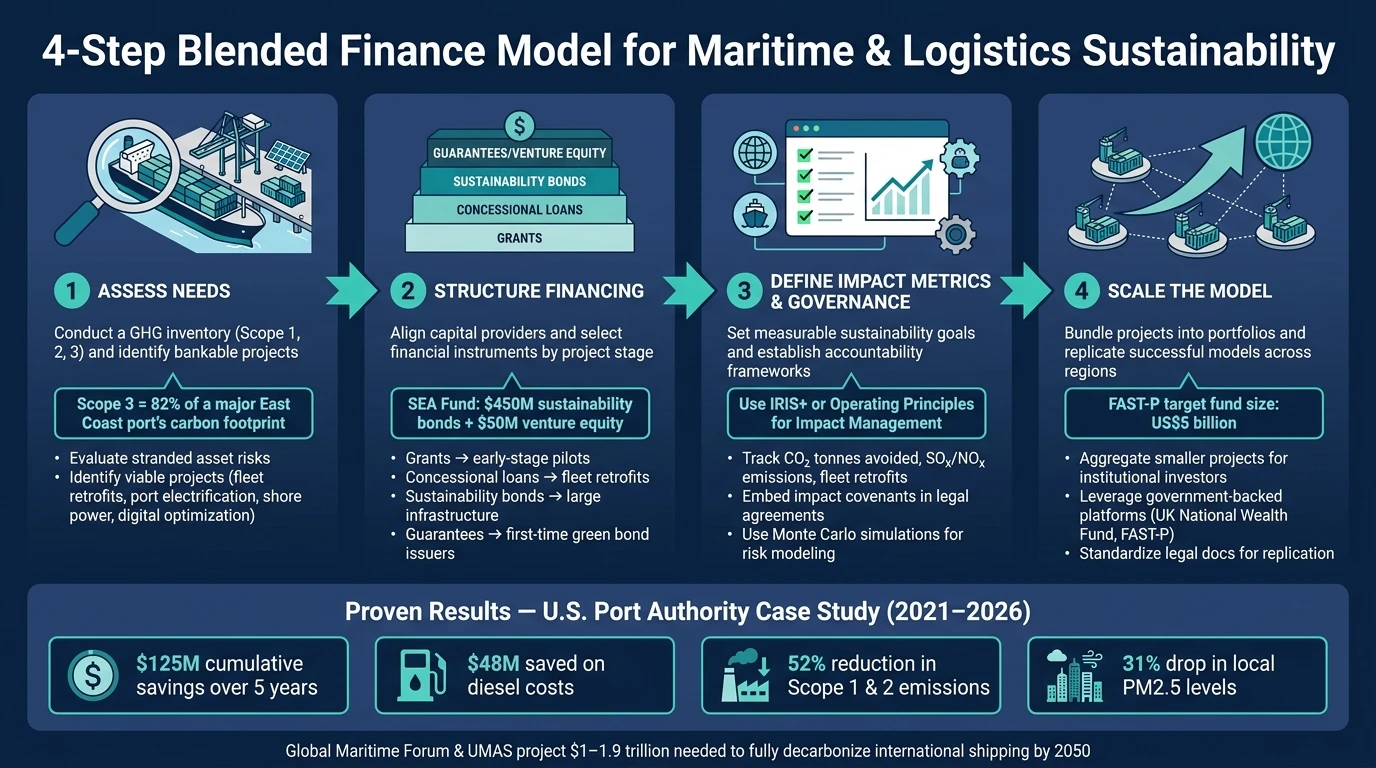
4-Step Blended Finance Model for Maritime & Logistics Sustainability
Step 1: Assess Your Sustainability Needs and Opportunities
Diagnosing Sustainability Challenges
To attract blended finance, you first need to pinpoint specific sustainability challenges. Start with a detailed greenhouse gas (GHG) inventory using the GHG Protocol, which categorizes emissions into three scopes:
Scope 1: Direct emissions from owned or controlled sources.
Scope 2: Indirect emissions from purchased energy.
Scope 3: Emissions from ancillary activities, such as supply chains and logistics.
A clear example of this is a major East Coast port authority that found Scope 1 and 2 emissions made up only 18% of its carbon footprint, while Scope 3 accounted for 82% [1].
"Strategies that only address Scope 1 and 2 miss the majority of impact and the majority of cost-reduction opportunity." - Council Fire [1]
Focusing solely on Scopes 1 and 2 leaves untapped potential for both environmental and financial gains.
Beyond emissions, it's crucial to assess risks tied to stranded assets. Infrastructure investments like terminals, cranes, and vessel fleets could become liabilities as climate regulations tighten. For instance, the EU ETS is expanding to include cargo and passenger ships over 5,000 GT, with full compliance required by 2026 [2]. Additionally, operations near underserved communities pose reputational and legal risks, particularly regarding diesel emissions and air quality concerns.
This thorough evaluation lays the groundwork for identifying projects that can attract blended finance.
Identifying Bankable Projects
Investors are drawn to projects with clear revenue potential, manageable risks, and measurable results. Below is a table showcasing project types in the maritime and logistics sector that often secure blended capital:
Project Type | Primary Financial Driver | Key Co-Benefit |
|---|---|---|
Fleet Retrofits (LNG/Hybrid) | Fuel cost savings (~27% CO2 reduction for LNG) | |
Port Electrification | 65% reduction in per-unit energy costs [1] | 31% decline in local PM2.5 levels [1] |
Shore Power Installation | Avoided vessel emission penalties | Improved community health outcomes [1] |
Digital Optimization (AI/IoT) | Reduced fuel consumption without hardware retrofits | Lower operational expenses (OPEX) [3] |
Projects like fleet retrofits or port electrification stand out as ideal candidates for blended finance. To enhance project viability, time equipment upgrades with natural replacement cycles - for instance, transitioning from diesel to electric yard tractors at the end of their service life instead of mid-cycle [1].
Building an Investment Case
Turning your sustainability diagnosis into financial metrics is key. Use indicators such as Net Present Value (NPV), Internal Rate of Return (IRR), and Debt Service Coverage Ratio (DSCR) to demonstrate project reliability across various scenarios [3]. Incorporating both optimistic and pessimistic sensitivity analyses ensures your project appears resilient under different conditions [3].
Equally important is quantifying co-benefits, which are often overlooked but provide tangible financial returns. These include avoided regulatory penalties, reduced healthcare costs for nearby communities, and lower insurance risks. For instance, between 2021 and 2026, a major East Coast port authority handling 3 million TEUs annually electrified 65% of its cargo-handling equipment and installed 12 MW of solar capacity. The results were impressive:
$125 million in cumulative savings over five years.
$48 million saved on diesel costs.
A 52% reduction in Scope 1 and 2 emissions.
A 31% drop in local PM2.5 levels[1].
Such documented outcomes turn abstract concepts into fundable, concrete opportunities.
To build credibility with lenders and development finance institutions, use operational data - like vessel noon reports - to create accurate fuel consumption profiles [2].
With a well-crafted investment case, you can proceed to develop a financial model that aligns with the needs of capital providers and effectively distributes risks.
Episode 3: OCBC – Financing a greener maritime future
Step 2: Structure Your Blended Finance Model
Designing a financial structure that effectively integrates public, philanthropic, and private funding is a critical step in advancing your project.
Mapping Capital Providers
Start by aligning each funding source with the specific stage of your project's development. For early-stage innovations, such as ammonia-powered vessels or zero-emission port equipment, focus on securing risk-tolerant capital like venture equity or philanthropic grants. On the other hand, well-established infrastructure projects - such as port electrification or installing shore power systems - are better suited to long-term debt instruments and sustainability bonds.
Take the Southeast Asia Blue Innovation Facility (SEA Fund) as an example. This initiative channels USD 450 million through sustainability bonds and USD 50 million via venture equity to support maritime decarbonization efforts [4]. Aligning your project documentation with International Capital Market Association (ICMA) standards for sustainability bonds can enhance your credibility with commercial investors, paving the way for selecting the most appropriate financial instruments.
Selecting Financial Instruments
Once capital providers are mapped, the next step is to choose financial instruments that match the project's risk profile. Here's a breakdown of how different instruments can be applied:
Instrument | Best Fit | Example Use Case |
|---|---|---|
Grants | Early-stage pilots | Feasibility studies for ammonia bunkering |
Concessional loans | Viable projects too costly at market rates | Fleet retrofits for smaller operators |
Guarantees | Bankable projects with perceived credit risk | Supporting first-time green bond issuers |
Venture equity | High-growth, early-stage climate tech | Financing zero-emission propulsion startups |
Sustainability bonds | Large, proven infrastructure projects | Port electrification programs |
Concessional loans, in particular, can be a game-changer for smaller maritime operators with older fleets and limited credit histories. These loans, offered at below-market interest rates, help reduce overall financing costs, making projects more feasible.
After selecting the instruments, the focus should shift to how risks and returns will be distributed.
Allocating Risks and Returns
A well-structured capital stack is essential for attracting private investment. Typically, public and philanthropic capital absorbs initial losses, creating a risk profile that appeals to private investors. This approach is key to the success of a blended finance model.
For projects that combine next-generation technologies with infrastructure development, consider creating a "venture sleeve." This separates market-rate equity from lower-yield debt, ensuring clear distinctions in risk and return profiles. For instance, in the SEA Fund model, the USD 50 million venture fund operates independently from the USD 450 million sustainability bond, maintaining a clear separation between the two [4].
Additionally, technical assistance facilities, such as the CC Facility, can provide valuable advisory support. These resources can help structure financing vehicles effectively and engage concessional investors, saving time and avoiding costly missteps in the process.
Step 3: Define Impact Metrics and Set Up Governance
With your financial structure established, the next step is ensuring your model delivers measurable sustainability outcomes and that its performance can be verified.
Defining Impact Metrics
Effective impact measurement begins with adopting a standardized framework. Two commonly used systems are the IRIS+ system (developed by the Global Impact Investing Network) and the Operating Principles for Impact Management. These frameworks offer standardized indicators to evaluate both financial returns and sustainability outcomes. For maritime and logistics projects, the most relevant metrics often fall into three main categories:
Category | Example Metrics |
|---|---|
Emissions reduction | CO₂ tonnes avoided per year, fuel consumption per nautical mile |
Air quality | Sulfur oxide (SOx) and nitrogen oxide (NOx) emissions at port |
Resilience | Number of vessels retrofitted, percentage of fleet using alternative fuels |
Additionally, incorporate additionality testing to ensure concessional capital is directed toward projects that would not be viable under purely commercial conditions.
Once metrics are clearly defined, the next step is to establish a governance framework that can oversee performance and manage risk effectively.
Establishing Governance Structures
Blended finance models with multiple capital providers require well-defined governance structures to ensure smooth operations. Your framework should address three critical elements:
Waterfall mechanics: Specify how cash flows are distributed among different tranches.
Governance rights: Clarify who has decision-making power over key actions like asset sales or restructuring.
Sunset provisions: Outline when concessional terms will end, transitioning the capital to market conditions.
Engaging representatives from public, philanthropic, and private capital sources in the governance process ensures diverse priorities are balanced. Assign clear responsibilities for monitoring, reporting, and escalation to maintain accountability. To better understand financial risks, use tools like Monte Carlo simulations to model how various market conditions could impact tranche performance, giving stakeholders a detailed view of potential outcomes.
Ensuring Transparency and Accountability
To enforce accountability, embed impact covenants in legal agreements. These covenants link specific sustainability milestones to funding disbursements or equity thresholds. For instance, in a fleet retrofit project, missing a CO₂ reduction target by a set margin could trigger a review or adjustment mechanism.
Consistent, standardized reporting and ongoing stakeholder engagement are essential for creating a transparent framework. This approach not only builds investor trust by clearly presenting financial and sustainability performance but also supports the long-term success and scalability of your blended finance model. Together, these measures lay the foundation for operationalizing and expanding your initiative.
Step 4: Put the Model into Practice and Scale It
With your governance framework and impact metrics established, it's time to move from planning to action - and eventually, expansion.
Operationalizing the Model
Now that you’ve built a structured capital stack and defined metrics, the next step is to implement your model effectively.
Start by assembling a cross-functional team that includes experts from finance, sustainability, legal, and project management. Clearly assign responsibilities for each part of the capital stack, and establish standardized processes for disbursement, reporting, and investor communications right from the beginning.
Incorporate technical assistance (TA) to support feasibility studies and operator training. This can help reduce the perceived credit risk among private investors. As of September 2023, 26% of blended finance transactions included a TA component, according to Convergence [5].
Collaborate with multilateral development banks (MDBs) to harness their regional expertise and de-risking capabilities, particularly when venturing into new markets or asset classes.
Navigating Legal and Regulatory Requirements
Legal complexity is often an underestimated hurdle in blended finance. In the U.S., structures involving grants, concessional loans, and private equity must comply with securities regulations, tax laws, and funding safeguards.
Scaling internationally adds another layer of complexity, as regulatory frameworks vary widely across jurisdictions. Many tax systems are designed for either for-profit or not-for-profit entities, while blended finance often operates in a gray area. This sometimes necessitates setting up multiple legal vehicles across jurisdictions to meet the needs of diverse investor groups [5]. To ease adoption, prioritize jurisdictions with favorable securities, trust, and insolvency laws. Currency risk is another significant challenge, particularly for maritime companies operating across regions.
To streamline future transactions and reduce costs, standardize legal documentation from the start. Moving away from entirely bespoke deal structures to more widely accepted terms and "off-the-shelf" investment products is a practical step toward scalability [5].
Once your legal framework is in place, focus on replicating and expanding successful projects.
Scaling Successful Models
Using the results and detailed playbooks from your initial projects, scaling often involves portfolio aggregation. Large institutional investors typically require deal sizes and liquidity levels that individual projects - such as a single vessel retrofit or a single-port initiative - cannot provide. Bundling smaller projects, like multiple cold-ironing installations across several ports, into a single portfolio creates the scale necessary to attract larger pools of capital.
Government-backed platforms are increasingly stepping in to facilitate this process. For example, the UK's National Wealth Fund, launched in 2024, prioritizes ports and industrial decarbonization as key areas for catalytic capital deployment, aiming to attract private investment [5]. Similarly, Singapore’s Financing Asia’s Transition Partnership (FAST-P) operates on an even larger scale, with a target fund size of US$5 billion [5]. These platforms provide maritime companies with opportunities to replicate successful models in new regions.
"Blended finance allows organisations with different objectives to invest alongside each other while achieving their own objectives (whether financial return, social/environmental impact, or a blend of both)." - Convergence [5]
Replication is most effective when you’ve documented the key factors behind your initial success. This includes the specific tranche structure, TA components, governance triggers, and impact metrics that resonated with investors. These insights become the foundation for your next project’s playbook.
Conclusion: Moving Forward with Blended Finance
Creating a blended finance model for maritime and logistics sustainability is a step-by-step journey. This guide outlined four key steps to help you get started: assessing your sustainability needs and pinpointing viable projects, crafting a capital structure that balances concessional and commercial funding, integrating impact metrics and governance into your framework, and scaling the model effectively. These steps provide a clear path to take action without delay.
The critical mindset shift lies in viewing sustainability projects as investment opportunities rather than expenses. For instance, a major East Coast port authority demonstrated how embedding sustainability into capital planning can lead to significant cost savings, proving the feasibility of such financial models. This example highlights the importance of rethinking sustainability as a driver of value.
Taking action now is essential. A practical 90-day plan could include:
Month 1: Form an internal task force and collect baseline data on emissions and fuel costs.
Month 2: Identify potential capital sources - such as U.S. commercial banks, export credit agencies, federal programs, and climate-focused philanthropic foundations - and draft a preliminary blended finance structure for a pilot project.
Month 3: Test the business case in USD, engage a few prospective partners for feedback on risk-sharing, and finalize a go/no-go decision memo.
With increasing regulatory demands around emissions and supply-chain transparency, companies that develop blended finance expertise now will be better equipped to secure concessional funding, meet emerging standards, and mitigate risks tied to fuel price fluctuations. The Global Maritime Forum and UMAS project that fully decarbonizing international shipping by 2050 could require $1–1.9 trillion in investments, making blended finance an essential strategy. These regulatory and financial challenges emphasize the importance of strong governance and strategic execution, which are explored in the next section.
FAQs
What’s the simplest way to stack grants, concessional debt, and private capital?
When structuring a capital stack, the most straightforward approach is to assign each layer a specific risk-return profile. Start by placing concessional capital, such as grants or low-interest loans, at the base. This layer is designed to take on greater risks, effectively reducing exposure for private investors and encouraging their involvement. Often, concessional funds serve as first-loss tranches, establishing a hierarchy that not only draws private capital but also aligns with long-term sustainability objectives.
Which sustainability projects are most likely to attract private investors?
Green bonds, sustainability-linked loans, and guarantees are drawing significant interest from private investors. These financial instruments are proving effective in channeling funds toward projects such as sustainable maritime infrastructure and decarbonization efforts. They offer a dual benefit by aligning financial returns with goals that support environmental and social progress.
How can we prove impact without creating a heavy reporting burden?
Proving impact doesn’t have to mean drowning in paperwork or overly complex processes. By adopting streamlined and standardized measurement methods, organizations can efficiently track and report their progress. For example, using a greenhouse gas inventory aligned with the GHG Protocol helps simplify emissions tracking across scopes 1, 2, and 3. Similarly, market-based accounting methods, such as the "book and claim" approach, offer a reliable way to report emissions. These frameworks provide standardized, auditable methodologies that reduce complexity while maintaining transparency.
Related Blog Posts
Latest Articles
©2026

Narrative Change and Power Building: The Missing Half of Advocacy
Narrative change is the process of disrupting dominant narratives that normalize inequity and advancing new narratives from historically marginalized communities.

Funding Resilience Without Federal Grants
BRIC is unreliable and FEMA is shrinking. Here's how cities fund climate resilience with dedicated revenue, blended finance, and a coordinating authority.

The ESG Blind Spot: How AI Is Finding Risks in Companies Nobody Else Is Watching
Norway's sovereign wealth fund uses AI to screen 7,200 portfolio companies for forced labor and corruption within 24 hours. The real story is the emerging-market coverage gap that traditional ESG data vendors miss — and what it means for any company with a global supply chain.
Narrative Change and Power Building: The Missing Half of Advocacy
Narrative change is the process of disrupting dominant narratives that normalize inequity and advancing new narratives from historically marginalized communities.
Funding Resilience Without Federal Grants
BRIC is unreliable and FEMA is shrinking. Here's how cities fund climate resilience with dedicated revenue, blended finance, and a coordinating authority.
The ESG Blind Spot: How AI Is Finding Risks in Companies Nobody Else Is Watching
Norway's sovereign wealth fund uses AI to screen 7,200 portfolio companies for forced labor and corruption within 24 hours. The real story is the emerging-market coverage gap that traditional ESG data vendors miss — and what it means for any company with a global supply chain.
FAQ
01
What does it really mean to “redefine profit”?
02
What makes Council Fire different?
03
Who does Council Fire work with?
04
What does working with Council Fire actually look like?
05
How does Council Fire help organizations turn big goals into action?
06
How does Council Fire define and measure success?
07
How does technology fit into Council Fire’s work?
May 26, 2026
How to Build a Blended Finance Model for Sustainability Initiatives for Maritime & Logistics Companies
Sustainability Strategy
In This Article
Step-by-step guide to structuring blended finance—mixing grants, concessional loans and private capital to fund maritime sustainability.
How to Build a Blended Finance Model for Sustainability Initiatives for Maritime & Logistics Companies
Blended finance can help maritime and logistics companies fund sustainability projects by combining public, philanthropic, and private capital. This approach reduces risks for private investors, making large-scale, impactful initiatives more feasible. Here's a step-by-step overview:
Assess needs: Identify emissions (Scope 1, 2, and 3) and risks, like stranded assets or regulatory changes, to pinpoint viable projects.
Structure financing: Use tools like grants, sustainability bonds, and concessional loans to balance risks and attract investors.
Define impact metrics: Set measurable goals for emissions, air quality, and fleet upgrades, ensuring accountability and transparency.
Scale efforts: Bundle projects or replicate successful models to attract larger investments and expand impact.
Key example: A U.S. port authority saved $125 million over five years by electrifying equipment and installing solar power, cutting emissions by 52%.
This guide simplifies the process of creating and scaling blended finance models, helping companies fund projects that tackle emissions, cut costs, and meet regulatory demands.
4-Step Blended Finance Model for Maritime & Logistics Sustainability
Step 1: Assess Your Sustainability Needs and Opportunities
Diagnosing Sustainability Challenges
To attract blended finance, you first need to pinpoint specific sustainability challenges. Start with a detailed greenhouse gas (GHG) inventory using the GHG Protocol, which categorizes emissions into three scopes:
Scope 1: Direct emissions from owned or controlled sources.
Scope 2: Indirect emissions from purchased energy.
Scope 3: Emissions from ancillary activities, such as supply chains and logistics.
A clear example of this is a major East Coast port authority that found Scope 1 and 2 emissions made up only 18% of its carbon footprint, while Scope 3 accounted for 82% [1].
"Strategies that only address Scope 1 and 2 miss the majority of impact and the majority of cost-reduction opportunity." - Council Fire [1]
Focusing solely on Scopes 1 and 2 leaves untapped potential for both environmental and financial gains.
Beyond emissions, it's crucial to assess risks tied to stranded assets. Infrastructure investments like terminals, cranes, and vessel fleets could become liabilities as climate regulations tighten. For instance, the EU ETS is expanding to include cargo and passenger ships over 5,000 GT, with full compliance required by 2026 [2]. Additionally, operations near underserved communities pose reputational and legal risks, particularly regarding diesel emissions and air quality concerns.
This thorough evaluation lays the groundwork for identifying projects that can attract blended finance.
Identifying Bankable Projects
Investors are drawn to projects with clear revenue potential, manageable risks, and measurable results. Below is a table showcasing project types in the maritime and logistics sector that often secure blended capital:
Project Type | Primary Financial Driver | Key Co-Benefit |
|---|---|---|
Fleet Retrofits (LNG/Hybrid) | Fuel cost savings (~27% CO2 reduction for LNG) | |
Port Electrification | 65% reduction in per-unit energy costs [1] | 31% decline in local PM2.5 levels [1] |
Shore Power Installation | Avoided vessel emission penalties | Improved community health outcomes [1] |
Digital Optimization (AI/IoT) | Reduced fuel consumption without hardware retrofits | Lower operational expenses (OPEX) [3] |
Projects like fleet retrofits or port electrification stand out as ideal candidates for blended finance. To enhance project viability, time equipment upgrades with natural replacement cycles - for instance, transitioning from diesel to electric yard tractors at the end of their service life instead of mid-cycle [1].
Building an Investment Case
Turning your sustainability diagnosis into financial metrics is key. Use indicators such as Net Present Value (NPV), Internal Rate of Return (IRR), and Debt Service Coverage Ratio (DSCR) to demonstrate project reliability across various scenarios [3]. Incorporating both optimistic and pessimistic sensitivity analyses ensures your project appears resilient under different conditions [3].
Equally important is quantifying co-benefits, which are often overlooked but provide tangible financial returns. These include avoided regulatory penalties, reduced healthcare costs for nearby communities, and lower insurance risks. For instance, between 2021 and 2026, a major East Coast port authority handling 3 million TEUs annually electrified 65% of its cargo-handling equipment and installed 12 MW of solar capacity. The results were impressive:
$125 million in cumulative savings over five years.
$48 million saved on diesel costs.
A 52% reduction in Scope 1 and 2 emissions.
A 31% drop in local PM2.5 levels[1].
Such documented outcomes turn abstract concepts into fundable, concrete opportunities.
To build credibility with lenders and development finance institutions, use operational data - like vessel noon reports - to create accurate fuel consumption profiles [2].
With a well-crafted investment case, you can proceed to develop a financial model that aligns with the needs of capital providers and effectively distributes risks.
Episode 3: OCBC – Financing a greener maritime future
Step 2: Structure Your Blended Finance Model
Designing a financial structure that effectively integrates public, philanthropic, and private funding is a critical step in advancing your project.
Mapping Capital Providers
Start by aligning each funding source with the specific stage of your project's development. For early-stage innovations, such as ammonia-powered vessels or zero-emission port equipment, focus on securing risk-tolerant capital like venture equity or philanthropic grants. On the other hand, well-established infrastructure projects - such as port electrification or installing shore power systems - are better suited to long-term debt instruments and sustainability bonds.
Take the Southeast Asia Blue Innovation Facility (SEA Fund) as an example. This initiative channels USD 450 million through sustainability bonds and USD 50 million via venture equity to support maritime decarbonization efforts [4]. Aligning your project documentation with International Capital Market Association (ICMA) standards for sustainability bonds can enhance your credibility with commercial investors, paving the way for selecting the most appropriate financial instruments.
Selecting Financial Instruments
Once capital providers are mapped, the next step is to choose financial instruments that match the project's risk profile. Here's a breakdown of how different instruments can be applied:
Instrument | Best Fit | Example Use Case |
|---|---|---|
Grants | Early-stage pilots | Feasibility studies for ammonia bunkering |
Concessional loans | Viable projects too costly at market rates | Fleet retrofits for smaller operators |
Guarantees | Bankable projects with perceived credit risk | Supporting first-time green bond issuers |
Venture equity | High-growth, early-stage climate tech | Financing zero-emission propulsion startups |
Sustainability bonds | Large, proven infrastructure projects | Port electrification programs |
Concessional loans, in particular, can be a game-changer for smaller maritime operators with older fleets and limited credit histories. These loans, offered at below-market interest rates, help reduce overall financing costs, making projects more feasible.
After selecting the instruments, the focus should shift to how risks and returns will be distributed.
Allocating Risks and Returns
A well-structured capital stack is essential for attracting private investment. Typically, public and philanthropic capital absorbs initial losses, creating a risk profile that appeals to private investors. This approach is key to the success of a blended finance model.
For projects that combine next-generation technologies with infrastructure development, consider creating a "venture sleeve." This separates market-rate equity from lower-yield debt, ensuring clear distinctions in risk and return profiles. For instance, in the SEA Fund model, the USD 50 million venture fund operates independently from the USD 450 million sustainability bond, maintaining a clear separation between the two [4].
Additionally, technical assistance facilities, such as the CC Facility, can provide valuable advisory support. These resources can help structure financing vehicles effectively and engage concessional investors, saving time and avoiding costly missteps in the process.
Step 3: Define Impact Metrics and Set Up Governance
With your financial structure established, the next step is ensuring your model delivers measurable sustainability outcomes and that its performance can be verified.
Defining Impact Metrics
Effective impact measurement begins with adopting a standardized framework. Two commonly used systems are the IRIS+ system (developed by the Global Impact Investing Network) and the Operating Principles for Impact Management. These frameworks offer standardized indicators to evaluate both financial returns and sustainability outcomes. For maritime and logistics projects, the most relevant metrics often fall into three main categories:
Category | Example Metrics |
|---|---|
Emissions reduction | CO₂ tonnes avoided per year, fuel consumption per nautical mile |
Air quality | Sulfur oxide (SOx) and nitrogen oxide (NOx) emissions at port |
Resilience | Number of vessels retrofitted, percentage of fleet using alternative fuels |
Additionally, incorporate additionality testing to ensure concessional capital is directed toward projects that would not be viable under purely commercial conditions.
Once metrics are clearly defined, the next step is to establish a governance framework that can oversee performance and manage risk effectively.
Establishing Governance Structures
Blended finance models with multiple capital providers require well-defined governance structures to ensure smooth operations. Your framework should address three critical elements:
Waterfall mechanics: Specify how cash flows are distributed among different tranches.
Governance rights: Clarify who has decision-making power over key actions like asset sales or restructuring.
Sunset provisions: Outline when concessional terms will end, transitioning the capital to market conditions.
Engaging representatives from public, philanthropic, and private capital sources in the governance process ensures diverse priorities are balanced. Assign clear responsibilities for monitoring, reporting, and escalation to maintain accountability. To better understand financial risks, use tools like Monte Carlo simulations to model how various market conditions could impact tranche performance, giving stakeholders a detailed view of potential outcomes.
Ensuring Transparency and Accountability
To enforce accountability, embed impact covenants in legal agreements. These covenants link specific sustainability milestones to funding disbursements or equity thresholds. For instance, in a fleet retrofit project, missing a CO₂ reduction target by a set margin could trigger a review or adjustment mechanism.
Consistent, standardized reporting and ongoing stakeholder engagement are essential for creating a transparent framework. This approach not only builds investor trust by clearly presenting financial and sustainability performance but also supports the long-term success and scalability of your blended finance model. Together, these measures lay the foundation for operationalizing and expanding your initiative.
Step 4: Put the Model into Practice and Scale It
With your governance framework and impact metrics established, it's time to move from planning to action - and eventually, expansion.
Operationalizing the Model
Now that you’ve built a structured capital stack and defined metrics, the next step is to implement your model effectively.
Start by assembling a cross-functional team that includes experts from finance, sustainability, legal, and project management. Clearly assign responsibilities for each part of the capital stack, and establish standardized processes for disbursement, reporting, and investor communications right from the beginning.
Incorporate technical assistance (TA) to support feasibility studies and operator training. This can help reduce the perceived credit risk among private investors. As of September 2023, 26% of blended finance transactions included a TA component, according to Convergence [5].
Collaborate with multilateral development banks (MDBs) to harness their regional expertise and de-risking capabilities, particularly when venturing into new markets or asset classes.
Navigating Legal and Regulatory Requirements
Legal complexity is often an underestimated hurdle in blended finance. In the U.S., structures involving grants, concessional loans, and private equity must comply with securities regulations, tax laws, and funding safeguards.
Scaling internationally adds another layer of complexity, as regulatory frameworks vary widely across jurisdictions. Many tax systems are designed for either for-profit or not-for-profit entities, while blended finance often operates in a gray area. This sometimes necessitates setting up multiple legal vehicles across jurisdictions to meet the needs of diverse investor groups [5]. To ease adoption, prioritize jurisdictions with favorable securities, trust, and insolvency laws. Currency risk is another significant challenge, particularly for maritime companies operating across regions.
To streamline future transactions and reduce costs, standardize legal documentation from the start. Moving away from entirely bespoke deal structures to more widely accepted terms and "off-the-shelf" investment products is a practical step toward scalability [5].
Once your legal framework is in place, focus on replicating and expanding successful projects.
Scaling Successful Models
Using the results and detailed playbooks from your initial projects, scaling often involves portfolio aggregation. Large institutional investors typically require deal sizes and liquidity levels that individual projects - such as a single vessel retrofit or a single-port initiative - cannot provide. Bundling smaller projects, like multiple cold-ironing installations across several ports, into a single portfolio creates the scale necessary to attract larger pools of capital.
Government-backed platforms are increasingly stepping in to facilitate this process. For example, the UK's National Wealth Fund, launched in 2024, prioritizes ports and industrial decarbonization as key areas for catalytic capital deployment, aiming to attract private investment [5]. Similarly, Singapore’s Financing Asia’s Transition Partnership (FAST-P) operates on an even larger scale, with a target fund size of US$5 billion [5]. These platforms provide maritime companies with opportunities to replicate successful models in new regions.
"Blended finance allows organisations with different objectives to invest alongside each other while achieving their own objectives (whether financial return, social/environmental impact, or a blend of both)." - Convergence [5]
Replication is most effective when you’ve documented the key factors behind your initial success. This includes the specific tranche structure, TA components, governance triggers, and impact metrics that resonated with investors. These insights become the foundation for your next project’s playbook.
Conclusion: Moving Forward with Blended Finance
Creating a blended finance model for maritime and logistics sustainability is a step-by-step journey. This guide outlined four key steps to help you get started: assessing your sustainability needs and pinpointing viable projects, crafting a capital structure that balances concessional and commercial funding, integrating impact metrics and governance into your framework, and scaling the model effectively. These steps provide a clear path to take action without delay.
The critical mindset shift lies in viewing sustainability projects as investment opportunities rather than expenses. For instance, a major East Coast port authority demonstrated how embedding sustainability into capital planning can lead to significant cost savings, proving the feasibility of such financial models. This example highlights the importance of rethinking sustainability as a driver of value.
Taking action now is essential. A practical 90-day plan could include:
Month 1: Form an internal task force and collect baseline data on emissions and fuel costs.
Month 2: Identify potential capital sources - such as U.S. commercial banks, export credit agencies, federal programs, and climate-focused philanthropic foundations - and draft a preliminary blended finance structure for a pilot project.
Month 3: Test the business case in USD, engage a few prospective partners for feedback on risk-sharing, and finalize a go/no-go decision memo.
With increasing regulatory demands around emissions and supply-chain transparency, companies that develop blended finance expertise now will be better equipped to secure concessional funding, meet emerging standards, and mitigate risks tied to fuel price fluctuations. The Global Maritime Forum and UMAS project that fully decarbonizing international shipping by 2050 could require $1–1.9 trillion in investments, making blended finance an essential strategy. These regulatory and financial challenges emphasize the importance of strong governance and strategic execution, which are explored in the next section.
FAQs
What’s the simplest way to stack grants, concessional debt, and private capital?
When structuring a capital stack, the most straightforward approach is to assign each layer a specific risk-return profile. Start by placing concessional capital, such as grants or low-interest loans, at the base. This layer is designed to take on greater risks, effectively reducing exposure for private investors and encouraging their involvement. Often, concessional funds serve as first-loss tranches, establishing a hierarchy that not only draws private capital but also aligns with long-term sustainability objectives.
Which sustainability projects are most likely to attract private investors?
Green bonds, sustainability-linked loans, and guarantees are drawing significant interest from private investors. These financial instruments are proving effective in channeling funds toward projects such as sustainable maritime infrastructure and decarbonization efforts. They offer a dual benefit by aligning financial returns with goals that support environmental and social progress.
How can we prove impact without creating a heavy reporting burden?
Proving impact doesn’t have to mean drowning in paperwork or overly complex processes. By adopting streamlined and standardized measurement methods, organizations can efficiently track and report their progress. For example, using a greenhouse gas inventory aligned with the GHG Protocol helps simplify emissions tracking across scopes 1, 2, and 3. Similarly, market-based accounting methods, such as the "book and claim" approach, offer a reliable way to report emissions. These frameworks provide standardized, auditable methodologies that reduce complexity while maintaining transparency.
Related Blog Posts
Latest Articles
©2026
Narrative Change and Power Building: The Missing Half of Advocacy
Narrative change is the process of disrupting dominant narratives that normalize inequity and advancing new narratives from historically marginalized communities.
Funding Resilience Without Federal Grants
BRIC is unreliable and FEMA is shrinking. Here's how cities fund climate resilience with dedicated revenue, blended finance, and a coordinating authority.
The ESG Blind Spot: How AI Is Finding Risks in Companies Nobody Else Is Watching
Norway's sovereign wealth fund uses AI to screen 7,200 portfolio companies for forced labor and corruption within 24 hours. The real story is the emerging-market coverage gap that traditional ESG data vendors miss — and what it means for any company with a global supply chain.
FAQ
01
What does it really mean to “redefine profit”?
02
What makes Council Fire different?
03
Who does Council Fire work with?
04
What does working with Council Fire actually look like?
05
How does Council Fire help organizations turn big goals into action?
06
How does Council Fire define and measure success?
07
How does technology fit into Council Fire’s work?
May 26, 2026
How to Build a Blended Finance Model for Sustainability Initiatives for Maritime & Logistics Companies
Sustainability Strategy
In This Article
Step-by-step guide to structuring blended finance—mixing grants, concessional loans and private capital to fund maritime sustainability.
How to Build a Blended Finance Model for Sustainability Initiatives for Maritime & Logistics Companies
Blended finance can help maritime and logistics companies fund sustainability projects by combining public, philanthropic, and private capital. This approach reduces risks for private investors, making large-scale, impactful initiatives more feasible. Here's a step-by-step overview:
Assess needs: Identify emissions (Scope 1, 2, and 3) and risks, like stranded assets or regulatory changes, to pinpoint viable projects.
Structure financing: Use tools like grants, sustainability bonds, and concessional loans to balance risks and attract investors.
Define impact metrics: Set measurable goals for emissions, air quality, and fleet upgrades, ensuring accountability and transparency.
Scale efforts: Bundle projects or replicate successful models to attract larger investments and expand impact.
Key example: A U.S. port authority saved $125 million over five years by electrifying equipment and installing solar power, cutting emissions by 52%.
This guide simplifies the process of creating and scaling blended finance models, helping companies fund projects that tackle emissions, cut costs, and meet regulatory demands.
4-Step Blended Finance Model for Maritime & Logistics Sustainability
Step 1: Assess Your Sustainability Needs and Opportunities
Diagnosing Sustainability Challenges
To attract blended finance, you first need to pinpoint specific sustainability challenges. Start with a detailed greenhouse gas (GHG) inventory using the GHG Protocol, which categorizes emissions into three scopes:
Scope 1: Direct emissions from owned or controlled sources.
Scope 2: Indirect emissions from purchased energy.
Scope 3: Emissions from ancillary activities, such as supply chains and logistics.
A clear example of this is a major East Coast port authority that found Scope 1 and 2 emissions made up only 18% of its carbon footprint, while Scope 3 accounted for 82% [1].
"Strategies that only address Scope 1 and 2 miss the majority of impact and the majority of cost-reduction opportunity." - Council Fire [1]
Focusing solely on Scopes 1 and 2 leaves untapped potential for both environmental and financial gains.
Beyond emissions, it's crucial to assess risks tied to stranded assets. Infrastructure investments like terminals, cranes, and vessel fleets could become liabilities as climate regulations tighten. For instance, the EU ETS is expanding to include cargo and passenger ships over 5,000 GT, with full compliance required by 2026 [2]. Additionally, operations near underserved communities pose reputational and legal risks, particularly regarding diesel emissions and air quality concerns.
This thorough evaluation lays the groundwork for identifying projects that can attract blended finance.
Identifying Bankable Projects
Investors are drawn to projects with clear revenue potential, manageable risks, and measurable results. Below is a table showcasing project types in the maritime and logistics sector that often secure blended capital:
Project Type | Primary Financial Driver | Key Co-Benefit |
|---|---|---|
Fleet Retrofits (LNG/Hybrid) | Fuel cost savings (~27% CO2 reduction for LNG) | |
Port Electrification | 65% reduction in per-unit energy costs [1] | 31% decline in local PM2.5 levels [1] |
Shore Power Installation | Avoided vessel emission penalties | Improved community health outcomes [1] |
Digital Optimization (AI/IoT) | Reduced fuel consumption without hardware retrofits | Lower operational expenses (OPEX) [3] |
Projects like fleet retrofits or port electrification stand out as ideal candidates for blended finance. To enhance project viability, time equipment upgrades with natural replacement cycles - for instance, transitioning from diesel to electric yard tractors at the end of their service life instead of mid-cycle [1].
Building an Investment Case
Turning your sustainability diagnosis into financial metrics is key. Use indicators such as Net Present Value (NPV), Internal Rate of Return (IRR), and Debt Service Coverage Ratio (DSCR) to demonstrate project reliability across various scenarios [3]. Incorporating both optimistic and pessimistic sensitivity analyses ensures your project appears resilient under different conditions [3].
Equally important is quantifying co-benefits, which are often overlooked but provide tangible financial returns. These include avoided regulatory penalties, reduced healthcare costs for nearby communities, and lower insurance risks. For instance, between 2021 and 2026, a major East Coast port authority handling 3 million TEUs annually electrified 65% of its cargo-handling equipment and installed 12 MW of solar capacity. The results were impressive:
$125 million in cumulative savings over five years.
$48 million saved on diesel costs.
A 52% reduction in Scope 1 and 2 emissions.
A 31% drop in local PM2.5 levels[1].
Such documented outcomes turn abstract concepts into fundable, concrete opportunities.
To build credibility with lenders and development finance institutions, use operational data - like vessel noon reports - to create accurate fuel consumption profiles [2].
With a well-crafted investment case, you can proceed to develop a financial model that aligns with the needs of capital providers and effectively distributes risks.
Episode 3: OCBC – Financing a greener maritime future
Step 2: Structure Your Blended Finance Model
Designing a financial structure that effectively integrates public, philanthropic, and private funding is a critical step in advancing your project.
Mapping Capital Providers
Start by aligning each funding source with the specific stage of your project's development. For early-stage innovations, such as ammonia-powered vessels or zero-emission port equipment, focus on securing risk-tolerant capital like venture equity or philanthropic grants. On the other hand, well-established infrastructure projects - such as port electrification or installing shore power systems - are better suited to long-term debt instruments and sustainability bonds.
Take the Southeast Asia Blue Innovation Facility (SEA Fund) as an example. This initiative channels USD 450 million through sustainability bonds and USD 50 million via venture equity to support maritime decarbonization efforts [4]. Aligning your project documentation with International Capital Market Association (ICMA) standards for sustainability bonds can enhance your credibility with commercial investors, paving the way for selecting the most appropriate financial instruments.
Selecting Financial Instruments
Once capital providers are mapped, the next step is to choose financial instruments that match the project's risk profile. Here's a breakdown of how different instruments can be applied:
Instrument | Best Fit | Example Use Case |
|---|---|---|
Grants | Early-stage pilots | Feasibility studies for ammonia bunkering |
Concessional loans | Viable projects too costly at market rates | Fleet retrofits for smaller operators |
Guarantees | Bankable projects with perceived credit risk | Supporting first-time green bond issuers |
Venture equity | High-growth, early-stage climate tech | Financing zero-emission propulsion startups |
Sustainability bonds | Large, proven infrastructure projects | Port electrification programs |
Concessional loans, in particular, can be a game-changer for smaller maritime operators with older fleets and limited credit histories. These loans, offered at below-market interest rates, help reduce overall financing costs, making projects more feasible.
After selecting the instruments, the focus should shift to how risks and returns will be distributed.
Allocating Risks and Returns
A well-structured capital stack is essential for attracting private investment. Typically, public and philanthropic capital absorbs initial losses, creating a risk profile that appeals to private investors. This approach is key to the success of a blended finance model.
For projects that combine next-generation technologies with infrastructure development, consider creating a "venture sleeve." This separates market-rate equity from lower-yield debt, ensuring clear distinctions in risk and return profiles. For instance, in the SEA Fund model, the USD 50 million venture fund operates independently from the USD 450 million sustainability bond, maintaining a clear separation between the two [4].
Additionally, technical assistance facilities, such as the CC Facility, can provide valuable advisory support. These resources can help structure financing vehicles effectively and engage concessional investors, saving time and avoiding costly missteps in the process.
Step 3: Define Impact Metrics and Set Up Governance
With your financial structure established, the next step is ensuring your model delivers measurable sustainability outcomes and that its performance can be verified.
Defining Impact Metrics
Effective impact measurement begins with adopting a standardized framework. Two commonly used systems are the IRIS+ system (developed by the Global Impact Investing Network) and the Operating Principles for Impact Management. These frameworks offer standardized indicators to evaluate both financial returns and sustainability outcomes. For maritime and logistics projects, the most relevant metrics often fall into three main categories:
Category | Example Metrics |
|---|---|
Emissions reduction | CO₂ tonnes avoided per year, fuel consumption per nautical mile |
Air quality | Sulfur oxide (SOx) and nitrogen oxide (NOx) emissions at port |
Resilience | Number of vessels retrofitted, percentage of fleet using alternative fuels |
Additionally, incorporate additionality testing to ensure concessional capital is directed toward projects that would not be viable under purely commercial conditions.
Once metrics are clearly defined, the next step is to establish a governance framework that can oversee performance and manage risk effectively.
Establishing Governance Structures
Blended finance models with multiple capital providers require well-defined governance structures to ensure smooth operations. Your framework should address three critical elements:
Waterfall mechanics: Specify how cash flows are distributed among different tranches.
Governance rights: Clarify who has decision-making power over key actions like asset sales or restructuring.
Sunset provisions: Outline when concessional terms will end, transitioning the capital to market conditions.
Engaging representatives from public, philanthropic, and private capital sources in the governance process ensures diverse priorities are balanced. Assign clear responsibilities for monitoring, reporting, and escalation to maintain accountability. To better understand financial risks, use tools like Monte Carlo simulations to model how various market conditions could impact tranche performance, giving stakeholders a detailed view of potential outcomes.
Ensuring Transparency and Accountability
To enforce accountability, embed impact covenants in legal agreements. These covenants link specific sustainability milestones to funding disbursements or equity thresholds. For instance, in a fleet retrofit project, missing a CO₂ reduction target by a set margin could trigger a review or adjustment mechanism.
Consistent, standardized reporting and ongoing stakeholder engagement are essential for creating a transparent framework. This approach not only builds investor trust by clearly presenting financial and sustainability performance but also supports the long-term success and scalability of your blended finance model. Together, these measures lay the foundation for operationalizing and expanding your initiative.
Step 4: Put the Model into Practice and Scale It
With your governance framework and impact metrics established, it's time to move from planning to action - and eventually, expansion.
Operationalizing the Model
Now that you’ve built a structured capital stack and defined metrics, the next step is to implement your model effectively.
Start by assembling a cross-functional team that includes experts from finance, sustainability, legal, and project management. Clearly assign responsibilities for each part of the capital stack, and establish standardized processes for disbursement, reporting, and investor communications right from the beginning.
Incorporate technical assistance (TA) to support feasibility studies and operator training. This can help reduce the perceived credit risk among private investors. As of September 2023, 26% of blended finance transactions included a TA component, according to Convergence [5].
Collaborate with multilateral development banks (MDBs) to harness their regional expertise and de-risking capabilities, particularly when venturing into new markets or asset classes.
Navigating Legal and Regulatory Requirements
Legal complexity is often an underestimated hurdle in blended finance. In the U.S., structures involving grants, concessional loans, and private equity must comply with securities regulations, tax laws, and funding safeguards.
Scaling internationally adds another layer of complexity, as regulatory frameworks vary widely across jurisdictions. Many tax systems are designed for either for-profit or not-for-profit entities, while blended finance often operates in a gray area. This sometimes necessitates setting up multiple legal vehicles across jurisdictions to meet the needs of diverse investor groups [5]. To ease adoption, prioritize jurisdictions with favorable securities, trust, and insolvency laws. Currency risk is another significant challenge, particularly for maritime companies operating across regions.
To streamline future transactions and reduce costs, standardize legal documentation from the start. Moving away from entirely bespoke deal structures to more widely accepted terms and "off-the-shelf" investment products is a practical step toward scalability [5].
Once your legal framework is in place, focus on replicating and expanding successful projects.
Scaling Successful Models
Using the results and detailed playbooks from your initial projects, scaling often involves portfolio aggregation. Large institutional investors typically require deal sizes and liquidity levels that individual projects - such as a single vessel retrofit or a single-port initiative - cannot provide. Bundling smaller projects, like multiple cold-ironing installations across several ports, into a single portfolio creates the scale necessary to attract larger pools of capital.
Government-backed platforms are increasingly stepping in to facilitate this process. For example, the UK's National Wealth Fund, launched in 2024, prioritizes ports and industrial decarbonization as key areas for catalytic capital deployment, aiming to attract private investment [5]. Similarly, Singapore’s Financing Asia’s Transition Partnership (FAST-P) operates on an even larger scale, with a target fund size of US$5 billion [5]. These platforms provide maritime companies with opportunities to replicate successful models in new regions.
"Blended finance allows organisations with different objectives to invest alongside each other while achieving their own objectives (whether financial return, social/environmental impact, or a blend of both)." - Convergence [5]
Replication is most effective when you’ve documented the key factors behind your initial success. This includes the specific tranche structure, TA components, governance triggers, and impact metrics that resonated with investors. These insights become the foundation for your next project’s playbook.
Conclusion: Moving Forward with Blended Finance
Creating a blended finance model for maritime and logistics sustainability is a step-by-step journey. This guide outlined four key steps to help you get started: assessing your sustainability needs and pinpointing viable projects, crafting a capital structure that balances concessional and commercial funding, integrating impact metrics and governance into your framework, and scaling the model effectively. These steps provide a clear path to take action without delay.
The critical mindset shift lies in viewing sustainability projects as investment opportunities rather than expenses. For instance, a major East Coast port authority demonstrated how embedding sustainability into capital planning can lead to significant cost savings, proving the feasibility of such financial models. This example highlights the importance of rethinking sustainability as a driver of value.
Taking action now is essential. A practical 90-day plan could include:
Month 1: Form an internal task force and collect baseline data on emissions and fuel costs.
Month 2: Identify potential capital sources - such as U.S. commercial banks, export credit agencies, federal programs, and climate-focused philanthropic foundations - and draft a preliminary blended finance structure for a pilot project.
Month 3: Test the business case in USD, engage a few prospective partners for feedback on risk-sharing, and finalize a go/no-go decision memo.
With increasing regulatory demands around emissions and supply-chain transparency, companies that develop blended finance expertise now will be better equipped to secure concessional funding, meet emerging standards, and mitigate risks tied to fuel price fluctuations. The Global Maritime Forum and UMAS project that fully decarbonizing international shipping by 2050 could require $1–1.9 trillion in investments, making blended finance an essential strategy. These regulatory and financial challenges emphasize the importance of strong governance and strategic execution, which are explored in the next section.
FAQs
What’s the simplest way to stack grants, concessional debt, and private capital?
When structuring a capital stack, the most straightforward approach is to assign each layer a specific risk-return profile. Start by placing concessional capital, such as grants or low-interest loans, at the base. This layer is designed to take on greater risks, effectively reducing exposure for private investors and encouraging their involvement. Often, concessional funds serve as first-loss tranches, establishing a hierarchy that not only draws private capital but also aligns with long-term sustainability objectives.
Which sustainability projects are most likely to attract private investors?
Green bonds, sustainability-linked loans, and guarantees are drawing significant interest from private investors. These financial instruments are proving effective in channeling funds toward projects such as sustainable maritime infrastructure and decarbonization efforts. They offer a dual benefit by aligning financial returns with goals that support environmental and social progress.
How can we prove impact without creating a heavy reporting burden?
Proving impact doesn’t have to mean drowning in paperwork or overly complex processes. By adopting streamlined and standardized measurement methods, organizations can efficiently track and report their progress. For example, using a greenhouse gas inventory aligned with the GHG Protocol helps simplify emissions tracking across scopes 1, 2, and 3. Similarly, market-based accounting methods, such as the "book and claim" approach, offer a reliable way to report emissions. These frameworks provide standardized, auditable methodologies that reduce complexity while maintaining transparency.
Related Blog Posts
Latest Articles
©2026
Narrative Change and Power Building: The Missing Half of Advocacy
Narrative change is the process of disrupting dominant narratives that normalize inequity and advancing new narratives from historically marginalized communities.
Funding Resilience Without Federal Grants
BRIC is unreliable and FEMA is shrinking. Here's how cities fund climate resilience with dedicated revenue, blended finance, and a coordinating authority.
The ESG Blind Spot: How AI Is Finding Risks in Companies Nobody Else Is Watching
Norway's sovereign wealth fund uses AI to screen 7,200 portfolio companies for forced labor and corruption within 24 hours. The real story is the emerging-market coverage gap that traditional ESG data vendors miss — and what it means for any company with a global supply chain.
FAQ
What does it really mean to “redefine profit”?
What makes Council Fire different?
Who does Council Fire work with?
What does working with Council Fire actually look like?
How does Council Fire help organizations turn big goals into action?
How does Council Fire define and measure success?
How does technology fit into Council Fire’s work?