
Sep 15, 2026
Blended Finance for Climate Adaptation: Guide
Sustainability Strategy
In This Article
Guide to matching grants, concessional loans, guarantees, and PPPs to make climate adaptation projects bankable and measurable.
Blended Finance for Climate Adaptation: Guide
Most climate adaptation projects do not fail because the need is unclear. They fail because the money does not fit the risk. In 2019/2020, about 98% of tracked adaptation finance came from public sources, while private capital stayed small. At the same time, developing countries need $215–$387 billion per year, yet public international adaptation finance was only about $28 billion in 2022.
I’d sum up the article this way: blended finance can help bring private money into climate resilience projects, but only when the project has a clear public purpose, a workable repayment path, and a contract that assigns risk in plain terms. It is a tool, not a fix for every funding gap.
What matters most:
Use grants first for studies, design, and projects with no direct income.
Use concessional loans when repayment is possible but market-rate debt is too expensive.
Use guarantees or insurance when lenders are worried about default, public contract failure, or disaster shocks.
Use equity or bonds only when the project is large enough and cash flow is stable enough.
Use PPPs with care; they fit large assets like drainage, roads, flood barriers, and water systems more than small local or nature-based projects.
Track outcomes, not just spending - look at avoided damage, service uptime, protected assets, and lower disruption.
My takeaway: if you’re funding flood control, drought-ready water, climate-smart agriculture, transport, health, or nature-based work, start with the project’s main problem: no revenue, high risk, or weak credit. Then match the finance tool to that problem instead of forcing one model onto every project.
A quick snapshot of the article’s core message is below.
Topic | Main point |
|---|---|
Public vs. private finance | Public money still carries most adaptation funding |
Best-use sectors | Water, flood protection, agriculture, transport, health, and nature-based projects |
Main tools | Grants, concessional loans, guarantees, insurance, catalytic capital, and bonds |
PPP fit | Best for large assets with clear service standards and public payment support |
Main warning | Not every adaptation project should be turned into a revenue deal |
Success test | Match the capital stack to revenue, risk, and public value |
I see this guide as a plain roadmap for choosing the right mix of public, philanthropic, and private capital without overloading projects that should stay publicly funded.
WAPPP Roundtable on Blended Finance for Climate Adaptation
Main Blended Finance Tools and How They Work
Each tool tackles a different financing problem: cost, risk, or capital structure. The mix matters because it often decides whether a deal is bankable. Adaptation deals tend to fall apart for three plain reasons: no revenue, too much risk, or weak credit quality. The best place to start is with the project’s main constraint - early-stage uncertainty, lender exposure, or the need for long-term capital.
Grants and Concessional Loans
Grants play three main roles in adaptation finance: project preparation, viability-gap support, and performance payments.
Early-stage grants pay for feasibility studies, environmental assessments, technical assistance, and project structuring. That’s the work that needs to happen before a lender will even consider the deal. Implementation grants cover viability gaps when a project delivers clear public value but cannot bring in enough revenue to pay full construction costs. Performance-based grants are paid only after results are verified, such as measured resilience gains.
Grant Type | Purpose | Timing | Risk Addressed |
|---|---|---|---|
Early-stage / Preparation | Feasibility studies, design, assessments, technical assistance | Pre-investment | Technical and structuring risk |
Implementation / Viability Gap | Capital subsidy for public-good projects | Construction / rollout | Revenue gap, affordability |
Performance-based | Pay for verified resilience outcomes | Post-delivery | Outcome verification, impact measurement |
Concessional loans come with below-market rates, longer repayment periods, and grace periods on principal. That matters because adaptation projects often take years before any financial return shows up. These loan terms help bridge that delay by allowing public lenders or development finance institutions to absorb part of the return gap.
Loan Type | Interest Rate | Tenor | Grace Period | Risk Allocation |
|---|---|---|---|---|
Concessional | Below-market | 15–30 years | Often 3–7 years | Public / DFI takes junior or subordinated risk |
Commercial | Market rate, risk-adjusted | 5–10 years | Minimal or none | Private lender holds senior position; expects de-risked deal |
A blended facility in Cambodia shows how these layers can work in practice. Concessional capital is combined with commercial lending, and a guarantee lowers capital requirements for participating lenders. The concessional layer cuts the cost of capital and stretches repayment terms for climate-resilient water systems.[5]
When cost is not the main obstacle, risk-transfer tools often do more than grants.
Guarantees, Insurance, and Risk Transfer Tools
Grants lower cost. Guarantees and insurance lower exposure. They do not make the project cheaper; they move downside risk to another party. These tools matter most when public contracts, tariff risk, or government performance risk sit at the center of the deal.
Partial credit guarantees (PCGs) cover part of debt service if a borrower defaults, including defaults caused by climate shocks or cash-flow stress. Partial risk guarantees (PRGs) deal with another issue: they protect lenders when a government fails to honor a PPP contract, change a tariff as agreed, or carry out a regulatory commitment. Political risk coverage goes one step further by covering expropriation, currency inconvertibility, and political disruption.
The fine print matters here. Coverage levels, trigger rules, fees, and the exact risks covered all shape how a lender views the deal.
Parametric insurance uses a different model. Instead of waiting to measure actual losses, it pays when a preset trigger is hit - rainfall below a threshold, wind speed above a set level, or storm surge past a fixed height. That speeds up cash flow, often before losses are fully counted, which can be critical for keeping debt service current on resilient infrastructure after a climate shock.[4] Catastrophe bonds use much the same logic in capital markets: investors take higher yields in exchange for carrying tail risk, and if a qualifying disaster happens, part of the principal is used to cover losses.[3][4]
Tool | Covered Risk | Who Pays the Fee | Best-Fit Adaptation Use Case |
|---|---|---|---|
Partial Credit Guarantee | Borrower default, cash-flow shortfall | Public / DFI subsidizes; lender may share | Climate-resilient water, urban drainage PPPs |
Partial Risk Guarantee | Government non-performance in PPP contracts | Public / development partner | Resilient transport, coastal protection PPPs |
Political Risk Coverage | Expropriation, currency risk, political disruption | Project sponsor or DFI | Cross-border adaptation investments |
Parametric Insurance | Pre-set climate trigger (rainfall, wind speed) | Project sponsor, government, or risk pool | Coastal defenses, agricultural resilience |
Catastrophe Bond | Large-scale disaster event (tail risk) | Investors accept reduced principal | Sovereign disaster risk, resilient infrastructure |
Contingent disaster liquidity facility | Post-disaster liquidity gap | Government / pooled facility | Recovery funding, essential services continuity |
Concessional guarantees and risk insurance have grown fast in the past few years. Their dollar value increased by more than 40% between 2021 and 2023, and by 2023 they made up 43% of all concessional funding.[6] In financial services, more than 55% of deals in 2023 included a concessional guarantee or risk insurance piece.[6]
If risk still looks too high, first-loss equity or quasi-equity may be what finishes the capital stack.
Equity, Catalytic Capital, and Bonds
Equity sits at the bottom of the capital stack, which means it absorbs losses first. That is also why adaptation projects with uncertain returns often struggle to attract it. Public catalytic equity takes those first losses, making senior capital safer.
Public catalytic equity often anchors blended impact funds and accepts below-market returns or subordinated positions to bring in private capital. Private equity wants market-rate returns and a clear path to exit, so it usually comes in only after public capital has reduced deal risk. Quasi-equity - including mezzanine debt, revenue-sharing instruments, or convertible notes - sits between debt and equity. It gives more repayment flexibility while still adding a cushion for senior lenders.
Capital Type | Position in Stack | Expected Return | Role in Adaptation Deals |
|---|---|---|---|
Public / Catalytic Equity | First-loss / subordinated | Below-market; accepts higher risk | Anchors funds; crowds in institutional investors |
Private Equity | Senior equity | Market-rate; needs exit path | Enters de-risked deals; requires contracted revenue |
Quasi-Equity | Mezzanine | Moderate; flexible repayment | Bridges gap between debt and equity; supports PPPs |
When projects need bigger, longer-duration pools of capital, bond structures can bring in more investors. Bonds fit assets with long operating lives, steady funding needs, and clear reporting rules. Green bonds are use-of-proceeds instruments, which means the money raised must go to defined eligible projects, and issuers report each year on impact metrics. Resilience bonds follow the same basic model but focus on hazard mitigation, such as flood barriers, wildfire buffers, and coastal restoration. Sustainability-linked bonds work another way: the proceeds are not restricted, but the coupon changes based on whether the issuer meets set adaptation KPIs. Miss the target, and the rate steps up.
Public or philanthropic capital can support bond issuance through guarantees or first-loss capital, which improves credit quality and can strengthen investor demand.
How to Set Up Public-Private Partnerships for Adaptation
Blended finance only works when the PPP itself is bankable. Grants and guarantees can cut cost and lower risk, but they can't fix a weak contract. In practice, PPP structures are what turn blended capital into bankable service contracts. For most adaptation assets, the aim is public value and service continuity, not direct private revenue. Once funding is lined up, the contract has to assign revenue and risk in a clean, workable way.
PPP Models, Contracts, and Revenue Design
Three PPP models show up most often in climate adaptation: Design-Build-Finance-Operate (DBFO), concessions, and availability-payment structures.
DBFO contracts tend to fit large, long-life assets such as flood barriers, resilient roads, or drainage networks. One private partner handles design, construction, financing, and operations across the asset's life. That setup creates a plain incentive: build it to last, because the same party will live with the outcome.
Concessions make more sense when users can be charged directly, as with a water utility or irrigation network. The problem is that most adaptation assets do not produce steady user-fee income. And when tariffs are politically sensitive, concessions often need concessional support to cover the gap between what users can pay and what the asset costs to build and run.
Availability-payment PPPs are often the best match for adaptation. Here, the public sector pays the private partner for keeping the asset available and meeting performance standards, instead of leaning on user demand. That matters because adaptation value is usually counted in avoided losses, not cash collected at a toll booth or gate. Put simply, contract design matters just as much as the capital stack.
The terms of the contract decide whether resilience is built in or watered down. Vague climate-resilience language rarely brings in private capital. Specific terms do. A stormwater PPP, for example, might require the system to keep a stated drainage capacity during a 1-in-50-year rainfall event. A coastal road contract might set elevated design standards, require materials that resist saltwater corrosion, and spell out inspection intervals after extreme weather. Payment mechanisms tied to uptime, post-disruption response time, or verified performance KPIs give lenders something concrete to underwrite.
Adjustment mechanisms matter too, especially in long contracts. Force majeure clauses, variation orders, and change-in-law provisions should deal directly with climate-driven events, not only standard construction risks. That gives the contract room to respond as hazard intensity and frequency shift over time.
Risk Sharing and Conditions for Success
Risk allocation in adaptation PPPs follows a simple rule: each party should take the risk it can manage best. In practice, that usually means:
Construction risk sits with the private sponsor or contractor, because that party controls design and delivery.
Climate hazard risk should be split between design-level resilience and system-level shocks. Many standard PPP contracts leave climate risk vague or leave it out altogether, so it needs to be written in from the start.
Demand risk usually stays with the public sector for adaptation assets, since user demand is too uncertain and too shaped by public policy to transfer fairly to a private operator.
Political and regulatory risk often calls for public backstops, such as clear tariff rules, indexation provisions, or guarantees.
Operational risk can sit with the private operator, but only if performance standards are realistic and the asset can still be maintained as climate conditions change.
Institutional readiness is often a bigger hurdle than financing. PPP laws, clear procurement rules, and strong public contract management need to be in place first. Public agencies also need enough technical depth to set performance standards, review bids that include climate criteria, and track compliance over contracts that may run for decades. Projects should also sit inside a recognized national or local adaptation plan, so they address a real resilience need and line up with public planning and funder requirements. After that comes a blunt but necessary question: is the asset large enough, and is its revenue profile stable enough, to justify a PPP at all?
When PPPs Are the Wrong Choice
PPPs are not the default answer. They make sense only when the risk and revenue profile fit the structure. When that fit is missing, transaction costs like legal structuring, market sounding, and lender due diligence can swallow the deal.
The clearest red flags are pretty plain. The project may be too small to justify structuring costs. Climate and engineering assumptions may still be moving too fast. Government capacity to manage long-term contracts may be thin. Or the benefits may be hard to monetize, as with community heat relief, ecosystem restoration, or small-scale watershed work. In cases like these, direct public procurement, grants, or community-based delivery will almost always be faster, cheaper, and more effective.
Attribute | PPP | Public Procurement |
|---|---|---|
Preparation time | Longer; requires legal structuring, market sounding, and lender due diligence | Shorter; standard tendering process |
Financing sources | Private capital plus public or concessional support | Public budget, grants, development finance |
Risk allocation | Shared; private partner takes delivery and operational risk | Public sector retains most risk |
Best-fit project type | Large assets with measurable performance and stable public payments | Small-scale, highly social, uncertain, or emergency adaptation works |
Transaction cost | High; often inappropriate for low-value projects | Lower; scales with project size |
Suitability for nature-based solutions | Limited; diffuse benefits are hard to contract | Better suited; flexible public funding |
Use the table to match the structure to the project type. A resilient urban drainage network serving a major metro area might be a strong PPP candidate. A small mangrove restoration project almost certainly is not.
How to Match Finance Tools to Project Needs
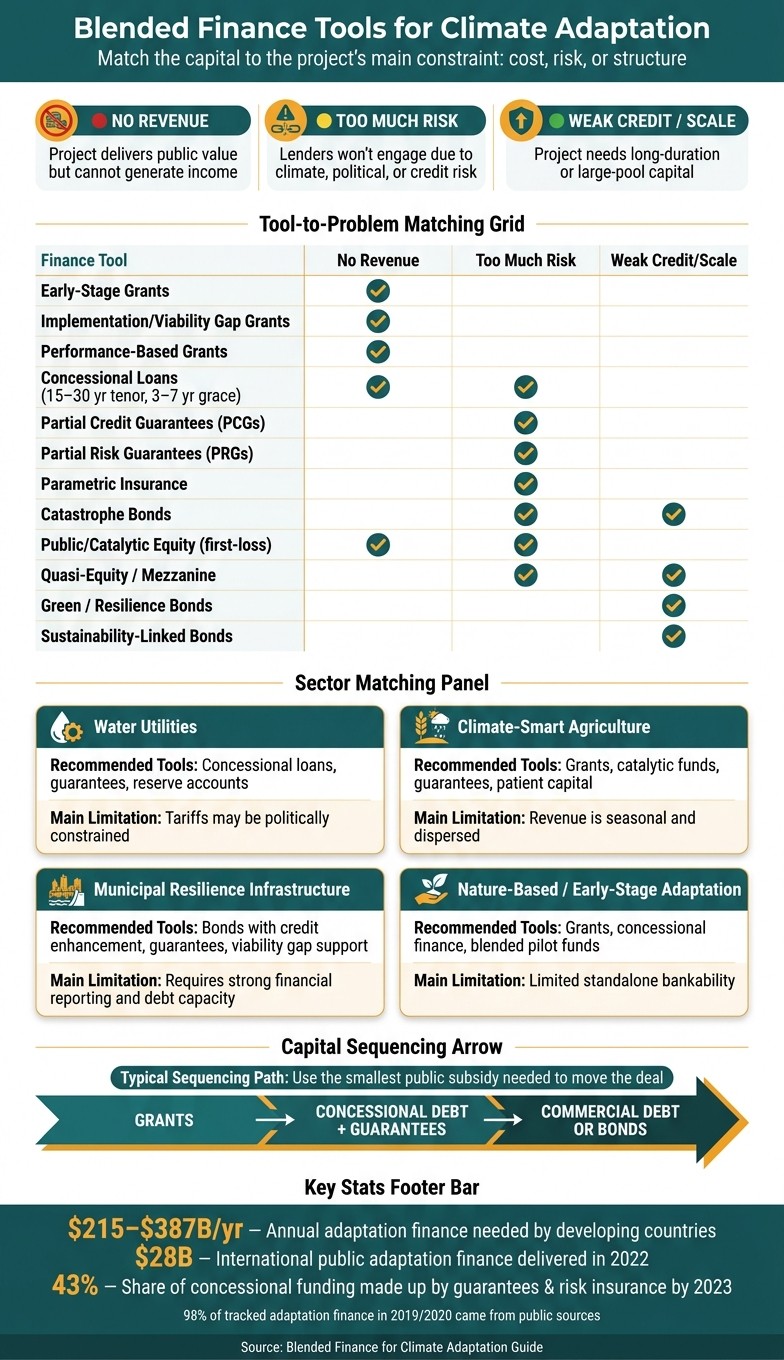
Blended Finance Tools for Climate Adaptation: Match the Tool to the Problem
After contract design, the next step is choosing the right capital for the project's stage, sector, and revenue profile. Adaptation finance works best when the money matches the project's main bottleneck - readiness, risk, or scale.
Sequencing Capital from Readiness to Scale
Most adaptation projects do not begin in a form lenders would call bankable. That is why sequencing matters more than picking a single instrument in isolation.
The path is usually straightforward: grant → de-risking concessional capital → commercial debt or bonds. Once a project has a credible service model, concessional debt or guarantees can lower risk during the pilot stage and bring in private lenders that would otherwise stay out. Some projects remain grant-supported. Others move into commercial refinancing after they show performance. The goal is simple: use the smallest public subsidy needed to get the deal moving.
Stage comes first. Sector then helps narrow the tool choice.
Matching Tools to Sectors and Project Types
Instrument choice can change a lot based on sector, revenue model, and institutional capacity. These are patterns, not fixed formulas. Local tariffs, land tenure, and governance can change the answer fast.
Water utilities often fit concessional loans and guarantees because revenue from tariffs or public transfers can support repayment if credit risk is lowered.
Climate-smart agriculture usually needs grants for farmer training, demonstration plots, and digital advisory systems, along with catalytic capital to take early losses.
Municipal resilience infrastructure - including drainage, flood protection, and resilient transport - can reach bond markets once credit support is in place and cash flows are easier to judge. But that only works when financial reporting is stronger, debt capacity is in place, and there is often a viability gap mechanism or credit enhancement before issuance makes sense.
Project Type | Commonly Suitable Tools | Main Limitation |
|---|---|---|
Water utilities | Concessional loans, guarantees, reserve accounts | Tariffs may be politically constrained |
Climate-smart agriculture | Grants, catalytic funds, guarantees, patient capital | Revenue is seasonal and dispersed |
Municipal resilience infrastructure | Bonds with credit enhancement, guarantees, viability gap support | Requires strong financial reporting and debt capacity |
Nature-based or early-stage adaptation | Grants, concessional finance, blended pilot funds | Limited standalone bankability |
Once the capital stack fits the project, the next job is checking whether it is producing resilience rather than just moving money.
Measuring Adaptation Results and Avoiding Maladaptation
Finance structures only help if results are tracked against real adaptation goals. Measurement should tie disbursements to outcomes such as reduced losses, protected assets, service continuity, livelihood resilience, and avoided damages - not just whether activities were completed.
A useful approach mixes output metrics with outcome metrics. Adaptation gains are often probabilistic, so baseline data and counterfactual analysis matter. It is also important to avoid structures that push climate risk onto other communities. Financing terms should require climate-risk screening, stakeholder consultation, and periodic review against updated climate scenarios, not just disbursement milestones.
Track the signals that point to real resilience: avoided losses, service continuity, livelihood stability, and reduced downtime.
Reporting expectations should match the complexity of the instrument. Grants usually focus on activity completion, beneficiary reach, and early outcome signals. Commercial structures - loans and bonds - need stronger data on performance, covenants, and ongoing disclosure. Additionality should be treated as a design requirement: public capital should improve feasibility, lower risk, or expand resilience outcomes that the market would not deliver.
Conclusion: What Blended Finance Can and Cannot Do
The main test is plain: does the financing structure fit the project's revenue, risk, and public value? Blended finance can help shrink the adaptation funding gap, but it cannot fill it on its own. Developing countries need $215–$387 billion per year, while international public adaptation finance was only about $28 billion in 2022.[7] That gap is still massive.
The next issue is where public support makes sense and where it should end. Concessionality should be used only when it is needed to make a project work. Additionality has to be shown with evidence, not treated as a given.[1][2] And not every adaptation need belongs in a blended finance structure. Early warning systems, social safety nets, ecosystem restoration, and community disaster risk reduction often deliver clear public value without producing revenue. Trying to force revenue-based models onto those efforts can weaken them and even create maladaptation.[8][9]
Key Points for Decision-Makers
For decision-makers, the rules are pretty direct:
Adaptation has different deal logic than mitigation. Adaptation deals should be shaped around avoided losses, lower vulnerability, and verified resilience outcomes.
Match the tool to the project. Use grants for early-stage work and non-revenue needs. Use concessional debt and catalytic capital for marginal projects. Use guarantees and insurance for specific risks. Use bonds for larger assets with steady cash flow.
Use PPPs only in the right settings. PPPs fit large assets with clear service standards, stable public payments, and strong public governance.
Measurement and governance are mandatory. Financing should be tied to resilience metrics, stakeholder input, and open oversight. Otherwise, the structure may reward investors without protecting vulnerable communities.
When those rules are ignored, blended finance can look efficient on paper and then fall apart in practice. Council Fire helps governments, foundations, nonprofits, and companies turn resilience plans into finance-ready programs.
FAQs
How do I choose the right blended finance tool?
Choose the tool by looking at three things: the risk that’s keeping private money on the sidelines, how the project makes money, and whether the deal is big enough to justify the transaction costs.
From there, match the barrier to the instrument:
Guarantees work well when the main issue is a gap between actual risk and perceived risk.
Concessional loans fit projects with lower returns that still need outside capital.
First-loss tranches help protect senior private investors and can make a deal easier to finance.
Council Fire can help assess risks, negotiate terms, and keep stakeholders aligned.
Which adaptation projects can attract private capital?
Projects focused on adaptation can draw private capital when they are set up as bankable investments. That usually means lowering risk through blended finance, public-private partnerships, or a clear path to financial return.
Good examples include critical infrastructure upgrades such as flood defenses and water management systems, along with nature-based work like wetland restoration and coastal protection. Projects that can show measurable returns - through avoided losses or energy savings - tend to stand out with investors.
When is a PPP the wrong fit?
A public-private partnership (PPP) can be the wrong fit when your timeline or budget has little room for delay. These deals often involve several parties, long negotiations, and a lot of upfront structuring. In practice, that work can take 18 to 36 months.
The cost of putting the deal together can also be steep. In some cases, expenses land between $500,000 and $2,000,000. If you need to move sooner or you’re working within tighter overhead limits, a different financing route may make more sense.
Related Blog Posts
Latest Articles
©2025

Narrative Change and Power Building: The Missing Half of Advocacy
Narrative change is the process of disrupting dominant narratives that normalize inequity and advancing new narratives from historically marginalized communities.

Funding Resilience Without Federal Grants
BRIC is unreliable and FEMA is shrinking. Here's how cities fund climate resilience with dedicated revenue, blended finance, and a coordinating authority.

The ESG Blind Spot: How AI Is Finding Risks in Companies Nobody Else Is Watching
Norway's sovereign wealth fund uses AI to screen 7,200 portfolio companies for forced labor and corruption within 24 hours. The real story is the emerging-market coverage gap that traditional ESG data vendors miss — and what it means for any company with a global supply chain.
Narrative Change and Power Building: The Missing Half of Advocacy
Narrative change is the process of disrupting dominant narratives that normalize inequity and advancing new narratives from historically marginalized communities.
Funding Resilience Without Federal Grants
BRIC is unreliable and FEMA is shrinking. Here's how cities fund climate resilience with dedicated revenue, blended finance, and a coordinating authority.
The ESG Blind Spot: How AI Is Finding Risks in Companies Nobody Else Is Watching
Norway's sovereign wealth fund uses AI to screen 7,200 portfolio companies for forced labor and corruption within 24 hours. The real story is the emerging-market coverage gap that traditional ESG data vendors miss — and what it means for any company with a global supply chain.
FAQ
01
What does it really mean to “redefine profit”?
02
What makes Council Fire different?
03
Who does Council Fire work with?
04
What does working with Council Fire actually look like?
05
How does Council Fire help organizations turn big goals into action?
06
How does Council Fire define and measure success?
Sep 15, 2026
Blended Finance for Climate Adaptation: Guide
Sustainability Strategy
In This Article
Guide to matching grants, concessional loans, guarantees, and PPPs to make climate adaptation projects bankable and measurable.
Blended Finance for Climate Adaptation: Guide
Most climate adaptation projects do not fail because the need is unclear. They fail because the money does not fit the risk. In 2019/2020, about 98% of tracked adaptation finance came from public sources, while private capital stayed small. At the same time, developing countries need $215–$387 billion per year, yet public international adaptation finance was only about $28 billion in 2022.
I’d sum up the article this way: blended finance can help bring private money into climate resilience projects, but only when the project has a clear public purpose, a workable repayment path, and a contract that assigns risk in plain terms. It is a tool, not a fix for every funding gap.
What matters most:
Use grants first for studies, design, and projects with no direct income.
Use concessional loans when repayment is possible but market-rate debt is too expensive.
Use guarantees or insurance when lenders are worried about default, public contract failure, or disaster shocks.
Use equity or bonds only when the project is large enough and cash flow is stable enough.
Use PPPs with care; they fit large assets like drainage, roads, flood barriers, and water systems more than small local or nature-based projects.
Track outcomes, not just spending - look at avoided damage, service uptime, protected assets, and lower disruption.
My takeaway: if you’re funding flood control, drought-ready water, climate-smart agriculture, transport, health, or nature-based work, start with the project’s main problem: no revenue, high risk, or weak credit. Then match the finance tool to that problem instead of forcing one model onto every project.
A quick snapshot of the article’s core message is below.
Topic | Main point |
|---|---|
Public vs. private finance | Public money still carries most adaptation funding |
Best-use sectors | Water, flood protection, agriculture, transport, health, and nature-based projects |
Main tools | Grants, concessional loans, guarantees, insurance, catalytic capital, and bonds |
PPP fit | Best for large assets with clear service standards and public payment support |
Main warning | Not every adaptation project should be turned into a revenue deal |
Success test | Match the capital stack to revenue, risk, and public value |
I see this guide as a plain roadmap for choosing the right mix of public, philanthropic, and private capital without overloading projects that should stay publicly funded.
WAPPP Roundtable on Blended Finance for Climate Adaptation
Main Blended Finance Tools and How They Work
Each tool tackles a different financing problem: cost, risk, or capital structure. The mix matters because it often decides whether a deal is bankable. Adaptation deals tend to fall apart for three plain reasons: no revenue, too much risk, or weak credit quality. The best place to start is with the project’s main constraint - early-stage uncertainty, lender exposure, or the need for long-term capital.
Grants and Concessional Loans
Grants play three main roles in adaptation finance: project preparation, viability-gap support, and performance payments.
Early-stage grants pay for feasibility studies, environmental assessments, technical assistance, and project structuring. That’s the work that needs to happen before a lender will even consider the deal. Implementation grants cover viability gaps when a project delivers clear public value but cannot bring in enough revenue to pay full construction costs. Performance-based grants are paid only after results are verified, such as measured resilience gains.
Grant Type | Purpose | Timing | Risk Addressed |
|---|---|---|---|
Early-stage / Preparation | Feasibility studies, design, assessments, technical assistance | Pre-investment | Technical and structuring risk |
Implementation / Viability Gap | Capital subsidy for public-good projects | Construction / rollout | Revenue gap, affordability |
Performance-based | Pay for verified resilience outcomes | Post-delivery | Outcome verification, impact measurement |
Concessional loans come with below-market rates, longer repayment periods, and grace periods on principal. That matters because adaptation projects often take years before any financial return shows up. These loan terms help bridge that delay by allowing public lenders or development finance institutions to absorb part of the return gap.
Loan Type | Interest Rate | Tenor | Grace Period | Risk Allocation |
|---|---|---|---|---|
Concessional | Below-market | 15–30 years | Often 3–7 years | Public / DFI takes junior or subordinated risk |
Commercial | Market rate, risk-adjusted | 5–10 years | Minimal or none | Private lender holds senior position; expects de-risked deal |
A blended facility in Cambodia shows how these layers can work in practice. Concessional capital is combined with commercial lending, and a guarantee lowers capital requirements for participating lenders. The concessional layer cuts the cost of capital and stretches repayment terms for climate-resilient water systems.[5]
When cost is not the main obstacle, risk-transfer tools often do more than grants.
Guarantees, Insurance, and Risk Transfer Tools
Grants lower cost. Guarantees and insurance lower exposure. They do not make the project cheaper; they move downside risk to another party. These tools matter most when public contracts, tariff risk, or government performance risk sit at the center of the deal.
Partial credit guarantees (PCGs) cover part of debt service if a borrower defaults, including defaults caused by climate shocks or cash-flow stress. Partial risk guarantees (PRGs) deal with another issue: they protect lenders when a government fails to honor a PPP contract, change a tariff as agreed, or carry out a regulatory commitment. Political risk coverage goes one step further by covering expropriation, currency inconvertibility, and political disruption.
The fine print matters here. Coverage levels, trigger rules, fees, and the exact risks covered all shape how a lender views the deal.
Parametric insurance uses a different model. Instead of waiting to measure actual losses, it pays when a preset trigger is hit - rainfall below a threshold, wind speed above a set level, or storm surge past a fixed height. That speeds up cash flow, often before losses are fully counted, which can be critical for keeping debt service current on resilient infrastructure after a climate shock.[4] Catastrophe bonds use much the same logic in capital markets: investors take higher yields in exchange for carrying tail risk, and if a qualifying disaster happens, part of the principal is used to cover losses.[3][4]
Tool | Covered Risk | Who Pays the Fee | Best-Fit Adaptation Use Case |
|---|---|---|---|
Partial Credit Guarantee | Borrower default, cash-flow shortfall | Public / DFI subsidizes; lender may share | Climate-resilient water, urban drainage PPPs |
Partial Risk Guarantee | Government non-performance in PPP contracts | Public / development partner | Resilient transport, coastal protection PPPs |
Political Risk Coverage | Expropriation, currency risk, political disruption | Project sponsor or DFI | Cross-border adaptation investments |
Parametric Insurance | Pre-set climate trigger (rainfall, wind speed) | Project sponsor, government, or risk pool | Coastal defenses, agricultural resilience |
Catastrophe Bond | Large-scale disaster event (tail risk) | Investors accept reduced principal | Sovereign disaster risk, resilient infrastructure |
Contingent disaster liquidity facility | Post-disaster liquidity gap | Government / pooled facility | Recovery funding, essential services continuity |
Concessional guarantees and risk insurance have grown fast in the past few years. Their dollar value increased by more than 40% between 2021 and 2023, and by 2023 they made up 43% of all concessional funding.[6] In financial services, more than 55% of deals in 2023 included a concessional guarantee or risk insurance piece.[6]
If risk still looks too high, first-loss equity or quasi-equity may be what finishes the capital stack.
Equity, Catalytic Capital, and Bonds
Equity sits at the bottom of the capital stack, which means it absorbs losses first. That is also why adaptation projects with uncertain returns often struggle to attract it. Public catalytic equity takes those first losses, making senior capital safer.
Public catalytic equity often anchors blended impact funds and accepts below-market returns or subordinated positions to bring in private capital. Private equity wants market-rate returns and a clear path to exit, so it usually comes in only after public capital has reduced deal risk. Quasi-equity - including mezzanine debt, revenue-sharing instruments, or convertible notes - sits between debt and equity. It gives more repayment flexibility while still adding a cushion for senior lenders.
Capital Type | Position in Stack | Expected Return | Role in Adaptation Deals |
|---|---|---|---|
Public / Catalytic Equity | First-loss / subordinated | Below-market; accepts higher risk | Anchors funds; crowds in institutional investors |
Private Equity | Senior equity | Market-rate; needs exit path | Enters de-risked deals; requires contracted revenue |
Quasi-Equity | Mezzanine | Moderate; flexible repayment | Bridges gap between debt and equity; supports PPPs |
When projects need bigger, longer-duration pools of capital, bond structures can bring in more investors. Bonds fit assets with long operating lives, steady funding needs, and clear reporting rules. Green bonds are use-of-proceeds instruments, which means the money raised must go to defined eligible projects, and issuers report each year on impact metrics. Resilience bonds follow the same basic model but focus on hazard mitigation, such as flood barriers, wildfire buffers, and coastal restoration. Sustainability-linked bonds work another way: the proceeds are not restricted, but the coupon changes based on whether the issuer meets set adaptation KPIs. Miss the target, and the rate steps up.
Public or philanthropic capital can support bond issuance through guarantees or first-loss capital, which improves credit quality and can strengthen investor demand.
How to Set Up Public-Private Partnerships for Adaptation
Blended finance only works when the PPP itself is bankable. Grants and guarantees can cut cost and lower risk, but they can't fix a weak contract. In practice, PPP structures are what turn blended capital into bankable service contracts. For most adaptation assets, the aim is public value and service continuity, not direct private revenue. Once funding is lined up, the contract has to assign revenue and risk in a clean, workable way.
PPP Models, Contracts, and Revenue Design
Three PPP models show up most often in climate adaptation: Design-Build-Finance-Operate (DBFO), concessions, and availability-payment structures.
DBFO contracts tend to fit large, long-life assets such as flood barriers, resilient roads, or drainage networks. One private partner handles design, construction, financing, and operations across the asset's life. That setup creates a plain incentive: build it to last, because the same party will live with the outcome.
Concessions make more sense when users can be charged directly, as with a water utility or irrigation network. The problem is that most adaptation assets do not produce steady user-fee income. And when tariffs are politically sensitive, concessions often need concessional support to cover the gap between what users can pay and what the asset costs to build and run.
Availability-payment PPPs are often the best match for adaptation. Here, the public sector pays the private partner for keeping the asset available and meeting performance standards, instead of leaning on user demand. That matters because adaptation value is usually counted in avoided losses, not cash collected at a toll booth or gate. Put simply, contract design matters just as much as the capital stack.
The terms of the contract decide whether resilience is built in or watered down. Vague climate-resilience language rarely brings in private capital. Specific terms do. A stormwater PPP, for example, might require the system to keep a stated drainage capacity during a 1-in-50-year rainfall event. A coastal road contract might set elevated design standards, require materials that resist saltwater corrosion, and spell out inspection intervals after extreme weather. Payment mechanisms tied to uptime, post-disruption response time, or verified performance KPIs give lenders something concrete to underwrite.
Adjustment mechanisms matter too, especially in long contracts. Force majeure clauses, variation orders, and change-in-law provisions should deal directly with climate-driven events, not only standard construction risks. That gives the contract room to respond as hazard intensity and frequency shift over time.
Risk Sharing and Conditions for Success
Risk allocation in adaptation PPPs follows a simple rule: each party should take the risk it can manage best. In practice, that usually means:
Construction risk sits with the private sponsor or contractor, because that party controls design and delivery.
Climate hazard risk should be split between design-level resilience and system-level shocks. Many standard PPP contracts leave climate risk vague or leave it out altogether, so it needs to be written in from the start.
Demand risk usually stays with the public sector for adaptation assets, since user demand is too uncertain and too shaped by public policy to transfer fairly to a private operator.
Political and regulatory risk often calls for public backstops, such as clear tariff rules, indexation provisions, or guarantees.
Operational risk can sit with the private operator, but only if performance standards are realistic and the asset can still be maintained as climate conditions change.
Institutional readiness is often a bigger hurdle than financing. PPP laws, clear procurement rules, and strong public contract management need to be in place first. Public agencies also need enough technical depth to set performance standards, review bids that include climate criteria, and track compliance over contracts that may run for decades. Projects should also sit inside a recognized national or local adaptation plan, so they address a real resilience need and line up with public planning and funder requirements. After that comes a blunt but necessary question: is the asset large enough, and is its revenue profile stable enough, to justify a PPP at all?
When PPPs Are the Wrong Choice
PPPs are not the default answer. They make sense only when the risk and revenue profile fit the structure. When that fit is missing, transaction costs like legal structuring, market sounding, and lender due diligence can swallow the deal.
The clearest red flags are pretty plain. The project may be too small to justify structuring costs. Climate and engineering assumptions may still be moving too fast. Government capacity to manage long-term contracts may be thin. Or the benefits may be hard to monetize, as with community heat relief, ecosystem restoration, or small-scale watershed work. In cases like these, direct public procurement, grants, or community-based delivery will almost always be faster, cheaper, and more effective.
Attribute | PPP | Public Procurement |
|---|---|---|
Preparation time | Longer; requires legal structuring, market sounding, and lender due diligence | Shorter; standard tendering process |
Financing sources | Private capital plus public or concessional support | Public budget, grants, development finance |
Risk allocation | Shared; private partner takes delivery and operational risk | Public sector retains most risk |
Best-fit project type | Large assets with measurable performance and stable public payments | Small-scale, highly social, uncertain, or emergency adaptation works |
Transaction cost | High; often inappropriate for low-value projects | Lower; scales with project size |
Suitability for nature-based solutions | Limited; diffuse benefits are hard to contract | Better suited; flexible public funding |
Use the table to match the structure to the project type. A resilient urban drainage network serving a major metro area might be a strong PPP candidate. A small mangrove restoration project almost certainly is not.
How to Match Finance Tools to Project Needs
Blended Finance Tools for Climate Adaptation: Match the Tool to the Problem
After contract design, the next step is choosing the right capital for the project's stage, sector, and revenue profile. Adaptation finance works best when the money matches the project's main bottleneck - readiness, risk, or scale.
Sequencing Capital from Readiness to Scale
Most adaptation projects do not begin in a form lenders would call bankable. That is why sequencing matters more than picking a single instrument in isolation.
The path is usually straightforward: grant → de-risking concessional capital → commercial debt or bonds. Once a project has a credible service model, concessional debt or guarantees can lower risk during the pilot stage and bring in private lenders that would otherwise stay out. Some projects remain grant-supported. Others move into commercial refinancing after they show performance. The goal is simple: use the smallest public subsidy needed to get the deal moving.
Stage comes first. Sector then helps narrow the tool choice.
Matching Tools to Sectors and Project Types
Instrument choice can change a lot based on sector, revenue model, and institutional capacity. These are patterns, not fixed formulas. Local tariffs, land tenure, and governance can change the answer fast.
Water utilities often fit concessional loans and guarantees because revenue from tariffs or public transfers can support repayment if credit risk is lowered.
Climate-smart agriculture usually needs grants for farmer training, demonstration plots, and digital advisory systems, along with catalytic capital to take early losses.
Municipal resilience infrastructure - including drainage, flood protection, and resilient transport - can reach bond markets once credit support is in place and cash flows are easier to judge. But that only works when financial reporting is stronger, debt capacity is in place, and there is often a viability gap mechanism or credit enhancement before issuance makes sense.
Project Type | Commonly Suitable Tools | Main Limitation |
|---|---|---|
Water utilities | Concessional loans, guarantees, reserve accounts | Tariffs may be politically constrained |
Climate-smart agriculture | Grants, catalytic funds, guarantees, patient capital | Revenue is seasonal and dispersed |
Municipal resilience infrastructure | Bonds with credit enhancement, guarantees, viability gap support | Requires strong financial reporting and debt capacity |
Nature-based or early-stage adaptation | Grants, concessional finance, blended pilot funds | Limited standalone bankability |
Once the capital stack fits the project, the next job is checking whether it is producing resilience rather than just moving money.
Measuring Adaptation Results and Avoiding Maladaptation
Finance structures only help if results are tracked against real adaptation goals. Measurement should tie disbursements to outcomes such as reduced losses, protected assets, service continuity, livelihood resilience, and avoided damages - not just whether activities were completed.
A useful approach mixes output metrics with outcome metrics. Adaptation gains are often probabilistic, so baseline data and counterfactual analysis matter. It is also important to avoid structures that push climate risk onto other communities. Financing terms should require climate-risk screening, stakeholder consultation, and periodic review against updated climate scenarios, not just disbursement milestones.
Track the signals that point to real resilience: avoided losses, service continuity, livelihood stability, and reduced downtime.
Reporting expectations should match the complexity of the instrument. Grants usually focus on activity completion, beneficiary reach, and early outcome signals. Commercial structures - loans and bonds - need stronger data on performance, covenants, and ongoing disclosure. Additionality should be treated as a design requirement: public capital should improve feasibility, lower risk, or expand resilience outcomes that the market would not deliver.
Conclusion: What Blended Finance Can and Cannot Do
The main test is plain: does the financing structure fit the project's revenue, risk, and public value? Blended finance can help shrink the adaptation funding gap, but it cannot fill it on its own. Developing countries need $215–$387 billion per year, while international public adaptation finance was only about $28 billion in 2022.[7] That gap is still massive.
The next issue is where public support makes sense and where it should end. Concessionality should be used only when it is needed to make a project work. Additionality has to be shown with evidence, not treated as a given.[1][2] And not every adaptation need belongs in a blended finance structure. Early warning systems, social safety nets, ecosystem restoration, and community disaster risk reduction often deliver clear public value without producing revenue. Trying to force revenue-based models onto those efforts can weaken them and even create maladaptation.[8][9]
Key Points for Decision-Makers
For decision-makers, the rules are pretty direct:
Adaptation has different deal logic than mitigation. Adaptation deals should be shaped around avoided losses, lower vulnerability, and verified resilience outcomes.
Match the tool to the project. Use grants for early-stage work and non-revenue needs. Use concessional debt and catalytic capital for marginal projects. Use guarantees and insurance for specific risks. Use bonds for larger assets with steady cash flow.
Use PPPs only in the right settings. PPPs fit large assets with clear service standards, stable public payments, and strong public governance.
Measurement and governance are mandatory. Financing should be tied to resilience metrics, stakeholder input, and open oversight. Otherwise, the structure may reward investors without protecting vulnerable communities.
When those rules are ignored, blended finance can look efficient on paper and then fall apart in practice. Council Fire helps governments, foundations, nonprofits, and companies turn resilience plans into finance-ready programs.
FAQs
How do I choose the right blended finance tool?
Choose the tool by looking at three things: the risk that’s keeping private money on the sidelines, how the project makes money, and whether the deal is big enough to justify the transaction costs.
From there, match the barrier to the instrument:
Guarantees work well when the main issue is a gap between actual risk and perceived risk.
Concessional loans fit projects with lower returns that still need outside capital.
First-loss tranches help protect senior private investors and can make a deal easier to finance.
Council Fire can help assess risks, negotiate terms, and keep stakeholders aligned.
Which adaptation projects can attract private capital?
Projects focused on adaptation can draw private capital when they are set up as bankable investments. That usually means lowering risk through blended finance, public-private partnerships, or a clear path to financial return.
Good examples include critical infrastructure upgrades such as flood defenses and water management systems, along with nature-based work like wetland restoration and coastal protection. Projects that can show measurable returns - through avoided losses or energy savings - tend to stand out with investors.
When is a PPP the wrong fit?
A public-private partnership (PPP) can be the wrong fit when your timeline or budget has little room for delay. These deals often involve several parties, long negotiations, and a lot of upfront structuring. In practice, that work can take 18 to 36 months.
The cost of putting the deal together can also be steep. In some cases, expenses land between $500,000 and $2,000,000. If you need to move sooner or you’re working within tighter overhead limits, a different financing route may make more sense.
Related Blog Posts
Latest Articles
©2025
Narrative Change and Power Building: The Missing Half of Advocacy
Narrative change is the process of disrupting dominant narratives that normalize inequity and advancing new narratives from historically marginalized communities.
Funding Resilience Without Federal Grants
BRIC is unreliable and FEMA is shrinking. Here's how cities fund climate resilience with dedicated revenue, blended finance, and a coordinating authority.
The ESG Blind Spot: How AI Is Finding Risks in Companies Nobody Else Is Watching
Norway's sovereign wealth fund uses AI to screen 7,200 portfolio companies for forced labor and corruption within 24 hours. The real story is the emerging-market coverage gap that traditional ESG data vendors miss — and what it means for any company with a global supply chain.
FAQ
01
What does it really mean to “redefine profit”?
02
What makes Council Fire different?
03
Who does Council Fire work with?
04
What does working with Council Fire actually look like?
05
How does Council Fire help organizations turn big goals into action?
06
How does Council Fire define and measure success?
Sep 15, 2026
Blended Finance for Climate Adaptation: Guide
Sustainability Strategy
In This Article
Guide to matching grants, concessional loans, guarantees, and PPPs to make climate adaptation projects bankable and measurable.
Blended Finance for Climate Adaptation: Guide
Most climate adaptation projects do not fail because the need is unclear. They fail because the money does not fit the risk. In 2019/2020, about 98% of tracked adaptation finance came from public sources, while private capital stayed small. At the same time, developing countries need $215–$387 billion per year, yet public international adaptation finance was only about $28 billion in 2022.
I’d sum up the article this way: blended finance can help bring private money into climate resilience projects, but only when the project has a clear public purpose, a workable repayment path, and a contract that assigns risk in plain terms. It is a tool, not a fix for every funding gap.
What matters most:
Use grants first for studies, design, and projects with no direct income.
Use concessional loans when repayment is possible but market-rate debt is too expensive.
Use guarantees or insurance when lenders are worried about default, public contract failure, or disaster shocks.
Use equity or bonds only when the project is large enough and cash flow is stable enough.
Use PPPs with care; they fit large assets like drainage, roads, flood barriers, and water systems more than small local or nature-based projects.
Track outcomes, not just spending - look at avoided damage, service uptime, protected assets, and lower disruption.
My takeaway: if you’re funding flood control, drought-ready water, climate-smart agriculture, transport, health, or nature-based work, start with the project’s main problem: no revenue, high risk, or weak credit. Then match the finance tool to that problem instead of forcing one model onto every project.
A quick snapshot of the article’s core message is below.
Topic | Main point |
|---|---|
Public vs. private finance | Public money still carries most adaptation funding |
Best-use sectors | Water, flood protection, agriculture, transport, health, and nature-based projects |
Main tools | Grants, concessional loans, guarantees, insurance, catalytic capital, and bonds |
PPP fit | Best for large assets with clear service standards and public payment support |
Main warning | Not every adaptation project should be turned into a revenue deal |
Success test | Match the capital stack to revenue, risk, and public value |
I see this guide as a plain roadmap for choosing the right mix of public, philanthropic, and private capital without overloading projects that should stay publicly funded.
WAPPP Roundtable on Blended Finance for Climate Adaptation
Main Blended Finance Tools and How They Work
Each tool tackles a different financing problem: cost, risk, or capital structure. The mix matters because it often decides whether a deal is bankable. Adaptation deals tend to fall apart for three plain reasons: no revenue, too much risk, or weak credit quality. The best place to start is with the project’s main constraint - early-stage uncertainty, lender exposure, or the need for long-term capital.
Grants and Concessional Loans
Grants play three main roles in adaptation finance: project preparation, viability-gap support, and performance payments.
Early-stage grants pay for feasibility studies, environmental assessments, technical assistance, and project structuring. That’s the work that needs to happen before a lender will even consider the deal. Implementation grants cover viability gaps when a project delivers clear public value but cannot bring in enough revenue to pay full construction costs. Performance-based grants are paid only after results are verified, such as measured resilience gains.
Grant Type | Purpose | Timing | Risk Addressed |
|---|---|---|---|
Early-stage / Preparation | Feasibility studies, design, assessments, technical assistance | Pre-investment | Technical and structuring risk |
Implementation / Viability Gap | Capital subsidy for public-good projects | Construction / rollout | Revenue gap, affordability |
Performance-based | Pay for verified resilience outcomes | Post-delivery | Outcome verification, impact measurement |
Concessional loans come with below-market rates, longer repayment periods, and grace periods on principal. That matters because adaptation projects often take years before any financial return shows up. These loan terms help bridge that delay by allowing public lenders or development finance institutions to absorb part of the return gap.
Loan Type | Interest Rate | Tenor | Grace Period | Risk Allocation |
|---|---|---|---|---|
Concessional | Below-market | 15–30 years | Often 3–7 years | Public / DFI takes junior or subordinated risk |
Commercial | Market rate, risk-adjusted | 5–10 years | Minimal or none | Private lender holds senior position; expects de-risked deal |
A blended facility in Cambodia shows how these layers can work in practice. Concessional capital is combined with commercial lending, and a guarantee lowers capital requirements for participating lenders. The concessional layer cuts the cost of capital and stretches repayment terms for climate-resilient water systems.[5]
When cost is not the main obstacle, risk-transfer tools often do more than grants.
Guarantees, Insurance, and Risk Transfer Tools
Grants lower cost. Guarantees and insurance lower exposure. They do not make the project cheaper; they move downside risk to another party. These tools matter most when public contracts, tariff risk, or government performance risk sit at the center of the deal.
Partial credit guarantees (PCGs) cover part of debt service if a borrower defaults, including defaults caused by climate shocks or cash-flow stress. Partial risk guarantees (PRGs) deal with another issue: they protect lenders when a government fails to honor a PPP contract, change a tariff as agreed, or carry out a regulatory commitment. Political risk coverage goes one step further by covering expropriation, currency inconvertibility, and political disruption.
The fine print matters here. Coverage levels, trigger rules, fees, and the exact risks covered all shape how a lender views the deal.
Parametric insurance uses a different model. Instead of waiting to measure actual losses, it pays when a preset trigger is hit - rainfall below a threshold, wind speed above a set level, or storm surge past a fixed height. That speeds up cash flow, often before losses are fully counted, which can be critical for keeping debt service current on resilient infrastructure after a climate shock.[4] Catastrophe bonds use much the same logic in capital markets: investors take higher yields in exchange for carrying tail risk, and if a qualifying disaster happens, part of the principal is used to cover losses.[3][4]
Tool | Covered Risk | Who Pays the Fee | Best-Fit Adaptation Use Case |
|---|---|---|---|
Partial Credit Guarantee | Borrower default, cash-flow shortfall | Public / DFI subsidizes; lender may share | Climate-resilient water, urban drainage PPPs |
Partial Risk Guarantee | Government non-performance in PPP contracts | Public / development partner | Resilient transport, coastal protection PPPs |
Political Risk Coverage | Expropriation, currency risk, political disruption | Project sponsor or DFI | Cross-border adaptation investments |
Parametric Insurance | Pre-set climate trigger (rainfall, wind speed) | Project sponsor, government, or risk pool | Coastal defenses, agricultural resilience |
Catastrophe Bond | Large-scale disaster event (tail risk) | Investors accept reduced principal | Sovereign disaster risk, resilient infrastructure |
Contingent disaster liquidity facility | Post-disaster liquidity gap | Government / pooled facility | Recovery funding, essential services continuity |
Concessional guarantees and risk insurance have grown fast in the past few years. Their dollar value increased by more than 40% between 2021 and 2023, and by 2023 they made up 43% of all concessional funding.[6] In financial services, more than 55% of deals in 2023 included a concessional guarantee or risk insurance piece.[6]
If risk still looks too high, first-loss equity or quasi-equity may be what finishes the capital stack.
Equity, Catalytic Capital, and Bonds
Equity sits at the bottom of the capital stack, which means it absorbs losses first. That is also why adaptation projects with uncertain returns often struggle to attract it. Public catalytic equity takes those first losses, making senior capital safer.
Public catalytic equity often anchors blended impact funds and accepts below-market returns or subordinated positions to bring in private capital. Private equity wants market-rate returns and a clear path to exit, so it usually comes in only after public capital has reduced deal risk. Quasi-equity - including mezzanine debt, revenue-sharing instruments, or convertible notes - sits between debt and equity. It gives more repayment flexibility while still adding a cushion for senior lenders.
Capital Type | Position in Stack | Expected Return | Role in Adaptation Deals |
|---|---|---|---|
Public / Catalytic Equity | First-loss / subordinated | Below-market; accepts higher risk | Anchors funds; crowds in institutional investors |
Private Equity | Senior equity | Market-rate; needs exit path | Enters de-risked deals; requires contracted revenue |
Quasi-Equity | Mezzanine | Moderate; flexible repayment | Bridges gap between debt and equity; supports PPPs |
When projects need bigger, longer-duration pools of capital, bond structures can bring in more investors. Bonds fit assets with long operating lives, steady funding needs, and clear reporting rules. Green bonds are use-of-proceeds instruments, which means the money raised must go to defined eligible projects, and issuers report each year on impact metrics. Resilience bonds follow the same basic model but focus on hazard mitigation, such as flood barriers, wildfire buffers, and coastal restoration. Sustainability-linked bonds work another way: the proceeds are not restricted, but the coupon changes based on whether the issuer meets set adaptation KPIs. Miss the target, and the rate steps up.
Public or philanthropic capital can support bond issuance through guarantees or first-loss capital, which improves credit quality and can strengthen investor demand.
How to Set Up Public-Private Partnerships for Adaptation
Blended finance only works when the PPP itself is bankable. Grants and guarantees can cut cost and lower risk, but they can't fix a weak contract. In practice, PPP structures are what turn blended capital into bankable service contracts. For most adaptation assets, the aim is public value and service continuity, not direct private revenue. Once funding is lined up, the contract has to assign revenue and risk in a clean, workable way.
PPP Models, Contracts, and Revenue Design
Three PPP models show up most often in climate adaptation: Design-Build-Finance-Operate (DBFO), concessions, and availability-payment structures.
DBFO contracts tend to fit large, long-life assets such as flood barriers, resilient roads, or drainage networks. One private partner handles design, construction, financing, and operations across the asset's life. That setup creates a plain incentive: build it to last, because the same party will live with the outcome.
Concessions make more sense when users can be charged directly, as with a water utility or irrigation network. The problem is that most adaptation assets do not produce steady user-fee income. And when tariffs are politically sensitive, concessions often need concessional support to cover the gap between what users can pay and what the asset costs to build and run.
Availability-payment PPPs are often the best match for adaptation. Here, the public sector pays the private partner for keeping the asset available and meeting performance standards, instead of leaning on user demand. That matters because adaptation value is usually counted in avoided losses, not cash collected at a toll booth or gate. Put simply, contract design matters just as much as the capital stack.
The terms of the contract decide whether resilience is built in or watered down. Vague climate-resilience language rarely brings in private capital. Specific terms do. A stormwater PPP, for example, might require the system to keep a stated drainage capacity during a 1-in-50-year rainfall event. A coastal road contract might set elevated design standards, require materials that resist saltwater corrosion, and spell out inspection intervals after extreme weather. Payment mechanisms tied to uptime, post-disruption response time, or verified performance KPIs give lenders something concrete to underwrite.
Adjustment mechanisms matter too, especially in long contracts. Force majeure clauses, variation orders, and change-in-law provisions should deal directly with climate-driven events, not only standard construction risks. That gives the contract room to respond as hazard intensity and frequency shift over time.
Risk Sharing and Conditions for Success
Risk allocation in adaptation PPPs follows a simple rule: each party should take the risk it can manage best. In practice, that usually means:
Construction risk sits with the private sponsor or contractor, because that party controls design and delivery.
Climate hazard risk should be split between design-level resilience and system-level shocks. Many standard PPP contracts leave climate risk vague or leave it out altogether, so it needs to be written in from the start.
Demand risk usually stays with the public sector for adaptation assets, since user demand is too uncertain and too shaped by public policy to transfer fairly to a private operator.
Political and regulatory risk often calls for public backstops, such as clear tariff rules, indexation provisions, or guarantees.
Operational risk can sit with the private operator, but only if performance standards are realistic and the asset can still be maintained as climate conditions change.
Institutional readiness is often a bigger hurdle than financing. PPP laws, clear procurement rules, and strong public contract management need to be in place first. Public agencies also need enough technical depth to set performance standards, review bids that include climate criteria, and track compliance over contracts that may run for decades. Projects should also sit inside a recognized national or local adaptation plan, so they address a real resilience need and line up with public planning and funder requirements. After that comes a blunt but necessary question: is the asset large enough, and is its revenue profile stable enough, to justify a PPP at all?
When PPPs Are the Wrong Choice
PPPs are not the default answer. They make sense only when the risk and revenue profile fit the structure. When that fit is missing, transaction costs like legal structuring, market sounding, and lender due diligence can swallow the deal.
The clearest red flags are pretty plain. The project may be too small to justify structuring costs. Climate and engineering assumptions may still be moving too fast. Government capacity to manage long-term contracts may be thin. Or the benefits may be hard to monetize, as with community heat relief, ecosystem restoration, or small-scale watershed work. In cases like these, direct public procurement, grants, or community-based delivery will almost always be faster, cheaper, and more effective.
Attribute | PPP | Public Procurement |
|---|---|---|
Preparation time | Longer; requires legal structuring, market sounding, and lender due diligence | Shorter; standard tendering process |
Financing sources | Private capital plus public or concessional support | Public budget, grants, development finance |
Risk allocation | Shared; private partner takes delivery and operational risk | Public sector retains most risk |
Best-fit project type | Large assets with measurable performance and stable public payments | Small-scale, highly social, uncertain, or emergency adaptation works |
Transaction cost | High; often inappropriate for low-value projects | Lower; scales with project size |
Suitability for nature-based solutions | Limited; diffuse benefits are hard to contract | Better suited; flexible public funding |
Use the table to match the structure to the project type. A resilient urban drainage network serving a major metro area might be a strong PPP candidate. A small mangrove restoration project almost certainly is not.
How to Match Finance Tools to Project Needs
Blended Finance Tools for Climate Adaptation: Match the Tool to the Problem
After contract design, the next step is choosing the right capital for the project's stage, sector, and revenue profile. Adaptation finance works best when the money matches the project's main bottleneck - readiness, risk, or scale.
Sequencing Capital from Readiness to Scale
Most adaptation projects do not begin in a form lenders would call bankable. That is why sequencing matters more than picking a single instrument in isolation.
The path is usually straightforward: grant → de-risking concessional capital → commercial debt or bonds. Once a project has a credible service model, concessional debt or guarantees can lower risk during the pilot stage and bring in private lenders that would otherwise stay out. Some projects remain grant-supported. Others move into commercial refinancing after they show performance. The goal is simple: use the smallest public subsidy needed to get the deal moving.
Stage comes first. Sector then helps narrow the tool choice.
Matching Tools to Sectors and Project Types
Instrument choice can change a lot based on sector, revenue model, and institutional capacity. These are patterns, not fixed formulas. Local tariffs, land tenure, and governance can change the answer fast.
Water utilities often fit concessional loans and guarantees because revenue from tariffs or public transfers can support repayment if credit risk is lowered.
Climate-smart agriculture usually needs grants for farmer training, demonstration plots, and digital advisory systems, along with catalytic capital to take early losses.
Municipal resilience infrastructure - including drainage, flood protection, and resilient transport - can reach bond markets once credit support is in place and cash flows are easier to judge. But that only works when financial reporting is stronger, debt capacity is in place, and there is often a viability gap mechanism or credit enhancement before issuance makes sense.
Project Type | Commonly Suitable Tools | Main Limitation |
|---|---|---|
Water utilities | Concessional loans, guarantees, reserve accounts | Tariffs may be politically constrained |
Climate-smart agriculture | Grants, catalytic funds, guarantees, patient capital | Revenue is seasonal and dispersed |
Municipal resilience infrastructure | Bonds with credit enhancement, guarantees, viability gap support | Requires strong financial reporting and debt capacity |
Nature-based or early-stage adaptation | Grants, concessional finance, blended pilot funds | Limited standalone bankability |
Once the capital stack fits the project, the next job is checking whether it is producing resilience rather than just moving money.
Measuring Adaptation Results and Avoiding Maladaptation
Finance structures only help if results are tracked against real adaptation goals. Measurement should tie disbursements to outcomes such as reduced losses, protected assets, service continuity, livelihood resilience, and avoided damages - not just whether activities were completed.
A useful approach mixes output metrics with outcome metrics. Adaptation gains are often probabilistic, so baseline data and counterfactual analysis matter. It is also important to avoid structures that push climate risk onto other communities. Financing terms should require climate-risk screening, stakeholder consultation, and periodic review against updated climate scenarios, not just disbursement milestones.
Track the signals that point to real resilience: avoided losses, service continuity, livelihood stability, and reduced downtime.
Reporting expectations should match the complexity of the instrument. Grants usually focus on activity completion, beneficiary reach, and early outcome signals. Commercial structures - loans and bonds - need stronger data on performance, covenants, and ongoing disclosure. Additionality should be treated as a design requirement: public capital should improve feasibility, lower risk, or expand resilience outcomes that the market would not deliver.
Conclusion: What Blended Finance Can and Cannot Do
The main test is plain: does the financing structure fit the project's revenue, risk, and public value? Blended finance can help shrink the adaptation funding gap, but it cannot fill it on its own. Developing countries need $215–$387 billion per year, while international public adaptation finance was only about $28 billion in 2022.[7] That gap is still massive.
The next issue is where public support makes sense and where it should end. Concessionality should be used only when it is needed to make a project work. Additionality has to be shown with evidence, not treated as a given.[1][2] And not every adaptation need belongs in a blended finance structure. Early warning systems, social safety nets, ecosystem restoration, and community disaster risk reduction often deliver clear public value without producing revenue. Trying to force revenue-based models onto those efforts can weaken them and even create maladaptation.[8][9]
Key Points for Decision-Makers
For decision-makers, the rules are pretty direct:
Adaptation has different deal logic than mitigation. Adaptation deals should be shaped around avoided losses, lower vulnerability, and verified resilience outcomes.
Match the tool to the project. Use grants for early-stage work and non-revenue needs. Use concessional debt and catalytic capital for marginal projects. Use guarantees and insurance for specific risks. Use bonds for larger assets with steady cash flow.
Use PPPs only in the right settings. PPPs fit large assets with clear service standards, stable public payments, and strong public governance.
Measurement and governance are mandatory. Financing should be tied to resilience metrics, stakeholder input, and open oversight. Otherwise, the structure may reward investors without protecting vulnerable communities.
When those rules are ignored, blended finance can look efficient on paper and then fall apart in practice. Council Fire helps governments, foundations, nonprofits, and companies turn resilience plans into finance-ready programs.
FAQs
How do I choose the right blended finance tool?
Choose the tool by looking at three things: the risk that’s keeping private money on the sidelines, how the project makes money, and whether the deal is big enough to justify the transaction costs.
From there, match the barrier to the instrument:
Guarantees work well when the main issue is a gap between actual risk and perceived risk.
Concessional loans fit projects with lower returns that still need outside capital.
First-loss tranches help protect senior private investors and can make a deal easier to finance.
Council Fire can help assess risks, negotiate terms, and keep stakeholders aligned.
Which adaptation projects can attract private capital?
Projects focused on adaptation can draw private capital when they are set up as bankable investments. That usually means lowering risk through blended finance, public-private partnerships, or a clear path to financial return.
Good examples include critical infrastructure upgrades such as flood defenses and water management systems, along with nature-based work like wetland restoration and coastal protection. Projects that can show measurable returns - through avoided losses or energy savings - tend to stand out with investors.
When is a PPP the wrong fit?
A public-private partnership (PPP) can be the wrong fit when your timeline or budget has little room for delay. These deals often involve several parties, long negotiations, and a lot of upfront structuring. In practice, that work can take 18 to 36 months.
The cost of putting the deal together can also be steep. In some cases, expenses land between $500,000 and $2,000,000. If you need to move sooner or you’re working within tighter overhead limits, a different financing route may make more sense.
Related Blog Posts
Latest Articles
©2025
Narrative Change and Power Building: The Missing Half of Advocacy
Narrative change is the process of disrupting dominant narratives that normalize inequity and advancing new narratives from historically marginalized communities.
Funding Resilience Without Federal Grants
BRIC is unreliable and FEMA is shrinking. Here's how cities fund climate resilience with dedicated revenue, blended finance, and a coordinating authority.
The ESG Blind Spot: How AI Is Finding Risks in Companies Nobody Else Is Watching
Norway's sovereign wealth fund uses AI to screen 7,200 portfolio companies for forced labor and corruption within 24 hours. The real story is the emerging-market coverage gap that traditional ESG data vendors miss — and what it means for any company with a global supply chain.
FAQ
What does it really mean to “redefine profit”?
What makes Council Fire different?
Who does Council Fire work with?
What does working with Council Fire actually look like?
How does Council Fire help organizations turn big goals into action?
How does Council Fire define and measure success?