In This Article
Step-by-step audit closure: record findings, assign accountable owners, verify evidence, test effectiveness, and approve closure.
Audit Findings: Corrective Action Tracking Guide
A completed action is not a closed audit finding. Closure requires proof that the fix meets the original requirement, addresses the cause, and works over a defined monitoring period - with approval from an authorized reviewer.
A December 2021 EPA inspector general report found management-oversight discrepancies in 3 of 13 completed cybersecurity corrective actions. One had been recorded as timely before completion.[3]
Corrective action tracking should connect every finding to:
A clear plan: Record the requirement, risk, root cause, and steps to contain and fix the issue.
One accountable owner per action: Set risk-based deadlines, track milestones, and escalate delays.
Proof and approval: Review records, test results, and document the closure decision.
Follow-up measures: Track repeat findings, overdue work, and failed checks to guide future fixes.
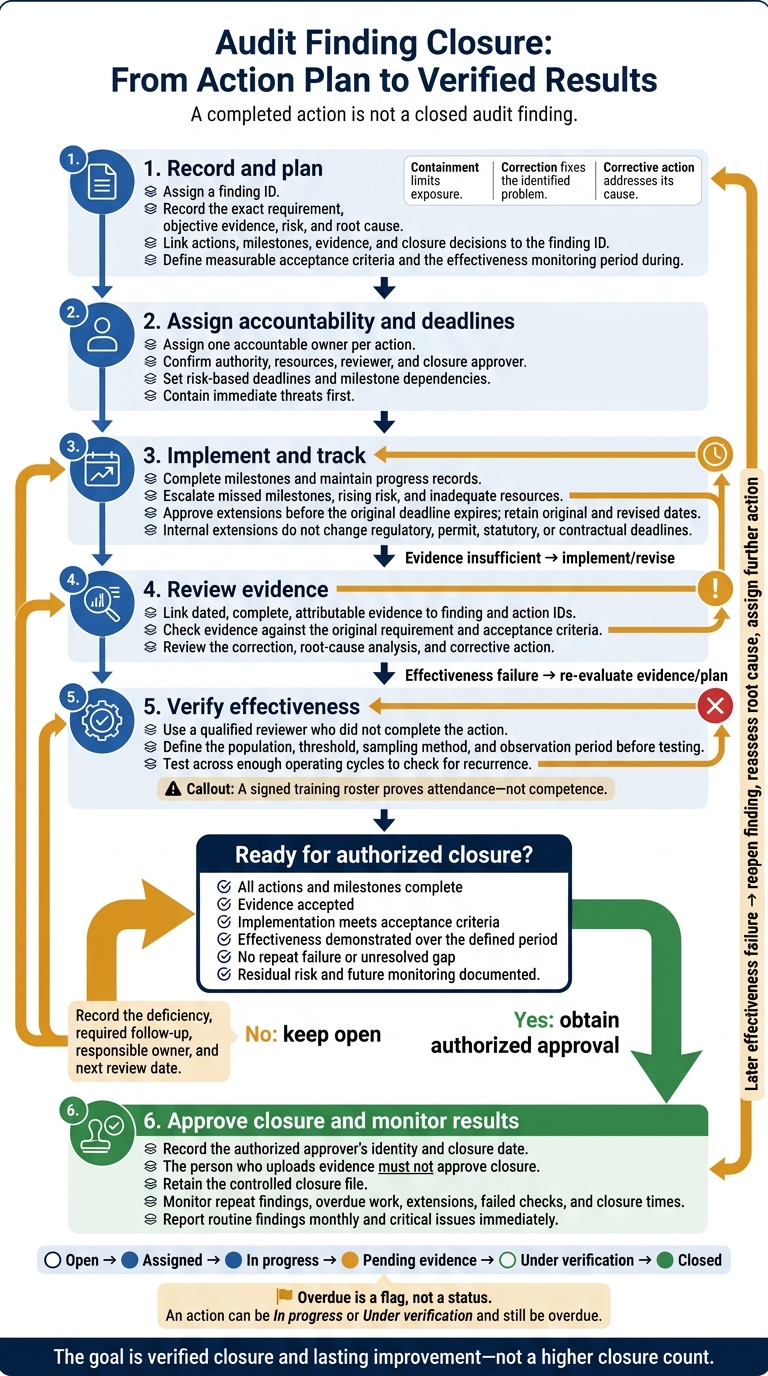
Audit Finding Closure: From Action Plan to Verified Results
1. Record Findings and Plan Actions
Create one controlled record for each finding.
Document Requirements, Risks, and Finding IDs
Assign each finding its own ID. Record the audit date, affected site/process/asset, exact requirement, objective evidence, observed condition, risk or potential consequence, severity, and root cause. Cite the specific permit condition, regulation, or procedure clause, not just the document title. Link every action, milestone, evidence item, and closure decision to the finding ID.[5][6]
Keep everything in one shared register, with a separate row for each action tied to the same finding. Use the template below to record the required fields. Write dates in full, such as November 24, 2026, and leave closure dates blank until approval.
| Finding ID | Requirement | Action | Owner | Due date | Evidence | Verifier | Status | Closure date |
|---|---|---|---|---|---|---|---|---|
| Same finding ID | Exact clause | Containment measure | Named individual | Target date | Interim-control records | Assigned reviewer | Current status | |
| Same finding ID | Exact clause | Correction | Named individual | Target date | Records of the direct fix | Assigned reviewer | Current status | |
| Same finding ID | Exact clause | Corrective action | Named individual | Target date | Implementation and effectiveness records | Assigned reviewer | Current status |
Once the finding is recorded, separate the immediate fix from the permanent remedy.
Distinguish Containment, Correction, and Corrective Action
Containment limits exposure. Correction fixes the identified problem. Corrective action addresses its cause. Before choosing a permanent action, investigate the root cause through interviews, record review, process mapping, or other documented methods.[2][7]
Base acceptance criteria on the original requirement - not a weaker internal target. State who must approve revised procedures, which employees need training, how competency will be checked, and how long performance will be monitored. Make the criteria measurable and clear enough for independent verification.[4][2]
Divide Complex Actions Into Milestones
Break permit, engineering, procedure, training, and monitoring work into observable deliverables. Give each milestone an owner, planned date, dependency, and supporting evidence. Put the work in the right sequence: approved design before procurement, required permits before installation, commissioning before operations begin, and training before affected employees use the revised process.[2][4]
Set the final effectiveness measure and monitoring period during planning. Keep the finding open until that measure is met.[2][4]
sbb-itb-8baf5f1
2. Assign Owners and Set Deadlines
Once the work is broken into milestones, give each action one accountable owner and a clear deadline.
Assign One Accountable Owner to Each Action
Assign each action to a named person - not a department - even when several teams share the work. That person owns the finding from assignment through evidence review, not just task completion.
Record the owner’s name, role, department, authority, required resources, supporting staff, reviewer, closure approver, due date, and finding ID. The owner must have the authority to direct work, secure resources, access records, and escalate blockers. If the owner also verifies the work, document the conflict, compensating review, and management approval.[10][12][14]
Set Risk-Based Deadlines and Extension Rules
Base deadlines on severity, likelihood, impact, exposure time, lead times, dependencies, and testing time. Account for regulatory, permit, and contract deadlines, and leave time to test effectiveness before final closure. Contain immediate threats first, then carry out the permanent corrective action.[8][9][14]
Approve extensions before the original deadline expires. Each request must identify the finding and action, original due date, proposed revised date, reason for delay, completed milestones, remaining work, risk assessment, interim controls, responsible owner, and approving authority.
Retain both dates, the approval time, and the approver’s identity. Internal approval does not change a permit, agency, statutory, or contractual deadline. Track those obligations separately.[11]
Update Status and Escalate Delays
Apply the status rules below consistently. Keep overdue as a separate flag: an action can remain “In progress” or “Under verification” while its delay stays visible. Each update should explain what changed, what evidence is available, what remains, and the next committed date.
| Status or control | Owner duties | Reviewer duties | Escalation trigger | Records |
|---|---|---|---|---|
| Open: recorded, not assigned | Confirm scope, risk, dependencies, and action | Confirm fit to the finding | No owner or plan within required timeframe | Finding ID, risk rating, action plan, owner |
| Assigned: owner and deadline approved | Accept accountability; confirm resources | Confirm authority and deadline | Assignment rejected; authority or resources lacking | Acceptance record, owner, support roles, due date |
| In progress: work underway | Complete milestones; update risks | Check milestone progress | Missed milestone, rising risk, or inadequate resources | Progress update, milestone evidence, risk log |
| Pending evidence: implementation reported, proof missing | Submit traceable evidence | Check against acceptance criteria | Incomplete, unverifiable, or late evidence | Evidence index, procedures, records, test results |
| Under verification: evidence or effectiveness being tested | Support testing; preserve evidence | Test implementation and effectiveness | Test failure, residual gap, or ineffective control | Verification workpapers, test results, exceptions |
| Closed: authorized approval recorded | Maintain control | Recommend closure when requirements are met | Closure disagreement or unresolved residual risk | Closure approval, rationale, final evidence |
| Overdue flag: deadline passed | Submit recovery plan; request extension if justified | Assess delay impact and interim controls | Deadline passed, extension unapproved, or external deadline at risk | Original/revised dates, reason, approval, interim-control record |
Critical or legal findings may need daily or weekly review; high-risk findings, weekly review; and lower-risk findings, monthly review. Escalate when no owner is assigned, a milestone is missed, an extension request arrives late, interim controls lapse, evidence is rejected, a dependency threatens the deadline, or risk increases.
Move escalation from the owner to the manager, then to the compliance or audit leader. Involve executive or governing oversight when the exposure or regulatory impact warrants it.[13][14]
Next, match the evidence to each action’s acceptance criteria.
3. Verify Evidence and Record Closure
Close a finding only after the evidence has passed review and verification is complete. Closure also requires approval from an authorized person.
Review Evidence Against Acceptance Criteria
Link every evidence file to its finding and action IDs. Check that each file is dated, complete, attributable, and tied to the affected site, process, or asset. Review the correction, root-cause analysis, and corrective action.[17][19]
Use the following examples as the minimum review standard for each action.
Action Required evidence Acceptance criterion Reviewer Review result Follow-up Repair machine guarding Dated work order, photographs, post-repair inspection Guards installed, secured, and functioning at all affected machines Qualified safety reviewer Approve or return Reinspect machines lacking evidence Update hazardous-material procedure Approved revision, distribution record, training and observation records Current procedure available at applicable work areas; affected staff trained and following it Environmental or EHS reviewer Approve or return Complete missing training or correct observed gaps Verify employee training Training roster, competency test, observation records All affected employees trained and meet the documented competency threshold Process owner or independent reviewer Approve or return Retrain and reassess employees who fail Confirm sustained control Inspection or monitoring data No repeat finding during the required observation period Internal auditor or qualified subject-matter expert Approve or return Extend monitoring or reopen the finding
Test Effectiveness and Resolve Gaps
Have a qualified reviewer who did not complete the action test its performance. Methods can include record reviews, inspections, sampling, interviews, demonstrations, or monitoring data. Define the population, threshold, sampling method, and observation period before testing begins. Cover enough operating cycles to check for recurrence. A signed training roster proves attendance - not competence.[17][18]
Return incomplete submissions with the exact deficiency, required follow-up, responsible owner, and next review date. Keep the finding open until all evidence is available and testing is complete. If later results show failure, reopen the finding. Record when the failure was discovered, reassess the root cause, and assign further action.[18][19]
Approve Closure and Retain Records
Once the evidence passes review and verification is complete, use the mandatory closure checklist below. The person who uploads the evidence must not approve closure. An authorized approver must make that decision, supported by qualified verification.[17][20]
| Mandatory condition | Required record | Responsible reviewer | Final decision |
|---|---|---|---|
| Finding and audit criterion are clearly identified | Finding record and linked action IDs | Audit program owner | Approve / return |
| Every action and milestone is complete | Action history and completion evidence | Action owner’s manager | Approve / return |
| Evidence is relevant, dated, complete, and attributable | Evidence index and source records | Assigned verifier | Approve / return |
| Implementation meets the acceptance criteria | Completed evidence-validation table | Qualified subject-matter reviewer | Approve / return |
| Effectiveness has been tested for the defined period | Inspection, sampling, interview, or monitoring results | Independent or qualified reviewer | Approve / return |
| No repeat failure or unresolved gap remains | Trend review and follow-up notes | Audit manager | Approve / return |
| Residual risk and future monitoring are documented | Risk assessment and monitoring plan | Risk or compliance owner | Approve / return |
| Closure is formally approved | Signed or electronically approved closure record | Authorized approver | Close / keep open |
Record the approver’s identity and closure date, using U.S. date format (MM/DD/YYYY). Store the full closure file in a controlled repository with version history and stable links. Retain it according to the applicable records-retention schedule.[15][16]
Conclusion: Use Results to Prevent Repeat Findings
Keep each finding linked to its owner, deadline, evidence, effectiveness check, and closure decision. The goal is verified closure and lasting improvement - not a higher closure count.[1][17]
After verifying closure, shift to dashboard-level monitoring. Use a recurring dashboard to support management oversight and prevent repeat findings. Report routine findings monthly and critical issues immediately. Show repeat findings separately, and include each high-risk item’s owner, due date, current barrier, next action, and expected resolution date.[21]
Review repeat findings, deadline extensions, failed effectiveness checks, and closure times together to spot recurring weak points and direct fixes where they’re needed. Use these patterns to revise procedures, strengthen training, or adjust staffing and budgets. Assign improvement actions, then check their results at the next management review. For sustainability findings, measure progress against outcomes tied to the original risk - not task completion alone.[22][23][24]
Relevant outcome measures include energy use, greenhouse-gas emissions, or waste-compliance exceptions.[22][23][24]
FAQs
How do I track actions that address multiple findings?
Classify findings by severity and assign an owner to coordinate remediation. Use a centralized control matrix or tracking log to connect each action to its finding, control objective, owner, evidence requirements, and deadline. Group recurring exceptions to support trend analysis.
Verify and document closure with independent evidence, rather than relying on management assertions. Keep reporting lines clear, and use established channels to escalate high-severity or material issues to senior management or the board.
How should I handle owner changes without missing deadlines?
Delegate specialist tasks, but keep overall accountability intact. When personnel change, immediately update the control matrix or central portfolio queue to name the new owner. Verify that the owner accepts the assignment and can access all supporting records and historical context - don’t rely on management’s word alone.
If a deadline is approaching during the handoff, escalate to the relevant committee or executive to keep oversight uninterrupted and the reporting path clear.
What if completion evidence conflicts with closure approval?
Keep the finding open. Closure requires independent evidence - not management’s assertion alone. The second-line review must verify that corrective action addresses both the finding and its root cause. For significant or critical issues, an independent reviewer, such as internal audit, must confirm operating effectiveness.
Document the evidence gap and continue reporting the finding at its original severity until the discrepancy is resolved and the control is retested through a full reporting cycle.




FAQ