

Mar 5, 2026
How to Align Stakeholders Around a Shared ESG Vision for Foundations & Philanthropic Organizations
ESG Strategy
In This Article
Uniting stakeholders behind a shared ESG vision multiplies philanthropic impact through co-creation, accountability, and measurable actions.
How to Align Stakeholders Around a Shared ESG Vision for Foundations & Philanthropic Organizations
Foundations and philanthropic organizations face increasingly complex challenges like climate change and inequality - issues no single entity can solve alone. Aligning diverse stakeholders, including board members, staff, grantees, and communities, is essential to drive effective ESG initiatives. When stakeholders collaborate around shared goals, organizations can achieve greater impact, as seen with initiatives like Generali's $4.4 million annual ESG funding boost.
Key Takeaways:
Stakeholder Mapping: Identify and prioritize groups based on their influence and impact.
Materiality Assessments: Use surveys and focus groups to determine ESG priorities that align with your mission and stakeholders' concerns.
Unified ESG Vision: Co-create a clear, actionable vision statement reflecting shared goals.
Engagement Strategies: Employ workshops, surveys, and open dialogue to build trust and collaboration.
Action Plans: Define roles, timelines, and deliverables to convert vision into measurable outcomes.
Monitoring Progress: Use KPIs and data-driven tools to track and communicate impact effectively.
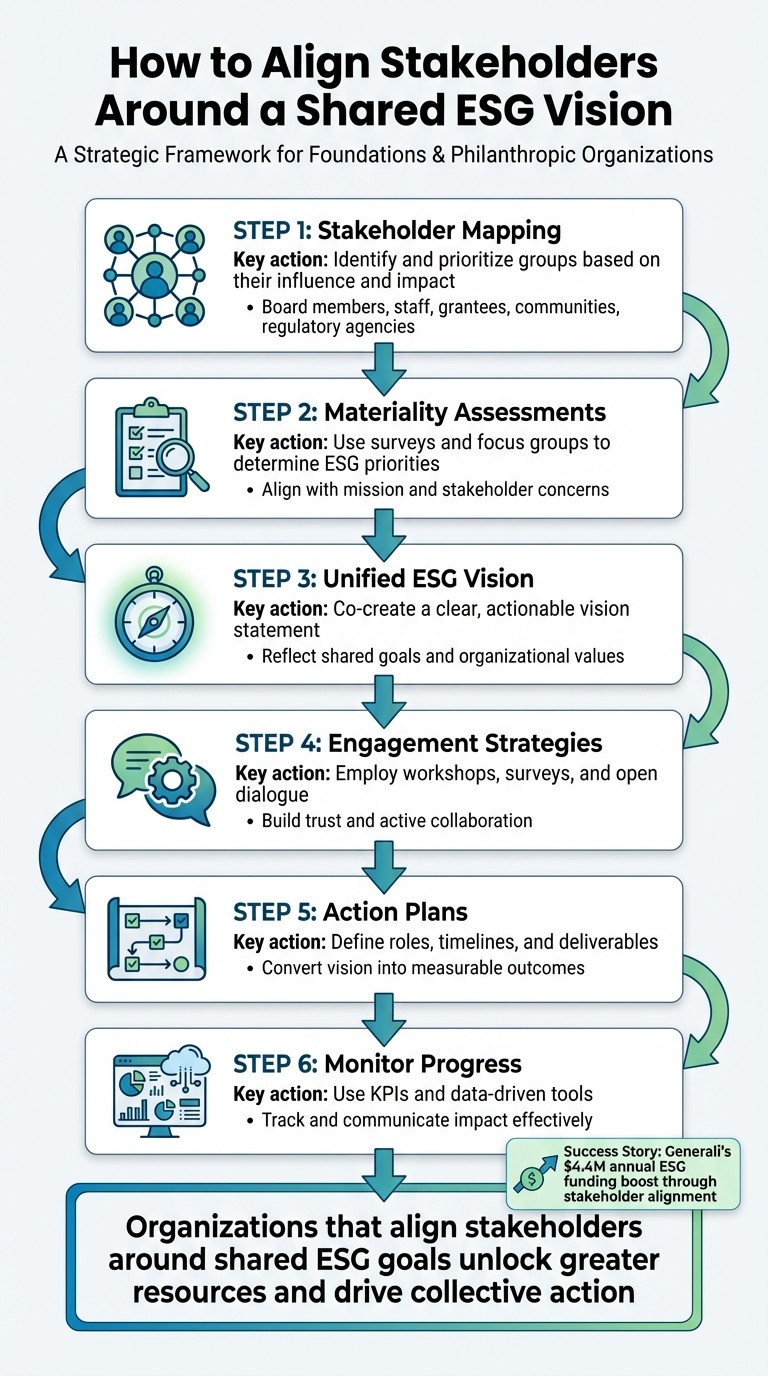
6-Step Framework for Aligning Stakeholders Around ESG Vision in Philanthropic Organizations
ESG webinar: Materiality assessments and stakeholder engagement
Assessing Your Stakeholder Landscape
Understanding who your stakeholders are and what they prioritize is essential for building a unified ESG strategy. This clarity ensures your efforts are aligned and engagement plans are effective. Stakeholders can range widely - from board members and staff to grantees, corporate partners, community organizations, and the populations directly impacted by your work. Each group plays a unique role in shaping or responding to your initiatives.
Start by identifying all individuals and groups connected to your ESG efforts. Keep in mind that stakeholders differ in influence and concerns. For instance, regulatory agencies often hold significant sway over compliance matters, while local communities might feel the most direct effects of your programs despite having limited decision-making authority. Recognizing these dynamics helps you prioritize engagement and determine how deeply to involve each group.
Mapping Stakeholders and Setting Priorities
Stakeholder mapping is a useful tool to evaluate both the influence stakeholders have on your ESG initiatives and the impact they experience as a result. This approach helps you identify where to focus collaboration efforts and where periodic updates may suffice.
For example, regulatory agencies and project proponents often fall into the category of high influence and high impact, meaning they play a critical role in shaping outcomes and are deeply invested in results. On the other hand, groups like environmental organizations might have moderate influence with less direct impact, while communities such as indigenous peoples may face significant impacts yet have historically limited influence in decision-making processes. By recognizing these distinctions, you can design engagement strategies that address power imbalances and amplify the voices of those most affected.
The International Association for Public Participation (IAP2) offers a practical framework for tailoring engagement levels to stakeholder roles:
Inform: Keep stakeholders updated with relevant information.
Consult: Seek feedback on proposals or plans.
Involve: Work directly with stakeholders to ensure their concerns shape decisions.
Collaborate: Partner with stakeholders on decision-making processes.
Empower: Allow stakeholders to take the lead in making final decisions.
For example, you might simply provide updates to certain groups while collaborating closely with key partners to shape critical strategies.
Conducting ESG Materiality Assessments
Materiality assessments help pinpoint the ESG issues that matter most to your stakeholders and align with your organization’s mission. This process ensures your resources are directed toward areas where you can make the greatest impact, avoiding the dilution of efforts.
To conduct a materiality assessment, use tools like surveys, interviews, and focus groups to gather input from stakeholders. Identify ESG issues that are both highly relevant to your organization’s goals and of significant concern to stakeholders. Cross-referencing these insights with your organization’s capacity and strategic objectives can help you focus on priorities that lie at the intersection of stakeholder concern and organizational relevance.
The results of this process can be visualized in a materiality matrix, which plots issues along two axes: their importance to stakeholders and their significance to your organization’s success. This tool helps leadership teams make informed decisions about where to direct ESG efforts. Regularly reviewing and updating your assessment ensures your strategy evolves with shifting stakeholder priorities and emerging challenges. These insights ultimately provide the foundation for crafting a cohesive ESG vision.
Building a Unified ESG Vision
Once you've mapped out stakeholder priorities, the next step is crafting a unified ESG vision. This vision acts as your organization's guiding star, offering clarity and direction while remaining adaptable to changing circumstances. It should align with your foundation's core values and mission, addressing the ESG issues that matter most to your stakeholders.
Collaboration is key to creating an effective ESG vision. Instead of imposing a top-down mandate, involve stakeholders in the process to foster shared ownership and long-term impact. By building this collaborative foundation, your organization can position itself as a connector within the ESG ecosystem, bringing together grantees, community organizations, corporate partners, and the populations you aim to serve. When stakeholders align around shared goals and pillars, it unlocks resources and drives collective action.
Writing an ESG Vision Statement
Using insights from your stakeholder assessments, craft a vision statement that clearly outlines your ESG goals. This statement should be concise, actionable, and easy to understand. Start by identifying the ESG issues that overlap with your organization's strengths and stakeholder concerns. From there, articulate what you aim to achieve, why it matters, and how it ties into your broader mission.
Avoid technical jargon that might alienate some audiences. A strong vision statement is typically two to three sentences long and should resonate across all organizational levels. Testing your draft with diverse stakeholders ensures it reflects their input and inspires commitment. The goal is to create a statement that serves as a shared reference point for decision-making and action.
Additionally, consider identifying your organization's "operating archetype." Are you functioning as a talent agency, think tank, campaign manager, or field builder? This can help clarify your approach and strategy [3].
Applying Systems Thinking to ESG Strategy
ESG issues are rarely isolated. For instance, climate change can influence community health, which in turn impacts economic opportunities and governance structures. Systems thinking allows you to identify these interconnections and address root causes rather than just symptoms.
Think of your ESG strategy as a flexible guide that evolves through continuous learning [2]. Examine how different ESG issues affect one another. For example, if your foundation focuses on education equity, consider how environmental factors like air quality influence student outcomes, how governance in school districts shapes reform efforts, and how housing stability affects learning environments. Viewing these issues holistically helps pinpoint leverage points where targeted actions can create ripple effects of positive change.
Trust-based philanthropy also reflects systems thinking by shifting power dynamics and empowering those closest to the challenges [2].
Establishing Leadership Accountability
Accountability transforms vision into results. Designate leaders or establish an ESG committee to oversee the implementation of your vision. This group should include representatives from various organizational levels and, when relevant, external stakeholders who bring fresh perspectives.
Clearly define ESG oversight responsibilities at both the board and executive levels. Some organizations appoint a Chief Impact Officer or incorporate ESG duties into existing leadership roles. The key is ensuring someone has the authority and resources to drive progress.
To track progress, develop simple dashboards for senior leadership. These dashboards should combine short-term metrics - like the number of stakeholders engaged or updated policies - with indicators of long-term impact aligned with your vision [1]. Regular reporting not only builds transparency but also keeps ESG priorities front and center, even amid competing demands.
When leadership consistently demonstrates commitment through decisions and resource allocation, it reinforces that ESG is not just aspirational but a core organizational priority.
Engaging Stakeholders for Collaboration and Buy-In
Once you've established a unified ESG vision, the next step is engaging stakeholders in a way that turns shared goals into meaningful action. Announce your plans and spark purposeful dialogue, ensuring stakeholders feel their voices are heard. The right engagement strategies not only build trust but also transform passive supporters into active collaborators.
Different approaches suit different needs. Surveys provide broad, measurable insights, while focus groups delve into the deeper reasons behind stakeholder concerns. Workshops are ideal for co-creating solutions, and listening sessions help foster trust by giving power to those most impacted by your decisions [4]. Choose the method that aligns with your objectives and use the feedback thoughtfully.
Using Surveys and Focus Groups for Stakeholder Input
Surveys are an efficient way to capture input from a wide audience, but timing is key. Align surveys with annual planning cycles so the insights can directly inform upcoming work plans and budgets [5]. Analyzing responses by demographic factors - such as gender, language, or location - can reveal diverse stakeholder experiences and perspectives [5].
For example, in 2021, the Arcus Foundation, led by Lia Parifax, conducted a tailored survey and interview process targeting grantees and external stakeholders. Over four weeks, they used "learning logs" to analyze feedback collaboratively across departments. This process uncovered significant differences in grantee experiences based on gender and language (English vs. Spanish), which shaped their 2022 planning and budgeting efforts [5].
Focus groups complement surveys by exploring the underlying reasons behind the data. They’re especially useful for unpacking complex concerns or testing stakeholder reactions to ESG initiatives. To be effective, keep groups small - six to ten participants is ideal - and ensure skilled facilitators can balance the discussion, drawing out quieter voices while managing more dominant participants.
These insights can then be expanded upon through interactive workshops, which deepen collaboration and engagement.
Facilitating Workshops and Open Dialogue
Workshops take stakeholder engagement a step further by turning participants into co-creators. When stakeholders are involved in shaping the strategy, they’re more likely to feel invested in its success. For instance, in 2022, Sobrato Philanthropies launched a two-year participatory evaluation process for its 10-year economic mobility strategy. The foundation worked with over 120 grantees through focus groups, compensated participants for their time, and even included grantees in selecting evaluation firms - sharing decision-making power throughout [6].
To run successful workshops, clear objectives and skilled facilitation are essential. Begin by framing the specific ESG challenge at hand, then guide participants through structured activities designed to generate actionable ideas. Techniques like small group discussions, dot voting for prioritization, and real-time documentation ensure all voices are heard and contributions are visible. Wrap up by outlining next steps and explaining how participants’ input will shape decisions. This transparency builds trust and sets the stage for future collaboration.
Turning Your ESG Vision into Action
Once you've established a clear ESG vision and engaged your stakeholders, the next step is translating that vision into measurable actions. A well-defined plan with specific deliverables, timelines, and accountability structures is essential to move from theory to tangible results.
Creating Action Plans with Stakeholders
Collaborating with stakeholders to co-develop action plans ensures clarity and alignment. These plans should outline roles, responsibilities, timelines, and deliverables. Incorporate a financial model, a compelling value proposition, and tie each initiative directly to your overarching strategic goals [10]. Clearly define who is responsible for what - whether it's board members, program officers, grant managers, or community partners [9].
The Marguerite Casey Foundation (MCF) provides an inspiring example of turning vision into action. After adopting a values-aligned investment policy, MCF made significant strides in aligning its endowment with its mission. Over four years, the foundation directed more than 33% of its $1 billion-plus endowment to diverse asset managers - those with at least 51% ownership by Black, Indigenous, people of color, or women managers. By 2025, MCF aims to increase this to 50%. Beyond portfolio adjustments, MCF has also engaged in shareholder advocacy, filing or co-filing nine resolutions in 2022 and more than 15 in 2023. These actions have addressed issues like worker treatment and environmental practices while delivering results that outperform industry benchmarks [8].
When conflicting priorities arise, it's crucial to address them head-on. Materiality assessments can help resolve discrepancies, and phased implementation can be a practical solution when stakeholders have differing concerns [7]. These steps ensure that your ESG strategy remains both effective and inclusive.
Working with Council Fire's Consulting Services
For organizations seeking expert guidance, specialized consulting services can be invaluable. Council Fire collaborates with foundations and philanthropic organizations to turn sustainability strategies into actionable results. Their approach goes beyond compliance, focusing on delivering system-level outcomes through data-driven insights and strategic planning.
Whether your organization needs help with climate resilience planning, stakeholder-focused strategies, or converting sustainability commitments into measurable initiatives, Council Fire offers the expertise and tools to bridge the gap between ambition and impact. Their services ensure that your ESG efforts create meaningful and lasting environmental, social, and economic outcomes.
Monitoring Progress and Measuring Impact
Keeping ESG initiatives on track requires continuous monitoring to ensure accountability and transparency. Without consistent evaluation, even the most ambitious plans risk becoming forgotten ideas, sidelined as mere paperwork.
Setting KPIs for ESG Success
Defining key performance indicators (KPIs) is the first step toward aligning your ESG goals with measurable outcomes. These metrics should be clear, quantifiable, and directly tied to your mission. For example:
Environmental goals: Track metrics like carbon emissions reduced per dollar spent or the percentage of your investments directed toward climate-focused solutions.
Social goals: Measure the reach of your programs in underrepresented communities or assess diversity statistics among grantees and staff.
Governance goals: Focus on areas such as board diversity, transparency ratings, or the percentage of grants that align with your stated values.
Tailor these KPIs to resonate with your stakeholders. For instance, addressing education equity will require different metrics than tackling environmental conservation. Engaging stakeholders in the KPI selection process not only ensures their relevance but also secures their support, making it easier to track progress that truly reflects your collective impact.
Using Data-Driven Tools for Monitoring
Once your KPIs are established, advanced analytics can help you track progress efficiently. Centralized ESG tools offer traceable and auditable data, reducing the risk of errors and enabling strategic adjustments. AI-powered systems can aggregate data from various sources - like PDFs, financial records, and IoT sensors - streamlining the process and cutting down on manual work.
Cloud-based dashboards offer real-time insights into sustainability metrics. These tools allow you to spot trends early, adapt strategies as needed, and provide stakeholders with up-to-date, transparent information. This transparency not only builds trust but also fosters stronger collaboration.
Conducting Regular Reviews and Refining Strategies
Regular reviews, whether quarterly or annually, are essential for staying responsive to changing conditions. These sessions should involve a diverse group, including board members, staff, grantees, and community partners. Together, they can analyze data, share observations, and identify areas for improvement.
Your ESG strategy should remain adaptable. Markets shift, community needs evolve, and new challenges arise. Regular reviews offer an opportunity to adjust your approach based on actual results, document valuable lessons, and celebrate milestones. This process ensures that your ESG efforts remain relevant, effective, and aligned with your mission as it grows and changes.
Conclusion
Bringing stakeholders together around a shared ESG vision is not a one-off task - it’s an ongoing effort that thrives on clear communication, meaningful collaboration, and a willingness to adapt. The organizations that succeed view stakeholder engagement as a living conversation, not a mere checklist. By carefully mapping out your stakeholder landscape, co-creating a shared vision, and maintaining transparent monitoring systems, you lay the groundwork for long-term success while enabling actionable steps in the present.
History shows that aligning diverse stakeholder goals can lead to powerful outcomes, such as unlocking additional funding and improving operational efficiency. This alignment doesn’t mean compromising your mission; instead, it’s about helping stakeholders recognize how ESG goals align with their own priorities - whether that’s financial returns, community trust, or operational improvements.
Using the strategies discussed earlier, take immediate action with the insights you already have. Perfect alignment isn’t achieved overnight - it’s a process of listening, understanding concerns, and finding common ground. Leverage tools like materiality assessments, collaborative workshops, and data-driven monitoring to build momentum step by step. Stay flexible, track new developments, and encourage stakeholders to contribute their ideas and perspectives to drive progress.
The challenges facing the philanthropic sector are too complex for any single organization to tackle alone. By uniting diverse stakeholders around a shared ESG vision, you amplify your collective impact and create systems that can evolve with future demands. This journey begins now - with open conversations and unwavering dedication to shared goals.
FAQs
How do we handle stakeholder conflicts on ESG priorities?
Resolving conflicts among stakeholders on ESG priorities hinges on genuinely understanding their varying perspectives, encouraging open dialogue, and tackling concerns head-on. A key step is to actively listen to stakeholder feedback, which can uncover underlying concerns and priorities. Identifying stakeholders who pose the highest risks or have significant influence allows for more focused engagement. Transparent and consistent communication - whether through meetings, surveys, or other forms of interaction - helps align differing interests and reduces the likelihood of misunderstandings. Ultimately, fostering trust and striking a balance between competing priorities are crucial for managing conflicts and driving progress toward shared ESG objectives.
What KPIs should a foundation use to measure ESG impact?
Foundations can track their ESG (Environmental, Social, and Governance) impact by using key performance indicators (KPIs) tailored to their specific goals. Environmental metrics might include reductions in carbon emissions, improvements in energy efficiency, water usage optimization, effective waste management, and impacts on biodiversity. Social KPIs could measure factors like stakeholder engagement, job creation, or improvements in community health. On the governance side, metrics often center around policy compliance and maintaining transparency. Selecting KPIs that align with the foundation's mission helps ensure clear progress, accountability, and openness with stakeholders.
How often should we update our ESG materiality assessment?
It’s typically advised to revisit your ESG materiality assessment every 2–3 years. This timeframe allows organizations to adapt to changes in stakeholder priorities, regulatory updates, and new ESG developments. For those operating in rapidly evolving industries, keeping an eye on ESG factors more often - monthly or quarterly - can help maintain alignment with shifting dynamics. However, conducting a formal review every few years strikes a balance between staying updated and managing resources effectively.
Related Blog Posts
How to Integrate ESG into Core Business Operations for Foundations & Philanthropic Organizations
How to Align Stakeholders Around a Shared ESG Vision for Corporations
How to Align Stakeholders Around a Shared ESG Vision for NGOs & Nonprofits
How to Align Stakeholders Around a Shared ESG Vision for Universities & Research Institutions
Latest Articles
©2025



FAQ
01
What does it really mean to “redefine profit”?
02
What makes Council Fire different?
03
Who does Council Fire you work with?
04
What does working with Council Fire actually look like?
05
How does Council Fire help organizations turn big goals into action?
06
How does Council Fire define and measure success?
Mar 5, 2026
How to Align Stakeholders Around a Shared ESG Vision for Foundations & Philanthropic Organizations
ESG Strategy
In This Article
Uniting stakeholders behind a shared ESG vision multiplies philanthropic impact through co-creation, accountability, and measurable actions.
How to Align Stakeholders Around a Shared ESG Vision for Foundations & Philanthropic Organizations
Foundations and philanthropic organizations face increasingly complex challenges like climate change and inequality - issues no single entity can solve alone. Aligning diverse stakeholders, including board members, staff, grantees, and communities, is essential to drive effective ESG initiatives. When stakeholders collaborate around shared goals, organizations can achieve greater impact, as seen with initiatives like Generali's $4.4 million annual ESG funding boost.
Key Takeaways:
Stakeholder Mapping: Identify and prioritize groups based on their influence and impact.
Materiality Assessments: Use surveys and focus groups to determine ESG priorities that align with your mission and stakeholders' concerns.
Unified ESG Vision: Co-create a clear, actionable vision statement reflecting shared goals.
Engagement Strategies: Employ workshops, surveys, and open dialogue to build trust and collaboration.
Action Plans: Define roles, timelines, and deliverables to convert vision into measurable outcomes.
Monitoring Progress: Use KPIs and data-driven tools to track and communicate impact effectively.
6-Step Framework for Aligning Stakeholders Around ESG Vision in Philanthropic Organizations
ESG webinar: Materiality assessments and stakeholder engagement
Assessing Your Stakeholder Landscape
Understanding who your stakeholders are and what they prioritize is essential for building a unified ESG strategy. This clarity ensures your efforts are aligned and engagement plans are effective. Stakeholders can range widely - from board members and staff to grantees, corporate partners, community organizations, and the populations directly impacted by your work. Each group plays a unique role in shaping or responding to your initiatives.
Start by identifying all individuals and groups connected to your ESG efforts. Keep in mind that stakeholders differ in influence and concerns. For instance, regulatory agencies often hold significant sway over compliance matters, while local communities might feel the most direct effects of your programs despite having limited decision-making authority. Recognizing these dynamics helps you prioritize engagement and determine how deeply to involve each group.
Mapping Stakeholders and Setting Priorities
Stakeholder mapping is a useful tool to evaluate both the influence stakeholders have on your ESG initiatives and the impact they experience as a result. This approach helps you identify where to focus collaboration efforts and where periodic updates may suffice.
For example, regulatory agencies and project proponents often fall into the category of high influence and high impact, meaning they play a critical role in shaping outcomes and are deeply invested in results. On the other hand, groups like environmental organizations might have moderate influence with less direct impact, while communities such as indigenous peoples may face significant impacts yet have historically limited influence in decision-making processes. By recognizing these distinctions, you can design engagement strategies that address power imbalances and amplify the voices of those most affected.
The International Association for Public Participation (IAP2) offers a practical framework for tailoring engagement levels to stakeholder roles:
Inform: Keep stakeholders updated with relevant information.
Consult: Seek feedback on proposals or plans.
Involve: Work directly with stakeholders to ensure their concerns shape decisions.
Collaborate: Partner with stakeholders on decision-making processes.
Empower: Allow stakeholders to take the lead in making final decisions.
For example, you might simply provide updates to certain groups while collaborating closely with key partners to shape critical strategies.
Conducting ESG Materiality Assessments
Materiality assessments help pinpoint the ESG issues that matter most to your stakeholders and align with your organization’s mission. This process ensures your resources are directed toward areas where you can make the greatest impact, avoiding the dilution of efforts.
To conduct a materiality assessment, use tools like surveys, interviews, and focus groups to gather input from stakeholders. Identify ESG issues that are both highly relevant to your organization’s goals and of significant concern to stakeholders. Cross-referencing these insights with your organization’s capacity and strategic objectives can help you focus on priorities that lie at the intersection of stakeholder concern and organizational relevance.
The results of this process can be visualized in a materiality matrix, which plots issues along two axes: their importance to stakeholders and their significance to your organization’s success. This tool helps leadership teams make informed decisions about where to direct ESG efforts. Regularly reviewing and updating your assessment ensures your strategy evolves with shifting stakeholder priorities and emerging challenges. These insights ultimately provide the foundation for crafting a cohesive ESG vision.
Building a Unified ESG Vision
Once you've mapped out stakeholder priorities, the next step is crafting a unified ESG vision. This vision acts as your organization's guiding star, offering clarity and direction while remaining adaptable to changing circumstances. It should align with your foundation's core values and mission, addressing the ESG issues that matter most to your stakeholders.
Collaboration is key to creating an effective ESG vision. Instead of imposing a top-down mandate, involve stakeholders in the process to foster shared ownership and long-term impact. By building this collaborative foundation, your organization can position itself as a connector within the ESG ecosystem, bringing together grantees, community organizations, corporate partners, and the populations you aim to serve. When stakeholders align around shared goals and pillars, it unlocks resources and drives collective action.
Writing an ESG Vision Statement
Using insights from your stakeholder assessments, craft a vision statement that clearly outlines your ESG goals. This statement should be concise, actionable, and easy to understand. Start by identifying the ESG issues that overlap with your organization's strengths and stakeholder concerns. From there, articulate what you aim to achieve, why it matters, and how it ties into your broader mission.
Avoid technical jargon that might alienate some audiences. A strong vision statement is typically two to three sentences long and should resonate across all organizational levels. Testing your draft with diverse stakeholders ensures it reflects their input and inspires commitment. The goal is to create a statement that serves as a shared reference point for decision-making and action.
Additionally, consider identifying your organization's "operating archetype." Are you functioning as a talent agency, think tank, campaign manager, or field builder? This can help clarify your approach and strategy [3].
Applying Systems Thinking to ESG Strategy
ESG issues are rarely isolated. For instance, climate change can influence community health, which in turn impacts economic opportunities and governance structures. Systems thinking allows you to identify these interconnections and address root causes rather than just symptoms.
Think of your ESG strategy as a flexible guide that evolves through continuous learning [2]. Examine how different ESG issues affect one another. For example, if your foundation focuses on education equity, consider how environmental factors like air quality influence student outcomes, how governance in school districts shapes reform efforts, and how housing stability affects learning environments. Viewing these issues holistically helps pinpoint leverage points where targeted actions can create ripple effects of positive change.
Trust-based philanthropy also reflects systems thinking by shifting power dynamics and empowering those closest to the challenges [2].
Establishing Leadership Accountability
Accountability transforms vision into results. Designate leaders or establish an ESG committee to oversee the implementation of your vision. This group should include representatives from various organizational levels and, when relevant, external stakeholders who bring fresh perspectives.
Clearly define ESG oversight responsibilities at both the board and executive levels. Some organizations appoint a Chief Impact Officer or incorporate ESG duties into existing leadership roles. The key is ensuring someone has the authority and resources to drive progress.
To track progress, develop simple dashboards for senior leadership. These dashboards should combine short-term metrics - like the number of stakeholders engaged or updated policies - with indicators of long-term impact aligned with your vision [1]. Regular reporting not only builds transparency but also keeps ESG priorities front and center, even amid competing demands.
When leadership consistently demonstrates commitment through decisions and resource allocation, it reinforces that ESG is not just aspirational but a core organizational priority.
Engaging Stakeholders for Collaboration and Buy-In
Once you've established a unified ESG vision, the next step is engaging stakeholders in a way that turns shared goals into meaningful action. Announce your plans and spark purposeful dialogue, ensuring stakeholders feel their voices are heard. The right engagement strategies not only build trust but also transform passive supporters into active collaborators.
Different approaches suit different needs. Surveys provide broad, measurable insights, while focus groups delve into the deeper reasons behind stakeholder concerns. Workshops are ideal for co-creating solutions, and listening sessions help foster trust by giving power to those most impacted by your decisions [4]. Choose the method that aligns with your objectives and use the feedback thoughtfully.
Using Surveys and Focus Groups for Stakeholder Input
Surveys are an efficient way to capture input from a wide audience, but timing is key. Align surveys with annual planning cycles so the insights can directly inform upcoming work plans and budgets [5]. Analyzing responses by demographic factors - such as gender, language, or location - can reveal diverse stakeholder experiences and perspectives [5].
For example, in 2021, the Arcus Foundation, led by Lia Parifax, conducted a tailored survey and interview process targeting grantees and external stakeholders. Over four weeks, they used "learning logs" to analyze feedback collaboratively across departments. This process uncovered significant differences in grantee experiences based on gender and language (English vs. Spanish), which shaped their 2022 planning and budgeting efforts [5].
Focus groups complement surveys by exploring the underlying reasons behind the data. They’re especially useful for unpacking complex concerns or testing stakeholder reactions to ESG initiatives. To be effective, keep groups small - six to ten participants is ideal - and ensure skilled facilitators can balance the discussion, drawing out quieter voices while managing more dominant participants.
These insights can then be expanded upon through interactive workshops, which deepen collaboration and engagement.
Facilitating Workshops and Open Dialogue
Workshops take stakeholder engagement a step further by turning participants into co-creators. When stakeholders are involved in shaping the strategy, they’re more likely to feel invested in its success. For instance, in 2022, Sobrato Philanthropies launched a two-year participatory evaluation process for its 10-year economic mobility strategy. The foundation worked with over 120 grantees through focus groups, compensated participants for their time, and even included grantees in selecting evaluation firms - sharing decision-making power throughout [6].
To run successful workshops, clear objectives and skilled facilitation are essential. Begin by framing the specific ESG challenge at hand, then guide participants through structured activities designed to generate actionable ideas. Techniques like small group discussions, dot voting for prioritization, and real-time documentation ensure all voices are heard and contributions are visible. Wrap up by outlining next steps and explaining how participants’ input will shape decisions. This transparency builds trust and sets the stage for future collaboration.
Turning Your ESG Vision into Action
Once you've established a clear ESG vision and engaged your stakeholders, the next step is translating that vision into measurable actions. A well-defined plan with specific deliverables, timelines, and accountability structures is essential to move from theory to tangible results.
Creating Action Plans with Stakeholders
Collaborating with stakeholders to co-develop action plans ensures clarity and alignment. These plans should outline roles, responsibilities, timelines, and deliverables. Incorporate a financial model, a compelling value proposition, and tie each initiative directly to your overarching strategic goals [10]. Clearly define who is responsible for what - whether it's board members, program officers, grant managers, or community partners [9].
The Marguerite Casey Foundation (MCF) provides an inspiring example of turning vision into action. After adopting a values-aligned investment policy, MCF made significant strides in aligning its endowment with its mission. Over four years, the foundation directed more than 33% of its $1 billion-plus endowment to diverse asset managers - those with at least 51% ownership by Black, Indigenous, people of color, or women managers. By 2025, MCF aims to increase this to 50%. Beyond portfolio adjustments, MCF has also engaged in shareholder advocacy, filing or co-filing nine resolutions in 2022 and more than 15 in 2023. These actions have addressed issues like worker treatment and environmental practices while delivering results that outperform industry benchmarks [8].
When conflicting priorities arise, it's crucial to address them head-on. Materiality assessments can help resolve discrepancies, and phased implementation can be a practical solution when stakeholders have differing concerns [7]. These steps ensure that your ESG strategy remains both effective and inclusive.
Working with Council Fire's Consulting Services
For organizations seeking expert guidance, specialized consulting services can be invaluable. Council Fire collaborates with foundations and philanthropic organizations to turn sustainability strategies into actionable results. Their approach goes beyond compliance, focusing on delivering system-level outcomes through data-driven insights and strategic planning.
Whether your organization needs help with climate resilience planning, stakeholder-focused strategies, or converting sustainability commitments into measurable initiatives, Council Fire offers the expertise and tools to bridge the gap between ambition and impact. Their services ensure that your ESG efforts create meaningful and lasting environmental, social, and economic outcomes.
Monitoring Progress and Measuring Impact
Keeping ESG initiatives on track requires continuous monitoring to ensure accountability and transparency. Without consistent evaluation, even the most ambitious plans risk becoming forgotten ideas, sidelined as mere paperwork.
Setting KPIs for ESG Success
Defining key performance indicators (KPIs) is the first step toward aligning your ESG goals with measurable outcomes. These metrics should be clear, quantifiable, and directly tied to your mission. For example:
Environmental goals: Track metrics like carbon emissions reduced per dollar spent or the percentage of your investments directed toward climate-focused solutions.
Social goals: Measure the reach of your programs in underrepresented communities or assess diversity statistics among grantees and staff.
Governance goals: Focus on areas such as board diversity, transparency ratings, or the percentage of grants that align with your stated values.
Tailor these KPIs to resonate with your stakeholders. For instance, addressing education equity will require different metrics than tackling environmental conservation. Engaging stakeholders in the KPI selection process not only ensures their relevance but also secures their support, making it easier to track progress that truly reflects your collective impact.
Using Data-Driven Tools for Monitoring
Once your KPIs are established, advanced analytics can help you track progress efficiently. Centralized ESG tools offer traceable and auditable data, reducing the risk of errors and enabling strategic adjustments. AI-powered systems can aggregate data from various sources - like PDFs, financial records, and IoT sensors - streamlining the process and cutting down on manual work.
Cloud-based dashboards offer real-time insights into sustainability metrics. These tools allow you to spot trends early, adapt strategies as needed, and provide stakeholders with up-to-date, transparent information. This transparency not only builds trust but also fosters stronger collaboration.
Conducting Regular Reviews and Refining Strategies
Regular reviews, whether quarterly or annually, are essential for staying responsive to changing conditions. These sessions should involve a diverse group, including board members, staff, grantees, and community partners. Together, they can analyze data, share observations, and identify areas for improvement.
Your ESG strategy should remain adaptable. Markets shift, community needs evolve, and new challenges arise. Regular reviews offer an opportunity to adjust your approach based on actual results, document valuable lessons, and celebrate milestones. This process ensures that your ESG efforts remain relevant, effective, and aligned with your mission as it grows and changes.
Conclusion
Bringing stakeholders together around a shared ESG vision is not a one-off task - it’s an ongoing effort that thrives on clear communication, meaningful collaboration, and a willingness to adapt. The organizations that succeed view stakeholder engagement as a living conversation, not a mere checklist. By carefully mapping out your stakeholder landscape, co-creating a shared vision, and maintaining transparent monitoring systems, you lay the groundwork for long-term success while enabling actionable steps in the present.
History shows that aligning diverse stakeholder goals can lead to powerful outcomes, such as unlocking additional funding and improving operational efficiency. This alignment doesn’t mean compromising your mission; instead, it’s about helping stakeholders recognize how ESG goals align with their own priorities - whether that’s financial returns, community trust, or operational improvements.
Using the strategies discussed earlier, take immediate action with the insights you already have. Perfect alignment isn’t achieved overnight - it’s a process of listening, understanding concerns, and finding common ground. Leverage tools like materiality assessments, collaborative workshops, and data-driven monitoring to build momentum step by step. Stay flexible, track new developments, and encourage stakeholders to contribute their ideas and perspectives to drive progress.
The challenges facing the philanthropic sector are too complex for any single organization to tackle alone. By uniting diverse stakeholders around a shared ESG vision, you amplify your collective impact and create systems that can evolve with future demands. This journey begins now - with open conversations and unwavering dedication to shared goals.
FAQs
How do we handle stakeholder conflicts on ESG priorities?
Resolving conflicts among stakeholders on ESG priorities hinges on genuinely understanding their varying perspectives, encouraging open dialogue, and tackling concerns head-on. A key step is to actively listen to stakeholder feedback, which can uncover underlying concerns and priorities. Identifying stakeholders who pose the highest risks or have significant influence allows for more focused engagement. Transparent and consistent communication - whether through meetings, surveys, or other forms of interaction - helps align differing interests and reduces the likelihood of misunderstandings. Ultimately, fostering trust and striking a balance between competing priorities are crucial for managing conflicts and driving progress toward shared ESG objectives.
What KPIs should a foundation use to measure ESG impact?
Foundations can track their ESG (Environmental, Social, and Governance) impact by using key performance indicators (KPIs) tailored to their specific goals. Environmental metrics might include reductions in carbon emissions, improvements in energy efficiency, water usage optimization, effective waste management, and impacts on biodiversity. Social KPIs could measure factors like stakeholder engagement, job creation, or improvements in community health. On the governance side, metrics often center around policy compliance and maintaining transparency. Selecting KPIs that align with the foundation's mission helps ensure clear progress, accountability, and openness with stakeholders.
How often should we update our ESG materiality assessment?
It’s typically advised to revisit your ESG materiality assessment every 2–3 years. This timeframe allows organizations to adapt to changes in stakeholder priorities, regulatory updates, and new ESG developments. For those operating in rapidly evolving industries, keeping an eye on ESG factors more often - monthly or quarterly - can help maintain alignment with shifting dynamics. However, conducting a formal review every few years strikes a balance between staying updated and managing resources effectively.
Related Blog Posts
How to Integrate ESG into Core Business Operations for Foundations & Philanthropic Organizations
How to Align Stakeholders Around a Shared ESG Vision for Corporations
How to Align Stakeholders Around a Shared ESG Vision for NGOs & Nonprofits
How to Align Stakeholders Around a Shared ESG Vision for Universities & Research Institutions
FAQ
01
What does it really mean to “redefine profit”?
02
What makes Council Fire different?
03
Who does Council Fire you work with?
04
What does working with Council Fire actually look like?
05
How does Council Fire help organizations turn big goals into action?
06
How does Council Fire define and measure success?
Mar 5, 2026
How to Align Stakeholders Around a Shared ESG Vision for Foundations & Philanthropic Organizations
ESG Strategy
In This Article
Uniting stakeholders behind a shared ESG vision multiplies philanthropic impact through co-creation, accountability, and measurable actions.
How to Align Stakeholders Around a Shared ESG Vision for Foundations & Philanthropic Organizations
Foundations and philanthropic organizations face increasingly complex challenges like climate change and inequality - issues no single entity can solve alone. Aligning diverse stakeholders, including board members, staff, grantees, and communities, is essential to drive effective ESG initiatives. When stakeholders collaborate around shared goals, organizations can achieve greater impact, as seen with initiatives like Generali's $4.4 million annual ESG funding boost.
Key Takeaways:
Stakeholder Mapping: Identify and prioritize groups based on their influence and impact.
Materiality Assessments: Use surveys and focus groups to determine ESG priorities that align with your mission and stakeholders' concerns.
Unified ESG Vision: Co-create a clear, actionable vision statement reflecting shared goals.
Engagement Strategies: Employ workshops, surveys, and open dialogue to build trust and collaboration.
Action Plans: Define roles, timelines, and deliverables to convert vision into measurable outcomes.
Monitoring Progress: Use KPIs and data-driven tools to track and communicate impact effectively.
6-Step Framework for Aligning Stakeholders Around ESG Vision in Philanthropic Organizations
ESG webinar: Materiality assessments and stakeholder engagement
Assessing Your Stakeholder Landscape
Understanding who your stakeholders are and what they prioritize is essential for building a unified ESG strategy. This clarity ensures your efforts are aligned and engagement plans are effective. Stakeholders can range widely - from board members and staff to grantees, corporate partners, community organizations, and the populations directly impacted by your work. Each group plays a unique role in shaping or responding to your initiatives.
Start by identifying all individuals and groups connected to your ESG efforts. Keep in mind that stakeholders differ in influence and concerns. For instance, regulatory agencies often hold significant sway over compliance matters, while local communities might feel the most direct effects of your programs despite having limited decision-making authority. Recognizing these dynamics helps you prioritize engagement and determine how deeply to involve each group.
Mapping Stakeholders and Setting Priorities
Stakeholder mapping is a useful tool to evaluate both the influence stakeholders have on your ESG initiatives and the impact they experience as a result. This approach helps you identify where to focus collaboration efforts and where periodic updates may suffice.
For example, regulatory agencies and project proponents often fall into the category of high influence and high impact, meaning they play a critical role in shaping outcomes and are deeply invested in results. On the other hand, groups like environmental organizations might have moderate influence with less direct impact, while communities such as indigenous peoples may face significant impacts yet have historically limited influence in decision-making processes. By recognizing these distinctions, you can design engagement strategies that address power imbalances and amplify the voices of those most affected.
The International Association for Public Participation (IAP2) offers a practical framework for tailoring engagement levels to stakeholder roles:
Inform: Keep stakeholders updated with relevant information.
Consult: Seek feedback on proposals or plans.
Involve: Work directly with stakeholders to ensure their concerns shape decisions.
Collaborate: Partner with stakeholders on decision-making processes.
Empower: Allow stakeholders to take the lead in making final decisions.
For example, you might simply provide updates to certain groups while collaborating closely with key partners to shape critical strategies.
Conducting ESG Materiality Assessments
Materiality assessments help pinpoint the ESG issues that matter most to your stakeholders and align with your organization’s mission. This process ensures your resources are directed toward areas where you can make the greatest impact, avoiding the dilution of efforts.
To conduct a materiality assessment, use tools like surveys, interviews, and focus groups to gather input from stakeholders. Identify ESG issues that are both highly relevant to your organization’s goals and of significant concern to stakeholders. Cross-referencing these insights with your organization’s capacity and strategic objectives can help you focus on priorities that lie at the intersection of stakeholder concern and organizational relevance.
The results of this process can be visualized in a materiality matrix, which plots issues along two axes: their importance to stakeholders and their significance to your organization’s success. This tool helps leadership teams make informed decisions about where to direct ESG efforts. Regularly reviewing and updating your assessment ensures your strategy evolves with shifting stakeholder priorities and emerging challenges. These insights ultimately provide the foundation for crafting a cohesive ESG vision.
Building a Unified ESG Vision
Once you've mapped out stakeholder priorities, the next step is crafting a unified ESG vision. This vision acts as your organization's guiding star, offering clarity and direction while remaining adaptable to changing circumstances. It should align with your foundation's core values and mission, addressing the ESG issues that matter most to your stakeholders.
Collaboration is key to creating an effective ESG vision. Instead of imposing a top-down mandate, involve stakeholders in the process to foster shared ownership and long-term impact. By building this collaborative foundation, your organization can position itself as a connector within the ESG ecosystem, bringing together grantees, community organizations, corporate partners, and the populations you aim to serve. When stakeholders align around shared goals and pillars, it unlocks resources and drives collective action.
Writing an ESG Vision Statement
Using insights from your stakeholder assessments, craft a vision statement that clearly outlines your ESG goals. This statement should be concise, actionable, and easy to understand. Start by identifying the ESG issues that overlap with your organization's strengths and stakeholder concerns. From there, articulate what you aim to achieve, why it matters, and how it ties into your broader mission.
Avoid technical jargon that might alienate some audiences. A strong vision statement is typically two to three sentences long and should resonate across all organizational levels. Testing your draft with diverse stakeholders ensures it reflects their input and inspires commitment. The goal is to create a statement that serves as a shared reference point for decision-making and action.
Additionally, consider identifying your organization's "operating archetype." Are you functioning as a talent agency, think tank, campaign manager, or field builder? This can help clarify your approach and strategy [3].
Applying Systems Thinking to ESG Strategy
ESG issues are rarely isolated. For instance, climate change can influence community health, which in turn impacts economic opportunities and governance structures. Systems thinking allows you to identify these interconnections and address root causes rather than just symptoms.
Think of your ESG strategy as a flexible guide that evolves through continuous learning [2]. Examine how different ESG issues affect one another. For example, if your foundation focuses on education equity, consider how environmental factors like air quality influence student outcomes, how governance in school districts shapes reform efforts, and how housing stability affects learning environments. Viewing these issues holistically helps pinpoint leverage points where targeted actions can create ripple effects of positive change.
Trust-based philanthropy also reflects systems thinking by shifting power dynamics and empowering those closest to the challenges [2].
Establishing Leadership Accountability
Accountability transforms vision into results. Designate leaders or establish an ESG committee to oversee the implementation of your vision. This group should include representatives from various organizational levels and, when relevant, external stakeholders who bring fresh perspectives.
Clearly define ESG oversight responsibilities at both the board and executive levels. Some organizations appoint a Chief Impact Officer or incorporate ESG duties into existing leadership roles. The key is ensuring someone has the authority and resources to drive progress.
To track progress, develop simple dashboards for senior leadership. These dashboards should combine short-term metrics - like the number of stakeholders engaged or updated policies - with indicators of long-term impact aligned with your vision [1]. Regular reporting not only builds transparency but also keeps ESG priorities front and center, even amid competing demands.
When leadership consistently demonstrates commitment through decisions and resource allocation, it reinforces that ESG is not just aspirational but a core organizational priority.
Engaging Stakeholders for Collaboration and Buy-In
Once you've established a unified ESG vision, the next step is engaging stakeholders in a way that turns shared goals into meaningful action. Announce your plans and spark purposeful dialogue, ensuring stakeholders feel their voices are heard. The right engagement strategies not only build trust but also transform passive supporters into active collaborators.
Different approaches suit different needs. Surveys provide broad, measurable insights, while focus groups delve into the deeper reasons behind stakeholder concerns. Workshops are ideal for co-creating solutions, and listening sessions help foster trust by giving power to those most impacted by your decisions [4]. Choose the method that aligns with your objectives and use the feedback thoughtfully.
Using Surveys and Focus Groups for Stakeholder Input
Surveys are an efficient way to capture input from a wide audience, but timing is key. Align surveys with annual planning cycles so the insights can directly inform upcoming work plans and budgets [5]. Analyzing responses by demographic factors - such as gender, language, or location - can reveal diverse stakeholder experiences and perspectives [5].
For example, in 2021, the Arcus Foundation, led by Lia Parifax, conducted a tailored survey and interview process targeting grantees and external stakeholders. Over four weeks, they used "learning logs" to analyze feedback collaboratively across departments. This process uncovered significant differences in grantee experiences based on gender and language (English vs. Spanish), which shaped their 2022 planning and budgeting efforts [5].
Focus groups complement surveys by exploring the underlying reasons behind the data. They’re especially useful for unpacking complex concerns or testing stakeholder reactions to ESG initiatives. To be effective, keep groups small - six to ten participants is ideal - and ensure skilled facilitators can balance the discussion, drawing out quieter voices while managing more dominant participants.
These insights can then be expanded upon through interactive workshops, which deepen collaboration and engagement.
Facilitating Workshops and Open Dialogue
Workshops take stakeholder engagement a step further by turning participants into co-creators. When stakeholders are involved in shaping the strategy, they’re more likely to feel invested in its success. For instance, in 2022, Sobrato Philanthropies launched a two-year participatory evaluation process for its 10-year economic mobility strategy. The foundation worked with over 120 grantees through focus groups, compensated participants for their time, and even included grantees in selecting evaluation firms - sharing decision-making power throughout [6].
To run successful workshops, clear objectives and skilled facilitation are essential. Begin by framing the specific ESG challenge at hand, then guide participants through structured activities designed to generate actionable ideas. Techniques like small group discussions, dot voting for prioritization, and real-time documentation ensure all voices are heard and contributions are visible. Wrap up by outlining next steps and explaining how participants’ input will shape decisions. This transparency builds trust and sets the stage for future collaboration.
Turning Your ESG Vision into Action
Once you've established a clear ESG vision and engaged your stakeholders, the next step is translating that vision into measurable actions. A well-defined plan with specific deliverables, timelines, and accountability structures is essential to move from theory to tangible results.
Creating Action Plans with Stakeholders
Collaborating with stakeholders to co-develop action plans ensures clarity and alignment. These plans should outline roles, responsibilities, timelines, and deliverables. Incorporate a financial model, a compelling value proposition, and tie each initiative directly to your overarching strategic goals [10]. Clearly define who is responsible for what - whether it's board members, program officers, grant managers, or community partners [9].
The Marguerite Casey Foundation (MCF) provides an inspiring example of turning vision into action. After adopting a values-aligned investment policy, MCF made significant strides in aligning its endowment with its mission. Over four years, the foundation directed more than 33% of its $1 billion-plus endowment to diverse asset managers - those with at least 51% ownership by Black, Indigenous, people of color, or women managers. By 2025, MCF aims to increase this to 50%. Beyond portfolio adjustments, MCF has also engaged in shareholder advocacy, filing or co-filing nine resolutions in 2022 and more than 15 in 2023. These actions have addressed issues like worker treatment and environmental practices while delivering results that outperform industry benchmarks [8].
When conflicting priorities arise, it's crucial to address them head-on. Materiality assessments can help resolve discrepancies, and phased implementation can be a practical solution when stakeholders have differing concerns [7]. These steps ensure that your ESG strategy remains both effective and inclusive.
Working with Council Fire's Consulting Services
For organizations seeking expert guidance, specialized consulting services can be invaluable. Council Fire collaborates with foundations and philanthropic organizations to turn sustainability strategies into actionable results. Their approach goes beyond compliance, focusing on delivering system-level outcomes through data-driven insights and strategic planning.
Whether your organization needs help with climate resilience planning, stakeholder-focused strategies, or converting sustainability commitments into measurable initiatives, Council Fire offers the expertise and tools to bridge the gap between ambition and impact. Their services ensure that your ESG efforts create meaningful and lasting environmental, social, and economic outcomes.
Monitoring Progress and Measuring Impact
Keeping ESG initiatives on track requires continuous monitoring to ensure accountability and transparency. Without consistent evaluation, even the most ambitious plans risk becoming forgotten ideas, sidelined as mere paperwork.
Setting KPIs for ESG Success
Defining key performance indicators (KPIs) is the first step toward aligning your ESG goals with measurable outcomes. These metrics should be clear, quantifiable, and directly tied to your mission. For example:
Environmental goals: Track metrics like carbon emissions reduced per dollar spent or the percentage of your investments directed toward climate-focused solutions.
Social goals: Measure the reach of your programs in underrepresented communities or assess diversity statistics among grantees and staff.
Governance goals: Focus on areas such as board diversity, transparency ratings, or the percentage of grants that align with your stated values.
Tailor these KPIs to resonate with your stakeholders. For instance, addressing education equity will require different metrics than tackling environmental conservation. Engaging stakeholders in the KPI selection process not only ensures their relevance but also secures their support, making it easier to track progress that truly reflects your collective impact.
Using Data-Driven Tools for Monitoring
Once your KPIs are established, advanced analytics can help you track progress efficiently. Centralized ESG tools offer traceable and auditable data, reducing the risk of errors and enabling strategic adjustments. AI-powered systems can aggregate data from various sources - like PDFs, financial records, and IoT sensors - streamlining the process and cutting down on manual work.
Cloud-based dashboards offer real-time insights into sustainability metrics. These tools allow you to spot trends early, adapt strategies as needed, and provide stakeholders with up-to-date, transparent information. This transparency not only builds trust but also fosters stronger collaboration.
Conducting Regular Reviews and Refining Strategies
Regular reviews, whether quarterly or annually, are essential for staying responsive to changing conditions. These sessions should involve a diverse group, including board members, staff, grantees, and community partners. Together, they can analyze data, share observations, and identify areas for improvement.
Your ESG strategy should remain adaptable. Markets shift, community needs evolve, and new challenges arise. Regular reviews offer an opportunity to adjust your approach based on actual results, document valuable lessons, and celebrate milestones. This process ensures that your ESG efforts remain relevant, effective, and aligned with your mission as it grows and changes.
Conclusion
Bringing stakeholders together around a shared ESG vision is not a one-off task - it’s an ongoing effort that thrives on clear communication, meaningful collaboration, and a willingness to adapt. The organizations that succeed view stakeholder engagement as a living conversation, not a mere checklist. By carefully mapping out your stakeholder landscape, co-creating a shared vision, and maintaining transparent monitoring systems, you lay the groundwork for long-term success while enabling actionable steps in the present.
History shows that aligning diverse stakeholder goals can lead to powerful outcomes, such as unlocking additional funding and improving operational efficiency. This alignment doesn’t mean compromising your mission; instead, it’s about helping stakeholders recognize how ESG goals align with their own priorities - whether that’s financial returns, community trust, or operational improvements.
Using the strategies discussed earlier, take immediate action with the insights you already have. Perfect alignment isn’t achieved overnight - it’s a process of listening, understanding concerns, and finding common ground. Leverage tools like materiality assessments, collaborative workshops, and data-driven monitoring to build momentum step by step. Stay flexible, track new developments, and encourage stakeholders to contribute their ideas and perspectives to drive progress.
The challenges facing the philanthropic sector are too complex for any single organization to tackle alone. By uniting diverse stakeholders around a shared ESG vision, you amplify your collective impact and create systems that can evolve with future demands. This journey begins now - with open conversations and unwavering dedication to shared goals.
FAQs
How do we handle stakeholder conflicts on ESG priorities?
Resolving conflicts among stakeholders on ESG priorities hinges on genuinely understanding their varying perspectives, encouraging open dialogue, and tackling concerns head-on. A key step is to actively listen to stakeholder feedback, which can uncover underlying concerns and priorities. Identifying stakeholders who pose the highest risks or have significant influence allows for more focused engagement. Transparent and consistent communication - whether through meetings, surveys, or other forms of interaction - helps align differing interests and reduces the likelihood of misunderstandings. Ultimately, fostering trust and striking a balance between competing priorities are crucial for managing conflicts and driving progress toward shared ESG objectives.
What KPIs should a foundation use to measure ESG impact?
Foundations can track their ESG (Environmental, Social, and Governance) impact by using key performance indicators (KPIs) tailored to their specific goals. Environmental metrics might include reductions in carbon emissions, improvements in energy efficiency, water usage optimization, effective waste management, and impacts on biodiversity. Social KPIs could measure factors like stakeholder engagement, job creation, or improvements in community health. On the governance side, metrics often center around policy compliance and maintaining transparency. Selecting KPIs that align with the foundation's mission helps ensure clear progress, accountability, and openness with stakeholders.
How often should we update our ESG materiality assessment?
It’s typically advised to revisit your ESG materiality assessment every 2–3 years. This timeframe allows organizations to adapt to changes in stakeholder priorities, regulatory updates, and new ESG developments. For those operating in rapidly evolving industries, keeping an eye on ESG factors more often - monthly or quarterly - can help maintain alignment with shifting dynamics. However, conducting a formal review every few years strikes a balance between staying updated and managing resources effectively.
Related Blog Posts
How to Integrate ESG into Core Business Operations for Foundations & Philanthropic Organizations
How to Align Stakeholders Around a Shared ESG Vision for Corporations
How to Align Stakeholders Around a Shared ESG Vision for NGOs & Nonprofits
How to Align Stakeholders Around a Shared ESG Vision for Universities & Research Institutions
FAQ
What does it really mean to “redefine profit”?
What makes Council Fire different?
Who does Council Fire you work with?
What does working with Council Fire actually look like?
How does Council Fire help organizations turn big goals into action?
How does Council Fire define and measure success?