
Mar 3, 2026
How to Align Stakeholders Around a Shared ESG Vision for NGOs & Nonprofits
ESG Strategy
In This Article
Practical steps for NGOs to align boards, donors, staff and communities around an ESG vision with SMART goals, stakeholder mapping, and reporting frameworks.
How to Align Stakeholders Around a Shared ESG Vision for NGOs & Nonprofits
Aligning stakeholders around a shared ESG vision is essential for NGOs and nonprofits to achieve meaningful impact. This requires balancing diverse priorities - board members focus on governance, donors demand measurable results, and program staff emphasize service delivery. Without alignment, organizations risk inefficiency and resource drain. Here's how to create a unified ESG framework:
Define Your ESG Vision: Conduct materiality assessments to identify key priorities and align goals with your mission.
Set SMART Goals: Make objectives specific, measurable, achievable, relevant, and time-bound to ensure clarity and accountability.
Engage Stakeholders: Use tools like stakeholder mapping and power-interest grids to prioritize and tailor engagement efforts.
Use Established Frameworks: Leverage trusted benchmarks like the UN SDGs, GRI, or SASB for credibility.
Build a Structured Framework: Document processes, set clear objectives, and maintain regular communication to ensure progress.
Measure and Adjust: Monitor KPIs, gather feedback, and refine strategies based on data-driven insights.
Charities - From Ambitions to ESG Action Podcast
Define Your ESG Vision and Objectives
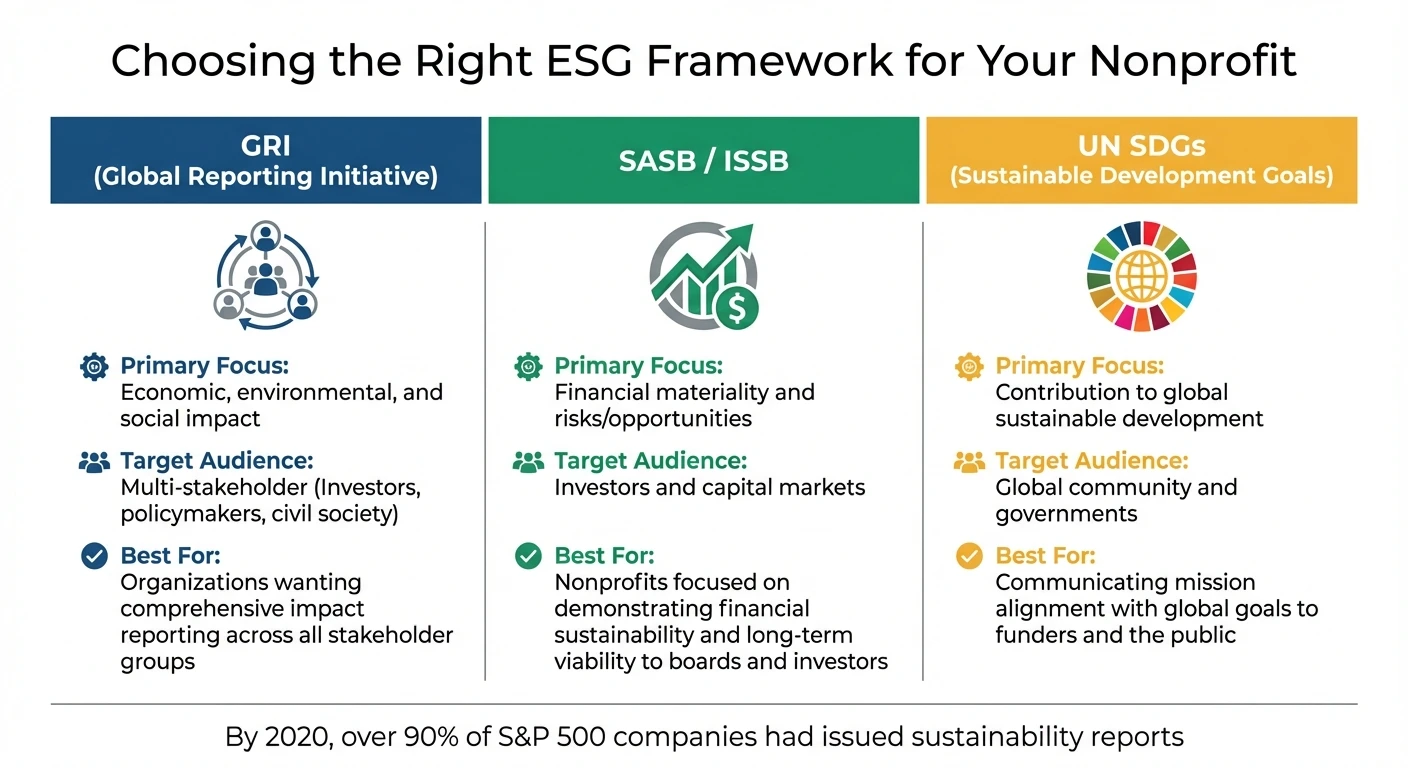
ESG Reporting Frameworks Comparison: GRI, SASB, and UN SDGs
A clear ESG vision serves as your guiding light, shaping decisions, directing resources, and establishing a unified framework for action. Without this clarity, conversations with stakeholders can quickly spiral into conflicting priorities and fragmented initiatives.
Start by conducting a materiality assessment to pinpoint what truly matters. This involves assessing both the internal effects on society and the external risks to your mission. For instance, a youth development nonprofit might identify climate change as a threat to the communities it serves, while its governance practices could directly influence donor trust and program success.
Your ESG objectives should naturally extend from your Theory of Change. Take Generation Hope in Washington, DC, as an example. When developing their strategic plan in 2023, CEO Nicole Lynn Lewis emphasized this connection. Instead of trying to serve every teen parent in the U.S., they focused on broader systemic impact, setting goals like forming 10 new partnerships and reaching 20,000 student parents through technical assistance by FY24. As Lewis stated:
"We couldn't serve every teen student parent in the US - but we knew we could help drive larger changes to benefit them" [1].
This approach seamlessly integrated ESG principles by leveraging partnerships and advocacy to expand their impact while staying true to their mission.
To maintain focus, limit your ESG initiatives to five to seven key priorities. Each goal should align closely with your mission, ensuring both authenticity and stakeholder support. When your ESG vision feels like a natural progression of your existing work rather than an unrelated add-on, stakeholders are more likely to see its value.
With your vision in place, the next step is to set SMART goals that deliver measurable results.
Set SMART ESG Goals
For your ESG efforts to resonate and avoid accusations of greenwashing, they must be grounded in Specific, Measurable, Achievable, Relevant, and Time-bound (SMART) goals. This approach builds credibility with donors, board members, and staff.
Specific goals clearly define success. For example, replace "improve environmental impact" with "reduce office paper use by 40%."
Measurable goals include quantifiable targets, such as percentages, dollar amounts, or participant numbers, that you can track over time.
Achievable goals are realistic, given your resources and capacity.
Relevant goals tie directly to your mission and values, ensuring alignment.
Time-bound goals establish deadlines to create a sense of urgency.
Living Goods in Kenya exemplifies this approach. During their 2023 strategic planning, they transitioned from direct service delivery to supporting government-led health systems. After training 12,000 health workers who reached 9 million people, they set a SMART goal: limit direct delivery to "learning laboratories" while helping governments implement community health systems at an annual per capita cost of $3 to $4 [1]. This goal was specific (focus on government systems), measurable (cost per capita), achievable (based on proven models), relevant (aligned with health access), and time-bound (linked to their planning cycle).
Organizations with sustainability efforts embedded in their operations see a 16% higher revenue growth rate and are 52% more likely to outperform their peers in profitability. For long-term goals like poverty reduction, tracking short-term milestones - such as behavior changes or service improvements - helps maintain momentum and demonstrate progress.
Use Existing Frameworks
You don’t have to start from scratch. Established frameworks like the UN Sustainable Development Goals (SDGs), Global Reporting Initiative (GRI), and SASB standards offer trusted benchmarks that stakeholders already recognize.
Each framework has its own focus:
SDGs help articulate your contribution to global goals, making them ideal for public and funder communication.
GRI emphasizes your broader economic, environmental, and social impacts, suitable for multi-stakeholder reporting.
SASB focuses on financial risks and opportunities, resonating with investors and boards concerned about long-term sustainability.
Framework | Primary Focus | Target Audience |
|---|---|---|
GRI (Global Reporting Initiative) | Economic, environmental, and social impact | Multi-stakeholder (Investors, policymakers, civil society) |
SASB / ISSB | Financial materiality and risks/opportunities | Investors and capital markets |
SDGs (Sustainable Development Goals) | Contribution to global sustainable development | Global community and governments |
By 2020, over 90% of S&P 500 companies had issued sustainability reports, and nonprofits are increasingly following suit. Leveraging these frameworks not only saves time but also enhances your credibility and helps stakeholders understand your ESG performance in context.
Align ESG Goals with Your Mission
Once your vision and SMART objectives are defined, ensure your ESG goals remain rooted in your mission. Authenticity is key. If your goals feel disconnected from your core purpose, stakeholders will notice - and they won’t engage.
Review foundational documents every five years to align evolving ESG priorities with your mission. For example, in 2024, KPMG UK partnered with Key4Life to reduce reoffending rates among ex-prisoners. By aligning their ESG goals with the mission of helping individuals rebuild their lives, they achieved a 14% reoffending rate - significantly lower than the UK’s national rate of 65% - and helped over 70% of participants secure employment.
Consider creating Beneficiary Advisory Councils to involve those you serve in shaping programs and setting ESG priorities. This ensures your goals remain relevant to real community needs. For organizations focused on environmental justice, align your initiatives with frameworks like Executive Order 14096, which emphasizes inclusive decision-making for all affected communities.
The 2025 Edelman Trust Barometer highlights a growing "trust deficit" across institutions, making genuine stakeholder engagement more important than ever. When ESG goals align with your mission and values, stakeholders don’t just support them - they advocate for them.
Identify and Engage Key Stakeholders
Achieving a cohesive ESG vision requires deliberate engagement with the right stakeholders. Once your ESG vision is defined, the next step is identifying those who are essential to its success. Not all stakeholders hold the same level of influence, and treating them equally can dilute your focus and waste resources.
Begin by categorizing stakeholders into Primary and Secondary groups. Primary stakeholders are those who directly affect your organization, such as beneficiaries, donors, board members, and staff. Secondary stakeholders, like local businesses and government entities, exert indirect influence on your efforts [2].
Richard Spencer, Director of Sustainability at ICAEW, highlights a common misstep in stakeholder engagement:
"The temptation with stakeholders is to think of it very much in one direction - namely, who you want to speak to. Often, that translates into who's going to agree with you." [3]
Insights from 2024 focus groups underscore the importance of listening to diverse voices. Beneficiaries, volunteers, and local businesses identified unmet needs that, when addressed, strengthened their involvement [2]. Similarly, an environmental nonprofit discovered through community forums that residents felt overlooked in specific areas, leading to targeted initiatives that built a loyal volunteer network [2].
The key is to start broad, gathering input from a wide range of stakeholders, and then refine your focus based on their level of influence and interest. This approach lays the groundwork for effective stakeholder mapping.
Map Stakeholders Using Power-Interest Grids
A power-interest grid is a practical tool for strategically categorizing stakeholders. It helps you visualize where each group stands in terms of their influence over your ESG initiatives and their interest in them. This visual map then serves as a guide for tailoring your engagement efforts.
The grid divides stakeholders into four categories:
High Power, High Interest: These are your key players - board members, major donors, and community leaders - who need active collaboration and regular updates.
High Power, Low Interest: Influential figures, such as government officials or potential funders, who require periodic updates to remain informed.
Low Power, High Interest: Enthusiastic supporters, including volunteers and advocacy groups, who should be kept engaged and informed.
Low Power, Low Interest: Peripheral stakeholders who require minimal interaction, typically through general communications.
For example, in 2025, DMV (Diedrichs Markenvertrieb), a German distributor, used stakeholder mapping to navigate industry changes. By identifying commercial directors and major retailers as "High Power, High Interest", they conducted interviews and workshops to align priorities for a new service launch [3].
To make the mapping process interactive, consider starting with a brainstorming session using tools like a whiteboard and sticky notes. Once ideas are organized, transfer them to digital platforms like Miro, Excel, or Power BI for further analysis [3].
Prioritize High-Impact Stakeholders
Concentrate your efforts on stakeholders who can directly influence your mission and ESG goals. Those in the "High Power, High Interest" quadrant should receive the most attention, as their support is critical to advancing your objectives. For nonprofits, this often includes major donors, board members, beneficiaries, and community leaders. Each of these groups brings unique perspectives and concerns that must be addressed to ensure your ESG vision gains momentum.
The IAP2 Spectrum of Public Participation offers a useful framework for determining the depth of engagement required. This model outlines five levels of participation, ranging from simply informing stakeholders to empowering them with decision-making authority. High-impact stakeholders typically require deeper engagement, such as collaboration or empowerment, where they actively contribute to decisions or even have the final say on specific issues [2].
While prioritizing, don’t neglect other stakeholders. For instance, those in the "Low Power, High Interest" category still benefit from regular updates and involvement, even if they don’t require the same level of engagement as a major donor.
Customize Engagement Based on Stakeholder Needs
Tailoring your approach to each stakeholder group is essential for effective engagement. The IAP2 Spectrum of Public Participation provides a clear structure for matching engagement levels to stakeholder needs:
Engagement Level | Goal | Promise to Stakeholder |
|---|---|---|
Inform | Provide clear and objective information | "We will keep you informed." |
Consult | Gather feedback to shape decisions | "We will listen to and acknowledge your concerns." |
Involve | Collaborate throughout the process | "We will ensure your input is reflected in our plans." |
Collaborate | Partner in decision-making | "We will seek your advice and ideas at every step." |
Empower | Delegate decision-making authority | "We will implement what you decide." |
Build a Stakeholder Engagement Framework
To move beyond sporadic interactions, it's important to establish a structured process that ensures every stakeholder group receives the right level of attention at the right time. A well-organized framework also helps keep your ESG (Environmental, Social, and Governance) goals front and center during all interactions.
The cornerstone of an effective framework is clear documentation and structure. Use a shared register to log stakeholder names, classifications, engagement schedules, and assigned team members. This creates accountability and ensures nothing falls through the cracks, providing a clear roadmap for engagement efforts [4].
Your framework should also include governance oversight. For nonprofits, this means separating key roles like CEO, board chair, and treasurer to maintain independent decision-making. Establishing an ESG Oversight Board or similar committee is another way to ensure your engagement activities align with your broader ESG vision [5].
Timing is critical. High-performing organizations revisit their stakeholder insights quarterly and after major organizational changes [4]. These regular updates keep your efforts aligned with shifting priorities. Between these formal reviews, maintain ongoing dialogue through channels like digital platforms, routine meetings, or interactive workshops.
Start small and expand gradually. For instance, you might begin with a single listening channel, such as an employee roundtable or a beneficiary advisory council. Once this approach is refined, you can scale to more complex methods [4]. This step-by-step process helps build internal capacity while avoiding unnecessary strain on your team or stakeholders.
With the framework in place, the next step is to establish clear objectives and delegate responsibilities effectively.
Set Clear Objectives and Responsibilities
Every engagement activity should have a specific, measurable goal and a designated person responsible for it. Use SMART objectives - Specific, Measurable, Achievable, Relevant, and Time-bound - to ensure clarity and focus. For example, instead of vaguely aiming to "engage donors more", set a goal like, "Host quarterly feedback sessions with the top 15 donors to gather input on climate initiatives by December 31, 2026" [5].
A shared register can also track promises made to stakeholders, who is responsible for each action item, and when updates are due [4]. This transparency builds trust by showing that feedback leads to real, actionable results. When stakeholders see their input driving meaningful change, they are more likely to stay engaged and supportive.
You might also consider adopting the "Advice Process" for decision-making. This approach empowers those closest to an issue to make the final call, provided they consult with those affected. It speeds up decision-making while ensuring diverse perspectives are considered.
Select Appropriate Engagement Channels
Once roles and objectives are defined, the next step is to choose communication channels that align with your engagement strategy. Tailor your approach to match stakeholder preferences and the depth of engagement required. For example, major donors might prefer private meetings, while volunteers might benefit from collaborative group sessions.
Method | Best For | Benefits | Considerations |
|---|---|---|---|
Workshops | Collaboration & Co-creation | Encourages diverse input and brainstorming | Requires skilled facilitation and planning |
Surveys | Quantitative Feedback | Broad reach and quantifiable data | May miss nuanced or qualitative details |
Online Forums | Continuous Dialogue | Accessible and wide-reaching | Needs active moderation to stay productive |
Community Meetings | Building Local Trust | Addresses specific local needs directly | Time-intensive and resource-heavy |
One-on-One | In-depth Insights | Allows for tailored, private conversations | Limited in scale and representation |
When selecting channels, consider digital literacy gaps among stakeholders. A hybrid approach - combining virtual tools with in-person meetings - can ensure inclusivity, allowing both tech-savvy and less digitally connected individuals to participate fully.
Document internal sponsors and preferred touchpoints for each stakeholder group [4]. For example, if your board chair prefers monthly email updates while a community partner values quarterly face-to-face meetings, record and respect these preferences. This attention to detail strengthens relationships and enhances engagement quality.
Create Feedback Loops for Continuous Improvement
Stakeholder engagement is most effective when it’s a two-way street. Act on the feedback you receive and communicate the changes made as a result. This "closing the loop" approach strengthens trust and encourages ongoing participation.
Rather than relying solely on annual surveys, establish regular touchpoints through digital platforms, scheduled meetings, or workshops. These frequent check-ins allow for quicker course corrections and show stakeholders that their input matters year-round - not just during formal reviews.
Consider setting up formal grievance mechanisms that provide stakeholders with a clear way to voice concerns and seek resolutions. These channels demonstrate accountability and build long-term credibility, even when the feedback is challenging.
Beneficiary advisory councils can also play a key role. These councils give those you serve a formal voice in shaping programs and ESG goals, turning beneficiaries into active partners in your work. Additionally, revisit your materiality assessments every two years to ensure your framework remains focused on the issues that matter most to both your stakeholders and your organizational strategy.
A structured engagement framework not only streamlines your processes but also amplifies your ESG efforts, ensuring that every stakeholder interaction contributes meaningfully to your mission.
Use Communication and Collaboration Techniques
Once your engagement framework is up and running, the way you communicate will determine whether stakeholders stay committed to your ESG goals. The key lies in transparency, active collaboration, and consistent updates. Without these, even the most well-designed frameworks can falter.
Effective communication means moving beyond one-sided updates to fostering genuine dialogue. Tailor your engagement approach to each stakeholder group and ensure you follow through on your promises. Using your stakeholder mapping as a guide, align your communication methods with the level of engagement you’ve committed to:
Engagement Level | Goal | Promise to Stakeholders |
|---|---|---|
Inform | Provide clear, unbiased information | "We will keep you informed." |
Consult | Seek feedback on decisions or analysis | "We will listen to and address your concerns." |
Involve | Actively include stakeholders in the process | "We will reflect your concerns in our decisions." |
Collaborate | Work together on decision-making | "We will integrate your input as much as possible." |
Empower | Hand over decision-making authority | "We will act on what you decide." |
By matching your communication to the appropriate engagement level, you avoid creating false expectations. For example, if you promise to "collaborate" but only "inform", trust will erode quickly. These techniques bridge your engagement framework with meaningful, actionable collaboration.
Promote Transparency and Inclusiveness
An effective ESG strategy relies on open, honest communication. Sharing both successes and challenges builds credibility, showing stakeholders the full picture. When people see you tackling issues head-on, they’re more likely to support your efforts, even during tough times.
Make your decision-making process visible. Show how stakeholder input has shaped your ESG strategy through accessible tools like dashboards, reports, or community meetings. This openness strengthens trust and demonstrates accountability.
To avoid delays caused by trying to achieve universal agreement, steer clear of a "consensus culture." Instead, consider the Advice Process. This method gives decision-making authority to those closest to the issue while requiring them to consult those affected. It strikes a balance between inclusiveness and efficiency, ensuring decisions don’t get stuck in endless debate.
Run Co-Creation Workshops
Once you’ve mapped stakeholders and tailored your engagement approach, co-creation workshops can deepen their involvement. These workshops transform stakeholders from passive observers into active participants, giving them a sense of ownership over the ESG strategy. When people help shape the plan, they’re more likely to champion its success.
Workshops are most effective when you set clear goals upfront - whether it’s validating your approach, identifying gaps, or brainstorming campaign ideas. Aim for 20 to 60 participants to ensure diverse perspectives without losing focus. Include key "gatekeepers" who control resources and stakeholders directly impacted by your initiatives. Mixing individuals from different levels and departments can also break down silos and encourage new ideas.
Establish clear ground rules at the start. Use tools like the VIPP method (Visualization in Participatory Programs), which organizes ideas with multi-colored cards to create a shared record. Flow diagrams or web sketches can also help participants visualize how ESG challenges connect, making complex issues easier to grasp.
Maintain Accountability Through Regular Updates
Keeping stakeholders engaged requires more than just initial meetings - it’s about consistent, transparent updates. Regular communication ensures your ESG efforts remain visible and ongoing. Instead of relying solely on annual reports, use newsletters, quarterly updates, or ESG briefings to provide frequent touchpoints. These updates show that progress is continuous, not sporadic.
Research shows that 85% of companies use stakeholder engagement to manage sustainability risks [7]. Moreover, organizations involving employees in sustainability efforts report 25-50% lower turnover rates [7], proving that communication can drive benefits beyond ESG metrics.
When sharing updates, focus on concrete progress toward your goals. Providing specific data builds trust and allows stakeholders to see measurable change over time. Frequent updates not only maintain accountability but also reinforce your commitment to shared objectives.
Measure Progress and Adjust Strategies
Tracking your ESG progress is essential to keeping stakeholders aligned and ensuring your efforts deliver meaningful results. Without clear metrics, it’s nearly impossible to gauge whether your initiatives are hitting the mark or if stakeholders are drifting from the shared vision. Start by establishing measurable indicators early in the process, using them as a foundation for ongoing evaluation and refinement. These metrics will keep your initiatives focused while allowing flexibility to adapt as needed.
Before launching new initiatives, gather 12 months of baseline data. This data will serve as a benchmark to measure progress on key metrics like energy use, water consumption, waste reduction, and stakeholder participation - offering a clear view of whether your efforts are making a difference.
Define and Monitor Key Performance Indicators (KPIs)
To ensure your measurement efforts are effective, focus on three key areas of KPIs:
Process Metrics: These track the quality and consistency of your activities.
Outcome Metrics: These measure the tangible impacts of your efforts.
Relationship Metrics: These assess trust and capacity-building among stakeholders.
For example, monitor stakeholder participation across various engagement channels. Are key stakeholders consistently attending discussions or meetings? Set specific, measurable targets tailored to your organization’s context, and review these regularly to fine-tune your approach.
Aligning your ESG goals with your Theory of Change is another critical step. This ensures that your goals support your broader strategy and long-term impact rather than competing with it.
Use Data-Driven Insights
Data is a powerful tool for refining your strategies. By analyzing patterns in stakeholder engagement, you can identify which groups are most responsive and where participation may be lagging. Tools such as surveys, attendance records, and feedback forms can highlight gaps in your approach. For instance, if certain stakeholders frequently miss meetings, it might be worth reassessing the level of engagement or improving communication clarity.
Data can also spotlight what’s working well. For example, if satisfaction improves after hosting interactive co-creation workshops or if more frequent ESG briefings spark greater dialogue, these insights can help you replicate successful practices. Regular monitoring ensures that your strategies evolve based on evidence rather than guesswork, keeping everyone aligned around your shared vision.
Partner with Council Fire for Expert Guidance
If your internal data uncovers areas for improvement, expert guidance can help you refine your strategy. Achieving alignment around ESG goals often requires a mix of strategic planning and technical expertise. Council Fire collaborates with NGOs and nonprofits to turn ambitious sustainability goals into actionable plans. Their approach combines stakeholder-focused planning, systems thinking, and data-driven insights to create meaningful, measurable outcomes.
Service Area | What It Includes | How It Supports Stakeholder Alignment |
|---|---|---|
Strategic Planning | ESG roadmap development, Theory of Change integration, goal-setting frameworks | Aligns ESG goals with organizational missions and stakeholder needs |
Stakeholder Collaboration | Engagement frameworks, co-creation facilitation, communication strategies | Builds trust and fosters active stakeholder partnerships |
Data-Driven Insights | Impact analysis, KPI development, progress monitoring | Tracks progress and identifies areas for continuous improvement |
Conclusion
Aligning stakeholders around a shared ESG vision requires more than just good intentions - it demands clear objectives, thoughtful engagement, and a willingness to adapt over time. Setting SMART ESG goals, identifying key stakeholders, and creating structured engagement processes lay the groundwork for meaningful collaboration. Maintaining transparency through open communication and leveraging data-driven insights ensures accountability and avoids surface-level efforts.
With regulations like the EU's CSRD now requiring active stakeholder involvement, organizations are being pushed to move beyond short-term profit strategies toward creating lasting ESG value [8][9]. Early engagement is critical - empowering those directly impacted by ESG initiatives and fairly compensating community members who serve on advisory boards fosters trust and inclusivity [6][8].
Strategic planning is key to achieving alignment, and Council Fire offers the expertise to help organizations bridge the gap between ambition and action. By partnering with NGOs and nonprofits, they help turn lofty sustainability goals into practical, measurable outcomes.
FAQs
How do we choose our top ESG priorities?
Choosing the right ESG priorities starts with understanding your organization’s goals and the expectations of those who matter most - your stakeholders. Begin with a materiality assessment, a process designed to pinpoint and rank environmental, social, and governance topics that are most relevant to your work. This provides a clear foundation for decision-making.
Engaging with stakeholders such as donors, employees, and community members is key. Their insights help shape priorities that resonate with your broader audience. Once you’ve gathered their input, translate it into clear, measurable goals that guide your initiatives.
It’s also important to evaluate regulatory requirements, industry benchmarks, and emerging trends. These factors ensure your ESG priorities not only align with your mission but also remain relevant, effective, and compliant in an ever-evolving landscape.
What ESG metrics should nonprofits track first?
Nonprofits embarking on their ESG journey should begin by identifying key metrics that reflect their efforts in environmental, social, and governance areas. For environmental metrics, it’s essential to monitor factors like carbon emissions, energy efficiency, water consumption, and waste management practices. When it comes to social metrics, consider tracking stakeholder engagement, the organization’s impact on local communities, and initiatives promoting inclusion. Lastly, governance metrics such as transparency, adherence to policies, and board oversight play a crucial role in ensuring accountability and ethical management. These metrics lay a solid groundwork for building trust and showcasing meaningful progress.
How can we prevent ESG greenwashing claims?
To address the risks of ESG greenwashing, focus on clarity, precision, and trustworthiness in your reporting. Employ robust measurement techniques and align objectives with established frameworks such as the Global Reporting Initiative (GRI) or the International Sustainability Standards Board (ISSB). Actively involve stakeholders to maintain accountability, and implement internal measures like audits or third-party verifications to ensure reliability. Providing detailed, evidence-backed progress updates reinforces transparency. By adhering to recognized standards and communicating clearly, organizations can build trust and demonstrate a sincere dedication to ESG principles while minimizing the chances of misrepresentation.
Related Blog Posts
How to Integrate ESG into Core Business Operations for NGOs & Nonprofits
How to Integrate ESG into Core Business Operations for Foundations & Philanthropic Organizations
How to Measure and Report ESG Impact Effectively for NGOs & Nonprofits
How to Align Stakeholders Around a Shared ESG Vision for Corporations
Latest Articles
©2026

Narrative Change and Power Building: The Missing Half of Advocacy
Narrative change is the process of disrupting dominant narratives that normalize inequity and advancing new narratives from historically marginalized communities.

Funding Resilience Without Federal Grants
BRIC is unreliable and FEMA is shrinking. Here's how cities fund climate resilience with dedicated revenue, blended finance, and a coordinating authority.

The ESG Blind Spot: How AI Is Finding Risks in Companies Nobody Else Is Watching
Norway's sovereign wealth fund uses AI to screen 7,200 portfolio companies for forced labor and corruption within 24 hours. The real story is the emerging-market coverage gap that traditional ESG data vendors miss — and what it means for any company with a global supply chain.
Narrative Change and Power Building: The Missing Half of Advocacy
Narrative change is the process of disrupting dominant narratives that normalize inequity and advancing new narratives from historically marginalized communities.
Funding Resilience Without Federal Grants
BRIC is unreliable and FEMA is shrinking. Here's how cities fund climate resilience with dedicated revenue, blended finance, and a coordinating authority.
The ESG Blind Spot: How AI Is Finding Risks in Companies Nobody Else Is Watching
Norway's sovereign wealth fund uses AI to screen 7,200 portfolio companies for forced labor and corruption within 24 hours. The real story is the emerging-market coverage gap that traditional ESG data vendors miss — and what it means for any company with a global supply chain.
FAQ
01
What does it really mean to “redefine profit”?
02
What makes Council Fire different?
03
Who does Council Fire work with?
04
What does working with Council Fire actually look like?
05
How does Council Fire help organizations turn big goals into action?
06
How does Council Fire define and measure success?
07
How does technology fit into Council Fire’s work?
Mar 3, 2026
How to Align Stakeholders Around a Shared ESG Vision for NGOs & Nonprofits
ESG Strategy
In This Article
Practical steps for NGOs to align boards, donors, staff and communities around an ESG vision with SMART goals, stakeholder mapping, and reporting frameworks.
How to Align Stakeholders Around a Shared ESG Vision for NGOs & Nonprofits
Aligning stakeholders around a shared ESG vision is essential for NGOs and nonprofits to achieve meaningful impact. This requires balancing diverse priorities - board members focus on governance, donors demand measurable results, and program staff emphasize service delivery. Without alignment, organizations risk inefficiency and resource drain. Here's how to create a unified ESG framework:
Define Your ESG Vision: Conduct materiality assessments to identify key priorities and align goals with your mission.
Set SMART Goals: Make objectives specific, measurable, achievable, relevant, and time-bound to ensure clarity and accountability.
Engage Stakeholders: Use tools like stakeholder mapping and power-interest grids to prioritize and tailor engagement efforts.
Use Established Frameworks: Leverage trusted benchmarks like the UN SDGs, GRI, or SASB for credibility.
Build a Structured Framework: Document processes, set clear objectives, and maintain regular communication to ensure progress.
Measure and Adjust: Monitor KPIs, gather feedback, and refine strategies based on data-driven insights.
Charities - From Ambitions to ESG Action Podcast
Define Your ESG Vision and Objectives
ESG Reporting Frameworks Comparison: GRI, SASB, and UN SDGs
A clear ESG vision serves as your guiding light, shaping decisions, directing resources, and establishing a unified framework for action. Without this clarity, conversations with stakeholders can quickly spiral into conflicting priorities and fragmented initiatives.
Start by conducting a materiality assessment to pinpoint what truly matters. This involves assessing both the internal effects on society and the external risks to your mission. For instance, a youth development nonprofit might identify climate change as a threat to the communities it serves, while its governance practices could directly influence donor trust and program success.
Your ESG objectives should naturally extend from your Theory of Change. Take Generation Hope in Washington, DC, as an example. When developing their strategic plan in 2023, CEO Nicole Lynn Lewis emphasized this connection. Instead of trying to serve every teen parent in the U.S., they focused on broader systemic impact, setting goals like forming 10 new partnerships and reaching 20,000 student parents through technical assistance by FY24. As Lewis stated:
"We couldn't serve every teen student parent in the US - but we knew we could help drive larger changes to benefit them" [1].
This approach seamlessly integrated ESG principles by leveraging partnerships and advocacy to expand their impact while staying true to their mission.
To maintain focus, limit your ESG initiatives to five to seven key priorities. Each goal should align closely with your mission, ensuring both authenticity and stakeholder support. When your ESG vision feels like a natural progression of your existing work rather than an unrelated add-on, stakeholders are more likely to see its value.
With your vision in place, the next step is to set SMART goals that deliver measurable results.
Set SMART ESG Goals
For your ESG efforts to resonate and avoid accusations of greenwashing, they must be grounded in Specific, Measurable, Achievable, Relevant, and Time-bound (SMART) goals. This approach builds credibility with donors, board members, and staff.
Specific goals clearly define success. For example, replace "improve environmental impact" with "reduce office paper use by 40%."
Measurable goals include quantifiable targets, such as percentages, dollar amounts, or participant numbers, that you can track over time.
Achievable goals are realistic, given your resources and capacity.
Relevant goals tie directly to your mission and values, ensuring alignment.
Time-bound goals establish deadlines to create a sense of urgency.
Living Goods in Kenya exemplifies this approach. During their 2023 strategic planning, they transitioned from direct service delivery to supporting government-led health systems. After training 12,000 health workers who reached 9 million people, they set a SMART goal: limit direct delivery to "learning laboratories" while helping governments implement community health systems at an annual per capita cost of $3 to $4 [1]. This goal was specific (focus on government systems), measurable (cost per capita), achievable (based on proven models), relevant (aligned with health access), and time-bound (linked to their planning cycle).
Organizations with sustainability efforts embedded in their operations see a 16% higher revenue growth rate and are 52% more likely to outperform their peers in profitability. For long-term goals like poverty reduction, tracking short-term milestones - such as behavior changes or service improvements - helps maintain momentum and demonstrate progress.
Use Existing Frameworks
You don’t have to start from scratch. Established frameworks like the UN Sustainable Development Goals (SDGs), Global Reporting Initiative (GRI), and SASB standards offer trusted benchmarks that stakeholders already recognize.
Each framework has its own focus:
SDGs help articulate your contribution to global goals, making them ideal for public and funder communication.
GRI emphasizes your broader economic, environmental, and social impacts, suitable for multi-stakeholder reporting.
SASB focuses on financial risks and opportunities, resonating with investors and boards concerned about long-term sustainability.
Framework | Primary Focus | Target Audience |
|---|---|---|
GRI (Global Reporting Initiative) | Economic, environmental, and social impact | Multi-stakeholder (Investors, policymakers, civil society) |
SASB / ISSB | Financial materiality and risks/opportunities | Investors and capital markets |
SDGs (Sustainable Development Goals) | Contribution to global sustainable development | Global community and governments |
By 2020, over 90% of S&P 500 companies had issued sustainability reports, and nonprofits are increasingly following suit. Leveraging these frameworks not only saves time but also enhances your credibility and helps stakeholders understand your ESG performance in context.
Align ESG Goals with Your Mission
Once your vision and SMART objectives are defined, ensure your ESG goals remain rooted in your mission. Authenticity is key. If your goals feel disconnected from your core purpose, stakeholders will notice - and they won’t engage.
Review foundational documents every five years to align evolving ESG priorities with your mission. For example, in 2024, KPMG UK partnered with Key4Life to reduce reoffending rates among ex-prisoners. By aligning their ESG goals with the mission of helping individuals rebuild their lives, they achieved a 14% reoffending rate - significantly lower than the UK’s national rate of 65% - and helped over 70% of participants secure employment.
Consider creating Beneficiary Advisory Councils to involve those you serve in shaping programs and setting ESG priorities. This ensures your goals remain relevant to real community needs. For organizations focused on environmental justice, align your initiatives with frameworks like Executive Order 14096, which emphasizes inclusive decision-making for all affected communities.
The 2025 Edelman Trust Barometer highlights a growing "trust deficit" across institutions, making genuine stakeholder engagement more important than ever. When ESG goals align with your mission and values, stakeholders don’t just support them - they advocate for them.
Identify and Engage Key Stakeholders
Achieving a cohesive ESG vision requires deliberate engagement with the right stakeholders. Once your ESG vision is defined, the next step is identifying those who are essential to its success. Not all stakeholders hold the same level of influence, and treating them equally can dilute your focus and waste resources.
Begin by categorizing stakeholders into Primary and Secondary groups. Primary stakeholders are those who directly affect your organization, such as beneficiaries, donors, board members, and staff. Secondary stakeholders, like local businesses and government entities, exert indirect influence on your efforts [2].
Richard Spencer, Director of Sustainability at ICAEW, highlights a common misstep in stakeholder engagement:
"The temptation with stakeholders is to think of it very much in one direction - namely, who you want to speak to. Often, that translates into who's going to agree with you." [3]
Insights from 2024 focus groups underscore the importance of listening to diverse voices. Beneficiaries, volunteers, and local businesses identified unmet needs that, when addressed, strengthened their involvement [2]. Similarly, an environmental nonprofit discovered through community forums that residents felt overlooked in specific areas, leading to targeted initiatives that built a loyal volunteer network [2].
The key is to start broad, gathering input from a wide range of stakeholders, and then refine your focus based on their level of influence and interest. This approach lays the groundwork for effective stakeholder mapping.
Map Stakeholders Using Power-Interest Grids
A power-interest grid is a practical tool for strategically categorizing stakeholders. It helps you visualize where each group stands in terms of their influence over your ESG initiatives and their interest in them. This visual map then serves as a guide for tailoring your engagement efforts.
The grid divides stakeholders into four categories:
High Power, High Interest: These are your key players - board members, major donors, and community leaders - who need active collaboration and regular updates.
High Power, Low Interest: Influential figures, such as government officials or potential funders, who require periodic updates to remain informed.
Low Power, High Interest: Enthusiastic supporters, including volunteers and advocacy groups, who should be kept engaged and informed.
Low Power, Low Interest: Peripheral stakeholders who require minimal interaction, typically through general communications.
For example, in 2025, DMV (Diedrichs Markenvertrieb), a German distributor, used stakeholder mapping to navigate industry changes. By identifying commercial directors and major retailers as "High Power, High Interest", they conducted interviews and workshops to align priorities for a new service launch [3].
To make the mapping process interactive, consider starting with a brainstorming session using tools like a whiteboard and sticky notes. Once ideas are organized, transfer them to digital platforms like Miro, Excel, or Power BI for further analysis [3].
Prioritize High-Impact Stakeholders
Concentrate your efforts on stakeholders who can directly influence your mission and ESG goals. Those in the "High Power, High Interest" quadrant should receive the most attention, as their support is critical to advancing your objectives. For nonprofits, this often includes major donors, board members, beneficiaries, and community leaders. Each of these groups brings unique perspectives and concerns that must be addressed to ensure your ESG vision gains momentum.
The IAP2 Spectrum of Public Participation offers a useful framework for determining the depth of engagement required. This model outlines five levels of participation, ranging from simply informing stakeholders to empowering them with decision-making authority. High-impact stakeholders typically require deeper engagement, such as collaboration or empowerment, where they actively contribute to decisions or even have the final say on specific issues [2].
While prioritizing, don’t neglect other stakeholders. For instance, those in the "Low Power, High Interest" category still benefit from regular updates and involvement, even if they don’t require the same level of engagement as a major donor.
Customize Engagement Based on Stakeholder Needs
Tailoring your approach to each stakeholder group is essential for effective engagement. The IAP2 Spectrum of Public Participation provides a clear structure for matching engagement levels to stakeholder needs:
Engagement Level | Goal | Promise to Stakeholder |
|---|---|---|
Inform | Provide clear and objective information | "We will keep you informed." |
Consult | Gather feedback to shape decisions | "We will listen to and acknowledge your concerns." |
Involve | Collaborate throughout the process | "We will ensure your input is reflected in our plans." |
Collaborate | Partner in decision-making | "We will seek your advice and ideas at every step." |
Empower | Delegate decision-making authority | "We will implement what you decide." |
Build a Stakeholder Engagement Framework
To move beyond sporadic interactions, it's important to establish a structured process that ensures every stakeholder group receives the right level of attention at the right time. A well-organized framework also helps keep your ESG (Environmental, Social, and Governance) goals front and center during all interactions.
The cornerstone of an effective framework is clear documentation and structure. Use a shared register to log stakeholder names, classifications, engagement schedules, and assigned team members. This creates accountability and ensures nothing falls through the cracks, providing a clear roadmap for engagement efforts [4].
Your framework should also include governance oversight. For nonprofits, this means separating key roles like CEO, board chair, and treasurer to maintain independent decision-making. Establishing an ESG Oversight Board or similar committee is another way to ensure your engagement activities align with your broader ESG vision [5].
Timing is critical. High-performing organizations revisit their stakeholder insights quarterly and after major organizational changes [4]. These regular updates keep your efforts aligned with shifting priorities. Between these formal reviews, maintain ongoing dialogue through channels like digital platforms, routine meetings, or interactive workshops.
Start small and expand gradually. For instance, you might begin with a single listening channel, such as an employee roundtable or a beneficiary advisory council. Once this approach is refined, you can scale to more complex methods [4]. This step-by-step process helps build internal capacity while avoiding unnecessary strain on your team or stakeholders.
With the framework in place, the next step is to establish clear objectives and delegate responsibilities effectively.
Set Clear Objectives and Responsibilities
Every engagement activity should have a specific, measurable goal and a designated person responsible for it. Use SMART objectives - Specific, Measurable, Achievable, Relevant, and Time-bound - to ensure clarity and focus. For example, instead of vaguely aiming to "engage donors more", set a goal like, "Host quarterly feedback sessions with the top 15 donors to gather input on climate initiatives by December 31, 2026" [5].
A shared register can also track promises made to stakeholders, who is responsible for each action item, and when updates are due [4]. This transparency builds trust by showing that feedback leads to real, actionable results. When stakeholders see their input driving meaningful change, they are more likely to stay engaged and supportive.
You might also consider adopting the "Advice Process" for decision-making. This approach empowers those closest to an issue to make the final call, provided they consult with those affected. It speeds up decision-making while ensuring diverse perspectives are considered.
Select Appropriate Engagement Channels
Once roles and objectives are defined, the next step is to choose communication channels that align with your engagement strategy. Tailor your approach to match stakeholder preferences and the depth of engagement required. For example, major donors might prefer private meetings, while volunteers might benefit from collaborative group sessions.
Method | Best For | Benefits | Considerations |
|---|---|---|---|
Workshops | Collaboration & Co-creation | Encourages diverse input and brainstorming | Requires skilled facilitation and planning |
Surveys | Quantitative Feedback | Broad reach and quantifiable data | May miss nuanced or qualitative details |
Online Forums | Continuous Dialogue | Accessible and wide-reaching | Needs active moderation to stay productive |
Community Meetings | Building Local Trust | Addresses specific local needs directly | Time-intensive and resource-heavy |
One-on-One | In-depth Insights | Allows for tailored, private conversations | Limited in scale and representation |
When selecting channels, consider digital literacy gaps among stakeholders. A hybrid approach - combining virtual tools with in-person meetings - can ensure inclusivity, allowing both tech-savvy and less digitally connected individuals to participate fully.
Document internal sponsors and preferred touchpoints for each stakeholder group [4]. For example, if your board chair prefers monthly email updates while a community partner values quarterly face-to-face meetings, record and respect these preferences. This attention to detail strengthens relationships and enhances engagement quality.
Create Feedback Loops for Continuous Improvement
Stakeholder engagement is most effective when it’s a two-way street. Act on the feedback you receive and communicate the changes made as a result. This "closing the loop" approach strengthens trust and encourages ongoing participation.
Rather than relying solely on annual surveys, establish regular touchpoints through digital platforms, scheduled meetings, or workshops. These frequent check-ins allow for quicker course corrections and show stakeholders that their input matters year-round - not just during formal reviews.
Consider setting up formal grievance mechanisms that provide stakeholders with a clear way to voice concerns and seek resolutions. These channels demonstrate accountability and build long-term credibility, even when the feedback is challenging.
Beneficiary advisory councils can also play a key role. These councils give those you serve a formal voice in shaping programs and ESG goals, turning beneficiaries into active partners in your work. Additionally, revisit your materiality assessments every two years to ensure your framework remains focused on the issues that matter most to both your stakeholders and your organizational strategy.
A structured engagement framework not only streamlines your processes but also amplifies your ESG efforts, ensuring that every stakeholder interaction contributes meaningfully to your mission.
Use Communication and Collaboration Techniques
Once your engagement framework is up and running, the way you communicate will determine whether stakeholders stay committed to your ESG goals. The key lies in transparency, active collaboration, and consistent updates. Without these, even the most well-designed frameworks can falter.
Effective communication means moving beyond one-sided updates to fostering genuine dialogue. Tailor your engagement approach to each stakeholder group and ensure you follow through on your promises. Using your stakeholder mapping as a guide, align your communication methods with the level of engagement you’ve committed to:
Engagement Level | Goal | Promise to Stakeholders |
|---|---|---|
Inform | Provide clear, unbiased information | "We will keep you informed." |
Consult | Seek feedback on decisions or analysis | "We will listen to and address your concerns." |
Involve | Actively include stakeholders in the process | "We will reflect your concerns in our decisions." |
Collaborate | Work together on decision-making | "We will integrate your input as much as possible." |
Empower | Hand over decision-making authority | "We will act on what you decide." |
By matching your communication to the appropriate engagement level, you avoid creating false expectations. For example, if you promise to "collaborate" but only "inform", trust will erode quickly. These techniques bridge your engagement framework with meaningful, actionable collaboration.
Promote Transparency and Inclusiveness
An effective ESG strategy relies on open, honest communication. Sharing both successes and challenges builds credibility, showing stakeholders the full picture. When people see you tackling issues head-on, they’re more likely to support your efforts, even during tough times.
Make your decision-making process visible. Show how stakeholder input has shaped your ESG strategy through accessible tools like dashboards, reports, or community meetings. This openness strengthens trust and demonstrates accountability.
To avoid delays caused by trying to achieve universal agreement, steer clear of a "consensus culture." Instead, consider the Advice Process. This method gives decision-making authority to those closest to the issue while requiring them to consult those affected. It strikes a balance between inclusiveness and efficiency, ensuring decisions don’t get stuck in endless debate.
Run Co-Creation Workshops
Once you’ve mapped stakeholders and tailored your engagement approach, co-creation workshops can deepen their involvement. These workshops transform stakeholders from passive observers into active participants, giving them a sense of ownership over the ESG strategy. When people help shape the plan, they’re more likely to champion its success.
Workshops are most effective when you set clear goals upfront - whether it’s validating your approach, identifying gaps, or brainstorming campaign ideas. Aim for 20 to 60 participants to ensure diverse perspectives without losing focus. Include key "gatekeepers" who control resources and stakeholders directly impacted by your initiatives. Mixing individuals from different levels and departments can also break down silos and encourage new ideas.
Establish clear ground rules at the start. Use tools like the VIPP method (Visualization in Participatory Programs), which organizes ideas with multi-colored cards to create a shared record. Flow diagrams or web sketches can also help participants visualize how ESG challenges connect, making complex issues easier to grasp.
Maintain Accountability Through Regular Updates
Keeping stakeholders engaged requires more than just initial meetings - it’s about consistent, transparent updates. Regular communication ensures your ESG efforts remain visible and ongoing. Instead of relying solely on annual reports, use newsletters, quarterly updates, or ESG briefings to provide frequent touchpoints. These updates show that progress is continuous, not sporadic.
Research shows that 85% of companies use stakeholder engagement to manage sustainability risks [7]. Moreover, organizations involving employees in sustainability efforts report 25-50% lower turnover rates [7], proving that communication can drive benefits beyond ESG metrics.
When sharing updates, focus on concrete progress toward your goals. Providing specific data builds trust and allows stakeholders to see measurable change over time. Frequent updates not only maintain accountability but also reinforce your commitment to shared objectives.
Measure Progress and Adjust Strategies
Tracking your ESG progress is essential to keeping stakeholders aligned and ensuring your efforts deliver meaningful results. Without clear metrics, it’s nearly impossible to gauge whether your initiatives are hitting the mark or if stakeholders are drifting from the shared vision. Start by establishing measurable indicators early in the process, using them as a foundation for ongoing evaluation and refinement. These metrics will keep your initiatives focused while allowing flexibility to adapt as needed.
Before launching new initiatives, gather 12 months of baseline data. This data will serve as a benchmark to measure progress on key metrics like energy use, water consumption, waste reduction, and stakeholder participation - offering a clear view of whether your efforts are making a difference.
Define and Monitor Key Performance Indicators (KPIs)
To ensure your measurement efforts are effective, focus on three key areas of KPIs:
Process Metrics: These track the quality and consistency of your activities.
Outcome Metrics: These measure the tangible impacts of your efforts.
Relationship Metrics: These assess trust and capacity-building among stakeholders.
For example, monitor stakeholder participation across various engagement channels. Are key stakeholders consistently attending discussions or meetings? Set specific, measurable targets tailored to your organization’s context, and review these regularly to fine-tune your approach.
Aligning your ESG goals with your Theory of Change is another critical step. This ensures that your goals support your broader strategy and long-term impact rather than competing with it.
Use Data-Driven Insights
Data is a powerful tool for refining your strategies. By analyzing patterns in stakeholder engagement, you can identify which groups are most responsive and where participation may be lagging. Tools such as surveys, attendance records, and feedback forms can highlight gaps in your approach. For instance, if certain stakeholders frequently miss meetings, it might be worth reassessing the level of engagement or improving communication clarity.
Data can also spotlight what’s working well. For example, if satisfaction improves after hosting interactive co-creation workshops or if more frequent ESG briefings spark greater dialogue, these insights can help you replicate successful practices. Regular monitoring ensures that your strategies evolve based on evidence rather than guesswork, keeping everyone aligned around your shared vision.
Partner with Council Fire for Expert Guidance
If your internal data uncovers areas for improvement, expert guidance can help you refine your strategy. Achieving alignment around ESG goals often requires a mix of strategic planning and technical expertise. Council Fire collaborates with NGOs and nonprofits to turn ambitious sustainability goals into actionable plans. Their approach combines stakeholder-focused planning, systems thinking, and data-driven insights to create meaningful, measurable outcomes.
Service Area | What It Includes | How It Supports Stakeholder Alignment |
|---|---|---|
Strategic Planning | ESG roadmap development, Theory of Change integration, goal-setting frameworks | Aligns ESG goals with organizational missions and stakeholder needs |
Stakeholder Collaboration | Engagement frameworks, co-creation facilitation, communication strategies | Builds trust and fosters active stakeholder partnerships |
Data-Driven Insights | Impact analysis, KPI development, progress monitoring | Tracks progress and identifies areas for continuous improvement |
Conclusion
Aligning stakeholders around a shared ESG vision requires more than just good intentions - it demands clear objectives, thoughtful engagement, and a willingness to adapt over time. Setting SMART ESG goals, identifying key stakeholders, and creating structured engagement processes lay the groundwork for meaningful collaboration. Maintaining transparency through open communication and leveraging data-driven insights ensures accountability and avoids surface-level efforts.
With regulations like the EU's CSRD now requiring active stakeholder involvement, organizations are being pushed to move beyond short-term profit strategies toward creating lasting ESG value [8][9]. Early engagement is critical - empowering those directly impacted by ESG initiatives and fairly compensating community members who serve on advisory boards fosters trust and inclusivity [6][8].
Strategic planning is key to achieving alignment, and Council Fire offers the expertise to help organizations bridge the gap between ambition and action. By partnering with NGOs and nonprofits, they help turn lofty sustainability goals into practical, measurable outcomes.
FAQs
How do we choose our top ESG priorities?
Choosing the right ESG priorities starts with understanding your organization’s goals and the expectations of those who matter most - your stakeholders. Begin with a materiality assessment, a process designed to pinpoint and rank environmental, social, and governance topics that are most relevant to your work. This provides a clear foundation for decision-making.
Engaging with stakeholders such as donors, employees, and community members is key. Their insights help shape priorities that resonate with your broader audience. Once you’ve gathered their input, translate it into clear, measurable goals that guide your initiatives.
It’s also important to evaluate regulatory requirements, industry benchmarks, and emerging trends. These factors ensure your ESG priorities not only align with your mission but also remain relevant, effective, and compliant in an ever-evolving landscape.
What ESG metrics should nonprofits track first?
Nonprofits embarking on their ESG journey should begin by identifying key metrics that reflect their efforts in environmental, social, and governance areas. For environmental metrics, it’s essential to monitor factors like carbon emissions, energy efficiency, water consumption, and waste management practices. When it comes to social metrics, consider tracking stakeholder engagement, the organization’s impact on local communities, and initiatives promoting inclusion. Lastly, governance metrics such as transparency, adherence to policies, and board oversight play a crucial role in ensuring accountability and ethical management. These metrics lay a solid groundwork for building trust and showcasing meaningful progress.
How can we prevent ESG greenwashing claims?
To address the risks of ESG greenwashing, focus on clarity, precision, and trustworthiness in your reporting. Employ robust measurement techniques and align objectives with established frameworks such as the Global Reporting Initiative (GRI) or the International Sustainability Standards Board (ISSB). Actively involve stakeholders to maintain accountability, and implement internal measures like audits or third-party verifications to ensure reliability. Providing detailed, evidence-backed progress updates reinforces transparency. By adhering to recognized standards and communicating clearly, organizations can build trust and demonstrate a sincere dedication to ESG principles while minimizing the chances of misrepresentation.
Related Blog Posts
How to Integrate ESG into Core Business Operations for NGOs & Nonprofits
How to Integrate ESG into Core Business Operations for Foundations & Philanthropic Organizations
How to Measure and Report ESG Impact Effectively for NGOs & Nonprofits
How to Align Stakeholders Around a Shared ESG Vision for Corporations
Latest Articles
©2026
Narrative Change and Power Building: The Missing Half of Advocacy
Narrative change is the process of disrupting dominant narratives that normalize inequity and advancing new narratives from historically marginalized communities.
Funding Resilience Without Federal Grants
BRIC is unreliable and FEMA is shrinking. Here's how cities fund climate resilience with dedicated revenue, blended finance, and a coordinating authority.
The ESG Blind Spot: How AI Is Finding Risks in Companies Nobody Else Is Watching
Norway's sovereign wealth fund uses AI to screen 7,200 portfolio companies for forced labor and corruption within 24 hours. The real story is the emerging-market coverage gap that traditional ESG data vendors miss — and what it means for any company with a global supply chain.
FAQ
01
What does it really mean to “redefine profit”?
02
What makes Council Fire different?
03
Who does Council Fire work with?
04
What does working with Council Fire actually look like?
05
How does Council Fire help organizations turn big goals into action?
06
How does Council Fire define and measure success?
07
How does technology fit into Council Fire’s work?
Mar 3, 2026
How to Align Stakeholders Around a Shared ESG Vision for NGOs & Nonprofits
ESG Strategy
In This Article
Practical steps for NGOs to align boards, donors, staff and communities around an ESG vision with SMART goals, stakeholder mapping, and reporting frameworks.
How to Align Stakeholders Around a Shared ESG Vision for NGOs & Nonprofits
Aligning stakeholders around a shared ESG vision is essential for NGOs and nonprofits to achieve meaningful impact. This requires balancing diverse priorities - board members focus on governance, donors demand measurable results, and program staff emphasize service delivery. Without alignment, organizations risk inefficiency and resource drain. Here's how to create a unified ESG framework:
Define Your ESG Vision: Conduct materiality assessments to identify key priorities and align goals with your mission.
Set SMART Goals: Make objectives specific, measurable, achievable, relevant, and time-bound to ensure clarity and accountability.
Engage Stakeholders: Use tools like stakeholder mapping and power-interest grids to prioritize and tailor engagement efforts.
Use Established Frameworks: Leverage trusted benchmarks like the UN SDGs, GRI, or SASB for credibility.
Build a Structured Framework: Document processes, set clear objectives, and maintain regular communication to ensure progress.
Measure and Adjust: Monitor KPIs, gather feedback, and refine strategies based on data-driven insights.
Charities - From Ambitions to ESG Action Podcast
Define Your ESG Vision and Objectives
ESG Reporting Frameworks Comparison: GRI, SASB, and UN SDGs
A clear ESG vision serves as your guiding light, shaping decisions, directing resources, and establishing a unified framework for action. Without this clarity, conversations with stakeholders can quickly spiral into conflicting priorities and fragmented initiatives.
Start by conducting a materiality assessment to pinpoint what truly matters. This involves assessing both the internal effects on society and the external risks to your mission. For instance, a youth development nonprofit might identify climate change as a threat to the communities it serves, while its governance practices could directly influence donor trust and program success.
Your ESG objectives should naturally extend from your Theory of Change. Take Generation Hope in Washington, DC, as an example. When developing their strategic plan in 2023, CEO Nicole Lynn Lewis emphasized this connection. Instead of trying to serve every teen parent in the U.S., they focused on broader systemic impact, setting goals like forming 10 new partnerships and reaching 20,000 student parents through technical assistance by FY24. As Lewis stated:
"We couldn't serve every teen student parent in the US - but we knew we could help drive larger changes to benefit them" [1].
This approach seamlessly integrated ESG principles by leveraging partnerships and advocacy to expand their impact while staying true to their mission.
To maintain focus, limit your ESG initiatives to five to seven key priorities. Each goal should align closely with your mission, ensuring both authenticity and stakeholder support. When your ESG vision feels like a natural progression of your existing work rather than an unrelated add-on, stakeholders are more likely to see its value.
With your vision in place, the next step is to set SMART goals that deliver measurable results.
Set SMART ESG Goals
For your ESG efforts to resonate and avoid accusations of greenwashing, they must be grounded in Specific, Measurable, Achievable, Relevant, and Time-bound (SMART) goals. This approach builds credibility with donors, board members, and staff.
Specific goals clearly define success. For example, replace "improve environmental impact" with "reduce office paper use by 40%."
Measurable goals include quantifiable targets, such as percentages, dollar amounts, or participant numbers, that you can track over time.
Achievable goals are realistic, given your resources and capacity.
Relevant goals tie directly to your mission and values, ensuring alignment.
Time-bound goals establish deadlines to create a sense of urgency.
Living Goods in Kenya exemplifies this approach. During their 2023 strategic planning, they transitioned from direct service delivery to supporting government-led health systems. After training 12,000 health workers who reached 9 million people, they set a SMART goal: limit direct delivery to "learning laboratories" while helping governments implement community health systems at an annual per capita cost of $3 to $4 [1]. This goal was specific (focus on government systems), measurable (cost per capita), achievable (based on proven models), relevant (aligned with health access), and time-bound (linked to their planning cycle).
Organizations with sustainability efforts embedded in their operations see a 16% higher revenue growth rate and are 52% more likely to outperform their peers in profitability. For long-term goals like poverty reduction, tracking short-term milestones - such as behavior changes or service improvements - helps maintain momentum and demonstrate progress.
Use Existing Frameworks
You don’t have to start from scratch. Established frameworks like the UN Sustainable Development Goals (SDGs), Global Reporting Initiative (GRI), and SASB standards offer trusted benchmarks that stakeholders already recognize.
Each framework has its own focus:
SDGs help articulate your contribution to global goals, making them ideal for public and funder communication.
GRI emphasizes your broader economic, environmental, and social impacts, suitable for multi-stakeholder reporting.
SASB focuses on financial risks and opportunities, resonating with investors and boards concerned about long-term sustainability.
Framework | Primary Focus | Target Audience |
|---|---|---|
GRI (Global Reporting Initiative) | Economic, environmental, and social impact | Multi-stakeholder (Investors, policymakers, civil society) |
SASB / ISSB | Financial materiality and risks/opportunities | Investors and capital markets |
SDGs (Sustainable Development Goals) | Contribution to global sustainable development | Global community and governments |
By 2020, over 90% of S&P 500 companies had issued sustainability reports, and nonprofits are increasingly following suit. Leveraging these frameworks not only saves time but also enhances your credibility and helps stakeholders understand your ESG performance in context.
Align ESG Goals with Your Mission
Once your vision and SMART objectives are defined, ensure your ESG goals remain rooted in your mission. Authenticity is key. If your goals feel disconnected from your core purpose, stakeholders will notice - and they won’t engage.
Review foundational documents every five years to align evolving ESG priorities with your mission. For example, in 2024, KPMG UK partnered with Key4Life to reduce reoffending rates among ex-prisoners. By aligning their ESG goals with the mission of helping individuals rebuild their lives, they achieved a 14% reoffending rate - significantly lower than the UK’s national rate of 65% - and helped over 70% of participants secure employment.
Consider creating Beneficiary Advisory Councils to involve those you serve in shaping programs and setting ESG priorities. This ensures your goals remain relevant to real community needs. For organizations focused on environmental justice, align your initiatives with frameworks like Executive Order 14096, which emphasizes inclusive decision-making for all affected communities.
The 2025 Edelman Trust Barometer highlights a growing "trust deficit" across institutions, making genuine stakeholder engagement more important than ever. When ESG goals align with your mission and values, stakeholders don’t just support them - they advocate for them.
Identify and Engage Key Stakeholders
Achieving a cohesive ESG vision requires deliberate engagement with the right stakeholders. Once your ESG vision is defined, the next step is identifying those who are essential to its success. Not all stakeholders hold the same level of influence, and treating them equally can dilute your focus and waste resources.
Begin by categorizing stakeholders into Primary and Secondary groups. Primary stakeholders are those who directly affect your organization, such as beneficiaries, donors, board members, and staff. Secondary stakeholders, like local businesses and government entities, exert indirect influence on your efforts [2].
Richard Spencer, Director of Sustainability at ICAEW, highlights a common misstep in stakeholder engagement:
"The temptation with stakeholders is to think of it very much in one direction - namely, who you want to speak to. Often, that translates into who's going to agree with you." [3]
Insights from 2024 focus groups underscore the importance of listening to diverse voices. Beneficiaries, volunteers, and local businesses identified unmet needs that, when addressed, strengthened their involvement [2]. Similarly, an environmental nonprofit discovered through community forums that residents felt overlooked in specific areas, leading to targeted initiatives that built a loyal volunteer network [2].
The key is to start broad, gathering input from a wide range of stakeholders, and then refine your focus based on their level of influence and interest. This approach lays the groundwork for effective stakeholder mapping.
Map Stakeholders Using Power-Interest Grids
A power-interest grid is a practical tool for strategically categorizing stakeholders. It helps you visualize where each group stands in terms of their influence over your ESG initiatives and their interest in them. This visual map then serves as a guide for tailoring your engagement efforts.
The grid divides stakeholders into four categories:
High Power, High Interest: These are your key players - board members, major donors, and community leaders - who need active collaboration and regular updates.
High Power, Low Interest: Influential figures, such as government officials or potential funders, who require periodic updates to remain informed.
Low Power, High Interest: Enthusiastic supporters, including volunteers and advocacy groups, who should be kept engaged and informed.
Low Power, Low Interest: Peripheral stakeholders who require minimal interaction, typically through general communications.
For example, in 2025, DMV (Diedrichs Markenvertrieb), a German distributor, used stakeholder mapping to navigate industry changes. By identifying commercial directors and major retailers as "High Power, High Interest", they conducted interviews and workshops to align priorities for a new service launch [3].
To make the mapping process interactive, consider starting with a brainstorming session using tools like a whiteboard and sticky notes. Once ideas are organized, transfer them to digital platforms like Miro, Excel, or Power BI for further analysis [3].
Prioritize High-Impact Stakeholders
Concentrate your efforts on stakeholders who can directly influence your mission and ESG goals. Those in the "High Power, High Interest" quadrant should receive the most attention, as their support is critical to advancing your objectives. For nonprofits, this often includes major donors, board members, beneficiaries, and community leaders. Each of these groups brings unique perspectives and concerns that must be addressed to ensure your ESG vision gains momentum.
The IAP2 Spectrum of Public Participation offers a useful framework for determining the depth of engagement required. This model outlines five levels of participation, ranging from simply informing stakeholders to empowering them with decision-making authority. High-impact stakeholders typically require deeper engagement, such as collaboration or empowerment, where they actively contribute to decisions or even have the final say on specific issues [2].
While prioritizing, don’t neglect other stakeholders. For instance, those in the "Low Power, High Interest" category still benefit from regular updates and involvement, even if they don’t require the same level of engagement as a major donor.
Customize Engagement Based on Stakeholder Needs
Tailoring your approach to each stakeholder group is essential for effective engagement. The IAP2 Spectrum of Public Participation provides a clear structure for matching engagement levels to stakeholder needs:
Engagement Level | Goal | Promise to Stakeholder |
|---|---|---|
Inform | Provide clear and objective information | "We will keep you informed." |
Consult | Gather feedback to shape decisions | "We will listen to and acknowledge your concerns." |
Involve | Collaborate throughout the process | "We will ensure your input is reflected in our plans." |
Collaborate | Partner in decision-making | "We will seek your advice and ideas at every step." |
Empower | Delegate decision-making authority | "We will implement what you decide." |
Build a Stakeholder Engagement Framework
To move beyond sporadic interactions, it's important to establish a structured process that ensures every stakeholder group receives the right level of attention at the right time. A well-organized framework also helps keep your ESG (Environmental, Social, and Governance) goals front and center during all interactions.
The cornerstone of an effective framework is clear documentation and structure. Use a shared register to log stakeholder names, classifications, engagement schedules, and assigned team members. This creates accountability and ensures nothing falls through the cracks, providing a clear roadmap for engagement efforts [4].
Your framework should also include governance oversight. For nonprofits, this means separating key roles like CEO, board chair, and treasurer to maintain independent decision-making. Establishing an ESG Oversight Board or similar committee is another way to ensure your engagement activities align with your broader ESG vision [5].
Timing is critical. High-performing organizations revisit their stakeholder insights quarterly and after major organizational changes [4]. These regular updates keep your efforts aligned with shifting priorities. Between these formal reviews, maintain ongoing dialogue through channels like digital platforms, routine meetings, or interactive workshops.
Start small and expand gradually. For instance, you might begin with a single listening channel, such as an employee roundtable or a beneficiary advisory council. Once this approach is refined, you can scale to more complex methods [4]. This step-by-step process helps build internal capacity while avoiding unnecessary strain on your team or stakeholders.
With the framework in place, the next step is to establish clear objectives and delegate responsibilities effectively.
Set Clear Objectives and Responsibilities
Every engagement activity should have a specific, measurable goal and a designated person responsible for it. Use SMART objectives - Specific, Measurable, Achievable, Relevant, and Time-bound - to ensure clarity and focus. For example, instead of vaguely aiming to "engage donors more", set a goal like, "Host quarterly feedback sessions with the top 15 donors to gather input on climate initiatives by December 31, 2026" [5].
A shared register can also track promises made to stakeholders, who is responsible for each action item, and when updates are due [4]. This transparency builds trust by showing that feedback leads to real, actionable results. When stakeholders see their input driving meaningful change, they are more likely to stay engaged and supportive.
You might also consider adopting the "Advice Process" for decision-making. This approach empowers those closest to an issue to make the final call, provided they consult with those affected. It speeds up decision-making while ensuring diverse perspectives are considered.
Select Appropriate Engagement Channels
Once roles and objectives are defined, the next step is to choose communication channels that align with your engagement strategy. Tailor your approach to match stakeholder preferences and the depth of engagement required. For example, major donors might prefer private meetings, while volunteers might benefit from collaborative group sessions.
Method | Best For | Benefits | Considerations |
|---|---|---|---|
Workshops | Collaboration & Co-creation | Encourages diverse input and brainstorming | Requires skilled facilitation and planning |
Surveys | Quantitative Feedback | Broad reach and quantifiable data | May miss nuanced or qualitative details |
Online Forums | Continuous Dialogue | Accessible and wide-reaching | Needs active moderation to stay productive |
Community Meetings | Building Local Trust | Addresses specific local needs directly | Time-intensive and resource-heavy |
One-on-One | In-depth Insights | Allows for tailored, private conversations | Limited in scale and representation |
When selecting channels, consider digital literacy gaps among stakeholders. A hybrid approach - combining virtual tools with in-person meetings - can ensure inclusivity, allowing both tech-savvy and less digitally connected individuals to participate fully.
Document internal sponsors and preferred touchpoints for each stakeholder group [4]. For example, if your board chair prefers monthly email updates while a community partner values quarterly face-to-face meetings, record and respect these preferences. This attention to detail strengthens relationships and enhances engagement quality.
Create Feedback Loops for Continuous Improvement
Stakeholder engagement is most effective when it’s a two-way street. Act on the feedback you receive and communicate the changes made as a result. This "closing the loop" approach strengthens trust and encourages ongoing participation.
Rather than relying solely on annual surveys, establish regular touchpoints through digital platforms, scheduled meetings, or workshops. These frequent check-ins allow for quicker course corrections and show stakeholders that their input matters year-round - not just during formal reviews.
Consider setting up formal grievance mechanisms that provide stakeholders with a clear way to voice concerns and seek resolutions. These channels demonstrate accountability and build long-term credibility, even when the feedback is challenging.
Beneficiary advisory councils can also play a key role. These councils give those you serve a formal voice in shaping programs and ESG goals, turning beneficiaries into active partners in your work. Additionally, revisit your materiality assessments every two years to ensure your framework remains focused on the issues that matter most to both your stakeholders and your organizational strategy.
A structured engagement framework not only streamlines your processes but also amplifies your ESG efforts, ensuring that every stakeholder interaction contributes meaningfully to your mission.
Use Communication and Collaboration Techniques
Once your engagement framework is up and running, the way you communicate will determine whether stakeholders stay committed to your ESG goals. The key lies in transparency, active collaboration, and consistent updates. Without these, even the most well-designed frameworks can falter.
Effective communication means moving beyond one-sided updates to fostering genuine dialogue. Tailor your engagement approach to each stakeholder group and ensure you follow through on your promises. Using your stakeholder mapping as a guide, align your communication methods with the level of engagement you’ve committed to:
Engagement Level | Goal | Promise to Stakeholders |
|---|---|---|
Inform | Provide clear, unbiased information | "We will keep you informed." |
Consult | Seek feedback on decisions or analysis | "We will listen to and address your concerns." |
Involve | Actively include stakeholders in the process | "We will reflect your concerns in our decisions." |
Collaborate | Work together on decision-making | "We will integrate your input as much as possible." |
Empower | Hand over decision-making authority | "We will act on what you decide." |
By matching your communication to the appropriate engagement level, you avoid creating false expectations. For example, if you promise to "collaborate" but only "inform", trust will erode quickly. These techniques bridge your engagement framework with meaningful, actionable collaboration.
Promote Transparency and Inclusiveness
An effective ESG strategy relies on open, honest communication. Sharing both successes and challenges builds credibility, showing stakeholders the full picture. When people see you tackling issues head-on, they’re more likely to support your efforts, even during tough times.
Make your decision-making process visible. Show how stakeholder input has shaped your ESG strategy through accessible tools like dashboards, reports, or community meetings. This openness strengthens trust and demonstrates accountability.
To avoid delays caused by trying to achieve universal agreement, steer clear of a "consensus culture." Instead, consider the Advice Process. This method gives decision-making authority to those closest to the issue while requiring them to consult those affected. It strikes a balance between inclusiveness and efficiency, ensuring decisions don’t get stuck in endless debate.
Run Co-Creation Workshops
Once you’ve mapped stakeholders and tailored your engagement approach, co-creation workshops can deepen their involvement. These workshops transform stakeholders from passive observers into active participants, giving them a sense of ownership over the ESG strategy. When people help shape the plan, they’re more likely to champion its success.
Workshops are most effective when you set clear goals upfront - whether it’s validating your approach, identifying gaps, or brainstorming campaign ideas. Aim for 20 to 60 participants to ensure diverse perspectives without losing focus. Include key "gatekeepers" who control resources and stakeholders directly impacted by your initiatives. Mixing individuals from different levels and departments can also break down silos and encourage new ideas.
Establish clear ground rules at the start. Use tools like the VIPP method (Visualization in Participatory Programs), which organizes ideas with multi-colored cards to create a shared record. Flow diagrams or web sketches can also help participants visualize how ESG challenges connect, making complex issues easier to grasp.
Maintain Accountability Through Regular Updates
Keeping stakeholders engaged requires more than just initial meetings - it’s about consistent, transparent updates. Regular communication ensures your ESG efforts remain visible and ongoing. Instead of relying solely on annual reports, use newsletters, quarterly updates, or ESG briefings to provide frequent touchpoints. These updates show that progress is continuous, not sporadic.
Research shows that 85% of companies use stakeholder engagement to manage sustainability risks [7]. Moreover, organizations involving employees in sustainability efforts report 25-50% lower turnover rates [7], proving that communication can drive benefits beyond ESG metrics.
When sharing updates, focus on concrete progress toward your goals. Providing specific data builds trust and allows stakeholders to see measurable change over time. Frequent updates not only maintain accountability but also reinforce your commitment to shared objectives.
Measure Progress and Adjust Strategies
Tracking your ESG progress is essential to keeping stakeholders aligned and ensuring your efforts deliver meaningful results. Without clear metrics, it’s nearly impossible to gauge whether your initiatives are hitting the mark or if stakeholders are drifting from the shared vision. Start by establishing measurable indicators early in the process, using them as a foundation for ongoing evaluation and refinement. These metrics will keep your initiatives focused while allowing flexibility to adapt as needed.
Before launching new initiatives, gather 12 months of baseline data. This data will serve as a benchmark to measure progress on key metrics like energy use, water consumption, waste reduction, and stakeholder participation - offering a clear view of whether your efforts are making a difference.
Define and Monitor Key Performance Indicators (KPIs)
To ensure your measurement efforts are effective, focus on three key areas of KPIs:
Process Metrics: These track the quality and consistency of your activities.
Outcome Metrics: These measure the tangible impacts of your efforts.
Relationship Metrics: These assess trust and capacity-building among stakeholders.
For example, monitor stakeholder participation across various engagement channels. Are key stakeholders consistently attending discussions or meetings? Set specific, measurable targets tailored to your organization’s context, and review these regularly to fine-tune your approach.
Aligning your ESG goals with your Theory of Change is another critical step. This ensures that your goals support your broader strategy and long-term impact rather than competing with it.
Use Data-Driven Insights
Data is a powerful tool for refining your strategies. By analyzing patterns in stakeholder engagement, you can identify which groups are most responsive and where participation may be lagging. Tools such as surveys, attendance records, and feedback forms can highlight gaps in your approach. For instance, if certain stakeholders frequently miss meetings, it might be worth reassessing the level of engagement or improving communication clarity.
Data can also spotlight what’s working well. For example, if satisfaction improves after hosting interactive co-creation workshops or if more frequent ESG briefings spark greater dialogue, these insights can help you replicate successful practices. Regular monitoring ensures that your strategies evolve based on evidence rather than guesswork, keeping everyone aligned around your shared vision.
Partner with Council Fire for Expert Guidance
If your internal data uncovers areas for improvement, expert guidance can help you refine your strategy. Achieving alignment around ESG goals often requires a mix of strategic planning and technical expertise. Council Fire collaborates with NGOs and nonprofits to turn ambitious sustainability goals into actionable plans. Their approach combines stakeholder-focused planning, systems thinking, and data-driven insights to create meaningful, measurable outcomes.
Service Area | What It Includes | How It Supports Stakeholder Alignment |
|---|---|---|
Strategic Planning | ESG roadmap development, Theory of Change integration, goal-setting frameworks | Aligns ESG goals with organizational missions and stakeholder needs |
Stakeholder Collaboration | Engagement frameworks, co-creation facilitation, communication strategies | Builds trust and fosters active stakeholder partnerships |
Data-Driven Insights | Impact analysis, KPI development, progress monitoring | Tracks progress and identifies areas for continuous improvement |
Conclusion
Aligning stakeholders around a shared ESG vision requires more than just good intentions - it demands clear objectives, thoughtful engagement, and a willingness to adapt over time. Setting SMART ESG goals, identifying key stakeholders, and creating structured engagement processes lay the groundwork for meaningful collaboration. Maintaining transparency through open communication and leveraging data-driven insights ensures accountability and avoids surface-level efforts.
With regulations like the EU's CSRD now requiring active stakeholder involvement, organizations are being pushed to move beyond short-term profit strategies toward creating lasting ESG value [8][9]. Early engagement is critical - empowering those directly impacted by ESG initiatives and fairly compensating community members who serve on advisory boards fosters trust and inclusivity [6][8].
Strategic planning is key to achieving alignment, and Council Fire offers the expertise to help organizations bridge the gap between ambition and action. By partnering with NGOs and nonprofits, they help turn lofty sustainability goals into practical, measurable outcomes.
FAQs
How do we choose our top ESG priorities?
Choosing the right ESG priorities starts with understanding your organization’s goals and the expectations of those who matter most - your stakeholders. Begin with a materiality assessment, a process designed to pinpoint and rank environmental, social, and governance topics that are most relevant to your work. This provides a clear foundation for decision-making.
Engaging with stakeholders such as donors, employees, and community members is key. Their insights help shape priorities that resonate with your broader audience. Once you’ve gathered their input, translate it into clear, measurable goals that guide your initiatives.
It’s also important to evaluate regulatory requirements, industry benchmarks, and emerging trends. These factors ensure your ESG priorities not only align with your mission but also remain relevant, effective, and compliant in an ever-evolving landscape.
What ESG metrics should nonprofits track first?
Nonprofits embarking on their ESG journey should begin by identifying key metrics that reflect their efforts in environmental, social, and governance areas. For environmental metrics, it’s essential to monitor factors like carbon emissions, energy efficiency, water consumption, and waste management practices. When it comes to social metrics, consider tracking stakeholder engagement, the organization’s impact on local communities, and initiatives promoting inclusion. Lastly, governance metrics such as transparency, adherence to policies, and board oversight play a crucial role in ensuring accountability and ethical management. These metrics lay a solid groundwork for building trust and showcasing meaningful progress.
How can we prevent ESG greenwashing claims?
To address the risks of ESG greenwashing, focus on clarity, precision, and trustworthiness in your reporting. Employ robust measurement techniques and align objectives with established frameworks such as the Global Reporting Initiative (GRI) or the International Sustainability Standards Board (ISSB). Actively involve stakeholders to maintain accountability, and implement internal measures like audits or third-party verifications to ensure reliability. Providing detailed, evidence-backed progress updates reinforces transparency. By adhering to recognized standards and communicating clearly, organizations can build trust and demonstrate a sincere dedication to ESG principles while minimizing the chances of misrepresentation.
Related Blog Posts
How to Integrate ESG into Core Business Operations for NGOs & Nonprofits
How to Integrate ESG into Core Business Operations for Foundations & Philanthropic Organizations
How to Measure and Report ESG Impact Effectively for NGOs & Nonprofits
How to Align Stakeholders Around a Shared ESG Vision for Corporations
Latest Articles
©2026
Narrative Change and Power Building: The Missing Half of Advocacy
Narrative change is the process of disrupting dominant narratives that normalize inequity and advancing new narratives from historically marginalized communities.
Funding Resilience Without Federal Grants
BRIC is unreliable and FEMA is shrinking. Here's how cities fund climate resilience with dedicated revenue, blended finance, and a coordinating authority.
The ESG Blind Spot: How AI Is Finding Risks in Companies Nobody Else Is Watching
Norway's sovereign wealth fund uses AI to screen 7,200 portfolio companies for forced labor and corruption within 24 hours. The real story is the emerging-market coverage gap that traditional ESG data vendors miss — and what it means for any company with a global supply chain.
FAQ
What does it really mean to “redefine profit”?
What makes Council Fire different?
Who does Council Fire work with?
What does working with Council Fire actually look like?
How does Council Fire help organizations turn big goals into action?
How does Council Fire define and measure success?
How does technology fit into Council Fire’s work?