
Mar 4, 2026
How to Align Stakeholders Around a Shared ESG Vision for Universities & Research Institutions
ESG Strategy
In This Article
Align students, faculty, leaders, and partners around a shared ESG vision using stakeholder mapping, SMART goals, inclusive governance, and measurable KPIs.
How to Align Stakeholders Around a Shared ESG Vision for Universities & Research Institutions
Universities and research institutions are under growing pressure to address global challenges through Environmental, Social, and Governance (ESG) initiatives. Yet, aligning diverse stakeholders - students, faculty, administrators, and external partners - around a unified ESG vision remains a complex task. By prioritizing collaboration, clear goals, and transparent communication, institutions can overcome obstacles like siloed operations, financial constraints, and inconsistent metrics.
Key takeaways include:
Stakeholder Mapping: Identify internal groups (students, faculty, staff) and external partners (donors, communities, government).
Engagement Methods: Use surveys, focus groups, and participatory planning to gather input and build consensus.
Setting Goals: Develop SMART goals tied to frameworks like the UN Sustainable Development Goals.
Tracking Progress: Use KPIs to measure success in areas like emissions reduction, equity, and research impact.
Examples from Harvard, Stanford, and others show that collaboration and accountability drive real progress. Institutions must regularly reassess strategies to stay aligned with evolving priorities and maintain momentum.
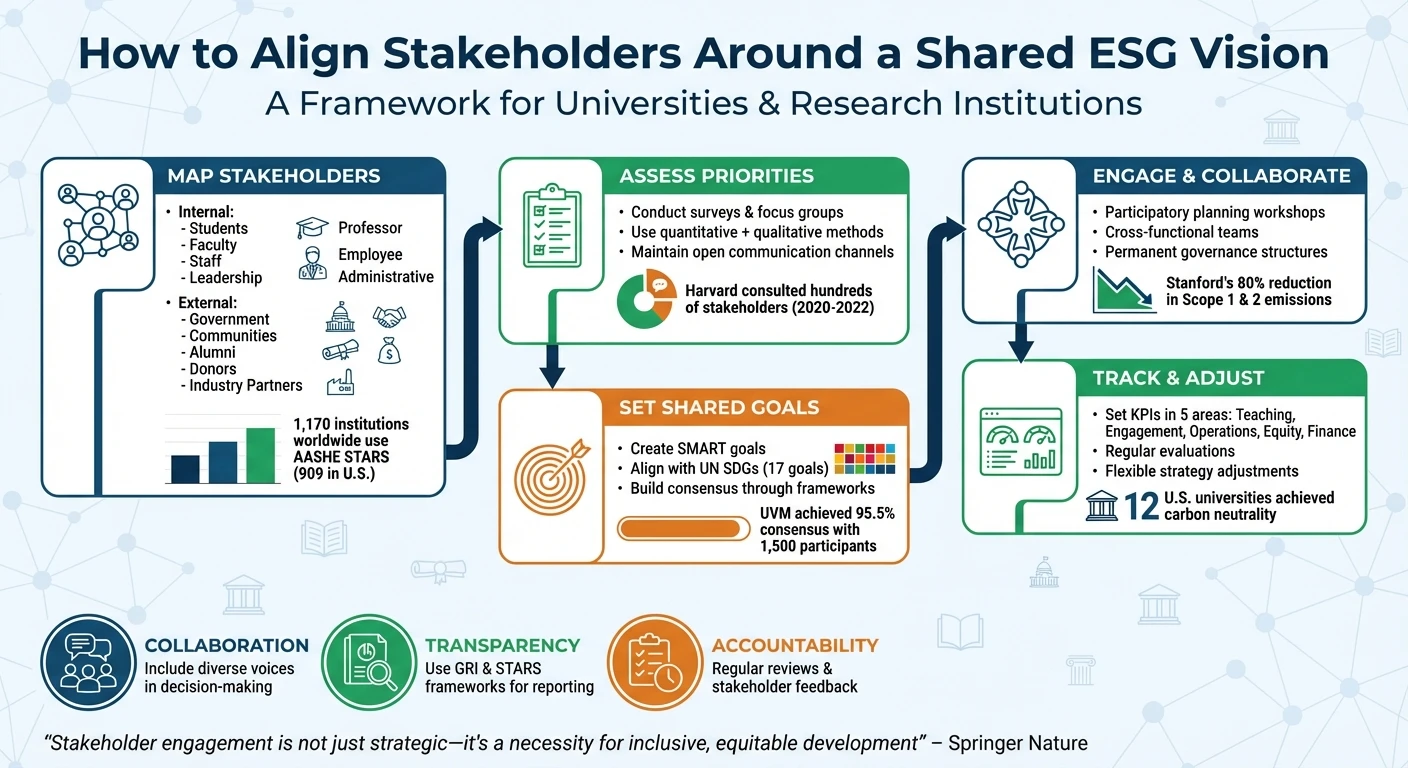
5-Step Framework for Aligning Stakeholders Around University ESG Vision
Strategies for Sustainable Stakeholder Engagement | Exclusive Lesson
How to Map Stakeholders and Understand Their ESG Priorities
Identifying and understanding stakeholder priorities is vital for creating a shared ESG vision within universities and research institutions. This alignment ensures that diverse groups can collectively contribute to sustainability goals.
Who Are Your Key Stakeholders?
A comprehensive stakeholder map should include both internal and external groups. Internally, stakeholders consist of:
Students: Often at the forefront of change, they advocate for ESG initiatives through activism and student-led organizations.
Faculty Members: These individuals incorporate ESG principles into teaching and research, often spanning multiple disciplines.
Administrative Staff: They oversee operational aspects like energy use and waste management, directly influencing sustainability efforts.
Senior Leadership: Boards, presidents, and deans set strategic priorities and allocate resources to ESG initiatives.
Externally, stakeholders include:
Government Agencies: They shape ESG efforts through regulations and funding opportunities.
Local Communities: These groups are directly affected by campus activities and can act as partners in achieving sustainability goals.
Alumni and Donors: Their financial contributions and concern for institutional reputation make them key allies.
Industry Partners: They offer cutting-edge research solutions and collaborative opportunities.
Prospective Students and Parents: Increasingly, sustainability factors into their decisions about enrollment.
The importance of stakeholder accountability is evident, with 1,170 higher education institutions worldwide, including 909 in the U.S., voluntarily participating in the AASHE Sustainability Tracking, Assessment, and Rating System (STARS) as of 2025 [6].
How to Assess What Stakeholders Expect from ESG
Engaging stakeholders directly is essential to understanding their expectations. For example, Harvard University consulted hundreds of stakeholders through committees and councils while developing its Sustainability Action Plan between 2020 and 2022 [8].
A mix of quantitative and qualitative methods provides a well-rounded perspective. The American University of Sharjah surveyed 81 stakeholders - students, educators, and administrative staff - to rank sustainability indicators [4]. Meanwhile, focus groups and semi-structured interviews can uncover deeper insights. The University of Johannesburg, for instance, engages its community through an eight-week online Sustainable Development Goals Short Learning Programme, which raises awareness and collects feedback on sustainability efforts [5].
"Institutional stakeholders are the carriers of your mission and institutional culture. If you do not respect your stakeholders, mission, and culture, your planning efforts will not yield a plan to enhance student success."
Maintaining open communication channels is equally important. Tools like dedicated email lists, newsletters, and online platforms ensure a steady flow of ideas and feedback [7]. Since stakeholder priorities shift over time, regularly updating assessment methods is crucial to keeping ESG strategies aligned with evolving needs.
Creating a Shared ESG Vision Through Collaboration
To transform stakeholder insights into a unified ESG vision, it’s essential to establish structured goals and frameworks that encourage collaboration, even when priorities differ. This process ensures that diverse perspectives align around common objectives, fostering a collective sense of purpose.
How to Set Shared ESG Goals
Start with SMART goals - specific, measurable, achievable, relevant, and time-bound. These goals should reflect your institution's mission while addressing the environmental, social, and governance (ESG) priorities identified through stakeholder input. Tying these goals to the 17 UN Sustainable Development Goals (SDGs) provides a universal framework that resonates across departments and with external partners [2][5].
In 2007, the University of Vermont (UVM) demonstrated this approach by engaging 1,500 participants in "Open Space" events and online surveys. Led by Noah Pollock, Eileen Horn, Robert Costanza, and Matt Sayre, the team used a modified Q methodology to distill 60 vision statements into a formal Sustainability Charter. This process achieved an impressive 95.5% consensus on priorities like ecological design while highlighting gaps in areas such as equitable compensation [13].
"By focusing on shared values and long-term goals, envisioning exercises can achieve a surprising amount of consensus while avoiding the divisiveness and polarization that often plague open-ended discussions and university governance" [13].
To build momentum, start with a small transition team to test ideas in existing forums before scaling up to a broader coalition that includes external partners [2]. Incentivize participation with awards, certifications, or competitions to encourage engagement [5].
Once SMART goals are defined, use collaborative frameworks to solidify commitment and drive progress.
Using Frameworks to Build Consensus
Frameworks like Stakeholder Theory and shared governance provide effective tools for fostering collaboration. Stakeholder Theory emphasizes the importance of including diverse voices - students, staff, and local communities - into policy-making, ensuring that decisions reflect a broad range of perspectives [6][12]. As defined, "a stakeholder is any group or individual that can influence or be influenced by the achievement of the organisation's objectives" [2].
Shared governance integrates expertise from various departments into decision-making, shifting away from rigid hierarchies toward collective learning [6]. Alongside this, inclusive governance works to eliminate barriers for underrepresented groups, helping to create an environment where everyone feels valued. This inclusivity strengthens commitment to goals like carbon neutrality by fostering a sense of belonging [6]. Together, these frameworks encourage a shift from top-down management to collaborative, grassroots strategies [6].
A materiality analysis is another key tool that aligns internal sustainability priorities with external stakeholder goals, such as those of community members, government agencies, and industry partners [2][12]. This analysis identifies which ESG issues are most important, helping institutions balance competing interests while demonstrating how sustainability efforts can optimize resources or attract external funding - an important consideration for organizations with limited budgets [5][4].
How to Engage Stakeholders and Secure Commitment
Once shared goals are established, keeping stakeholders actively involved is essential. Universities and research institutions must adopt structured approaches that go beyond one-off surveys, fostering ongoing dialogue and a deep commitment to ESG outcomes.
Methods for Cross-Stakeholder Collaboration
Participatory planning is a powerful way to engage stakeholders. Instead of relying solely on surveys, institutions can use workshops, focus groups, and town halls to involve participants in shaping decisions in real time [10].
The Society for College and University Planning suggests innovative approaches like "speed dating" sessions. These short, focused conversations between individuals from different departments encourage idea sharing and break down silos. Such informal exchanges often spark creative solutions. For more intricate issues, such as budget constraints or infrastructure planning, cross-functional teams bring together diverse expertise to address challenges that no single department could handle alone [10].
Stanford University offers a valuable example of sustained engagement through permanent governance structures. In November 2024, the university launched a framework to achieve net-zero emissions by 2050. Led by Associate Director Sam Lubow, this framework includes specialized working groups focused on areas such as waste, food, and travel, alongside a Climate Action Advisory Committee made up of faculty, staff, and students. This committee meets monthly to review proposals, resulting in a remarkable 80% reduction in Scope 1 and 2 emissions [11].
"Integrating voices from all parts of campus, including undergraduate and graduate students, is essential in continuing to push Stanford to be a leader in climate action and climate commitments." - Rebecca Grekin, Ph.D. candidate and member of the Climate Action Advisory Committee, Stanford University [11]
Similarly, Harvard University ensures alignment by conducting periodic reviews with its Presidential Committee on Sustainability and Council of Student Sustainability Leaders. These reviews help keep ESG priorities relevant across its decentralized schools [8].
To maintain momentum, institutions can recognize stakeholder contributions through awards or green certifications [5]. Consistent communication about collaborative efforts also reinforces trust and commitment.
Using Transparency to Build Trust
Transparency plays a critical role in sustaining stakeholder engagement. It’s not just about publishing reports - it’s about demonstrating how stakeholder input influences decisions. When institutions actively involve stakeholders in the reporting process, they uncover potential risks and build stronger relationships [14]. However, many organizations fall short: 38% fail to identify their stakeholders in ESG reporting, and 42% don’t explain how they determine key sustainability issues [14].
Clear and consistent communication is essential. Channels like annual sustainability reports, website updates, and workshops ensure accessibility [14]. Frameworks such as the Global Reporting Initiative (GRI) and AASHE STARS provide standardized methods for transparent and comparable reporting. By 2025, 1,170 higher education institutions worldwide, including 909 in the U.S., were using the STARS system to demonstrate accountability [6].
For instance, the University of Johannesburg publishes an annual sustainability report aligned with GRI guidelines. This report details environmental impacts, such as waste management and energy use, and highlights initiatives like introducing electric buses to reduce the university’s carbon footprint. These efforts align with UN SDG 11, focusing on sustainable cities and communities [5].
Institutions can further strengthen trust by consolidating stakeholder feedback into internal reports that link input to tangible outcomes. When stakeholders see their concerns reflected in policy changes or resource allocations, their confidence and commitment grow [15].
"Active stakeholder engagement in analysis, discussions about the future, brainstorm sessions, action planning, and decision-making will supercharge your college's or university's strategic plan." - Society for College and University Planning (SCUP) [10]
Establishing dedicated sustainability committees that include faculty, students, senior administrators, and external experts is another way to embed ESG within institutional governance. These committees demonstrate that sustainability is not an afterthought but a core part of the university's mission [8][5].
Tracking Progress and Adjusting Your ESG Strategy
After engaging stakeholders, the next step is to carefully track outcomes to refine and sustain ESG efforts. Ambitious goals demand measurable outcomes, yet many universities and research institutions struggle to translate their commitments into actionable, trackable results [1]. This challenge underscores the importance of using quantitative metrics to assess progress and adjust strategies as needed.
Setting Key Performance Indicators (KPIs)
Key Performance Indicators (KPIs) should adhere to the SMART framework - Specific, Measurable, Achievable, Relevant, and Time-bound - to ensure effective progress evaluation [16]. Instead of attempting to measure everything, institutions should prioritize metrics in five critical areas: teaching and research, stakeholder engagement, campus operations, racial equity and social justice, and administration and finance [16].
For campus operations, metrics might include energy and water efficiency, reductions in greenhouse gas emissions (Scope 1 and 2), waste recovery rates, and sustainable transportation practices [6]. For example, Second Nature reports that 12 U.S. universities have already achieved total carbon neutrality by addressing or offsetting such emissions [6].
Stakeholder engagement metrics could track participation in green initiatives and the number of active sustainability partnerships [16]. For academic impact, institutions might measure the number of sustainability-focused courses, research projects tackling global challenges, and employee training completion rates [16]. Social justice metrics may include pay equity ratios, compliance with living wage standards, and equitable student access [16].
A notable example comes from Emlyon Business School in France, which adopted the "SDG Inside" framework in July 2025. This initiative, led by professors Rhoda Davidson and Hans-Jörg Schlierer, evaluated ESG competencies across its MBA and Master's programs. Using an audit tool based on 34 ESG competencies, the school found that 82% of students felt more prepared to address sustainability challenges in their careers [3].
"In an era of high-stakes accountability and limited financial resources, it is imperative that academic leaders intentionally connect institutional goals to measurable outcomes." - Abbygail T. Langham and Matthew Fifolt, SCUP [17]
With KPIs in place, institutions can focus on continuous evaluation and adjustment to ensure progress.
When and How to Adjust Your Strategy
ESG strategies need to remain flexible and adaptive. Adjustments should be considered when performance data falls short of KPIs, stakeholder feedback highlights dissatisfaction, or external factors - such as changes in federal policies or enrollment trends - demand a shift [18]. Without this adaptability, strategic plans risk becoming mere aspirational statements rather than actionable guides [18].
Regular evaluations based on both performance data and stakeholder input allow institutions to move from simple, surface-level measures to impactful, systemic changes [1]. For instance, while many universities encourage behavioral shifts like turning off lights, others are advancing toward larger infrastructure investments, such as forming public-private partnerships for renewable energy projects [1].
If no baseline data exists, surveys can help establish metrics before setting new targets [18]. Audit tools specifically designed for ESG can also reveal gaps in curriculum and operations, offering clear pathways for realignment [3].
Adjusting goals often involves structured workshops with faculty and stakeholders to brainstorm solutions for identified gaps [3]. Additionally, annual board self-assessments can help review governance responsibilities and address weaknesses that may impede ESG progress [19]. The key lies in maintaining a long-term vision while staying responsive to new developments.
"Goals without clarity, metrics, or flexibility can leave institutions with a strategic plan that is just a list of aspirational statements instead of a roadmap to have real impact." - Kennedy & Company [18]
Case Studies: ESG Alignment in Universities and Research Institutions
Examples of Stakeholder-Centered ESG Programs
These examples showcase how universities and research institutions have successfully brought together diverse stakeholders to implement effective ESG strategies.
Harvard University tackled the challenge of aligning its decentralized schools and administration through a structured six-step engagement process between 2020 and 2022. Led by the Presidential Committee on Sustainability, co-chaired by Professor Bill Clark (International Science) and Professor Jody Freeman (Law), the university developed a comprehensive Sustainability Action Plan. Requiring formal approval from schools and senior administrators, this process ensured accountability across the community [8]. The collaboration between academic and operational leadership bridged the gap between research goals and campus operations, setting a strong example for others.
At the University of Pennsylvania, Nina Morris, Director of Penn Sustainability, spearheaded the Climate and Sustainability Action Plan 3.0 (2019–2024). The results are impressive: a 46% reduction in carbon emissions since 2009, securing the state’s largest solar project via a power-purchase agreement, and increasing non-single-occupancy vehicle commuting to 72% among employees. Additional initiatives included replacing 92 inefficient freezers, with a projected 60% emissions reduction by January 2024 - surpassing national goals by six years. The university also enrolled 4,886 students in environment-related courses during the 2022–23 academic year [22]. These achievements highlight the tangible benefits of well-coordinated ESG efforts.
Emory University took a forward-looking approach by launching its Sustainability Visioning Committee in January 2024 to craft a vision for 2025–2036 aligned with the UN Sustainable Development Goals. Co-chaired by Robin Morey (VP of Campus Services) and Professor Eri Saikawa (Environmental Sciences), the committee distributed a "Sustainability Vision Conversation Guide" and created a digital platform to gather community input. This collaborative effort aims to shape a vision grounded in collective insights.
"The committee hopes to use our collective sustainability knowledge informed by the wide-ranging community input to identify the vision and goals that strengthen the local implementation of the UN SDGs."
Professor Eri Saikawa [20]
The University of Vermont achieved a 60% reduction in greenhouse gas emissions compared to 2007 levels by 2024 through its Comprehensive Sustainability Plan. The introduction of the "ReusePass" app in 2024 resulted in a 98% return rate for reusable containers, diverting 48,000 single-use items from landfills. To address funding challenges, the university extended the payback period for its Energy Revolving Fund from 7 to 15 years, enabling more ambitious efficiency upgrades. For example, a lab project at Stafford Hall is expected to cut annual electricity use by 610,000 kWh. Additionally, UVM increased its investment in socially responsible funds to $30 million in 2023 [21].
Concordia University demonstrated the power of financial alignment by reducing fossil fuel investments from 5.7% in 2019 to 1.19% by April 2024. This shift was part of its five-stream Sustainability Action Plan, led by Cassandra Lamontagne, and showed how divestment can align institutional values with operations [23].
Meanwhile, McGill University achieved a platinum sustainability rating six years ahead of schedule, showcasing how ambitious timelines combined with strong stakeholder engagement can lead to exceptional outcomes [24].
These examples highlight the effectiveness of stakeholder-focused strategies in driving meaningful ESG progress across diverse institutions.
Conclusion
Creating a unified ESG vision demands consistent stakeholder engagement, active collaboration, transparent communication, and the flexibility to adjust as circumstances evolve. Institutions that succeed in this effort understand that sustainability thrives on collective action rather than a rigid, top-down approach.
The data supports this perspective. Surveys reveal that environmental sustainability ranks as a priority for most institutions. When diverse groups - students, faculty, administrators, alumni, and community partners - work together toward shared objectives, institutions not only gain credibility but also attract talent and resources.
The road ahead involves establishing lasting governance structures that integrate ESG principles into every aspect of campus life [26]. These structures should build on the collaborative strategies and engagement methods discussed earlier. Using shared governance models that tap into expertise across departments can foster the "synergies of knowledge" needed to address complex issues like reducing carbon emissions [6].
"Stakeholder engagement is not just a strategic approach to achieving sustainability goals but a necessity for ensuring that the development is inclusive, equitable, and capable of meeting the needs of both present and future generations." – Springer Nature [2]
As shown in the case studies and practices highlighted, meaningful progress depends on regular reassessment and evolution. Stakeholder priorities shift over time, and your ESG strategy must reflect those changes [25]. Tools like STARS, transparent reporting, and open forums help maintain community engagement and commitment to long-term goals. Institutions such as Harvard, with its structured engagement processes, and UVM, with its community-driven planning, illustrate how empowering stakeholders fosters a sense of ownership - turning them into the most passionate advocates for lasting change.
FAQs
Who should own the ESG vision on campus?
The responsibility for shaping an ESG vision on campus starts with the board and president, but its success hinges on shared leadership. It takes the combined efforts of faculty, staff, students, and administrative teams to craft and execute a unified ESG strategy. This collaborative effort promotes alignment and ensures all stakeholders are held accountable.
How do we pick ESG goals everyone can support?
To establish ESG goals that resonate across a university or research institution, it's crucial to bring stakeholders into the process from the outset. Engage groups like students, faculty, staff, and members of the surrounding community to ensure their perspectives are heard. By involving these key voices, you can identify shared priorities and set practical objectives that reflect collective interests. Using a collaborative approach encourages open discussions, builds consensus, and helps create goals that are clear, inclusive, and aligned with the institution's core values and sustainability commitments.
What KPIs should we track first?
To build a strong starting point, prioritize key performance indicators (KPIs) that reflect stakeholder engagement and measurable progress. Begin by assessing participation levels, such as the number and diversity of groups actively involved in initiatives. Evaluate progress on sustainability action plans, as well as the establishment of policies or committees designed to support ESG (Environmental, Social, and Governance) efforts.
It's also crucial to monitor strides toward specific objectives, like reducing emissions or improving resource efficiency. These metrics help paint a clear picture of how well ESG principles are being integrated and the overall progress being made.
Related Blog Posts
Latest Articles
©2026

Narrative Change and Power Building: The Missing Half of Advocacy
Narrative change is the process of disrupting dominant narratives that normalize inequity and advancing new narratives from historically marginalized communities.

Funding Resilience Without Federal Grants
BRIC is unreliable and FEMA is shrinking. Here's how cities fund climate resilience with dedicated revenue, blended finance, and a coordinating authority.

The ESG Blind Spot: How AI Is Finding Risks in Companies Nobody Else Is Watching
Norway's sovereign wealth fund uses AI to screen 7,200 portfolio companies for forced labor and corruption within 24 hours. The real story is the emerging-market coverage gap that traditional ESG data vendors miss — and what it means for any company with a global supply chain.
Narrative Change and Power Building: The Missing Half of Advocacy
Narrative change is the process of disrupting dominant narratives that normalize inequity and advancing new narratives from historically marginalized communities.
Funding Resilience Without Federal Grants
BRIC is unreliable and FEMA is shrinking. Here's how cities fund climate resilience with dedicated revenue, blended finance, and a coordinating authority.
The ESG Blind Spot: How AI Is Finding Risks in Companies Nobody Else Is Watching
Norway's sovereign wealth fund uses AI to screen 7,200 portfolio companies for forced labor and corruption within 24 hours. The real story is the emerging-market coverage gap that traditional ESG data vendors miss — and what it means for any company with a global supply chain.
FAQ
01
What does it really mean to “redefine profit”?
02
What makes Council Fire different?
03
Who does Council Fire work with?
04
What does working with Council Fire actually look like?
05
How does Council Fire help organizations turn big goals into action?
06
How does Council Fire define and measure success?
07
How does technology fit into Council Fire’s work?
Mar 4, 2026
How to Align Stakeholders Around a Shared ESG Vision for Universities & Research Institutions
ESG Strategy
In This Article
Align students, faculty, leaders, and partners around a shared ESG vision using stakeholder mapping, SMART goals, inclusive governance, and measurable KPIs.
How to Align Stakeholders Around a Shared ESG Vision for Universities & Research Institutions
Universities and research institutions are under growing pressure to address global challenges through Environmental, Social, and Governance (ESG) initiatives. Yet, aligning diverse stakeholders - students, faculty, administrators, and external partners - around a unified ESG vision remains a complex task. By prioritizing collaboration, clear goals, and transparent communication, institutions can overcome obstacles like siloed operations, financial constraints, and inconsistent metrics.
Key takeaways include:
Stakeholder Mapping: Identify internal groups (students, faculty, staff) and external partners (donors, communities, government).
Engagement Methods: Use surveys, focus groups, and participatory planning to gather input and build consensus.
Setting Goals: Develop SMART goals tied to frameworks like the UN Sustainable Development Goals.
Tracking Progress: Use KPIs to measure success in areas like emissions reduction, equity, and research impact.
Examples from Harvard, Stanford, and others show that collaboration and accountability drive real progress. Institutions must regularly reassess strategies to stay aligned with evolving priorities and maintain momentum.
5-Step Framework for Aligning Stakeholders Around University ESG Vision
Strategies for Sustainable Stakeholder Engagement | Exclusive Lesson
How to Map Stakeholders and Understand Their ESG Priorities
Identifying and understanding stakeholder priorities is vital for creating a shared ESG vision within universities and research institutions. This alignment ensures that diverse groups can collectively contribute to sustainability goals.
Who Are Your Key Stakeholders?
A comprehensive stakeholder map should include both internal and external groups. Internally, stakeholders consist of:
Students: Often at the forefront of change, they advocate for ESG initiatives through activism and student-led organizations.
Faculty Members: These individuals incorporate ESG principles into teaching and research, often spanning multiple disciplines.
Administrative Staff: They oversee operational aspects like energy use and waste management, directly influencing sustainability efforts.
Senior Leadership: Boards, presidents, and deans set strategic priorities and allocate resources to ESG initiatives.
Externally, stakeholders include:
Government Agencies: They shape ESG efforts through regulations and funding opportunities.
Local Communities: These groups are directly affected by campus activities and can act as partners in achieving sustainability goals.
Alumni and Donors: Their financial contributions and concern for institutional reputation make them key allies.
Industry Partners: They offer cutting-edge research solutions and collaborative opportunities.
Prospective Students and Parents: Increasingly, sustainability factors into their decisions about enrollment.
The importance of stakeholder accountability is evident, with 1,170 higher education institutions worldwide, including 909 in the U.S., voluntarily participating in the AASHE Sustainability Tracking, Assessment, and Rating System (STARS) as of 2025 [6].
How to Assess What Stakeholders Expect from ESG
Engaging stakeholders directly is essential to understanding their expectations. For example, Harvard University consulted hundreds of stakeholders through committees and councils while developing its Sustainability Action Plan between 2020 and 2022 [8].
A mix of quantitative and qualitative methods provides a well-rounded perspective. The American University of Sharjah surveyed 81 stakeholders - students, educators, and administrative staff - to rank sustainability indicators [4]. Meanwhile, focus groups and semi-structured interviews can uncover deeper insights. The University of Johannesburg, for instance, engages its community through an eight-week online Sustainable Development Goals Short Learning Programme, which raises awareness and collects feedback on sustainability efforts [5].
"Institutional stakeholders are the carriers of your mission and institutional culture. If you do not respect your stakeholders, mission, and culture, your planning efforts will not yield a plan to enhance student success."
Maintaining open communication channels is equally important. Tools like dedicated email lists, newsletters, and online platforms ensure a steady flow of ideas and feedback [7]. Since stakeholder priorities shift over time, regularly updating assessment methods is crucial to keeping ESG strategies aligned with evolving needs.
Creating a Shared ESG Vision Through Collaboration
To transform stakeholder insights into a unified ESG vision, it’s essential to establish structured goals and frameworks that encourage collaboration, even when priorities differ. This process ensures that diverse perspectives align around common objectives, fostering a collective sense of purpose.
How to Set Shared ESG Goals
Start with SMART goals - specific, measurable, achievable, relevant, and time-bound. These goals should reflect your institution's mission while addressing the environmental, social, and governance (ESG) priorities identified through stakeholder input. Tying these goals to the 17 UN Sustainable Development Goals (SDGs) provides a universal framework that resonates across departments and with external partners [2][5].
In 2007, the University of Vermont (UVM) demonstrated this approach by engaging 1,500 participants in "Open Space" events and online surveys. Led by Noah Pollock, Eileen Horn, Robert Costanza, and Matt Sayre, the team used a modified Q methodology to distill 60 vision statements into a formal Sustainability Charter. This process achieved an impressive 95.5% consensus on priorities like ecological design while highlighting gaps in areas such as equitable compensation [13].
"By focusing on shared values and long-term goals, envisioning exercises can achieve a surprising amount of consensus while avoiding the divisiveness and polarization that often plague open-ended discussions and university governance" [13].
To build momentum, start with a small transition team to test ideas in existing forums before scaling up to a broader coalition that includes external partners [2]. Incentivize participation with awards, certifications, or competitions to encourage engagement [5].
Once SMART goals are defined, use collaborative frameworks to solidify commitment and drive progress.
Using Frameworks to Build Consensus
Frameworks like Stakeholder Theory and shared governance provide effective tools for fostering collaboration. Stakeholder Theory emphasizes the importance of including diverse voices - students, staff, and local communities - into policy-making, ensuring that decisions reflect a broad range of perspectives [6][12]. As defined, "a stakeholder is any group or individual that can influence or be influenced by the achievement of the organisation's objectives" [2].
Shared governance integrates expertise from various departments into decision-making, shifting away from rigid hierarchies toward collective learning [6]. Alongside this, inclusive governance works to eliminate barriers for underrepresented groups, helping to create an environment where everyone feels valued. This inclusivity strengthens commitment to goals like carbon neutrality by fostering a sense of belonging [6]. Together, these frameworks encourage a shift from top-down management to collaborative, grassroots strategies [6].
A materiality analysis is another key tool that aligns internal sustainability priorities with external stakeholder goals, such as those of community members, government agencies, and industry partners [2][12]. This analysis identifies which ESG issues are most important, helping institutions balance competing interests while demonstrating how sustainability efforts can optimize resources or attract external funding - an important consideration for organizations with limited budgets [5][4].
How to Engage Stakeholders and Secure Commitment
Once shared goals are established, keeping stakeholders actively involved is essential. Universities and research institutions must adopt structured approaches that go beyond one-off surveys, fostering ongoing dialogue and a deep commitment to ESG outcomes.
Methods for Cross-Stakeholder Collaboration
Participatory planning is a powerful way to engage stakeholders. Instead of relying solely on surveys, institutions can use workshops, focus groups, and town halls to involve participants in shaping decisions in real time [10].
The Society for College and University Planning suggests innovative approaches like "speed dating" sessions. These short, focused conversations between individuals from different departments encourage idea sharing and break down silos. Such informal exchanges often spark creative solutions. For more intricate issues, such as budget constraints or infrastructure planning, cross-functional teams bring together diverse expertise to address challenges that no single department could handle alone [10].
Stanford University offers a valuable example of sustained engagement through permanent governance structures. In November 2024, the university launched a framework to achieve net-zero emissions by 2050. Led by Associate Director Sam Lubow, this framework includes specialized working groups focused on areas such as waste, food, and travel, alongside a Climate Action Advisory Committee made up of faculty, staff, and students. This committee meets monthly to review proposals, resulting in a remarkable 80% reduction in Scope 1 and 2 emissions [11].
"Integrating voices from all parts of campus, including undergraduate and graduate students, is essential in continuing to push Stanford to be a leader in climate action and climate commitments." - Rebecca Grekin, Ph.D. candidate and member of the Climate Action Advisory Committee, Stanford University [11]
Similarly, Harvard University ensures alignment by conducting periodic reviews with its Presidential Committee on Sustainability and Council of Student Sustainability Leaders. These reviews help keep ESG priorities relevant across its decentralized schools [8].
To maintain momentum, institutions can recognize stakeholder contributions through awards or green certifications [5]. Consistent communication about collaborative efforts also reinforces trust and commitment.
Using Transparency to Build Trust
Transparency plays a critical role in sustaining stakeholder engagement. It’s not just about publishing reports - it’s about demonstrating how stakeholder input influences decisions. When institutions actively involve stakeholders in the reporting process, they uncover potential risks and build stronger relationships [14]. However, many organizations fall short: 38% fail to identify their stakeholders in ESG reporting, and 42% don’t explain how they determine key sustainability issues [14].
Clear and consistent communication is essential. Channels like annual sustainability reports, website updates, and workshops ensure accessibility [14]. Frameworks such as the Global Reporting Initiative (GRI) and AASHE STARS provide standardized methods for transparent and comparable reporting. By 2025, 1,170 higher education institutions worldwide, including 909 in the U.S., were using the STARS system to demonstrate accountability [6].
For instance, the University of Johannesburg publishes an annual sustainability report aligned with GRI guidelines. This report details environmental impacts, such as waste management and energy use, and highlights initiatives like introducing electric buses to reduce the university’s carbon footprint. These efforts align with UN SDG 11, focusing on sustainable cities and communities [5].
Institutions can further strengthen trust by consolidating stakeholder feedback into internal reports that link input to tangible outcomes. When stakeholders see their concerns reflected in policy changes or resource allocations, their confidence and commitment grow [15].
"Active stakeholder engagement in analysis, discussions about the future, brainstorm sessions, action planning, and decision-making will supercharge your college's or university's strategic plan." - Society for College and University Planning (SCUP) [10]
Establishing dedicated sustainability committees that include faculty, students, senior administrators, and external experts is another way to embed ESG within institutional governance. These committees demonstrate that sustainability is not an afterthought but a core part of the university's mission [8][5].
Tracking Progress and Adjusting Your ESG Strategy
After engaging stakeholders, the next step is to carefully track outcomes to refine and sustain ESG efforts. Ambitious goals demand measurable outcomes, yet many universities and research institutions struggle to translate their commitments into actionable, trackable results [1]. This challenge underscores the importance of using quantitative metrics to assess progress and adjust strategies as needed.
Setting Key Performance Indicators (KPIs)
Key Performance Indicators (KPIs) should adhere to the SMART framework - Specific, Measurable, Achievable, Relevant, and Time-bound - to ensure effective progress evaluation [16]. Instead of attempting to measure everything, institutions should prioritize metrics in five critical areas: teaching and research, stakeholder engagement, campus operations, racial equity and social justice, and administration and finance [16].
For campus operations, metrics might include energy and water efficiency, reductions in greenhouse gas emissions (Scope 1 and 2), waste recovery rates, and sustainable transportation practices [6]. For example, Second Nature reports that 12 U.S. universities have already achieved total carbon neutrality by addressing or offsetting such emissions [6].
Stakeholder engagement metrics could track participation in green initiatives and the number of active sustainability partnerships [16]. For academic impact, institutions might measure the number of sustainability-focused courses, research projects tackling global challenges, and employee training completion rates [16]. Social justice metrics may include pay equity ratios, compliance with living wage standards, and equitable student access [16].
A notable example comes from Emlyon Business School in France, which adopted the "SDG Inside" framework in July 2025. This initiative, led by professors Rhoda Davidson and Hans-Jörg Schlierer, evaluated ESG competencies across its MBA and Master's programs. Using an audit tool based on 34 ESG competencies, the school found that 82% of students felt more prepared to address sustainability challenges in their careers [3].
"In an era of high-stakes accountability and limited financial resources, it is imperative that academic leaders intentionally connect institutional goals to measurable outcomes." - Abbygail T. Langham and Matthew Fifolt, SCUP [17]
With KPIs in place, institutions can focus on continuous evaluation and adjustment to ensure progress.
When and How to Adjust Your Strategy
ESG strategies need to remain flexible and adaptive. Adjustments should be considered when performance data falls short of KPIs, stakeholder feedback highlights dissatisfaction, or external factors - such as changes in federal policies or enrollment trends - demand a shift [18]. Without this adaptability, strategic plans risk becoming mere aspirational statements rather than actionable guides [18].
Regular evaluations based on both performance data and stakeholder input allow institutions to move from simple, surface-level measures to impactful, systemic changes [1]. For instance, while many universities encourage behavioral shifts like turning off lights, others are advancing toward larger infrastructure investments, such as forming public-private partnerships for renewable energy projects [1].
If no baseline data exists, surveys can help establish metrics before setting new targets [18]. Audit tools specifically designed for ESG can also reveal gaps in curriculum and operations, offering clear pathways for realignment [3].
Adjusting goals often involves structured workshops with faculty and stakeholders to brainstorm solutions for identified gaps [3]. Additionally, annual board self-assessments can help review governance responsibilities and address weaknesses that may impede ESG progress [19]. The key lies in maintaining a long-term vision while staying responsive to new developments.
"Goals without clarity, metrics, or flexibility can leave institutions with a strategic plan that is just a list of aspirational statements instead of a roadmap to have real impact." - Kennedy & Company [18]
Case Studies: ESG Alignment in Universities and Research Institutions
Examples of Stakeholder-Centered ESG Programs
These examples showcase how universities and research institutions have successfully brought together diverse stakeholders to implement effective ESG strategies.
Harvard University tackled the challenge of aligning its decentralized schools and administration through a structured six-step engagement process between 2020 and 2022. Led by the Presidential Committee on Sustainability, co-chaired by Professor Bill Clark (International Science) and Professor Jody Freeman (Law), the university developed a comprehensive Sustainability Action Plan. Requiring formal approval from schools and senior administrators, this process ensured accountability across the community [8]. The collaboration between academic and operational leadership bridged the gap between research goals and campus operations, setting a strong example for others.
At the University of Pennsylvania, Nina Morris, Director of Penn Sustainability, spearheaded the Climate and Sustainability Action Plan 3.0 (2019–2024). The results are impressive: a 46% reduction in carbon emissions since 2009, securing the state’s largest solar project via a power-purchase agreement, and increasing non-single-occupancy vehicle commuting to 72% among employees. Additional initiatives included replacing 92 inefficient freezers, with a projected 60% emissions reduction by January 2024 - surpassing national goals by six years. The university also enrolled 4,886 students in environment-related courses during the 2022–23 academic year [22]. These achievements highlight the tangible benefits of well-coordinated ESG efforts.
Emory University took a forward-looking approach by launching its Sustainability Visioning Committee in January 2024 to craft a vision for 2025–2036 aligned with the UN Sustainable Development Goals. Co-chaired by Robin Morey (VP of Campus Services) and Professor Eri Saikawa (Environmental Sciences), the committee distributed a "Sustainability Vision Conversation Guide" and created a digital platform to gather community input. This collaborative effort aims to shape a vision grounded in collective insights.
"The committee hopes to use our collective sustainability knowledge informed by the wide-ranging community input to identify the vision and goals that strengthen the local implementation of the UN SDGs."
Professor Eri Saikawa [20]
The University of Vermont achieved a 60% reduction in greenhouse gas emissions compared to 2007 levels by 2024 through its Comprehensive Sustainability Plan. The introduction of the "ReusePass" app in 2024 resulted in a 98% return rate for reusable containers, diverting 48,000 single-use items from landfills. To address funding challenges, the university extended the payback period for its Energy Revolving Fund from 7 to 15 years, enabling more ambitious efficiency upgrades. For example, a lab project at Stafford Hall is expected to cut annual electricity use by 610,000 kWh. Additionally, UVM increased its investment in socially responsible funds to $30 million in 2023 [21].
Concordia University demonstrated the power of financial alignment by reducing fossil fuel investments from 5.7% in 2019 to 1.19% by April 2024. This shift was part of its five-stream Sustainability Action Plan, led by Cassandra Lamontagne, and showed how divestment can align institutional values with operations [23].
Meanwhile, McGill University achieved a platinum sustainability rating six years ahead of schedule, showcasing how ambitious timelines combined with strong stakeholder engagement can lead to exceptional outcomes [24].
These examples highlight the effectiveness of stakeholder-focused strategies in driving meaningful ESG progress across diverse institutions.
Conclusion
Creating a unified ESG vision demands consistent stakeholder engagement, active collaboration, transparent communication, and the flexibility to adjust as circumstances evolve. Institutions that succeed in this effort understand that sustainability thrives on collective action rather than a rigid, top-down approach.
The data supports this perspective. Surveys reveal that environmental sustainability ranks as a priority for most institutions. When diverse groups - students, faculty, administrators, alumni, and community partners - work together toward shared objectives, institutions not only gain credibility but also attract talent and resources.
The road ahead involves establishing lasting governance structures that integrate ESG principles into every aspect of campus life [26]. These structures should build on the collaborative strategies and engagement methods discussed earlier. Using shared governance models that tap into expertise across departments can foster the "synergies of knowledge" needed to address complex issues like reducing carbon emissions [6].
"Stakeholder engagement is not just a strategic approach to achieving sustainability goals but a necessity for ensuring that the development is inclusive, equitable, and capable of meeting the needs of both present and future generations." – Springer Nature [2]
As shown in the case studies and practices highlighted, meaningful progress depends on regular reassessment and evolution. Stakeholder priorities shift over time, and your ESG strategy must reflect those changes [25]. Tools like STARS, transparent reporting, and open forums help maintain community engagement and commitment to long-term goals. Institutions such as Harvard, with its structured engagement processes, and UVM, with its community-driven planning, illustrate how empowering stakeholders fosters a sense of ownership - turning them into the most passionate advocates for lasting change.
FAQs
Who should own the ESG vision on campus?
The responsibility for shaping an ESG vision on campus starts with the board and president, but its success hinges on shared leadership. It takes the combined efforts of faculty, staff, students, and administrative teams to craft and execute a unified ESG strategy. This collaborative effort promotes alignment and ensures all stakeholders are held accountable.
How do we pick ESG goals everyone can support?
To establish ESG goals that resonate across a university or research institution, it's crucial to bring stakeholders into the process from the outset. Engage groups like students, faculty, staff, and members of the surrounding community to ensure their perspectives are heard. By involving these key voices, you can identify shared priorities and set practical objectives that reflect collective interests. Using a collaborative approach encourages open discussions, builds consensus, and helps create goals that are clear, inclusive, and aligned with the institution's core values and sustainability commitments.
What KPIs should we track first?
To build a strong starting point, prioritize key performance indicators (KPIs) that reflect stakeholder engagement and measurable progress. Begin by assessing participation levels, such as the number and diversity of groups actively involved in initiatives. Evaluate progress on sustainability action plans, as well as the establishment of policies or committees designed to support ESG (Environmental, Social, and Governance) efforts.
It's also crucial to monitor strides toward specific objectives, like reducing emissions or improving resource efficiency. These metrics help paint a clear picture of how well ESG principles are being integrated and the overall progress being made.
Related Blog Posts
Latest Articles
©2026
Narrative Change and Power Building: The Missing Half of Advocacy
Narrative change is the process of disrupting dominant narratives that normalize inequity and advancing new narratives from historically marginalized communities.
Funding Resilience Without Federal Grants
BRIC is unreliable and FEMA is shrinking. Here's how cities fund climate resilience with dedicated revenue, blended finance, and a coordinating authority.
The ESG Blind Spot: How AI Is Finding Risks in Companies Nobody Else Is Watching
Norway's sovereign wealth fund uses AI to screen 7,200 portfolio companies for forced labor and corruption within 24 hours. The real story is the emerging-market coverage gap that traditional ESG data vendors miss — and what it means for any company with a global supply chain.
FAQ
01
What does it really mean to “redefine profit”?
02
What makes Council Fire different?
03
Who does Council Fire work with?
04
What does working with Council Fire actually look like?
05
How does Council Fire help organizations turn big goals into action?
06
How does Council Fire define and measure success?
07
How does technology fit into Council Fire’s work?
Mar 4, 2026
How to Align Stakeholders Around a Shared ESG Vision for Universities & Research Institutions
ESG Strategy
In This Article
Align students, faculty, leaders, and partners around a shared ESG vision using stakeholder mapping, SMART goals, inclusive governance, and measurable KPIs.
How to Align Stakeholders Around a Shared ESG Vision for Universities & Research Institutions
Universities and research institutions are under growing pressure to address global challenges through Environmental, Social, and Governance (ESG) initiatives. Yet, aligning diverse stakeholders - students, faculty, administrators, and external partners - around a unified ESG vision remains a complex task. By prioritizing collaboration, clear goals, and transparent communication, institutions can overcome obstacles like siloed operations, financial constraints, and inconsistent metrics.
Key takeaways include:
Stakeholder Mapping: Identify internal groups (students, faculty, staff) and external partners (donors, communities, government).
Engagement Methods: Use surveys, focus groups, and participatory planning to gather input and build consensus.
Setting Goals: Develop SMART goals tied to frameworks like the UN Sustainable Development Goals.
Tracking Progress: Use KPIs to measure success in areas like emissions reduction, equity, and research impact.
Examples from Harvard, Stanford, and others show that collaboration and accountability drive real progress. Institutions must regularly reassess strategies to stay aligned with evolving priorities and maintain momentum.
5-Step Framework for Aligning Stakeholders Around University ESG Vision
Strategies for Sustainable Stakeholder Engagement | Exclusive Lesson
How to Map Stakeholders and Understand Their ESG Priorities
Identifying and understanding stakeholder priorities is vital for creating a shared ESG vision within universities and research institutions. This alignment ensures that diverse groups can collectively contribute to sustainability goals.
Who Are Your Key Stakeholders?
A comprehensive stakeholder map should include both internal and external groups. Internally, stakeholders consist of:
Students: Often at the forefront of change, they advocate for ESG initiatives through activism and student-led organizations.
Faculty Members: These individuals incorporate ESG principles into teaching and research, often spanning multiple disciplines.
Administrative Staff: They oversee operational aspects like energy use and waste management, directly influencing sustainability efforts.
Senior Leadership: Boards, presidents, and deans set strategic priorities and allocate resources to ESG initiatives.
Externally, stakeholders include:
Government Agencies: They shape ESG efforts through regulations and funding opportunities.
Local Communities: These groups are directly affected by campus activities and can act as partners in achieving sustainability goals.
Alumni and Donors: Their financial contributions and concern for institutional reputation make them key allies.
Industry Partners: They offer cutting-edge research solutions and collaborative opportunities.
Prospective Students and Parents: Increasingly, sustainability factors into their decisions about enrollment.
The importance of stakeholder accountability is evident, with 1,170 higher education institutions worldwide, including 909 in the U.S., voluntarily participating in the AASHE Sustainability Tracking, Assessment, and Rating System (STARS) as of 2025 [6].
How to Assess What Stakeholders Expect from ESG
Engaging stakeholders directly is essential to understanding their expectations. For example, Harvard University consulted hundreds of stakeholders through committees and councils while developing its Sustainability Action Plan between 2020 and 2022 [8].
A mix of quantitative and qualitative methods provides a well-rounded perspective. The American University of Sharjah surveyed 81 stakeholders - students, educators, and administrative staff - to rank sustainability indicators [4]. Meanwhile, focus groups and semi-structured interviews can uncover deeper insights. The University of Johannesburg, for instance, engages its community through an eight-week online Sustainable Development Goals Short Learning Programme, which raises awareness and collects feedback on sustainability efforts [5].
"Institutional stakeholders are the carriers of your mission and institutional culture. If you do not respect your stakeholders, mission, and culture, your planning efforts will not yield a plan to enhance student success."
Maintaining open communication channels is equally important. Tools like dedicated email lists, newsletters, and online platforms ensure a steady flow of ideas and feedback [7]. Since stakeholder priorities shift over time, regularly updating assessment methods is crucial to keeping ESG strategies aligned with evolving needs.
Creating a Shared ESG Vision Through Collaboration
To transform stakeholder insights into a unified ESG vision, it’s essential to establish structured goals and frameworks that encourage collaboration, even when priorities differ. This process ensures that diverse perspectives align around common objectives, fostering a collective sense of purpose.
How to Set Shared ESG Goals
Start with SMART goals - specific, measurable, achievable, relevant, and time-bound. These goals should reflect your institution's mission while addressing the environmental, social, and governance (ESG) priorities identified through stakeholder input. Tying these goals to the 17 UN Sustainable Development Goals (SDGs) provides a universal framework that resonates across departments and with external partners [2][5].
In 2007, the University of Vermont (UVM) demonstrated this approach by engaging 1,500 participants in "Open Space" events and online surveys. Led by Noah Pollock, Eileen Horn, Robert Costanza, and Matt Sayre, the team used a modified Q methodology to distill 60 vision statements into a formal Sustainability Charter. This process achieved an impressive 95.5% consensus on priorities like ecological design while highlighting gaps in areas such as equitable compensation [13].
"By focusing on shared values and long-term goals, envisioning exercises can achieve a surprising amount of consensus while avoiding the divisiveness and polarization that often plague open-ended discussions and university governance" [13].
To build momentum, start with a small transition team to test ideas in existing forums before scaling up to a broader coalition that includes external partners [2]. Incentivize participation with awards, certifications, or competitions to encourage engagement [5].
Once SMART goals are defined, use collaborative frameworks to solidify commitment and drive progress.
Using Frameworks to Build Consensus
Frameworks like Stakeholder Theory and shared governance provide effective tools for fostering collaboration. Stakeholder Theory emphasizes the importance of including diverse voices - students, staff, and local communities - into policy-making, ensuring that decisions reflect a broad range of perspectives [6][12]. As defined, "a stakeholder is any group or individual that can influence or be influenced by the achievement of the organisation's objectives" [2].
Shared governance integrates expertise from various departments into decision-making, shifting away from rigid hierarchies toward collective learning [6]. Alongside this, inclusive governance works to eliminate barriers for underrepresented groups, helping to create an environment where everyone feels valued. This inclusivity strengthens commitment to goals like carbon neutrality by fostering a sense of belonging [6]. Together, these frameworks encourage a shift from top-down management to collaborative, grassroots strategies [6].
A materiality analysis is another key tool that aligns internal sustainability priorities with external stakeholder goals, such as those of community members, government agencies, and industry partners [2][12]. This analysis identifies which ESG issues are most important, helping institutions balance competing interests while demonstrating how sustainability efforts can optimize resources or attract external funding - an important consideration for organizations with limited budgets [5][4].
How to Engage Stakeholders and Secure Commitment
Once shared goals are established, keeping stakeholders actively involved is essential. Universities and research institutions must adopt structured approaches that go beyond one-off surveys, fostering ongoing dialogue and a deep commitment to ESG outcomes.
Methods for Cross-Stakeholder Collaboration
Participatory planning is a powerful way to engage stakeholders. Instead of relying solely on surveys, institutions can use workshops, focus groups, and town halls to involve participants in shaping decisions in real time [10].
The Society for College and University Planning suggests innovative approaches like "speed dating" sessions. These short, focused conversations between individuals from different departments encourage idea sharing and break down silos. Such informal exchanges often spark creative solutions. For more intricate issues, such as budget constraints or infrastructure planning, cross-functional teams bring together diverse expertise to address challenges that no single department could handle alone [10].
Stanford University offers a valuable example of sustained engagement through permanent governance structures. In November 2024, the university launched a framework to achieve net-zero emissions by 2050. Led by Associate Director Sam Lubow, this framework includes specialized working groups focused on areas such as waste, food, and travel, alongside a Climate Action Advisory Committee made up of faculty, staff, and students. This committee meets monthly to review proposals, resulting in a remarkable 80% reduction in Scope 1 and 2 emissions [11].
"Integrating voices from all parts of campus, including undergraduate and graduate students, is essential in continuing to push Stanford to be a leader in climate action and climate commitments." - Rebecca Grekin, Ph.D. candidate and member of the Climate Action Advisory Committee, Stanford University [11]
Similarly, Harvard University ensures alignment by conducting periodic reviews with its Presidential Committee on Sustainability and Council of Student Sustainability Leaders. These reviews help keep ESG priorities relevant across its decentralized schools [8].
To maintain momentum, institutions can recognize stakeholder contributions through awards or green certifications [5]. Consistent communication about collaborative efforts also reinforces trust and commitment.
Using Transparency to Build Trust
Transparency plays a critical role in sustaining stakeholder engagement. It’s not just about publishing reports - it’s about demonstrating how stakeholder input influences decisions. When institutions actively involve stakeholders in the reporting process, they uncover potential risks and build stronger relationships [14]. However, many organizations fall short: 38% fail to identify their stakeholders in ESG reporting, and 42% don’t explain how they determine key sustainability issues [14].
Clear and consistent communication is essential. Channels like annual sustainability reports, website updates, and workshops ensure accessibility [14]. Frameworks such as the Global Reporting Initiative (GRI) and AASHE STARS provide standardized methods for transparent and comparable reporting. By 2025, 1,170 higher education institutions worldwide, including 909 in the U.S., were using the STARS system to demonstrate accountability [6].
For instance, the University of Johannesburg publishes an annual sustainability report aligned with GRI guidelines. This report details environmental impacts, such as waste management and energy use, and highlights initiatives like introducing electric buses to reduce the university’s carbon footprint. These efforts align with UN SDG 11, focusing on sustainable cities and communities [5].
Institutions can further strengthen trust by consolidating stakeholder feedback into internal reports that link input to tangible outcomes. When stakeholders see their concerns reflected in policy changes or resource allocations, their confidence and commitment grow [15].
"Active stakeholder engagement in analysis, discussions about the future, brainstorm sessions, action planning, and decision-making will supercharge your college's or university's strategic plan." - Society for College and University Planning (SCUP) [10]
Establishing dedicated sustainability committees that include faculty, students, senior administrators, and external experts is another way to embed ESG within institutional governance. These committees demonstrate that sustainability is not an afterthought but a core part of the university's mission [8][5].
Tracking Progress and Adjusting Your ESG Strategy
After engaging stakeholders, the next step is to carefully track outcomes to refine and sustain ESG efforts. Ambitious goals demand measurable outcomes, yet many universities and research institutions struggle to translate their commitments into actionable, trackable results [1]. This challenge underscores the importance of using quantitative metrics to assess progress and adjust strategies as needed.
Setting Key Performance Indicators (KPIs)
Key Performance Indicators (KPIs) should adhere to the SMART framework - Specific, Measurable, Achievable, Relevant, and Time-bound - to ensure effective progress evaluation [16]. Instead of attempting to measure everything, institutions should prioritize metrics in five critical areas: teaching and research, stakeholder engagement, campus operations, racial equity and social justice, and administration and finance [16].
For campus operations, metrics might include energy and water efficiency, reductions in greenhouse gas emissions (Scope 1 and 2), waste recovery rates, and sustainable transportation practices [6]. For example, Second Nature reports that 12 U.S. universities have already achieved total carbon neutrality by addressing or offsetting such emissions [6].
Stakeholder engagement metrics could track participation in green initiatives and the number of active sustainability partnerships [16]. For academic impact, institutions might measure the number of sustainability-focused courses, research projects tackling global challenges, and employee training completion rates [16]. Social justice metrics may include pay equity ratios, compliance with living wage standards, and equitable student access [16].
A notable example comes from Emlyon Business School in France, which adopted the "SDG Inside" framework in July 2025. This initiative, led by professors Rhoda Davidson and Hans-Jörg Schlierer, evaluated ESG competencies across its MBA and Master's programs. Using an audit tool based on 34 ESG competencies, the school found that 82% of students felt more prepared to address sustainability challenges in their careers [3].
"In an era of high-stakes accountability and limited financial resources, it is imperative that academic leaders intentionally connect institutional goals to measurable outcomes." - Abbygail T. Langham and Matthew Fifolt, SCUP [17]
With KPIs in place, institutions can focus on continuous evaluation and adjustment to ensure progress.
When and How to Adjust Your Strategy
ESG strategies need to remain flexible and adaptive. Adjustments should be considered when performance data falls short of KPIs, stakeholder feedback highlights dissatisfaction, or external factors - such as changes in federal policies or enrollment trends - demand a shift [18]. Without this adaptability, strategic plans risk becoming mere aspirational statements rather than actionable guides [18].
Regular evaluations based on both performance data and stakeholder input allow institutions to move from simple, surface-level measures to impactful, systemic changes [1]. For instance, while many universities encourage behavioral shifts like turning off lights, others are advancing toward larger infrastructure investments, such as forming public-private partnerships for renewable energy projects [1].
If no baseline data exists, surveys can help establish metrics before setting new targets [18]. Audit tools specifically designed for ESG can also reveal gaps in curriculum and operations, offering clear pathways for realignment [3].
Adjusting goals often involves structured workshops with faculty and stakeholders to brainstorm solutions for identified gaps [3]. Additionally, annual board self-assessments can help review governance responsibilities and address weaknesses that may impede ESG progress [19]. The key lies in maintaining a long-term vision while staying responsive to new developments.
"Goals without clarity, metrics, or flexibility can leave institutions with a strategic plan that is just a list of aspirational statements instead of a roadmap to have real impact." - Kennedy & Company [18]
Case Studies: ESG Alignment in Universities and Research Institutions
Examples of Stakeholder-Centered ESG Programs
These examples showcase how universities and research institutions have successfully brought together diverse stakeholders to implement effective ESG strategies.
Harvard University tackled the challenge of aligning its decentralized schools and administration through a structured six-step engagement process between 2020 and 2022. Led by the Presidential Committee on Sustainability, co-chaired by Professor Bill Clark (International Science) and Professor Jody Freeman (Law), the university developed a comprehensive Sustainability Action Plan. Requiring formal approval from schools and senior administrators, this process ensured accountability across the community [8]. The collaboration between academic and operational leadership bridged the gap between research goals and campus operations, setting a strong example for others.
At the University of Pennsylvania, Nina Morris, Director of Penn Sustainability, spearheaded the Climate and Sustainability Action Plan 3.0 (2019–2024). The results are impressive: a 46% reduction in carbon emissions since 2009, securing the state’s largest solar project via a power-purchase agreement, and increasing non-single-occupancy vehicle commuting to 72% among employees. Additional initiatives included replacing 92 inefficient freezers, with a projected 60% emissions reduction by January 2024 - surpassing national goals by six years. The university also enrolled 4,886 students in environment-related courses during the 2022–23 academic year [22]. These achievements highlight the tangible benefits of well-coordinated ESG efforts.
Emory University took a forward-looking approach by launching its Sustainability Visioning Committee in January 2024 to craft a vision for 2025–2036 aligned with the UN Sustainable Development Goals. Co-chaired by Robin Morey (VP of Campus Services) and Professor Eri Saikawa (Environmental Sciences), the committee distributed a "Sustainability Vision Conversation Guide" and created a digital platform to gather community input. This collaborative effort aims to shape a vision grounded in collective insights.
"The committee hopes to use our collective sustainability knowledge informed by the wide-ranging community input to identify the vision and goals that strengthen the local implementation of the UN SDGs."
Professor Eri Saikawa [20]
The University of Vermont achieved a 60% reduction in greenhouse gas emissions compared to 2007 levels by 2024 through its Comprehensive Sustainability Plan. The introduction of the "ReusePass" app in 2024 resulted in a 98% return rate for reusable containers, diverting 48,000 single-use items from landfills. To address funding challenges, the university extended the payback period for its Energy Revolving Fund from 7 to 15 years, enabling more ambitious efficiency upgrades. For example, a lab project at Stafford Hall is expected to cut annual electricity use by 610,000 kWh. Additionally, UVM increased its investment in socially responsible funds to $30 million in 2023 [21].
Concordia University demonstrated the power of financial alignment by reducing fossil fuel investments from 5.7% in 2019 to 1.19% by April 2024. This shift was part of its five-stream Sustainability Action Plan, led by Cassandra Lamontagne, and showed how divestment can align institutional values with operations [23].
Meanwhile, McGill University achieved a platinum sustainability rating six years ahead of schedule, showcasing how ambitious timelines combined with strong stakeholder engagement can lead to exceptional outcomes [24].
These examples highlight the effectiveness of stakeholder-focused strategies in driving meaningful ESG progress across diverse institutions.
Conclusion
Creating a unified ESG vision demands consistent stakeholder engagement, active collaboration, transparent communication, and the flexibility to adjust as circumstances evolve. Institutions that succeed in this effort understand that sustainability thrives on collective action rather than a rigid, top-down approach.
The data supports this perspective. Surveys reveal that environmental sustainability ranks as a priority for most institutions. When diverse groups - students, faculty, administrators, alumni, and community partners - work together toward shared objectives, institutions not only gain credibility but also attract talent and resources.
The road ahead involves establishing lasting governance structures that integrate ESG principles into every aspect of campus life [26]. These structures should build on the collaborative strategies and engagement methods discussed earlier. Using shared governance models that tap into expertise across departments can foster the "synergies of knowledge" needed to address complex issues like reducing carbon emissions [6].
"Stakeholder engagement is not just a strategic approach to achieving sustainability goals but a necessity for ensuring that the development is inclusive, equitable, and capable of meeting the needs of both present and future generations." – Springer Nature [2]
As shown in the case studies and practices highlighted, meaningful progress depends on regular reassessment and evolution. Stakeholder priorities shift over time, and your ESG strategy must reflect those changes [25]. Tools like STARS, transparent reporting, and open forums help maintain community engagement and commitment to long-term goals. Institutions such as Harvard, with its structured engagement processes, and UVM, with its community-driven planning, illustrate how empowering stakeholders fosters a sense of ownership - turning them into the most passionate advocates for lasting change.
FAQs
Who should own the ESG vision on campus?
The responsibility for shaping an ESG vision on campus starts with the board and president, but its success hinges on shared leadership. It takes the combined efforts of faculty, staff, students, and administrative teams to craft and execute a unified ESG strategy. This collaborative effort promotes alignment and ensures all stakeholders are held accountable.
How do we pick ESG goals everyone can support?
To establish ESG goals that resonate across a university or research institution, it's crucial to bring stakeholders into the process from the outset. Engage groups like students, faculty, staff, and members of the surrounding community to ensure their perspectives are heard. By involving these key voices, you can identify shared priorities and set practical objectives that reflect collective interests. Using a collaborative approach encourages open discussions, builds consensus, and helps create goals that are clear, inclusive, and aligned with the institution's core values and sustainability commitments.
What KPIs should we track first?
To build a strong starting point, prioritize key performance indicators (KPIs) that reflect stakeholder engagement and measurable progress. Begin by assessing participation levels, such as the number and diversity of groups actively involved in initiatives. Evaluate progress on sustainability action plans, as well as the establishment of policies or committees designed to support ESG (Environmental, Social, and Governance) efforts.
It's also crucial to monitor strides toward specific objectives, like reducing emissions or improving resource efficiency. These metrics help paint a clear picture of how well ESG principles are being integrated and the overall progress being made.
Related Blog Posts
Latest Articles
©2026
Narrative Change and Power Building: The Missing Half of Advocacy
Narrative change is the process of disrupting dominant narratives that normalize inequity and advancing new narratives from historically marginalized communities.
Funding Resilience Without Federal Grants
BRIC is unreliable and FEMA is shrinking. Here's how cities fund climate resilience with dedicated revenue, blended finance, and a coordinating authority.
The ESG Blind Spot: How AI Is Finding Risks in Companies Nobody Else Is Watching
Norway's sovereign wealth fund uses AI to screen 7,200 portfolio companies for forced labor and corruption within 24 hours. The real story is the emerging-market coverage gap that traditional ESG data vendors miss — and what it means for any company with a global supply chain.
FAQ
What does it really mean to “redefine profit”?
What makes Council Fire different?
Who does Council Fire work with?
What does working with Council Fire actually look like?
How does Council Fire help organizations turn big goals into action?
How does Council Fire define and measure success?
How does technology fit into Council Fire’s work?