
Jun 3, 2026
How to Align Local Policy with State and Federal Climate Goals for NGOs & Nonprofits
Sustainability Strategy
In This Article
A practical guide for nonprofits to align local climate plans with state and federal goals, secure funding, and center equity.
How to Align Local Policy with State and Federal Climate Goals for NGOs & Nonprofits
Local climate policies often face challenges when misaligned with state and federal goals, leading to funding gaps, legal conflicts, and stalled progress. NGOs and nonprofits play a vital role in bridging these gaps and driving effective climate action.
Key Takeaways:
Policy alignment ensures local, state, and federal climate strategies work together rather than in conflict.
NGOs act as connectors, translating federal directives into local actions and amplifying community needs.
Tools like the Inflation Reduction Act (IRA) and Justice40 Initiative offer funding opportunities for clean energy and equity-focused initiatives.
Conducting local policy assessments helps identify gaps in Climate Action Plans (CAPs) and ensures alignment with broader climate goals.
Building coalitions and maintaining equity in decision-making are critical for long-term success.
Practical Steps for NGOs:
Understand Federal and State Frameworks: Familiarize yourself with programs like the IRA, Climate Pollution Reduction Grants, and state-specific climate targets.
Assess and Align Local Policies: Audit existing CAPs, evaluate GHG inventories, and ensure targets align with state and federal goals.
Leverage Funding Opportunities: Use tools like the AFFORD Tool and EPA directories to secure grants and tax credits.
Build Partnerships: Collaborate with municipalities, businesses, and community groups to create unified climate strategies.
Track and Refine: Regularly monitor progress using KPIs and third-party validation to maintain accountability.
NGOs can drive impactful climate progress by connecting fragmented efforts, securing funding, and ensuring equity remains central to every initiative.
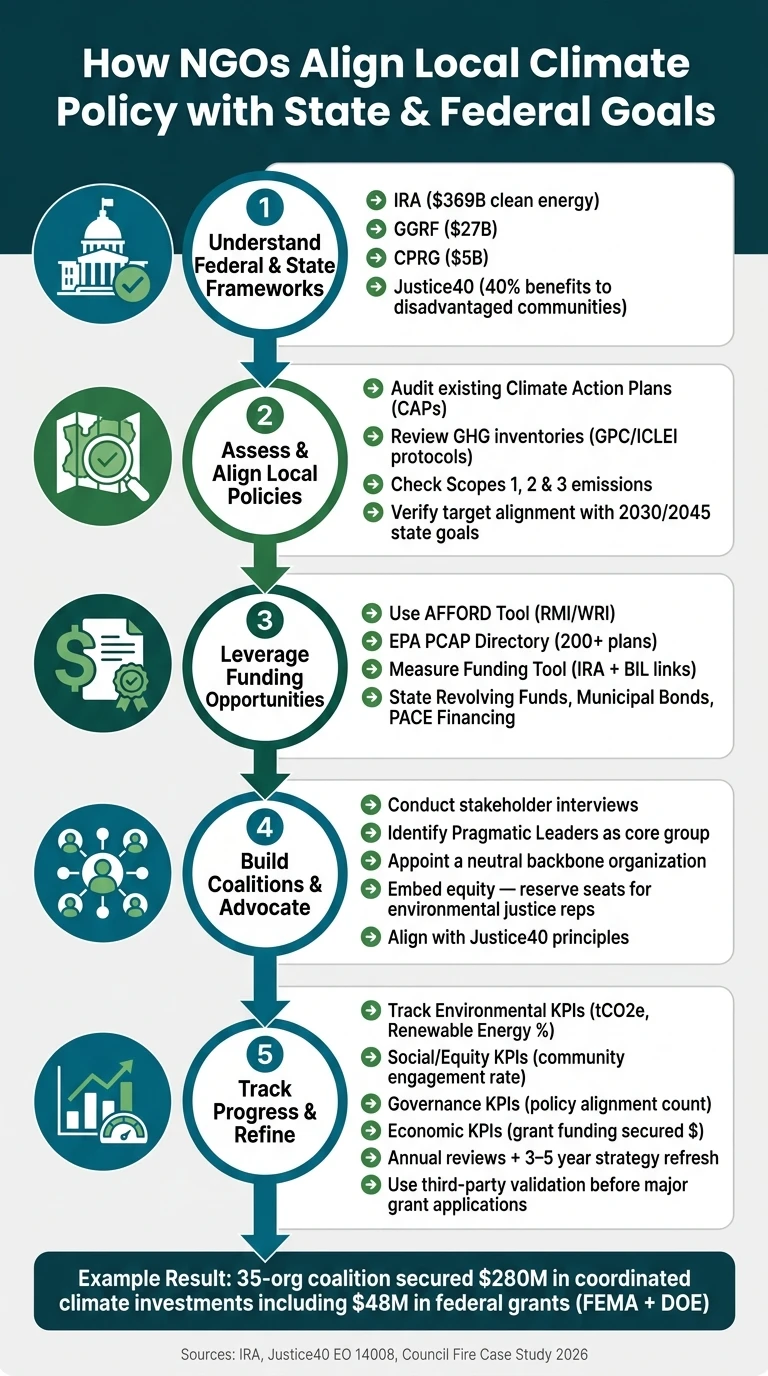
How NGOs Can Align Local Climate Policy with State & Federal Goals
The Power of Localizing NGO Efforts: Why Global Problems Need Local Solutions
Understanding Federal and State Climate Goals
To align local policies effectively, it's crucial to first grasp the federal and state frameworks shaping climate action. These frameworks, led by initiatives like the Inflation Reduction Act (IRA), provide a solid foundation for evaluating how local efforts can complement broader objectives.
Key Federal Climate Frameworks
The Inflation Reduction Act (IRA) stands out as a cornerstone of U.S. climate investment, allocating $369 billion toward clean energy initiatives. This effort is expected to cut U.S. emissions to 31%–44% below 2005 levels, positioning the nation toward its 2030 goal of halving emissions [4]. For nonprofits, the Direct Pay (Elective Pay) provision is particularly impactful, enabling 501(c) organizations and municipal governments to receive direct payments from the IRS for clean energy tax credits [4].
Other significant federal programs include:
Greenhouse Gas Reduction Fund (GGRF): A $27 billion initiative managed by the EPA that focuses on clean energy financing for low-income and disadvantaged communities. It aims to mobilize nearly $7 in private capital for every $1 of federal funding[6].
Climate Pollution Reduction Grants (CPRG): Providing $5 billion to support states and local governments in developing and implementing emission-reduction strategies, with $4.6 billion available through competitive grants [3].
The Justice40 Initiative, established under Executive Order 14008, ensures that 40% of the benefits from select federal climate and energy investments reach disadvantaged communities. This initiative spans 518 programs across 16 federal agencies [5].
"40 percent of the benefits of certain federal climate and energy investments flow to communities that are disadvantaged, marginalized, and overburdened by pollution." - President Joe Biden, Executive Order 14008 [5]
State-Level Climate Policies and Targets
States often build on federal frameworks by setting more ambitious goals. By February 2025, 22 states, the District of Columbia, and Puerto Rico will have binding greenhouse gas (GHG) reduction targets [7]. Additionally, 33 states have formal climate action plans, and 36 states have renewable energy or clean electricity standards [10].
The scope of these targets varies significantly. For instance, California's 2022 Scoping Plan aims for net negative GHG emissions after 2045, using the PATHWAYS model to monitor progress at the sector level [7][11]. Similarly, Maryland's 2030 Greenhouse Gas Reduction Act Plan mandates that 100% of electricity consumed in the state come from renewable sources by 2035, which is projected to cut emissions by 2,507,000 metric tons of CO₂ equivalent (MTCO2e) by 2045 [9].
It’s important to note that states differ in their baseline years for measuring emissions reductions. Twelve states use 1990 as the baseline, while ten rely on 2005 [7]. Understanding your state’s baseline is essential for aligning local progress with state reporting standards.
How to Track Federal and State Opportunities
A variety of tools are available to help nonprofits and local organizations navigate federal and state climate opportunities:
The State Climate Policy Dashboard monitors 69 climate mitigation policies across all 50 states, highlighting whether each is enacted, in progress, or partially enacted. Its State Comparison Tool is particularly useful for benchmarking local policies against those in other states [8].
The EPA's PCAP Directory offers access to over 200 Priority Climate Action Plans, complete with quantified GHG reduction measures and calculation tools [14].
For funding, the AFFORD Tool, developed by RMI and WRI, connects nonprofits and local groups to federal funding, tax credits, and incentives for projects in sectors like transportation, buildings, and electricity [12].
The Measure Funding Tool links specific PCAP measures to relevant IRA and Bipartisan Infrastructure Law (BIL) funding opportunities in real time [15].
The Funding for Climate Justice Hub focuses on Justice40 and IRA opportunities for grassroots organizations, while its "Funding Defense" section tracks federal actions that could jeopardize existing climate funding [13].
With these resources, NGOs can align local initiatives with federal and state programs, ensuring maximum impact while leveraging available funding and support.
Assessing Local Policies and Identifying Gaps
To effectively align with state and federal goals, it's essential to evaluate how local policies stack up and pinpoint areas needing attention.
How to Map Local Policies
Start by determining if your area has a Climate Action Plan (CAP). A CAP serves as a forward-looking roadmap, laying out specific actions, timelines, and accountability measures for tackling climate goals. As Council Fire explains:
"A climate action plan (CAP) translates climate commitments into concrete actions, timelines, and accountability structures. Unlike a sustainability report (which looks backward at performance), a CAP looks forward." [17]
If a CAP is in place, examine it across four critical areas: Energy and Buildings, Transportation, Waste and Materials, and Nature-Based Solutions. If no CAP exists, that's the first gap to address. Even in proactive states like California, only 48% of cities and 38% of counties had adopted a CAP by 2026 [16]. In less active states, the numbers are likely even lower, highlighting a considerable opportunity for improvement.
How to Identify Policy Gaps
To identify gaps, start by reviewing the CAP (if available) against four essential components: GHG inventory, target setting, monitoring, and legal status. Here's a quick breakdown of what to evaluate:
Evaluation Component | What to Look For |
|---|---|
GHG Inventory | Ensure it follows GPC or ICLEI protocols and includes Scopes 1, 2, and 3 [16][17] |
Target Setting | Confirm alignment with state targets (e.g., 2030/2045) and 1.5°C science-based pathways [16][17] |
Monitoring | Look for annual public progress reports and third-party verification [17] |
Legal Status | Verify if the plan is "CEQA-qualified" (in California) or meets similar standards [16] |
Additionally, examine the governance structures supporting these policies. Without dedicated staff, regular reporting, or interim milestones, even the most ambitious plans risk becoming aspirational rather than actionable. Plans should include annual or biennial checkpoints to maintain focus on long-term goals like 2045 or 2050 targets.
Once gaps are identified, the next step is to use specialized tools for a thorough local policy assessment.
Tools for Local Policy Assessment
Several tools can assist in evaluating local policies:
CalEEMod: Useful for calculating GHG emissions and modeling reduction strategies [16].
NOAA's Climate Explorer and the World Bank Climate Portal: These platforms help assess whether local policies address physical risks like extreme heat or flooding, which are often underrepresented in plans [17].
For NGOs and other organizations, structured assessments can provide deeper insights. For example, in February 2026, Council Fire worked with a coalition of 35 organizations, including 14 municipalities and 12 businesses, covering a metropolitan region with 1.8 million residents. Over three months, the team conducted 65 interviews and uncovered that three municipalities were independently hiring consultants for overlapping climate assessments. By fostering collaboration, the coalition adopted a shared regional target of 50% emissions reduction by 2030 and secured $280 million in coordinated climate investments, including $48 million in federal grants from FEMA and the DOE [1].
The key takeaway from this process was clear:
"Start with trust, not targets. Stakeholders who'd been talking past each other for years needed facilitated dialogue before they could negotiate shared commitments." - Council Fire Case Study [1]
Building trust and mapping stakeholders - whether they are ambitious, pragmatic, or cautious - are just as critical as any technical tools. This approach complements earlier discussions on multi-level partnerships, emphasizing the importance of collaboration and open dialogue for advancing local climate policies.
Building an Actionable Alignment Strategy
Once you've assessed local policies, the next step is turning those insights into actionable strategies. This involves setting measurable targets, embedding climate goals into policies, and ensuring adequate funding to drive implementation.
Setting Local Targets and Metrics
Start by conducting a Greenhouse Gas (GHG) inventory using the Global Protocol for Community-Scale Greenhouse Gas Inventories (GPC). This internationally recognized framework provides a standardized baseline for tracking emissions from key sources like buildings, transportation, and waste. It’s also aligned with state and federal reporting requirements, ensuring consistency [17].
Establish both near-term targets (2030–2035) and long-term goals (2050), grounding them in 1.5°C science-based pathways as outlined by organizations like C40 Cities. This ensures your objectives meet rigorous standards and gain credibility with state and federal agencies [17]. Tools from the EPA, such as the Local GHG Inventory Tool and the State Inventory and Projection Tool, can help maintain data accuracy and compliance with reporting standards [18].
Equity metrics are equally important. Track which communities face the greatest pollution burdens and prioritize investments in these areas. Doing so aligns your initiatives with federal "Just Transition" principles, promoting fairness in climate action [17].
Once targets are set, the next step is weaving these goals into your local policy frameworks.
Embedding Climate Goals Into Local Policies
To make climate objectives actionable, integrate them into legally binding policies. Start by creating a Climate Action Plan (CAP) that outlines specific actions, timelines, and funding strategies. Avoid vague aspirations - focus on concrete steps [17].
Incorporate these goals into zoning codes, building regulations, and comprehensive plans, ensuring they carry legal weight. For example, enforce policies like location-efficient development, zoning for flood and heat resilience, and protecting natural lands [19].
On the governance side, establish cross-departmental working groups or board-level committees that include teams from finance, facilities, and human resources. This collaborative approach ensures climate goals are treated as a shared responsibility rather than isolated within a single department [17].
Securing Funding for Implementation
Securing funding is a critical piece of the puzzle, and federal and state programs can be valuable resources. Below is a summary of key funding mechanisms, their reliability, and ideal use cases:
Funding Mechanism | Security Level | Best Use Case |
|---|---|---|
State Revolving Funds (SRF) | High | Water/wastewater resilience, green infrastructure |
STORM RLF | Moderate | Hazard mitigation, zoning changes, land use planning |
Municipal Bonds | High (market-based) | Large-scale infrastructure projects |
Local Utility Fees | High (local control) | Stormwater management, recurring maintenance |
PACE Financing | Moderate | Property-level energy and resilience upgrades |
To maximize your chances of securing funding, align applications with state strategic documents to demonstrate coherence [20]. Submit proposals 6–12 months in advance, focusing on the 5–10 most impactful actions identified in your CAP rather than spreading resources thinly [20]. If your application is rejected, seek feedback to improve for future opportunities [20].
Building Coalitions and Advocating for Change
The next step involves forming strong partnerships, advocating effectively, and ensuring that affected communities have a meaningful role in decision-making.
Building Multi-Level Partnerships
Creating multi-level partnerships builds on earlier discussions about cohesive local policy frameworks. The process begins with understanding the priorities of all stakeholders. Start by conducting one-on-one interviews with leaders from government, business, academia, labor, and faith communities. These conversations help uncover their goals, limitations, and openness to change.
Once this input is gathered, organize stakeholders into four distinct clusters based on their level of ambition and practicality:
Stakeholder Cluster | Characteristics | Role in Coalition |
|---|---|---|
Ambitious Advocates | Aim high but less focused on feasibility | Push for bold targets and visionary goals |
Pragmatic Leaders | Combine ambition with a focus on execution | Act as the core steering group to bridge gaps |
Cautious Participants | Cautious, emphasizing constraints | Offer reality checks on capacity and feasibility |
Skeptical Observers | Focused on economic development/status quo | Engage through dialogue to reduce resistance |
Successful coalitions are often led by pragmatic leaders - those who balance ambition with a realistic approach to implementation.
"Coalitions led by the most ambitious voices alienate pragmatists and never achieve the breadth needed for regional impact. Coalitions led by cautious participants set targets too low to matter." - Council Fire [1]
To maintain momentum, appoint a backbone organization - a neutral entity responsible for coordinating meetings and tracking progress. This group doesn't hold decision-making power but plays a vital role in maintaining trust among participants [21].
With a coalition in place, the next step is advocating for local climate policies that align with community priorities.
Advocacy Strategies for Local Climate Policies
Once partnerships are established, targeted advocacy bridges coalition insights to policy action. Tailor your approach to the audience, as local policymakers often respond differently than state or federal officials. Localized messaging is key.
"Policy issues at the city level are the least politicized among traditional party lines. Mayors and city councilors don't have the same set of political incentives that members of Congress do." - Climate Changemakers [22]
Focus on local impact data instead of broad national statistics. Tools like Climate Costs 2040 can project specific taxpayer costs for individual cities, making financial arguments more relatable and persuasive. For advocates already on board, reinforce their leadership. For neutral policymakers, highlight shared priorities such as job creation and infrastructure savings. For those resistant to change, local economic data often serves as the best starting point.
Public commitments also play a role in accountability. Encourage mayors to sign pledges such as Mayors & Municipal Leaders for Electrification or to join the National League of Cities' Federal Advocacy Committee, amplifying their influence at higher levels of government [22]. Pair these pledges with transparent annual progress reports to ensure ongoing accountability, even without formal enforcement mechanisms [1].
A notable example occurred in March 2026, when nearly 100 community-serving organizations convened in Salinas, California, through the LCI/SGC Catalyst Convening. Supported by the California Climate and Energy Collaborative (CCEC), this event provided direct recommendations to state agencies on energy and climate needs. These regional gatherings synthesize local insights into state-led initiatives, ensuring that policies reflect the realities on the ground [24].
Putting Equity and Justice at the Center
Ensuring that frontline communities have a central role in decision-making is a critical aspect of coalition building and advocacy. Equity must be embedded from the start, not treated as an afterthought. Reserve dedicated seats for environmental justice representatives on steering committees to ensure these communities influence decision-making rather than just offering feedback.
Apply environmental justice screening to all coalition projects, prioritizing investments in areas with the highest pollution burdens. This aligns with Justice40 principles, which direct 40% of federal climate investment benefits to disadvantaged communities. Tools like the National League of Cities' Policy and Systems Change Compass, piloted in July 2024, provide practical steps for this work. For instance, Mount Vernon, NY, used the tool to develop its first municipal sustainability plan, while another city prioritized a healthy housing inspection ordinance over energy disclosure policies to better meet health equity goals [23].
"Real coordination is more than talk. It's systems change and operational reforms." - CivicWell [24]
Incorporating equity early not only strengthens your coalition's credibility but also aligns with the requirements of many state and federal grants that now mandate Justice40 compliance.
Tracking Progress and Refining Your Approach
Once coalitions are established and advocacy efforts are in motion, maintaining alignment with policy goals requires consistent evaluation, honest reflection, and the flexibility to adapt when strategies fall short.
Tracking Key Performance Indicators
Start by identifying key metrics across environmental, social/equity, governance, and economic areas. Each category provides insight into different aspects of your alignment strategy.
KPI Category | Example Metrics | Why It Matters |
|---|---|---|
Environmental | Total tCO2e, Renewable Energy %, Waste Diversion Tons | Tracks emissions reductions and mitigation efforts |
Social/Equity | Community Engagement Rate, Demographic Reach, Health Co-benefits | Measures justice outcomes and public health benefits |
Governance | Policy Alignment Count, Financial Audit Status, Board Diversity % | Ensures accountability and structural alignment |
Economic | Grant Funding Secured ($), Procurement Savings ($), Job Placement % | Demonstrates financial strength and local impact |
Rather than centralizing all metrics to one team, consider forming specialized working groups. For example, one group could focus on emissions reduction, another on resilience, and a third on workforce transition. Each group would oversee KPIs specific to their area of expertise [1].
For emissions tracking, the GHG Protocol Corporate Standard provides a reliable framework to establish a baseline year and monitor progress consistently [17]. This is especially crucial since urban areas contribute about 70% of global CO₂ emissions [26]. Even small improvements at the local level can lead to meaningful regional benefits.
"Public commitments with public tracking are surprisingly powerful." - Council Fire [1]
Publishing updates on progress not only builds accountability but also strengthens confidence in the overall strategy. Regularly reviewing these metrics allows you to adjust and improve your approach as needed.
Reviewing and Updating Alignment Efforts
From the outset, include a cyclical review process in your strategy. Conduct annual evaluations of your KPIs and plan for a more comprehensive strategy refresh every three to five years - or sooner if there are major regulatory changes [17].
A useful framework for this review is the AAA model, which focuses on three key areas:
Awareness: Understanding the causes of climate challenges and the broader policy landscape.
Analysis: Turning data into actionable insights.
Action: Applying those insights to guide policy decisions [25].
Highlighting small, early successes is vital. For instance, sharing measurable wins like energy cost reductions within the first few months can build internal momentum and keep coalition partners engaged. Detroit's Community Benefit Ordinance, adopted in 2016, is a great example. Through its Neighborhood Advisory Council, the city ensures long-term accountability for large-scale development projects. As of 2026, eleven projects have finalized agreements under this framework [10].
After internal reviews, bringing in external expertise can further validate your progress and reveal areas for improvement.
Using Third-Party Expertise to Validate Progress
While self-reported data is a good starting point, third-party validation adds credibility. This external perspective is valuable for both internal stakeholders, like your board, and external ones, such as funders and government entities. Independent reviews help ensure that your metrics align with state and federal standards, identify gaps in your data, and uncover new opportunities.
For example, Council Fire’s work with the February 2026 regional climate compact illustrates the benefits of third-party validation. By guiding a joint vulnerability assessment across three counties, they helped the coalition establish a unified regional target. This collaboration reduced redundant efforts and provided a more accurate picture of collective risks and progress [1]. Such efforts often pave the way for significant, coordinated investments.
Having an independent review in place is especially advantageous before applying for major grants or during policy renewal cycles, as it can positively influence funding decisions.
Conclusion: Turning Policy Alignment Into Local Impact
To effectively align local policies with broader climate objectives, continuous efforts in gap analysis, fostering trust, securing funding, and tracking measurable outcomes are essential. NGOs play a pivotal role in this process - not as bystanders but as active facilitators who bring fragmented efforts together into cohesive, impactful progress.
One notable example of this approach is a coalition that successfully secured substantial investments, showcasing the power of coordinated local action. [1]
The emphasis on equity, discussed earlier, remains central to this work. As Suriya Khan, Advisor at the Fair Start Movement, aptly stated:
"Climate is not a separate issue; it is a force that amplifies existing harm, deepens inequality, and destabilizes communities. Ignoring it means accepting worsening conditions." [2]
Incorporating justice into policy design - whether through community benefit agreements, health equity frameworks, or inclusive coalition-building - is not just a moral imperative. It ensures that climate solutions are enduring, widely supported, and capable of addressing the needs of all communities.
FAQs
Where do we start if our city doesn’t have a Climate Action Plan?
If your city doesn't have a Climate Action Plan, the first step is to connect with local officials to encourage the development of policies and frameworks that address climate challenges. Key areas to focus on include master plans, resilience strategies, local ordinances, and zoning regulations. Start by researching your city’s existing climate initiatives through official websites or social media channels to understand what steps, if any, are already in place.
To determine where efforts should be concentrated, consider conducting a greenhouse gas inventory. This will help pinpoint the primary sources of emissions in your area - commonly stemming from sectors like buildings, transportation, and waste management. Identifying these sources allows for a more targeted and effective approach to reducing emissions.
How can a nonprofit prove Justice40 benefits in a grant application?
To illustrate the benefits of Justice40, focus on how your project addresses the needs of disadvantaged communities, aligning with federal criteria. Begin by collecting relevant data and hosting community listening sessions to understand local challenges and priorities. Tools such as the Climate and Economic Justice Screening Tool can help pinpoint areas of focus. Clearly explain how your project provides measurable outcomes in areas like clean energy access, community resilience, or workforce development. This approach will enhance the strength and clarity of your application.
What’s the fastest way to align local climate targets with state baselines?
Building trust starts with structured and intentional stakeholder engagement. Begin by conducting interviews to identify influential local leaders who can champion the initiative. From there, prioritize working with stakeholders who bring practical expertise and credibility to the table. Early successes can be achieved through efforts like joint vulnerability assessments and collaborative procurement strategies.
It's also crucial to review and audit state laws to ensure your plans align with legal frameworks and avoid conflicts with preemption laws. Throughout the process, maintain transparency by sharing public progress reports instead of relying on rigid, top-down enforcement. This approach fosters collaboration and accountability, laying a solid foundation for long-term success.
Related Blog Posts
Latest Articles
©2026

Narrative Change and Power Building: The Missing Half of Advocacy
Narrative change is the process of disrupting dominant narratives that normalize inequity and advancing new narratives from historically marginalized communities.

Funding Resilience Without Federal Grants
BRIC is unreliable and FEMA is shrinking. Here's how cities fund climate resilience with dedicated revenue, blended finance, and a coordinating authority.

The ESG Blind Spot: How AI Is Finding Risks in Companies Nobody Else Is Watching
Norway's sovereign wealth fund uses AI to screen 7,200 portfolio companies for forced labor and corruption within 24 hours. The real story is the emerging-market coverage gap that traditional ESG data vendors miss — and what it means for any company with a global supply chain.
Narrative Change and Power Building: The Missing Half of Advocacy
Narrative change is the process of disrupting dominant narratives that normalize inequity and advancing new narratives from historically marginalized communities.
Funding Resilience Without Federal Grants
BRIC is unreliable and FEMA is shrinking. Here's how cities fund climate resilience with dedicated revenue, blended finance, and a coordinating authority.
The ESG Blind Spot: How AI Is Finding Risks in Companies Nobody Else Is Watching
Norway's sovereign wealth fund uses AI to screen 7,200 portfolio companies for forced labor and corruption within 24 hours. The real story is the emerging-market coverage gap that traditional ESG data vendors miss — and what it means for any company with a global supply chain.
FAQ
01
What does it really mean to “redefine profit”?
02
What makes Council Fire different?
03
Who does Council Fire work with?
04
What does working with Council Fire actually look like?
05
How does Council Fire help organizations turn big goals into action?
06
How does Council Fire define and measure success?
07
How does technology fit into Council Fire’s work?
Jun 3, 2026
How to Align Local Policy with State and Federal Climate Goals for NGOs & Nonprofits
Sustainability Strategy
In This Article
A practical guide for nonprofits to align local climate plans with state and federal goals, secure funding, and center equity.
How to Align Local Policy with State and Federal Climate Goals for NGOs & Nonprofits
Local climate policies often face challenges when misaligned with state and federal goals, leading to funding gaps, legal conflicts, and stalled progress. NGOs and nonprofits play a vital role in bridging these gaps and driving effective climate action.
Key Takeaways:
Policy alignment ensures local, state, and federal climate strategies work together rather than in conflict.
NGOs act as connectors, translating federal directives into local actions and amplifying community needs.
Tools like the Inflation Reduction Act (IRA) and Justice40 Initiative offer funding opportunities for clean energy and equity-focused initiatives.
Conducting local policy assessments helps identify gaps in Climate Action Plans (CAPs) and ensures alignment with broader climate goals.
Building coalitions and maintaining equity in decision-making are critical for long-term success.
Practical Steps for NGOs:
Understand Federal and State Frameworks: Familiarize yourself with programs like the IRA, Climate Pollution Reduction Grants, and state-specific climate targets.
Assess and Align Local Policies: Audit existing CAPs, evaluate GHG inventories, and ensure targets align with state and federal goals.
Leverage Funding Opportunities: Use tools like the AFFORD Tool and EPA directories to secure grants and tax credits.
Build Partnerships: Collaborate with municipalities, businesses, and community groups to create unified climate strategies.
Track and Refine: Regularly monitor progress using KPIs and third-party validation to maintain accountability.
NGOs can drive impactful climate progress by connecting fragmented efforts, securing funding, and ensuring equity remains central to every initiative.
How NGOs Can Align Local Climate Policy with State & Federal Goals
The Power of Localizing NGO Efforts: Why Global Problems Need Local Solutions
Understanding Federal and State Climate Goals
To align local policies effectively, it's crucial to first grasp the federal and state frameworks shaping climate action. These frameworks, led by initiatives like the Inflation Reduction Act (IRA), provide a solid foundation for evaluating how local efforts can complement broader objectives.
Key Federal Climate Frameworks
The Inflation Reduction Act (IRA) stands out as a cornerstone of U.S. climate investment, allocating $369 billion toward clean energy initiatives. This effort is expected to cut U.S. emissions to 31%–44% below 2005 levels, positioning the nation toward its 2030 goal of halving emissions [4]. For nonprofits, the Direct Pay (Elective Pay) provision is particularly impactful, enabling 501(c) organizations and municipal governments to receive direct payments from the IRS for clean energy tax credits [4].
Other significant federal programs include:
Greenhouse Gas Reduction Fund (GGRF): A $27 billion initiative managed by the EPA that focuses on clean energy financing for low-income and disadvantaged communities. It aims to mobilize nearly $7 in private capital for every $1 of federal funding[6].
Climate Pollution Reduction Grants (CPRG): Providing $5 billion to support states and local governments in developing and implementing emission-reduction strategies, with $4.6 billion available through competitive grants [3].
The Justice40 Initiative, established under Executive Order 14008, ensures that 40% of the benefits from select federal climate and energy investments reach disadvantaged communities. This initiative spans 518 programs across 16 federal agencies [5].
"40 percent of the benefits of certain federal climate and energy investments flow to communities that are disadvantaged, marginalized, and overburdened by pollution." - President Joe Biden, Executive Order 14008 [5]
State-Level Climate Policies and Targets
States often build on federal frameworks by setting more ambitious goals. By February 2025, 22 states, the District of Columbia, and Puerto Rico will have binding greenhouse gas (GHG) reduction targets [7]. Additionally, 33 states have formal climate action plans, and 36 states have renewable energy or clean electricity standards [10].
The scope of these targets varies significantly. For instance, California's 2022 Scoping Plan aims for net negative GHG emissions after 2045, using the PATHWAYS model to monitor progress at the sector level [7][11]. Similarly, Maryland's 2030 Greenhouse Gas Reduction Act Plan mandates that 100% of electricity consumed in the state come from renewable sources by 2035, which is projected to cut emissions by 2,507,000 metric tons of CO₂ equivalent (MTCO2e) by 2045 [9].
It’s important to note that states differ in their baseline years for measuring emissions reductions. Twelve states use 1990 as the baseline, while ten rely on 2005 [7]. Understanding your state’s baseline is essential for aligning local progress with state reporting standards.
How to Track Federal and State Opportunities
A variety of tools are available to help nonprofits and local organizations navigate federal and state climate opportunities:
The State Climate Policy Dashboard monitors 69 climate mitigation policies across all 50 states, highlighting whether each is enacted, in progress, or partially enacted. Its State Comparison Tool is particularly useful for benchmarking local policies against those in other states [8].
The EPA's PCAP Directory offers access to over 200 Priority Climate Action Plans, complete with quantified GHG reduction measures and calculation tools [14].
For funding, the AFFORD Tool, developed by RMI and WRI, connects nonprofits and local groups to federal funding, tax credits, and incentives for projects in sectors like transportation, buildings, and electricity [12].
The Measure Funding Tool links specific PCAP measures to relevant IRA and Bipartisan Infrastructure Law (BIL) funding opportunities in real time [15].
The Funding for Climate Justice Hub focuses on Justice40 and IRA opportunities for grassroots organizations, while its "Funding Defense" section tracks federal actions that could jeopardize existing climate funding [13].
With these resources, NGOs can align local initiatives with federal and state programs, ensuring maximum impact while leveraging available funding and support.
Assessing Local Policies and Identifying Gaps
To effectively align with state and federal goals, it's essential to evaluate how local policies stack up and pinpoint areas needing attention.
How to Map Local Policies
Start by determining if your area has a Climate Action Plan (CAP). A CAP serves as a forward-looking roadmap, laying out specific actions, timelines, and accountability measures for tackling climate goals. As Council Fire explains:
"A climate action plan (CAP) translates climate commitments into concrete actions, timelines, and accountability structures. Unlike a sustainability report (which looks backward at performance), a CAP looks forward." [17]
If a CAP is in place, examine it across four critical areas: Energy and Buildings, Transportation, Waste and Materials, and Nature-Based Solutions. If no CAP exists, that's the first gap to address. Even in proactive states like California, only 48% of cities and 38% of counties had adopted a CAP by 2026 [16]. In less active states, the numbers are likely even lower, highlighting a considerable opportunity for improvement.
How to Identify Policy Gaps
To identify gaps, start by reviewing the CAP (if available) against four essential components: GHG inventory, target setting, monitoring, and legal status. Here's a quick breakdown of what to evaluate:
Evaluation Component | What to Look For |
|---|---|
GHG Inventory | Ensure it follows GPC or ICLEI protocols and includes Scopes 1, 2, and 3 [16][17] |
Target Setting | Confirm alignment with state targets (e.g., 2030/2045) and 1.5°C science-based pathways [16][17] |
Monitoring | Look for annual public progress reports and third-party verification [17] |
Legal Status | Verify if the plan is "CEQA-qualified" (in California) or meets similar standards [16] |
Additionally, examine the governance structures supporting these policies. Without dedicated staff, regular reporting, or interim milestones, even the most ambitious plans risk becoming aspirational rather than actionable. Plans should include annual or biennial checkpoints to maintain focus on long-term goals like 2045 or 2050 targets.
Once gaps are identified, the next step is to use specialized tools for a thorough local policy assessment.
Tools for Local Policy Assessment
Several tools can assist in evaluating local policies:
CalEEMod: Useful for calculating GHG emissions and modeling reduction strategies [16].
NOAA's Climate Explorer and the World Bank Climate Portal: These platforms help assess whether local policies address physical risks like extreme heat or flooding, which are often underrepresented in plans [17].
For NGOs and other organizations, structured assessments can provide deeper insights. For example, in February 2026, Council Fire worked with a coalition of 35 organizations, including 14 municipalities and 12 businesses, covering a metropolitan region with 1.8 million residents. Over three months, the team conducted 65 interviews and uncovered that three municipalities were independently hiring consultants for overlapping climate assessments. By fostering collaboration, the coalition adopted a shared regional target of 50% emissions reduction by 2030 and secured $280 million in coordinated climate investments, including $48 million in federal grants from FEMA and the DOE [1].
The key takeaway from this process was clear:
"Start with trust, not targets. Stakeholders who'd been talking past each other for years needed facilitated dialogue before they could negotiate shared commitments." - Council Fire Case Study [1]
Building trust and mapping stakeholders - whether they are ambitious, pragmatic, or cautious - are just as critical as any technical tools. This approach complements earlier discussions on multi-level partnerships, emphasizing the importance of collaboration and open dialogue for advancing local climate policies.
Building an Actionable Alignment Strategy
Once you've assessed local policies, the next step is turning those insights into actionable strategies. This involves setting measurable targets, embedding climate goals into policies, and ensuring adequate funding to drive implementation.
Setting Local Targets and Metrics
Start by conducting a Greenhouse Gas (GHG) inventory using the Global Protocol for Community-Scale Greenhouse Gas Inventories (GPC). This internationally recognized framework provides a standardized baseline for tracking emissions from key sources like buildings, transportation, and waste. It’s also aligned with state and federal reporting requirements, ensuring consistency [17].
Establish both near-term targets (2030–2035) and long-term goals (2050), grounding them in 1.5°C science-based pathways as outlined by organizations like C40 Cities. This ensures your objectives meet rigorous standards and gain credibility with state and federal agencies [17]. Tools from the EPA, such as the Local GHG Inventory Tool and the State Inventory and Projection Tool, can help maintain data accuracy and compliance with reporting standards [18].
Equity metrics are equally important. Track which communities face the greatest pollution burdens and prioritize investments in these areas. Doing so aligns your initiatives with federal "Just Transition" principles, promoting fairness in climate action [17].
Once targets are set, the next step is weaving these goals into your local policy frameworks.
Embedding Climate Goals Into Local Policies
To make climate objectives actionable, integrate them into legally binding policies. Start by creating a Climate Action Plan (CAP) that outlines specific actions, timelines, and funding strategies. Avoid vague aspirations - focus on concrete steps [17].
Incorporate these goals into zoning codes, building regulations, and comprehensive plans, ensuring they carry legal weight. For example, enforce policies like location-efficient development, zoning for flood and heat resilience, and protecting natural lands [19].
On the governance side, establish cross-departmental working groups or board-level committees that include teams from finance, facilities, and human resources. This collaborative approach ensures climate goals are treated as a shared responsibility rather than isolated within a single department [17].
Securing Funding for Implementation
Securing funding is a critical piece of the puzzle, and federal and state programs can be valuable resources. Below is a summary of key funding mechanisms, their reliability, and ideal use cases:
Funding Mechanism | Security Level | Best Use Case |
|---|---|---|
State Revolving Funds (SRF) | High | Water/wastewater resilience, green infrastructure |
STORM RLF | Moderate | Hazard mitigation, zoning changes, land use planning |
Municipal Bonds | High (market-based) | Large-scale infrastructure projects |
Local Utility Fees | High (local control) | Stormwater management, recurring maintenance |
PACE Financing | Moderate | Property-level energy and resilience upgrades |
To maximize your chances of securing funding, align applications with state strategic documents to demonstrate coherence [20]. Submit proposals 6–12 months in advance, focusing on the 5–10 most impactful actions identified in your CAP rather than spreading resources thinly [20]. If your application is rejected, seek feedback to improve for future opportunities [20].
Building Coalitions and Advocating for Change
The next step involves forming strong partnerships, advocating effectively, and ensuring that affected communities have a meaningful role in decision-making.
Building Multi-Level Partnerships
Creating multi-level partnerships builds on earlier discussions about cohesive local policy frameworks. The process begins with understanding the priorities of all stakeholders. Start by conducting one-on-one interviews with leaders from government, business, academia, labor, and faith communities. These conversations help uncover their goals, limitations, and openness to change.
Once this input is gathered, organize stakeholders into four distinct clusters based on their level of ambition and practicality:
Stakeholder Cluster | Characteristics | Role in Coalition |
|---|---|---|
Ambitious Advocates | Aim high but less focused on feasibility | Push for bold targets and visionary goals |
Pragmatic Leaders | Combine ambition with a focus on execution | Act as the core steering group to bridge gaps |
Cautious Participants | Cautious, emphasizing constraints | Offer reality checks on capacity and feasibility |
Skeptical Observers | Focused on economic development/status quo | Engage through dialogue to reduce resistance |
Successful coalitions are often led by pragmatic leaders - those who balance ambition with a realistic approach to implementation.
"Coalitions led by the most ambitious voices alienate pragmatists and never achieve the breadth needed for regional impact. Coalitions led by cautious participants set targets too low to matter." - Council Fire [1]
To maintain momentum, appoint a backbone organization - a neutral entity responsible for coordinating meetings and tracking progress. This group doesn't hold decision-making power but plays a vital role in maintaining trust among participants [21].
With a coalition in place, the next step is advocating for local climate policies that align with community priorities.
Advocacy Strategies for Local Climate Policies
Once partnerships are established, targeted advocacy bridges coalition insights to policy action. Tailor your approach to the audience, as local policymakers often respond differently than state or federal officials. Localized messaging is key.
"Policy issues at the city level are the least politicized among traditional party lines. Mayors and city councilors don't have the same set of political incentives that members of Congress do." - Climate Changemakers [22]
Focus on local impact data instead of broad national statistics. Tools like Climate Costs 2040 can project specific taxpayer costs for individual cities, making financial arguments more relatable and persuasive. For advocates already on board, reinforce their leadership. For neutral policymakers, highlight shared priorities such as job creation and infrastructure savings. For those resistant to change, local economic data often serves as the best starting point.
Public commitments also play a role in accountability. Encourage mayors to sign pledges such as Mayors & Municipal Leaders for Electrification or to join the National League of Cities' Federal Advocacy Committee, amplifying their influence at higher levels of government [22]. Pair these pledges with transparent annual progress reports to ensure ongoing accountability, even without formal enforcement mechanisms [1].
A notable example occurred in March 2026, when nearly 100 community-serving organizations convened in Salinas, California, through the LCI/SGC Catalyst Convening. Supported by the California Climate and Energy Collaborative (CCEC), this event provided direct recommendations to state agencies on energy and climate needs. These regional gatherings synthesize local insights into state-led initiatives, ensuring that policies reflect the realities on the ground [24].
Putting Equity and Justice at the Center
Ensuring that frontline communities have a central role in decision-making is a critical aspect of coalition building and advocacy. Equity must be embedded from the start, not treated as an afterthought. Reserve dedicated seats for environmental justice representatives on steering committees to ensure these communities influence decision-making rather than just offering feedback.
Apply environmental justice screening to all coalition projects, prioritizing investments in areas with the highest pollution burdens. This aligns with Justice40 principles, which direct 40% of federal climate investment benefits to disadvantaged communities. Tools like the National League of Cities' Policy and Systems Change Compass, piloted in July 2024, provide practical steps for this work. For instance, Mount Vernon, NY, used the tool to develop its first municipal sustainability plan, while another city prioritized a healthy housing inspection ordinance over energy disclosure policies to better meet health equity goals [23].
"Real coordination is more than talk. It's systems change and operational reforms." - CivicWell [24]
Incorporating equity early not only strengthens your coalition's credibility but also aligns with the requirements of many state and federal grants that now mandate Justice40 compliance.
Tracking Progress and Refining Your Approach
Once coalitions are established and advocacy efforts are in motion, maintaining alignment with policy goals requires consistent evaluation, honest reflection, and the flexibility to adapt when strategies fall short.
Tracking Key Performance Indicators
Start by identifying key metrics across environmental, social/equity, governance, and economic areas. Each category provides insight into different aspects of your alignment strategy.
KPI Category | Example Metrics | Why It Matters |
|---|---|---|
Environmental | Total tCO2e, Renewable Energy %, Waste Diversion Tons | Tracks emissions reductions and mitigation efforts |
Social/Equity | Community Engagement Rate, Demographic Reach, Health Co-benefits | Measures justice outcomes and public health benefits |
Governance | Policy Alignment Count, Financial Audit Status, Board Diversity % | Ensures accountability and structural alignment |
Economic | Grant Funding Secured ($), Procurement Savings ($), Job Placement % | Demonstrates financial strength and local impact |
Rather than centralizing all metrics to one team, consider forming specialized working groups. For example, one group could focus on emissions reduction, another on resilience, and a third on workforce transition. Each group would oversee KPIs specific to their area of expertise [1].
For emissions tracking, the GHG Protocol Corporate Standard provides a reliable framework to establish a baseline year and monitor progress consistently [17]. This is especially crucial since urban areas contribute about 70% of global CO₂ emissions [26]. Even small improvements at the local level can lead to meaningful regional benefits.
"Public commitments with public tracking are surprisingly powerful." - Council Fire [1]
Publishing updates on progress not only builds accountability but also strengthens confidence in the overall strategy. Regularly reviewing these metrics allows you to adjust and improve your approach as needed.
Reviewing and Updating Alignment Efforts
From the outset, include a cyclical review process in your strategy. Conduct annual evaluations of your KPIs and plan for a more comprehensive strategy refresh every three to five years - or sooner if there are major regulatory changes [17].
A useful framework for this review is the AAA model, which focuses on three key areas:
Awareness: Understanding the causes of climate challenges and the broader policy landscape.
Analysis: Turning data into actionable insights.
Action: Applying those insights to guide policy decisions [25].
Highlighting small, early successes is vital. For instance, sharing measurable wins like energy cost reductions within the first few months can build internal momentum and keep coalition partners engaged. Detroit's Community Benefit Ordinance, adopted in 2016, is a great example. Through its Neighborhood Advisory Council, the city ensures long-term accountability for large-scale development projects. As of 2026, eleven projects have finalized agreements under this framework [10].
After internal reviews, bringing in external expertise can further validate your progress and reveal areas for improvement.
Using Third-Party Expertise to Validate Progress
While self-reported data is a good starting point, third-party validation adds credibility. This external perspective is valuable for both internal stakeholders, like your board, and external ones, such as funders and government entities. Independent reviews help ensure that your metrics align with state and federal standards, identify gaps in your data, and uncover new opportunities.
For example, Council Fire’s work with the February 2026 regional climate compact illustrates the benefits of third-party validation. By guiding a joint vulnerability assessment across three counties, they helped the coalition establish a unified regional target. This collaboration reduced redundant efforts and provided a more accurate picture of collective risks and progress [1]. Such efforts often pave the way for significant, coordinated investments.
Having an independent review in place is especially advantageous before applying for major grants or during policy renewal cycles, as it can positively influence funding decisions.
Conclusion: Turning Policy Alignment Into Local Impact
To effectively align local policies with broader climate objectives, continuous efforts in gap analysis, fostering trust, securing funding, and tracking measurable outcomes are essential. NGOs play a pivotal role in this process - not as bystanders but as active facilitators who bring fragmented efforts together into cohesive, impactful progress.
One notable example of this approach is a coalition that successfully secured substantial investments, showcasing the power of coordinated local action. [1]
The emphasis on equity, discussed earlier, remains central to this work. As Suriya Khan, Advisor at the Fair Start Movement, aptly stated:
"Climate is not a separate issue; it is a force that amplifies existing harm, deepens inequality, and destabilizes communities. Ignoring it means accepting worsening conditions." [2]
Incorporating justice into policy design - whether through community benefit agreements, health equity frameworks, or inclusive coalition-building - is not just a moral imperative. It ensures that climate solutions are enduring, widely supported, and capable of addressing the needs of all communities.
FAQs
Where do we start if our city doesn’t have a Climate Action Plan?
If your city doesn't have a Climate Action Plan, the first step is to connect with local officials to encourage the development of policies and frameworks that address climate challenges. Key areas to focus on include master plans, resilience strategies, local ordinances, and zoning regulations. Start by researching your city’s existing climate initiatives through official websites or social media channels to understand what steps, if any, are already in place.
To determine where efforts should be concentrated, consider conducting a greenhouse gas inventory. This will help pinpoint the primary sources of emissions in your area - commonly stemming from sectors like buildings, transportation, and waste management. Identifying these sources allows for a more targeted and effective approach to reducing emissions.
How can a nonprofit prove Justice40 benefits in a grant application?
To illustrate the benefits of Justice40, focus on how your project addresses the needs of disadvantaged communities, aligning with federal criteria. Begin by collecting relevant data and hosting community listening sessions to understand local challenges and priorities. Tools such as the Climate and Economic Justice Screening Tool can help pinpoint areas of focus. Clearly explain how your project provides measurable outcomes in areas like clean energy access, community resilience, or workforce development. This approach will enhance the strength and clarity of your application.
What’s the fastest way to align local climate targets with state baselines?
Building trust starts with structured and intentional stakeholder engagement. Begin by conducting interviews to identify influential local leaders who can champion the initiative. From there, prioritize working with stakeholders who bring practical expertise and credibility to the table. Early successes can be achieved through efforts like joint vulnerability assessments and collaborative procurement strategies.
It's also crucial to review and audit state laws to ensure your plans align with legal frameworks and avoid conflicts with preemption laws. Throughout the process, maintain transparency by sharing public progress reports instead of relying on rigid, top-down enforcement. This approach fosters collaboration and accountability, laying a solid foundation for long-term success.
Related Blog Posts
Latest Articles
©2026
Narrative Change and Power Building: The Missing Half of Advocacy
Narrative change is the process of disrupting dominant narratives that normalize inequity and advancing new narratives from historically marginalized communities.
Funding Resilience Without Federal Grants
BRIC is unreliable and FEMA is shrinking. Here's how cities fund climate resilience with dedicated revenue, blended finance, and a coordinating authority.
The ESG Blind Spot: How AI Is Finding Risks in Companies Nobody Else Is Watching
Norway's sovereign wealth fund uses AI to screen 7,200 portfolio companies for forced labor and corruption within 24 hours. The real story is the emerging-market coverage gap that traditional ESG data vendors miss — and what it means for any company with a global supply chain.
FAQ
01
What does it really mean to “redefine profit”?
02
What makes Council Fire different?
03
Who does Council Fire work with?
04
What does working with Council Fire actually look like?
05
How does Council Fire help organizations turn big goals into action?
06
How does Council Fire define and measure success?
07
How does technology fit into Council Fire’s work?
Jun 3, 2026
How to Align Local Policy with State and Federal Climate Goals for NGOs & Nonprofits
Sustainability Strategy
In This Article
A practical guide for nonprofits to align local climate plans with state and federal goals, secure funding, and center equity.
How to Align Local Policy with State and Federal Climate Goals for NGOs & Nonprofits
Local climate policies often face challenges when misaligned with state and federal goals, leading to funding gaps, legal conflicts, and stalled progress. NGOs and nonprofits play a vital role in bridging these gaps and driving effective climate action.
Key Takeaways:
Policy alignment ensures local, state, and federal climate strategies work together rather than in conflict.
NGOs act as connectors, translating federal directives into local actions and amplifying community needs.
Tools like the Inflation Reduction Act (IRA) and Justice40 Initiative offer funding opportunities for clean energy and equity-focused initiatives.
Conducting local policy assessments helps identify gaps in Climate Action Plans (CAPs) and ensures alignment with broader climate goals.
Building coalitions and maintaining equity in decision-making are critical for long-term success.
Practical Steps for NGOs:
Understand Federal and State Frameworks: Familiarize yourself with programs like the IRA, Climate Pollution Reduction Grants, and state-specific climate targets.
Assess and Align Local Policies: Audit existing CAPs, evaluate GHG inventories, and ensure targets align with state and federal goals.
Leverage Funding Opportunities: Use tools like the AFFORD Tool and EPA directories to secure grants and tax credits.
Build Partnerships: Collaborate with municipalities, businesses, and community groups to create unified climate strategies.
Track and Refine: Regularly monitor progress using KPIs and third-party validation to maintain accountability.
NGOs can drive impactful climate progress by connecting fragmented efforts, securing funding, and ensuring equity remains central to every initiative.
How NGOs Can Align Local Climate Policy with State & Federal Goals
The Power of Localizing NGO Efforts: Why Global Problems Need Local Solutions
Understanding Federal and State Climate Goals
To align local policies effectively, it's crucial to first grasp the federal and state frameworks shaping climate action. These frameworks, led by initiatives like the Inflation Reduction Act (IRA), provide a solid foundation for evaluating how local efforts can complement broader objectives.
Key Federal Climate Frameworks
The Inflation Reduction Act (IRA) stands out as a cornerstone of U.S. climate investment, allocating $369 billion toward clean energy initiatives. This effort is expected to cut U.S. emissions to 31%–44% below 2005 levels, positioning the nation toward its 2030 goal of halving emissions [4]. For nonprofits, the Direct Pay (Elective Pay) provision is particularly impactful, enabling 501(c) organizations and municipal governments to receive direct payments from the IRS for clean energy tax credits [4].
Other significant federal programs include:
Greenhouse Gas Reduction Fund (GGRF): A $27 billion initiative managed by the EPA that focuses on clean energy financing for low-income and disadvantaged communities. It aims to mobilize nearly $7 in private capital for every $1 of federal funding[6].
Climate Pollution Reduction Grants (CPRG): Providing $5 billion to support states and local governments in developing and implementing emission-reduction strategies, with $4.6 billion available through competitive grants [3].
The Justice40 Initiative, established under Executive Order 14008, ensures that 40% of the benefits from select federal climate and energy investments reach disadvantaged communities. This initiative spans 518 programs across 16 federal agencies [5].
"40 percent of the benefits of certain federal climate and energy investments flow to communities that are disadvantaged, marginalized, and overburdened by pollution." - President Joe Biden, Executive Order 14008 [5]
State-Level Climate Policies and Targets
States often build on federal frameworks by setting more ambitious goals. By February 2025, 22 states, the District of Columbia, and Puerto Rico will have binding greenhouse gas (GHG) reduction targets [7]. Additionally, 33 states have formal climate action plans, and 36 states have renewable energy or clean electricity standards [10].
The scope of these targets varies significantly. For instance, California's 2022 Scoping Plan aims for net negative GHG emissions after 2045, using the PATHWAYS model to monitor progress at the sector level [7][11]. Similarly, Maryland's 2030 Greenhouse Gas Reduction Act Plan mandates that 100% of electricity consumed in the state come from renewable sources by 2035, which is projected to cut emissions by 2,507,000 metric tons of CO₂ equivalent (MTCO2e) by 2045 [9].
It’s important to note that states differ in their baseline years for measuring emissions reductions. Twelve states use 1990 as the baseline, while ten rely on 2005 [7]. Understanding your state’s baseline is essential for aligning local progress with state reporting standards.
How to Track Federal and State Opportunities
A variety of tools are available to help nonprofits and local organizations navigate federal and state climate opportunities:
The State Climate Policy Dashboard monitors 69 climate mitigation policies across all 50 states, highlighting whether each is enacted, in progress, or partially enacted. Its State Comparison Tool is particularly useful for benchmarking local policies against those in other states [8].
The EPA's PCAP Directory offers access to over 200 Priority Climate Action Plans, complete with quantified GHG reduction measures and calculation tools [14].
For funding, the AFFORD Tool, developed by RMI and WRI, connects nonprofits and local groups to federal funding, tax credits, and incentives for projects in sectors like transportation, buildings, and electricity [12].
The Measure Funding Tool links specific PCAP measures to relevant IRA and Bipartisan Infrastructure Law (BIL) funding opportunities in real time [15].
The Funding for Climate Justice Hub focuses on Justice40 and IRA opportunities for grassroots organizations, while its "Funding Defense" section tracks federal actions that could jeopardize existing climate funding [13].
With these resources, NGOs can align local initiatives with federal and state programs, ensuring maximum impact while leveraging available funding and support.
Assessing Local Policies and Identifying Gaps
To effectively align with state and federal goals, it's essential to evaluate how local policies stack up and pinpoint areas needing attention.
How to Map Local Policies
Start by determining if your area has a Climate Action Plan (CAP). A CAP serves as a forward-looking roadmap, laying out specific actions, timelines, and accountability measures for tackling climate goals. As Council Fire explains:
"A climate action plan (CAP) translates climate commitments into concrete actions, timelines, and accountability structures. Unlike a sustainability report (which looks backward at performance), a CAP looks forward." [17]
If a CAP is in place, examine it across four critical areas: Energy and Buildings, Transportation, Waste and Materials, and Nature-Based Solutions. If no CAP exists, that's the first gap to address. Even in proactive states like California, only 48% of cities and 38% of counties had adopted a CAP by 2026 [16]. In less active states, the numbers are likely even lower, highlighting a considerable opportunity for improvement.
How to Identify Policy Gaps
To identify gaps, start by reviewing the CAP (if available) against four essential components: GHG inventory, target setting, monitoring, and legal status. Here's a quick breakdown of what to evaluate:
Evaluation Component | What to Look For |
|---|---|
GHG Inventory | Ensure it follows GPC or ICLEI protocols and includes Scopes 1, 2, and 3 [16][17] |
Target Setting | Confirm alignment with state targets (e.g., 2030/2045) and 1.5°C science-based pathways [16][17] |
Monitoring | Look for annual public progress reports and third-party verification [17] |
Legal Status | Verify if the plan is "CEQA-qualified" (in California) or meets similar standards [16] |
Additionally, examine the governance structures supporting these policies. Without dedicated staff, regular reporting, or interim milestones, even the most ambitious plans risk becoming aspirational rather than actionable. Plans should include annual or biennial checkpoints to maintain focus on long-term goals like 2045 or 2050 targets.
Once gaps are identified, the next step is to use specialized tools for a thorough local policy assessment.
Tools for Local Policy Assessment
Several tools can assist in evaluating local policies:
CalEEMod: Useful for calculating GHG emissions and modeling reduction strategies [16].
NOAA's Climate Explorer and the World Bank Climate Portal: These platforms help assess whether local policies address physical risks like extreme heat or flooding, which are often underrepresented in plans [17].
For NGOs and other organizations, structured assessments can provide deeper insights. For example, in February 2026, Council Fire worked with a coalition of 35 organizations, including 14 municipalities and 12 businesses, covering a metropolitan region with 1.8 million residents. Over three months, the team conducted 65 interviews and uncovered that three municipalities were independently hiring consultants for overlapping climate assessments. By fostering collaboration, the coalition adopted a shared regional target of 50% emissions reduction by 2030 and secured $280 million in coordinated climate investments, including $48 million in federal grants from FEMA and the DOE [1].
The key takeaway from this process was clear:
"Start with trust, not targets. Stakeholders who'd been talking past each other for years needed facilitated dialogue before they could negotiate shared commitments." - Council Fire Case Study [1]
Building trust and mapping stakeholders - whether they are ambitious, pragmatic, or cautious - are just as critical as any technical tools. This approach complements earlier discussions on multi-level partnerships, emphasizing the importance of collaboration and open dialogue for advancing local climate policies.
Building an Actionable Alignment Strategy
Once you've assessed local policies, the next step is turning those insights into actionable strategies. This involves setting measurable targets, embedding climate goals into policies, and ensuring adequate funding to drive implementation.
Setting Local Targets and Metrics
Start by conducting a Greenhouse Gas (GHG) inventory using the Global Protocol for Community-Scale Greenhouse Gas Inventories (GPC). This internationally recognized framework provides a standardized baseline for tracking emissions from key sources like buildings, transportation, and waste. It’s also aligned with state and federal reporting requirements, ensuring consistency [17].
Establish both near-term targets (2030–2035) and long-term goals (2050), grounding them in 1.5°C science-based pathways as outlined by organizations like C40 Cities. This ensures your objectives meet rigorous standards and gain credibility with state and federal agencies [17]. Tools from the EPA, such as the Local GHG Inventory Tool and the State Inventory and Projection Tool, can help maintain data accuracy and compliance with reporting standards [18].
Equity metrics are equally important. Track which communities face the greatest pollution burdens and prioritize investments in these areas. Doing so aligns your initiatives with federal "Just Transition" principles, promoting fairness in climate action [17].
Once targets are set, the next step is weaving these goals into your local policy frameworks.
Embedding Climate Goals Into Local Policies
To make climate objectives actionable, integrate them into legally binding policies. Start by creating a Climate Action Plan (CAP) that outlines specific actions, timelines, and funding strategies. Avoid vague aspirations - focus on concrete steps [17].
Incorporate these goals into zoning codes, building regulations, and comprehensive plans, ensuring they carry legal weight. For example, enforce policies like location-efficient development, zoning for flood and heat resilience, and protecting natural lands [19].
On the governance side, establish cross-departmental working groups or board-level committees that include teams from finance, facilities, and human resources. This collaborative approach ensures climate goals are treated as a shared responsibility rather than isolated within a single department [17].
Securing Funding for Implementation
Securing funding is a critical piece of the puzzle, and federal and state programs can be valuable resources. Below is a summary of key funding mechanisms, their reliability, and ideal use cases:
Funding Mechanism | Security Level | Best Use Case |
|---|---|---|
State Revolving Funds (SRF) | High | Water/wastewater resilience, green infrastructure |
STORM RLF | Moderate | Hazard mitigation, zoning changes, land use planning |
Municipal Bonds | High (market-based) | Large-scale infrastructure projects |
Local Utility Fees | High (local control) | Stormwater management, recurring maintenance |
PACE Financing | Moderate | Property-level energy and resilience upgrades |
To maximize your chances of securing funding, align applications with state strategic documents to demonstrate coherence [20]. Submit proposals 6–12 months in advance, focusing on the 5–10 most impactful actions identified in your CAP rather than spreading resources thinly [20]. If your application is rejected, seek feedback to improve for future opportunities [20].
Building Coalitions and Advocating for Change
The next step involves forming strong partnerships, advocating effectively, and ensuring that affected communities have a meaningful role in decision-making.
Building Multi-Level Partnerships
Creating multi-level partnerships builds on earlier discussions about cohesive local policy frameworks. The process begins with understanding the priorities of all stakeholders. Start by conducting one-on-one interviews with leaders from government, business, academia, labor, and faith communities. These conversations help uncover their goals, limitations, and openness to change.
Once this input is gathered, organize stakeholders into four distinct clusters based on their level of ambition and practicality:
Stakeholder Cluster | Characteristics | Role in Coalition |
|---|---|---|
Ambitious Advocates | Aim high but less focused on feasibility | Push for bold targets and visionary goals |
Pragmatic Leaders | Combine ambition with a focus on execution | Act as the core steering group to bridge gaps |
Cautious Participants | Cautious, emphasizing constraints | Offer reality checks on capacity and feasibility |
Skeptical Observers | Focused on economic development/status quo | Engage through dialogue to reduce resistance |
Successful coalitions are often led by pragmatic leaders - those who balance ambition with a realistic approach to implementation.
"Coalitions led by the most ambitious voices alienate pragmatists and never achieve the breadth needed for regional impact. Coalitions led by cautious participants set targets too low to matter." - Council Fire [1]
To maintain momentum, appoint a backbone organization - a neutral entity responsible for coordinating meetings and tracking progress. This group doesn't hold decision-making power but plays a vital role in maintaining trust among participants [21].
With a coalition in place, the next step is advocating for local climate policies that align with community priorities.
Advocacy Strategies for Local Climate Policies
Once partnerships are established, targeted advocacy bridges coalition insights to policy action. Tailor your approach to the audience, as local policymakers often respond differently than state or federal officials. Localized messaging is key.
"Policy issues at the city level are the least politicized among traditional party lines. Mayors and city councilors don't have the same set of political incentives that members of Congress do." - Climate Changemakers [22]
Focus on local impact data instead of broad national statistics. Tools like Climate Costs 2040 can project specific taxpayer costs for individual cities, making financial arguments more relatable and persuasive. For advocates already on board, reinforce their leadership. For neutral policymakers, highlight shared priorities such as job creation and infrastructure savings. For those resistant to change, local economic data often serves as the best starting point.
Public commitments also play a role in accountability. Encourage mayors to sign pledges such as Mayors & Municipal Leaders for Electrification or to join the National League of Cities' Federal Advocacy Committee, amplifying their influence at higher levels of government [22]. Pair these pledges with transparent annual progress reports to ensure ongoing accountability, even without formal enforcement mechanisms [1].
A notable example occurred in March 2026, when nearly 100 community-serving organizations convened in Salinas, California, through the LCI/SGC Catalyst Convening. Supported by the California Climate and Energy Collaborative (CCEC), this event provided direct recommendations to state agencies on energy and climate needs. These regional gatherings synthesize local insights into state-led initiatives, ensuring that policies reflect the realities on the ground [24].
Putting Equity and Justice at the Center
Ensuring that frontline communities have a central role in decision-making is a critical aspect of coalition building and advocacy. Equity must be embedded from the start, not treated as an afterthought. Reserve dedicated seats for environmental justice representatives on steering committees to ensure these communities influence decision-making rather than just offering feedback.
Apply environmental justice screening to all coalition projects, prioritizing investments in areas with the highest pollution burdens. This aligns with Justice40 principles, which direct 40% of federal climate investment benefits to disadvantaged communities. Tools like the National League of Cities' Policy and Systems Change Compass, piloted in July 2024, provide practical steps for this work. For instance, Mount Vernon, NY, used the tool to develop its first municipal sustainability plan, while another city prioritized a healthy housing inspection ordinance over energy disclosure policies to better meet health equity goals [23].
"Real coordination is more than talk. It's systems change and operational reforms." - CivicWell [24]
Incorporating equity early not only strengthens your coalition's credibility but also aligns with the requirements of many state and federal grants that now mandate Justice40 compliance.
Tracking Progress and Refining Your Approach
Once coalitions are established and advocacy efforts are in motion, maintaining alignment with policy goals requires consistent evaluation, honest reflection, and the flexibility to adapt when strategies fall short.
Tracking Key Performance Indicators
Start by identifying key metrics across environmental, social/equity, governance, and economic areas. Each category provides insight into different aspects of your alignment strategy.
KPI Category | Example Metrics | Why It Matters |
|---|---|---|
Environmental | Total tCO2e, Renewable Energy %, Waste Diversion Tons | Tracks emissions reductions and mitigation efforts |
Social/Equity | Community Engagement Rate, Demographic Reach, Health Co-benefits | Measures justice outcomes and public health benefits |
Governance | Policy Alignment Count, Financial Audit Status, Board Diversity % | Ensures accountability and structural alignment |
Economic | Grant Funding Secured ($), Procurement Savings ($), Job Placement % | Demonstrates financial strength and local impact |
Rather than centralizing all metrics to one team, consider forming specialized working groups. For example, one group could focus on emissions reduction, another on resilience, and a third on workforce transition. Each group would oversee KPIs specific to their area of expertise [1].
For emissions tracking, the GHG Protocol Corporate Standard provides a reliable framework to establish a baseline year and monitor progress consistently [17]. This is especially crucial since urban areas contribute about 70% of global CO₂ emissions [26]. Even small improvements at the local level can lead to meaningful regional benefits.
"Public commitments with public tracking are surprisingly powerful." - Council Fire [1]
Publishing updates on progress not only builds accountability but also strengthens confidence in the overall strategy. Regularly reviewing these metrics allows you to adjust and improve your approach as needed.
Reviewing and Updating Alignment Efforts
From the outset, include a cyclical review process in your strategy. Conduct annual evaluations of your KPIs and plan for a more comprehensive strategy refresh every three to five years - or sooner if there are major regulatory changes [17].
A useful framework for this review is the AAA model, which focuses on three key areas:
Awareness: Understanding the causes of climate challenges and the broader policy landscape.
Analysis: Turning data into actionable insights.
Action: Applying those insights to guide policy decisions [25].
Highlighting small, early successes is vital. For instance, sharing measurable wins like energy cost reductions within the first few months can build internal momentum and keep coalition partners engaged. Detroit's Community Benefit Ordinance, adopted in 2016, is a great example. Through its Neighborhood Advisory Council, the city ensures long-term accountability for large-scale development projects. As of 2026, eleven projects have finalized agreements under this framework [10].
After internal reviews, bringing in external expertise can further validate your progress and reveal areas for improvement.
Using Third-Party Expertise to Validate Progress
While self-reported data is a good starting point, third-party validation adds credibility. This external perspective is valuable for both internal stakeholders, like your board, and external ones, such as funders and government entities. Independent reviews help ensure that your metrics align with state and federal standards, identify gaps in your data, and uncover new opportunities.
For example, Council Fire’s work with the February 2026 regional climate compact illustrates the benefits of third-party validation. By guiding a joint vulnerability assessment across three counties, they helped the coalition establish a unified regional target. This collaboration reduced redundant efforts and provided a more accurate picture of collective risks and progress [1]. Such efforts often pave the way for significant, coordinated investments.
Having an independent review in place is especially advantageous before applying for major grants or during policy renewal cycles, as it can positively influence funding decisions.
Conclusion: Turning Policy Alignment Into Local Impact
To effectively align local policies with broader climate objectives, continuous efforts in gap analysis, fostering trust, securing funding, and tracking measurable outcomes are essential. NGOs play a pivotal role in this process - not as bystanders but as active facilitators who bring fragmented efforts together into cohesive, impactful progress.
One notable example of this approach is a coalition that successfully secured substantial investments, showcasing the power of coordinated local action. [1]
The emphasis on equity, discussed earlier, remains central to this work. As Suriya Khan, Advisor at the Fair Start Movement, aptly stated:
"Climate is not a separate issue; it is a force that amplifies existing harm, deepens inequality, and destabilizes communities. Ignoring it means accepting worsening conditions." [2]
Incorporating justice into policy design - whether through community benefit agreements, health equity frameworks, or inclusive coalition-building - is not just a moral imperative. It ensures that climate solutions are enduring, widely supported, and capable of addressing the needs of all communities.
FAQs
Where do we start if our city doesn’t have a Climate Action Plan?
If your city doesn't have a Climate Action Plan, the first step is to connect with local officials to encourage the development of policies and frameworks that address climate challenges. Key areas to focus on include master plans, resilience strategies, local ordinances, and zoning regulations. Start by researching your city’s existing climate initiatives through official websites or social media channels to understand what steps, if any, are already in place.
To determine where efforts should be concentrated, consider conducting a greenhouse gas inventory. This will help pinpoint the primary sources of emissions in your area - commonly stemming from sectors like buildings, transportation, and waste management. Identifying these sources allows for a more targeted and effective approach to reducing emissions.
How can a nonprofit prove Justice40 benefits in a grant application?
To illustrate the benefits of Justice40, focus on how your project addresses the needs of disadvantaged communities, aligning with federal criteria. Begin by collecting relevant data and hosting community listening sessions to understand local challenges and priorities. Tools such as the Climate and Economic Justice Screening Tool can help pinpoint areas of focus. Clearly explain how your project provides measurable outcomes in areas like clean energy access, community resilience, or workforce development. This approach will enhance the strength and clarity of your application.
What’s the fastest way to align local climate targets with state baselines?
Building trust starts with structured and intentional stakeholder engagement. Begin by conducting interviews to identify influential local leaders who can champion the initiative. From there, prioritize working with stakeholders who bring practical expertise and credibility to the table. Early successes can be achieved through efforts like joint vulnerability assessments and collaborative procurement strategies.
It's also crucial to review and audit state laws to ensure your plans align with legal frameworks and avoid conflicts with preemption laws. Throughout the process, maintain transparency by sharing public progress reports instead of relying on rigid, top-down enforcement. This approach fosters collaboration and accountability, laying a solid foundation for long-term success.
Related Blog Posts
Latest Articles
©2026
Narrative Change and Power Building: The Missing Half of Advocacy
Narrative change is the process of disrupting dominant narratives that normalize inequity and advancing new narratives from historically marginalized communities.
Funding Resilience Without Federal Grants
BRIC is unreliable and FEMA is shrinking. Here's how cities fund climate resilience with dedicated revenue, blended finance, and a coordinating authority.
The ESG Blind Spot: How AI Is Finding Risks in Companies Nobody Else Is Watching
Norway's sovereign wealth fund uses AI to screen 7,200 portfolio companies for forced labor and corruption within 24 hours. The real story is the emerging-market coverage gap that traditional ESG data vendors miss — and what it means for any company with a global supply chain.
FAQ
What does it really mean to “redefine profit”?
What makes Council Fire different?
Who does Council Fire work with?
What does working with Council Fire actually look like?
How does Council Fire help organizations turn big goals into action?
How does Council Fire define and measure success?
How does technology fit into Council Fire’s work?