
Jun 2, 2026
How to Align Local Policy with State and Federal Climate Goals for Municipalities & Government Agencies
Sustainability Strategy
In This Article
Steps for municipalities to align local climate policy with state and federal goals: audits, funding, governance, and tracking.
How to Align Local Policy with State and Federal Climate Goals for Municipalities & Government Agencies
Aligning local climate policies with state and federal goals ensures access to funding, strengthens legal resilience, and maximizes emission reductions. Here's what you need to know:
Funding Opportunities: Federal programs like the Inflation Reduction Act (IRA) and Infrastructure Investment and Jobs Act (IIJA) provide billions in grants and incentives for climate initiatives. Alignment with federal priorities improves eligibility.
Legal Protection: By aligning with state frameworks, municipalities can reduce the risk of state-level preemption laws blocking local climate actions.
Emission Reductions: Coordinated efforts between cities, states, and federal agencies can achieve up to 62% emissions reductions by 2035 compared to 2005 levels.
Key Steps for Policy Alignment:
Understand Federal and State Goals: Familiarize yourself with programs like the IRA, Justice40 Initiative, and state climate action plans.
Conduct Local Policy Audits: Evaluate current municipal operations, community emissions, and regulatory frameworks to identify gaps.
Prioritize High-Impact Actions: Focus on sectors like transportation and buildings, emphasizing equity and funding eligibility.
Build Intergovernmental Partnerships: Form coalitions or resilience authorities to enhance collaboration and funding prospects.
Secure Funding and Build Capacity: Leverage federal and state grants, while investing in skilled teams and governance structures.
Track Progress and Update Plans: Use established metrics and reporting frameworks to monitor results and refine policies over time.
With clear goals, strong partnerships, and structured implementation, municipalities can align their policies to drive meaningful progress while securing critical resources.
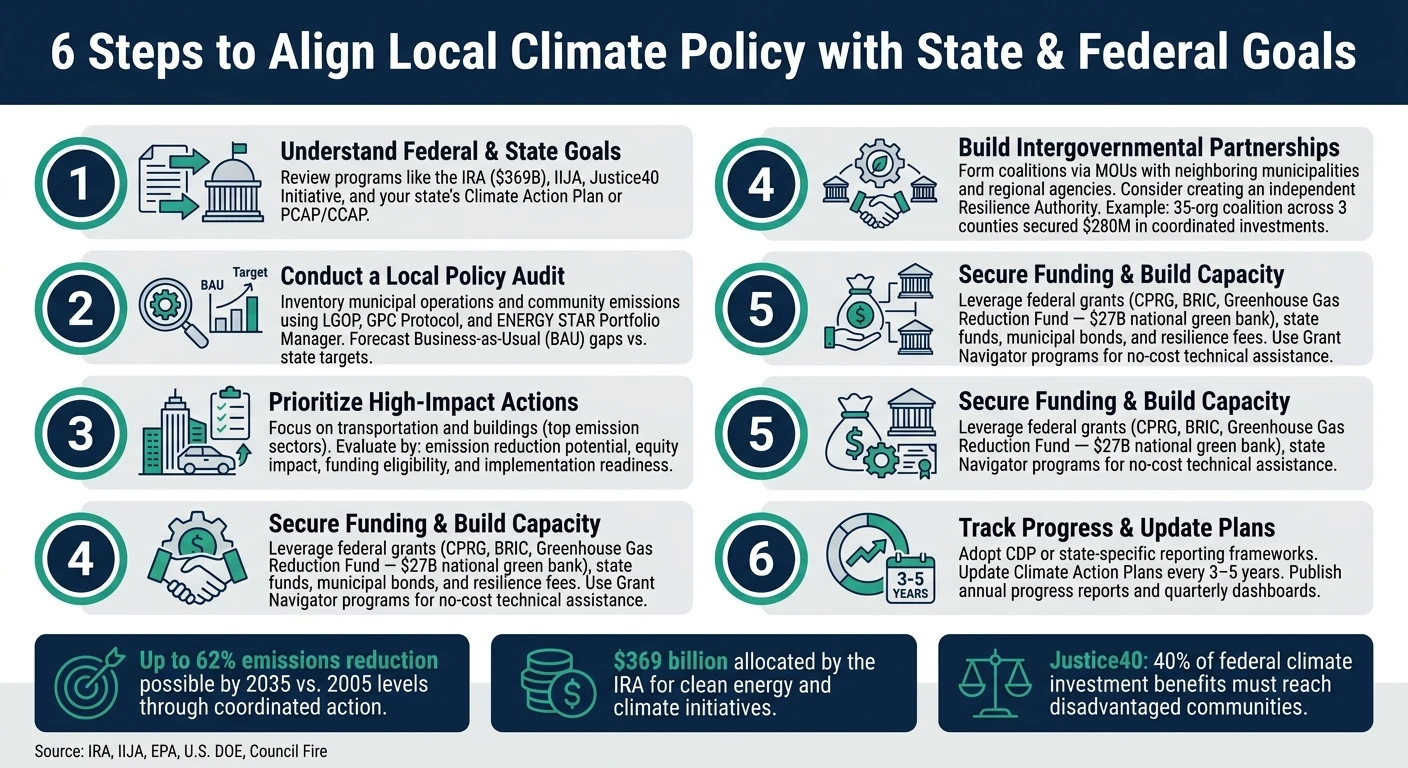
6 Steps to Align Local Climate Policy with State & Federal Goals
Turning NDC 3.0 into Local Climate Action in Cities
Understanding State and Federal Climate Goals
For municipalities aiming to align their policies with broader climate objectives, understanding federal and state goals is essential. These goals are shaped by a web of agencies, programs, and legislative actions. Knowing which apply to your jurisdiction is the first step in creating an effective local strategy. Below, we explore key federal programs, state-level policies, and tools that can help municipalities chart a clear path forward.
Key Federal Climate Programs and Targets
The federal government has set ambitious climate targets: reducing greenhouse gas emissions 50–52% below 2005 levels by 2030, achieving a carbon pollution-free electricity sector by 2035, and reaching net-zero emissions economy-wide by 2050 [4]. Two major legislative acts provide the framework for these goals.
The Inflation Reduction Act (IRA) allocates $369 billion toward clean energy and climate initiatives, including domestic manufacturing, clean transportation, and home electrification. Crucially, the IRA introduced Direct Pay, which allows tax-exempt entities like municipalities to receive cash payments equivalent to clean energy tax credits. This enables cities with public utilities to monetize solar, wind, and storage projects in ways that were previously unavailable [3]. Modeling suggests the IRA could reduce U.S. emissions by 31% to 44% below 2005 levels by 2030 [3].
The Infrastructure Investment and Jobs Act (IIJA) complements the IRA by funding large-scale initiatives like EV charging networks, power grid modernization, and climate resilience projects [3]. Additionally, the Justice40 Initiative mandates that 40% of the benefits from certain federal climate investments go to disadvantaged communities [4][5]. Municipalities that clearly demonstrate how their projects serve these communities are more likely to secure federal grant funding.
"The Act is the single largest and most ambitious investment in the ability of the United States to advance clean energy, cut consumer energy costs, confront the climate crisis, promote environmental justice, and strengthen energy security." - President Joseph R. Biden Jr. [4]
Another noteworthy program is the Greenhouse Gas Reduction Fund, a $27 billion initiative operating as a national green bank. It offers competitive financing for climate-smart projects, with $7 billion earmarked for low-income and disadvantaged communities [3].
How to Read and Use State Climate Policies
States take varied approaches to climate planning, often producing documents like Scoping Plans or Priority Climate Action Plans (PCAPs). These outline state-level greenhouse gas (GHG) reduction targets, recommended local actions, and sector-specific mandates. For municipalities, these documents serve as a critical starting point.
When reviewing your state’s plan, focus on three key areas:
Target milestone years (commonly 2030 and 2045)
Priority sectors (such as transportation, buildings, and electricity)
Local implementing authorities identified in the plan
Some states offer legal incentives for municipalities that align their policies with state goals. California, for instance, allows municipalities with a "CEQA-qualified" Climate Action Plan - meeting six specific criteria under Section 15183.5 of CEQA Guidelines - to streamline environmental reviews for development projects [8]. In 2023, 41% of California’s 260 city and county Climate Action Plans identified as CEQA-qualified [8], highlighting the tangible benefits of policy alignment.
For states participating in the federal CPRG program, many are transitioning from PCAPs to Comprehensive Climate Action Plans (CCAPs). This shift unlocks long-term funding for implementation. The submission deadline for most CCAPs was June 1, 2026 [6]. Municipalities should check if their state has submitted a CCAP and use it as a reference for updating local policies.
Tools for Mapping Higher-Level Climate Goals
Understanding federal and state goals is one thing; integrating them into local policies is another. Thankfully, several tools can help municipalities bridge the gap.
Tool | Purpose |
|---|---|
EPA PCAP Directory | A searchable database of 211 state and metropolitan climate plans, covering over 30 data categories like GHG inventories and workforce planning [10] |
State Climate Policy Dashboard | Tracks 69 climate policies across all 50 states, with a comparison tool to verify if a policy is enacted, in-progress, or partially enacted [11][9] |
SLOPE Platform (DOE) | Provides energy consumption and generation data at the county level, along with a Scenario Planner for future emission trajectories [12] |
FLIGHT Tool (EPA) | Maps large stationary emission sources within a jurisdiction, aligning local industrial policies with federal data [12] |
The EPA PCAP Directory is particularly useful for municipalities just beginning their climate planning journey. It includes over 2,600 specific GHG reduction measures from state and metropolitan plans, along with quantification tools and source links [10][7]. Local planners can adapt these vetted measures instead of starting from scratch.
"The directory is designed to help CPRG planning grantees identify and leverage approaches within PCAPs to support the development of their Comprehensive Climate Action Plans (CCAPs)." - U.S. EPA [10]
Before drafting new local ordinances, municipalities should consult the State Climate Policy Dashboard to ensure their policies align with existing state mandates. Overlooking this step can lead to conflicts that are easily avoided.
Steps for Aligning Local Policies with State and Federal Climate Frameworks
Turning federal and state climate goals into actionable local policies can be complex, but it’s essential for meaningful progress. The process begins with a thorough evaluation of existing policies and operations, prioritizing areas for improvement, and integrating climate objectives into everyday governance.
How to Conduct a Local Policy Audit
Start by creating two key inventories: one for municipal operations (such as city buildings, fleets, streetlights, water systems, and waste management) and another for the wider community (like residential and commercial energy use, transportation, and solid waste). To ensure consistency with state and federal standards, use established protocols like LGOP for municipal audits and the GPC for community-scale assessments.
Next, conduct a Business-as-Usual (BAU) forecast to measure the gap between current emissions and state-mandated targets. For example, California’s SB 32 mandates a 40% reduction below 1990 emission levels by 2030 [13]. This step clarifies the scale of action needed to meet those goals.
Evaluate regulatory documents, including zoning codes, building standards, procurement policies, and transit plans. Benchmark city-owned buildings using tools like ENERGY STAR Portfolio Manager to identify the most energy-intensive properties for retrofitting [2]. The table below outlines the three audit categories and recommended tools for each:
Audit Scope | Key Components | Recommended Tools |
|---|---|---|
Municipal | Buildings, fleets, streetlights, water, waste | LGOP, ClearPath |
Community | Residential/commercial energy, transportation, solid waste | GPC Protocol, ICLEI U.S. Community Protocol |
Regulatory | Zoning codes, building standards, procurement, transit plans | CEQA Guidelines, State Scoping Plans |
The findings from these audits will help prioritize actions that align with both local needs and broader climate goals.
How to Prioritize High-Impact Alignment Actions
Not all gaps identified in an audit warrant equal attention. Prioritization should focus on four key criteria: emission reduction potential, equity impact, eligibility for funding, and readiness for implementation.
Transportation and buildings often dominate local emissions, making them logical starting points. However, the sequence of actions should also consider available funding opportunities, such as the Greenhouse Gas Reduction Fund or EPA’s Climate Pollution Reduction Grants (CPRG). Securing external funding can significantly ease implementation. Additionally, federal Justice40 guidelines emphasize that at least 40% of benefits from funded projects should reach disadvantaged communities, making equitable actions more competitive for grants [2].
"The most successful municipal climate programs are those that deliver tangible household savings alongside emissions reductions." - Council Fire [2]
Early wins - actions that are straightforward to implement and yield visible results - are vital for building public trust. For instance, launching a community solar campaign or weatherizing municipal buildings can deliver immediate benefits while generating valuable data for future reporting cycles.
Once priority actions are identified, integrate them into sector-specific policies to ensure they align with state and federal goals.
Aligning Sector-Specific Policies with Broader Goals
Aligning local sector policies with higher-level objectives requires intentional updates to rules governing how cities manage energy, transportation, and development.
In transportation, set local targets for reducing vehicle miles traveled (VMT) and update zoning codes to mandate EV charging infrastructure in new developments. For buildings, cities are moving toward mandatory emissions limits, as seen in New York City’s Local Law 97, which imposes binding carbon caps on large commercial and multifamily buildings [2]. In the energy sector, simplifying the permitting process for residential solar and storage can have a significant impact. The SolarAPP+ platform, launched by the National Renewable Energy Laboratory (NREL) in 2021, offers instant permit approvals for compliant residential solar systems. By the end of 2023, 167 jurisdictions had adopted or piloted the platform, reducing staff workload and project delays [15].
"Subnational governments hold primary authority over infrastructure development, siting and development of energy generation and transmission, energy efficiency in buildings, and land use decisions." - Federation of American Scientists [15]
For larger initiatives, integrating Community Benefit Agreements (CBAs) into approval processes ensures that climate investments also deliver tangible local benefits like jobs and infrastructure improvements. Detroit’s Community Benefit Ordinance, enacted in 2016, requires projects exceeding $75 million in value and receiving city subsidies to provide measurable benefits to local communities. By 2026, eleven projects had finalized agreements under this ordinance, delivering workforce and infrastructure gains [15].
Building Intergovernmental Collaboration and Local Capacity
Once sector-specific policies are aligned, municipalities need to focus on creating strong partnerships and building internal expertise to carry out these initiatives effectively. Solid governance structures play a key role in maintaining alignment with state and federal climate objectives.
Setting Up Governance Structures for Alignment
Collaborating across jurisdictions begins with forming a formal intergovernmental coalition that includes neighboring municipalities and regional agencies. Establishing this coalition through a Memorandum of Understanding (MOU) ensures shared principles and governance norms are in place before seeking funding. This is particularly important as federal and state funding agencies increasingly favor multi-jurisdictional proposals over individual applications [1].
For example, a regional climate compact consisting of 35 organizations across three counties and 28 municipalities signed an agreement that resulted in $280 million in coordinated investments. This partnership also launched a clean energy procurement initiative, achieving prices 18% below retail rates and saving $12 million annually [16].
Another effective governance model is the creation of an independent Resilience Authority, which facilitates coordination across municipal boundaries without interfering with local land-use authority [1].
"Regional problems need regional governance. Municipal-level resilience planning in a shared watershed is inherently incomplete." - Council Fire [1]
These governance frameworks lay the foundation for accessing critical funding, as outlined in the next section.
Accessing State and Federal Funding
With governance structures in place, municipalities can better align their project proposals with the priorities of funding agencies. Programs like FEMA's Building Resilient Infrastructure and Communities (BRIC) grants and state resilience funds favor applications that demonstrate regional collaboration and dedicated local match funding.
For instance, an independent Resilience Authority in a coastal county representing 12 municipalities secured $340 million in funding. This impressive total combined FEMA BRIC grants, state funds, and authority-issued bonds, supported by a resilience fee generating $14 million annually [1].
"Dedicated local match funding strengthens grant applications compared to those relying solely on annual appropriations." - Council Fire [1]
Municipalities without sufficient internal resources can rely on state-funded Grant Navigator programs and technical assistance hubs. These resources provide no-cost services such as grant writing, benefit-cost analysis, and project management support, helping local governments compete for funding more effectively.
Building Local Capacity for Long-Term Implementation
Sustained success depends not only on partnerships and funding but also on capable leadership and skilled teams. Governance structures and financial resources are ineffective without the people and expertise to bring plans to life.
Leaders like mayors, department heads, and community representatives who focus on practical, measurable outcomes help maintain coalition momentum and build credibility with both supporters and skeptics [16]. Incorporating equity into governance - through representative boards, means-tested fee exemptions, and project scoring criteria that prioritize underserved communities - also strengthens public support over the long term.
For municipalities struggling with limited in-house expertise, external partners can be invaluable. Firms like Council Fire specialize in helping governments turn climate goals into actionable plans. Their services range from stakeholder engagement and intergovernmental coordination to grant strategy and implementation planning. This type of support is particularly helpful in the early stages of coalition-building, where laying the groundwork for lasting, scalable action is critical.
Tracking Progress and Updating Policies Over Time
Regular monitoring is the key to connecting local initiatives with broader objectives. Once governance, funding, and local capacity are in place, the next step is ensuring your efforts deliver measurable results. A well-structured monitoring and reporting system distinguishes municipalities that maintain momentum from those that falter after the initial push.
Building a Monitoring and Reporting Framework
Effective tracking involves more than just counting CO₂ emissions. Municipalities should monitor emissions from their core operations, such as solid waste management, water and wastewater services, road maintenance, and administrative activities. Additionally, emissions from contracted services that rely on fossil fuels in vehicles or equipment must be accounted for [17]. Broader metrics, including buildings, transportation, and community planning, provide a clearer picture of progress and gaps.
Metric Category | Key Performance Indicators |
|---|---|
Corporate Emissions | GHG emissions from fire, waste, water, and administrative services |
Buildings | Progress in energy step code adoption and public building upgrades |
Transportation | Number of EV charging stations and zero-emission vehicles in fleets |
Community Planning | Rates of organics diversion and investments in renewable energy |
Resilience | Completion of climate risk assessments for local assets |
To ensure local data aligns with state and federal tracking systems, municipalities should adopt established frameworks like the Carbon Disclosure Project (CDP) or state-specific methodologies [17]. Standardizing emissions quantification across fuel types and sectors simplifies integration into regional or national reports [17]. Additionally, having a financial officer or equivalent verify that climate funds are used appropriately adds accountability, which helps build trust with both funding agencies and the public [17].
These metrics provide a foundation for revisiting and refining policies regularly.
Conducting Regular Policy Reviews
Metrics alone aren’t enough - policies must also evolve. Treat your Climate Action Plan as a dynamic document that adapts based on real-world outcomes. Research shows that the most effective policies are built on iterative processes, where implementation data informs future updates [14]. For instance, a review of 350 city Climate Action Plans revealed that only 35% explicitly addressed public health [14], highlighting a missed opportunity to showcase benefits beyond emissions reductions.
Policy reviews should go beyond checking boxes. Combine quantitative data with qualitative insights into local political dynamics and community needs [14]. Many local governments now adopt strategies from peer cities through "policy diffusion", adapting proven approaches to their own contexts [14]. Conducting vulnerability assessments can help identify populations facing disproportionate climate risks, ensuring revised policies prioritize those most in need [14].
"Achieving equity in CAPs requires not only fair outcomes but also procedural justice, including transparent and inclusive decision-making processes." - Adlakha et al., PLOS Climate [14]
Maintaining Community Engagement and Public Trust
The value of tracking and reporting lies in how clearly results are communicated to the public. Sharing climate action survey results in council meetings or posting them on the municipal website - rather than hiding them in technical reports - fosters transparency and builds long-term public support [17]. When residents can easily understand your progress, they are more likely to support future policy updates and budget decisions.
"City climate policy is one of the most powerful levers that can address environmental, health and equity challenges simultaneously." - Adlakha et al., PLOS Climate [14]
Engage health professionals to explain climate progress in relatable terms, such as improved air quality and safer neighborhoods [14]. These tangible benefits resonate more with the public than abstract emissions goals and provide elected officials with stronger arguments for continued investment in climate initiatives.
Conclusion: Moving Forward with Local Climate Policy Alignment
Bringing local climate policies in line with state and federal objectives requires a continuous, adaptable approach. The municipalities that thrive in this effort are those that treat their Climate Action Plans as evolving tools, establish governance structures with clear accountability, and maintain strong connections with their communities.
Governance is the cornerstone. Without clear leadership, designated budgets, and consistent oversight, even the most well-funded plans can falter. As highlighted in a Council Fire case study:
"A resilience strategy without a clear implementation governance structure - who leads, who decides, how progress is tracked, how the plan adapts - will lose momentum after the initial political enthusiasm fades." [19]
In addition to governance, financial stability is crucial. A heavy reliance on federal grants can leave municipalities vulnerable. Those that combine funding sources - like State Revolving Funds, municipal bonds, resilience fees, and local revenue streams - create a more resilient financial foundation. For instance, a coastal county uniting 12 municipalities under a Resilience Authority secured $340 million in infrastructure funding over three years. This included $120 million from authority-issued bonds and $85 million in FEMA grants, leveraging stable local revenue alongside competitive grants [1].
Maintaining financial and policy relevance demands regular evaluations. Conducting major updates to Climate Action Plans every 3–5 years - or in response to significant regulatory changes - helps ensure local goals align with the latest science and policy shifts [18]. To keep the public and stakeholders engaged, municipalities should pair these updates with annual progress reports and quarterly dashboards to track progress and maintain transparency.
For local governments navigating these complexities, Council Fire provides expert consulting services. From policy audits and stakeholder engagement to governance design and grant-readiness planning, their team helps municipalities map their local policies to state frameworks and scale regional climate initiatives. With a focus on governance, diverse funding, and regular updates, municipalities can ensure their climate policies remain aligned with broader goals while driving meaningful progress.
FAQs
Which federal grants should my city pursue first?
To begin, align your projects with established climate objectives and evaluate your city's readiness to meet these goals. Make sure your city has a Unique Entity Identifier (UEI) and an active registration in the System for Award Management (SAM) - both are essential for accessing federal funding opportunities.
Some key programs to explore include:
Climate Pollution Reduction Grants (CPRG): Designed to support projects that reduce greenhouse gas emissions and promote sustainability.
Clean Water and Drinking Water State Revolving Funds (SRF): These funds provide financial assistance for water infrastructure improvements.
WIFIA Loans: The Water Infrastructure Finance and Innovation Act (WIFIA) program offers low-cost loans for significant water projects.
FEMA’s BRIC Program: The Building Resilient Infrastructure and Communities (BRIC) initiative focuses on funding projects that enhance resilience against natural disasters.
DOT’s Safe Streets and Roads for All: This program supports initiatives aimed at improving roadway safety and reducing traffic fatalities.
To identify funding tailored to your needs, consider using tools like the EPA Water Finance Clearinghouse, which provides a centralized resource for water-related financing options.
How can we avoid state preemption of local climate rules?
Municipalities aiming to sidestep state preemption need to start by thoroughly examining their state's legal framework, as the scope of local authority and its limitations can differ significantly. This involves reviewing state constitutions, statutes, and home rule charters to pinpoint where local powers exist and where preemption might apply. Utilizing resources such as state-specific legal guides can provide clarity, while collaborating with state organizations ensures awareness of pending legislation. These efforts allow for proactive advocacy and coordinated strategies to address potential preemption challenges effectively.
What should we track to prove results and keep funding?
To showcase outcomes and secure funding, prioritize monitoring total greenhouse gas emissions (measured in metric tons of CO2 equivalent) compared to a baseline year. Track key metrics such as renewable energy consumption, the adoption of electric vehicles, and preparedness for climate adaptation. Make these targets a core part of your annual budget planning. Commit to releasing at least one public sustainability report each year, and use internal quarterly dashboards to ensure compliance with grant requirements and maintain steady progress.
Related Blog Posts
Why Local Governments Must Lead the Climate Fight - With or Without Federal Support
How to Build a Climate Resilience Plan for Municipalities & Government Agencies
How to Integrate Climate Risk into Infrastructure Planning for Municipalities & Government Agencies
How to Align Stakeholders Around a Shared ESG Vision for Municipalities & Government Agencies
Latest Articles
©2026

Narrative Change and Power Building: The Missing Half of Advocacy
Narrative change is the process of disrupting dominant narratives that normalize inequity and advancing new narratives from historically marginalized communities.

Funding Resilience Without Federal Grants
BRIC is unreliable and FEMA is shrinking. Here's how cities fund climate resilience with dedicated revenue, blended finance, and a coordinating authority.

The ESG Blind Spot: How AI Is Finding Risks in Companies Nobody Else Is Watching
Norway's sovereign wealth fund uses AI to screen 7,200 portfolio companies for forced labor and corruption within 24 hours. The real story is the emerging-market coverage gap that traditional ESG data vendors miss — and what it means for any company with a global supply chain.
Narrative Change and Power Building: The Missing Half of Advocacy
Narrative change is the process of disrupting dominant narratives that normalize inequity and advancing new narratives from historically marginalized communities.
Funding Resilience Without Federal Grants
BRIC is unreliable and FEMA is shrinking. Here's how cities fund climate resilience with dedicated revenue, blended finance, and a coordinating authority.
The ESG Blind Spot: How AI Is Finding Risks in Companies Nobody Else Is Watching
Norway's sovereign wealth fund uses AI to screen 7,200 portfolio companies for forced labor and corruption within 24 hours. The real story is the emerging-market coverage gap that traditional ESG data vendors miss — and what it means for any company with a global supply chain.
FAQ
01
What does it really mean to “redefine profit”?
02
What makes Council Fire different?
03
Who does Council Fire work with?
04
What does working with Council Fire actually look like?
05
How does Council Fire help organizations turn big goals into action?
06
How does Council Fire define and measure success?
07
How does technology fit into Council Fire’s work?
Jun 2, 2026
How to Align Local Policy with State and Federal Climate Goals for Municipalities & Government Agencies
Sustainability Strategy
In This Article
Steps for municipalities to align local climate policy with state and federal goals: audits, funding, governance, and tracking.
How to Align Local Policy with State and Federal Climate Goals for Municipalities & Government Agencies
Aligning local climate policies with state and federal goals ensures access to funding, strengthens legal resilience, and maximizes emission reductions. Here's what you need to know:
Funding Opportunities: Federal programs like the Inflation Reduction Act (IRA) and Infrastructure Investment and Jobs Act (IIJA) provide billions in grants and incentives for climate initiatives. Alignment with federal priorities improves eligibility.
Legal Protection: By aligning with state frameworks, municipalities can reduce the risk of state-level preemption laws blocking local climate actions.
Emission Reductions: Coordinated efforts between cities, states, and federal agencies can achieve up to 62% emissions reductions by 2035 compared to 2005 levels.
Key Steps for Policy Alignment:
Understand Federal and State Goals: Familiarize yourself with programs like the IRA, Justice40 Initiative, and state climate action plans.
Conduct Local Policy Audits: Evaluate current municipal operations, community emissions, and regulatory frameworks to identify gaps.
Prioritize High-Impact Actions: Focus on sectors like transportation and buildings, emphasizing equity and funding eligibility.
Build Intergovernmental Partnerships: Form coalitions or resilience authorities to enhance collaboration and funding prospects.
Secure Funding and Build Capacity: Leverage federal and state grants, while investing in skilled teams and governance structures.
Track Progress and Update Plans: Use established metrics and reporting frameworks to monitor results and refine policies over time.
With clear goals, strong partnerships, and structured implementation, municipalities can align their policies to drive meaningful progress while securing critical resources.
6 Steps to Align Local Climate Policy with State & Federal Goals
Turning NDC 3.0 into Local Climate Action in Cities
Understanding State and Federal Climate Goals
For municipalities aiming to align their policies with broader climate objectives, understanding federal and state goals is essential. These goals are shaped by a web of agencies, programs, and legislative actions. Knowing which apply to your jurisdiction is the first step in creating an effective local strategy. Below, we explore key federal programs, state-level policies, and tools that can help municipalities chart a clear path forward.
Key Federal Climate Programs and Targets
The federal government has set ambitious climate targets: reducing greenhouse gas emissions 50–52% below 2005 levels by 2030, achieving a carbon pollution-free electricity sector by 2035, and reaching net-zero emissions economy-wide by 2050 [4]. Two major legislative acts provide the framework for these goals.
The Inflation Reduction Act (IRA) allocates $369 billion toward clean energy and climate initiatives, including domestic manufacturing, clean transportation, and home electrification. Crucially, the IRA introduced Direct Pay, which allows tax-exempt entities like municipalities to receive cash payments equivalent to clean energy tax credits. This enables cities with public utilities to monetize solar, wind, and storage projects in ways that were previously unavailable [3]. Modeling suggests the IRA could reduce U.S. emissions by 31% to 44% below 2005 levels by 2030 [3].
The Infrastructure Investment and Jobs Act (IIJA) complements the IRA by funding large-scale initiatives like EV charging networks, power grid modernization, and climate resilience projects [3]. Additionally, the Justice40 Initiative mandates that 40% of the benefits from certain federal climate investments go to disadvantaged communities [4][5]. Municipalities that clearly demonstrate how their projects serve these communities are more likely to secure federal grant funding.
"The Act is the single largest and most ambitious investment in the ability of the United States to advance clean energy, cut consumer energy costs, confront the climate crisis, promote environmental justice, and strengthen energy security." - President Joseph R. Biden Jr. [4]
Another noteworthy program is the Greenhouse Gas Reduction Fund, a $27 billion initiative operating as a national green bank. It offers competitive financing for climate-smart projects, with $7 billion earmarked for low-income and disadvantaged communities [3].
How to Read and Use State Climate Policies
States take varied approaches to climate planning, often producing documents like Scoping Plans or Priority Climate Action Plans (PCAPs). These outline state-level greenhouse gas (GHG) reduction targets, recommended local actions, and sector-specific mandates. For municipalities, these documents serve as a critical starting point.
When reviewing your state’s plan, focus on three key areas:
Target milestone years (commonly 2030 and 2045)
Priority sectors (such as transportation, buildings, and electricity)
Local implementing authorities identified in the plan
Some states offer legal incentives for municipalities that align their policies with state goals. California, for instance, allows municipalities with a "CEQA-qualified" Climate Action Plan - meeting six specific criteria under Section 15183.5 of CEQA Guidelines - to streamline environmental reviews for development projects [8]. In 2023, 41% of California’s 260 city and county Climate Action Plans identified as CEQA-qualified [8], highlighting the tangible benefits of policy alignment.
For states participating in the federal CPRG program, many are transitioning from PCAPs to Comprehensive Climate Action Plans (CCAPs). This shift unlocks long-term funding for implementation. The submission deadline for most CCAPs was June 1, 2026 [6]. Municipalities should check if their state has submitted a CCAP and use it as a reference for updating local policies.
Tools for Mapping Higher-Level Climate Goals
Understanding federal and state goals is one thing; integrating them into local policies is another. Thankfully, several tools can help municipalities bridge the gap.
Tool | Purpose |
|---|---|
EPA PCAP Directory | A searchable database of 211 state and metropolitan climate plans, covering over 30 data categories like GHG inventories and workforce planning [10] |
State Climate Policy Dashboard | Tracks 69 climate policies across all 50 states, with a comparison tool to verify if a policy is enacted, in-progress, or partially enacted [11][9] |
SLOPE Platform (DOE) | Provides energy consumption and generation data at the county level, along with a Scenario Planner for future emission trajectories [12] |
FLIGHT Tool (EPA) | Maps large stationary emission sources within a jurisdiction, aligning local industrial policies with federal data [12] |
The EPA PCAP Directory is particularly useful for municipalities just beginning their climate planning journey. It includes over 2,600 specific GHG reduction measures from state and metropolitan plans, along with quantification tools and source links [10][7]. Local planners can adapt these vetted measures instead of starting from scratch.
"The directory is designed to help CPRG planning grantees identify and leverage approaches within PCAPs to support the development of their Comprehensive Climate Action Plans (CCAPs)." - U.S. EPA [10]
Before drafting new local ordinances, municipalities should consult the State Climate Policy Dashboard to ensure their policies align with existing state mandates. Overlooking this step can lead to conflicts that are easily avoided.
Steps for Aligning Local Policies with State and Federal Climate Frameworks
Turning federal and state climate goals into actionable local policies can be complex, but it’s essential for meaningful progress. The process begins with a thorough evaluation of existing policies and operations, prioritizing areas for improvement, and integrating climate objectives into everyday governance.
How to Conduct a Local Policy Audit
Start by creating two key inventories: one for municipal operations (such as city buildings, fleets, streetlights, water systems, and waste management) and another for the wider community (like residential and commercial energy use, transportation, and solid waste). To ensure consistency with state and federal standards, use established protocols like LGOP for municipal audits and the GPC for community-scale assessments.
Next, conduct a Business-as-Usual (BAU) forecast to measure the gap between current emissions and state-mandated targets. For example, California’s SB 32 mandates a 40% reduction below 1990 emission levels by 2030 [13]. This step clarifies the scale of action needed to meet those goals.
Evaluate regulatory documents, including zoning codes, building standards, procurement policies, and transit plans. Benchmark city-owned buildings using tools like ENERGY STAR Portfolio Manager to identify the most energy-intensive properties for retrofitting [2]. The table below outlines the three audit categories and recommended tools for each:
Audit Scope | Key Components | Recommended Tools |
|---|---|---|
Municipal | Buildings, fleets, streetlights, water, waste | LGOP, ClearPath |
Community | Residential/commercial energy, transportation, solid waste | GPC Protocol, ICLEI U.S. Community Protocol |
Regulatory | Zoning codes, building standards, procurement, transit plans | CEQA Guidelines, State Scoping Plans |
The findings from these audits will help prioritize actions that align with both local needs and broader climate goals.
How to Prioritize High-Impact Alignment Actions
Not all gaps identified in an audit warrant equal attention. Prioritization should focus on four key criteria: emission reduction potential, equity impact, eligibility for funding, and readiness for implementation.
Transportation and buildings often dominate local emissions, making them logical starting points. However, the sequence of actions should also consider available funding opportunities, such as the Greenhouse Gas Reduction Fund or EPA’s Climate Pollution Reduction Grants (CPRG). Securing external funding can significantly ease implementation. Additionally, federal Justice40 guidelines emphasize that at least 40% of benefits from funded projects should reach disadvantaged communities, making equitable actions more competitive for grants [2].
"The most successful municipal climate programs are those that deliver tangible household savings alongside emissions reductions." - Council Fire [2]
Early wins - actions that are straightforward to implement and yield visible results - are vital for building public trust. For instance, launching a community solar campaign or weatherizing municipal buildings can deliver immediate benefits while generating valuable data for future reporting cycles.
Once priority actions are identified, integrate them into sector-specific policies to ensure they align with state and federal goals.
Aligning Sector-Specific Policies with Broader Goals
Aligning local sector policies with higher-level objectives requires intentional updates to rules governing how cities manage energy, transportation, and development.
In transportation, set local targets for reducing vehicle miles traveled (VMT) and update zoning codes to mandate EV charging infrastructure in new developments. For buildings, cities are moving toward mandatory emissions limits, as seen in New York City’s Local Law 97, which imposes binding carbon caps on large commercial and multifamily buildings [2]. In the energy sector, simplifying the permitting process for residential solar and storage can have a significant impact. The SolarAPP+ platform, launched by the National Renewable Energy Laboratory (NREL) in 2021, offers instant permit approvals for compliant residential solar systems. By the end of 2023, 167 jurisdictions had adopted or piloted the platform, reducing staff workload and project delays [15].
"Subnational governments hold primary authority over infrastructure development, siting and development of energy generation and transmission, energy efficiency in buildings, and land use decisions." - Federation of American Scientists [15]
For larger initiatives, integrating Community Benefit Agreements (CBAs) into approval processes ensures that climate investments also deliver tangible local benefits like jobs and infrastructure improvements. Detroit’s Community Benefit Ordinance, enacted in 2016, requires projects exceeding $75 million in value and receiving city subsidies to provide measurable benefits to local communities. By 2026, eleven projects had finalized agreements under this ordinance, delivering workforce and infrastructure gains [15].
Building Intergovernmental Collaboration and Local Capacity
Once sector-specific policies are aligned, municipalities need to focus on creating strong partnerships and building internal expertise to carry out these initiatives effectively. Solid governance structures play a key role in maintaining alignment with state and federal climate objectives.
Setting Up Governance Structures for Alignment
Collaborating across jurisdictions begins with forming a formal intergovernmental coalition that includes neighboring municipalities and regional agencies. Establishing this coalition through a Memorandum of Understanding (MOU) ensures shared principles and governance norms are in place before seeking funding. This is particularly important as federal and state funding agencies increasingly favor multi-jurisdictional proposals over individual applications [1].
For example, a regional climate compact consisting of 35 organizations across three counties and 28 municipalities signed an agreement that resulted in $280 million in coordinated investments. This partnership also launched a clean energy procurement initiative, achieving prices 18% below retail rates and saving $12 million annually [16].
Another effective governance model is the creation of an independent Resilience Authority, which facilitates coordination across municipal boundaries without interfering with local land-use authority [1].
"Regional problems need regional governance. Municipal-level resilience planning in a shared watershed is inherently incomplete." - Council Fire [1]
These governance frameworks lay the foundation for accessing critical funding, as outlined in the next section.
Accessing State and Federal Funding
With governance structures in place, municipalities can better align their project proposals with the priorities of funding agencies. Programs like FEMA's Building Resilient Infrastructure and Communities (BRIC) grants and state resilience funds favor applications that demonstrate regional collaboration and dedicated local match funding.
For instance, an independent Resilience Authority in a coastal county representing 12 municipalities secured $340 million in funding. This impressive total combined FEMA BRIC grants, state funds, and authority-issued bonds, supported by a resilience fee generating $14 million annually [1].
"Dedicated local match funding strengthens grant applications compared to those relying solely on annual appropriations." - Council Fire [1]
Municipalities without sufficient internal resources can rely on state-funded Grant Navigator programs and technical assistance hubs. These resources provide no-cost services such as grant writing, benefit-cost analysis, and project management support, helping local governments compete for funding more effectively.
Building Local Capacity for Long-Term Implementation
Sustained success depends not only on partnerships and funding but also on capable leadership and skilled teams. Governance structures and financial resources are ineffective without the people and expertise to bring plans to life.
Leaders like mayors, department heads, and community representatives who focus on practical, measurable outcomes help maintain coalition momentum and build credibility with both supporters and skeptics [16]. Incorporating equity into governance - through representative boards, means-tested fee exemptions, and project scoring criteria that prioritize underserved communities - also strengthens public support over the long term.
For municipalities struggling with limited in-house expertise, external partners can be invaluable. Firms like Council Fire specialize in helping governments turn climate goals into actionable plans. Their services range from stakeholder engagement and intergovernmental coordination to grant strategy and implementation planning. This type of support is particularly helpful in the early stages of coalition-building, where laying the groundwork for lasting, scalable action is critical.
Tracking Progress and Updating Policies Over Time
Regular monitoring is the key to connecting local initiatives with broader objectives. Once governance, funding, and local capacity are in place, the next step is ensuring your efforts deliver measurable results. A well-structured monitoring and reporting system distinguishes municipalities that maintain momentum from those that falter after the initial push.
Building a Monitoring and Reporting Framework
Effective tracking involves more than just counting CO₂ emissions. Municipalities should monitor emissions from their core operations, such as solid waste management, water and wastewater services, road maintenance, and administrative activities. Additionally, emissions from contracted services that rely on fossil fuels in vehicles or equipment must be accounted for [17]. Broader metrics, including buildings, transportation, and community planning, provide a clearer picture of progress and gaps.
Metric Category | Key Performance Indicators |
|---|---|
Corporate Emissions | GHG emissions from fire, waste, water, and administrative services |
Buildings | Progress in energy step code adoption and public building upgrades |
Transportation | Number of EV charging stations and zero-emission vehicles in fleets |
Community Planning | Rates of organics diversion and investments in renewable energy |
Resilience | Completion of climate risk assessments for local assets |
To ensure local data aligns with state and federal tracking systems, municipalities should adopt established frameworks like the Carbon Disclosure Project (CDP) or state-specific methodologies [17]. Standardizing emissions quantification across fuel types and sectors simplifies integration into regional or national reports [17]. Additionally, having a financial officer or equivalent verify that climate funds are used appropriately adds accountability, which helps build trust with both funding agencies and the public [17].
These metrics provide a foundation for revisiting and refining policies regularly.
Conducting Regular Policy Reviews
Metrics alone aren’t enough - policies must also evolve. Treat your Climate Action Plan as a dynamic document that adapts based on real-world outcomes. Research shows that the most effective policies are built on iterative processes, where implementation data informs future updates [14]. For instance, a review of 350 city Climate Action Plans revealed that only 35% explicitly addressed public health [14], highlighting a missed opportunity to showcase benefits beyond emissions reductions.
Policy reviews should go beyond checking boxes. Combine quantitative data with qualitative insights into local political dynamics and community needs [14]. Many local governments now adopt strategies from peer cities through "policy diffusion", adapting proven approaches to their own contexts [14]. Conducting vulnerability assessments can help identify populations facing disproportionate climate risks, ensuring revised policies prioritize those most in need [14].
"Achieving equity in CAPs requires not only fair outcomes but also procedural justice, including transparent and inclusive decision-making processes." - Adlakha et al., PLOS Climate [14]
Maintaining Community Engagement and Public Trust
The value of tracking and reporting lies in how clearly results are communicated to the public. Sharing climate action survey results in council meetings or posting them on the municipal website - rather than hiding them in technical reports - fosters transparency and builds long-term public support [17]. When residents can easily understand your progress, they are more likely to support future policy updates and budget decisions.
"City climate policy is one of the most powerful levers that can address environmental, health and equity challenges simultaneously." - Adlakha et al., PLOS Climate [14]
Engage health professionals to explain climate progress in relatable terms, such as improved air quality and safer neighborhoods [14]. These tangible benefits resonate more with the public than abstract emissions goals and provide elected officials with stronger arguments for continued investment in climate initiatives.
Conclusion: Moving Forward with Local Climate Policy Alignment
Bringing local climate policies in line with state and federal objectives requires a continuous, adaptable approach. The municipalities that thrive in this effort are those that treat their Climate Action Plans as evolving tools, establish governance structures with clear accountability, and maintain strong connections with their communities.
Governance is the cornerstone. Without clear leadership, designated budgets, and consistent oversight, even the most well-funded plans can falter. As highlighted in a Council Fire case study:
"A resilience strategy without a clear implementation governance structure - who leads, who decides, how progress is tracked, how the plan adapts - will lose momentum after the initial political enthusiasm fades." [19]
In addition to governance, financial stability is crucial. A heavy reliance on federal grants can leave municipalities vulnerable. Those that combine funding sources - like State Revolving Funds, municipal bonds, resilience fees, and local revenue streams - create a more resilient financial foundation. For instance, a coastal county uniting 12 municipalities under a Resilience Authority secured $340 million in infrastructure funding over three years. This included $120 million from authority-issued bonds and $85 million in FEMA grants, leveraging stable local revenue alongside competitive grants [1].
Maintaining financial and policy relevance demands regular evaluations. Conducting major updates to Climate Action Plans every 3–5 years - or in response to significant regulatory changes - helps ensure local goals align with the latest science and policy shifts [18]. To keep the public and stakeholders engaged, municipalities should pair these updates with annual progress reports and quarterly dashboards to track progress and maintain transparency.
For local governments navigating these complexities, Council Fire provides expert consulting services. From policy audits and stakeholder engagement to governance design and grant-readiness planning, their team helps municipalities map their local policies to state frameworks and scale regional climate initiatives. With a focus on governance, diverse funding, and regular updates, municipalities can ensure their climate policies remain aligned with broader goals while driving meaningful progress.
FAQs
Which federal grants should my city pursue first?
To begin, align your projects with established climate objectives and evaluate your city's readiness to meet these goals. Make sure your city has a Unique Entity Identifier (UEI) and an active registration in the System for Award Management (SAM) - both are essential for accessing federal funding opportunities.
Some key programs to explore include:
Climate Pollution Reduction Grants (CPRG): Designed to support projects that reduce greenhouse gas emissions and promote sustainability.
Clean Water and Drinking Water State Revolving Funds (SRF): These funds provide financial assistance for water infrastructure improvements.
WIFIA Loans: The Water Infrastructure Finance and Innovation Act (WIFIA) program offers low-cost loans for significant water projects.
FEMA’s BRIC Program: The Building Resilient Infrastructure and Communities (BRIC) initiative focuses on funding projects that enhance resilience against natural disasters.
DOT’s Safe Streets and Roads for All: This program supports initiatives aimed at improving roadway safety and reducing traffic fatalities.
To identify funding tailored to your needs, consider using tools like the EPA Water Finance Clearinghouse, which provides a centralized resource for water-related financing options.
How can we avoid state preemption of local climate rules?
Municipalities aiming to sidestep state preemption need to start by thoroughly examining their state's legal framework, as the scope of local authority and its limitations can differ significantly. This involves reviewing state constitutions, statutes, and home rule charters to pinpoint where local powers exist and where preemption might apply. Utilizing resources such as state-specific legal guides can provide clarity, while collaborating with state organizations ensures awareness of pending legislation. These efforts allow for proactive advocacy and coordinated strategies to address potential preemption challenges effectively.
What should we track to prove results and keep funding?
To showcase outcomes and secure funding, prioritize monitoring total greenhouse gas emissions (measured in metric tons of CO2 equivalent) compared to a baseline year. Track key metrics such as renewable energy consumption, the adoption of electric vehicles, and preparedness for climate adaptation. Make these targets a core part of your annual budget planning. Commit to releasing at least one public sustainability report each year, and use internal quarterly dashboards to ensure compliance with grant requirements and maintain steady progress.
Related Blog Posts
Why Local Governments Must Lead the Climate Fight - With or Without Federal Support
How to Build a Climate Resilience Plan for Municipalities & Government Agencies
How to Integrate Climate Risk into Infrastructure Planning for Municipalities & Government Agencies
How to Align Stakeholders Around a Shared ESG Vision for Municipalities & Government Agencies
Latest Articles
©2026
Narrative Change and Power Building: The Missing Half of Advocacy
Narrative change is the process of disrupting dominant narratives that normalize inequity and advancing new narratives from historically marginalized communities.
Funding Resilience Without Federal Grants
BRIC is unreliable and FEMA is shrinking. Here's how cities fund climate resilience with dedicated revenue, blended finance, and a coordinating authority.
The ESG Blind Spot: How AI Is Finding Risks in Companies Nobody Else Is Watching
Norway's sovereign wealth fund uses AI to screen 7,200 portfolio companies for forced labor and corruption within 24 hours. The real story is the emerging-market coverage gap that traditional ESG data vendors miss — and what it means for any company with a global supply chain.
FAQ
01
What does it really mean to “redefine profit”?
02
What makes Council Fire different?
03
Who does Council Fire work with?
04
What does working with Council Fire actually look like?
05
How does Council Fire help organizations turn big goals into action?
06
How does Council Fire define and measure success?
07
How does technology fit into Council Fire’s work?
Jun 2, 2026
How to Align Local Policy with State and Federal Climate Goals for Municipalities & Government Agencies
Sustainability Strategy
In This Article
Steps for municipalities to align local climate policy with state and federal goals: audits, funding, governance, and tracking.
How to Align Local Policy with State and Federal Climate Goals for Municipalities & Government Agencies
Aligning local climate policies with state and federal goals ensures access to funding, strengthens legal resilience, and maximizes emission reductions. Here's what you need to know:
Funding Opportunities: Federal programs like the Inflation Reduction Act (IRA) and Infrastructure Investment and Jobs Act (IIJA) provide billions in grants and incentives for climate initiatives. Alignment with federal priorities improves eligibility.
Legal Protection: By aligning with state frameworks, municipalities can reduce the risk of state-level preemption laws blocking local climate actions.
Emission Reductions: Coordinated efforts between cities, states, and federal agencies can achieve up to 62% emissions reductions by 2035 compared to 2005 levels.
Key Steps for Policy Alignment:
Understand Federal and State Goals: Familiarize yourself with programs like the IRA, Justice40 Initiative, and state climate action plans.
Conduct Local Policy Audits: Evaluate current municipal operations, community emissions, and regulatory frameworks to identify gaps.
Prioritize High-Impact Actions: Focus on sectors like transportation and buildings, emphasizing equity and funding eligibility.
Build Intergovernmental Partnerships: Form coalitions or resilience authorities to enhance collaboration and funding prospects.
Secure Funding and Build Capacity: Leverage federal and state grants, while investing in skilled teams and governance structures.
Track Progress and Update Plans: Use established metrics and reporting frameworks to monitor results and refine policies over time.
With clear goals, strong partnerships, and structured implementation, municipalities can align their policies to drive meaningful progress while securing critical resources.
6 Steps to Align Local Climate Policy with State & Federal Goals
Turning NDC 3.0 into Local Climate Action in Cities
Understanding State and Federal Climate Goals
For municipalities aiming to align their policies with broader climate objectives, understanding federal and state goals is essential. These goals are shaped by a web of agencies, programs, and legislative actions. Knowing which apply to your jurisdiction is the first step in creating an effective local strategy. Below, we explore key federal programs, state-level policies, and tools that can help municipalities chart a clear path forward.
Key Federal Climate Programs and Targets
The federal government has set ambitious climate targets: reducing greenhouse gas emissions 50–52% below 2005 levels by 2030, achieving a carbon pollution-free electricity sector by 2035, and reaching net-zero emissions economy-wide by 2050 [4]. Two major legislative acts provide the framework for these goals.
The Inflation Reduction Act (IRA) allocates $369 billion toward clean energy and climate initiatives, including domestic manufacturing, clean transportation, and home electrification. Crucially, the IRA introduced Direct Pay, which allows tax-exempt entities like municipalities to receive cash payments equivalent to clean energy tax credits. This enables cities with public utilities to monetize solar, wind, and storage projects in ways that were previously unavailable [3]. Modeling suggests the IRA could reduce U.S. emissions by 31% to 44% below 2005 levels by 2030 [3].
The Infrastructure Investment and Jobs Act (IIJA) complements the IRA by funding large-scale initiatives like EV charging networks, power grid modernization, and climate resilience projects [3]. Additionally, the Justice40 Initiative mandates that 40% of the benefits from certain federal climate investments go to disadvantaged communities [4][5]. Municipalities that clearly demonstrate how their projects serve these communities are more likely to secure federal grant funding.
"The Act is the single largest and most ambitious investment in the ability of the United States to advance clean energy, cut consumer energy costs, confront the climate crisis, promote environmental justice, and strengthen energy security." - President Joseph R. Biden Jr. [4]
Another noteworthy program is the Greenhouse Gas Reduction Fund, a $27 billion initiative operating as a national green bank. It offers competitive financing for climate-smart projects, with $7 billion earmarked for low-income and disadvantaged communities [3].
How to Read and Use State Climate Policies
States take varied approaches to climate planning, often producing documents like Scoping Plans or Priority Climate Action Plans (PCAPs). These outline state-level greenhouse gas (GHG) reduction targets, recommended local actions, and sector-specific mandates. For municipalities, these documents serve as a critical starting point.
When reviewing your state’s plan, focus on three key areas:
Target milestone years (commonly 2030 and 2045)
Priority sectors (such as transportation, buildings, and electricity)
Local implementing authorities identified in the plan
Some states offer legal incentives for municipalities that align their policies with state goals. California, for instance, allows municipalities with a "CEQA-qualified" Climate Action Plan - meeting six specific criteria under Section 15183.5 of CEQA Guidelines - to streamline environmental reviews for development projects [8]. In 2023, 41% of California’s 260 city and county Climate Action Plans identified as CEQA-qualified [8], highlighting the tangible benefits of policy alignment.
For states participating in the federal CPRG program, many are transitioning from PCAPs to Comprehensive Climate Action Plans (CCAPs). This shift unlocks long-term funding for implementation. The submission deadline for most CCAPs was June 1, 2026 [6]. Municipalities should check if their state has submitted a CCAP and use it as a reference for updating local policies.
Tools for Mapping Higher-Level Climate Goals
Understanding federal and state goals is one thing; integrating them into local policies is another. Thankfully, several tools can help municipalities bridge the gap.
Tool | Purpose |
|---|---|
EPA PCAP Directory | A searchable database of 211 state and metropolitan climate plans, covering over 30 data categories like GHG inventories and workforce planning [10] |
State Climate Policy Dashboard | Tracks 69 climate policies across all 50 states, with a comparison tool to verify if a policy is enacted, in-progress, or partially enacted [11][9] |
SLOPE Platform (DOE) | Provides energy consumption and generation data at the county level, along with a Scenario Planner for future emission trajectories [12] |
FLIGHT Tool (EPA) | Maps large stationary emission sources within a jurisdiction, aligning local industrial policies with federal data [12] |
The EPA PCAP Directory is particularly useful for municipalities just beginning their climate planning journey. It includes over 2,600 specific GHG reduction measures from state and metropolitan plans, along with quantification tools and source links [10][7]. Local planners can adapt these vetted measures instead of starting from scratch.
"The directory is designed to help CPRG planning grantees identify and leverage approaches within PCAPs to support the development of their Comprehensive Climate Action Plans (CCAPs)." - U.S. EPA [10]
Before drafting new local ordinances, municipalities should consult the State Climate Policy Dashboard to ensure their policies align with existing state mandates. Overlooking this step can lead to conflicts that are easily avoided.
Steps for Aligning Local Policies with State and Federal Climate Frameworks
Turning federal and state climate goals into actionable local policies can be complex, but it’s essential for meaningful progress. The process begins with a thorough evaluation of existing policies and operations, prioritizing areas for improvement, and integrating climate objectives into everyday governance.
How to Conduct a Local Policy Audit
Start by creating two key inventories: one for municipal operations (such as city buildings, fleets, streetlights, water systems, and waste management) and another for the wider community (like residential and commercial energy use, transportation, and solid waste). To ensure consistency with state and federal standards, use established protocols like LGOP for municipal audits and the GPC for community-scale assessments.
Next, conduct a Business-as-Usual (BAU) forecast to measure the gap between current emissions and state-mandated targets. For example, California’s SB 32 mandates a 40% reduction below 1990 emission levels by 2030 [13]. This step clarifies the scale of action needed to meet those goals.
Evaluate regulatory documents, including zoning codes, building standards, procurement policies, and transit plans. Benchmark city-owned buildings using tools like ENERGY STAR Portfolio Manager to identify the most energy-intensive properties for retrofitting [2]. The table below outlines the three audit categories and recommended tools for each:
Audit Scope | Key Components | Recommended Tools |
|---|---|---|
Municipal | Buildings, fleets, streetlights, water, waste | LGOP, ClearPath |
Community | Residential/commercial energy, transportation, solid waste | GPC Protocol, ICLEI U.S. Community Protocol |
Regulatory | Zoning codes, building standards, procurement, transit plans | CEQA Guidelines, State Scoping Plans |
The findings from these audits will help prioritize actions that align with both local needs and broader climate goals.
How to Prioritize High-Impact Alignment Actions
Not all gaps identified in an audit warrant equal attention. Prioritization should focus on four key criteria: emission reduction potential, equity impact, eligibility for funding, and readiness for implementation.
Transportation and buildings often dominate local emissions, making them logical starting points. However, the sequence of actions should also consider available funding opportunities, such as the Greenhouse Gas Reduction Fund or EPA’s Climate Pollution Reduction Grants (CPRG). Securing external funding can significantly ease implementation. Additionally, federal Justice40 guidelines emphasize that at least 40% of benefits from funded projects should reach disadvantaged communities, making equitable actions more competitive for grants [2].
"The most successful municipal climate programs are those that deliver tangible household savings alongside emissions reductions." - Council Fire [2]
Early wins - actions that are straightforward to implement and yield visible results - are vital for building public trust. For instance, launching a community solar campaign or weatherizing municipal buildings can deliver immediate benefits while generating valuable data for future reporting cycles.
Once priority actions are identified, integrate them into sector-specific policies to ensure they align with state and federal goals.
Aligning Sector-Specific Policies with Broader Goals
Aligning local sector policies with higher-level objectives requires intentional updates to rules governing how cities manage energy, transportation, and development.
In transportation, set local targets for reducing vehicle miles traveled (VMT) and update zoning codes to mandate EV charging infrastructure in new developments. For buildings, cities are moving toward mandatory emissions limits, as seen in New York City’s Local Law 97, which imposes binding carbon caps on large commercial and multifamily buildings [2]. In the energy sector, simplifying the permitting process for residential solar and storage can have a significant impact. The SolarAPP+ platform, launched by the National Renewable Energy Laboratory (NREL) in 2021, offers instant permit approvals for compliant residential solar systems. By the end of 2023, 167 jurisdictions had adopted or piloted the platform, reducing staff workload and project delays [15].
"Subnational governments hold primary authority over infrastructure development, siting and development of energy generation and transmission, energy efficiency in buildings, and land use decisions." - Federation of American Scientists [15]
For larger initiatives, integrating Community Benefit Agreements (CBAs) into approval processes ensures that climate investments also deliver tangible local benefits like jobs and infrastructure improvements. Detroit’s Community Benefit Ordinance, enacted in 2016, requires projects exceeding $75 million in value and receiving city subsidies to provide measurable benefits to local communities. By 2026, eleven projects had finalized agreements under this ordinance, delivering workforce and infrastructure gains [15].
Building Intergovernmental Collaboration and Local Capacity
Once sector-specific policies are aligned, municipalities need to focus on creating strong partnerships and building internal expertise to carry out these initiatives effectively. Solid governance structures play a key role in maintaining alignment with state and federal climate objectives.
Setting Up Governance Structures for Alignment
Collaborating across jurisdictions begins with forming a formal intergovernmental coalition that includes neighboring municipalities and regional agencies. Establishing this coalition through a Memorandum of Understanding (MOU) ensures shared principles and governance norms are in place before seeking funding. This is particularly important as federal and state funding agencies increasingly favor multi-jurisdictional proposals over individual applications [1].
For example, a regional climate compact consisting of 35 organizations across three counties and 28 municipalities signed an agreement that resulted in $280 million in coordinated investments. This partnership also launched a clean energy procurement initiative, achieving prices 18% below retail rates and saving $12 million annually [16].
Another effective governance model is the creation of an independent Resilience Authority, which facilitates coordination across municipal boundaries without interfering with local land-use authority [1].
"Regional problems need regional governance. Municipal-level resilience planning in a shared watershed is inherently incomplete." - Council Fire [1]
These governance frameworks lay the foundation for accessing critical funding, as outlined in the next section.
Accessing State and Federal Funding
With governance structures in place, municipalities can better align their project proposals with the priorities of funding agencies. Programs like FEMA's Building Resilient Infrastructure and Communities (BRIC) grants and state resilience funds favor applications that demonstrate regional collaboration and dedicated local match funding.
For instance, an independent Resilience Authority in a coastal county representing 12 municipalities secured $340 million in funding. This impressive total combined FEMA BRIC grants, state funds, and authority-issued bonds, supported by a resilience fee generating $14 million annually [1].
"Dedicated local match funding strengthens grant applications compared to those relying solely on annual appropriations." - Council Fire [1]
Municipalities without sufficient internal resources can rely on state-funded Grant Navigator programs and technical assistance hubs. These resources provide no-cost services such as grant writing, benefit-cost analysis, and project management support, helping local governments compete for funding more effectively.
Building Local Capacity for Long-Term Implementation
Sustained success depends not only on partnerships and funding but also on capable leadership and skilled teams. Governance structures and financial resources are ineffective without the people and expertise to bring plans to life.
Leaders like mayors, department heads, and community representatives who focus on practical, measurable outcomes help maintain coalition momentum and build credibility with both supporters and skeptics [16]. Incorporating equity into governance - through representative boards, means-tested fee exemptions, and project scoring criteria that prioritize underserved communities - also strengthens public support over the long term.
For municipalities struggling with limited in-house expertise, external partners can be invaluable. Firms like Council Fire specialize in helping governments turn climate goals into actionable plans. Their services range from stakeholder engagement and intergovernmental coordination to grant strategy and implementation planning. This type of support is particularly helpful in the early stages of coalition-building, where laying the groundwork for lasting, scalable action is critical.
Tracking Progress and Updating Policies Over Time
Regular monitoring is the key to connecting local initiatives with broader objectives. Once governance, funding, and local capacity are in place, the next step is ensuring your efforts deliver measurable results. A well-structured monitoring and reporting system distinguishes municipalities that maintain momentum from those that falter after the initial push.
Building a Monitoring and Reporting Framework
Effective tracking involves more than just counting CO₂ emissions. Municipalities should monitor emissions from their core operations, such as solid waste management, water and wastewater services, road maintenance, and administrative activities. Additionally, emissions from contracted services that rely on fossil fuels in vehicles or equipment must be accounted for [17]. Broader metrics, including buildings, transportation, and community planning, provide a clearer picture of progress and gaps.
Metric Category | Key Performance Indicators |
|---|---|
Corporate Emissions | GHG emissions from fire, waste, water, and administrative services |
Buildings | Progress in energy step code adoption and public building upgrades |
Transportation | Number of EV charging stations and zero-emission vehicles in fleets |
Community Planning | Rates of organics diversion and investments in renewable energy |
Resilience | Completion of climate risk assessments for local assets |
To ensure local data aligns with state and federal tracking systems, municipalities should adopt established frameworks like the Carbon Disclosure Project (CDP) or state-specific methodologies [17]. Standardizing emissions quantification across fuel types and sectors simplifies integration into regional or national reports [17]. Additionally, having a financial officer or equivalent verify that climate funds are used appropriately adds accountability, which helps build trust with both funding agencies and the public [17].
These metrics provide a foundation for revisiting and refining policies regularly.
Conducting Regular Policy Reviews
Metrics alone aren’t enough - policies must also evolve. Treat your Climate Action Plan as a dynamic document that adapts based on real-world outcomes. Research shows that the most effective policies are built on iterative processes, where implementation data informs future updates [14]. For instance, a review of 350 city Climate Action Plans revealed that only 35% explicitly addressed public health [14], highlighting a missed opportunity to showcase benefits beyond emissions reductions.
Policy reviews should go beyond checking boxes. Combine quantitative data with qualitative insights into local political dynamics and community needs [14]. Many local governments now adopt strategies from peer cities through "policy diffusion", adapting proven approaches to their own contexts [14]. Conducting vulnerability assessments can help identify populations facing disproportionate climate risks, ensuring revised policies prioritize those most in need [14].
"Achieving equity in CAPs requires not only fair outcomes but also procedural justice, including transparent and inclusive decision-making processes." - Adlakha et al., PLOS Climate [14]
Maintaining Community Engagement and Public Trust
The value of tracking and reporting lies in how clearly results are communicated to the public. Sharing climate action survey results in council meetings or posting them on the municipal website - rather than hiding them in technical reports - fosters transparency and builds long-term public support [17]. When residents can easily understand your progress, they are more likely to support future policy updates and budget decisions.
"City climate policy is one of the most powerful levers that can address environmental, health and equity challenges simultaneously." - Adlakha et al., PLOS Climate [14]
Engage health professionals to explain climate progress in relatable terms, such as improved air quality and safer neighborhoods [14]. These tangible benefits resonate more with the public than abstract emissions goals and provide elected officials with stronger arguments for continued investment in climate initiatives.
Conclusion: Moving Forward with Local Climate Policy Alignment
Bringing local climate policies in line with state and federal objectives requires a continuous, adaptable approach. The municipalities that thrive in this effort are those that treat their Climate Action Plans as evolving tools, establish governance structures with clear accountability, and maintain strong connections with their communities.
Governance is the cornerstone. Without clear leadership, designated budgets, and consistent oversight, even the most well-funded plans can falter. As highlighted in a Council Fire case study:
"A resilience strategy without a clear implementation governance structure - who leads, who decides, how progress is tracked, how the plan adapts - will lose momentum after the initial political enthusiasm fades." [19]
In addition to governance, financial stability is crucial. A heavy reliance on federal grants can leave municipalities vulnerable. Those that combine funding sources - like State Revolving Funds, municipal bonds, resilience fees, and local revenue streams - create a more resilient financial foundation. For instance, a coastal county uniting 12 municipalities under a Resilience Authority secured $340 million in infrastructure funding over three years. This included $120 million from authority-issued bonds and $85 million in FEMA grants, leveraging stable local revenue alongside competitive grants [1].
Maintaining financial and policy relevance demands regular evaluations. Conducting major updates to Climate Action Plans every 3–5 years - or in response to significant regulatory changes - helps ensure local goals align with the latest science and policy shifts [18]. To keep the public and stakeholders engaged, municipalities should pair these updates with annual progress reports and quarterly dashboards to track progress and maintain transparency.
For local governments navigating these complexities, Council Fire provides expert consulting services. From policy audits and stakeholder engagement to governance design and grant-readiness planning, their team helps municipalities map their local policies to state frameworks and scale regional climate initiatives. With a focus on governance, diverse funding, and regular updates, municipalities can ensure their climate policies remain aligned with broader goals while driving meaningful progress.
FAQs
Which federal grants should my city pursue first?
To begin, align your projects with established climate objectives and evaluate your city's readiness to meet these goals. Make sure your city has a Unique Entity Identifier (UEI) and an active registration in the System for Award Management (SAM) - both are essential for accessing federal funding opportunities.
Some key programs to explore include:
Climate Pollution Reduction Grants (CPRG): Designed to support projects that reduce greenhouse gas emissions and promote sustainability.
Clean Water and Drinking Water State Revolving Funds (SRF): These funds provide financial assistance for water infrastructure improvements.
WIFIA Loans: The Water Infrastructure Finance and Innovation Act (WIFIA) program offers low-cost loans for significant water projects.
FEMA’s BRIC Program: The Building Resilient Infrastructure and Communities (BRIC) initiative focuses on funding projects that enhance resilience against natural disasters.
DOT’s Safe Streets and Roads for All: This program supports initiatives aimed at improving roadway safety and reducing traffic fatalities.
To identify funding tailored to your needs, consider using tools like the EPA Water Finance Clearinghouse, which provides a centralized resource for water-related financing options.
How can we avoid state preemption of local climate rules?
Municipalities aiming to sidestep state preemption need to start by thoroughly examining their state's legal framework, as the scope of local authority and its limitations can differ significantly. This involves reviewing state constitutions, statutes, and home rule charters to pinpoint where local powers exist and where preemption might apply. Utilizing resources such as state-specific legal guides can provide clarity, while collaborating with state organizations ensures awareness of pending legislation. These efforts allow for proactive advocacy and coordinated strategies to address potential preemption challenges effectively.
What should we track to prove results and keep funding?
To showcase outcomes and secure funding, prioritize monitoring total greenhouse gas emissions (measured in metric tons of CO2 equivalent) compared to a baseline year. Track key metrics such as renewable energy consumption, the adoption of electric vehicles, and preparedness for climate adaptation. Make these targets a core part of your annual budget planning. Commit to releasing at least one public sustainability report each year, and use internal quarterly dashboards to ensure compliance with grant requirements and maintain steady progress.
Related Blog Posts
Why Local Governments Must Lead the Climate Fight - With or Without Federal Support
How to Build a Climate Resilience Plan for Municipalities & Government Agencies
How to Integrate Climate Risk into Infrastructure Planning for Municipalities & Government Agencies
How to Align Stakeholders Around a Shared ESG Vision for Municipalities & Government Agencies
Latest Articles
©2026
Narrative Change and Power Building: The Missing Half of Advocacy
Narrative change is the process of disrupting dominant narratives that normalize inequity and advancing new narratives from historically marginalized communities.
Funding Resilience Without Federal Grants
BRIC is unreliable and FEMA is shrinking. Here's how cities fund climate resilience with dedicated revenue, blended finance, and a coordinating authority.
The ESG Blind Spot: How AI Is Finding Risks in Companies Nobody Else Is Watching
Norway's sovereign wealth fund uses AI to screen 7,200 portfolio companies for forced labor and corruption within 24 hours. The real story is the emerging-market coverage gap that traditional ESG data vendors miss — and what it means for any company with a global supply chain.
FAQ
What does it really mean to “redefine profit”?
What makes Council Fire different?
Who does Council Fire work with?
What does working with Council Fire actually look like?
How does Council Fire help organizations turn big goals into action?
How does Council Fire define and measure success?
How does technology fit into Council Fire’s work?