
Oct 9, 2026 · 10 min read
Governance
In This Article
Why multistakeholder partnerships fail and how to fix them: name accountable owners, set shared data rules, enforce remedies, and fund participation.
On this page
- System Update - Episode 7: When stronger collaboration ensures platform accountability
- Unclear Roles Leave Commitments Without Owners
- Weak Data Rules Make Reports Unreliable
- Poor Follow-Up Leaves Problems Unresolved
- Uneven Power Limits Stakeholder Influence
- Conclusion: Turn Commitments Into Verifiable Action
- FAQs
Why Multi-Stakeholder Frameworks Fail
I see four ways partnerships fail: unclear ownership, weak data rules, poor follow-up, and uneven power. Before you launch, I recommend naming who answers for each commitment, agreeing on how results will be checked, setting deadlines for fixes, and giving affected communities the resources and rights to challenge decisions.
My checklist is simple:
Assign owners: Give each measurable commitment one accountable owner with the authority and resources to deliver.
Check the numbers: Agree on definitions, baselines, sources, and review rules before collecting data.
Require action: Set response deadlines, check whether fixes worked, and escalate unresolved problems.
Share influence: Fund participation, provide access to information, and protect people who disagree.
I would test these rules against five scenarios before launch: a missed target, disputed data, a partner leaving, funding changes, and reported harm. Then I would track delivery, reporting, response times, and verified fixes - not just meetings or reports.
Participation is a starting point. <u>Accountability means someone must answer - and act - when commitments are missed.</u>
System Update - Episode 7: When stronger collaboration ensures platform accountability
sbb-itb-8baf5f1
Unclear Roles Leave Commitments Without Owners
Work stalls when no one owns a commitment. Decisions wait for another partner’s approval. Teams repeat tasks because handoffs aren’t defined. Required work slips through the cracks because each organization assumes another will handle it. Assign one accountable owner to each measurable commitment - not one owner for the entire partnership. Other partners keep their delivery, reporting, and review duties.[2][3]
Separate Delivery, Decisions, and Oversight
Define six roles: decision-makers approve actions and deadlines; implementers do the work; data owners maintain records; reviewers test the evidence; oversight bodies authorize escalation and remedies; and affected stakeholders identify harms and exercise defined rights to challenge decisions or actions. An institution may hold more than one role, but document any overlaps and conflicts. Keep delivery separate from independent review when money or public trust is at stake.[1]
| Governance area | Unclear arrangement | Explicit arrangement |
|---|---|---|
| Ownership | Everyone supports the target; nobody answers for it. | One organization must explain any shortfall. |
| Decisions | Every issue waits for undefined consensus. | A named approver has a decision deadline and approval rules. |
| Reporting | No named data owner or reporting schedule. | A data owner maintains records on an agreed schedule. |
| Escalation | Problems return to the same working group. | A named oversight body has escalation authority. |
| Corrective action | No one owns the response to a missed commitment. | The owner proposes a remedy; oversight approves it. |
Approve an Accountability Charter Before Launch
Use RACI to specify who is Responsible, Accountable, Consulted, and Informed. Each item needs at least one R and exactly one A.[4][5] Alongside the matrix, record required inputs, resources, decision rights, deadlines, review authority, escalation triggers, and remedies.
Get written approval from institutions that control decisions and resources. Publish a plain-language version while protecting personal information, commercially sensitive data, and security-sensitive records. Make a clear distinction between agreed governance duties and legally enforceable commitments set through contracts, grant terms, or other legal instruments.
Check Whether Owners Can Be Held Accountable
Ask who must explain a missed target - and what happens next? Confirm that the owner can approve spending, direct staff or suppliers, access the required data, and make decisions within the stated deadline. Name an owner and a backup, not just a liaison.
Keep a live commitment register showing owners, due dates, overdue decisions, evidence, and corrective-action status. Track funded plans, decision time, and overdue decisions.[6][7]
Even with clear ownership, partners need shared evidence they can verify.
Weak Data Rules Make Reports Unreliable
Partners cannot judge progress when definitions differ, baselines are missing, or reporting boundaries change without explanation. Disputed numbers turn commitments into matters for negotiation. Irregular reporting hides early signs of trouble, while inaccessible files and unchecked claims prevent scrutiny. Common targets need common metrics and rules so everyone answers to the same standard.
Separate Disclosure From Verifiable Evidence
Workshops held and dollars spent show activity - not better service access or less waste. Pair those counts with outcome measures, and explain what the evidence supports. GRI names accuracy, balance, clarity, comparability, completeness, timeliness, and verifiability as core principles of reporting quality.[8]
| Reporting level | Typical source | Verification | Accessibility | Decision use |
|---|---|---|---|---|
| Disclosure | Narrative report or press release | Usually untested | May be hard to search or understand | Shows activity but offers limited support for decisions |
| Usable reporting | Metric definition, baseline, boundary, trend, limitations, and method note | Some internal checks | Accessible tables, downloadable data, and plain-language summaries | Helps stakeholders interpret progress |
| Accountability evidence | Source records, audit trail, calculations, version history, and independent review | Reproducible or independently examined | Protected details remain restricted, but pathways to check the evidence are explained | Supports challenge, corrective action, funding, and oversight |
Reporting rules work only when stakeholders can test the numbers.
Set Shared Measurement and Data Rules
Build the measurement dictionary before collecting data. For every metric, record its definition, formula, unit, baseline value and year, boundaries, sources, collection frequency, limitations, and named owner. Specify whether “tons” means U.S. tons or metric tons. Agree on definitions together, and keep incompatible measures separate. The GHG Protocol requires a base year backed by verifiable data and clearly defined inventory boundaries.[10][11]
Set rules for validation, version control, access, privacy, retention, and corrections. Before publication, check for missing values, duplicates, unit mismatches, and unexplained changes. Keep source records and calculation versions. Publish correction dates, reasons, and affected periods.
Require independent review for high-stakes claims tied to funding, compliance, or safety. Give affected communities accessible HTML or tagged documents, downloadable tables, and plain-language summaries - not just scanned PDFs.[8][13]
Check Whether Results Can Be Verified
Check whether stakeholders can trace each figure to its source, understand exclusions and uncertainty, and reproduce calculations where appropriate. Give them a channel to challenge findings without exposing protected information.
Track methodology coverage - which methods were used and where gaps remain - along with on-time reporting and the age of unresolved data disputes. When methods change, explain the effect and restate earlier results where possible. If that is not possible, mark a break in the trend rather than suggesting the results are comparable year to year.[8][9][12] Move unresolved disputes into corrective action instead of leaving them in reporting.
Poor Follow-Up Leaves Problems Unresolved
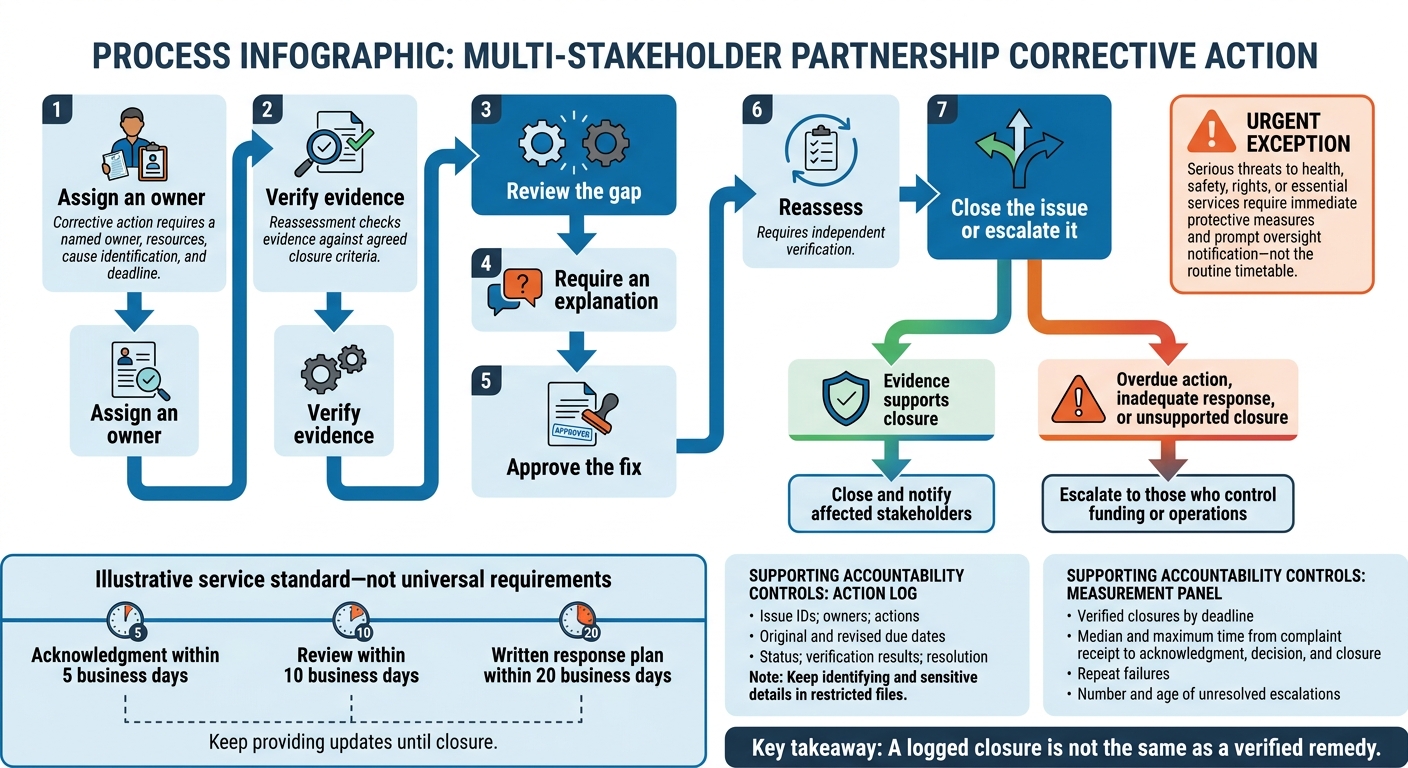
Accountability Workflow: From Finding to Verified Fix
Once results can be verified, the next test is whether the framework requires a response.
A verified finding changes nothing if no one has to act. Missed deadlines and weak review authority create a report-without-remedy cycle.[14][15]
Require Corrective Action After Review
Receiving a finding is just the start. Closing it requires corrective action, evidence that the action worked, and notice to affected stakeholders. Set closure criteria before problems arise, and require independent verification.[15][16]
| Reporting-only system | Action-oriented system |
|---|---|
| Records a missed target | Requires a cause, named owner, resources, and deadline |
| Leaves a complaint “under review” | Provides an issue timeline and progress updates |
| Accepts the owner’s claim of completion | Checks results against agreed closure criteria |
| Carries unresolved findings into the next report | Escalates overdue actions and revises plans to prevent recurrence |
Define Response Deadlines and Escalation
Make each step enforceable: assign an owner, verify evidence, review the gap, require an explanation, approve the fix, reassess, and either close the issue or escalate it.
An illustrative service standard is acknowledgment within 5 business days, review within 10 business days, and a written response plan within 20 business days.[15][16]
Keep providing updates until closure. Serious threats to health, safety, rights, or essential services require immediate protective measures to maintain climate resilience and prompt oversight notification - not the routine timetable.[15][16]
Give the review function an agreed mandate to access records, request explanations, reject unsupported closure, and escalate inadequate responses to those who control funding or operations.
Publish an action log with issue IDs, owners, actions, original and revised due dates, status, verification results, and resolution. Store identifying and sensitive details in restricted files, while preserving access to judicial or other remedies.[15][16][18]
Track Resolved Problems, Not Reports Produced
Measure verified closures by deadline, along with median and maximum time from complaint receipt to acknowledgment, decision, and closure. Track repeat failures and the number and age of unresolved escalations. A logged closure is not the same as a verified remedy.
Schedule learning reviews at fixed intervals and after major findings. When failures recur, check staffing, resources, targets, and delivery methods rather than adding another explanation to the next report.[16][17]
Even these requirements can fail when some stakeholders lack the power to force action.
Uneven Power Limits Stakeholder Influence
Equal seats do not mean equal influence. Funding, legal authority, expertise, staff capacity, and access to information shape who can challenge decisions. Control over the agenda determines which proposals get discussed at all. Paid staff can weather delays that volunteer representatives cannot. Without the power to demand review and corrective action, stakeholders may take part without changing outcomes.[22][23]
Map Control Over Decisions and Remedies
Before launch, identify who is affected and who controls funding, data, drafting, approvals, and vetoes. Document who can demand review and who bears the cost of failure. Back each finding with evidence, such as funding agreements, voting rules, or statutory authority.[21]
| Area | Formal participation | Effective influence |
|---|---|---|
| Resources | A seat at meetings | Paid time and independent technical support to challenge decisions |
| Information | Materials arrive too late to challenge | Early access to clear materials and underlying data |
| Agendas | Participants suggest topics | A clear route to bring unresolved issues before decision-makers |
| Voting | Each organization has one vote | Voting rules that block vetoes, bloc control, and procedural delay |
| Challenges | Participants express disagreement | Rights to reconsideration and independent review |
| Remedies | Complaints are accepted | A process authorized to require corrective action |
Fund Participation and Protect Challenge Rights Before Launch
Fund participation before launch - not after barriers appear. Cover compensation, travel, childcare, interpretation, accessible materials, training, and independent technical assistance where needed. Offer flexible meeting times. Disclose funding amounts, allocation rules, and conflicts. When decision-makers fund participation, use independent administration and recusals. Support must never depend on endorsing a preferred outcome.
Give affected communities the decision or review rights allowed by law. Provide complaint routes independent of the party being challenged, and prohibit retaliation.[19][20][24][25] Define consensus and a time-limited fallback process. Preserve minority positions instead of pressuring participants to withdraw objections. Review how representatives are selected, how they consult their communities, and how they report decisions back to them.[23]
Measure Influence, Not Just Attendance
Track how often affected groups’ proposals receive consideration, change decisions, or receive a reasoned rejection. Measure response times and access to independent review and remedies. These measures can expose weak governance before it turns into failure.
Use confidential feedback and reviews of representation to identify barriers that attendance records miss. Ask who risks funding, employment, or access by disagreeing - and who bears the harm when the partnership fails.
Conclusion: Turn Commitments Into Verifiable Action
Accountability rests on four controls: named owners, shared measurement rules, enforced follow-up, and real stakeholder influence. Use the simplest governance system that still makes commitments enforceable.
Test Governance Before Launch
Before launch, test the framework under pressure - not just on paper. Approve a single, linked governance package that includes an accountability charter, RACI, data protocol, monitoring plan, complaint path, escalation path, and review schedule. Tie every part to the same commitments and deadlines.
Run through five scenarios: a missed target, disputed data, partner withdrawal, funding changes, and reported harm. For each, specify the action, required evidence, deadline, and escalation. Document gaps, assign fixes, and set a retest date.
Track six metrics: ownership coverage, methodology coverage, on-time reporting, verified closure, response time, and unresolved escalations. Define each metric, name its data owner, and set its reporting schedule. Close issues only when evidence supports closure.
Connect Governance to Sustainability Action
A real partnership must meet this standard. Council Fire turns sustainability strategy into measurable action; lasting partnerships need clear responsibilities, evidence that can be checked, timely remedies, and real influence.
FAQs
How can we hold partners accountable without legal authority?
Use peer accountability and transparent tracking. Public commitments and annual, data-driven progress reports on shared platforms put reputations on the line, giving partners a reason to meet their obligations. Document roles, decision rights, and resource commitments early in a formal memorandum of understanding. Use steering committees to oversee the work.
Council Fire helps partners put these frameworks into practice through honest dialogue, power mapping, and capacity building aimed at long-term, system-level results.
How can a small partnership afford independent oversight?
Make oversight part of core governance and budget planning. Successful collaborations set aside 5% to 15% of their total budget for governance and administrative support. Universities or specialized consultancies can provide objective evaluations.
Peer accountability can keep costs down while making progress visible. Publishing annual progress reports and tracking results publicly helps teams maintain momentum and build trust - without costly formal enforcement.
How do we resolve conflicting stakeholder priorities?
Look beyond stated positions to find shared interests. Map stakeholders by their ambitions and practical approach to implementation, then identify leaders who can bridge differences. Set a governance charter early that spells out how decisions are made, issues are escalated, and conflicts are resolved.
Keep stakeholders aligned through interest-based negotiation, joint fact-finding, and transparent, data-driven reporting. Focus on early, concrete wins and meet regularly to build trust, work through trade-offs, and keep collaboration moving.



FAQ