In This Article
Cut packaging waste while keeping products protected—measure use, pilot changes, assign owners, and verify results.
Ultimate Guide to Packaging Waste Reduction Plans
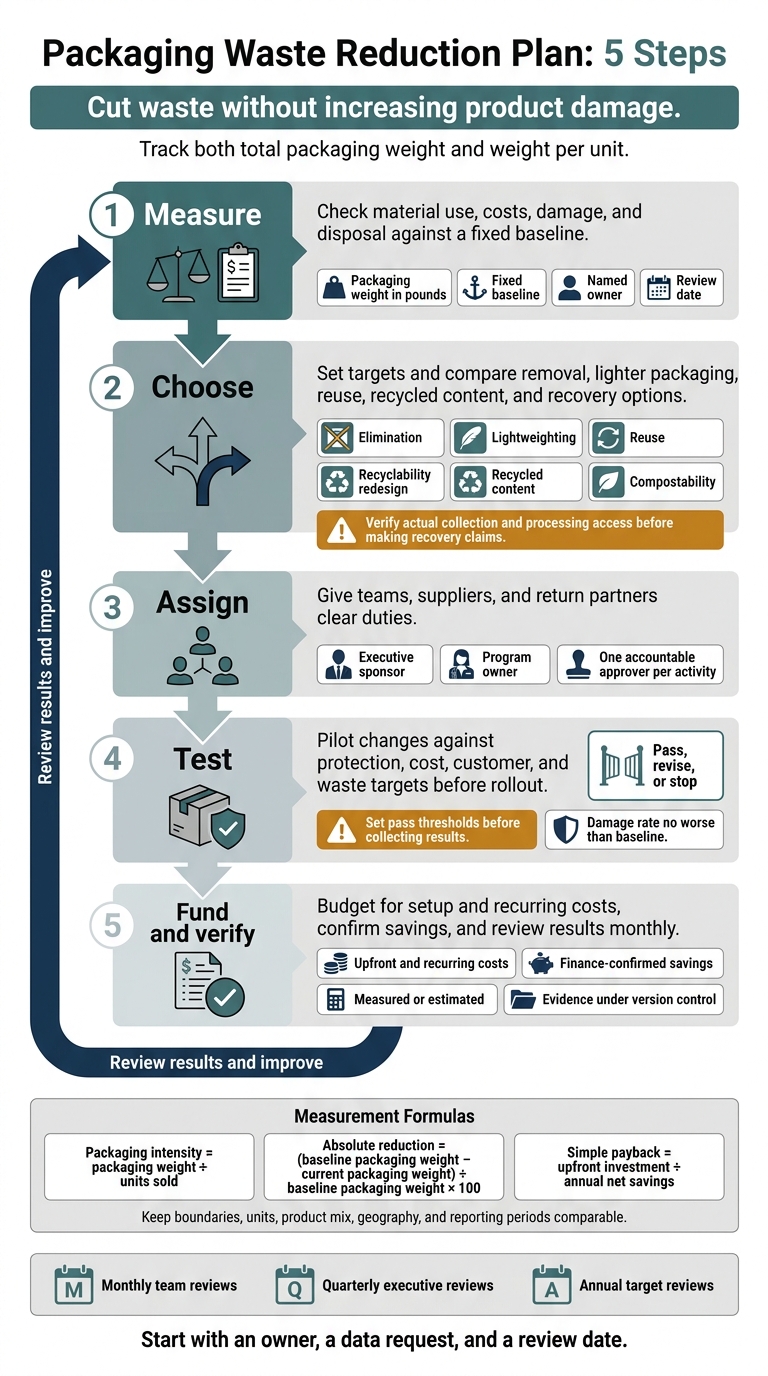
I start a packaging waste reduction plan with one rule: cut waste without increasing product damage. First, I measure packaging use in pounds, name an owner, and set a review date. Then I track both total weight and weight per unit so changes in sales don’t hide the results.
My approach covers five steps:
Measure: Check material use, costs, damage, and disposal against a fixed baseline.
Choose: Set targets and compare removal, lighter packaging, reuse, recycled content, and recovery options.
Assign: Give teams, suppliers, and return partners clear duties.
Test: Pilot changes against protection, cost, customer, and waste targets before rollout.
Fund and verify: Budget for setup and recurring costs, confirm savings, and review results monthly.
A lighter package is not enough. For example, I would check whether a 20% cut in cardboard weight is offset by added damage or return freight. My goal is <u>less waste with product protection intact</u> - backed by records, testing, and clear reporting.
Packaging Waste Reduction Plan: 5 Steps
Set Targets and Prioritize Packaging Changes
Set Absolute and Per-Unit Targets
Set separate targets for source reduction, reuse, virgin-material reduction, recycled content, and disposal reduction. Add a recyclability target only after defining the applicable geography, accepted materials, and collection pathway.
For every target, record the base year, organizational and product boundary, deadline, accountable owner, data source, and verification method. Measure reuse through completed cycles or the share of reusable packaging - not purchases alone.
Track both metrics:
Packaging intensity: packaging weight ÷ units sold.
Absolute reduction: (baseline packaging weight − current packaging weight) ÷ baseline packaging weight × 100.
Keep the numerator, denominator, product mix, geography, and reporting period comparable. Use both metrics to screen design options.
Compare Packaging Options
Compare every option against the same product-protection requirements. Before making recovery claims, verify actual collection and processing access in the U.S. markets you serve. Technical processability alone does not justify calling a package recyclable or compostable.
| Option | Waste impact | Emissions and cost considerations | Operating needs and risks | Suitable uses |
|---|---|---|---|---|
| Elimination | Usually offers the greatest potential reduction because no package is produced or discarded | Can cut material purchasing, handling, and disposal costs, but may increase damage or contamination risk | Requires product, safety, labeling, and customer review | Unnecessary secondary packaging, duplicate inserts, excess void fill |
| Lightweighting | Cuts material per unit while preserving package function | Often lowers material and freight costs; higher damage rates or shorter shelf life may offset gains | Requires engineering tests and supplier process controls | Bottles, caps, films, cartons, and shipping boxes with excess material |
| Reuse | Can sharply reduce single-use packaging after enough circulation cycles | Results depend on return rates, sanitation, loss rates, and number of cycles | Requires reverse logistics, washing or inspection, tracking, storage, and customer participation | Transport totes, pallets, refill containers, and closed-loop delivery systems |
| Recyclability redesign | Improves the chance that a package enters an available recovery stream | May require new equipment, labels, adhesives, or materials; gains depend on actual processing | Must account for local acceptance, sorting, contamination, and end markets | Mono-material packages, compatible closures, easily separable components |
| Recycled content | Reduces reliance on virgin feedstock and can lower material emissions | Availability, quality, price, food-contact rules, and supply-chain traceability affect feasibility | Requires supplier declarations and quality specifications | PET, HDPE, paperboard, corrugated fiber, and other materials with reliable supply |
| Compostability | May provide a pathway for suitable items in controlled systems | Results depend on certified facilities, collection, contamination controls, and transport | Access to industrial composting is often limited; unclear claims can confuse customers | Food-soiled service items or applications where recycling is impractical and a verified composting pathway exists |
Carry the strongest options into the ranking step.
Weigh Trade-Offs and Rank Projects
Score each option on a 1–5 scale, where 5 is best. Start with these weights: 25% waste reduction, 20% greenhouse-gas impact, 15% total cost, 15% implementation feasibility, 15% product protection, and 10% customer adoption. Include both one-time and recurring costs. Set firm no-go criteria for safety, legal compliance, unacceptable product loss, or unavailable recovery infrastructure.
Create one ranked record for each proposed change. Include current and proposed package specifications, annual units, baseline and expected material weights, estimated waste and emissions effects, one-time and recurring costs, supplier, affected equipment, testing, dependencies, timing, owners, verification, score, and assumptions.
Score each option against the targets above, using life-cycle impacts - not package weight alone. Test how return rates, material prices, damage rates, and collection access affect the results. Then classify each project as implement now, pilot first, co-develop with supplier, or defer pending infrastructure.
sbb-itb-8baf5f1
Five Sustainable Packaging Trends Shaping the Future | Sustainable Packaging Innovations Webinar
Assign Team and Supplier Responsibilities
Once projects are ranked, assign owners and agree on contract terms before pilot work begins.
Name Owners and Decision Makers
Name an executive sponsor to handle major decisions and a program owner to manage the roadmap, decision log, and reporting schedule. Give every activity one accountable approver - even when several teams share the work.
| Activity | Responsible for delivery | Accountable approver | Consulted |
|---|---|---|---|
| Collect supplier material data and manage contracts | Procurement | Procurement lead | Engineering, sustainability, legal |
| Develop and approve packaging specifications | Packaging engineering | Engineering lead | Operations, logistics, quality |
| Run line trials and verify product protection | Operations, quality | Quality lead | Engineering, logistics |
| Build funding requests and confirm savings | Finance | Executive sponsor | Procurement, program owner |
| Update labels and customer instructions | Marketing | Marketing lead | Legal, quality, sustainability |
| Verify waste and emissions results | Sustainability | Sustainability lead | Finance, procurement, operations |
Set approval gates for requirements, design, supplier selection, pilot launch, and rollout. At each gate, record the evidence, approver, deadline, and escalation path. Agree on spending limits before work starts.
Escalate cost overruns, protection failures, accessibility barriers, and supply risks to the sponsor and affected functional leads. Safety and legal requirements remain nonnegotiable.
Set Supplier Contract Requirements
Make requirements binding in bids, specifications, purchase orders, contracts, and supplier scorecards. Require supplier-certified weights, composition, recycled-content evidence, certifications, and end-of-life assumptions. Set submission deadlines and audit rights, and separate mandatory acceptance criteria from improvement targets.
Require written approval before suppliers substitute materials. Define corrective-action deadlines and the consequences of unsupported claims.
Before approval, confirm tooling cost and ownership, minimum order quantities, lead times, capacity, quality controls, pilot quantities, and backup supply. Assign responsibility for obsolete inventory and failed lots.
Review supplier scorecards monthly during launch and quarterly after stabilization. Cover specification compliance, defects, damage, delivery, and corrective-action closure.
When projects depend on returns or recovery, apply the same ownership model to customers and logistics partners.
Plan Customer and Recovery Partner Roles
For reuse, take-back, or recovery projects, build an implementation plan with customers, logistics providers, and collection, recycling, or reuse partners. Specify who writes and tests instructions, runs collection, pays return freight, inspects and cleans reusable packaging, and covers losses from missing items or contamination.
Treat instructions, reverse logistics, and partner acceptance rules as requirements of the waste-reduction design - not details to sort out later. Confirm accepted materials, service coverage, contamination limits, and downstream evidence.
Include feedback channels and response deadlines. Give every unresolved dependency, such as retailer participation or collection capacity, an owner and a due date.
Test Packaging Changes Before Rollout
Set Pilot Scope and Pass Criteria
Use this stage for projects ranked pilot first or co-develop with supplier.
Create a pilot charter for one project. Include the objective, hypothesis, package version, supplier, site, channel, routes, budget, baseline period, and test dates. Use a matched control group when available. Set the sample size and test duration to reflect normal variation, including demanding routes and handling conditions.
Complete safety, legal, quality, accessibility, and procurement reviews before launch. Pair field trials with suitable distribution tests. ISTA recommends repeated testing with new samples: three successful tests improve assurance, while five or more are preferred when feasible.[1]
Set pass thresholds before collecting results.
| Pilot criterion | Measurement method | Responsible function | Example threshold | Rollout decision |
|---|---|---|---|---|
| Product protection | Track damage claims, inspections, returns, and controlled distribution tests | Quality and operations | No critical failures; damage rate no worse than baseline | Pass only if protection is maintained |
| Packaging reduction | Weigh package components and calculate material per saleable unit | Sustainability and packaging engineering | At least 15% lower packaging weight | Pass if the reduction does not create offsetting impacts |
| Cost | Compare packaging, labor, freight, damage, and disposal costs per unit | Finance and procurement | Net cost no higher than baseline, or an approved payback period | Approve, revise, or reject based on the business case |
| Packing labor | Time a standard order and record rework or equipment changes | Operations | Packing time within 5% of baseline | Revise training or design if the threshold is missed |
| Freight utilization | Measure carton dimensions, cube, pallet density, and shipment weight | Logistics | At least 10% improvement in carton cube efficiency | Expand if transportation performance improves |
| Customer acceptance | Track complaints, surveys, reviews, and accessibility feedback | Customer experience and accessibility | No material increase in complaints | Revise the design if use or opening becomes harder |
| End-of-life outcome | Audit sorting instructions, recycler feedback, or actual recovery data | Sustainability and recovery partners | Meets the intended local recovery pathway | Do not claim recyclability without verification |
Measure Savings and Effects on Daily Work
Track results per shipped or sold unit against the baseline and control group. Measure packaging weight by component, packaging and labor costs, packing time, line speed, changeover time, and energy use. Also record carton cube, pallet utilization, freight costs, product damage, returns, customer complaints, and recovery or disposal results.
Document changes to daily work, including new tools, slower picking, added quality checks, supplier delays, and worker training. Normalize results for order volume, product mix, shipment zone, and seasonality. Report pilot results per order, adjusted for product mix and shipping zone.
For example, a 20% reduction in cardboard weight is not a net gain if it causes a 3% increase in product damage or materially increases return freight.
Use clear rules for what happens next:
Stop for safety, regulatory, contamination, or product-integrity failures.
Pause and redesign when damage, complaints, or disposal exceed thresholds.
Extend the pilot when the sample is too small or the test missed seasonality.
Test against actual distribution hazards: shock, vibration, compression, and atmospheric exposure.[1][2] Do not approve a packaging reduction that simply shifts impacts to damaged products, replacement shipments, reverse logistics, customer service, or disposal.
Approve Rollout and Revise Specifications
Use five gates: design review, supplier readiness, limited pilot, validation, and rollout approval. Record a written pass, revise, or stop decision at each gate.
Before expansion, document verified benefits, remaining risks, total costs, the rollout owner, implementation schedule, and approval. Update the following under version control:
Procurement specifications, approved-material lists, drawings, bills of materials, and supplier contracts.
Quality inspection plans, work instructions, training materials, and warehouse settings.
Customer instructions, labeling, and recovery guidance.
Dashboards should show the baseline, target, actual result, units, reporting period, data owner, and exception status. After rollout, watch for increases in damage, returns, complaints, costs, or recovery problems.
Feed verified savings, costs, and rollout risks into the funding plan and tracking dashboard.
Fund, Track, and Maintain the Program
Once rollout is approved, secure funding, set up tracking, and assign accountability.
Build the Business Case and Funding Plan
Create a one-page business case in U.S. dollars. Separate upfront equipment, tooling, and setup costs from recurring materials, cleaning, maintenance, reverse logistics, and reporting costs. Have finance confirm the accounting treatment.
Calculate simple payback = upfront investment ÷ annual net savings. Count freight, labor, damage, disposal, and compliance costs - not just material savings. Document project volume, timing, and asset life. Test how the numbers change with commodity prices, demand, regulations, recovery infrastructure, and supply disruptions.
| Funding source | Eligibility | Obligations | Benefits | Limitations |
|---|---|---|---|---|
| Operating budget | Departmental spending authority | Meet procurement and budget controls | Covers small pilots and staff time | May not cover equipment or multiyear investments |
| Reinvested savings | Demonstrated savings from earlier projects | Track and reserve savings for improvements | Reduces new funding needs | Savings may be hard to isolate or retain |
| Supplier cost-sharing | Negotiated supplier participation | Define ownership, pricing, performance, data, and contract duration | Reduces capital requirements | May create supplier dependence |
| Capital allocation | Meets return, risk, and approval criteria | Complete capital planning, procurement, and asset controls | Funds equipment and infrastructure | Competes with other capital projects |
| Milestone-based funding | Payment depends on verified milestones | Define baselines, measurement, verification, and clawback terms | Ties payment to results | Adds administration and measurement-dispute risk |
| Grants or incentives | Meets geographic, sectoral, or project criteria | Complete applications, matching funds, reporting, and compliance | Reduces upfront cost | Eligibility and timing require confirmation |
Track Results, Emissions, and Accountability
With funding in place, track the same measures used to approve the project. Keep a KPI register with fixed units and evidence sources, using the baseline’s boundaries and definitions. Keep reported data separate from verified data, and label results as measured or estimated.
| KPI | Definition and formula | Owner | Frequency | Evidence and assurance status |
|---|---|---|---|---|
| Material use | Total packaging material purchased or consumed, by material and weight | Procurement or packaging engineering | Monthly | Measured from invoices, scales, or bills of material; flag supplier-reported weights separately |
| Intensity | Packaging weight ÷ units shipped | Operations analytics | Monthly | Measured when both totals reconcile |
| Material mix | Material-category weight ÷ total weight × 100 | Packaging engineering | Monthly or quarterly | Measured or supplier-reported |
| Reuse cycles | Completed cycles ÷ tracked assets in the defined cohort | Operations or reverse logistics | Monthly | Measured through scans or inventory records |
| Disposal | Packaging sent to landfill, incineration, recycling, composting, or reuse | Facilities or waste contractor | Monthly | Measured where weights exist; otherwise estimated |
| Net savings | Avoided costs minus added material, labor, logistics, cleaning, and disposal costs | Finance | Monthly or quarterly | Measured from financial records and assumptions |
| Implementation progress | Completed milestones ÷ approved milestones | Program manager | Monthly | Measured against the controlled project plan |
| Emissions estimate | Activity data multiplied by documented emission factor | Sustainability or greenhouse-gas inventory team | Quarterly or annually | Estimated; record verification status separately |
Link results to the applicable greenhouse-gas inventory boundaries and categories. These include purchased goods and services, upstream transportation and distribution, waste generated in operations, and downstream transportation or treatment where relevant. Account for company-controlled energy or fuel in the appropriate scopes.
Record each emission factor’s source, version, geography, units, and life-cycle boundaries. Less packaging weight does not automatically mean lower emissions. Report avoided emissions separately; do not subtract them from inventory totals.
Keep evidence under version control and require approval for changes to baselines or emission factors. Hold monthly team reviews to address variances and corrective actions, quarterly executive reviews for funding and escalations, and annual target reviews to check goals, boundaries, and assumptions.
Legal or compliance should maintain a state-level compliance register for packaging producer-responsibility obligations. Review it quarterly, confirm it annually, and check it before entering new markets or changing packaging.
Before publishing claims, get approval from sustainability, legal, and communications. State the baseline, period, scope, method, and whether the results are measured or estimated.
Conclusion: Start Your Packaging Waste Reduction Plan
Move from baseline assessment and waste prevention into assigned ownership, testing, funding, and verification. Start with an owner, a data request, and a review date.
FAQs
How can I set a baseline with incomplete packaging data?
Start with one facility, product line, or waste category. Audit waste by type, volume, and source to pinpoint the three to five material categories that account for 60–80% of waste.
Fill data gaps with value chain mapping, screening life cycle assessments (LCAs), and industry databases. For community-level gaps, use Waste Value Chain Analysis informed by local stakeholders. Document your baseline, then set measurable targets tied to internal incentives.
How do I calculate when reusable packaging breaks even?
Use a Life Cycle Assessment (LCA) to compare the environmental impacts of reusable and single-use packaging across different numbers of use cycles, paired with a cost analysis. Account for upfront production, reverse logistics, cleaning, and inspection costs, along with savings on materials and waste disposal.
Track material flows and recovery rates to determine how many use cycles reusable packaging needs to become both less costly and better for the environment.
Which packaging changes should I prioritize on a tight budget?
Focus first on changes that deliver the highest return on investment. Start with a waste audit to find the three to five material categories that account for 60% to 80% of your waste by weight.
Then improve packaging and remove unnecessary components to cut material purchasing costs and disposal fees. Choose single-material designs to make recycling easier and lower costs.

FAQ