
Jul 27, 2026
Ultimate Guide to Psychological Benefits of Sustainability
Sustainability Strategy
In This Article
Simple green habits—time in nature, gardening, and community action—reduce stress, boost meaning, and ease eco‑anxiety.
Ultimate Guide to Psychological Benefits of Sustainability
Small green habits can help people feel less stressed, more connected, and more in control. In the research covered here, just 15 minutes in urban nature improved mental health, and 120 minutes a week outdoors was linked to better well-being. The piece also points to high climate worry: 68% of U.S. adults report eco-anxiety, while 59% of people ages 16–25 say they are very or extremely worried about climate change.
If I boil the article down, the main points are simple:
Time outside helps mood and can cut stress, anxiety, and rumination.
Action helps with climate distress because it gives people a sense of control.
Daily green habits can reduce value conflict and support self-respect.
Shared efforts like gardens, cleanups, and green teams can reduce isolation.
Programs work better when they are easy to join, social, and part of daily life.
The article argues that the strongest mental health gains come when green action is not random or one-time. It works best when people can see progress, do it with others, and tie it to what matters in their own lives.
I’d sum it up this way: this is less about saving the planet in the abstract and more about how everyday green choices can support calmer minds, stronger identity, closer ties, and steadier communities.
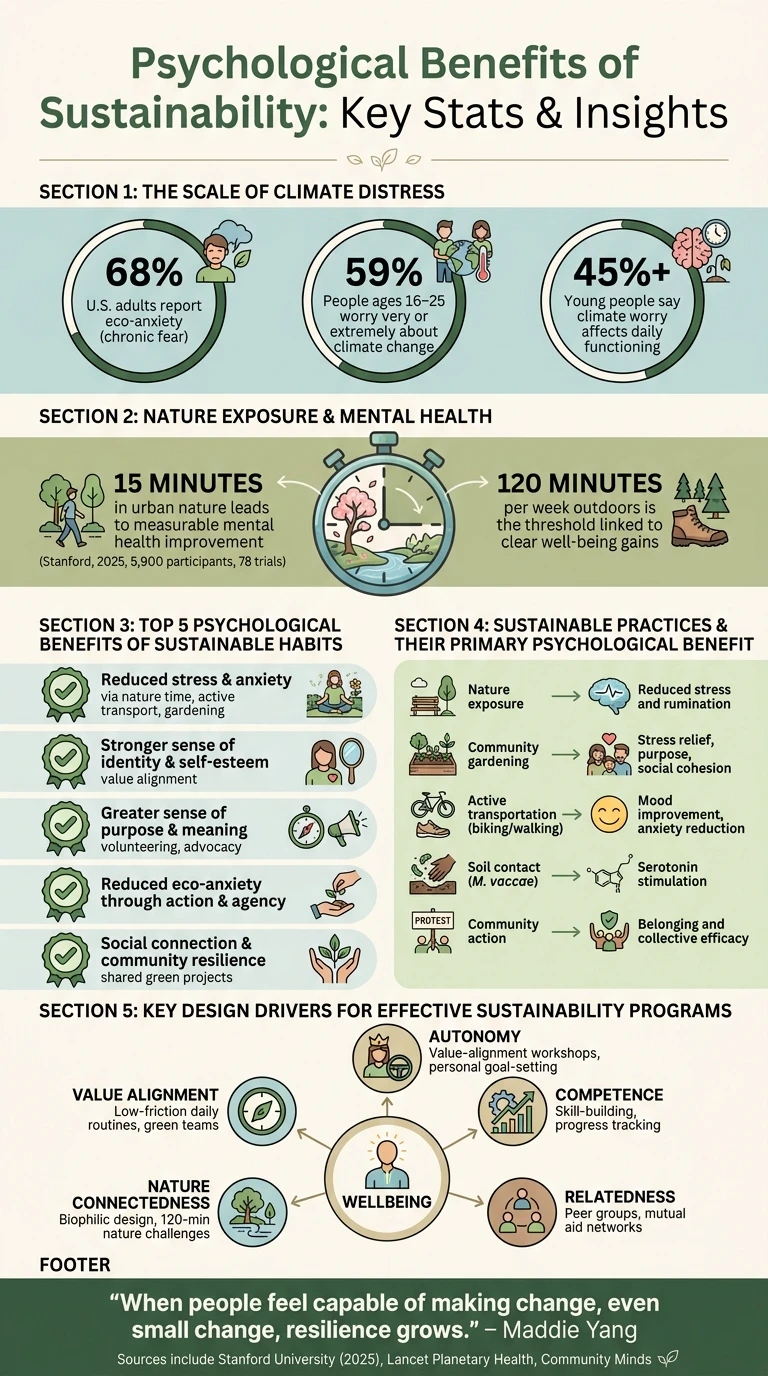
Psychological Benefits of Sustainability: Key Stats & Insights
The Surprising Psychological Benefits of Living Sustainably
Mental Health Benefits of Sustainable Practices
Sustainable routines can support mental health in plain, practical ways: more time outside, more movement, and more connection with other people.
How Sustainable Habits Reduce Stress, Anxiety, and Depression
Time in nature is one of the clearest tools we have for mental health support. A 2025 study published in Nature Cities followed 5,900 participants across 78 experimental trials. Led by Stanford University postdoctoral scholar Yingjie Li, the study found that spending just 15 minutes in urban nature led to measurable mental health improvement. Urban forests stood out as especially helpful for lowering depression and anxiety. [7]
"Urban nature isn't just good for cities, it's good for us." - Yingjie Li, Stanford University [7]
Researchers also identified a threshold: people need at least 120 minutes per week in natural settings to see clear gains in well-being. [2] That’s about two hours a week. In daily life, that could look like a weekend hike, a few walks in the park, or regular time in a community garden.
Gardening brings extra mental health support. Contact with garden soil may affect mood through exposure to helpful microbes, including Mycobacterium vaccae. [6] Gardeners also report lower perceived stress than people doing indoor exercise. Active transportation can work in a similar way. Walking or biking instead of driving may ease traffic stress while adding the mood lift that comes with moderate movement.
That sense of doing something useful matters too. It can help ease climate anxiety, not just the stress of day-to-day life.
Here’s a quick look at what the research shows across common sustainable practices:
Practice | Primary Psychological Benefit | Evidence Strength |
|---|---|---|
Nature exposure | Reduced stress and rumination | Strong |
Community gardening | Stress relief, sense of purpose, social cohesion | Moderate |
Active transportation (biking/walking) | Mood improvement, anxiety reduction | Moderate |
Soil contact (M. vaccae exposure) | Serotonin stimulation, immune regulation | Emerging |
Community action | Belonging and collective efficacy | Strong |
Passive nature time often helps lower distress, while hands-on activities like gardening or conservation work more often boost energy and alertness. [7] Both forms help, and programs that bring them together tend to support the broadest range of mental health gains.
These effects matter even more when sustainable action also helps people deal with climate-related stress.
Taking Action to Address Eco-Anxiety and Climate Distress
Mental health gains are often strongest when sustainable action gives people a sense of control.
About 68% of U.S. adults report eco-anxiety, meaning a chronic fear of environmental doom. [5] Among young people ages 16 to 25, 59% say they are very or extremely worried about climate change, and more than 45% say it affects their daily functioning. [2]
One of the clearest responses is action. As Maddie Yang, host of Environmental Minute, puts it:
"When people feel powerless, stress increases. When people feel capable of making change, even small change, resilience grows." [5]
Community-based efforts seem to help the most. Neighborhood resilience groups, local clean-energy participation, and conservation volunteering can reduce the isolation that often makes climate distress worse. They also build collective efficacy, the shared belief that a group can shape outcomes together, which is a major protective factor against climate-related anxiety. [1] Individual action still matters, but it tends to work best when it connects to something bigger than one household.
The Emotional Value of a Consistent Green Lifestyle
When people act in ways that match their environmental values, cognitive dissonance tends to fall and well-being tends to improve. Habits like waste reduction can lower internal conflict and support a steadier sense of emotional balance.
There’s a catch, though. Perfectionism can undo that benefit. Realistic optimism - seeing the damage, but staying involved anyway - supports more lasting well-being than trying to do everything flawlessly. Repeated, grounded behavior change is what helps sustain both mental health and environmental impact over time.
Meaning, Identity, and Personal Fulfillment Through Sustainability
Beyond stress relief, sustainability can give people a stronger sense of purpose and identity. It doesn't just ease stress or lift mood. It can also support meaning-centered wellbeing: the feeling that your life has meaning, that you're growing, and that your actions line up with what you believe.
Why Sustainable Action Feels Meaningful
Sustainable action often feels meaningful because it ties everyday behavior to something bigger than one home or one workday. Cutting consumption, volunteering, or speaking up for a cause can bring moral satisfaction by connecting daily choices to a shared good. It can also ease the strain of living out of step with your values, narrowing the gap between what people believe is right and how they live from day to day.
That sense of meaning tends to last when it shows up in daily habits, not just one-off efforts.
How Sustainable Choices Shape Identity and Self-Esteem
When people repeat sustainable choices, those choices start to become part of identity. At that point, sustainability feels less like a task and more like part of who someone is. Many people experience sustainable living as a sign of integrity, not sacrifice. And when it is treated as a personal value instead of a duty, it is more likely to support long-term commitment and self-respect.
The table below links key psychological ideas to sustainable behaviors that may support them:
Psychological Construct | Sustainable Behavior | Likely Mechanism |
|---|---|---|
Agency | Household energy reduction; diet shifts | Moves a person from passive concern to active response |
Integrity / Self-Esteem | Waste reduction; mindful consumption | Eases discomfort from living against one's values |
Purpose | Environmental volunteering; advocacy | Connects personal effort to a cause larger than oneself |
Shared Identity | Community gardening; local clean-ups | Strengthens social bonds and a sense of common cause |
For leaders, the main question is not only which sustainability programs to launch. It is also which behaviors will help people feel a real sense of agency and purpose.
Building Resilience and Psychological Growth Over Time
Sustainable habits can also support the emotional energy people need to keep going, especially during hard stretches. Grounded hope means staying engaged while facing environmental loss honestly. Pair steady action with rest and peer support to help prevent burnout, especially in long-term climate work.
These personal gains grow deeper when sustainable action becomes social, shared, and reinforced by institutions.
Social Connection, Workplace Wellbeing, and Collective Resilience
Those personal gains get stronger when sustainability is shared. Once people do this work together - on a team, in a neighborhood, or across an organization - the mental and social payoff grows.
How Shared Green Spaces and Group Action Build Belonging
Shared action turns private habits into social support. Community gardens, neighborhood cleanups, and local restoration projects can ease isolation and build a sense of common purpose. Research keeps pointing to the same pattern: social cohesion helps protect psychological resilience. Communities with strong social networks recover better from climate-related disruptions and cope better with long periods of stress [3].
Helping other people can also improve mood and make it easier to stick with the work. Shared projects matter because they make action visible, social, and repeatable.
Workplace Sustainability and Employee Engagement
The same pattern shows up inside organizations. Workplace sustainability tends to work best when employees can take part, track progress, and connect the effort to the organization's purpose. If sustainability is tied to the core mission instead of treated like a symbolic exercise, it can support meaning, agency, and shared purpose at work.
Acting for Future Generations and Building Community-Scale Resilience
At the community level, collective action turns concern for future generations into shared responsibility and planning. That shift matters when communities are trying to build resilience under climate stress.
These gains can grow from personal agency to group belonging to organizational commitment.
Council Fire translates sustainability strategy into measurable action through systems thinking and stakeholder-centered planning. The next step is designing programs that make participation easy, visible, and repeatable.
Putting These Insights to Work in Organizations and Communities
How to Design Sustainability Programs That People Will Stick With
These gains tend to last when sustainability becomes part of daily life, not a side project people try for a week and then forget. People stay with these programs when the design speaks to basic human needs, not only green targets. The main drivers are autonomy, competence, relatedness, nature connectedness, and value alignment. Each one links back to the outcomes covered in this guide: lower stress, a stronger sense of self, and more shared resilience.
The way a program is framed makes a big difference. When you lead with wellbeing gains - better focus, less stress, stronger ties with other people - engagement usually goes up. Participatory design helps too. If people help shape the thing they’re joining, they’re more likely to feel ownership instead of obligation. Visible progress keeps that energy going. A simple benchmark, like 120 minutes a week in nature, gives people a clear target without making the program feel heavy. It also helps to build behaviors into routines people already have. Active commuting and workplace green teams are good examples because they cut friction and make drop-off less likely.
Psychological Driver | Core Mechanism | Practical Intervention |
|---|---|---|
Autonomy | Reduces internal conflict | Value-alignment workshops; individual goal-setting; digital boundary setting |
Competence | Builds agency; prevents feeling stuck | Self-repair clinics; community gardening; effort-based progress tracking |
Relatedness | Counteracts isolation; builds collective efficacy | Mutual aid networks; community tool shares; peer-led sustainability circles |
Nature Connectedness | Lowers stress; restores attention | Biophilic workplace design; 120-min weekly nature challenges |
Value Alignment | Reduces daily stress | Low-friction behaviors embedded in daily routines; workplace green teams |
The best results show up when policy, physical space, and incentives all push in the same direction. If a workplace says it cares about sustainability but makes low-waste choices hard, people notice. If a neighborhood wants more outdoor time but lacks safe green space, participation will lag. Good design closes that gap.
How Systems Thinking Strengthens Psychological Outcomes
The strongest programs don’t treat behavior as a stand-alone issue. They reshape the system around it. Systems thinking looks at the links between policies, incentives, built spaces, and social norms instead of treating each action on its own. That shift moves the work from harm reduction to wellbeing-building design: creating conditions that produce wellbeing on purpose. [8]
Council Fire uses this approach by tying climate goals to workforce development, neighborhood health, and long-term economic stability. That link matters. When people can see how a sustainability effort connects to something personal and concrete, their sense of agency grows. Trust in the process grows too.
Conclusion: The Clearest Psychological Gains From Sustainability
Sustainable practices can lower stress, strengthen identity, build community, and increase resilience under climate pressure. The strongest outcomes come from actions that match people’s values, fit into social life, and are backed by systems that make participation practical and measurable.
"Climate resilience is the ability to stay psychologically strong, hopeful, and engaged even in the face of overwhelming climate threats. It's about feeling the fear, and then finding ways to move through it." - Community Minds Editorial [4]
Individual habits matter, but they go farther when they’re part of something bigger - a team, a neighborhood, or an organization with a clear commitment to mental health, meaning, and social connection.
FAQs
How much nature time is enough?
Research points to a simple target: about 120 minutes a week in nature - whether that’s a park, garden, or a street lined with trees - is tied to better mental health and well-being.
The good news is that you don’t have to do it all at once. You can spread those two hours across the week, and even short visits of 10 to 15 minutes can make a difference. While 120 minutes is a common benchmark, smaller, regular doses of nature can still help.
Can small green habits really ease eco-anxiety?
Yes. Small green habits can ease eco-anxiety because they give you back a sense of agency and chip away at helplessness.
When daily actions like active transportation, buying less, or eating more plant-based meals line up with your values, they can ease the inner tension that often feeds climate distress. Their effect on the larger system may be modest, but their effect on your state of mind can still matter.
What makes sustainability programs stick?
Sustainability programs last when they go beyond surface-level efforts and become part of an organization’s culture and daily work. That shift happens when goals line up with company values and local norms, so people see the work as part of how the organization operates - not just another initiative.
Clear SMART goals help turn vision into action. A target like reducing carbon emissions by 20% within three years gives teams something concrete to work toward. Council Fire supports this with systems thinking and stakeholder-centered planning.
Related Blog Posts
Latest Articles
©2026
Narrative Change and Power Building: The Missing Half of Advocacy
Narrative change is the process of disrupting dominant narratives that normalize inequity and advancing new narratives from historically marginalized communities.

Funding Resilience Without Federal Grants
BRIC is unreliable and FEMA is shrinking. Here's how cities fund climate resilience with dedicated revenue, blended finance, and a coordinating authority.

The ESG Blind Spot: How AI Is Finding Risks in Companies Nobody Else Is Watching
Norway's sovereign wealth fund uses AI to screen 7,200 portfolio companies for forced labor and corruption within 24 hours. The real story is the emerging-market coverage gap that traditional ESG data vendors miss — and what it means for any company with a global supply chain.
Narrative Change and Power Building: The Missing Half of Advocacy
Narrative change is the process of disrupting dominant narratives that normalize inequity and advancing new narratives from historically marginalized communities.
Funding Resilience Without Federal Grants
BRIC is unreliable and FEMA is shrinking. Here's how cities fund climate resilience with dedicated revenue, blended finance, and a coordinating authority.
The ESG Blind Spot: How AI Is Finding Risks in Companies Nobody Else Is Watching
Norway's sovereign wealth fund uses AI to screen 7,200 portfolio companies for forced labor and corruption within 24 hours. The real story is the emerging-market coverage gap that traditional ESG data vendors miss — and what it means for any company with a global supply chain.
FAQ
01
What does it really mean to “redefine profit”?
02
What makes Council Fire different?
03
Who does Council Fire work with?
04
What does working with Council Fire actually look like?
05
How does Council Fire help organizations turn big goals into action?
06
How does Council Fire define and measure success?
07
How does technology fit into Council Fire’s work?
Jul 27, 2026
Ultimate Guide to Psychological Benefits of Sustainability
Sustainability Strategy
In This Article
Simple green habits—time in nature, gardening, and community action—reduce stress, boost meaning, and ease eco‑anxiety.
Ultimate Guide to Psychological Benefits of Sustainability
Small green habits can help people feel less stressed, more connected, and more in control. In the research covered here, just 15 minutes in urban nature improved mental health, and 120 minutes a week outdoors was linked to better well-being. The piece also points to high climate worry: 68% of U.S. adults report eco-anxiety, while 59% of people ages 16–25 say they are very or extremely worried about climate change.
If I boil the article down, the main points are simple:
Time outside helps mood and can cut stress, anxiety, and rumination.
Action helps with climate distress because it gives people a sense of control.
Daily green habits can reduce value conflict and support self-respect.
Shared efforts like gardens, cleanups, and green teams can reduce isolation.
Programs work better when they are easy to join, social, and part of daily life.
The article argues that the strongest mental health gains come when green action is not random or one-time. It works best when people can see progress, do it with others, and tie it to what matters in their own lives.
I’d sum it up this way: this is less about saving the planet in the abstract and more about how everyday green choices can support calmer minds, stronger identity, closer ties, and steadier communities.
Psychological Benefits of Sustainability: Key Stats & Insights
The Surprising Psychological Benefits of Living Sustainably
Mental Health Benefits of Sustainable Practices
Sustainable routines can support mental health in plain, practical ways: more time outside, more movement, and more connection with other people.
How Sustainable Habits Reduce Stress, Anxiety, and Depression
Time in nature is one of the clearest tools we have for mental health support. A 2025 study published in Nature Cities followed 5,900 participants across 78 experimental trials. Led by Stanford University postdoctoral scholar Yingjie Li, the study found that spending just 15 minutes in urban nature led to measurable mental health improvement. Urban forests stood out as especially helpful for lowering depression and anxiety. [7]
"Urban nature isn't just good for cities, it's good for us." - Yingjie Li, Stanford University [7]
Researchers also identified a threshold: people need at least 120 minutes per week in natural settings to see clear gains in well-being. [2] That’s about two hours a week. In daily life, that could look like a weekend hike, a few walks in the park, or regular time in a community garden.
Gardening brings extra mental health support. Contact with garden soil may affect mood through exposure to helpful microbes, including Mycobacterium vaccae. [6] Gardeners also report lower perceived stress than people doing indoor exercise. Active transportation can work in a similar way. Walking or biking instead of driving may ease traffic stress while adding the mood lift that comes with moderate movement.
That sense of doing something useful matters too. It can help ease climate anxiety, not just the stress of day-to-day life.
Here’s a quick look at what the research shows across common sustainable practices:
Practice | Primary Psychological Benefit | Evidence Strength |
|---|---|---|
Nature exposure | Reduced stress and rumination | Strong |
Community gardening | Stress relief, sense of purpose, social cohesion | Moderate |
Active transportation (biking/walking) | Mood improvement, anxiety reduction | Moderate |
Soil contact (M. vaccae exposure) | Serotonin stimulation, immune regulation | Emerging |
Community action | Belonging and collective efficacy | Strong |
Passive nature time often helps lower distress, while hands-on activities like gardening or conservation work more often boost energy and alertness. [7] Both forms help, and programs that bring them together tend to support the broadest range of mental health gains.
These effects matter even more when sustainable action also helps people deal with climate-related stress.
Taking Action to Address Eco-Anxiety and Climate Distress
Mental health gains are often strongest when sustainable action gives people a sense of control.
About 68% of U.S. adults report eco-anxiety, meaning a chronic fear of environmental doom. [5] Among young people ages 16 to 25, 59% say they are very or extremely worried about climate change, and more than 45% say it affects their daily functioning. [2]
One of the clearest responses is action. As Maddie Yang, host of Environmental Minute, puts it:
"When people feel powerless, stress increases. When people feel capable of making change, even small change, resilience grows." [5]
Community-based efforts seem to help the most. Neighborhood resilience groups, local clean-energy participation, and conservation volunteering can reduce the isolation that often makes climate distress worse. They also build collective efficacy, the shared belief that a group can shape outcomes together, which is a major protective factor against climate-related anxiety. [1] Individual action still matters, but it tends to work best when it connects to something bigger than one household.
The Emotional Value of a Consistent Green Lifestyle
When people act in ways that match their environmental values, cognitive dissonance tends to fall and well-being tends to improve. Habits like waste reduction can lower internal conflict and support a steadier sense of emotional balance.
There’s a catch, though. Perfectionism can undo that benefit. Realistic optimism - seeing the damage, but staying involved anyway - supports more lasting well-being than trying to do everything flawlessly. Repeated, grounded behavior change is what helps sustain both mental health and environmental impact over time.
Meaning, Identity, and Personal Fulfillment Through Sustainability
Beyond stress relief, sustainability can give people a stronger sense of purpose and identity. It doesn't just ease stress or lift mood. It can also support meaning-centered wellbeing: the feeling that your life has meaning, that you're growing, and that your actions line up with what you believe.
Why Sustainable Action Feels Meaningful
Sustainable action often feels meaningful because it ties everyday behavior to something bigger than one home or one workday. Cutting consumption, volunteering, or speaking up for a cause can bring moral satisfaction by connecting daily choices to a shared good. It can also ease the strain of living out of step with your values, narrowing the gap between what people believe is right and how they live from day to day.
That sense of meaning tends to last when it shows up in daily habits, not just one-off efforts.
How Sustainable Choices Shape Identity and Self-Esteem
When people repeat sustainable choices, those choices start to become part of identity. At that point, sustainability feels less like a task and more like part of who someone is. Many people experience sustainable living as a sign of integrity, not sacrifice. And when it is treated as a personal value instead of a duty, it is more likely to support long-term commitment and self-respect.
The table below links key psychological ideas to sustainable behaviors that may support them:
Psychological Construct | Sustainable Behavior | Likely Mechanism |
|---|---|---|
Agency | Household energy reduction; diet shifts | Moves a person from passive concern to active response |
Integrity / Self-Esteem | Waste reduction; mindful consumption | Eases discomfort from living against one's values |
Purpose | Environmental volunteering; advocacy | Connects personal effort to a cause larger than oneself |
Shared Identity | Community gardening; local clean-ups | Strengthens social bonds and a sense of common cause |
For leaders, the main question is not only which sustainability programs to launch. It is also which behaviors will help people feel a real sense of agency and purpose.
Building Resilience and Psychological Growth Over Time
Sustainable habits can also support the emotional energy people need to keep going, especially during hard stretches. Grounded hope means staying engaged while facing environmental loss honestly. Pair steady action with rest and peer support to help prevent burnout, especially in long-term climate work.
These personal gains grow deeper when sustainable action becomes social, shared, and reinforced by institutions.
Social Connection, Workplace Wellbeing, and Collective Resilience
Those personal gains get stronger when sustainability is shared. Once people do this work together - on a team, in a neighborhood, or across an organization - the mental and social payoff grows.
How Shared Green Spaces and Group Action Build Belonging
Shared action turns private habits into social support. Community gardens, neighborhood cleanups, and local restoration projects can ease isolation and build a sense of common purpose. Research keeps pointing to the same pattern: social cohesion helps protect psychological resilience. Communities with strong social networks recover better from climate-related disruptions and cope better with long periods of stress [3].
Helping other people can also improve mood and make it easier to stick with the work. Shared projects matter because they make action visible, social, and repeatable.
Workplace Sustainability and Employee Engagement
The same pattern shows up inside organizations. Workplace sustainability tends to work best when employees can take part, track progress, and connect the effort to the organization's purpose. If sustainability is tied to the core mission instead of treated like a symbolic exercise, it can support meaning, agency, and shared purpose at work.
Acting for Future Generations and Building Community-Scale Resilience
At the community level, collective action turns concern for future generations into shared responsibility and planning. That shift matters when communities are trying to build resilience under climate stress.
These gains can grow from personal agency to group belonging to organizational commitment.
Council Fire translates sustainability strategy into measurable action through systems thinking and stakeholder-centered planning. The next step is designing programs that make participation easy, visible, and repeatable.
Putting These Insights to Work in Organizations and Communities
How to Design Sustainability Programs That People Will Stick With
These gains tend to last when sustainability becomes part of daily life, not a side project people try for a week and then forget. People stay with these programs when the design speaks to basic human needs, not only green targets. The main drivers are autonomy, competence, relatedness, nature connectedness, and value alignment. Each one links back to the outcomes covered in this guide: lower stress, a stronger sense of self, and more shared resilience.
The way a program is framed makes a big difference. When you lead with wellbeing gains - better focus, less stress, stronger ties with other people - engagement usually goes up. Participatory design helps too. If people help shape the thing they’re joining, they’re more likely to feel ownership instead of obligation. Visible progress keeps that energy going. A simple benchmark, like 120 minutes a week in nature, gives people a clear target without making the program feel heavy. It also helps to build behaviors into routines people already have. Active commuting and workplace green teams are good examples because they cut friction and make drop-off less likely.
Psychological Driver | Core Mechanism | Practical Intervention |
|---|---|---|
Autonomy | Reduces internal conflict | Value-alignment workshops; individual goal-setting; digital boundary setting |
Competence | Builds agency; prevents feeling stuck | Self-repair clinics; community gardening; effort-based progress tracking |
Relatedness | Counteracts isolation; builds collective efficacy | Mutual aid networks; community tool shares; peer-led sustainability circles |
Nature Connectedness | Lowers stress; restores attention | Biophilic workplace design; 120-min weekly nature challenges |
Value Alignment | Reduces daily stress | Low-friction behaviors embedded in daily routines; workplace green teams |
The best results show up when policy, physical space, and incentives all push in the same direction. If a workplace says it cares about sustainability but makes low-waste choices hard, people notice. If a neighborhood wants more outdoor time but lacks safe green space, participation will lag. Good design closes that gap.
How Systems Thinking Strengthens Psychological Outcomes
The strongest programs don’t treat behavior as a stand-alone issue. They reshape the system around it. Systems thinking looks at the links between policies, incentives, built spaces, and social norms instead of treating each action on its own. That shift moves the work from harm reduction to wellbeing-building design: creating conditions that produce wellbeing on purpose. [8]
Council Fire uses this approach by tying climate goals to workforce development, neighborhood health, and long-term economic stability. That link matters. When people can see how a sustainability effort connects to something personal and concrete, their sense of agency grows. Trust in the process grows too.
Conclusion: The Clearest Psychological Gains From Sustainability
Sustainable practices can lower stress, strengthen identity, build community, and increase resilience under climate pressure. The strongest outcomes come from actions that match people’s values, fit into social life, and are backed by systems that make participation practical and measurable.
"Climate resilience is the ability to stay psychologically strong, hopeful, and engaged even in the face of overwhelming climate threats. It's about feeling the fear, and then finding ways to move through it." - Community Minds Editorial [4]
Individual habits matter, but they go farther when they’re part of something bigger - a team, a neighborhood, or an organization with a clear commitment to mental health, meaning, and social connection.
FAQs
How much nature time is enough?
Research points to a simple target: about 120 minutes a week in nature - whether that’s a park, garden, or a street lined with trees - is tied to better mental health and well-being.
The good news is that you don’t have to do it all at once. You can spread those two hours across the week, and even short visits of 10 to 15 minutes can make a difference. While 120 minutes is a common benchmark, smaller, regular doses of nature can still help.
Can small green habits really ease eco-anxiety?
Yes. Small green habits can ease eco-anxiety because they give you back a sense of agency and chip away at helplessness.
When daily actions like active transportation, buying less, or eating more plant-based meals line up with your values, they can ease the inner tension that often feeds climate distress. Their effect on the larger system may be modest, but their effect on your state of mind can still matter.
What makes sustainability programs stick?
Sustainability programs last when they go beyond surface-level efforts and become part of an organization’s culture and daily work. That shift happens when goals line up with company values and local norms, so people see the work as part of how the organization operates - not just another initiative.
Clear SMART goals help turn vision into action. A target like reducing carbon emissions by 20% within three years gives teams something concrete to work toward. Council Fire supports this with systems thinking and stakeholder-centered planning.
Related Blog Posts
Latest Articles
©2026
Narrative Change and Power Building: The Missing Half of Advocacy
Narrative change is the process of disrupting dominant narratives that normalize inequity and advancing new narratives from historically marginalized communities.
Funding Resilience Without Federal Grants
BRIC is unreliable and FEMA is shrinking. Here's how cities fund climate resilience with dedicated revenue, blended finance, and a coordinating authority.
The ESG Blind Spot: How AI Is Finding Risks in Companies Nobody Else Is Watching
Norway's sovereign wealth fund uses AI to screen 7,200 portfolio companies for forced labor and corruption within 24 hours. The real story is the emerging-market coverage gap that traditional ESG data vendors miss — and what it means for any company with a global supply chain.
FAQ
01
What does it really mean to “redefine profit”?
02
What makes Council Fire different?
03
Who does Council Fire work with?
04
What does working with Council Fire actually look like?
05
How does Council Fire help organizations turn big goals into action?
06
How does Council Fire define and measure success?
07
How does technology fit into Council Fire’s work?
Jul 27, 2026
Ultimate Guide to Psychological Benefits of Sustainability
Sustainability Strategy
In This Article
Simple green habits—time in nature, gardening, and community action—reduce stress, boost meaning, and ease eco‑anxiety.
Ultimate Guide to Psychological Benefits of Sustainability
Small green habits can help people feel less stressed, more connected, and more in control. In the research covered here, just 15 minutes in urban nature improved mental health, and 120 minutes a week outdoors was linked to better well-being. The piece also points to high climate worry: 68% of U.S. adults report eco-anxiety, while 59% of people ages 16–25 say they are very or extremely worried about climate change.
If I boil the article down, the main points are simple:
Time outside helps mood and can cut stress, anxiety, and rumination.
Action helps with climate distress because it gives people a sense of control.
Daily green habits can reduce value conflict and support self-respect.
Shared efforts like gardens, cleanups, and green teams can reduce isolation.
Programs work better when they are easy to join, social, and part of daily life.
The article argues that the strongest mental health gains come when green action is not random or one-time. It works best when people can see progress, do it with others, and tie it to what matters in their own lives.
I’d sum it up this way: this is less about saving the planet in the abstract and more about how everyday green choices can support calmer minds, stronger identity, closer ties, and steadier communities.
Psychological Benefits of Sustainability: Key Stats & Insights
The Surprising Psychological Benefits of Living Sustainably
Mental Health Benefits of Sustainable Practices
Sustainable routines can support mental health in plain, practical ways: more time outside, more movement, and more connection with other people.
How Sustainable Habits Reduce Stress, Anxiety, and Depression
Time in nature is one of the clearest tools we have for mental health support. A 2025 study published in Nature Cities followed 5,900 participants across 78 experimental trials. Led by Stanford University postdoctoral scholar Yingjie Li, the study found that spending just 15 minutes in urban nature led to measurable mental health improvement. Urban forests stood out as especially helpful for lowering depression and anxiety. [7]
"Urban nature isn't just good for cities, it's good for us." - Yingjie Li, Stanford University [7]
Researchers also identified a threshold: people need at least 120 minutes per week in natural settings to see clear gains in well-being. [2] That’s about two hours a week. In daily life, that could look like a weekend hike, a few walks in the park, or regular time in a community garden.
Gardening brings extra mental health support. Contact with garden soil may affect mood through exposure to helpful microbes, including Mycobacterium vaccae. [6] Gardeners also report lower perceived stress than people doing indoor exercise. Active transportation can work in a similar way. Walking or biking instead of driving may ease traffic stress while adding the mood lift that comes with moderate movement.
That sense of doing something useful matters too. It can help ease climate anxiety, not just the stress of day-to-day life.
Here’s a quick look at what the research shows across common sustainable practices:
Practice | Primary Psychological Benefit | Evidence Strength |
|---|---|---|
Nature exposure | Reduced stress and rumination | Strong |
Community gardening | Stress relief, sense of purpose, social cohesion | Moderate |
Active transportation (biking/walking) | Mood improvement, anxiety reduction | Moderate |
Soil contact (M. vaccae exposure) | Serotonin stimulation, immune regulation | Emerging |
Community action | Belonging and collective efficacy | Strong |
Passive nature time often helps lower distress, while hands-on activities like gardening or conservation work more often boost energy and alertness. [7] Both forms help, and programs that bring them together tend to support the broadest range of mental health gains.
These effects matter even more when sustainable action also helps people deal with climate-related stress.
Taking Action to Address Eco-Anxiety and Climate Distress
Mental health gains are often strongest when sustainable action gives people a sense of control.
About 68% of U.S. adults report eco-anxiety, meaning a chronic fear of environmental doom. [5] Among young people ages 16 to 25, 59% say they are very or extremely worried about climate change, and more than 45% say it affects their daily functioning. [2]
One of the clearest responses is action. As Maddie Yang, host of Environmental Minute, puts it:
"When people feel powerless, stress increases. When people feel capable of making change, even small change, resilience grows." [5]
Community-based efforts seem to help the most. Neighborhood resilience groups, local clean-energy participation, and conservation volunteering can reduce the isolation that often makes climate distress worse. They also build collective efficacy, the shared belief that a group can shape outcomes together, which is a major protective factor against climate-related anxiety. [1] Individual action still matters, but it tends to work best when it connects to something bigger than one household.
The Emotional Value of a Consistent Green Lifestyle
When people act in ways that match their environmental values, cognitive dissonance tends to fall and well-being tends to improve. Habits like waste reduction can lower internal conflict and support a steadier sense of emotional balance.
There’s a catch, though. Perfectionism can undo that benefit. Realistic optimism - seeing the damage, but staying involved anyway - supports more lasting well-being than trying to do everything flawlessly. Repeated, grounded behavior change is what helps sustain both mental health and environmental impact over time.
Meaning, Identity, and Personal Fulfillment Through Sustainability
Beyond stress relief, sustainability can give people a stronger sense of purpose and identity. It doesn't just ease stress or lift mood. It can also support meaning-centered wellbeing: the feeling that your life has meaning, that you're growing, and that your actions line up with what you believe.
Why Sustainable Action Feels Meaningful
Sustainable action often feels meaningful because it ties everyday behavior to something bigger than one home or one workday. Cutting consumption, volunteering, or speaking up for a cause can bring moral satisfaction by connecting daily choices to a shared good. It can also ease the strain of living out of step with your values, narrowing the gap between what people believe is right and how they live from day to day.
That sense of meaning tends to last when it shows up in daily habits, not just one-off efforts.
How Sustainable Choices Shape Identity and Self-Esteem
When people repeat sustainable choices, those choices start to become part of identity. At that point, sustainability feels less like a task and more like part of who someone is. Many people experience sustainable living as a sign of integrity, not sacrifice. And when it is treated as a personal value instead of a duty, it is more likely to support long-term commitment and self-respect.
The table below links key psychological ideas to sustainable behaviors that may support them:
Psychological Construct | Sustainable Behavior | Likely Mechanism |
|---|---|---|
Agency | Household energy reduction; diet shifts | Moves a person from passive concern to active response |
Integrity / Self-Esteem | Waste reduction; mindful consumption | Eases discomfort from living against one's values |
Purpose | Environmental volunteering; advocacy | Connects personal effort to a cause larger than oneself |
Shared Identity | Community gardening; local clean-ups | Strengthens social bonds and a sense of common cause |
For leaders, the main question is not only which sustainability programs to launch. It is also which behaviors will help people feel a real sense of agency and purpose.
Building Resilience and Psychological Growth Over Time
Sustainable habits can also support the emotional energy people need to keep going, especially during hard stretches. Grounded hope means staying engaged while facing environmental loss honestly. Pair steady action with rest and peer support to help prevent burnout, especially in long-term climate work.
These personal gains grow deeper when sustainable action becomes social, shared, and reinforced by institutions.
Social Connection, Workplace Wellbeing, and Collective Resilience
Those personal gains get stronger when sustainability is shared. Once people do this work together - on a team, in a neighborhood, or across an organization - the mental and social payoff grows.
How Shared Green Spaces and Group Action Build Belonging
Shared action turns private habits into social support. Community gardens, neighborhood cleanups, and local restoration projects can ease isolation and build a sense of common purpose. Research keeps pointing to the same pattern: social cohesion helps protect psychological resilience. Communities with strong social networks recover better from climate-related disruptions and cope better with long periods of stress [3].
Helping other people can also improve mood and make it easier to stick with the work. Shared projects matter because they make action visible, social, and repeatable.
Workplace Sustainability and Employee Engagement
The same pattern shows up inside organizations. Workplace sustainability tends to work best when employees can take part, track progress, and connect the effort to the organization's purpose. If sustainability is tied to the core mission instead of treated like a symbolic exercise, it can support meaning, agency, and shared purpose at work.
Acting for Future Generations and Building Community-Scale Resilience
At the community level, collective action turns concern for future generations into shared responsibility and planning. That shift matters when communities are trying to build resilience under climate stress.
These gains can grow from personal agency to group belonging to organizational commitment.
Council Fire translates sustainability strategy into measurable action through systems thinking and stakeholder-centered planning. The next step is designing programs that make participation easy, visible, and repeatable.
Putting These Insights to Work in Organizations and Communities
How to Design Sustainability Programs That People Will Stick With
These gains tend to last when sustainability becomes part of daily life, not a side project people try for a week and then forget. People stay with these programs when the design speaks to basic human needs, not only green targets. The main drivers are autonomy, competence, relatedness, nature connectedness, and value alignment. Each one links back to the outcomes covered in this guide: lower stress, a stronger sense of self, and more shared resilience.
The way a program is framed makes a big difference. When you lead with wellbeing gains - better focus, less stress, stronger ties with other people - engagement usually goes up. Participatory design helps too. If people help shape the thing they’re joining, they’re more likely to feel ownership instead of obligation. Visible progress keeps that energy going. A simple benchmark, like 120 minutes a week in nature, gives people a clear target without making the program feel heavy. It also helps to build behaviors into routines people already have. Active commuting and workplace green teams are good examples because they cut friction and make drop-off less likely.
Psychological Driver | Core Mechanism | Practical Intervention |
|---|---|---|
Autonomy | Reduces internal conflict | Value-alignment workshops; individual goal-setting; digital boundary setting |
Competence | Builds agency; prevents feeling stuck | Self-repair clinics; community gardening; effort-based progress tracking |
Relatedness | Counteracts isolation; builds collective efficacy | Mutual aid networks; community tool shares; peer-led sustainability circles |
Nature Connectedness | Lowers stress; restores attention | Biophilic workplace design; 120-min weekly nature challenges |
Value Alignment | Reduces daily stress | Low-friction behaviors embedded in daily routines; workplace green teams |
The best results show up when policy, physical space, and incentives all push in the same direction. If a workplace says it cares about sustainability but makes low-waste choices hard, people notice. If a neighborhood wants more outdoor time but lacks safe green space, participation will lag. Good design closes that gap.
How Systems Thinking Strengthens Psychological Outcomes
The strongest programs don’t treat behavior as a stand-alone issue. They reshape the system around it. Systems thinking looks at the links between policies, incentives, built spaces, and social norms instead of treating each action on its own. That shift moves the work from harm reduction to wellbeing-building design: creating conditions that produce wellbeing on purpose. [8]
Council Fire uses this approach by tying climate goals to workforce development, neighborhood health, and long-term economic stability. That link matters. When people can see how a sustainability effort connects to something personal and concrete, their sense of agency grows. Trust in the process grows too.
Conclusion: The Clearest Psychological Gains From Sustainability
Sustainable practices can lower stress, strengthen identity, build community, and increase resilience under climate pressure. The strongest outcomes come from actions that match people’s values, fit into social life, and are backed by systems that make participation practical and measurable.
"Climate resilience is the ability to stay psychologically strong, hopeful, and engaged even in the face of overwhelming climate threats. It's about feeling the fear, and then finding ways to move through it." - Community Minds Editorial [4]
Individual habits matter, but they go farther when they’re part of something bigger - a team, a neighborhood, or an organization with a clear commitment to mental health, meaning, and social connection.
FAQs
How much nature time is enough?
Research points to a simple target: about 120 minutes a week in nature - whether that’s a park, garden, or a street lined with trees - is tied to better mental health and well-being.
The good news is that you don’t have to do it all at once. You can spread those two hours across the week, and even short visits of 10 to 15 minutes can make a difference. While 120 minutes is a common benchmark, smaller, regular doses of nature can still help.
Can small green habits really ease eco-anxiety?
Yes. Small green habits can ease eco-anxiety because they give you back a sense of agency and chip away at helplessness.
When daily actions like active transportation, buying less, or eating more plant-based meals line up with your values, they can ease the inner tension that often feeds climate distress. Their effect on the larger system may be modest, but their effect on your state of mind can still matter.
What makes sustainability programs stick?
Sustainability programs last when they go beyond surface-level efforts and become part of an organization’s culture and daily work. That shift happens when goals line up with company values and local norms, so people see the work as part of how the organization operates - not just another initiative.
Clear SMART goals help turn vision into action. A target like reducing carbon emissions by 20% within three years gives teams something concrete to work toward. Council Fire supports this with systems thinking and stakeholder-centered planning.
Related Blog Posts
Latest Articles
©2026
Narrative Change and Power Building: The Missing Half of Advocacy
Narrative change is the process of disrupting dominant narratives that normalize inequity and advancing new narratives from historically marginalized communities.
Funding Resilience Without Federal Grants
BRIC is unreliable and FEMA is shrinking. Here's how cities fund climate resilience with dedicated revenue, blended finance, and a coordinating authority.
The ESG Blind Spot: How AI Is Finding Risks in Companies Nobody Else Is Watching
Norway's sovereign wealth fund uses AI to screen 7,200 portfolio companies for forced labor and corruption within 24 hours. The real story is the emerging-market coverage gap that traditional ESG data vendors miss — and what it means for any company with a global supply chain.
FAQ
What does it really mean to “redefine profit”?
What makes Council Fire different?
Who does Council Fire work with?
What does working with Council Fire actually look like?
How does Council Fire help organizations turn big goals into action?
How does Council Fire define and measure success?
How does technology fit into Council Fire’s work?